
Bernatz R. Fourier Series and Numerical Methods for Partial Differential Equations
Подождите немного. Документ загружается.

82 STURM-LIOUVILLE PROBLEMS
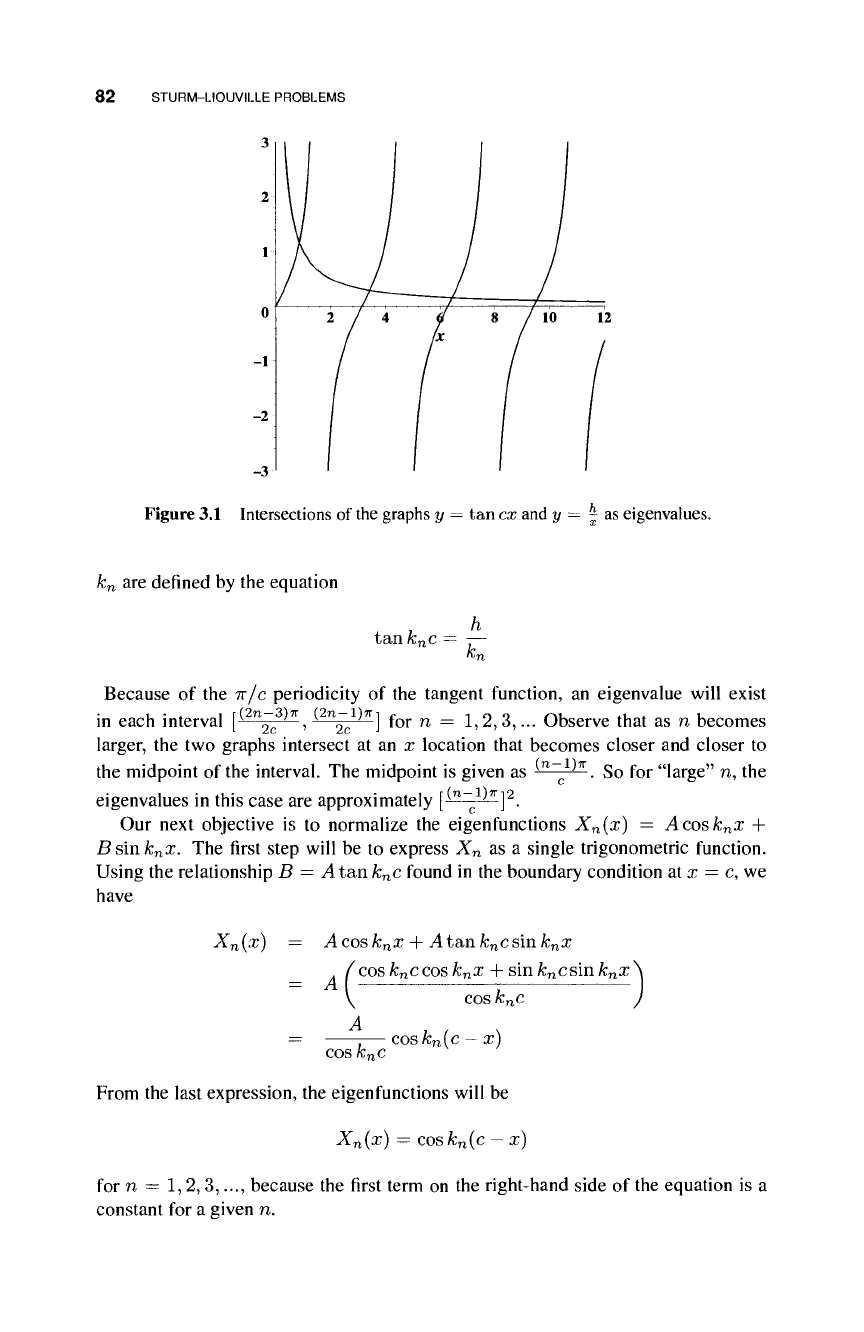
Figure
3.1
Intersections of
the
graphs
y =
tan ex and
y
=
-
as eigenvalues.
k
n
are defined by the equation
LEU!
n>r*
C
■
Because
of
the
π/c
periodicity
of
the tangent function,
an
eigenvalue will exist
in each interval
[
(2n
~
c
3)7r
,
(2n
~
c
1)7r
]
for n =
1,2,3,... Observe that
as n
becomes
larger, the two graphs intersect
at an x
location that becomes closer and closer
to
the midpoint of the interval. The midpoint is given as
^
n
~ .
So for "large"
n,
the
eigenvalues in this case are approximately [
c
]
2
-
Our next objective
is to
normalize
the
eigenfunctions
X
n
(x) =
^4cosfc
n
a;
+
B sin
k
n
x. The
first step will be
to
express
X
n
as a
single trigonometric function.
Using the relationship
B =
Atan
k
n
c
found in the boundary condition at
x =
c, we
have
Xn{x)
—
Acosk
n
x
+
Atan
k
n
c
sin
k
n
x
{
cos
k
n
c
cos
k
n
x +
sin
A:
n
c
sin &
n
x
N
=
A\
cos fc
n
c
= —cosk
n
(c
—
x)
cos /c
n
c
From the last expression, the eigenfunctions will
be
for
n =
1,2,3,..., because the first term
on
constant for a given
n.
the right-hand side
of
the equation
is a
EXAMPLES
83
The norm squared of X
n
is given by
||X
n
(x)||
2
= / cos
2
k
n
(c
—
x)dx
Jo
/ ( 2
+
2
COS
2kn
(
C
~
x
))
dx
c
i . ,
= - +
——
sin k
n
c
2 4k
n
ch 4- sin
2
k
n
c ( . .
= -
h
fusing fc„ =
h
L8tn txijiC
so that
n
v ( MI
A
ch +sin k
n
c
V
2ft
In summary, the eigenvalues fc
n
for this example are such that
tanfc
n
c=— n =
l,2,3,...
k
n
with corresponding eigenfunctions
2h
ch + sin
2
k
n
c
Xn(x) = \l
7
, _._ 2 ,. cosfc
n
(c-x) n = 1,2,3,...
3.4.3 Periodic Boundary Conditions
The next ODE-boundary condition case to consider is that with periodic boundary
conditions. More specifically, our objective is to determine all eigenvalues and
corresponding eigenfunctions for the problem
X"{x)
+ XX (x) = 0 (3.39)
X(-a) = X(a)
X'(-a)
=
X'{a).
(3.40)
Problems of this type are commonly associated with boundary values problems on
circular domains.
The problem outlined in Equations (3.40) and (3.40) is, technically, not a Sturm-
Liouville problem because the periodic boundary conditions given in Equations (3.40)
are not those required for a Sturm-Liouville problem. However, it was pointed out
that Theorem 3.1 is valid in the event of periodic boundary conditions so we are
assured that the resulting eigenfunctions are orthogonal. This, in turn, assures us that
the eigenvalues are real-valued as stated in the accompanying corollary (Corollary
3.1).
As in the two examples already considered, we determine eigenvalues and eigen-
functions using case analysis on λ.
84 STURM-LIOUVILLE PROBLEMS
Case
Λ
= 0
For λ = 0, we have X"(x) = 0, which means X(x) = A+Bx represents the general
solution to the ODE. Applying the boundary conditions gives X(—a) — X(a) =>
A - Ba = A + Ba => -Ba = Ba => B = 0 and
X'(-a)
= X'(a)
=>
B = B.
These conditions give no restrictions on A, so Xo(x) = 1 is the simplest eigenfunc-
tion corresponding to λ =. Any other eigenf unction corresponding to the eigenvalue
of
A
= 0
is
just a constant multiple of
#o (#)
=
1 .
Case
A
> 0
If
A
> 0, then let
A
= k
2
(k > 0), and the ODE becomes
X"(x)
+ k
2
X(x) = 0
which, as a second-order, linear, homogeneous ODE, has the general solution
X(x) = A cos kx + B sin kx
Invoking the periodic boundary conditions on X gives
X(—a) = X(a) => A cos(-ka) + B sin(-ka)
—
A cos(ka) + B sm(ka)
=> A cos(ka)
—
B sin(fca) = A cos(fca) -f B sin(fca)
=> —Bsin(ka) = Bsin(ka)
=> B sin(ka) = 0
Likewise, the periodic boundary conditions on X'{x) — —kAsvnkx + kB cos kx
result in
X'(-a)
= X'(a) => -kA s'm(-ka) + kB cos(-ka) = -kA sin(ka) + kB cos(ka)
=> kAsin(ka) + kBcos(ka) — —kAsin(ka) + kBcos(ka)
=4>
kAsin(ka) = —kAsin(ka)
=> ,4sin(fca) = 0
Because we want nontrivial solutions, both A and B cannot be zero. Consequently,
we require that sin ka
—
0, which means
71 7Γ
ka = ηπ
=>
k = — n = 1,2,3,...
a
So,
the eigenvalues for this case are
A
= (^)
2
with the corresponding eigenfunc-
tionsX
n
(x) = Acos(^) +£sin(^p) forn= 1,2,3,....
BESSEL'S EQUATION 85
Case
Λ
< 0
For λ < 0, let λ = -fe
2
(fe > 0). The ODE of Equation (1.22) becomes
X"{x)
- k
2
X{x) = 0
which has, as a general solution, functions of the form
X{x) = Ae
kx
+ Be~
kx
Invoking the periodic boundary conditions on X once again gives
X{-a) = X{a) => Ae~
ka
+ Be
ka
= Ae
ka
+ Be~
ka
=> (A- B)e~
ka
= (A- B)e
ka
=> A-B = 0
=» A = B
Invoking the periodic boundary conditions on X
f
(x) — kAe
kx
—
kBe~
kx
results
in
X'(-a)
= X'{a) =» kAe~
ka
- kBe
ka
= kAe
ka
- kBe~
ka
=> k(A + B)e~
ka
= k(A + B)e
ka
=> A + b = 0
=» A = -B
It follows that A = B = 0 is the only possible way for both periodic boundary
conditions to be satisfied for this case. Consequently, no nontrivial solutions emerge
here.
In summary, the eigenvalues for this problem are λ
η
= (^
1
) η = 0,1,2,...
with corresponding eigenfunctionsXo(^) = landX
n
(x) = A cos (
2M
^)+J9sin (^^)
?
n =
1,2,3,...
3.5 BESSEL'S EQUATION
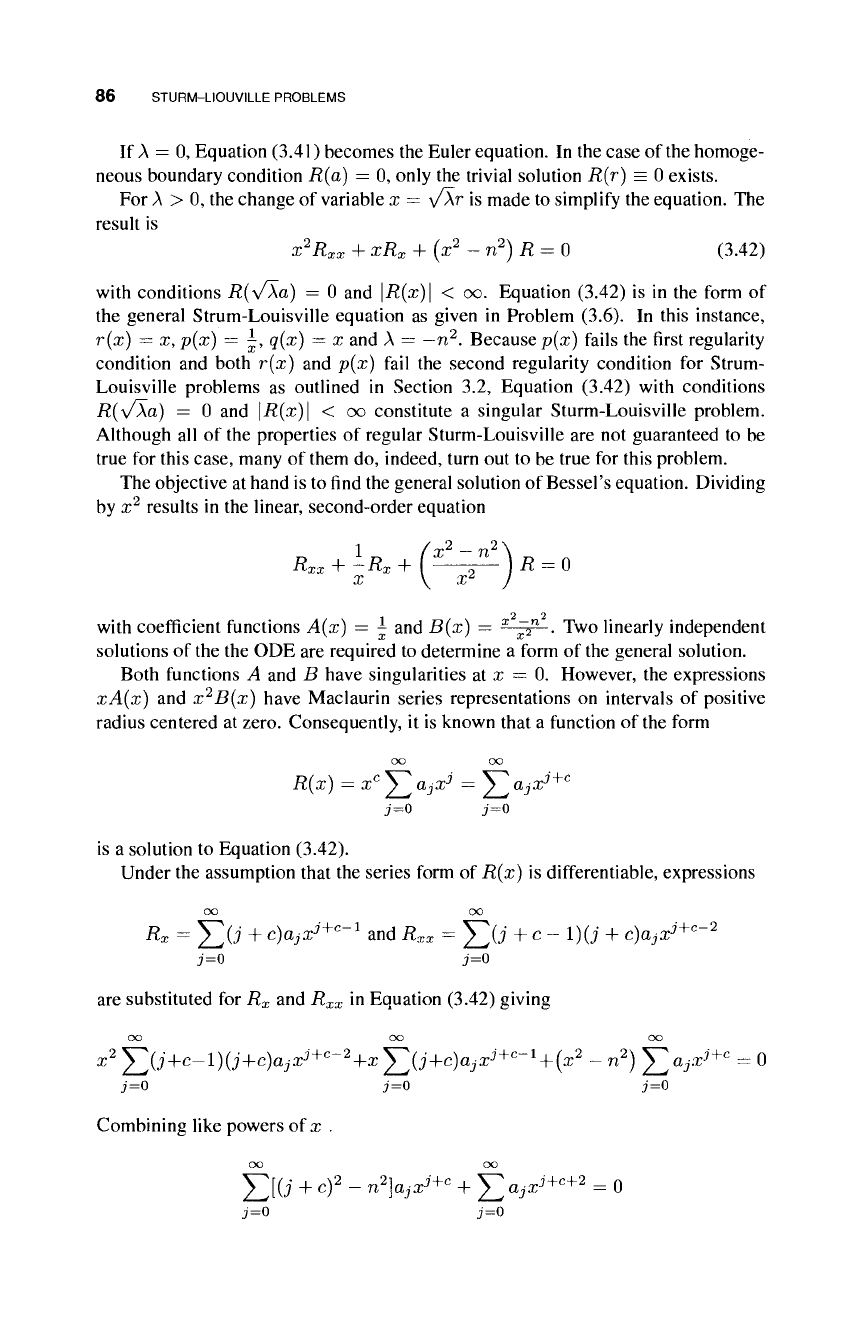
Bessel's equation is a second-order ODE that results from using separation of vari-
ables on polar-cylindrical domains. The equation for radius R(r) has the form
R
rr
+ -R
r
+ | λ - ^r
1
i? = 0 (3.41)
r \ r
2
/
where λ and n are separation constants, with λ > 0 and n a positive integer. The
equation applies for 0 < r < a with conditions R(a)
—
0 and |i?(#)| < oo.
86 STURM-LIOUVILLE PROBLEMS
If λ = 0, Equation
(3.41 )
becomes the Euler equation. In the case of the homoge-
neous boundary condition R(a) = 0, only the trivial solution R(r) = 0 exists.
For λ > 0, the change of variable x = y/\r is made to simplify the equation. The
result is
x
2
R
xx
+ xR
x
4- (x
2
- n
2
) R = 0 (3.42)
with conditions R{yf\a) = 0 and
\R(x)\
<
CXD.
Equation (3.42) is in the form of
the general Strum-Louisville equation as given in Problem (3.6). In this instance,
r(x) = x, p(x) = ^, q(x) = x and λ = —n
2
. Because p(x) fails the first regularity
condition and both r(x) and p(x) fail the second regularity condition for Strum-
Louisville problems as outlined in Section 3.2, Equation (3.42) with conditions
R(y/\a) = 0 and
\R(x)\
< oo constitute a singular Sturm-Louisville problem.
Although all of the properties of regular Sturm-Louisville are not guaranteed to be
true for this case, many of them do, indeed, turn out to be true for this problem.
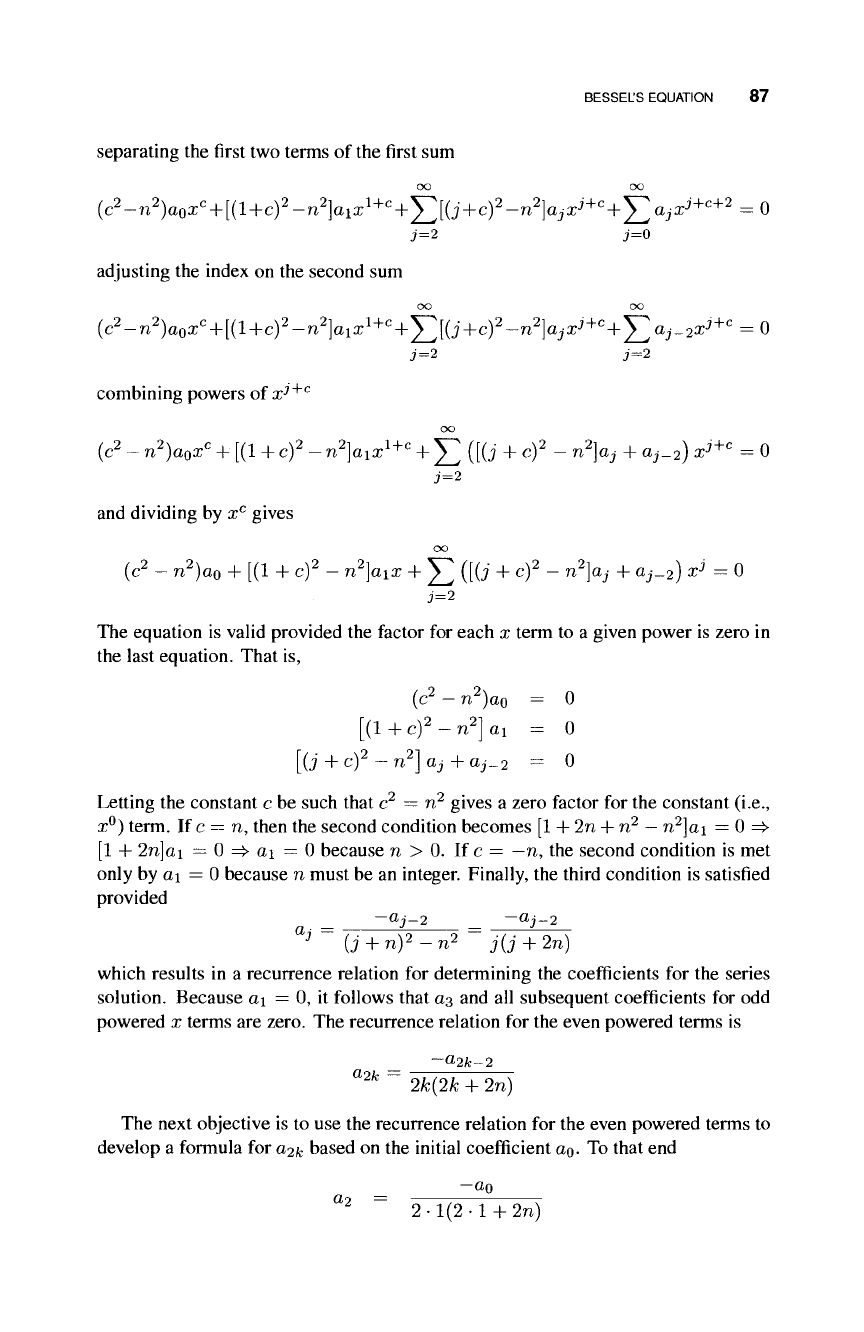
The objective at hand is to find the general solution of Bessel's equation. Dividing
by x
2
results in the linear, second-order equation
Rxx H—Rx + ñ— I R = 0
with coefficient functions A(x) — ^ and B(x) —
x
~™
. Two linearly independent
solutions of the the ODE are required to determine a form of the general solution.
Both functions A and B have singularities at x = 0. However, the expressions
xA(x) and x
2
B(x) have Maclaurin series representations on intervals of positive
radius centered at zero. Consequently, it is known that a function of the form
OO CO
R(x) =
x
c
^^ajX
j
=
y^^a,jX
j+c
j=0 j=0
is a solution to Equation (3.42).
Under the assumption that the series form of R(x) is differentiate, expressions
CXD
CXD
R
* = Σ^ + Φ^^
1 and
Rxx = Σϋ +
c
- 1)Ü + c)a
jX
^
c
-
2
3=0 j=0
are substituted for R
x
and R
xx
in Equation (3.42) giving
CXD
CXD CXD
x
2
^(j+c-l)(j+c)a
J
x^
+c
-
2
+x^(i+c)a
j
^'
+c
-
1
+ (x
2
- n
2
) ^a
ó
x
j+c
= 0
j=0 j=0 i=0
Combining like powers of x .
CXD
OO
Σ>· + c? -
n^ajx^
+ Σ α^+^» = 0
J=0 i=0
BESSELS EQUATION 87
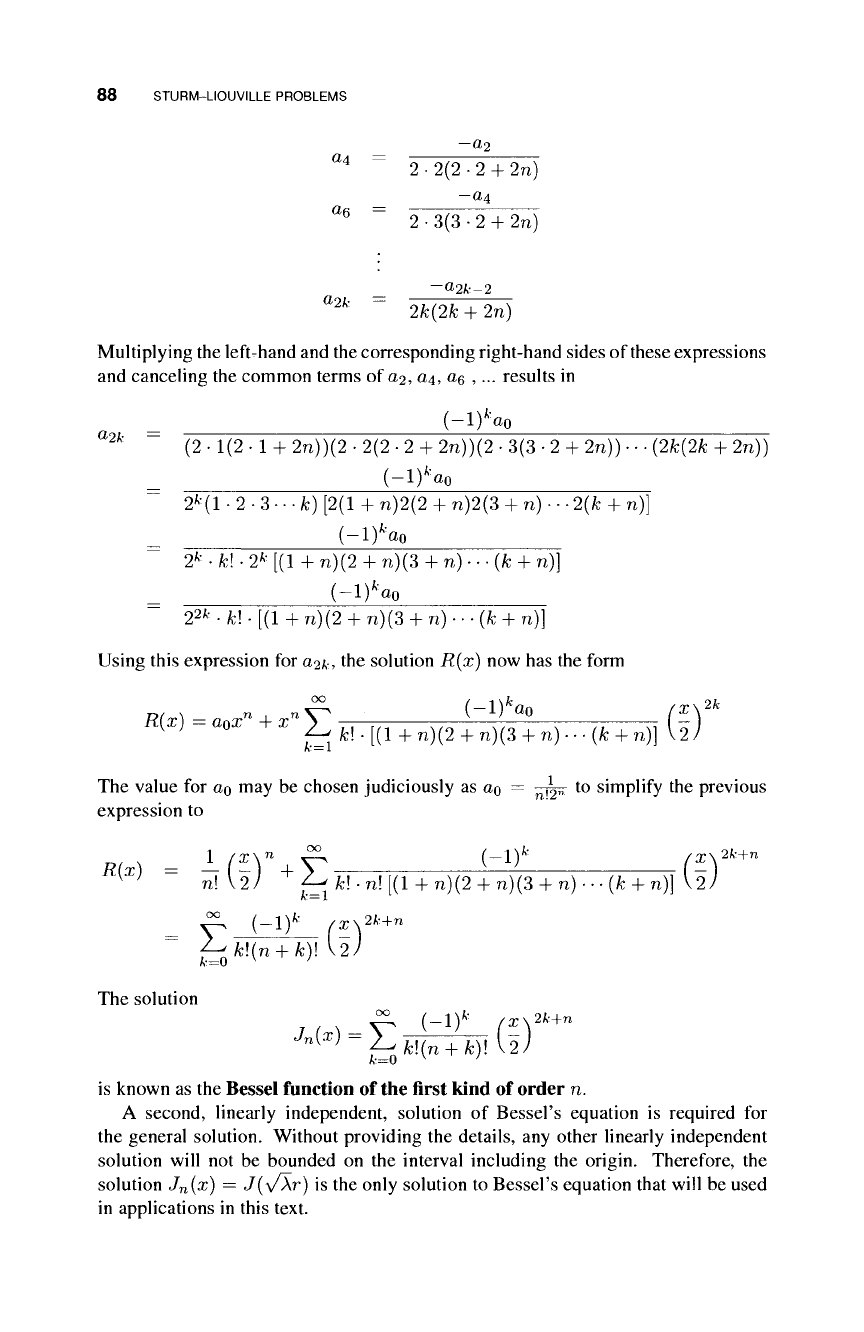
separating the first two terms of the first sum
oo oo
(c
2
-72
2
)a
0
x
c
+[(l+c)
2
-n
2
]ai£^
3=2 j=0
adjusting the index on the second sum
oo oo
(c
2
-n
2
)a
0
x
c
+[(l+c)
2
-n
2
^
3=2 j=2
combining powers of
x
3
+
c
oo
(c
2
- n
2
)a
0
x
c
+ [(1 + c)
2
- n
2
]a
lX
1+c
+ ^ (IÜ + c)
2
-
n
2
]a
3
-
+ a
3
-
2
)
x
j+c
= 0
and dividing by x
c
gives
oo
(c
2
- n
2
)a
0
+ [(1 4- c)
2
- n
2
]aix + ]T ([(j + c)
2
- n
2
]^· + a¿_
2
) x
j
= 0
The equation is valid provided the factor for each x term to a given power is zero in
the last equation. That is,
(c
2
- n
2
)a
0
= 0
[(1 + c)
2
- n
2
] ai = 0
[C? + c)
2
- n
2
] a
3
+ aj_2 = 0
Letting the constant c be such that c
2
= n
2
gives a zero factor for the constant (i.e.,
x°) term. If
c
= n, then the second condition becomes
[1
-f 2n + n
2
—
n
2
]ai = 0 =>
[1 + 2η]αι = 0 => ai =0 because n > 0. If c = —n, the second condition is met
only by a\
—
0 because n must be an integer. Finally, the third condition is satisfied
provided
— ~
a
j-2 _ ~
a
j-2
aj
~ (j + n)
2
-n
2
~ j{j + 2n)
which results in a recurrence relation for determining the coefficients for the series
solution. Because a\ = 0, it follows that as and all subsequent coefficients for odd
powered x terms are zero. The recurrence relation for the even powered terms is
—0>2k-2
Q>2k
2k(2k + 2n)
The next objective is to use the recurrence relation for the even powered terms to
develop a formula for a2k based on the initial coefficient αο· To that end
-a
0
a>2
2·1(2·1 + 2η)
88 STURM-LIOUVILLE PROBLEMS
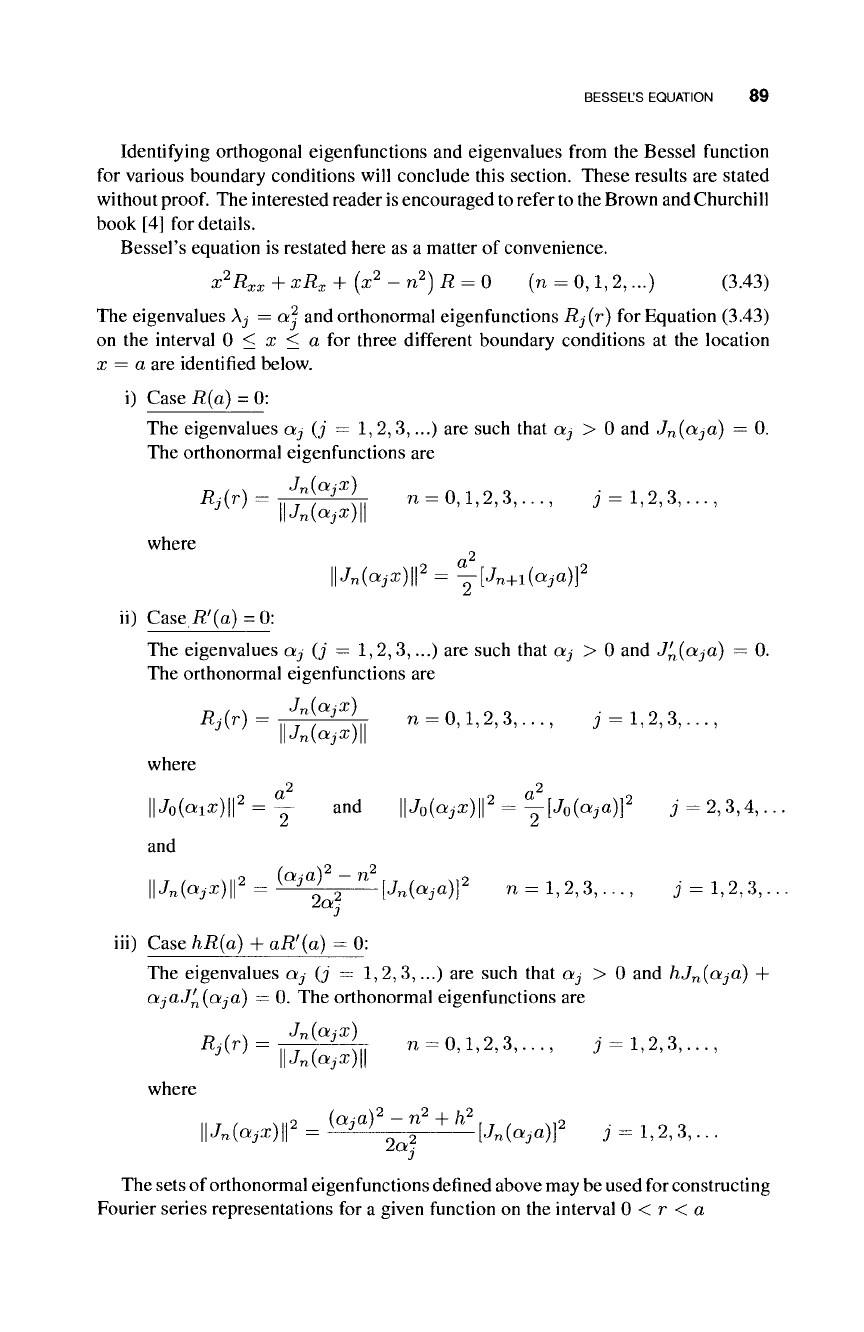
_
-q
2
a4
~
2 · 2(2 · 2
+
2n)
— Ü4
αβ
=
2 . 3(3 · 2
+
2n)
-«2/C-2
«2/c
2&(2A;
+
2n)
Multiplying the left-hand and the corresponding right-hand sides of these expressions
and canceling the common terms of a
2
,
c¿4,
ÜQ
,... results in
a>2k
(-1)%)
(2 -1(2
-
1
+
2n))(2 · 2(2 · 2
+
2n))(2 · 3(3 · 2
+
2n)) · · · (2fc(2fc
+
2n))
(-l)
fc
ao
2
fc
(l · 2 · 3 .. · k) [2(1
+
n)2(2 4- n)2(3
+
n) · ·
·
2(fc
+
n)]
(-l)
fc
ao
2
fc
· k\ · 2^ [(1
+
n)(2
+
n)(3
+
n)
· · ·
(k
+
n)]
(-1)%
2
2fc
·
fc!
·
[(1
+
n)(2
+
n)(3
+
n) · · · (k
+
n)}
Using this expression for α
2
/ο the solution i?(x) now has the form
R(x) =
a
0
x
n
+x
n
Y 7T-T-
Wo
(
~y
o
a
°
N
77
TT
i^Y
KJ
^fe!.[(l+n)(2
+
n)(3
+
n)---(fc4-n)]
\2/
The value for ao may be chosen judiciously as a$
= ¿^
to simplify the previous
expression to
}_(X\
n
V^ (~l)
fc
/X\2/c+n
(X)
~~ n\\2J
+
^A:!.n!f(l+n)(2
+
n)(3
+
n)...(^
+
n)l V27
oo
The solution
Aífc!(n
+
fc)!
UJ
^w-2^
fe!
(
n
+
fc
)i
V2J
*=o
fc,
("
+
*>
!
is known as the Bessel function of the first kind of order n.
A second, linearly independent, solution
of
Bessel's equation
is
required
for
the general solution. Without providing the details, any other linearly independent
solution will not be bounded on the interval including the origin. Therefore, the
solution
J
n
(x) =
J(y/\r) is the only solution to Bessel's equation that will be used
in applications in this text.
BESSEL'S EQUATION
89
Identifying orthogonal eigenfunctions
and
eigenvalues from
the
Bessel function
for various boundary conditions will conclude this section. These results
are
stated
without
proof.
The interested reader
is
encouraged
to
refer
to
the Brown and Churchill
book
[4]
for
details.
Bessel's equation
is
restated here
as a
matter
of
convenience.
x
2
R
xx
4-
xR
x
+ (x
2
- n
2
) R = 0 (n =
0,1,2,...) (3.43)
The eigenvalues
\j = a?
and
orthonormal eigenfunctions
Rj(r) for
Equation (3.43)
on
the
interval
0 < x < a for
three different boundary conditions
at the
location
x
—
a
are
identified below.
i) Case
R(a)
=
0:
The eigenvalues
aj (j =
1,2,3,...)
are
such that
aj > 0 and
J
n
(aja)
= 0.
The orthonormal eigenfunctions
are
Rj(r)
=
/
T
n(
?
j
%
n =
0,1,2,3,...,
j =
1,2,3,...,
\\
J
n{cXjX)\\
where
a
2
||
Jn^-X) ||
2
=
y[4+lK'ö)f
ii) Casefl
/
(a)=0:
The eigenvalues
aj (j =
1,2,3,...)
are
such that
aj > 0 and
J'
n
{ajà)
= 0.
The orthonormal eigenfunctions
are
Rj(r)
=
nti^ln
n =
0,1,2,3,...,
j =
1,2,3,...,
where
2
2
ΙΙΛ("ι^)Ι|
2
= y and
\\Jo(a
jX
)\\
2
=
^[J
0
(
aj
a)}
2
j =
2,3,4,...
and
||J
n
K-x)||
2
=
(aja
£~
n2
[Jn(^-a)]
2
n =
1,2,3,...,
j =
1,2,3,...
iii) Case /ιΑ(α)
+
αη'(α)
= 0:
The eigenvalues
aj (j =
1,2,3,...)
are
such that
aj > 0 and
hJ
n
{ajO)
4-
ajaJ'
n
{aja)
= 0.
The
orthonormal eigenfunctions
are
Rj(r)
=
„ti^in
« =
0,1,2,3,...,
j =
1,2,3,...,
where
Λ,(α,·ζ)||
2
=
J ;
0
o
[Maja)]
2
j =
1,2,3,
2a,
The sets of orthonormal eigenfunctions defined above may be used for constructing
Fourier series representations
for a
given function
on
the
interval
0 < r < a
90 STURM-LIOUVILLE PROBLEMS
3.6 LEGENDRE'S EQUATION
Legendre's equation
is a
second-order
ODE
that results from using separation
of variables
on
spherical domains.
The
solution u(r, φ,
Θ)
has
separated form
Α(Γ)Φ(0)Θ(0).
After substitution
and the
introduction
of
the separation constant
—λ, the equation
for Θ is
(sin
θθ
θ
)
θ
+ λθ
sin
θ
= 0
(3.44)
The change
of
variable
x =
cos
Θ
gives
[(1
-
χ
2
)β
χ
{χ)]
χ
+
λθ(χ)
=0 - 1< x < 1
(3.45)
Equation (3.45)
is in the
form
of
the general Strum-Louisville equation
as
given
in
Equation (3.6).
In
this instance,
r(x) = 1
—
x
2
, q(x) = 0,
and
p(x)
—
1.
Because
r(x) is zero at
x
—
±1, this equation fails the second regularity condition on Sturm-
Liouville equations
if the
interval
of
application includes either
of
these values,
which
is
typically the case
for
spherical domains with —π
< θ < π.
Consequently,
Legendre's equation
is
another example
of
a singular Sturm-Liouville problem.
The general solution
to
Equation (3.45) requires
two
linearly independent solu-
tions.
Rearranging the equation gives
2x
X
Q
xx
(x)
- z
~θ
χ
(χ)
+ z
?
θ(χ) = 0
(3.46)
The coefficient functions
2x
and
1
—
x
2
1
—
x
2
have convergent Maclaurin series
on the
interval — 1
< x < 1.
Consequently,
a
series solution
θ(χ) =
J2^L
0
c
n
x
n
is
sought
in a
way similar
to
that
for
Bessel's
equation. Assuming the series
is
differentiable, series substitutions are made
for Θ,
θ
χ
,
and
θ
χχ
in
Equation (3.44) giving
OO
OO OO CO
y^
n(n -
l)c
n
x
n
~
2
- ^2
n
(
n
-
l
)
c
nX
n
- ^
2nc
n
x
n
+ ^
Xc
n
x
n
= 0
n=0 n=0 n=0 n=0
Using
the
fact that
the
first
tow
terms
in the
first series
are
zero, combining like
powers
of
x, and simplifying gives
OO
OO
]T
n(n -
l)c
n
x
n
-
2
- Σ[η(η + 1) -
X]c
n
x
n
= 0
n=2 n=0
Adjusting the index on the second series so that
it
begins, as the first series,
at n = 2
results
in
ΣΗ
η
-
l
)
c
n -
[(n
-
2)(n
- 1) -
X)c
n
_
2
}x
n
n=2
LEGENDRE'S EQUATION 91
This equation is satisfied if
Cn=
(n-2)(n-l)-X
Cn
_
2
n = 2
^^
(3
.
47)
n(n
—
1)
or, substituting n + 2 for n,
Cn+2
= ,
n(n
L
1}
,^n n =
2,3,...
(3.48)
(n + 2)(n + l)
Consequently, the series with form
6(x) = ¿c
n
x
n
(3.49)
n=0
and recurrence relation given by Equation (3.48) solves Equation (3.45). Because
coefficients
Co
and c\ are not dictated by the recurrence relation, they may be chosen
arbitrarily. Letting
Co
= 0 and c\ φ 0 results in the non-trivial solution with each
c
2n
= 0· In this case, the series solution is
oo
θι (x) = ax + ^c
2n+1
x
2n+1
(3.50)
where each
c
2n+
i
is given by recurrence relation (3.48). Alternately, setting
Co
φ 0
and c\
—
0 gives the nontrivial series solution
oo
θ
2
(χ) = co + X>
2n
x
2n
(3.51)
n=l
where the coefficients c^n are found using the same recurrence relation (3.48). The
solution θι(χ) and θ
2
(χ) are linearly independent because θι(χ) has only odd
powers of x while θ
2
(χ) has even powers only.
It is left as an exercise (see Exercise 3.6) to show the series given in Equations
(3.50) and (3.51) converge for \x\ < 1 and diverge for \x\ > 1. It is also known,
and more difficult to show, that both series diverge for \x\ — 1. Consequently, non-
terminating versions of the series do not yield functions sufficiently continuous on
the interval [—1,1].
Attention is given to the recurrence relation given in Equation (3.48) to identify
circumstances that lead to series with only a finite number of nonzero terms. If the
separation constant λ has a value such that n(n + 1)
—
λ is zero, each subsequent
coefficient c
n+2
would be zero. Therefore, suppose Λ = m(m + 1) for m =
0,1,2,.... lfm = 0, then
0(0 + 1) -0(0 + 1)
C0+2=
(0 + 1X0 + 2)
C0 = 0
It follows, then, that each C2j,j = 1,2,3,... is zero as well. As for the odd coeffi-
cients,
1(1 + 1)-0(0+1) 2
03 = Cl+2 =
(1 + 1X1+2)
Cl =
6
Cl