
Bernatz R. Fourier Series and Numerical Methods for Partial Differential Equations
Подождите немного. Документ загружается.

102 HEAT EQUATION
y + Ay —
y —
I
x x-\- Ax
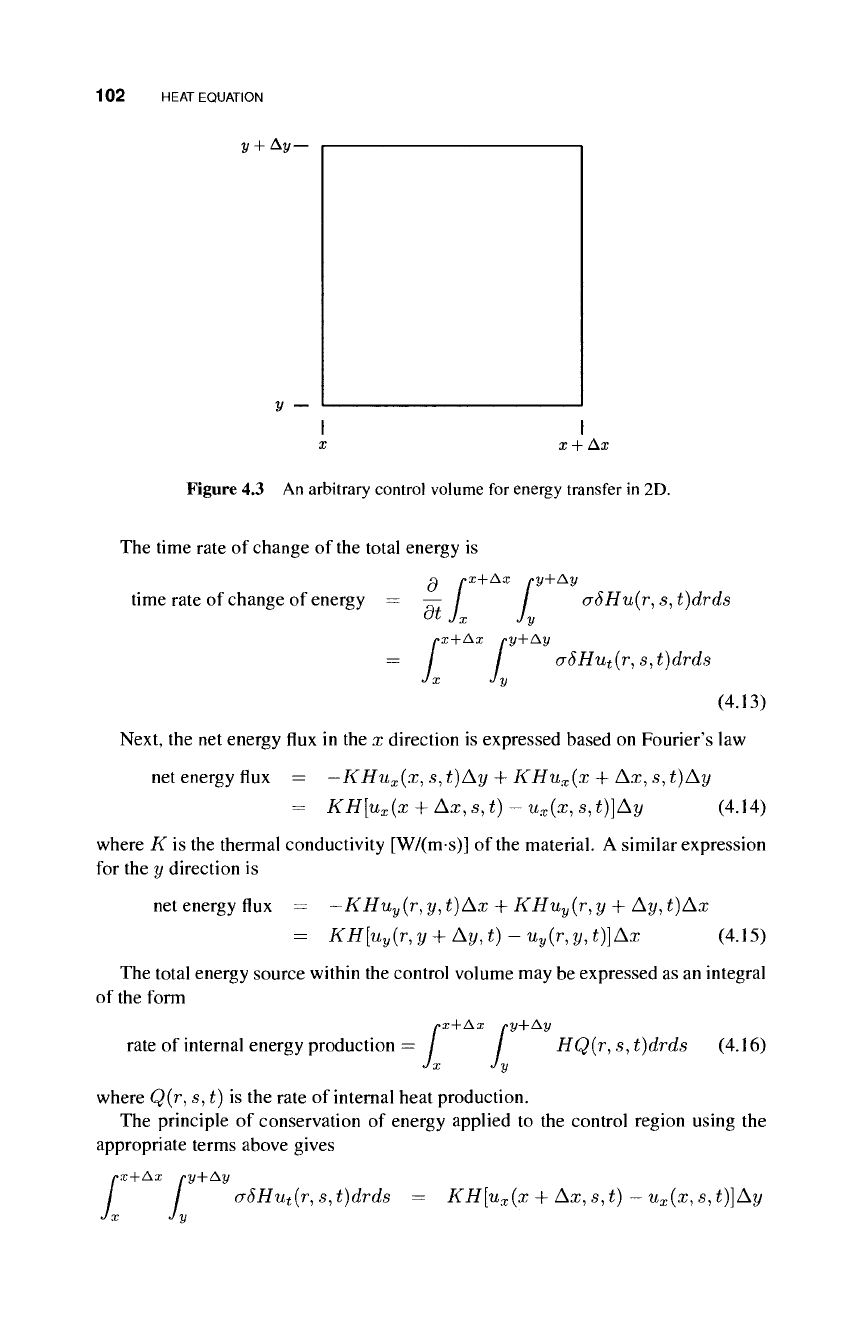
Figure 4.3 An arbitrary control volume for energy transfer in 2D.
The time rate of change of the total energy is
g rx+Ax çy+Ay
time rate of change of energy = — / / a6Hu(r,s,t)drds
O*
Jχ Jy
çx+Ax ry+Ay
= j / aSHu
t
(r,s,t)drds
Jx Jy
(4.13)
Next, the net energy flux in the x direction is expressed based on Fourier's law
net energy flux = —KHu
x
(x, s, t)Ay + KHu
x
(x 4- Δχ, s, t)Ay
= KH[u
x
(x + Ax,s,t) - u
x
(x,s,t)]Ay (4.14)
where K is the thermal conductivity [W/(ms)] of the material. A similar expression
for the y direction is
net energy flux = —KHu
y
(r, y, t)Ax + KHu
y
(r, y -f Ay, t)Ax
= KH[uy(r,y + Ay,t)-u
y
(r,y,t)]Ax (4.15)
The total energy source within the control volume may be expressed as an integral
of the form
x+Ax ¡>y+Ay
rate of internal energy production = / / HQ(r,s,t)drds (4.
J x J v
16)
where Q(r,s, t) is the rate of internal heat production.
The principle of conservation of energy applied to the control region using the
appropriate terms above gives
rx+Ax ry+Ay
j I a8Hu
t
{r,s,t)drds = KH[u
x
(x + Δχ, s,t)
—
u
x
(x, s,t)]Ay
J x Jy
HEAT EQUATION IN 3D 103
+ KH[u
y
(r, y + Ay, t) - u
y
(r, y, t)]Ax
px+Ax py+Ay
+ / / HQ{r,s,t)drds
J x Jy
(4.17)
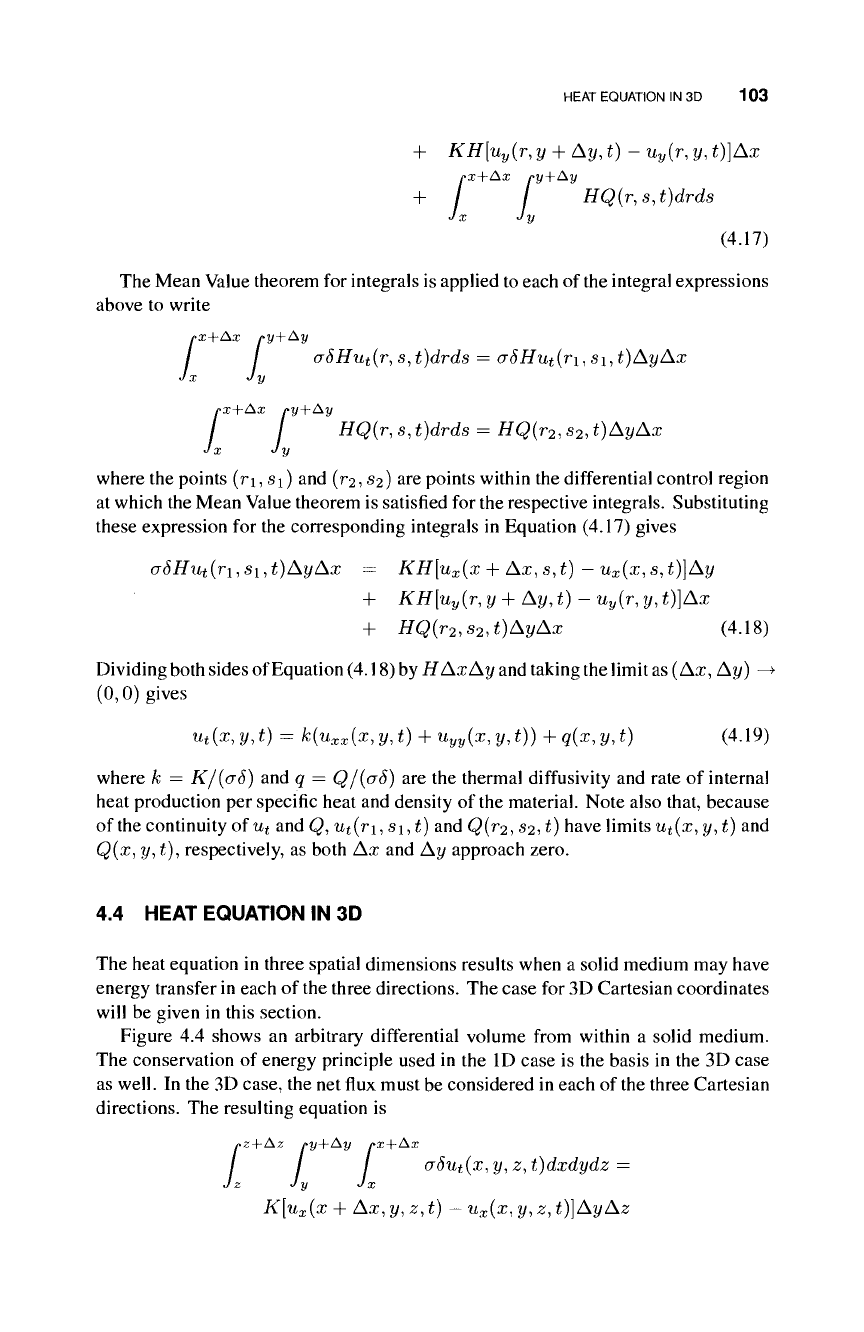
The Mean Value theorem for integrals is applied to each of the integral expressions
above to write
px+Ax py+Ay
I l aôHu
t
(r,s,t)drds = aSHu
t
(ri,si,t)AyAx
J x J y
px+Ax py+Ay
I I HQ(r, s, t)drds = HQ(r
2
, s
2
,t)AyAx
Jx J y
where the points {r\,s\) and (r2, S
2
) are points within the differential control region
at which the Mean Value theorem is satisfied for the respective integrals. Substituting
these expression for the corresponding integrals in Equation (4.17) gives
oSHut^i^si.^AyAx = KH[u
x
{x + Ax,s,t)
—
u
x
(x,s,t)]Ay
+ KH[uy(r,y + Ay,t)-Uy(r,y,t)]Ax
+ HQ{r
2
,s
2
,t)AyAx (4.18)
Dividing both sides of Equation (4.18) by H Ax Ay and taking the limit
as
(Δχ, Ay)
—>
(0,0) gives
ut(x,y,t) = k{u
xx
(x,y,t) +u
yy
(x,y,t)) +q(x,y,t) (4.19)
where k = Κ/(σδ) and q = Q/(aS) are the thermal diffusivity and rate of internal
heat production per specific heat and density of the material. Note also that, because
of
the
continuity of u
t
and Q, u
t
(ri,s\,t) andQ(r
2
,s
2
,t) have limits u
t
(x,y,t) and
Q{x, y, t), respectively, as both Ax and Ay approach zero.
4.4 HEAT EQUATION IN 3D
The heat equation in three spatial dimensions results when a solid medium may have
energy transfer in each of the three directions. The case for 3D Cartesian coordinates
will be given in this section.
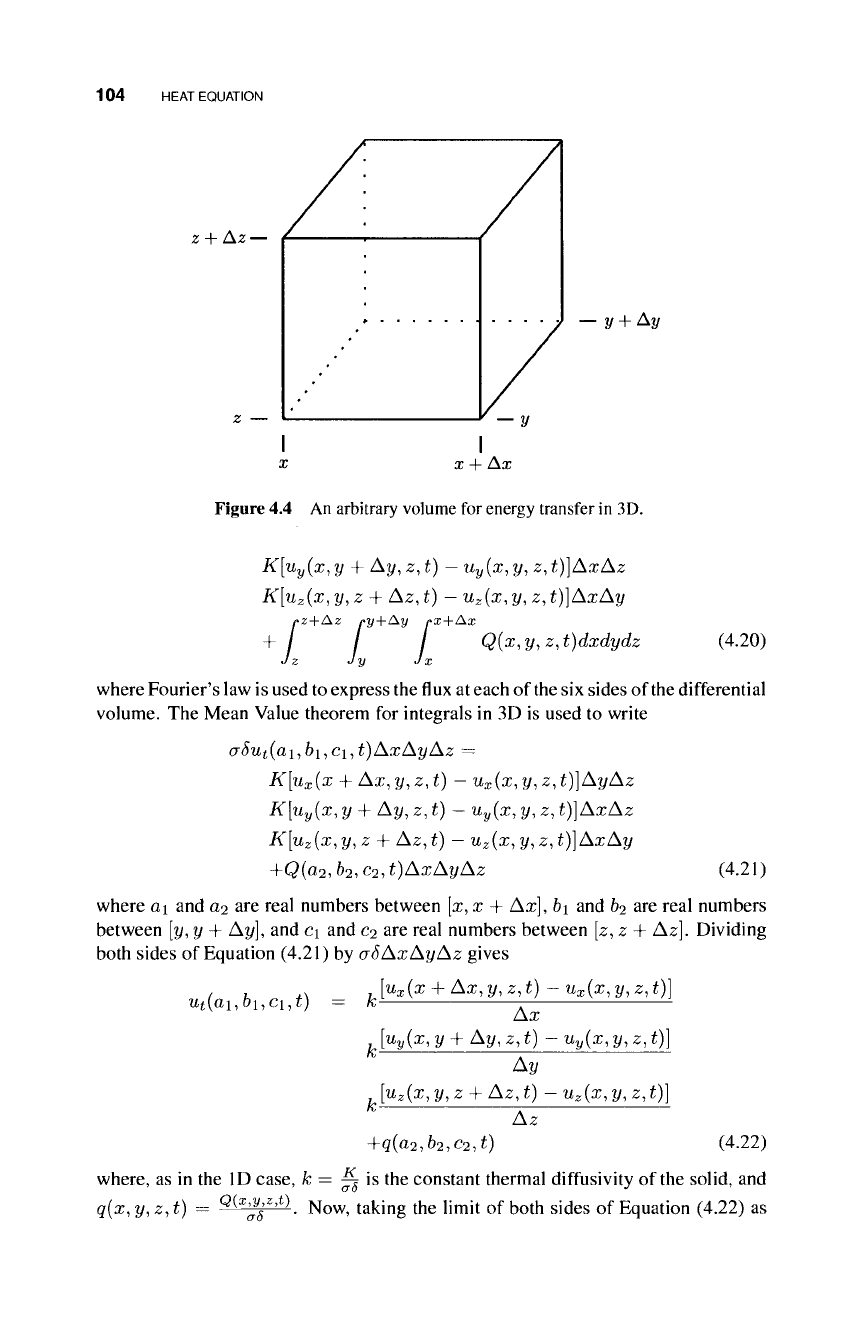
Figure 4.4 shows an arbitrary differential volume from within a solid medium.
The conservation of energy principle used in the ID case is the basis in the 3D case
as well. In the 3D case, the net flux must be considered in each of the three Cartesian
directions. The resulting equation is
nzArAz py+Ay px+Ax
¡¡I a6ut(x,y, z,t)dxdydz =
J z Jy Jx
K[u
x
(x + Δχ, y, z, t) - u
x
(x, y, z, t)]AyAz
104 HEAT EQUATION
z + Az
—
—
V
+ Ay
x
4-
Ax
Figure 4.4 An arbitrary volume for energy transfer in 3D.
K[u
y
(x, y + Ay, z, t)
—
u
y
(x, y, z, t)]AxAz
K[u
z
(x, y,z + Az, t)
—
u
z
(x, y, z, t)]AxAy
f>z+Az py+Ay px+Ax
Q{x,y,z,t)dxdydz
pz-tnz py-\-¿\y px
+
Jz Jy Jx
(4.20)
where Fourier's law is used to express the flux at each of the six sides of the differential
volume. The Mean Value theorem for integrals in 3D is used to write
a5ut(a\,bi,ci,t)AxAyAz =
K[u
x
(x + Ax, y, z, t) - u
x
(x, y, z,t)]AyAz
K[u
y
(x, y + Ay, z, t) - u
y
(x, y, z, t))AxAz
K[u
z
(x, y,z + Az, i)
—
u
z
(x, y, z, t)]AxAy
+Q(a
2
, b
2
, c
2
,t)AxAyAz (4.21)
where a\ and a
2
are real numbers between
[x,
x + Ax], b\ and b
2
are real numbers
between
[y,
y + Ay], and c\ and c
2
are real numbers between \z,z
-V
Az]. Dividing
both sides of Equation (4.21) by aSAxAyAz gives
u
t
{ai,bi,ci,t)
[u
x
(x + Ax,y,z,t) -
Ax
Ί
^[η
υ
(χ^
+ Ay,z,t) -
Ay
U
[u
z
(x,y,z + Az,t) -
-u
x
(x,y,z,t)]
-u
y
{x,y,z,t)]
-u
z
(x,y,z,t)]
+q(a
2
,b
2
,c
2
,t) (4.22)
where, as in the ID case, k = ^ is the constant thermal diffusivity of the solid, and
x,y,z
σδ
q(x, y, z, t) = Q(
x
'
y
*
z
¿>. Now, taking the limit of both sides of Equation (4.22) as
POLAR-CYLINDRICAL COORDINATES 105
Ax, Ay and Az all go to zero gives
ut(x, y, z, t) = kV
2
u{x, y, z, t) + q(x, y, z, t)
(4.23)
which is the 3D heat equation in Cartesian coordinates. The first term on the right-
hand side of Equation (4.23) is
V
2
u(x, y, z, t) =
u
xx
(x,
y, z, t) +
u
yy
{x,
y, z, t) +
u
zz
(x,
y, z, t) (4.24)
and represents the Laplacian of u in Cartesian coordinates.
4.5 POLAR-CYLINDRICAL COORDINATES
There are numerous PDE applications that require polar-cylindrical coordinates for
a more efficient solution process. Therefore, the Laplacian in polar-cylindrical form
is derived in this section.
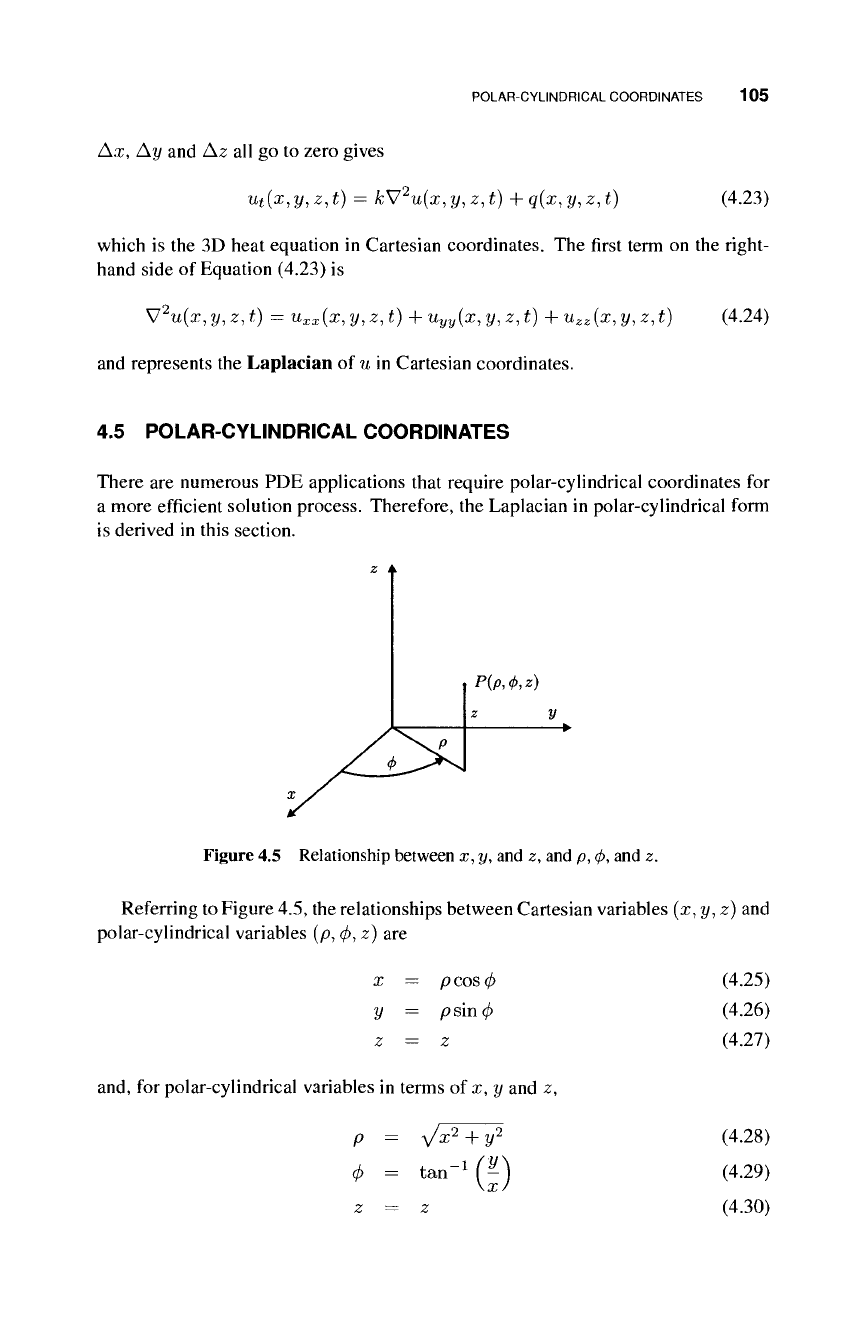
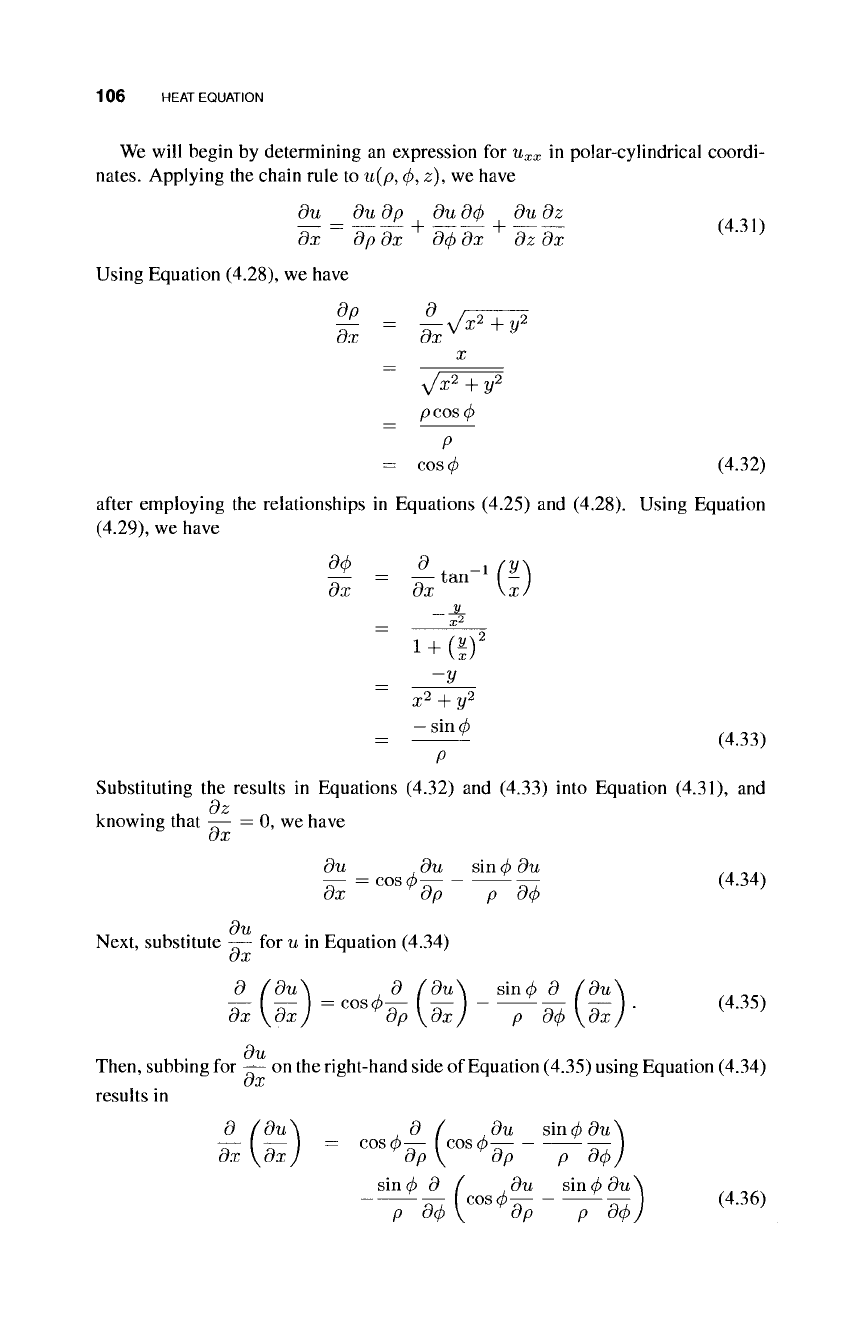
Figure 4.5 Relationship between x, y, and 2, and
p,
φ,
and z.
Referring to Figure
4.5,
the relationships between Cartesian variables (x, y, z) and
polar-cylindrical variables (p,
</>,
z) are
x —
p cos
φ
y = p sin φ
z — z
and, for polar-cylindrical variables in terms of x, y and z,
p = \Jx
2
+ y
2
φ = tan
z = z
•(i)
(4.25)
(4.26)
(4.27)
(4.28)
(4.29)
(4.30)
106
HEAT EQUATION
We will begin by determining an expression for u
xx
in polar-cylindrical coordi-
nates.
Applying the chain rule to u(p, 0, z), we have
du du dp du do du dz , _
— = -A -H (4.31)
dx dp dx
dcf)
dx dz dx
Using Equation (4.28), we have
dp _ d_
dx dx
\Jx
2
+ y
2
Λ/Χ
2
+ y
2
pcos(/>
9
= cos0 (4.32)
after employing the relationships in Equations (4.25) and (4.28). Using Equation
(4.29),
we have
dx dx
d
tan
■©
-JL
rr-2
i + (f)
2
x
2
+ y
2
—
sin(/>
(4.33)
Substituting the results in Equations (4.32) and (4.33) into Equation (4.31), and
dz
knowing that —- = 0, we have
dx
du
,
du sinö!) du ,
Λ
„
,
s
— = cos φ- ^ — (4.34)
ox op ρ οφ
du
Next, substitute
——
for u in Equation (4.34)
dx
d /du\ _ d f du\ sin0 d Ídu\
dx \dxJ dp \dxj p
d<fi
\dxJ
du
Then, subbing for —- on the right-hand side of Equation (4.35) using Equation (4.34)
ox
results in
d (du\ . d ( ßu sinφ du
-— = cos©-—- cos
dx \dxj dp \ dp p
δϊηφ d ( du smódu
s
. ,
Λ
„^
COS0- -τττ)
(
4
·
36
)
ρ dφ \ dp p
POLAR-CYLINDRICAL COORDINATES 107
Executing the derivative in Equation (4.36) and simplifying results in
d
2
u 2
y
d
2u
2
sin φ cos φ du sin
2
φ du
dx
2
dp
2
p
2
8φ p dp
2 sin φ cos φ d
2
u sin
2
φ d
2
u ,,
Λ
^
Ύ_ Ύ_ ! Ύ_ (4.37)
ρ δρδφ ρ
2
δφ
2
Now, a similar sequence of manipulations will be used to express u
yy
in terms of
polar-cylindrical variables.
du du dp du dφ du dz
dy dp dy άφ dy dz dy
Finding proper expressions for -^- and -^, substituting them in Equation (4.38), and
simplifying gives
du .
,
du cos φ du ,
Λ
„^
— = sin φ— + ^ — (4.39)
dy dp ρ οφ
Using Equation (4.39) in the same way as Equation (4.34), the following result for
Uyy
is found.
d
2
u .
2
d
2
u
2
sin 0 cos φ du cos
2
φ du
dy
2
dp
2
p
2
άφ ρ dp
2sinφcos φ d
2
u cos
2
φ d
2
u ,
ΛΛ
^
J\
L· L· 1 Z (4.40)
p dpdφ p
2
dφ
2
Adding the results from Equations (4.37) and (4.40) gives
d
2
u d
2
u d
2
u 1 du 1 d
2
u
dx
2
dy
2
dp
2
p dp ρ
2
άφ
2
Because the z coordinate is the same for Cartesian and polar-cylindrical coor-
dinates, it follows that the Laplacian of u in polar-cylindrical coordinates is given
by
2 _ 9
2
u 1 du 1 d
2
u d
2
u
dp
2
p dp p
2
άφ
2
dz
2
Using the identity
ld_/ du\ _ldu (Pu
pdp \ dp J p dp dp
2
Equation (4.42) may be written as
V
2
--—( —\ —— —
pdp\dpj p
2
άφ
2
dz
2
or
V
2
u = -(pUp)p + -^ηψφ + u
zz
(4.45)
108
HEAT EQUATION
4.6 SPHERICAL COORDINATES
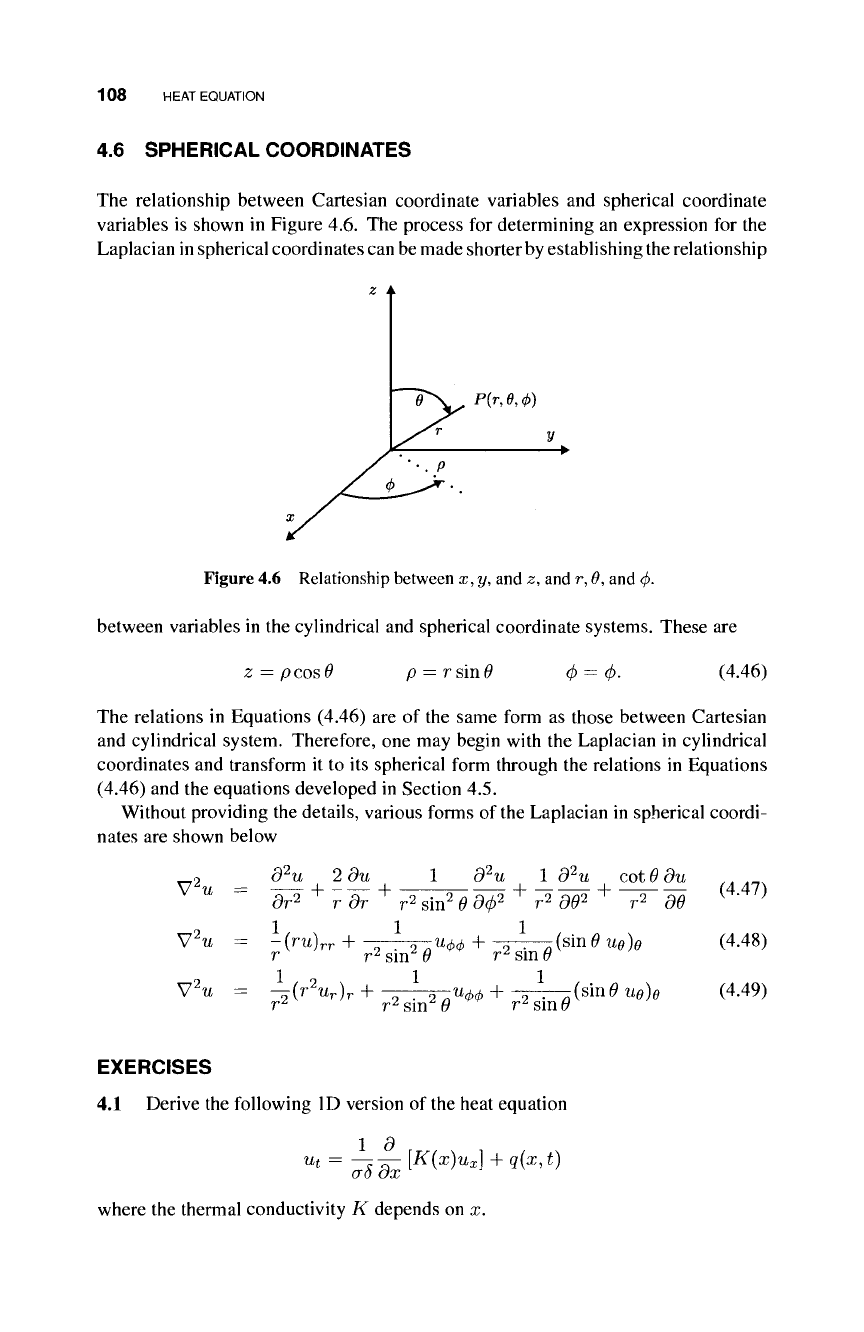
The relationship between Cartesian coordinate variables and spherical coordinate
variables is shown in Figure 4.6. The process for determining an expression for the
Laplacian in spherical coordinates can be made shorter
by
establishing
the
relationship
Figure 4.6 Relationship between x, y, and z, and r,
Θ,
and φ.
between variables in the cylindrical and spherical coordinate systems. These are
z = p cos θ p = r sin
θ
φ = φ. (4.46)
The relations in Equations (4.46) are of the same form as those between Cartesian
and cylindrical system. Therefore, one may begin with the Laplacian in cylindrical
coordinates and transform it to its spherical form through the relations in Equations
(4.46) and the equations developed in Section 4.5.
Without providing the details, various forms of the Laplacian in spherical coordi-
nates are shown below
V
2
u =
1
d
2
u 2 du
^
+
r^
4
r
2
sin
2
<9d</>
2
'
r
2
d6
2
' r
2
3Θ
d
2
u 1 d
2
u cot
Θ
du
1
Vu =
-(ru)
rr
-\-
r
1
V
2
u
r
2
sin
2
Θ
1
/ 2 x 1
-ö(r u
r
)
r
+
ηψφ
+
1
r
2
sin
2
-ν>ΦΦ
+
1
r
2
sin
Θ
-(sin 6^0)0
(sinö u
e
)e
(4.47)
(4.48)
(4.49)
EXERCISES
4.1 Derive the following ID version of the heat equation
1 /-)
ut =
—z
— [K(x)u
x
] +q(x,t)
σο ox
where the thermal conductivity K depends on x.
EXERCISES
109
4.2 Derive the ID form of the heat equation for the case where the thermal con-
ductivity K is a function of temperature u.
4.3 By making the substitution τ = kt, show that the 2D heat Equation (4.19),
without internal heat sources or sinks, can be written as
U
T
=
ΊΙχχ i tLyy
showing this change of variable makes it possible to remove the explicit dependency
of u on the thermal diffusivity k.
4.4 A solid slab occupies the region between 0 < x < c and — oo < y < oo. The
slab's face at x = 0 is maintained at a constant temperature of
To
while the face at
x — c has a constant temperature of zero. Write the steady-state boundary value
problem (BVP) for this case. Then, find the solution for u(x) in terms of
To,
c, and
k, the given thermal diffusivity of the material.
4.5 A solid slab has faces at x = 0 and x — c. The face is kept at x = c is kept
at a constant temperature of zero. There is a constant flux of heat into the slab at
x = 0 of Φο· Write down the steady-state BVP for this case. Then solve the BVP
for temperature u(x).
4.6 In this exercise, we consider a solid slab with faces at x = 0 and x = c. There
is surface heat transfer at both faces with the same surface conductance of h. The
surrounding medium for x < 0 has a constant temperature of
0,
and the surrounding
for x > c has a constant temperature of T
s
.
a) Show that the steady-state BVP for this case is
u
xx
(x) =0 0 < x < c
KU
X
(0) = hu(0) KU
X
{C) — h[T
s
— u(c)]
when Newton's law of cooling and Fourier's law of heat transfer are applied
to the respective boundaries.
b) Solve the BVP derived above to show that
u(x)=
Ί
Τ
° Jh*x + 1)
where h* = h/κ.
4.7 Show that Equations (4.48) and (4.49) follow from Equation (4.47).
4.8 Suppose u{r) is the temperature as a function of radius r in the region bounded
by two concentric spheres, the inner sphere has radius a and the outer sphere has
radius
b.
The surface of
the
inner sphere is kept at temperature zero while the surface
at r = b is maintained at temperature
T&.
a) Show that the spherical form of the Laplacian given in Equation (4.48)
reduces to
(ru)
rr
= 0
110 HEAT EQUATION
b) Solve
the
BVP
to
give
bT
b
bl
b
/ a\
u(r)
= I a <r <b
b
- a \ r
/
,
h*b
2
T
s Λ
αχ
wir)
= —— 1 a < r < b
4.9 Suppose
the
boundary condition
at r = 6 of
Exercise
4.8 is
replaced with
that
of
surface heat transfer, obeying Newton's
law of
cooling, with
the
surrounding
temperature
of T
s
.
Show that the temperature
u(r) in
this case
is
given
by
h*b
2
T
s
a
+
h*b(b-a)
where h*
—
h/κ.
4.10 Consider
the
hollow cylinder
(a < p < b)
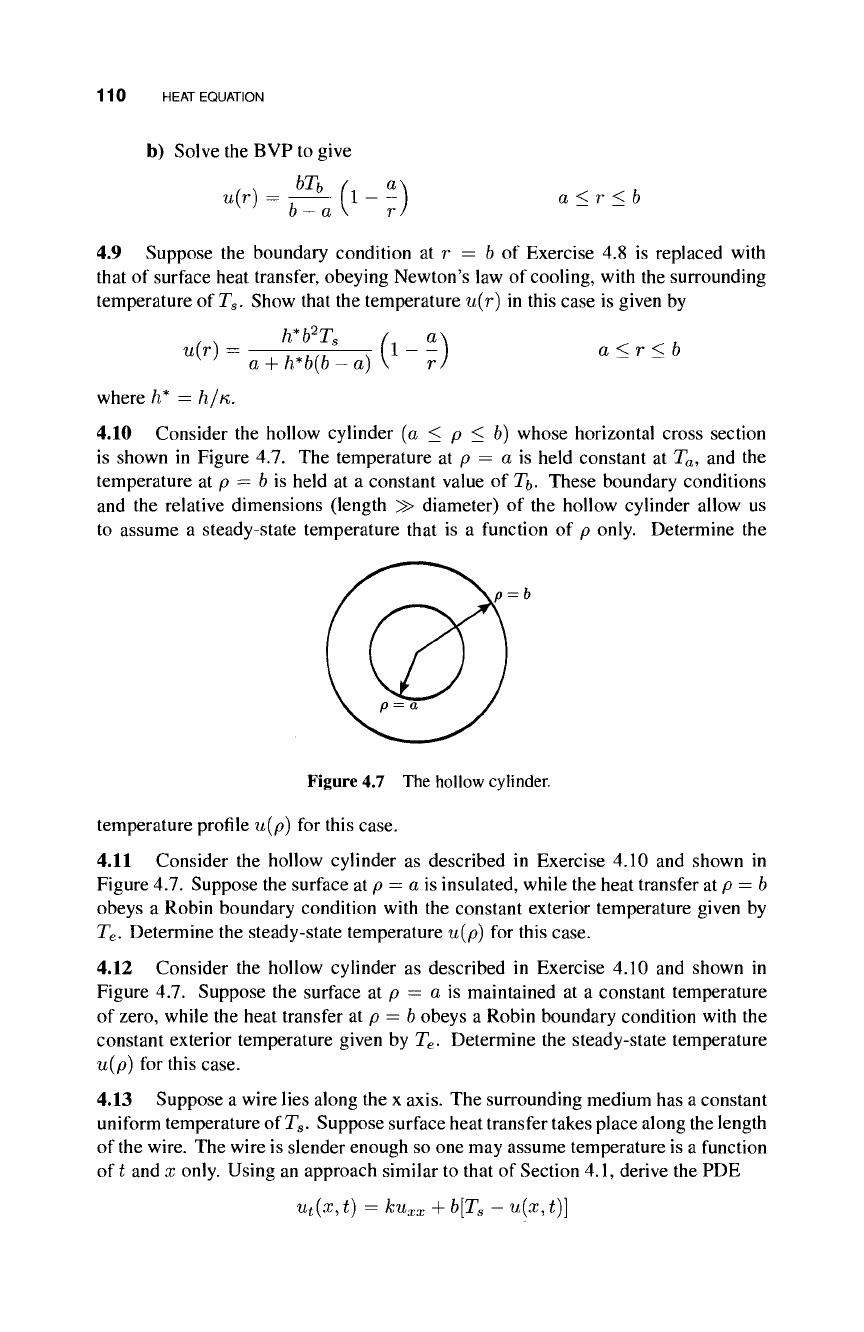
whose horizontal cross section
is shown
in
Figure
4.7. The
temperature
at p = a is
held constant
at T
a
, and the
temperature
at p = b is
held
at a
constant value
of T
b
.
These boundary conditions
and
the
relative dimensions (length
^>
diameter)
of the
hollow cylinder allow
us
to assume
a
steady-state temperature that
is a
function
of p
only. Determine
the
Figure 4.7 The hollow cylinder.
temperature profile
u(p) for
this case.
4.11 Consider
the
hollow cylinder
as
described
in
Exercise
4.10 and
shown
in
Figure 4.7. Suppose the surface
at p
—
a is
insulated, while the heat transfer
at p = b
obeys
a
Robin boundary condition with
the
constant exterior temperature given
by
T
e
. Determine
the
steady-state temperature
u(p) for
this case.
4.12 Consider
the
hollow cylinder
as
described
in
Exercise
4.10 and
shown
in
Figure
4.7.
Suppose
the
surface
at p = a is
maintained
at a
constant temperature
of zero, while
the
heat transfer
at p =
b obeys
a
Robin boundary condition with
the
constant exterior temperature given
by T
e
.
Determine
the
steady-state temperature
u(p)
for
this case.
4.13 Suppose
a
wire lies along
the x
axis.
The
surrounding medium
has a
constant
uniform temperature of
T
s
.
Suppose surface heat transfer takes place along the length
of the wire. The wire
is
slender enough
so
one may assume temperature
is a
function
of
t and x
only. Using
an
approach similar
to
that
of
Section
4.1,
derive
the PDE
u
t
(x,t)
=
ku
xx
+
b[T
s
-
u(x,t)]
EXERCISES 111
where b is a constant that is given by material characteristics including the surface
heat conductance represented by H. What is the formula for 6?
4.14 For each of the following descriptions, give a complete and accurate statement
of the IB VP (PDE, IC, and BCs). In each case, let the heat diffusion coefficient = Λ,
the constant thermal conductivity = κ, and thermal diffusivity = k.
a) A thin wire is stretched from x = 0 to x = c. The wire is insulated on the
lateral boundaries and at the left endpoint. At the right endpoint, the wire
is exposed to a medium at a constant temperature of 20 °C, and the system
obeys Newton's law of cooling at the boundary. The wire has an initial
temperature of 10 °C.
b) A thin wire is stretched from x
—
0 to x = c. The wire is insulated on the
lateral boundaries. Both the left and right boundaries are insulated. The
(
7TX
\
].
c) A long pipe has an inner radius of 2 cm and an outer radius of
1
cm. The
outside of the pipe is insulated, and a fluid with constant temperature of 10
°C.
flows through the pipe. The pipe and the fluid obey Newton's law of
cooling, and has an initial uniform temperature of 30 °C.
d) A solid steel ball with radius of 5 cm is dropped into a medium with
constant temperature of 14 °C. The ball's interaction with the medium
obeys Newton's law of cooling, and the initial temperature distribution in
the ball is proportional to its distance from the center of the ball.