
Boults Е. Illustrated history of landscape design
Подождите немного. Документ загружается.

147
18th CENTURY
T
he great advances in science and technology that defi ned the Enlightenment changed the way people viewed their
place in the world. The spirit of inquiry extended to the contestation of fi rmly held beliefs in social structures and
political systems. Scientifi c progress shed new light on social relations. The rise of the middle class as an economic
and political force brought about the collapse of the ancien régime. Philosophers like Rousseau and Voltaire laid the intel-
lectual ground for change. The Scientifi c Revolution coincided with the American Revolution, the French Revolution, and the
so-called revolution of taste in England.
England became the force that shaped garden history in the 18th century. The English “landscape” garden created
a new lens through which we see nature. The infl uence of Chinese garden styles on English trends is examined in this
chapter, as is the effect of the landscape garden on early American landscape design.
148
1700
1770 1780
1710 1720
1715
1716
1724
1782
1769
1773
1717
1774
ROCOCO
FREEMASONS
THE SORROWS OF YOUNG WERTHER
RUSSIAN VERSAILLES
FAHRENHEIT
FULL OF HOT AIR
STEAM CART
TEA PARTY
18th CENTURY / A BRIEF CHRONOLOGY
149
1790
1800
1730 1740 1750
1760
1791
1793
1785
1789
1741
1753
1768
1752
MIDDLETON PLACE
SPECIES PLANTARUM
EXPERIMENT WITH AN
AIR PUMP
HIGH VOLTAGE!
THE MAGIC
FLUTE
COTTON GIN
NATIONAL GRID
LIBERTÉ, ÉGALITÉ, FRATERNITÉ
18th CENTURY / A BRIEF CHRONOLOGY

150
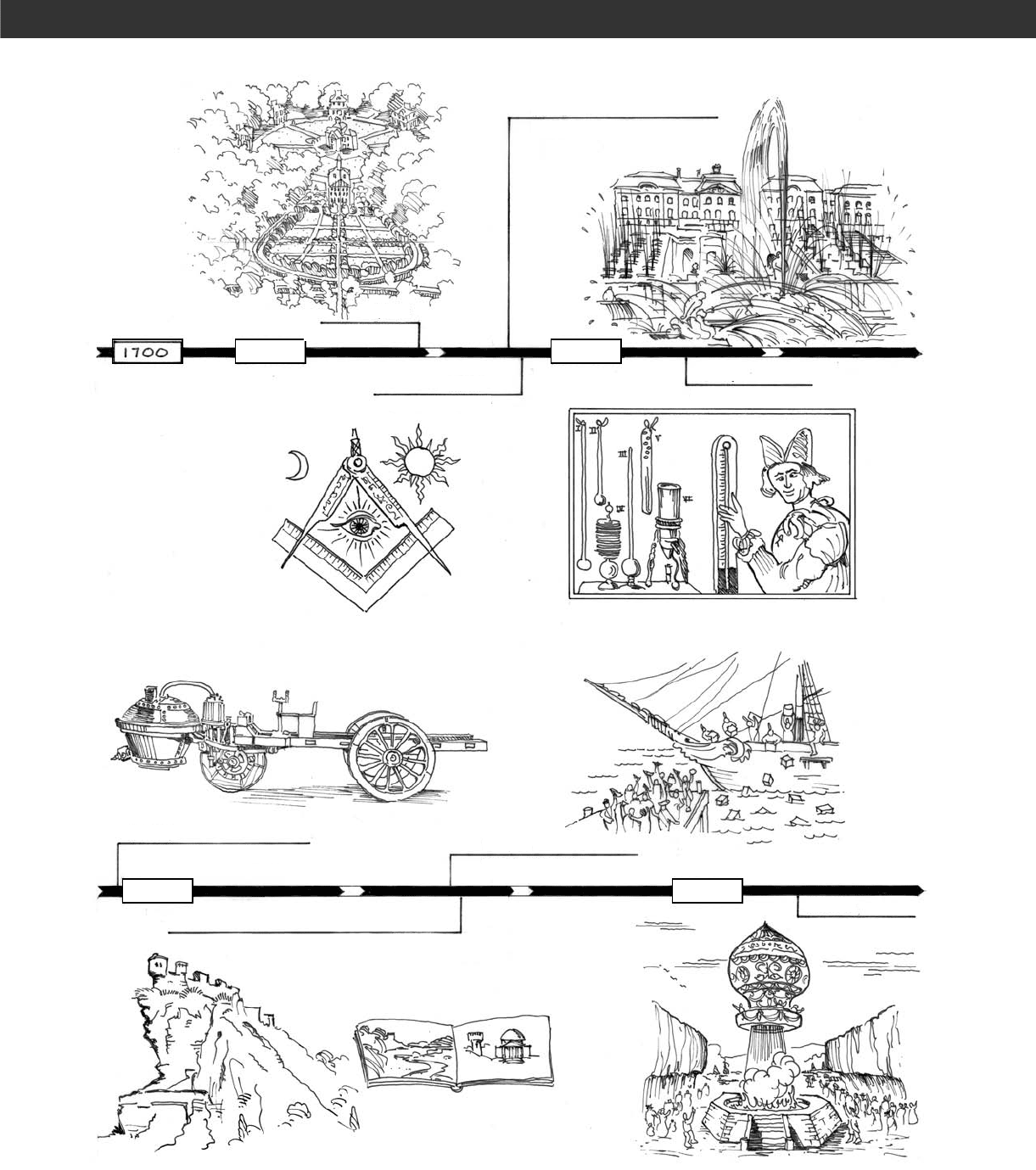
1715 ROCOCO
Following the death of Louis XIV, the
grandeur and drama of 17th-century Ba-
roque art forms relaxed into the cheerful
exuberance of the Rococo style. Curvy
and sinuous Rococo geometries are evi-
dent in 18th-century German gardens.
1716 RUSSIAN VERSAILLES
Czar Peter the Great instituted reforms
that modernized the Russian empire
and made the country a world power. He
had his new capital at St. Petersburg
designed along European models. Le
Notre’s pupil Jean-Baptiste Alexandre
Le Blond planned the gardens at the
czar’s summer palace and park, Petrod-
vorets, to celebrate Russia’s victory over
the Swedes.
1717 FREEMASONS
Individuals committed to ideals of
tolerance and universal understand-
ing inspired by the Scientifi c Revolution
established the fi rst grand lodge of the
freemasons in London.
1724 FAHRENHEIT
Gabriel Fahrenheit developed the tem-
perature scale based on a freezing point
of 32 degrees and a boiling point of 212
degrees.
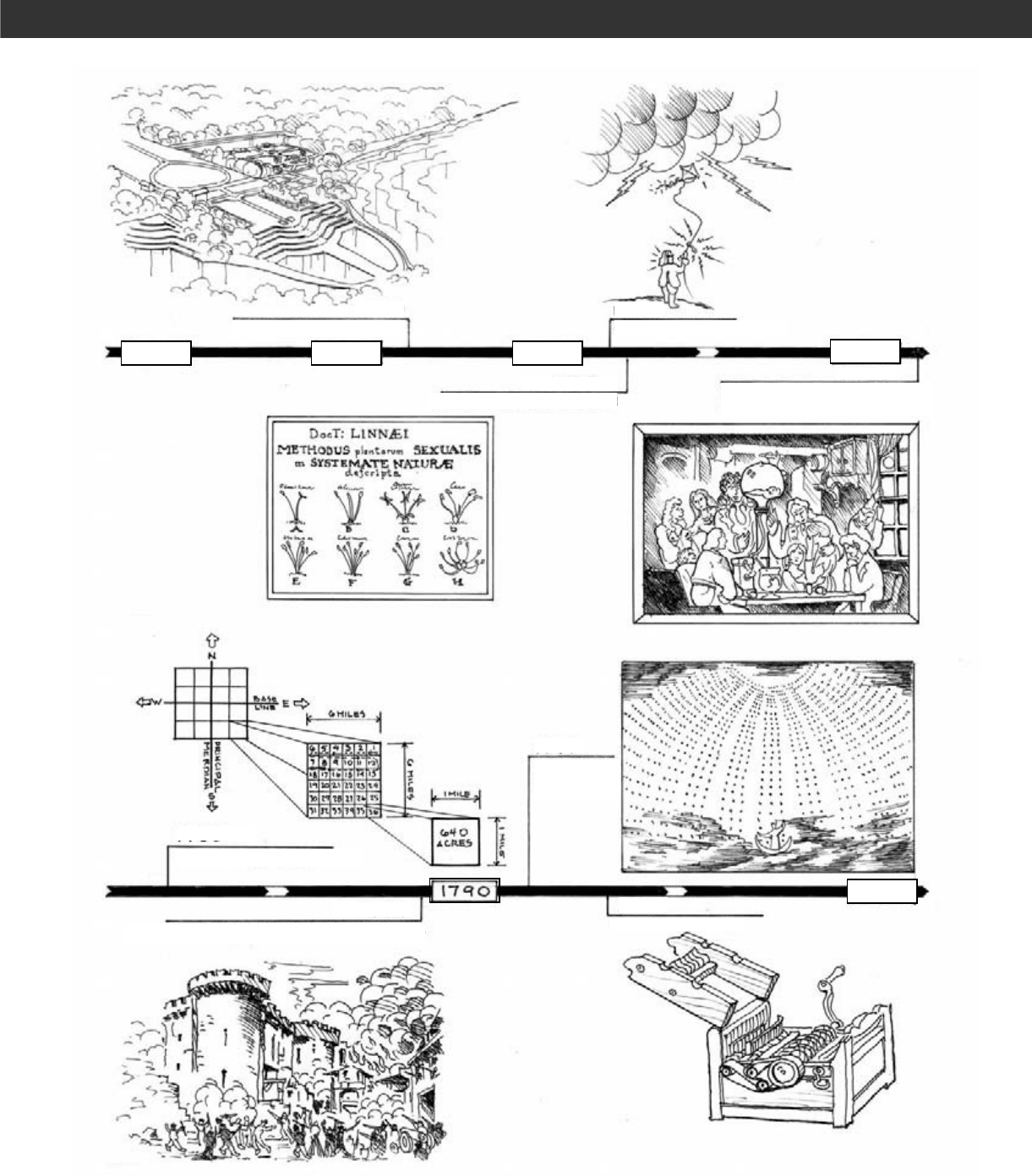
1741 MIDDLETON PLACE
Henry Middleton, former president of
the First Continental Congress, initiated
work on the garden at his plantation
near Charleston, South Carolina, in 1741.
Slaves labored for 10 years to create
the 40-acre formal garden, which is
symmetrically arranged along a main
axis that begins at the entry drive. Five
grass terraces (called the “falls”) lead
down to the river where “butterfl y” lakes
help control the water level for the rice
paddies. Geometric parterres border the
north side of the great lawn.
1752 HIGH VOLTAGE!
Ben Franklin fl ew his kite in a lightning
storm, discovering static electricity.
1753 SPECIES PLANTARUM
Swedish botanist Carl Linnaeus
(1707–1778) developed a new, binomial
system of plant classifi cation based on
genus and species names. The simpli-
fi ed system outlined in his book, Species
Plantarum, was internationally accept-
ed, facilitating the study of botanical
research.
1768 EXPERIMENT WITH AN AIR PUMP
This painting by Joseph Wright of Derby
illustrates how Enlightenment science
was simultaneously trusted and viewed
with suspicion.
1769 STEAM CART
The fi rst self-propelled road vehicle, in-
vented by Nicholas-Joseph Cugnot, was
adapted to many uses in industry and
agriculture.
1773 TEA PARTY
American colonists destroyed English
tea rather than pay the tax on it. “No
taxation without representation” be-
came the clarion call of revolution.
1774 THE SORROWS OF YOUNG
WERTHER
Johann Wolfgang von Goethe
(1749–1832) is known for his poems
and plays, including The Sorrows of
Young Werther, which infl uenced the
development of Romanticism. Equally
important was his contribution to nat-
ural philosophy. His scientifi c studies
were based on a fi rsthand encounter
with nature, a prelude to the science of
phenomenology.
1782 FULL OF HOT AIR
Joseph-Michel Montgolfi er’s balloon
prototype rose 30 meters. He and his
brother Jacques-Etienne demonstrated
the new technology to the public in the
main square of Annouay, France, the
following year.
1785 NATIONAL GRID
Thomas Jefferson enacted the Land
Ordinance of 1785 to survey the Ameri-
can territories gained in the Louisiana
Purchase. The section-township-range
system established a grid over 1.2 billion
acres of land.
July 14, 1789 LIBERTÉ, ÉGALITÉ,
FRATERNITÉ
The storming of the Bastille by citizens
of Paris was the fi rst move toward
the overthrow of the ancien régime.
The French Revolution brought radical
change to the country.
1791 THE MAGIC FLUTE
Wolfgang Amadeus Mozart (1756–1791)
premiered his last opera, Die Zauber-
fl ote, in Vienna.
1793 COTTON GIN
American Eli Whitney revolutionized ag-
riculture with his engine that separated
cotton fi bers from seeds.
18th CENTURY / A BRIEF CHRONOLOGY
151
18th CENTURY
/
ENGLAND
In the 17th century, English gardens
were a mix of French and Dutch styles
adapted to different environmental cir-
cumstances. In the 18th century, these
foreign, formal styles were overthrown in
favor of a more English, “natural” style.
1
Landscape gardens, as they came to
be called, were equally as contrived as
formal gardens, but somehow people
interpreted irregular geometries as be-
ing more representative of nature than
straight lines, a prejudice that exists in
the Western tradition to this day.
The development of the English landscape
garden occurred in phases that coincided
with changing tastes and aesthetic
theories. Early 18th-century gardens,
while developing their naturalistic form,
included numerous architectural features
(temples, Gothic ruins, obelisks, etc.)
that were the focal points of vistas
connected by walks. Later 18th-century
English gardens focused on views and
prospects to natural features. The fi nal
phase was characterized by an increase
in tension and variation characteristic of
the Picturesque movement.
THE INFLUENCE
OF POLITICS,
POETRY, AND
PAINTING
The 18th-century English garden was in-
fl uenced by a desire to rid the landscape
of the rigid order indicative of French
absolutism. These forms were no longer
appropriate in England after a constitu-
tional monarchy and a formalized par-
liamentary system were established fol-
lowing the Glorious Revolution of 1688.
Although opposing political parties
were united in their efforts to ensure a
Protestant succession, the Whigs, who
supported constitutional government
and civil liberties, often differed with the
Tories, who remained loyal to the crown.
Thus the lifestyles of the aristocratic
Whig landowners became centered on
their country estates rather than the
royal court. They incorporated classical
imagery in their gardens, to represent
their elevated status and cultured
taste.
To improve the agricultural economy of
England, the Enclosure Acts of Parlia-
ment put vast tracts of once commonly
held land into private hands, increasing
the economic and political power of the
landed gentry. Property owners enclosed
fi elds and pastures within the boundar-
ies of their private estates, called parks.
Timber and grazing land (which was now
leased out) were two main sources of
income.
Subsequent to their calls for political
freedom, 18th-century English poets and
philosophers also articulated a case for a
freer style of landscape design. Essayists
such as Joseph Addison, Alexander Pope,
and Anthony Ashley Cooper (fi rst Earl
of Shaftesbury) denounced the tyranny
of foreign garden styles and practices in
England; they especially ridiculed topiary,
and advocated nature itself as the ideal.
Pope’s Epistle to Lord Burlington of 1731
states that “good sense” is essential
to garden making and that Le Notre
“had it not to give.” He reminds design-
THE DEVELOPMENT OF THE
LANDSCAPE GARDEN
ers to consider nature as the “genius of
the place,” the force that “paints as you
plant.” Finally, he cites the design of Lord
Cobham’s park at Stowe as an example of
good sense.
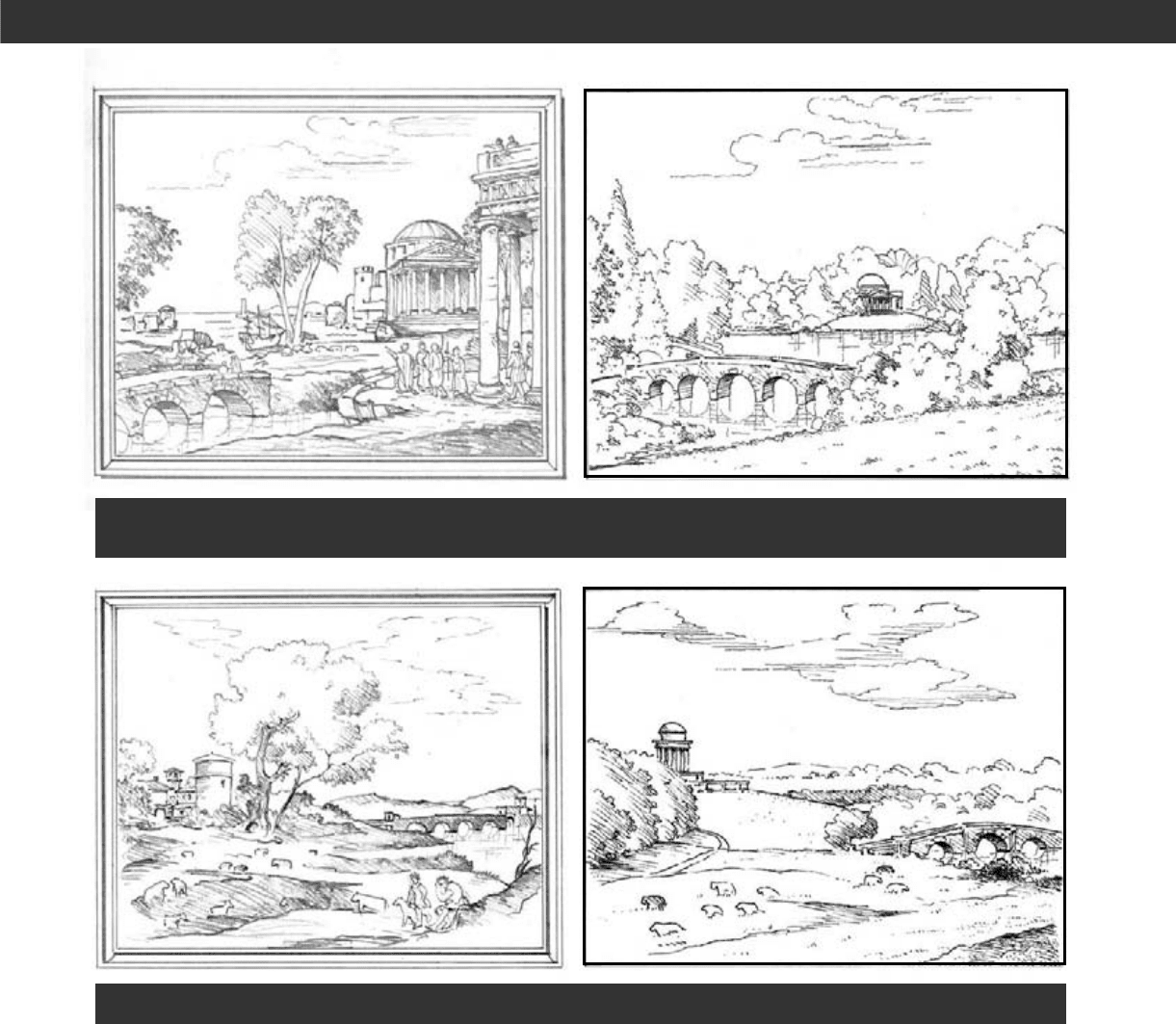
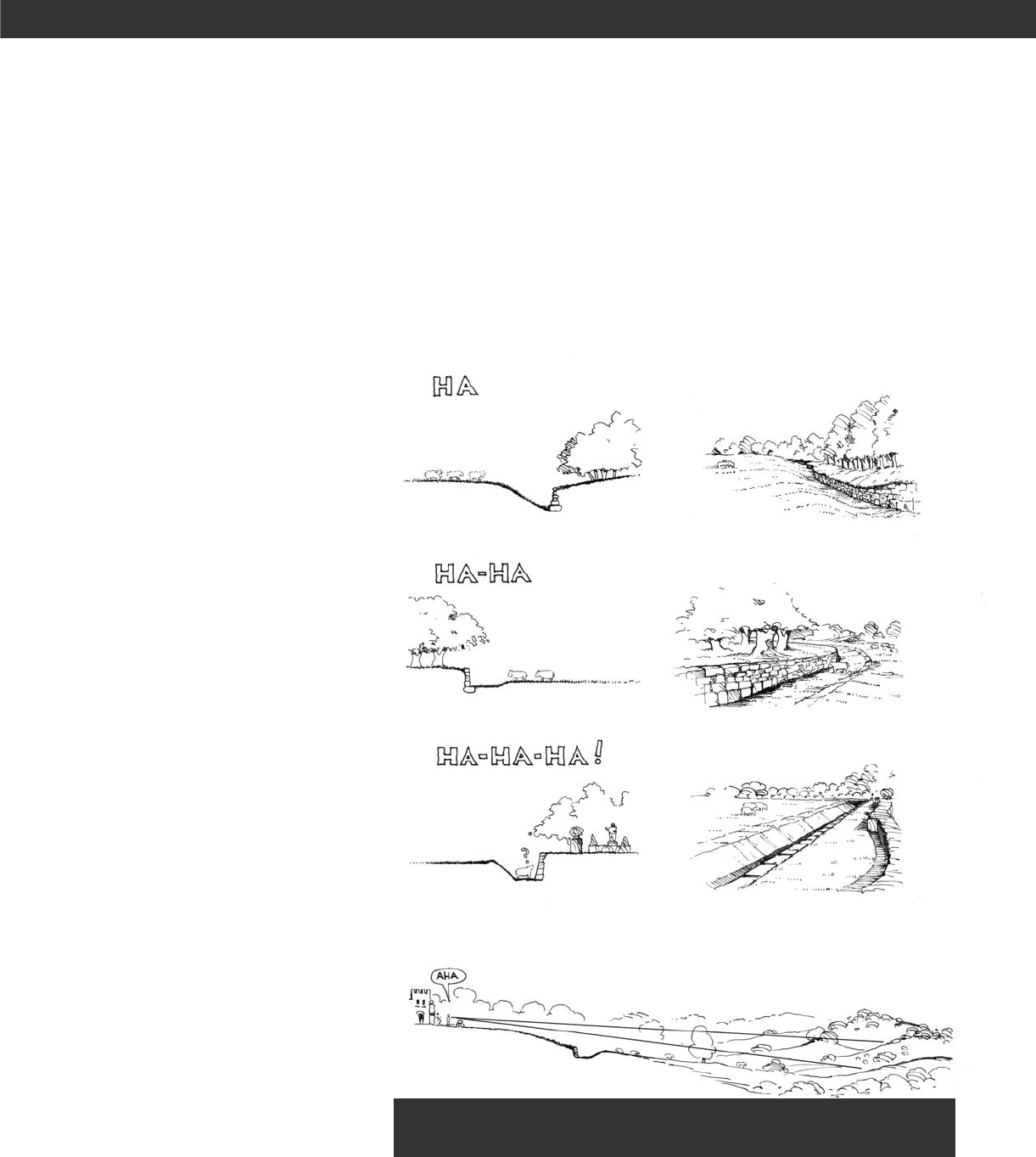
2
In 1771, Horace Walpole, the
son of the fi rst prime minister of England,
wrote Essay on Modern Gardening, refer-
encing the work of writer John Milton and
landscape painter Claude Lorrain as infl u-
ences on the development of the English
landscape garden.
Alexander Pope said “all gardening is
landscape painting.”
3
The 17th-century
landscapes of French painters Claude
Lorrain and Nicholas Poussin were revered
by the English for their mix of heroic and
pastoral imagery. These paintings were
collected by the landed gentry who went
abroad on “grand tours” to continue their
classical education.
4
Wealthy landown-
ers were eager to re-create in their parks
the idyllic Arcadia represented in the
paintings. Educated aristocrats would
have understood the allusions to Ovid,
Virgil, and Pliny contained in the Italian
Renaissance gardens they visited. Early
18th-century English gardens had similar
encoded meanings. Lord Burlington
toured Italy and was particularly taken
by the scenographic effects and classical
vocabulary of the Palladian villa. In 1715,
Palladio’s books were translated into
English, further inspiring ideals of agrar-
ian classicism.
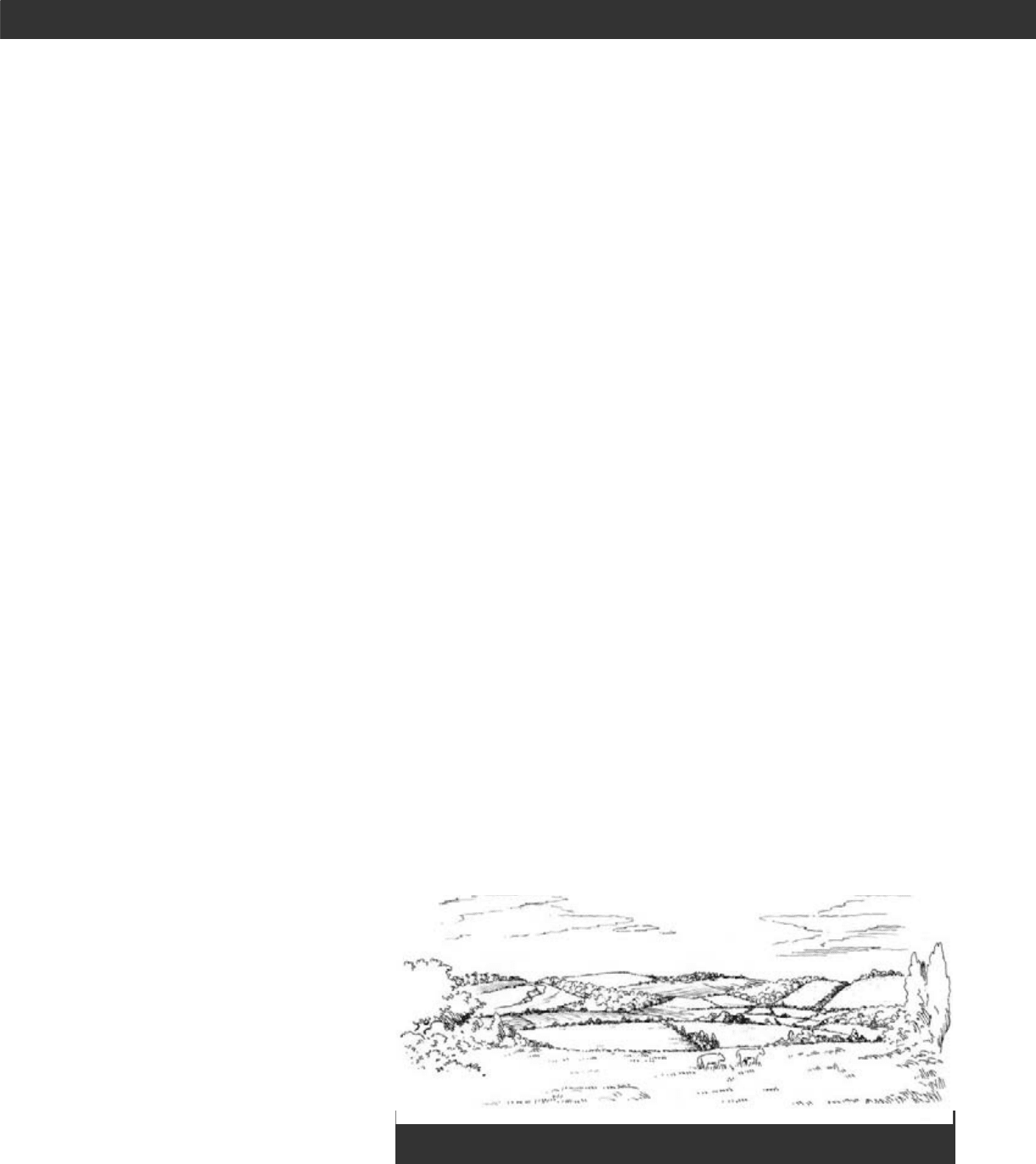
GREEN AND PLEASANT LAND: Common pastures were enclosed by acts of
Parliament to increase agricultural productivity.
152
In the second half of the 18th century,
English gardens became poetic con-
structions devoid of earlier moral over-
tones. Allusions to classical themes
were not as readily understood by the
new class of landowners, who were not
as educated as the landed aristocracy
and whose estates were much more
modest.
18th CENTURY / ENGLAND
VIEW OF PONTE MOLLE: The position of the temple and bridge in Lorrain’s landscape was re-created at Castle Howard.
FASCINATION
WITH CHINESE
STYLES
Other infl uences on the development of
the English landscape garden include
the images and descriptions of Chinese
gardens brought back to Europe by the
Jesuits. The French Jesuit missionary
and painter Jean-Denis Attiret
(1702–1768) moved to China in 1737
and sent home illustrated accounts
of the imperial gardens. His reports
were translated into English in 1752.
English designers were receptive to
the irregular forms of Chinese gardens
that “shunned” the straight line. In
1757, the Scottish architect Sir William
Chambers published Designs of Chinese
Buildings, Furniture, Dresses, Machines,
COAST VIEW OF DELOS WITH AENEAS: The composition of a scene at Stourhead is remarkably similar to one portrayed
in Lorrain’s painting.
153
and Utensils. Chinese decorative ele-
ments were included in the garden, as
well as in the home. Chinoiserie refers to
the Chinese-themed textiles, ceramics,
wallpaper, and furniture that were now
in demand. The fascination with Chinese
styles fi gured in the serious debates
over style that engaged English design-
ers later in the century. (The controver-
sy is examined further in this chapter.)
DESIGN
ELEMENTS
In addition to their productive agricul-
tural function, the newly enclosed parks
were developed by their owners as plea-
sure grounds to conform to the new
ideal of pastoral life. English garden
designers shaped lakes and hills and
used trees as visual frames. To create
the anti-Versailles, they deconstructed
the stiff boundaries that separated
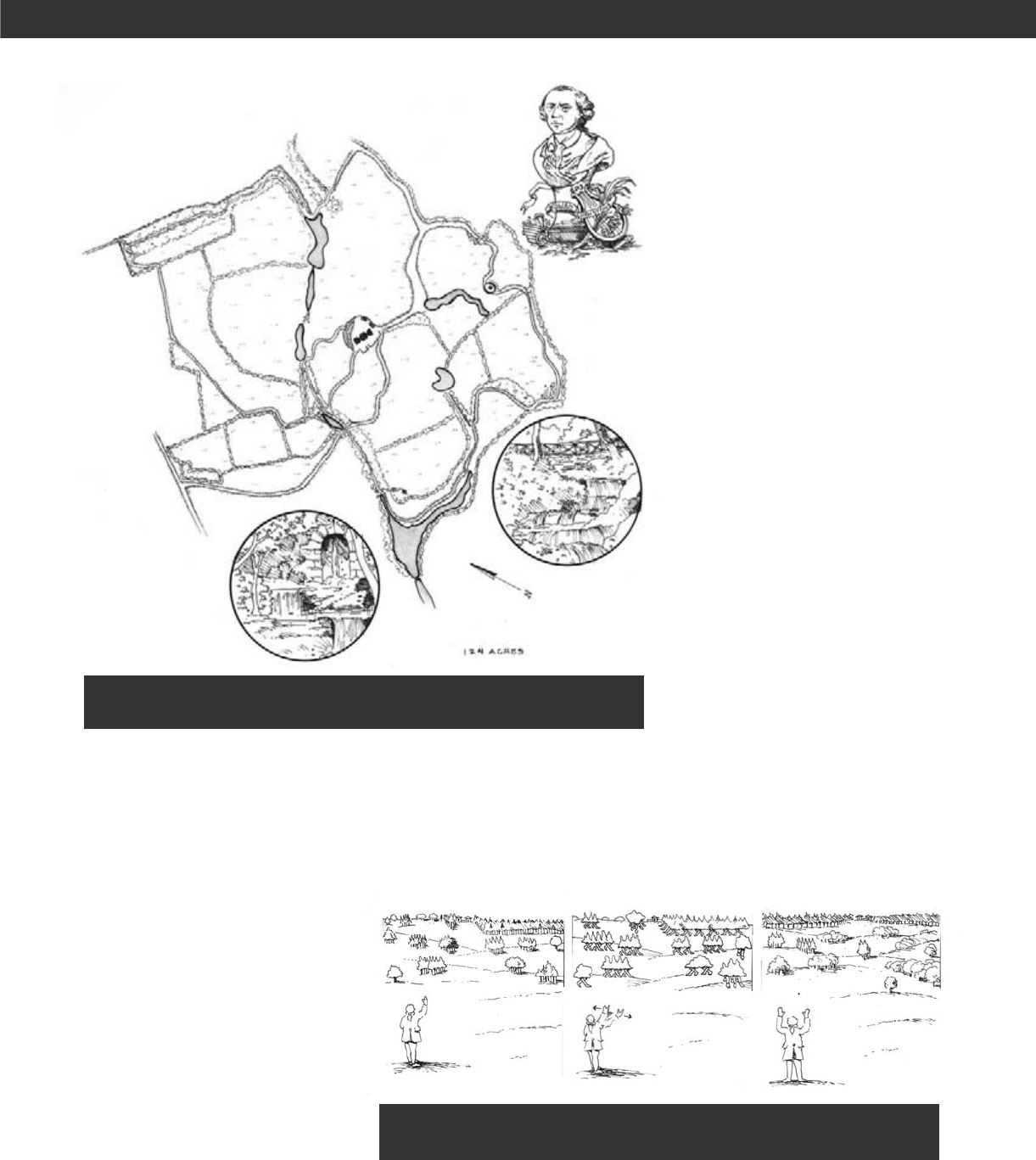
garden from park. The ha-ha (a sunken
fence or ditch) and the tree cluster
(variations of belting, clumping, and
dotting) were important elements in
the transition to the naturalistic style.
An organic design vocabulary—gently
rolling hills, free-form lakes, and groves
of trees—unifi ed site plans. “Profes-
sional” landscape designers spread
this style across England.
The idea of the ferme ornée—a work-
ing farm “decorated” like a garden—
accorded with English cultural identity,
and was an early attempt to impart a
classical theme on a rural aesthetic.
5
William Shenstone developed a ferme
ornée at the Leasowes, his estate in
Warwickshire. Perimeter walks connect-
ed separate scenes of the garden. Latin
inscriptions on sculptural elements
provided an overlay of classical ideology.
Trees, clustered around the boundar-
ies of the site, kept views focused
inward. Shenstone was also fi rst to use
the terms “landscape gardening” and
“landscape gardener” in his essay of
1764 entitled “Unconnected Thoughts
on Gardens.”
INFLUENTIAL
GARDEN
DESIGNERS
While key writers and philosophers pro-
moted the revolution of taste, profes-
sional landscape designers like William
Kent, Lancelot “Capability” Brown, and
Humphry Repton remade the country
as an English landscape garden. Their
work followed that of architect Sir John
Vanbrugh and landscape designers Henry
Wise and George London, who worked
with formal design vocabularies in the
early 18th century, and established an
English Baroque style. Charles Bridge-
man set the stage for the transition to
the natural style. He mixed the regular
geometry of the parterre with free-form
wildernesses. Bridgeman was a masterly
site planner; his avenues conformed to
the topography and terrain of the site.
He pioneered the use of the ha-ha at
Stowe, although Walpole’s praise of Kent,
AH HA!: The ha-ha is a sunken fence or ditch that permits distant views of fi elds
while keeping grazing animals away from living areas.
18th CENTURY / ENGLAND
154
who “leaped the fence,” has somewhat
obscured Bridgeman’s contribution.
6
WILLIAM KENT (1685–1748)
William Kent was a landscape painter
and set designer who understood the
scenic capacity of the landscape and
composed gardens pictorially. Kent is
credited with creating the new move
toward informality, working “without
level or line.”
7
He was the ultimate set
dresser, incorporating literary allusions
and mythological content through nam-
ing and inscription—for example, the
“Elysian Fields” and “Praeneste Terrace”
at Stowe. His gardens unfold in time
and space like a performance develops in
sequential scenes and acts.
Kent spent almost 10 years studying
in Italy. Italian Renaissance gardens
made an impression on him, but it was
their overgrown, neglected state that
he observed—an overlay of disorder on
their perfect geometric harmonies. Kent’s
vocabulary included the use of serpen-
tine bodies of water and the massing of
trees in individual groups. His landscapes
contained architectural features such as
sham ruins or fabriques that were similar
to elements seen in the paintings of Lor-
rain and Poussin; he even planted dead
trees to give “truth” to a scene.
8
Kent’s Italian diaries indicate his un-
derstanding of sophisticated perspec-
tive construction techniques; he used
oblique perspective points that con-
verged outside the “scene” to unify the
design and encourage the viewer to move
through the space. Scenes were not
framed from any single point.
9
The visi-
tor approached architectural features,
such as the Praeneste Terrace, from an
angle, adding to the element of surprise.
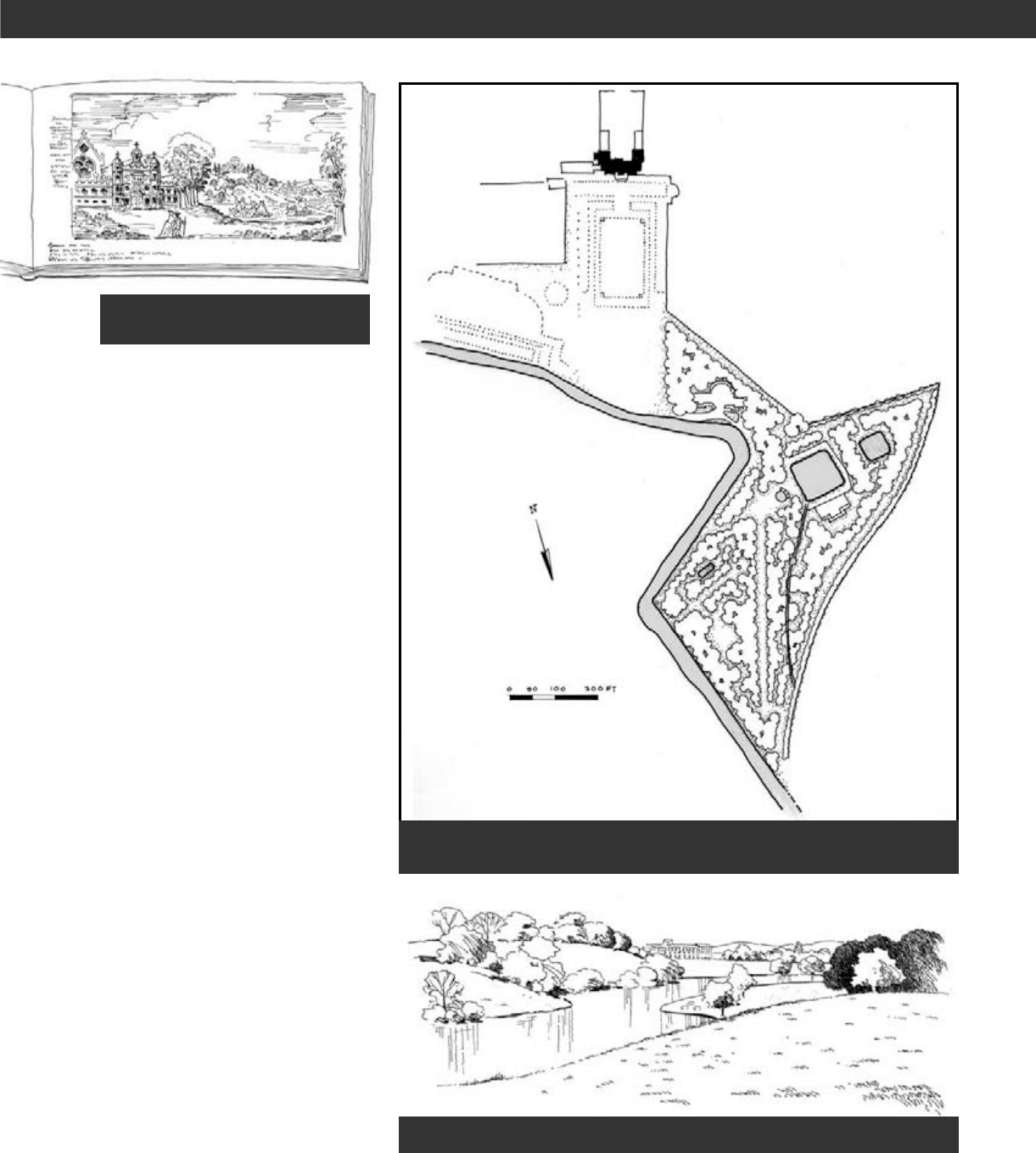
Kent’s early work at Rousham illus-
trates Addison’s ideas that an entire
estate should be considered a garden.
Kent produced a great variety of ex-
periences in a small, awkwardly shaped
space by clearing and grouping trees.
Delightful surprises awaited the visitor
within the confi nes of the garden.
Rousham, sited along a river bank in
Oxfordshire, is a narrative circuit garden
Kent composed as a series of landscape
pictures. He began work in the 1730s,
a decade after Bridgeman had estab-
lished the framework of the garden. Kent
reworked some of Bridgeman’s straight
paths, and developed a series of sequen-
tial visual events. Directly behind the
house, a reproduction of a famous an-
tique statue of a lion attacking a horse
sits at the edge of a rectangular grassy
18th CENTURY / ENGLAND
THE LEASOWES: The ornamented farm of William Shenstone partnered horticul-
ture with agriculture.
STAGE DIRECTION: William Kent employed trees as visual screens. Capability
Brown planted trees in belts, clumps, and dots to direct views of the landscape.
155
terrace. Views continue down the open
slope toward the river and across to a far
hilltop crowned with an “eyecatcher”—a
fake Gothic ruin placed there by Kent.
As the visitor moves through the garden,
views of sculptures and architectural
features are suddenly revealed, evoking
historical and literary themes.
LANCELOT “CAPABILITY”
BROWN (1715–1783)
The naturalistic style reached its height
of expression through the work of Lance-
lot Brown, whose reputation (and name)
was built on his skill in visualizing the
capability of a site to be transformed
into a garden and thus “improved.”
Brown changed the character of the
built landscape in England by redesigning
existing gardens and parks of country
seats in the new naturalistic fashion. He
obtained nearly 200 commissions during
his career. His early apprenticeship at
Stowe gave him a background in practical
horticulture that Kent lacked.
Brown was concerned foremost with the
harmony of line. Smooth transitions in
topographic elevation complemented
the fl owing curves of lakes and paths.
Brown eliminated all traces of the formal
parterre and terrace and brought the
lawn right up to the house. He disguised
any visible aspects of the working farm.
The landscape was no longer a vehicle
for narrative expression; it became the
narrative itself. Brown took the idea of
the landscape garden to an extreme.
His landscapes were devoid of literary
associations. His work was criticized by
SKETCHBOOK: William Kent considered
the garden a stage for human activity.
S-CURVE: The “serpentine line of beauty” defi nes Brown’s landscape gardens.
ROUSHAM: Kent added a theatrical overlay onto the framework established by
Bridgeman.
18th CENTURY / ENGLAND
156
18th CENTURY / ENGLAND
advocates of the picturesque as being
too “empty”; there was no “nature” to be
seen except for the gentle landforms, and
the groups of trees creating light and
dark spaces.
HUMPHRY REPTON (1752–1818)
Repton changed careers midlife; he was
an educated writer and skilled painter
who turned his hand to landscape design
at the age of 36. He was fi rst to adver-
tise himself as a landscape gardener. He
visually merged gardens into the land-
scape, “correcting” nature’s imperfec-
tions.
Repton developed a style that combined
aspects of formalism and naturalism. As
his career matured, he reintroduced geo-
metrically planned garden details around
the house to establish a foreground,
close-up view, which contrasted with the
sculpted landscape park beyond. Repton
reintroduced balustraded terraces into
his work and planted understories with
mixed shrubs and fl owers.
Unlike Brown, Repton recorded and pub-
lished his theories. He joined the stylistic
controversy by supporting Brown’s style
and defending his own work against criti-
cism from the proponents of the pictur-
esque movement, who advocated a more
dramatic realization of nature.
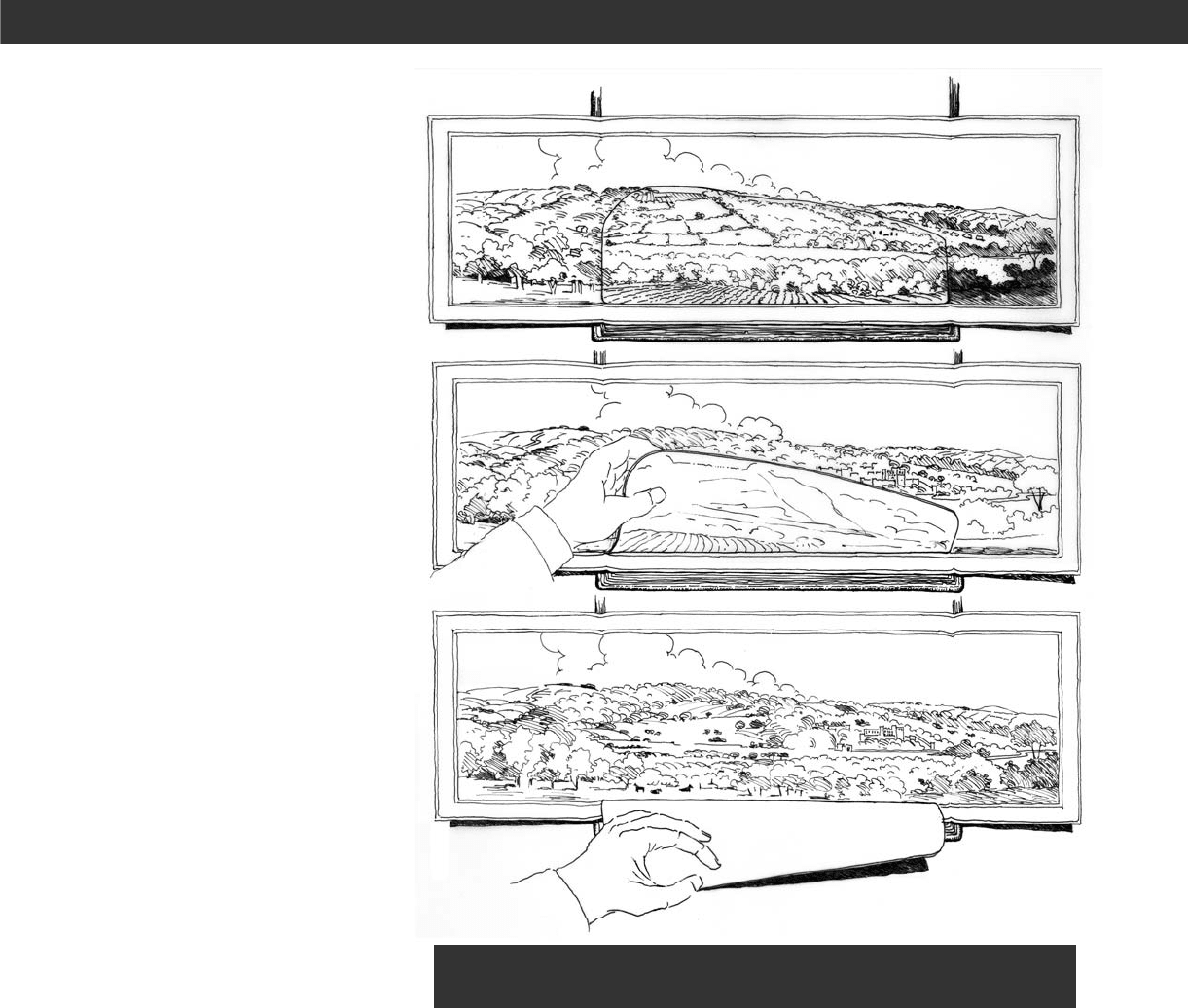
Repton was known for the before-and-
after scenes he painted for his clients,
viewable by raising a hinged fl ap on the
drawing. The works, bound in red leather,
were called his “red books.” Repton’s work
was a major infl uence on the development
of Victorian garden styles in the 19th
century.
REPRESENTATIVE
PROJECTS
STOWE, BUCKINGHAMSHIRE
Bridgeman’s work at Stowe began in
1714, when the Enclosure Acts increased
Richard Temple’s (Viscount Cobham’s)
property from 28 acres to almost 900
RED BOOK: Repton helped his clients visualize his proposals by preparing books
with before-and-after views.
acres. Bridgeman removed the terraces,
planted trees along the perimeter, and
created axial views terminated by archi-
tectural features.
Kent’s work began in 1734. He relaxed
the geometric boundaries that subdi-
vided the space and used vegetation as
visual frames. He divided the large body
of water into two irregularly shaped
lakes, sculpted the Elysian Fields, and
planned the curving pathways and tree
clusters. The Elysian Fields were staged
by Kent around a triad of temples to
Ancient Virtue, Modern Virtue, and the
British Worthies. The round Temple of
Ancient Virtue is a copy of the Temple of
the Sibyl at Tivoli; the Temple of Modern
Virtue (no longer extant) was built as a
ruin and contained a headless bust—
Cobham’s political commentary aimed at
Robert Walpole, the prime minister. The
Temple of British Worthies contained
busts of celebrated “heroes, patriots,
and wits” and included a commemora-
tion of the family dog.