
Boults Е. Illustrated history of landscape design
Подождите немного. Документ загружается.

137
the grand traditions fi rst established
by Claude Mollet (1563–1650) and
Boyceau. He ev
entually assumed his
father’s role as superintendent of royal
gardens. Le Notre understood space as
an abstraction, and was able to impart
more clarity and unity on the style of
his predecessors. His was an ordered
geometry based on Cartesian logic.
When designing a landscape, he said
“man sets himself up as a little god.”
33
He shaped nature with purpose.
Le Notre collected the paintings of
Claude Lorrain. Like Lorrain, Le Notre
used devices to create spatial illu-
sions. Lorrain’s compositions and color
palettes created a golden atmosphere
that dissolved into infi nite perspec-
tive. His paintings show mythological
fi gures and classical architecture set in
a utopian landscape; an ordered world
not unlike the one Louis XIV created
at Versailles. (The aesthetics of the
pastoral ideal as represented by the
17th-century landscape painters would
have particularly powerful implications in
the formation of an English garden style
in the 18th century.)
At the age of 37, Le Notre teamed up
with his artist friend Charles Le Brun
and the architect Louis Le Vau to
undertake work for Louis XIV’s fi nance
minister. Vaux-le-Vicomte was the fi rst
in a series of notable collaborations, and
epitomizes the spirit of the 17th-century
French formal garden. Andre Le Notre
died in 1700 at the age of 88. The clar-
ity of the French formal style expressed
in his work was imitated across the
continent. La Theorie et le pratique du
jardinage by Antoine-Joseph Dezallier
d’Argenville, written in 1709, summarized
the elements of the French Classical
garden based on Le Notre’s work. The
book became enormously popular, diffus-
ing the grand style throughout Europe.
THE WORK OF
ANDRE LE NOTRE
Andre Le Notre (1613–1700) grew up in
Paris, where his father was superinten-
dent of the royal palace gardens at the
Tuileries. (The Louvre was still the seat
of government.) Le Notre studied the
curriculum for landscape designers sug-
gested by the recognized authority on
gardening, Jacques Boyceau: geometry,
perspective, drafting, architecture, and
horticulture. He studied painting at the
studio of Simon Vouet, an early advocate
of the French Classical style, where he
met fellow student Charles Le Brun.
As a young man Le Notre worked at the
Tuileries and Fountainbleau, continuing
THE COURT OF
LOUIS XIV
France was launched as a leading Euro-
pean power in 1648, when the Peace of
Westphalia ended the Thirty Years’ War.
But a period of social and political un-
rest followed, called the Fronde, in which
the French nobility rebelled against the
king. Louis XIV (1638–1715) was able to
subordinate the dissidents and estab-
lish an absolute monarchy; in 1655, he
proclaimed “L’Etat, c’est moi” (I am the
State). His great garden at Versailles is
symbolic of absolute power and control.
To keep an eye on the nobility and
quash any potential insurgency, at-
tendance at court was expected of
the noble families by Louis XIV. Any
kind of advancement or favor required
attracting the king’s attention. The
court was always under scrutiny by
the king, and proper etiquette, which
dictated everything from dress to fa-
cial expressions, had to be observed.
32
The landscape itself conformed to this
idea; formal gardens compelled formal
behavior. The garden was the stage for
the political and social theater of 17th-
century France.
To accommodate the entire nobility and
the huge retinues that followed the
monarch, royal gardens and palaces had
to be enormous. Vast volumes of void
space were carved out of dense forests.
The palace at Versailles stands on a
huge terrace, surrounded by parterres;
sculptural urns and fountains are the
only vertical elements, and they are
dwarfed by the expanse of their sur-
roundings. Only crowds in the thousands
would make the scale of the place com-
prehensible. The vista is what made the
landscape dynamic.
17TH CENTURY
/
FRENCH CLASSICAL GARDENS
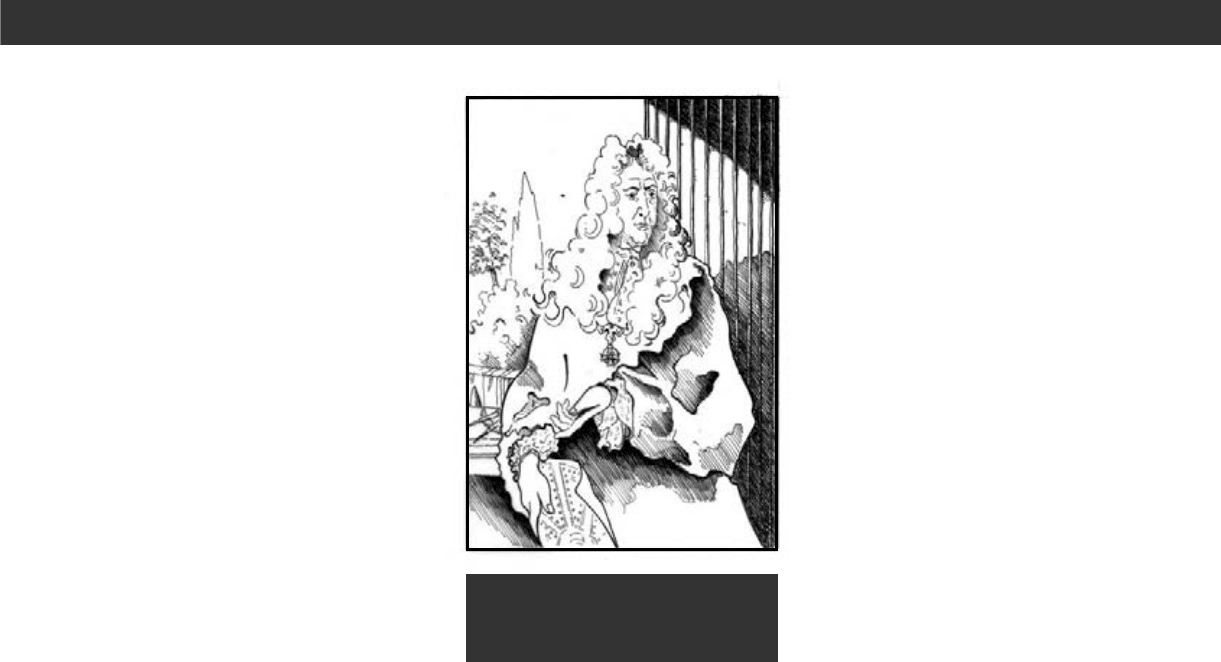
ANDRE LE NOTRE: The landscape
designer’s success was due in part
to his mastery of court etiquette.
138
17th CENTURY
/
FRENCH CLASSICAL GARDENS
VAUX-LE-VICOMTE
Nicolas Fouquet, superintendent of fi -
nances for the king, hired the team of Le
Notre, Le Brun, and Le Vau to design his
new chateau at Maincy (about 34 miles
from Paris). Initial site work involved
the demolition of three villages. More
than 18,000 laborers constructed the
project from 1656 to 1661.
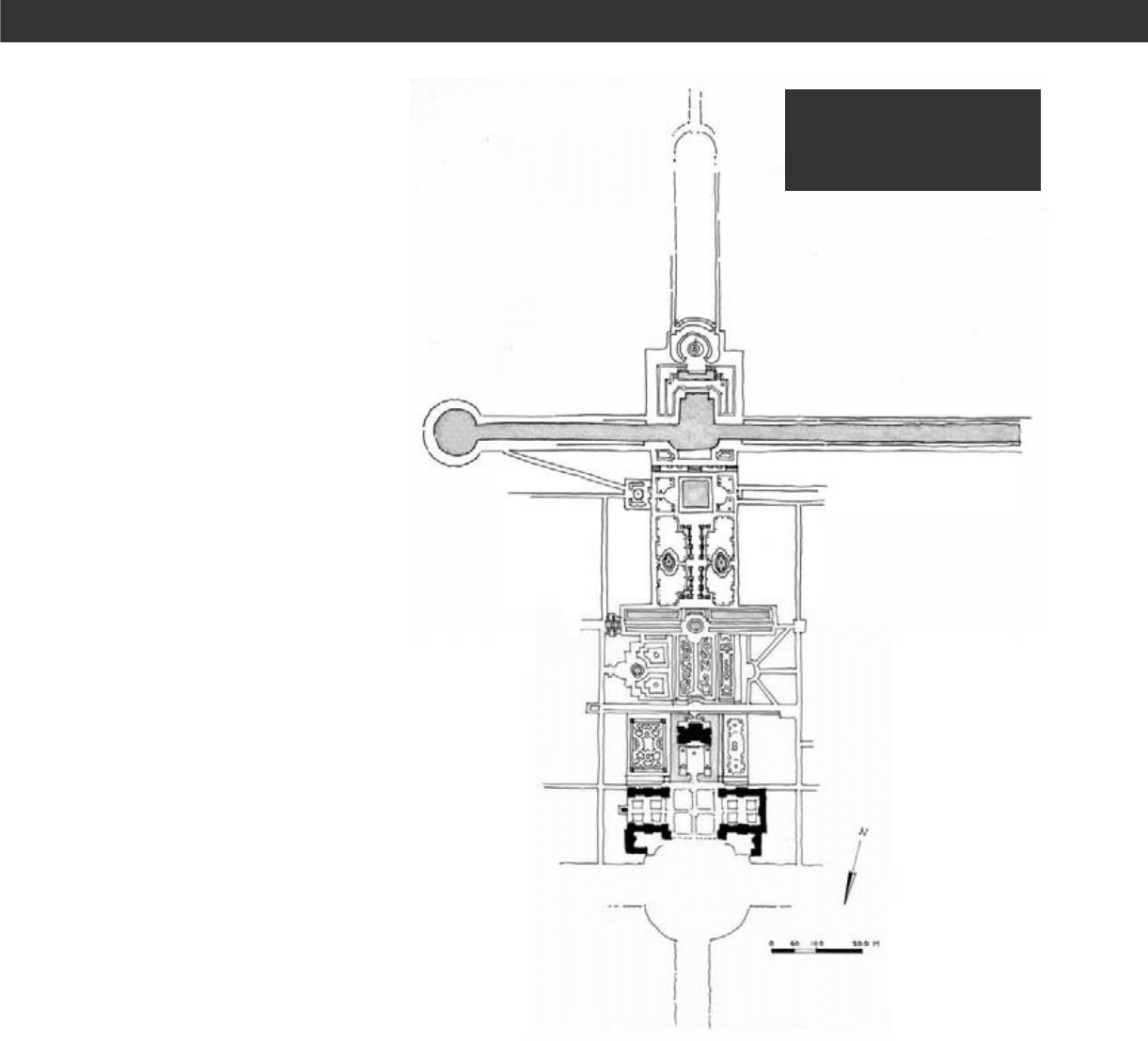
Vaux-le-Vicomte is approached through
the woods. A semicircular clearing in
front of decorative wrought iron gates
leads to the moated chateau. The visi-
tor passes into the Court of Honor. Two
lower parterres fl ank the chateau to the
east and west. From the terrace behind
the chateau, the garden propels itself
into the landscape. Space is carved out
of the forest, the green backdrop acting
like stage wings, or a coulisse, that keeps
the view focused toward the horizon and
provides a dark contrast for sculptural
elements. Small clearings and paths hid-
den within the ornamental groves, called
bosquets, provide intimate subspaces.
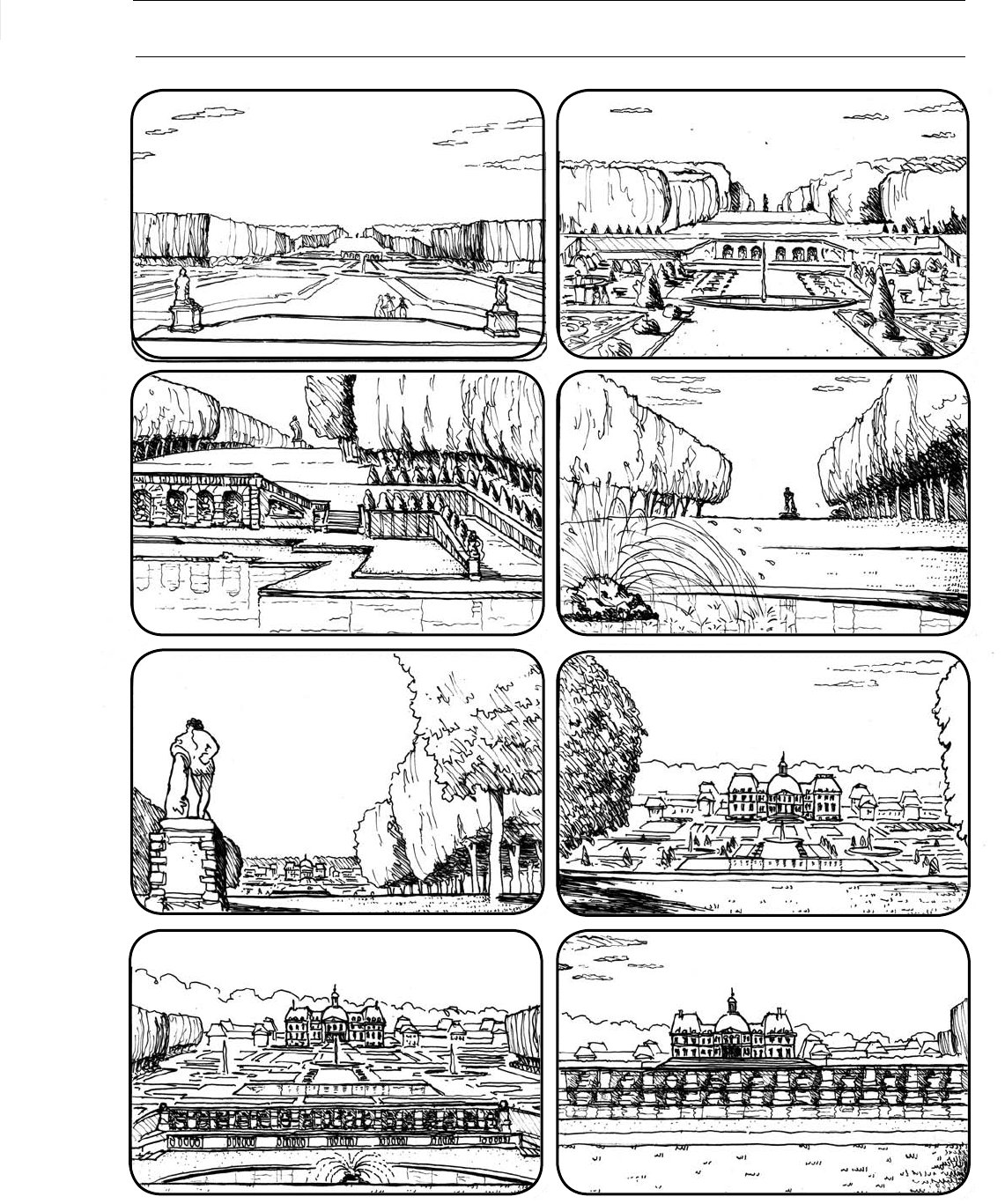
The entire garden appears to be compre-
hensible from a single perspective point
behind the chateau. But as one moves
through the garden, its true extents
and complexities are revealed. Elements
are not what they seemed. The ground is
not one fl at plane, but a series of subtle
level changes and inclines connected by
steps. The oval pool is, in fact, circular.
A canal cuts across the main axis. The
second pool is square, not rectangular.
The arcaded grotto, visible from the
house, is at a lower level on the far side
of another, longer, transverse canal. The
grotto forms the base of an upper-level
terrace. Opposite the grotto, and hidden
from view, one is surprised to fi nd an
additional water feature known as the
Grandes Cascades. At the terminus of
the axis, on the sloping lawn, or tapis
vert (“green carpet”), the visitor can
make an about-face and see the cha-
teau as a central object on the horizon.
In this reciprocal view, distances are
foreshortened; the gardens appear fl at
again. Viewpoint becomes focal point;
the gardens form a closed system.
COHESIVE GEOMETRY: Vaux-
le-Vicomte is considered by
many to be the most successful
of Le Notre’s gardens.
Vaux-le-Vicomte illustrates Le Notre’s
understanding of the laws of optics and
perspective put forth by Euclid and Des-
cartes. As part of the experience of the
garden, Le Notre reveals that reality is
an illusion; there are logical explanations
for the optical effects.
Fouquet hosted an elaborate fete upon
the completion of his gardens, which
the king did not attend. Word spread of
the garden’s magnifi cence, and Fouquet
was obliged to host another party for
the king and his court of thousands.
Fouquet’s lavish display of wealth was
his undoing; he was imprisoned for
embezzlement soon after the event. The
property was looted by Louis XIV, who
carted off its sculptural and arboreal
treasures to Versailles.
139
Vaux-le-Vicomte
CASE STUDY:
140
VERSAILLES
Louis XIV hired the same trio of Le
Notre, Le Brun, and Le Vau to convert
his father’s hunting lodge into an enter-
tainment villa and, later, a royal palace.
Le Notre reworked Jacques Boyceau’s
original parterre directly behind the
chateau and established the axial
structure and geometry of the Petit
Parc. Versailles, which is located about
15 miles from Paris, became the seat
of government in 1682. Additional work
was completed to expand the palace to
accommodate the nearly 5,000 people
who resided at court. The axis grew to
monumental proportions with the later
17th CENTURY
/
FRENCH CLASSICAL GARDENS
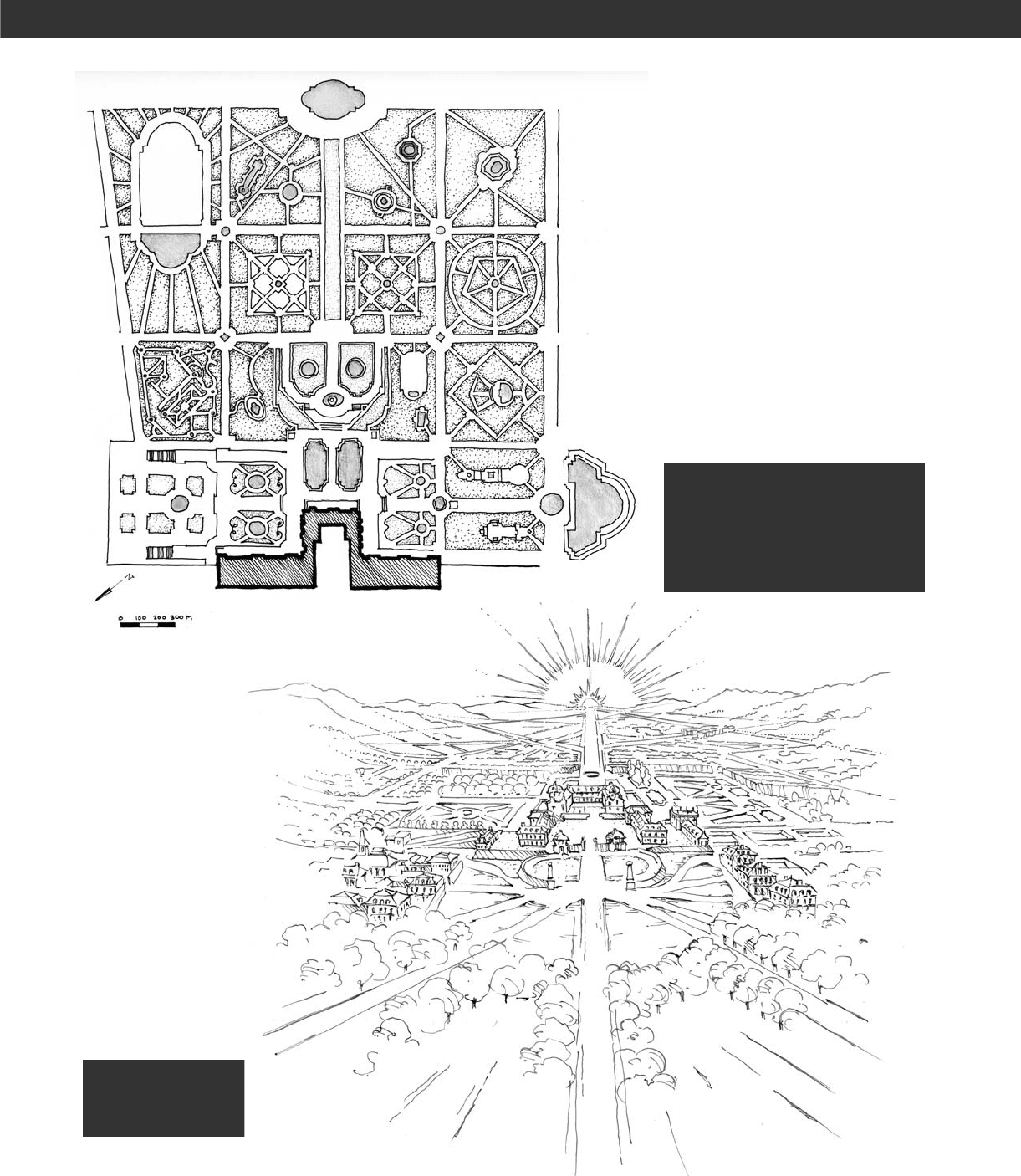
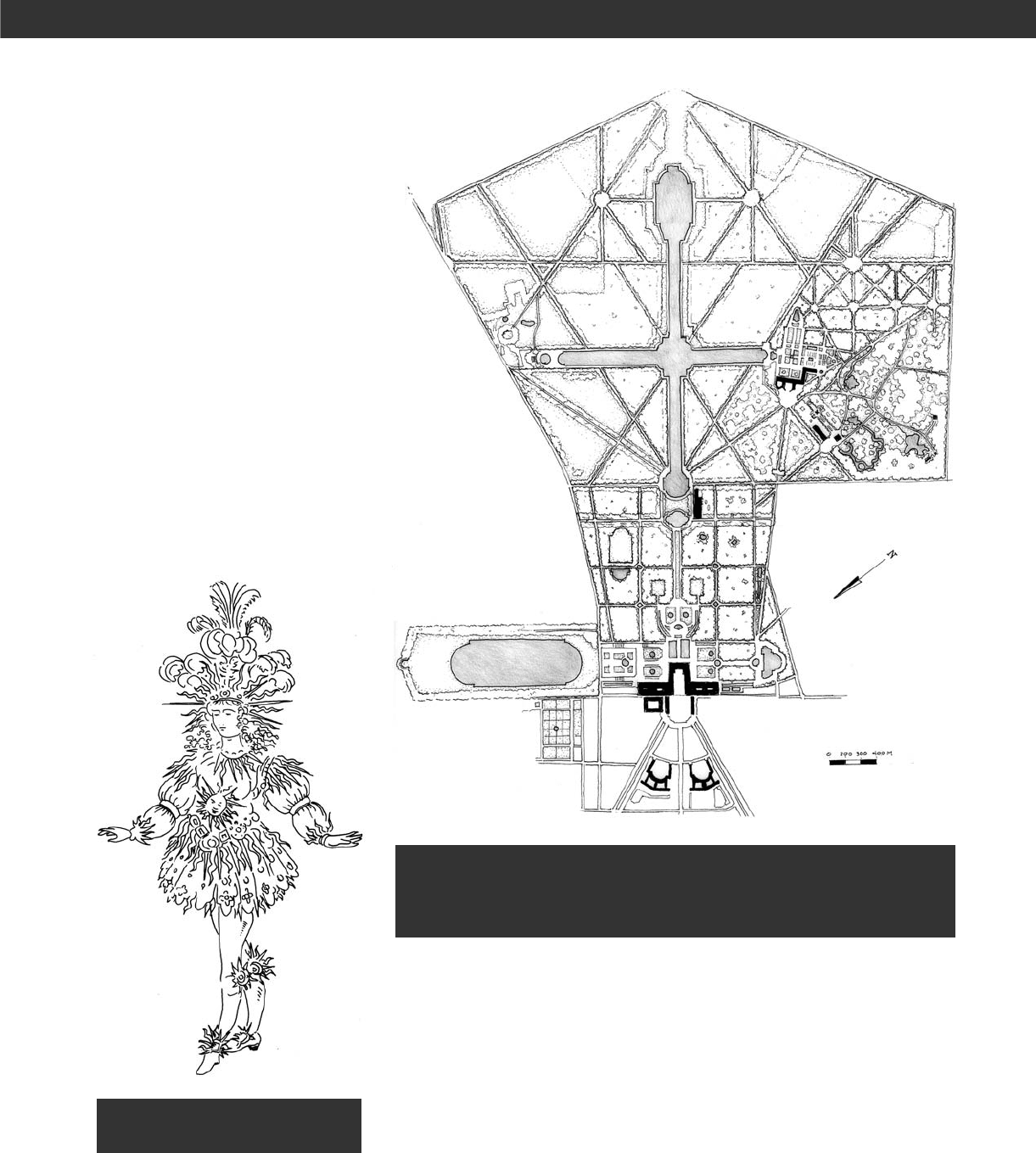
PETIT PARC: The bosquets between
the Fountain of Latona and the
Fountain of Apollo form the core of
the Petit Parc. Today the Petit Parc
at Versailles covers almost 1,900
acres.
THE MATHEMATICS
OF INFINITY: Cartesian
space is endless.
141
addition of the mile-long grand canal.
The vanishing point at Versailles ex-
tended to infi nity, beyond one’s reach.
Louis established his persona as the
Sun King at a grand, themed festival
held at the Tuileries in 1662, called the
Carrousel. Heliocentric iconography,
including imagery of Apollo, the god of
the Sun, is pervasive at Versailles. The
layout of the gardens on an east-west
axis records the trajectory of the sun,
literally and symbolically. Within the
palace, the king’s chambers occupy
the dominant position on the axis.
Fountains and sculptures continue the
theme in the garden.
34
Versailles, located in a lowland marsh,
contained thousands of water features
and fountains. The magnifi cent canals
were not only an important element
of the decorative program, they also
feed the fountains by gravity. Still, the
Machine de Marly was not adequate;
it mostly supplied Louis XIV’s private
retreat at Marly.
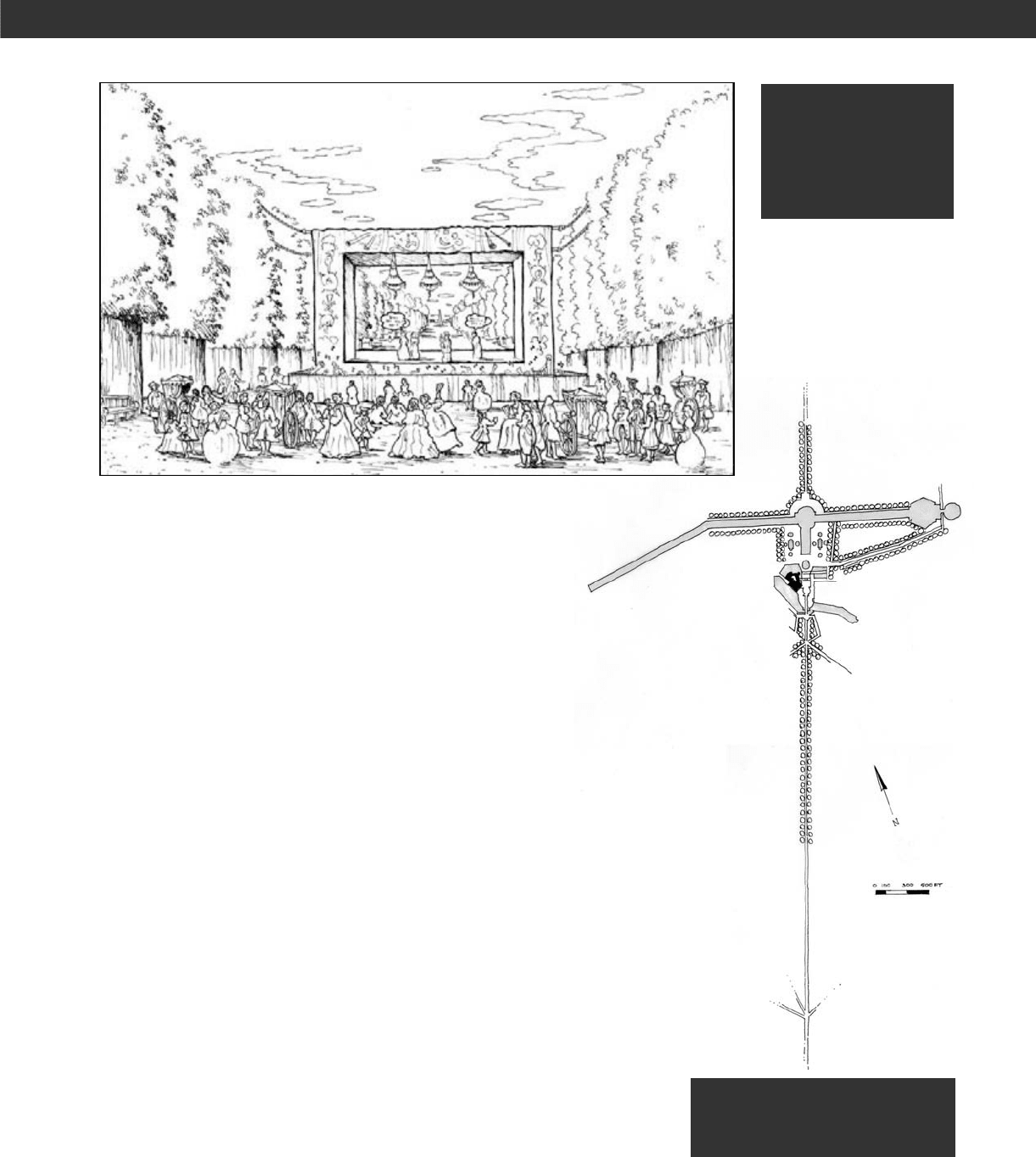
Parties, banquets, ballets—all kinds
of events and spectacles were staged
in the bosquets, the garden rooms
carved out of the ornamental groves
helped drain the swamps. The supply and
pressure of water, however, was never
suffi cient to operate all the water works
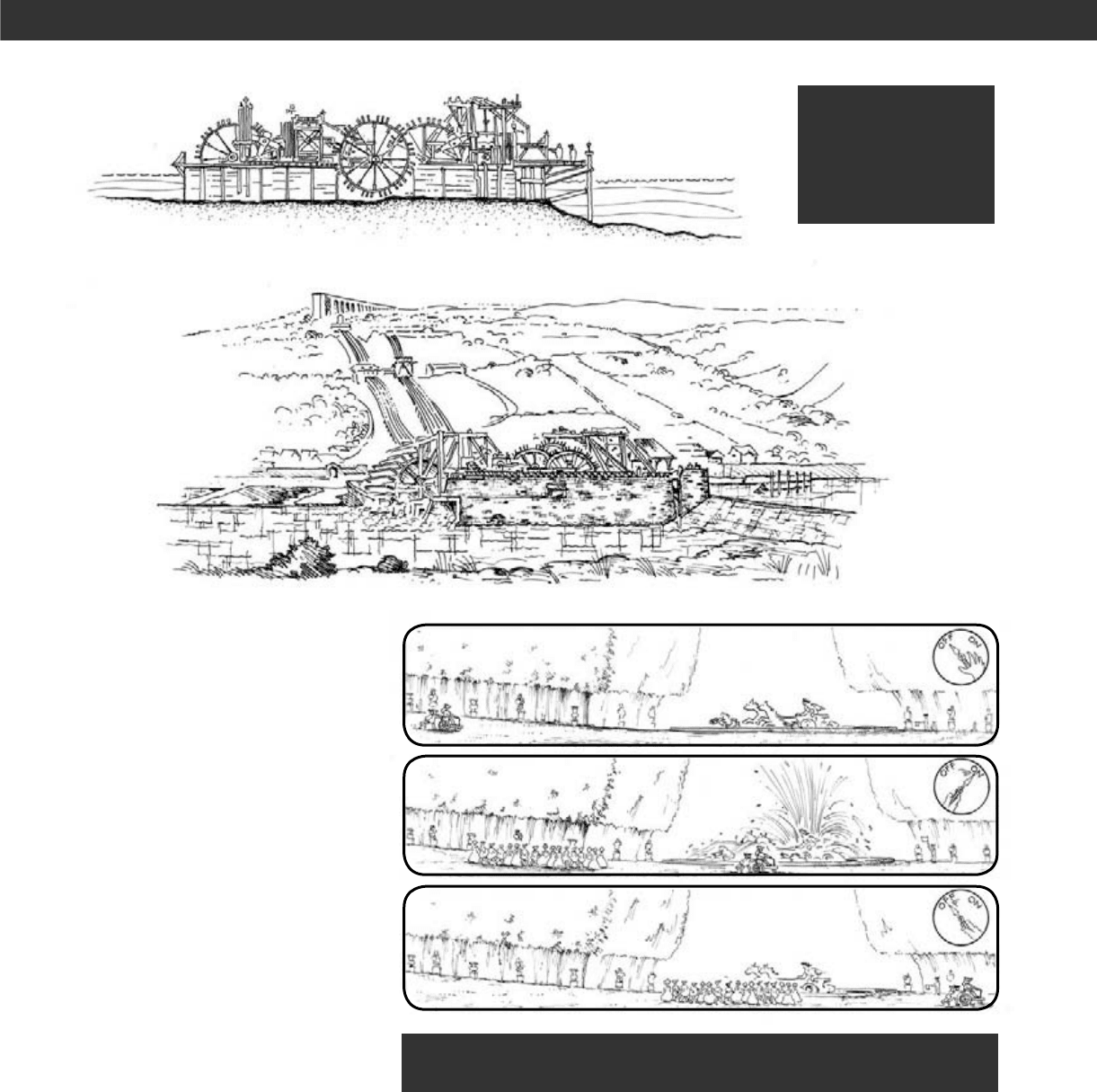
at once. Gardeners and fontainiers were
stationed along the king’s route to turn
the fountains on and off as he passed.
The magnifi cent Machine de Marly was
constructed in 1688 to raise water
from the Seine, nearly 4 miles away, and
17TH CENTURY
/
FRENCH CLASSICAL GARDENS
SITE PLAN OF VERSAILLES: The Grand Parc, a woodland crossed with diagonal
avenues and rond points, surrounded the Petit Parc. By 1689, the Grand Parc,
which included the hunting grounds and the forest at Marly, covered 37,000
acres.
LE ROI DE SOLEIL: Louis performed
in ballets dressed as Apollo.
142
parterre. In front of the main struc-
ture was the grand parterre, where 12
pavilions, 6 for men and 6 for women,
lined both sides of a central pool.
was at the center of geometrical
parterres. Allées, hedges, and statues
decorated the gardens. At the bottom
of the cascade at Marly was the petit
in different geometric patterns. In one
bosquet, a spectacular water theater,
built in 1671 and destroyed in the late
18th century, contained hundreds of
single jets capable of creating many dif-
ferent combinations of effects.
The transverse arm of the Grand Canal
was terminated by the Trianon at its
north end and the menagerie to the
south. The Trianon was built to accom-
modate Louis’s need to escape the public
atmosphere at the palace. In 1671, the
Trianon de Porcelaine was built for Louis’s
consort, Madame de Montespan. The
structure was replaced in 1687 with
the Grand Trianon, in honor of his new
mistress, Madame de Maintenon. The
grounds were used for cultivating fl owers.
Hothouses ensured that Louis would
have fl owers blooming year-round in the
garden.
The retreat at Marly, designed in 1677,
was even more secluded than the Tri-
anon. The hillside location enabled the
construction of a cascade, La Riviere,
composed of 53 steps of colored
marble. As at the Trianon, the house
17th CENTURY
/
FRENCH CLASSICAL GARDENS
MACHINE DE MARLY:
Fourteen wheels lifted
water 528 feet into res-
ervoirs and aqueducts
to supply Versailles’s
waterworks.
FLAGS AND WHISTLES: A crew of behind-the-scenes workers operated the foun-
tains at Versailles.
143
17TH CENTURY
/
FRENCH CLASSICAL GARDENS
BOSQUETS: The bos-
quets were decked out
with proscenium arches,
chandeliers, and tapes-
tries as set decorations
for performances.
CHANTILLY: The chateau is subor-
dinate to the monumental axis that
organizes the landscape.
Above the cascade was a primitive
roller coaster, large swings, and other
play areas. Louis’s intimate retreat at
Marly eventually contained a 300-acre
garden and an 1850-acre hunting park.
Le Notre is not believed to have been
involved in the planning and design
of Marly.
35
Although organized around a central
axis like Vaux-le-Vicomte, the gar-
dens at Versailles were so large and
the attractions so numerous that
no clear logic existed to visually lead
one through the space. When Louis
reached middle age, political and fa-
milial circumstances discouraged his
sponsorship of the huge spectacles of
his earlier years. He enjoyed stroll-
ing around the gardens and wrote an
itinerary for viewing his gardens in a
particular order. The king commands:
“Enter the labyrinth and after having
walked down as far as the ducks and
the dog, go up again and leave by the
side of Bacchus.”
36
The book, rewrit-
ten six times, is an excellent record of
the alterations made to the gardens
throughout his reign.
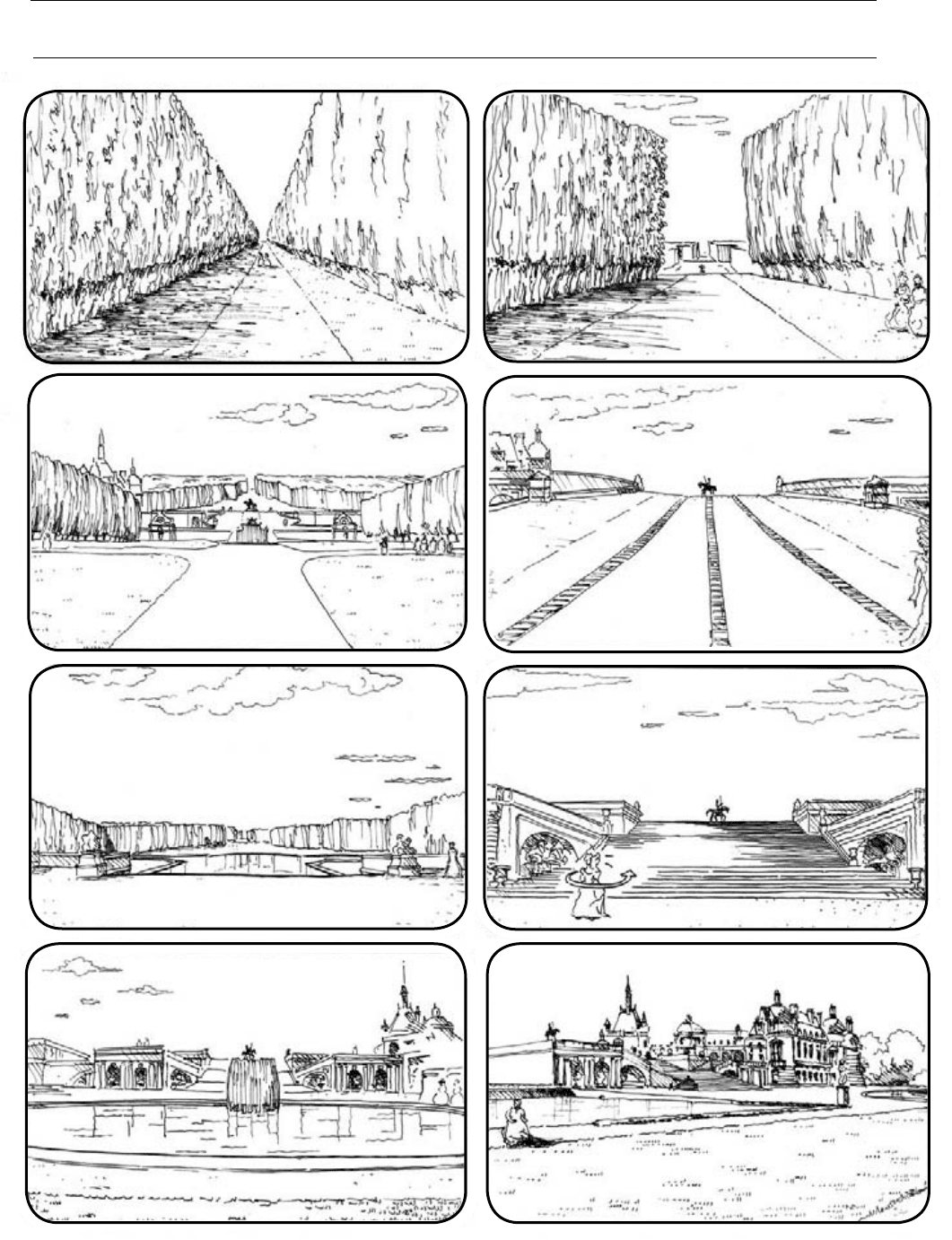
CHANTILLY
Prince de Conde regained possession
of his chateau at Chantilly in 1660. He
hired Le Notre to restore the gardens. Or-
ganized along a central axis of sight, the
visitor approaches the chateau through
the woods, focused on the equestrian
statue of Montmorency. Arriving at the
statue, which is situated on the Grand
Terrace, the gardens below become
visible. The house is to the left of the
axis. Descending the steps to the water
parterres, one sees a central rectangu-
lar pool connected to the long arms of
a transverse canal. The water feature
continues on the other side of the canal
in a semicircular shape. The monumental
axis extends into a clearing in the dense
woodland. There is no inherent symbolism
in the garden. The refl ecting pools and
the infi nite axial view are contemplative.
The pools at Vaux-le-Vicomte refl ect the
chateau, the station point of the vista.
The pools at Versailles refl ect the sun,
a representation of the former king. The
pools at Chantilly refl ect nature—the
woodlands, the sky, and the limitless
imagination of the viewer.
144
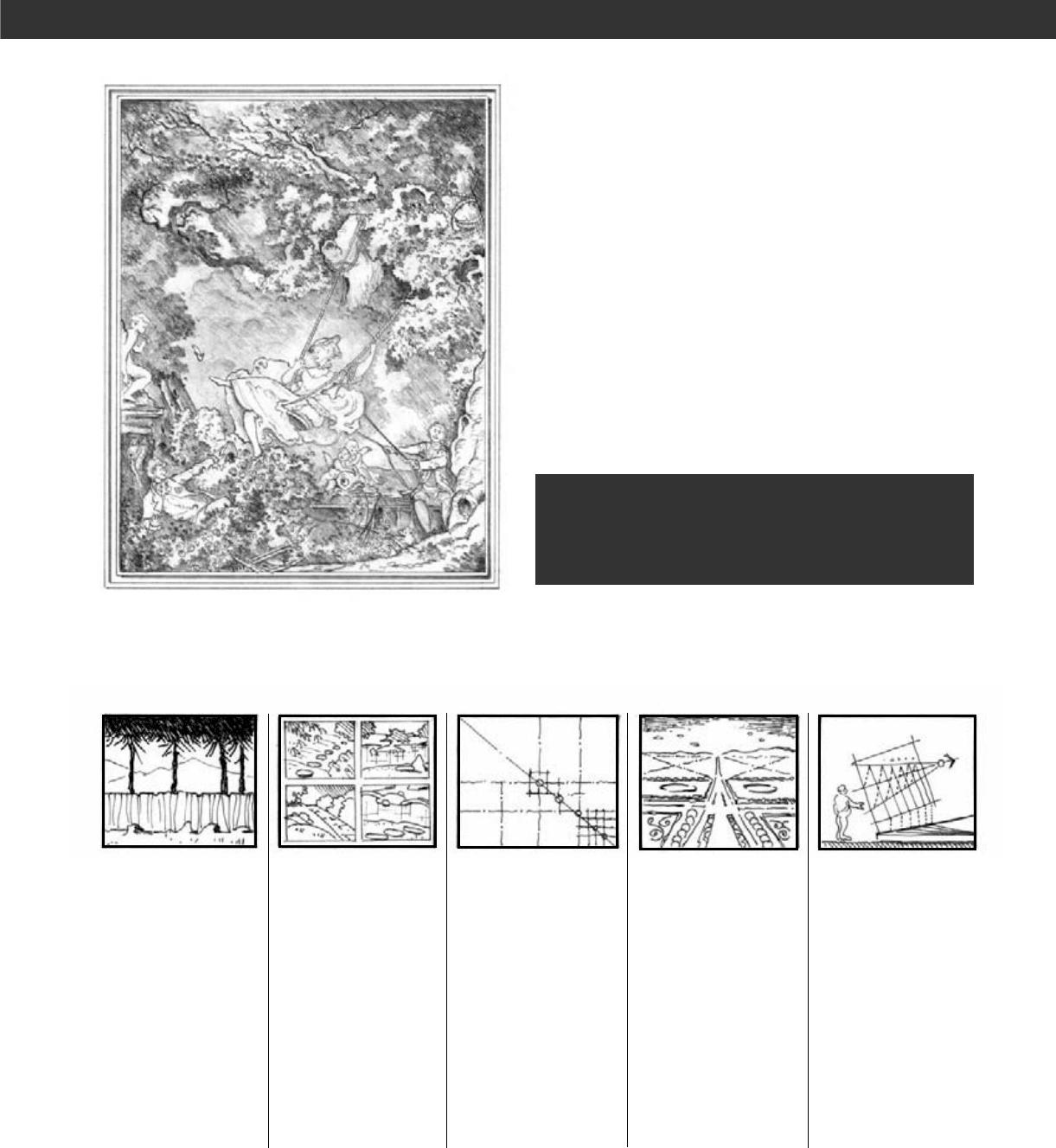
VISUAL NARRATIVE: Chantilly
145
SUMMARY
Straight lines! In the 17th century, the landscape was ordered by
geometries that expressed the power and authority of humans
over nature. Whether through monumental axes or lines of sight,
as chahar baghs or with borrowed scenery, gardens extended into
the landscape, literally and fi guratively.
DESIGN PRINCIPLES
17th CENTURY
/
CONCLUSION
SHAKKEI
Distant landscapes
are “borrowed” and
incorporated into the
pictorial composition
of Japanese stroll
gardens. Views are
framed by vegetation,
and garden elements
strategically placed
in the foreground help
place the viewer in the
scene.
HIDE AND REVEAL
Space unfolds incre-
mentally as various
focal points capture
the viewer’s atten-
tion and imagination
in the Japanese stroll
garden.
SUBDIVISION
Mughal gardens are
characterized by the
four-square paradise
form. The recursive
subdivision of the
four-square geometry
creates interesting
patterns and modula-
tions of space.
EXTENSION
French gardens of
the 17th century were
projected into the
landscape through
monumental axes.
Vistas merged with
the horizon.
ILLUSION
Perspective was
manipulated in Italian
Baroque gardens to
create theatrical ef-
fects and a sense of
mystery.
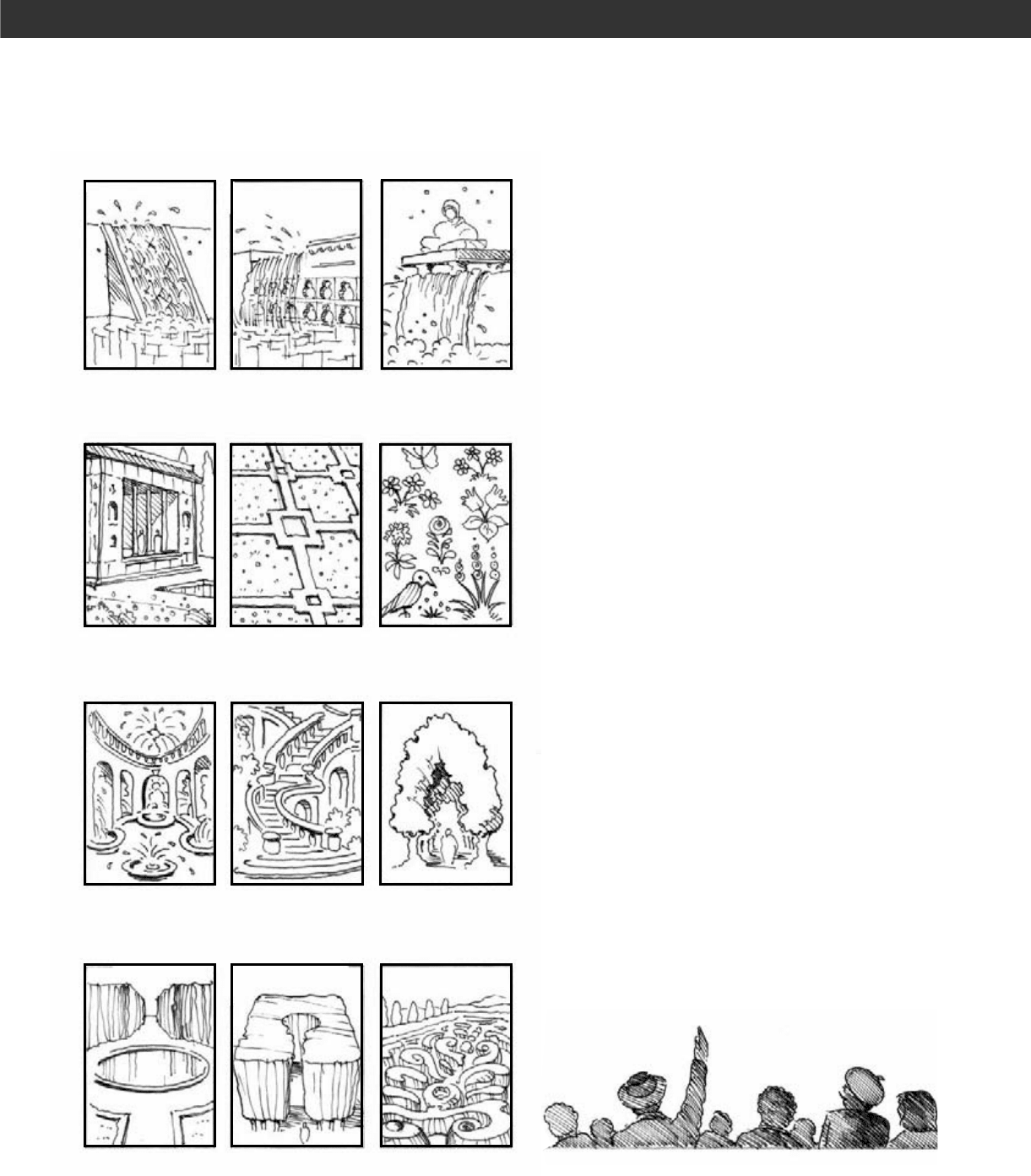
GIRL ON A SWING: Nature overtakes the garden in the paint-
ings of Neo-Romantics like Fragonard, Boucher, and Watteau.
They captured the decadent gaiety of the fetes galantes that
were staged in the decaying French formal gardens at the end
of the 17th century.
146
17th CENTURY
/
CONCLUSION
BOOKS
T
HE CRUCIBLE, play by Arthur Miller
D
ON QUIXOTE, by Cervantes
T
HE DIARY OF JOHN EVELYN
ESSAY CONCERNING HUMAN UNDERSTANDING, by John Locke
P
ARADISE LOST, by John Milton
T
HE SCARLET LETTER, by Nathaniel Hawthorne
T
ARTUFFE, by Molière
T
HE THREE MUSKETEERS, by Alexandre Dumas
FILMS
ARTEMISIA (1997)
L
AST YEAR AT MARIENBAD (1961)
T
HE NEW WORLD (2005)
R
ESTORATION (1995)
R
IDICULE (1996)
J
AMES CLAVELL’S SHOGUN, TV mini-series (1980)
V
ATEL (2000)
PAINTINGS AND SCULPTURE
LANDSCAPE WITH THE FLIGHT INTO EGYPT,
by Annibale Carracci (1603)
P
ORTRAIT OF CHARLES I HUNTING, by Anthony Van Dyck (1635)
L
ANDSCAPE WITH THE CHATEAU OF STEEN,
by Peter Paul Rubens (1636)
P
ASTORAL LANDSCAPE, by Claude Lorrain (1638)
E
T IN ARCADIA EGO (THE ARCADIAN SHEPHERDS),
by Nicolas Poussin (1640)
T
HE ECSTASY OF ST. THERESA, by Gianlorenzo Bernini (1645)
T
HE LETTER, by Jan Vermeer (1666)
DESIGN VOCABULARY
F
o
r further exploration
MUGHAL EMPIRE
Chadars, Chini-kanas, Chabutras
PERSIA
Talars, Chahar baghs, Flowers
FRANCE
Refl ective pools, Bosquets, Parterres de broderie
ITALY
Water theaters, Stairs, “Stage” management