
Boults Е. Illustrated history of landscape design
Подождите немного. Документ загружается.

157
18th CENTURY / ENGLAND
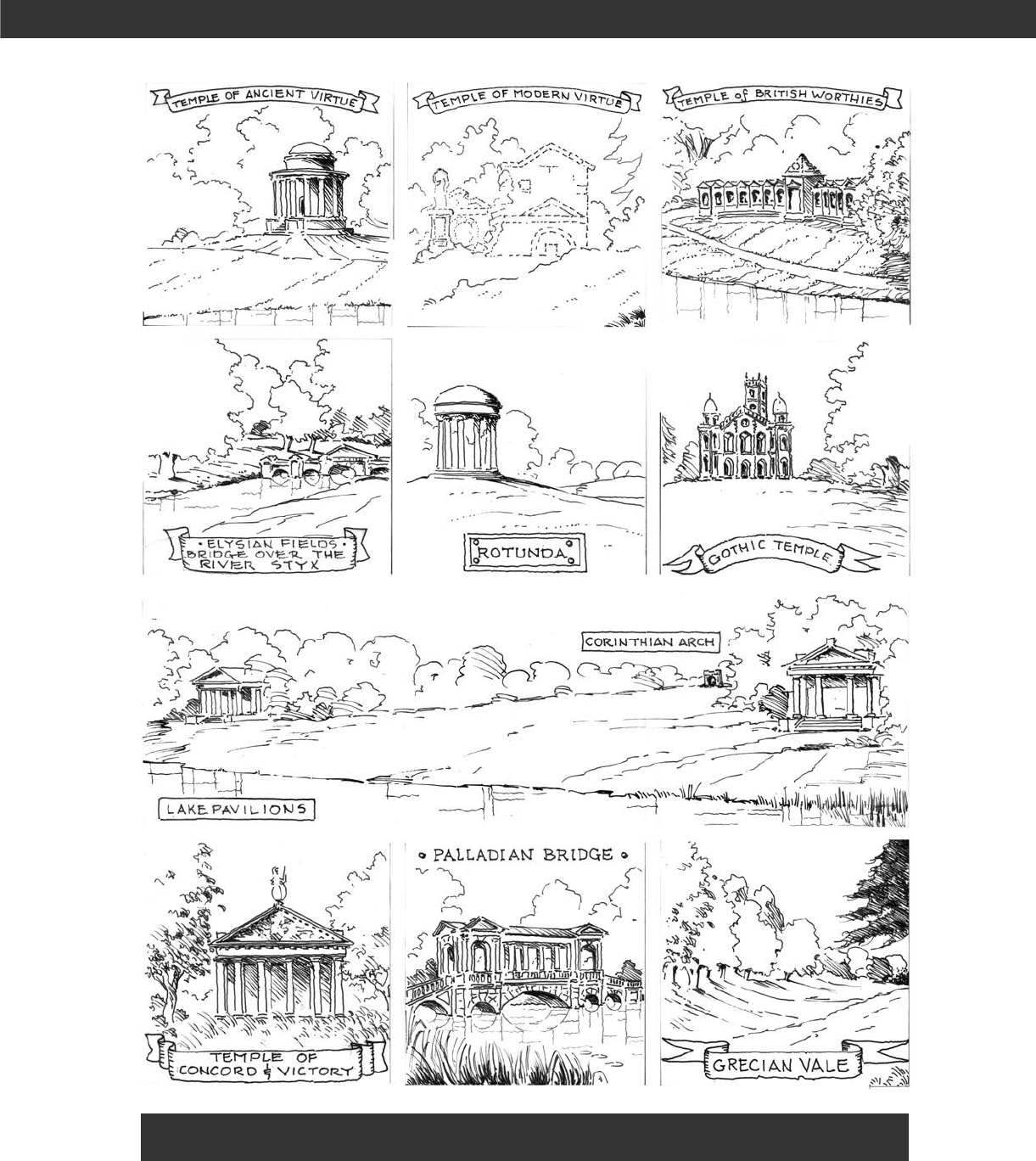
ELYSIAN FIELDS: Like the garden at Versailles was used as political theater by Louis XIV, the design of Stowe was
politically motivated.
158
18th CENTURY / ENGLAND
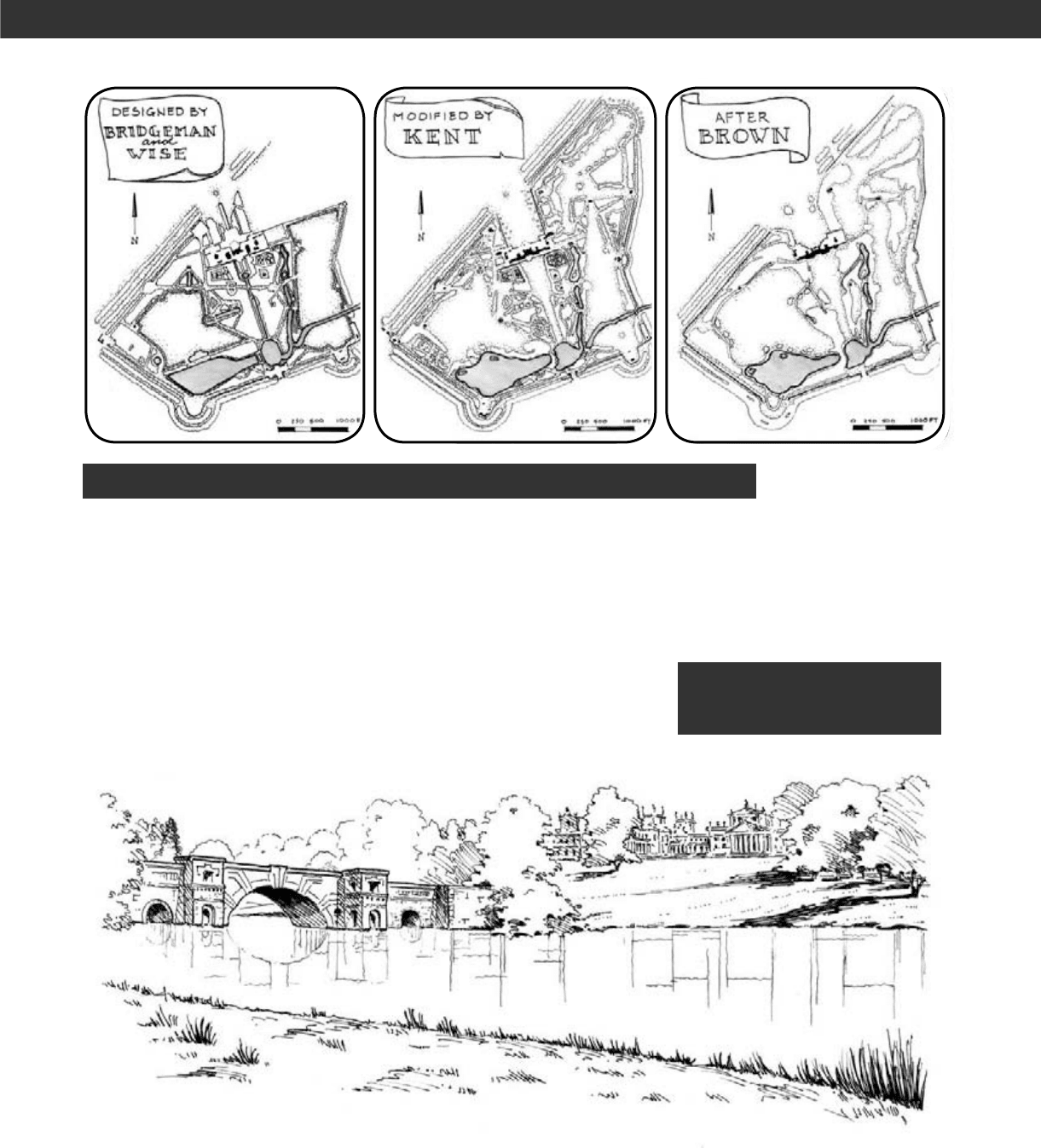
Brown began his work at Stowe in 1741.
He extended the Grecian valley and cre-
ated the south lawn.
BLENHEIM, OXFORDSHIRE
The original plan of Blenheim was
completed in 1722 by Henry Wise, who
designed a monumental parterre in
keeping with the grandeur of the build-
ing. An axial alignment of trees along
the approach avenue represented the
placement of soldiers in the Battle of
Blenheim.
Brown’s work at Blenheim began in
1764. He dammed the river and exca-
vated the two existing lakes, raising
the water level to make the single vol-
ume of water more in balance with the
STOWE: The successive site plans are a record of changing garden design styles in the 18th century.
BLENHEIM: Brown’s changes to the
Blenheim plan exemplifi ed the new
naturalistic style.
heavy architectural mass of the stone
house and bridge. He obliterated the
parterres and brought the lawn to the
base of the huge palace.
159
STOURHEAD, WILTSHIRE
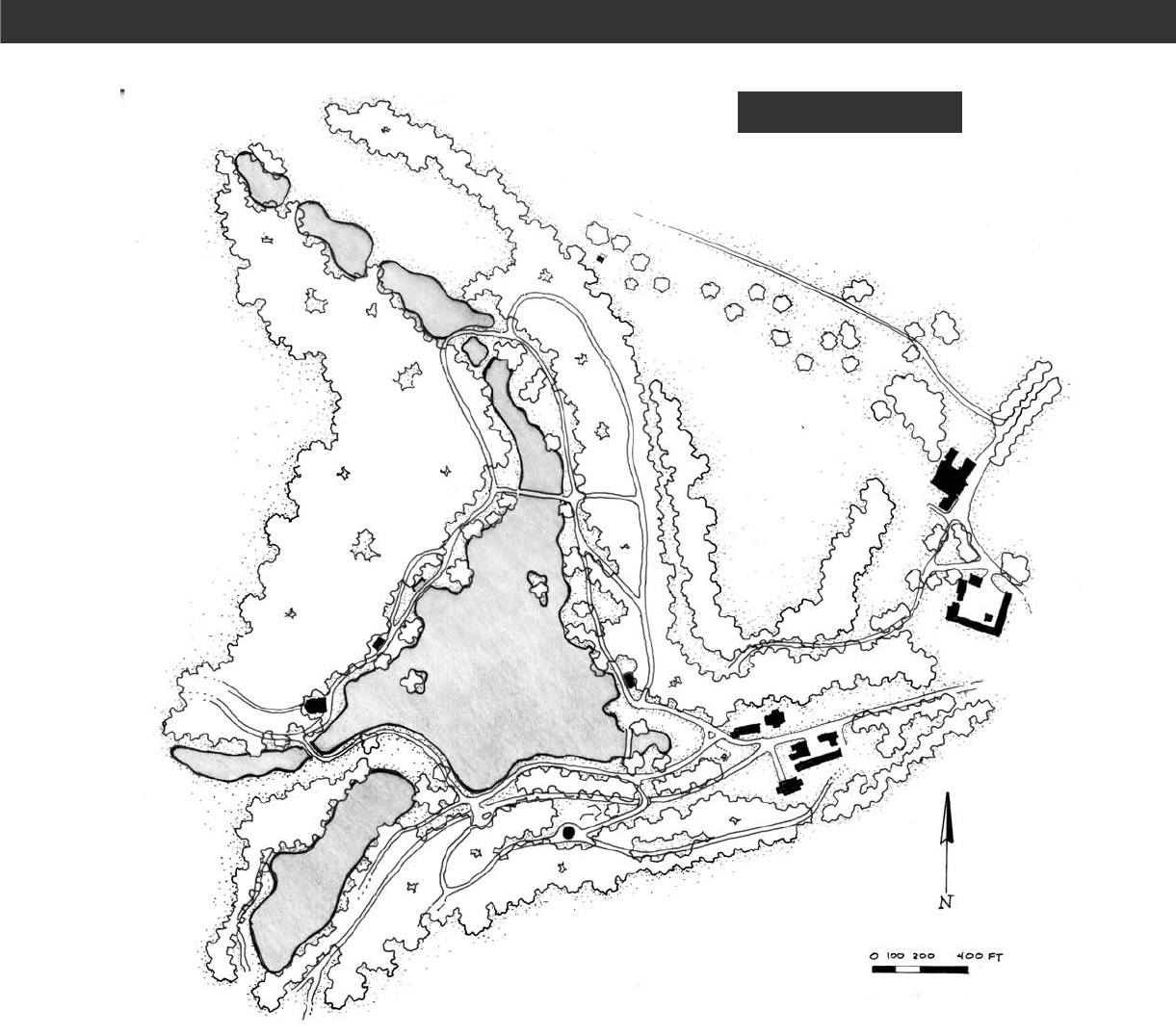
The design of Stourhead was begun
by its owner, Henry Hoare II, in 1735.
He set the garden in a deep valley
around a 20-acre lake, which he
constructed by damming a stream.
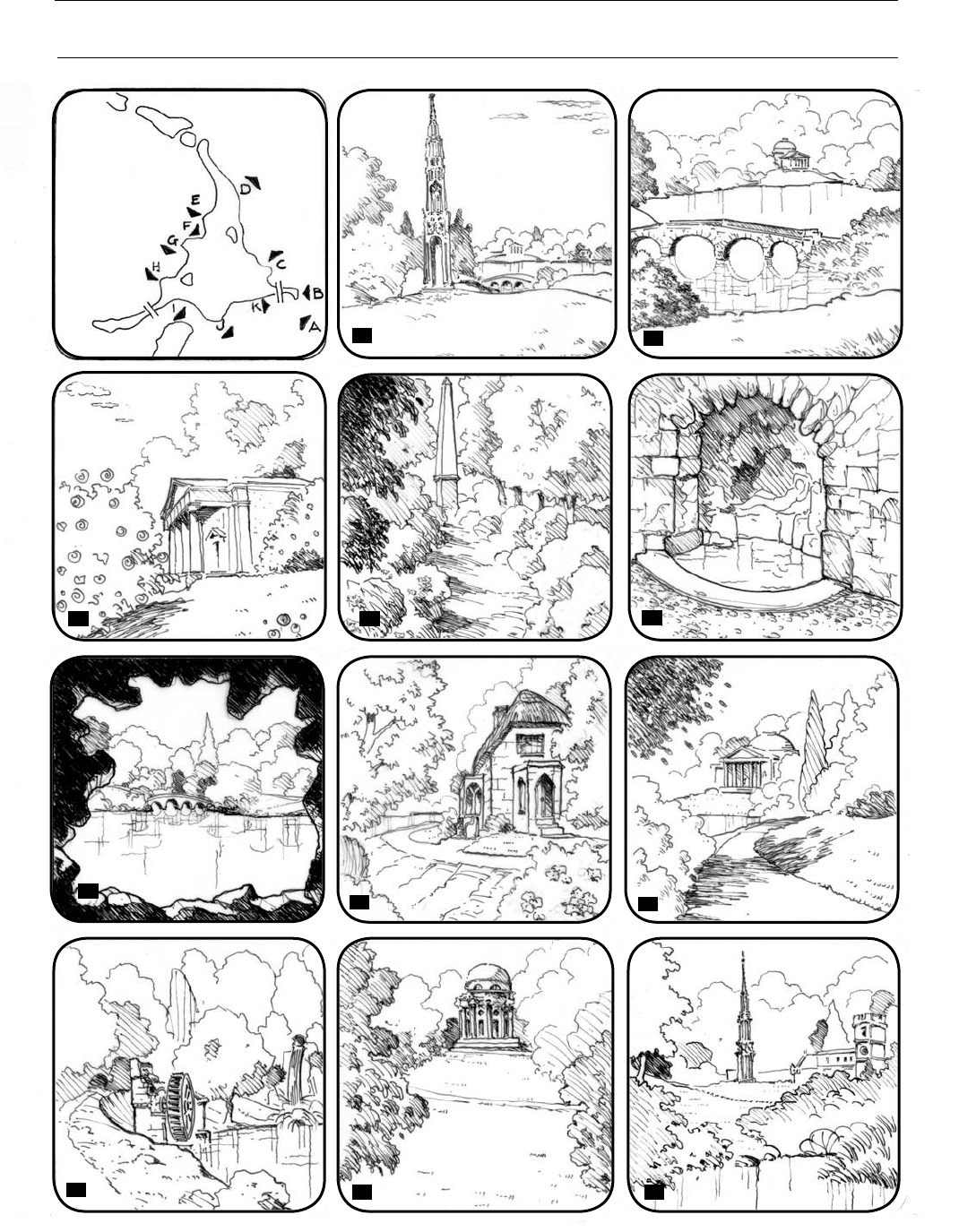
While the narrative circuit at
Rousham incorporated outward
views to distant scenes, the garden
at Stourhead focused inward, on
intimate views across the central
lake. The path leads the visitor in a
counterclockwise direction, relating
a sequence of events from Virgil’s
The Aeneid—the story of the voyage
to Rome by Aeneas and the Trojan
survivors. From the Temple of Apollo,
the ultimate stop on the itinerary,
the whole garden becomes visible.
STOURHEAD: Site plan.
18th CENTURY / ENGLAND
160
A
B
C
F
I
J K
G
H
D
E
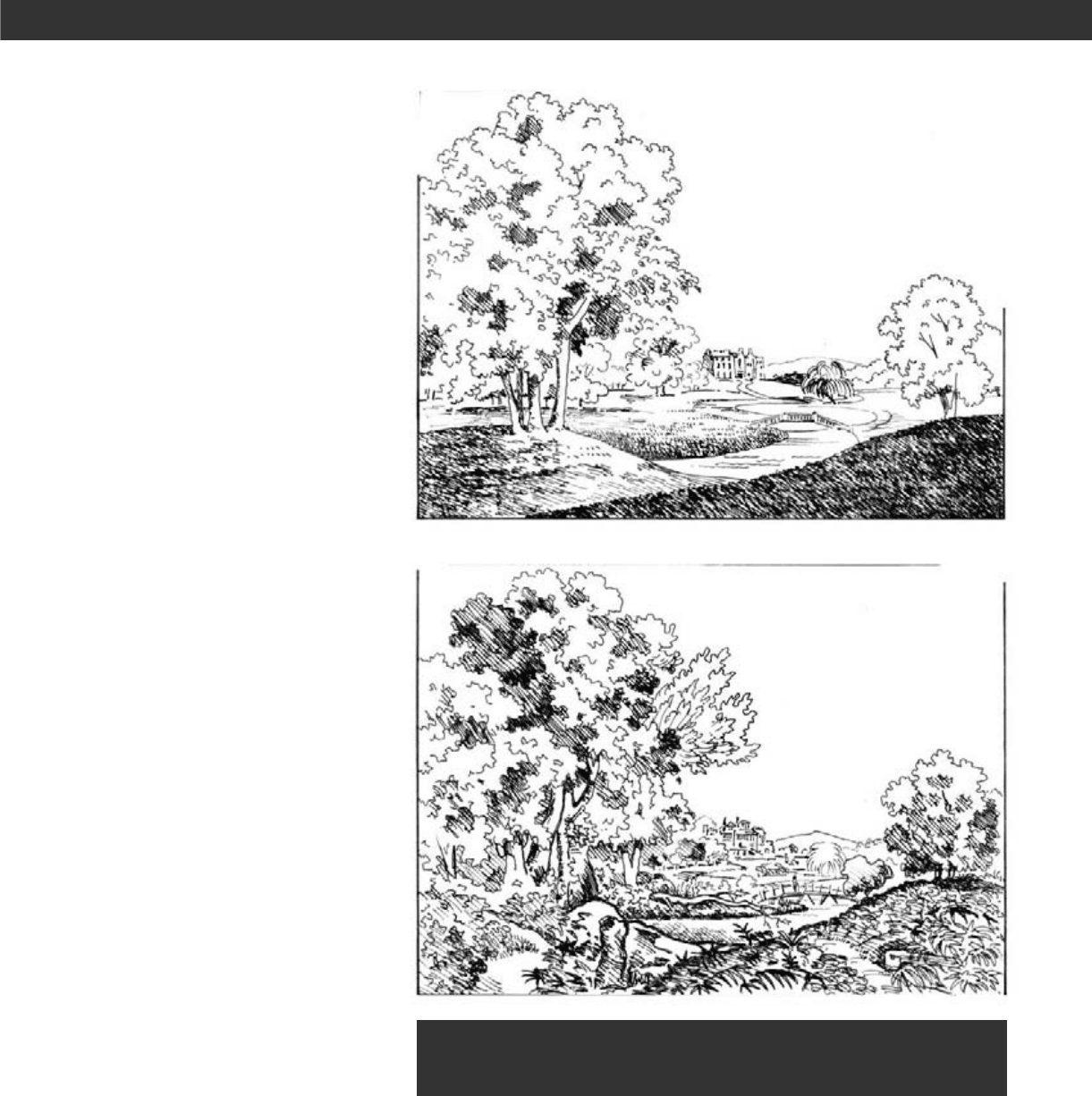
VISUAL NARRATIVE: Stourhead
161
STYLISTIC
CONTROVERSY
What exactly a naturalistic garden
should look like became a matter of
contention early in its history. The
aesthetic rebellion against formalism
was interpreted in different ways—as
beautiful and as picturesque. The de-
bate about the superior style was taken
seriously because taste was critical to
position in English society. Added to the
mix was the new fad for Chinese decora-
tive styles, and the idea of the sublime.
In addition to the idealized view of an-
tiquity that the landed gentry brought
back from their grand tours of Italy, Chi-
nese imagery began to exert an infl uence
on the English imagination. In William
Chambers’s book Dissertation on Orien-
tal Gardening, published in 1772, he sug-
gested a sort of Chinese fantasyland as
a counter to the naturalistic movement.
He interpreted the emotional effects
of Chinese gardens as being “pleasing,
horrid, and enchanted,” and suggested
that a sublime garden should contain
some element of terror—like the clamor
of a thunderstorm or the threat of a
fi re. He used the publication to critique
Capability Brown’s style, complaining
that Brown’s work was indistinguishable
from nature’s own. Chambers’s book was
infl uential in the development of highly
wrought rococo styles in continental
Europe and led to the popularity of the
jardin anglo-chinois in Germany and
France.
Artists and critics put forth aesthetic
theories to explain the qualities of the
landscape most desirable in a garden.
The painter William Hogarth published
his book The Analysis of Beauty in 1753,
suggesting that all beautiful forms fol-
low an S-curve. Beauty was expressed
in the landscape by the fl owing forms
and unrestricted spaces defi ned by a
serpentine line. The philosopher Edmund
Burke wrote an essay in 1756 entitled A
Philosophical Enquiry into the Origin of
Our Ideas of the Sublime and Beauti-
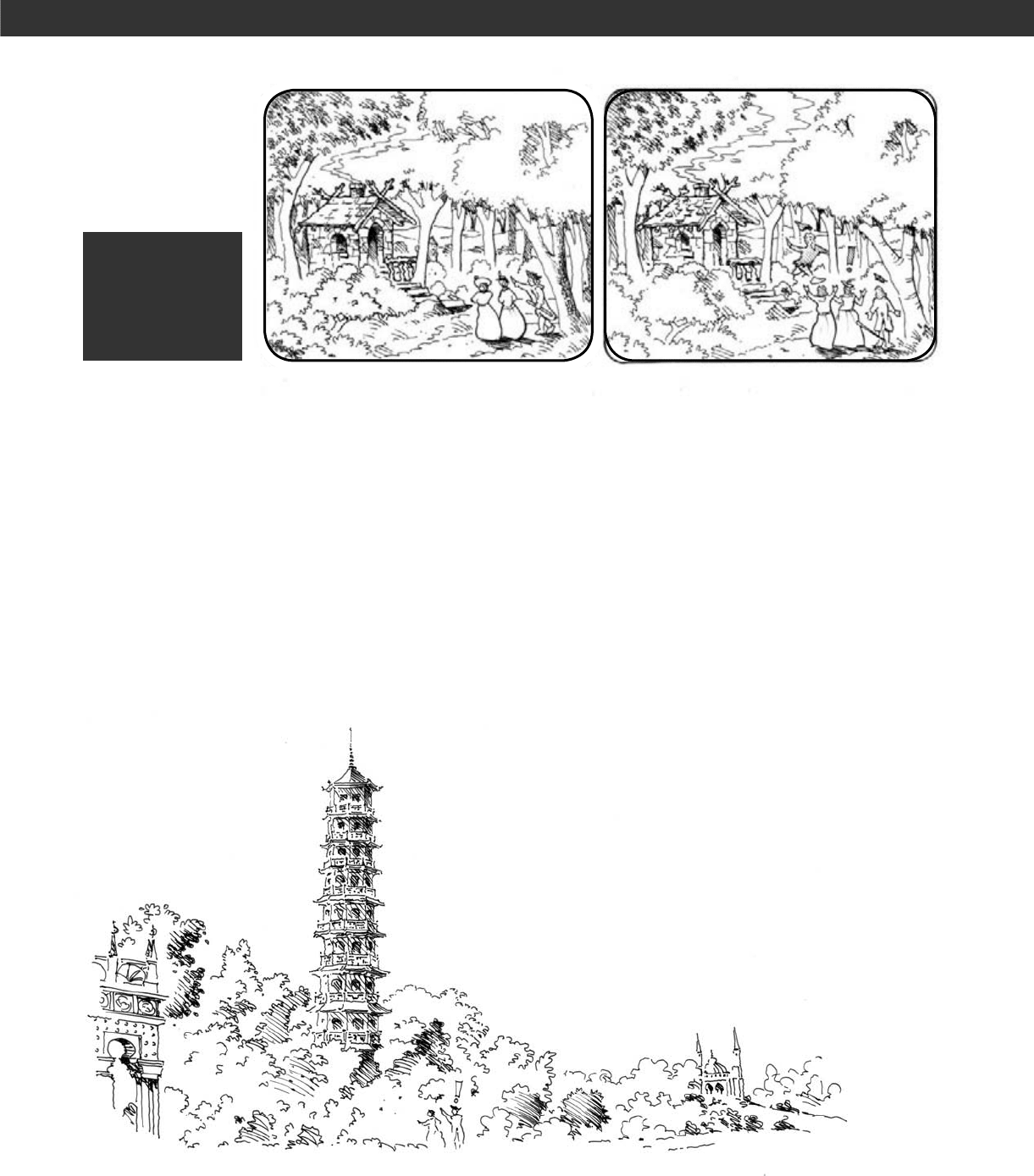
THE LANDSCAPE—A DIDACTIC POEM: Richard Payne Knight compared a pictur-
esque scene (bottom) to the landscape gardens of Brown (top), “dressed in the
modern style.”
18th CENTURY / ENGLAND
162162
18th CENTURY / ENGLAND
RUSTIC IDYLL:
Estate owners
added grottoes and
hermitages to their
gardens for their
poetic associations.
trasting elements that would appeal
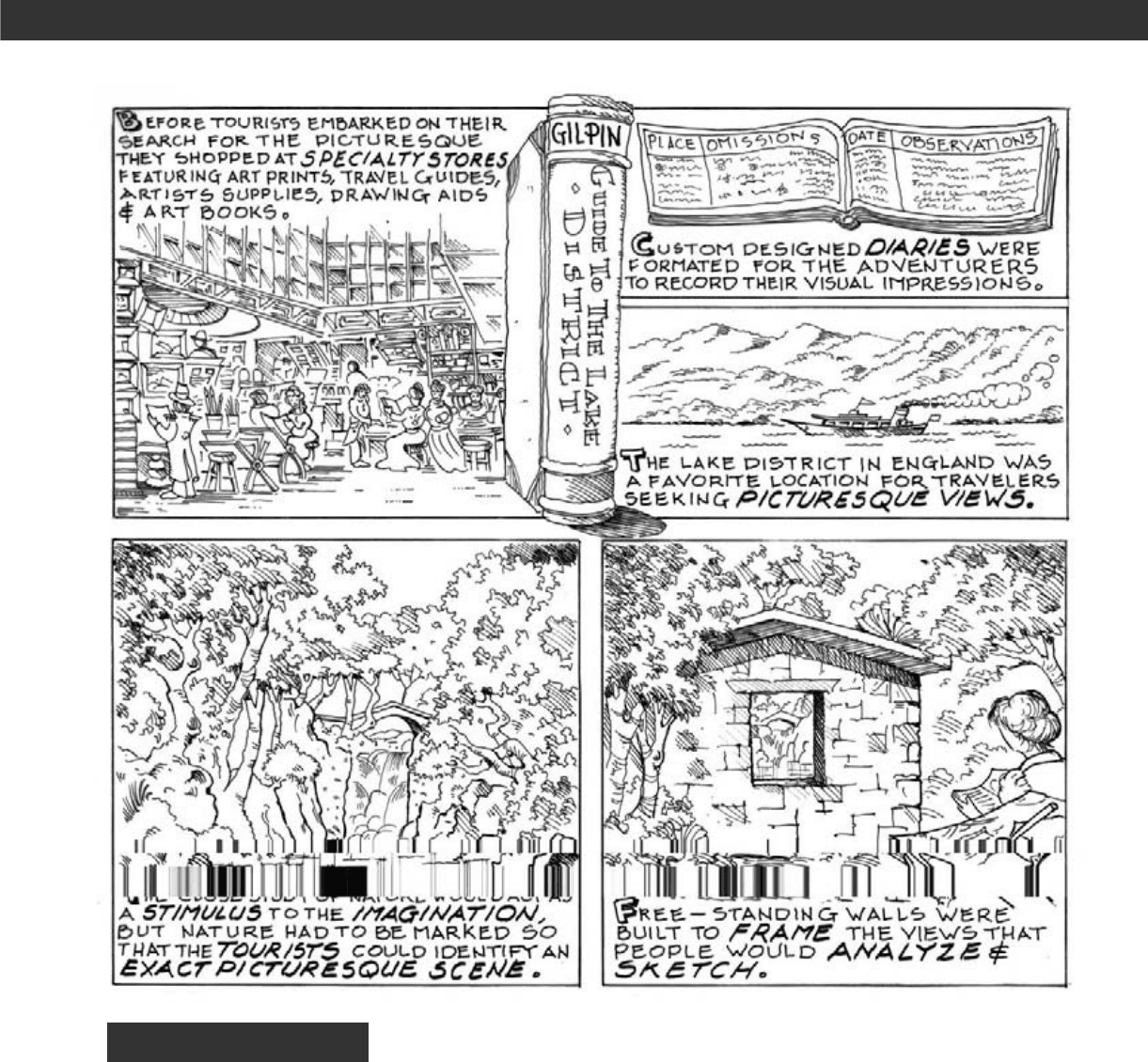
to a painter. William Gilpin proposed
that the landscape should be viewed
the same way a painting is viewed, that
views of nature should be picturesque.
10
The formal, compositional aspect of
pictures, not their thematic content, is
what came to defi ne the viewer’s experi-
ence of nature in the second half of the
18th century. Scenery without statuary
was valued; the experience shifted from
looking at objects in the landscape to
looking at the landscape as an object.
Gilpin traveled the British Isles and pub-
lished his observations on various scenic
spots. In his book, Observations on the
River Wye, and Several Parts of South
Wales, &c. Relative Chiefl y to Picturesque
Beauty; Made in the Summer of the Year
1770, he expanded the defi nition of the
picturesque to include the requirements
of ruggedness, variety, and architectural
elements.
Gilpin also published touring
guides and gave instructions for framing
particular views according to compo-
sitional techniques used by painters.
People sought a more dramatic depiction
ful, in which he proposed that beauty
is characterized by smoothness and
gentle transition. The sublime, on the
other hand, was characterized by rug-
ged, masculine forms.
Intellectuals such as Uvedale Price and
Richard Payne Knight grew discontent
with the sameness and lack of distinc-
tion within the Brownian landscape
garden. Anti-Brownian sentiment
reached its apex as Repton entered
the profession. Critics called for more
rugged scenery—the inclusion of con-
163
of nature and toured the countryside
sketching and analyzing scenery.
A scathing war of words was waged
in the press between the two schools.
Thrown into the mix was Chambers,
with his new requirement of terror to
defi ne the sublime. There were now three
conceptions of space: the beautiful, the
18th CENTURY / ENGLAND
GILPIN’S PICTURESQUE TOURS.
picturesque, and the sublime. Repton
countered that the use and experience
of the landscape should be the foremost
criteria for evaluation, not its two-
dimensional characteristics. Walpole
defended Brown against Chambers.
Knight and Price later disagreed with
each other over matters of taste and
what form variety should take.
The abstraction of the landscape
yearned for by Price and Knight
would develop in the 19th century as
Impressionism. The debate had been
centered on aspects of the tame and
the wild. The argument continued into
the next century, when John Claudius
Loudon developed another style—the
gardenesque.
The revolution of taste spread across
Europe at the end of the 18th century,
about the same time that Attiret’s
letters from China reached France. The
French saw a connection between the
Chinese garden and the English garden
through their similar vocabularies of
winding paths and irregularly shaped
lakes. A hybrid style known as anglo-
chinois became popular in France and
Germany.
The appeal of uncorrupted nature was
also felt throughout French soci-
ety in the late 18th century. French
writer Jean-Jacques Rousseau wrote
a novel, La Nouvelle Heloise, in which
he described a garden where no trace
of human intervention can be found.
He evoked poetic images of a glorifi ed
wilderness that was later reproduced in
actual gardens. The book had a big im-
pact on Marquis Rene-Louis de Girardin,
who created one of the best examples of
an English landscape garden in France
at Ermenonville.
Girardin himself was intimately
engaged in the project. The full title
of the treatise he published in 1777
summarized his design intentions: De
la composition des paysages, ou Des
moyens d’embellir la nature autour
des habitations, en joignant l’agreable
a l’utile (Of the composition of land-
scapes, or ways of embellishing the
land surrounding dwellings by bringing
together what is pleasurable and what
is useful). Girardin toured England
in 1763 and visited the Leasowes.
Ermenonville contained similar kinds of
rustic retreats and artifi cial pasto-
ral elements—fabriques—like mills,
cascades, tombs, and temples. The
grounds comprised four distinct areas:
the grand parc, petit parc, farmland,
and wilderness, called the Desert.
Girardin’s model farm was both func-
tional and ornamental. Its utilitarian
purpose helped create renewed interest
in “real” agriculture in France.
11
18th CENTURY
/
FRANCE
Rousseau left Paris for Ermenonville
and died there months later. In an
ironic twist, the “man of nature and of
truth” was buried in Girardin’s garden
on an artifi cial island in an artifi cial lake.
(His body was eventually moved to the
Pantheon in Paris.) The romantic image
of the Isle of Poplars—the circle of
poplar trees and the isolated tomb—was
much imitated in later gardens and
cemeteries, prompting the 19th-century
cult of the melancholy.
The landscape garden remains enormously
infl uential today. The style, as artifi cial
and contrived as French formalism, is for
many people synonymous with nature.
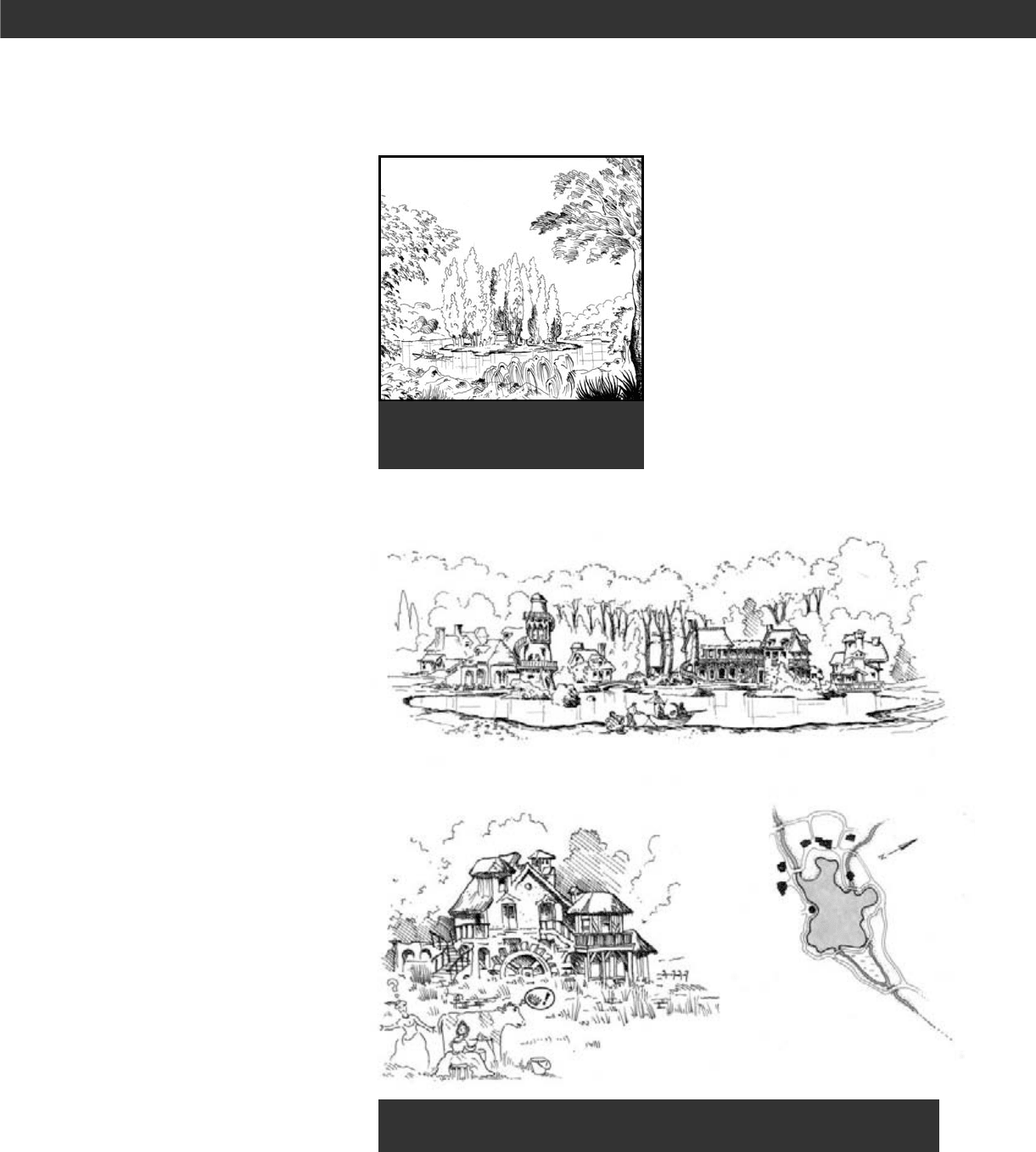
THE LANDSCAPE GARDEN IN FRANCE
HAMEAU: In 1782, Marie Antoinette commissioned Le Hameau de la Reine (the
Queen’s Hamlet), a model farm, for the Petit Trianon at Versailles.
164
ILE DES PEUPLIERS: Jean-Jacques
Rousseau’s tomb at Ermenonville.
165
18th CENTURY
/
CHINA
In the late 17th century, Manchu warriors
from the north deposed the last Ming
emperor, establishing the Qing Dynasty
(1644–1911). The foreign rulers strength-
ened the country by reconciling various
tribes and ridding the court of corrup-
tion. Chinese territory extended into
Central Asia. In 1710, approximately 110
million people inhabited China; by 1814,
the population had reached 375 million.
12
The height of prosperity and expansion
was reached during the reign of Qianlong
(1736–1795), who also nurtured the
development of the arts and sciences.
The imperial palace became a repository
for the emperor’s collection of rocks and
paintings from Suzhou.
Qianlong welcomed the Jesuit mission-
aries and invited them to live at court
as his advisors on Western culture.
French, Italian, and German priests had
lived in the Forbidden City since the 17th
century. In fact, German missionary
Johann Adam Schall von Bell reformed
the Chinese calendar and was appointed
director of the royal observatory at
Beijing, in 1651.
Parallels exist between Chinese gardens
and English landscape gardens. The fl ow
of nature inspired their forms, and both
shared similar motives to prompt emo-
tional reactions in the viewer through
poetic allusion. The poetic naming of
views and their conceptual association
with natural scenery was as critical to
Chinese gardens as political references
were to English gardens.
IRREGULAR
BEAUTY
English explorers and merchants related
their impressions of the “spontaneous
beauty” they saw in Chinese gardens.
13
Chambers, whose tour of China was
limited to Canton province, wrote of
the asymmetry of Chinese forms. He
and the other advocates of the sublime
yearned for gardens with gripping visual
content. They saw in the Chinese garden
a fundamental interdependence of
architecture and garden that was lack-
ing in the English landscape gardens of
Capability Brown.
More than just the Chinese aesthetic of
natural order appealed to the English.
Advancement in the Qing court was
based on one’s knowledge of Neo-Confu-
cian philosophies. Confucian teachings,
particularly the idea that status could
be acquired through cultural education
rather than birthright, were inspiring
to the Europeans, who were rebelling
against absolutist forms of government
and royal privilege.
The wealth and power of Beijing culture
during the Qing dynasty is captured in
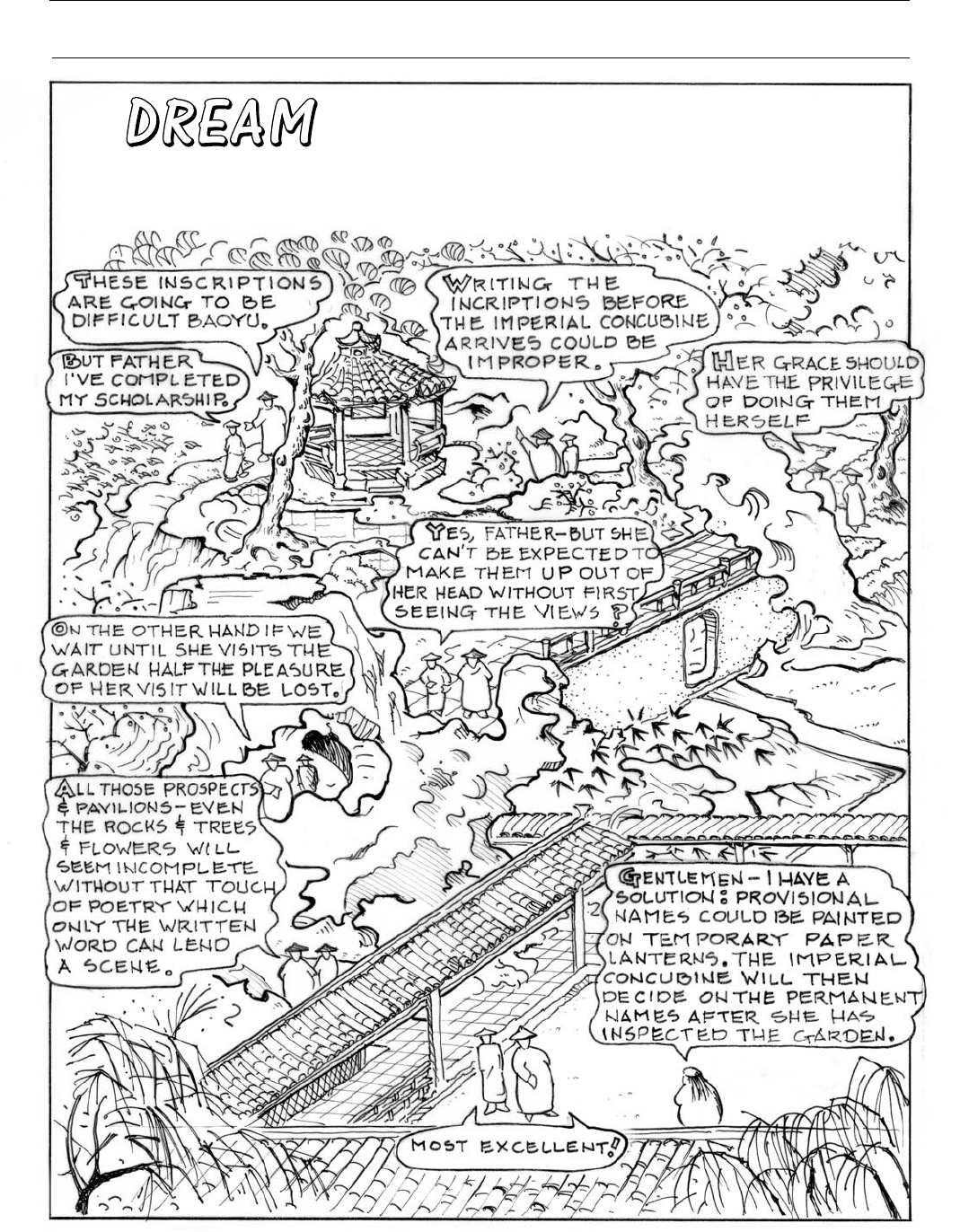
The Dream of the Red Chamber (also
called The Story of the Stone) written
by Cao Xueqin in the 1750s. The novel is
a good primary source of information
on 18th-century Chinese gardens, since
a main part of the story takes place
in a garden. The daughter of a wealthy
aristocratic family has been appointed
royal concubine. Her family prepares for
her visit by enlarging their garden and
adding apartments. The author leads the
reader on a tour of the garden, describing
its elements and materials—pavilions,
rocks, stone bridges, orchards, artifi cial
mountains, and so on. The family is trying
to come up with poetic inscriptions for
the spaces, because a garden is not com-
plete without them. Their suggestions
(such as “pathway to mysteries”) were
written on paper lanterns and left for the
daughter to select.
QIANLONG’S IMPRINT
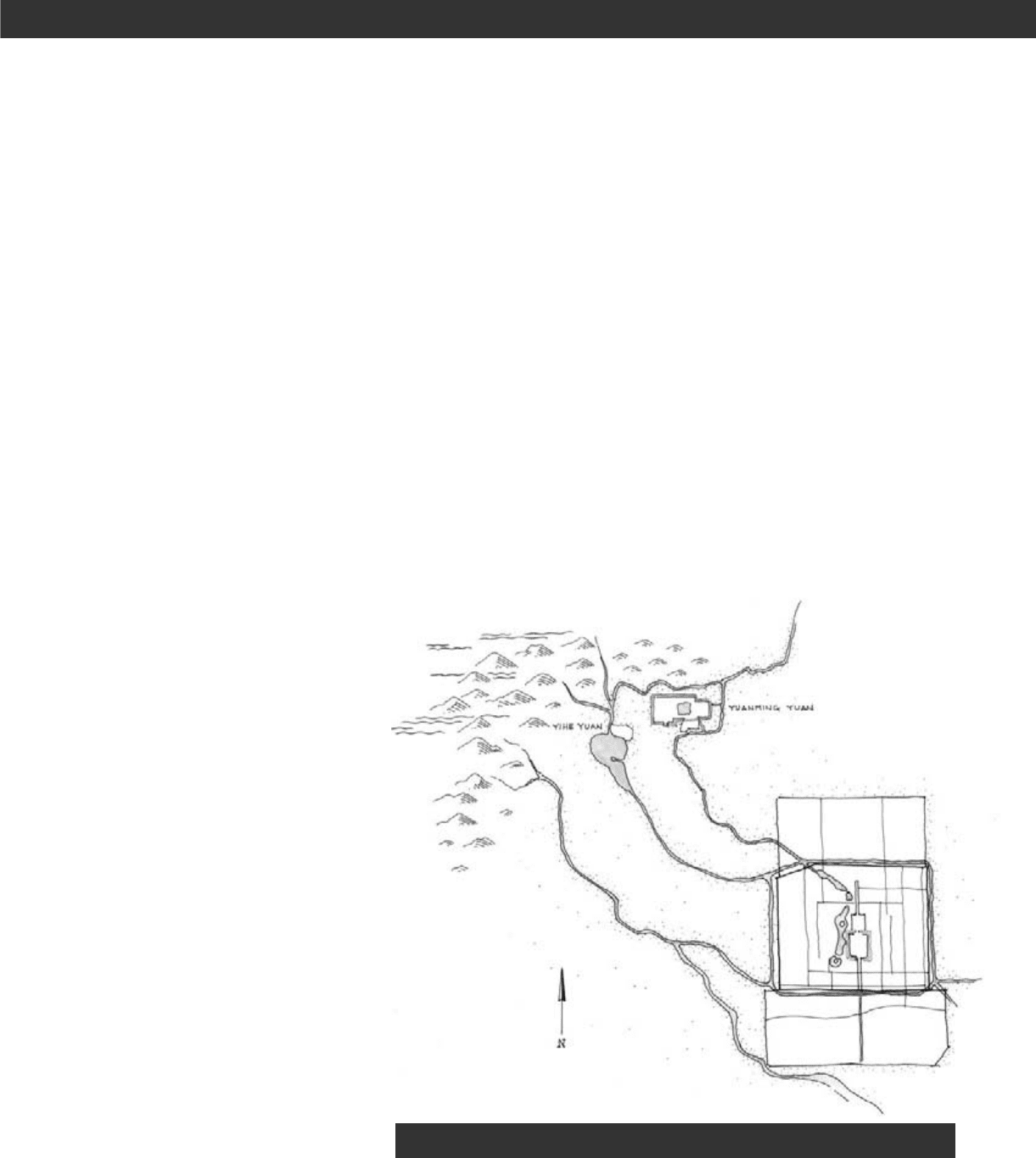
FRAGRANT HILLS: Emperors built imperial villas in the hills northwest of Beijing.
166
of THE RED CHAMBER
This 18th-century novel takes place in a newly built garden, a constructed nature questioned by one of
the protagonists.
VISUAL NARRATIVE