
Boults Е. Illustrated history of landscape design
Подождите немного. Документ загружается.

167
During the early Qing period, the em-
peror built pleasure gardens in the hills
northwest of the capital. The gardens
of Suzhou, in southern China, served as
inspiration. Representative examples of
both are described here.
YUANMING YUAN (GARDEN OF
PERFECT BRIGHTNESS), BEIJING
The imperial gardens, located in
the Western Hills outside the For-
bidden City, were first planned by
Emperor Kangxi, and further devel-
oped by his grandson Qianlong. The
Yuanming Yuan has much in common
with Versailles. The huge, elaborate
garden was established as the seat
of government by Qianlong, much
like Versailles became the official
court under Louis XIV. Both gardens
reflect the grand ambitions of their
royal patron. The Yuanming Yuan was
destroyed during the war with France
and Britain in the 19th century.
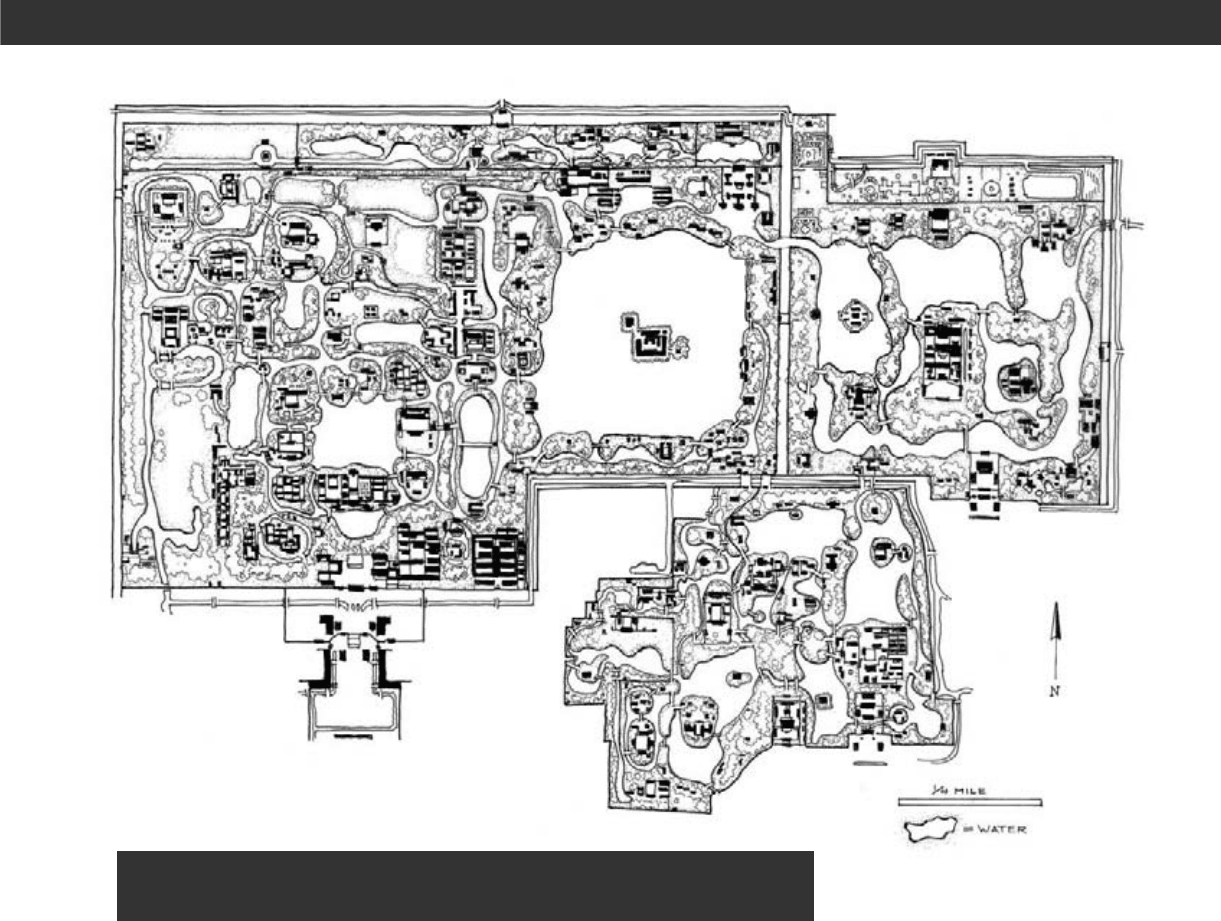
The Yuanming Yuan comprised three
linked gardens, which, through dredging
and artifi cially fi lling the fl at site, re-
created the topography and water-
18th CENTURY
/
CHINA
GARDEN OF PERFECT BRIGHTNESS: The garden encompassed more than 700 acres,
with water covering about one-third of the site.
scape of the three geographic areas
of China—the northwest plateau,
the great plains, and the southeast
coastal area.
14
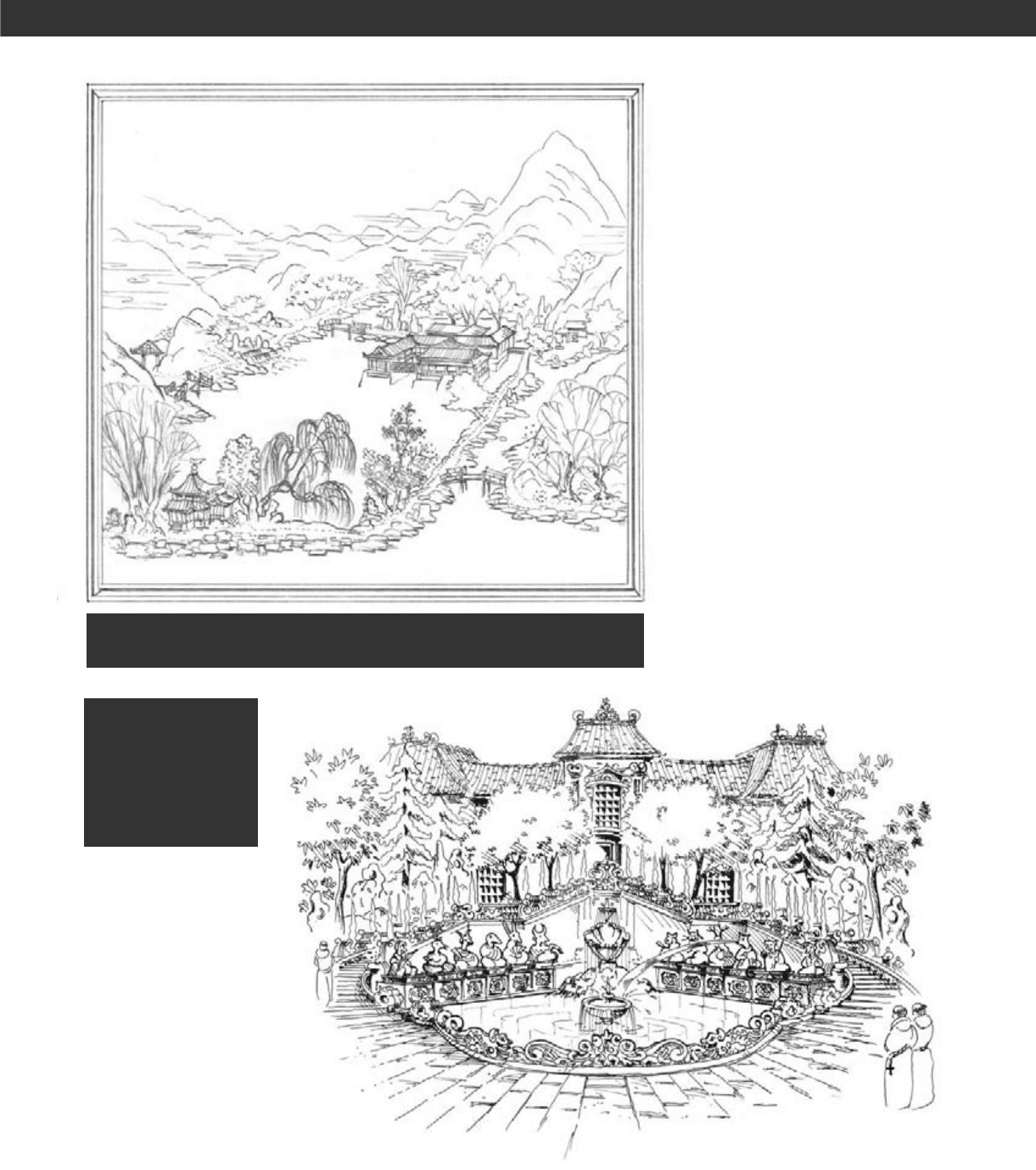
Qianlong designated the
“40 best views” of the garden. He wrote
poems about them and commissioned
court artists Tang Dai and Shen Yuan
to paint the 40 scenes. The album of
silk paintings was completed in 1747
and now resides in the Bibliotheque
Nationale, in Paris.
168
Images of the garden reached Europe
in the mid-18th century. French and
Swedish publishers reproduced the
paintings of the famous scenes as
woodcuts in European editions. The
scale of the Yuanming Yuan was also
described by Father Attiret in his let-
ters of 1743.
Qianlong was interested in foreign
garden styles and asked the Jesuits
to design a garden in the European
style. The work was undertaken by
Giuseppe Castiglione, Michel Benoit,
and Attiret. They created a baroque
garden complete with sculpture, foun-
tains, parterres, a brick maze, and the
famous water clock that told time by
spouting water from the mouths of 12
different animals.
Qianlong loved gardens and kept build-
ing them. The huge complex contained
study pavilions, entertainment rooms,
audience halls, artifi cial hills, canals,
rockeries, a library, farm fi elds, and
drill fi elds. Each space had a unique
identity, defi ned by both architecture
and landscape.
18th CENTURY / CHINA
FORTY FAMOUS VIEWS: The 40 dominant scenes of the Yuanming Yuan were
internationally known.
CHINESE VERSAILLES:
Emperor Qianlong
asked the Jesuit
residents of the palace
to build a European-
style garden within the
Yuanming Yuan.
169
YIHE YUAN (SUMMER
PALACE), BEIJING
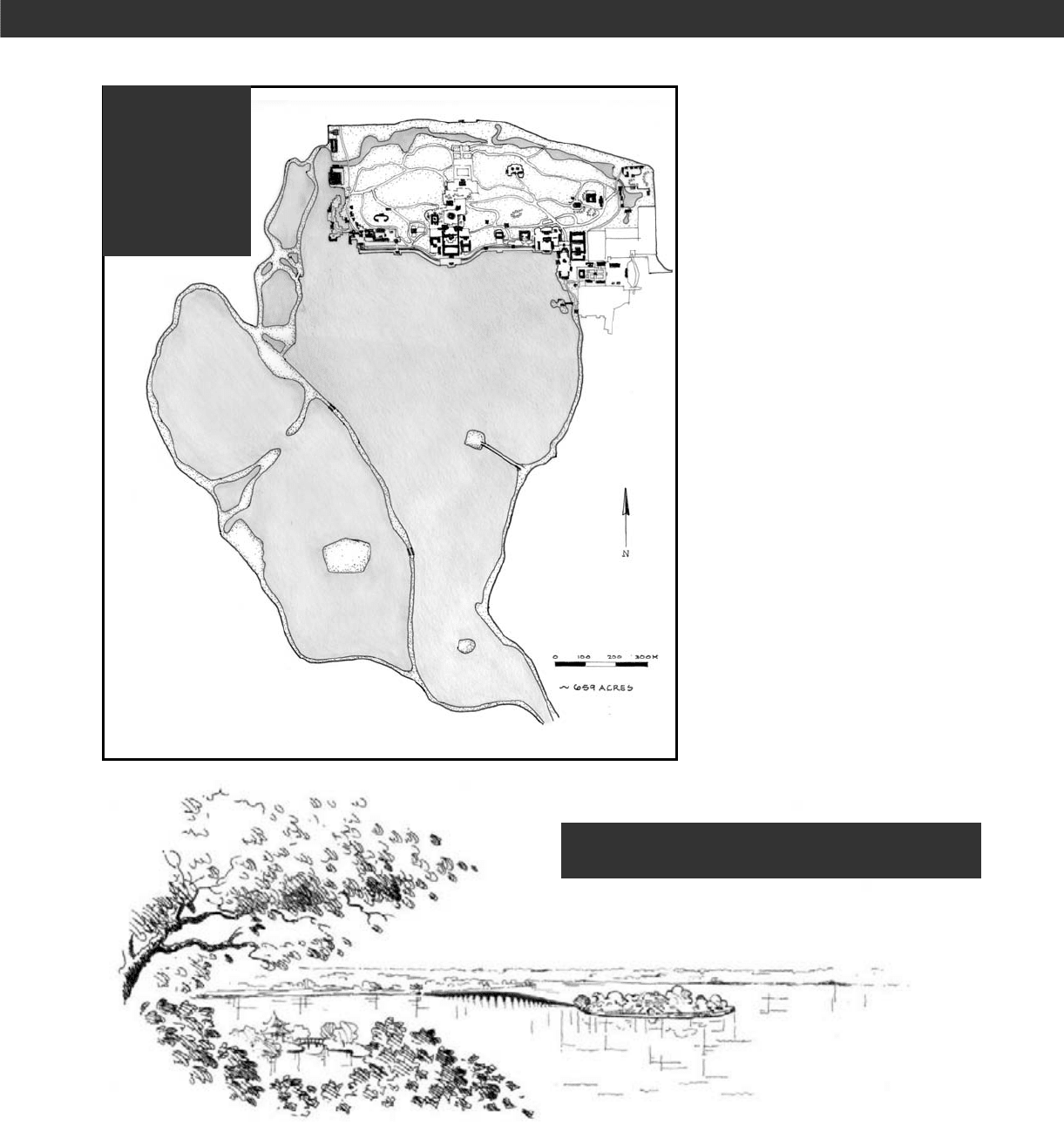
In 1680, Kangxi began restoring the gar-
dens on what is now called Longevity Hill.
Qianlong continued the work, excavating
Kunming Lake in honor of his mother’s
sixtieth birthday, in 1754. The large lake
recalled the beauty of West Lake in
Hangzhou. The garden was named Yihe
Yuan, the Garden of Harmony and Ease,
in the 19th century.
A covered gallery, over a half mile long,
borders the north side of Kunming Lake.
Landscape scenes and fl oral motifs
decorate the crossbeams of the gal-
lery’s 273 bays. Picturesque bridges,
such as the Marble (Jade Belt) Bridge
and the Seventeen-Arch Bridge con-
nect various causeways. Behind Longev-
ity Hill to the north, the emperor had
an urban street scene re-created along
a canal, in imitation of an actual retail
district in Suzhou. Behind the royal
palace to the east, a garden-within-a-
garden (called The Garden of Harmo-
nious Interest) replicated a famous
Suzhou garden.
The original garden was destroyed during
the Opium Wars in the 19th century, and
has since been rebuilt.
18th CENTURY / CHINA
SEVENTEEN-ARCH BRIDGE: The stone bridge leads to the
picturesque Island of the Dragon Temple at Yihe Yuan.
SUMMER PALACE:
Over a period of
14 years, Qianlong
enlarged Kun-
ming Lake and
sculpted hills and
causeways at his
favorite retreat.
170
WANGSHI YUAN (GARDEN OF
THE MASTER OF THE FISHING
NETS), SUZHOU
Suzhou was the center of learning and
creativity during the Ming dynasty. It
was said, “Everyone’s a scholar and cal-
ligrapher in Suzhou.”
15
Suzhou reached
its current size in the 12th century,
when the Song court fl ed south. Pictur-
esque canals and bridges traversed the
walled city. Suzhou remained a cultural
capital throughout the Qing dynasty.
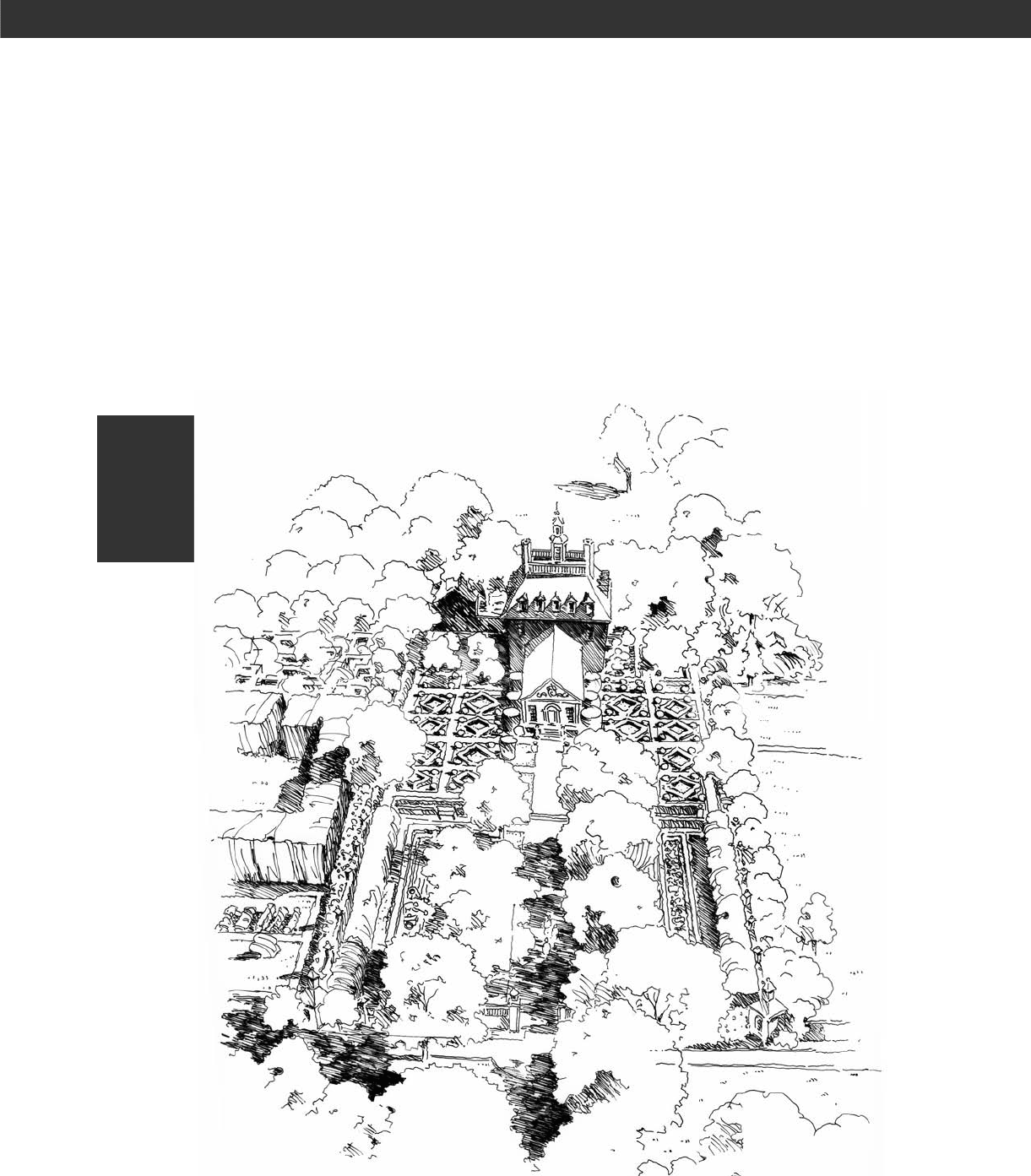
Wangshi Yuan is an excellent example
of the many scholar gardens that were
built and renovated during the 18th
century.
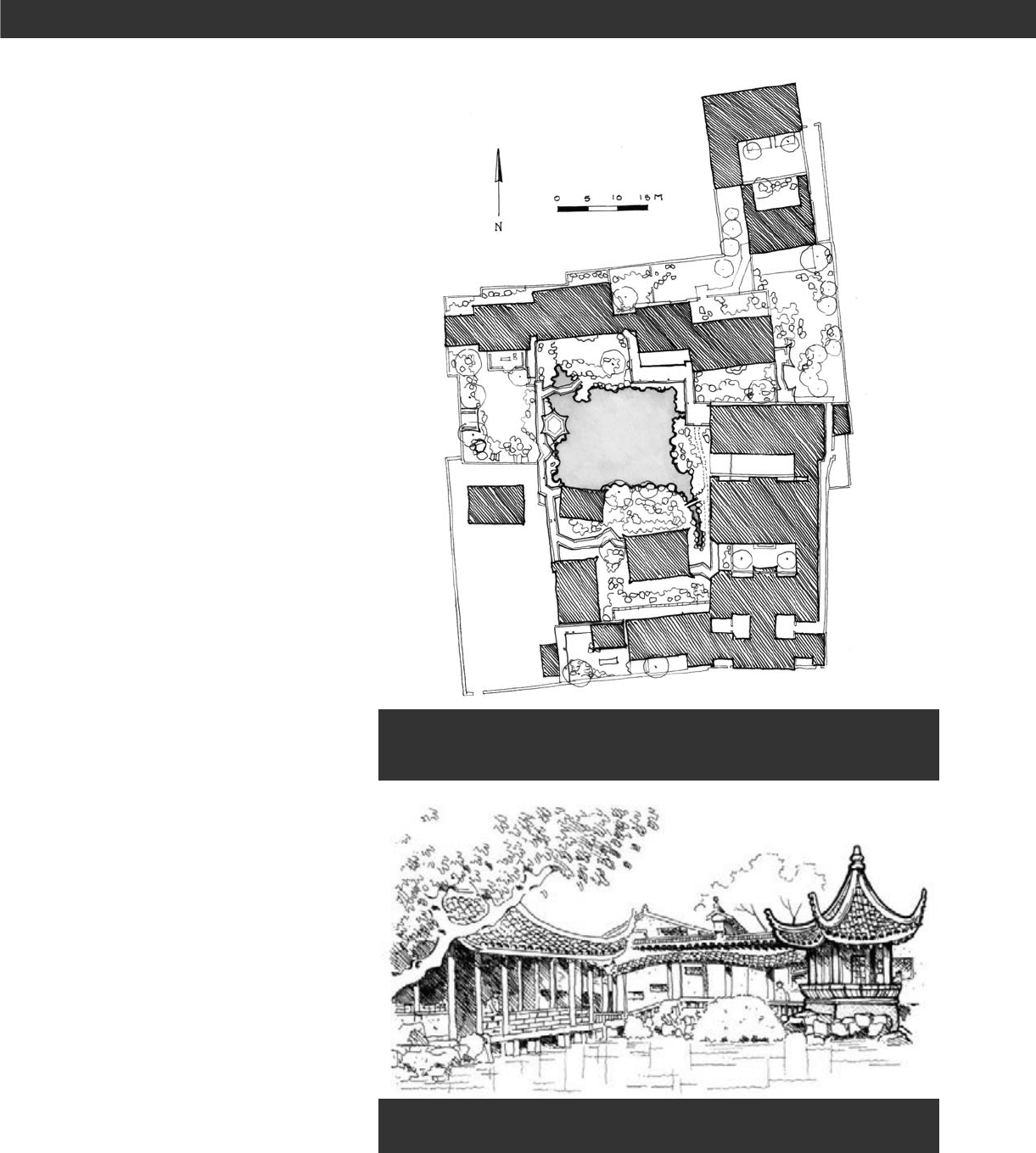
Wangshi Yuan was built in 1140 and
rebuilt in 1770. The 18th-century owner,
a retired government offi cial, placed new
structures on old foundations around
the central pond. The small, 1-acre gar-
den consists of a series of interlocking
courtyards and pavilions, each with a dif-
ferent character and confi guration. The
illusion of space is created by concealing
and framing views along a circuitous
route around the pond. Views to scenic
spots and planting areas are disclosed
in sequence. The full extent of the pond is
not visible from any one point.
To create a poetic atmosphere, garden
owners named spaces in their gardens.
At Wangshi Yuan, the “Pavilion of the
Accumulated Void” is hidden behind a
lakefront gallery; the “Pavilion of the Ar-
riving Moon and Wind” juts out onto the
western edge of the pond. This pictur-
esque structure with its stone founda-
tion and fl aring eaves is the focal point
of the garden. Mirrors inside the pavilion
refl ect the water.
18th CENTURY / CHINA
GARDEN OF THE MASTER OF THE FISHING NETS: The visitor is afforded a vari-
ety of experiences through the artful manipulation of level changes and controlled
views in this small Suzhou garden.
PAVILION OF THE ARRIVING MOON AND WIND: From this central location, all of
the garden is visible.
171
18th CENTURY
/
EARLY AMERICAN GARDENS
HOMELAND TRADITIONS
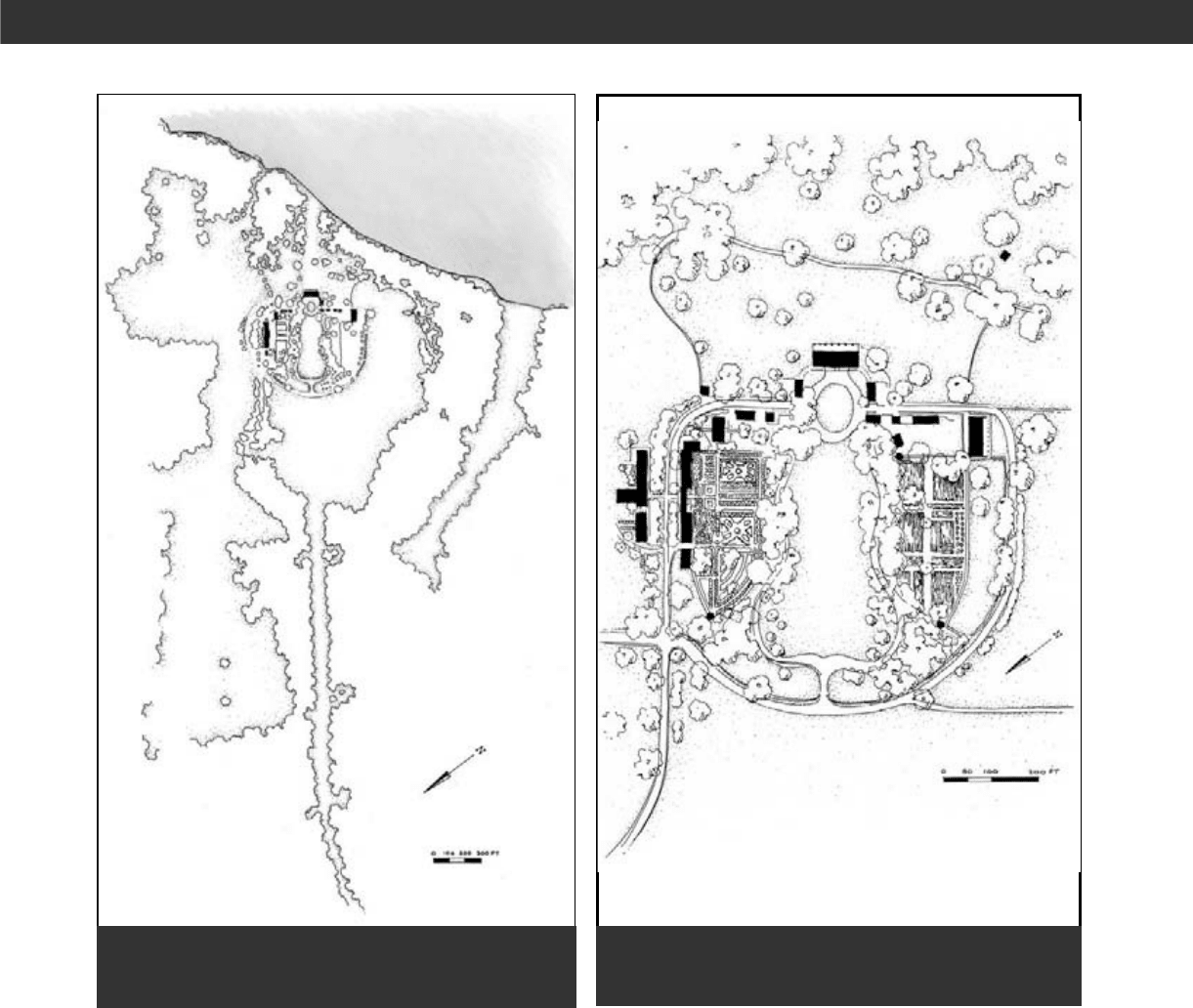
GOVERNOR’S
MANSION: Th
gardens of Wi
liamsburg, Vir
exhibit English
Dutch, and Fr
infl uences.
gardens were planted in the northern
townships, while the landed aristocracy
who settled in the south planted more
extensive estate gardens.
Beginning in 1716, Alexander
Spotswood, the second governor of
Virginia, extended the gardens at the
governor’s mansion in a style reminis-
cent of 17th-century English gardens.
The formal parterres arranged along
a central axis recalled the gardens
of William and Mary, and contained
garden terraces and canals. Affl uent
residents copied the formal styles, and
included topiary in their gardens. The
mild climate encouraged horticultural
research. Local plantsmen studied na-
tive plants and sent seeds back to bo-
tanical gardens in England. The gardens
were restored in the 1930s by Arthur
Shurcliff in association with the Colonial
Williamsburg Foundation.
Although their war for independence
would eventually be won, many settlers
were still fi ghting a war with nature in
the 18th century. They struggled to
clear the dense forests and put land un-
der cultivation to secure stable sources
of food and income—meanwhile destroy-
ing Native grounds and food supplies.
In established settlements, such as
Williamsburg and Boston, the Europe-
ans continued the garden traditions of
their homeland. Dooryard and cottage
172
A FARMER-PRESIDENT
The Arcadian ideals expressed in the
18th-century English landscape gar-
den appealed to the sons of liberty
in the newly formed United States of
America. George Washington was a
keen plantsman and practical farmer.
Although he read the English garden
18th CENTURY / EARLY AMERICAN GARDENS
treatises that were illustrated with
irregular geometries, his foremost
priority in laying out the grounds of
his estate at Mount Vernon, Virginia,
was the improvement of his farm
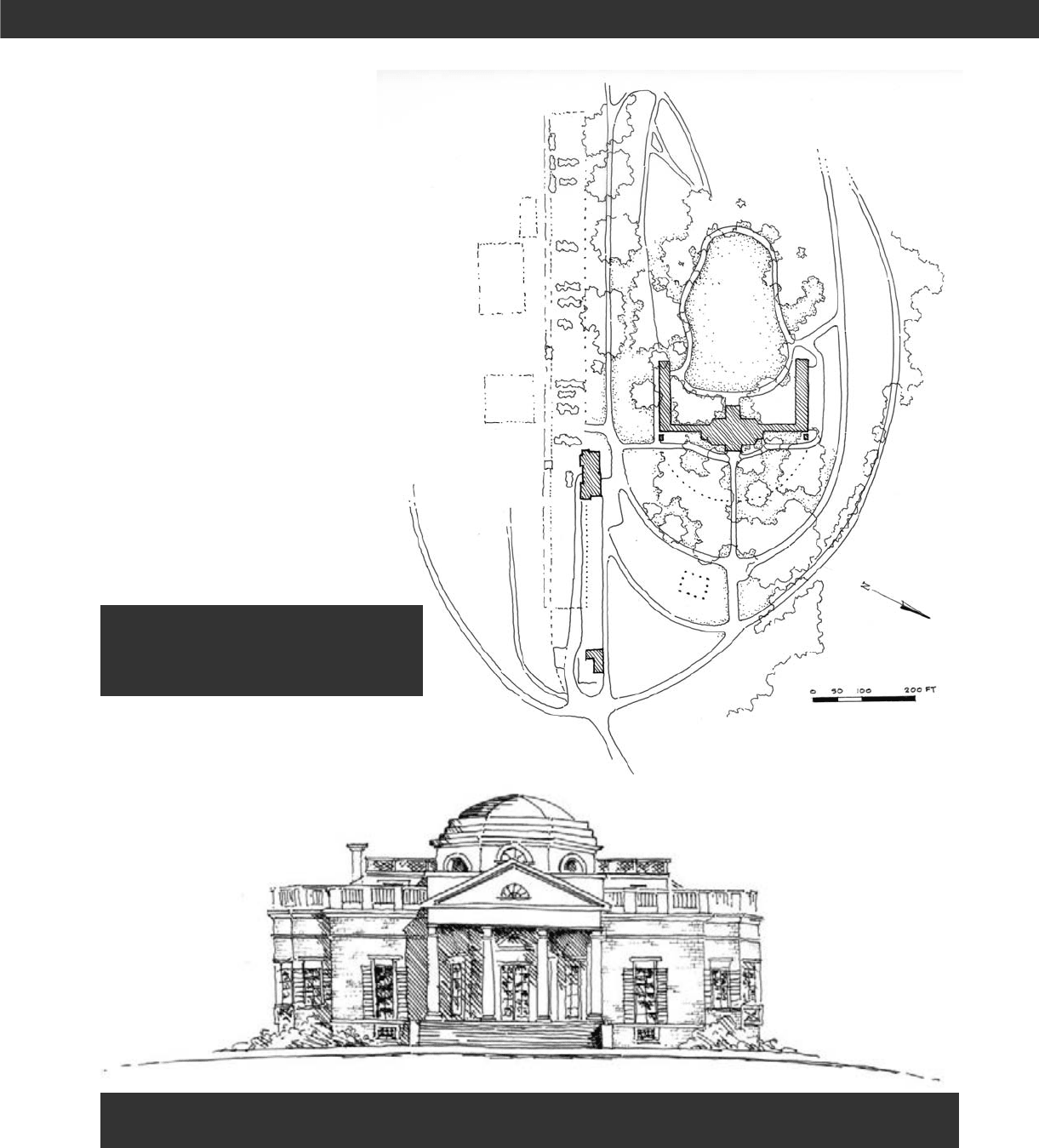
lands. Still, Washington sited his
house to take advantage of pictur-
esque views. A sloping lawn extended
from the two-storied portico at the
front of the house to the river. The
entry drive was at the back of the
whitewashed wood house. He unifi ed
the symmetrical plan with a curvilinear
path, incorporating utilitarian areas
and ornamental gardens around a
bowling green and orchards. Washing-
ton mixed exotic plants with native
species.
MOUNT VERNON, VIRGINIA: The modest, coherent plan of
Mount Vernon refl ects the values of a gentleman farmer.
FERME ORNÉE: George Washington’s design for his estate at
Mount Vernon was based on both artistic and rational plan-
ning principles.
173
JEFFERSONIAN VILLAS
From 1784 to 1789, Thomas Jefferson
was the American ambassador to
France. He visited Marly and Versailles.
He went to England in 1786 and toured
the landscape gardens. While he was
critical of the formality and ostenta-
tion at some gardens, he was im-
pressed with the manipulation of sight
lines and the prospects of pastoral
scenery.
16
He hoped to adapt the natu-
ralistic English garden style to the ter-
rain and climate of Virginia. Beginning
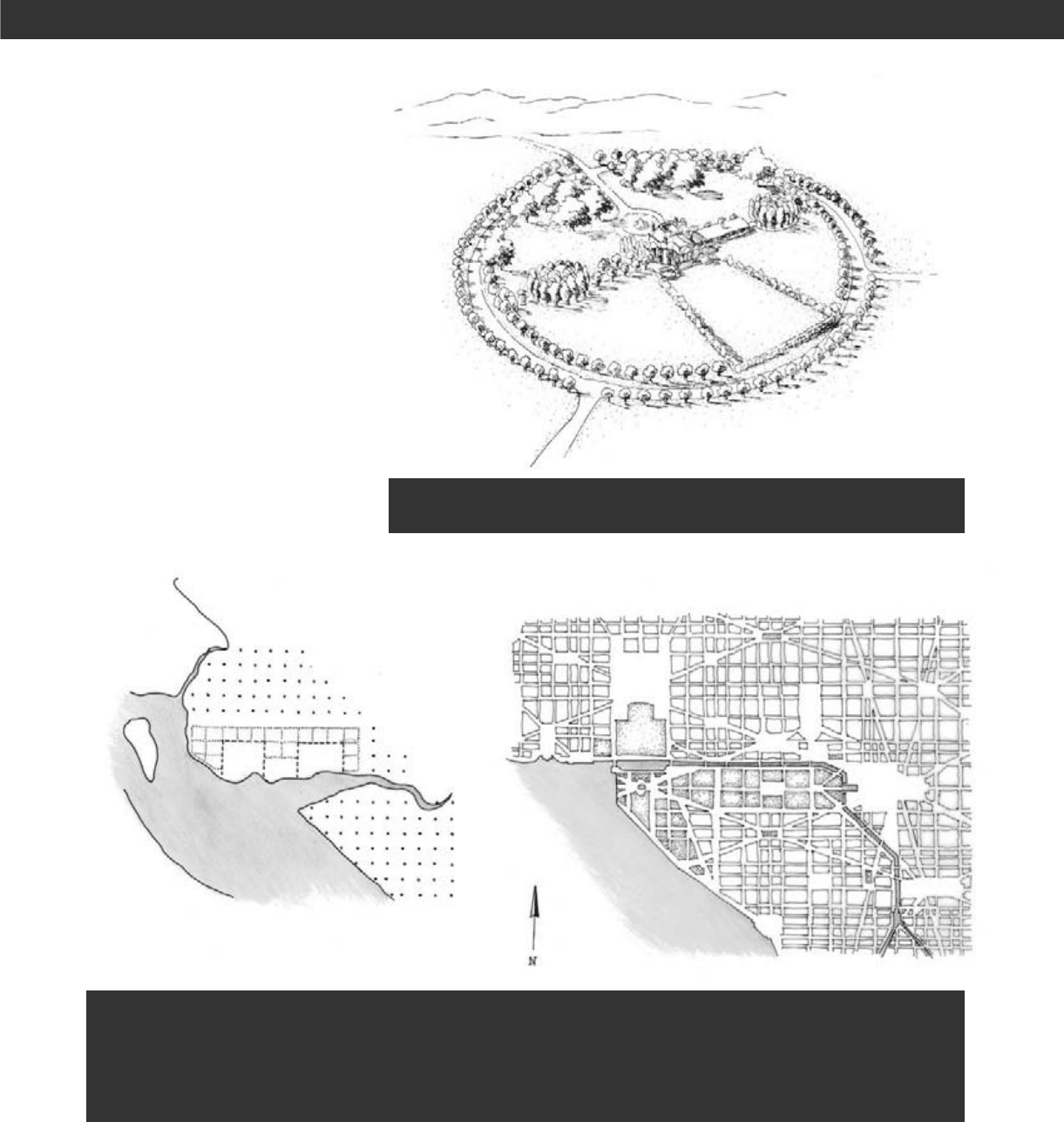
around 1771, Jefferson built Monticello
as his private retreat, where he could
pursue his studies of natural history
and architecture. He developed a ver-
nacular style by using local materials
within a classical idiom. Jefferson laid
out the grounds around a central lawn.
Partially sunken corridors connected
service buildings to the main house and
kept slave activities out of sight.
18th CENTURY / EARLY AMERICAN GARDENS
MONTICELLO, VIRGINIA: Thomas Jefferson’s
long terraces and promenades introduced a
degree of the picturesque to 18th-century
American gardens.
PALLADIAN CLASSICISM: Jefferson’s house, with its Greek temple front and octagonal dome, recalled Palladio’s Villa Rotonda
and its precedent, the Pantheon in Rome.
174
Jefferson’s design of his farm-estate
at Poplar Forest truly represented the
artful science of the Enlightenment.
He referred to the 61-acre property
as his “curtilage” or private sanctu-
ary. The 10-acre homestead was a
study in sophisticated proportional
relationships. The house was sited by
Jefferson to take advantage of specifi c
views of distant ridgelines, and was the
center point of a 540-foot-diameter
circular drive. An axis formed by the en-
try drive and rear terrace was crossed
by an allée of trees. The dimensions
of the central room of the house were
echoed on both sides by willow trees
planted in a 20-foot square. The trees
stand on 100-foot-diameter circular
mounds; the mounds are connected to
the house by 100-foot-long tree-lined
allées. The bowling green behind the
house is 100 feet wide.
18th CENTURY / EARLY AMERICAN GARDENS
POPLAR FOREST, VIRGINIA: Jefferson’s second farmstead was a perfect marriage
of architecture and landscape. Archeological investigations at the site are ongoing.
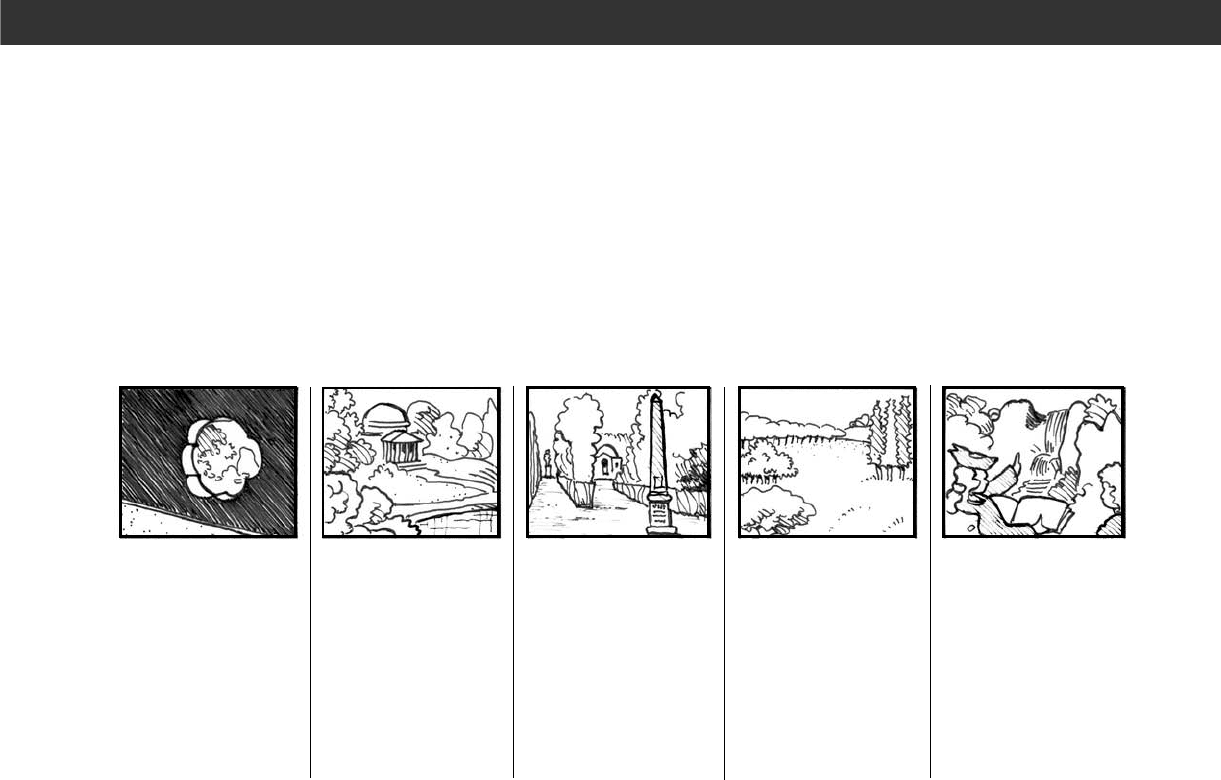
DISTRICT OF COLUMBIA: Jefferson’s plan (left) for the proposed capital district shows the president’s house and Capitol sepa-
rated by public walks, and a grid infrastructure for future development. French-born citizen Pierre Charles L’Enfant, a veteran of
the American Revolutionary War, developed a plan (right) expressive of French classical design ideas—a monumental grid inter-
sected with diagonal avenues. He sited the president’s house and the Capitol at right angles to each other and connected them
through sight lines. He named the major thoroughfares after existing states and referenced their actual geographic location by
their position within the new federal district.
175
18th CENTURY / CONCLUSION
SUMMARY
Curves, realized as sweeping lawns, serpentine lakes, and billowing trees, defi ned the “line of beauty” in the 18th-century English
garden. Here, “landscape” became an adjective descriptive of an enlightened vision of uncorrupted nature—the garden. The tradi-
tion of the pastoral aesthetic as embodied in the English landscape garden infl uenced early American gardens and continues
today in parks, campuses, and residential developments. The relationship between art and nature in 18th century Chinese gardens
and its impact on English styles was also examined in this chapter.
DESIGN PRINCIPLES
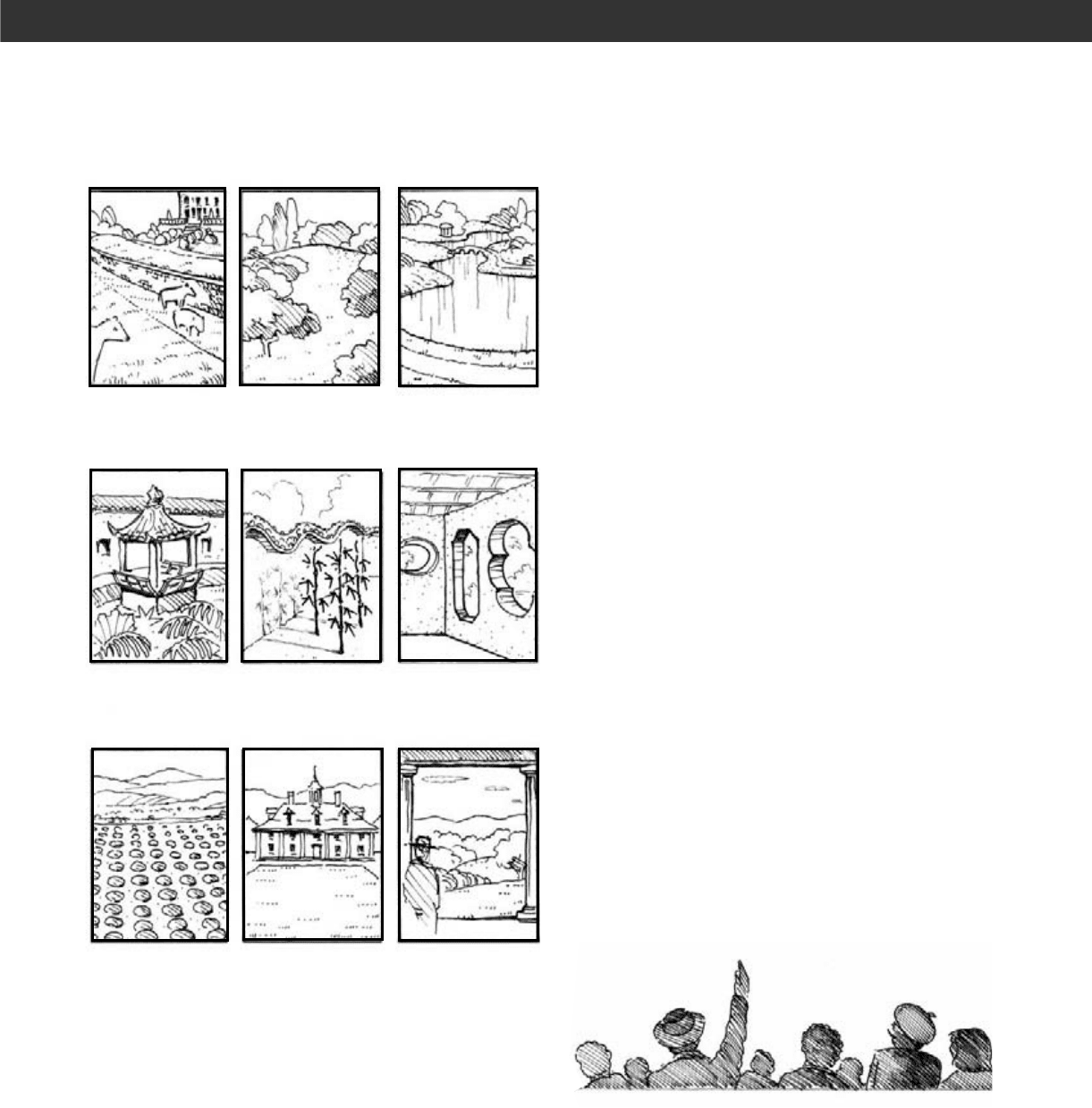
FRAMING
Garden scenes
were viewed through
intricate latticework
windows and screens
in Chinese gardens.
Trees framed views
of fi elds and hills in
English gardens.
ALLUSION
Both English and
Chinese gardens
contained visual
references to literary
passages. Naming
and inscribing scenes
assured common
interpretations.
NARRATIVE
The heroic or patriotic
theme of an English
garden was made ex-
plicit through statuary
and built form.
VARIETY
Picturesque gardens
contained contrasting
forms, textures, and
lines.
OBSERVATION
Plants, landscapes,
scenery—all of nature
was scrutinized and
classifi ed during the
Enlightenment.
176
18th CENTURY / CONCLUSION
DESIGN VOCABULARY
ENGLAND
Ha-has, Hills, and Lakes
CHINA
Pavilions, Walls, and Windows
AMERICA
Orchards, Lawns, and Prospects
BOOKS
CANDIDE, by Voltaire
D
ISCOURSE ON THE MORAL EFFECTS OF THE ARTS AND
S
CIENCES, by Jean-Jacques Rousseau
G
ULLIVER’S TRAVELS, by Jonathan Swift
M
ANSFIELD PARK, by Jane Austen
P
RIDE AND PREJUDICE, by Jane Austen
R
OBINSON CRUSOE, by Daniel Defoe
T
HE SOCIAL CONTRACT, by Jean-Jacques Rousseau
S
YSTEMA NATURAE, by Linnaeus
FILMS
BARRY LYNDON (1975)
B
RIDESHEAD REVISITED, television miniseries (1981)
D
ANGEROUS LIAISONS (1988)
T
HE DRAUGHTSMAN’S CONTRACT (1982)
M
ARIE ANTOINETTE (2006)
T
OM JONES (1963)
PAINTINGS AND SCULPTURE
EIGHT-PLANKED BRIDGE (FOLDING SCREEN), by Ogata Korin
(c. 1701)
P
ILGRIMAGE TO CYTHERA, by Jean Antoine Watteau (1717)
R
OBERT ANDREW AND HIS WIFE, by Thomas Gainsborough
(1748)
L
ANDSCAPE, by Alexander Cozens (1784)
P
ROJECT FOR A MEMORIAL TO ISAAC NEWTON, by Étienne-Louis
Boullée (1784)
G
EORGE WASHINGTON, by Jean-Antoine Houdon (1788)
T
HE DEATH OF MARAT, by Jacques-Louis David (1793)
F
o
r further exploration