
Boults Е. Illustrated history of landscape design
Подождите немного. Документ загружается.

177
19th CENTURY
T
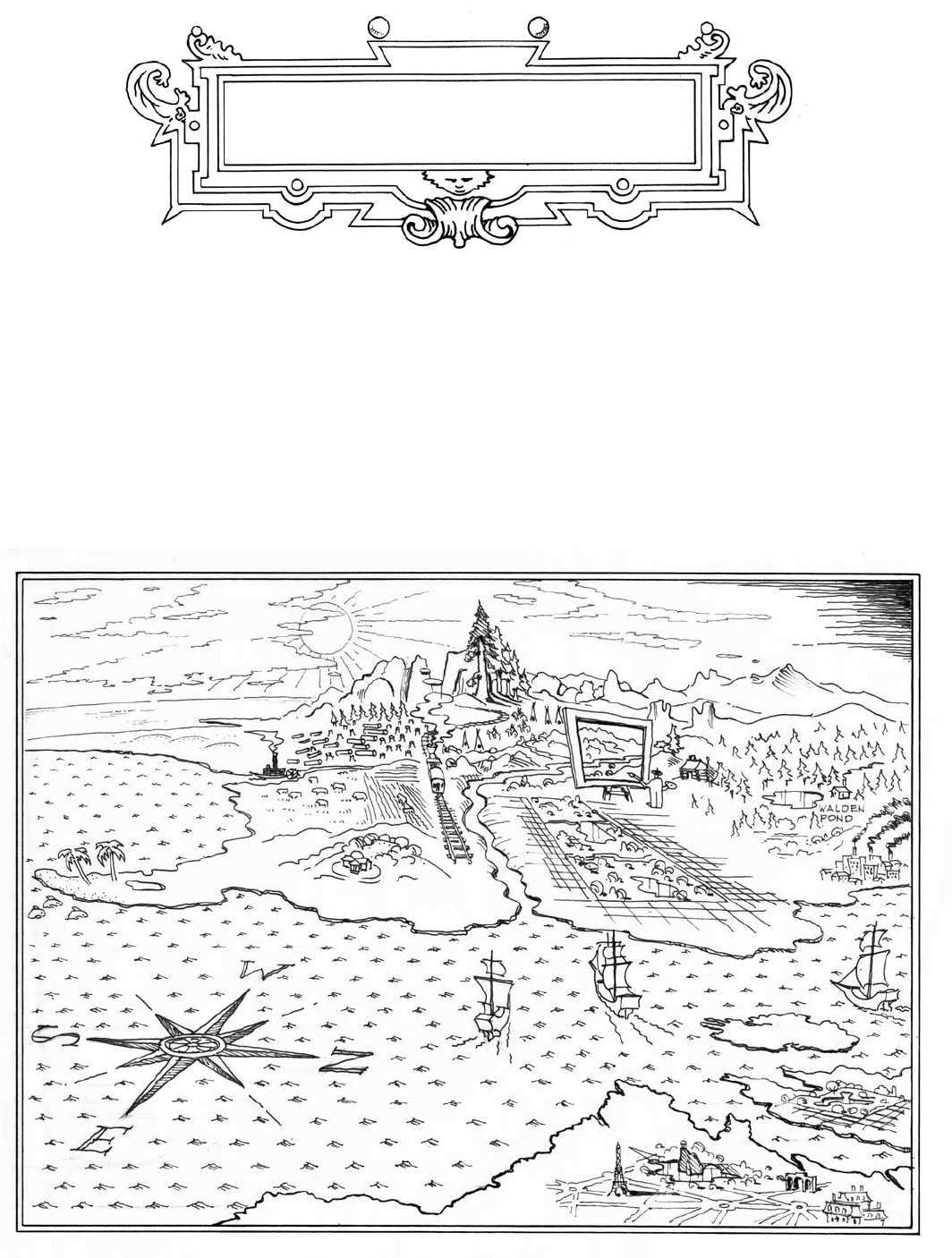
he Enlightenment left in its wake a new concept of time and space. The Industrial Revolution eroded
agrarian society. People moved into cities to supply the labor force required by factories. Urban popula-
tions swelled, causing concern for public welfare.
Industrial production defi ned the social, economic, and political order of the western world in the 19th century. The
unquestioned belief in technology prompted a backlash: Romanticism became the antidote to the ills of mechanized
society. For the middle class, emotion triumphed over reason, imagination was prized more than cultivated scholar-
ship, and nature was elevated as the source of inspiration. Society believed sensitivity to natural phenomena and
appreciation of natural beauty to be morally and spiritually uplifting.
The 19th-century landscape was urban, public, and Romantic.
178
19th CENTURY / A BRIEF CHRONOLOGY
1800
1860
1810 1820
1804–1806
1817
1819
1868
1822
1861–1865
1860
1866
LEWIS & CLARK
FLORILEGIUM
JOHHNY APPLESEED
AMERICAN CIVIL WAR
WHIRLED PEAS
OPIUM WAR
ÉCOLE DES BEAUX-ARTS
MEIJI RESTORATION
179
19th CENTURY / A BRIEF CHRONOLOGY
1860 1880 1890
1900
1830 1840 1850
1830
1841
1869
1869 1899
1886
1893
1859
1830
UKIYO-E
KEW GARDENS
GOLDEN SPIKE
SUEZ CANAL
ASLA
STATUE OF LIBERTY
WATER LILIES
ON THE ORIGIN OF SPECIES
INDIAN REMOVAL
ACT

180
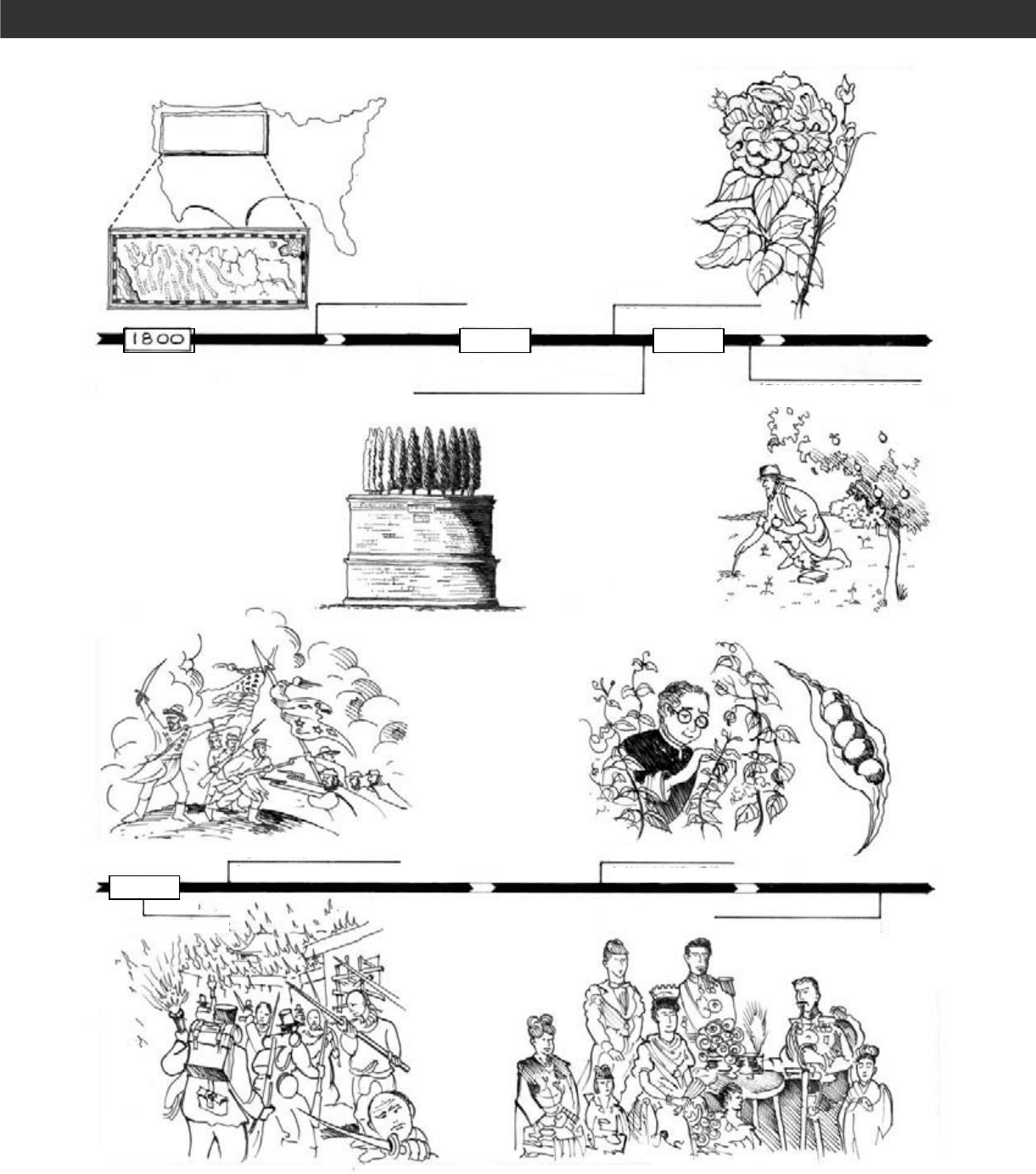
1804–1806 LEWIS AND CLARK
American president Thomas Jefferson
sent two explorers out to the newly ac-
quired western territories to inventory
the terrain and plant life.
1817 FLORILEGIUM
Pierre-Joseph Redoute painted the 250
species of roses at Empress Josephine’s
garden at Malmaison, near Paris. Les
Roses was one of his most famous
albums of botanical illustrations.
1819 ÉCOLE DES BEAUX-ARTS
Napoleon I established a school of fi ne
arts, training architects and artists in
the neoclassical tradition.
1822 JOHNNY APPLESEED
John Chapman (1774–1845), mission-
ary and nurseryman, distributed apple
seeds across the Midwestern frontier.
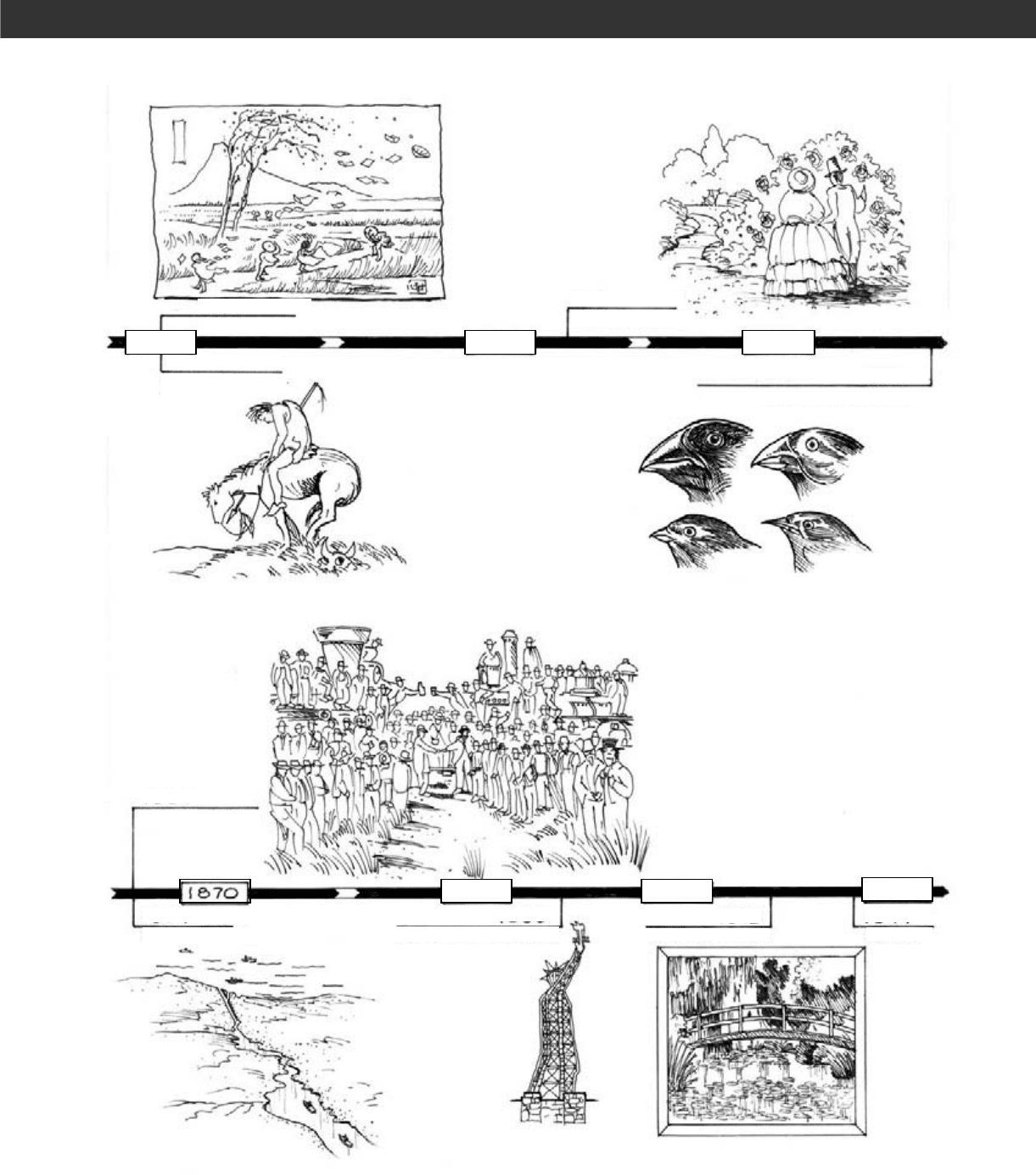
1830 UKIYO-E
Hokusai and Hiroshige captured the
bohemian life of Japanese actors and
courtesans in colored woodblock prints.
Later subjects included urban land-
scapes and nature scenes such as
Hokusai’s Thirty-six Views of Mount Fuji.
1830 INDIAN REMOVAL ACT
The railroad opened the American West
to settlers and gold miners at the
expense of Native Americans, who were
forcibly removed to reservations and un-
claimed western territories. In 1876, the
Sioux defeated the U.S. Army at Little
Bighorn—Custer’s last stand. But the
Indian victory was short-lived. In 1890,
the Sioux were massacred at the battle
of Wounded Knee Creek, in South Dakota.
1841 KEW GARDENS
Kew Botanic Gardens, a former royal
property, opened to the public. Within
fi ve years it grew from 15 to 250 acres,
attesting not only to the exponential
growth in new plant introductions
but also to the popularity of public
gardens.
1859 ON THE ORIGIN OF SPECIES
Charles Darwin wrote a groundbreaking
treatise on evolutionary biology, based
on his voyages to the Galapagos Islands
on the HMS Beagle in 1831.
1860 OPIUM WAR
The British burned the Yuanming Yuan
in retaliation for the abuse of hostage
British soldiers.
1861–1865 AMERICAN CIVIL WAR
Eleven southern states seceded from
the Union over the issue of slavery, form-
ing the Confederate States of America.
Confederate General Robert E. Lee sur-
rendered to Union commander Ulysses
S. Grant at Appomattox after fi ve years
of bloody warfare.
1866 WHIRLED PEAS
Gregor Mendel discovered the laws of
heredity, making possible plant hybrid-
ization.
1868 MEIJI RESTORATION
The Emperor of Japan was restored to
power after 250 years of shogun rule,
ending a long period of isolation and
initiating economic and political reforms.
1869 GOLDEN SPIKE
The transcontinental railroad was com-
pleted in Promontory Point, Utah.
1869 SUEZ CANAL
An important trade route opened
between the Mediterranean and the Red
Sea, connecting Europe and Asia.
1886 STATUE OF LIBERTY
Lady Liberty was given to the people
of the United States by the people of
France in celebration of the 1876 cen-
tennial of the signing of the Declaration
of Independence.
1893 WATER LILIES
Artist Claude Monet acquired a neigh-
boring property in Giverny, France, to
construct a water garden. His garden
served as the inspiration for many of his
impressionist landscape paintings.
1899 ASLA
The American Society of Landscape
Architects was founded by Beatrix
Jones Farrand, Warren H. Manning, John
Charles Olmsted, Frederick Law Olmsted
Jr., Downing Vaux, Nathan Barrett, Daniel
Langton, Charles N. Lowrie, Samuel
Parsons Jr., George F. Pentecost Jr., and
Ossian Cole Simonds.
19th CENTURY / A BRIEF CHRONOLOGY
181
19th CENTURY
/
ENGLAND
The landscape garden style, so popular
in the 18th century, became less feasible
in the changed economic circumstances
of the 19th century. Large estates
were expensive to maintain, and many
property owners had to sell or split
their estates into smaller units for
development. Panoramic views were
curtailed. Whereas Georgian society was
dominated by the upper class and their
landscape gardens, Victorian society
was dominated by the middle class, who
built smaller “suburban villas” around
industrial centers. People’s tastes
were changing. Attention shifted from
the scale of the wider landscape to the
scale of the individual plant.
The Victorians were enthralled by the
plethora of new plant species being
introduced to England. They collected
and displayed exotic plants with fervor.
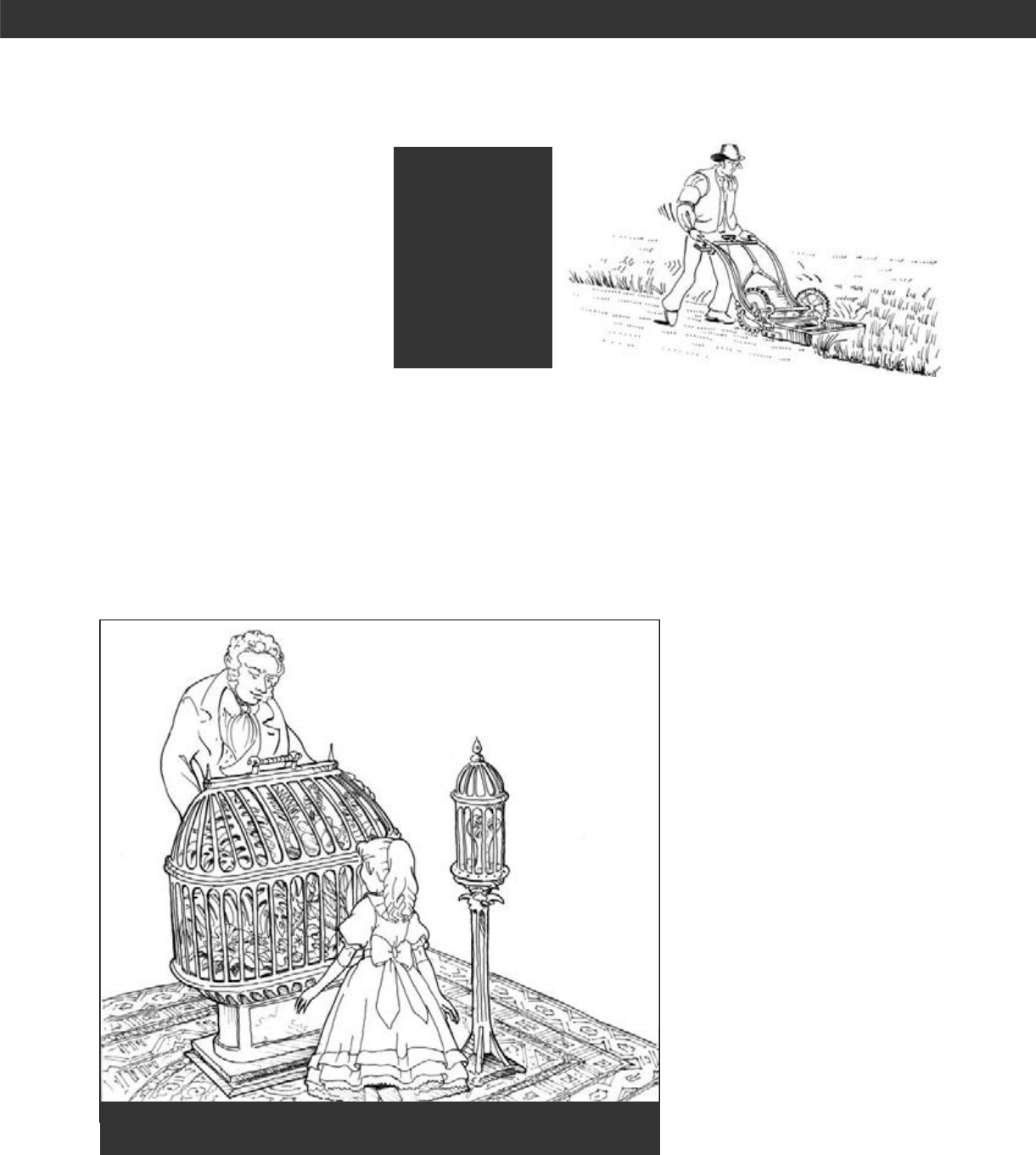
The invention of the Wardian case, the
development of the glasshouse, and the
proliferation of gardening literature all
made gardening accessible and fashion-
able with the middle class.
The naturalist, fern enthusiast, and med-
ical doctor Nathaniel Bagshaw Ward de-
veloped his glass case by accident. While
studying butterfl ies, he buried a chrysalis
in soil and sealed it in a glass jar. A fern,
instead of a butterfl y, emerged from this
THE VICTORIANS AND THEIR PLANTS
perfect environment. Wardian cases, es-
sentially miniature greenhouses, enabled
live specimens rather than seeds to be
transported from China, India, and North
America, dramatically increasing the
number of plants available to the trade.
Ward also thought his case could be used
to help the poor, who “might grow fl owers,
ferns and ivies for pleasure…and raise
small salads, radishes, etc.”
1
The repeal of the glass tax in England in
1845 made the manufacture of sheet
glass more economical. Small glass-
houses were marketed to homeowners
who were eager to include tender plants
in their gardens. J. C. Loudon fi rst devel-
oped the ridge-and-furrow system that
Joseph Paxton later adapted to curved
glass. The many contributions of these
two men are discussed next.
Horticultural industries prospered from
the middle-class zeal for fl ower and veg-
etable gardens. In addition to new tech-
nologies geared to the management of
more modest-sized properties, numerous
periodicals and magazines were devoted
to small-scale gardening. Garden writers
focused on botany rather than aesthetic
theory. The inexpensive publications were
eagerly read by the new class of hom-
eowners. This emphasis on practicality
was even recognized by Repton in the
last decades of his career. The terraces,
cutting gardens, and fountains that Rep-
ton added to his later landscape plans
refl ected his preoccupation with the more
intimate functions of a garden.
2
BUDDING’S LAWN
MOWER: Budding
patented his lawn
mower design in
1832. Its small size
made easy work
of cutting around
intricate planting
beds, and made lawns
feasible for even the
smallest gardens.
WARDIAN CASE: Glass cases protected plants displayed in the home from the
poisonous fumes of gaslight.
182
John Claudius Loudon (1783–1843) is
known for his prolifi c contributions to
the literature of landscape design and
his progressive views on public space.
He published Gardener’s Magazine from
1826 to 1843, a popular source of
garden information for the middle-class
homeowner, who sought advice from
periodicals rather than landscape de-
signers. His Encyclopedia of Gardening
(1822) was a compendium of historical
styles and practices, collected from his
travels abroad.
Dedicated to the causes of the middle
class, Loudon developed the gardenesque
style as a way for small property owners
to enjoy the landscape. He formulated
different prototypical garden plans for a
variety of lot sizes, which he categorized
as fi rst rate (10 acres), second rate
(2–10 acres), third rate (1–2 acres), and
fourth rate (1 acre and less). Loudon
also supported the development of public
parks. He designed the Derby Arboretum,
which opened to the public in 1840, as an
educational and recreational garden. He
applied his gardenesque principles to the
11-acre site, which contained a central
gravel promenade, a perimeter walk
screened by trees, constructed mounds,
and amenities such as restrooms,
19th CENTURY / ENGLAND
pavilions, and benches. Plants and trees
were labeled with botanical and common
names, country of origin, and height at
maturity.
Loudon suffered from rheumatic fever in
his early life and eventually had to have
his arm amputated. Despite this and
J. C. LOUDON AND THE AMATEUR LANDSCAPIST
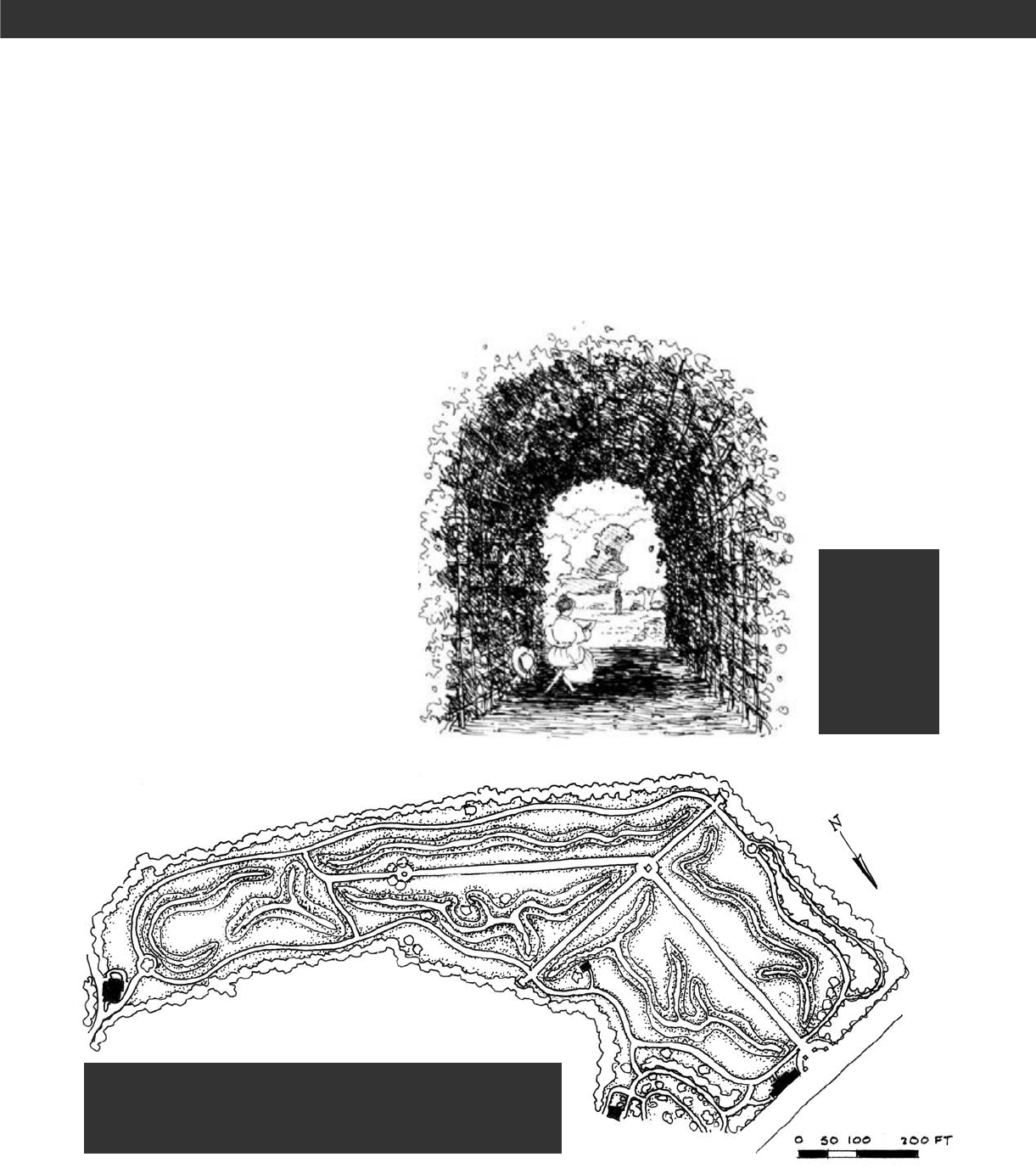
DERBY ARBORETUM: While Loudon’s intent was to make the Derby
Arboretum a publicly accessible garden, the reality was that an
admission fee had to be charged to cover its high maintenance costs.
The arboretum was opened free of charge only one day a week.
SUBURBAN
GARDENER
(1838):
Loudon believed
that sketching
the landscape
was good prac-
tice for women
gardeners..
other adversities, his career continued,
due in part to the contributions of his
wife, Jane. After John’s death, Jane
Loudon went on to publish dozens of
articles and books on her own, including
the popular Gardening for Ladies (1840)
which profoundly infl uenced women’s
involvement with gardening.
183
Joseph Paxton (1803–1865) wore many
hats in his career: He was head garden-
er and close friend to the sixth Duke of
Devonshire; he authored and published
several gardening journals; he designed
buildings and engineered sites; he was
a Fellow of the Horticultural Society,
and an elected Member of Parliament.
His innovations in glasshouse technol-
ogy and his advocacy of public parks are
two particular contributions we examine
here.
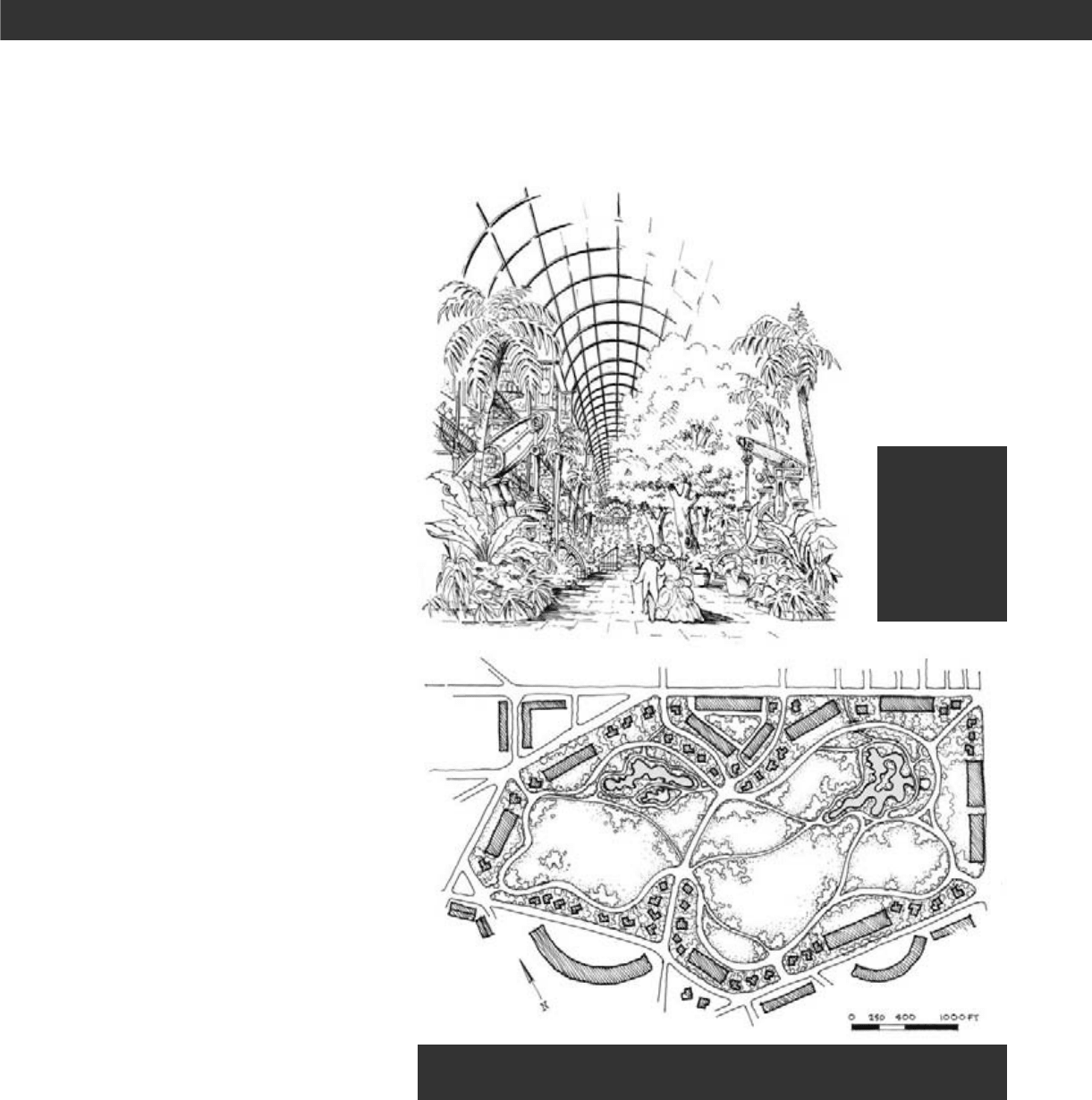
Paxton built the conservatory (the
“Great Stove”) at Chatsworth in 1836,
the largest glasshouse ever constructed
at the time. He improved upon Loudon’s
system by replacing wrought iron ele-
ments with cast iron and wood. In 1850,
he designed the Crystal Palace for the
Great Exhibition in Hyde Park. Conserva-
tories and winter gardens displayed rare
plants, and were popular public attrac-
tions; smaller glasshouses, affordable by
middle-class homeowners, were used for
entertaining.
3
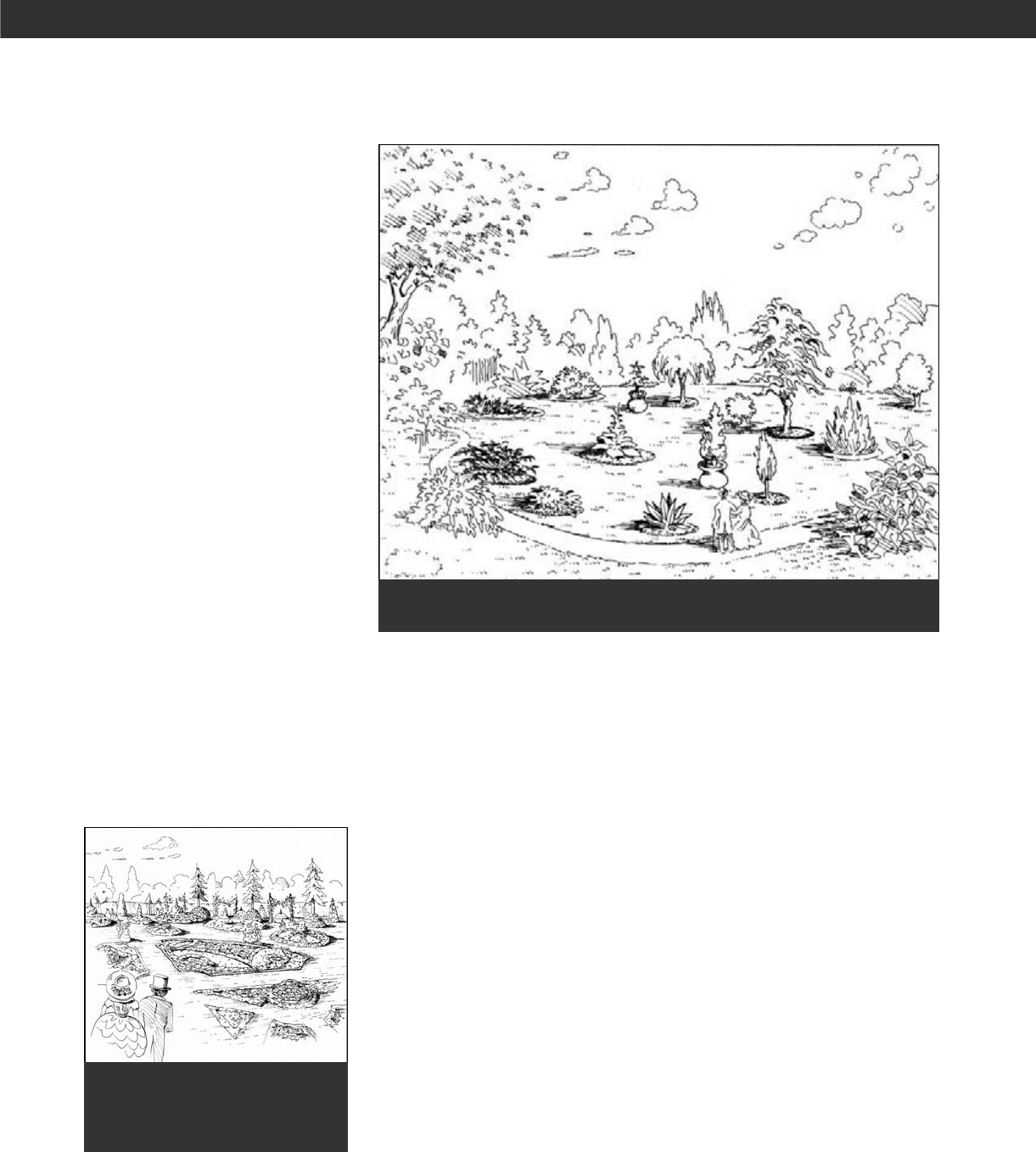
The fi rst park publicly funded and main-
tained, and opened to everyone, was
Birkenhead Park in Liverpool, designed
by Paxton in 1843. He excavated two
lakes in the swampy site, and screened
from view the extent of the water to
create the illusion of distance. Con-
structed islands, as well as small hills
and mounds, created layers of visual
interest. The park opened in 1847.
Frederick Law Olmsted visited the park
in 1850 and was particularly impressed
by its unique circulation system, which
separated carriage traffi c from pedes-
trian traffi c.
The concern for social welfare in the
19th century was prompted in part by
a general awareness of the detrimental
effects of industrial development and
the paternalistic concept of noblesse
oblige. Public parks were a response to
unchecked urban growth and the unsani-
tary conditions of cities. But in addition
to being morally uplifting, parks were
also regarded by developers as poten-
tially profi table—housing lots were sold
along the parks’ boundaries. Paxton was
fi rst to develop the idea of “subscrip-
tion plots” to help make public parks
economically feasible.
4
19th CENTURY / ENGLAND
THE PUBLIC AND PRIVATE SECTOR WORK
OF JOSEPH PAXTON
CRYSTAL
PALACE:
Built around
an existing
tree, Paxton’s
glasshouse was
nearly 1,900
feet long.
BIRKENHEAD PARK, LIVERPOOL: Paxton’s unique circulation system infl uenced
Olmsted’s scheme for Central Park.
184
The stylistic controversies that raged
at the end of the 18th century were
stirred up again by garden theorists at
the end of the 19th century. The debate
this time was centered on aspects of
“formal” and “informal” styles.
Formal styles were characterized by
the revival of “architectural” gar-
dens—planting areas defi ned by built
elements and strong geometries. Often
these parterres contained color-
ful fl owers arranged in mosaic-like
patterns and changed seasonally, a
practice known as carpet bedding. Hun-
dreds of gardeners were required for
“bedding out”—putting tender plants
in the open ground during the summer
months. Plants numbered in the tens of
thousands, a symbol of the status of
the owner.
5
Bedding out was a result of Loudon’s
idea of the gardenesque taken to
an extreme. Loudon, a prolifi c and
infl uential writer, was at fi rst critical
of Brown’s and Repton’s landscape
gardens, siding with Price and the
advocates of the picturesque. After
traveling to the continent and visiting
the great European gardens, Loudon
came to appreciate the formal geom-
etries that were so clearly of “art”
rather than “nature.” He proposed a
new style, termed the gardenesque,
that refl ected popular interest in the
aesthetic qualities of plants and the
practice of horticulture.
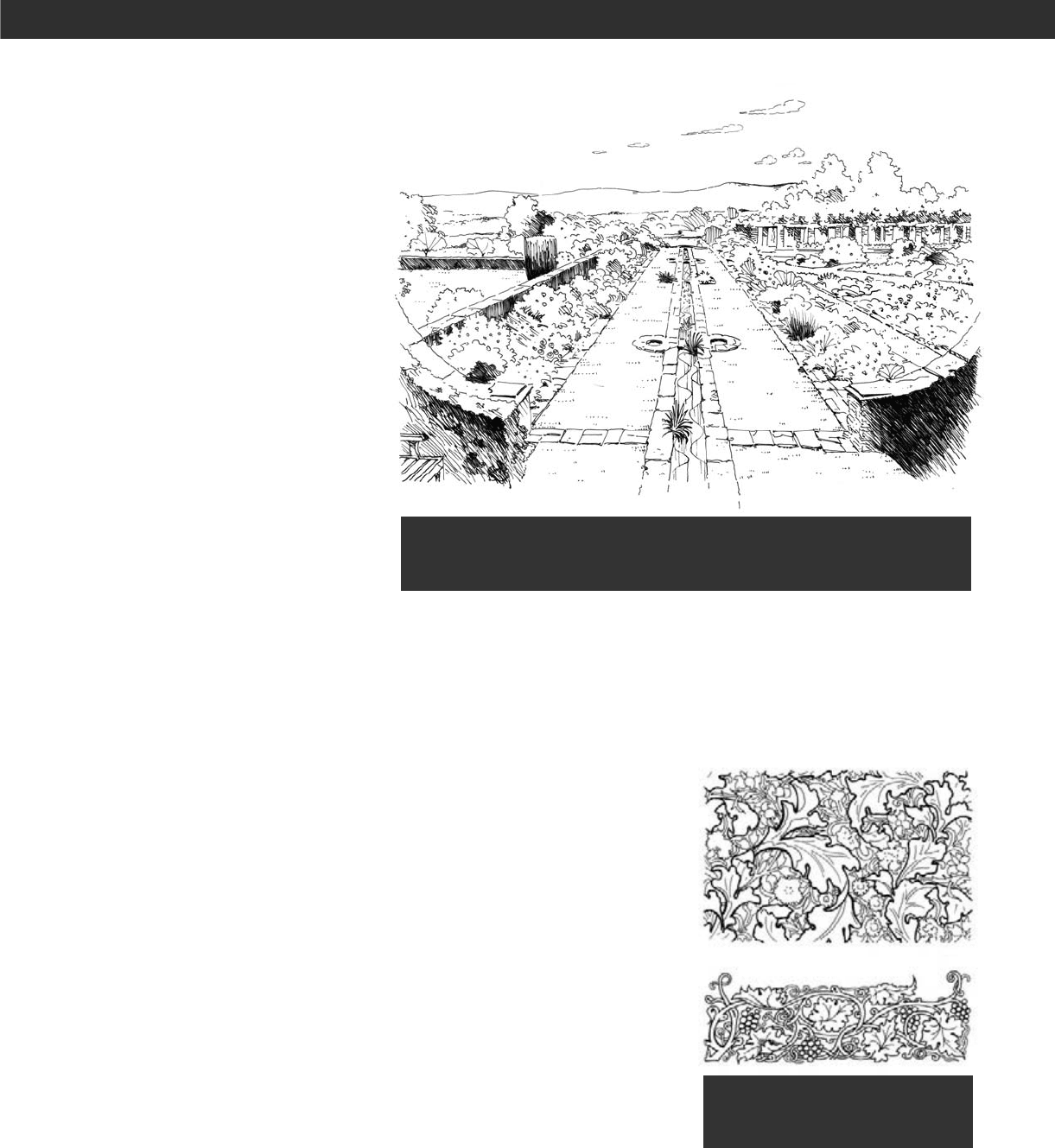
The gardenesque was a particular style
of planting wherein each plant was
displayed individually, expressing the
artistic talents of the gardener, not the
ideals of the owner or designer. Lawn
was kept away from planting areas, and
ample room was provided for cultivation
and maintenance. The viewer’s focus was
on the individual character of a tree or
shrub, not on the mass of vegetation
or the wider landscape scene. Loudon’s
theory was that a garden is a work of
creative artistry, not an imitation of na-
ture. He believed gardens should be com-
posed with specimen plants of unusual
form, particularly exotic species, unifi ed
in some ordered scheme. Unfortunately,
the result was often an unrelated col-
lection of plants, not the structured
composition Loudon envisioned.
Critics reacted against the stiffness
of bedding out and the eclecticism
of the gardenesque. William Robinson
(1838–1935) referred to the geometri-
cal presentation of plants as “degrading
the true garden art to the level of the
pastrycook’s notions of design.”
6
He
suggested that people inclined to these
practices limit themselves to wallpa-
per and rug design. In his book The Wild
Garden, published in 1870, he proposed
a natural approach to planting based
on the horticultural needs and artistic
qualities of the plants. He advocated
the use of herbaceous borders mixed
with wildfl owers as a way to merge the
gardenesque with the picturesque.
Masses of shrubs could be broken up by
outlying plants, softening the perimeter.
In his book of 1883, The English Flower
Garden, Robinson cataloged all the new
plant species introduced in the 19th
century and focused on creating low-
maintenance habitats. The book ran for
many editions.
19th CENTURY / ENGLAND
THE CONTINUING SAGA OF STYLES
CARPET BEDDING: Gardeners clipped
dwarf foliage plants and perennials
like lobelia, salvia, and verbena into
knots, monograms, and clocks.
THE GARDENESQUE: Plants did not touch each other in gardenesque planting
schemes.
185
In opposition to the informal style pro-
posed by Robinson, Reginald T. Blomfi eld
(1856–1942) called for a return to
formality. In 1892, he wrote The Formal
Garden in England, citing the Italianate
terrace garden as the perfect example of
garden art. The controversy raged until
art and nature met in the partnership of
architect Edwin Lutyens (1869–1944)
and landscape designer Gertrude Jekyll
(1843–1932). Jekyll was a disciple of
Robinson’s. She trained as a painter and
developed planting design theories based
on principles of form, texture, and color.
Jekyll was advised to give up painting be-
cause of her bad eyesight, so she turned
her attention full-time to gardening. She
was a steady contributor to Country Life
magazine in the 1890s, and wrote her
fi rst book, Wood and Garden, in 1899.
Lutyens created the structural geometry
for Jekyll’s softscape. His highly detailed
forms, built with local materials, were
the perfect complement to her sweeping
strokes of fl ora.
aesthetic values. They were particularly
inspired by medieval craftsmanship
and regarded the guild system as an
answer to industrial order. The Arts
and Crafts movement of the 1880s
and 1890s was a response to the poor
quality of machine-made goods and the
process of mass production. Writer,
designer, and socialist William Morris
founded a decorative arts company
whose work was based in the Arts
and Crafts style. Morris used organic
patterns and fl oral motifs, fi nding
inspiration in nature. These Romantic
impulses can be seen in the cult of
the English cottage garden, with its
straight paths and profusion of fl owers,
and in the development of the rural
cemetery and garden suburb.
The Industrial Revolution brought
unprecedented change to the land-
scape. Factories replaced home
workshops. Trade boomed and popula-
tion increased. Ten million people lived
in England in 1800; the population had
doubled by 1850, and doubled again
by 1900. People increasingly moved to
cities; London in 1830 was home to 1.5
million people.
7
Author and critic John Ruskin (1819–
1900) was one of the fi rst people to
question society’s blind faith in tech-
nology. He saw traditional landscapes
and lifestyles deteriorate and called
for the preservation of both. In 1848
a group of artists known as the pre-
Raphaelites tried to revive traditional
THE ARTS AND CRAFTS MOVEMENT
WILLIAM MORRIS & CO.: The fl oral mo-
tifs in Morris’s wallpaper designs were
inspired by the plants in his garden.
HERBACEOUS BORDERS: Gertrude Jekyll developed William Robinson’s ideas
about naturalistic planting. She created distinctive perennial borders with large
swaths of single colors.
19th CENTURY / ENGLAND
186
19th CENTURY / FRANCE
In 1802, Napoleon Bonaparte (1769-1821)
was elected consul for life by represen-
tatives of the people of France under
the provisions of their new constitution
(France’s “fi rst republic”). Two years later
he appointed himself emperor and sought
to dominate all of Europe (the “fi rst em-
pire”). After Napoleon’s defeat at Waterloo
in 1815, a constitutional monarchy was
established by King Louis XVIII. Upon the
king’s death, his brother, ultra-royalist
Charles X, assumed the throne. In 1830,
Charles X acted to suppress the consti-
tutional charter; political turbulence and
social unrest followed. Liberal opponents
of the king forced his abdication in favor
of “citizen-king” Louis-Philippe. Rapid
industrialization was taking its toll on
the country. People wanted reform, and
an overthrow of the old order. A Second
Republic was formed by the assembly in
1848, and Louis-Napoleon (nephew of Na-
poleon Bonaparte) was elected president.
In 1851 he dissolved the parliament and
established the Second Empire, crowning
himself as emperor Napoleon III. He ruled
until 1871, when liberal opposition prevailed
and a Third Republic was formed.
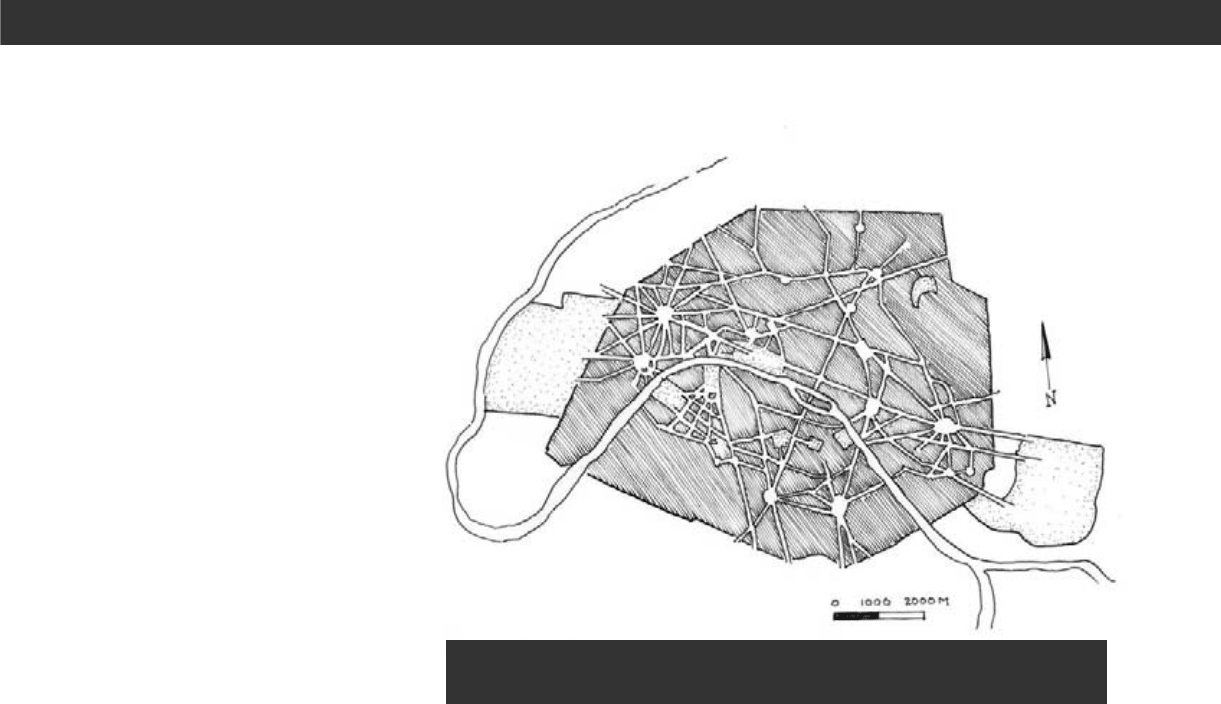
HAUSSMANNIZATION
Baron Georges-Eugene Haussmann
(1809–1891) was appointed Prefect of
the Seine (city manager) by Napoleon III in
1853. He implemented the emperor’s plan
for modernizing the city of Paris, which
involved upgrading the existing infrastruc-
ture and adding new tree-lined boulevards,
road junctions, green squares, and parks.
The urban renewal campaign came at the
expense of the working-class neighbor-
hoods, which were destroyed during the
“improvements.” Ironically, the ideal of so-
cial reform had the effect of displacing the
poor, forcing them out of the city limits.
Much like Pope Sixtus V created a system
to link important sites in Rome during the
Renaissance, the emperor and Haussmann
overlaid a formal geometry on the medieval
fabric of the city. The new street plan
facilitated modern transportation and
commerce, but was also a form of social
control. Wide boulevards divided the city
into manageable districts, and open
spaces—places—were traffi c nodes.
Building codes established uniform
heights for new structures. A grand op-
era house and other cultural institutions
were built as part of Haussmann’s plan.
An earlier renovation of the Champs-
Elysées served as a precedent for
Haussmann’s urban vision. By 1836, the
avenue extended from the Tuileries to the
new Arc de Triomphe and was embellished
with fountains, streetlights, and benches;
theaters and restaurants were planned.
8
In 1858, Haussmann lengthened the
avenue toward the Bois de Boulogne.
Haussmann appointed engineer-de-
signer Jean-Charles-Adolphe Alphand
(1817–1891) as head of the division
of Promenades et Plantations, the
agency responsible for carrying out the
redevelopment plan. Alphand estab-
lished a coherent design language for all
public spaces in the city. Between 1867
and 1873 he published two infl uential
volumes on the architecture and urban
design of Paris, which contained illustra-
tions of his elegant curvilinear landforms
and precisely detailed structures.
9
PARIS PARKS
Haussmann’s plan keyed public parks to
the city’s geography: Bois de Boulogne
to the west, Bois de Vincennes to the
east, Parc des Buttes-Chaumont to
the north, and Parc Montsouris to the
south.
The Bois de Boulogne, a former royal
hunting park, was opened to the public
by Louis XIV and given to the city in 1851.
Radial allées and rond-points typical of
French formalism inscribed the dense
woodlands. Prior to the French Revolu-
tion, it was a fashionable location for
the social promenade. Napoleon III was
impressed by London’s public parks and
had Haussmann redesign the Bois de
REPUBLICS AND EMPIRES
HAUSSMANN’S PARIS: A geometry of order and control was imposed on the
medieval fabric of Paris.