
Boults Е. Illustrated history of landscape design
Подождите немного. Документ загружается.

187
19th CENTURY / FRANCE
Boulogne in the English landscape style.
10
The refurbished park was a popular at-
traction; Olmsted met with Alphand in
1859 and toured the Bois de Boulogne.
Haussmann converted the Bois de Vin-
cennes, a former military parade ground,
to a public park in 1860. Located in the
working-class section east of the city
center, the park contained promenades
like the Bois de Boulogne, so the “com-
mon people” would have equal opportunity
to educate and improve themselves by
imitating their more privileged neighbors.
11
A former quarry in the northern section
of the city created a naturally pictur-
esque site for Parc des Buttes-Chau-
mont. Built from 1864–1867, the park
contains a steep promontory that rises
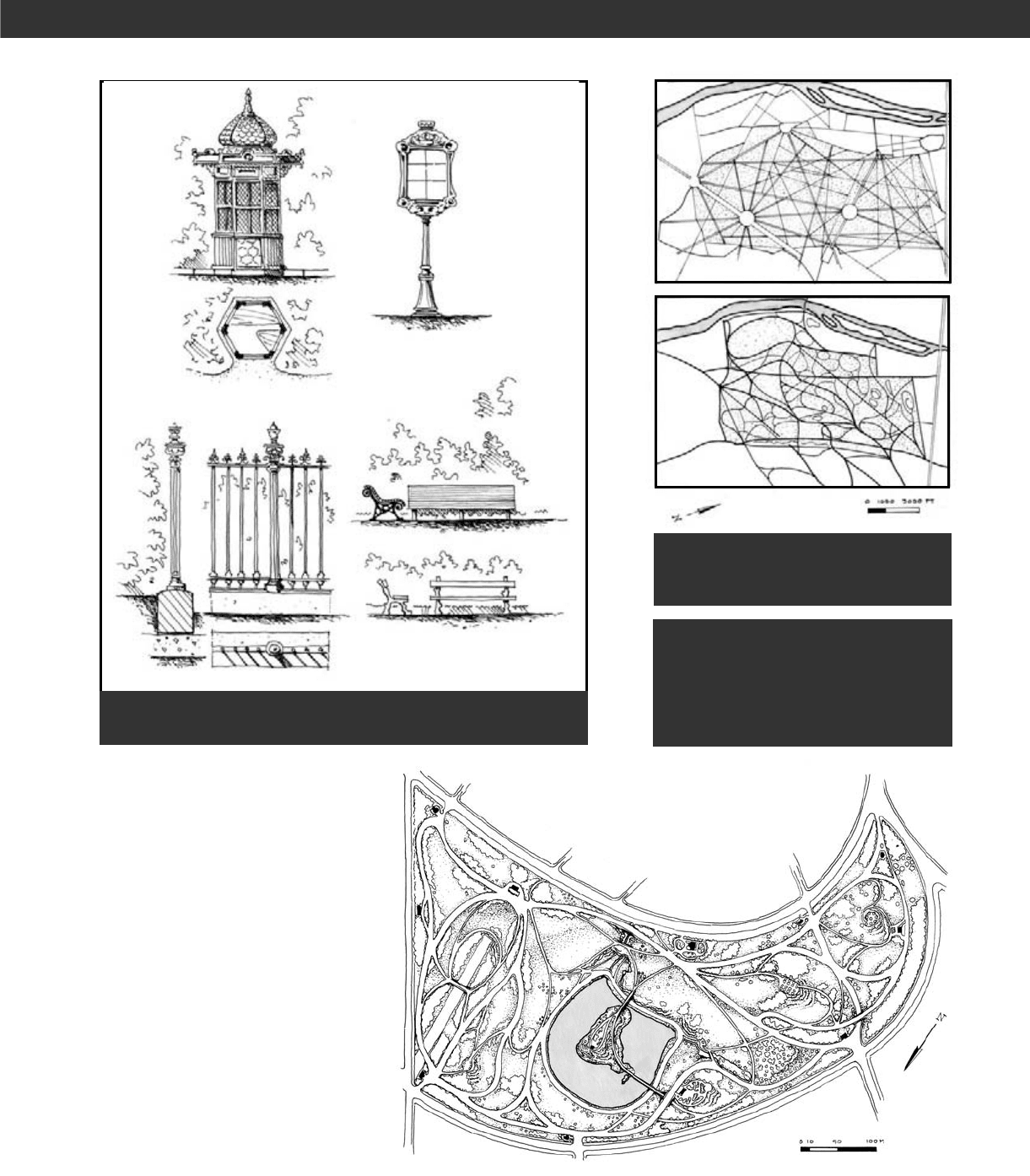
ALPHAND’S VOCABULARY: The highly detailed architectural elements
created a unifi ed design language across the city.
PARC DES BUTTES-CHAUMONT: A former
quarry was reborn as a public park. Pictur-
esque prospects resulted from the sensu-
ously curving path system and the tree
planting scheme, both of which conformed to
Alphand’s dramatic re-grading of the terrain.
BOIS DE BOULOGNE: A naturalistic, Eng-
lish-style landscape replaced the formality
of the 18th-century Baroque design.
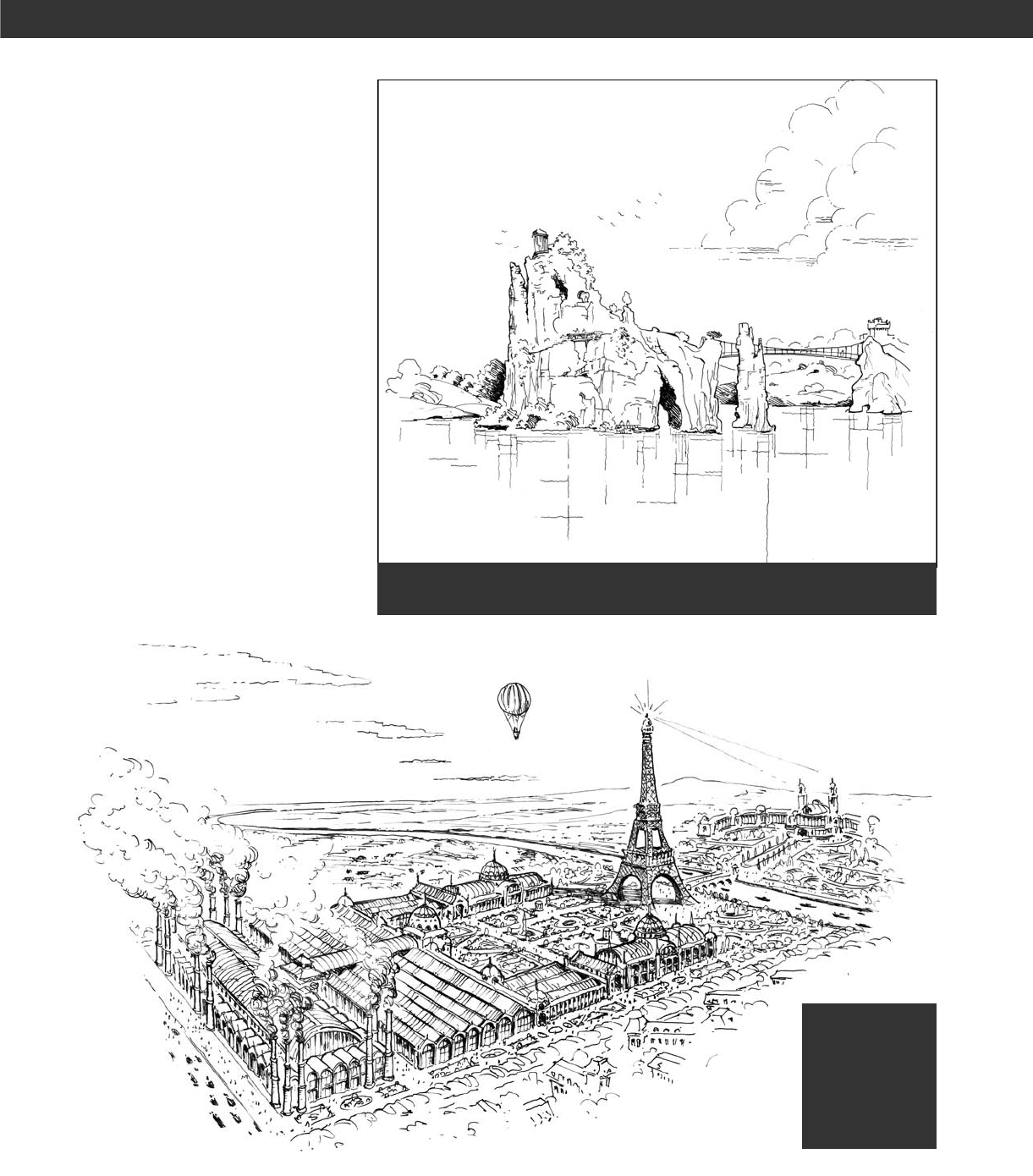
188
from a central lake. A suspension bridge
connects the island with the banks. The
cliff is topped with a circular temple.
Classically themed follies coexist with
grottoes and waterfalls.
Haussmann’s plan also included the
design of 24 neighborhood parks, deco-
rated with Alphand’s gates, streetlights,
and furniture.
INTERNATIONAL
EXPOSITIONS
During the 19th century, countries held
world’s fairs and exhibitions to show off
their cultural advancements and techno-
logical achievements. The Great Exhibi-
tion of London in 1851 was followed by
international exhibitions in Paris in 1855,
1867, 1878, and 1889. For the exhibition
in 1889, celebrating the centennial of the
revolution, Gustave Eiffel designed the
iron tracery of the Eiffel Tower—at 984
feet high, it remains one of the tallest
structures in the world.
19th CENTURY / FRANCE
TECHNOLOGICAL
FEAT: Built for
a world expo in
1889, the Eiffel
Tower remains an
icon of structural
engineering.
“BRIDGE OF SUICIDES”: A suspension bridge leads directly to a temple atop a
steep cliff creating a thrilling experience for the 19
th
-century visitor.
189
America in the 19th century was subject
to the same impulses toward industri-
alization as Europe. People embraced
technology as a means to achieve a
comfortable lifestyle. In 1803, the size
of the United States doubled with the
acquisition of former French territories
in the Louisiana Purchase.
Large-scale consequences to the
environment were hard to imagine in a
country of such immense proportions
and seemingly infi nite resources. But
the impact of industrialization was more
immediate for the urban dweller. As the
century wore on and the frontier drew
nearer, people reexamined their relation-
ship to the landscape. The important
contributions to the history of land-
scape architecture in 19th-century
America were the public park and the
idea of a wilderness aesthetic. What is
particularly American about these land
uses is the fact that citizen initiative
was integral to their creation.
ENGLISH
PRECEDENTS
FOR PUBLIC
PARKS
England’s Reform Bill of 1832 was
symbolic of the increased social con-
sciousness that followed on the heels of
rapid industrialization. The government
acknowledged the need for public green
spaces as one aspect of social reform.
The crown had opened royal properties
to the public in the wealthier West End
of London, but no comparable spaces
existed in poorer neighborhoods. Parks
were part of the housing developments
that industrialists built in the 1830s,
but these green spaces were sur-
rounded by gates and accessible only to
residents. Birkenhead Park in Liverpool,
the fi rst nonroyal property opened to
the public, was one manifestation of
the progressive trend. However, its
motivation was not only philanthropic;
profi ts were to be made from develop-
ing adjacent lands.
Similar trends infl uenced the devel-
opment of the urban landscape in
America. The works of both Andrew
Jackson Downing and Frederick Law
Olmsted were shaped by the aesthetics
of the English landscape garden and
the ideals of social reform.
ANDREW JACKSON
DOWNING
(1815–1852)
Downing grew up in a town along the
Hudson River, north of New York City.
His early training was in horticulture.
His book, A Treatise on the Theory
and Practice of Landscape Gardening,
Adapted to North America, written in
1841, expressed his affection for the “ru-
ral” landscape and his dedication to the
artful design of middle-class residences
(typically single-family country homes).
His belief that environment infl uenced
behavior formed the focus of his profes-
sional career. Downing’s early support
of the public’s right to open space was
crucial to the eventual realization of
Central Park in Manhattan.
Downing considered the stylistic
improvement of suburban properties a
moral imperative and a patriotic duty.
He believed that an inventory of fi nely
designed houses and gardens—a mark
of civilization and republican virtue—
would give America the cultural caché
it lacked in the eyes of the Europeans.
Downing was an advocate of “taste,”
which he defi ned as “good proportions,
pleasing form, and fi tness for the use
intended”—qualities he believed to be
embodied by naturalistic-style gar-
dens.
12
Downing reinforced the harmoni-
ous relationship between house and
LANDSCAPE ARCHITECTURE IN AMERICA
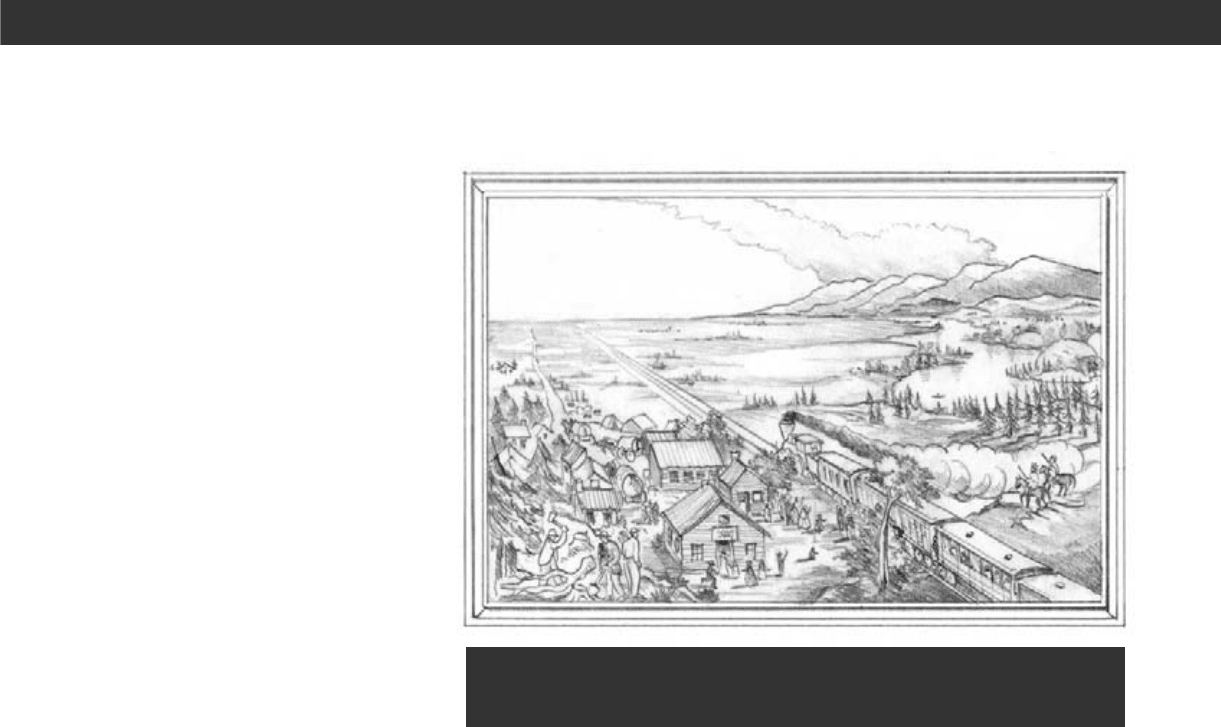
ACROSS THE CONTINENT, WESTWARD THE COURSE OF EMPIRE TAKES ITS
WAY (1868): This popular Currier and Ives lithograph of a Frances Palmer painting
expressed the nation’s belief in manifest destiny.
19th CENTURY / AMERICA
190
19th CENTURY / AMERICA
garden by suggesting improvements
that were based on “beautiful” and “pic-
turesque” principles. Typical elements
included lawns, porches, vegetable
gardens, and ornamental planting. His
forms were based on curvy geometries.
Downing met the architect Calvert Vaux
(1824–1895) in England and persuaded
him to join his practice in New York. Vaux
later formed an equally infl uential part-
nership with Olmsted.
THE NEED FOR
URBAN OPEN
SPACE
With limited opportunity to enjoy
outdoor space, people used cemeter-
ies as pleasure grounds. Rural parklike
cemeteries addressed the needs of
growing urban populations in two ways.
They provided access to landscaped
space for recreational purposes and
they insured public health by keeping
burial sites away from populated areas.
Church graveyards in cities were fi lled to
capacity. The new, secularized cemetery
was seen not just as a graveyard, but
as a sentimental and inspirational
landscape, much like Rousseau’s tomb
at Ermenonville. Nondenominational
cemeteries became fashionable cities
of the dead, ornamented with monu-
ments and sculptures. In 1804, Pere
Lachaise Cemetery was planned by the
city of Paris as one of the fi rst cemeter-
ies in which plots could be purchased in
perpetuity. It was a blend of both formal
and informal geometries. Curvy paths
surrounded a central grid of straight
avenues.
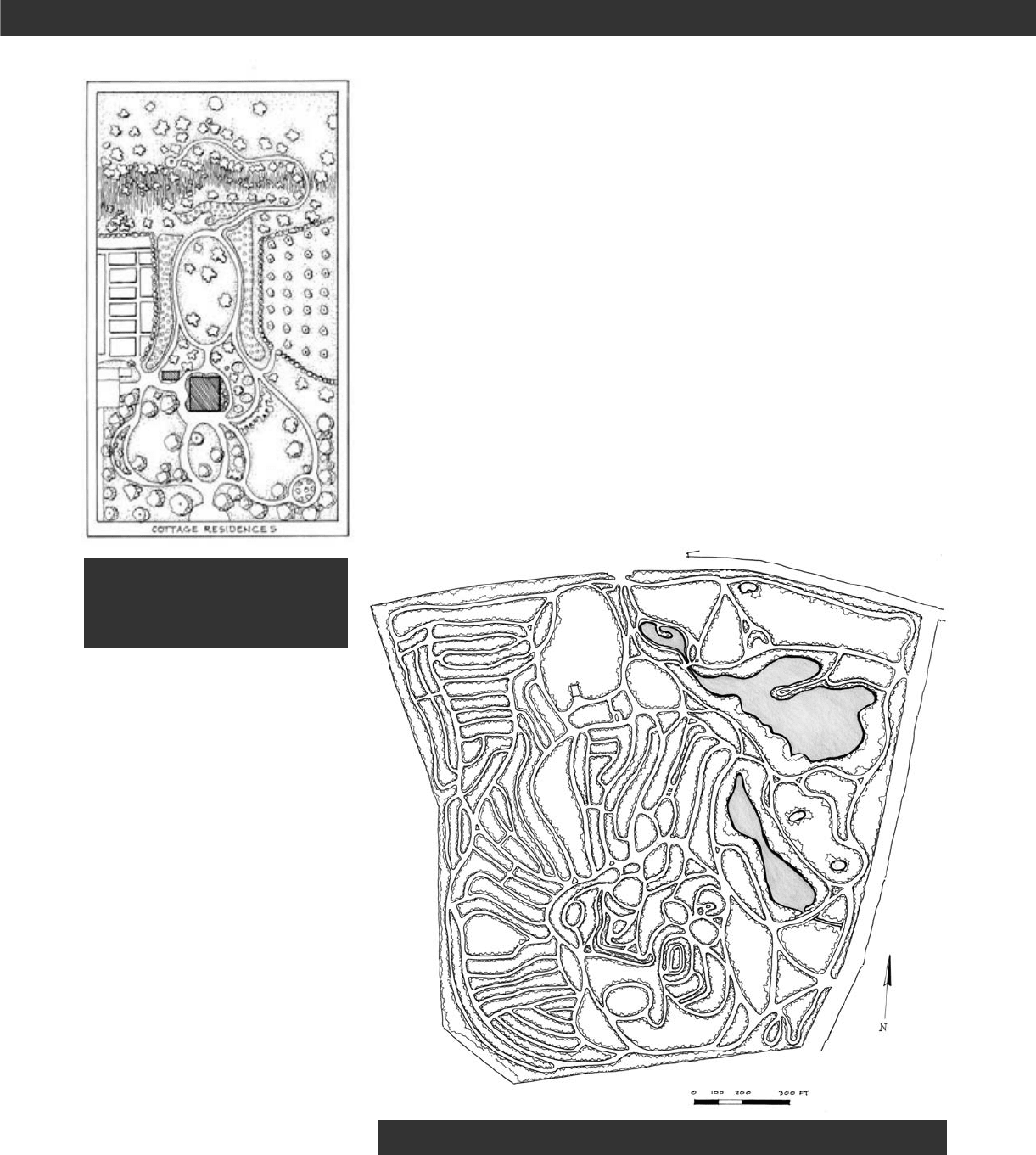
Mount Auburn Cemetery in Cambridge,
Massachusetts, was developed in 1831
by the Massachusetts Horticultural So-
ciety as an experimental garden, arbore-
tum, and cemetery. Its sweeping lawns,
lakes, native trees, and exotic fl owers
were reminiscent of English landscape
gardens, and became the vocabulary of
park design. Cemetery administrators
prohibited slab tombs; instead, urns,
obelisks, and fi gurative sculpture helped
create a picturesque scene. The popular
appeal of cemeteries strengthened the
lobby for public parks.
COTTAGE RESIDENCES: Downing
offered prototypical plans for the
design of small-scale gardens in his
book, Cottage Residences (1842).
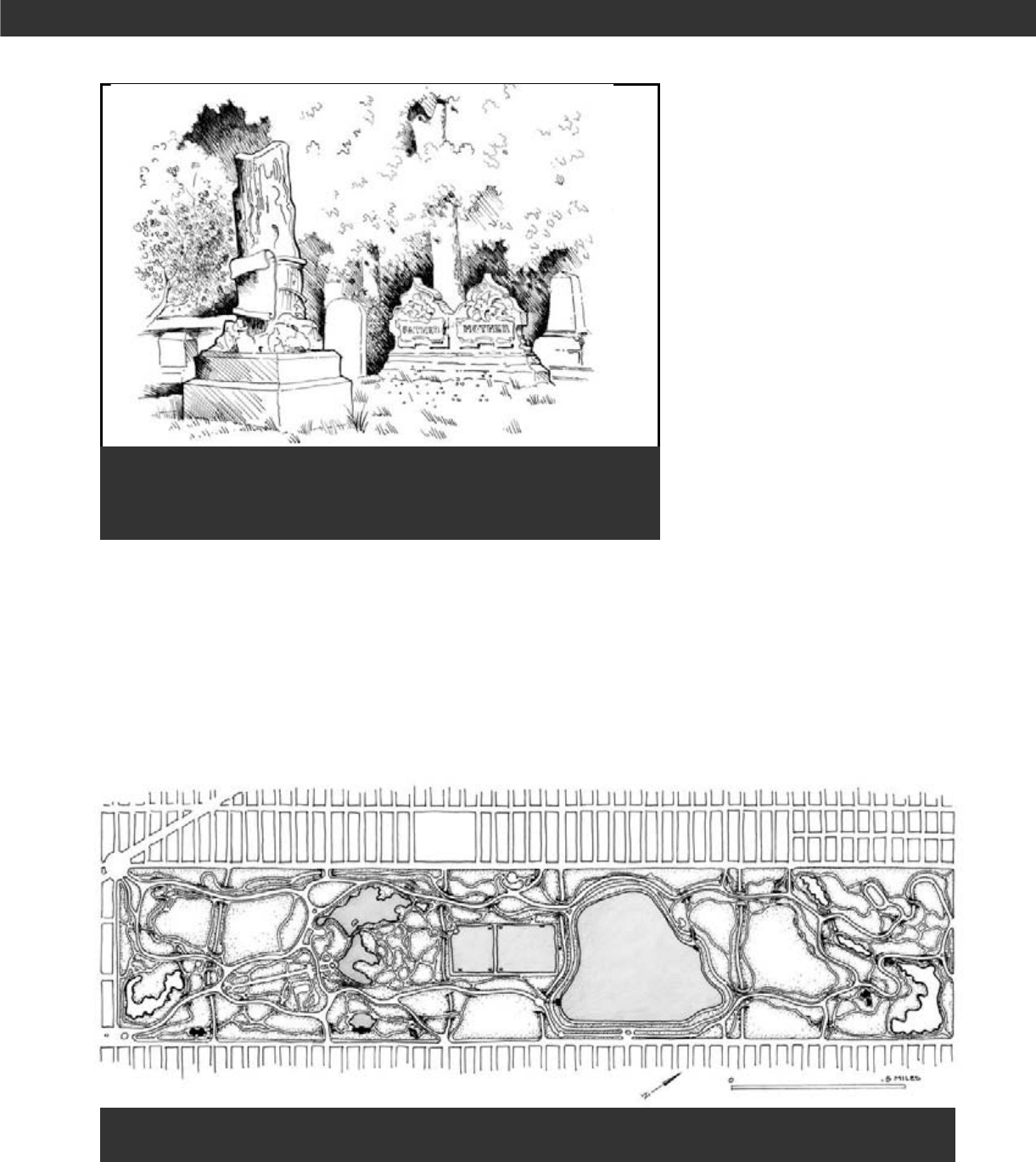
MOUNT AUBURN CEMETERY: Pathways followed the natural contours of the land.
191
19th CENTURY / AMERICA
Waves of European immigration in the
mid-19th century added urgency to the
campaign for public open space in New
York City. The cause was taken up in the
press with support from Downing and
William Cullen Bryant, poet, and editor of
the Evening Post. After much delib-
eration and partisan politics, the city
secured state funding and purchased
a site. A board of commissioners was
set up by the state, and in 1857 they
appointed Frederick Law Olmsted to
oversee the project. Land values around
the proposed park skyrocketed once the
existing tenant farmers, squatter villag-
es, and noxious industries were cleared.
Seneca Village, an African-American
settlement, was destroyed. Many im-
migrant populations were displaced to
make way for the new “people’s” park.
13
FREDERICK
LAW OLMSTED
(1822–1903)
Olmsted was a gentleman farmer who
had a keen interest in the cultural land-
scape. He traveled widely and published
his accounts of vernacular landscapes,
agricultural practices, and social is-
sues.
14
He toured the English landscape
in 1850 and commented on the success
of Birkenhead Park.
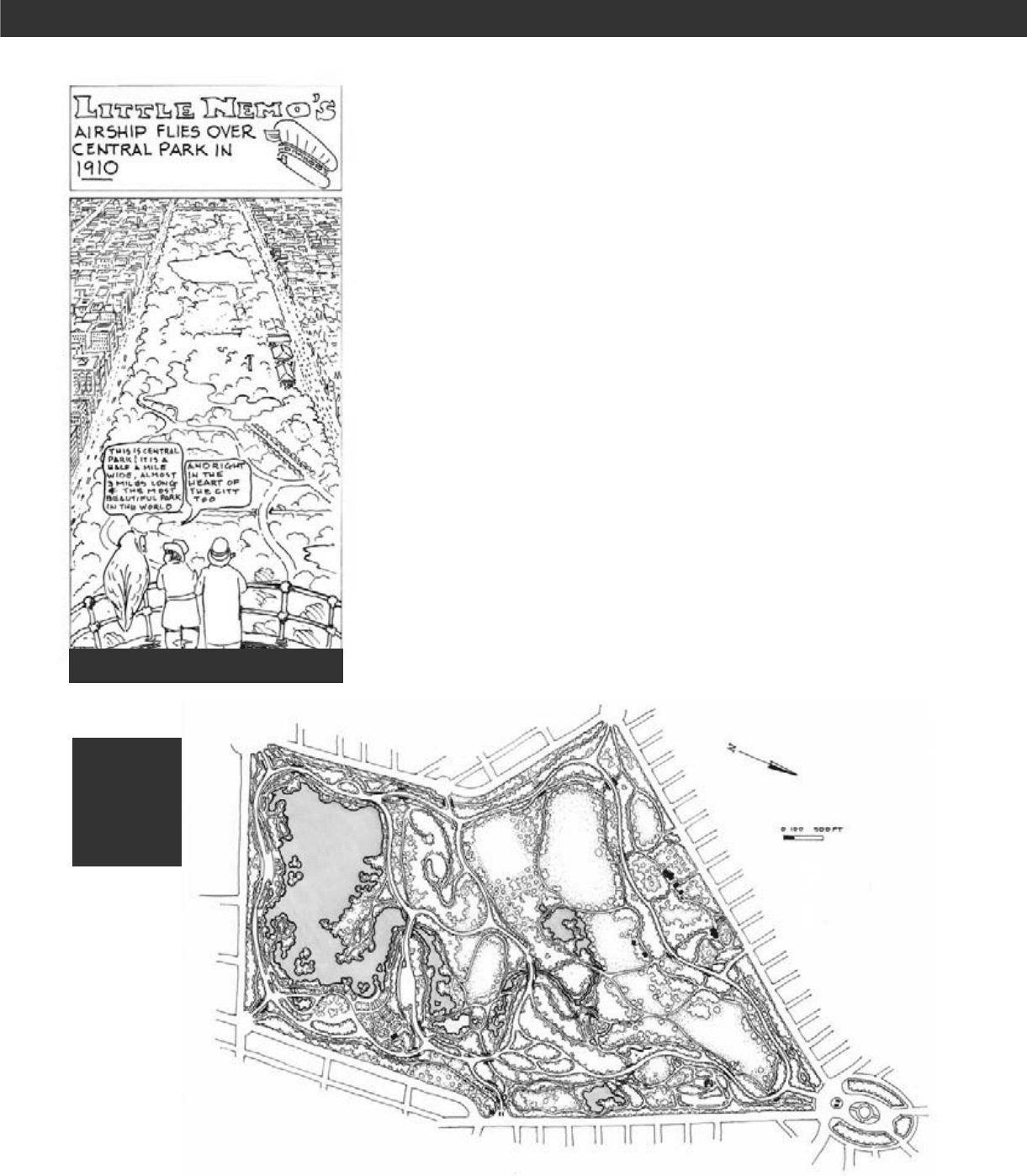
CENTRAL PARK
Olmsted teamed up with Calvert Vaux
to enter the competition for the design
of Central Park in New York City. Their
winning entry, the Greensward Plan,
preserved the wooded area and exposed
bedrock in the middle part of the site,
south of the reservoir, which they called
“The Ramble.” Extensive site engineering
was necessary to create the many lakes
and sloping lawns within the park. They
included a formal pedestrian mall and
terrace to accommodate society’s need
to see and be seen. The perimeter they
screened with trees. The total area of
parkland eventually covered 843 acres—
an area about 2–1/2 miles long, and 1/2
mile wide. The project brief necessitated
RURAL ROMANTICISM: People used cemeteries as pleasure grounds before public
parks were built. Monuments and sculptures created architectonic focal points
against a picturesque background. The idea of commemorating a person’s earthly life
and achievements represented the individualism characteristic of the 19th century.
CENTRAL PARK: Olmsted and Vaux overcame the challenges of the orthogonal site and planted an English landscape garden
within the grid of Manhattan.
192192
19th CENTURY / AMERICA
signing their letters with the title
“landscape architects.” This momentous
designation helped defi ne the scope of
the future profession.
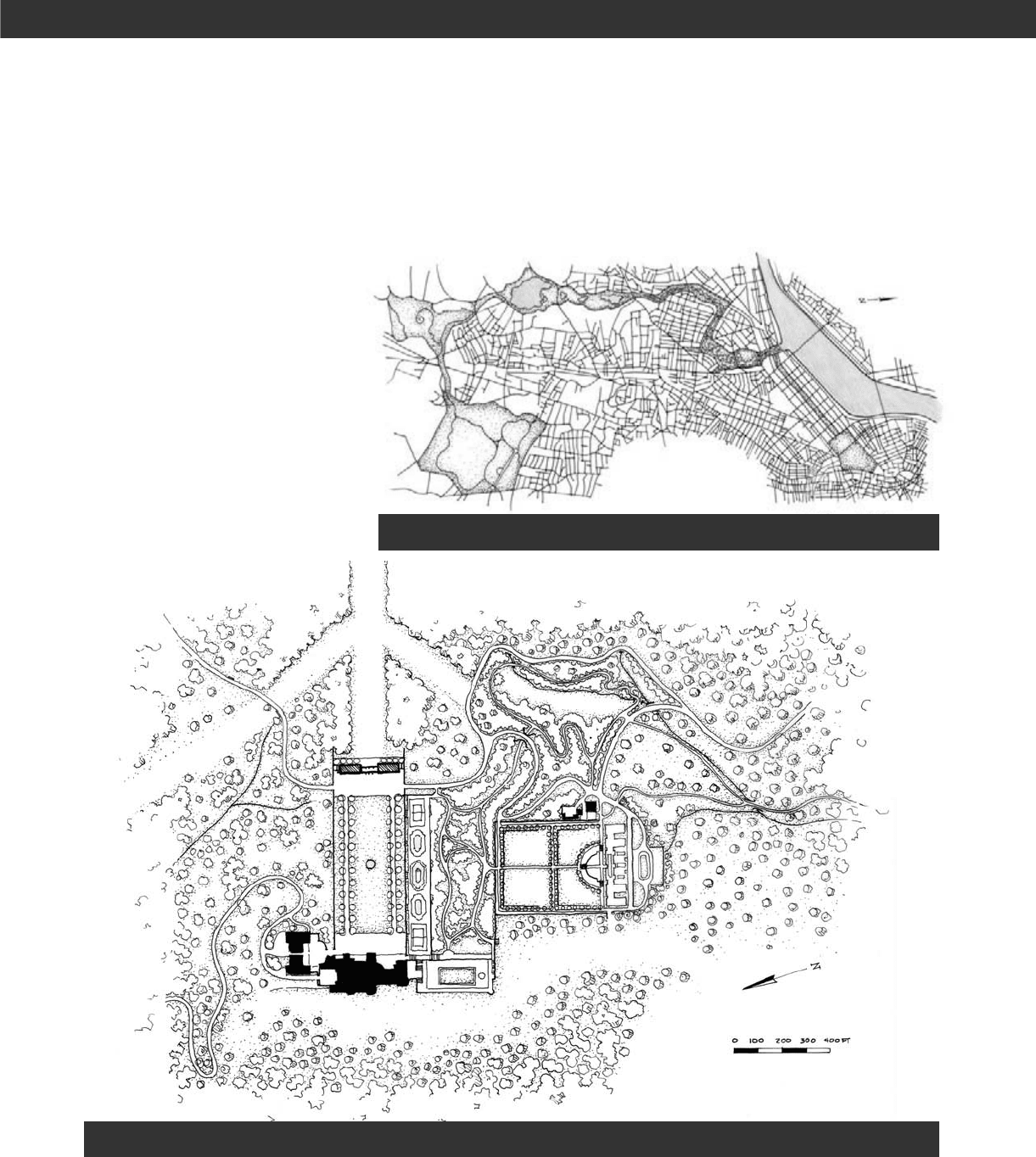
PROSPECT PARK
In 1866, Olmsted and Vaux collaborated
on the design of Prospect Park in Brook-
lyn. The 526-acre park was constructed
over an 8-year period, under much more
congenial political circumstances and
on a site with much fewer programmatic
and topographic constraints. Prospect
Park presented opportunities for the
scenic choreography of space. The main
entrance to the park is through an
underpass in the northern boundary.
The visitor is drawn into the sweeping
space of the Long Meadow; sight lines
continue to pull one through the space
as new vistas open up around trees and
curving lakes.
PARK SYSTEMS
Olmsted’s vision was to go beyond the
creation of an isolated urban park and
develop a continuous network of open
spaces within a city. Olmsted and Vaux
developed a park system for Buffalo,
New York, in 1868. Landscaped boule-
that four cross streets be included in
the plan. Olmsted and Vaux’s innovation
was to depress these arteries beneath
the paths that ran lengthwise through
the park, thereby separating all the dif-
ferent modes of circulation—pedestrian,
equestrian, and carriage.
Humanitarian ideals motivated Olm-
sted. He saw public parks as a means of
escape from the oppressive conditions
of cities. He believed that access to
nature was physically therapeutic and
psychologically uplifting for the working
class.
15
His plan included a dairy, where
refreshment was available for women
and children. But boating and skat-
ing, not the fi eld sports of the working
class, were the only organized sports
originally accommodated in Central Park.
He also disdained the incorporation of
monuments and cultural institutions
in the park, although the Metropolitan
Museum was fi rst included in 1880, and
other architectural features, such as
the Bethesda Terrace, help structure
the landscape space.
Periods of administrative confl ict and
political turmoil marked the progress of
the park’s construction. At one point,
the designers resigned their posts,
PROSPECT PAR
Picturesque
prospects are
afforded by the
irregular geom-
etries of the sit
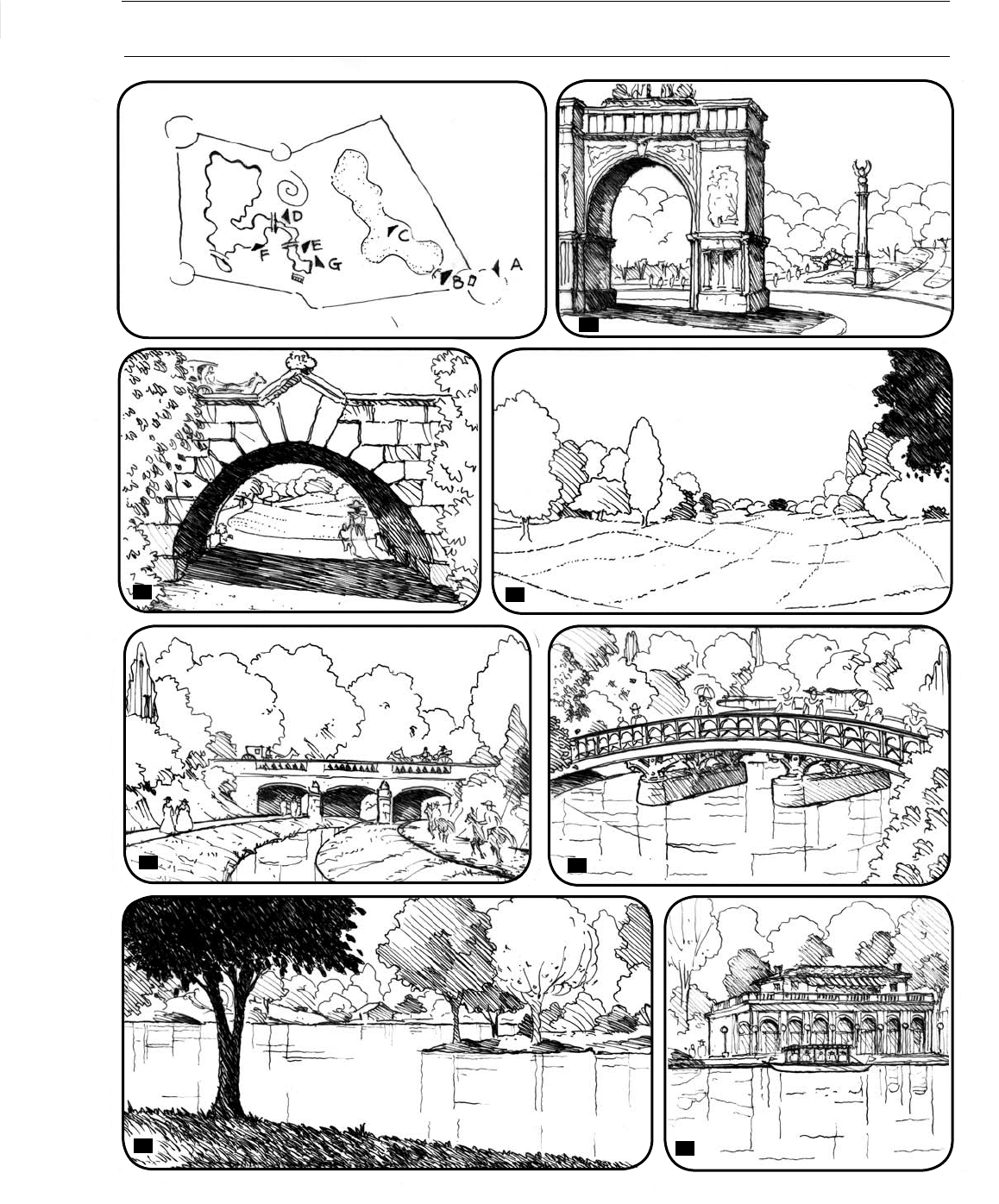
MIDTOWN MANHATTAN, c. 1910.
193
VISUAL NARRATIVE: Prospect Park
A
B
D
E
F
G
C
vards, 200 feet wide, connect Delaware
Park, the 350-acre centerpiece, with
The Front, located on Lake Erie, and
The Parade, on the eastern edge of the
city. Olmsted began planning Boston’s
“Emerald Necklace” in 1875, initially as a
drainage and fl ood control project along
the Back Bay Fens. He went on to develop
a linear greenway that linked the Boston
Common with Jamaica Pond, the Arnold
Arboretum and Franklin Park, the 500-
acre “jewel.”
BILTMORE ESTATE
The Biltmore estate, in Asheville, North
Carolina, was Olmsted’s last private
commission. Richard Morris Hunt
designed the French-style chateau
for George Vanderbilt. Olmsted began
to develop the site plan in 1888. A
3-mile-long approach road winds
through the 250-acre estate, ter-
minating in a formal entry court. The
19th CENTURY
/
AMERICA
the slope are the walled fl ower and veg-
etable gardens and the Conservatory.
A woodland vernal garden borders a
low-lying stream. Olmsted collaborated
with Gifford Pinchot in 1898 to develop
a school for scientifi c forestry on the
grounds, the extents of which reached
over 120,000 acres.
contrast of the picturesque experience
with the sudden presentation of formal
geometries heightened the drama of
the visitor’s arrival. The esplanade is
defi ned by two allées that continue the
lines of the mansion. Parallel to the
esplanade is the lower parterre known
as the Italian Garden. Further down
194
EMERALD NECKLACE: A network of parks and greenways ring the city.
BILTMORE ESTATE: In addition to an eclectic mix of gardens, the estate contained a school of scientifi c forestry.
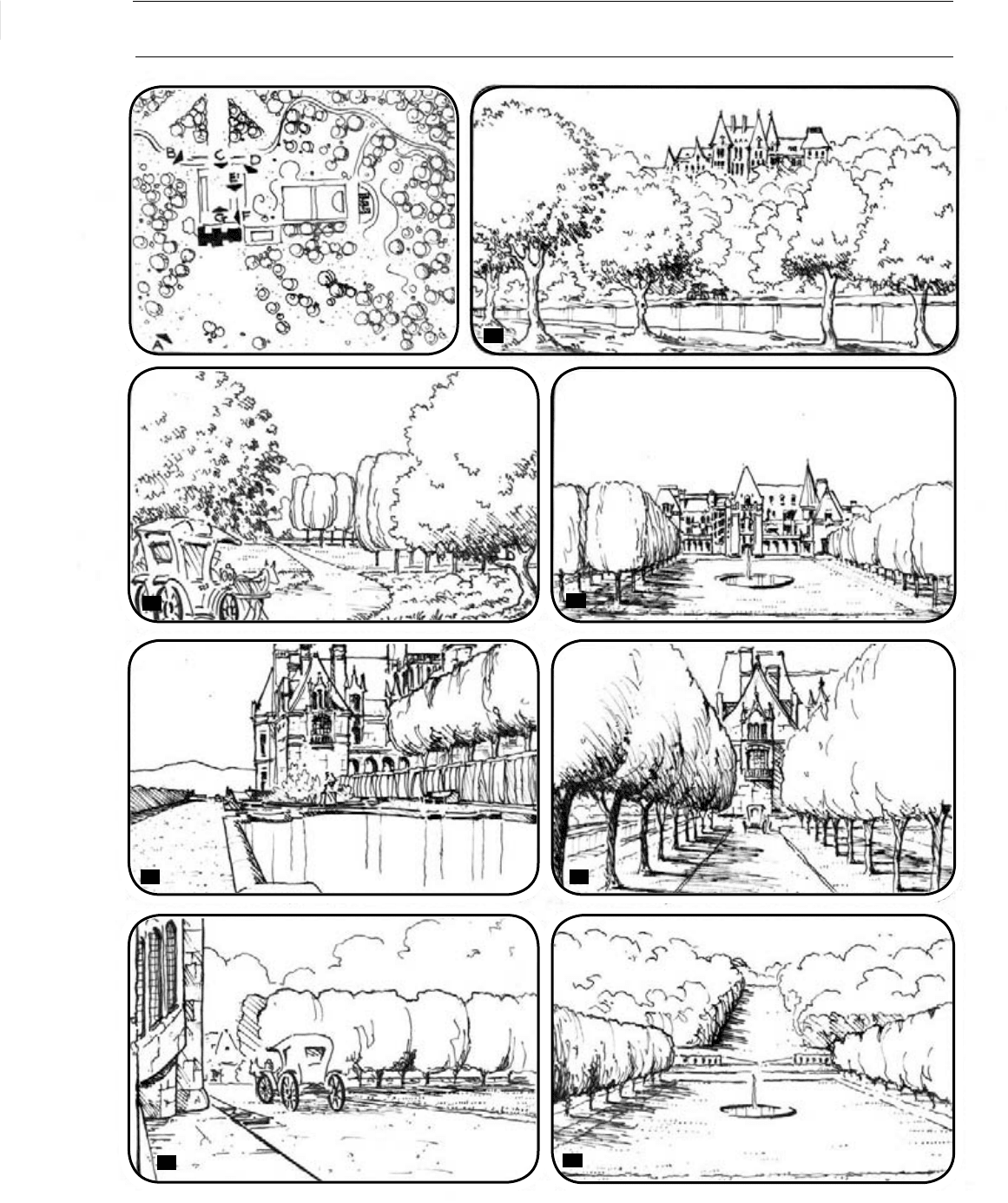
195
A
B
C
D
E
F
G
VISUAL NARRATIVE: Biltmore
196
19th CENTURY
/
AMERICA
The social reform movement and the
cause for wilderness preservation can
both be understood as Romantic efforts
to counter the negative consequences
of the Industrial Revolution. Artists and
writers came to appreciate nature as
an aesthetic object in the 19th cen-
tury. They celebrated in their work the
awe-inspiring phenomena and natural
scenery that they believed was capable
of transforming one’s soul. Transcenden-
talists like Henry David Thoreau, Ralph
Waldo Emerson, and Walt Whitman saw
in untamed nature the hand of God. The
Hudson River School painters were the
fi rst to treat the landscape as a legiti-
mate genre in itself, devoid of any clas-
sical imagery. They were instrumental in
developing a sense of pride and value in
the unique American landscape.
The idea of a “nation’s park” is deeply
rooted in the American character. The
breathtaking landscape of the American
West, fi rst known only to Native Ameri-
cans, was astonishing to early explorers.
Yosemite Valley, in California, and the
Wyoming territory called Yellowstone
captivated the young republic’s Romantic
imagination.
John Colter, a member of the Lewis and
Clark Expedition, along with other explor-
ers and trappers, spoke of the astound-
ing scenic wonders and frightful natural
phenomena in the West.
16
Decades later,
in the 1870s, the government sponsored
expeditions to the Montana and Wyoming
territories. Thomas Moran was one of
the artists who accompanied the 1871
expedition. He captured the overwhelm-
ing majesty of the landscape and helped
inspire the public’s recognition of the
landscape as a unique treasure. The
expedition returned with the suggestion
that the magnifi cent natural scenery
be preserved as a public park. Under the
provisions of the Yellowstone Act of
1872, the area was established as the
ROMANTIC IDEALS OF NATURE
NATIONAL PARKS
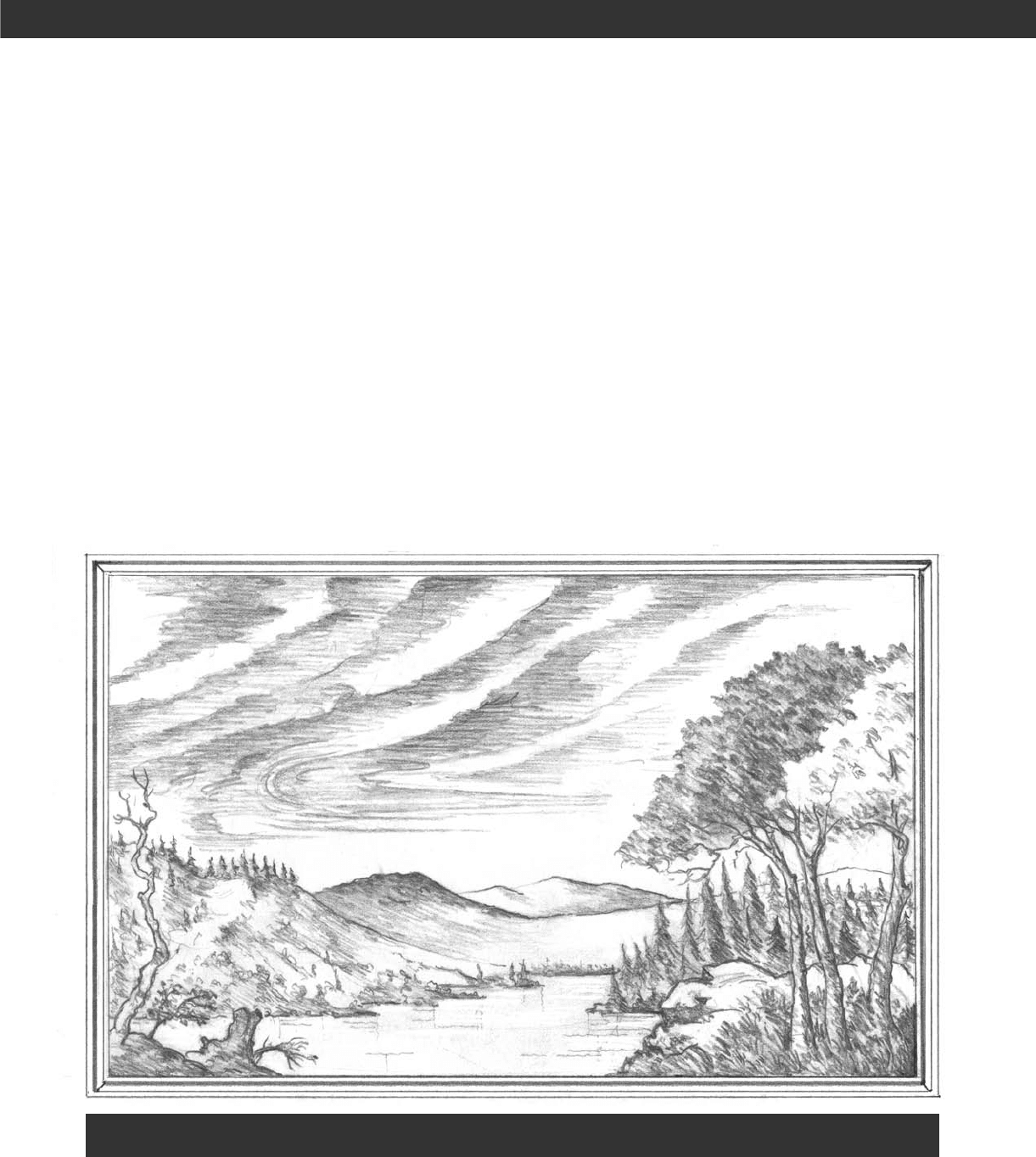
TWILIGHT IN THE WILDERNESS, 1860: Frederick Edwin Church and the Hudson River School painters helped defi ne a distinct
American art form.