
Boults Е. Illustrated history of landscape design
Подождите немного. Документ загружается.

207
20th CENTURY
/
THE GILDED AGE
America experienced tremendous
growth in industry and a great wave of
immigration in the period between Re-
construction (1877) and the country’s
entry into World War I (1917). Fortunes
were made for investors in steel, oil,
and railroads. The very rich indulged
themselves in Roaring Twenties speak-
easies, while the very poor struggled
to survive in overcrowded tenements.
In 1873, Mark Twain collaborated with
the author Charles Dudley Warner on a
book entitled The Gilded Age: A Tale of
Tomorrow—a satire about the pol-
EXTREMES OF WEALTH AND POVERTY
ished surface disguising the underlying
greed and corruption in society. The
term came to characterize the era.
The dramatic changes of the 20th
century were written on the landscape
and completely shifted the priorities of
design.
From the 1880s to the 1920s, wealthy
American industrialists and bank-
ers expressed their pow
er by building
estates in the countryside, much like
ancient emperors and Renaissance
princes did. European-styled houses
and gardens—manors, villas, castles,
and chateaux—dotted the landscape
outside major cities. The period is
contemporary to that of the Lutyens/
Jekyll partnership (1893–1912) and
is characterized by a similar focus
on high-quality materials and clearly
structured space. Typical of the era
is an enhanced relationship between
house and garden, a balance of natural-
istic and formal areas, and a hierarchi-
cal ordering of space. The stock market
crash of 1929 and the new income tax
laws enacted in 1933 put an end to the
Country Place Era.
Beatrix Jones Farrand (1872–1959)
was a founding member of the Ameri-
can Society of Landscape Architects
(ASLA) and a pioneering woman
designer. Her privileged background put
THE COUNTRY PLACE ERA
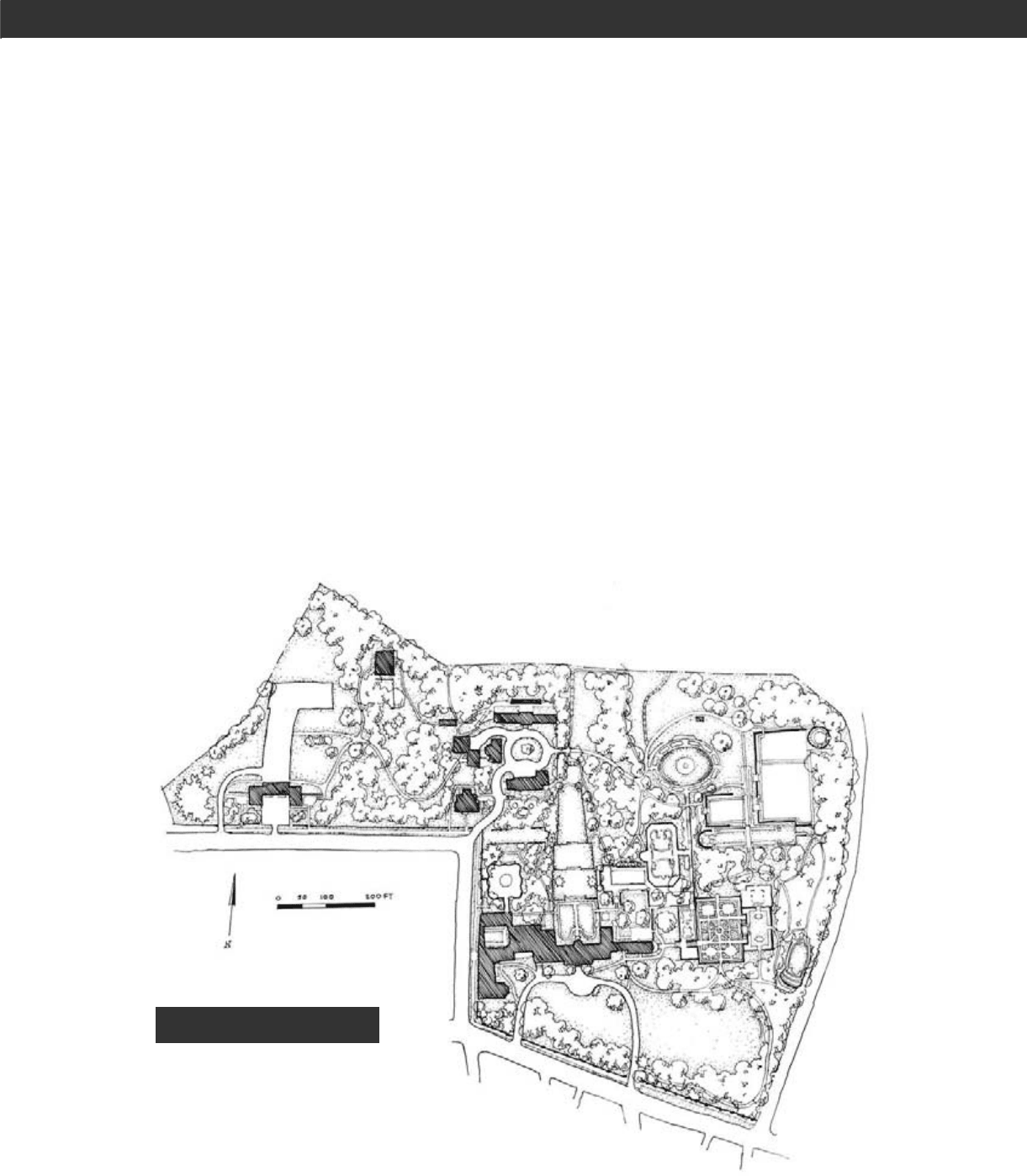
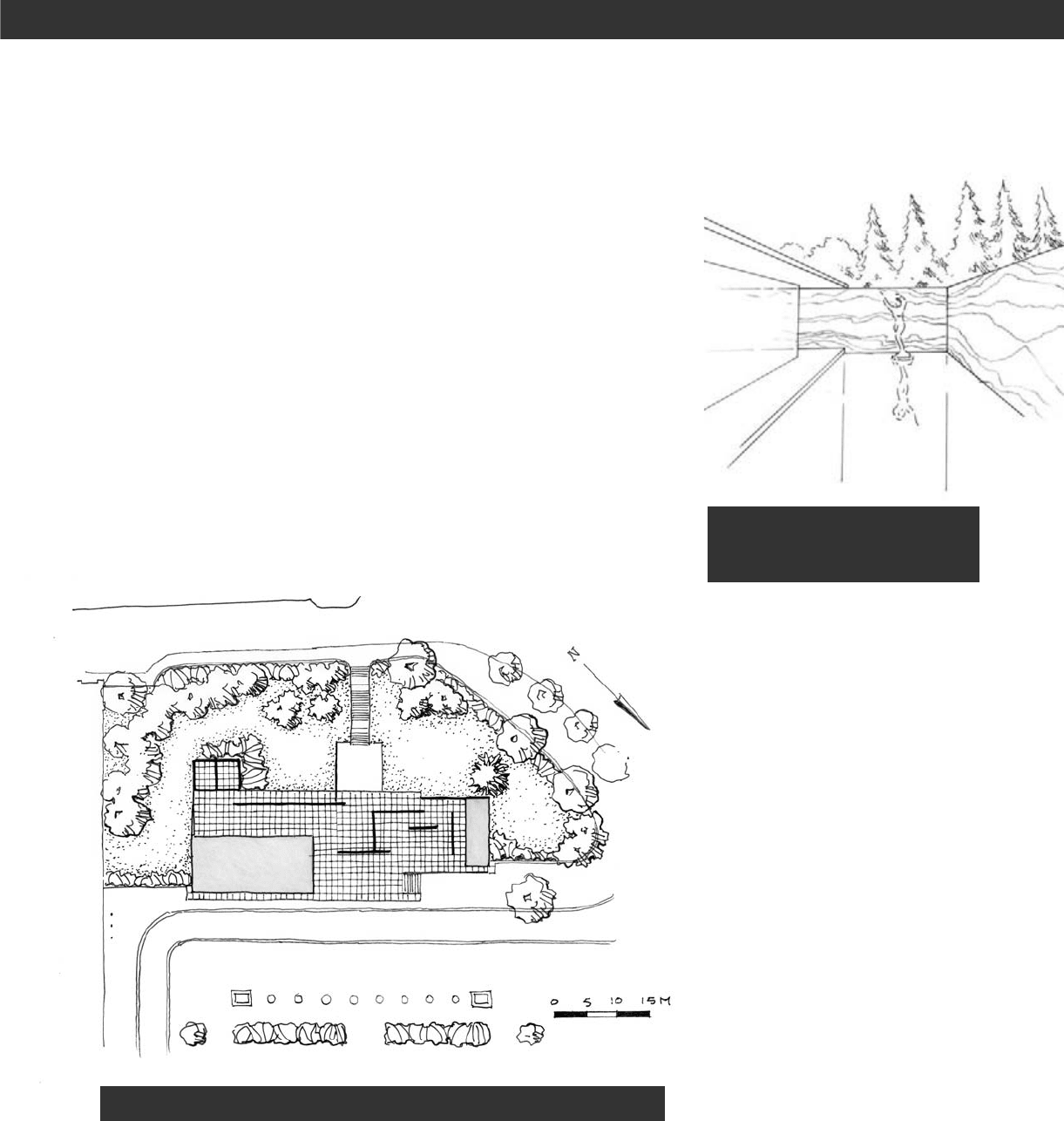
DUMBARTON OAKS: Site plan.
208
20th CENTURY
/
THE GILDED AGE
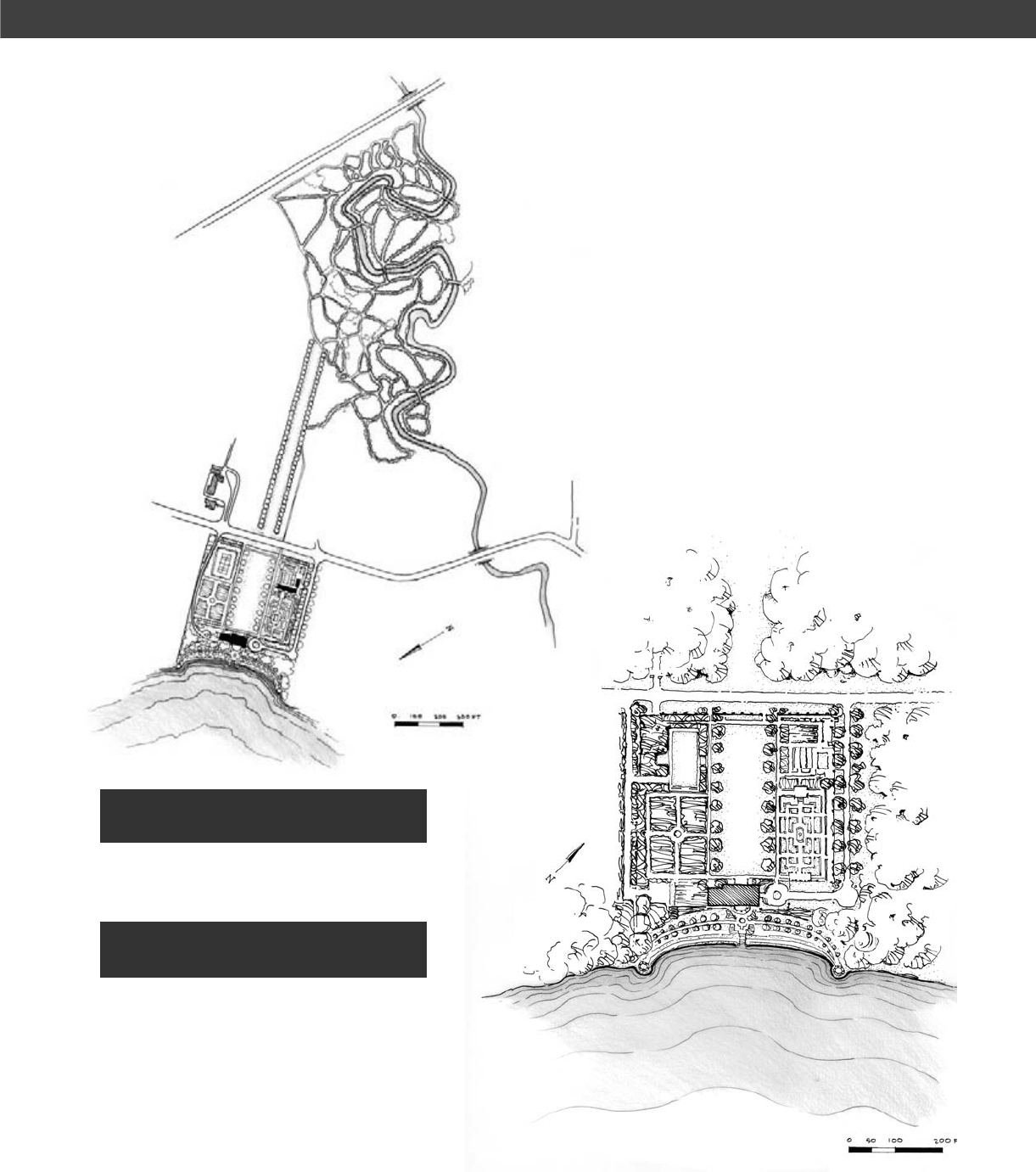
Charles A. Platt (1861–1933) was an
architect whose work was informed
by a sense of spatial order and visual
coherence reminiscent of Italian Renais-
sance gardens. His book, Italian Gardens
(1894), was infl uential in introducing ar-
chitectonic spatial relationships to resi-
dential design in America. He conceived
of the house and garden as a single
composition, connecting interior and
exterior spaces through proportional
relationships and sight lines. His work at
Gwinn, the Cleveland estate of William G.
Mather, began in 1906. Warren Manning
laid out the 27-acre estate for which
Platt designed the house and its 5-acre
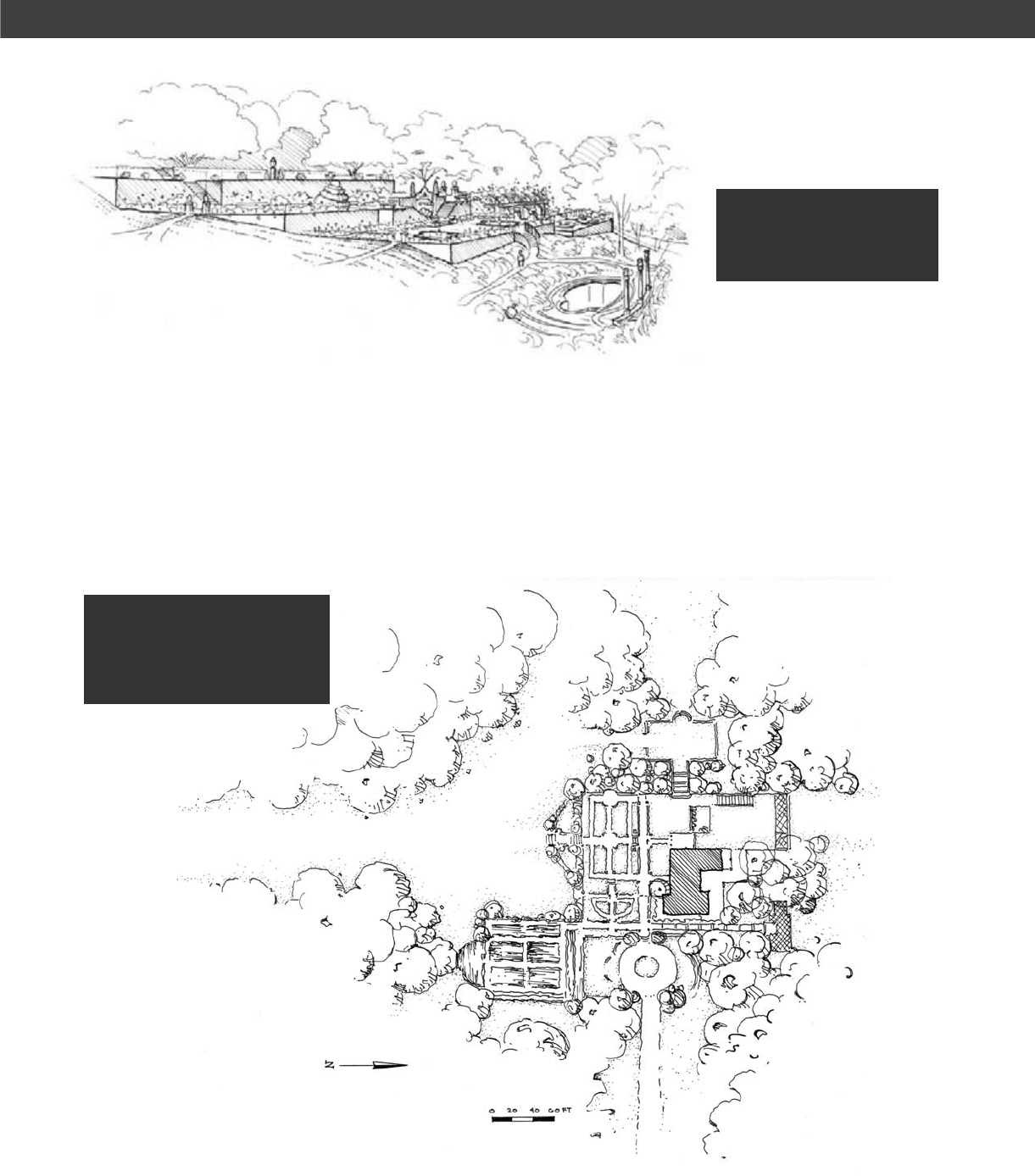
TERRACE GARDEN: Farrand
created a wonderful harmony
of planting, paving, and archi-
tectural elements.
PLATT RESIDENCE: Charles
Platt’s own house in Cornish, New
Hampshire, exemplifi es the balanc-
ing of space through the use of
lateral axes.
her in the same social circle as many of
her infl uential clients.
1
Farrand began
work on Dumbarton Oaks in 1920 and
remained engaged in the project for
27 years. Located in Georgetown, near
Washington, DC, Dumbarton Oaks was
the home of Mildred Barnes Bliss and
Robert Woods Bliss. Architectural
elements structure the terraces that
descend the woodland slope. Outdoor
rooms, like the rose garden, north vis-
ta, and pebble garden are distinguished
by their Arts and Crafts detailing.
209
garden. Platt structured the formal and
informal spaces through sight lines
. In
1935 Mather hired Ellen Shipman to
redesign Platt’s formal gardens.
Other notable country place estates
include Filoli, the Bourn family estate
in Woodside, California; Winterthur,
home of the du Ponts, in Delaware; the
Mount, Edith Wharton’s house in Lenox,
Massachusetts; John Deering’s Villa
Vizcaya in Miami, Florida; and Biltmore
in Asheville, North Carolina (discussed
in the previous chapter). In the second
half of the 20th century, the focus
of professional practice shifted away
from residential design. Landscape
architects adopted corporate busi-
ness models to undertake large-scale
projects for corporate clients and
municipalities.
GWINN MASTER PLAN: Platt and Manning
juxtaposed naturalistic and formal geometries.
GWINN SITE PLAN: A curving terrace formed
an elegant seawall on the shores of Lake Erie.
20th CENTURY
/
THE GILDED AGE
210
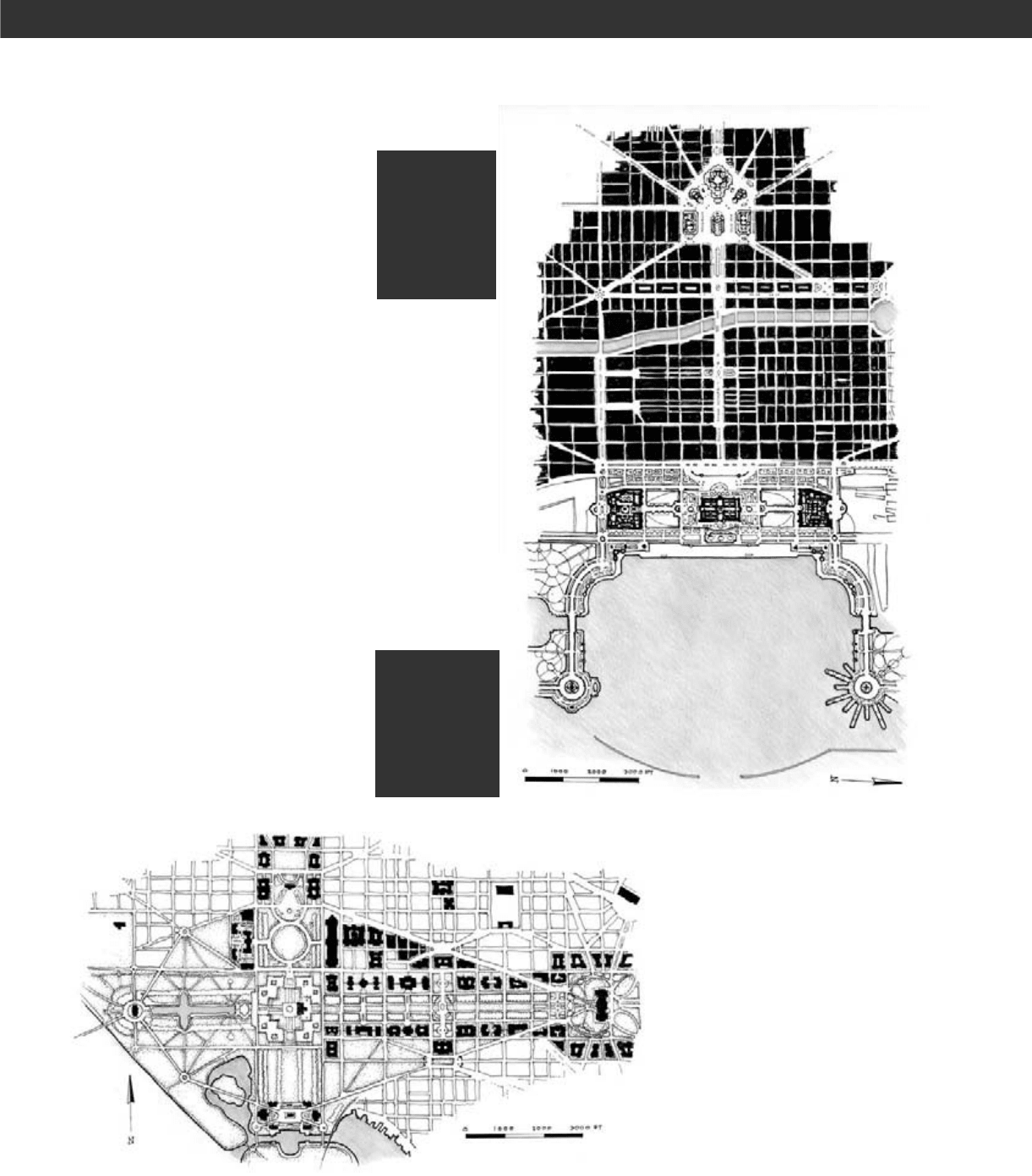
Burnham, however, did get an oppor-
tunity to remake an entire city in the
neoclassical manner. Burnham, along
with landscape architect Frederick Law
Olmsted Jr., sculptor Augustus Saint-
Gaudens,
and architect Charles McKim,
was appointed by the McMillan Com-
mission to enact Pierre L’Enfant’s 1791
plan for the redesign of Washington, DC.
Known as the McMillan Plan, the capital
was given a Beaux-Arts facelift.
The City Beautiful movement helped city
planning evolve as a discipline separate
from landscape architecture in the
late 1920s. The fi rst professional city
planning curriculum was established at
Harvard University in 1929.
20th CENTURY
/
THE GILDED AGE
BEAUX-ARTS
CHICAGO:
Burnham’s
plan for the
redesign of
Chicago was
not realized.
McMILLAN
PLAN: The Mc-
Millan Plan of
1901 gave the
nation’s capital
a Beaux-Arts
facelift.
THE CITY MADE BEAUTIFUL
The veneer of grandeur that charac-
terized Gilded Age estates was also
applied to cities by reformists who
perceived the advantages of represent-
ing a city as a single, unifi ed vision. The
success of the Chicago World’s Fair
brought the idea of city planning to
the forefront of public consciousness.
Journalist and author Charles Mulford
Robinson (1869–1917) reviewed the fair
in the press and subsequently developed
theories of “civic aesthetics,” which were
enthusiastically received by the public.
His book, Modern Civic Art, or the City
Made Beautiful (1903) helped make the
commitment to civic improvement a
fashionable cause.
2
The City Beautiful movement resulted in
the piecemeal addition of monuments
and sculptures to urban spaces, and the
construction of public institutions like li-
braries and post offi ces. Architects, con-
forming to Beaux-Arts ideals, proposed
comprehensive urban plans for cities, but
for a variety of reasons, none were real-
ized.
3
Daniel Burnham’s formal plan for
the redesign of Chicago included radial
and diagonal street systems, wide boule-
vards, and a monumental civic center. His
approach was criticized for its emphasis
on appearance rather than social respon-
sibility, and for many additional reasons,
the plan was never actualized.
4
211
Modernism in landscape architecture
refers to the rejection of traditional
styles and approaches and the embrace
of functionalism. The new aesthetic of
modernism overcame the eclectic mix
of historical styles that was prevalent
at the turn of the century. Modern de-
signers articulated in their work values
that were democratic, accessible, and
refl ective of a new more casual life-
style. Landscape designs were antiaxial
and omnidirectional, and incorporated
nontraditional materials, abstract
shapes, and sculpture. Designers em-
ployed plants and sculptures purely for
aesthetic impact, not their associative
meanings.
unnecessary; design elements had to be
purposeful.
“Form follows function” was the slogan
that summarized modernist intentions.
6
The interdisciplinary art and design
school called the Bauhaus, in Dessau,
Germany, stressed the unity of art,
industry, and nature. Students explored
the use of industrial materials and
technologies, which were less expen-
sive and therefore indicative of a more
egalitarian aesthetic. Walter Gropius
(1883–1969) founded the Bauhaus and
was its director from 1925 to 1933.
He became the head of the Graduate
School of Design at Harvard, in 1933,
and brought the International Style to
America.
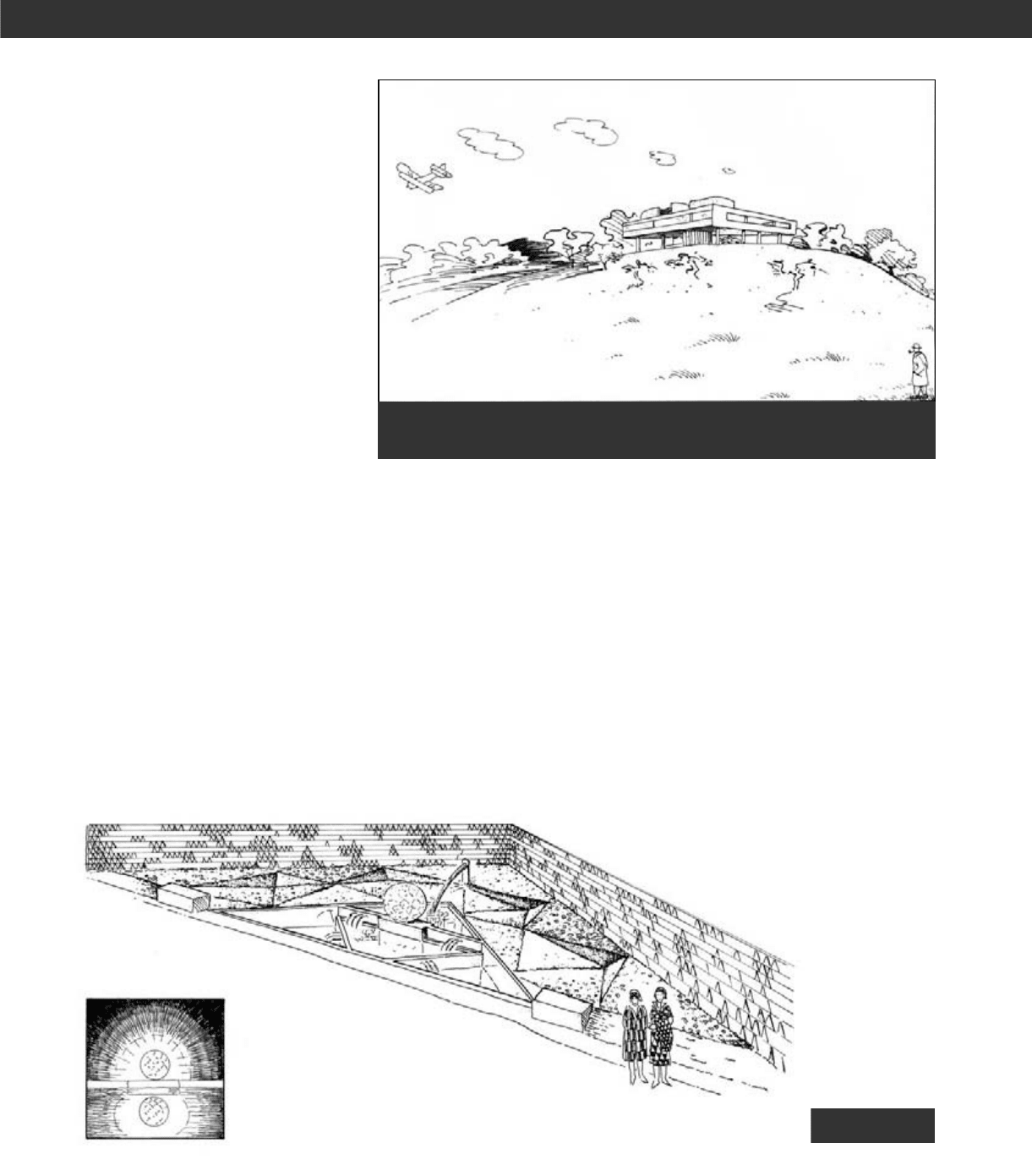
Ludwig Mies van der Rohe’s German
Pavilion, designed for the Barcelona
Exposition in 1929, became the
archetype of modern spatial
composition. Its open fl oor plan and
modular system of support created
a new sense of space, defi ned by
interpenetrating vertical and horizontal
planes. Charles-Edouard Jeanneret
THE
INTERNATIONAL
STYLE
Designers in the fi rst half of the 20th
century were optimistic about the role
of machine-age technology, and saw its
potential to encourage healthy and lei-
surely lifestyles. Architectural theorists
promoted a single International Style
that expressed industrial materials
and processes and that was free of
any trace of authority, hierarchy, social
class, or vernacular fl avor.
5
Modernist
objects and spaces expressed utili-
tarian functions. Ornamentation was
20th CENTURY
/
MODERNISM
THE NEW AESTHETIC OF MODERNISM
BARCELONA PAVILION: The lack of load-bearing walls created an open fl oor plan.
ALBA (DAWN), by GEORG KOLBE:
Sculptures created dynamic focal
points in modern gardens.
212
20th CENTURY
/
MODERNISM
(Le Corbusier, 1887–1965) applied the
International Style to residential design.
He considered the house a “machine
for living.”
7
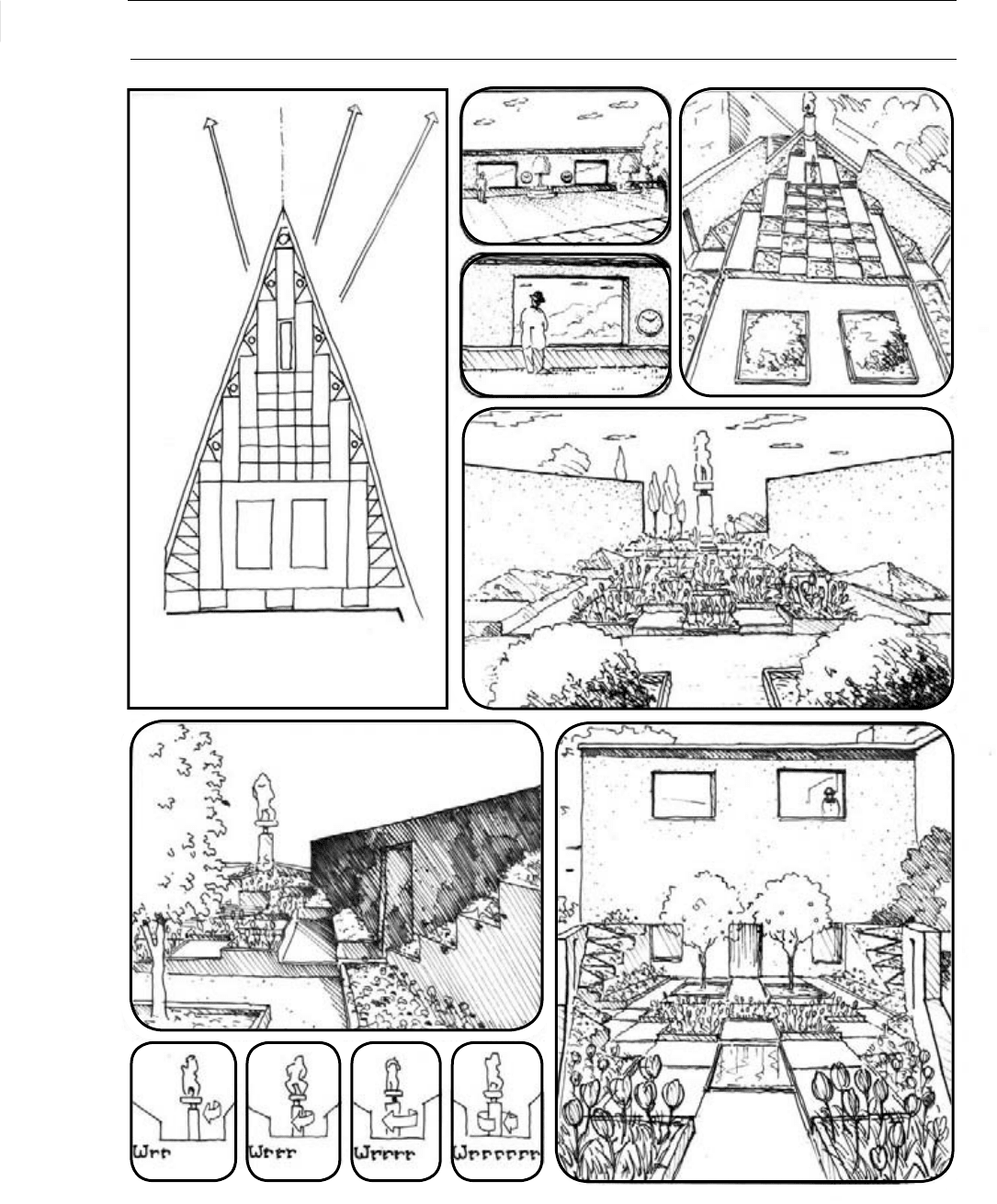
His Villa Savoye of 1929, at
Poissy, outside Paris, was raised up on
pilotis (columns) and disconnected from
the landscape. Nature functioned as a
romantic backdrop for architecture, an
attitude that lingered in the minds of
many architects.
the same ideas in his later work at Villa
Noailles (1927). His gardens were often
referred to in the press as “cubist” gar-
dens because they created the illusion
of representing multiple points of view all
at once, as did cubist still-lifes. However,
scholars point out that it is impossible
to replicate the visual effects of two-
dimensional cubist paintings in physical
space.
10
While it was diffi cult to apply
the rigid modernist aesthetic to the
landscape—which is shaped by dynamic
processes—several individuals became
key fi gures in promoting a new style of
landscape design.
The 1925 Exposition Internationale des
Arts Decoratifs et Industriels Modernes
in Paris helped establish a new vocabu-
lary of design, known as Art Deco. The
temporary “viewing” gardens that were
on display at the expo had an enormous
infl uence on early 20th-century land-
scape design. A new concept of space
was explored in the work of Gabriel
Guevrekian (1900–1970), who was asked
by J. C. N. Forestier, the site designer
for the exposition, to design a modern
Persian garden.
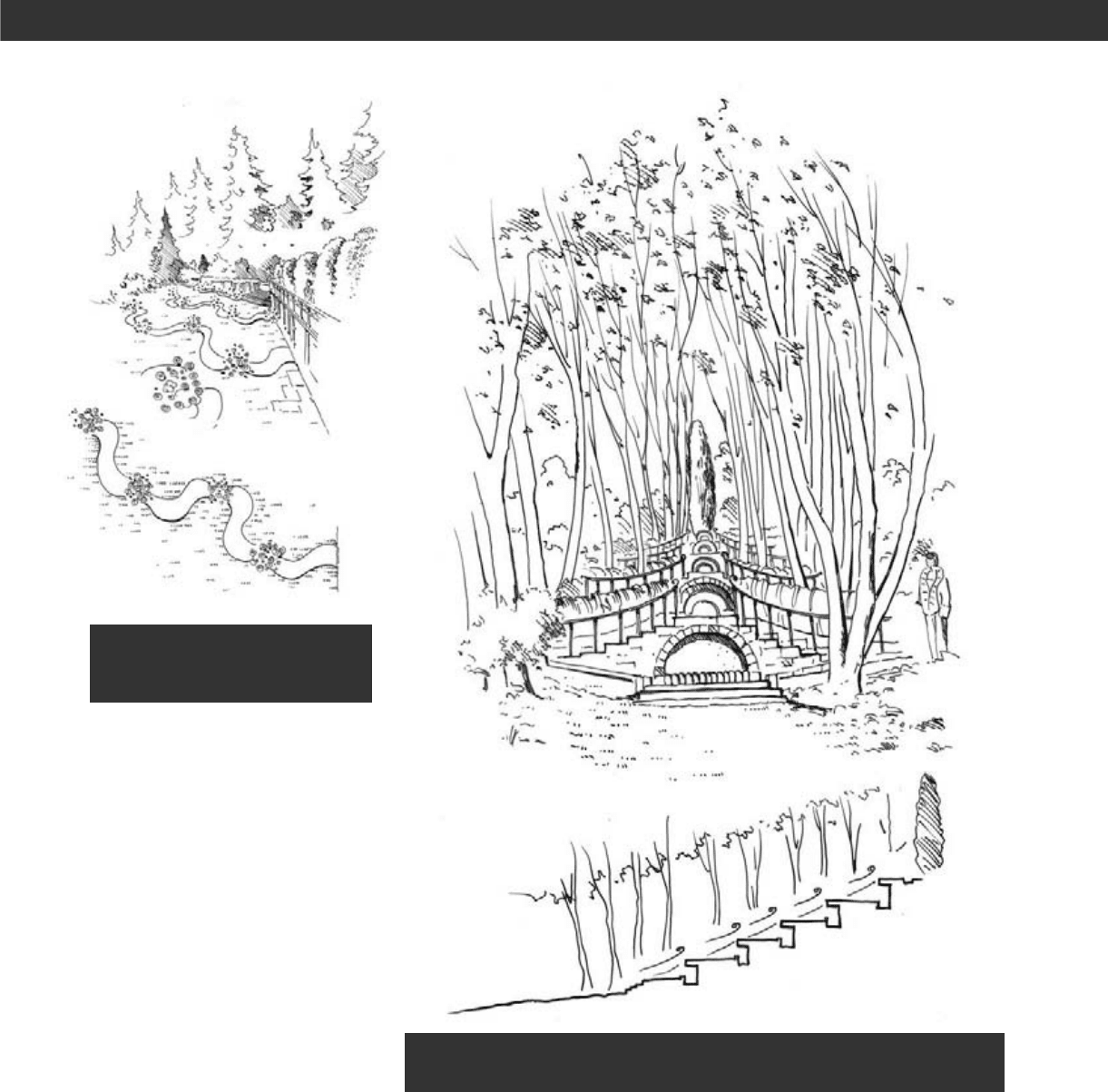
8
His solution, called the
Garden of Water and Light, was based
on the use of triangular forms and
ace.
EARLY
INFLUENCES
ON MODERNIST
GARDENS
refl ective surfaces, as well as on optical
color theories that created the illusion
of a three-dimensional painting.
9
The
plan formed a large triangle, broken up
by triangular planting beds and trian-
gular pools of water. The surrounding
“fence” was composed of tinted glass
triangles. A rotating spherical sculp-
ture, illuminated from within, was made
of faceted refl ective glass.
Guevrekian’s work positioned the garden
as a conceptual artistic statement,
where plants functioned as abstract
masses of color. He explored many of
MACHINE FOR LIVING: The landscape continued uninterrupted beneath the el-
evated structure of Villa Savoye.
213
CASE STUDY: Villa Noailles
AVANT-GARDEN: Plan and sequence of space at the Villa Noailles in Hyeres, France. Raised planters and a revolving
sculpture created a surreal experience of landscape space.
214
Fletcher Steele (1885–1971) was a
Boston writer, critic, and landscape
designer whose work can be seen as a
link between Beaux-Arts formality and
modernism. He received his practical
training in the offi ce of Warren Manning
(1860–1938). He attended the 1925
Paris Expo and was infl uenced by the
abstract concepts represented in the
demonstration gardens.
11
His purity of
line, fl uid geometric forms, and use of
color typify the Art Deco style.
The series of gardens Steele created at
Naumkeag, a private estate for Mabel
Choate in Stockbridge, Massachusetts,
illustrated a new conception of the land-
scape as a setting for outdoor living.
Starting in 1938, and continuing over a
30-year period, he composed a series
of garden rooms including the Rose
Garden, the Afternoon Garden, and the
iconic Blue Steps. Curving white tubular
steel handrails draw attention to the
stand of white birch trees, and contrast
with the surrounding green woodland
and blue recesses at the stair landings.
In 1938, Christopher Tunnard
(1910–1979) wrote a book entitled Gar-
dens in the Modern Landscape that pre-
NAUMKEAG: Fletcher Steele’s de-
sign of the Rose Garden at Naum-
keag reveals Art Deco infl uences.
BLUE STEPS: Terraced stairs and landings are symmetrical about a vertical stack
of blue arched grottoes.
sented the garden as a social concept,
where functional requirements dictated
form. Inspired by Japanese gardens and
their emphasis on line, Tunnard advocat-
ed asymmetrical balance and a harmony
of indoor and outdoor spaces.
12
20th CENTURY
/
MODERNISM
215
MIDCENTURY
MODERNISTS IN
AMERICA
The Mediterranean-type climate in
California is conducive to outdoor living.
The patios of Spain and the loggias of
Italy served as design precedents for
Californians who increasingly sought out-
door living and recreational areas in their
gardens. Sunset Magazine (originally
established in 1898) published landscape
architects’ plans, and was infl uential in
promoting the low-maintenance, laid-back
lifestyle of the West Coast. In response
to this new way of using outdoor space,
a group of infl uential designers cre-
ated functional, user-driven, modernist
landscapes that have come to defi ne the
“California garden style.”
Thomas Church (1902–1978) was a
Beaux-Arts trained landscape archi-
tect based in California whose practice
primarily focused on residential design.
His infl uential book of 1955, Gardens
Are for People, advised designers to
consider foremost the needs of the cli-
ent in designing landscape spaces. He
provided practical advice to homeowners
about how to exploit unique aspects of
a site. Church abandoned the central
axis and organized space functionally. He
employed line, texture, and form in asym-
metrical compositions that were both
pragmatic and artistic settings for fam-
ily life and casual entertaining. His hall-
mark was the patterning of the ground
plane, with emphasis on the structure of
space rather than the planting. He often
juxtaposed curvilinear and biomorphic
forms against orthogonal shapes. The
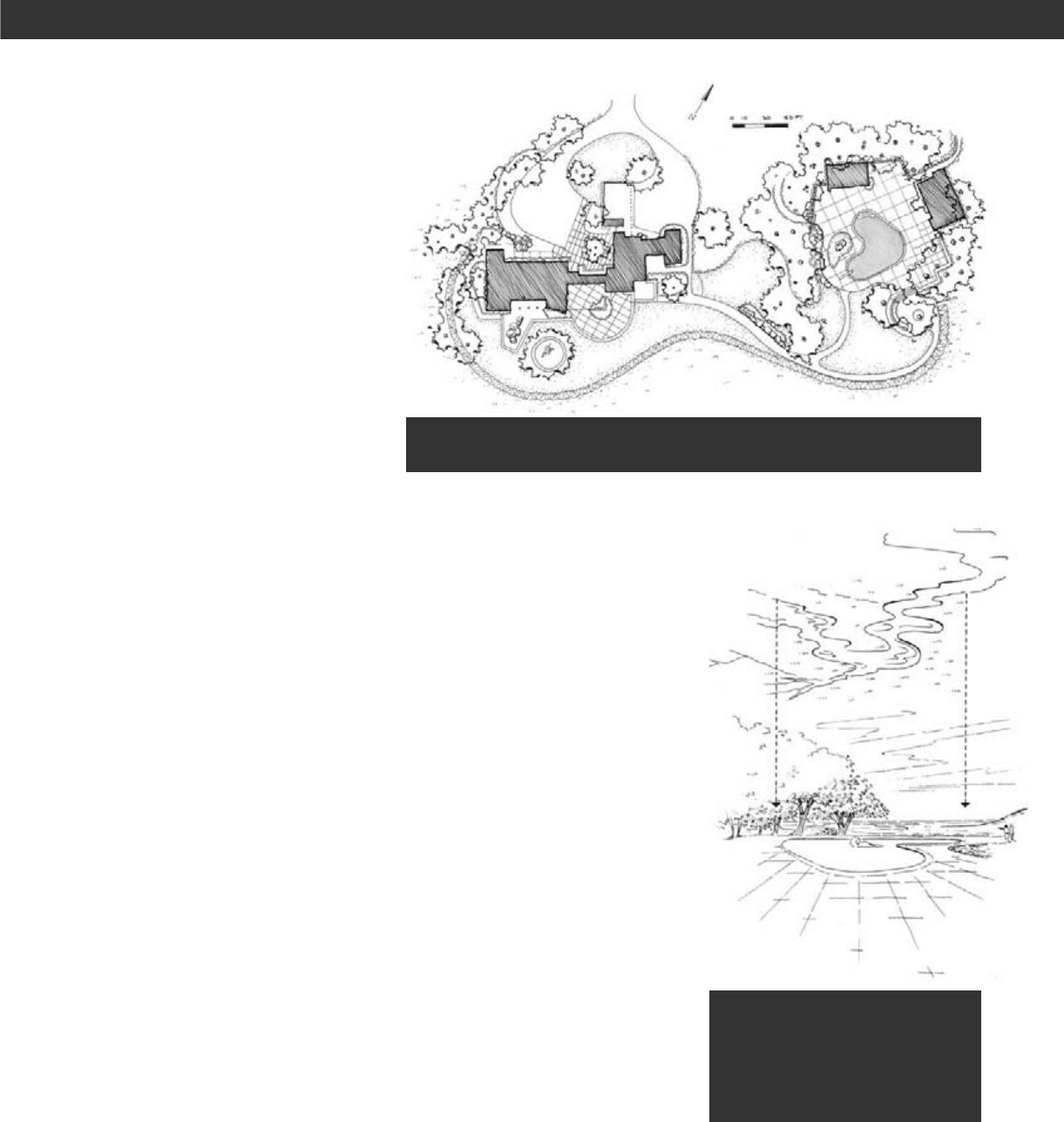
Donnell Garden, completed between 1947
and 1949, in Sonoma, California, is per-
haps his most recognizable work.
Similarly, Garrett Eckbo (1910–2000)
was dedicated to providing affordable,
functional, and dynamic landscapes for
middle-class families. His books Land-
scape for Living (1950) and The Art
of Home Landscaping (1956) provided
guidance appropriate for the design of
small-scale spaces. He believed that
the organization and composition of
space itself should be the focus of the
garden, and developed plans based
on user needs and functional spatial
relationships. Eckbo was one of the fi rst
landscape designers to rebel against
the Beaux-Arts formalism that was still
being taught in professional schools.
13
Gropius was at Harvard while Eckbo and
Daniel Urban Kiley (introduced below)
studied there, but the landscape archi-
tecture program was slow in adopting
the modernist curriculum.
Eckbo sought a more relevant design
response to the larger issues facing
contemporary society. He was inspired
by contemporary cultural trends and
let his interests in jazz, fashion, fi lm,
and art infl uence his work. Eckbo was
also concerned with progressive causes
and socially conscious design. He
worked for the Farm Security Adminis-
tration, designing migrant-worker hous-
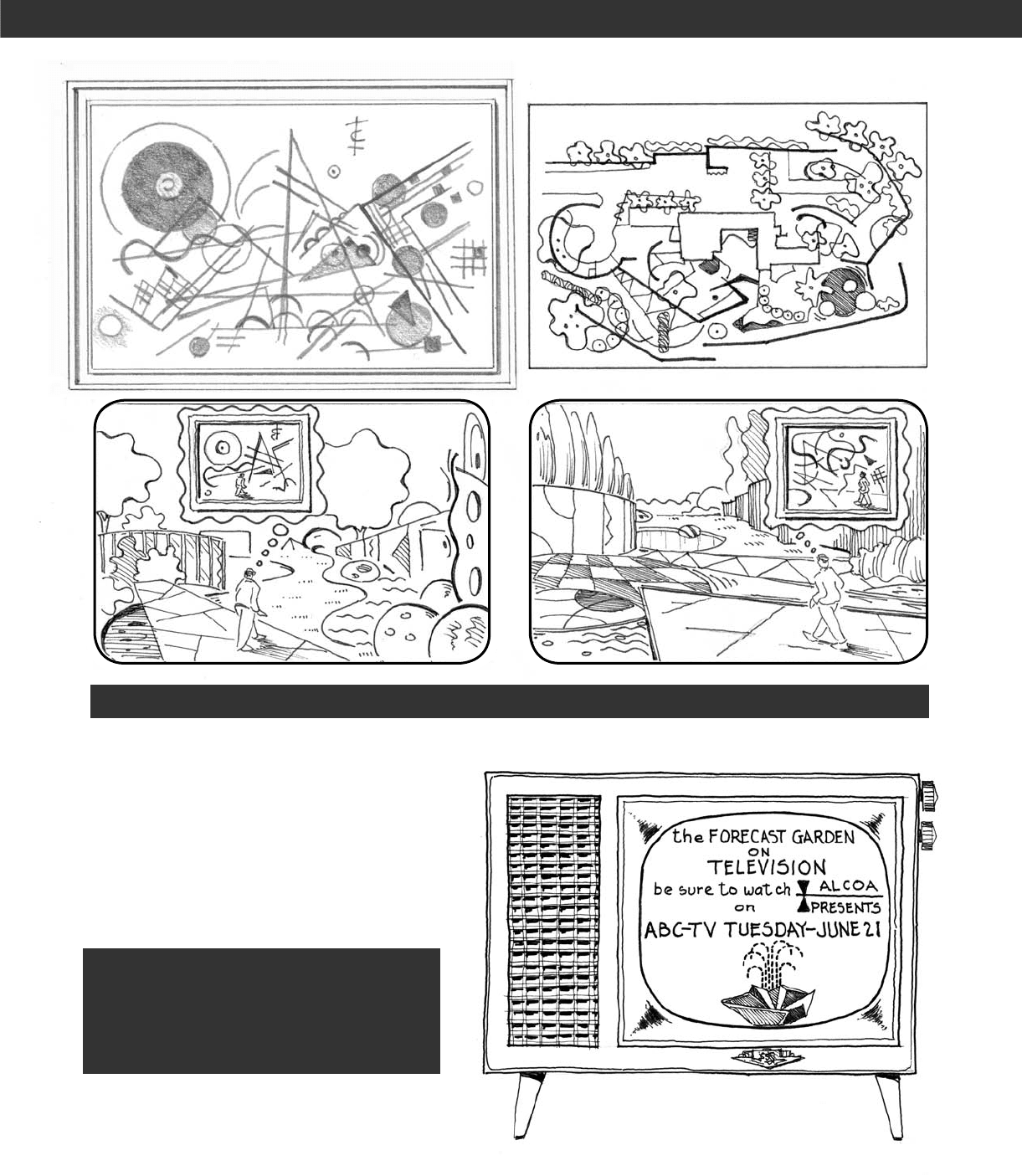
ing and community centers. The Alcoa
Forecast Garden (1959), in Laurel
Canyon, California, was fi nanced by the
Aluminum Company of America to dem-
onstrate how the new material could be
used in residential applications. Eckbo
used his own backyard to showcase
his innovative design solutions, which
included screens, trellises, and a foun-
tain, all made from aluminum.
DONNELL GARDEN SITE PLAN: The California garden style accommodated the
informality of midcentury lifestyles.
ARC-AND-TANGENT: The kidney-
shaped pool became the ultimate
icon of the modernist garden. The
marshlands of Sonoma, visible from
the Donnell garden, mimic the pool’s
curves.
20th CENTURY
/
MODERNISM
216
COMPOSITION (1923) by WASSILY KANDINSKY: Walking through an Eckbo garden is like walking through an abstract painting.
FORECAST BROADCASTED: The Aluminum Company
of America commissioned designers to explore the
lightweight material through their “Forecast” pro-
gram. Eckbo’s garden received national acclaim when
it was featured during the Company’s Alcoa Pres-
ents…One Step Beyond television series in 1960.
20th CENTURY
/
MODERNISM