
Boults Е. Illustrated history of landscape design
Подождите немного. Документ загружается.

217
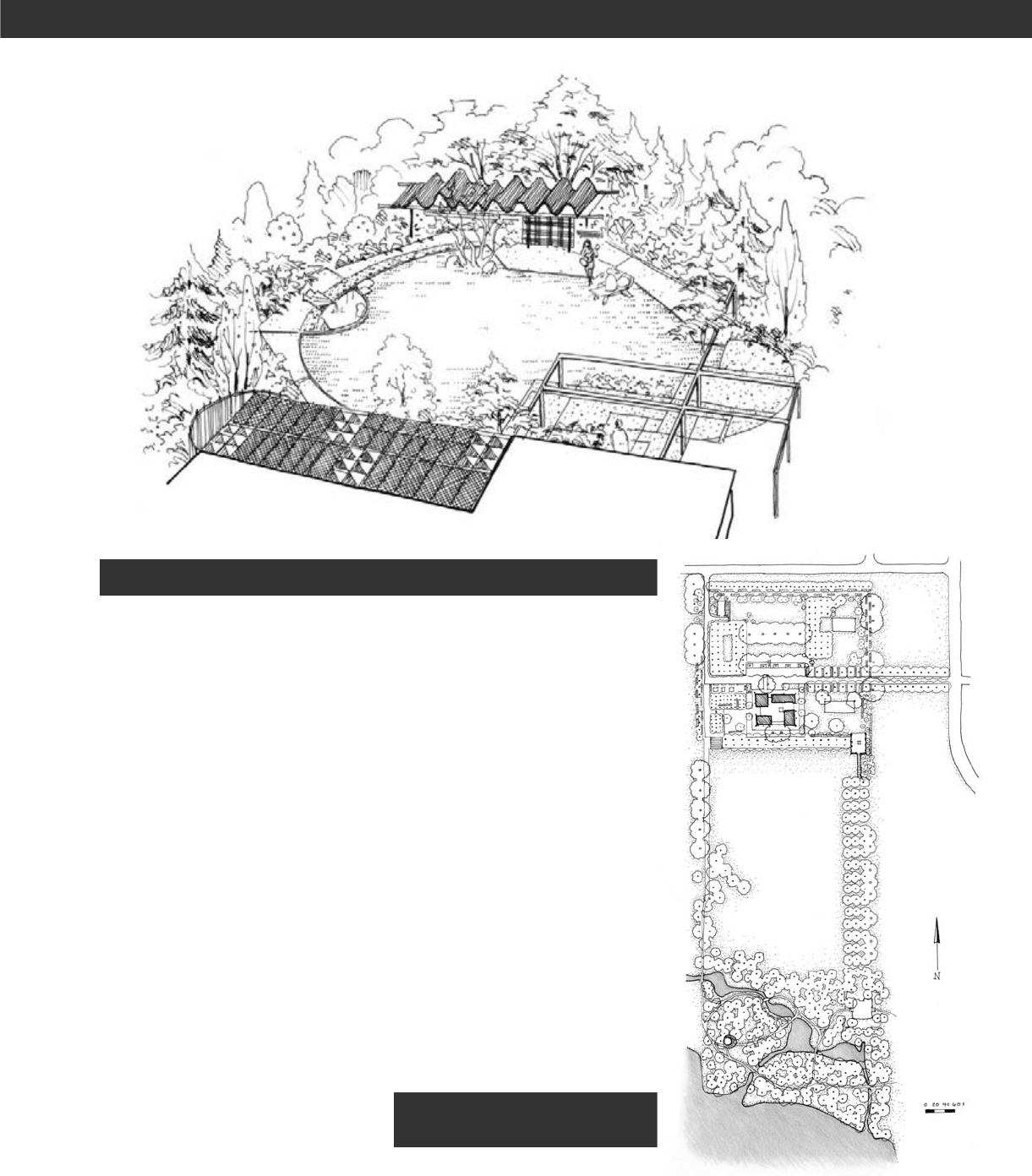
Dan Kiley (1912–2004) worked for both
Warren Manning and the architect
Louis Kahn. His work demonstrated a
concern with form and spatial hierar-
chy. He used strong geometries to or-
der the landscape, and like the French
formalists of the 17th century, was
able to achieve a sense of directional-
ity. Kiley worked closely with many of
the great modernist architects. He
developed a style characterized by the
use of overlapping planes and repeated
modules to create a dynamic inter-
penetration of landscape space. The
offset axes, long allées, and rectilinear
forms that defi ne the Miller Garden
(1955), in Columbus, Indiana, work with
the geometry of the house designed
by Eero Saarinen. Kiley’s practice also
included corporate work; he designed
many well-known plazas for banks and
private businesses.
MODERN MAVERICK
The work of Lawrence Halprin (1916–
2009) serves as a bridge between the
modernist and environmental design
movements. Halprin started his career
in the offi ce of Thomas Church. His
interest in “process” was consis-
tent. His book, RSVP Cycles: Creative
Processes in the Human Environment,
published in 1969, outlined his ideas
about the relationship between hu-
mans and nature, and his belief that
a holistic site analysis was integral
to the development of a successful
design. He developed an original tech-
nique for “scoring” the landscape that
maps natural, social, and cultural
patterns.
Halprin’s work and his approach were
innovative. He found inspiration in
many different sources, and encour-
aged collaboration. Halprin was also
one of the fi rst advocates for citizen
participation in the design process.
14
MILLER GARDEN: Modern forces
operate upon formal geometry.
LANDSCAPE FOR LIVING: The Alcoa garden showcased aluminum in the garden.
20th CENTURY
/
MODERNISM
218218
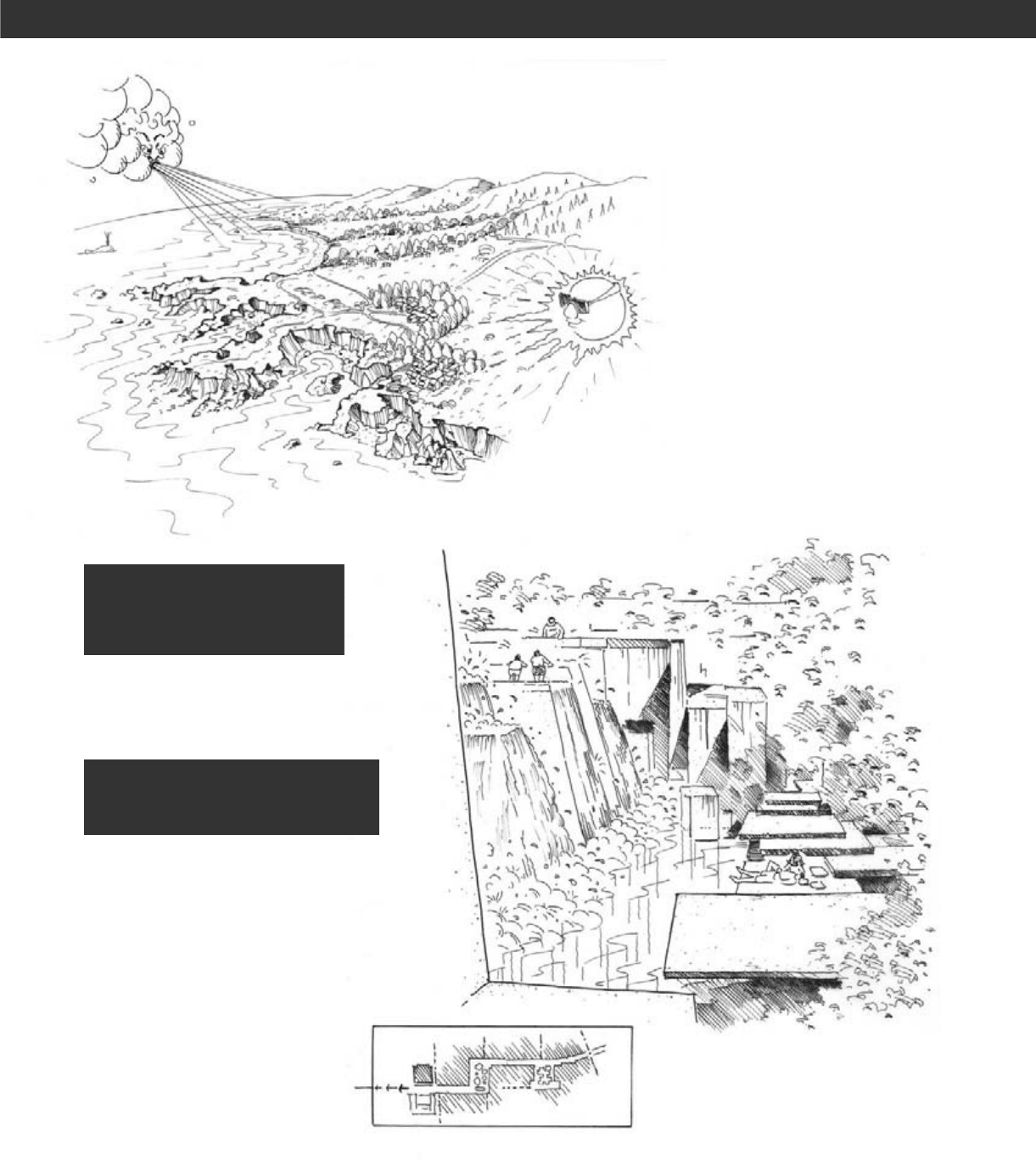
Sea Ranch, a housing development in
Gualala, California, completed in 1965,
is an excellent example of Halprin’s
commitment to working collaboratively
with other professionals and with the
forces of nature.
Halprin also valued urban life, and
promoted the revitalization and green-
ing of cities. His 1962 renovation of
the old Ghirardelli chocolate factory
into a public plaza in San Francisco
was one of the fi rst examples of suc-
cessful adaptive reuse. Other well-
known Halprin designs include the Ira
Keller fountain in Portland, Oregon;
Freeway Park in Seattle, Washington;
Levi Strauss Plaza in San Francisco,
California; and the FDR Memorial in
Washington, DC.
SEA RANCH: Halprin clustered the
houses and tucked them into slopes to
preserve open space, maintain view cor
ridors, and provide shelter from the win
FOUNTAIN PLAZA: People can climb on
and participate with the water feature
that occupies an entire city block.
20th CENTURY
/
MODERNISM
219
People have understood the landscape
as an expressive medium since prehis-
toric times. As landscape architects
became more focused on corporate
culture in the 1960s, artists began to
fi nd opportunities for creative expres-
sion in the landscape. Environmental
artists work with the earth itself as
their medium. Their engagement with the
landscape can be understood as a reac-
tion to large-scale cultural and environ-
mental changes in the second half of the
20th century.
Environmental artists challenged the
idea of art as a marketable product
isolated in galleries. Their frame of refer-
ence shifted from commodity to con-
cept. Earthworks were large-scale land-
scape interventions that required heavy
machinery to realize. Often in remote
locations, distance and solitude became
part of the experience. Documentation
of the work, particularly through the
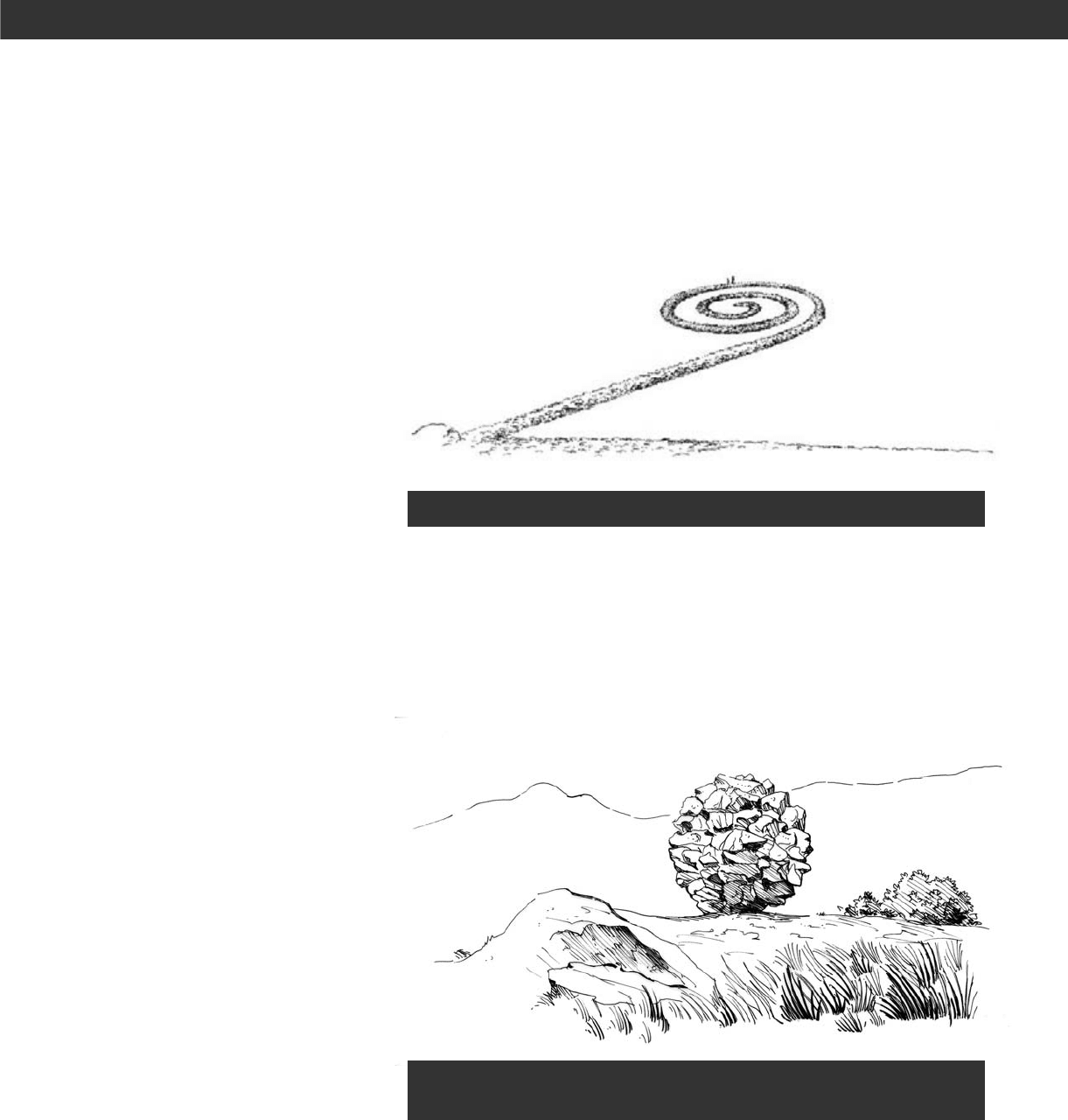
use of photography, was critical. Robert
Smithson (1938–1973) constructed the
Spiral Jetty in Great Salt Lake, Utah, in
1970. It remains a powerful icon of the
land art movement.
Other environmental artists seek
to express the ephemeral or unseen
processes of nature. Andy Goldsworthy
(b. 1956) works with nature and time to
construct temporary sculptures. He uses
natural materials—ice, leaves, stones,
wood—found on a particular site to cre-
ate patterns and forms in the landscape.
The works remain as photographic images
after the effects of wind, water, and
weather reclaim the form.
The environmental art and land art
movements gave visual expression to
ecological processes and brought the
idea of the landscape as an expressive
medium back into the focus of landscape
architects.
15
NATURE AS MEDIUM
TEMPORARY SPHERE: Goldsworthy’s art pieces are formed from nature and
eventually return to nature.
SPIRAL JETTY: Earthworks often contain cosmological references.
20th CENTURY
/
ENVIRONMENTAL ART
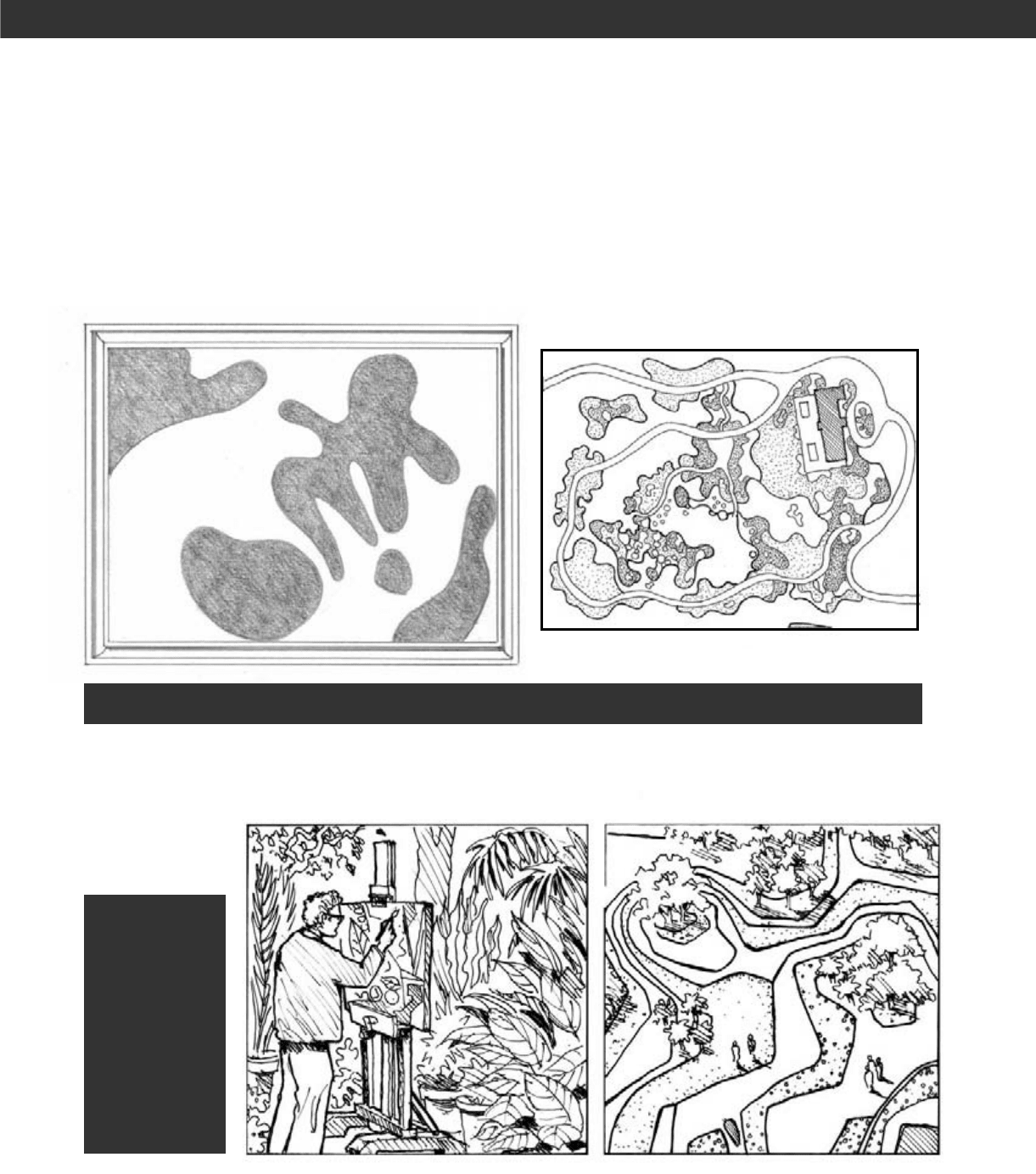
Burle Marx (1909–1994) was a
Brazilian landscape designer whose
work refl ected his interests in botany
and painting. He treated the ground
plane as a canvas on which he painted
abstract compositions with colorful
masses of typically native plants. His
The work of two international designers,
Roberto Burle Marx and Luis Barragan,
set modern precedents for approaching
the landscape as a work of art. Com-
mon to both was a focus on form-giving
through the manipulation of color,
texture, and line.
220
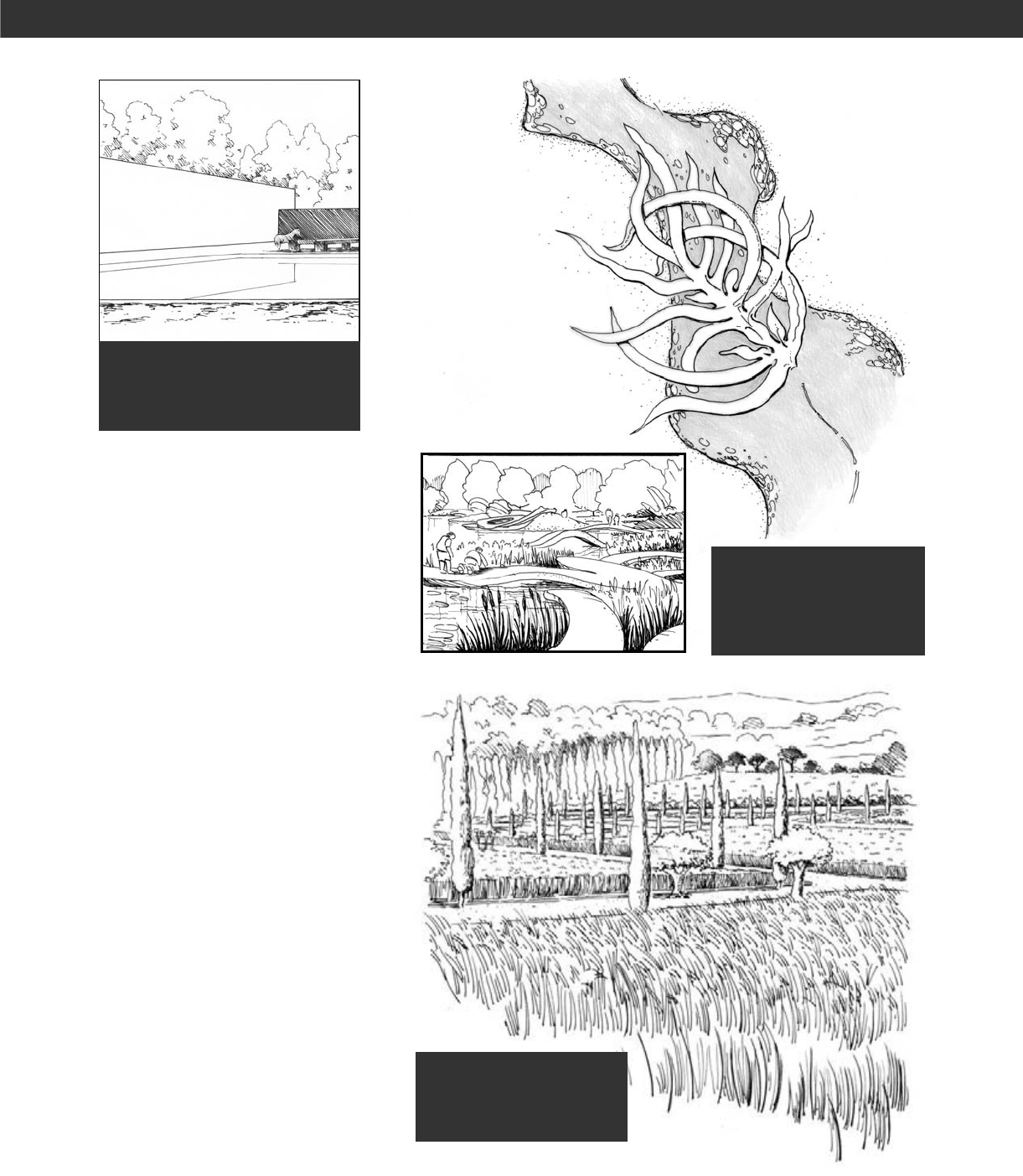
PLANT PAINTER: Burle Marx’s biomorphic shapes at the Monteiro Garden resemble paintings by Jean Arp.
ARTISTIC TRENDS IN LANDSCAPE DESIGN
1948 plan for the Monteiro garden
(now the Fernandes garden) treats
the space as a purely visual experi-
ence. The landscape asserted its iden-
tity independent of the architecture;
Burle Marx did not extend the geom-
etry of the house into the garden.
LANDSCAPE AS
CANVAS: Burle
Marx painted in
his garden. His
abstract compo-
sitions infl uenced
his landscape
designs. Shown to
the right is his de-
sign for the plaza
at Banco Safra, in
Sao Paulo, Brazil
(1983).
20th CENTURY
/
THE LANDSCAPE AS ART
221
Barragan (1902–1988) was a Mexi-
can architect who was known for his
colorful, minimalist spatial composi-
tions. He used walls to subdivide
landscape space in a way that recalled
the courtyards of the Alhambra in
Spain, which he visited. His interior and
exterior spaces were artfully fused in a
vocabulary of form that was infl uenced
by vernacular Mexican traditions. Rural
ideals can be seen in his design for the
San Cristobal horse farm near Mexico
City, completed in 1969. The composi-
tion of house, pools (for horses and
for people), and stable still inspires
contemporary architects, designers,
and landscape architects.
The work of more recent landscape
designers such as Kathryn Gustafson,
Patricia Johanson, and Spanish land-
scape architect Fernando Caruncho
speaks to the legacy of Burle Marx
and Luis Barragán. Gustafson folds
and pleats the ground plane like fabric;
Johanson translates organic forms
into built elements; and Caruncho
structures the landscape with agrar-
ian geometry, combining plants, water,
and mineral elements.
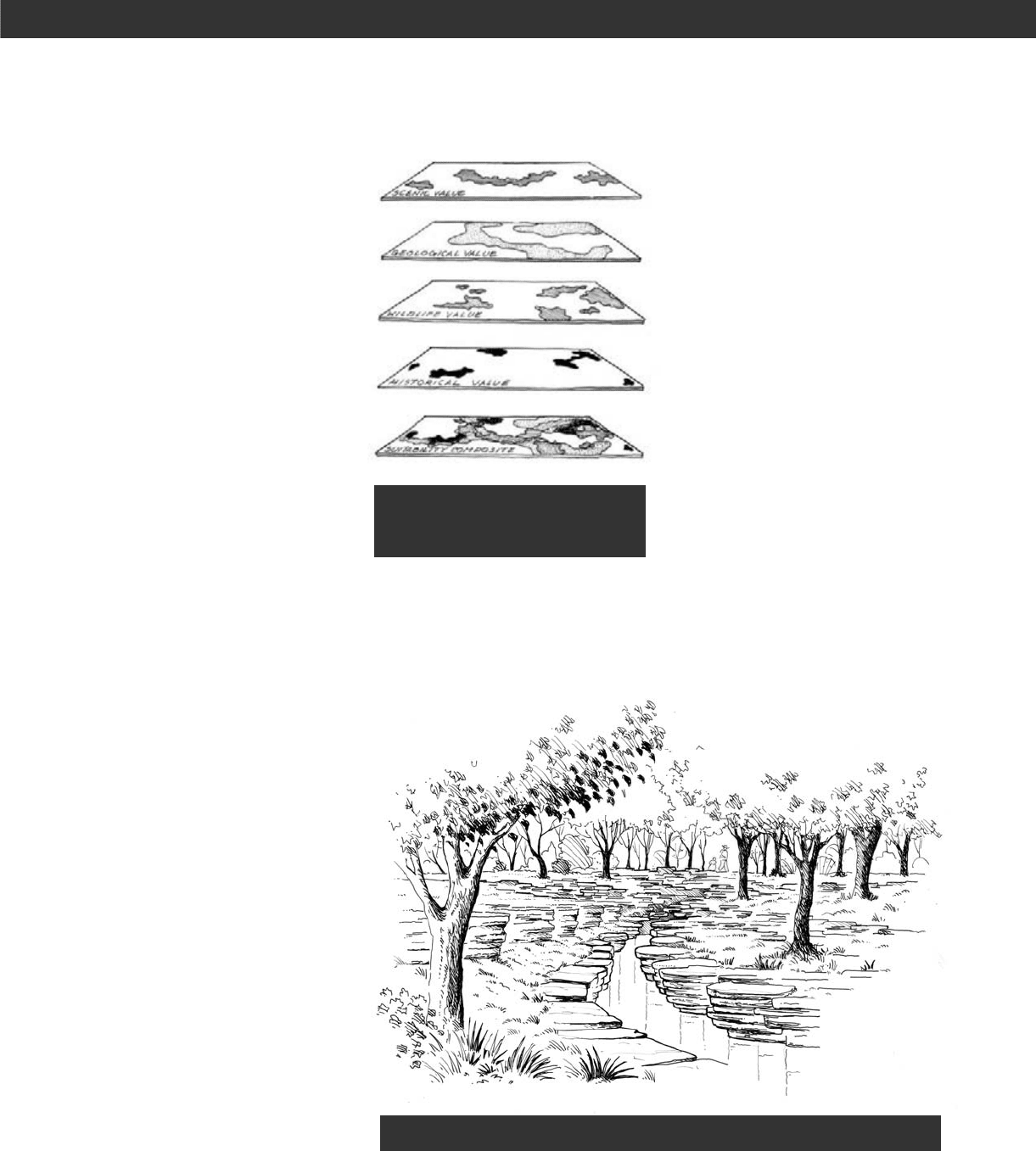
LEONHARDT LAGOON: Patri-
cia Johanson translated the
form of an aquatic plant into
a path system at Fair Park, in
Dallas, Texas.
WHEAT PARTERRES: Fernan-
do Caruncho reinterpreted
the ferme ornée at Mas de
les Voltes, Spain.
HORSE FARM, SAN CRISTOBAL:
Barragan created lively volumes of
space with painted stucco walls and
water features.
20th CENTURY
/
THE LANDSCAPE AS ART
222
Homeowners and groundskeepers
battled with the landscape in the
fi rst half of the 20th century—huge
amounts of weed killers, fertilizers, and
pesticides were dumped on the earth.
The dangers of degraded environmental
conditions were brought to the atten-
tion of the American public in 1962 with
the publication of the book Silent Spring
by Rachel Carson. The fi rst Earth Day
celebration, in 1970, also advanced the
foundation of ecological awareness.
Citizens called the government to
action. Key environmental legislation
included the Clean Air Act (1970),
the Clean Water Act (1972), and the
National Environmental Protection Act
(1970), which required that an Environ-
mental Impact Statement be prepared
for all projects receiving government
funding. The design team was required
to evaluate the natural, social, and
economic impact of a project and make
the plans available for review by the
community.
Ecological designers continued the
pioneering work of 18th-century bota-
nists and 19th-century conservationists.
Jens Jensen (1860–1951) was conscious
of environmental themes early in his
professional career. Jensen was born
in Denmark, immigrated to the States
in his early twenties, and established a
landscape design practice in Chicago.
He worked in the naturalistic style and
believed in the social benefi t of public
parks and recreational facilities. Jensen
was a transitional fi gure, infl uenced by
19th-century reformist ideals and 20th-
century Prairie Style design, as exempli-
fi ed by the work of Frank Lloyd Wright.
His sphere of infl uence was centered
around the Midwest, and his practice
consisted of large-scale residential proj-
ects and smaller urban parks. Jensen’s
palette was distinguished by his use of
native plants and local stone, inspired
by the natural meadows and woodland
plantings he treasured. His book Siftings,
from 1933, presented his ideology of
environmental design. He established a
“folk” school of horticulture and the arts
in Wisconsin, called the Clearing, in 1935.
An ecological ideology also drove Ian
McHarg (1920–2001) to advocate a
holistic approach to design. In his book,
Design with Nature (1969), he champi-
oned site analysis techniques based on
the carrying capacity of the land and
its fi tness to intended use. McHarg
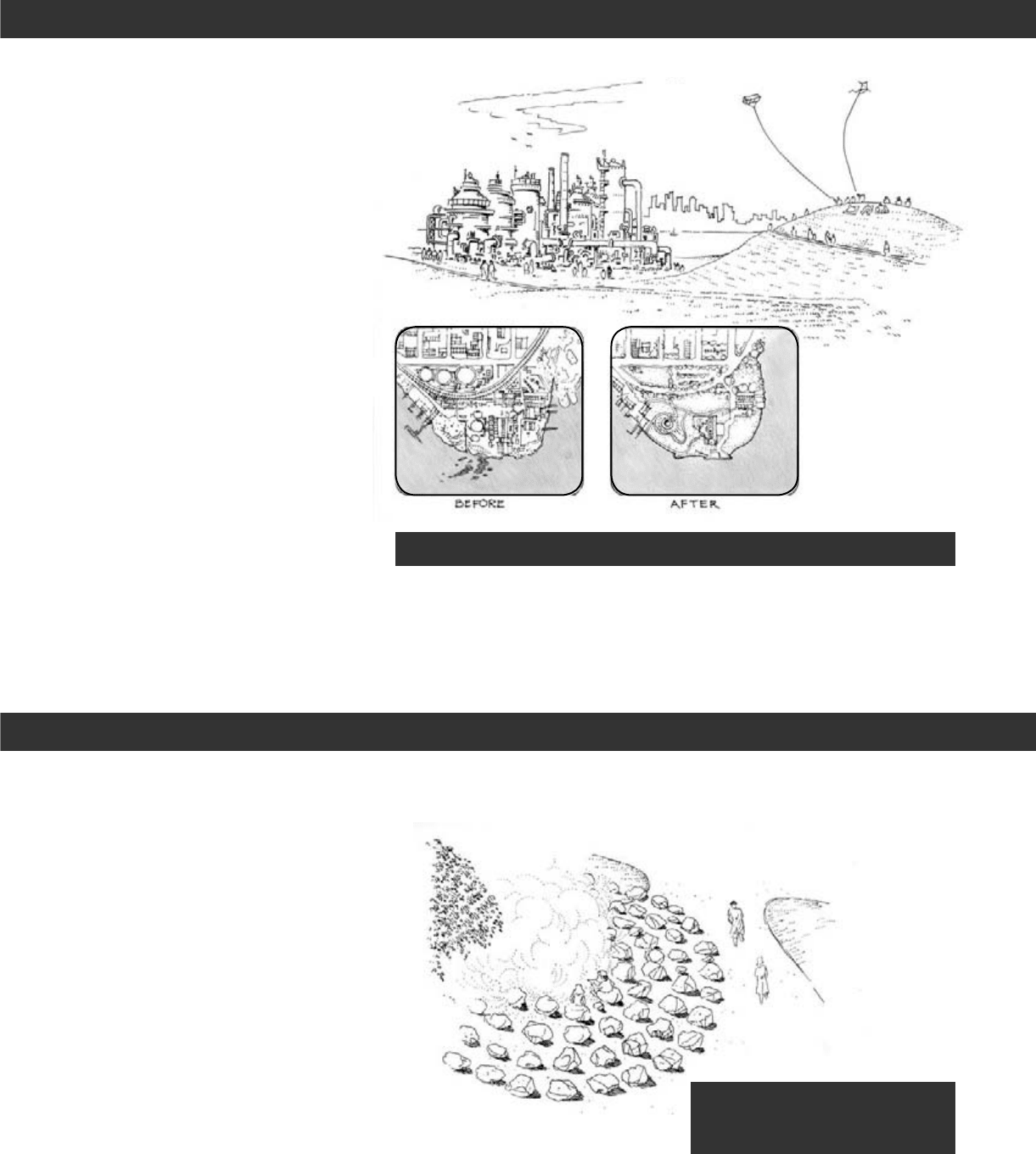
developed a methodology based on coor-
dinated overlays of maps, which became
the foundation of geographic informa-
tion systems (GIS) technologies. He pio-
neered the analysis of opportunities and
constraints to assess the many social
and environmental costs of a project.
PIONEERING NEW DIRECTIONS
OPPORTUNITIES AND CONSTRAINTS:
McHarg developed the overlay analysis
process used in GIS.
PRAIRIE STYLE: Jens Jensen’s work fostered an ecological aesthetic.
20th CENTURY
/
ENVIRONMENTAL AND ECOLOGICAL DESIGN
223
Current trends in the participatory
design process and the development of
healing gardens and community gardens
all stem from this conception of land
stewardship and the idea of a partner-
ship between humans and the Earth.
Randolph T. Hester, in his book Design for
Ecological Democracy (2006), presents
a poetic vision of this kinship that em-
powers people toward positive environ-
mental change.
Ecological designers seek creative solu-
tions to environmental problems, and
include in their approach the science
of biological systems. Their goal is to
develop solutions that are beautiful,
functional, and sustainable. Project
types include the bioremediation and
rehabilitation of brownfi eld sites, landfi ll
reclamation, and wetland restoration.
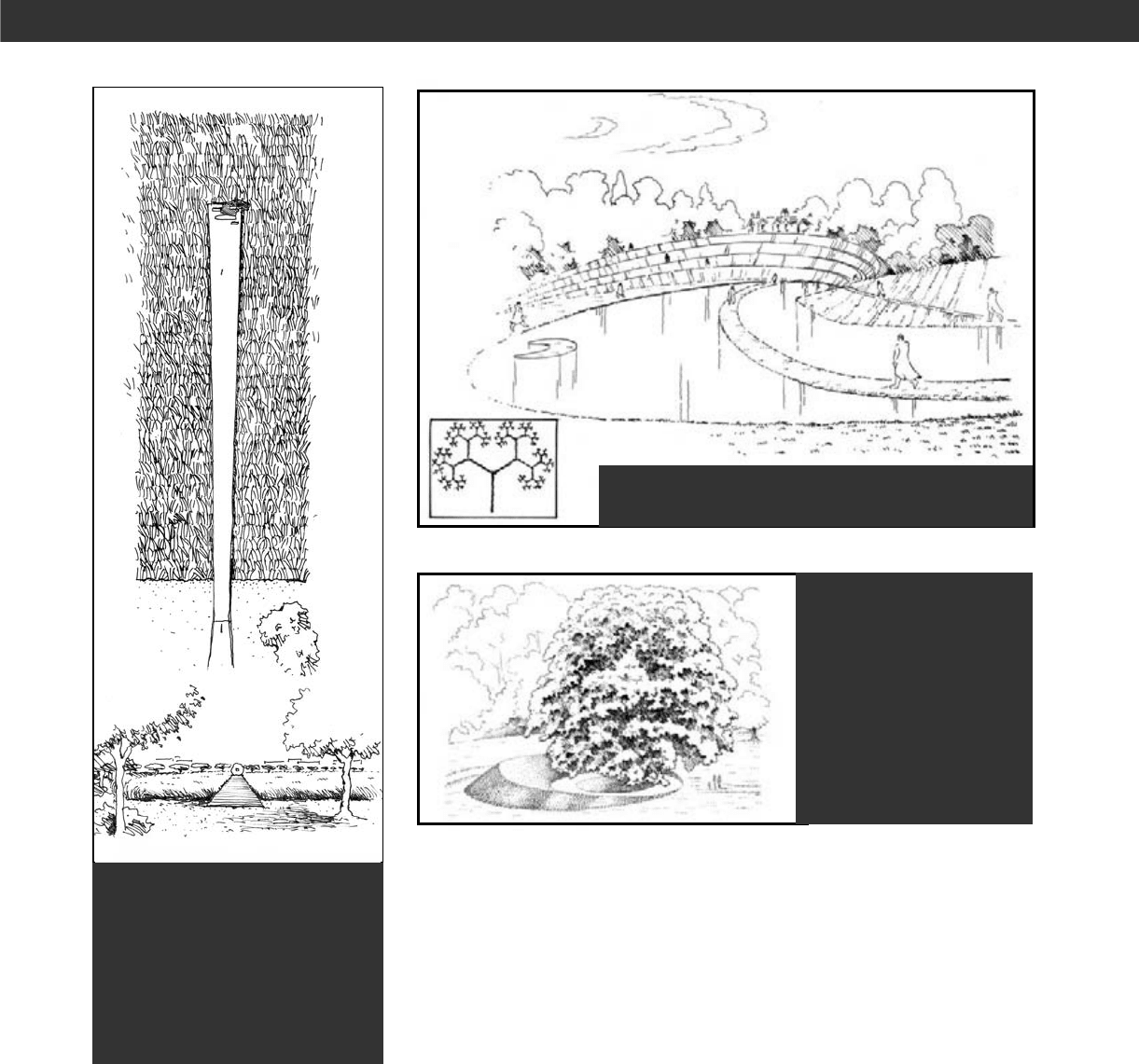
One of the fi rst landscape reclamation
projects was Gas Works Park in Seattle,
Washington. The park was designed in
1975 by Richard Haag (b. 1923) on the
19-acre site of an abandoned gas plant.
Industrial remains were repurposed
as picnic and play structures. A more
recent example, Duisburg-Nord Park, in
Germany, was completed by Peter Latz
(b. 1939) in 1994. He transformed a
500-acre abandoned steel and coal
production facility in the Ruhr River val-
ley into public open space as part of the
Postmodernism implies skepticism
about the assumptions of modernism.
In the latter half of the 20th century,
philosophers, artists, and writers
began to challenge the idea of a privi-
leged or dominant point of view. They
thought of contemporary culture like
a collage, subject to many different
infl uences and interpretations. In the
arts, postmodernism was character-
ized by ambiguity and simultaneity.
Meaning could not be embedded in
a work of art; it was relative to the
viewer. Space, too, was considered
“neutral.”
16
As a reaction to modernist
sterility, artists and designers rein-
GAS WORKS PARK: An abandoned gas plant was transformed into a public park.
POSTMODERN LANDSCAPES
troduced playful ornament, color, and
historic motifs into their work.
TANNER FOUNTAIN: Peter Walker
blurred the line between landscape
design and environmental art.
20th CENTURY
/
ENVIRONMENTAL AND ECOLOGICAL DESIGN
20th CENTURY
/
POSTMODERNISM
Emscher Park regional redevelopment
plan. Ore bunkers, smokestacks, and
a blast furnace became climbing walls,
garden rooms, and sculptural features.
224
20th CENTURY
/
POSTMODERNISM
A renewed interest in metaphor was also
evident in postmodern gardens. Land-
scape design became increasingly con-
ceptual. Ideas of framing nature, using
the landscape itself as a material, and
making natural processes explicit were
common themes explored by landscape
designers.
17
Michael Van Valkenburgh’s
Krakow Ice Garden (1990) on Martha’s
Vineyard, Massachusetts, and Peter
Walker’s Tanner Fountain (1984), at Har-
vard University, exemplifi ed this trend.
Conceptual projects included Martha
Schwartz’s Splice Garden (1986) at
the Whitehead Institute in Cambridge,
Massachusetts; Ron Wigginton/Land
Studio’s Wheat Walk (1988) proposed
for Davis, California; and Charles Jencks
and Maggie Keswick’s Garden of Cosmic
Speculation (1990) at their home in
Dumfriesshire, Scotland.
Postmodernist designers employed al-
legory like 18th-century Whig landowners
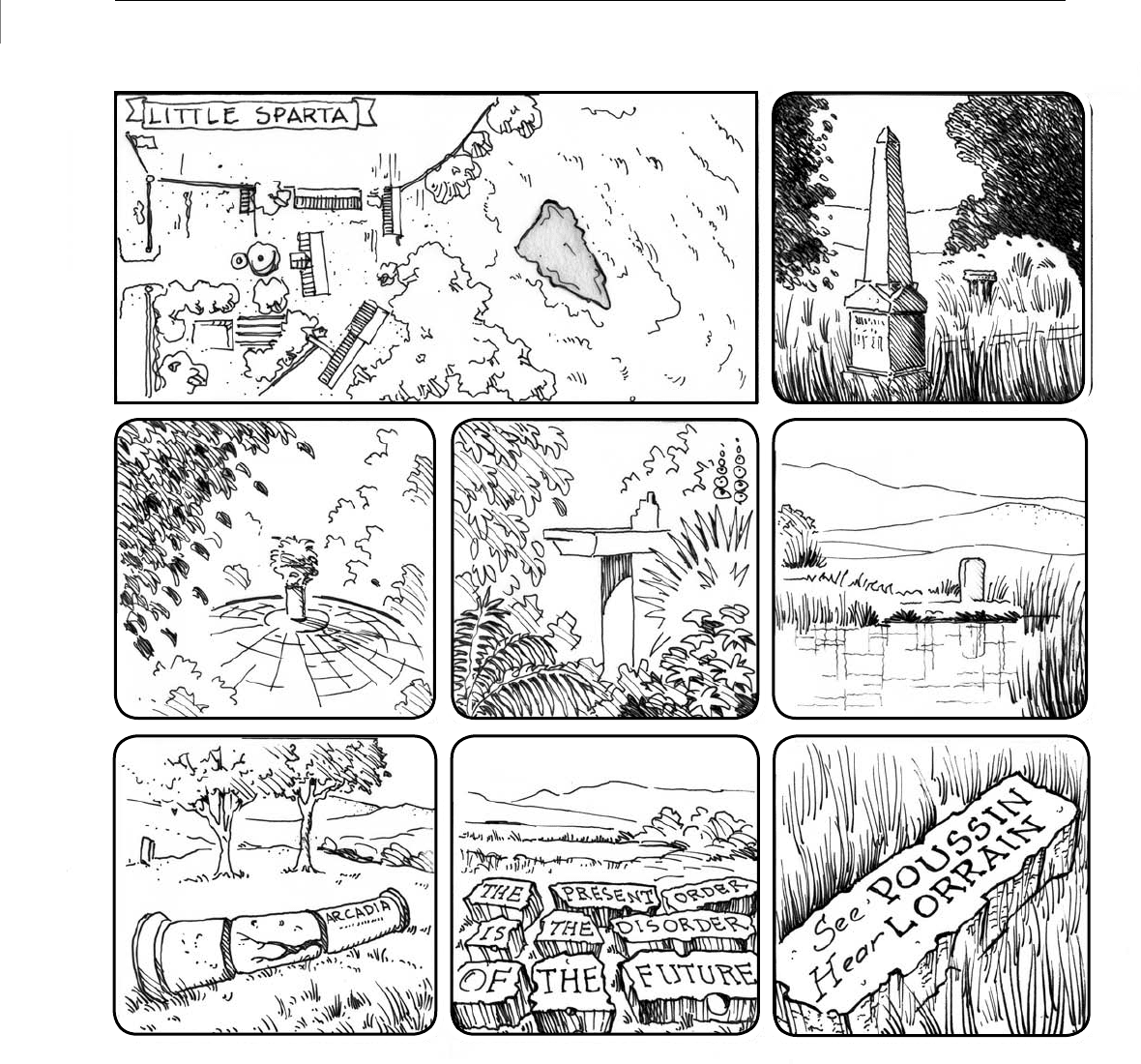
did. Ian Hamilton Finlay constructed a
poet’s garden at his home in Lanarkshire,
Scotland. He is known for his “concrete
poetry”—words carved into stones and
set into provocative pictorial composi-
tions. His garden, Little Sparta, came to
refl ect his fascination with the French
Revolution and his disappointment in
contemporary society.
18
At the end of the 20th century, interna-
tional garden expositions and festivals
resurfaced as popular cultural phenom-
ena. The Chaumont Garden Festival in
Chaumont-sur-Loire, France, initiated
the trend in 1992, showcasing the work
of renowned landscape designers as well
as emerging talents. Annual festivals
in England, Germany, Canada, and the
Netherlands feature temporary, themed
gardens, and help shape the public’s idea
of what a garden can be.
WHEAT WALK: Ron Wigginton was
one of the fi rst landscape archi-
tects to approach the design of a
landscape as a conceptual work of
art. His award-winning proposal for
the arboretum at the University of
California, Davis (1988) poetically
conveyed his belief in the landscape
as a place of collective memory.
LIMELIGHT: Landscape
architects David Meyer and
Ramsey Silberberg celebrated
one of Britain’s “champion”
trees in their installation at
the 2003 Westonbrit Inter-
national Festival of the Gar-
den. Set within a constructed
earth mound that imitates
an amphitheater, the tree
occupies center stage.
FRACTAL LAKE: Quantum theories were explored in
Charles Jencks’s garden.
225
Sequence of space in the postmodern picturesque stroll garden.
VISUAL NARRATIVE: Little Sparta
226
Trends in architecture and literary theory
also infl uenced the postmodernists.
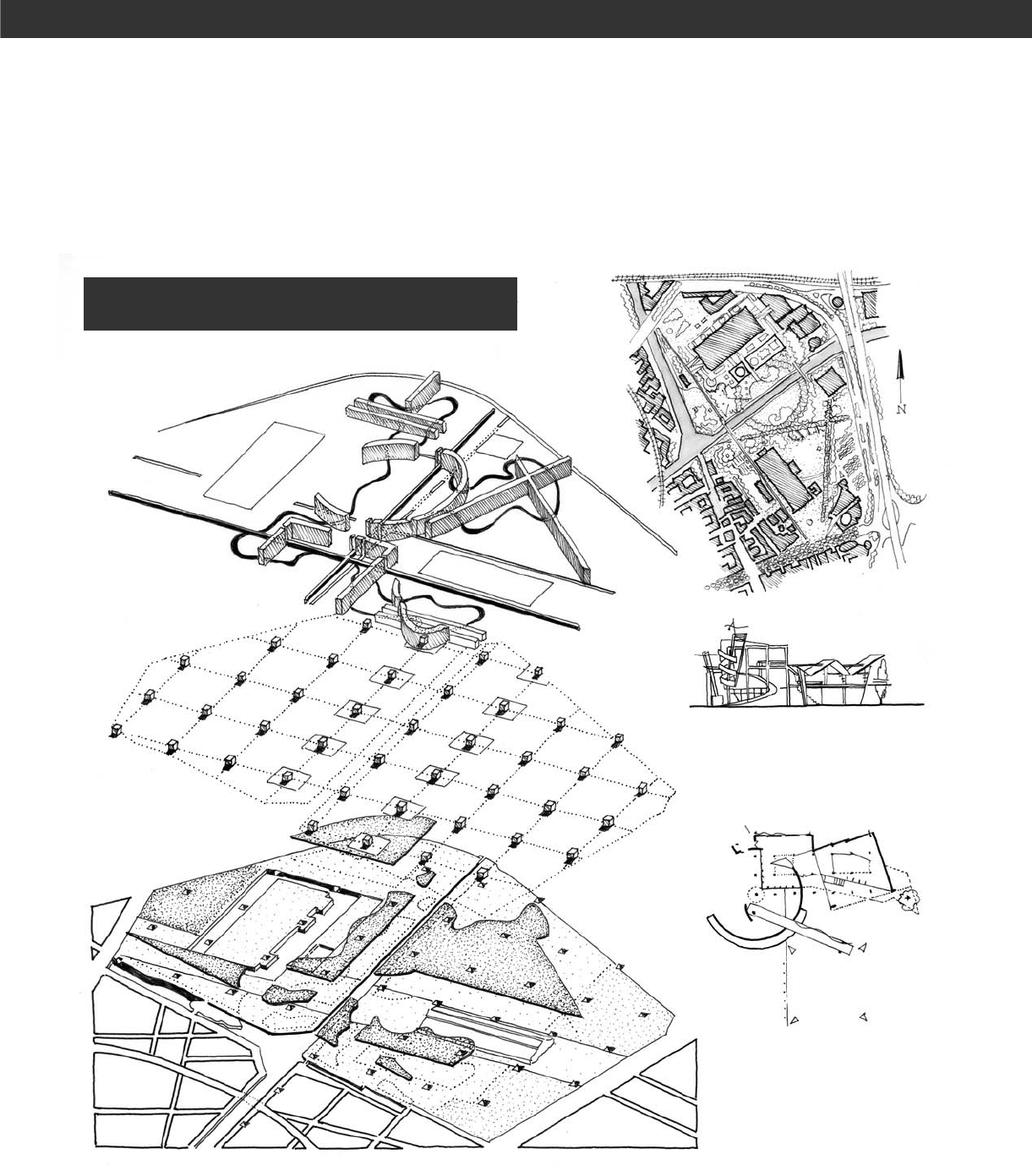
The architect Bernard Tschumi won the
design competition for the construction
of a new public park on the grounds of an
20th CENTURY
/
POSTMODERNISM
old slaughterhouse on the outskirts of
Paris. His design for Parc de la Villette
(1985) was based on deconstructivist
theories that questioned the boundar-
ies and defi nitions of architecture and
space. The park provides 85 acres of
open space as part of a large-scale
redevelopment project that includes a
science and technology museum and a
music center.
DECONSTRUCTION AND RECONSTRUCTION
PARC DE LA VILLETTE: People make their own connections in
deconstructed space.