
Boults Е. Illustrated history of landscape design
Подождите немного. Документ загружается.

227
20th CENTURY
/
POSTMODERNISM
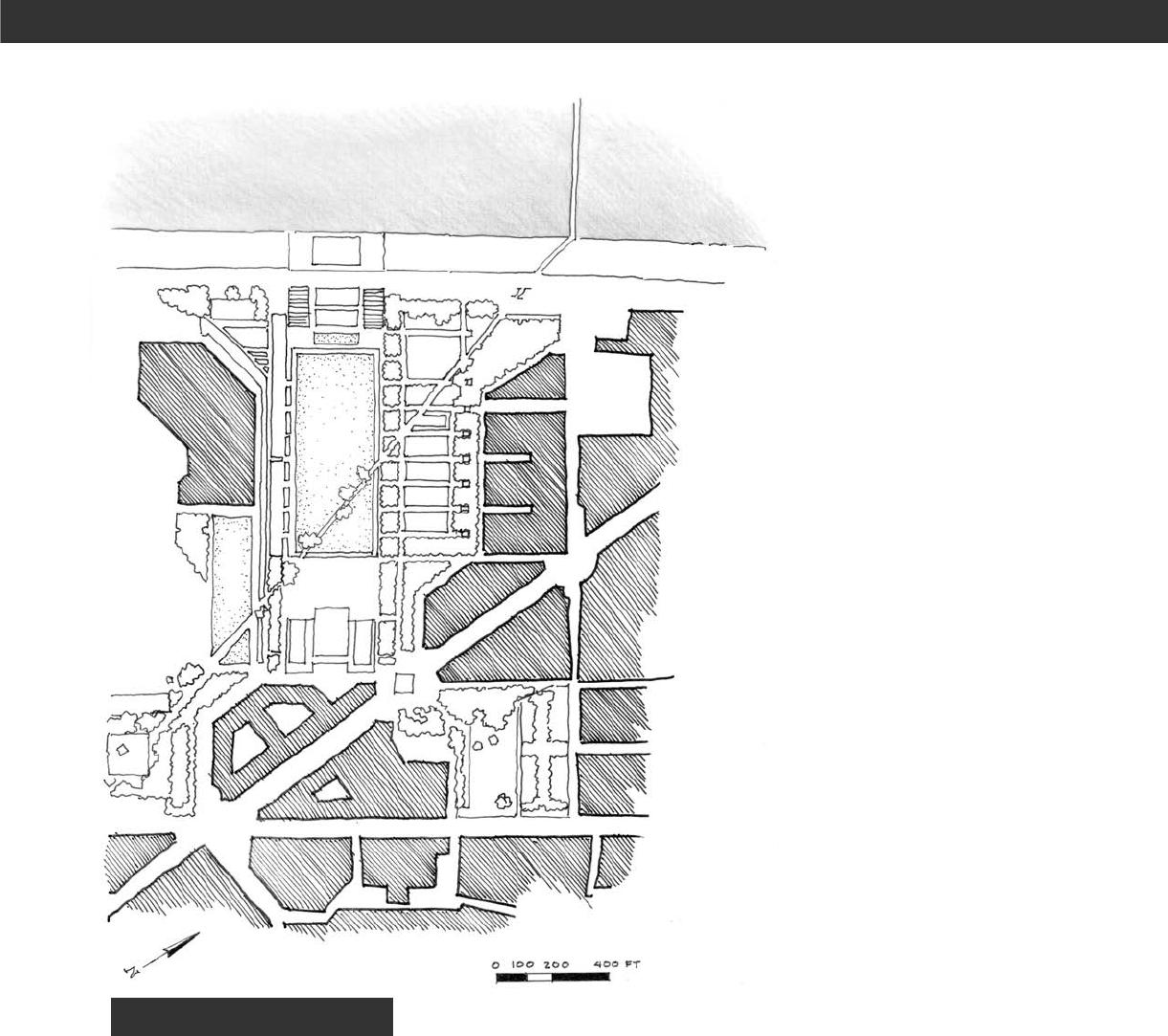
Landscape architects Alain Provost
and Gilles Clement took a different
approach to their design of Parc André
Citroën (1992), built on the site of a
former car plant on the outskirts of
Paris. Organized by precise geometry,
the 35-acre park might be understood
as a bold, minimalist interpretation of
a 17th-century French formal garden. A
large central lawn (a tapis vert) forms
an axis perpendicular to the Seine, as
did historic riverfront gardens in the
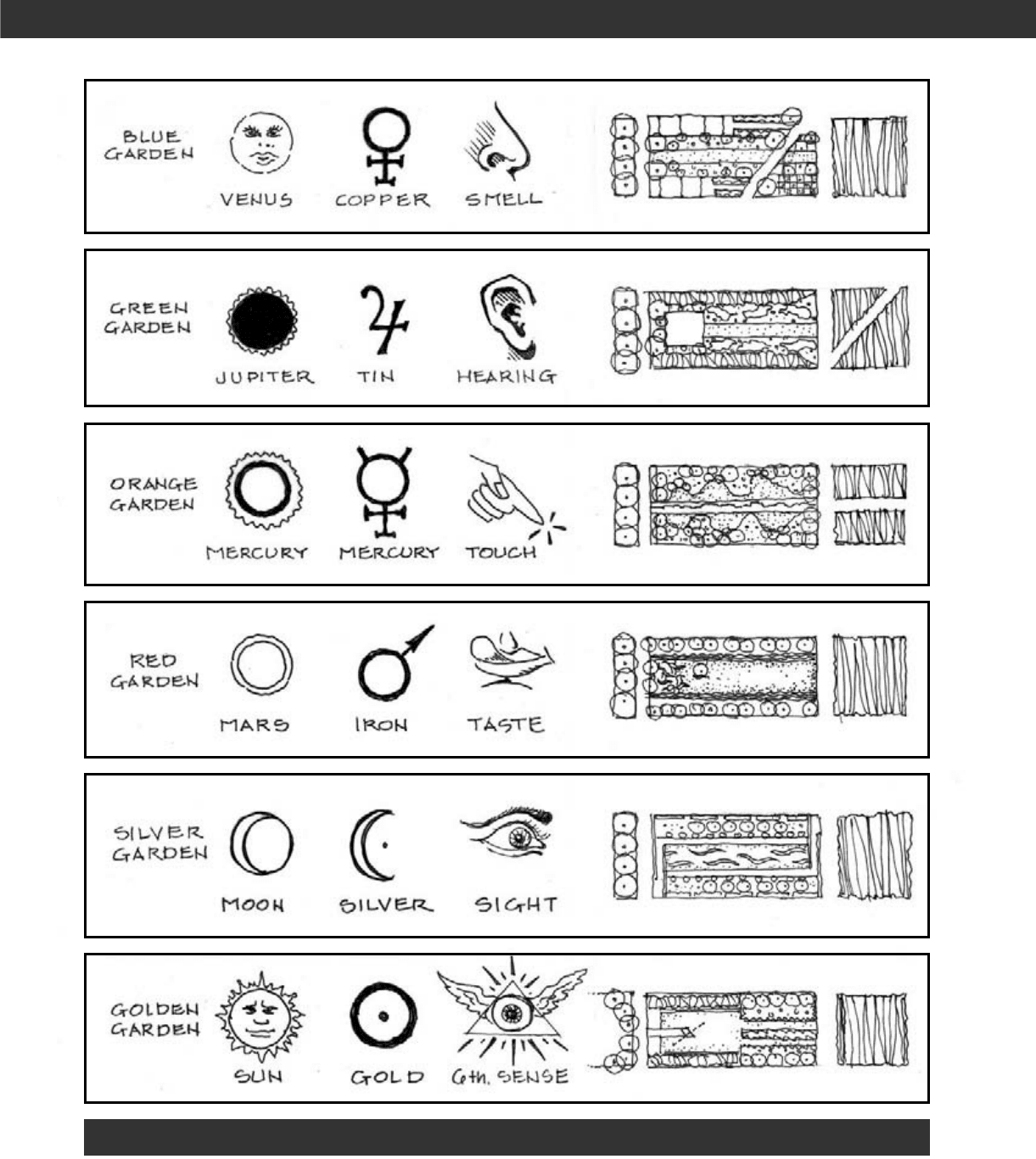
city center. Six themed gardens on the
north side of the open lawn all have an
alchemical symbology: each is associ-
ated with a metal, a planet, a day of
the week, a state of water, and a sense
(the sixth sense being intuition).
19
Water channels subdivide the spaces.
Two glasshouses on the eastern end
of the park are separated by a plaza
with dancing jets of water. An elevated
walkway on the south side of the lawn
parallels a refl ecting pool. A long di-
agonal path cuts across the park and
creates a variety of dynamic spatial
experiences.
These two urban parks represent a
new idiom of park design, one vastly
different from the 19th-century
conception of a picturesque ideal.
Whereas Parc de la Villette presents a
purposely unresolved space in which a
variety of activities and paths can be
determined by the visitor, Parc André
Citroën, nestled within the urban fab-
ric, provides a sense of place deter-
mined by the landscape. Its enclosed
gardens return us to the idea of the
hortus conclusus, a place of peace,
pleasure, and joy.
PARC ANDRÉ CITROËN: Site plan.
228
20th CENTURY
/
POSTMODERNISM
ALCHEMY IN THE GARDEN: The six intimate garden rooms at Parc André Citroën all represent a different theme.

229
20th CENTURY / CONCLUSION
SUMMARY
New resources, technologies, modes of transportation, and communication systems transformed the way people interacted with
each other and with the natural world in the 20th century. The ideals expressed in the landscape refl ected these changing values.
Landscape design in the 20th century was subject to a variety of infl uences. Space became very architectonic. Trends in the art
world were interpreted by landscape architects. Analyses of site conditions and user needs determined the form and function
of the modernist landscape. Postmodernist designers searched to rebuild a traditional sense of community. The so-called green
revolution focused the profession on ecological design.
DESIGN PRINCIPLES
UTILITY
Form determined
by functionality
makes users’ needs
a priority.
TRUTH
Honest design ex-
presses the inherent
quality of a material
or a site.
CORRESPONDENCE
Beauty results from
an awareness of the
synchronicity of time,
place, and idea.
ORIGINALITY
Innovation results from
rejecting preconceived
ideas and being open
to all possibilities.
INTEGRITY
A design is complete in
itself when it acknowl-
edges the moral com-
ponent of beauty.
230
20th CENTURY / CONCLUSION
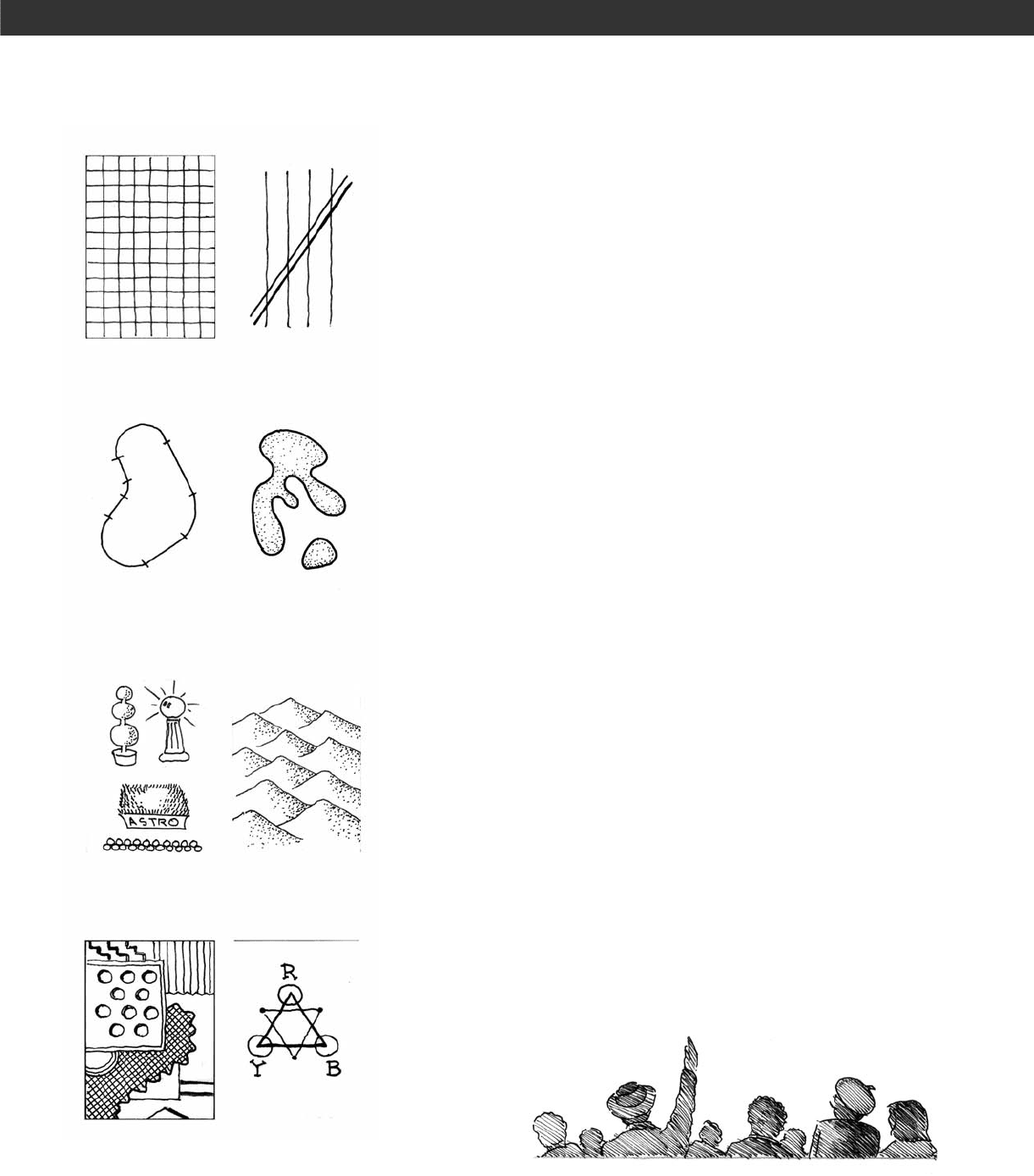
DESIGN VOCABULARY
Grids
Arcs and
tangents
Synthetic
material
Collage
Shifted axes
Biomorphic
shapes
Landform
Color
BOOKS
1984, by George Orwell
T
HE AGE OF INNOCENCE, by Edith Wharton
B
RAVE NEW WORLD, by Aldous Huxley
T
HE FOUNTAINHEAD, by Ayn Rand
T
HE GRAPES OF WRATH, by John Steinbeck
T
HE GREAT GATSBY, by F. Scott Fitzgerald
T
HE JUNGLE, by Upton Sinclair
O
N THE ROAD, by Jack Kerouac
O
VERLAY, by Lucy Lippard
S
AND COUNTY ALMANAC, by Aldo Leopold
S
ILENT SPRING, by Rachel Carson
FILMS
ALL’S FAIR AT THE FAIR (1938)
A
POCALYPSE NOW (1979)
T
HE CABINET OF DR. CALIGARI (1920)
C
ASABLANCA (1942)
C
ITIZEN KANE (1941)
D
R. STRANGELOVE (1964)
G
ONE WITH THE WIND (1939)
H
OTEL RWANDA (2004)
T
HE LAST EMPEROR (1987)
M
ETROPOLIS (1927)
M
ON ONCLE, by Jacques Tati (1958)
S
CHINDLER’S LIST (1993)
T
HE TRUMAN SHOW (1998)
PAINTINGS AND SCULPTURE
LES MADEMOISELLES D’AVIGNON, by Pablo Picasso (1907)
N
UDE DESCENDING A STAIRCASE, by Marcel Duchamp (1912)
S
UPREMATIST COMPOSITION: WHITE ON WHITE, by Kazimir Malevich (1918)
B
IRD IN SPA CE , by Constantin Brancusi (1928)
C
OMPOSITION WITH RED, BLUE AND YELLOW, by Piet Mondrian (1930)
R
ECUMBENT FIGURE, by Henry Moore (1938)
L
OBSTER TRAP AND FISH TAIL, by Alexander Calder (1939)
A
N AMERICAN EXODUS, photographic series by Dorothea Lange (1939)
A
UTUMN RHYTHM (NUMBER 30), by Jackson Pollock (1950)
L
IGHTNING FIELD, by Walter de Maria (1977)
S
URROUNDED ISLANDS, by Christo and Jean-Claude (1983)
B
OHEMIA LIES BY THE SEA (1996), by Anselm Kiefer
F
o
r further exploration
231
21st CENTURY
Everything depends on an unforeseeable historic continuity. But if we succeed in developing
our culture while continuing to respect our past, we have a chance of preserving it.
—Stephen Jay Gould (2000)
C
ultural trends have become linked to the marketplace; 21st-century culture is mobile, networked, and instantly
available. The fashionable trend at the moment is “green”; what started as a countercultural movement has
now become mainstream. Everything is green. Sustainability is a buzzword. One hopes that this trend will be
permanently instilled into the global consciousness and become the origin of all design
.
The early modernists were optimistic about the potential for industrial materials and methods to offer promise for
the future. Designers are again hopeful that technology can help reestablish a harmonic balance with nature. The
projects described in this chapter demonstrate that art and science can combine to create beautiful and ecologically
responsible design.
232
A SUSTAINABLE EARTH / TEN IDEAS
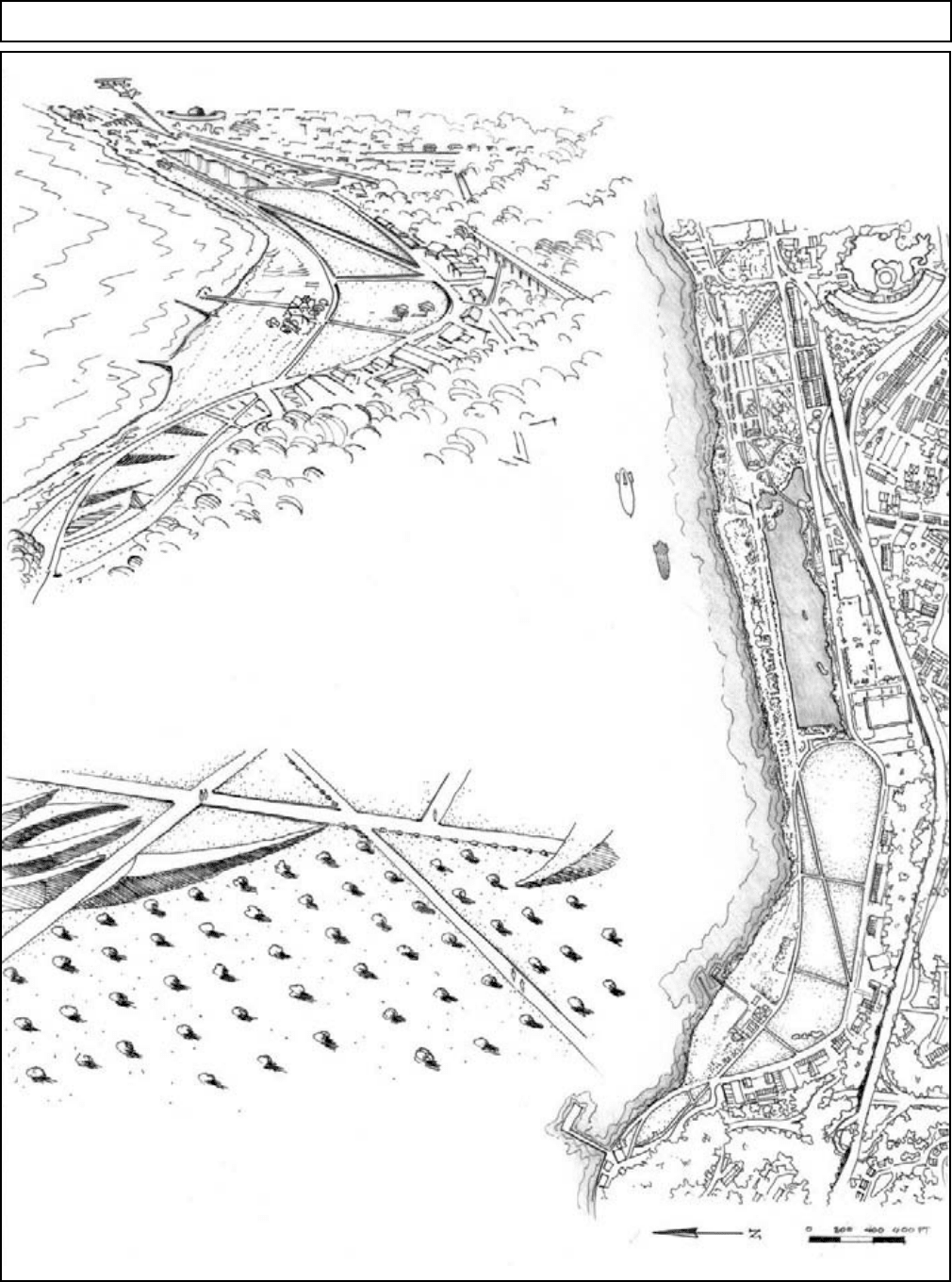
CRISSY FIELD, SAN FRANCISCO, CALIFORNIA (2001)
Hargreaves Associates
A restoration of wetlands and dune fi elds along the bay front helped turn this
former U.S. Army installation into San Francisco’s “front yard.”
1
Hargreaves’s
fi rm also created a series of paths and earthen forms that serve as a
framework for new recreational activities along the waterfront.
233
A SUSTAINABLE EARTH / TEN IDEAS
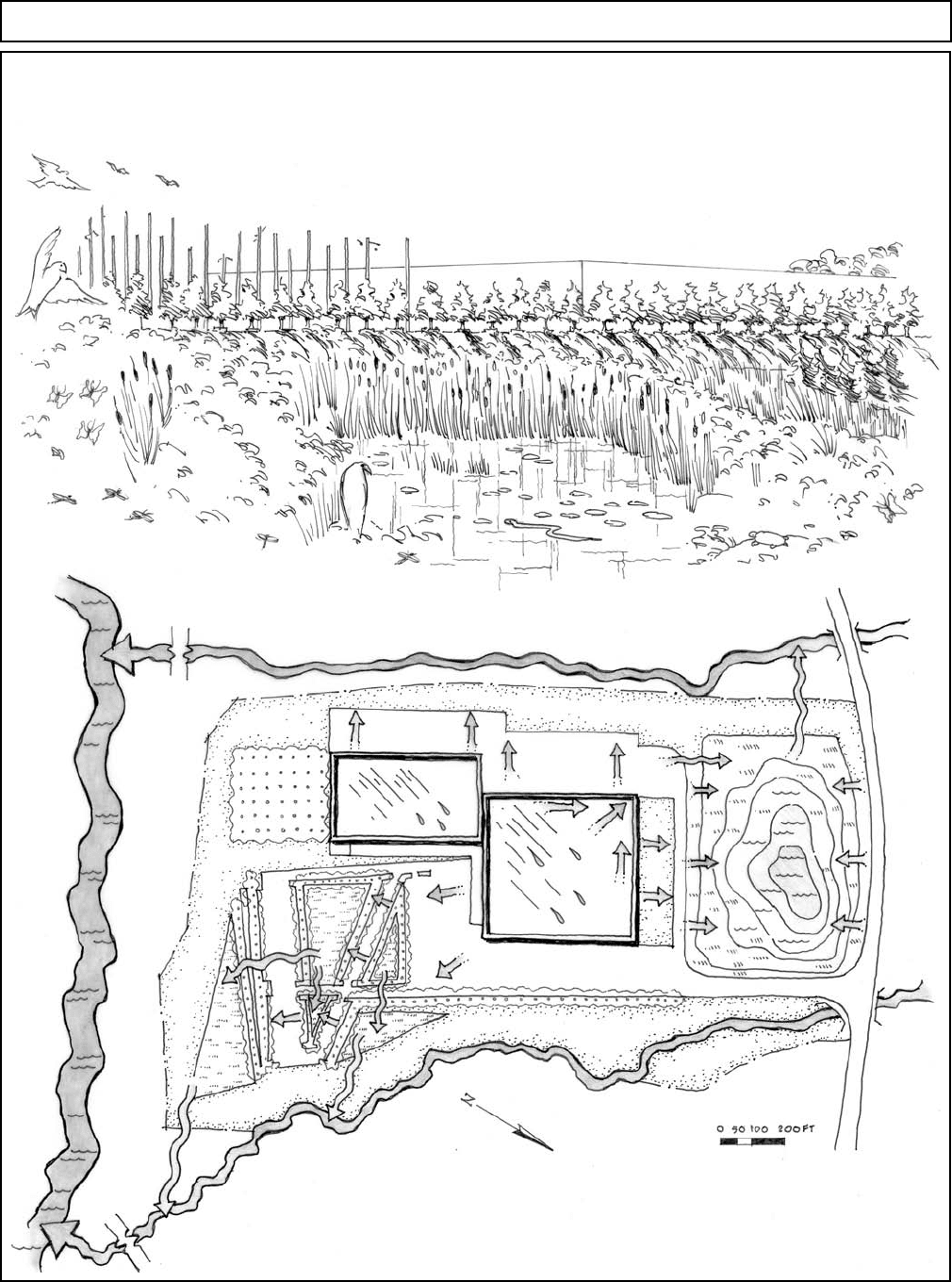
HERMAN MILLER FACTORY LANDSCAPE, CHEROKEE COUNTY, GEORGIA (2001)
Michael Van Valkenburgh Associates, Inc.
The design for this rural factory was driven largely by hydrologic management. The entire 22-acre
building site is graded at a 5 percent slope, allowing for runoff from the built surfaces to sheet into
wetlands without the use of pipes or curbs. When the wetland system is dry, it functions as a
meadow, with trees creating thickets along the edges of the fl oodplain.
234
A SUSTAINABLE EARTH / TEN IDEAS
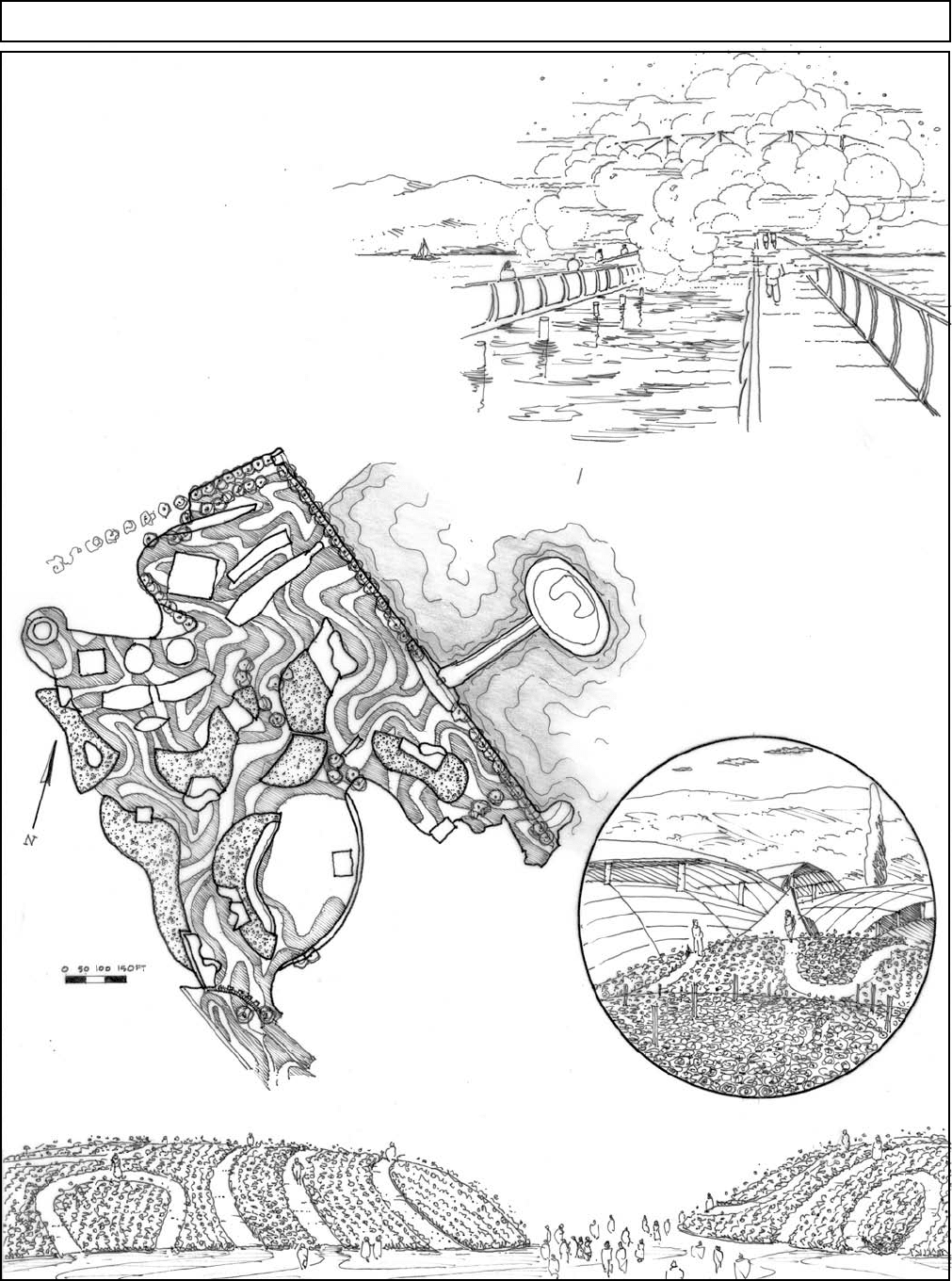
BLUR BUILDING AND
ARTEPLAGE, YVERDON-LES-BAINS,
SWITZERLAND (2002)
Diller + Scofi dio (architects),
West 8 (landscape architects)
Built as the Exposition Pavilion for the Swiss
Expo, this space takes the line between
architecture and landscape, structure and
atmosphere, and erases it completely. The
site is consistently engulfed in fog, thanks
to water pumped from Lake Neuchatel and
shot as a fi ne mist through 35,000 nozzles.
The resulting whiteout effect leaves the
visitor in a space that is both formless and
scaleless. It is a 21st-century rumination on
the limits of physical spatial design.
Access to the pavilion was across
a plaza constructed entirely with
recyclable materials. Eighteen-
foot-high artifi cial dunes collided
with rough timber structures and
biomorphic patterns of fragrant,
colorful fl owers, adding to the
visitor’s sense of disorientation.
235
A SUSTAINABLE EARTH / TEN IDEAS
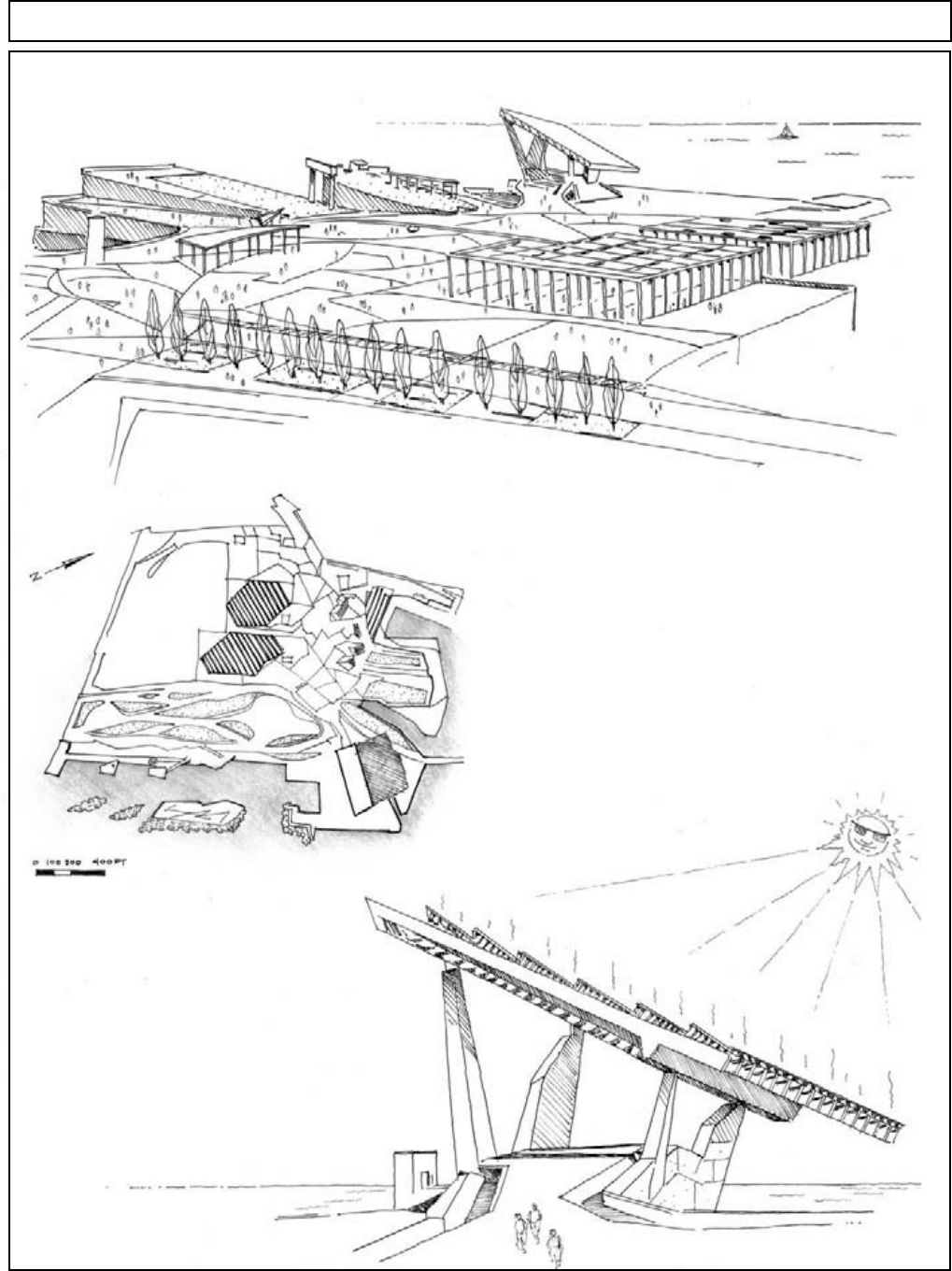
FORUM ESPLANADE BARCELONA, SPAIN (2004)
Torres & Lapena
When designers began employing renewable energy
technologies in their designs in the latter part of the
20th century, the electricity-generating infrastructure
often served merely as a skin applied to a design. However,
the photovoltaic “pergola” at the Forum Esplanade
Barcelona employs solar energy production as an integral
space-making device. The grand scale and skewed plane of
the pergola’s canopy provides crucial shade, 4,500 square
meters of photovoltaic panels, and a clear terminus for
the waterfront esplanade.
236
A SUSTAINABLE EARTH / TEN IDEAS
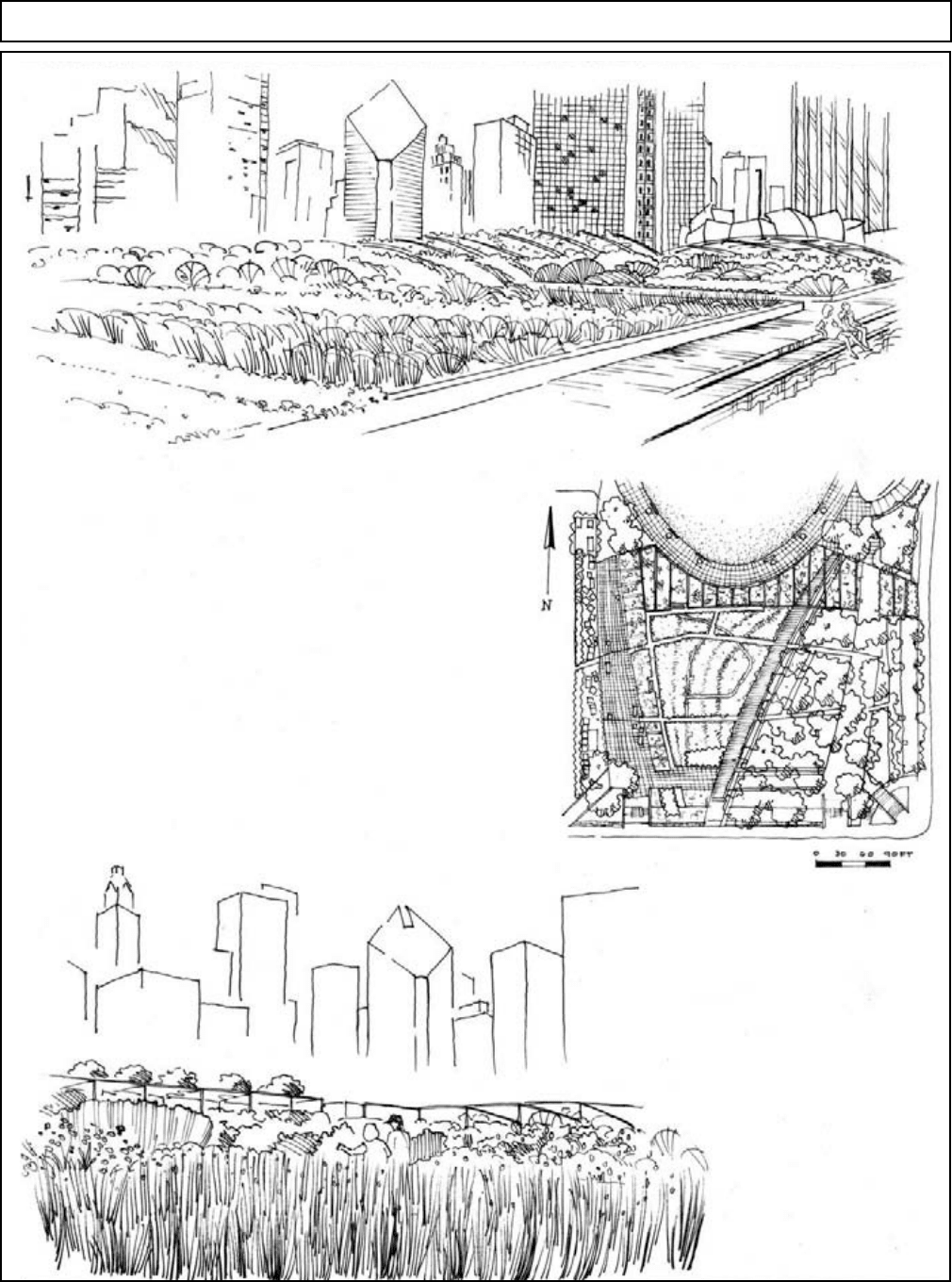
LURIE GARDEN, CHICAGO, ILLINOIS (2004)
Gustafson Guthrie Nichol Ltd., Piet Oudolf
and Robert Israel
Built atop an underground parking structure and former
rail line in Chicago, the Lurie Garden is the focal point
of Millennium Park, the open space that connects the
city’s downtown to Lake Michigan. Gustafson tapped
into Chicago’s ecological history, using native plants and
local stones to reference the Midwestern prairie in a
grouping of geometric gardens. A boardwalk runs beside
a stylized stream where pedestrians can sit with their
feet in the water—a new promenade for the tourists
and businesspeople, who crowd into the park during the
humid summer months.