
Boults Е. Illustrated history of landscape design
Подождите немного. Документ загружается.

237
A SUSTAINABLE EARTH / TEN IDEAS
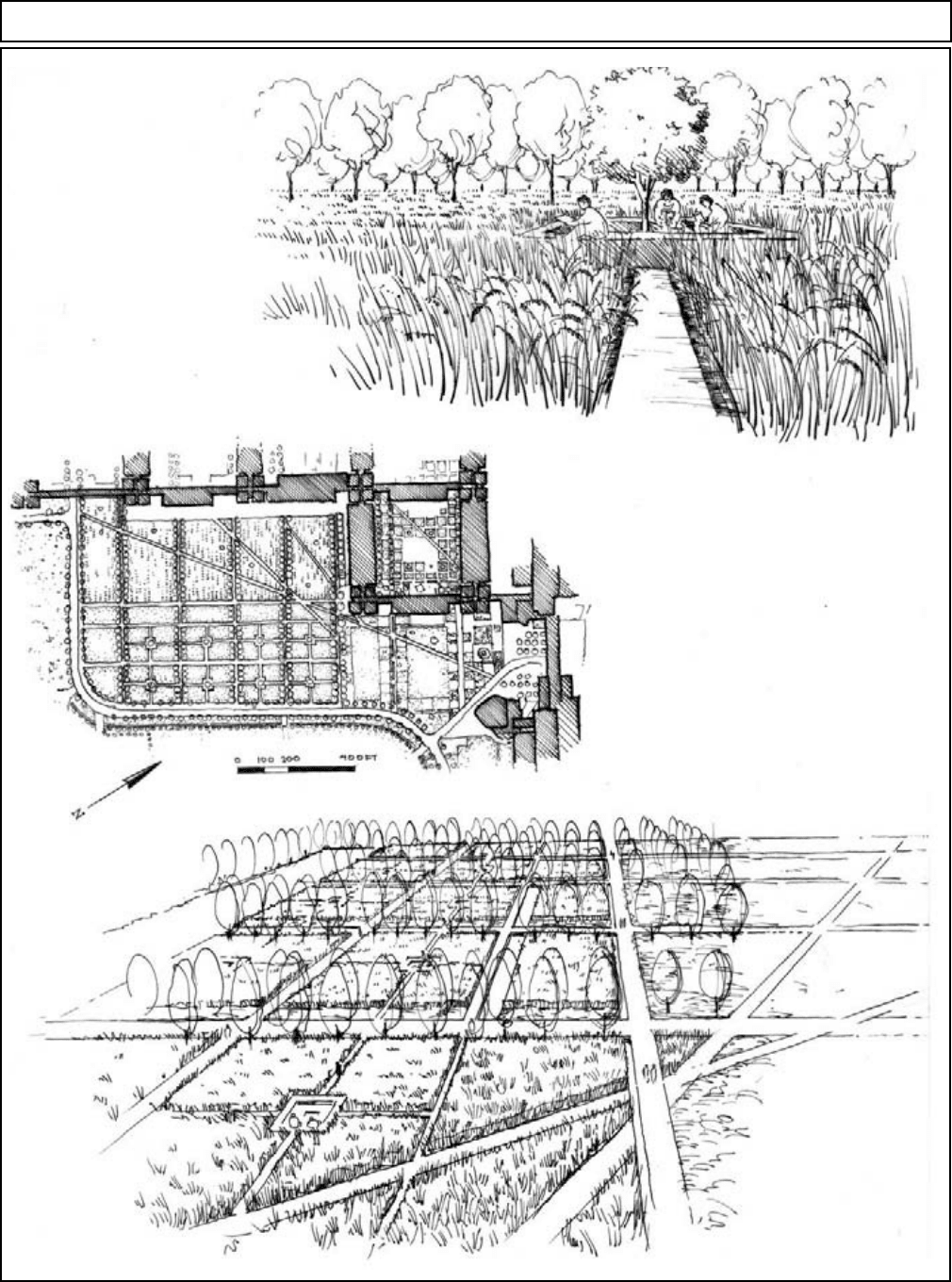
SHENYANG ARCHITECTURAL
UNIVERSITY CAMPUS, SHENYANG
CITY, LIAONING PROVINCE, CHINA
(2004)
Kongjian Yu and Lin Shihong
With China’s stunningly quick turn toward
urbanization in the 20th century, food-
production landscapes in the country
have come under increasing pressure. In
response, landscape architect Kongjian Yu
combined rice fi elds and native vegetation
to frame spaces for outdoor education,
helping make clear the connection between
productive agriculture and urban existence.
238
A SUSTAINABLE EARTH / TEN IDEAS
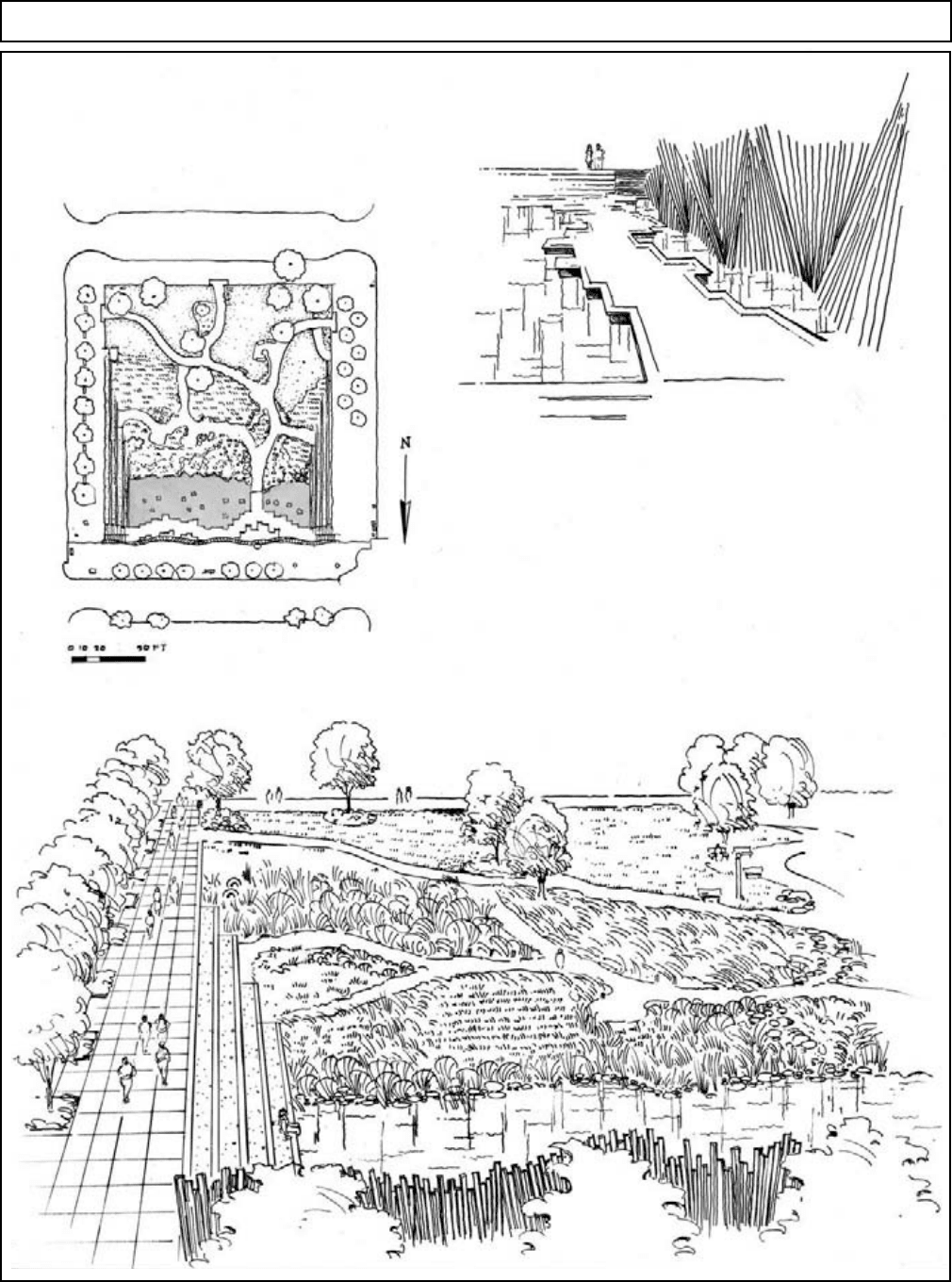
TANNER SPRINGS PARK, PORTLAND,
OREGON (2005)
Atelier Dreiseitl
In a city widely noted for its sustainable water practices,
Tanner Springs Park stands out for its combination of
smart hydrology and thoughtful aesthetics. Rainwater
is collected and purifi ed through a wetland system. An
orthogonal boardwalk fl oats over the wetlands, bringing
urban dwellers in close contact with these natural
hydrological processes.
239
A SUSTAINABLE EARTH / TEN IDEAS
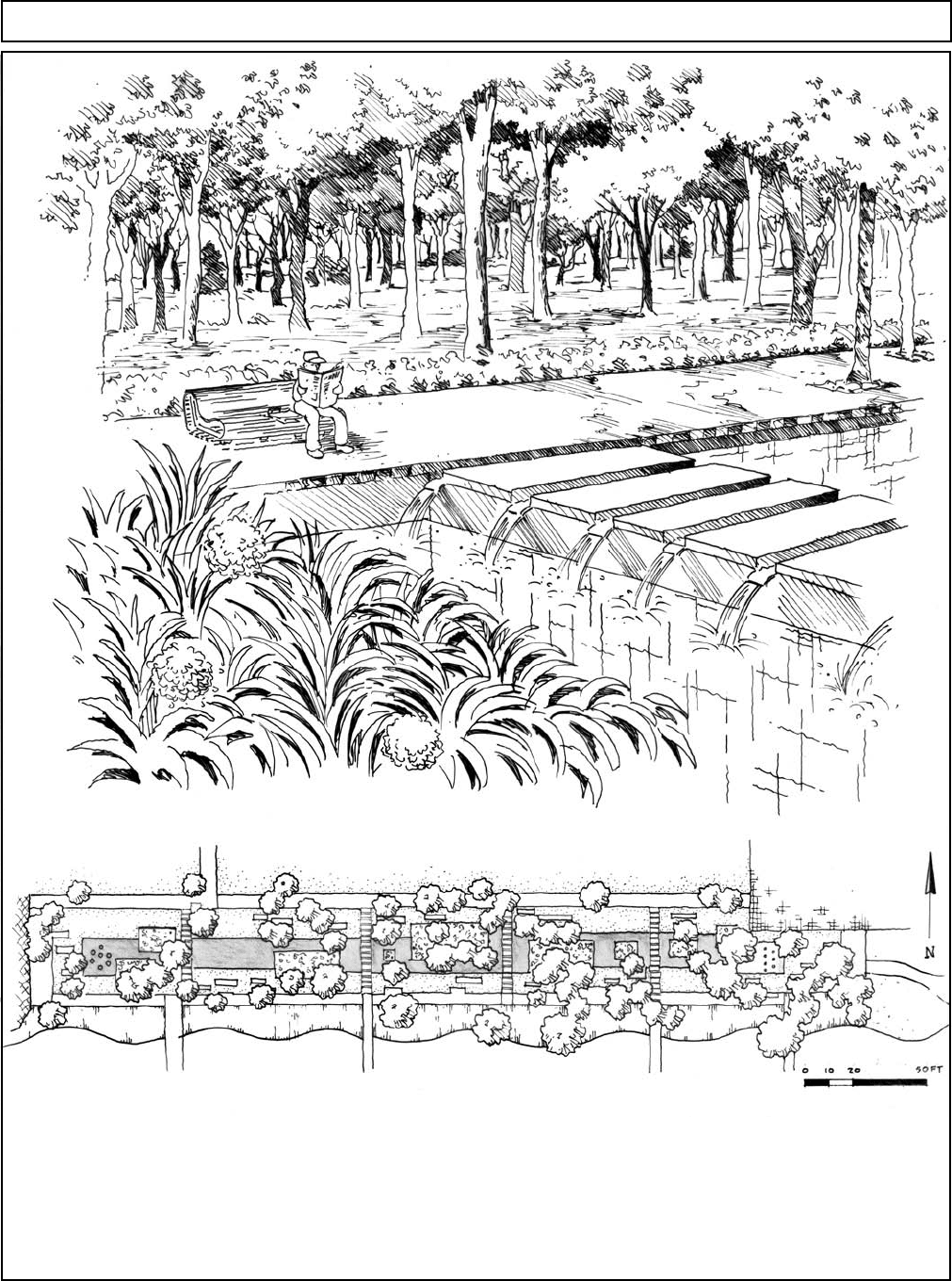
FOUNTAIN PROMENADE AT CHAPULTEPEC PARK, MEXICO CITY, MEXICO (2006)
Grupo de Diseno (Mario Schjetnan)
One of several phases of redesigns for Chapultepec Park by Schjetnan and company, this piece
sought to attract families to a previously underused area of the city’s central park. A promenade,
stone-and-steel pergolas, and a children’s play area are integrated with the green infrastructure
of the park, which includes new canals for water quality improvement and reforestation programs.
240
A SUSTAINABLE EARTH / TEN IDEAS
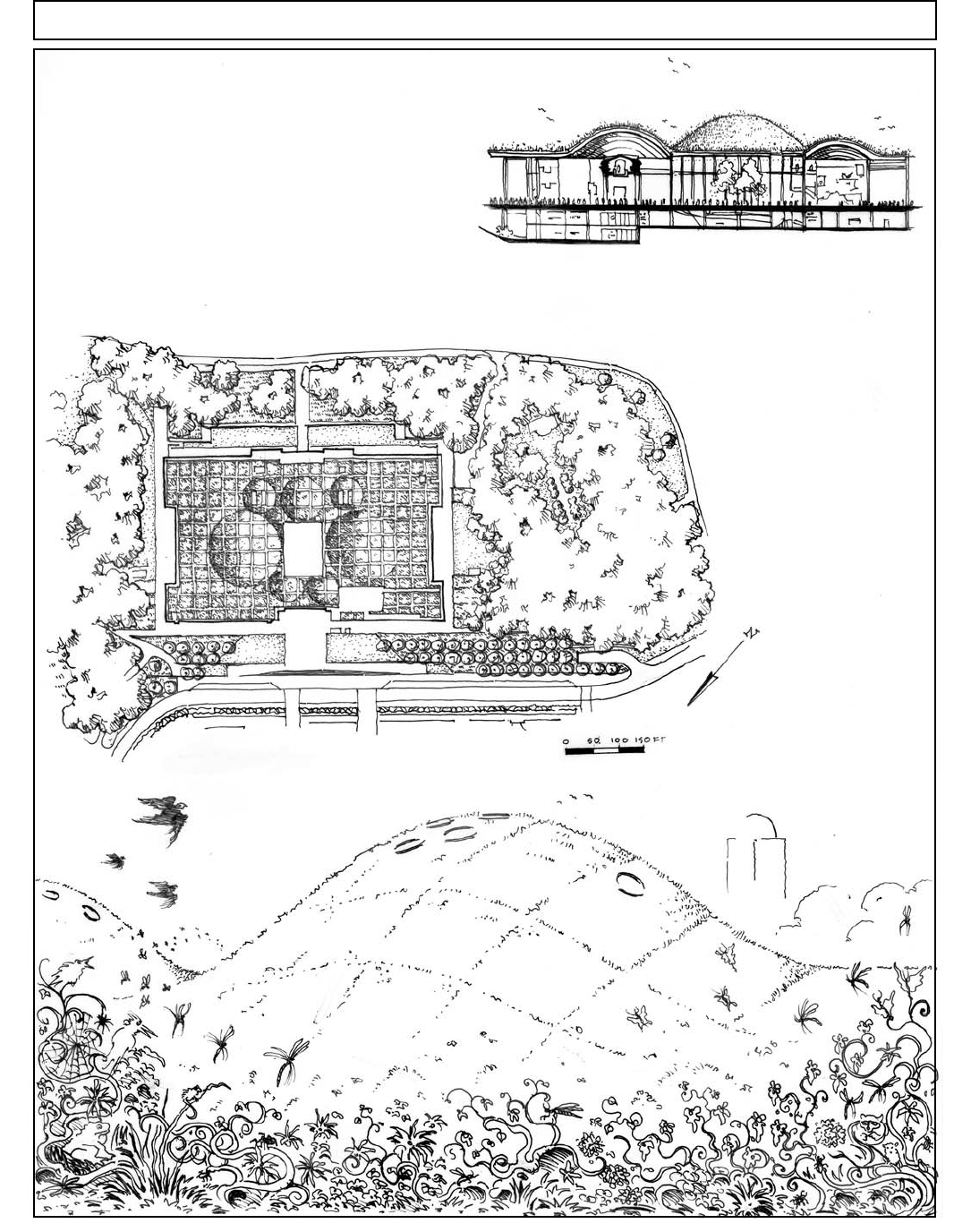
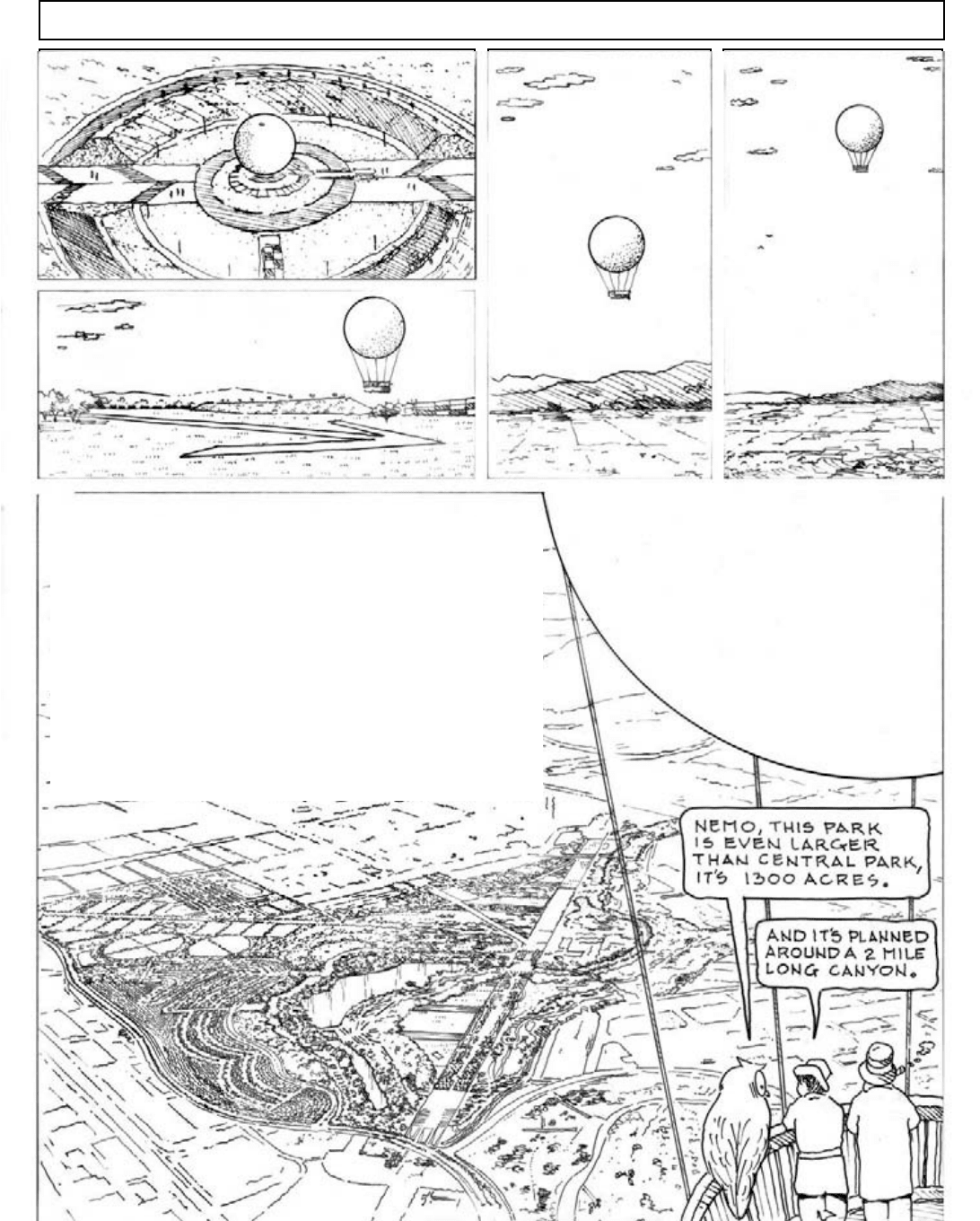
THE LIVING ROOF: CALIFORNIA ACADEMY
OF SCIENCES, SAN FRANCISCO, CALIFORNIA
(2008)
Renzo Piano
The architect employed a series of seven undulating
landforms atop the roof of the Academy of Sciences
to reference San Francisco’s iconic hills. The design
allows Golden Gate Park to climb up and over the new
building. The slopes draw cool air into the open piazza in
the middle of the building, while the rooftop’s weather
stations regulate its passive ventilation system.
241
A SUSTAINABLE EARTH / TEN IDEAS
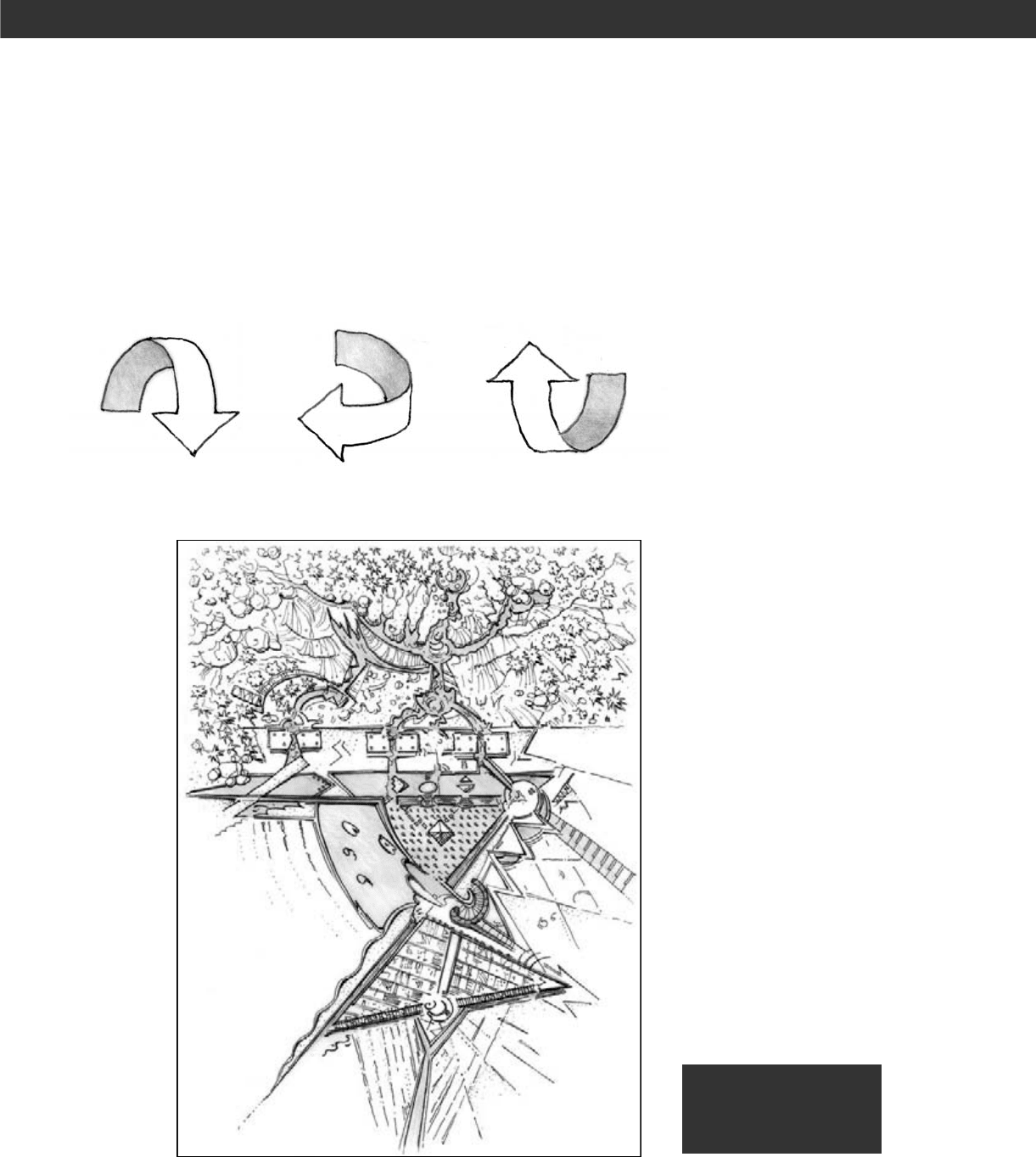
ORANGE COUNTY GREAT PARK, IRVINE, CALIFORNIA (2010)
Ken Smith Workshop, with Mia Lehrer + Associates
The competition to design a park on the former El Toro Marine
Base resulted in the greatest urban park commission since
Olmsted’s Central Park. The project involves the restoration and
transformation of more than 1,300 acres of land. The designers
envision the park as three distinct conceptual areas: habitat, fi elds,
and canyon. Features include a sports park and recreational fi elds;
a Veterans Memorial; a Botanic Garden; cultural facilities, including
a Library, Museum, and café; and a wildlife corridor contiguous to a
State Park and National Forest. Goals of sustainability will be met
through habitat restoration, natural water treatment systems,
and the use of photovoltaics.
242
21st CENTURY / CONCLUSION
SUMMARY
Thus our visual romp through landscape design history comes to a rest, as a whole new set of challenges faces the 21st cen-
tury designer. In the fi rst decade of this century, it is diffi cult to judge which of the more recent projects will survive the test
of time. Go forth and plant the future.
Whatever befalls the Earth,
befalls the children of the Earth.
C
HIEF SEATTLE
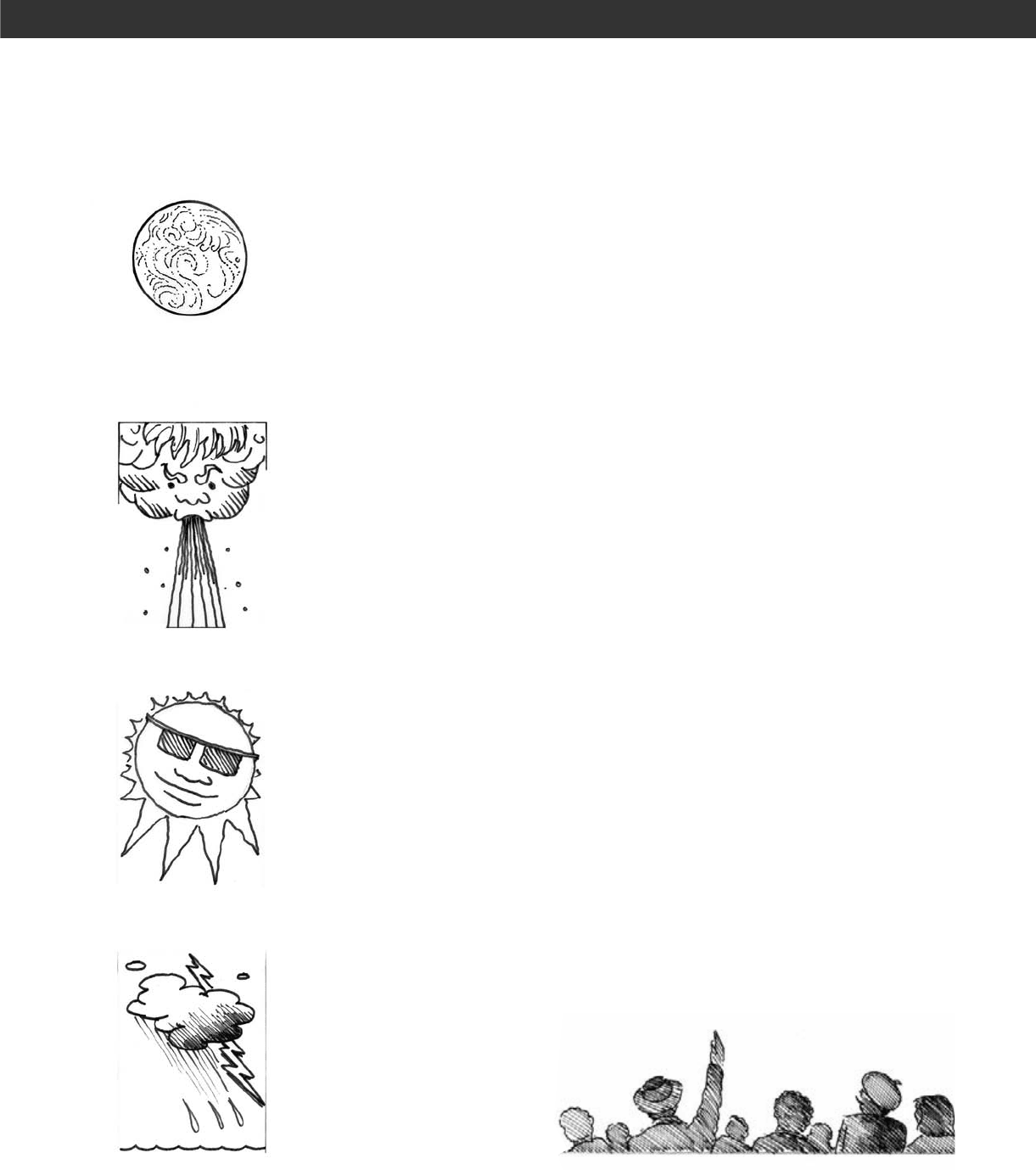
DESIGN PRINCIPLES
REDUCE
REUSE
RECYCLE
GARDEN FOR THE 21st
CENTURY: Chip Sullivan’s pro-
posal for an energy-conserving
garden.
243
BOOKS
C
RADLE TO CRADLE: REMAKING THE WAY WE MAKE THINGS, by
William McDonough and Michael Braungart
D
ESIGN FOR ECOLOGICAL DEMOCRACY, by Randolph T. Hester
T
HE DIAMOND AGE, by Neal Stephenson
D
UNE, by Frank Herbert
T
HE END OF OIL: ON THE EDGE OF A PERILOUS NEW WORLD, by Paul
Roberts
G
ARDEN AND CLIMATE, by Chip Sullivan
T
HE MEMOIRS OF A SURVIVOR, by Doris Lessing
T
HE OMNIVORE’S DILEMMA, by Michael Pollan
O
RYX AND CRAKE, by Margaret Atwood
R
ECLAIMING THE AMERICAN WEST, by Alan Berger
FILMS
2001: A S
PA CE ODYSSEY (1968)
A
N INCONVENIENT TRUTH (2006)
B
LADERUNNER (1982)
L
OST IN TRANSLATION (2003)
T
HE MARCH OF THE PENGUINS (2005)
T
HE MATRIX (1999)
R
IVERS AND TIDES (2001)
S
LUMDOG MILLIONAIRE (2008)
S
UPER SIZE ME (2004)
W
ALL-E (2006)
ARTWORKS
R
ODEN CRATER (earthwork), by James Turrell (2000)
E
VERY SHOT, EVERY EPISODE (installation), by Jennifer and Kevin
McCoy (2001)
S
ETO INLAND SEA, YASHIMA (photography), by Hiroshi Sugimoto
(2001)
T
HE WEATHER PROJECT (installation), by Olafur Eliasson (2003)
C
LOUD GATE, by Anish Kapoor (2004)
F
OR NEW YORK CITY (light projection), by Jenny Holzer (2004)
F
o
r further exploration
DESIGN VOCABULARY
EARTH
WIND
SUN
WATER
21st CENTURY / CONCLUSION

245
Notes
PREHISTORY–6TH CENTURY CE
1. Archeologist Alfred Kroeber and Peruvian scholar Toribio Mejia
fi rst documented the lines in their travel diaries in 1926. German
mathematician Maria Reiche began studying the geoglyphs at
Nazca in 1946. She dedicated her life to the documentation and
preservation of the enigmatic lines and fi gures. Reiche published
her photographs and infl uential theories on the astronomical ori-
entation of the Nazca lines in her pamphlet Mystery on the Desert
(1949). Reiche acknowledged the work of historian Paul Kosok, who
fi rst noted the alignment of one of the traces with sunset on the
summer solstice, and who referred to the markings as a “gigantic
calendar.”
2. The tale of adventure known as the Epic of Gilgamesh dates from
the 7th century BCE and was written in cuneiform on a series of
clay tablets. In the story, the walled city of Uruk enclosed “one
league city, one league palm gardens, one league lowlands.” See
The Epic of Gilgamesh, translated by Maureen Gallery Kovacs
(Stanford, CA: Stanford University Press, 1989), p. 3.
3. This drawing is based on the plan reconstructed by Elisabeth B.
Moynihan in Paradise as a Garden in Persia and Mughal India (New
York: George Braziller, 1979), p. 17. See also Ralph Pinder-Wilson,
“The Persian Garden: Bagh and Chahar Bagh,” in The Islamic Gar-
den, Dumbarton Oaks Colloquium on the History of Landscape
Architecture IV, Elisabeth B. MacDougall and Richard Ettinghau-
sen, eds. (Washington, DC: Dumbarton Oaks, Trustees for Harvard
University, 1976), pp. 71–72.
4. The total area of Hadrian’s villa is estimated at 300 acres. See
William L. MacDonald and John A. Pinto, Hadrian’s Villa and Its
Legacy (New Haven: Yale University Press, 1995), p. 29.
5. Hobhouse, Penelope. The Story of Gardening (London: Dorling
Kindersley Ltd., 2002), p. 27.
6. The classical “orders” refer to specifi c compositions of column,
capital, and base, and include the Doric, Ionic, and Corinthian or-
ders. The Doric order is the simplest in design, and the oldest. The
Ionic order is taller and more slender, its capital distinguished by
scrolling volutes. The Corinthian capital is more ornate, with carved
acanthus leaves. Vitruvius cataloged the orders in the 1st century.
Serlio elaborated on the proportioning system during the Renais-
sance.
7. In his book Design of Cities (1974), Edmund Bacon described the
development of the agora over time, particularly noting the relation-
ship between architecture and open space, and its effect on move-
ment systems (see pp. 64–71). The open space of the agora was
most clearly articulated during the Hellenistic era. In the Roman
period, the addition of fountains, sculptures, and temples affected
the clarity of the space. The agora was destroyed in 267 CE.
8. Emperor Qin Shi Huangdi unifi ed all of China. Great advancements
took place during his reign; weights, measures, currency, and writ-
ing were standardized. He initiated a canal-building project to con-
nect northern and southern river systems, and expanded existing
border fortifi cations to form the Great Wall. The imperial system
stayed in place until the 20th century.
Qin Shi Huangdi commissioned a new royal palace and great hunt-
ing park, Shanglin, built along the Wei River near the capital of
Chang-an, on the slopes of Li Shan mountain. Written accounts
describe a miniature universe of rare plants and animals and a
network of secret passageways and corridors that connected
the opulent palace complex. He also ordered the construction of
an enormous mausoleum that included an army of life-size terra-
cotta soldiers. His lavish extravagances led to the downfall of his
dynasty, but established a prototype for imperial gardens.
9. The Neolithic Revolution refers to the important societal shift from
hunting and gathering to settled agriculture. Glaciers began to
recede at the end of the Paleolithic Era, or Old Stone Age (500,000
BCE–8,000 BCE). The cave paintings in southern France date from
this period. During the Neolithic Era, or New Stone Age (8,000
BCE–4,000 BCE), belief in celestial gods replaced notions of an
earth goddess. The fi rst urban civilizations developed in the fertile
crescent during the Bronze Age (4,000 BCE–2,000 BCE), when
writing and metallurgy advanced.
Jane Jacobs disputed the theory that settled agriculture was a
prerequisite for the development of cities in her book The Economy
of Cities (1969), stating that agriculture and the domestication
of animals emerged from urban centers.
6TH–15TH CENTURIES CE
1. “A garden enclosed is my sister, my spouse; a spring shut up, a
fountain sealed.” Song of Solomon 4:12.
2. See Ferguson, George. Signs and Symbols in Christian Art (Lon-
don: Oxford University Press, 1961).
3. From The Romance of the Rose, Guillaume de Lorris and Jean de
Meun; translated and edited by Frances Horgan (New York: Oxford
University Press, 1999).
4. King, Roland. The Quest for Paradise (New York: Mayfl ower Books,
1979), p. 70.
5. Illustration after M. Gomez-Moreno, in Marianne Barrucand and
Achim Bednorz, Moorish Architecture in Andalusia (Cologne:
Taschen, 2007), p. 69. See also Hobhouse, Penelope. The Story of
Gardening (London, Dorling Kindersley Limited, 2002), pp. 66–67.
6. Wright, Richardson. The Story of Gardening: From the Hanging
Gardens of Babylon to the Hanging Gardens of New York (New
York: Garden City Publishing Co. Inc., 1938), p. 30.
7. James Dickie, “The Islamic Garden in Spain,” in The Islamic Garden,
Dumbarton Oaks Colloquium on the History of Landscape Archi-
tecture IV, Elisabeth B. MacDougall and Richard Ettinghausen,
eds. (Washington, DC: Dumbarton Oaks, Trustees for Harvard
University, 1976), p. 99.

8. Casa Valdes, Marquesa de. Spanish Gardens. Translated by Ed-
ward Tanner (Woodbridge, Suffolk, UK: Antique Collectors’ Club
Ltd., [1973] 1987), p. 41.
9. Keswick, Maggie. The Chinese Garden: History, Art & Architecture
(New York: Rizzoli, 1978), pp. 48–49.
10. Kostoff, Spiro. The City Shaped: Urban Patterns and Meanings
Through History (Boston: Bulfi nch Press/Little Brown and Co.,
1991), p. 33.
1 1. See Tuan, Yi-Fu. Topophilia: A Study of Environmental Perception,
Attitudes, and Values (New York: Columbia University Press, 1990),
pp. 164–166. Also, Tuan, Yi-Fu. Space and Place: The Perspective of
Experience (Minneapolis: University of Minnesota Press, 2001), p. 134.
12. Wang Wei (701–761), poems from the Wang River sequence, in The
Anchor Book of Chinese Poetry, Tony Barnstone and Chou Ping, eds.
(New York: Anchor Books/Random House, 2005), pp. 106–107.
13. Jellicoe, Sir Geoffrey, Susan Jellicoe, Patrick Goode, and Michael
Lancaster, eds. The Oxford Companion to Gardens (Oxford, UK:
Oxford University Press, 1986), p. 541.
14. Keswick, The Chinese Garden, p. 56.
15. See Cahill, James. Chinese Painting (New York: Rizzoli, 1977).
16. Thacker, Christopher. The History of Gardens (Berkeley, CA: Uni-
versity of California Press, 1979), p. 55.
17. Image and poem adapted from the work of Chen Congzhou (1956)
as presented by Stanislaus Fung in “Longing and Belonging in
Chinese Garden History,” in Perspectives on Garden Histories,
Dumbarton Oaks Colloquium on the History of Landscape Archi-
tecture, vol. 21, Michel Conan, ed. (Washington, DC: Dumbarton
Oaks, Trustees for Harvard University, 1999), pp. 209–210.
18. The Travels of Marco Polo, Art Type edition, The World’s Popular
Classics (New York Books, Inc., undated).
19. Flower-viewing festivals remain popular in Japan. Springtime cel-
ebrations include the plum blossom festival in February, the peach
blossom festival in March, and the cherry blossom festival in April.
See also Thacker, The History of Gardens, pp. 63–66.
20. Yuniwa refers to the purifi ed space of Shinto shrines. A discussion
of the evolution of the term can be found in Camelia Nakagawara,
“The Japanese Garden for the Mind: The ‘Bliss’ of Paradise Tran-
scended,” in Stanford Journal of East Asian Affairs, vol. 4, no. 2,
Summer 2004, pp. 84–85, 88–89. Retr. 3.1.09 from http://www
.stanford.edu/group/sjeaa/journal42/japan2.pdf.
Irmtraud Schaarschmidt-Richter discusses the function of the
“sandy parterre” in Japanese Gardens (New York: William Morrow
& Co. Inc., 1979), pp. 95–98. The changing use of the yuniwa at
Kyoto Imperial Palace is described by Marc Treib and Ron Herman
in A Guide to the Gardens of Kyoto (New York: Kodansha America
Inc., 2003 revised edition), pp. 6, 72.
21. Schaarschmidt-Richter, Japanese Gardens, p. 50.
22. See Morris, A. E. J. History of Urban Form: Before the Industrial
Revolution (New York: John Wiley & Sons, Inc., 1982), pp. 292–295.
23. See Nitschke, Gunter. Japanese Gardens: Right Angle and Natural
Form (Cologne: Taschen, 1999), pp. 34–35.
24. Shikibu, Murasaki. The Tale of Genji. Translated by Edward G.
Seidensticker (New York: Alfred A. Knopf, 1987), p. 386.
25. See Keane, Marc. Japanese Garden Design (Rutland, VT: Charles E.
Tuttle Inc., 1996), p. 50.
26. Nitschke, Japanese Gardens, pp. 76–77.
15th CENTURY
1. For a discussion of how changing architectural styles affected the
perception and use of gardens, see Camelia Nakagawara, “The Jap-
anese Garden for the Mind: The ‘Bliss’ of Paradise Transcended,”
in Stanford Journal of East Asian Affairs, vol. 4, no. 2, Summer
2004, p. 93. Retr. 3.1.09 from http://www.stanford.edu/group/
sjeaa/journal42/japan2.pdf.
2. See the section on “The Rise of the Working Garden Master” by
Irmtraud Schaarschmidt-Richter in Japanese Gardens (New York:
William Morrow & Co. Inc., 1979), p. 257.
3. Kuck, Loraine. The World of the Japanese Garden: From Chinese
Origins to Modern Landscape Art (New York: Weatherhill, 1968),
p. 142.
4. Ibid., p. 139.
5. Gunter Nitschke discusses the symbolism of the garden in Japa-
nese Gardens: Right Angle and Natural Form (Cologne: Taschen,
1999), p. 93.
6. Schaarschmidt-Richter, Japanese Gardens, p. 75.
7. Keswick, Maggie. The Chinese Garden: History, Art & Architecture
(New York: Rizzoli, 1978), p. 59.
8. Yi-Fu Tuan explains how the form of the city is based on tradition-
al symbolism in Topophilia: A Study of Environmental Perception,
Attitudes, and Values (New York: Columbia University Press, 1990),
pp. 164–166. Also, Tuan, Yi-Fu, Space and Place: The Perspective of
Experience (Minneapolis: University of Minnesota Press, 2001), p.
165.
9. See Ruy Gonzalez de Clavijo, Embassy to Tamerlane 1403–1406,
translated by Guy LeStrange (London: George Routledge & Sons,
1928).
10. Wilber, Donald Newton. Persian Gardens and Garden Pavilions
(Washington, DC: Dumbarton Oaks, Trustees for Harvard Univer-
sity, 1979), p. 32.
11. Ralph Pinder-Wilson, “The Persian Garden: Bagh and Chahar Bagh,”
in The Islamic Garden, Dumbarton Oaks Colloquium on the History
of Landscape Architecture IV, Elisabeth B. MacDougall and Richard
Ettinghausen, eds. (Washington, DC: Dumbarton Oaks, Trustees for
Harvard University, 1976), p. 80.
12. de Clavijo, Embassy to Tamerlane 1403–1406, p. 206.
13. Ibid., p. 227.
14. Masson, Georgina. Italian Gardens (Woodbridge, England: Antique
Collectors’ Club, 1987), p. 57.
15. Van der Ree, Paul, Gerrit Smienk, and Clemens Steenbergen. Italian
Villas and Gardens. (Munich: Presel-Verlag, 1993), p. 24.
16. Cicero, in the 1st century BCE, coined the phrase “second na-
ture” to denote a landscape shaped by use; the conceptual
framework was expanded upon during the Renaissance to in-
clude a third state of nature shaped by art. See John Dixon
Hunt, Gardens and the Picturesque (Cambridge: MIT Press,
1992), pp. 3–4. Claudia Lazzaro discusses the categorization
of plantings in chapters two and fi ve of The Italian Renaissance
Garden (New Haven, CT: Yale University Press, 1990); her expla-
nation of the origin of the concept of second and third nature
occurs on page 9.
17. Ackerman, James S. The Villa: Form and Ideology of Country Hous-
es (Princeton, NJ: Princeton University Press, 1990), p. 73.
18. Sica, Grazia Gobbi. The Florentine Villa (Oxford: Routledge, 2007),
p. 47.
NOTES
246