
Brewster H.D. Solid State Physics
Подождите немного. Документ загружается.

92 Effective Mass Theory
and
Transport Phenomena
and
k
2 2
- =
(BT)
f'tW d
SF
k2
121th
v
We now evaluate the contribution to the thennal conductivity from the
thermoelectric coupling effects for the case
of
a metal having a simple
dispersion relation
E= h2k2/2m*
In
this case where 't'
is
considered to be independent
ofE,
Eqs. 5.91 and
5.90, respectively, provide expressions for
kl
and
ko
from which
~k
k-1k =
1t
4
m k
2
T(k
B
T)2
T 1 0 1 4m * B
EF
so that from Eqs. 5.28 and 5.94 the total electronic thermal conductivity for
the metal becomes
=
1t
2
m k
2
T[
31t
2
(kBT)2]
ke
3 * B 1 +
m 4
EF
For
typical metals (T/T
F
)
~
(1/30)
at
room temperature so that the
thennoelectric correction tenn
is
less than 1 %.
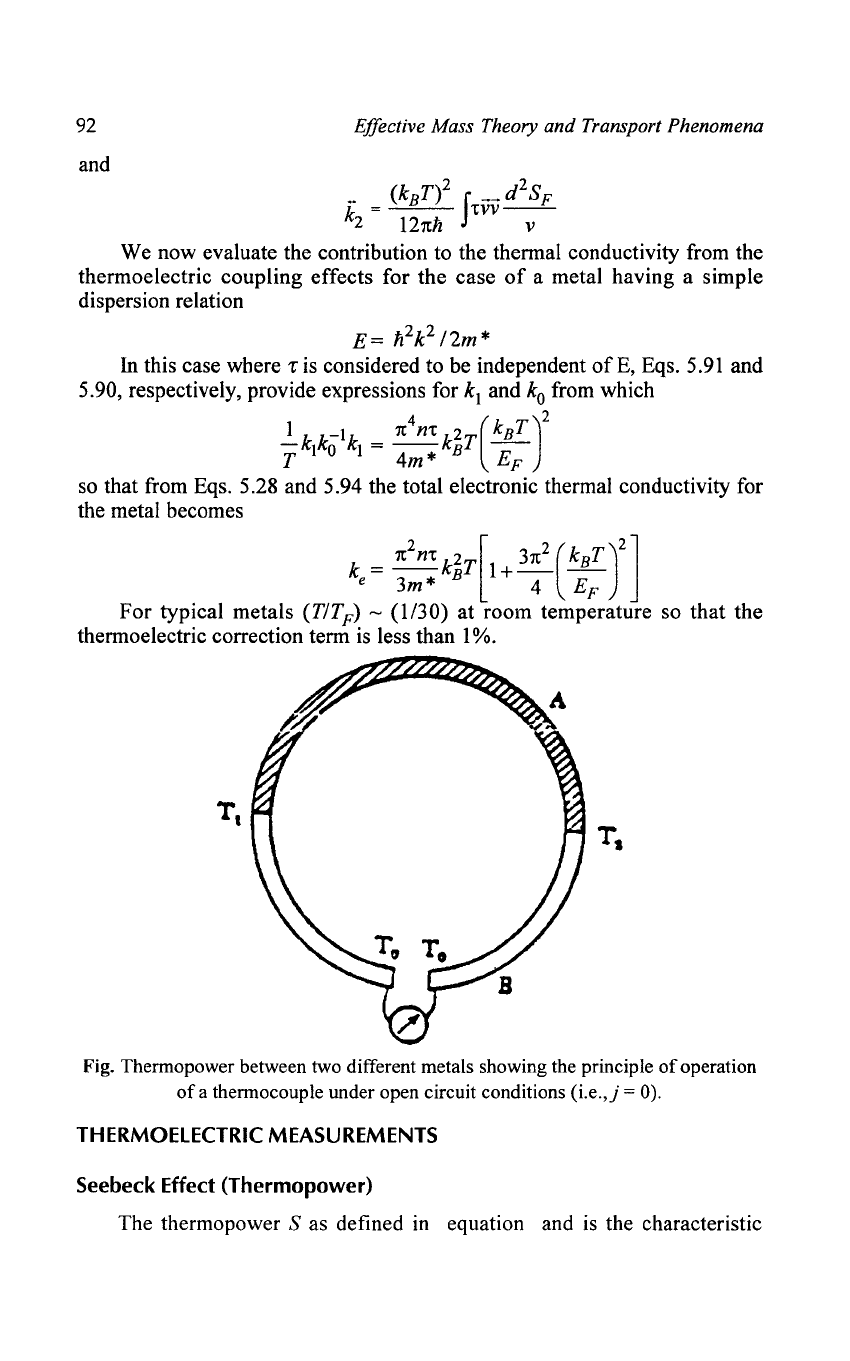
Fig. Thermopower between two different metals showing the principle
of
operation
of
a thermocouple under open circuit conditions
(i.e.,)
= 0).
TH
ERMOElECTRIC
MEASU
REMENTS
Seebeck Effect (Thermopower)
The thermopower S as defined
in
equation and
is
the characteristic
Effective Mass Theory and Transport Phenomena 93
coefficient
in
the Seebeck effect, where a metal subjected to a thermal gradient
VT
exhibits an electric field E =
SVT
, or an open-circuit voltage V under
conditions
of
no current flow.
In
the application
of
the Seebeck effect to thermocouple operation, we
usually measure the di fference
in
thermopower
SA
- S B between two different
metals
A and B by measuring the open circuit voltage V
AB
. This voltage can
be calculated from
4
- 4
oT
V =
E·dr=-i
S-dr
AB
of
W
ith
Tl
'*
T
2
,
an open-circuit potential difference V
AB
can be measured
and equation shows that
V
AB
is independent
of
the temperature
To.
Thus
if
Tl
is known and V
AB
is measured, then temperature
T2
can be found from the
calibration table
of
the thermocouple. From the simple expression
of
equation
1t
2
k
B
kBT
S=----
2e
EF
a linear dependence
of
Son
T is predicted for simple metals. For actual
thermocouples used for temperature measurements, the
S (1) dependence is
approximately linear, but is given by an accurate calibration table to account
for small deviations from this linear relation. Thermocouples are calibrated at
several fixed temperatures and the calibration table comes from a fit
of
these
thermal data to a polynomial function that is approximately linear in
T.
n.,J
~
{Il.-0,v=
r
.......
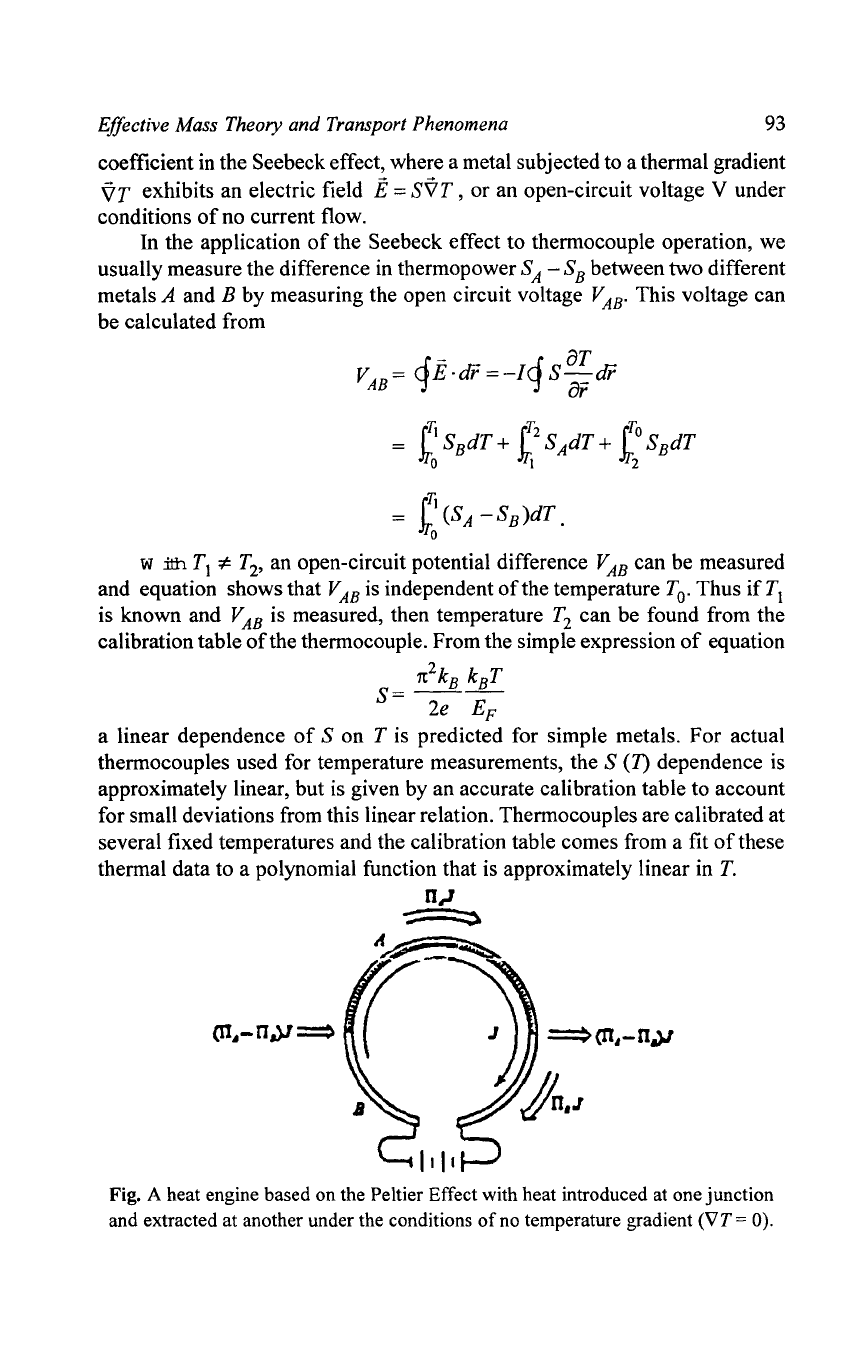
Fig. A heat engine based on the Peltier Effect with heat introduced at one junction
and extracted at another under the conditions
of
no temperature gradient
(VT=
0).
94
Effective Mass Theory
and
Transport Phenomena
Peltier
Effect
The Peltier effect is the observation
of
a thermal current
(j
=
IT·
J
III
the presence
of
an electric current J with no thermal gradient (
VT
=:=
0) so
that
IT
=
TS.
The Peltier effect measures the heat generated (or absorbed) at the junction
of
two dissimilar metals held at constant temperature, when an electric current
passes through the junction. Sending electric current around a circuit
of
two
dissimilar metals cools one junction and heats another and
is
the basis
of
the
operation
of
thermoelectric coolers. This thermoelectric effect is represented
schematically. Because
of
the similarities between the Peltier coefficient and
the Seebeck coefficient, materials exhibiting a large Seebeck effect also show
a large Peltier effect. Since both
S and
IT
are proportional to (lie), the sign
of
S and
IT
is negative for electrons and positive for holes in the case
of
degenerate semiconductors. Reversing the direction
of
J,
will interchange
the junctions where heat is generated (absorbed).
Thomson
Effect
Assume that we have an electric circuit consisting
of
a single metal
conductor. The power generated in a sample, such
as
an n-type semiconductor,
IS
p=
J.E
where the electric field can be obtained from equation as
E =
(a-I).
]
-Tb·
VT
where
Tb
is the Thomson coefficient defined in equation and
is
related to the
Seebeck coefficient
S . Substitution
of
equation yields the total power
dissipation
P=
j.(a-
I
).
] - ]
.T
b
·
VT
The first term in equation is the conventional joule heating term while
the second term is the contribution from the Thomson effect. For an n-type
semiconductor
Tb
is negative. Thus when J and
VT
are parallel, heating
will result. However
if
] and
VT
are antiparallel, cooling will occur. Thus
reversal
of
the direction
of
J without changing the direction
of
VT
will reverse
the sign
of
the Thomson contribution.
Effective Mass Theory
and
Transport Phenomena
95
Likewise, a reversal
in
the direction
of
VT
keeping the direction
of
J
unchanged will also reverse the sign
of
the Thomson contribution.
Thus,
if
either (but not both) the direction
of
the electric current or the
direction
of
the thermal gradient is reversed, an absorption
of
heat from the
surroundings will take place. The Thomson effect is utilized
in
thermoelectric
refrigerators which are useful as practical low temperature laboratory coolers.
We see a schematic diagram explaining the operation
of
a thermoelectric cooler.
We
se~
that for a degenerate n-type
semiconductor where
T
b
,
S,
and
IT
are all negative, when J and
VT
are anti parallel then cooling occurs and heat is extracted from the cold junction
and transferred to the heat sink at temperature
T H. For the p-type leg, all the
thermoelectric coefficients are positive, so equation shows that cooling occurs
when
J and
VT
are parallel. Thus both the n-type and p-type legs in a
thermoelectric element contribute to cooling in a thermoelectric cooler.
The Kelvin Relations
The three thermoelectric effects are related and these relations were first
derived by Lord Kelvin after he became a Lord and changed his name from
Thomson to Kelvin. The Kelvin relations are based on arguments
of
irreversible
thermodynamics and relate
IT,
S, and T
b
.
If
we define the thermopower
SAB
=
SB
-
SA
and the Peltier coefficient
similarly
IT
AB
=
ITA
-
IT
B for material A joined to material E, then we obtain
the first Kelvin relation:
ITAB
SAB=r·
The Thomson coefficient
Tb
is
defined by
as
Tb=
T
aT
which allows determination
of
the Seebeck coefficient at temperature
To
by
integration
of
the above equation
S
(To) =
fO
[Tbi)
JdT.
Furthermore, from the above Definitions, we deduce the second Kelvin
relation
T - T = T
as
AB
= T
as
A _ T
as
B
b'A
b'B
aT aT aT
from which we obtain an expression relating all
three
thermoelectric
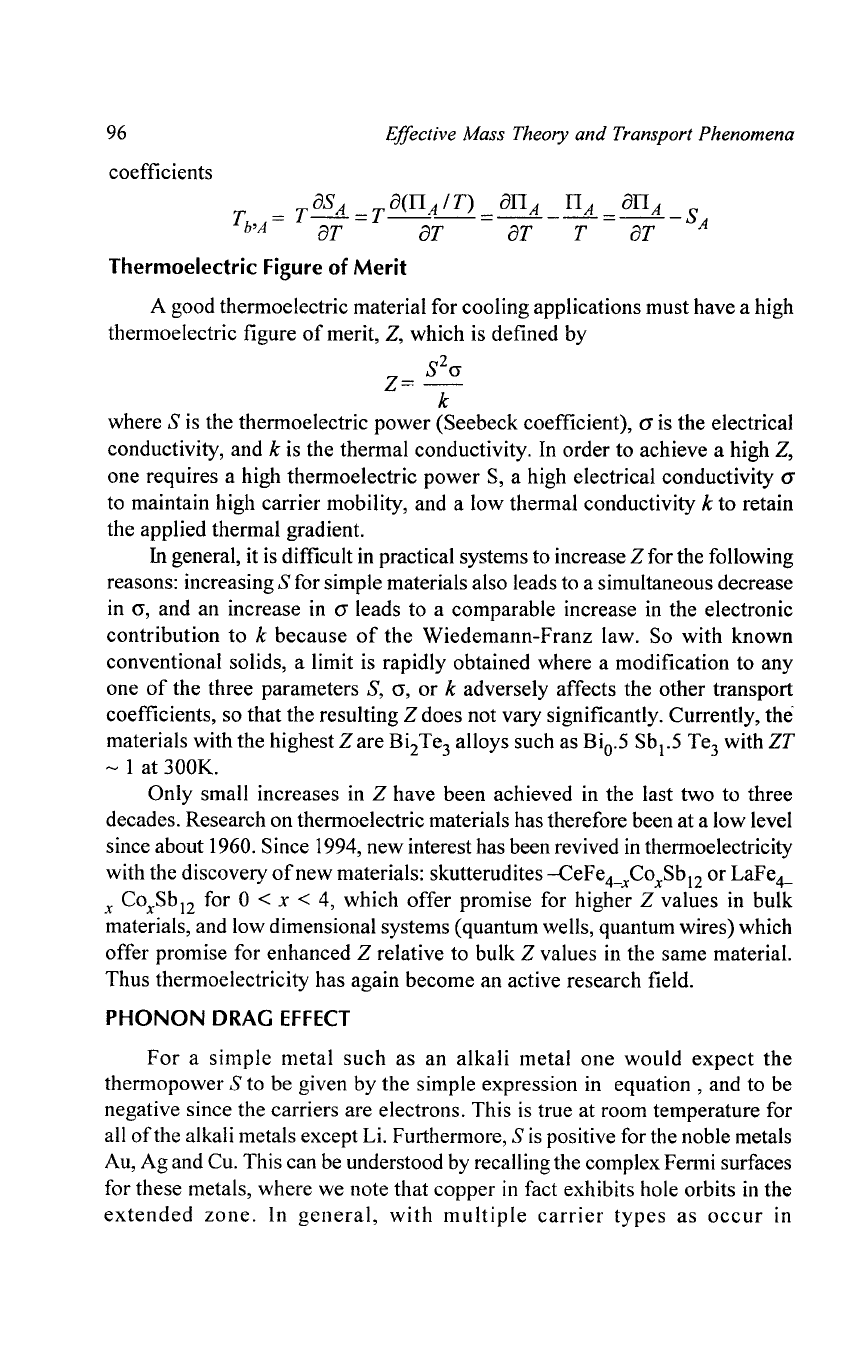
96
Effective Mass Theory
and
Transport Phenomena
coefficients
= T as A = T
a(rr
A /
T)
=
orr
A _
rr
A =
orr
A _ S
Tb'A
aT aT aT
T
aT
A
Thermoelectric Figure
of
Merit
A good thermoelectric material for cooling applications must have a high
thermoelectric figure
of
merit, Z, which is defined by
S2(J
Z=-
k
where S is the thermoelectric power (Seebeck coefficient),
(j
is the electrical
conductivity, and
k is the thermal conductivity. In order to achieve a high
Z,
one requires a high thermoelectric power S, a high electrical conductivity
(j
to maintain high carrier mobility, and a low thermal conductivity k to retain
the applied thermal gradient.
In general, it
is
difficult in practical systems to increase Z for the following
reasons: increasing S for simple materials also leads to a simultaneous decrease
in
a,
and an increase in
(j
leads to a comparable increase in the electronic
contribution
to
k because
of
the
Wiedemann-Franz law. So with known
conventional solids, a limit is rapidly obtained where a modification to any
one
of
the three parameters S,
a,
or
k adversely affects the other transport
coefficients, so that the resulting
Z does not vary significantly. Currently,
the
materials with the highest Z are Bi2 Te
3
alloys such as Bi
o
.5
Sb
1
.5
Te
3
with
ZT
~
1 at 300K.
Only
small increases in Z have been achieved in the last two to three
decades. Research on thermoelectric materials has therefore been at a low level
since about 1960.
Since 1994, new interest has been revived
in
thermoelectricity
with the discovery
of
new materials: skutterudites -CeFe4_xCoxSbI2
or
LaFe4-
x Co
x
Sb
l2
for 0 < x < 4, which offer promise for higher Z values in bulk
materials, and low dimensional systems (quantum wells, quantum wires) which
offer promise for enhanced
Z relative to bulk Z values in the same material.
Thus thermoelectricity has again become an active research field.
PHONON
DRAG
EFFECT
For
a
simple
metal
such
as an
alkali
metal
one
would
expect
the
thermopower S to be given by the simple expression in
equation,
and to be
negative since the carriers are electrons. This is true at room temperature for
all
of
the alkali metals except Li. Furthermore, S
is
positive for the noble metals
Au,
Ag
and Cu. This can be understood by recalIing the complex Fenni surfaces
for these metals, where we note that copper in fact exhibits hole orbits
in
the
extended
zone.
In
general,
with
multiple
carrier
types
as
occur
in
Effective Mass Theory
and
Transport Phenomena
97
semiconductors,
the
interpretation
of
thermopower
data
can
become
complicated.
Another complication which must also be considered, especially at low
temperatures, is the phonon drag effect. In the presence
of
a thermal gradient,
the phonons will diffuse and
"drag"
the electrons along with them because
of
the electron-phonon interaction.
For
a simple explanation
of
phonon drag,
consider a gas
of
phonons with an average energy density Eph =V. Using kinetic
theory, we find that the phonon gas exerts a pressure on the electron gas.
P=
~(E;h
)
In the presence
of
a thermal gradient, the electrons are subject to a force density
F
IV
=
_dPldx=
__
l
(dE
ph
) dT
x'
3V
dT
dx·
To
prevent the flow
of
current, this force must
be
balanced by the electric
force. Thus, for an electron density
n,
we
obtain
-neE
x
+
F)V=
0
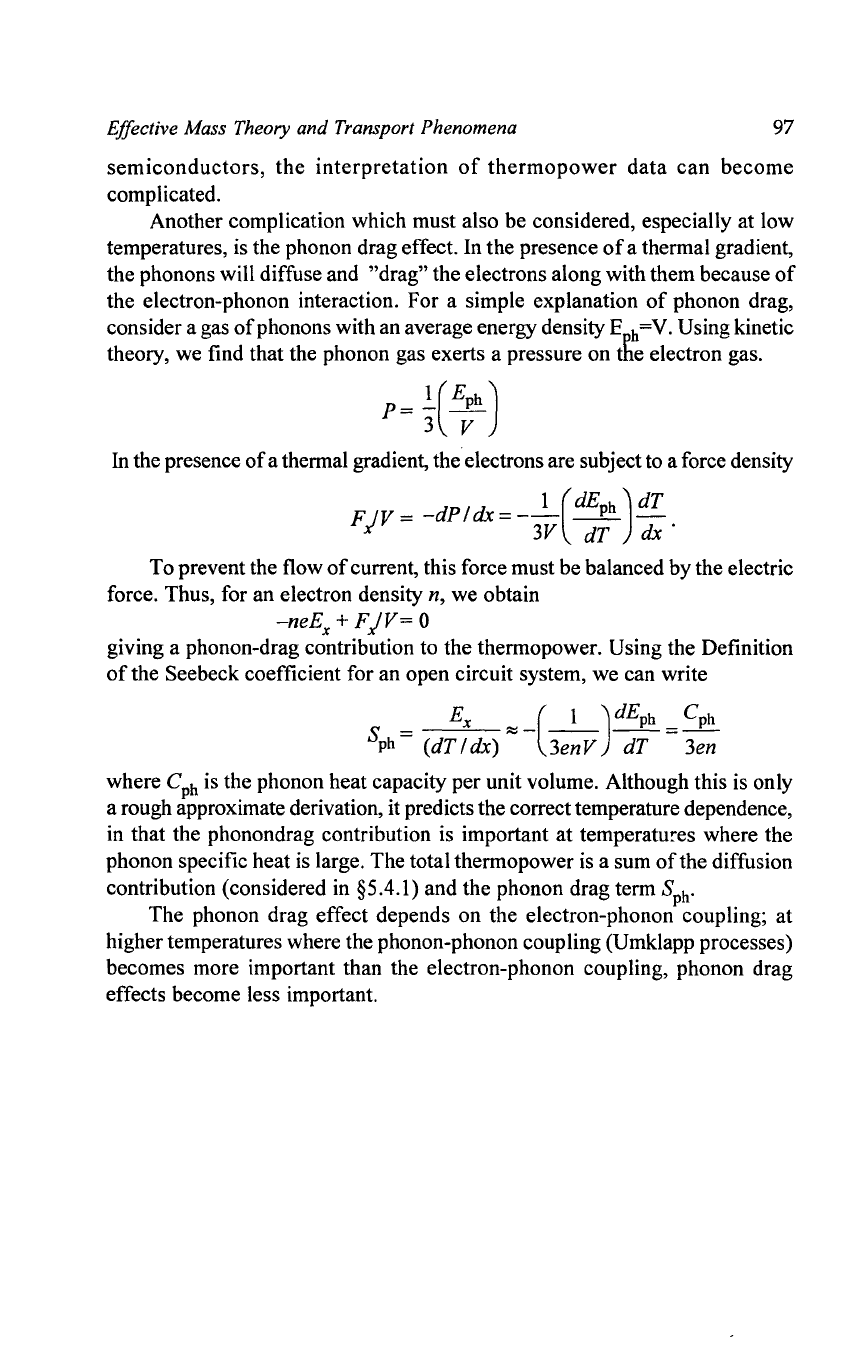
giving a phonon-drag contribution to the thermopower. Using the Definition
of
the Seebeck coefficient for an open circuit system,
we
can write
E
(1
)dE
ph
C
ph
Sph =
(dT;
dx)
:::::
- 3enV dT =
3en
where C
ph
is the phonon heat capacity per unit volume. Although this is only
a rough approximate derivation, it predicts the correct temperature dependence,
in that the phonon drag contribution is important
at
temperatu!"es where the
phonon specific heat is large.
The
total thermopower is a sum
of
the diffusion
contribution (considered in §5.4.1) and the phonon drag term
Sph.
The
phonon drag effect depends
on
the electron-phonon coupling;
at
higher temperatures where the phonon-phonon coupling (Umklapp processes)
becomes more important than the electron-phonon coupling, phonon drag
effects become less important.
Chapter 3
Electron
and
Phon<;»n
Scattering
ELECTRON
SCATTERING
The transport properties
of
solids depend on the availability
of
carriers
and on their scattering rates. Electron scattering brings an electronic system
which has been subjected to external perturbations back to equilibrium.
Collisions also alter the momentum
ofthe
carriers as the electrons are brought
back into equilibrium. Electron collisions can occur through a variety
of
mechanisms such as electron-phonon, electron-impurity, electron-defect, and
electron-electron scattering processes.
In principle, the collision rates can be calculated from scattering theory.
To do this, we introduce a transition probability
S(k,k')
for scattering from a
state
k to a state
k'.
Since electrons obey the Pauli principle, scattering will
occur from an occupied to an unoccupied state. The process
of
scattering from
k to k' decreases the distribution function
f(r,k,t)
and depends on the
probability that
k is occupied and that
k'
is unoccupied. The process
of
scattering from
k'
to
-k
increases
f(r,k,t)
and depends on the probability
that state
k'
is occupied and state k is unoccupied.
We
will use the following
notation for describing the scattering process:
· h is the probability that an electron occupies a state
-k
2
[1
j f
k
]
is
the probability that state k is unoccupied
•
S(k,k')
is the probability per unit time that an electron in state k
will be scattered to state
k'
•
S(k',k)
is
the probability per unit time that an electron
in
state k'
will be scattered back into state k.
Using these Definitions, the rate
of
change in the distribution function
due to collisions can be written as:
Electron
and
Phonon Scattering 99
al(r,k,t)1
=
Jd
3
k'Uk,(I-
Ik)S(k',k)-
fk(l-
fk,)S(k,k')]
at collisions
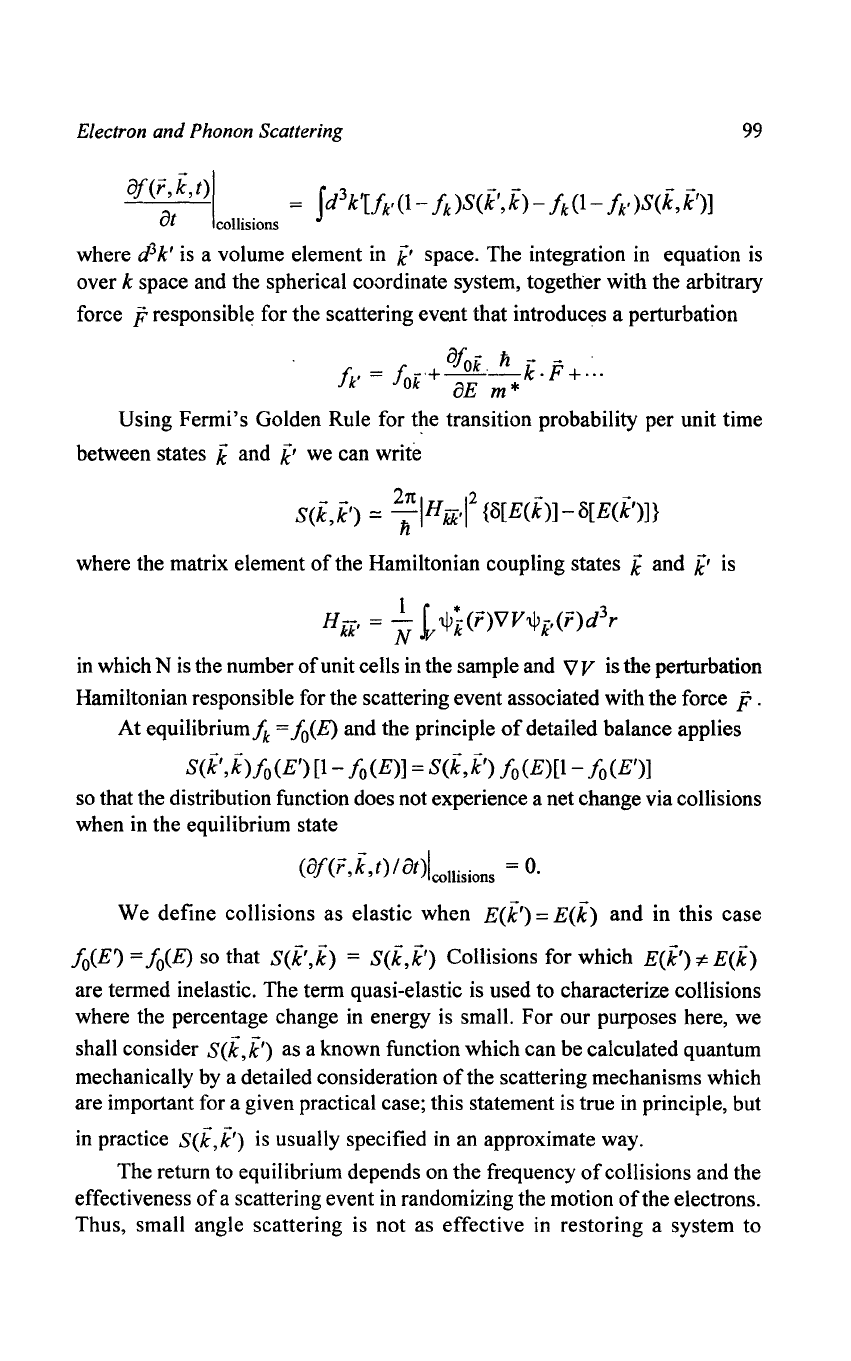
where d
3
k'
is a volume element
in
k'
space. The integration
in
equation
is
over k space and the spherical c00rdinate system, together with the arbitrary
force
F responsible for the scattering event that introduces a perturbation
al
ok
h - - .
Ik' =
10k+
aE
·m*k.F+
...
Using Fermi's Golden Rule for
t~e
transition probability per unit time
between states
k and
k'
we can write
21t
1
12
- -
S(k,k')
::
h
HjJ?
{8[E(k)]-8[E(k')]}
where the matrix element
of
the Hamiltonian coupling states k and
k'
is
H
kP
=
~
1 tPic(r)
VV
tPp(r)d
3
r
in
which N is the number
of
unit cells in the sample and
VV
is the perturbation
Hamiltonian responsible for the scattering event associated with the force
F.
At
equilibrium./k = fo(E) and the principle
of
detailed balance applies
S(k',k)/o(E')
[1-
10
(E)] =
S(k,k')
10(E)[I-
10
(E')]
so that the distribution function does not experience a net change via collisions
when in the equilibrium state
(al(r,k,t)lat)lcollisions =
O.
We define collisions as elastic when
E(k')
=
E(k)
and in this case
fo(E1 = fo(E) so that
S(k',k)
=
S(k,k')
Collisions for which
E(k')
*
E(k)
are termed inelastic. The term quasi-elastic is used to characterize collisions
where the percentage change
in
energy is small. For our purposes here, we
shall consider
S(k,k')
as a known function which can be calculated quantum
mechanically by a detailed consideration
of
the scattering mechanisms which
are important for a given practical case; this statement
is
true in principle, but
in practice
S(k,k')
is usually specified in an approximate way.
The return to equilibrium depends on the frequency
of
collisions and the
effectiveness
of
a scattering event in randomizing the motion
of
the electrons.
Thus, small angle scattering is not as effective in restoring a system to
100
Electron
and
Phonon Scattering
equilibrium as large angle scattering. For this reason we distinguish between
't
D
,
the time for the system to be restored to equilibrium, and
't
c
'
the time
between collisions. These times are related by
tc
1:
=
----"--
D
I-cose
where e is the mean change
of
angle
of
the electron on collision. The time
1:D
is the quantity which enters into Boltzmann's equation while l/'tc determines
the actual scattering rate.
The mean free time between collisions,
't
c
'
is related to several other
quantities
of
interest: the mean free path
lp
the scattering cross section
0"
d'
and the concentration
of
scattering centers
Nc
by
I
1:
=
---
c NcO"d
v
where v
is
the drift velocity given by
If
v=-
tc
NcO"d't
c
and
is
in the direction
ofthe
electron transport. The drift velocity is
of
course
very much smaller in magnitude than the instantaneous velocity
of
the electron
at the Fermi level, which is typically
of
magnitude v
F
-
10
8
cm/sec. Electron
scattering centers include phonons, impurities, dislocations, the crystal surface,
etc.
The most important electron scattering mechanism for both metals and
semiconductors is electron-phonon scattering (scattering
of
electrons by the
thermal motion
of
the lattice), though the scattering process for metals differs
in detail from that in semiconductors.
In the case
of
metals, much
of
the Brillouin zone is occupied by electrons,
while in the case
of
semiconductors, most
of
the Brillouin zone is unoccupied
and represents states into which electrons can be scattered.
In the case
of
metals,
electrons are scattered from one point on the Fermi surface to another point,
and a large change in momentum occurs, corresponding to a large change in
k. In the case
of
semiconductors, changes in wave vector from k to
-k
normally correspond to a very small change
in
wave vector, and thus changes
from
k
to
-k
can
be
accomplished
much more
easily
in
the
case
of
semiconductors. By the same token, small angle scattering (which is not so
efficient for returning the system to equilibrium)
is
especially important for
semiconductors where the change
in
wavevector
is
small. Since the scattering
processes
in
semiconductors and metals are quite different, they will be
Electron and Phonon Scattering
101
discussed separately below. Scattering probabilities for more than one
scattering process are additive and therefore so are the reciprocal scattering
time or scattering rates:
1 "
-I
(-r
)total =
~
.,
j
since
Ih
is proportional to the scattering probability. Metals have large Fermi
wavevectors
kF'
and therefore large momentum transfers
Il.k
can occur as a
result
of
electronic collisions.
In
contrast, for semiconductors,
kF
is small and
so also is
M on collision.
SCATTERING
PROCESSES
IN
SEMICONDUCTORS
Electron-Phonon Scattering
Electron-phonon scattering
is
the dominant scattering mechanism in
crystalline semiconductors except at very low temperatures. Conservation
of
energy in the scattering process, which creates
or
absorbs a phonon
of
energy
hro(ij)
, is written as:
2
E;
-E
j
=±hro(ij) =
-h-ckl-kJ)'
2m*
where E
j
is the initial energy, E
j
is the final energy, k
j
the initial
wavevector, and
klhe
final wavevector. Here, the "+" sign corresponds to the
creation
of
phonons (the phonon emission process), while the
"-"
sign
corresponds to the absorption
of
phonons. Conservation
of
momentum in the
scattering by a phonon
of
wavevector
ij
yields
kj-k
j
=±ij.
For semiconductors, the electrons involved in the scattering event
generally remain
in
the vicinity
of
a single band extremum and involve only a
small change
in
k and hence only low phonon
ij
vectors participate. The
probability that an electron makes a transition from an initial state i to a final
state f
is
proportional to:
(a) The availability
of
final states for electrons,
(b) The probability
of
absorbing or emitting a phonon,
(c) The strength
of
the electron-phonon coupling or interaction.
The first factor, the availability
of
final states,
is
proportional to the density
of
final electron
statesp(E
j
)
times the probability that the final state is
unoccupied. (This occupatiorrprobability for a semiconductor
is
assumed to
be
unity since the conduction band
is
essentially empty.) For a parabolic band
p(Ej)
is
: