
Brewster H.D. Solid State Physics
Подождите немного. Документ загружается.

2
Energy Dispersion Relations in Solids
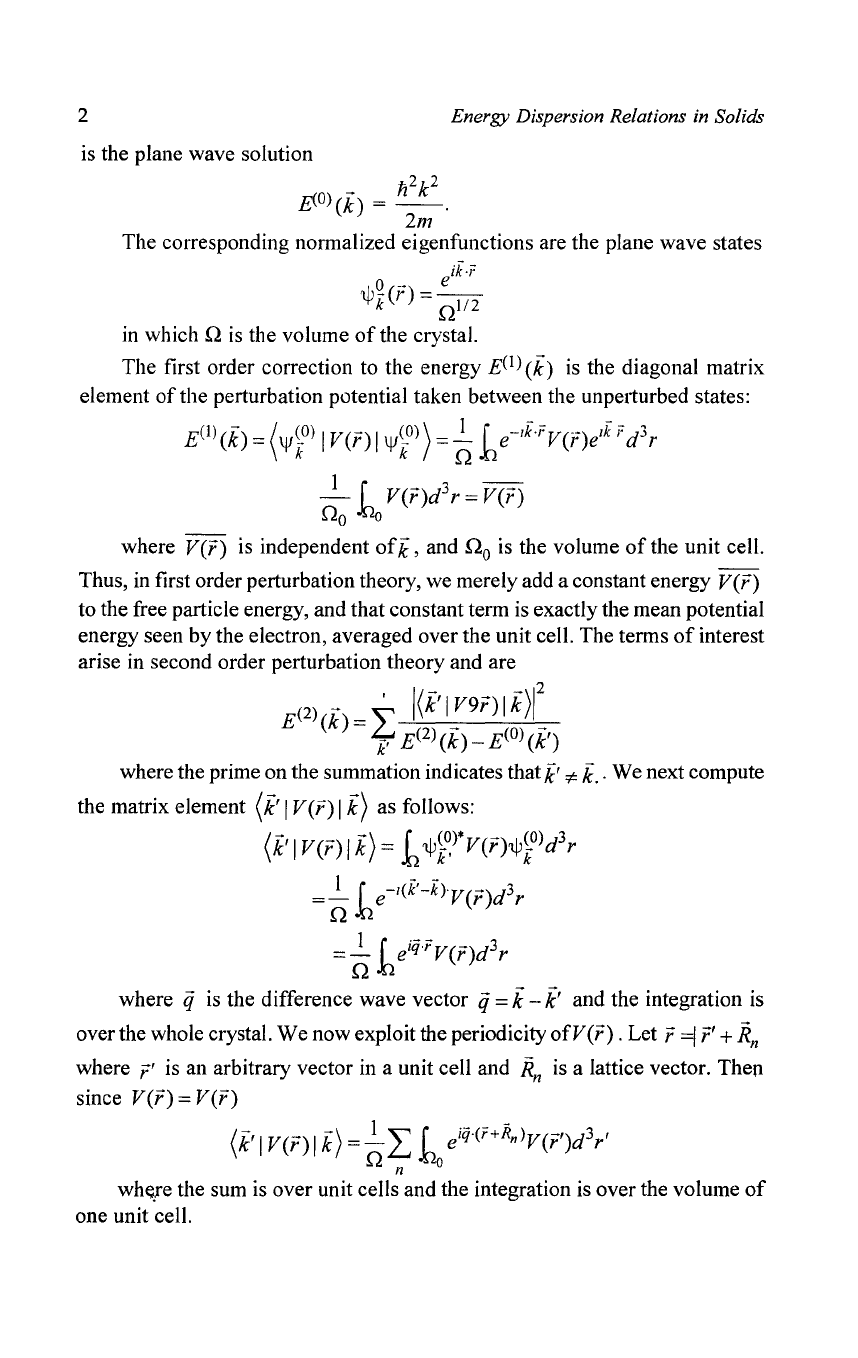
is the plane wave solution
1i
2
k
2
E,Q)(k)
=-.
2m
The corresponding normalized eigenfunctions are the plane wave states
{k-F
'ljJ0C) e
k r = 0
112
in
which n
is
the volume
of
the crystal.
The first order
cOITection
to the energy
E(l)
(k)
is
the diagonal matrix
element
of
the perturbation potential taken between the unperturbed states:
E(1)
(k)
=
(\fJtO)
!V(r)
1
\fJtO))
=
~
1
e-1k-F
V(ne
1k
F d
3
r
_1_
r
V(r)d
3
r =
VCr)
no
.b
o
where
VCr)
is independent
off,
and
00
is
the volume
of
the unit cell.
Thus,
in
first order perturbation theory, we merely add a constant energy
VCr)
to the free particle energy, and that constant term is exactly the mean potential
energy seen by the electron, averaged over the unit cell. The terms
of
interest
arise in second order perturbation theory and are
(2) - _
I'
1(f'1
V9r)
1
kt
E
(k)
- (2) -
(0)-
k'
E
(k)-E
(k')
where the prime on the summation indicates that f'
7=
f .. We next compute
the matrix element
(f'1
VCr) 1
k)
as follows:
(f'!V(r)lk)= 1
'ljJ%~)*V(rN%0)d3r
=
~
1 e-
1
(k'-k).V(r)d
3
r
=
~
1 e
iiF
V(r)d
3
r
where q
is
the difference wave vector q = k -
k'
and the integration is
over the whole crystal. We now exploit the periodicity
ofV(r)
. Let r
=1
r'
+
Rn
where r' is an arbitrary vector in a unit cell and
Rn
is
a lattice vector. Then
since
VCr) = VCr)
(f'1
V(r)
1
f)
=
~
I r eiijo(r+Rn)V(r')d3r'
n n .b
o
where the sum
is
over unit cells and the integration
is
over the volume
of
one unit cell.
Energy Dispersion Relations in Solids
Then
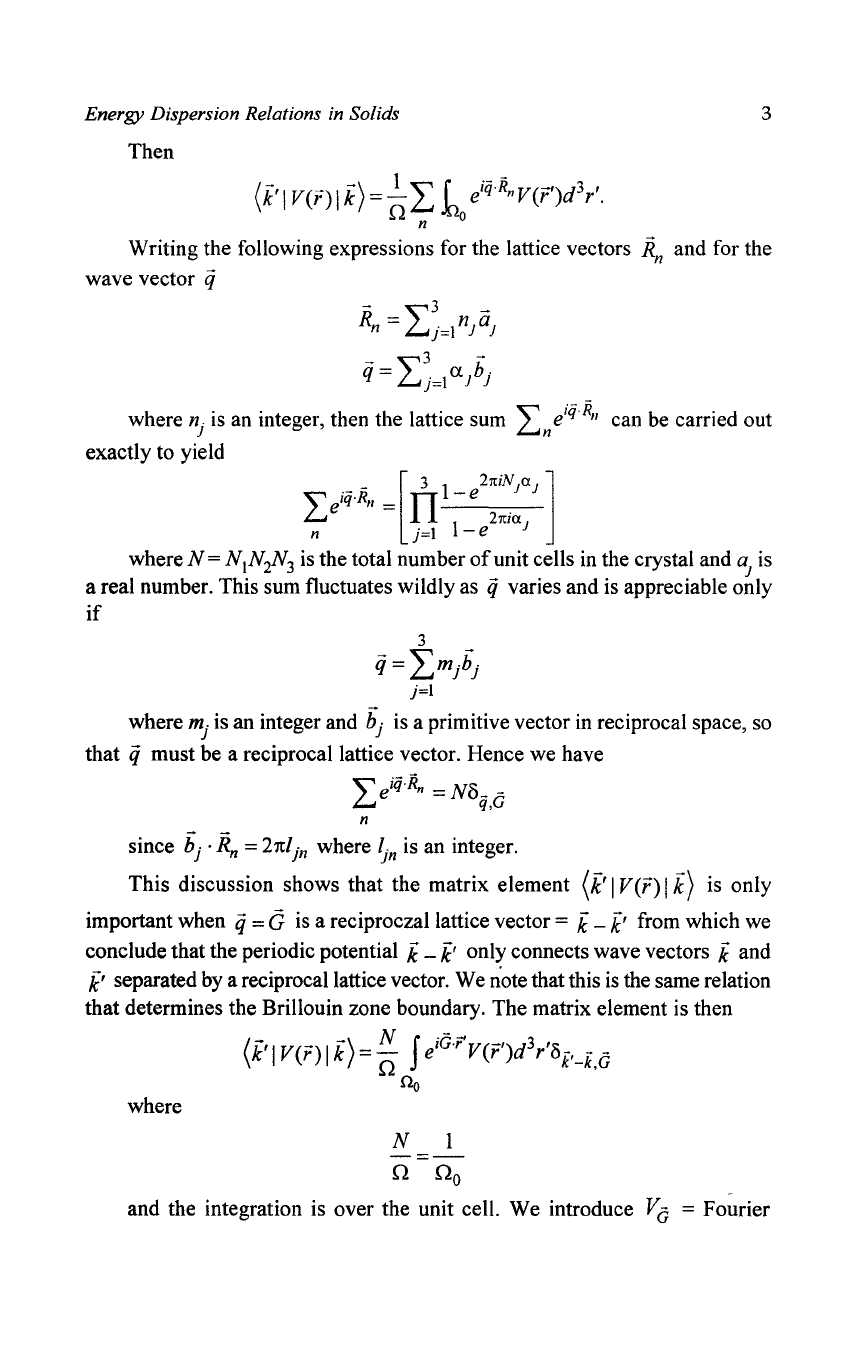
(k'W(r)lk)=~
I r eiij.Rnv(r')d3r'.
o n
.ln
o
3
Writing the following expressions for the lattice vectors
Rn
and for the
wave vector
q
-
"",3
_
Rn
=
"-.Jj=l
n
j
aj
_
"",3
-
q =
"-.Jj=l
ujbj
where
nj
is
an integer, then the lattice sum
In
ifRI/
can be carried out
exactly to yield
[
3
21tiN
a ]
I
·-·R
rr
l
-
e
} }
e
,q
II
=
1
21tia
J
n j=1 - e
where N =
NIN2N3
is
the total number
of
unit cells in the crystal and a
j
is
a real number. This sum fluctuates wildly as
q varies and is appreciable only
if
3
q=Imij
j=l
where
mj
is an integer and b
j
is a primitive vector in reciprocal space, so
that
q must be a reciprocal lattiee vector. Hence we have
I e
iij
.
Rn
=
NOij,(;
n
since b
j
.
R"
= 21tljl1 where
~n
is an integer.
This discussion shows that the matrix element
(k'i
VCr)
I
k)
is only
important when
q = G is a reciproczallattice vector = k _
k'
from which we
conclude that the periodic potential
k - k' only connects wave vectors k and
k'
separated by a reciprocal lattice vector. We note that this
is
the same relation
that determines the Brillouin zone boundary. The matrix element is then
(k'
W(r)
I
k)
=~
f e
i
(;"V(r')d
3
r'Of'_f,(;
no
where
N
-=-
o
00
and the integration is over the unit cell. We introduce
V(;
= Fourier
4
Energy Dispersion Relations
in
Solids
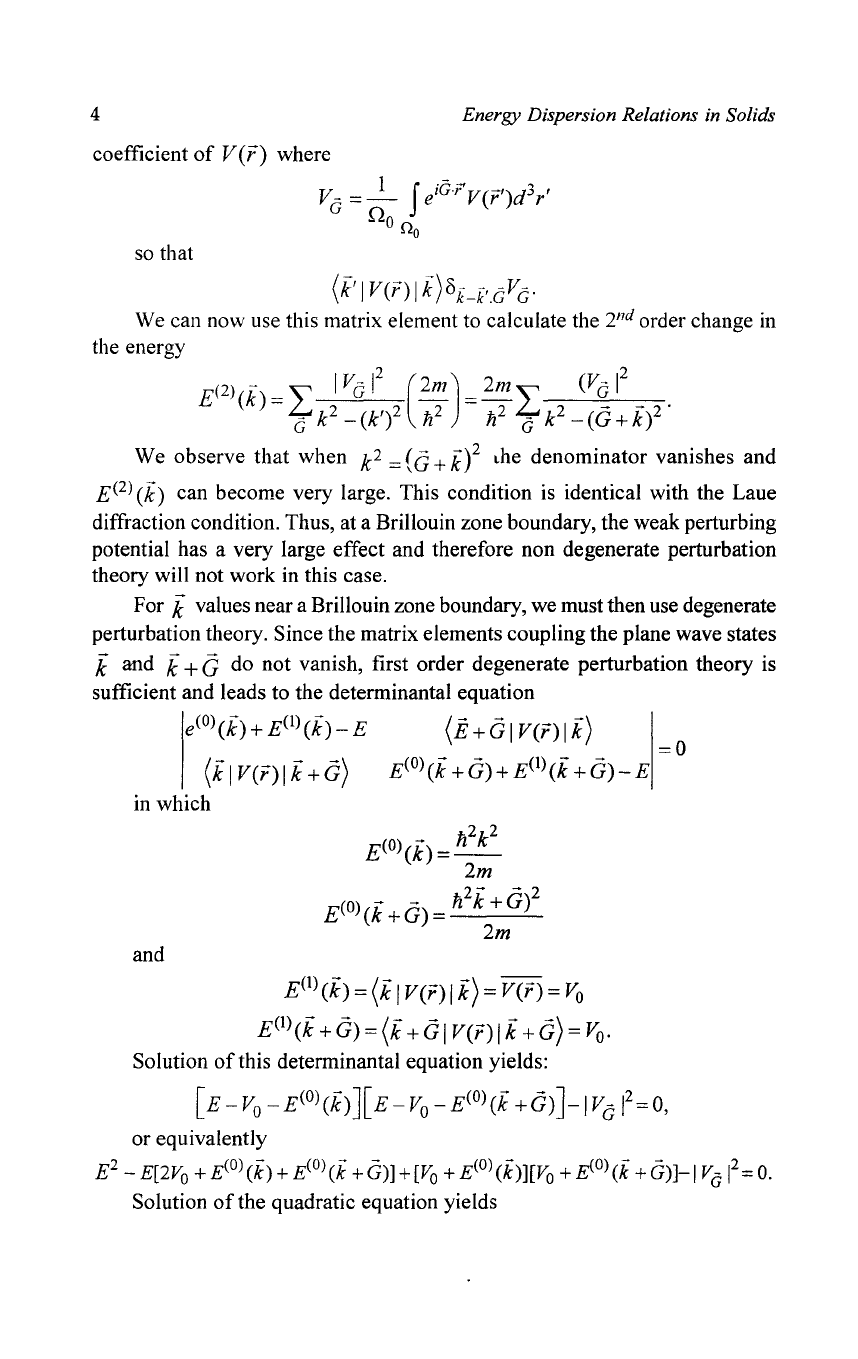
coefficient
of
VCr)
where
so that
V- =_1_ feif;oPVCr')d3r'
G n
o
no
(I'
1
VCr)
1
I)8
f
_k'.f;Vf;o
We can now use this matrix element to calculate the 2
nd
order change
in
the energy
E(2)(k)
=
~
!Vf;
12
(2m)
=
2m
~
(Vf;
12
~
k
2
_(k,)2
112
112
~
k
2
_(G+k)2
°
We observe that when k
2
=
(G
+
£)2
the denominator vanishes and
E(2)
(k)
can become very large. This condition
is
identical with the Laue
diffraction condition. Thus, at a Brillouin zone boundary, the weak perturbing
potential has a very large effect and therefore non degenerate perturbation
theory will not work in this case.
For
k values near a Brillouin zone boundary, we must then use degenerate
perturbation theory. Since the matrix elements coupling the plane wave states
k and k + G do not vanish, first order degenerate perturbation theory
is
sufficient and leads to the determinantal equation
e(O)(k)+E(1)Ck)-E (£+GI VCr)lk)
(k
!VCr)
1 k
+G)
E(O)Ck
+
G)+
E(1)Ck
+
G)-E
in which
and
E(1)Ck)
=
(k
WCr) 1
k)
=
VCr)
=
Vo
E(I)Ck +
G)
=
(k
+ G 1
VCr)
1 k +
G)
=
Vo·
Solution
of
this determinantal equation yields:
=0
[E
-
Vo
-
E(O)Ck)J[
E -
Vo
-E(O)Ck +G)J-
IVa
12=
0,
or equivalently
E2
- E[
2V
o +
E(O)
(k)
+ E(°Jck +
G)]
+
[Vo
+ E(°Jck)][Vo +
E(O)
(k
+
G)]-I
Va
12=
o.
Solution
of
the quadratic equation yields
Energy Dispersion Relations in Solids
5
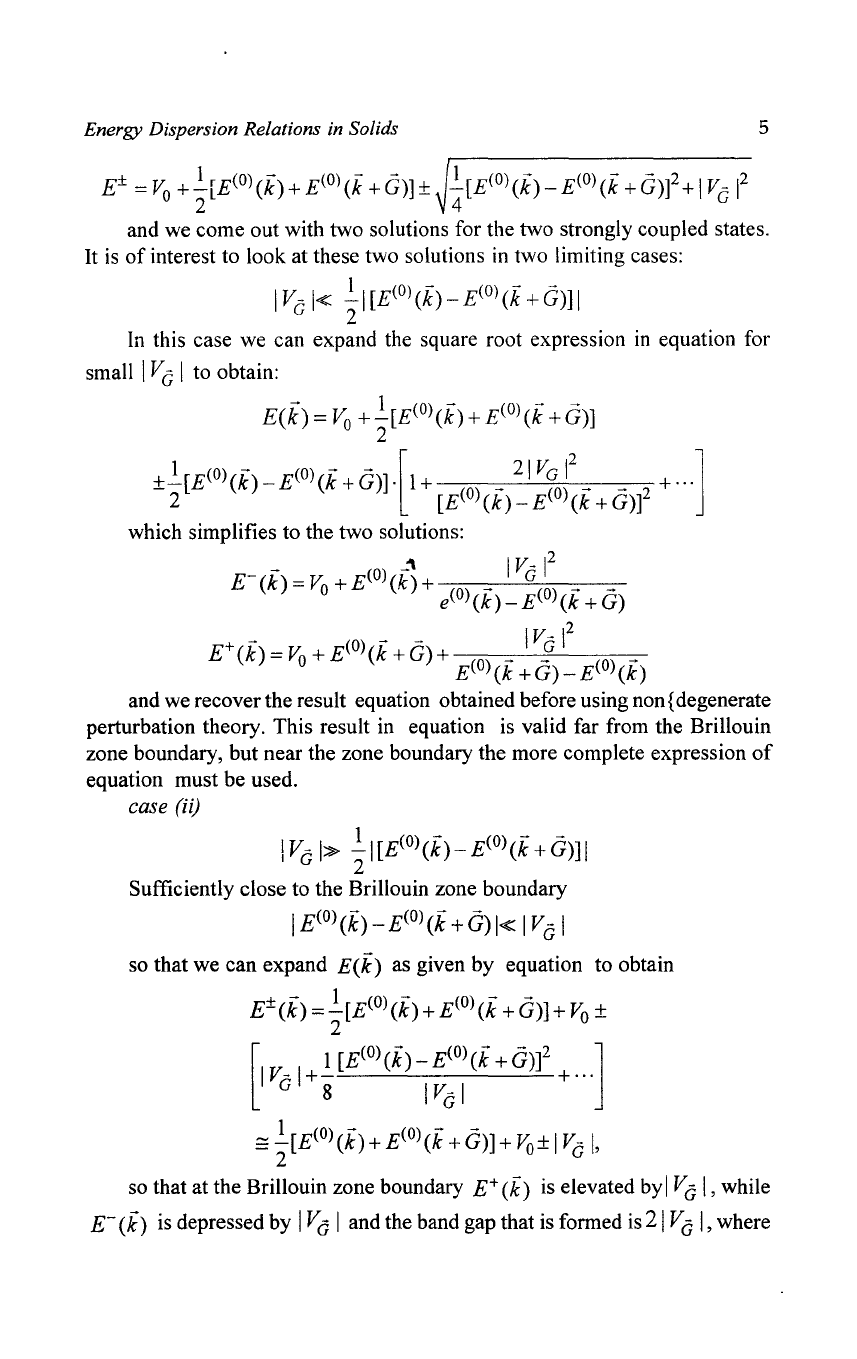
E±
=
Vo
+ .!..[E(O)(k) +
E(O)
(k
+
G)]
± .!..[E(O)(k) - E(O)(k +
G)f+
\V-
12
2 4 G
and we come out with two solutions for the two strongly coupled states.
It
is
of
interest to look at these two solutions
in
two limiting cases:
I
v-
1<
.!..I
[E(O)(k) -
E(O)
(k
+
G)]I
G 2
In
this case we can expand the square root expression
in
equation for
small
I
Ve
1 to obtain:
E(k)
=
Vo
+ .!..[E(O)(k) + E(O)(k +
G)]
2
1
(0) - (0) - - [ 2WG
12
1
±-[E
(k)-E
(k+G)]·
1+
(0) - (0) - - 2 +
...
2
[E
(k)-E
(k+G)]
which simplifies to the two solutions:
_ - _ (0) -"" 1
Ve
12
E
(k)-Vo+E
(k)+
(0) - (0) - -
e
(k)-E
(k+G)
2
+ - _ (0) - - 1
Ve
1
E
(k)-Vo+E
(k+G)+
(0) - -
(0)-
E
(k
+G)-E
(k)
and we recover the result equation obtained before using non { degenerate
perturbation theory. This result in equation is valid far from the Brillouin
zone boundary, but near the zone boundary the more complete expression
of
equation must be used.
case (ii)
!Ve
I~
~I[E(O)(k)-E(O)(k+G)]1
Sufficiently close to the Brillouin zone boundary
I
E(O)(k)-E(O)(k+G)
1<
We
1
so that
we
can expand
E(k)
as given
by
equation to obtain
E±(k)
=.!..[E(O)(k) + E(O)(k +
G)]+
Vo
±
2
[
1
[E(O)(k)-E(O)(k
+
G)f
1
\V-I+-
+ ...
G 8 We 1
==
.!..[E(O)(k) +
E(O)(f
+
G)]
+ V
o
± 1
Ve
I,
2
so that at the Brillouin zone boundary
E+
(k)
is elevated by I
Ve
1 , while
E-
(k)
is depressed
by
I
Va
1 and the band gap that is formed is
21
Ve
I,
where
6 Energy Dispersion Relations in Solids
G is the reciprocal lattice vector for which
E(kB,z)
= E(kB,z. +
G)
and
V
I
f
itj.rV(-)d
3
e
=0-
err.
o Q
o
From this discussion it is clear that every Fourier component
of
the
periodic potential gives rise to a specific band gap.
We
see further that the
band gap represents a range
of
energy values for which there
is
no solution to
the eigenvalue problem
of
equation for real
k.
In
the band gap we assign an
imaginary value to the wave vector which can
be
interpreted as a highly damped
and non {propagating wave.
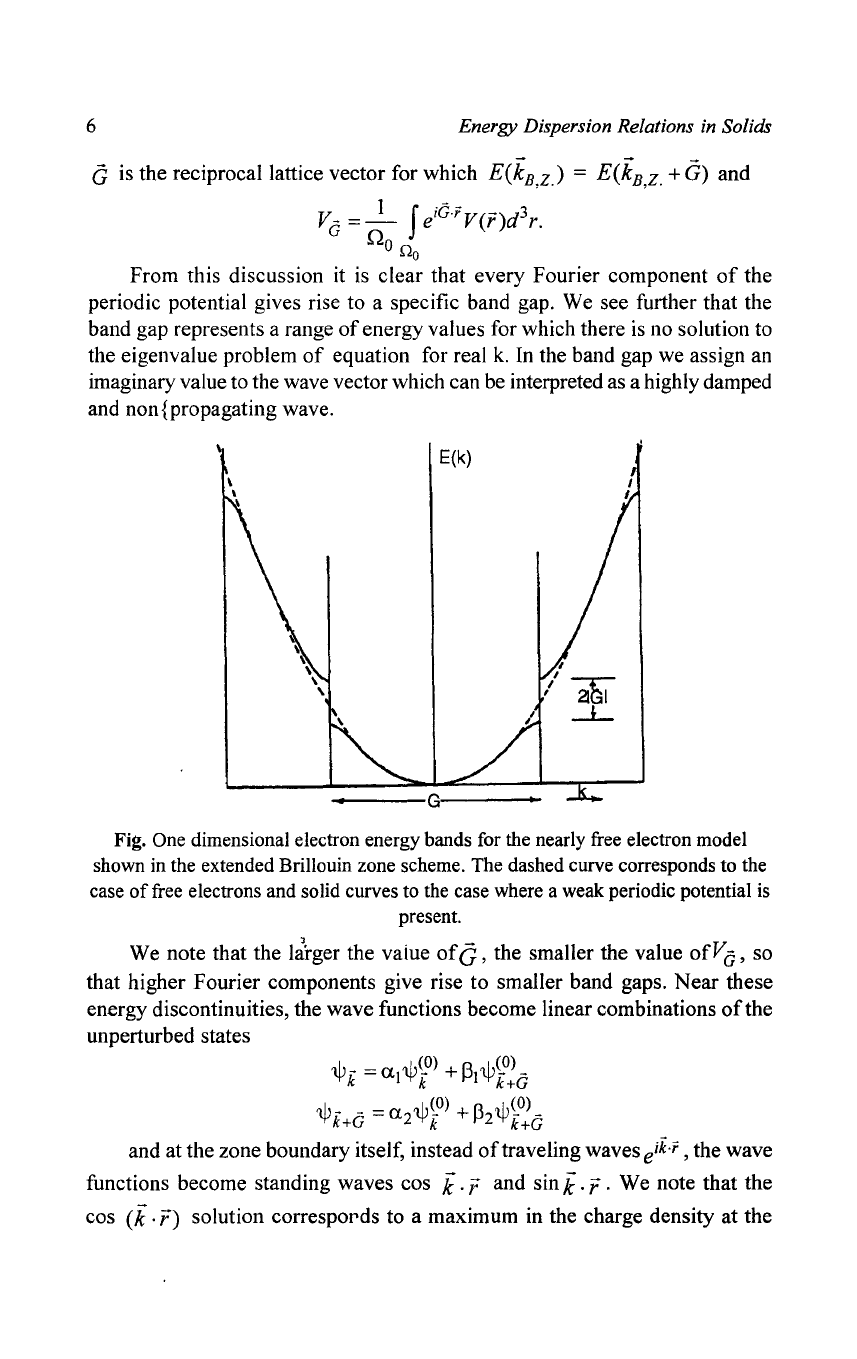
Fig. One dimensional electron energy bands for the nearly free electron model
shown in the extended Brillouin zone scheme. The dashed curve corresponds to the
case
of
free electrons and solid curves to the case where a weak periodic potential is
present.
We note that the
l~rger
the vaiue
ofe,
the smaller the value
ofV
e
,
so
that higher Fourier components give rise to smaller band gaps. Near these
energy discontinuities, the wave functions become linear combinations
of
the
unperturbed states
01,
_ =
(X.
01,(0)
+ A
01,(0)
_
'I'
k 1'1' k 1-'1'1'
k+G
t(Jk-
G-
=
(X.2t(J(O)
+ P2t(J(O) -
+ k k+G
and at the zone boundary itself, instead
of
traveling waves
e(k.r
, the wave
functions become stand ing waves cos
k.
r and sin k .
r.
We note that the
cos
(f.
r)
solution correspopds to a maximum in the charge density at the
Energy Dispersion Relations
in
Solids 7
lattice sites and therefore corresponds to an energy minimum (the lower level).
Likewise, the sin
(k·
r)
solution corresponds to a minimum in the charge
density and therefore corresponds to a maximum
in
the energy, thus forming
the upper level.
In
constructing
E(k)
for the reduced zone scheme
we
make use
of
the
periodicity
of
E(k)
in
reciprocal space
- - -
E(k+G)=E(k).
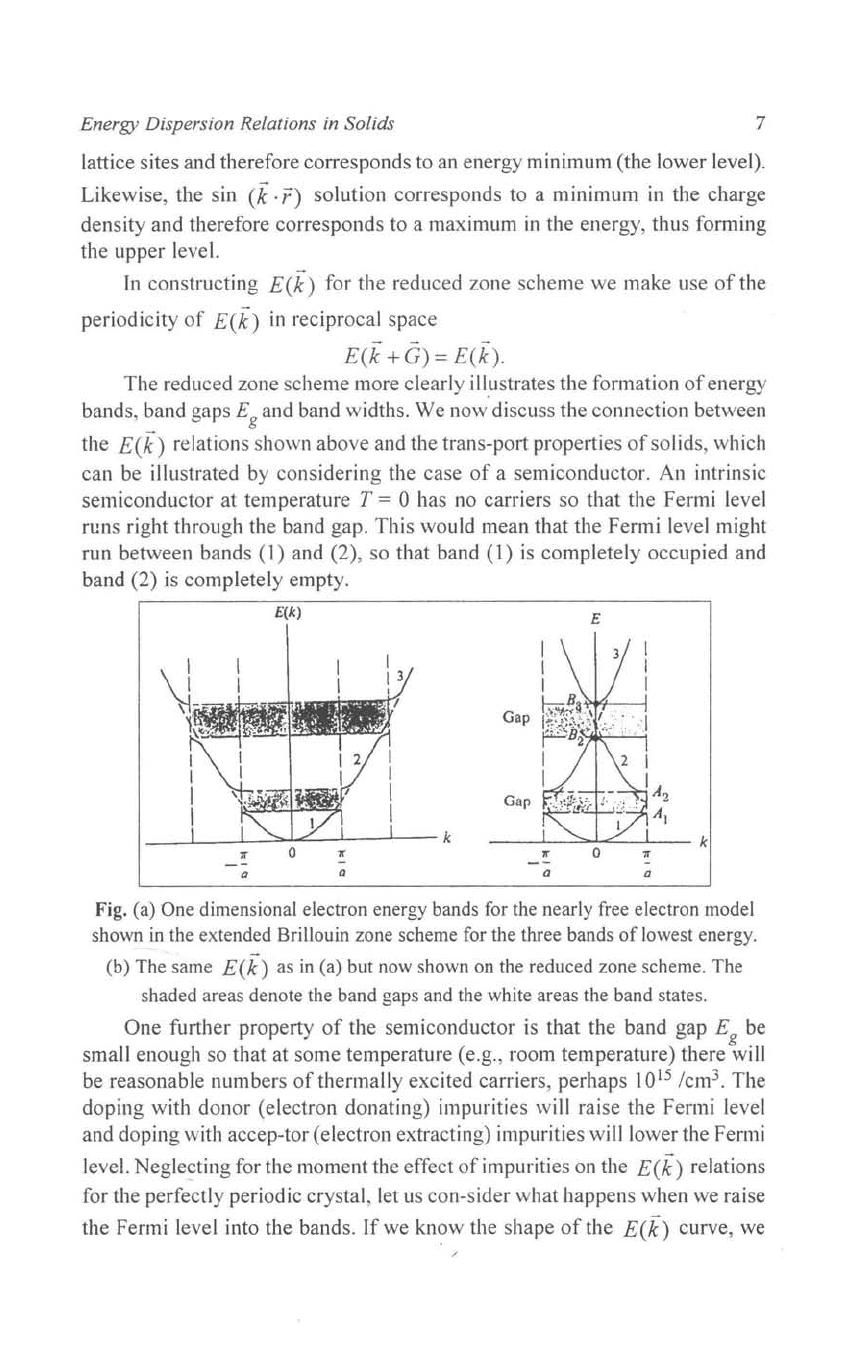
The reduced zone scheme more clearly illustrates the formation
of
energy
bands, band gaps
Eg
and band widths. We now discuss the connection between
the
E(k)
relations shown above and the trans-port properties
of
solids, which
can be illustrated by considering the case
of
a semiconductor. An intrinsic
semiconductor at temperature
T = 0 has no carriers so that the Fermi level
runs right through the band gap. This would mean
that
the Fermi level might
run between bands (1) and (2), so that band (1)
is
completely occupied and
band (2) is completely empty.
£(k)
E
Gap
Gap
k
k
...
...
".
".
--
-
--
-
a
a
a
a
Fig. (a) One dimensional electron energy bands for the nearly free electron model
shown
in
the extended Brillouin zone scheme for the three bands
of
lowest energy.
(b) The same
E(k)
as
in
(a) but now shown on the reduced zone scheme. The
shaded areas denote the band gaps and the white areas the band states.
One
further property
of
the semiconductor is that the band gap
Eg
be
small enough so that at some temperature (e.g., room temperature) there will
be reasonable numbers
of
thermally excited carriers, perhaps 10
15
Icm
3
.
The
doping with donor (electron donating) impurities will raise the Fermi level
and doping with accep-tor (electron extracting) impurities will lower the Fermi
level.
Negle~ting
for the moment the effect
of
impurities on the
E(k)
relations
for the perfectly periodic crystal, let us con-sider what happens when we raise
the Fermi level into the bands.
Ifwe
know the shape
of
the
E(k)
curve, we
8 Energy Dispersion Relations
in
Solids
are
in
a position to estimate the velocity
of
the electrons and also the so called
effective mass
of
the electrons. We see that the conduction bands tend to fill
up
electron states starting at their energy extrema.
Since the energy bands have zero slope about their extrema, we can write
E(k)
as a quadratic form
in
k .
It
is
convenient to write the proportional ity
in
terms
of
the quantity called the effective mass m*
2 2
E(k)=E(O)+~
2111*
so that m*
is
defined by
m*
/1
2
ae
and we can say
in
some approximate way that an electron
in
a solid moves
as
if
it were a free electron but with an effective mass
m£
rather than a free
electron mass. The larger the band curvature, the smaller the effective mass.
The mean velocity
of
the electron is also
found from
E(k),
according to the relation
_ 1
aE(k)
uk
=-----.
n ak
For
this reason the energy dispersion relations E
(-k)
are very important
in
the determination
of
the transport properties for carriers
in
solids.
TIGHT
BINDING
APPROXIMATION
In the tight binding approximation a number
of
assumptions are made
and these are different from the assumptions that are made for the weak binding
approximation.
The
assumptions for the tight binding approximation are:
The energy eigenvalues and eigenfunctions are known for an electron
in
an isolated atom.
When the atoms are brought together to form a solid they remain
sufficiently far apart so that each electron can be assigned to a
particular atomic site. This assumption is not valid for valence
electrons in metals and for this reason, these valence electrons are
best treated by the weak binding approximation.
The periodic potential is approximated by a superposition
of
atomic
potentials.
Perturbation theory can be used to treat the difference between the
actual potential and the atomic potential.
Thus
both the weak and tight binding approximations are based on
perturbation theory. For the weak binding approximation the unperturbed state
is the free electron plane{ wave state while for the tight binding approximation
Energy Dispersion Relations
in
Solids
9
the unperturbed state is the atomic state. In the case
of
the weak binding
approximation, the perturbation Hamiltonian is the weak periodic potential
itself, while for the tight binding case, the perturbation is the differ-ence
between the periodic potential and the atomic potential around which the
electron
is
localized.
We review here the major features
of
the tight binding approximation.
Let
4>(P
- Rn) represent the atomic wave function for
an
atom at a lattice
position denoted by
~Rn'
which IS measured with respect to the origin. The
SchrAodinger equation for an electron
in
an isolated atom
is
then:
[-
;':1
\7
2
+U(r
-Rn)-E(O)
]~(r
-Rn)==O
where U
(r
- Rn) is the atomic potential and
E(O)
is the atomic eigenvalue.
We now assume that the atoms are brought together to form the crystal for
which
VCr)
is
the periodic potential, and
t\J(r)
and E(f) are, respectively,
the wave function and energy eigenvalue for the electron in the crystal:
[ -
;:
112
+
VCr)
- E ]t\J(r)
==
o.
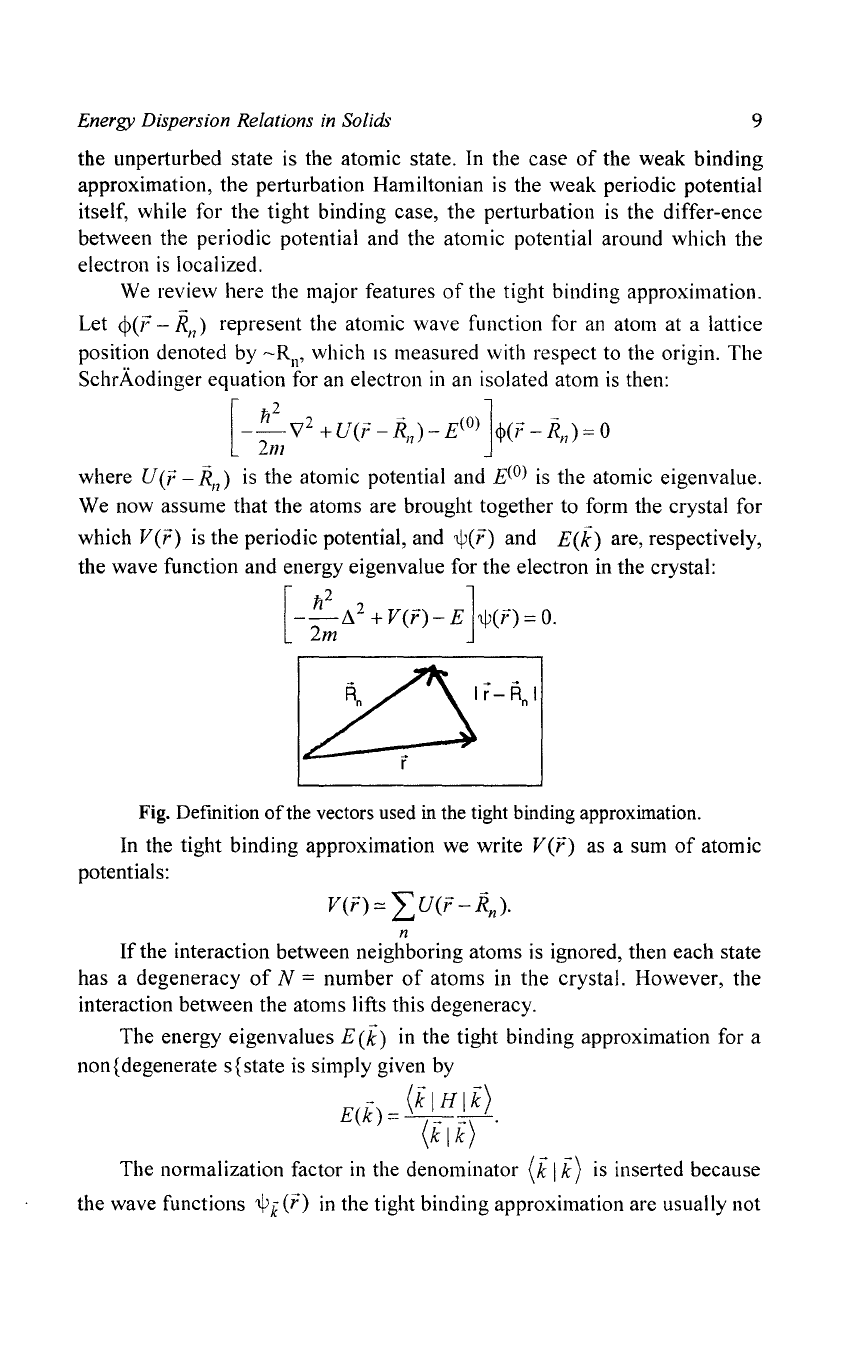
Fig.
Definition
of
the
vectors used
in
the tight binding approximation.
In the tight binding approximation we write
VCr)
as a sum
of
atomic
potentials:
n
If
the interaction between neighboring atoms is ignored, then each state
has a degeneracy
of
N = number
of
atoms in the crystal. However, the
interaction between the atoms lifts this degeneracy.
The energy eigenvalues
E
(k)
in the tight binding approximation for a
non {degenerate s{state is simply given by
ECk)
==
(f
I H I
f)
(k
I
f)
.
The normalization factor
in
the denominator
(k
I
k)
is
inserted because
the wave functions
t\J
k
(r)
in
the tight binding approximation are usually not
10
Energy Dispersion Relations in Solids
normalized. The Hamiltonian in the tight binding approximation is written as
H=-!{V
2
+
V(r)
={_!{V
2
+[V(r)-U(r-R
)]+U(r-R)}
2m 2m n n
H=Ho
+H'
in
which
Ho
is
the atomic Hamiltonian at site
11
tz2
2
_-
Ho=--V
+U(r-R
I1
)
2m
and
H'
is
the difference between the actual periodic potential and the
atomic potential at lattice site
n
H'
=
V(r)-U(r
-Rn).
We construct the wave functions for the unperturbed problem as a linear
combination
of
atomic functions
~
j
(r
-
Rn)
labeled by quantum number j
N
1I-
1
/
r
)
=
ICj,l1~j(r
-Rn)
11=1
and so that
tV
j
(r)
is an eigenstate
of
a Hamiltonian satisfying the periodic
potential
of
the lattice. In this treatment we assume that the tight binding wave-
functions
tV
j can be
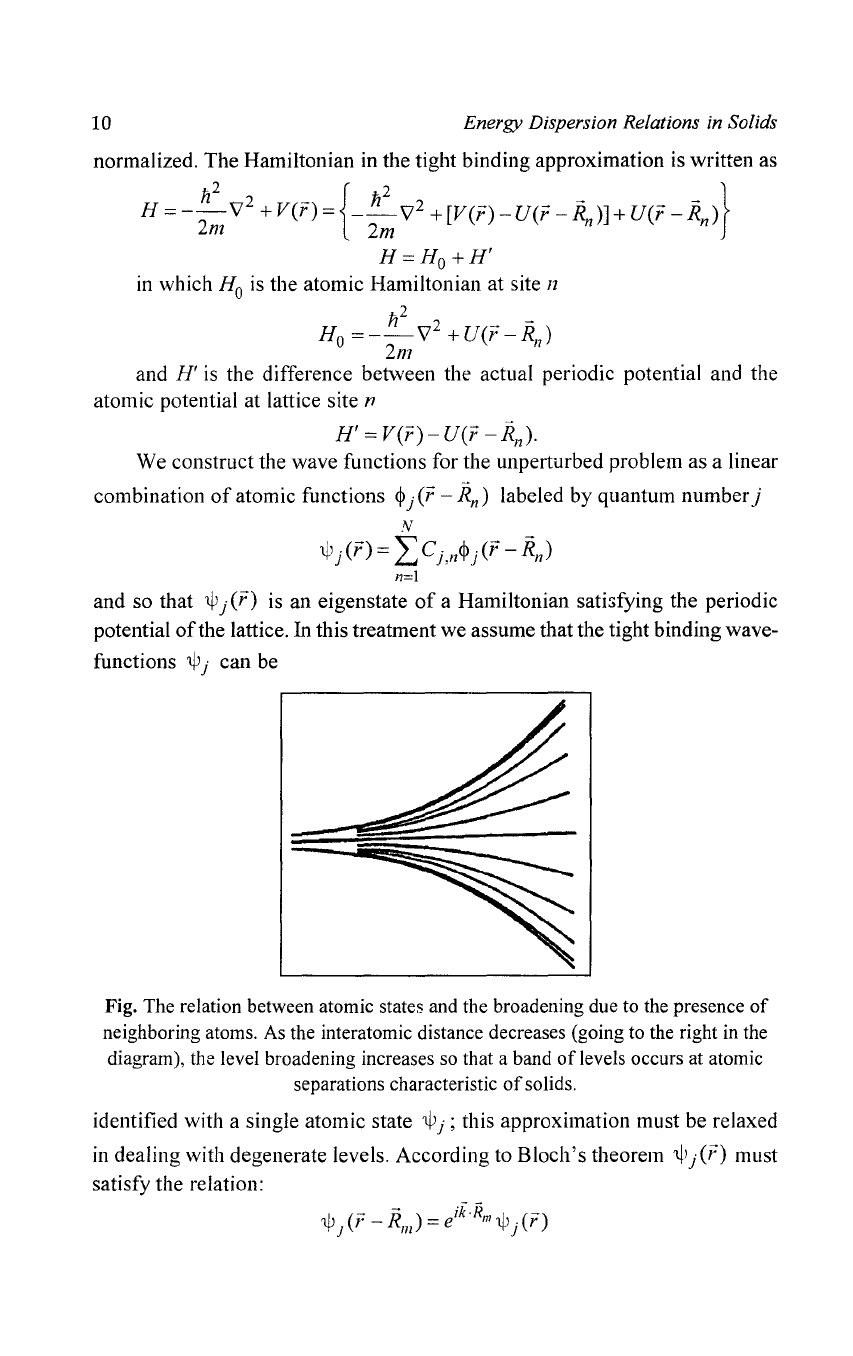
Fig. The relation between atomic states and the broadening due to the presence
of
neighboring atoms. As the interatomic distance decreases (going to the right in the
diagram), the level broadening increases so that a band ofieveis occurs at atomic
separations characteristic
of
solids.
identified with a single atomic state
'tjJ
j ; this approximation must be relaxed
in
dealing with degenerate levels. According to Bloch's theorem
'4'j(r)
must
satisfy the relation:
,I,
(-:
R-
) -
if.R
m
,I.
(-)
'V)
,-
III
-e
'Vj
r
Energy Dispersion Relations in Solids
11
where
RI11
is
an arbitrary lattice vector. This restriction imposes a special form
on the coefficients
C).n.
Substitution
of
the expansion in atomic functions
'4J
j
(r)
from equation
into the left side
of
equation yields:
'If')
(/:
+ Rn) =
In
C).n~)
(r
-
Rn
+ Rill)
=
IQC).Q+'11~;Ci;
-10)
=
InCj.n+IIl~(r
-Rn)
where we have utilized the substitution
10
=
Rn
-
Rm
and the fact that Q
is
a dummy index. Now for the right side
of
the Bloch theorem we have
-
ii.
Rm'4Jj(r)
=
ICj_ni~'Rm~/r
-Rn).
n
The coefficients
C},n
which relate the actual wave function
'4J
j(r)
to the
atomic functions
~
j
(r
- Rn) are therefore not arbitrary but must thus satisfy:
C
-
ik
Rmc
j,n+111
- e
j.n
which can be accomplished by setting:
C
-):
ik-Rn
j,n -
'-.Jje
~
Pnm
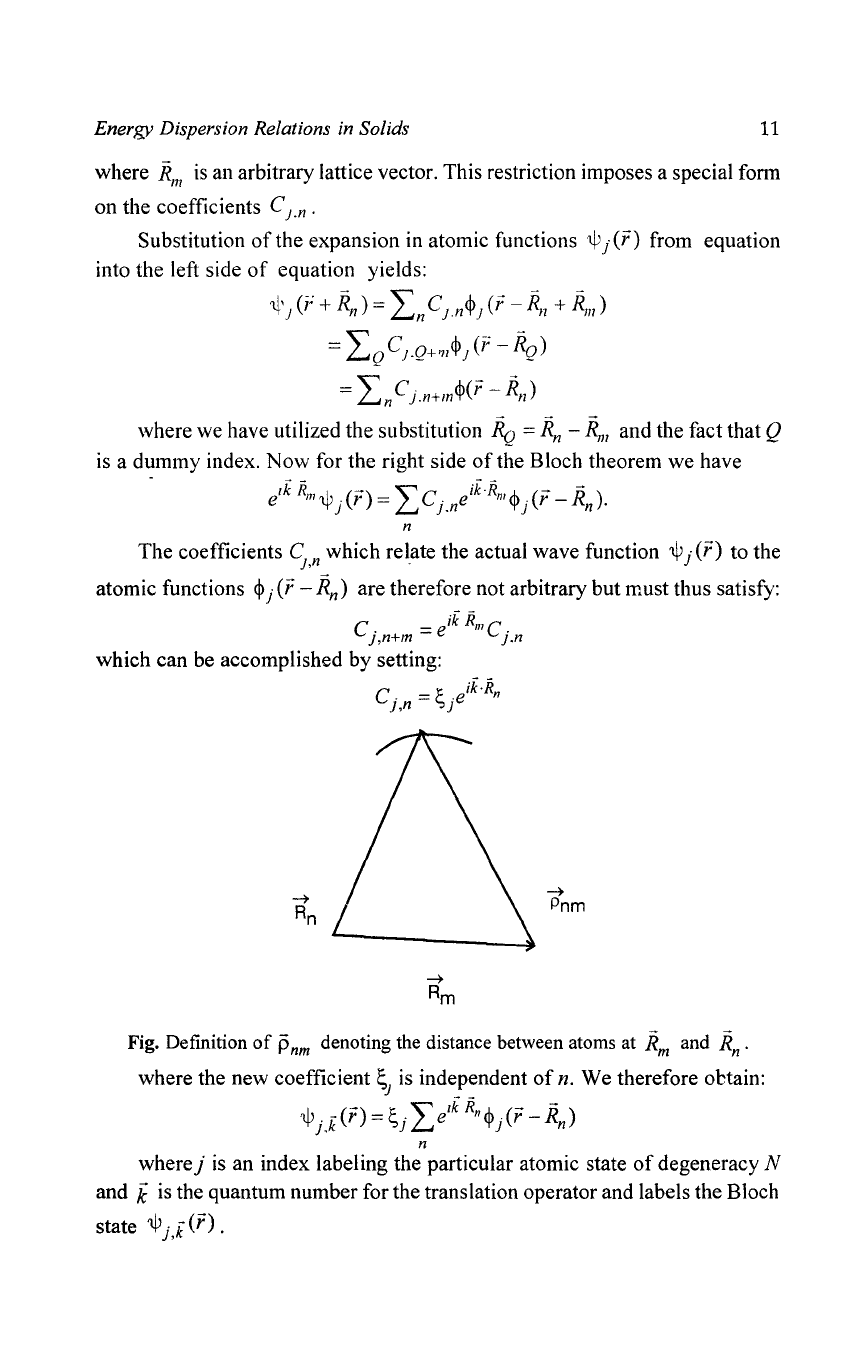
Fig. Defmition
of
Pnm
denoting the distance between atoms at
Rm
and Rn'
where the new
coefficient~}
is
independent
of
n.
We therefore obtain:
'4J
j
,k(r)
=
Sj
Ie
1k
Rn~/r
- Rn)
n
where j
is
an index labeling the particular atomic state
of
degeneracy N
and k
is
the quantum number for the translation operator and labels the Bloch
state
'4>j,k(r).