
Brewster H.D. Solid State Physics
Подождите немного. Документ загружается.

72
Effective Mass Theory
and
Transport Phenomena
in which ne and nh are the carrier densities for the carriers, and
l-1e
and
I-1h
are
their mobilities. We have shown in equation that for cubic materials the
static conductivity can under certain approximations be written as
ne
2
'"(
(J=--
m*
for each carrier type, so that the mobilities and effective masses are related by
lei
(-rh)
(J
=---
e
mh
and
lel(th)
I-1h
=
--;;;;:-
which show that materials with small effective masses have high mobilities.
By writing the electrical conductivity as a product
of
the carrier density with
the mobility, it is easy to contrast the temperature dependence
of
(J
for metals
and semiconductors. For metals, the carrier density n
is
essentially independent
of
T, while
1-1
is temperature dependent. In contrast, n for semiconductors
is
highly temperature dependent
in
the intrinsic regime and
1-1
is relatively less
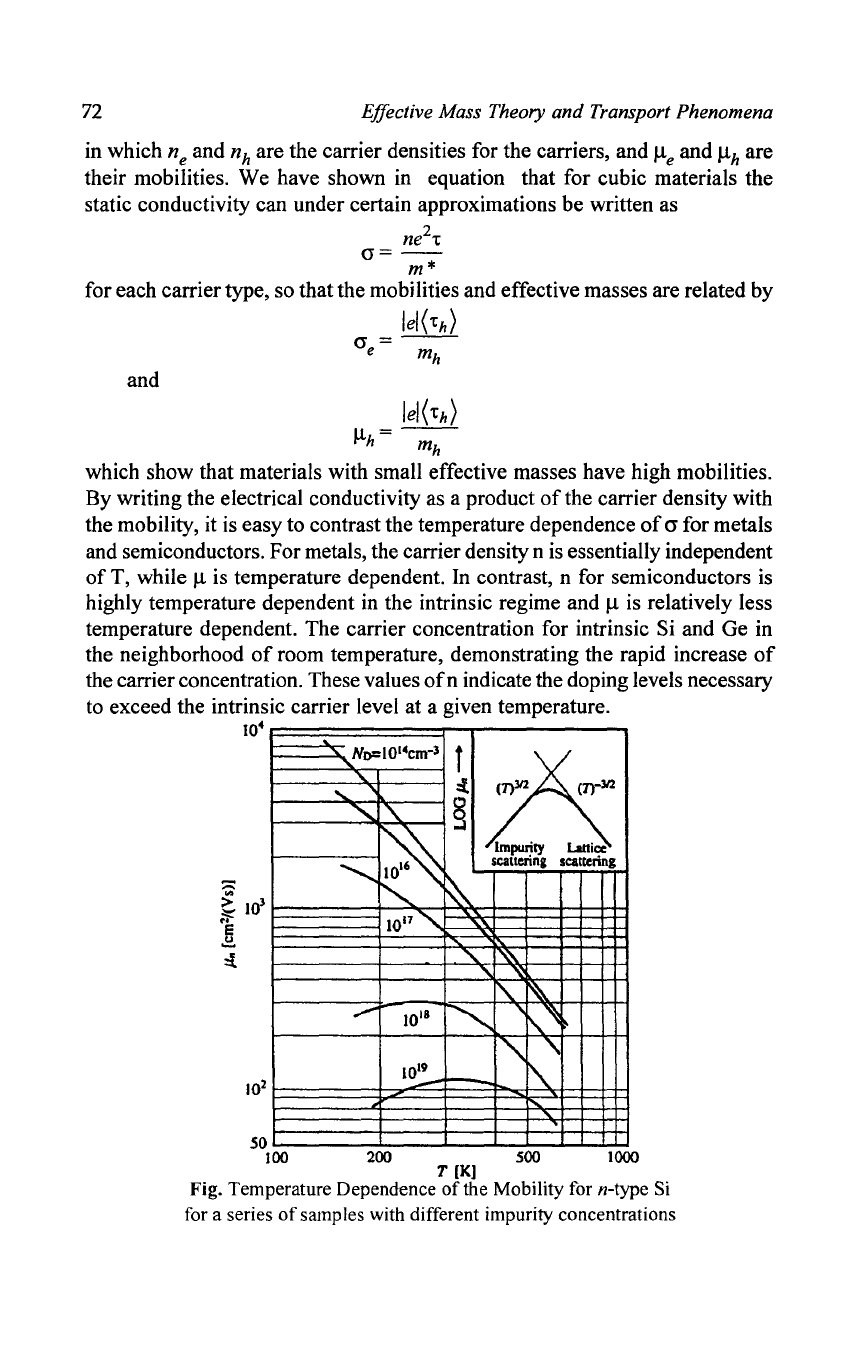
temperature dependent. The carrier concentration for intrinsic Si and Ge in
the neighborhood
of
room temperature, demonstrating the rapid increase
of
the carrier concentration. These values
of
n indicate the doping levels necessary
to
exceed the intrinsic carrier level at a given temperature.
10·
50
100
,Nr>=I
OICcm-
3
~?s:
"
'"
........
,
§
,,~
lmpurjty Lania:
scallennB scattering
~
~
10
17
........
""
I~
'\
~
r'\.
~
..-
10
18
"
,,~
"
'\
10
19
r\.
..
'-
200
500
1000
T
[K]
Fig. Temperature Dependence
of
the Mobility for n-type
Si
for a series
of
samples with different impurity concentrations
Effective Mass Theory and Transport Phenomena
·73
-;;;
10
6
>
~
E
2
.~
Jl
0
:i!
o Experimental
--
Calculated
Temperature
(K)
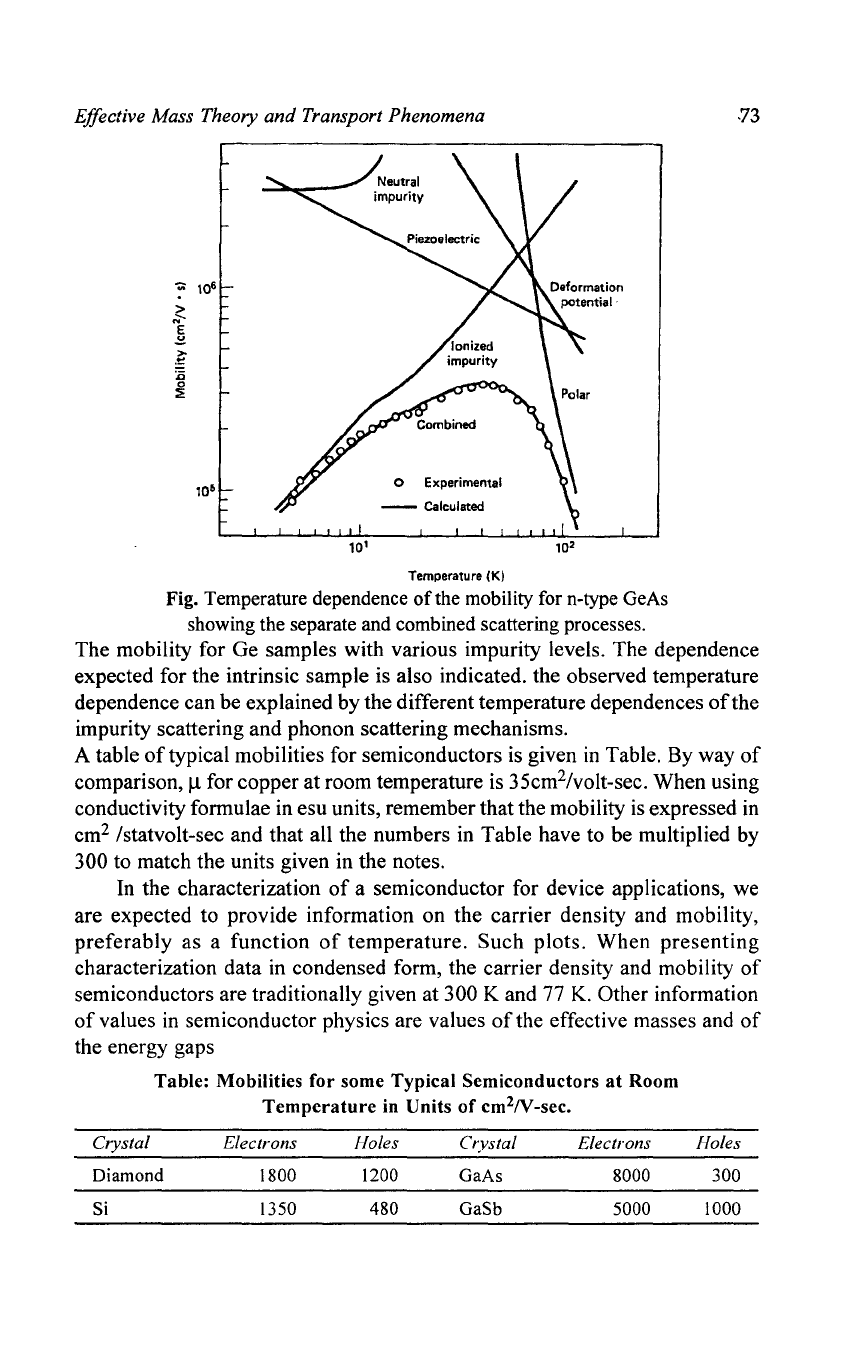
Fig. Temperature dependence
of
the mobility for n-type GeAs
showing the separate and combined scattering processes.
The mobility for Ge samples with various impurity levels. The dependence
expected for the intrinsic sample is also indicated. the observed temperature
dependence can be explained by the different temperature dependences
of
the
impurity scattering and phonon scattering mechanisms.
A table
of
typical mobilities for semiconductors is given
in
Table.
By
way
of
comparison,
f.l
for copper at room temperature is 35cm
2
/volt-sec. When using
conductivity formulae in esu units, remember that the mobility
is
expressed
in
cm
2
Istatvolt-sec and that all the numbers in Table have to be multiplied
by
300 to match the units given in the notes.
In
the characterization
of
a semiconductor for device applications,
we
are expected to provide information on the carrier density and mobility,
preferably as a function
of
temperature. Such plots. When presenting
characterization data in condensed form, the carrier density and mobility
of
semiconductors are traditionally given at 300 K and
77
K.
Other information
of
values
in
semiconductor physics are values
of
the effective masses and
of
the energy gaps
Crystal
Table:
Mobilities
for
some
Typical
Semiconductors
at
Room
Temperature
in Units
of
cm
2
N-sec.
Electrons Holes
Crystal Electrons
Diamond
1800
1200
GaAs
8000
Si
1350
480
GaSb
5000
Holes
300
1000
74
Effective Mass Theory
and
Transport Phenomena
Ge 3600 1800
PbS
550
600
InSb 77,000
750
PbSe
1020 930
InAs
30,000
460 PbTe 2500
1000
InP 4600
100
AgCl
50
AlAs
280
KBr
(lOOK)
100
AlSb
900
400
SiC
100
10-20
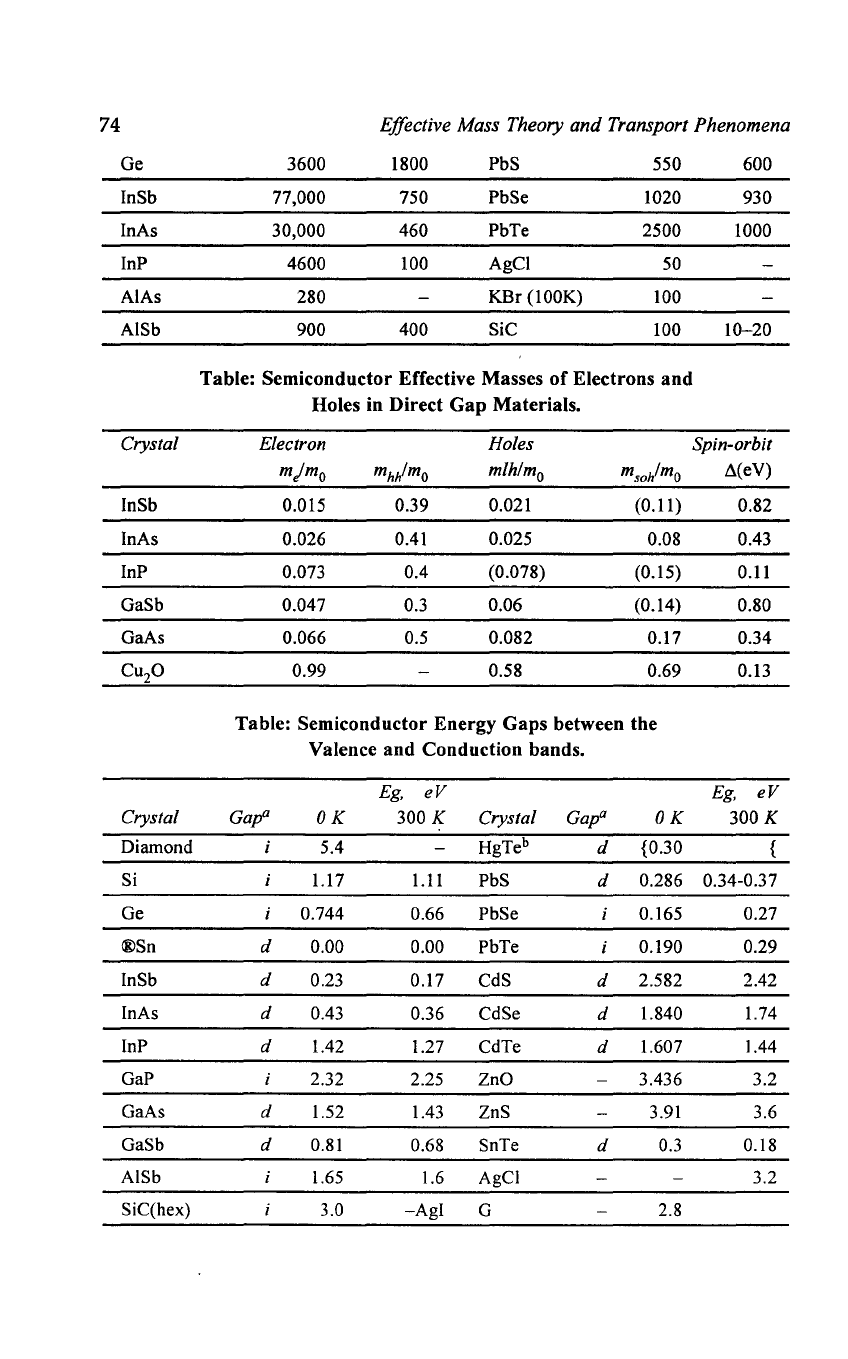
Table:
Semiconductor
Effective
Masses
of
Electrons
and
Holes
in
Direct
Gap
Materials.
Crystal Electron Holes Spin-orbit
m.!mo
mh/m
O
mlhlmo
mso/mo
~(eV)
InSb 0.015 0.39 0.021 (0.11)
0.82
InAs
0.026 0.41
0.025
0.08 0.43
InP
0.073 0.4
(0.078) (0.15)
0.11
GaSb 0.047
0.3
0.06 (0.14)
0.80
GaAs 0.066 0.5 0.082 0.17 0.34
Cup
0.99 0.58 0.69 0.13
Table:
Semiconductor
Energy
Gaps
between
the
Valence
and
Conduction
bands.
Eg,
eV
Eg,
eV
Crystal
Gapo
OK
300
K
Crystal
Gapo
OK
300
K
Diamond
5.4
HgTe
b
d {0.30 {
Si
1.17
1.11
PbS
d
0.286 0.34-0.37
Ge 0.744 0.66 PbSe
0.165
0.27
®Sn
d 0.00 0.00 PbTe 0.190 0.29
InSb d
0.23 0.17 CdS
d
2.582 2.42
InAs
d 0.43
0.36
CdSe
d
1.840 1.74
InP d 1.42
1.27
CdTe
d 1.607 1.44
GaP 2.32
2.25
ZnO
3.436 3.2
GaAs
d 1.52
1.43
ZnS 3.91
3.6
GaSb d
0.81
0.68
SnTe
d
0.3
0.18
AlSb
1.65
1.6
AgCl 3.2
SiCChex)
3.0
-AgI
G
2.8
Effective
Mass
,Theory
and
Transp.ort
Phenomena
Te
d 0:33
-Cl1:!0 d
2.172
ZnSb
0.56 0.56
Ti0
2
3.03
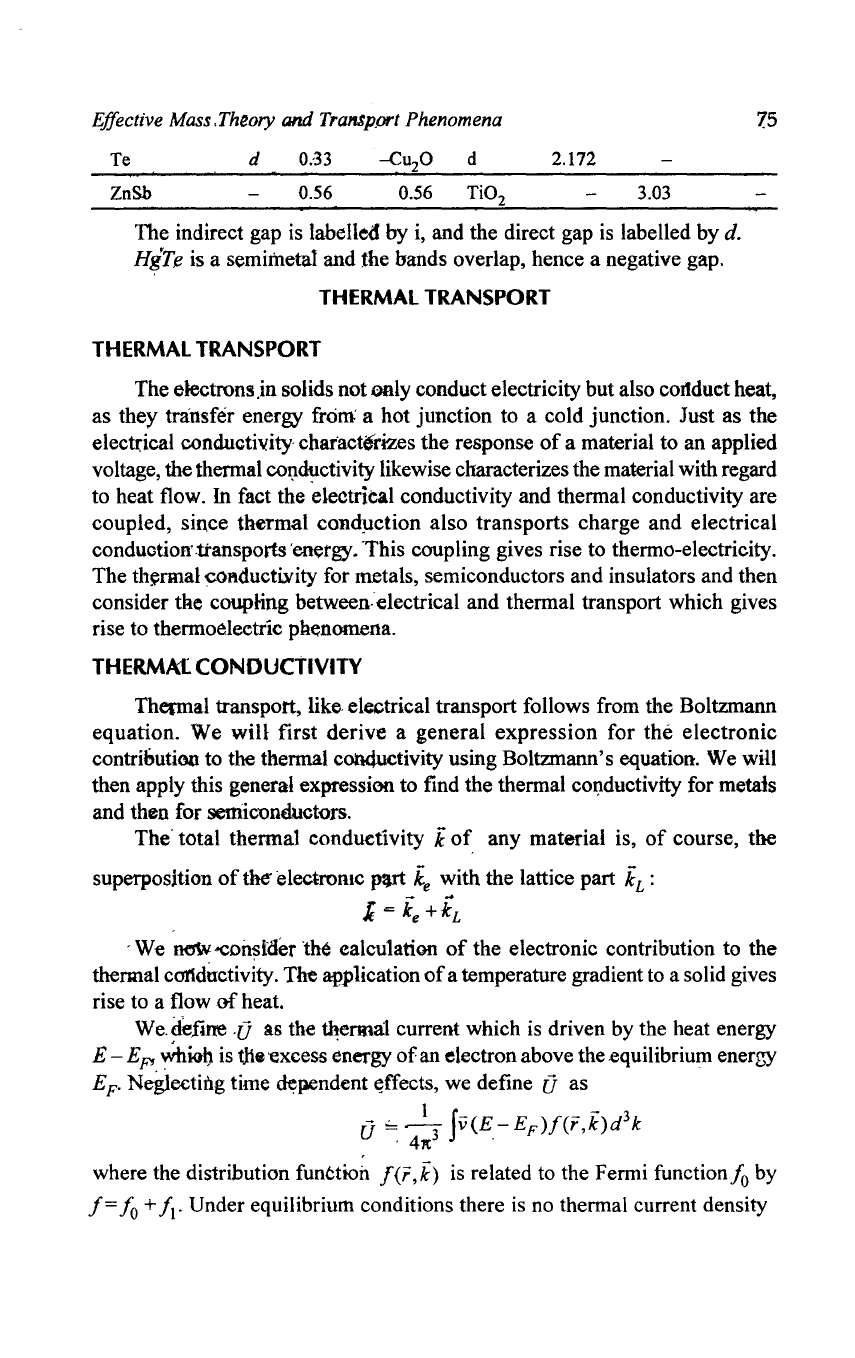
The indirect gap is labelled by
i,
and the direct gap
is
labelled by
d.
HiTe
is a semiI'netal and
th~
bands overlap, hence a negative gap.
THERMAL
TRANSPORT
THERMAL
TRANSPORT
Z5
The electrons
.in
solids not only conduct electricity but also cottduct heat,
as they
transfer energy
from:
a hot junction to a cold junction. Just as the
electdcal
conducthlity characterizes the response
of
a material to an applied
voltage, the thermal
cof).~ctivity
likewise characterizes the material with regard
to heat flow.
In
fact the electrical conductivity and thermal conductivity are
coupled, since thermal
cond~ction
also transports charge and electrical
conduction'transports
'etWtgy. 'This coupling gives rise to thermo-electricity.
The
th~rRla!
'¢QftductiYity
for metals, semiconductors and insulators and then
consider
the coupl1ng between· electrical and thermal transport which gives
rise to thermoelectric
phen~na.
THERMA'L
CONDUCTIVITY
Thermal transport, like electrical transport follows from the Boltzmann
equation. We
will first derive a general expression for the electronic
contribution to the thermal con4uctivity using Boltzmann's equation. We will
then apply this general expression to find the thermal
cOf).ductivity
for metais
and
then for semic'Onductors. .
The'total
thermal
conduet~vity
k
of
any material is,
of
course, the
superposition
oftne-electronic
~.k.e
with the lattice part k
L
:
.:.
":":
....
:7'=£
:tk
L
..
#' _
-""
.If
e '
.I.r>
•
. We
n<iW.c~n~tder
the'
calculation
of
the electronic contribution to the
thennal
conductivity. The application
of
a temperature gradient to a solid gives
rise to a flow
of
heat. '
We.
define
·0
a.s
the !hennal current which is driven by the heat energy
E -
EF'
~WI)
is
tlisexcess energy
of
an electron above the.equilibrium energy
E
F'
NegJecting time
~pendent
~ffects,
we define 0 as
o
"=
~
Jv(E-E
F
)f(r,k)d
3
k
.
411:
where the distribution funttton
f(F,k)
is
related to the Fermi
functionf
o
by
f=
fo +
fl'
Under equilibrium conditions there
is
no thermal current density
...
-
76
Effective Mass Theory and Transport Phenomena
Jv(E-E
F
)d
3
k = 0
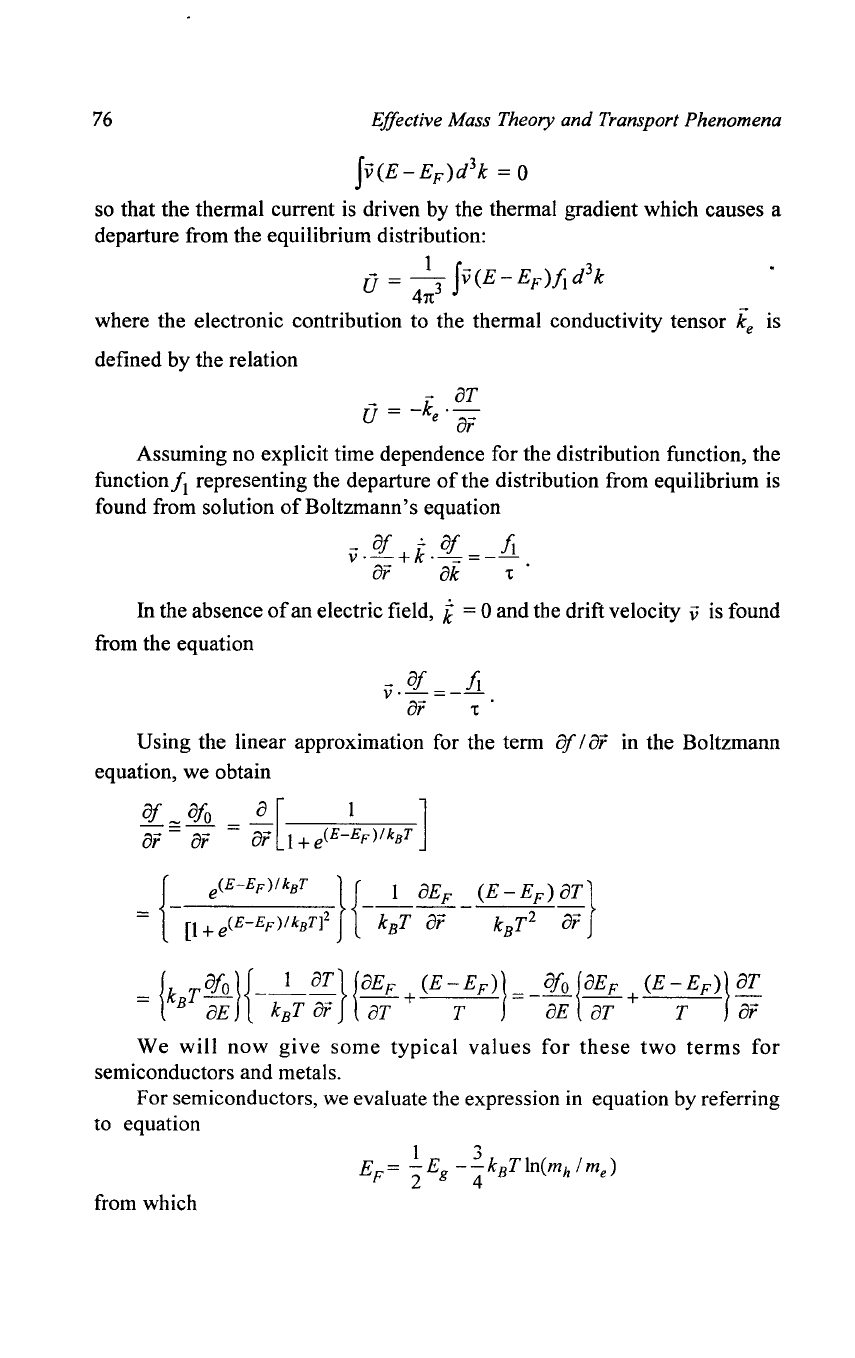
so that the thennal current
is
driven by the thermal gradient which causes a
departure from the equilibrium distribution:
(j
=
~
Jv(E-E
F
)fi
d3k
4n
where the electronic contribution to the thennal conductivity tensor
ke
IS
defined by the relation
-
oT
(j
=
-k
e ·
or
Assuming no explicit time dependence for the distribution function, the
function./i representing the departure
of
the distribution from equilibrium
is
found from solution
of
Boltzmann's equation
v.
oj
+k.0~=_fi
or
ok
't
In
the absence
of
an electric field, k = 0 and the drift velocity v
is
found
from the equation
-
oj
fi
v·-=--
or
't
Using the linear approximation for the tenn
Of/or
in the Boltzmann
equation, we obtain
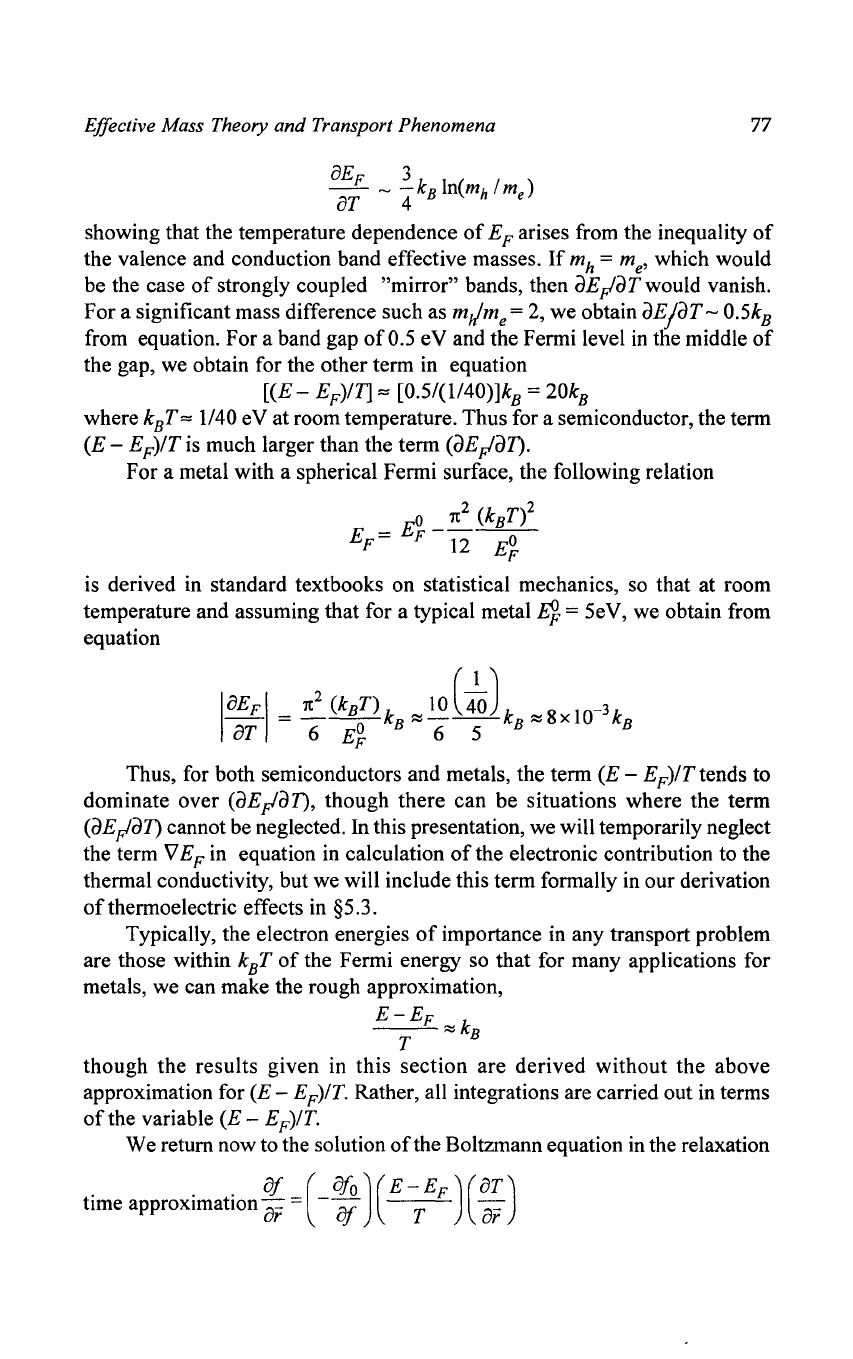
oj
_
ojo
~[
1 ]
or
=
or
=
or
1 + e(E-E
F
)/
k8
T
= {k TOjo } {
__
l_
o:}
{OEF
+
(E
- EF
)}
= _
Ofo
{OEF
+
(E
- EF )}
oT
B
oE
k BT or
oT
T
oE
oT
T
or
We
will
now
give some
typical
values
for
these
two
terms
for
semiconductors and metals.
For semiconductors, we evaluate the expression in equation by referring
to equation
from which
Effective Mass Theory
and
Transport Phenomena
77
OEF
3
--
~
-kBln(mh/me)
oT 4
showing that the temperature dependence
of
EF
arises from the inequality
of
the valence and conduction band effective masses.
If
m
h
= me' which would
be the case
of
strongly coupled "mirror" bands, then
aElaTwould
vanish.
For a significant mass difference such as
mJm
e
=
2,
we obtain
aEJaT
~
O.SkB
from equation. For a band gap
of
0.5 eV and the Fermi level
in
the middle
of
the gap, we obtain for the other term
in
equation
[(E
-
EF)/TJ:::<
[0.S/(1/40)]kB =
20k
B
where
kBT:::;
1140
eV at room temperature. Thus for a semiconductor, the term
(E
- E
F)/T
is much larger than the term (aE
laT).
For a metal with a spherical Fermi surface, the following relation
2 2
_
EO
_ 1t (kBT)
E
F
- F
12
E~
is derived in standard textbooks on statistical mechanics,
so
that at room
temperature and assuming that for a typical metal
If} = SeV, we obtain from
equation
\
OE
F
\
~
.2
(kBT)
kB
~l()
(4~)
kB
~
8 x
10-
3
kB
oT 6
E~
6 5
Thus, for both semiconductors and metals, the term
(E
- EF)/Ttends to
dominate over
(aE
la
T), though there can be situations where the term
(aElaT)
cannot be neglected. In this presentation, we will temporarily neglect
the term
V E F
in
equation in calculation
of
the electronic contribution to the
thermal conductivity, but we will include this term formally in our derivation
of
thermoelectric effects in §S.3.
Typically, the electron energies
of
importance in any transport problem
are those within
kBT
of
the Fermi energy so that for many applications for
metals, we can make the rough approximation,
E-EF
----''--;:;
kB
T
though the results given in this section are derived without the above
approximation for
(E
- EF)/T. Rather, all integrations are carried out
in
terms
of
the variable
(E
- EF)/T.
We return now to the solution
of
the Boltzmann equation
in
the relaxation
.
.,
Of
(
Ofo)
(E
-E F )
(OT
)
time approXImatIOn
or
==
-
of
T
or
78
Effective Mass"'/'heo.ty and-Transport Phenomena
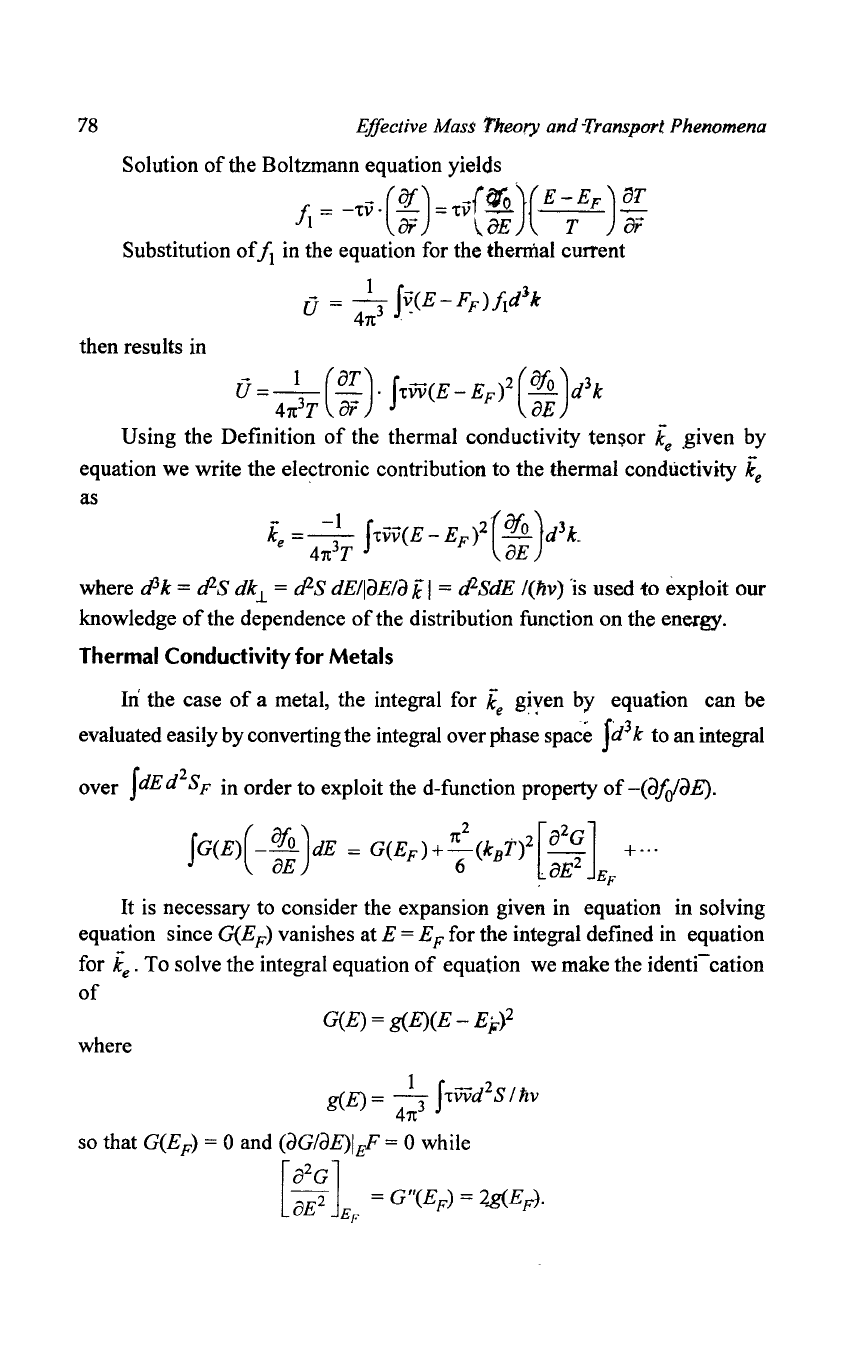
Solution
of
the Boltzmann equation yields ,
-
(Of)_
~('~~)'
'('i-,EF)"OT
It =
-'tV.
or
-'tv iii
T'
or
'
Substitution
of
It in the equation for the thermal cutTent
U =
-2-3
f~(E
-
FF
)
Ird
J
k
4n ' '
then results in
U
=_1_
(aT).
J'tw(E
_
EF)2
(afo
)d
3
k
4n
3
T
or
aE'
Using the Definition
of
the thermal conductivity ten$or
ke
.given by
equation we write the electronic contribution to the thermal conductivity
ke
as
ke
= -i-
J'tvv(
E - E F
)2
(Ofo
)d
3
k.
4n T
aE
where
cPk
=
d2s
dk.l =
d2s
dE/laE/a k I =
d2SdE
/(hv)
'is
used
to
exploit our
knowledge
of
the dependence
of
the distribution function on the energy.
Thermal
Conductivity
for
Metals
In'
the case
of
a metal, the integral for k given by equation can be
e
'.
evaluated easily by converting the integral over phase space
Jd
3
k to an integral
over
JdEd
2
SF in order to exploit the d-function property
of
-(alo/a£).
J
(
Ofo)
n
2
,
2[a
2
G]
G(E)
--
dE =
G(EF)+-(kBT)
- + ...
aE
6,
,:aE
2
EF
It
is necessary to consider the expansion given in equation in solving
equation since
G(E
F)
vanishes at E = E F for the integral defined in equation
for
k
e
.
To solve the integral equation
of
equation we make the identi-cation
of
G(E) = g(£)(E -
Ej..)2
where
Effective Mass Theory
and
Transport Phenomena
79
These
relations
will
be
used
again
in
connection
with
the
calculation
of
the
thermopower
in §5.3.1.
For
the
case
of
the
thermal
conductivity
for a metal
we
then
obtain
- _ 1t
2
(k
T)2
(E
) _
(k
B
T)2
f
--
d
2
S
F
k - - B g F -
'tvv--
e 3
121tn
v
where
the
integration
is
over the
Fermi
surface.
We
immediately
recognize
that
the
integral
appearing
in
equation
is
the
same
as
that
for
the
electrical
conductivity
2
d2
e f
--
SF
cr
=
--
'tvv--
41tn
v
so
that
the
electronic
contribution
to
the
thermal
conductivity
and
the
electrical
conductivity
tensors
are
proportional
to
each
other
50
0:0
(1)
'040
E
<>
--
'"
t
m
,!
30
Z.
1
:;
~
-620
I
c:
0
u
1
ro
~10
.r=
t--
0
0
20
•
\
_
-T(1t
2
k;)
k=CJ
--
e
'"
2
.Je
\
•
\
•
\
\
"',--.
-,-
12
10
8
0:0
C1)
'0
E
6
u
u
C1)
'"
--
ro
4
~
2
0
100
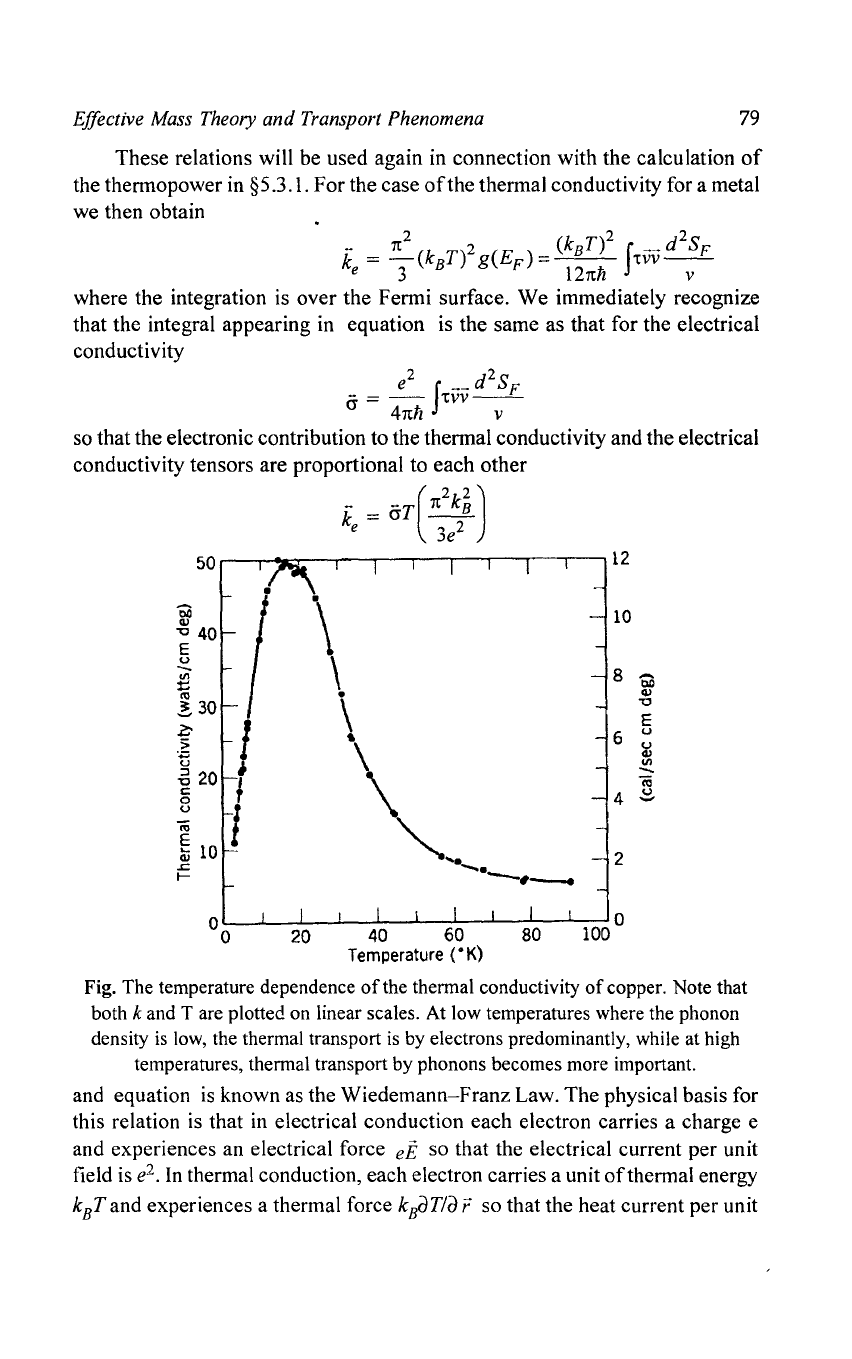
Fig. The temperature dependence
of
the thermal conductivity
of
copper. Note that
both
k and T are plotted on linear scales. At low temperatures where the phonon
density
is
low, the thermal transport
is
by
electrons predominantly, while at high
temperatures, thermal transport by phonons becomes more important.
and
equation
is
known
as
the
Wiedemann-Franz
Law.
The
physical
basis
for
this
relation
is
that
in
electrical
conduction
each
electron
carries
a
charge
e
and
experiences
an
electrical
force
eE
so
that
the
electrical
current
per
unit
field is e
2
.
In thermal conduction,
each
electron
carries a unit
ofthermal
energy
kBT
and experiences
a
thermal
force
kiJT/a
r
so
that
the
heat
current
per
unit
80
Effective Mass Theory
and
Transport Phenomena
thennal gradient
is
proportional to
~T.
Therefore the ratio
of
Ikel
=
lal
must
be on the order
of
(~Tle2).
The Wiedemann-Franz law suggests that the ratio
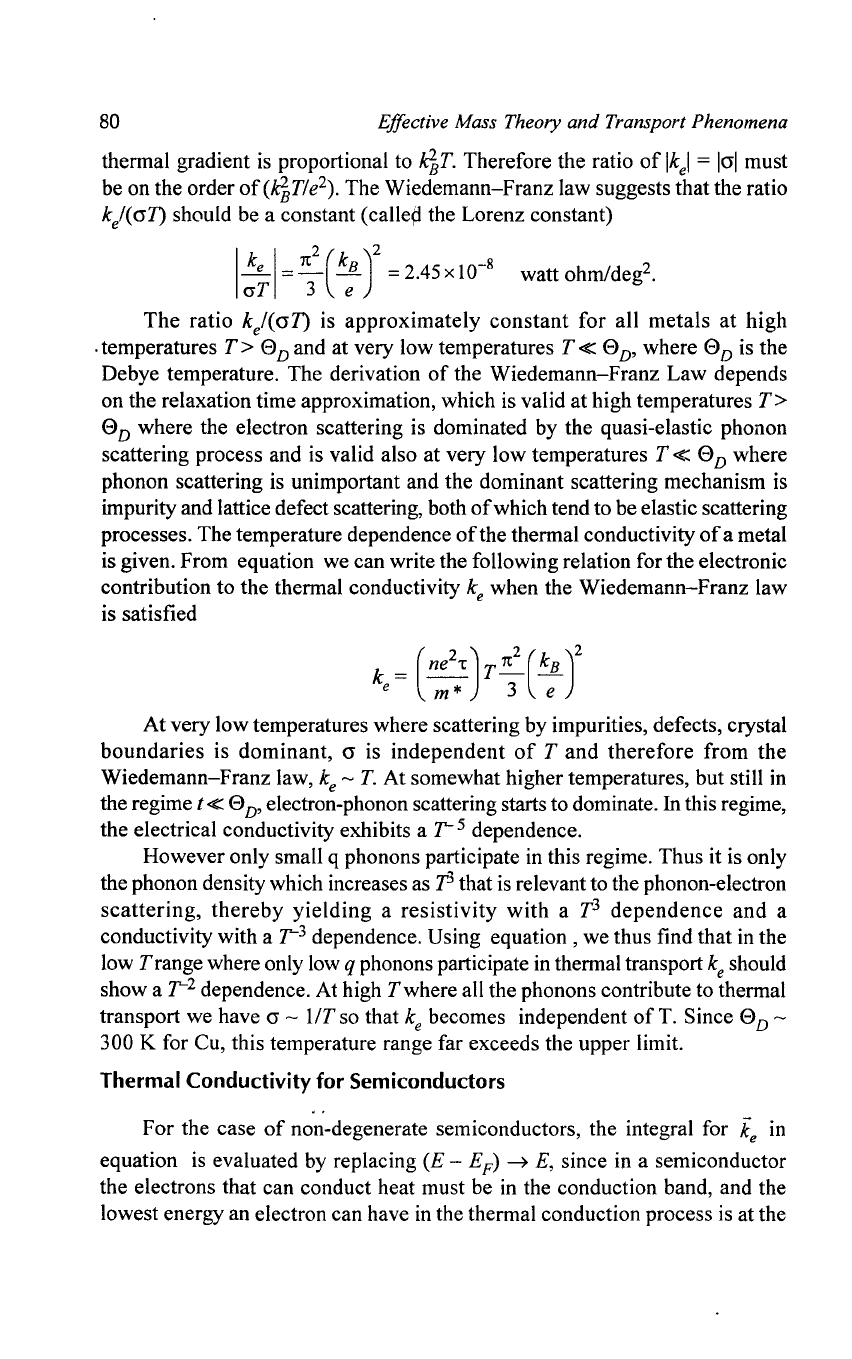
k/(
an
should be a constant (callep the Lorenz constant)
I
:~
1=
'lt3
2
(k:
r = 2.45 x 10-
8
watt ohmldeg
2
.
The
ratio
k/(an
is approximately constant for all metals
at
high
. temperatures
T>
e D and at very low temperatures T
~
eD'
where e D is the
Debye temperature. The derivation
of
the Wiedemann-Franz Law depends
on the relaxation time approximation, which is valid at high temperatures
T>
e
D
where the electron scattering is dominated by the quasi-elastic phonon
scattering process and is valid also at very low temperatures T
~
e
D
where
phonon scattering
is
unimportant and the dominant scattering mechanism is
impurity and lattice defect scattering, both
of
which tend to be elastic scattering
processes. The temperature dependence
of
the thennal conductivity
of
a metal
is given. From equation we can write the following relation for the electronic
contribution to the thennal conductivity
ke
when the Wiedemann-Franz law
is satisfied
ke
= (
:2*,
) T
~2
(k:
r
At
very low temperatures where scattering by impurities, defects, crystal
boundaries is dominant,
a is independent
of
T and therefore from the
Wiedemann-Franz law,
ke
~
T.
At somewhat higher temperatures, but still
in
the regime
t~
eD'
electron-phonon scattering starts to dominate.
In
this regime,
the electrical conductivity exhibits a
r-
5 dependence.
However only small q phonons participate in this regime. Thus it is only
the phonon density which increases
as
T3
that
is
relevant to the phonon-electron
scattering,
thereby
yielding
a
resistivity
with
a
T3
dependence
and a
conductivity with a
r-3
dependence. Using equation, we thus find that
in
the
low Trange where only low
q phonons participate
in
thennal transport
ke
should
show a
r-2
dependence. At high Twhere all the phonons contribute to thennal
transport we have
a
~
liT
so that
ke
becomes independent
of
T.
Since e
D
~
300 K for Cu, this temperature range far exceeds the upper limit.
Thermal Conductivity for Semiconductors
For the case
of
non-degenerate semiconductors, the integral for
ke
in
equation
is
evaluated by replacing
(E
- E
F
)
~
E, since in a semiconductor
the electrons that can conduct heat must be
in
the conduction band, and the
lowest energy an electron can have
in
the thermal conduction process
is
at the
Effective Mass Theory and Transport Phenomena
81
conduction band minimum. Then the thennal conductivity for a non-degenerate
semiconductor can be written as
- 1
J--E2(
Bfo)d
3
k
k =
--
'tvv
--
e
47t
3
T
BE
For
intrinsic
semiconductors,
the
distribution
function
can
be
approximated
by
the
Maxwell-Boltzmann
distribution
so
that
(Bfo
I
BE)
-+
-(1/
kBT)e(-IE~I/
k8
T
e -(E
/k8
T
)
For a parabolic band we have E =
1i2fi212m*,
so that the volume element
in reciprocal space can be written
Jd
3
k=
J47tk
2
dk=
127t(2m*lh2)3/2E"2dE,
and v =
(llh)(oE
I Bk) =
hk
1m.
Assuming a constant relaxation time, we then
substitute all these
tenns
into equation for k and integrate to obtain
e
k
exx
=
(11
47t
3
T)
J'tv;E
2
[(kBT)-1 e
-IE~I(/
k8
T
)
e-
E
/(k
8
T}
]
27t(2m
* I h
2
)3/2 El/2dE
=
[kB(kBT)'t/(37t2m*)J(2m*kBTlh2)3/2e-iE~I/(k8T)
1 x
7
/
2
e-
x
dx
where
1x7/2e-
X
dx = 10S.[;,/S ,
from
which
it
follows
that
k
has
a
exx
temperature dependence
of
the form T5/2 e
-IE~,I/(k8T)
in which the exponential
tenn
is dominant for temperatures
of
physical interest,
where
k8T«
IE}I.
We
note from equation
that
for a semiconductor the
temperature dependence
of
the electrical conductivity is given by
cr
= 2e
2
't
(m
* k
B
T)3/2 e
-IE~I/(k8T)
xx
m *
27t1i
2
Assuming cubic symmetry, we can write the conductivity tensor as
so
that
the
electronic
(
0'
xx 0 0 J
0-=
0 O'
xx
0
o 0
O'
xx
contributIOn
to
the
thermal
conductivity
of
a
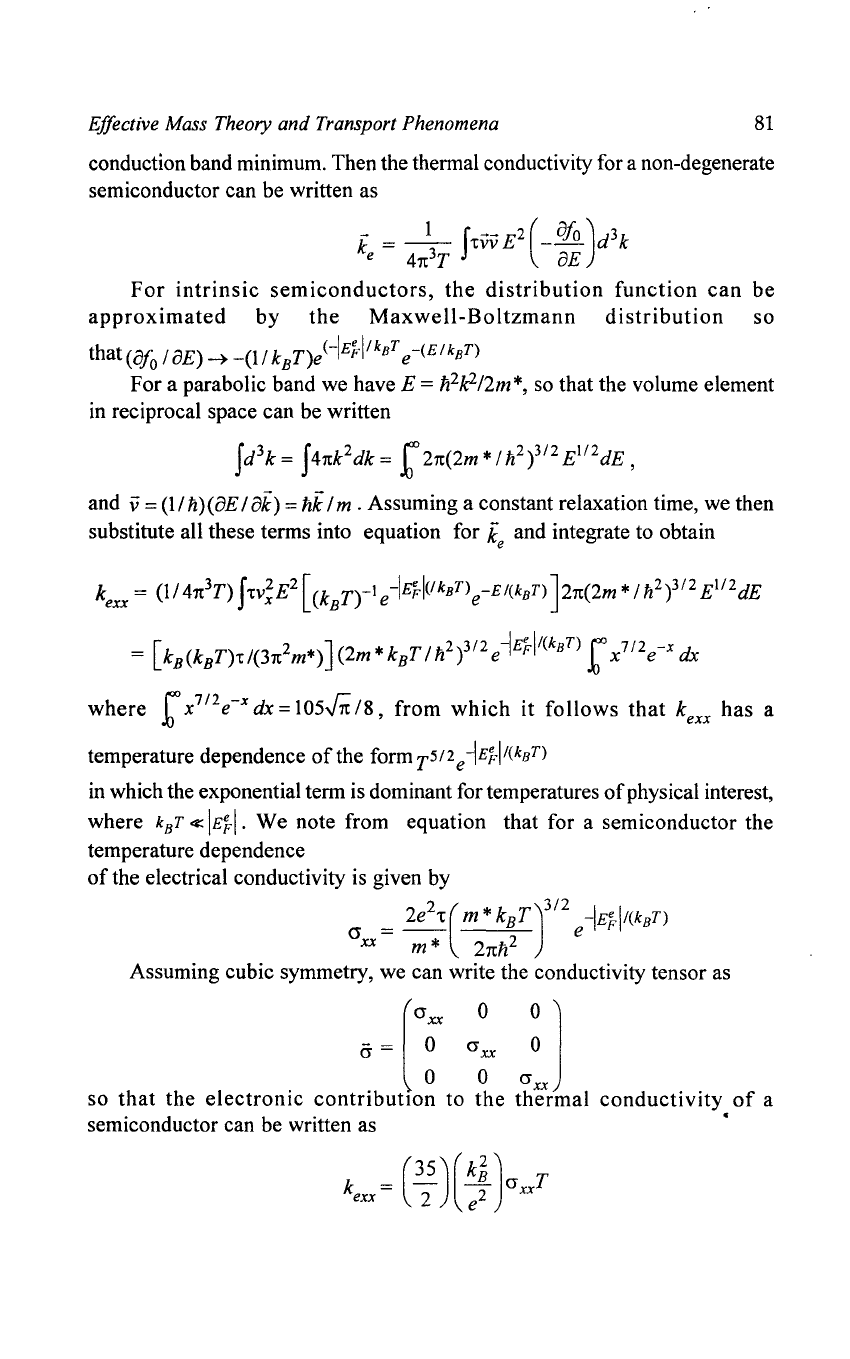
semiconductor can be written as
.