
Brewster H.D. Solid State Physics
Подождите немного. Документ загружается.

102
Electron
and
Phonon Scattering
(
2m*)3/2
E1I2
[E.
+ h
(-)]112
_ I _
(2
*)3/2 I -
00
q
p(EI)
-
2rc
2h3 - m
2rc
2h3 '
where equation has been employed and the "+" sign corresponds to absorption
of
a phonon and the
"-"
sign corresponds to phonon emission.
The probability
of
absorbing
or
emitting a phonon is proportional to the
electron-phonon coupling
G(ij) and to the phonon density n(ij) for absorption,
and
[1
+ n(ij)] for emission, where n(ij) is given by the Bose-Einstein factor
_ 1
n(q) = llro(q)
e
k8
T
-1
Combining the terms in Eqs. 6.13 and 6.14 gives a scattering probability
(or
Ute>
proportional to a sum over final states
1
(2m*)3/2 _ [[E; +
hoo(ij)]112
[E;
-
hOO(ij)]1I2]
~ - 2 3 I
G(
q)
lIro(ij) + -lIro(ij)
c
2rc
h ij e k8
T
-1
1-
e
k8
T
where the first term in the big bracket
of
equation corresponds to phonon
absorption and the second term to phonon emission.
If
E;
<
hoo(
ij),
only the
phonon absorption process is energetically allowed.
The electron-phonon coupling coefficient
G(ij) in equation depends on
the electronphonon coupling mechanism. There are three important coupling
mechanisms
in
semiconductors
which
we
briefly
describe
below:
electromagnetic coupling, piezoelectric coupling, and deformation-potential
coupling.
Electromagnetic coupling is important only for semiconductors where the
charge distribution has different signs on neighboring ion sites.
In
this case,
the oscillatory electric field can give rise to oscillating dipole moments
associated with the motion
of
neighboring ion sites in the LO mode. The
electromagnetic coupling mechanism is important in coupling electrons to
longitudinal
optical
phonon
modes
in III-V
and
II-VI
compound
semiconductors, but does not contribute in the case
of
silicon. To describe the
LO mode we can use the Einstein approximation, since.
oo(ij)
is only weakly
dependent on
q for the optical modes.
In
this case
hroo
»kBT
and
hroo
»E,
so that from equation the collision rate is proportional to
m*3/2(hroo)1I2
't
c
enroo
1 knT
-1
.
Electron and Phonon Scattering 103
Thus, the collision rate depends on the temperature T, the LO phonon
frequency
00
0
and the electron effective mass m*. The corresponding mobility
for the optical phonon scattering
is
e(.)
e(ehroo/kBT
-1)
11=
m*
- m*s/2(hooo)il2
Thus for optical phonon scattering, the mobility
11
is independent
of
the
electron energy
E and decreases with increasing temperature.
As in the case
of
electromagnetic coupling, piezoelectric coupling is
important in semiconductors which are ionic or partly ionic.
If
these crystals
lack inversion symmetry, then acoustic mode vibrations generate regions
of
compression and rarefaction in a crystal which lead to electric field
s.
The
piezoelectric scattering mechanism
is
thus associated with the coupling between
electrons and phonons arising from these electromagnetic
u(r)
~~~~~~
~~'"""~
..
r
.:.
LO
~,~~A
..
O,~~
~
~
U'
"0'
'0' '0'
~
TO
(a)
u(r)
F~~
.:.
LO
TO
(b)
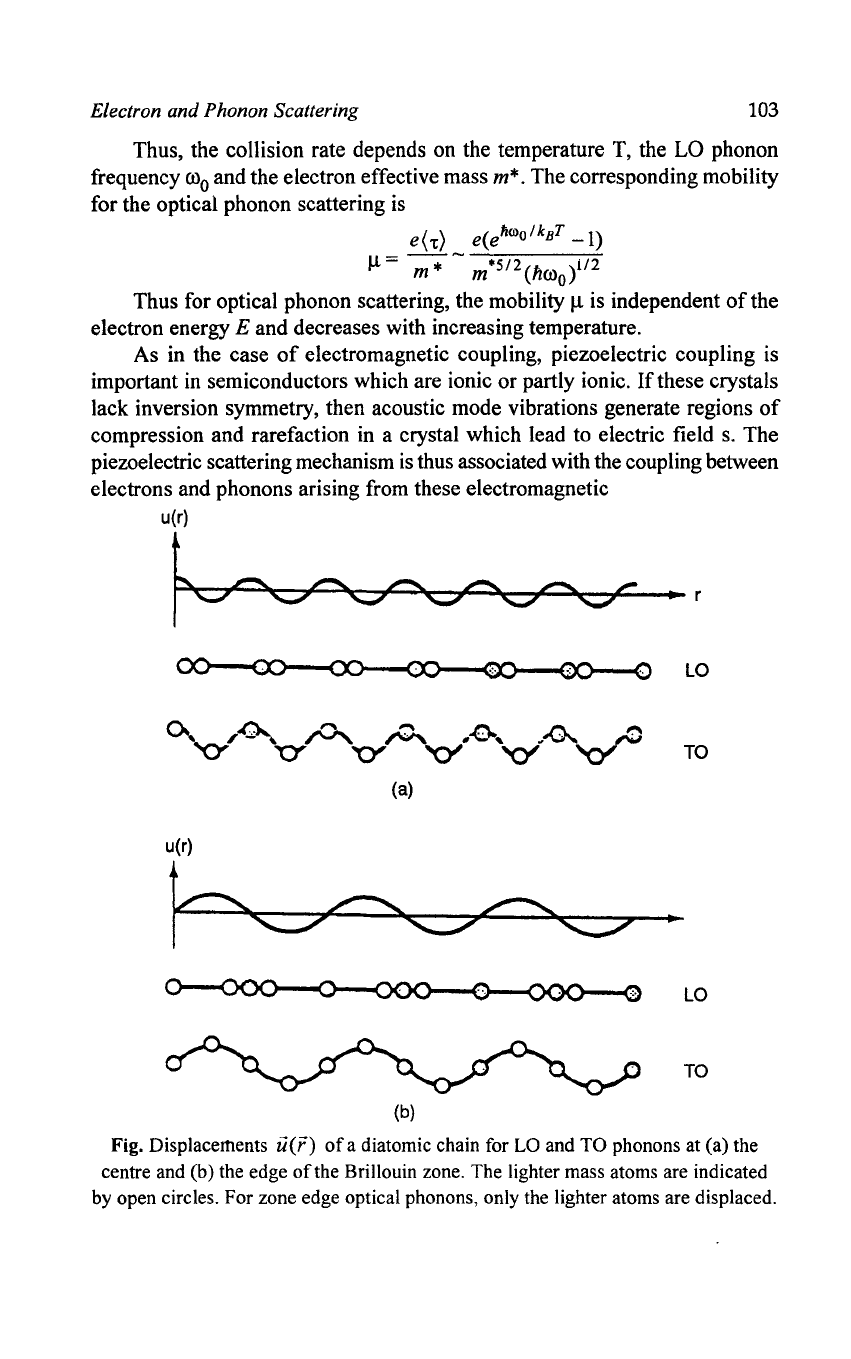
Fig. Displacements
ii(F)
ofa
diatomic chain for
LO
and TO phonons at (a) the
centre and (b) the edge
of
the Brillouin zone. The lighter mass atoms are indicated
by open circles. For zone edge optical phonons, only the lighter atoms are displaced.
104
Electron
and
Phonon Scattering
II
r
':.
LA
TA
LA
TA
(b)
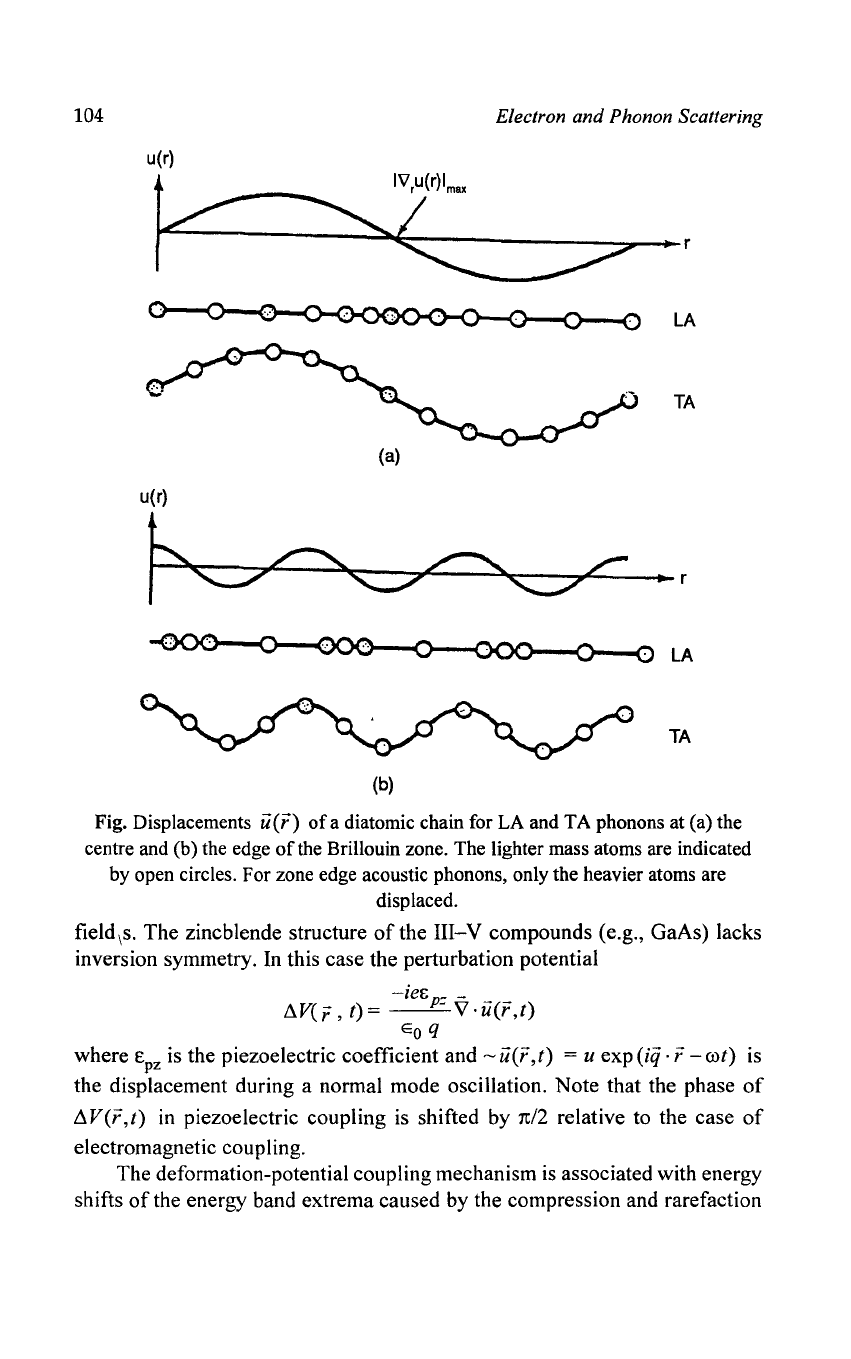
Fig. Displacements iter)
ofa
diatomic chain for LA and TA phonons at (a) the
centre and (b) the edge
of
the Brillouin zone. The lighter mass atoms are indicated
by open circles. For zone edge acoustic phonons, only the heavier atoms are
displaced.
field IS. The zincblende structure
of
the
III-V
compounds (e.g., GaAs) lacks
inversion symmetry.
In
this case the perturbation potential
-ieEp-
_
LlV(r,
t)=
---
V·it(r,l)
EO
q
where c
pz
is the piezoelectric coefficient and
~
it(r
,t)
= u exp
(iq
. r - rot)
is
the displacement during a normal mode oscillation. Note that the phase
of
LlV(r,t)
in
piezoelectric coupling
is
shifted by
rrJ2
relative to the case
of
electromagnetic coupling.
The deformation-potential coupling mechanism
is
associated with energy
shifts
of
the energy band extrema caused by the compression and rarefaction
Electron and Phonon Scattering
105
of
crystals during acoustic mode vibrations.
The
deformation potential
scattering mechanism
is
important in crystals like silicon which have inversion
symmetry (and hence no piezoelectric scattering coupling) and have the same
species on each site (and hence no electromagnetic coupling). The longitudinal
acoustic modes are important for phonon coupling in n-type Si and Ge where
the conduction band minima occur away from
k =
o.
For deformation potential coupling, it
is
the LA acoustical phonons that
are most important though contributions by
LO optical phonons still make a
contribution. For the acoustic phonons, we have the condition
hm«
kBT and
hO)«
E,
while for the optical phonons it
is
usually the case that
hm«
kBT
at room temperature. For the range
of
acoustic phonon modes
of
interest,
G(q)
~
q , where q is the phonon wave vector and !
~
q for acoustic phonons.
Furthermore for the LA phonon branch the phonon absorption process will
depend on
n(q) in accordance with the Bose factor
=-
__
1_-",-_~
kBT _ kBT
e
hro
/ knT
-1
:::::
[
hm
]
hO)
q
1+-+···
-1
kBT
1
while for phonon emission
=-
___
-=
__
kBT _ kBT
1-
e
hro
/
kBT
:::::
[
hm
]
hm
q
1--+···
-1
kBT
Therefore, in considering both phonon absorption and phonon emission,
the factors
and
G(q)[I-
e -1Irol
k8
T
rl
are independent
of
q for the
LA
branch. Consequently for the acoustic phonon
scattering process, the carrier mobility
11
decreases with increasing T according
to
e('t)
*-5/2
E-
1/2
(k
T)-I
~l=
---m
B.
m*
For the optical LO contribution, we have
G(q)
independent
of
q but an
E
112
factor
is
introduced
by
equation for both phonon absorption and emission,
leading to the same basic dependence as given by
equation.
Thus, we find
that the temperature and energy dependence
of
the mobility
11
is
different for
106
Electron
and
Phonon Scattering
the various electron-phonon coupling mechanisms. These differences
in
the E
and T dependences can thus be used to identify which scattering mechanism
is dominant
in
specific semiconducting samples. Furthermore, when explicit
account
is
taken
of
the energy dependence
of
1:, departures from the strict
Drude model
a =
ne
2
1:lm*
can be expected.
Electron
path
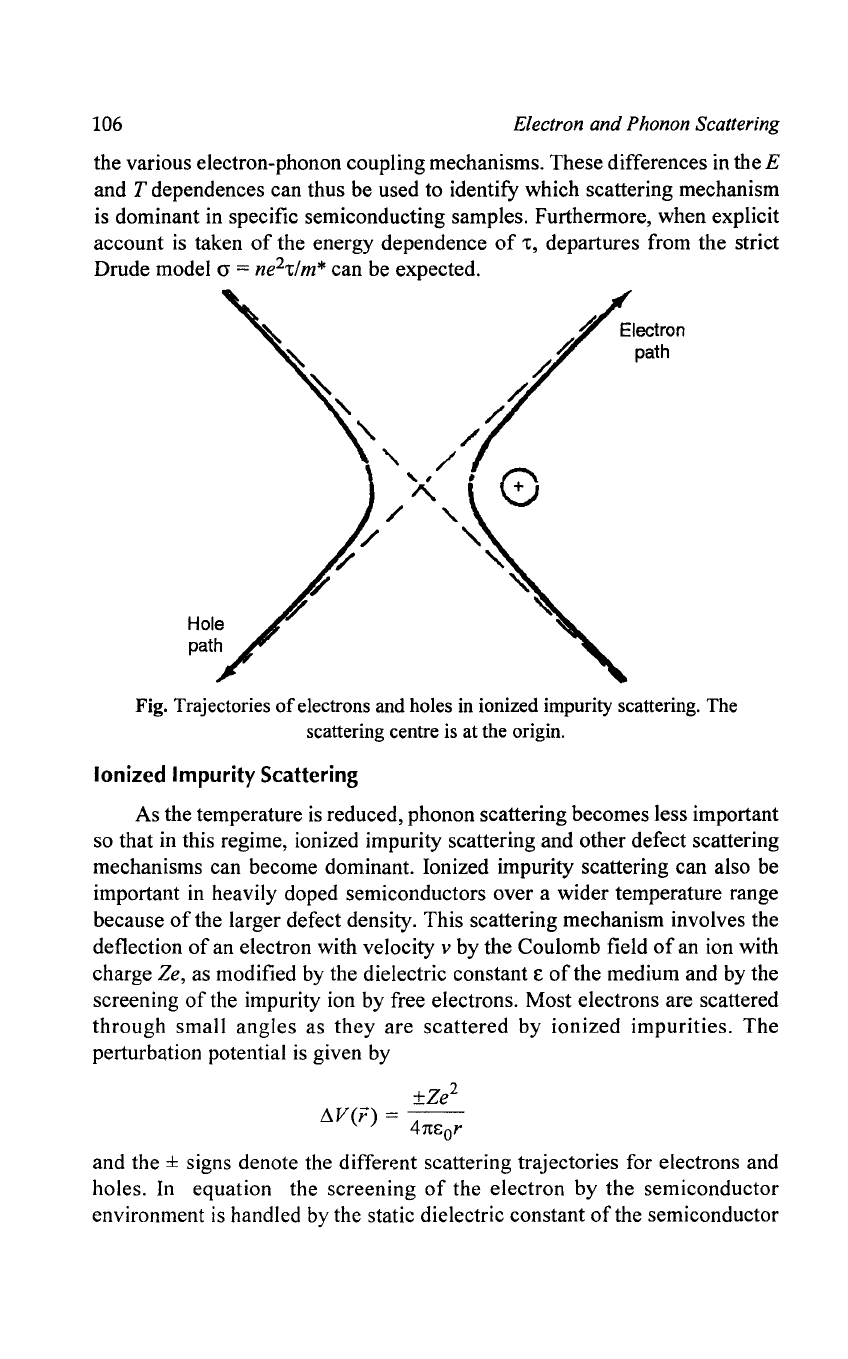
Fig. Trajectories
of
electrons and holes in ionized impurity scattering. The
scattering centre is at the origin.
Ionized Impurity Scattering
As the temperature
is
reduced, phonon scattering becomes less important
so that in this regime, ionized impurity scattering and other defect scattering
mechanisms can become dominant. Ionized impurity scattering can also be
important
in
heavily doped semiconductors over a wider temperature range
because
of
the larger defect density. This scattering mechanism involves the
deflection
of
an electron with velocity v by the Coulomb field
of
an ion with
charge
Ze, as modified by the dielectric constant E
of
the medium and
by
the
screening
of
the impurity ion by free electrons. Most electrons are scattered
through small angles as they are scattered by ionized impurities. The
perturbation potential
is
given
by
±Ze
2
L'lV(r)
=
-4-
1tEar
and the ± signs denote the different scattering trajectories for electrons and
holes.
In
equation the screening
of
the electron by the semiconductor
environment
is
handled
by
the static dielectric constant
of
the semiconductor
Electron and Phonon Scattering
107
2
0
,
Because
of
the long-range nature
of
the Coulomb interaction, screening by
other free carriers and by other ionized impurities could be important. Such
screening effects are further discussed in §6.2.4.
The scattering rate
1/'1:
r
due to ionized impurity scattering
is
given to a
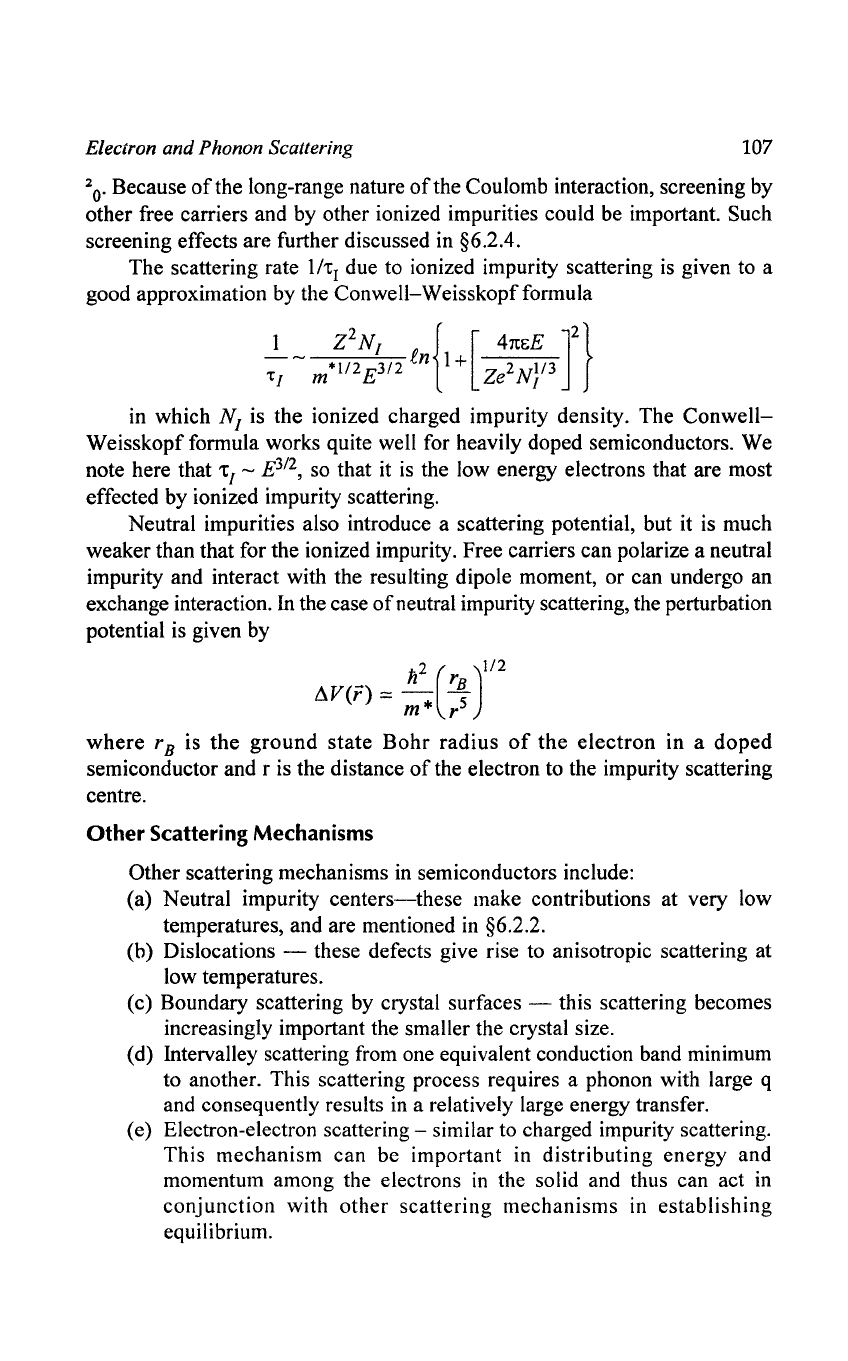
good approximation by the Conwell-Weisskopfformula
_I
_
*~/22N;/2
R.n{I+[
4;E~3]2}
T:I
m E Ze
NI
in which
NI
is the ionized charged impurity density. The
Conwell-
Weisskopf formula works quite well for heavily doped semiconductors. We
note here that
'1:
1
-
E3/2, so that it
is
the low energy electrons that are most
effected by ionized impurity scattering.
Neutral impurities also introduce a scattering potential, but it is much
weaker than that for the ionized impurity. Free carriers can polarize a neutral
impurity and interact with the resulting dipole moment, or can undergo an
exchange interaction.
In
the case
of
neutral impurity scattering, the perturbation
potential is given by
~V(r)::::
_ rB
1i
2
(
)112
m*
r
5
where
r
B
is the
ground
state
Bohr
radius
of
the
electron
in a
doped
semiconductor and r is the distance
of
the electron to the impurity scattering
centre.
Other Scattering Mechanisms
Other scattering mechanisms
in
semiconductors include:
(a) Neutral impurity
centers-these
make contributions at very low
temperatures, and are mentioned
in
§6.2.2.
(b) Dislocations - these defects give rise to anisotropic scattering at
low temperatures.
(c) Boundary scattering by crystal surfaces - this scattering becomes
increasingly important the smaller the crystal size.
(d) Intervalley scattering from one equivalent conduction band minimum
to another. This scattering process requires a phonon with large q
and consequently results
in
a relatively large energy transfer.
(e) Electron-electron scattering - similar to charged impurity scattering.
This mechanism can be important in distributing energy and
momentum among the electrons
in
the solid and thus can act
in
conjunction with other scattering mechanisms in establishing
equilibrium.
108
Electron and Phonon Scattering
(f)
Electron-hole scattering - depends on having both electrons and
holes present. Because the electron and hole motions induced by an
applied electric field are in opposite directions, electron-hole
scattering tends to reverse the direction
of
the incident electrons
and holes.
Screening Effects in Semiconductors
In the vicinity
of
a charged impurity or an acoustic phonon, charge carriers
are accumulated or depleted by the scattering potential, giving rise to a charge
density
p(r)
= e[n(r) -
p(r)
+
N~
(r)
-
N;
(r)] = en *
(r)
where
n(r),p(f),N~(r),N;(r),
and
n*(r)
are, respectively, the electron,
hole, ionized acceptor, ionized donor, and effective total carrier concentrations
as a function
of
distance r to the scatterer. We can then write expressions for
these quantities in terms
of
their excess charge above the uniform potential in
the absence
of
impurities:
nCr) = n +
on(r)
N;(r)
=
N;
+
oN;(r)
,
and similarly for the holes and acceptors. The space charge
per)
is related to
the perturbing potential by Poisson's equation
V'2~(r)
= _
per)
.
EO
Approximate relations for the excess concentrations are
on(r)/n
=
-e~(r)/(kBT)
oN;(r)/
N;
=
-e~(f)/(kBT)
and similar relations for the holes. Substitution
of
equation into
n*e
2
V'2~(r)
= k T
~(r)
.
EO
B
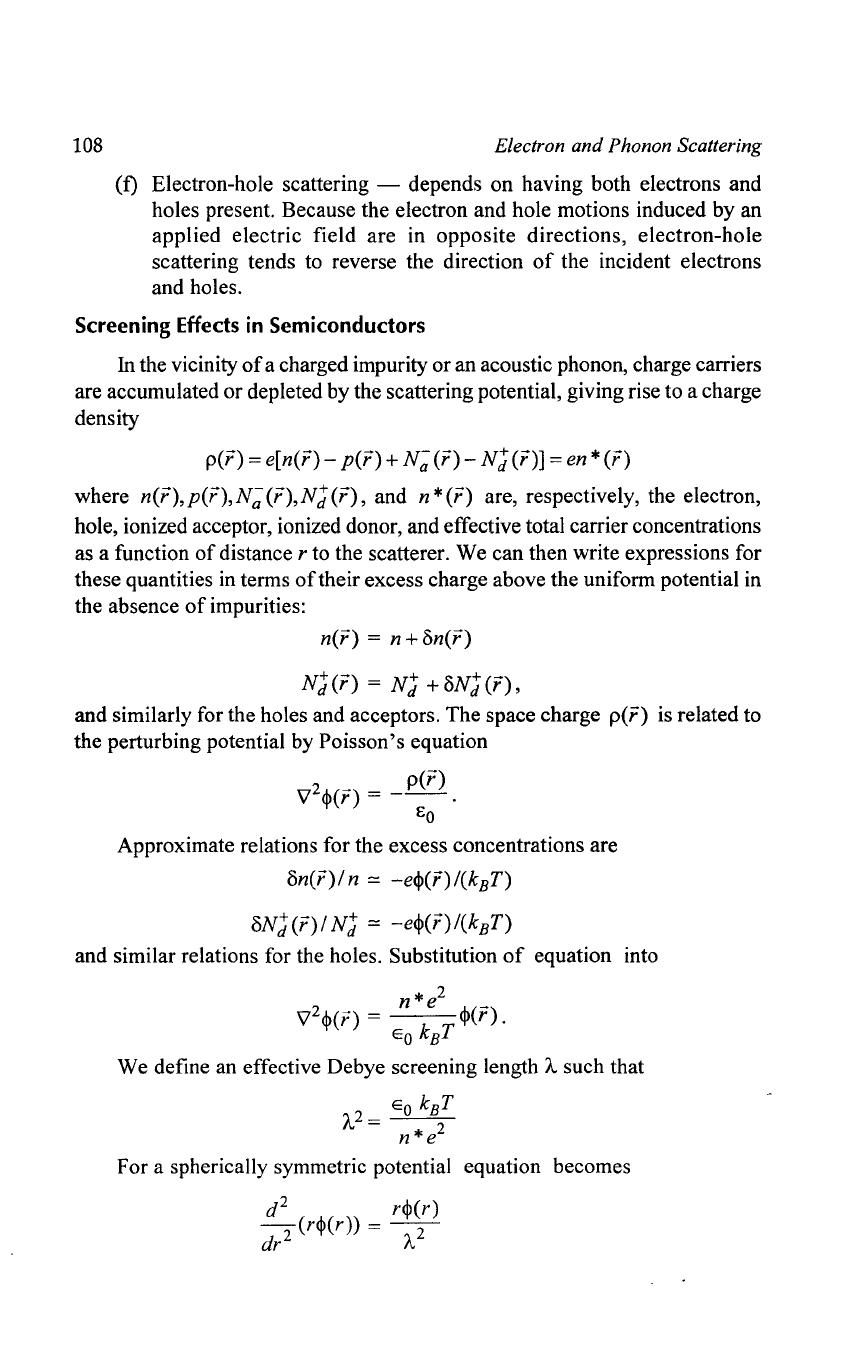
We define an effective Debye screening length').. such that
EO
kBT
')..2
= 2
n*e
For a spherically symmetric potential equation becomes
Electron and Phonon Scattering
which yields a solution
109
2
Ze
-en...
<\l(r)
=
41t
EO
r e
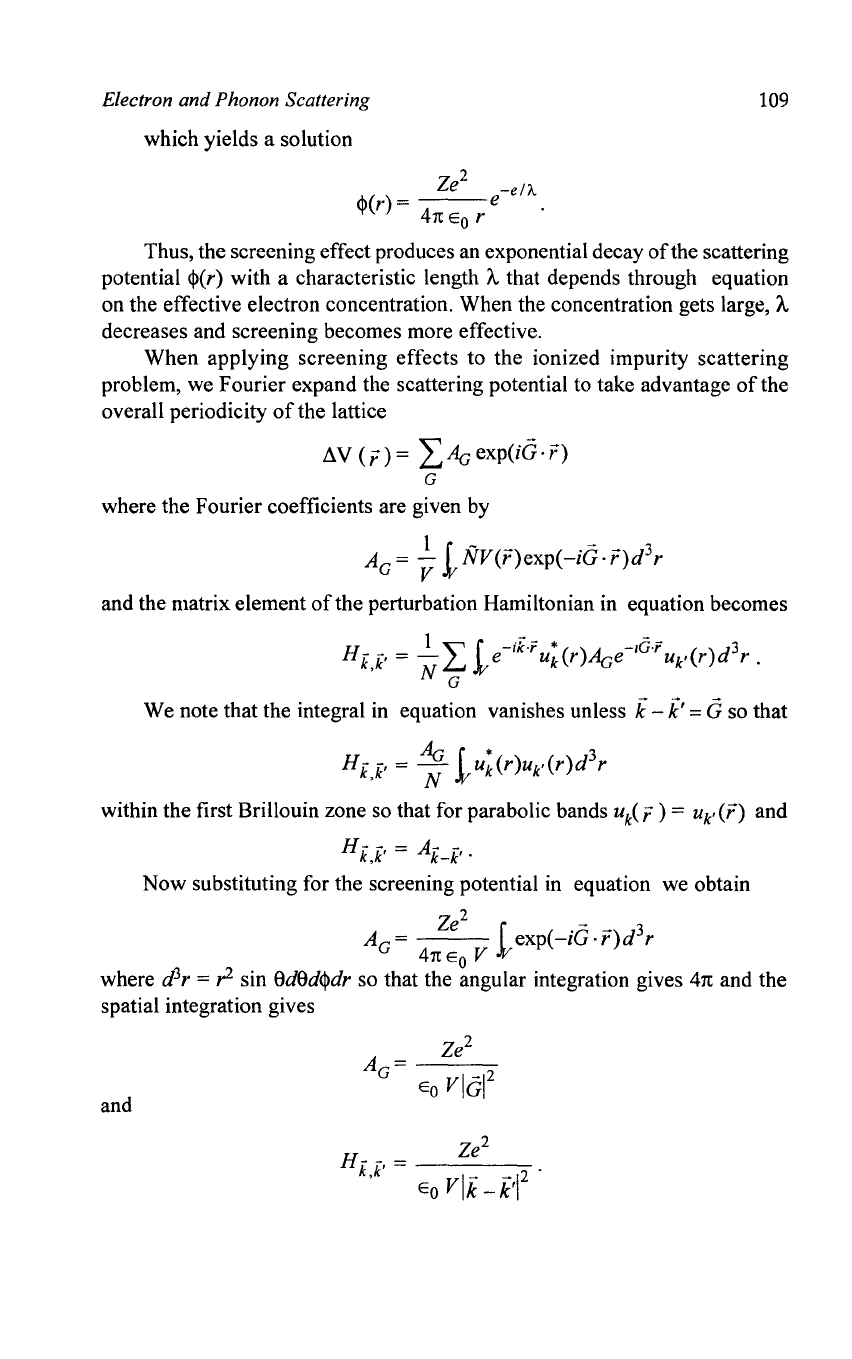
Thus, the screening effect produces an exponential decay
of
the scattering
potential
<\l(r)
with a characteristic length A that depends through equation
on the effective electron concentration. When the concentration gets large,
A
decreases and screening becomes more effective.
When applying screening effects to the ionized impurity scattering
problem, we Fourier expand the scattering potential to take advantage
of
the
overall periodicity
of
the lattice
I1V
(r)
=
LAo
exp(iG·F)
G
where the Fourier coefficients are given by
AG
=
~
1
NV(r)exp(
-iG·
r)d
3
r
and the matrix element
of
the perturbation Hamiltonian in equation becomes
H
I"
r
-ifF
*(
) ,,1_
-IG'r
()d3
k,k'
= N
L.
# e
uk
r '-'(je
Uk'
r r .
G
We note that the integral in equation vanishes unless k -
k'
= G so that
H
f
k'
=
Ao
r
u;(r)uk,(r)d
3
r
,
N#
within the first Brillouin zone so that for parabolic bands u
k
( r ) =
Uk'
(F) and
H
f,k' = Af_f"
Now substituting for the screening potential
in
equation we obtain
Ze
2
_
AG
= r exp(
-iG·
F)d
3
r
41t
EO
V #
where d
3
r =
y2
sin
9d9d<\ldr
so that the angular integration gives
41t
and the
spatial integration gives
and
110 Electron
and
Phonon Scattering
When screening
is
included
in
considering the ionized impurity scattering
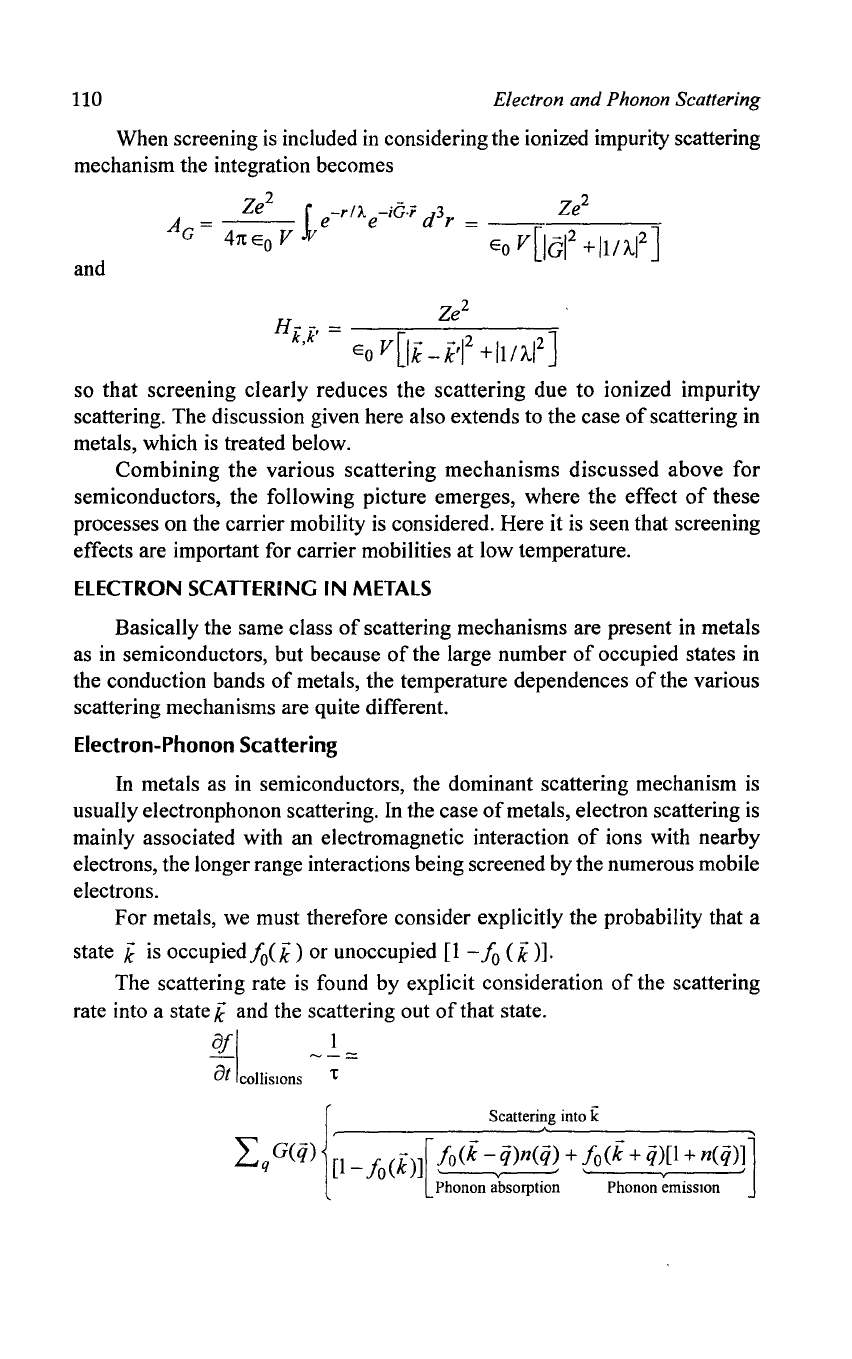
mechanism the integration becomes
Z
2 - Ze
2
e 1
-r
IA
-iG·r
d
3
A=
e e
r=
-----:;-
G
41t
EO
V
EO
V[181
2
+Ilni
]
and
Hi,"£'
=
EO
V[lk
-k'f
+llIAP
]
so that screening clearly reduces the scattering due to ionized impurity
scattering. The discussion given here also extends to the case
of
scattering in
metals, which
is
treated below.
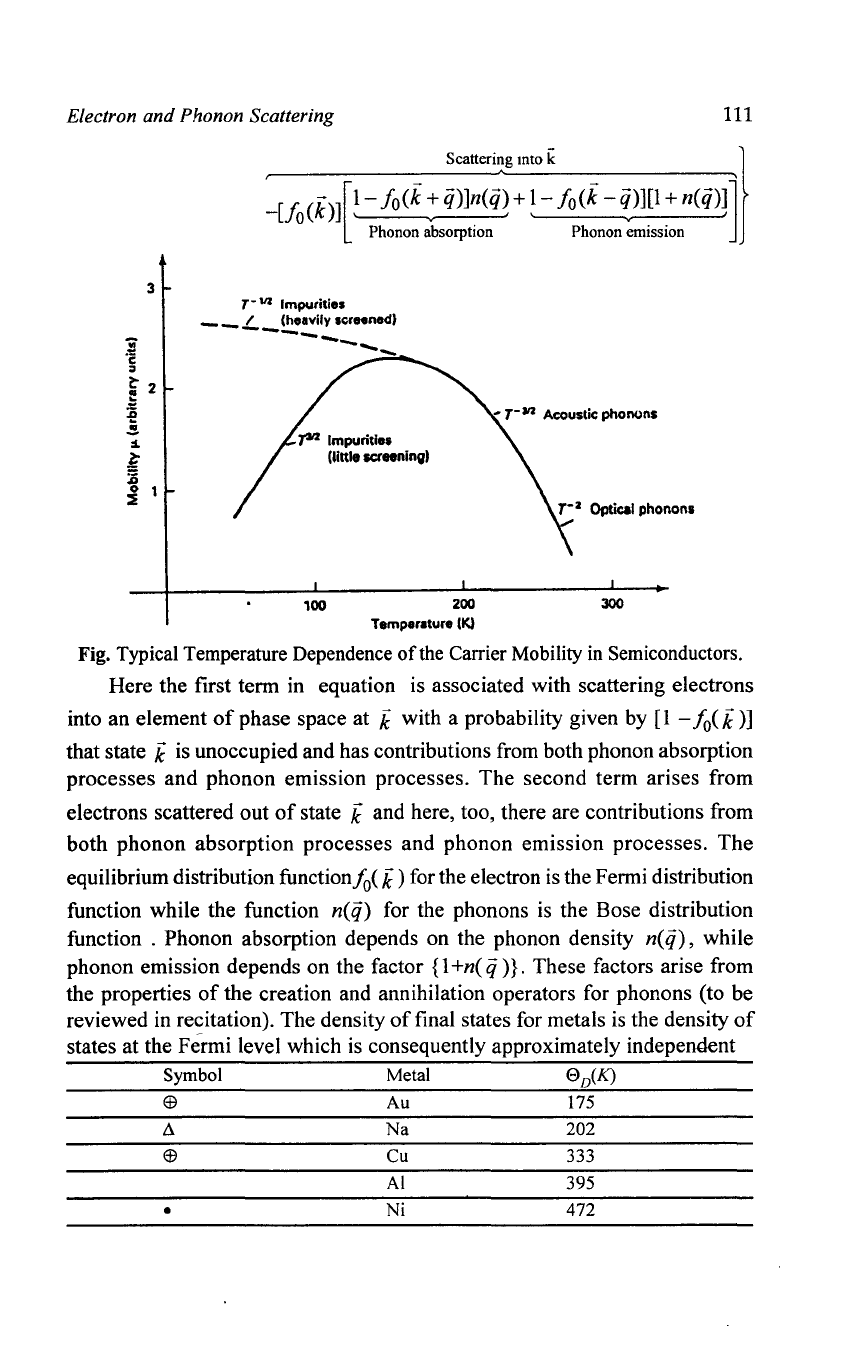
Combining the various scattering mechanisms discussed above for
semiconductors, the following picture emerges, where the effect
of
these
processes on the carrier mobility is considered. Here it is seen that screening
effects are important for carrier mobilities at low temperature.
ELECTRON SCATTERING
IN
METALS
Basically the same class
of
scattering mechanisms are present
in
metals
as in semiconductors, but because
of
the large number
of
occupied states in
the conduction bands
of
metals, the temperature dependences
of
the various
scattering mechanisms are quite different.
Electron-Phonon Scattering
In metals as in semiconductors, the dominant scattering mechanism
is
usually electronphonon scattering.
In
the case
of
metals, electron scattering
is
mainly associated with an electromagnetic interaction
of
ions with nearby
electrons, the longer range interactions being screened by the numerous mobile
electrons.
For metals, we must therefore consider explicitly the probability that a
state
k is occupied
foe
k ) or unoccupied
[1
-
fo
(k
)].
The scattering rate
is
found by explicit consideration
of
the scattering
rate into a state
k and the scattering out
of
that state.
:lcolIislOns
-
~
==
{
Scattering into
k
Lq
G(q)
~1-
fo(k)][~
+
!o(k
+
q~[1
+
n(Q)1]'
Phonon absorption Phonon emissIon
Electron
and
Phonon Scattering
111
3
Scattering Into k }
~[fo(k)][~
-
Jo(k
~
ij)]n(ih
+
~
-
Jo(k
-
~)][1
+
n(ij)~]'
Phonon absorption Phonon emission
T -
lIZ
Impurities
__
L_~avilY
sc;rHnedl
--
---
"(lIZ
Impurities
(Iittl.ICI'Hning)
100
200
Temper.tur.lK)
~
T-Ita Acoustic; phonQns
T-
2
~Iphononl
300
Fig.
Typical
Temperature
Dependence
of
the
Carrier
Mobility
in
Semiconductors.
Here the first term in equation is associated with scattering electrons
into an element
of
phase space at k with a probability given by
[1
- J
o
(
k)]
that state k is unoccupied and has contributions from both phonon absorption
processes and phonon emission processes. The second term arises from
electrons scattered out
of
state k and here, too, there are contributions from
both phonon absorption processes and phonon emission processes. The
equilibrium distribution functionJ
o
(
k)
for the electron
is
the Fermi distribution
function while the function
n(ij) for the phonons
is
the Bose distribution
function.
Phonon absorption depends on the phonon density
n(ij),
while
phonon emission depends on the factor {I
+n(
if
)}.
These factors arise from
the properties
of
the creation and annihilation operators for phonons (to be
reviewed in recitation). The density
of
final states for metals
is
the density
of
states at the Fermi level which
is
consequently approximately independent
Symbol Metal 8
D
(K)
EB
Au
175
!l.
Na 202
EB
eu
333
AI
395
•
Ni 472