
Brewster H.D. Solid State Physics
Подождите немного. Документ загружается.

82
Effective Mass Theory and Transport Phenomena
where
cr
xx
=
ne2rJm:xx
=
ne
Ilxx
and we note that the coefficient (35/2) for this calculation for semiconductors
corresponds to
(1[2/3)
for metals.
Except for numerical constants, the formal results relating the electronic
cont~:b"tion
to the thermal conductivity k
exx
and
cr
xx
are similar for metals
and semiconductors, with the electronic thermal conductivity and electrical
conductivity being proportional.
A major difference between semiconductors and metals is the magnitude
of
the electrical conductivity and hence
of
the electronic contribution to the
thermal conductivity.
Since
cr
xx
is much smaller for semiconductors than for metals,
ke
for
semiconductors is relatively unimportant and
the
thermal conductivity is
dominated by the lattice contribution
k
L
.
Thermal Conductivity for Insulators
In
the
case
of
insulators,
heat
is
only
carried
by
phonons
(lattice
vibrations). The thermal conductivity in insulators therefore depends on phonon
scattering mechanisms. The lattice thermal conductivity is calculated from
kinetic theory and is given
CpVqAph
kL
= 3
where C
p
is the heat capacity,
Vq
is the average phonon velocity and
Aph
is the
phonon mean free path.
The total thermal conductivity
of
a solid is given as the sum
of
the lattice
contribution
kL
and the electronic contribution k
e
.
For metals the electronic
contribution dominates, while for insulators and semiconductors the phonon
contribution dominates. Let us now consider the temperature dependence
of
k
exx
·
At
very low T in the defect scattering range, the heat capacity has a
dependence
C
p
DC
T3 while vq and
Aph
are almost independent
of
T.
As T increases and we enter the phonon-phonon scattering regime due to
normal scattering processes and involving only low
q phonons, C is still
increasing with
Tbut
more slowly that T3 while
Vq
remains independent
of
T
and A
ph
.
As T increases further, the thermal conductivity increases more and more
gradually and eventually starts to decrease because
of
phonon-phonon events
where the density
of
phonons available for scattering depends on [exp(lico/
kBT) -
1].
This causes a peak in kL(T).
Effective Mass Theory
and
Transport Phenomena
83
200
-
100
f
~
-
I
E
50
:oJ
~
-=
~.
20
>
-,;::;
U
:l
""0
10
c
8
;a
c
5
i:
~
~
2
1
1
5
20
100
Temperature, K
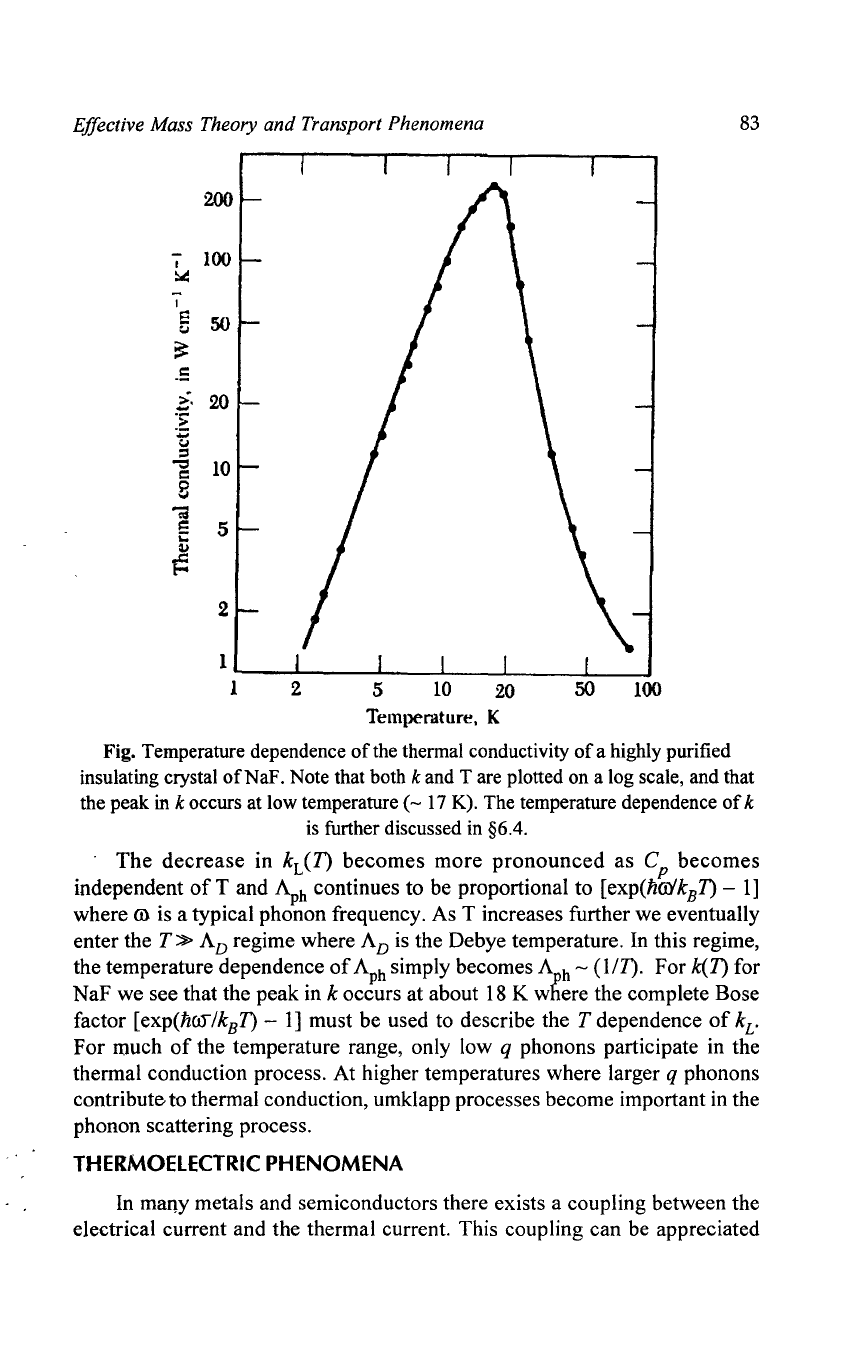
Fig. Temperature dependence
of
the
thermal conductivity
of
a highly purified
insulating crystal ofNaF_ Note that both
k
and
T
are
plotted
on
a
log
scale, and that
the peak
in
k occurs
at
low
temperature
(-
17
K).
The
temperature dependence
of
k
is
further discussed
in
§6.4.
.
The
decrease
in k
L
(1)
becomes
more
pronounced
as C
p
becomes
independent
ofT
and Aph continues to be proportional to
[exp(hID'kB1)
-
1]
where ID is a typical phonon frequency. As T increases further we eventually
enter the
T>
AD
regime where
AD
is the Debye temperature. In this regime,
the temperature dependence
of
Aph simply becomes Ayh - (1/1). For k(1) for
NaF
we
see that the peak in k occurs at about
18
K where the complete Bose
factor
[exp(hculk
B
1) -
1]
must be used to describe the T dependence
of
kr-
For much
of
the temperature range, only low q phonons participate in the
thermal conduction process. At higher temperatures where larger q phonons
contribute to thermal conduction, umklapp processes become important in the
phonon scattering process.
THERMOELECTRIC
PHENOMENA
In many metals and semiconductors there exists a coupling between the
electrical current and the thermal current. This coupling can be appreciated
84
Effective Mass Theory
and
Transport Phenomena
by observing that when electrons carry thermal current, they are also
transporting charge and therefore generating electric field
s.
This coupling
between the charge transport and heat transport gives rise to thermoelectric
phenomena.
In
our discussion
of
thermoelectric phenomena
we
start with a
general derivation
of
the coupled equations for the electrical current density
J and the thermal current density
(j:
(j
=
~
fv(E-EF).lid3k
4n
and the perturbation to the distribution function!! is found from solution
of
Boltzmann's equation in the relaxation time approximation:
v .
81
+
k.
aj._
=
(f
-
fo)
ar
ak
't
which
is
written here for the case
of
time independent forces and field
s.
Substituting for
(af
I
ar)
from Eqs. 5.8 and 5.15, for
af
I
ok
from equation,
and for
81
I
ok
= (ofo I aE) (aE I
ak)
yields
v·
(81
0
I
OE)[C
eE
- V E
F
)
(E
- E
F
)
(VT)]
=
_.Ii
T
't'
so that the solution to the Boltzmann equation in the presence
of
an electric
field and a temperature gradient
is
fl
=
v't·(8foloE){[(E-EF)IT]V'T-eE+VEF}·
The electrical and thermal currents
in
the presence
of
both an applied
electric field and a temperature gradient can thus be obtained by substituting
fl
into J and
(j
in Eqs. 5.39 and 5.40 to
yield
expressions
of
the
-:
2-
-
1-
- -
form:)
=e
ko
·(E--VEF)-(eIT)kl·VT
e
and(j=
ek
l
-(
E-~VEF
)-(lIT)k
2
·VT
where
ko
is related to the conductivity tensor
cr
by
and
Effective Mass Theory and Transport Phenomena
85
k = _1_
fr:VV(E
-
EF
)(_
810
)d
3
k
1 4n
3
aE'
and
k2
is related to the thermal conductivity tensor
ke
by
k2
=
~
f-r;vv(E-E
F
)2(-8!0/8E)d
3
k=Tk
e
4n
Note that the integrands for
kl
and
k2
are both related to that for
ko
by
introducing factors
of(E
- E
F
) and (E -
EF)2,
respectively. Note also that the
same integral
kl
occurs
in
the expression for the electric current J induced
by a thermal gradient
VT
arid in the expression for the thermal current
fj
induced by an electric field jj;. The motion
of
charged carriers across a
temperature gradient results in a flow
of
electric current expressed by the term
-(e
IT)(k
l
)·
VT
. This term is the origin
of
thermoelectric effects.
The discussion up to this point has been general.
If
specific boundary
conditions are imposed, we obtain a variety
of
thermoelectric effects such as
the
Seebeck effect, the Peltier effect and the Thomson effect.
We
now define
the conditions under which each
of
these thermoelectric effects occur.
We define the thermopower
S (Seebeck coefficient) and the Thomson
coefficient
Tb
under conditions
of
zero current flow. Then referring to equation,
we obtain under open circuit conditions
-:
2-
-
1-
- -
} =O=e
ko·(E--VEF)-(eIT)kl·VT
e
so that the Seebeck coefficient S
is
defined by
- 1 -
--I
- -
--
E
--VEF
= (lIeT)ko
·k
l
·
VT
=S·
VT
e
the Definition for the Thomson coefficient
Tb
jj;
=
(~
a:;
+ S ) V T
==
Tb
. V T
a -
where
T
-
S
aT
_
For many thermoelectric systems
of
interest, S has a linear temperature
dependence, and
in
this case it follows from equation that
Tb
and S are
almost equivalent for practical purposes. Therefore the
Seebeck and Thomson
coefficients are used almost interchangeably
in
the literature.
From equation we have
- 1 -
S = (1/
eT)ko
.
kl
86 Effective Mass Theory
and
Transport Phenomena
which
is
simplified by assuming an isotropic medium, yielding the scalar
quantities
s=
(lIel)
(k/k
o
).
However in an anisotropic medium the tensor components of$S are found
from
SIj
=
(lIel)
(k-J),cx
(k1)CXj'
where the Einstein summation convention
is
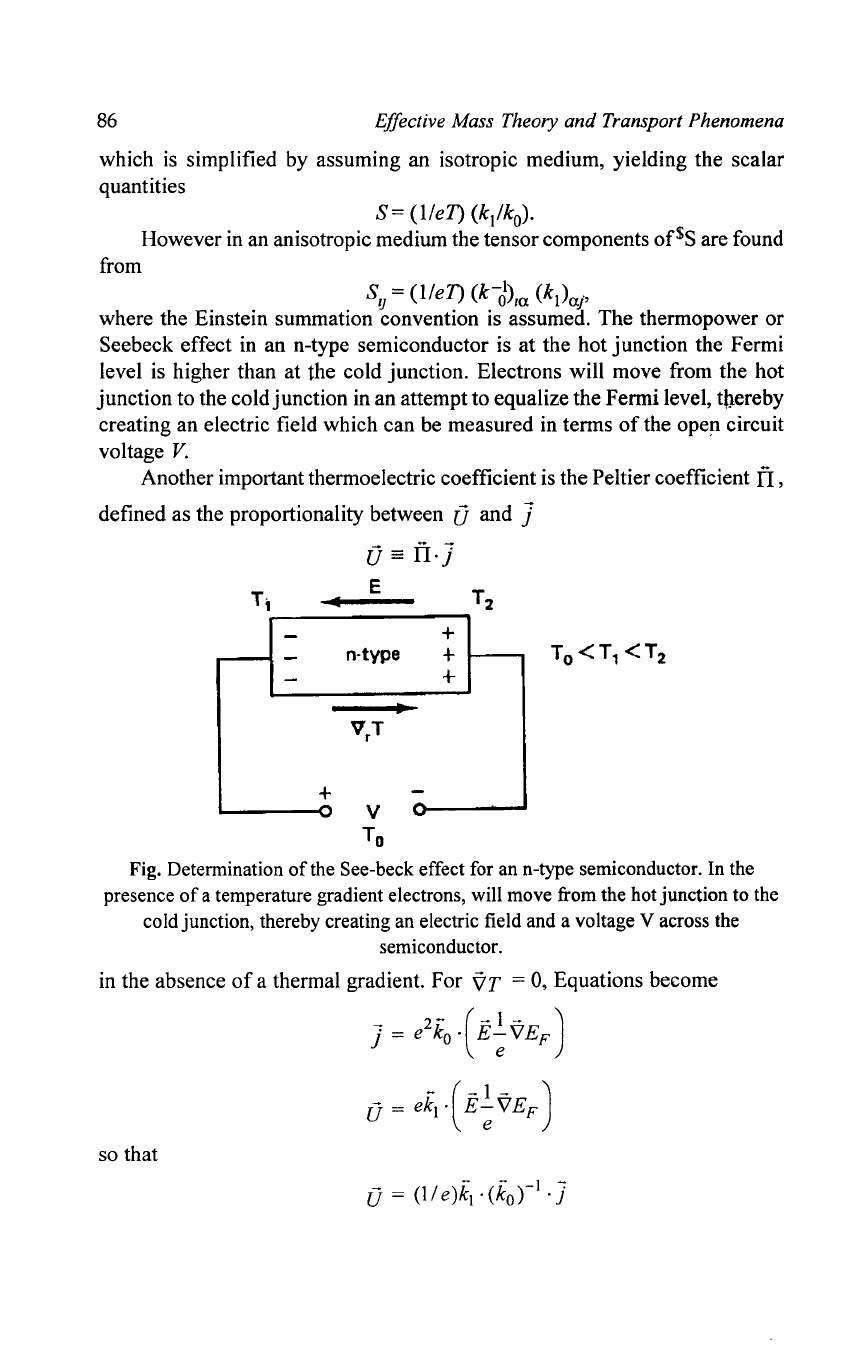
assumed. The thermopower or
Seebeck effect
in
an n-type semiconductor is at the hot junction the Fermi
level is higher than at the cold junction. Electrons will move from the hot
junction to the cold junction in an attempt to equalize the Fermi level,
tbereby
creating an electric field which can be measured in terms
of
the open circuit
voltage
v.
Another important thermoelectric coefficient is the Peltier coefficient
IT
,
defined as the proportionality between (j and J
(j=IT·J
T;
E
T2
II
+
-
n-type
+
r--
To<T1<T2
+
•
VrT
+
~
V
...
To
Fig. Detennination
of
the See-beck effect for
an
n-type semiconductor. In the
presence
of
a temperature gradient electrons, will move from the hot junction to the
cold junction, thereby creating an electric field and a voltage
V across the
semiconductor.
in the absence
of
a thermal gradient. For
VT
=
0,
Equations become
_
2-
(-1
- )
j = e ko·
E-;VEF
so that
Effective Mass Theory
and
Transport Phenomena
=
n.]
where
- - -
--I
IT -
(l/e)kl
·(k
o
)
Comparing Eqs. 5.53 and 5.60 we see that
nand
s are related by
n =
TS
,
87
where T is the temperature. For isotropic materials the Peltier coefficient thus
becomes a scalar,
and is proportional to the thermopower S :
1
IT=
-(k
1
Ik
o
)=TS,
e
while for anisotropic materials the tensor components
of
n can be found
in analogy with equation.
We
note that both
sand
n exhibit a linear
dependence on e and therefore depend explicitly on the sign
of
the carrier,
and measurements
of
S
or
n can be used to determine whether transport is
dominated by electrons
or
holes.
We have already considered the evaluation
of
ko
in treating the electrical
conductivity and
k2
in treating the thermal conductivity. To treat thermoelectric
phenomena
we
need now to evaluate kl
kl
=
4~3
f'tw(E-E
F
)(-8!oI8E)d
3
k.
In §5.3.1 we evaluate
kl
for the case
of
a metal and in §5.3.2
we
evaluate
kl
for the case
of
the electrons in an intrinsic semiconductor.
Thermoelectric Phenomena
in
Metals
All thermoelectric effects in metals depend on the tensor
kl
which we
evaluate below for the case
of
a metal. We can then obtain the thermopower
1 - - 1
S =
-(k
1
·k
o
)
or the Peltier coefficient
or the Thomson coefficient
eT
_ 1 -
--I
IT
=
-(k
1
ok
o
)
e
88
Effective Mass Theory and Transport Phenomena
a -
r,
-
=
T-S
b
aT·
To evaluate
kl
for metals
we
wish to exploit the
<5-function
behaviour
of
(-allaE).
This is accomplished by converting the integration d
3
k to an
integration over dE and a constant energy surface,
d3k=
J2s
dElhv. From Fermi
statistics we have the general relation
fG(E)(-
a/O)dE=G(E
F
)+
n
2
(kBT)2[a
2
G]
+ ...
aE 6
aE
2
EF
For the integral in equation which defines kl' we can write
G(E) =
g(E.l
(E - E
F)
where
g(E)=
~
ftwd2SIv
4n
and the integration in equation is carried out over a constant energy surface
at energy
E.
Differentiation
of
G(E) then yields
G'(E) = g'(E)(E - E
F)
+ g(E)
Gil (E) = g"(E)
(E
- E
F
)
+ 2g'(E).
Evaluation
at
E = EF yields
G(E
F
)
= 0
Gil
(E
F
)
= 2g'(E
F
).
We therefore obtain
- n
2
k
2,(
)
kl
=
3(
BT) g EF .
We interpret
g'(E
F)
in equation to mean that the same integral
ko
which
determines the conductivity tensor
is
evaluated on a constant energy surface
E, and
g'(E
F)
is
the energy derivative
of
that integral evaluated at the Fermi
energy~.
The temperature dependence
of
g'(E
F
)
is
related to the temperature
dependence
of't,
since v
is
essentially temperature independent. For example,
the acoustic phonon scattering
in
the high temperature limit
T»
0
D
yields a
temperature dependence
T
~
r-'
so that
k,
in this important case for metals
will be proportional to
T.
For a spherical constant energy surface E =
/i
2
k
2
12m * and assuming a
relaxation time
't that
is
independent
of
energy, we can readily evaluate equation
to obtain
Effective Mass Theory
and
Transport Phenomena
and
=
_'t_(2m*)3/2
E1I2(k T)2
kl 6m*
h2
F B
Using the same approximations, we can write for
ko:
k =
't
(2m
*)3/2
E1I2
o
31t2m*
h
2
F
so that from equation we have for the Seebeck coefficient
1t
2
k
B
kBT
S=----
2e E
F
·
89
From equation we see that S exhibits a linear dependence on T and a
sensitivity to the sign
of
the carriers. We note from equation that a low carrier
density implies a large
S value.
Thus degenerate (heavily doped with
n
_10
18
_
10
19
fcm
3
)
semiconductors
tend to have higher thermopowers than metals.
Thermopower for
Semiconductors
We evaluate
kl
for electrons
in
an intrinsic or lightly doped semiconductor
for illustrative purposes. Intrinsic semiconductors are not important for practical
thermoelectric devices since the contributions
of
electrons and holes to
kl
are
of
opposite
signs
and
tend
to
cancel.
Thus
it
is
only
heavily
doped
semiconductors with a single carrier type that are important for thermoelectric
applications.
The evaluation
of
the general expression for the integral k
j
k =
_1_
fT.vv(E
-
EF
)(_
a/
o
)d
3
k
I
4n
3
aE
is
different for semiconductors and metals. An intrinsic semiconductor we
need to make the substitution
(E - E
F)
~
E
in
equation, since only conduction
electrons can carry heat. The equilibrium distribution function for an intrinsic
semiconductor can be written as
90
Effective Mass Theory
and
Transport Phenomena
so that
a.to =
__
I_e-E1(kBT)e
-/EFI/(kBT)
BE
kBT
To evaluate d
3
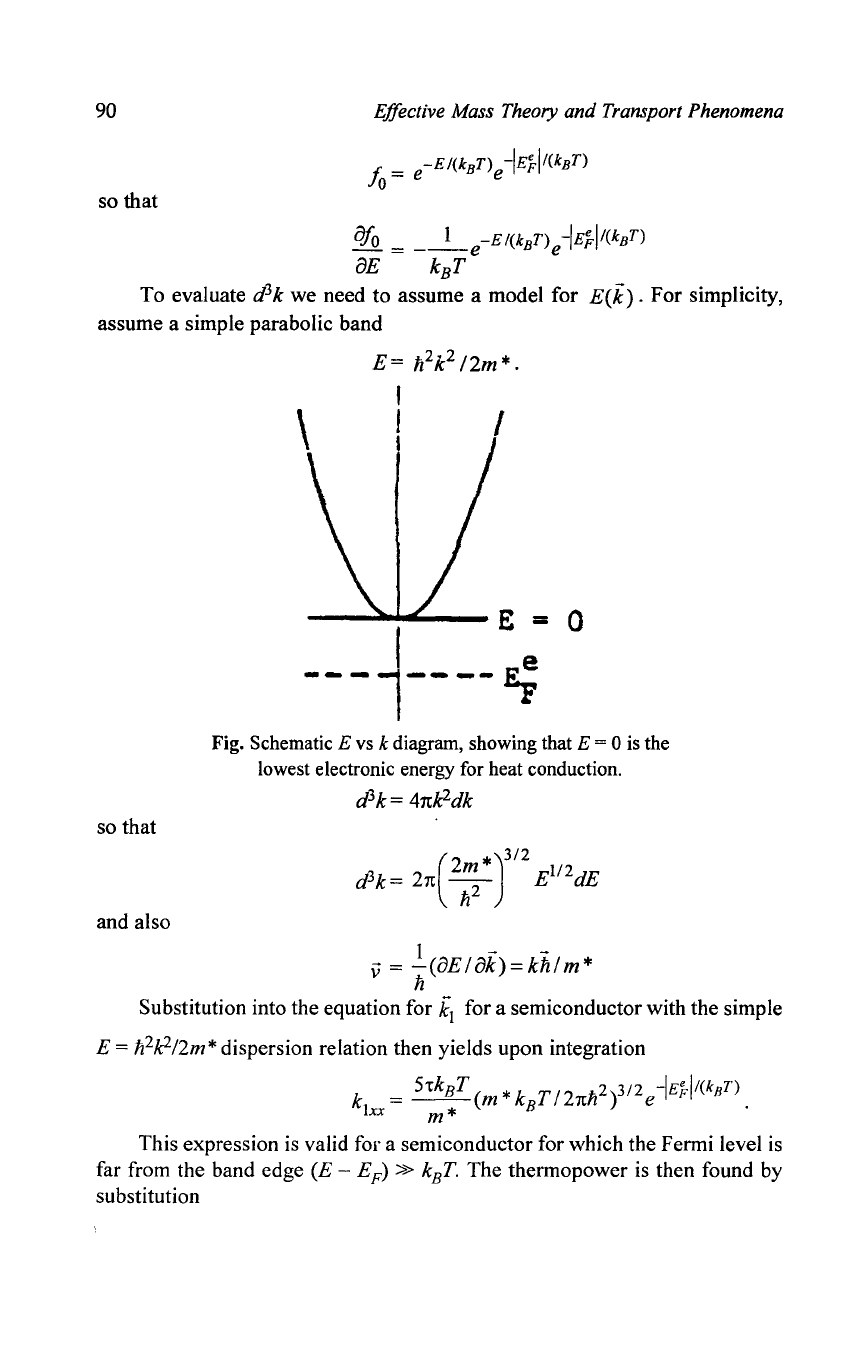
k we need to assume a model for
E(k).
For simplicity,
assume a simple parabolic band
so that
and also
E=
1i
2
k
2
12m
*.
Fig. Schematic E vs k diagram, showing that E = 0 is the
lowest electronic energy for heat conduction.
d
3
k=
41tt2dk
1
--
v =
-(BEIBk)=klilm*
Ii
Substitution into the equation for k
J
for a semiconductor with the simple
E =
12
2
t2/2m * dispersion relation then yields upon integration
= 5'tkBT (m * k T I
2n122)3/2
e -/EFI/(kBT)
~D
* B .
m
This expression is valid for a semiconductor for which the Fermi level
is
far from the band edge (E - E
F
) »
kBT.
The thermopower
is
then found by
substitution
Effective Mass Theory and Transport Phenomena
91
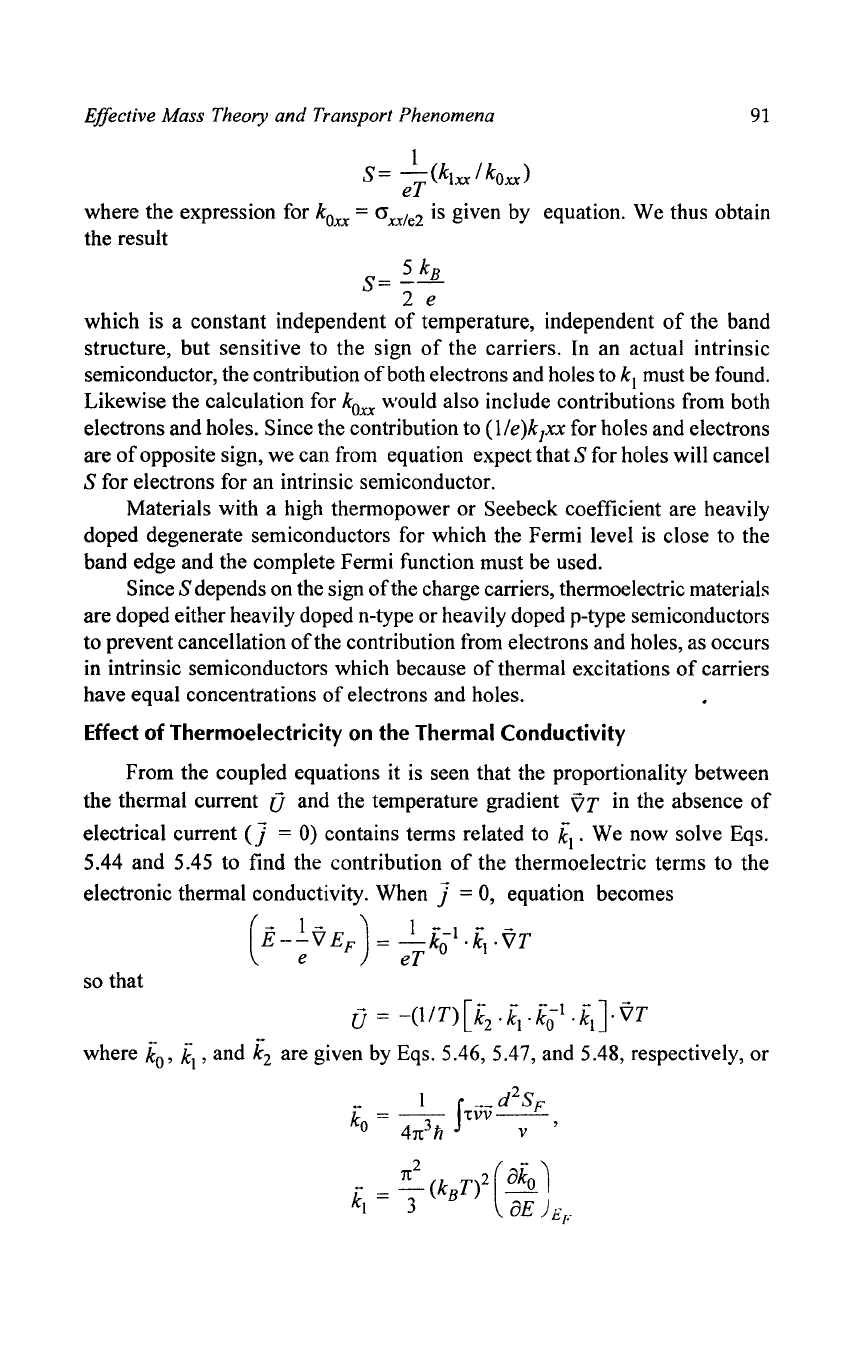
1
S =
-(klxx
/ k
oxx
)
eT
where the expression for
koxx
=
(Jxxle2
is given by equation. We thus obtain
the result
s=
~kB
2 e
which is a constant independent
of
temperature, independent
of
the band
structure, but sensitive to the sign
of
the carriers. In an actual intrinsic
semiconductor, the contribution
of
both electrons and holes to kl must
be
found.
Likewise the calculation for
koxx
would also include contributions from both
electrons and holes. Since the contribution to
(l/e)k]xx
for holes and electrons
are
of
opposite sign, we can from equation expect that S for holes will cancel
S for electrons for an intrinsic semiconductor.
Materials with a high thermopower or Seebeck coefficient are heavily
doped degenerate semiconductors for which the Fermi level
is
close to the
band edge and the complete Fermi function must be used.
Since
S depends on the sign
of
the charge carriers, thermoelectric materials
are doped either heavily doped n-type or heavily doped p-type semiconductors
to prevent cancellation
of
the contribution from electrons and holes, as occurs
in intrinsic semiconductors which because
of
thermal excitations
of
carriers
have equal concentrations
of
electrons and holes.
Effect
of
Thermoelectricity on the Thermal Conductivity
From the coupled equations it is seen that the proportionality between
the thermal current
0 and the temperature gradient VT in the absence
of
electrical current
<J
= 0) contains terms related to k
1
•
We now solve Eqs.
5.44 and 5.45 to find the contribution
of
the thermoelectric terms to the
electronic thermal conductivity. When
J =
0,
equation becomes
(
E-J..
V
EF)
=
_1
k
a
1
.k
I
.VT
e
eT
so that
0=
-(IIT)[k
2
·k
l
·k
a
I
.kJ·VT
where
ko'
kI'
and
k2
are given by Eqs. 5.46, 5.47, and 5.48, respectively, or
2
- 1
S-_dS
F
k
=--
'tvv--
o 4n
3
h
v'