
Brewster H.D. Solid State Physics
Подождите немного. Документ загружается.

272
Electronic Bands
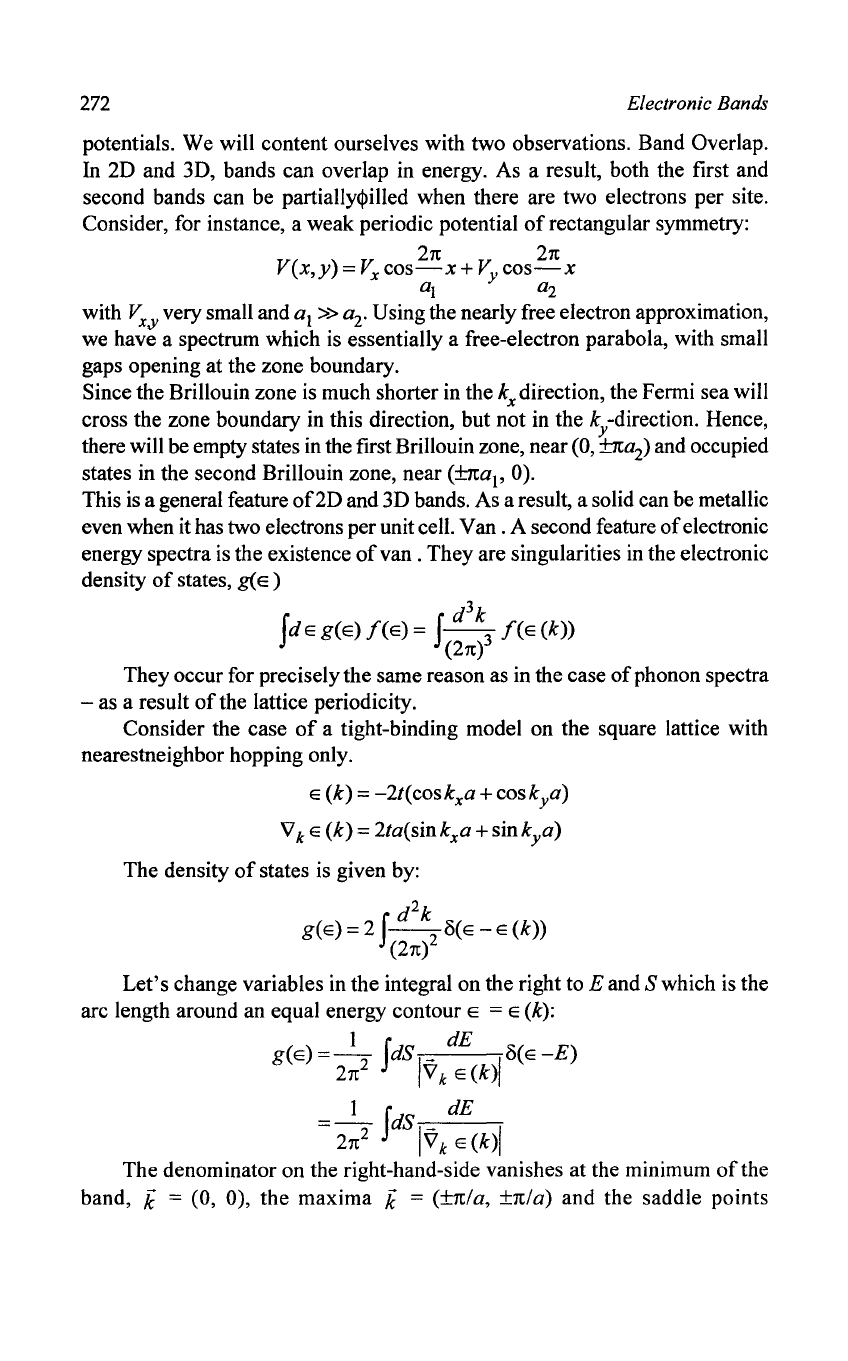
potentials. We will content ourselves with two observations. Band Overlap.
In 2D and 3D, bands can overlap in energy. As a result, both the first and
second bands can be
partially</>illed
when there are two electrons per site.
Consider, for instance, a weak periodic potential
of
rectangular symmetry:
2n 2n
V(x,y)
=
Vx
cos-x
+
Vy
cos-x
al
a2
with VXJ' very small and a
l
»a
2
.
Using the nearly free electron approximation,
we have a spectrum which is essentially a free-electron parabola, with small
gaps opening at the zone boundary.
Since the Brillouin zone is much shorter in the
kx
direction, the Fermi sea will
cross the zone boundary in this direction, but not in the ky-direction. Hence,
there will be empty states in the first Brillouin zone, near (0,
±rca
2
)
and occupied
states in the second Brillouin zone, near
(±rca
l
,
0).
This
is
a general feature
of2D
and 3D bands. As a result, a solid can be metallic
even when it has two electrons per unit cell.
Van.
A second feature
of
electronic
energy spectra is the existence
of
van . They are singularities
in
the electronic
density
of
states,
g(
e )
d
3
k
Ide
gee)
fee)
=
f-3
feE
(k))
(2n)
They occur for precisely the same reason as in the case
of
phonon spectra
- as a result
of
the lattice periodicity.
Consider the case
of
a tight-binding model on the square lattice with
nearestneighbor hopping only.
e (k) =
-2t(coskxa
+ coskya)
V k e (k) = 2ta(sink
x
a
+sinkya)
The density
of
states is given by:
d
2
k
gee) = 2
f--2
D(e
- e
(k))
(2n)
Let's
change variables in the integral on the right to E and S which is the
arc length around an equal energy contour
e = e (k):
1 f dE
g(e)
=-2
dS
I
_
ID(e-E)
2n V k e
(k)
=_1_
fdS
dE
2n2
IV
k e
(k)1
The denominator on the right-hand-side vanishes at the minimum
of
the
band,
k = (0, 0), the maxima k = (±1t/a, ±1t/a) and the saddle points
Electronic Bands
273
k = (±Tela, 0), (0, ±Tela). At the latter points, the density
of
states will have
divergent slope.
THE
FERMI
SURFACE
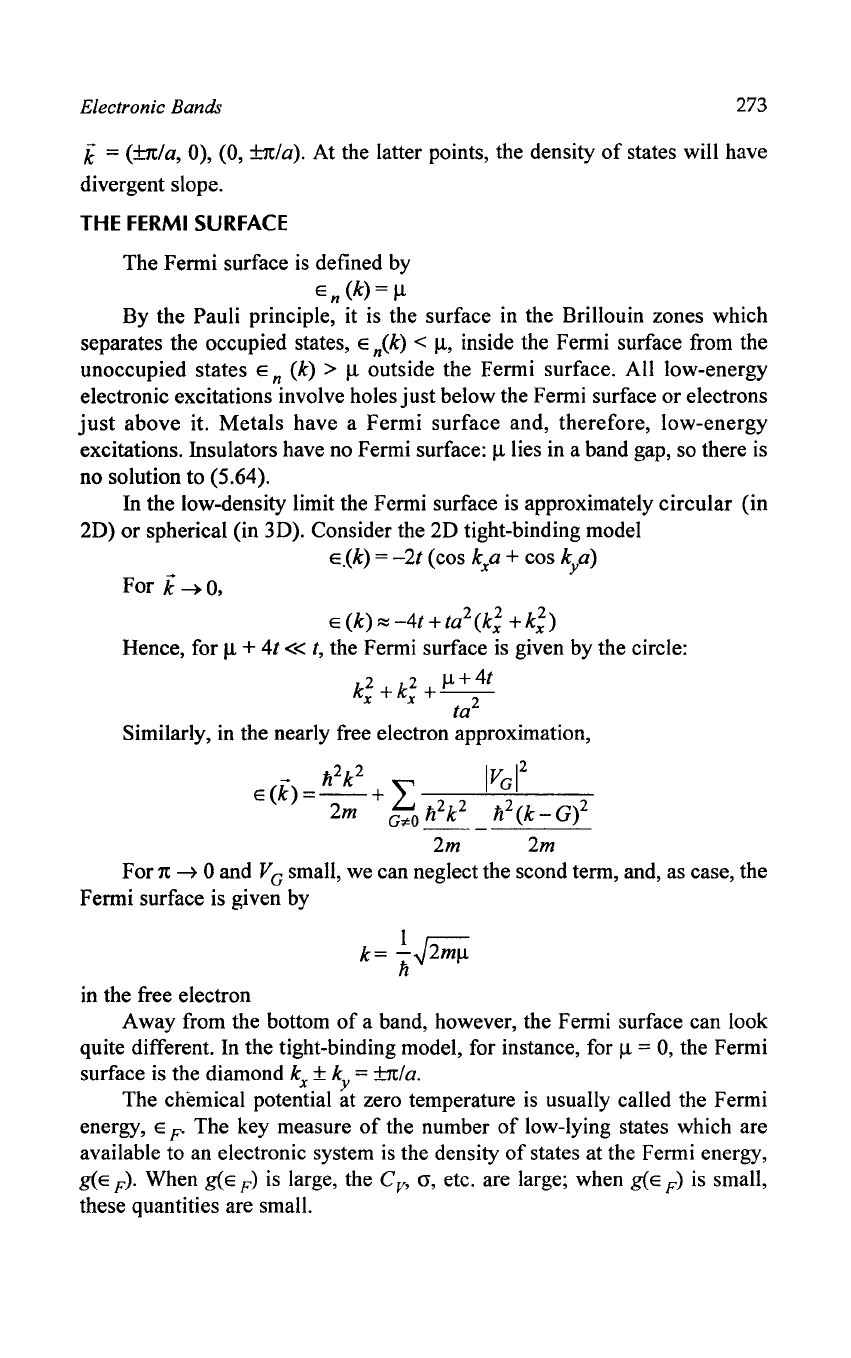
The Fenni surface
is
defined by
En
(k)=
~
By the Pauli principle, it is the surface in the Brillouin zones which
separates the occupied states,
E
ik)
<
~,
inside the Fenni surface from the
unoccupied states
En
(k) >
~
outside the Fermi surface. All low-energy
electronic excitations involve holes
just
below the Fenni surface or electrons
just
above it. Metals have a Fermi surface and, therefore, low-energy
excitations. Insulators have no Fermi surface:
~
lies in a band gap, so there is
no solution to (5.64).
In the low-density limit the Fcnni surface is approximately circular (in
2D) or spherical (in 3D). Consider the 2D tight-binding model
For
k
~O,
E.(k) =
-2t
(cos
kp
+ cos kya)
E
(k)
R::
-4t
+ ta
2
(k;
+
k;)
Hence, for
~
+
4t«
t,
the Fenni surface
is
given by the circle:
k
2 k2
Jl+
4t
x + x
+--2-
fa
Similarly, in the nearly free electron approximation,
_ h
2
k
2
IV;
12
E(k)=-+"
G
2m
ito
h
2
k
2
_
h2(k_G)2
2m 2m
For
1t
~
0 and V G small, we can neglect the scond tenn, and, as case, the
Fenni surface is given by
in the free electron
Away from the bottom
of
a band, however, the Fenni surface can look
quite different.
In
the tight-binding model, for instance, for
~
=
0,
the Fenni
surface is the diamond
kx ± ky =
±Tela.
The chemical potential at zero temperature
is
usually called the Fermi
energy,
E F. The key measure
of
the number
of
low-lying states which are
available to an electronic system is the density
of
states at the Fenni energy,
g(
E
F).
When
g(
E
F)
is large, the C
v'
cr,
etc. are large; when
g(
E
F)
is small,
these quantities are small.
274
Electronic Bands
METALS,
INSULATORS,
AND
SEMICONDUCTORS
Earlier we saw that, in order to compute the vibrational properties
of
a
solid, we needed to determine the phonon spectra
of
the crystal. A characteristic
feature
of
these phonon spectra
is
that there is always an acoustic mode with
roCk)
- k for k small. This mode
is
responsible for carrying sound in a solid,
and it
,.~w~ys
gives a
C~
-
T3
contribution to the specific heat.
In order to compute the electronic properties
of
a solid, we must similarly
determine
the
electronic spectra.
If
we
ignore the interactions
between
electrons, the electronic spectra are determined by the single-electron energy
levels in the periodic potential due to the ions.
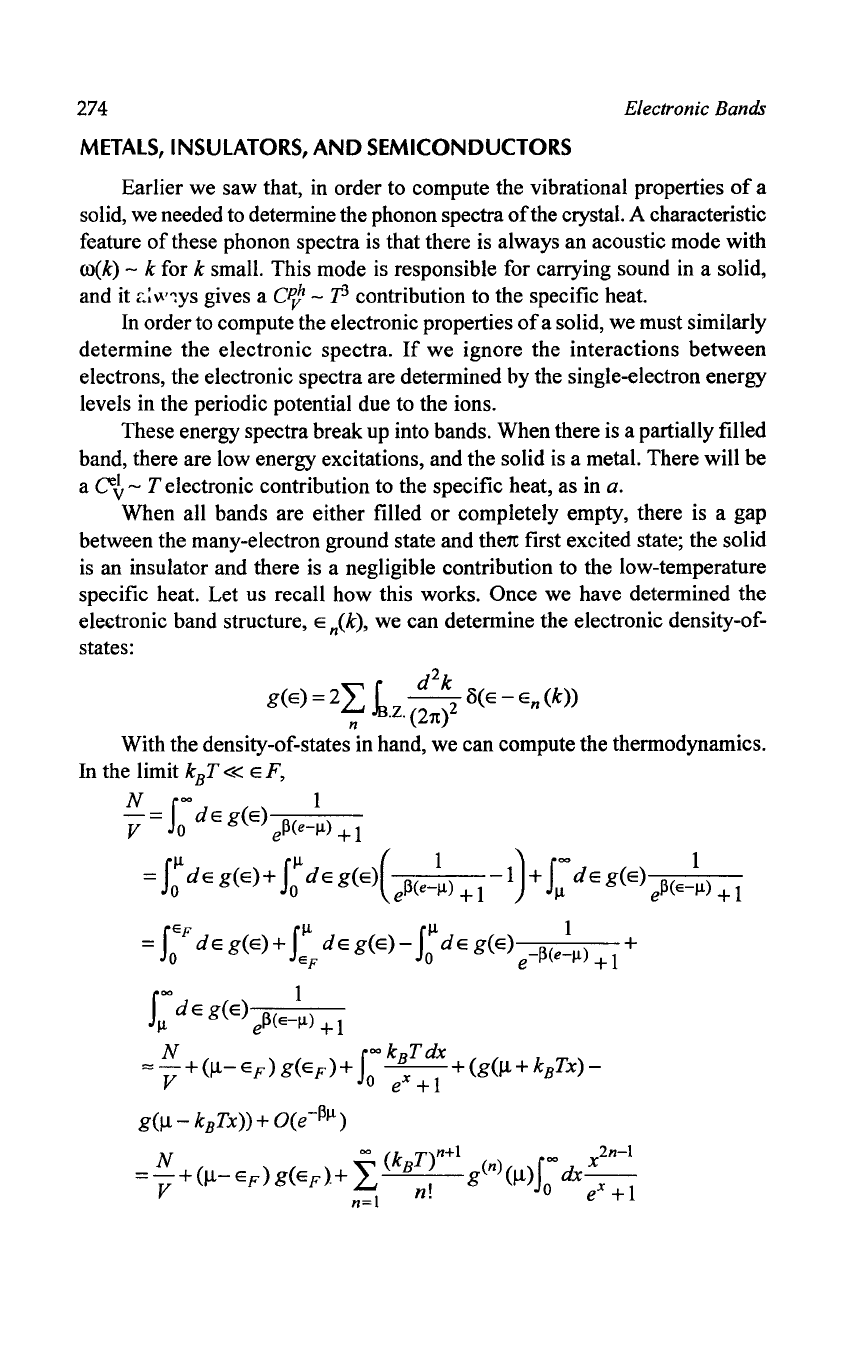
These energy spectra break up into bands. When there is a partially filled
band, there are low energy excitations, and the solid is a metal. There will be
a
cet
~
T electronic contribution to the specific heat, as in
Q.
When all bands are either filled
or
completely empty, there is a gap
between the many-electron ground state and
then first excited state; the solid
is
an insulator and there is a negligible contribution to the low-temperature
specific heat. Let us recall how this works.
Once we have determined the
electronic band structure,
E n(k), we can determine the electronic density-of-
states:
d
2
k
g(E)=2L
r
--20(E-En(k»
n
Js.z.
(21t)
With the density-of-states in hand, we can compute the thermodynamics.
In
the limit kBT « E F,
N
roo
1
V = J
o
dE
geE)
e~(e-~)
+ 1
=
r~
dEg(E)+
r~
dEg(E)(
~(_1)
-1)+
roo
dEg(E)
~(
_1)
Jo
J
o
e e
~
+ 1
J~
e E
~
+ 1
Electronic Bands
We
will
only
need
1t
2
1
1
=-
6
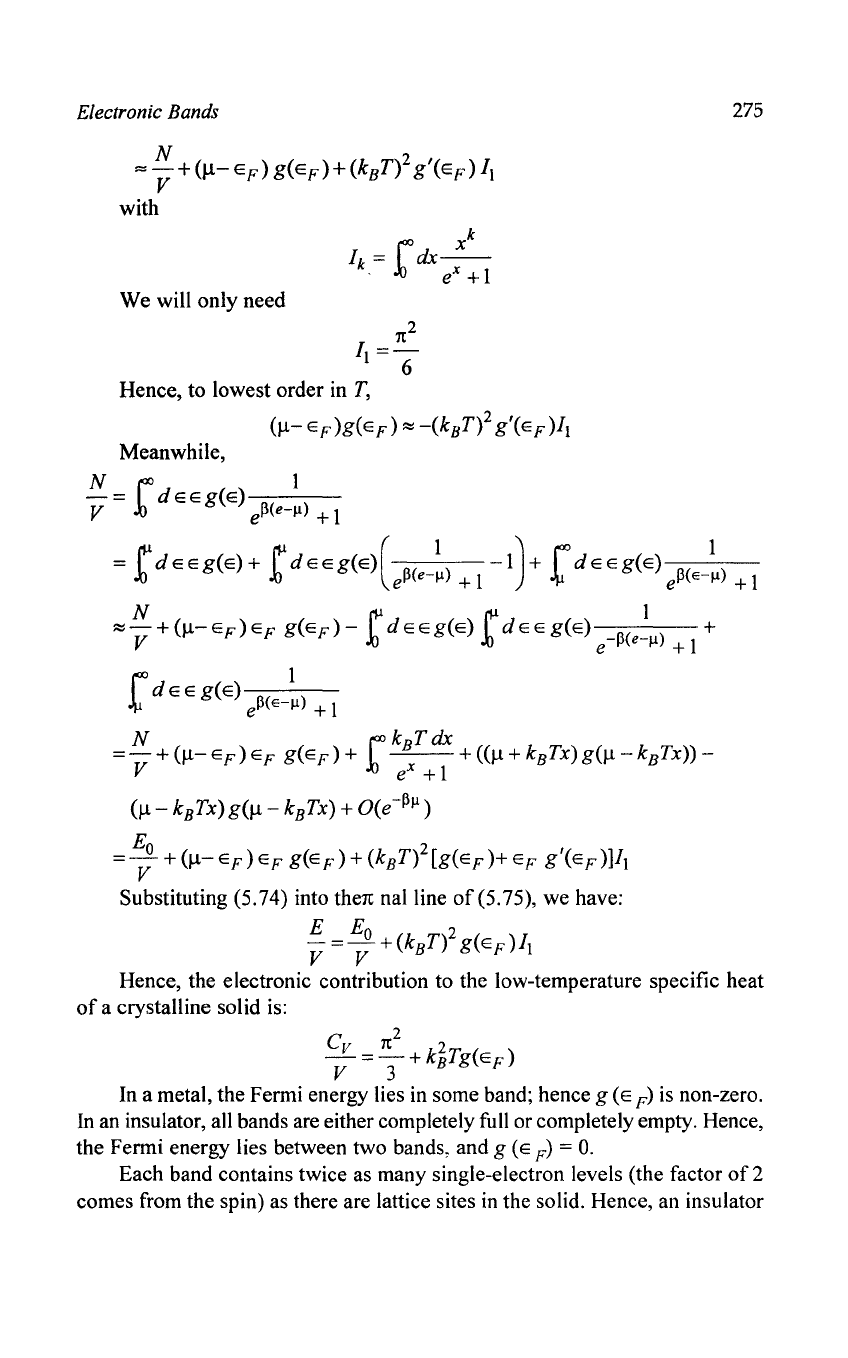
Hence, to lowest order in
T,
(Jl-
EF
)g(EF)
~
-(k
B
T)2
g'(EF)ft
Meanwhile,
N r 1
-=
dEEg(E)
P(
)
Vee-I!
+ 1
275
= r
dEEg(E)+
r
dEEg(E)Cp(e_~)
+1
-1)+
r
dEEg(E)
eP(E-~)
+1
~
N
+(Jl-EF)EF
g(EF)-
f
dEEg(E)
f
dEEg(E)
P(
1)
+
V
.b.b
e -
e-I!
+ 1
r
dEE
geE)
eP(E-~)
+ 1
N
rkBTdx
=-
+
(Jl-
EF)
EF
g(EF)
+ +
«Jl
+ ksTx)
g(Jl-
ksTx»-
V
eX
+ 1
(Jl-
ksTx)
g(Jl-
ksTx) + O(e -PI!)
Eo
2,
=-+(Jl-EF)EF
g(EF)+(ksT)
[g(EF)+EF
g
(EF)]!t
V
Substituting (5.74) into the1t
nalline
of
(5.75),
we
have:
E
Eo
2
-
=-+(ksT)
g(EF )/1
V V
Hence, the electronic contribution to the low-temperature specific heat
of
a crystalline solid is:
2
C
v
1t 2
-=-+kBTg(EF)
V 3
In a metal, the Fermi energy lies in some band; hence
g (E
F)
is non-zero.
In an insulator, all bands are either completely full or completely empty. Hence,
the Fermi energy lies between two bands,
and
g (E
F)
=
O.
Each band contains twice as many single-electron levels (the factor
of
2
comes from the spin) as there are lattice sites
in
the solid. Hence, an insulator
276
Electronic Bands
must have an even number
of
electrons per unit cell. A metal will result
if
there
is
an odd number
of
electrons per unit cell (unless the electron-electron
interactions, which we have neglected, are strong); as a result
of
band overlap,
a metal can also result
if
there
is
an even number
of
electrons per unit cell.
A semiconductor is an insulator with a small band gap. A good insulator
will have a band gap
of
Eg
- 4eV. At room temperature, the number
of
electrons
which will
~"
excited out
of
the highestfilled band and into the lowest empty
band will be
-e-
E
gI2k
B
r - 10-
35
which is negligible.
Hence,
the<jJilled
and empty bands will remain. filled and empty despite
thermal excitation. A semiconductor can have a band gap
of
order
Eg
- 0.25
I e V. As a result, the thermal excitation
of
electrons can be as high as -e-Egi
2f<Br
- 10-
2
.
Hence, there will be a small number
of
carriers excited into the
empty band, and some conduction can occur. Doping a semiconductor with
impurities can enhance this.
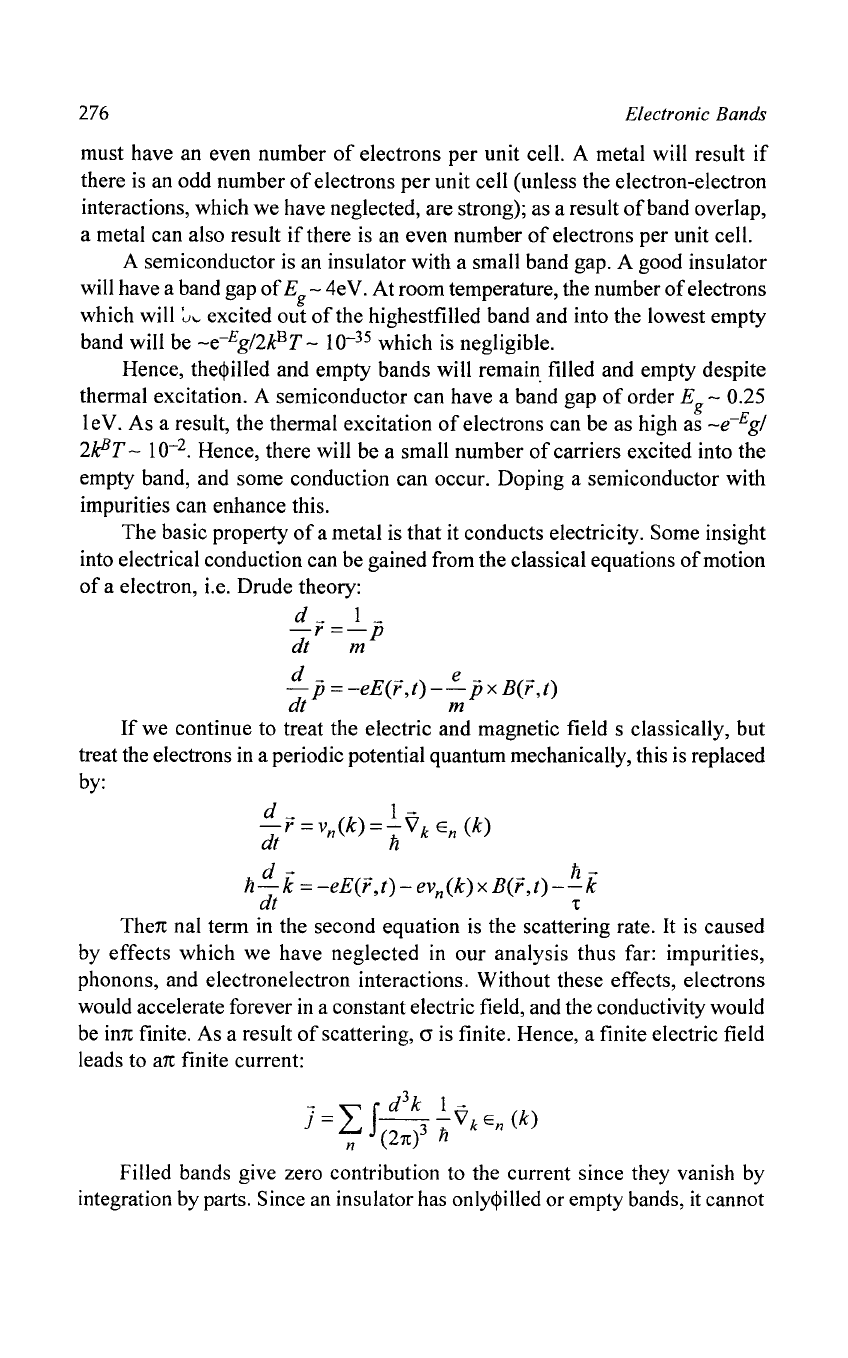
The basic property
of
a metal is that it conducts electricity. Some insight
into electrical conduction can be gained from the classical equations
of
motion
of
a electron, i.e. Drude theory:
d _
1_
-r=-p
dt m
d
d
p=-eE(r,t)-~pxB(r,t)
t m
If
we continue to treat the electric and magnetic field s classically, but
treat the electrons
in
a periodic potential quantum mechanically, this
is
replaced
by:
d _ 1 -
-r
=vn(k)=-'V
k
En
(k)
dt
Ii
d -
Ii-
Ii-k
=-eE(r,t)-evn(k)xB(r,t)--k
~
t
Then nal term
in
the second equation
is
the scattering rate. It
is
caused
by effects which we have neglected
in
our analysis thus far: impurities,
phonons, and electronelectron interactions. Without these effects, electrons
would accelerate forever
in
a constant electric field, and the conductivity would
be
inn finite. As a result
of
scattering, a
is
finite. Hence, a finite electric field
leads to
an finite current:
-
"f
d
3
k
1-
j =
L..J
--3
-
'V
kEn
(k)
n
(211:)
11
Filled bands give zero contribution to the current since they vanish by
integration by parts. Since an insulator has
only<jJilled
or empty bands,
it
cannot
Electronic Bands 277
carry current. Hence, it
is
not characterized by its conductivity but, instead,
by its dielectric constant,
E .
ELECTRONS
IN
A
MAGNETIC
FIELD:
LANDAU
BANDS
In
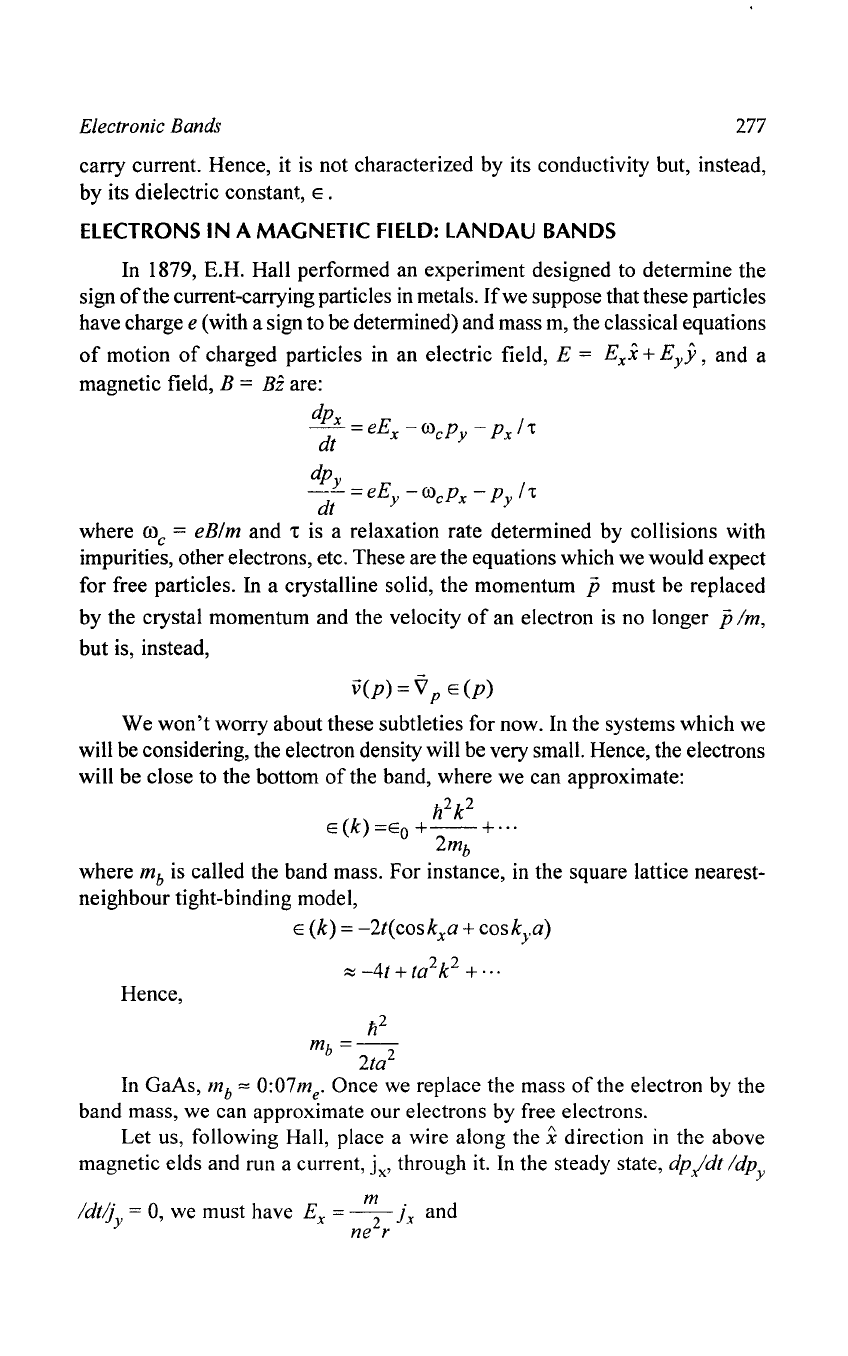
1879, E.H. Hall performed an experiment designed to determine the
sign
of
the current-carrying particles
in
metals.
Ifwe
suppose that these particles
have charge
e (with a sign to be determined) and mass
m,
the classical equations
of
motion
of
charged particles
in
an electric field, E =
E/x
+
EyY,
and a
magnetic field,
B =
Bi
are:
dpx I
--
=
eEx
-
(f)cPy
- P
x
1:
dt
dpy
--=eE
-(f)
P
-P
/'t
dt y c x y
where
roc
= eBlm and
't
is a relaxation rate determined by collisions with
impurities, other electrons, etc. These are the equations which we would expect
for free particles.
In
a crystalline solid, the momentum p must he replaced
by the crystal momentum and the velocity
of
an electron is no longer p
1m,
but is, instead,
v(p)
= V P E
(p)
We
won't
worry about these subtleties for now.
In
the systems which we
will be considering, the electron density will
be
very small. Hence, the electrons
will be close to the bottom
of
the band, where we can approximate:
n
2
k
2
E(k)=EO
+--+
...
2mb
where
mb
is called the band mass. For instance,
in
the square lattice nearest-
neighbour tight-binding model,
Hence,
E
(k)
=
-2t(coskxa
+
coskya)
~
-41 + ta
2
k
2
+ ...
1i
2
mb=--
2ta
2
In
GaAs,
I11b
"'"
O:07m
e
.
Once
we
replace the mass
of
the electron by the
band mass, we can approximate our electrons by free electrons.
Let us, following Hall, place a wire along the
x direction
in
the above
magnetic elds and run a current,
L,
through
it.
In
the steady state,
dp/dt
Idpy
Idt/jy =
0,
we must have
Ex
=
-;-
ix
and
ne r
278
E _
B.
_
-e
h
<1>/<1>0
.
y---Jx--11
2
-N
Jx
ne
e e
Electronic Bands
where
nand
N are the density and number
of
electrons in the wire,
<I>
is the
magnetic ux penetrating the wire, and
<1>0
= hie is the ux quantum. Hence, the
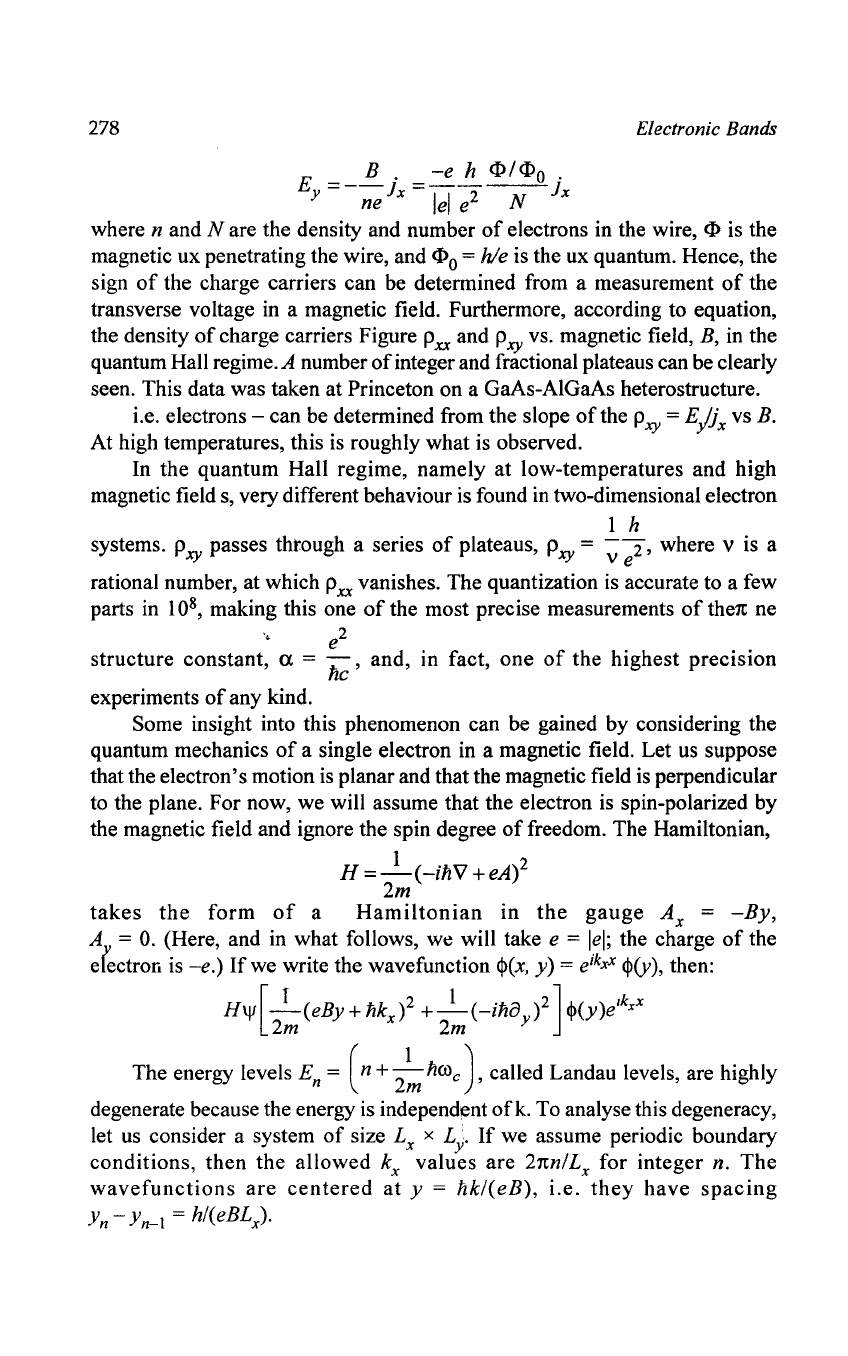
sign
of
the charge carriers can be determined from a measurement
of
the
transverse voltage in a magnetic field. Furthermore, according to equation,
the density
of
charge carriers Figure
Pxx
and
Pxy
vs. magnetic field, B, in the
quantum Hall regime.
A number
of
integer and fractional plateaus can be clearly
seen. This data was taken at Princeton on a GaAs-AIGaAs heterostructure.
i.e. electrons - can be determined from the slope
of
the
Pxy
= Eji
x
vs
B.
At high temperatures, this
is
roughly what is observed.
In the quantum Hall regime, namely at low-temperatures and high
magnetic field
s,
very different behaviour is found
in
two-dimensional electron
1 h
systems.
Pxy
passes through a series
of
plateaus,
Pxy
=
~;,
where v is a
rational number, at which
Pxx
vanishes. The quantization is accurate to a few
parts in
10
8
,
making this one
of
the most precise measurements
of
the1t
ne
" e
2
structure constant, a =
he'
and, in fact, one
of
the highest precision
experiments
of
any kind.
Some insight into this phenomenon can be gained by considering the
quantum mechanics
of
a single electron in a magnetic field. Let us suppose
that the electron's motion
is
planar and that the magnetic field
is
perpendicular
to the plane. For now, we will assume that the electron
is
spin-polarized by
the magnetic field and ignore the spin degree
of
freedom. The Hamiltonian,
H
=_I_(-ihV
+eA)2
2m
takes
the
form
of
a
Hamiltonian
in
the
gauge
Ax
=
-By,
Ay =
O.
(Here, and in what follows,
wt!
will take e =
lei;
the charge
of
the
electroli is
-e.)
If
we write the wavefunction
<1>(x,
y)
= e
1kxx
<1>(Y),
then:
H\jf[_I_(eBY
+
hk
x
)2
+_1_(
-ih8
y
)2]
cj>(y)e1kxx
2m 2m
The energy levels
En
=
(n
+
2~
hme
),
called Landau levels, are highly
degenerate because the energy is independent
ofk.
To analyse this degeneracy,
let
us
consider a system
of
size Lx x L
y
.
If
we assume periodic boundary
conditions, then the allowed
kx values are 21tn/ Lx for integer n. The
wavefunctions
are
centered
at
Y =
hk/(eB),
i.e.
they
have
spacing
Y
n
- Yn-l =
h/(eBL).
Electronic Bands
279
The number
of
these which will fit in
Ly
is
eBLJ-jh
=
BA/cJ.>o'
In other
words, there are as many degenerate states
in
a Landau level as there are ux
quanta.
1
It is often more convenient to work
in
symmetric gauge, A =
'2
B x r
Writing z = x + iy, we have:
H<[-2(a-
4~~)(a-
4;J
2~~1
with (unnormalized) energy eigenfunctions:
1=12
--2
(
-)
_ m Tm (
-)
4£0
\!fnm
z,z
-z
1..J
n
Z,Z
e
at energies
En
= (n +
~
)tZCJl
c
'
where
L~(z,z)
are the Laguerre polynomials
and
,J1i/(eB) is the magnetic length.
Let's
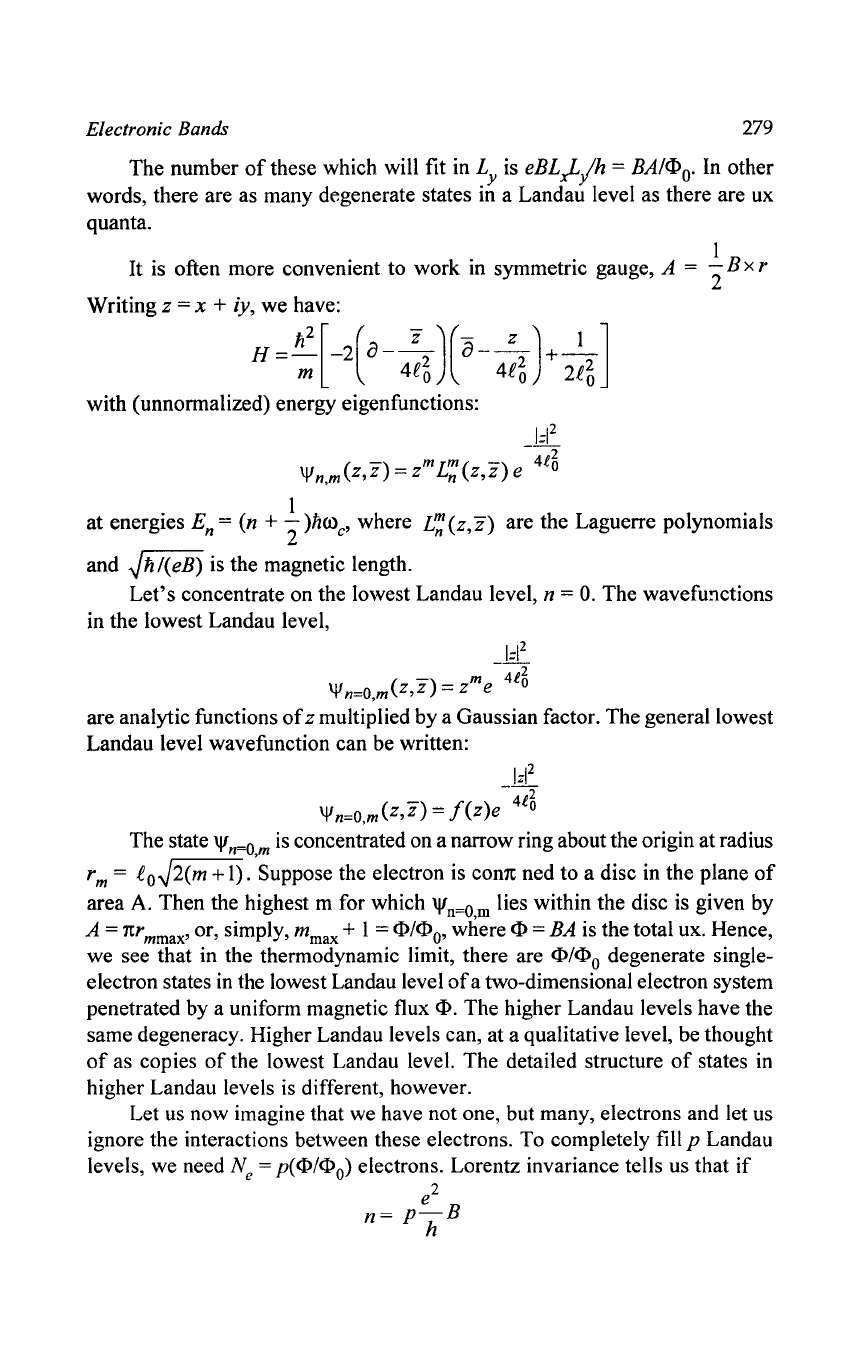
concentrate on the lowest Landau level, n =
O.
The wavefu!lctions
in the lowest Landau level,
1=12
--2
(
-)
_ m
410
\!fn=O,m
z,z
- z e
are analytic functions
of
z multiplied by a Gaussian factor. The general lowest
Landau level wavefunction can be written:
Izl2
--2
\!fn=O,m(z,z) =
J(z)e
410
The state'll
n=O
m
is
concentrated on a narrow ring about the origin at radius
r m = t'0,J2(m + 1). 'Suppose the electron is
con1t
ned to a disc in the plane
of
area A. Then the highest m for which
'IIn=o
m lies within the disc is given by
A =
1tr
mmax' or, simply,
mmax
+ 1 =
cJ.>/cJ.>o'
where
cJ.>
= BA is the total ux. Hence,
we see that in the thermodynamic limit, there are
<1>/<1>0
degenerate single-
electron states
in
the lowest Landau level
of
a two-dimensional electron system
penetrated by a uniform magnetic flux
<1>.
The higher Landau levels have the
same degeneracy. Higher Landau levels can, at a qualitative level, be thought
of
as copies
of
the lowest Landau level. The detailed structure
of
states
in
higher Landau levels
is
different, however.
Let us now imagine that we have not one, but many, electrons and let us
ignore the interactions between these electrons. To completely fill
p Landau
levels, we need
Ne
=
p(cJ.>/cJ.>o)
electrons. Lorentz invariance tells us that
if
e
2
n=
p-B
h
280
then
I.e.
e
2
j =
p-E
x h Y
e
cr
=p-
xy h
Electronic Bands
The same result can be found by inverting the semi-classical resistivity
matrix, and substituting this electron number.
Suppose that we fix the chemical potential,
J..l.
As the magnetic field
is
varied, the energies
of
the Landau levels will shift relative to the chemical
potential. However, so long
as
the chemical potential lies between two Landau
levels, an integer number
of
Landau levels will
be<J>illed,
and we expect
ton
nd the quantized Hall conductance.
These simple considerations neglected two factors which are crucial to
the observation
of
the
quantum,
namely the effects
of
impurities and inter-
electron interactions. The integer quantum occurs in the regime in which
impurities dominate; in the fractional quantum, interactions dominate.
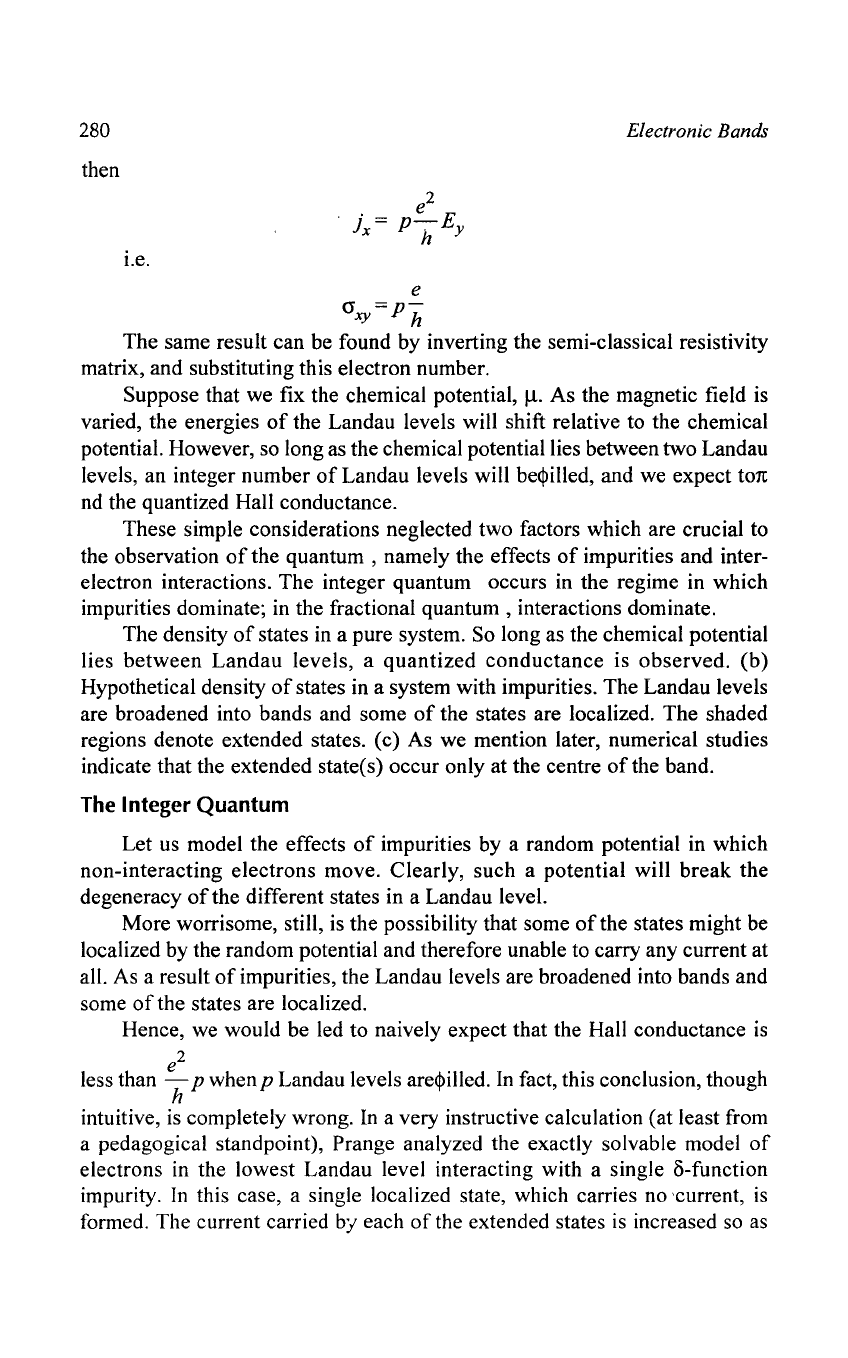
The density
of
states in a pure system. So long as the chemical potential
lies between Landau levels, a quantized conductance is observed. (b)
Hypothetical density
of
states in a system with impurities. The Landau levels
are broadened into bands and some
of
the states are localized. The shaded
regions denote extended states. (c) As we mention later, numerical studies
indicate that the extended state( s) occur only at the centre
of
the band.
The Integer Quantum
Let
us
model the effects
of
impurities by a random potential in which
non-interacting electrons move. Clearly, such a potential will break the
degeneracy
of
the different states in a Landau level.
More worrisome, still, is the possibility that some
of
the states might be
localized by the random potential and therefore unable to carry any current at
all. As a result
of
impurities, the Landau levels are broadened into bands and
some
of
the states are localized.
Hence, we would be led to naively expect that the Hall conductance
is
2
less than
!!..-
p when p Landau levels
are<J>illed.
In
fact, this conclusion, though
h
intuitive,
is
completely wrong.
In
a very instructive calculation (at least from
a pedagogical standpoint),
Prange analyzed the exactly solvable model
of
electrons in the lowest Landau level interacting with a single 8-function
impurity.
In
this case, a single localized state, which carries no 'current,
is
formed. The current carried by each
of
the extended states
is
increased
so
as
Electronic Bands
281
to exactly compensate for the localized state, and the conductance remains at
2
the quantized value,
cr
xy
= e
h
.
This
calculation
gives an important
hint
of
the
robustness
of
the
quantization, but cannot be easily generalized to the physically relevant
situation in which there
is
a random distribution
of
impurities. To understand
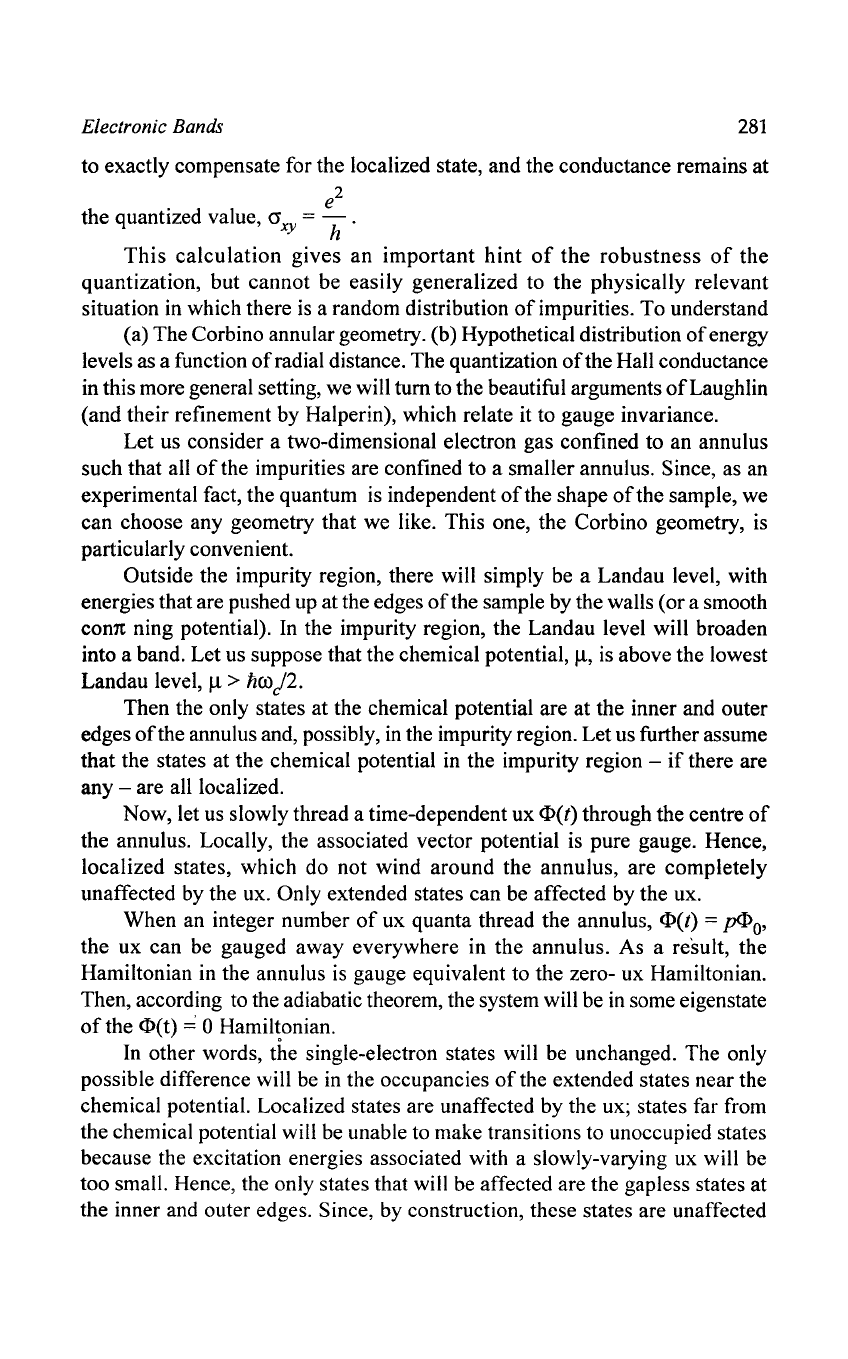
(a) The Corbino annular geometry. (b) Hypothetical distribution
of
energy
levels as a function
of
radial distance. The quantization
of
the Hall conductance
in this more general setting, we will tum to the beautiful arguments
of
Laughlin
(and their refinement by Halperin), which relate it to gauge invariance.
Let us consider a two-dimensional electron gas confined to an annulus
such that all
of
the impurities are confined to a smaller annulus. Since, as an
experimental fact, the quantum
is
independent
of
the shape
of
the sample, we
can choose any geometry that we like. This one, the Corbino geometry,
is
particularly convenient.
Outside the impurity region, there will simply be a Landau level, with
energies that are pushed up at the edges
of
the sample by the walls (or a smooth
comt ning potential). In the impurity region, the Landau level will broaden
into a band. Let us suppose that the chemical potential,
J-l,
is
above the lowest
Landau level,
J-l>
nroj2.
Then the only states at the chemical potential are at the inner and outer
edges
of
the annulus and, possibly,
in
the impurity region. Let us further assume
that the states at the chemical potential
in
the impurity region -
if
there are
any - are all localized.
Now, let us slowly thread a time-dependent ux
cI>(t)
through the centre
of
the annulus. Locally, the associated vector potential is pure gauge. Hence,
localized states, which do not wind around the annulus, are completely
unaffected by the ux.
Only extended states can be affected by the ux.
When an integer number
of
ux quanta thread the annulus,
cI>(t)
=
p<I>o'
the ux can be gauged away everywhere in the annulus. As a result, the
Hamiltonian in the annulus
is
gauge equivalent to the zero- ux Hamiltonian.
Then, according to the adiabatic theorem, the system will be
in
some eigenstate
of
the
cI>(t)
~
0
Hamil~onian.
In other words, the single-electron states will be unchanged. The only
possible difference will
be
in
the occupancies
of
the extended states near the
chemical potential. Localized states are unaffected by the ux; states far from
the chemical potential will be unable to make transitions to unoccupied states
because the excitation energies associated with a slowly-varying ux will be
too small. Hence, the only states that will be affected are the gapless states at
the inner and outer edges. Since, by construction, these states are unaffected