
Brewster H.D. Solid State Physics
Подождите немного. Документ загружается.

112
Electron
and
Phonon Scattering
of
energy and temperature. The condition that,
in
metals, electron scattering
takes place to states near the Fermi level implies that the largest phonon wave
vector in an electron collision
is
2kF
where
kF
is the electron wave vector at
the Fermi surface.
Of
particular interest is the temperature dependence
of
the phonon
scattering
mechanism
in
the
limit
of
low
and
high
temperatures.
Experimentally, the temperature dependence
of
the resistivity
of
metals can
be plotted on a universal curve in terms
of
p Tip 0 D vs. T
10
D where 0 D is the
Debye temperature. This plot includes data for several metals, and values for
the Debye temperature
of
these metals.
T
« 0 D defines the low temperature limit and
T»
8 D the high
temperature limit. Except for the very low temperature defect scattering limit,
the electron-phonon scattering mechanism dominates, and the temperature
dependence
of
the scattering rate depends on the product
of
the density
of
phonon states and the phonon occupation, since the electron-phonon coupling
coefficient is essentially independent
of
T.
The phonon concentration in the
high temperature limit becomes
1 kBT
n(q) =
~-
exp(ncol kBT)
-1
nco
since (nrolkBy)
<:
1,
so that from equation we have
1I't
~
Tand a =
nell
~T-
1. In this high temperature limit, the scattering is quasi-elastic and involves
large-angle scattering, since phonon wave vectors up to the Debye wave vector
qo are involved in the electron scattering where
qD
is
related to the Debye
frequency
roD and to the Debye temperature 8
D
according to
nroD
=
kB
8
D
=
nqDvq
where v q is the velocity
of
sound.
We
can interpret
qD
as the radius
of
a Debye sphere in k -space which
defines the range
of
accessible q vectors for scattering, i.e., 0 < q < qo' The
magnitude
of
qo
is
comparable to the Brillouin zone dimensions but the energy
change
of
an electron
(,1.E)
on scattering by a phonon will be less than
kB
0
D
;
1I40eV so that the restriction
of
(,1.E)max;
kB
8
D
implies that the maximum
electronic energy change on scattering will be small compared with the Fermi
energy
EF"
We
thus obtain that for
T>
0
D
(the high temperature regime), M <
kBT
and the scattering will
be
quasi-elastic.
In
the opposite limit,
T»
0
D'
we
have
nro
q
;
kBT
(because only low frequency acoustic phonons are available
for scattering) and in the low temperature limit there is the possibility that
M
>
kBT,
which implies inelastic scattering.
In
the low temperature limit, T « 0
D'
the scattering
is
also small-angle
scattering, since only low energy (low wave vector) phonons are available for
Electron and Phonon Scattering
113
scattering.
At
low temperature, the phonon density contributes a factor
of
T3
to the scattering rate when the sum over phonon states is converted to an integral
and
q 2 dq is written
in
terms
of
the dimensionless variable I1ro/ksTwith
ro
=
vqq.
Since small momentum transfer gives rise to small angle scattering, the
small energy transfer we can write,
,-
-,
I 2 1 2
k;-k
f
-kf(1-cos8):::::Zkf8
:::::Zkf(qlk
f
)
so that another factor
of
q 2 appears
in
the integration over
-q
when calculating
(1I't
D
).
Thus, the electron scattering rate at low temperature is predicted to be
proportional to
T 5 so that
cr
- 1
5
(Bloch-Griineisen formula). Thus, when
phonon
scattering
is the
dominant
scattering mechanism
in
metals,
the
following results are obtained:
cr-
8dT
T»
8
D
cr-
(8011)5
T«
8
D
In practice, the resistivity
of
metals at very low temperatures
is
dominated
by
other
scattering mechanisms such as impurities, etc., and electron-phonon
scattering is relatively unimportant.
The possibility
of
umklapp processes further increases the range
of
phonon
modes that
can
contribute to electron scattering
in
electron-phonon scattering
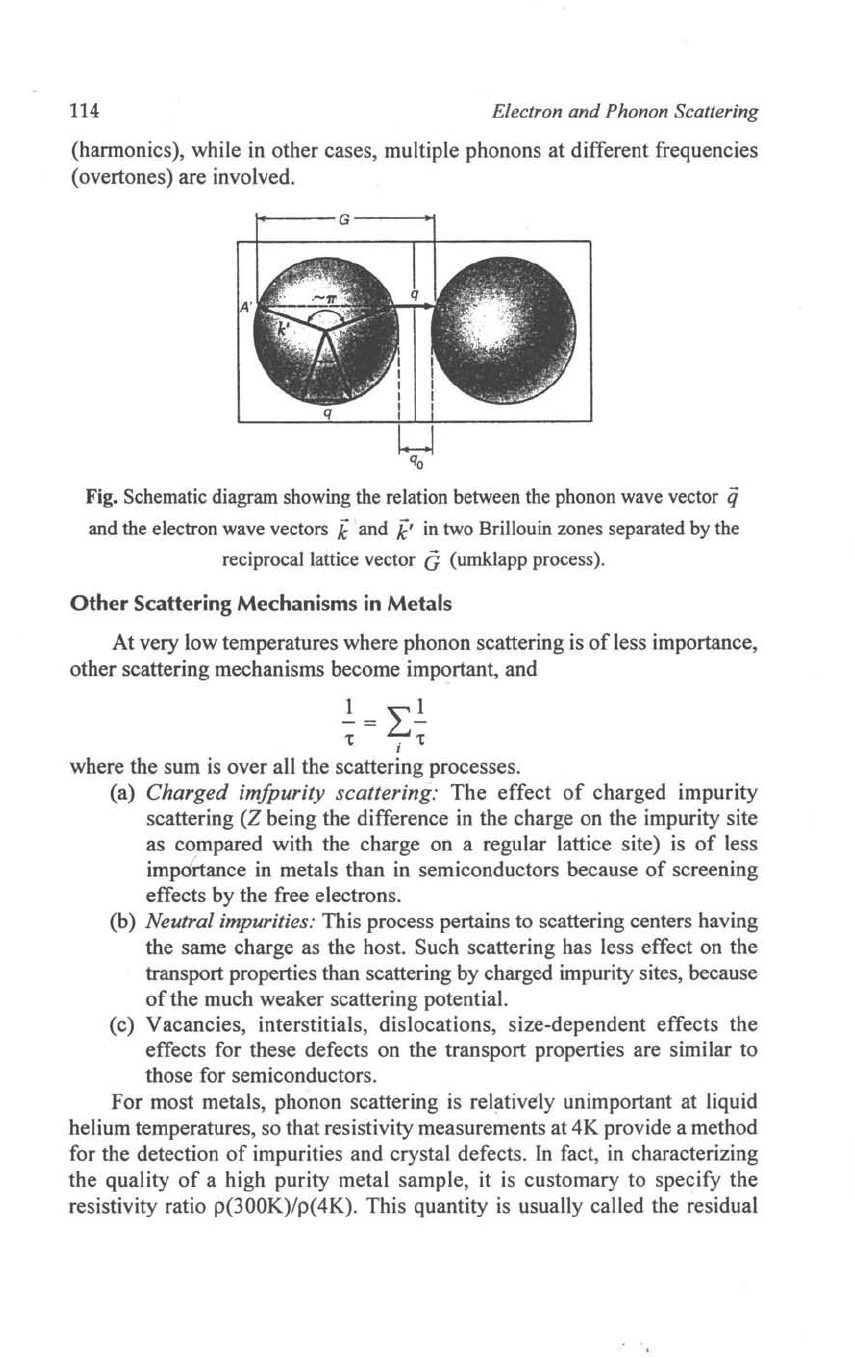
processes. In an umklapp process, a non-vanishing reciprocal lattice vector
can be involved in the momentum conservation relation.
The
relation between the wave vectors for the phonon and for the incident
and scattered electrons
G = k + q +
k'
is shown when crystal momentum is
conserved for a non-vanishing reciprocal lattice vector
G.
Thus, phonons
involved
in
an umklapp process have large wave vectors with magnitudes
of
about
113
of
the Brillouin zone dimensions.
Therefore, substantial energies can be transferred on collision through
an umklapp process.
At
low
temperatures,
normal
scattering processes
(i.e.,
normal
as
distinguished from umklapp processes) play an important part in completing
the
return to equilibrium
of
an excited electron in a metal, while
at
high
temperatures, umklapp processes become more important.
This discussion is applicable to the creation
or
absorption
of
a single
phonon
in
a particular scattering event. Since the restoring forces for lattice
vibrations in solids are not strictly harmonic, anharmonic corrections to the
restoring forces give rise to multiphonon processes where more than
one
phonon can be created or annihilated
in
a single scattering event. Experimental
evidence for multi phonon processes is provided in both optical and transport
studies.
In
some cases, more than one phonon at the same frequency are created
114 Electron
and
Phonon Scattering
(hannonics), while in other cases, multiple phonons at different frequencies
(overtones) are involved.
Fig.
Schematic
diagram
showing
the
relation
between
the
phonon
wave
vector
if
and
the
electron
wave
vectors k
and
k'
in
two
Brillouin
zones
separated
by
the
reciprocal lattice vector G (umklapp process).
Other Scattering Mechanisms
in
Metals
At very low temperatures where phonon scattering is
of
less importance,
other scattering mechanisms become important, and
~=
L~
tit
where the sum
is
over all the scattering processes.
(a)
Charged imfpurity scattering:
The
effect
of
charged impurity
scattering
(Z being the difference in the charge on the impurity site
as compared with the charge on a regular lattice site)
is
of
less
impo'rtance in metals than in semiconductors because
of
screening
effects by the free electrons.
(b)
Neutral impurities: This process pertains to scattering centers having
the same charge as the host. Such scattering has less effect on the
transport properties than scattering by charged impurity sites, because
of
the much weaker scattering potential.
(c) Vacancies, interstitials, dislocations, size-dependent effects the
effects for
these defects on the transport properties are similar to
those for semiconductors.
For most metals, phonon scattering
is
rel!ltively unimportant at liquid
helium temperatures, so that resistivity measurements at 4K provide a method
for the detection
of
impurities and crystal defects.
In
fact,
in
characterizing
the quality
of
a high purity metal sample, it is customary to specify the
resistivity ratio
p(300K)/p( 4K). This quantity is usually called the residual
Electron
and
Phonon Scattering 115
resistivity ratio (RRR), or the residual resistance ratio.
In
contrast, a typical·
semiconductor
is
characterized by its conductivity and Hall coefficient at room
temperature and at
77
K.
PHONON
SCATTERING
Whereas electron scattering is important in electronic transport properties,
phonon scattering
is
important in thermal transport, particularly for the case
of
insulators where heat is carried mainly by phonons. The major scattering
mechanisms for phonons are phononphonon scattering, phonon-boundary
scattering and defect-phonon scattering.
Phonon-phonon
Scattering
Phonons are scattered by other phonons because
of
anharmonic terms in
the restoring potential. This scattering process permits:
• Two phonons to combine to form a third phonon
or
• One phonon to break up into two phonons.
In these anharmonic processes, energy and wavevector conservation apply:
normal processes
or
umklapp processes
where
Q corresponds to a phonon wave vector
of
magnitude comparable to
that
of
reciprocal lattice vectors. When umklapp processes are present, the
scattered phonon wavevector
ih
can be in a direction opposite to the energy
flow, thereby giving rise to thermal resistance. Because
of
the high momentum
transfer and the large phonon energies that are involved, umklapp processes
dominate the thermal conductivity at high
T.
The phonon density is proportional to the Bose factor so that the scattering
rate is proportional to
1
"ph
-
(e
llro
/(k
B
T)
-1)
At high temperatures
T'»
(3D'
the scattering time thus varies as i
1
since
"ph
_(ellro/kBT
-l)-liro/(kBT)
while at low temperatures T -
(3
D'
an exponential temperature dependence
for
't
ph
is found
"ph
- e
llro
/ kBT
-1.
These temperature dependences are important
in
considering the lattice
contribution to the thermal conductivity.
116 Electron
and
Phonon Scattering
Phonon-Boundary Scattering
Phonon-boundary scattering is important at low temperatures where the
phonon density is low. In this regime, the scattering time is independent
of
T.
The
thermal conductivity in this range is proportional to the phonon density
which is in
tum
proportional to
T3.
This effect combined with phonon-phonon
scattering results in a thermal conductivity . for insulators with the general
shape.
The
lattice thermal conductivity follows the relation
KL
= CpVq e
ph
/3
where
the
phonon
mean free path
Aph
is related
to
the
phonon
scattering
probability
(1I't
ph
) by
't
ph
= Aph/v q
in which v q is the velocity
of
sound and C
p
is the
heat
capacity at constant
pressure.
Phonon-boundary scattering becomes more important as the crystallite
size decreases.
Defect-Phonon Scattering
Defect-phonon scattering includes a variety
of
crystal defects, charged
and uncharged impurity sites and different isotopes
of
the host constituents.
The
thermal conductivity, the scattering effects due to different isotopes
of
Li.
The
low mass
ofLi
makes it possible
to
see such effects clearly. Isotope
effects are also important in graphite and diamond which have the highest
thermal conductivity
of
any solid.
Electron-Phonon Scattering
If
electrons scatter from phonons, the reverse process also occurs.
When
phonons impart momentum to electrons, the electron distribution is affected.
Thus, the electrons will also carry energy as they are dragged also by the stream
of
phonons. This phenomenon is called phonon drag. In the case
of
phonon
drag
we
must simultaneously solve the Boltzmann equations for the electron
and phonon distributions which are coupled
by
the phonon drag term.
TEMPERATURE DEPENDENCE
OF
THE ELECTRICAL
AND
THERMAL
CONDUCTIVITY
For the electrical conductivity, at very low temperatures, impurity, defect,
and
boundary
scattering
dominate.
In
this
regime
a is
independent
of
temperature.
At
somewhat
higher temperatures but still far
below
e
D
the
electrical conductivity for metals exhibits a strong temperature dependence
a
oc
(ed1)s
T«
e
D
.
At
higher temperatures where
T»
eD' scattering by phonons with any q
vector is possible and the formula
Electron
and
Phonon Scattering 117
cr-
(8dT)
T»
8
D
applies. We now summarize the corresponding temperature ranges for the
thermal conductivity.
Although the thermal conductivity was formally discussed in, a meaningful
discussion
of
the temperature dependence ofK depends on scattering processes.
The total thermal conductivity
K
in
general depends on the lattice and electronic
contributions,
KL
and K
e
,
respectively. The temperature dependence
of
the
lattice contribution
is
discussed
in
with regard to the various phonon scattering .
processes and their
t~mperature
dependence. For the electronic contribution,
we
must consider the temperature dependence
of
the electron scattering
processes discussed. At very low temperatures, in the impurity scattering range,
cr
is independent
of
T and the same scattering processes apply for both the
electronic thermal conductivity and the electrical conductivity so that
Ke
oc
T
in the impurity scattering regime where
cr
- constant and the Wiedemann-
Franz law is applicable. Copper, defect and boundary scattering are dominant
below
- 20 K, while phonon scattering becomes important at higher
T.
At low temperatures T « 8
D'
but with T in a regime where phonon
scattering has already become the dominant scattering mechanism, the thermal
transport depends on the electron-phonon collision rate which in turn is
proportional to the phonon density. At low temperatures the phonon density
is proportional to
T3.
This follows from the proportionality
of
the phonon
density
of
states arising from the integration
ofSq
2
dq,
and from the dispersion
relation for the acoustic phonons
co
==
qv q
q
==
co/v
q
==
xkT/liv q
where x
==
Iico/kBT.
Thus
in
the low temperature range
of
phonon scattering
where
T
<:
8
D
and the Wiedemann-Franz law is no longer satisfied, the
temperature dependence
of
't
is found from the product T
('1
3
)
so that
Ke
oc
T-2. One reason why the Wiedemann-Franz law is not satisfied in this
temperature regime
is
that
Ke
depends on the collision rate
't
c
while
cr
depends
on the time to reach thermal equilibrium,
't
D. At low temperatures where only
low q phonons participate
in
scattering events the times
't
c
and
't
D
are not the
same. At high
T where
T»
8
D
and the Wiedemann-Franz law applies,
Ke
approaches
a
constant
value
corresponding
to
the regime
where
cr
is
proportional to
liT. This occurs at temperatures much higher than those shown.
The decrease
in
K above the peak value at
-17K
follows a IlT2 dependence
quite well. In addition to the electronic thermal conductivity, there
is
heat
flow due to lattice vibrations. The phonon thermal conductivity mechanism
is
in
fact the principal mechanism operative
in
semiconductors and insulators,
since the electronic contribution
in
this case is negligibly small. Since
KL
contributes also to metals the total measured thermal conductivity for metals
should exceed the electronic contribution
(1t2k~Tcr)/(3e2).
In
good metallic
118
Electron
and
Phonon Scattering
conductors
of
high purity, the electronic thermal conductivity dominates and
the phonon contribution tends to be small.
On the other hand, in conductors
where the thermal conductivity due to phonons makes a significant contribution
to the total thermal conductivity, it is necessary to separate the electronic and
lattice contributions before applying the Wiedemann-Franz law to the total
K.
With regard to the lattice contribution, KL at very low temperatures
is
dominated
by defect and boundary scattering processes. From the relation
1
KL
= 3CpvqAph
we can determine the temperature dependence
of
K
L
, since C -
T3
at low T
while the sound velocity v q and phonon mean free path Aph
at
very low
Tare
independent
of
T.
In this regime the number
of
scatterers IS independent
of
T.
In the regime where only low q phonons contribute to transport and to
scattering, only normal scattering processes contribute. In this regime
C
p
is
still increasing as
'f3,
v q is independent
of
T, but 1 I
Aph
increases in proportion
to the phonon density
of
states. With increasing
T,
the temperature dependence
of
C
p
becomes less pronounced and that for 0
ph
becomes more pronounced as
more scatters participate, leading eventually to a
qecrease
in
K
L
.
We note that it is only the inelastic collisions that contribute to the decrease
in
A
ph
' since elastic phonon-phonon scattering has a similar effect as impurity
scattering for phonons. The inelastic collisions are
of
course due to anharmonic
forces.
Eventually phonons with wavevectors large enough to support umklapp
processes are thermally activated. Umklapp processes give rise to thermal
resistance and in this regime
KL
decreases as
exp(-0dD.
In the high
temperature limit
T»
°
D'
the heat capacity and phonon velocity are both
independent
of
T.
The KL
-liT
dependence arises from the 1
IT
dependence
of
the mean free path, since
in
this limit the scattering rate becomes proportional
to
kBT.
Chapter 4
Magneto-transport Phenomena
Since the electrical conductivity is sensitive to the product
of
the carrier
density
and
the
carrier
mobility rather
than
each
of
these
quantities
independently, it is necessary to look for different transport techniques to
provide information on the carrier density n and the carrier mobility
Il
separately.
Magneto-transport provides us with such techniques, at least for simple
cases, since the magneto resistance is sensitive to the carrier mobility and the
is sensitive to the carrier density. We return to the discussion
of
magneto-
transport for lower dimensional systems later in the course particularly with
regard to the quantum and giant magnetoresistance.
MAGNETO-TRANSPORT
IN
THE
CLASSICAL
REGIME
(wc'!:
< 1)
The magnetoresistance and measurements, which are used to characterize
semiconductors,
are
made
in
the
weak
magnetic
field
limit
Olc't « 1 where the cyclotron frequency is given by
Ole
= eBI(m*c).
The cyclotron frequency Ole is the angular frequency
of
rotation
of
a
charged particle as it makes an orbit in a plane perpendicular to the magnetic
field.
In
the low field limit (defined by
Olc't«
1)
the carriers are scattered long
before com pleting a single cyclotron orbit in real space, so that quantum effects
are unimportant.
In
higher field s where
Olc't>
1,
quantum effects become
important.
In
this limit (discussed
in
Part III
of
this course), the electrons
complete cyclotron orbits and
th(;
r~sonance
achieved by tuning the microwave
frequency
of
a resonant cavity to coincide with
Ole
allows us to measure the
effective mass
of
electrons in semiconductors.
A simplified version
of
the magnetoresistance phenomenon can be
obtained interms
of
the F =
rna
approach and
is
presented
in
§7.1.1. The
virtue
of
the simplified approach
is
to introduce the concept
of
the Hall field
and the general form
of
the magneto-conductivity tensor. A more general
version
of
these results will then be given using the Boltzmann equation
120
Magneto-transport Phenomena
formulation.
The
advantage
of
the
more
general
derivation
is
to
put
the
derivation
on
a firmer foundation
and
to distinguish
between
the various
effective masses which
enter
the transport equations: the cyclotron effective
mass
of
equation the longitudinal effective mass along the magnetic field
direction, and the dynamical effective mass which describes transport in
an
electric field.
CLASSICAL
MAGNETO-TRANSPORT
EQUATIONS
For
the simplified F =
ma
treatment,
let
the
magnetic
field
jj
be
directed along the z direction.
Then
writing F =
ma
for the electronic motion
in the plane perpendicular to
jj
we
obtain
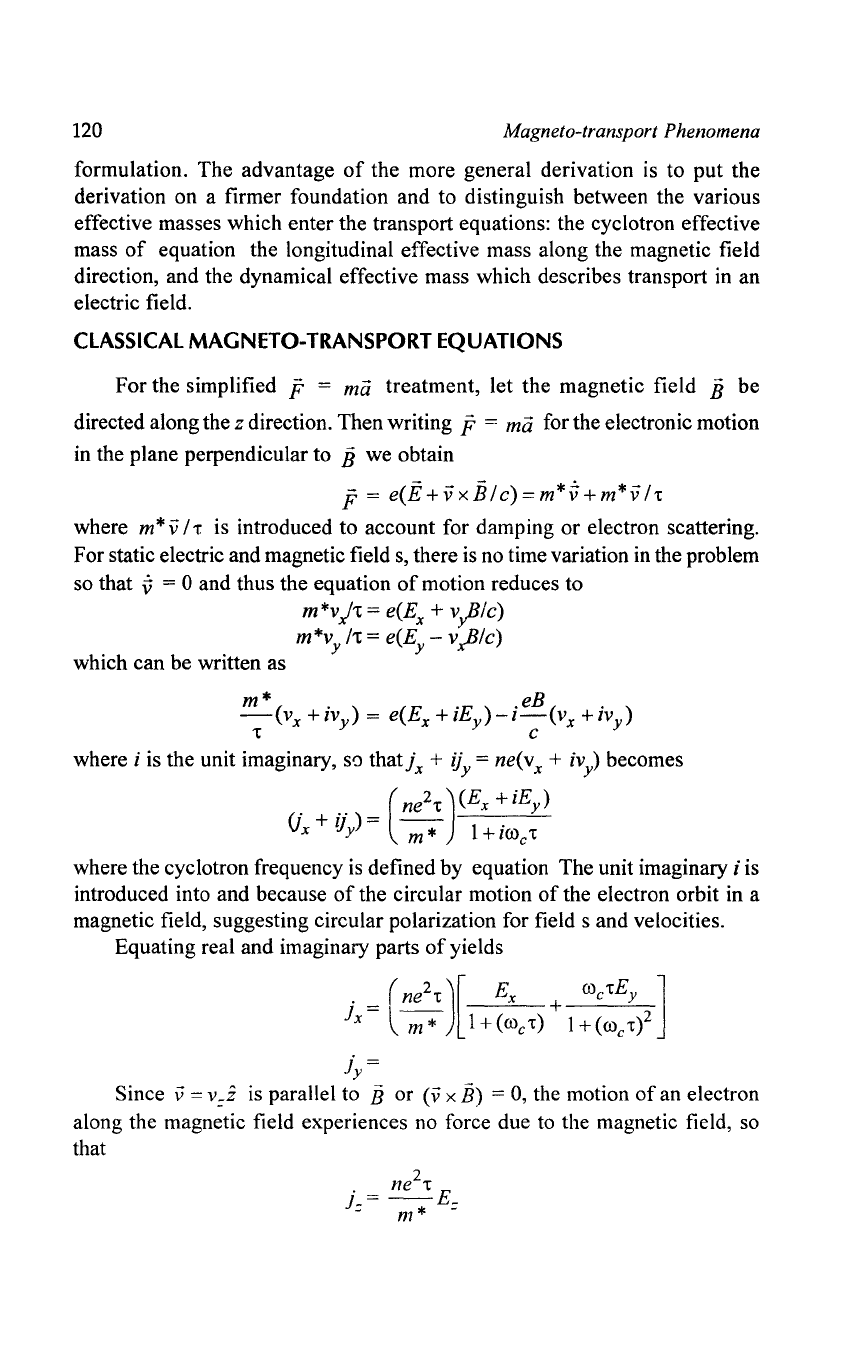
F = e( Ii + v x
jj
/
c)
= m *
~
+ m * v
IT.
where
m*
v /
i.
is introduced
to
account for damping
or
electron scattering.
For
static electric and magnetic field s, there is no time variation in the problem
so
that
~
= 0 and thus
the
equation
of
motion reduces to
m*v)'t
= e(Ex +
vj3/c)
m*v
y
/'t = e(Ey -
vj3/c)
which
can
be
written as
m *
(v
x
+
ivy)
=
e(Ex
+
iEy)
- i
eB
(vx +
ivy)
't c
where
i is the unit imaginary,
S0
thatix
+ ijy =
ne(v
x
+
iv)
becomes
. + r =
(ne
2
't)
(Ex
+iE
y
)
U
x
rJ)
*
l+iro't
m c
where the cyclotron frequency is defined
by
equation
The
unit imaginary i is
introduced into and because
of
the circular motion
of
the electron orbit in a
magnetic field, suggesting circular polarization for field s and velocities.
Equating real
and
imaginary parts
of
yields
jx
~
(
n~2*t)[
1 +
~~"
t)
+ 1
:;::~)2
]
j =
y
Since \i =
v=z
is parallel to
jj
or
(\i x
B)
= 0, the motion
of
an electron
along the magnetic field experiences no force due to the magnetic field, so
that
Magneto-transport Phenomena
121
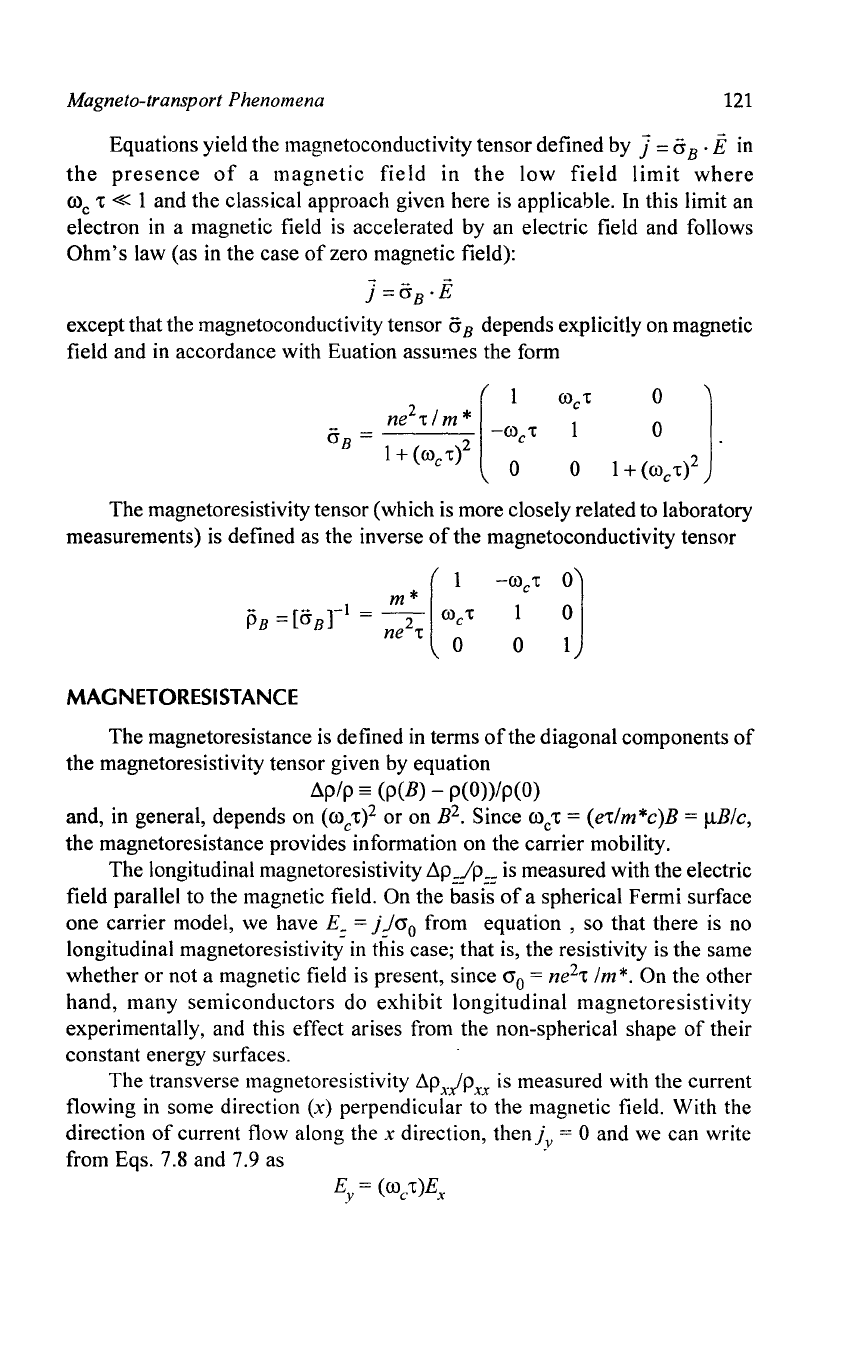
Equations yield the magnetoconductivity tensor defined by ] =
cr
B •
jj;
in
the
presence
of
a
magnetic
field
in
the
low
field
limit
where
roc
't
« 1 and the classical approach given here is applicable.
In
this limit an
electron in a magnetic field
is
accelerated by an electric field and follows
Ohm's
law (as in the case
of
zero magnetic field):
]=crB·jj;
except that the magnetoconductivity tensor
cr
B depends explicitly on magnetic
field and in accordance with Euation assU!nes the fonn
The magnetoresistivity tensor (which
is
more closely related to laboratory
measurements)
is
defined
as
the inverse
of
the magnetoconductivity tensor
MAGNETORESISTANCE
The magnetoresistance
is
defined
in
terms
of
the diagonal components
of
the magnetoresistivity tensor given by equation
L1p/p
==
(p(B) -
p(O))/p(O)
and, in general, depends on (roc't? or on
B2.
Since roc't = (e't/m*c)B = 'tlB/c,
the magnetoresistance provides infonnation on the carrier mobility.
The longitudinal magnetoresistivity
L1pjp==
is
measured with the electric
field parallel to the magnetic field.
On the basis
of
a spherical Fermi surface
one carrier model, we have
E=
= i/ao from
equation,
so that there is no
longitudinal magnetoresistivity
in
this case; that
is,
the resistivity is the same
whether or not a magnetic field
is
present, since a
o
=
ne
2
't
/m*. On the other
hand, many semiconductors do exhibit longitudinal magnetoresistivity
experimentally, and this effect arises from the non-spherical shape
of
their
constant energy surfaces.
The transverse magnetoresistivity
Llpx)Pxx is measured with the current
flowing
in
some direction (x) perpendicular to the magnetic field. With the
direction
of
current flow along the x direction, theniv = 0 and we can write
from Eqs. 7.8 and 7.9 as .
~v
=
(roc't)Ex