
Brewster H.D. Solid State Physics
Подождите немного. Документ загружается.

62
Effective Mass Theory
and
Transport Phenomena
k~
= ka
~
mo
/ ma
for
ex
=
x,
y, z brings equation into spherical form
ti
2
k,2
E(k')
=--
21110
where k
r2
=
k';
+ k
2y
+ k
2
::.
For the volume element J3k
in
equation we
, / 2 d3k'
d)
k =
l11:
ct
l7l.1
),nl::::
1110
and the carrier density associated with a single carrier pocket becomes
3/2
_ / 2 (
ksT
)
-IEFl/kBT
J7
i
-
2
111
xx
1l1.1)·I11::
z
1110
2rcti2
e .
For
an
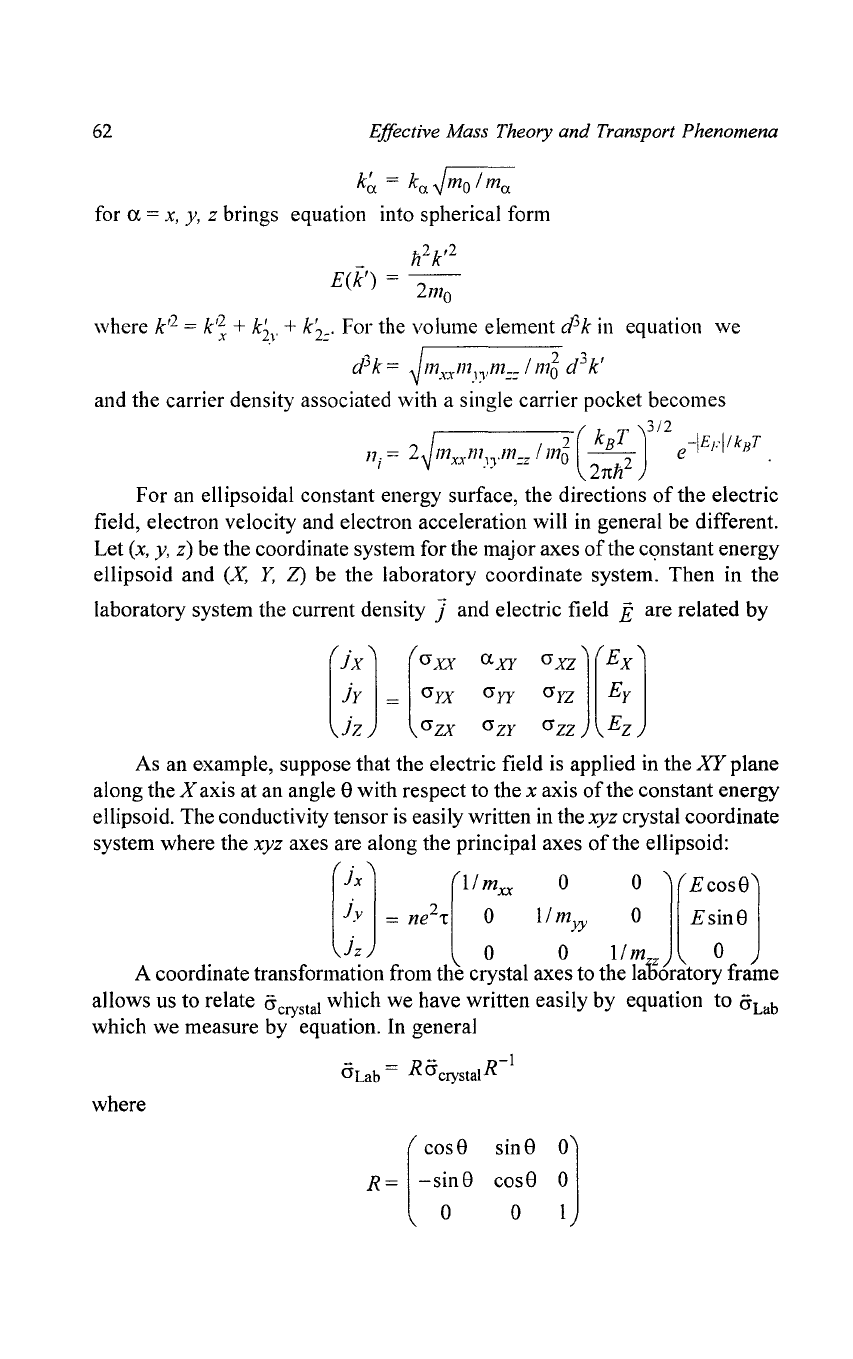
ellipsoidal constant energy surface, the directions
of
the electric
field, electron velocity and electron acceleration will
in
general be different.
Let
(x,
y, z) be the coordinate system for the major axes
of
the
c<?nstant
energy
ellipsoid and
(.¥,
Y,
Z)
be
the laboratory coordinate system. Then in the
laboratory system the current density ] and electric field
E are related by
[
;;J
=
[::
::
::J[!~J
iz
azx
aZy
azz
E
z
As an example, suppose that the electric field
is
applied
in
the
XY
plane
along the
X axis at an angle 8 with respect to the x axis
of
the constant energy
ellipsoid. The conductivity tensor
is
easily written in the
xyz
crystal coordinate
system where the
xyz
axes are along the principal axes
of
the ellipsoid:
<v
=
ne
2
L
0
11
myy 0
EsinS
(
ix]
(lImxx
0 0
][ECOS8J
}z
0 0
11m
_ 0
A coordinate transformation from the crystal axes to the lal)oratory frame
allows us to relate
<Ycrystal
which we have written easily by equation to
<YLab
which we measure by equation.
In
general
R
-
R-I
<YLab
= a crystal
where
[
cosS
R=
-s~ns
sin S
O~J
cosS
o
Effective Mass Theory and Transport Phenomena
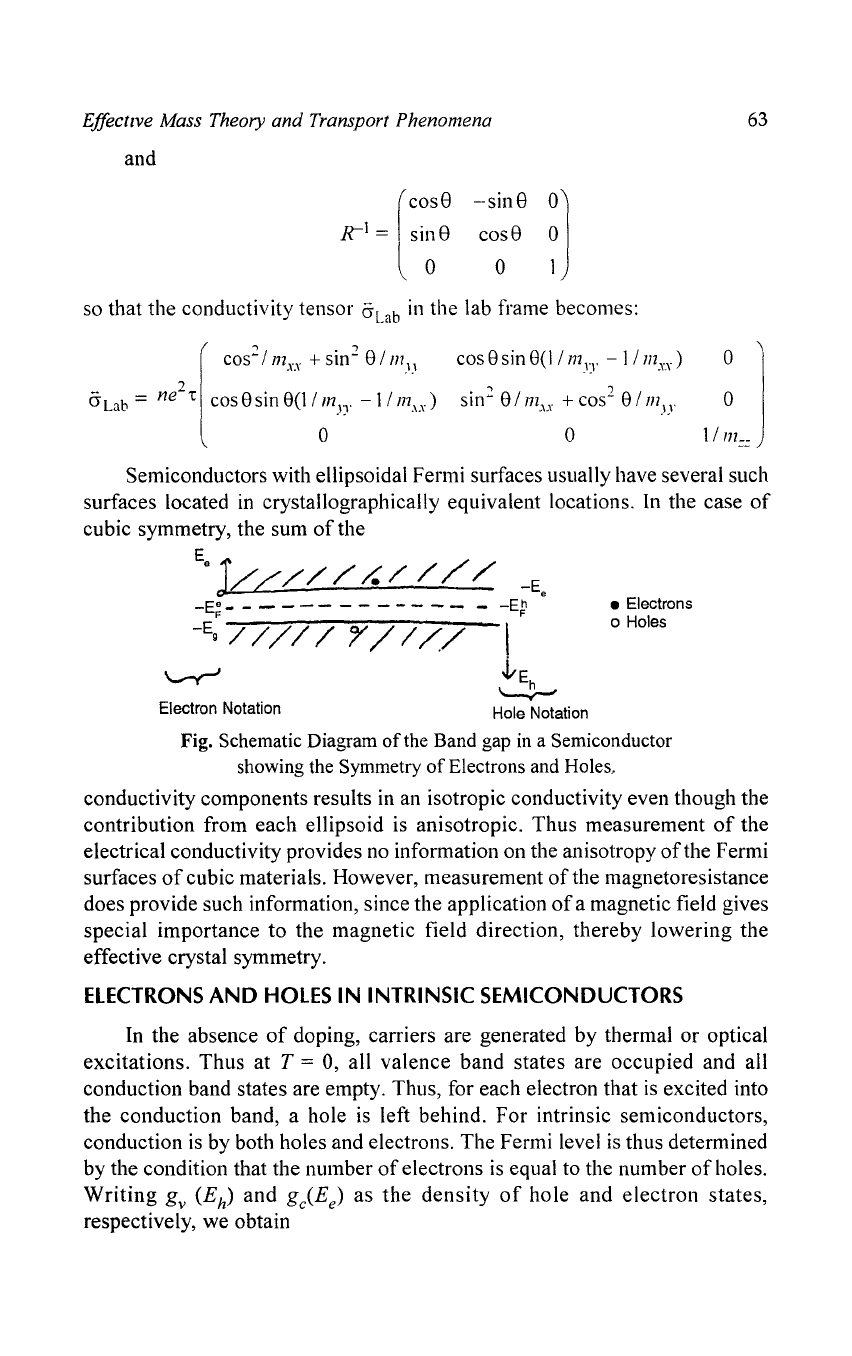
and
(COS8
]{I
= l
Si~8
-sin8
0]
cos8
°
°
1
so that the conductivity tensor aLab
in
the lab frame becomes:
cos
8 sin
8(1
/
m1~1'
- 1 /
lIlyX
)
•
~
J
SIl1-
8 /
11l~x
+ cos-
8/
lIl
J
}'
o
63
Semiconductors with ellipsoidal Fermi surfaces usually have several such
surfaces located
in
crystallographically equivalent locations. In the case
of
cubic symmetry, the sum
of
the
E.
V/////.////
-E.
-E~
- - - - - - - - - - - - - -
-E
g
/////
r///./
-Ep
I
J.,E
~
Electron Notation Hole Notation
• Electrons
o Holes
Fig. Schematic Diagram
of
the Band gap
in
a Semiconductor
showing the Symmetry
of
Electrons and Holes,
conductivity components results in an isotropic conductivity even though the
contribution from each ellipsoid is anisotropic. Thus measurement
of
the
electrical conductivity provides
no
information on the anisotropy
of
the Fermi
surfaces
of
cubic materials. However, measurement
of
the magnetoresistance
does provide such information, since the application
of
a magnetic field gives
special importance to the magnetic field direction, thereby lowering the
effective crystal symmetry.
ELECTRONS
AND
HOLES
IN
INTRINSIC SEMICONDUCTORS
In the absence
of
doping, carriers are generated by thermal or optical
excitations. Thus at
T = 0, all valence band states are occupied and all
conduction band states are empty. Thus, for each electron that
is
excited into
the conduction band, a hole is left behind. For intrinsic semiconductors,
conduction
is
by both holes and electrons. The Fermi level is thus determined
by the condition that the number
of
electrons
is
equal to the number
of
holes.
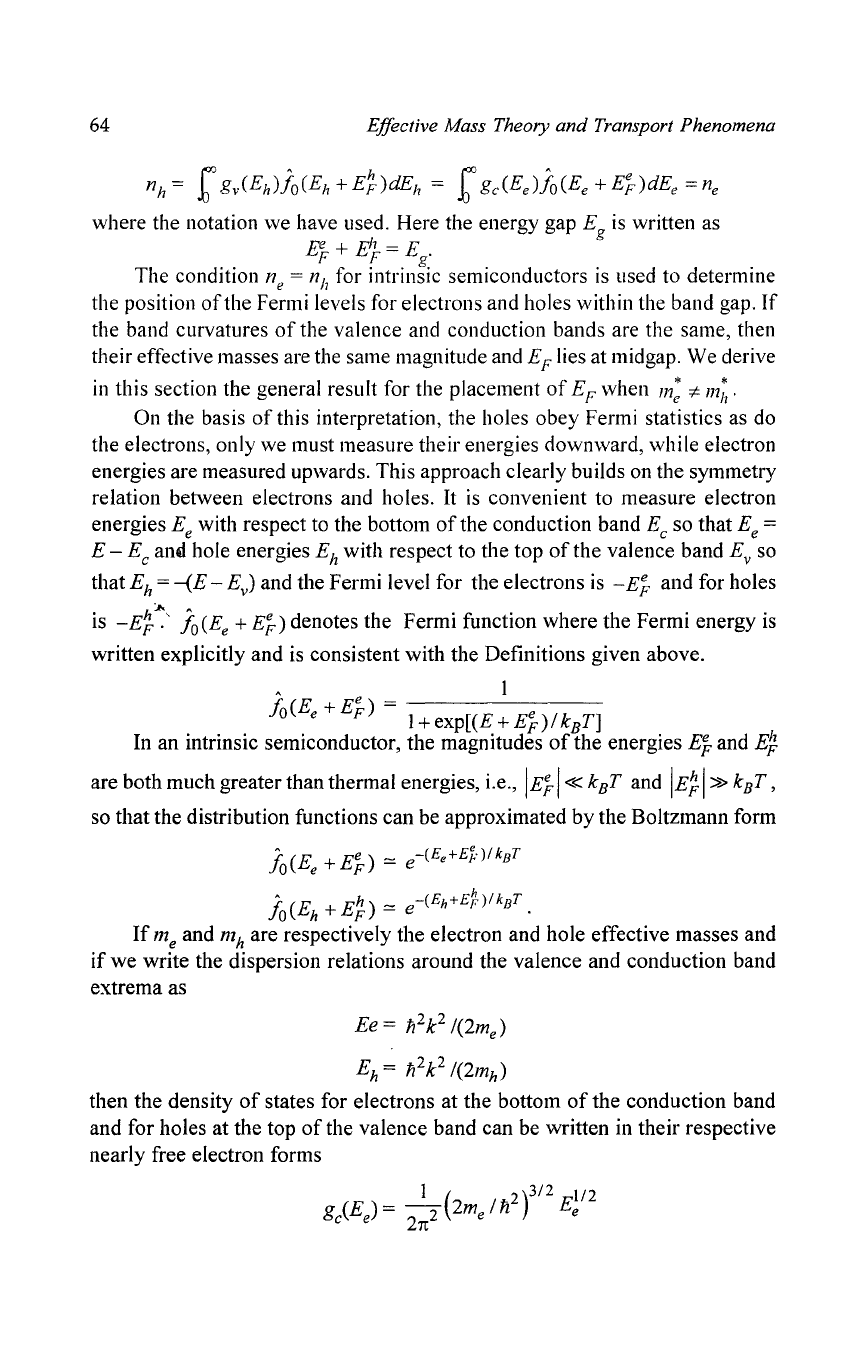
Writing
gv
(E
h
)
and gc(Ee) as
the
density
of
hole and electron states,
respectively, we obtain
64 Effective Mass Theory
and
Transport Phenomena
r
' h r ' e
n
h
=
gv(Eh)fo(E
h
+ EF
)dE
h
= gc
(Ee)fo
(Ee + EF ) dEe =
ne
where the notation we have used. Here the energy gap
Eg
is
written as
E;.+Eh=E
F F
g'
The condition
ne
=
nil
for intrinsic semiconductors
is
used to determine
the position
of
the Fermi levels for electrons and holes within the band gap.
If
the band curvatures
of
the valence and conduction bands are the same, then
their effective masses are the same magnitude and
EF
lies at midgap.
We
derive
in
this section the general result for the placement
of
EF
when
111;
i:-171~'
On the basis
of
this interpretation, the holes obey Fermi statistics as do
the electrons, only we must measure their energies downward, while electron
energies are measured upwards. This approach clearly builds on the symmetry
relation between electrons and holes. It
is
convenient to measure electron
energies
Ee
with respect to the bottom
of
the conduction band
Ec
so that
Ee
=
E -
Ec
ami hole energies
Eh
with respect to the top
of
the valence band
Ev
so
that
Eh
=
-{E
-
E)
and the Fermi level for the electrons
is
-E}
and for holes
is
-Ef'
lo(E
e
+
E})
denotes the Fermi function where the Fermi energy
is
written explicitly and
is
consistent with the Definitions given above.
, 1
Ie
(E
+ E
e
)
=
-------
o e F 1 + exp[(E +
E})lkBT]
In
an intrinsic semiconductor, the magnitudes
of
the energies
EF
and
Eft.
are both much greater than thermal energies, i.e.,
IE}I«
kBT
and
IE;I»
kBT,
so that the distribution functions can be approximated by the Boltzmann form
JO(Ee
+E})
~
e-(Ee+E~.)/kBT
;.
(E
Eh)
-
-(Eh+El.)/
kBT
JO
h + F - e .
If
111e
and
111h
are respectively the electron and hole effective masses and
if
we write the dispersion relations around the valence and conduction band
extrema as
Ee
=
-n
2
k
2
1(2m
e
)
Eh
=
-n
2
e
1(2I71h)
then the density
of
states for electrons at the bottom
of
the conduction band
and for holes at the top
of
the valence band can be written in their respective
nearly free electron forms
1 (
2)3/2
112
g
(E)=
-2
2me1h
Ee
c e 2n
Effective Mass Theory
and
Transport Phenomena
1 (
2)3/2
112
g
(E
h
)
=
-2
2mh/h
E
h
.
v
2rc
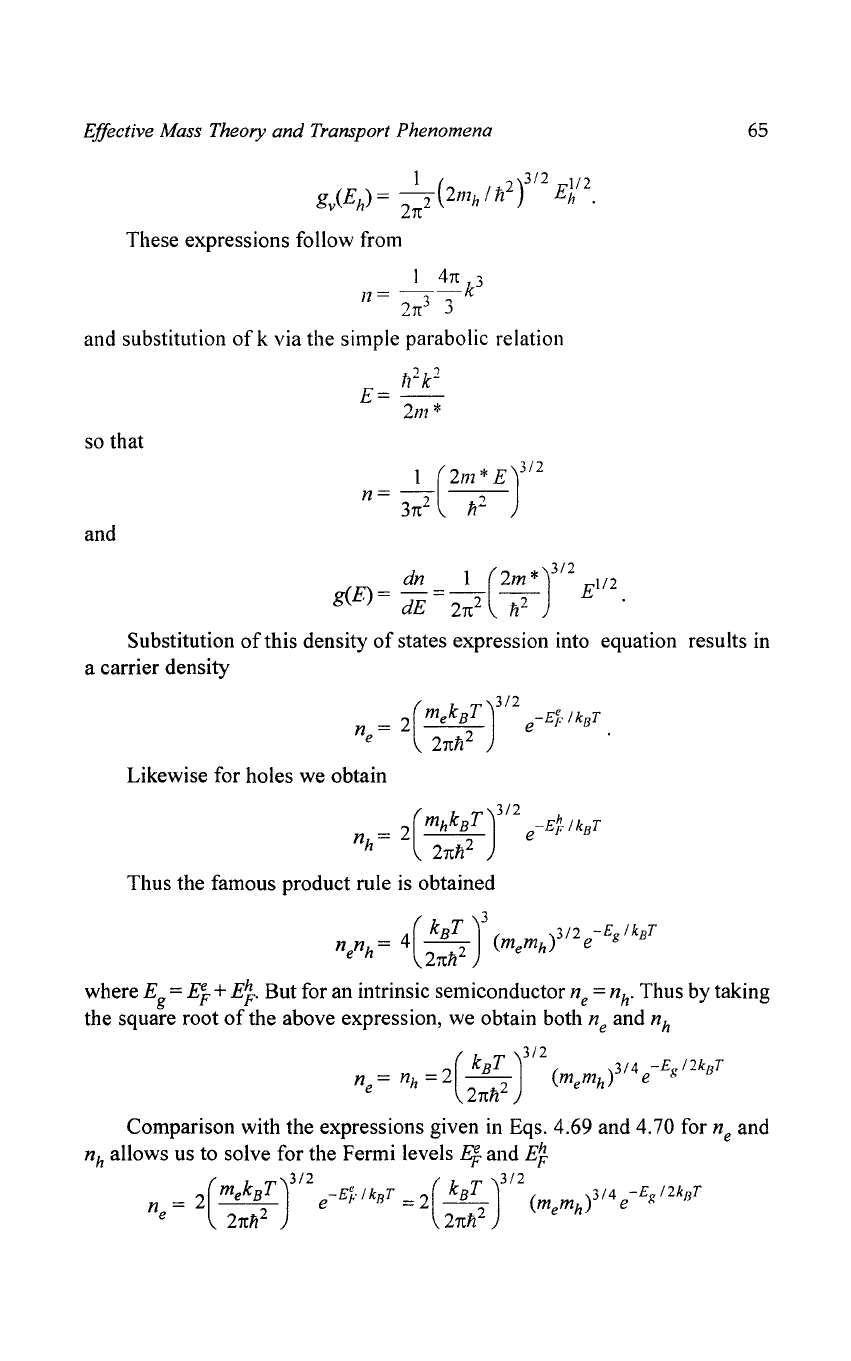
These expressions follow from
11=
~
4rc
k
3
2rc
J
3
and substitution
of
k via the simple parabolic relation
tz2
k
2
E=-
2111*
so that
11=
_1_(2111* E)3/2
3rc
2
/7
2
and
=
dll
=_I_(2m*)3/2
E1I2
geE)
dE
2rc
2
n
2
.
65
Substitution
of
this density
of
states expression into equation results in
a carrier density
11
= 2 mekBT
e-
E
'f./
k
8
T
.
(
)
3/2
e
2rch2
Likewise for holes we obtain
11
=
2(mhkBT)3/2
e-
E
'}./k
8
T
h
2rcn2
Thus the famous product rule
is
obtained
4(
k
B
T)3(
)3/2
-Eg/k8
T
11
llh=
--2
memh
e
e
27th
where
Eg
= E} +
E}.
But for an intrinsic semiconductor
lle
=
ll
h
.
Thus by taking
the square root
of
the above expression, we obtain both
lle
and
llh
2(
kBT
)3/2
( )3/4 -Eg/2k8T
11
=
llh
=
--2
me
l11
h e
e
2rcn
Comparison with the expressions given
in
Eqs. 4.69 and 4.70 for
lle
and
llh
allows us to solve for the Fermi levels
Eft-
and
E~
11
=
2(
l11
e
k
BT)3/2
e-E~./kaT
=2(
kBT
)3/2
(memh)3/4e-Eg/2kaT
e
2rcn
2
2rch2
66
Effective Mass Theory
and
Transport Phenomena
so thatexp(-E} /
ksT)
= (mhme)3/4 exp(-E
g
/2ksT)
and
e Eg 3
EF
=---kSTln(mhme).
2 4
If
me
= m
h
,
we obtain the simple result that
Ej;
=
E/2
which says that the
Fermi level lies in the middle
of
the energy gap. However,
if
the masses are
not equal,
E F will lie closer to the band edge with higher curvature, thereby
enhancing the Boltzmann factor term in the thermal excitation process, to
compensate for the lower density
of
states for the higher curvature band.
If
however
me
<: m
h
,
the Fermi level approaches the conduction band
edge and the full Fermi functions have to be considered. In this case
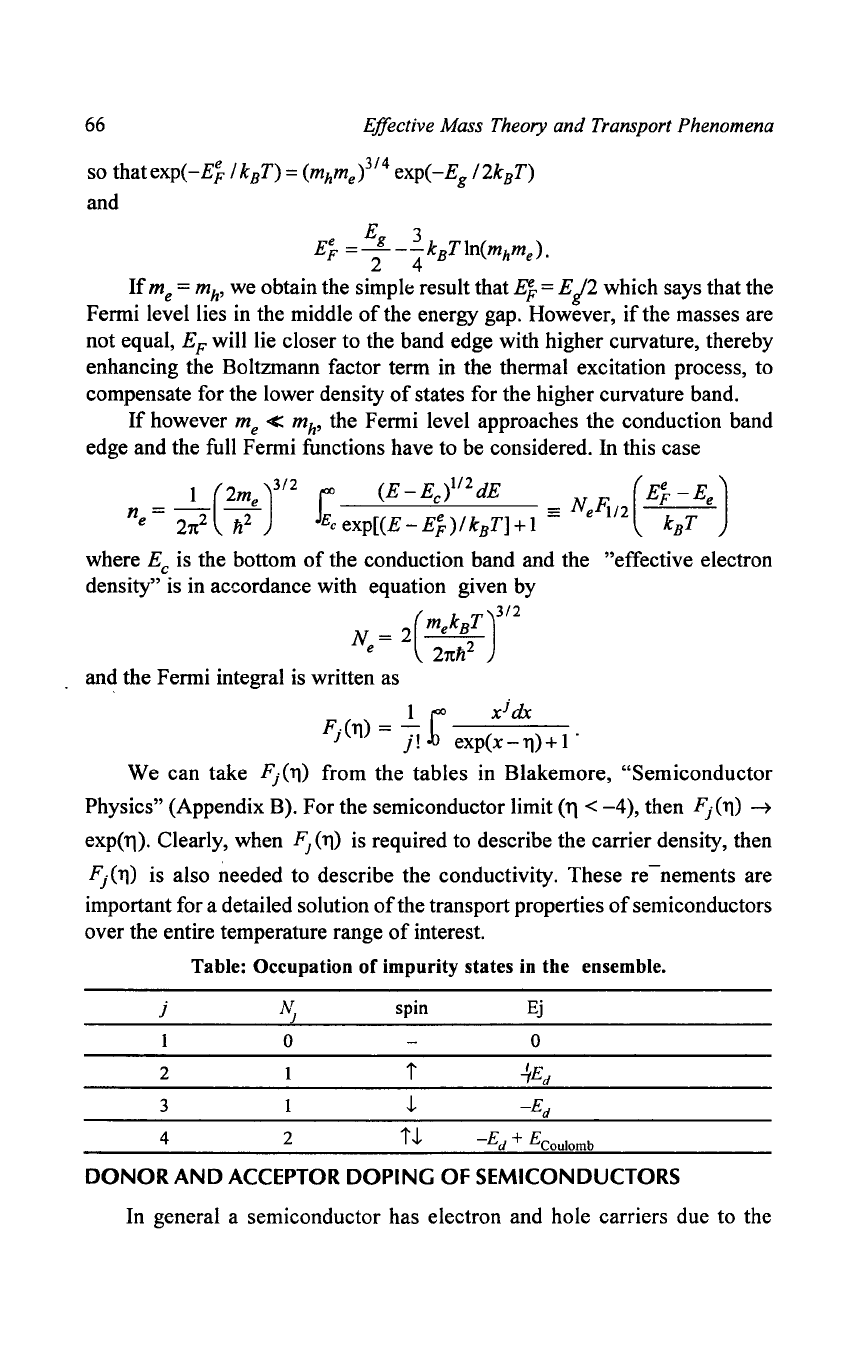
n =
_1_(2m
e
)
3/Z
.r:
(E-Ee)
lIZ
dE =
NeFi/z(E}-Ee)
e
21t
z
liz
'Ee
exp[(E -
E})/
ksT] + 1 -
ksT
where Ee is the bottom
of
the conduction band and the "effective electron
density" is in accordance with equation given by
N =
2(me
k
s
T
)3/Z
e
21tliz
and the Fermi integral is written as
I r
xidx
F'(ll)
= -
J
j!
exp(x-ll)
+ I .
We can take
F/ll)
from the tables in Blakemore, "Semiconductor
Physics"
(Appendix B). For the semiconductor limit
(11
<
-4),
then
F/ll)
~
exp(ll). Clearly, when
F/ll)
is required to describe the carrier density, then
F/ll)
is also needed to describe the conductivity. These re - nements are
important for a detailed solution
of
the transport properties
of
semiconductors
over the entire temperature range
of
interest.
Table: Occupation of impurity states
in
the ensemble.
j N
}
spin
Ej
0 0
2
i
-iEd
3
J,
-Ed
4 2
iJ,
-Ed
+ ECoulomb
DONOR
AND ACCEPTOR
DOPING
OF
SEMICONDUCTORS
In general a semiconductor has electron and hole carriers due to the
Effective Mass Theory
and
Transport Phenomena
67
presence
of
impurities as well as from thermal excitation processes. For many
applications, impurities
are intentionally introduced to generate carriers: donor
impurities to generate electrons in n-type material and acceptor impurities to
generate holes in p-type material. Assuming for the moment that each donor
contributes one electron to the conduction band, then the donors can contribute
an excess carrier concentration up to
N
d
, where
Nd
is the donor impurity
concentration. Similarly,
if
every acceptor contributes one hole to the valence
band, then the excess hole concentration will be
N
a
, where
Na
is the acceptor
impurity concentration.
In general, the semiconductor
is
partly compensated, with both donor and
acceptor impurities present. Furthermore, at finite temperatures, the donor and
acceptor levels will be partially occupied so that somewhat less than the
maximum charge will
be
released as mobile charge into the conduction and
valence bands. The density
of
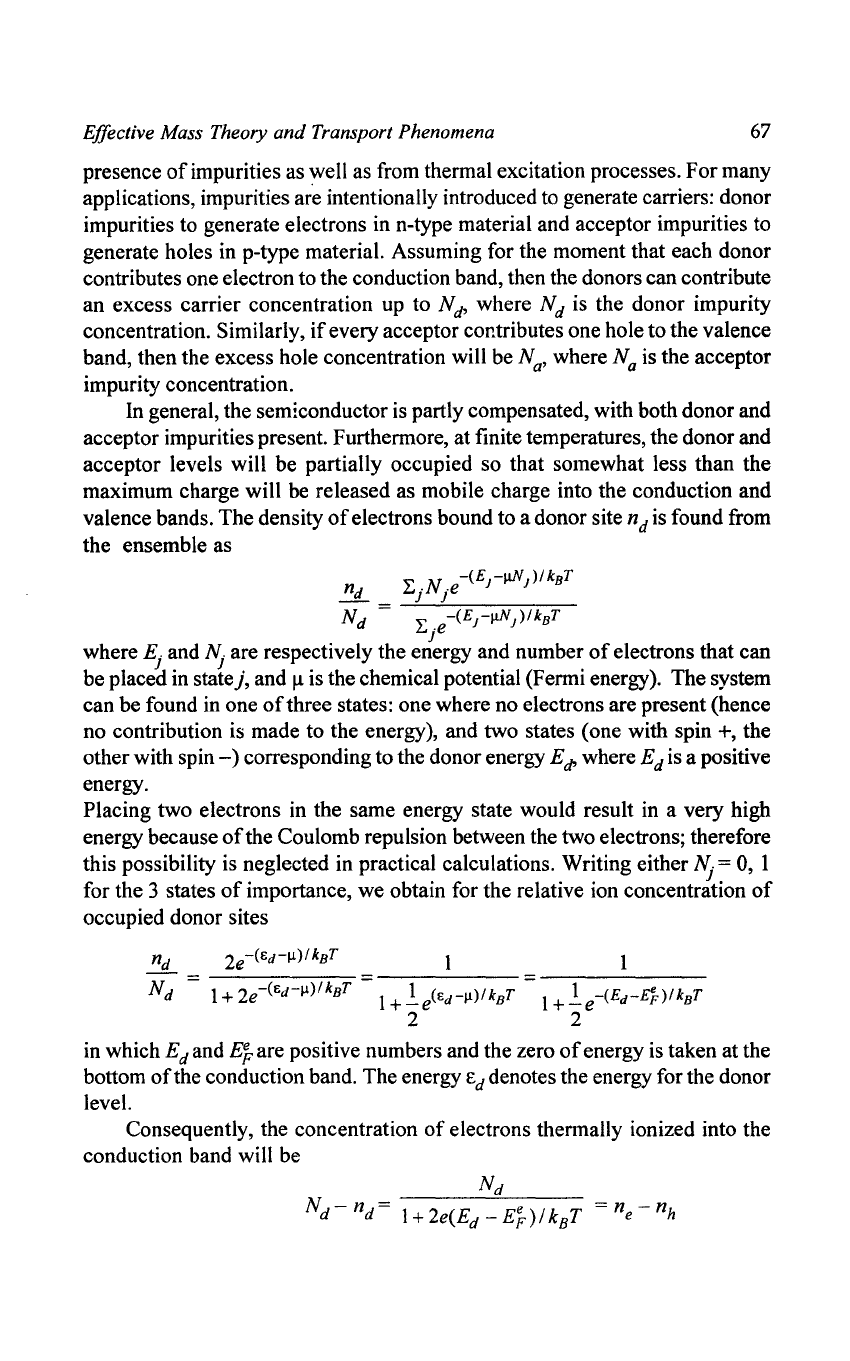
electrons bound to a donor site n d is found from
the ensemble as
L
.N
.e
-(Ej-JJ.N
j
)/
kBT
nd
} }
=---,,--..::...--;-:::---:-:-:---:-:--=--
Nd
~
-(Ej-JJ.Nj)/kBT
£Jje
where E
j
and
~
are respectively the energy and number
of
electrons that can
be placed in state), and
~
is the chemical potential (Fermi energy). The system
can be found in one
of
three states: one where no electrons are present (hence
no contribution is made to the energy), and two states (one with spin
+, the
other with spin
-)
corresponding to the donor energy
Ed'
where
Ed
is a positive
energy.
Placing two electrons in the same energy state would result in a very high
energy because
ofthe
Coulomb repulsion between the two electrons; therefore
this possibility is neglected in practical calculations. Writing either
~
= 0, 1
for the 3 states
of
importance, we obtain for the relative ion concentration
of
occupied donor sites
------=------=-------
1 + 2e
-(Erll)/
kBT 1
+!
e(Erll)/
kBT 1
+!
e
-(ErE})/
kBT
2 2
in
which
Ed
and Ej. are positive numbers and the zero
of
energy is taken at the
bottom
of
the conduction band. The energy
Ed
denotes the energy for the donor
level.
Consequently, the concentration
of
electrons thermally ionized into the
conduction band will be
68
B.
Effective Mass Theory
and
Transport Phenomena
8
f
______________
~--------------8c
-----------
---&d
8
v
_-.1...-_-_-_-_-_-_-_-_-_-_-
-_--J..
_________
-'---!l_
{N
d
-
N.)
-N
v
0
Nc
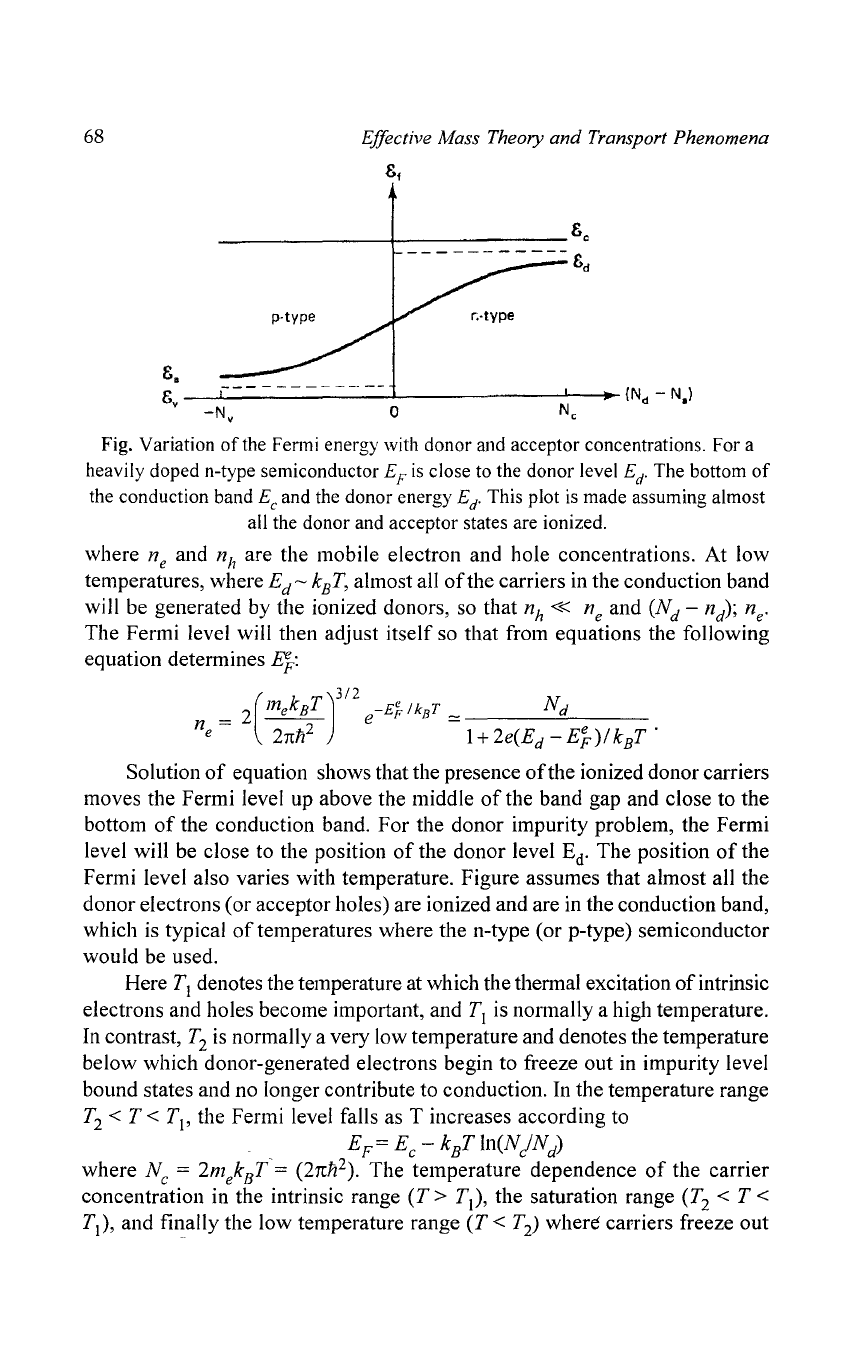
Fig. Variation
of
the Fermi energy with donor and acceptor concentrations. For a
heavily doped n-type semiconductor
EF
is
close to the donor level
Ed.
The bottom
of
the conduction band
Ec
and the donor energy
Ed.
This plot
is
made assuming almost
all the donor and acceptor states are ionized.
where
ne
and
1111
are the mobile electron and hole concentrations. At low
temperatures, where
E
d
- kBT, almost all
of
the carriers in the conduction band
will be generated by the ionized donors, so that
11
11
«
ne
and (Nd -
ll
d
);
lle.
The Fermi level will then adjust itself so that from equations the following
equation determines
E}:
3/2
2(me
k
BT)
-E'f.lkBT
_ Nd
lle=
2rr.h2
e
-1+2e(E
d
-E})lk
B
T·
Solution
of
equation shows that the presence
of
the ionized donor carriers
moves the Fermi level up above the middle
of
the band gap and close to the
bottom
of
the conduction band. For the donor impurity problem, the Fermi
level will be close to the position
of
the donor level
Ed.
The position
of
the
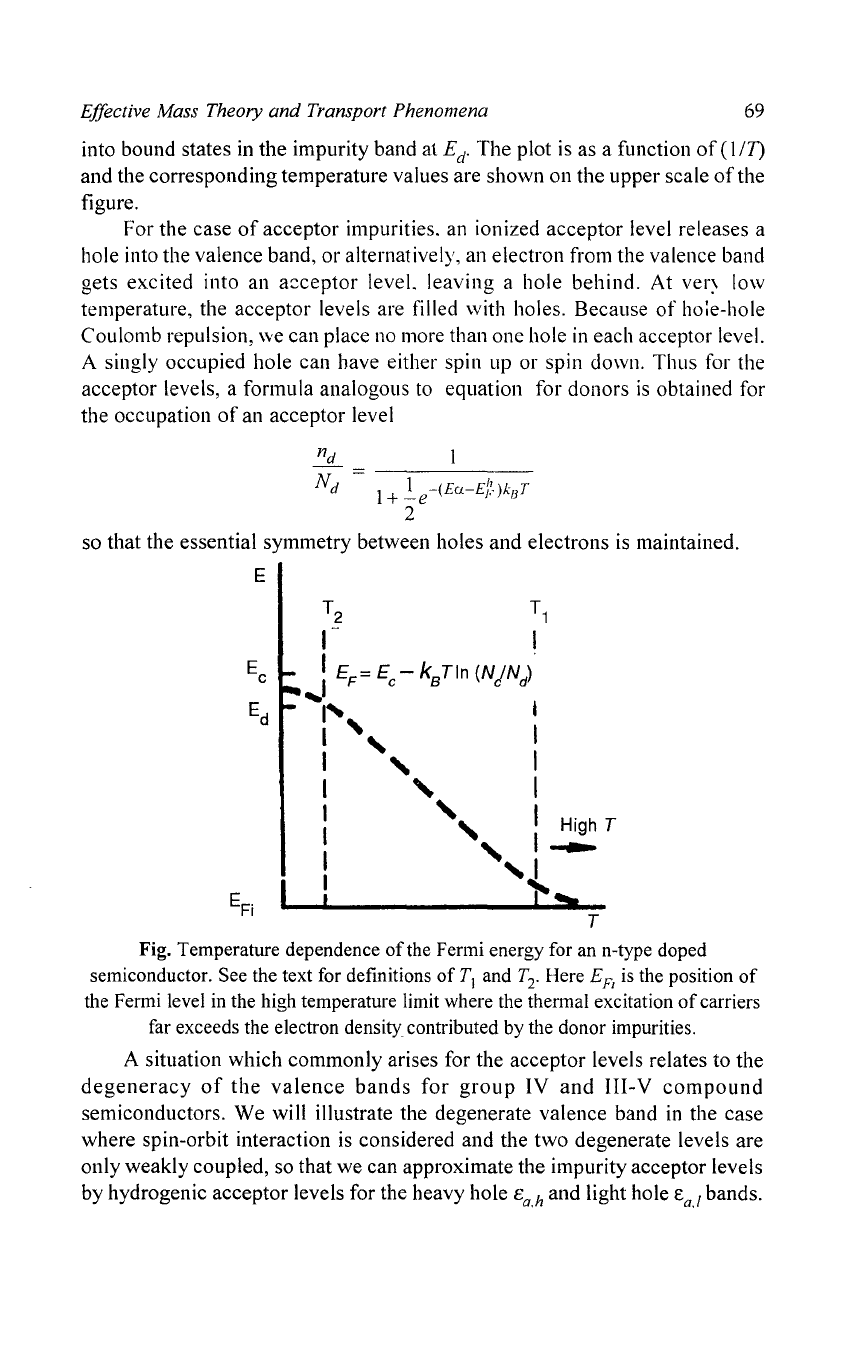
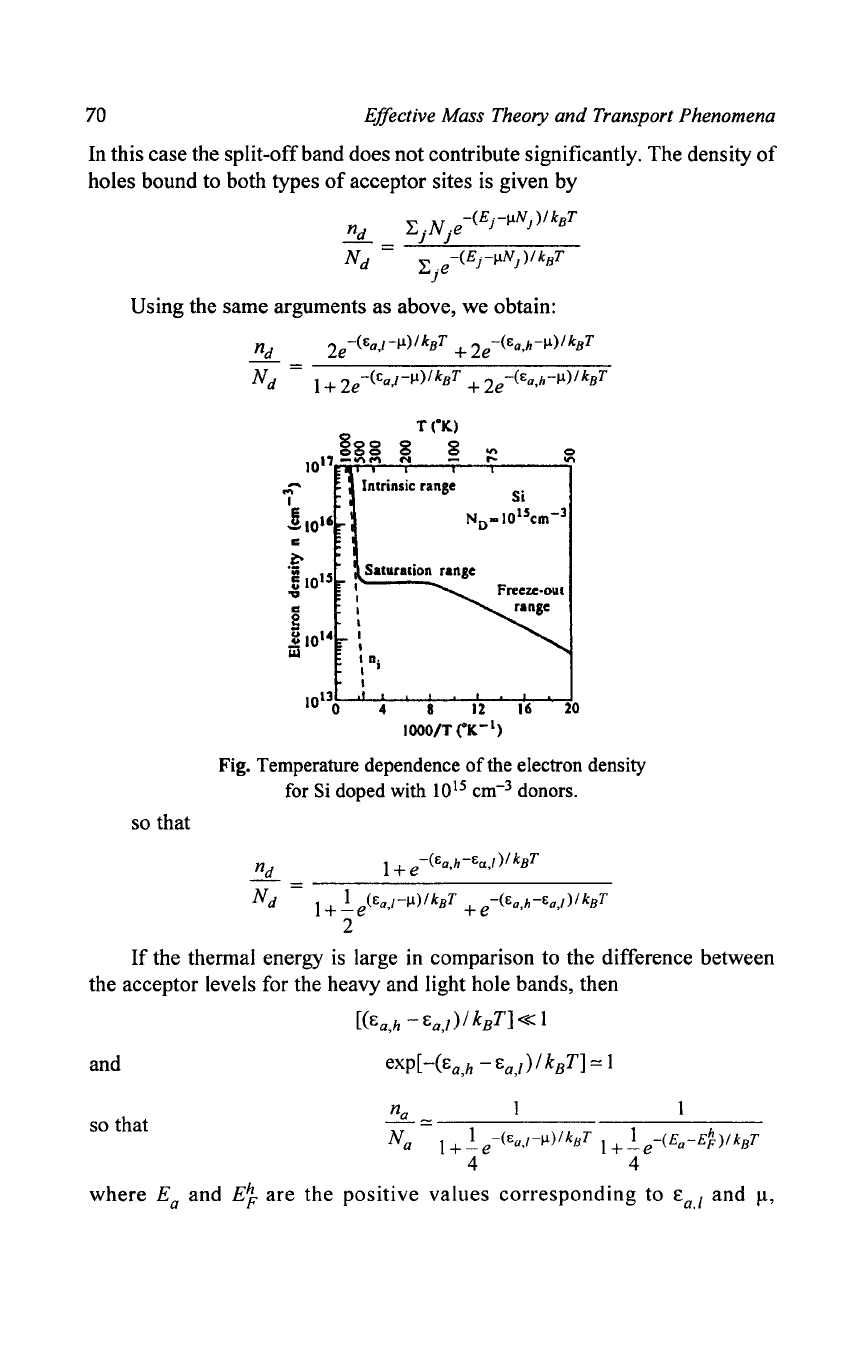
Fermi level also varies with temperature. Figure assumes that almost all the
donor electrons (or acceptor holes) are ionized and are in the conduction band,
which is typical
of
temperatures where the n-type (or p-type) semiconductor
would be used.
Here
TI
denotes the temperature at which the thermal excitation
of
intrinsic
electrons and holes become important, and
TI
is normally a high temperature.
In contrast,
T2
is
normally a very low temperature and denotes the temperature
below which donor-generated electrons begin to freeze out in impurity level
bound states and no longer contribute to conduction. In the temperature range
T2
< T < T
I
,
the Fermi level falls as T increases according to
E F=
Ee
- kBT In(N
jNd)
where
Ne
=
2miBT-=
(2nn
2
).
The temperature dependence
of
the carrier
concentration in the intrinsic range
(T>
T
I
),
the saturation range
(T
2
< T <
T
I
),
and finally the low temperature range
(T
< T
2
)
where carriers freeze out
Effective Mass Theory
and
Transport Phenomena
69
into bound states
in
the impurity band at
Ed'
The plot is as a function
of
(1/1)
and the corresponding temperature values are shown on the upper scale
of
the
figure.
For the case
of
acceptor impurities. an ionized acceptor level releases a
hole into the valence band, or alternatively, an electron from the valence band
gets excited into an
a~ceptor
level. leaving a hole behind. At
ver~
low
temperature, the acceptor levels are filled with holes. Because
of
hoie-hole
Coulomb repulsion,
we can place no more than one hole
in
each acceptor level.
A singly occupied hole can have either spin up or spin down. Thus for the
acceptor levels, a formula analogous to equation for donors
is
obtained for
the occupation
of
an acceptor level
!3!L_
-------
Nd
-
l+.le-(Ea-Ej:.)k
13
T
2
so that the essential symmetry between holes and electrons is maintained.
E
T2
T1
r I
I E = E - k Tin (N IN )'
1
FeB
d d
...
I'
I
I ' I
I',
I
I , I
1
',I
High T
I I
I
"I
.......
:
r--
....
T
Fig. Temperature dependence
of
the Fermi energy for an n-type doped
semiconductor. See the text for definitions
of
T]
and T
2
.
Here
EFI
is the position
of
the Fermi level
in
the high temperature limit where the thermal excitation
of
carriers
far exceeds the electron density contributed by the donor impurities.
A situation which commonly arises for the acceptor levels relates to the
degeneracy
of
the
valence
bands
for
group
IV
and
III-V
compound
semiconductors. We will illustrate the degenerate valence band
in
the case
where spin-orbit interaction
is
considered and the two degenerate levels are
only weakly coupled, so that we can approximate the impurity acceptor levels
by hydrogenic acceptor levels for the heavy hole
ca.h and light hole
ta.!
bands.
70
Effective Mass Theory and Transport Phenomena
In
this case the split-off band does not contribute significantly. The density
of
holes bound to both types
of
acceptor sites
is
given by
L
.N
.e
-(ErIlNj)1
knT
!!.sL
) }
--".---.:!.'-:-:::----:-:--:-:-:-::c-
Nd
L.e-(ErIlNj)/kBT
}
Using the same arguments as above, we obtain:
so that
....
....
I
2e-(&a,J-Il)1 knT +
2e
-(&a,h-Il)1
knT
I 2
-(CaJ-Il)/knT
2
-(&ah-Il)/knT
+
e'
+ e .
T(OK)
8g8
g g
10"
-"'.......
-
Intrinsic range
on
....
o
on
1
10
16
I
I
I
I
I
I
Satlifation range
I
D.
I I
I
10
13
0
4 8
12
16
20
IOOO!T
(K-
l
)
Fig. Temperature dependence
of
the electron density
for
Si doped with
10
15
cm-
3
donors.
I
I
(&a
J-Il)1
knT -(&a h-&a /)1 kBT
+-e'
+e"
2
If
the thermal energy is large in comparison to the difference between
the acceptor levels for the heavy and light hole bands, then
[(cah
-cal)lkBT]«1
and
na
- ::::
---,--------:-------
1
1
-(Eu
,-Il)1
kBT 1 1
-(E
-EFh)1 kBT
+-e'
+-e
a
so that
4 4
where
Ea
and
Ei
are the positive values corresponding to
£a.1
and
~,
Effective Mass Theory and Transport Phenomena
71
respectively. From Equation, the temperature dependence
of
EF
can be
calculated for the case
of
doped semiconductors. The doping dependence
of
EF
for p-doped semiconductors as well as n-doped semiconductors.
CHARACTERIZATION
OF
SEMICONDUCTORS
In describing the electrical conductivity
of
semiconductors, it is customary
to write the conductivity as
~
...
I
E
2.
500
lOll
8
6
4
cr
=
ne
lei
~e
+ nh
lei
~h
TCOK)
400
300
1000lT
COK)-I
250
4
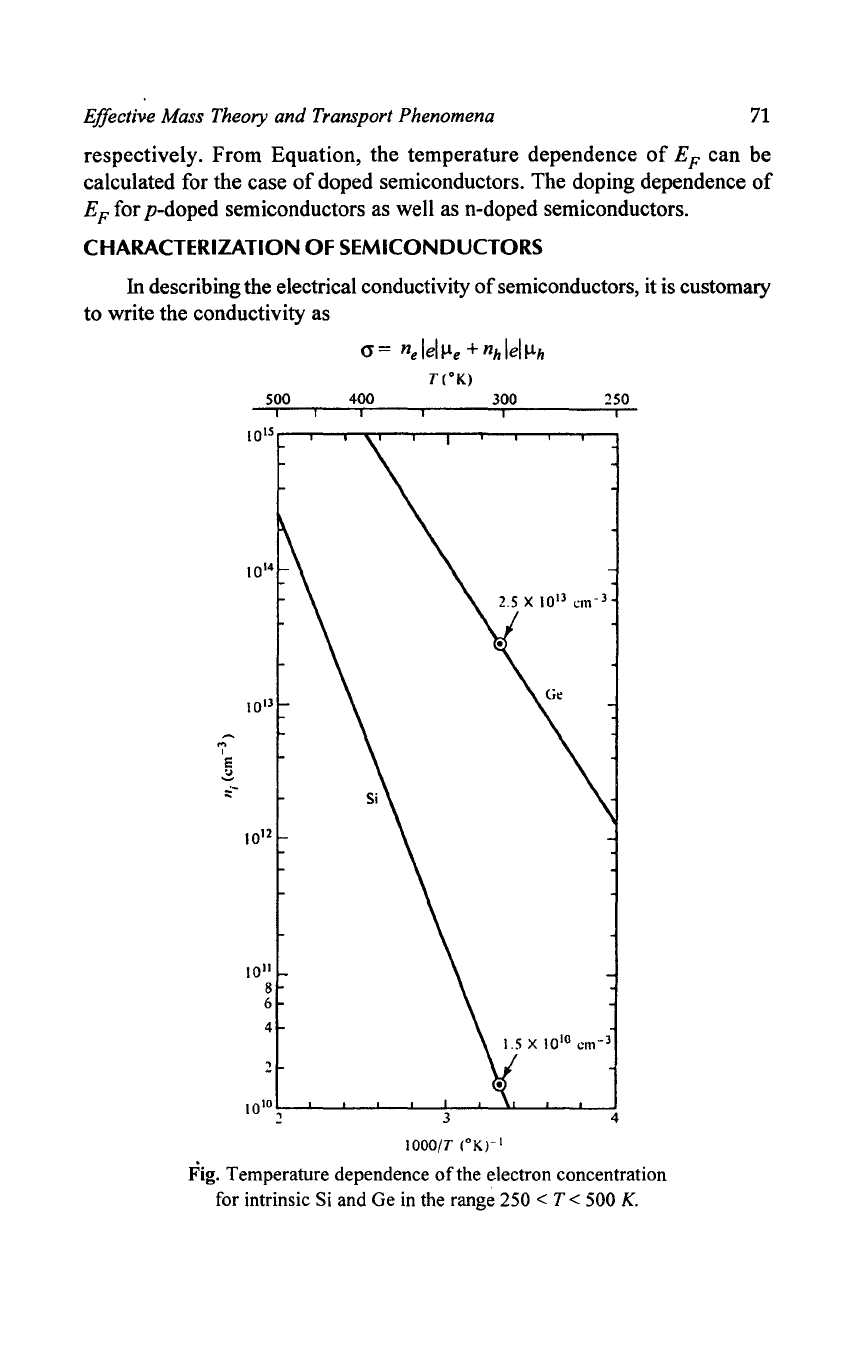
Fig. Temperature dependence
of
the electron concentration
for intrinsic Si and Ge
in
the range 250 < T < 500
K.