
Brewster H.D. Solid State Physics
Подождите немного. Документ загружается.

132
Magneto-transport Phenomena
where n
is
the electron density. Similarly the longitudinal current ]
II
it
will
approach a constant value or saturate since
it.1.
]
,and
it.1.
B .
(100)
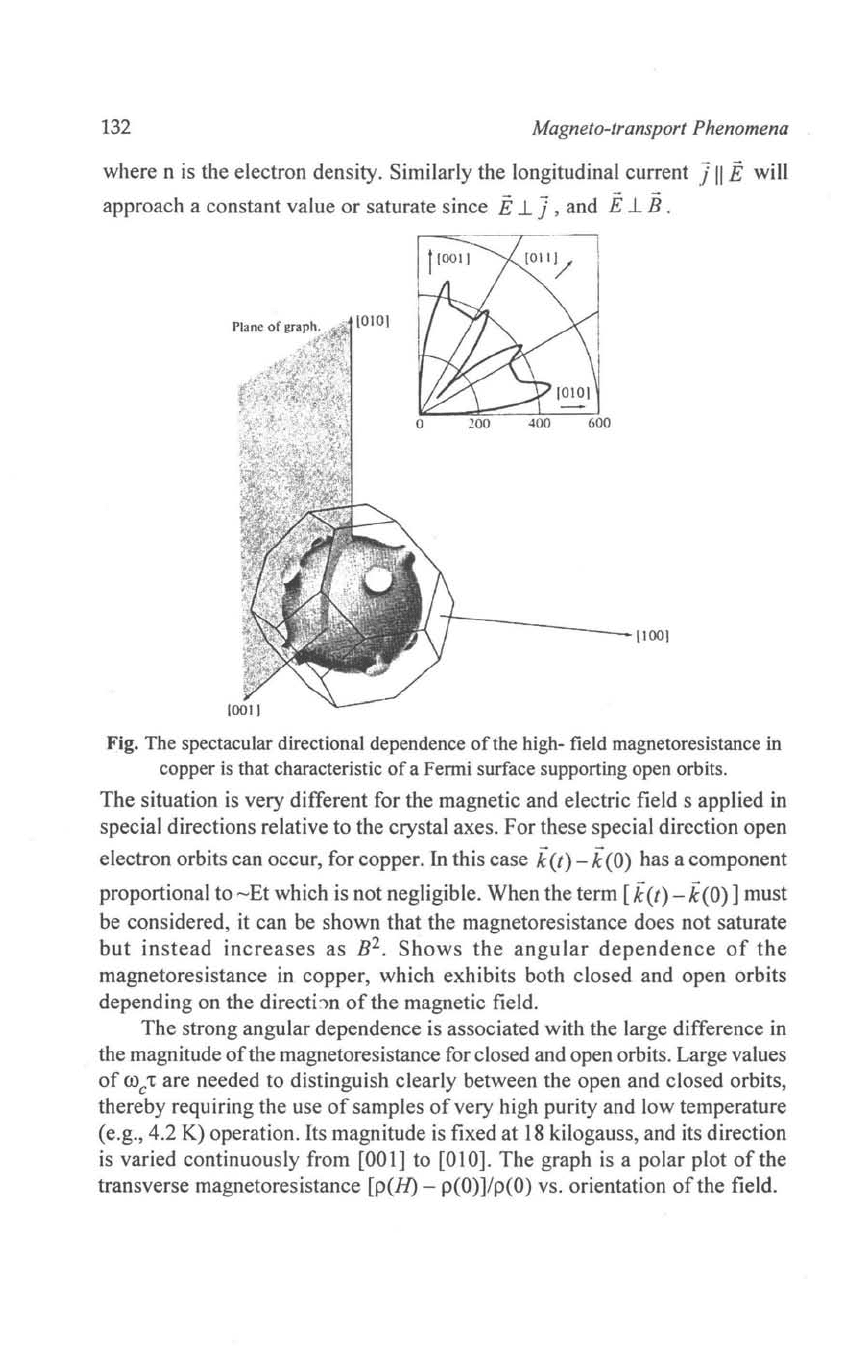
Fig. The spectacular directional dependence
of
the high- field magnetoresistance in
copper
is
that characteristic
of
a Fermi surface supporting open orbits.
The situation
is
very different for the magnetic and electric field s applied
in
special directions relative to the crystal axes. For these special direction open
electron orbits can occur, for copper.
In this case
k(t)
- k(O) has a component
proportional to
~Et
which is not negligible. When the term
[k(f)
-
k(O)]
must
be considered, it can be shown that the magnetoresistance does not saturate
but
instead
increases
as
B2.
Shows
the
angular
dependence
of
the
magnetoresistance in copper, which exhibits both closed and open orbits
depending on the
directhn
of
the magnetic field.
The strong angular dependence is associated with the large difference in
the magnitude
of
the magnetoresistance for closed and open orbits. Large values
of
wc't
are needed to distinguish clearly between the open and closed orbits,
thereby requiring the use
of
samples
of
very high purity and low temperature
(e.g., 4.2 K) operation. Its magnitude
is
fixed at
18
kilogauss, and its direction
is
varied continuously from [001] to [010]. The graph
is
a polar plot
of
the
transverse magnetoresistance
[p(H) - p(O)]/p(O) vs. orientation
of
the field.
Chapter 5
Transport
in
Low Dimensional Systems
Transport phenomena
in
low dimensional systems such as
in
quantum
wells (2D), quantum wires
(1
D), and quantum dots
(OD)
are dominated by
quantum effects not included
in
the classical treatments based on the Boltzmann
equation.
With the availability
of
experimental techniques to synthesize materials
of
high chemical purity and
of
nanometer dimensions, transport
in
low
dimensional systems has become an active current research area.
OBSERVATION
OF
QUANTUM
EFFECTS
IN
REDUCED
DIMENSIONS
Quantum effects dominate the transport
in
quantum wells and other low
dimensional systems such as quantum wires and quantum dots when the de
Broglie wavelength
of
the electron
"A
_ h
dB
- (2m *
E)I/2
exceeds the dimensions
of
a quantum structure
of
characteristic length
L/A
dB
>
L=)
or likewise for tunneling through a potential barrier
of
length
L=.
To get some order
of
magnitude estimates
of
the electron kinetic energies E
below which quantum effects become important where a log-log plot
of
AdB
vs E in equation
is
shown for
GaAs and lnAs.
from
the plot we see that an electron energy
of
E - 0: I
eV for GaAs corresponds to a de Broglie wavelength
of
200
A.
Thus wave
properties for electrons can be expected for structures smaller than
A
dB
.
To observe quantum effects, the thermal energy must also be less than
the energy level separation,
kBT
<
M,
where we note that room temperature
corresponds to 25 me
V.
Since quantum effects depend on the phase coherence
of
electrons,
scattering can also destroy quantum effects. The observation
of
quantum effects
thus requires that the carrier mean free path be much larger than the dimensions
of
the quantum structures (wells, wires or dots).
The limit where quantum effects become important has been given the
134
Transport in Low Dimensional Systems
name
of
meso scopic physics. Carrier transport
in
this limit exhibits both particle
and wave characteristics.
In
this ballistic transport limit, carriers can
in
some cases transmit charge
or energy without scattering.
The small dimensions required for the observation
of
quantum effects
can be achieved by the direct fabrication
of
semiconductor elements
of
small
dimensions (quantum wells, quantum wires and quantum dots). Another
approach
is
the use
of
gates on a field effect transistor to define an electron
gas
of
reduced dimensionality.
In
this context, negatively charged metal gates can be used to control the
source to drain current
of
a 2D electron gas formed near the GaAsl AlGaAs
interface. A thin conducting wire is formed
lJut
of
the 2D electron gas.
Controlling the gate voltage controls the amount
of
charge
in
the depletion
region under the gates, as well as the charge in the quantum wire.
Thus lower dimensional channels can be made
in
a 2D electron gas by
using metallic gates.
DENSITY
OF
STATES
IN
lOW
DIMENSIONAL
SYSTEMS
We showed in equation that the density
of
states for a 2D electron gas
is
a constant for each 2D subband
m*
g2D =
Tth2
The inset
is
appropriate to the quantum well formed near a modulation
doped GaAs-AIGaAs interface.
In
the diagram only the lowest bound state
is
occupied.
Using the same argument, we now derive the density
of
states for a ID
electron gas
2 I
NID =
2Tt
(k)
=;(k)
which for a parabolic band E = En +
h2~/(2m*)
becomes
N =
2(k)=!(2m*(E-E
n
))1/2
ID
2Tt
Tt
h
2
yielding an expression for the density
of
states g
ID
(E) =
aN
lljaE
(
)
1/2
1
2m
-1/2
g
(
E)
= - -
(E
- E )
ID
2Tt
h2 n ·
Transport in Low Dimensional Systems 135
I
20
Electron gas
(a)
Gate Gate
Source 1 1 Drain
I-
(\-{\
..L
~8~
(b)
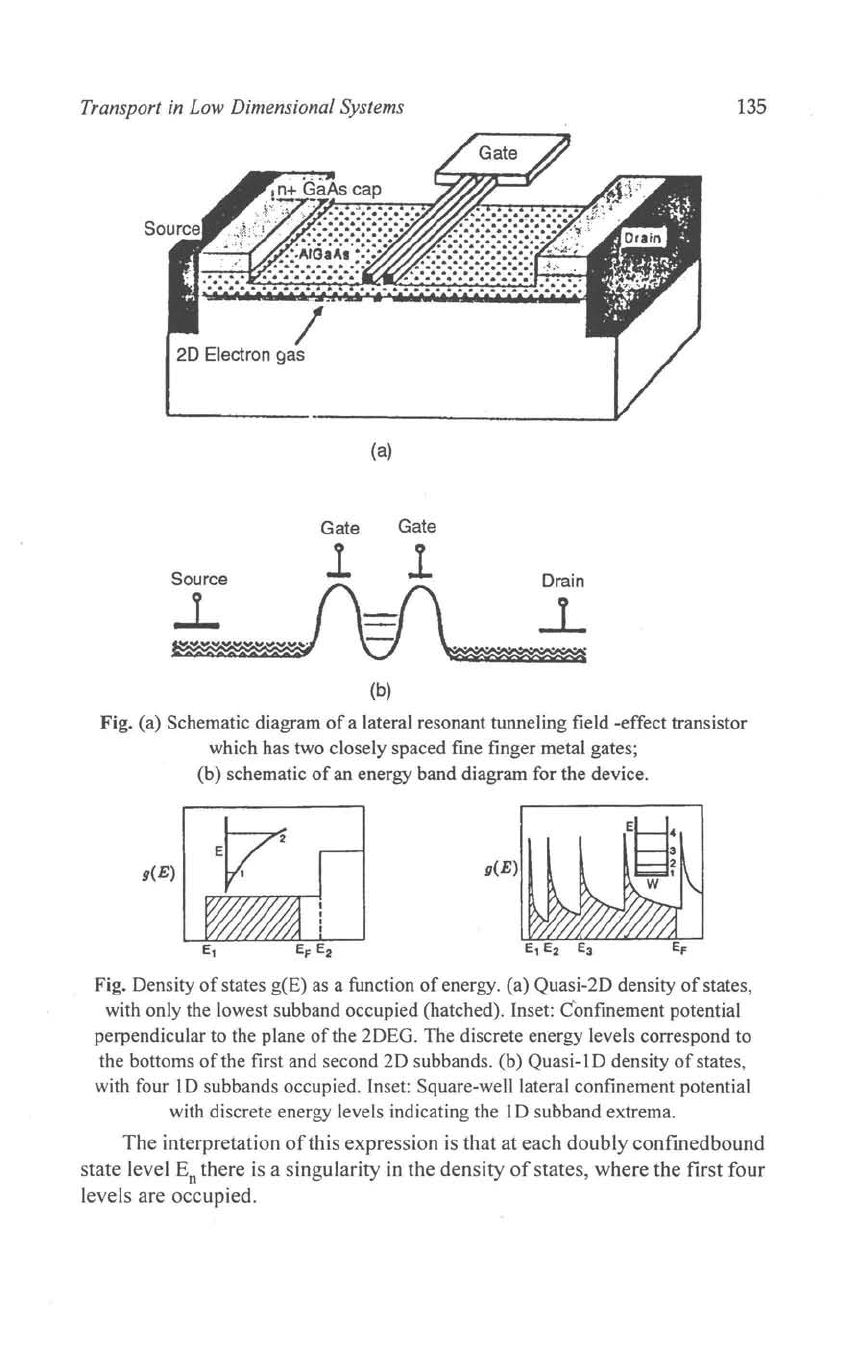
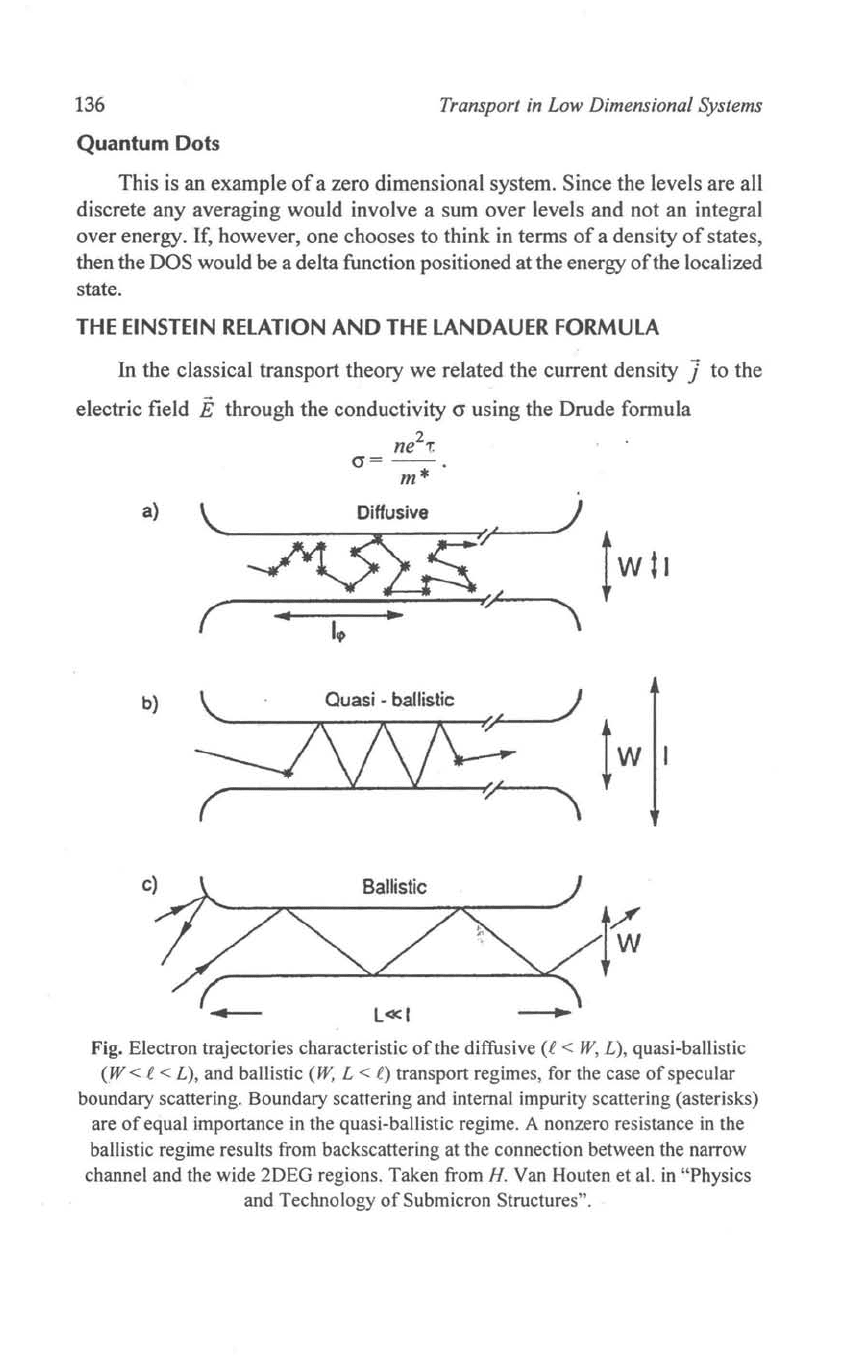
Fig. (a) Schematic diagram
of
a lateral resonant tunneling field -effect transistor
which has two closely spaced fme finger metal gates;
(b) schematic
of
an energy band diagram for the device.
g(E)
Fig. Density
of
states g(E) as a function
of
energy. (a) Quasi-2D density
of
states,
with only the lowest subband occupied (hatched). Inset: Confinement potential
perpendicular to the plane
of
the 2DEG. The discrete energy levels correspond to
the bottoms
of
the first and second 2D subbands. (b) Quasi-l D density
of
states,
with four I D subbands occupied. Inset: Square-well lateral confinement potential
with discrete energy levels indicating the I D subband extrema.
The
interpretation
of
this expression is that at each doubly confinedbound
state level
En
there
is
a singularity in the density
of
states, where the first four
levels are occupied.
136
Transport in Low Dimensional Systems
Quantum Dots
This is an example
of
a zero dimensional system. Since the levels are all
discrete any averaging would involve a sum over levels and not an integral
over energy. If, however, one chooses to think in terms
of
a density
of
states,
then the
DOS would be a delta function positioned at the energy
of
the localized
state.
THE
EINSTEIN
RELATION
AND
THE
LANDAUER
FORMULA
In the classical transport theory we related the current density J to the
electric field
E through the conductivity a using the Drude formula
ne
2
..
0'=
--.
m*
a}
'---
Diffusive
.J
-~_-----r"'/.I"-(
-
tw
t I
--..
'/~,(
r
SF
"
.
..
lIP
b}
Quasi·
ballistic J
~--~--
__
~-T~~_/
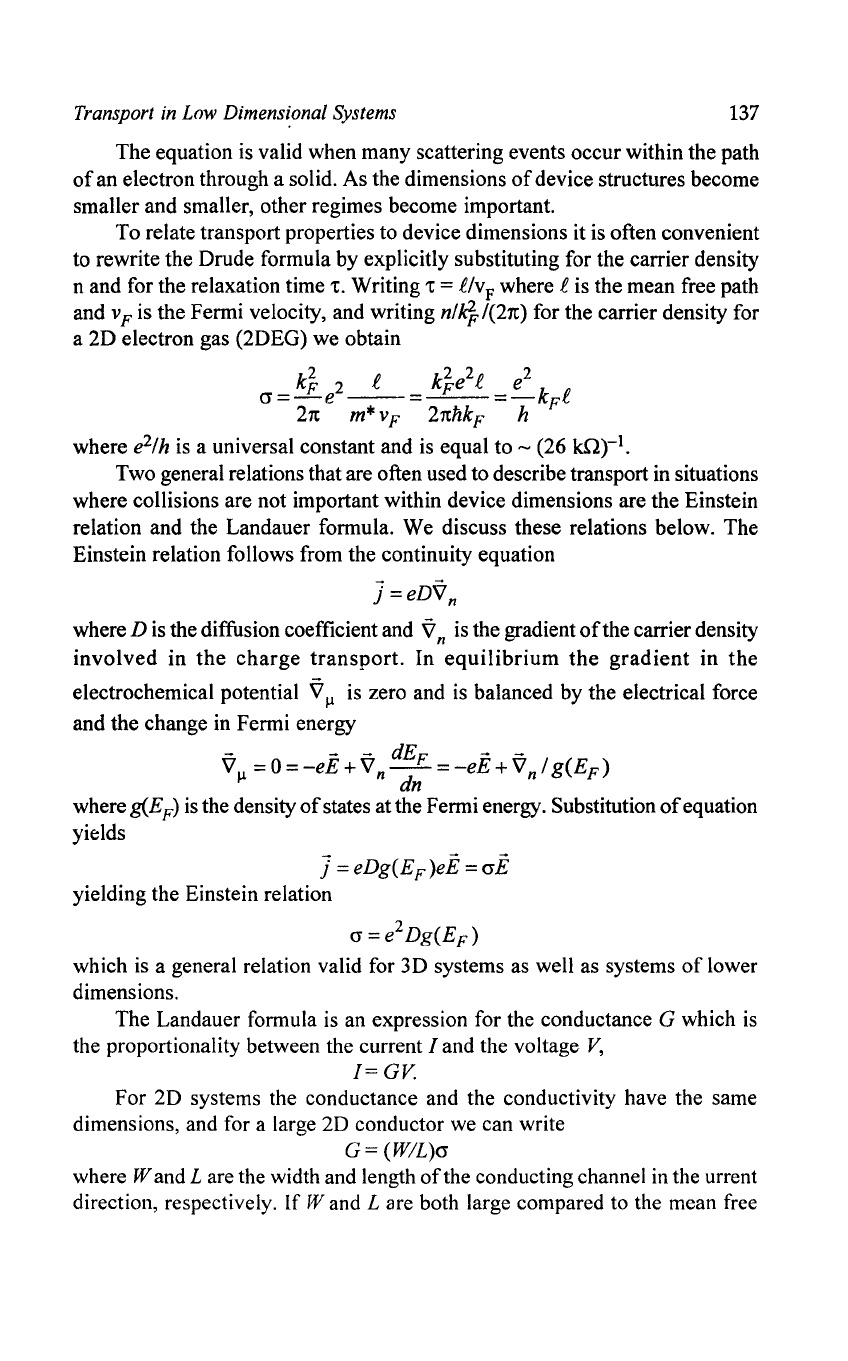
Fig. Electron trajectories characteristic
of
the diffusive (£ <
W,
L), quasi-ballistic
(W
<
f.
< L), and ballistic (w, L <
f.)
transport regimes, for the case
of
specular
boundary scattering. Boundary scattering and internal impurity scattering (asterisks)
are
of
equal importance in the quasi-ballistic regime. A nonzero resistance
in
the
ballistic regime results from backscattering at the connection between the narrow
channel and the wide 2DEG regions. Taken from
H. Van Houten et al.
in
"Physics
and Technology
of
Submicron Structures",
Transport
in
Low
Dimens~onal
Systems
137
The equation
is
valid when many scattering events occur within the path
of
an electron through a solid. As the dimensions
of
device structures become
smaller and smaller, other regimes become important.
To relate transport properties to device dimensions it is often convenient
to rewrite the Drude formula by explicitly substituting for the carrier density
n and for the relaxation time
'to
Writing't =
£/vF
where £ is the mean free path
and
v
F
is the Fermi velocity, and writing
n/k}/(21t)
for the carrier density for
a 2D electron gas
(20EG)
we obtain
k
2
£ k2
2£
2
cr
=Le
2
= Fe
=~kF£
21t
m*
VF
21thkF h
where e
2
/h
is
a universal constant and
is
equal to
~
(26
kiltl.
Two general relations that are often used to describe transport
in
situations
where collisions are not important within device dimensions are the Einstein
relation and the Landauer formula. We discuss these relations below. The
Einstein relation follows from the continuity equation
] =eDV
n
where D is the diffusion coefficient and V n is the gradient
of
the carrier density
involved
in
the
charge
transport.
In
equilibrium
the
gradient
in
the
electrochemical potential V
~
is zero and is balanced by the electrical force
and the change
in
Fermi energy
- - -
dE
F
--
V'~
=O=-eE+
V'n--=-eE
+ V'n/
g(E
F
)
dn
where
g(E
F
)
is
the density
of
states at the Fermi energy. Substitution
of
equation
yields
] = eDg(EF )eE =
crE
yielding the Einstein relation
cr
= e
2
Dg(EF)
which is a general relation valid for 3D systems as well as systems
of
lower
dimensions.
The Landauer formula
is
an expression for the conductance G which
is
the proportionality between the current I and the voltage
V,
/=
Gv.
For
20
systems the conductance and the conductivity have the same
dimensions, and for a large
20
conductor we can write
G=
(WIL)cr
where Wand L are the width and length
of
the conducting channel in the urrent
direction, respectively. If Wand
L are both large compared to the mean free
138 Transport in Low Dimensional Systems
path t, then we are in the diffusive regime. However when we are in the
opposite regime, the ballistic regime, where
t >
W,
L, then the conductance
is
written in terms
of
the Landauer formula which
is
obtained from equations.
Writing the number
of
quantum modes N, then N 1t =
kFWor
Nit
kF= W
and noting that the quantum mechanical transition probability coupling one
channel to another in the ballistic limit
jta;~2
is
1t'
/(2LN) per mode, we obtain
the general Landauer formula
2e
2
N
2
G=
h
~]ea,~I·
a,~
We will obtain the Landauer formula below for some explicit examples,
which will make the derivation
of
the normalization factor more convincing.
-2
-1.8
-1.6
-1.4 -1.2
-1
gate voltage M
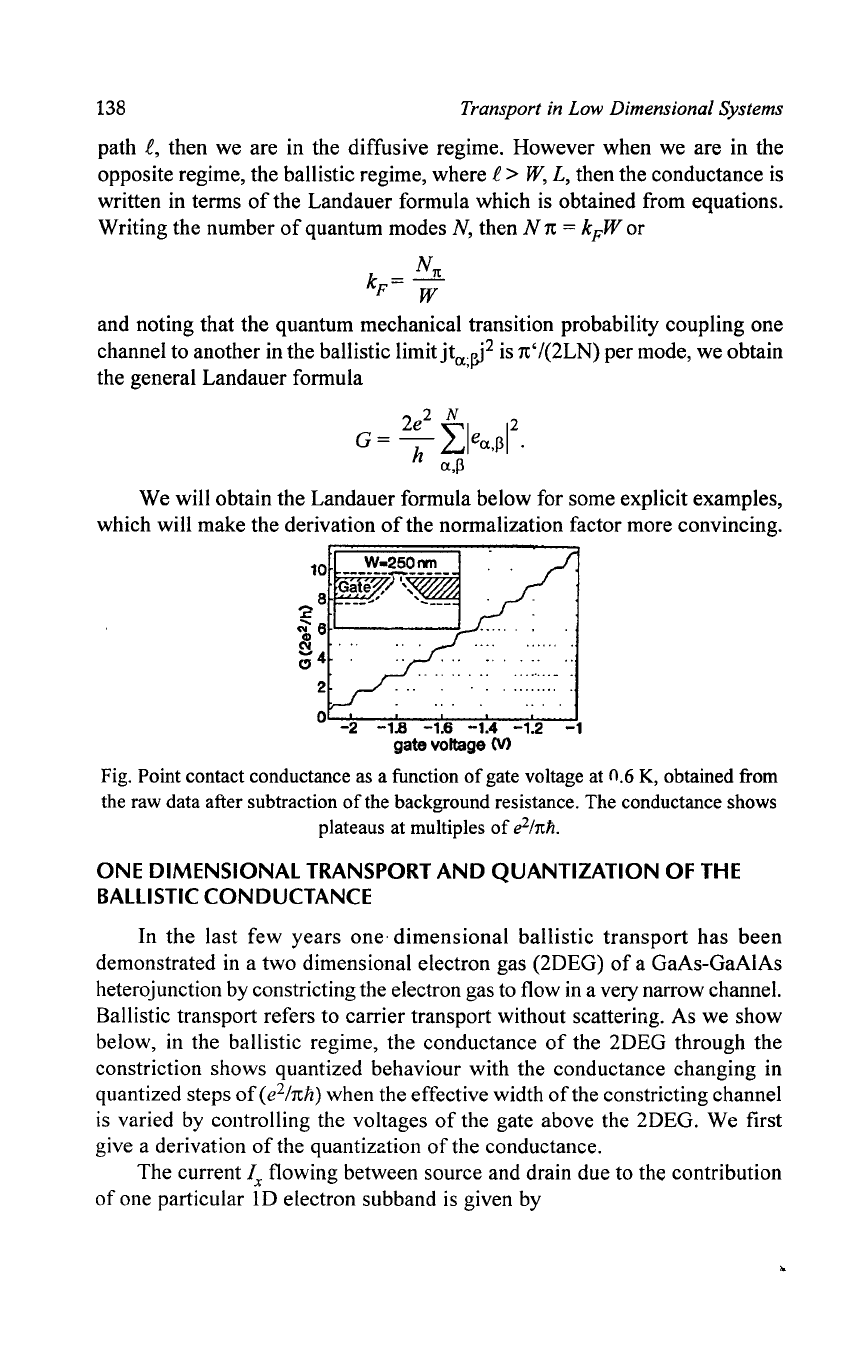
Fig. Point contact conductance as a function
of
gate voltage at
n.6
K,
obtained from
the raw data after subtraction
of
the background resistance. The conductance shows
plateaus at multiples
of
e'l/1tIi.
ONE DIMENSIONAL
TRANSPORT
AND QUANTIZATION OF
THE
BALLISTIC
CONDUCTANCE
In
the
last few years one· dimensional ballistic transport has been
demonstrated
in
a two dimensional electron gas (2DEG)
of
a GaAs-GaAIAs
heterojunction by constricting the electron gas to flow
in
a very narrow channel.
Ballistic transport refers to carrier transport without scattering. As we show
below,
in
the ballistic regime, the conductance
of
the
20EG
through the
constriction shows quantized behaviour with the conductance changing in
quantized steps
of
(e
2
/1tIl)
when the effective width
of
the constricting channel
is
varied
by
controlling the voltages
of
the gate above the
20EG.
We first
give a derivation
of
the quantization
of
the conductance.
The current
Ix
flowing between source and drain due to the contribution
of
one particular
10
electron subband
is
given by
Transport in Low Dimensional Systems
139
Ix=
neov
where n is the carrier density (i.e., the number
of
carriers per unit length
of
the channel) and
ov
is the increase
in
electron velocity due to the application
of
a voltage
V.
The carrier density
in
ID is
2 kF
n=
-kF
=-
27t
7t
and the gain
in
velocity
ov
resulting from an applied voltage V is
1 2 1 2 1 2
eV=
"2
m
*(VF
+Ov)
-"2
m
*VF =m*VFO
V
+"2
m
*(OV)
.
Retaining only the first order term in equation yields
ov=
eV
Im*vF
so that from equation we get for the source-drain current
kF
eV
e
2
I
=-e--=-V
x
7t
m*vF
7th
since hkF =
m*v
p
This yields a conductance per
ID
electron subband G
j
of
e
2
G.=-
I
7th
or summing over all occupied subbands i we obtain
e
2
ie
G=
~7th
=
7th
I
Two experimental observations
of
these phenomena were simultaneously
published. The experiments by Van Wees et
at. were done using ballistic point
contacts on a gate structure placed over a two-dimensional electron gas. The
width W
of
the gate (in this case 2500A) defines the effective width
WOof
the conducting electron channel, and the applied gate voltage is varied in order
to control the effective width W
o.
Superimposed on the raw data for the
resistance vs gate voltage
is
a collection
of
periodic steps after subtracting
off
the background resistance
of
400.
There
are
several
conditions
necessary
to
observe
perfect
2e
2
/
h
quantization
of
the
ID
conductance. One requirement
is
that the electron mean
free path
Ie
be much greater than the length
of
the channel
L.
This limits the
values
of
channel lengths to L < 5,000 A even though mean free path values
are much larger,
Ie
=
8.5
~m.
It
is
important to note, however, that
Ie
=
8.51lm
is
the mean free path for the 2D electron gas. When the channel
is
formed, the
screening effect
of
the 2D electron gas
is
no longer present and the effective
mean free path becomes much shorter.
140
Transport
in
Low Dimensional Systems
A second condition
is
that there are adiabatic transitions at the inputs and
outputs
of
the channel. This minimizes reflections at these two points, an
important condition for the validity
of
the Landauer formula. A third condition
requires the Fermi wavelength
Ap
=
21rJk
F
(or
kFL >
21t)
to satisfy the relation
/...F
< L by introducing a sufficient carrier density (3.6 x 101lcm-
2
) into the
channel. Finally, it
is
necessary that the thermal energy
kBT«
Ej
-
ELI
where
Ej
- E
j
_
l
is the subband separation between the j and j i
lone
dimensional
energy levels. Therefore, the quantum conductance measurements are done at
low temperatures
(T
<1
K).
The
point
contacts
were
made on high-mobility molecular-beam-
epitaxygrown GaAs-AIGaAs heterostructures using electron beam lithography.
The electron density
of
the material is 3.6
xl
011/cm2
and the mobility
is
8.5
x
105
cm
2N
s (at 0.6 K). These values were obtained directly from measurements
of
the devices themselves. For the transport measurements, a standard Hall
bar geometry was defined by wet etching.
At
a gate voltage
of
Vg
=
-0.6
V the
electron gas underneath the gate is depleted, so that conduction takes place
through the point contact only. At this voltage, the point contacts have their
maximum effective width W
0 max, which
is
about equal to the opening W
between the gates.
Bya
further decrease (more negative)
of
the gate voltage,
the width
of
the point contacts can be reduced, until they are fully pinched
off
at
Vg
=
-2.2V.
The results agree well with the appearance
of
conductance steps that are
integral multiples
of
e
2
/1th,
indicating that the conductance depends directly
on the number
of
ID
subbands that are occupied with electrons. To check the
validity
of
the proposed explanation for these steps in the conductance, the
effective width
W
O
for the gate was estimated from the voltage
Vg
=
-0.6
V to
be
3600
A,
which is close to the geometric value for
W.
We see that the average conductance varies linearly with
Vg
which
in
tum
indicates a linear relation between the effective point contact width W'
and V
g
.
From the
16
observed steps and a maximum effective point contact
width
W:nax
= 3600
A,
an estimate
of
220 A
is
obtained for the increase in
width per step, corresponding to
Ap/2.
Theoretical work done by
Rolf
Landauer
nearly
20 years ago shows that transport through the channel can be described
by summing up the conductances for all the possible transmission modes, each
with a well defined transmission coefficient
t
nm
.
The conductance
of
the ID
channel can then be described by the Landauer formula
2 Nc
G=
:Ii
L
It
nm
l
2
n,m=!
where
Nc
is the number
of
occupied subbands.
If
the conditions for perfect
quantization described earlier are satisfied, then the transmission coefficient
Transport
in
Low Dimensional Systems
141
reduces to
Itnml2
/ 8
nm
. This corresponds to purely ballistic transport with no
scattering or mode mixing
in
the channel (i.e., no back reflections).
A more explicit derivation
of
the Landauer formula for the special case
of
a
ID
system can be done as follows. The current flowing
in
a
ID
channel
can be written as
~=
f;f
egj(E)vz(E)Tj(E)dE
where the electron velocity
is
given by
and
m*v=
=
nk
z
n2k~
E=
E+---
}
2m*
while the ID density
of
states
is
from equation given by
(2m*)112
g/E)=
h(E_E
g
)I12
and
1j
(E)
is
the probability that an electron injected into subband j with energy
E wiiJ get across the 1 D wire ballistically. Substitution
of
equation then yields
/=
2e rEj
T(E)dE
= 2e
2
Ti1V
} h
JE;
} h }
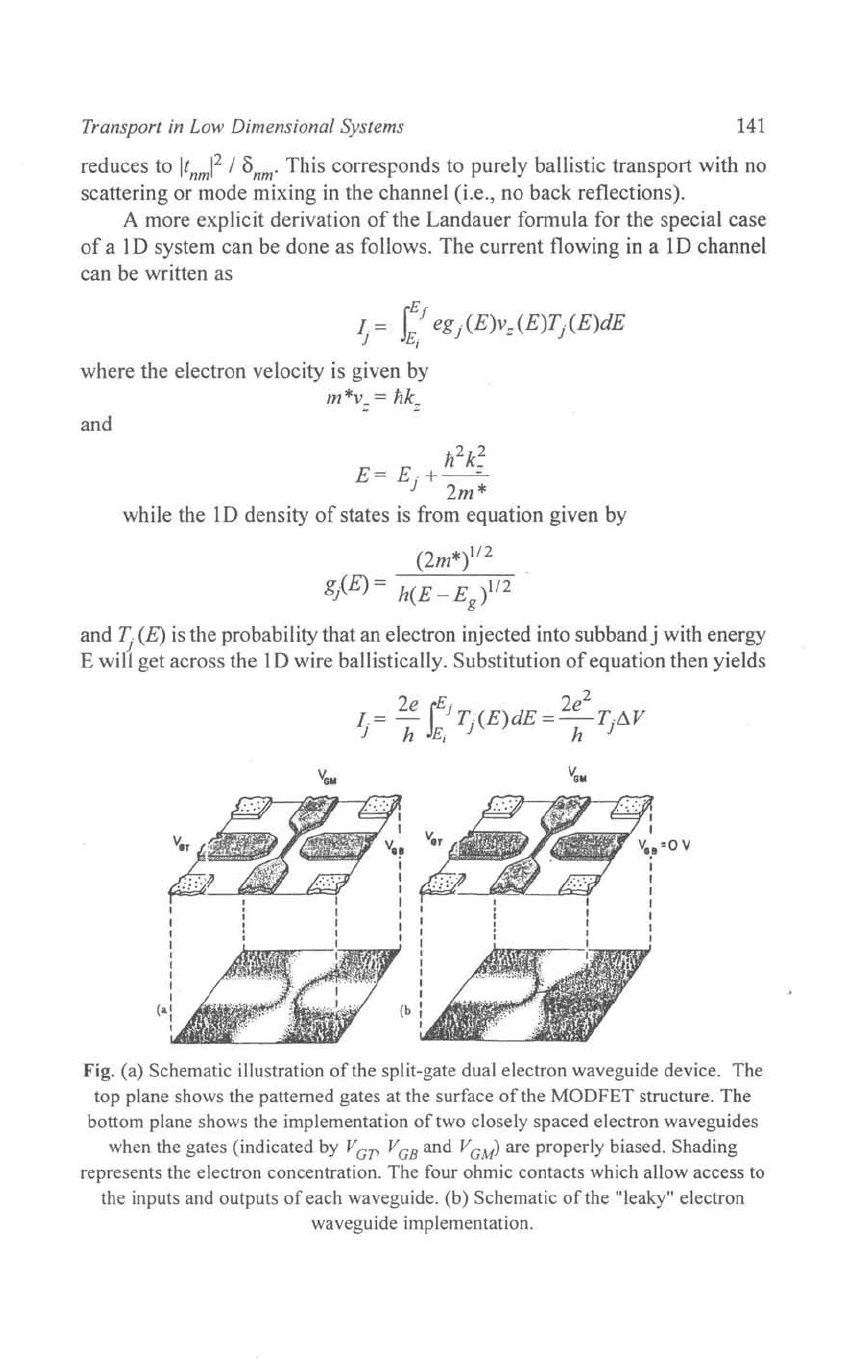
Fig. (a) Schematic illustration
of
the split-gate dual electron waveguide device. The
top plane shows the patterned gates at the surface
of
the MODFET structure. The
bottom plane shows the implementation
of
two closely spaced electron waveguides
when the gates (indicated by
VCT'
V
CB
and V
CM
) are properly biased. Shading
represents the electron concentration. The four ohmic contacts which allow access to
the inputs and outputs
of
each waveguide. (b) Schematic
of
the "leaky" electron
waveguide implementation.