
Brewster H.D. Solid State Physics
Подождите немного. Документ загружается.

142
Transport in Low Dimensional Systems
The bottom gate is grounded
(V
GB
==
0) so that only one waveguide
is
in
an
"on"
state. V
GM
is fixed such that only a small tunneling current crosses it.
The current flowing through the waveguide as well as the tunneling current
(depicted by arrows) are monitored simultaneously.
where we have noted that the potential energy difference
is
the difference
between initial and final energies
e/). V
==
E
f
-
Ej"
Summing over all occupied
states} we then obtain the Landauer formula
2
G==
2e
IT).
h )
BALLISTIC TRANSPORT
IN
1 D ELECTRON WAVEGUIDES
Another interesting quantum-effect structure proposed and implemented
the appropriate negative biases on patterned gates at the surface, two electron
waveguides can be formed at the heterointerface
of
a MODFET structure. The
two electron waveguides are closely spaced over a certain length and their
separation is controlled by the middle gate bias
(V
GM
).
2e
21
-h
T
LaJ
~
~
u
:>
o
z
o
u
-1.5 -1.3
-1.1
-0.9
-0.7
SIDE-GATE
VOLTAGE
(V)
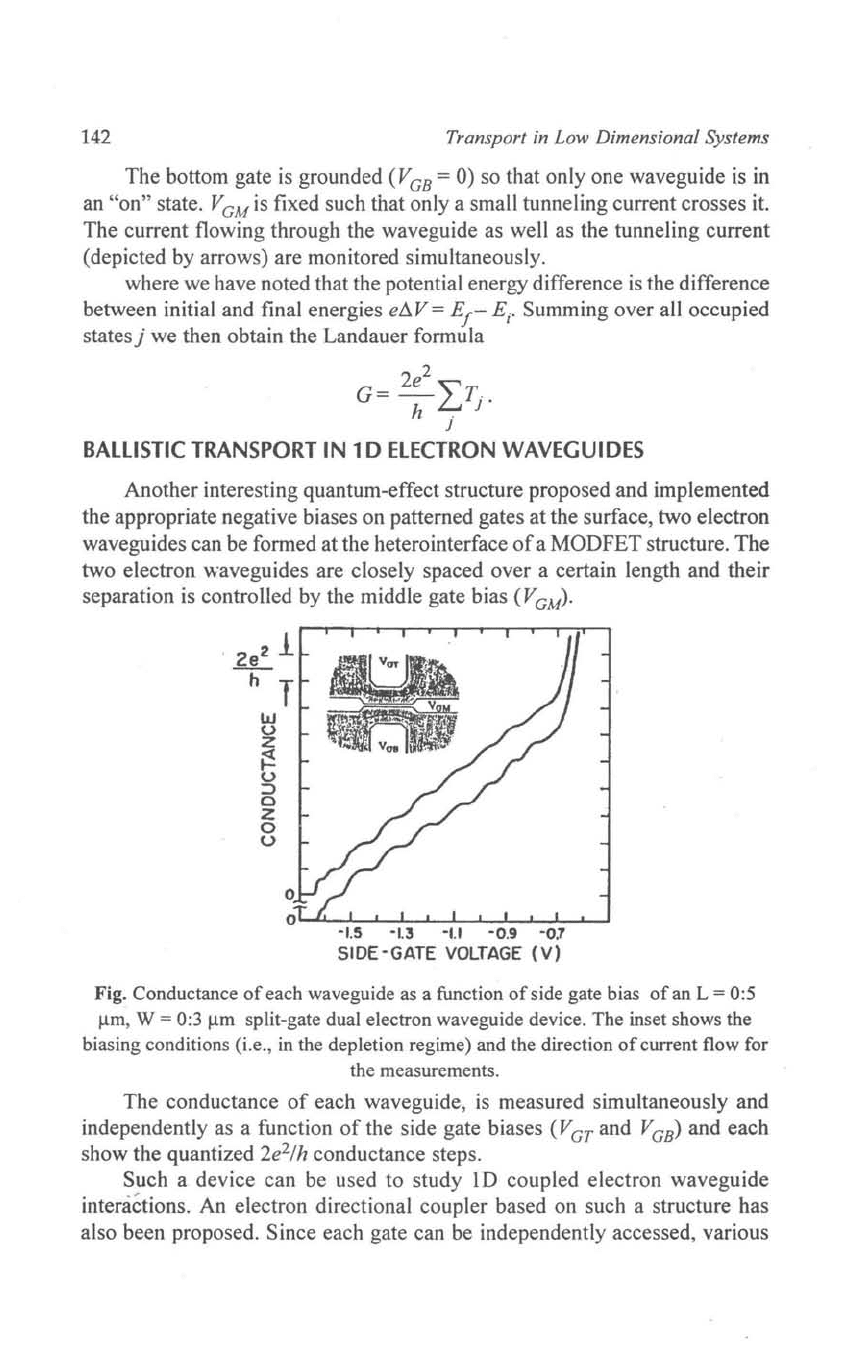
Fig. Conductance
of
each waveguide as a function
of
side gate bias
of
an L = 0:5
11m,
W = 0:3
11m
split-gate dual electron waveguide device. The inset shows the
biasing conditions (Le., in the depletion regime) and the direction
of
current flow for
the measurements.
The conductance
of
each waveguide,
is
measured simultaneously and
independently as a function
of
the side gate biases
(V
Gr
and V
GB
) and each
show the quantized
2e
2
/h conductance steps.
Such a device can be used to study
ID
coupled electron waveguide
intenictions. An electron directional coupler based on such a structure has
also been proposed.
Since each gate can be independently accessed, various
Transport in Low Dimensional Systems
143
other regimes can be studied
in
addition to the coupled waveguide regime.
One interesting regime is that
of
a "leaky" electron.
For such a scheme, one
of
the side gates
is
grounded so that the
20
electron
gas underneath it is unaffected. The middle gate is biased such that only a
small tunneling current can flow from one waveguide to the other
in
the
20
electron gas.
The other outer gate bias
V
GT
is used to sweep the subbands in the
waveguide through the Fermi level.
In
such a scheme, there
is
only one waveguide which has a thin side wall
barrier established by the middle gate bias. The current flowing through the
waveguide as well as the current leaking out
of
the thin middle barrier are
independently monitored.
The
I - V GS
characteristics
for
the
leaky
electron
waveguide
implementation. Conductance steps
of
order 2e
2
1h
are observed for the current
flowing.
However what is unique to the leaky electron experiment is that the
tunneling current leaking from the thin side wall is monitored.
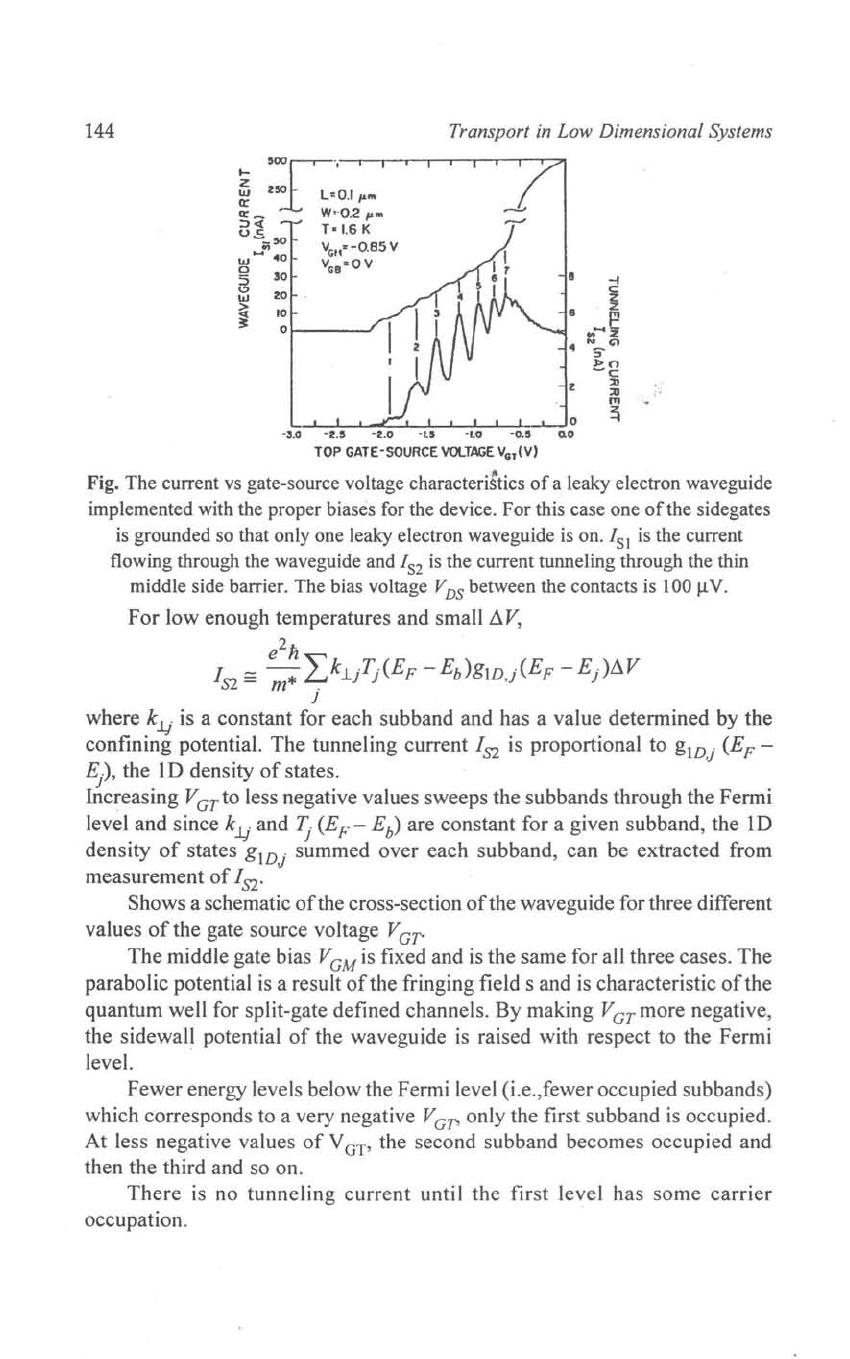
Very strong oscillations in the tunneling current are observed as the Fermi
level is modulated in the waveguide.
We show below that the tunneling current is directly tracing out the
10
density
of
states
of
the waveguide.
An expression for the tunneling current Is2 flowing through the sidewall
of
the waveguide can be obtained by the following integral,
IS2
= eI
[00
vl.j(E-E)glDj(E-Ej)Tj(E-E
b
)
j
[f(E-E
F
-et..V,T)-
f(E-EF,T)]dE
where we have accounted for the contribution to the current from each occupied
subbandj.
Here E
j
is
the energy at the bottom
ofthejth
subband and
Eb
is the
height
of
the tunneling energy barrier. The normal velocity against the tunneling
barrier
is
v
l.,t
(E) =
hk
l.,t
Im*.
The transmission coefficient,
~.
(E
- E
b
),
to first order,
is
the same for
the different
10
electron subbands since the barrier height relative to the Fermi
level
E F
is
fixed.
The Fermi function,j, gives the distribution
of
electrons as a function
of
temperature and applied bias
t..
V between the input
of
the waveguide and the
20EG
on the other side
of
~h
,
e
tunneling barrier.
144
Transport
in
Low Dimensional Systems
I
'3~~-L'~f
.
~5~~'2~.O-L~'l~5~~·t~O~~'O~.5~~~g,
TOP
GATE-SOURCE
VOLTAGE
VGT(V)
Fig. The current
vs
gate-source voltage characteristics
of
a leaky electron waveguide
implemented with the proper biases
for
the
device. For this case one
of
the sidegates
is
grounded
so
that only
one
leaky electron waveguide
is
on.
lSI
is
the current
flowing through the waveguide
and
Is2
is
the current tunneling through
the
thin
middle side barrier.
The
bias voltage V
DS
between the contacts
is
100
~V.
For
low enough temperatures and small flV,
e
2
h
IS2
==
m*
Ikl.j~
.
(EF
-Eb)gID
,
j(E
F
-E
j
)!1V
}
where k
lj
is a constant for each subband and has a value determined by the
confining potentiaL The tunneling current
IS2 is proportional to gID,J
(E
F
-
E), the ID density
of
states.
Increasing
V
GT
to less negative values sweeps the subbands through the Fermi
level
and
since
klj
and
1)
(EF - E
b
)
are constant for a given subband, the ID
density
of
states gIDj summed
over
each subband,
can
be extracted from
measurement
of
I
S2
.
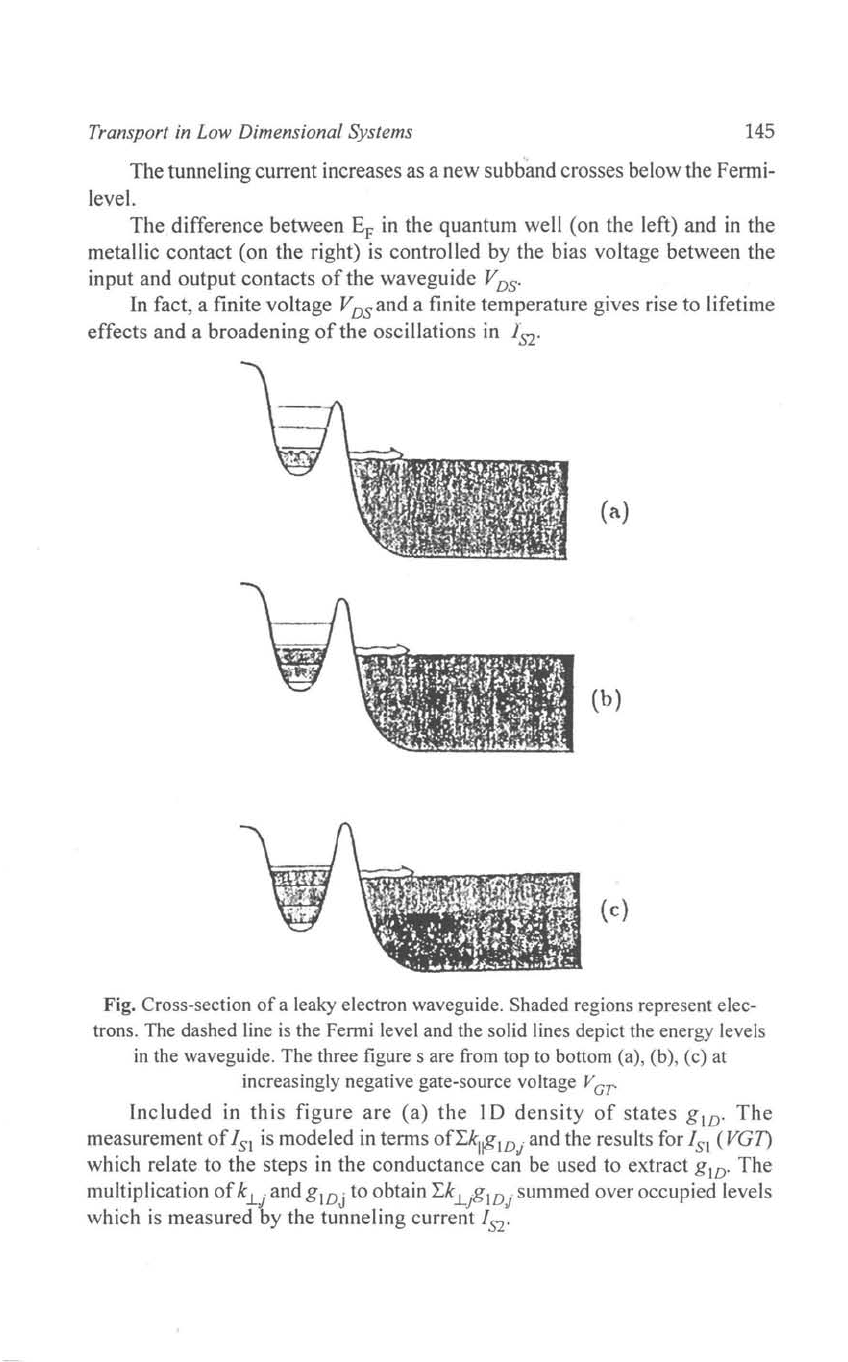
Shows a schematic
of
the cross-section
of
the waveguide for three different
values
of
the gate source voltage V GT'
The middle gate bias V
GM
is fixed and
is
the same for all three cases.
The
parabolic potential is a result
ofthe
fringing field s and is characteristic
of
the
quantum well for split-gate defined channels.
By
making V
GT
more negative,
the sidewall potential
of
the waveguide is raised with respect to the Fermi
leveL
Fewer energy levels below the Fermi level (i.e.,fewer occupied subbands)
which corresponds to a very negative
VGT' only the first subband is occupied.
At
less negative values
of
V
GP
the second subband becomes occupied and
then the third and so on.
There
is no
tunneling
current
until
the
first level has
some
carrier
occupation.
Transport in Low Dimensional Systems
145
The tunneling current increases as a new
subb~md
crosses below the Fermi-
level.
Thedifference
between
EF
in the quantum well (on the left) and
in
the
metallic
contact
(on the right) is controlled by the bias voltage between the
input and output contacts
of
the waveguide V
DS
'
In fact, a finite voltage VDsand a finite temperature gives rise to lifetime
effects and a broadening
of
the oscillations in
1"s2.
(a)
(b)
(c)
Fig. Cross-section
of
a leaky electron waveguide. Shaded regions represent elec-
trons.
The
dashed line
is
the Fermi level and the solid lines depict the energy levels
in
the waveguide. The three figure s are
from
top
to
bottom (a), (b), (c)
at
increasingly negative gate-source voltage V GT'
Included
in
this
figure
are
(a)
the
ID
density
of
states
glD'
The
measurement
of
lSI
is
modeled in terms
ofLkl~!D
·
and the results for
lSI
(VG1)
which relate to the steps in the conductance
ca~
be used to extract g!D' The
multiplication
of
kl.j
and
glDj
to obtain
Lk
l..jglDj summed over occupied levels
which
is
measured by the tunneling current
1S2'
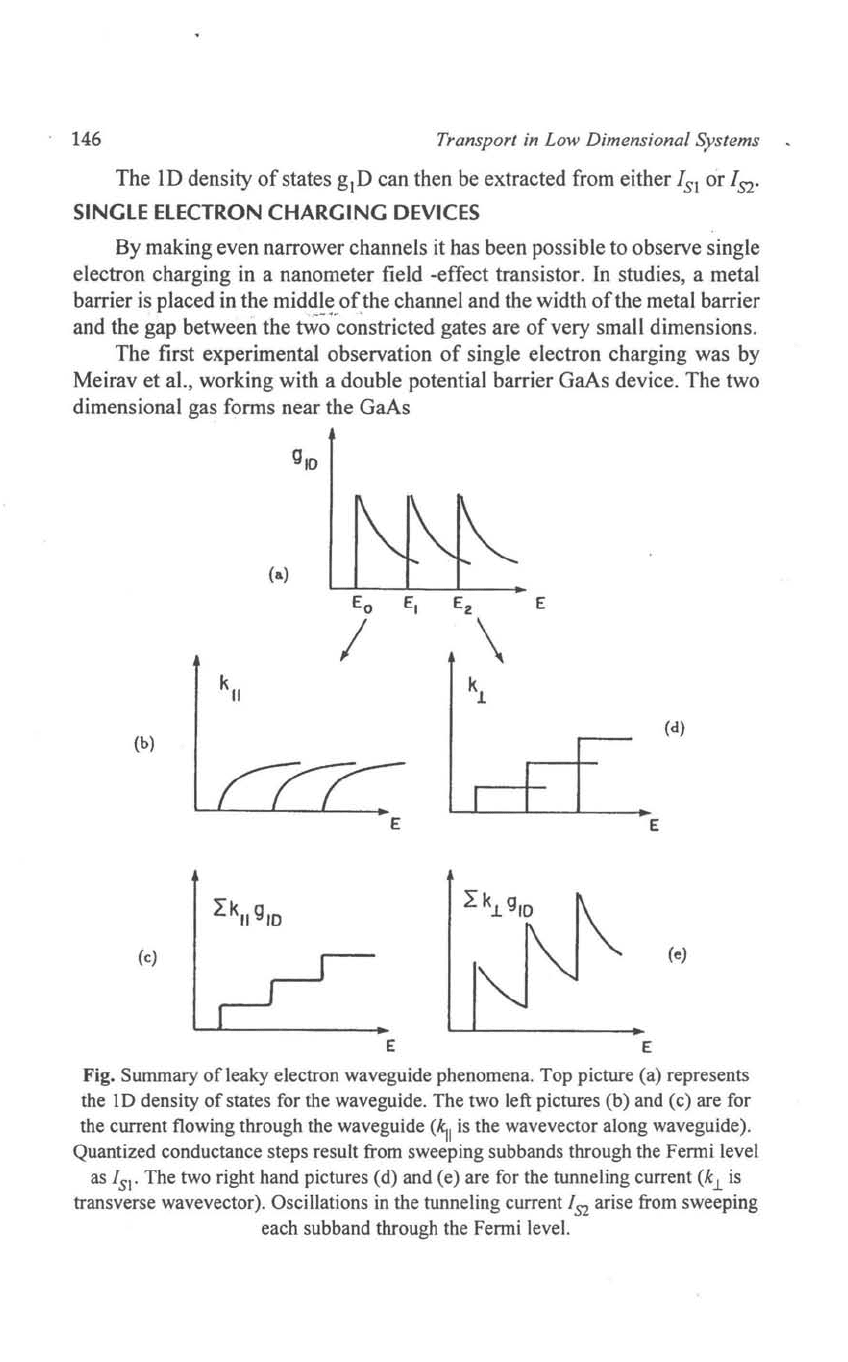
146
Transport
in
Low Dimensional Systems
The ID density
of
states glD can then
be
extracted from either
lSI
or
1S2.
SINGLE ELECTRON
CHARGING
DEVICES
By making even narrower channels it has been possible to observe single
electron charging in a nanometer field -effect transistor.
In
studies, a metal
barrier
is
placed
in
the middle
ofthe
channel and the width
of
the metal barrier
and the gap between the
~~
'"
co~stricted
gates are
of
very small dimensions.
The first experimental observation
of
single electron charging was by
Meirav et aI., working with a double potential barrier GaAs device. The two
dimensional gas forms near the GaAs
(a)
Eo
EI
E2
E
I
\
kll
kl
(b)
(d)
E
(c)
(e)
E
E
Fig. Summary
ofleaky
electron waveguide phenomena. Top picture (a) represents
the
10
density
of
states for the waveguide. The two left pictures (b) and (c) are for
the current flowing through the waveguide
(~I
is the wavevector along waveguide).
Quantized conductance steps result from sweeping subbands through the Fermi level
as
lSI.
The two right hand pictures (d) and (e) are for the tunneling current (k.l is
transverse wavevector). Oscillations in the tunneling current
ISl arise from sweeping
each subband through the Fermi level.
Transport in Low Dimensional Systems
147
S
G
D
S.1.
GaAs
1 D Single Barrier
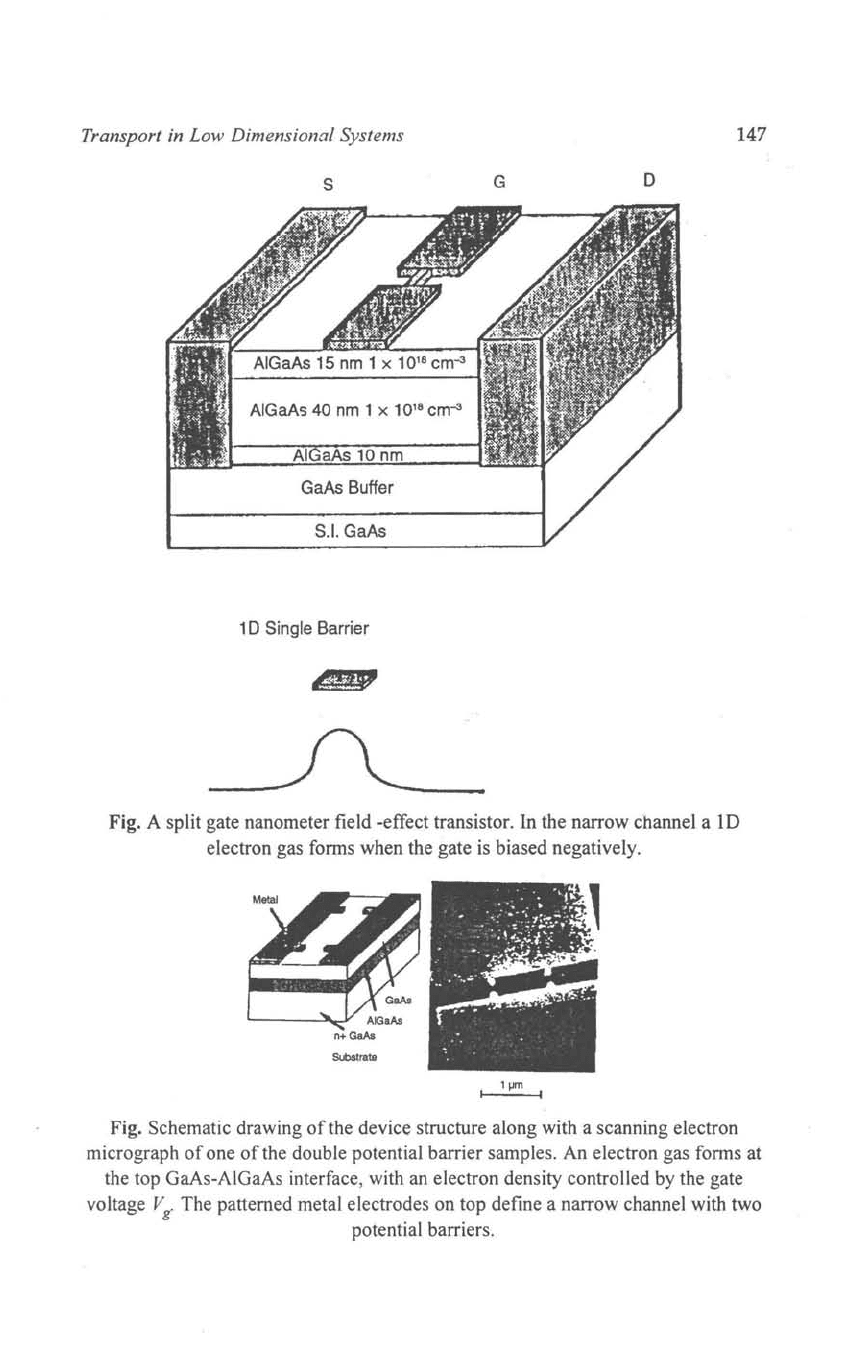
Fig. A split gate nanometer field -effect transistor. In the narrow channel a
lD
electron gas forms when the gate
is
biased negatively.
Fig. Schematic drawing
of
the device structure along with a scanning electron
micrograph
of
one
of
the double potential barrier samples.
An
electron gas forms at
the top GaAs-AIGaAs interface, with
an
electron density controlled by the gate
voltage
V
g
.
The patterned metal electrodes on top define a narrow channel with two
potential barriers.
148
Transport in Low Dimensional Systems .
12
8
(0)
..
12
.........
8
I
C
<0
,
I
0
.:::.
12
4)
8
(.)
c
0
U
..
::J
"'0
c
12
0
u
8
..
..
8
12
Vg
-
VI
(mV)
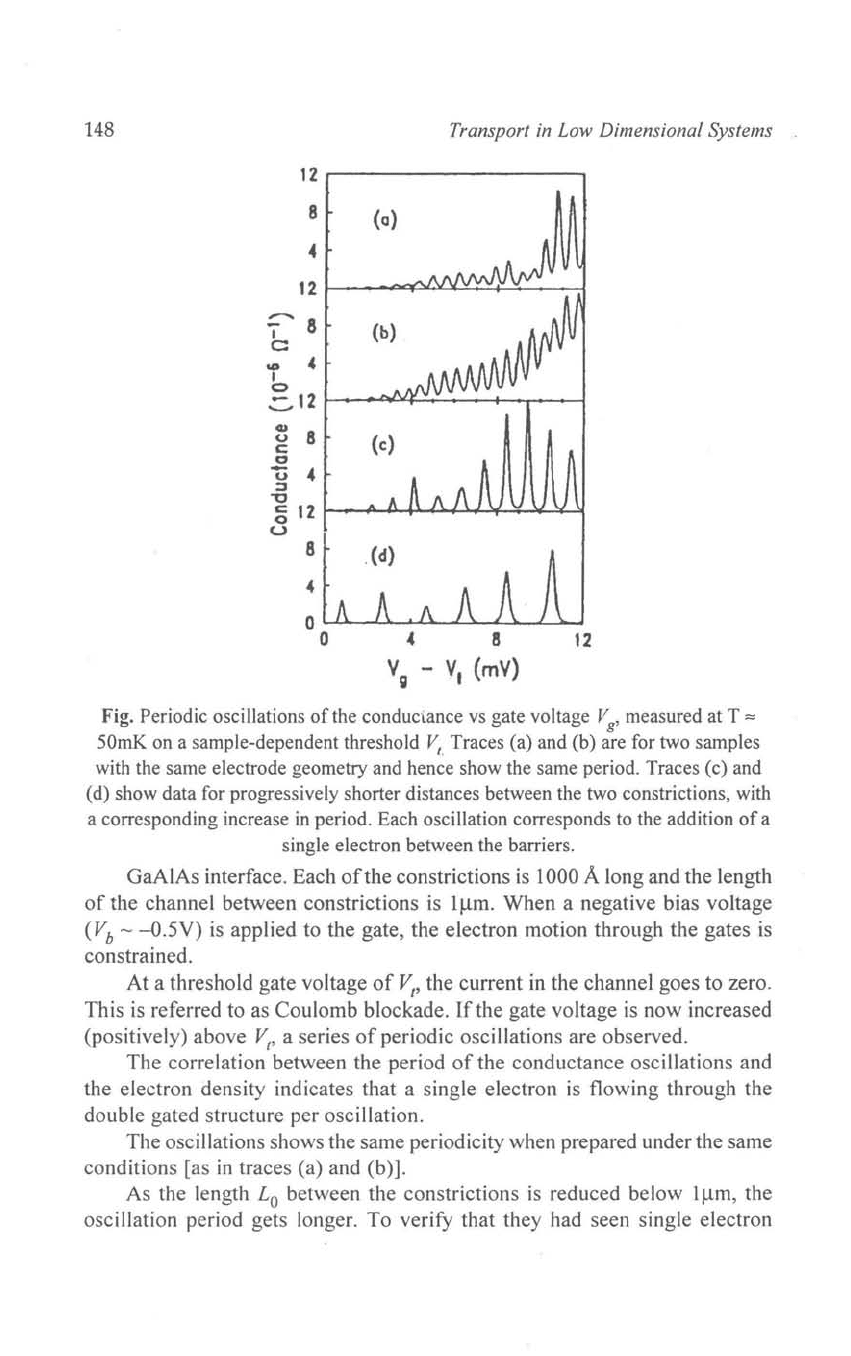
Fig. Periodic oscillations
of
the conductance
vs
gate voltage V
g
,
measured at T
""
50mK on a sample-dependent threshold
VI
Traces (a) and (b) are for two samples
with the same electrode geometry and hence show the same period. Traces (c) and
(d) show data
for progressively shorter distances between the two constrictions, with
a corresponding increase
in
period. Each oscillation corresponds
to
the addition
of
a
single electron between the barriers.
GaAIAs
interface.
Each
of
the
constrictions
is 1000 A
long
and
the
length
of
the
channel
between
constrictions
is
IJ..1.m.
When
a
negative
bias
voltage
(Vb
- -O.SV) is
applied
to
the
gate,
the electron
motion
through
the
gates is
constrained.
At
a
threshold
gate
voltage
of
VI'
the
current
in
the
channel
goes
to
zero
.
This
is referred to
as
Coulomb
blockade.
If
the
gate
voltage
is
now
increased
(positively)
above
VI
' a series
of
periodic
oscillations
are
observed.
The
correlation
between the
period
of
the
conductance
oscillations
and
the electron
density
indicates
that
a single
electron
is
flowing
through
the
double
gated
structure
per
oscillation.
The
oscillations
shows
the same periodicity
when
prepared under the
same
conditions
[as
in
traces
(a) and (b)].
As
the
length
Lo
between
the
constrictions
is
reduced
below
I
!-lm,
the
oscillation period
gets
longer.
To
verifY
that
they had seen single
electron
Transport in Low Dimensional Systems
149
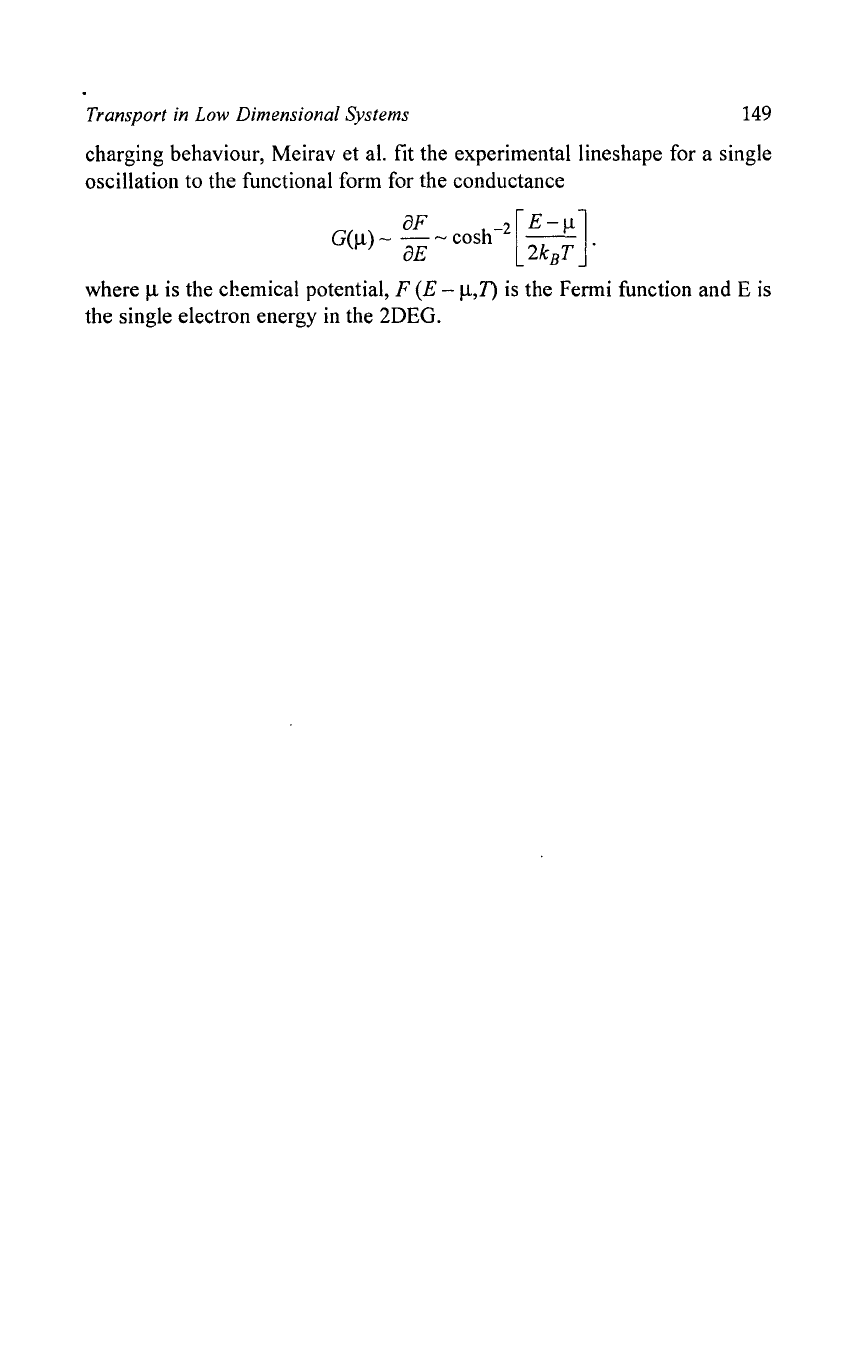
charging behaviour, Meirav
et
al. fit the experimental lineshape for a single
oscillation to the functional form for the conductance
G(I1)
_
8F
_ cosh-2
[E
-11].
8E 2kBT
where
11
is the chemical potential, F (E -
11,1)
is the Fermi function and E is
the single electron energy in the 2DEG.
Chapter 6
Rutherford 8ackscattering Spectroscopy
INTRODUCTION
TO
THE
TECHNIQUE
Ions
of
all energies incident on a solid influence its materials properties.
Ions are used in many different ways in research and technology. We here
review some
of
the physics
of
the interaction
of
ion beams with solids and
some
of
the uses
of
ion beams in semiconductors.
We start by noting that the interaction
of
ion beams with solids depends
on the energy
of
the incident ion. A directed low energy ion
(-
10-100 eV)
comes to rest at or near the surface
of
a solid, possibly growing into a registered
epitaxial layer upon annealing. A
I-ke
V heavy ion beam is the essential
component in the sputtering
of
surfaces. For this application, a large fraction
of
the incident energy is transferred to the atoms
of
the solid
reSUlting
in the
ejection
of
surface atoms into
~he
vacuum. The surface is left in a disordered
state. Sputtering
is
used for removal
of
material from a sample surface on an
almost layer-by-layer basis.
It
is
used both in semiconductor device fabrication,
ion etching or ion milling, and more generally in materials analysis, through
depth profiling. The sputtered atoms can also be used as a source for the sputter
deposition technique discussed
in
connection with the growth
of
superlattices.
At
higher energies, - 100-300 keY, energetic ions are used as a source
of
atoms to modify the properties
of
materials. Low concentrations, «
0.1
atomic percent,
of
implanted atoms are used to change and control the electrical
properties
of
semiconductors. The implanted atom comes to rest - 1
oooA
below
the surface
in
a region
of
disorder created by the passage
of
the implanted ion.
The electrical properties
of
the implanted layer depend on the species and
concentration ofimpurities, the lattice position
of
the impurities and the amount
of
lattice disorder that
is
created.
Lattice site and lattice disorder as well as epitaxial layer formation can
readily be analyzed by the channeling
of
high energy light ions (such as
H+
and He+), using the Rutherford backscattering technique.
In
this case MeV
ions are used because they penetrate deeply into the crystal (microns) without
substantially perturbing the lattice. This
is
an
attractive ion energy regime
Rutherford Backscattering Spectroscopy
151
because scattering cross sections, flux distributions in the crystal, and
the
rate
of
energy loss are quantitatively established.
Particle-solid
interactions in
the
range from
about
0.1
MeV
to 5
MeV
are understood and one
can
use
this
well-characterized
tool for investigations
of
solid state phenomena. Outside
of
this range
many
of
the concepts discussed
below
remain valid: however,
the use
of
MeV
ions is favored in solid state characterization applications
because
of
both experimental convenience and the ability to probe both surface
and
bulk
properties.
In
§ 6.2
and
§ 6.3,
we
will review the
two
last energy regimes, namely
ion implantation in
the
100 keV region and ion
beam
analysis (Rutherford
backscattering and channeling)
by
MeV
light mass particles (H+, He+).
We
start
by
describing the
most
important features
of
ion implantation.
Then
we
will review a
two
atom collision in order to introduce the basic atomic scattering
concepts needed
to
describe the slowing down
of
ions in a solid.
Then
we
will
state the results
of
the
LSS
theory (1. Lindhard, M.
Scharff
and H.
Schittl,
Mat.
Fys.
Medd. Dan.
Vid.
Selsk.
33,
No.
14 (1963»
which
is
the
most
successful basic theory for describing the distribution
of
ion positions and the
radiation-induced
disorder
in
the
implanted
sample.
A
number
of
improvements to this model have been made in the last
two
decades and are
used
for
current
applications.
We
will
conclude
this
introduction
to
ion
implantation with a discussion
of
the lattice damage caused
by
the slowing
down
of
the energetic ions in the solid.
We
then
go
on
and
describe the use
of
a
beam
of
energetic
(1-2
MeV)
light mass particles (H+ , He+) to study material properties in the
near
surface
region
«
J.lm)
of
a solid.
We
will then see
how
to use Rutherford backscattering
spectrometry
(RBS)
to
determine the stoichiometry
of
a sample composed
of
multiple
chemical
species
and
the
depth distribution
of
implanted
ions.
Furthermore,
we
see
that
with single-crystal targets, the effect
of
channeling
also allows investigation
of
the crystalline perfection
of
the sample as well as
the lattice location
of
the implanted atomic species. Finally,
we
will review
some examples
of
the modification
of
material properties by ion implantation,
including the
use
of
ion
beam
analysis
in
the study
of
these
materials
modifications.
ION
IMPLANTATION
Ion implantation is
an
important technique for introducing impurity atoms
in a controlled way, thus leading to the synthesis
of
new
classes
of
materials,
including
metastable
materials.
The
technique
is
imp~rtant
in
the
semiconductor industry for
makingp-n
junctions
by, for example, implanting
n-type
impurities into a
p-type
host material. From a materials science point