
Brewster H.D. Solid State Physics
Подождите немного. Документ загружается.

152
Rutherford Backscattering Spectroscopy
of
view, ion implantation allows essentially any element
of
the periodic table
to be introduced into the near surface region
of
essentially any host material,
with quantitative control over the depth and composition profile by proper
choice
of
ion energy and fluence. More generally, through ion implantation,
materials with increased strength and corrosion resistance
or
other desirable
properties can be synthesized.
A schematic diagram
of
an ion implanter in this diagram the "target"
is
the sample that is being implanted.
In
the implantation process, ions
of
energy
E and beam current
ib
are incident on a sample surface and come to rest at
some characteristic distance
Rp
with a Gaussian distribution
of
half
width at
half
maximum
Mp'
Typical values
of
the implantation parameters are: ion energies E
~
100
keY, beam currents
ib
~
50!J.A,
penetration
dep~hs
Rp
~
1000A and half-widths
Mp
~
300A. In the implanted regions, implant concentrations
of
10i3 to
10
i
5
relative to the host materials are typical.
In
special cases, local concentrations
as high as
20 at.% (atomic percent)
of
implants have been achieved.
Some charactedstic features
of
ion implantation are the following:
1.
The ions characteristically only penetrate the host material to a depth
Rp
~
l!J.m.
Thus ion implantation
is
a near surface phenomena. To
achieve a large percentage
of
impurity ions in the host, the host
material must be thin (comparable to
Rp),
and high fluences
of
implants must be used
(<1>
>
1016/
cm
2).
2. The depth profile
of
the implanted ions
(Rp)
is controlled by the
ion energy. The impurity content is controlled by the ion fluence
<1>.
3. Implantation
is
a non-equilibrium process. Therefore there are no
solubility limits on the introduction
of
dopants. With ion implantation
one can thus introduce high concentrations
of
dopants, exceeding
the normal solubility limits. For this reason ion implantation permits
the synthesis
of
metastable materials.
4.
The implantation process is highly directional with little lateral
spread. Thus it is possible to implant materials according to
prescribed patterns using masks. Implantation proceeds in the regions
where the masks are not present. An application
of
this technology
is
to the ion implantation
of
polymers to make photoresists with
sharp boundaries. Both positive and negative photoresists can be
prepared using ion implantation, depending on the choice
of
the
polymer. These masks are widely used
in
the semiconductor industry.
5.
The diffusion process
is
commonly used for the introduction
of
impurities into semiconductors. Efficient diffusion occurs at high
temperatures. With ion implantation, impurities can be introduced
at much lower temperatures,
as
for example room temperature, which
.is
a major convenience to the semiconductor industry.
Rutherford Backscattering Spectros.copy
153
6.
The versatility
of
ion implantation
is
another important characteristic.
With the same implanter, a large number
of
different implants can
be introduced by merely changing the ion source. The technique is
readily automated, and thus is amenable for use by technicians in
the semiconductor industry. The implanted atoms are introduced
in
an atomically dispersed fashion, which
is
also desirable. Furthermore,
no oxide or interfacial barriers are formed in the implantation
process.
7.
The maximum concentration
of
ions that can be introduced
is
limited.
As the implantation process proceeds, the incident ions participate
in both implantation into the bulk and the sputtering
of
atoms
off
the surface. Sputtering occurs because the surface atoms receive
sufficient energy to escape from the surface during the collision
process. The dynamic equilibrium between the sputtering and
implantation processes limits the maximum concentration
of
the
implanted species that
call.
be achieved.
Sputtering causes the surface to recede slowly during implantation.
8.
Implantation causes radiation damage. For many applications, this
radiation damage is undesirable. To reduce the radiation damage,
the implantation can be carried out at elevated temperatures or the
materials can be annealed after implantation.
In
practice, the elevated temperatures used for implantation or for
post-implantation
annealing
are
much
lower
than
typical
temperatures used for the diffusion
of
impurities into semiconductors.
A variety
of
techniques are used to characterize the implanted alloy. Ion
backscattering
of
light ions at higher energies (e.g., 2 MeV
He+)
is used to
determine the composition versus depth with
- 10nm depth resolution. Depth
profiling by sputtering in combination with Auger or secondary ion mass
spectroscopy
is
also used.
Lateral resolution is provided by analytical transmission electron
microscopy. Electron microscopy, glancing angle
x-ray
analysis and ion
channeling
in
single crystals provide detailed information on the local atomic
structure
of
the alloys formed. Ion backscattering and channeling.
Basic Scattering Equations
An ion penetrating into a solid will lose its energy through the Coulomb
interaction with the atoms in the target. This energy loss will determine the
final penetration
of
the projectile into the solid and the amount
of
disorder
created in the lattice
of
the sample. When
we
look more closely into one
of
these collisions we see that it
is
a very complicated event
in
which:
The two nuclei with masses
M
J
and
M2
and charges ZI and
Z2'
154
Rutherford Backscattering Spectroscopy
respectively, repel each other
by
a Coulomb interaction, screened
by the respective electron clouds.
•
Each
electron
is
attracted
by
the
two
nuclei
(again
with
the
corresponding screening) and is repelled by all other electrons.
In
addition, the target atom is bonded to its neighbors through bonds which
usually involve its valence electrons. The collision is thus a many-body event
described by a complicated Hamiltonian. However experience has shown that
very accurate solutions for the trajectory
of
the nuclei can be obtained by
making some simplifying assumptions. The most important assumption for
us, is that the interaction between the two atoms can be separated into two
components:
• Ion (projectile}--nucleus (target) interaction
• Ion (projectile }--electron (target) interaction.
Let us now use the very simple example
of
a collision between two masses
M}
and
M2
to determine the relative importance
of
these two processes and to
introduce the basic atomic scattering concepts required to describe the stopping
of
ions in a solid. The classical collision between the incident mass
M}
and
the target mass
M2
which can be a target atom
or
a nearly free target electron.
By
applying conservation
of
energy
and
momentum, the following
relations can be derived
•
The
energy transferred
(T)
in
the
collision
from
the
incident
projectile
M}
to the target particle
M2
is given by
•
•
T=
T.
sin2(e)
max:
2
where
T =
4E
M}M2
max 0 (M} +M2)2
is the maximum possible energy transfer from
M}
to M
2
.
The scattering angle
of
the projectile in the laboratory system
of
coordinates is given by
1-
(1
+
M2
+
M1)(T
12E)
cos
8=
..j(1-TIE)
The energies
of
the projectile before (Eo) and after
(E
1
)
scattering
are related by
E1
=
1(2
E
o
where the kinematic factor k
is
given by
k=
(M1COS8±(MI-M1
2
Sin
2
8)1I2J
Ml+M2
Rutherford Backscattering Spectroscopy
155
These relations are absolutely general no matter how complex the force
between the two particles, so long as the force acts along the line joining the
particles and the electron is nearly free so that the collision can be taken to be
elastic.
In
reality, the collisions between the projectile and the target electrons
are inelastic because
of
the binding energy
of
the electrons. The case
of
inelastic
collisions will be considered
in
what follows.
Using equations and assuming either that
M2
is
of
the same atomic species
as the projectile
(M
2
= M
1
),
or that
M2
is a nearly free electron
(M2
= me) we
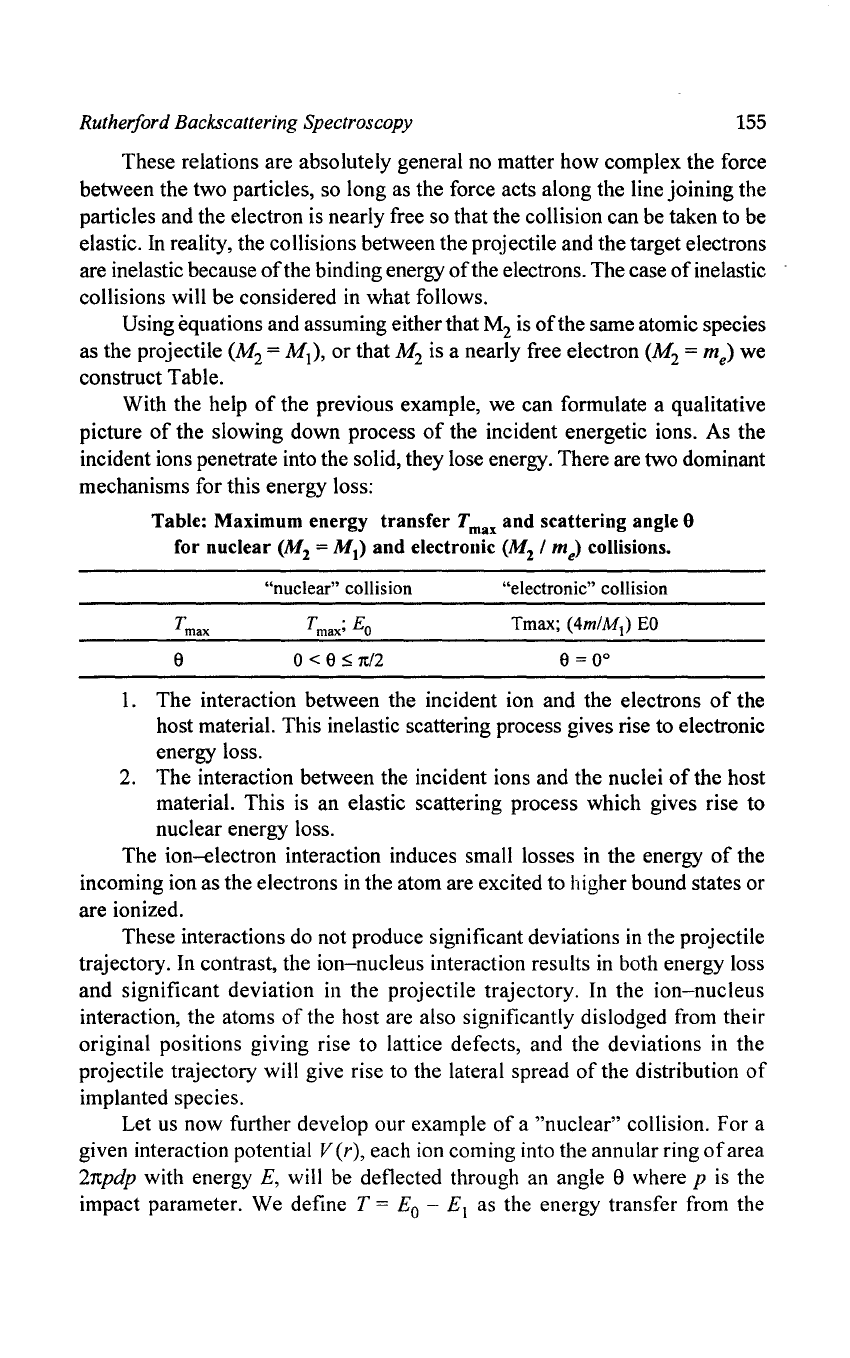
construct Table.
With the help
of
the previous example, we can formulate a qualitative
picture
of
the slowing down process
of
the incident energetic ions. As the
incident ions penetrate into the solid, they lose energy. There are two dominant
mechanisms for this energy loss:
Table: Maximum energy transfer T max and scattering angle 9
for nuclear (M2 = M
I
)
and electronic (M2 / me) collisions.
"nuclear" collision
"electronic" collision
Tmax;
(4mIM
J
)
EO
9
o
<9:S1t/2
1.
The interaction between the incident ion and the electrons
of
the
host material. This inelastic scattering process gives rise to electronic
energy loss.
2.
The interaction between the incident ions and the nuclei
of
the host
material. This is an elastic scattering process which gives rise to
nuclear energy loss.
The ion-electron interaction induces small losses
in
the energy
of
the
incoming ion as the electrons in the atom are excited to higher bound states or
are ionized.
These interactions
do
not produce significant deviations
in
the projectile
trajectory.
In
contrast, the ion-nucleus interaction results
in
both energy loss
and significant deviation in the projectile trajectory.
In
the ion-nucleus
interaction, the atoms
of
the host are also significantly dislodged from their
original positions giving rise to lattice defects, and the deviations
in
the
projectile trajectory will give rise to the lateral spread
of
the distribution
of
implanted species.
Let us now further develop our example
of
a "nuclear" collision. For a
given interaction potential
V
(r),
each ion coming into the annular ring
of
area
21tpdp with energy
E,
will be deflected through
an
angle 0 where p
is
the
impact parameter. We define
T =
Eo
- E\ as the energy transfer from the

156
Rutherford Backscattering Spectroscopy
incoming ion to the host and we define 21tpdp =
do
as the differential cross
section. When the ion moves a distance
Ax in the host material, it will interact
with
N Ax21tpdp atoms where N is the atom density
of
the host.
The energy
IlE
lost by an ion traversing a distance
Ax
will be
tlE
=
NAx
f
T2n
pdp
so that as
Ax
~
0, we have for the stopping power
dE
f
dx = N Tdcr
where
cr
denotes the cross sectional area. We thus obtain for the stopping cross
section E
1 dE f
E=
N dx =
Tdcr
The total stopping power
is
due to both electronic and nuclear processes
dE
=(dE) +(dE)
=N(Ee
+En)
dx
dX
e
dX
n
where N is the target density and
Ee
and
En
are the electronic and nuclear
stopping cross sections, respectively. Likewise for the stopping cross section
E.
E=Ee
+
En·
Table: Typical Values
of
El'
E
2
,
E3 for silicon.a
Ion
El(keV)
EikeV)
EikeV)
B 3
17
3000
P
17
140
,. 3
£10
4
As
73
800
>
10
5
Sb
180
2000
>
10
5
From the energy loss we can obtain the ion range
or
penetration depth
f
dE
R=
dE/dx.
Since we know the energy transferred to the lattice (including both phonon
generation and displacements
of
the host ions), we can calculate the energy
of
the incoming ions as a function
of
distance into the medium E(x).
At low energies
of
the projectile ion, nuclear stopping
is
dominant, while
electron stopping dominates at high energies as shown
in
the characteristic

Rutherford Backscattering Spectroscopy
157
stopping power curves. Note the three important energy parameters on the
curves:
El is the energy where the nuclear stopping power is a maximum,
E3
where the electronic stopping power is a maximum, and
E2
where the electronic
and nuclear stopping powers are equal. As the atomic number
of
the ion
increases for a fixed target, the scale
of
E
1
,
E2
and
E3
increases. Also indicated
on the diagram is the functional form
of
the energy dependence
of
the stopping
power in several
of
the regimes
of
interest.
Typical values
ofthe
parameters E
1
,
E2
and
E3
for various ions in silicon.
Ion implantation
in
semiconductors
is
usually done
in
the regime where nuclear
energy loss is dominant. The region where
(dE Idx)
~
liE
corresponds to the
regime where light ions like
H+
and
He+
have incident energies
of
1-2 MeV
and is therefore the region
of
interest for Rutherford backscattering and
channeling phenomena.
Radiation Damage
The energy transferred from the projectile ion to the target atom is usually
sufficient to result in the breaking
of
a chemical bond and the permanent
displacement
of
the target atom from its original site. The condition for this
process is that the energy transfer per collision T
is
greater than the binding
energy
Ed'
Because
of
the high incident energy
of
the projectile ions, each incident
ion
can
dislodge multiple host ions. The damage profile for low dose
implantation gives rise to isolated regions
of
damage.
As the fluence is increased, these damaged regions coalesce. The damage
profile also depends on the mass
ofthe
projectile ion, with heavy mass ions
of
a given energy causing more local lattice damage as the ions come to rest.
Since (dE Idx)n increases as the energy decreases, more damage is caused as
the ions are slowed down and come to rest. The damage pattern schematically
for light ions (such as boron in silicon) and for heavy ions (such as antimony
in silicon). Damage is caused both by the incident ions and by the displaced
energetic (knock-on) ions.
The types
of
defects caused by ion implantation. Here we see the formation
of
vacancies and interstitials, Frenkel pairs (the pair formed by the Coulomb
attraction
of
a vacancy and an interstitial). The formation
of
multiple vacancies
leads to a depleted zone while multiple interstitials lead to ion crowding.
Applications
of
Ion Implantation
For the case
of
semiconductors, ion implantation is dominantly used for
doping purposes, to create sharp p-njunctions
in
the near-surface region. To
reduce radiation damage, implantation is sometimes done at elevated
temperatures. Post implantation annealing is also used to reduce radiation
158 Rutherford Backscattering Spectroscopy
damage, with elevated temperatures provided by furnaces, lasers or flash lamps.
The ion implanted samples are characterized by a variety
of
experimental
techniques for the implant depth profile, the lattice location
of
the implant,
the residual lattice disorder subsequent to implantation and annealing, the
electrical properties ( and conductivity) and the device performance.
A major limitation
of
ion implantation for modifying metal surfaces has
been the shallow depth
of
implantation.
In
addition, the sputtering
of
atoms
from the surface sets a maximum concentration
of
elements which can be added
to a solid, typically
~
20 to 40 at.%.
To form thicker layers and higher concentrations, combined processes
involving ion implantation and film deposition are being investigated. Intense
ion beams are directed at the solid to bring about alloying while other elements
are simultaneously brought to the surface, for example by sputter deposition,
vapour deposition
or
the introduction
of
reactive gases.
One process
of
interest
is
ion beam mixing, where thin films are deposited
onto the surface first and then bombarded with ions. The dense collision
cascades
of
the ions induce atomic-scale mixing between elements. Ion beam
mixing
is
also a valuable tool to study metastable phase formation.
With regard to polymers, ion implantation can enhance the electrical
conductivity by many orders
of
magnitude, as is for example observed for ion
implanted polyacrylonitrile
(PAN, a graphite fibre precursor). Some
of
the
attendant property changes
of
polymers due to ion implantation include cross-
linking and scission
of
polymer chains, gas evolution as volatile species are
released from polymer chains and free radical formation when vacancies or
interstitials are formed.
Implantation produces solubility changes in polymers and therefore can
be utilized for the patterning
of
resists for semiconductor mask applications.
For the positive resists, implantation enhances the solubility, while for negative
resists, the solubility
is
reduced. The high spatial resolution
of
the ion beams
makes ion beam lithography a promising technique for sub-micron patterning
, applications.
For
selected 'polymers (such as PAN), implantation can result in
transforming a good insulator into a conducting material with an increase in
conductivity
by more than 10
orders
of
magnitude
upon irradiation.
Thermoelectric power measurements on various implanted polymers show that
implantation can yield either
p-type
or
n-type conductors and in fact a
p-n
junction has recently been made in a polymer through ion implantation.
The temperature dependence
of
the conductivity for many implanted
polymers is
of
the form
0'
lao
exp(Tol1)1I2 which is also the relation
characteristic
of
the
one-dimensional
hopping conductivity model for
Rutherford Backscattering Spectroscopy
159
disordered materials. Also
of
interest is the long term chemical stability
of
implanted polymers.
Due to recent developments
of
high brightness ion sources, focused ion
beams to submicron dimensions can now be routinely produced, using ions
from a liquid metal source.
Potential applications
of
this technology are to ion beam lithography,
including the possibility
of
maskless implantation doping
of
semiconductors.
Instruments based
on
these ideas may be developed in the future. The
applications
of
ion implantation represent a rapidly growing field.
Instruments based on these ideas may be developed in the future. The
applications
of
ion implantation represent a rapidly growing field.
Further discussion
ofthe
application
of
ion implantation to the preparation
of
metastable materials is presented after the following sections on the
characterization
of
ion implanted materials by ion backscattering and
channeling.
ION
BACKSCATTERING
In Rutherford backscattering spectrometry (RBS), a beam
of
mono-
energetic
(1-2
MeV), collimated light mass ions
(H+,
He+)
impinges
(~sually
at near normal incidence) on a target and the number and energy
of
the particles
that are scattered backwards at a certain angle
8 are monitored to obtain
information about the composition
of
the target (host species and impurities)
as a function
of
depth. We will review the fundamentals
of
the RBS analysis.
Particles scattered at the surface
of
the target will have the highest energy
E upon detection. Here the energy
of
the backscattered ions E
is
given by the
relation.
where
E=
k?-E
o
k=
(Ml
cos8±(Mi
-Mfsin28)1I2J
Ml+M2
For a given mass species, the energy
Es
of
particles scattered from the surface
corresponds to the edge
of
the spectrum. In addition, the scattered energy
depends through
k on the mass
of
the scattering atom. Thus different species
will appear displaced on the energy scale, thereby allowing for their chemical
identification. We next show that the displacement along the energy scale from
the surface
contribution
gives information about the depth
where
the
backscattering took place. Thus the energy scale
is
effectively a depth scale.
The height H
of
the RBS spectrum corresponds to the number
of
detected
particles in each energy channel
M.
160
CHANNELING
Rutherford Backscattering Spectroscopy
If
the probing beam
is
aligned nearly parallel to a close-packed row
of
atoms in a single crystal target, the particles in the beam will be steered by the
potential field
ofthe
rows
of
atoms, resulting in an undulatory motion
in
which
the
"channeled" ions will not approach the atoms in the row to closer than
0.1-0.2
A.
This
is
called the channeling effect. Under this channeling condition,
the probability
of
large angle scattering is greatly reduced. As a consequence,
there will be a drastic reduction
in
the scattering yield from a channeled probing
beam relative to the yield from a beam incident
in
a random direction. Two
characteristic parameters for channeling are the normalized minimum yield
XmiiH/Hwhich is a measure
of
the crystallinity
of
the target, and the critical
angle for channeling
'l/J1/2
(the halfwidth at
half
maximum intensity
of
the
channeling resonance) which determines the degree
of
alignment required to
observed the channeling effect.
The RBS-channeling technique is frequently used to study radiation-
induced lattice disorder by measuring the fraction
of
atom sites where the
channel is blocked.
In
general, the channeled ions are steered by the rows
of
atoms
in
the
crystal. However
if
some portion
of
the crystal is
disorder~d
and lattice atoms
are displaced so that they partially block the channels, the ions directed along
nominal channeling directions can now have a close collision with these
displaced atoms, so that the resulting scattered yield will be increased above
that for an undisturbed channel.
Furthermore, since the displaced atoms are
of
equal mass to those
of
the
surrounding lattice, the increase in the yield occurs at a position in the yield
vs. energy spectrum corresponding to the depth at which the displaced atoms
are located. The increase in the backscattering yield from a given depth will
depend upon the number
of
displaced atoms, so the depth (or equivalently,
the backscattering energy E) dependence
of
the yield, reflects the depth
dependence
of
displaced atoms, and integrations over the whole spectrum will
give a measure
of
the total number
of
displaced atoms.
Another very useful application
of
the RBS-channeling technique
is
in
the determination
of
the location
of
foreign atoms
in
a host lattice. Since
channeled ions cannot approach the rows
of
atoms which form the channel
closer than
-
o.IA,
we can think
of
a "for-bidden region", as a cylindrical
region along each row
of
atoms with radius
~
o.IA,
such that there are no
collisions between the channeled particles and atoms located within the
forbidden zone.
In
particular,
if
an impurity
is
located
in
a forbidden region it
will not be detected by the channeled probing beam.
On the other hand, any
target particle can be detected by (i.e., will scatter off) probing particles from
Rutherford Backscattering Spectroscopy
161
a beam which impinges in a random direction. Thus, by comparing the impurity
peak observed for channeling and random alignments, the fraction
of
impurities
sitting in the forbidden region
of
a particular channel (high symmetry
crystallographic axis) can be determined. Repeating the procedure for other
crystallographic directions allows the identification
of
the lattice location
of
the impurity atom in many cases.
Rutherford backscattering will not always reveal impurities embedded in
a host matrix, in particular
if
the mass
of
the impurities is smaller than the
mass
of
the host atoms.
In
such cases, ion induced x-rays and ion induced
nuclear reactions are used as signatures for the presence
of
the impurities inside
the crystal, and the lattice location
is
derived from the changes in yield
of
these processes for random and channeled impingement
of
the probing beam.
Ion markers consist
of
a very thin layer
of
a guest atomic species are
embedded in an otherwise uniform host material
of
a different species to
establish reference distances. Backscattering spectra are taken before
al).d
after
introduction
of
the marker. The RBS spectrum taken after insertion
of
the
marker can be used as a reference for various applications. Some examples
where marker references are useful include:
• Estimation
of
surface sputtering by ion implantation.
In
this case,
recession
of
the surface from the reference position set by the marker
can
be
measured
by RBS and
can
be analyzed to
yield
the
implantation-induced surface sputtering.
• Estimation
of
surface material vapourized through laser annealing,
rapid thermal annealing or laser melting
of
a surface.
• Estimation
of
the extent
of
ion beam mixing.
~
.... , ,
..
,
..
•
••••••
• •
~.
- 10-Ev Au· ION BEAM DEPOSMON
•••••
s.'
•••••••••
0.'.
• • , , 0 • 0 •
• 0 SINGLE
...,.
Ar+
•
'.
CRYSTAL
• • , • • '
.....
- 1-kev
Ar+
SPUTTERING, SCATIERING
· .......
....
•••••
·oI~,
• • , • •
GE
0 0
· . . , , ,
..
.
••••••••
,
•••
~.
~
- 100-kev
p.
ION IMPLANTATION
• • • • • • •
•
• • • • • • • • •
-.lI
• , • « • , I • , - 1-Mev He· ION BEAM
ANA,vSIS
o a 0 • • •
==;r=-
6.
6
...
L.r
· . . . . . . . . ,
· , . . . . . . . . \
•
••••••••
• He·
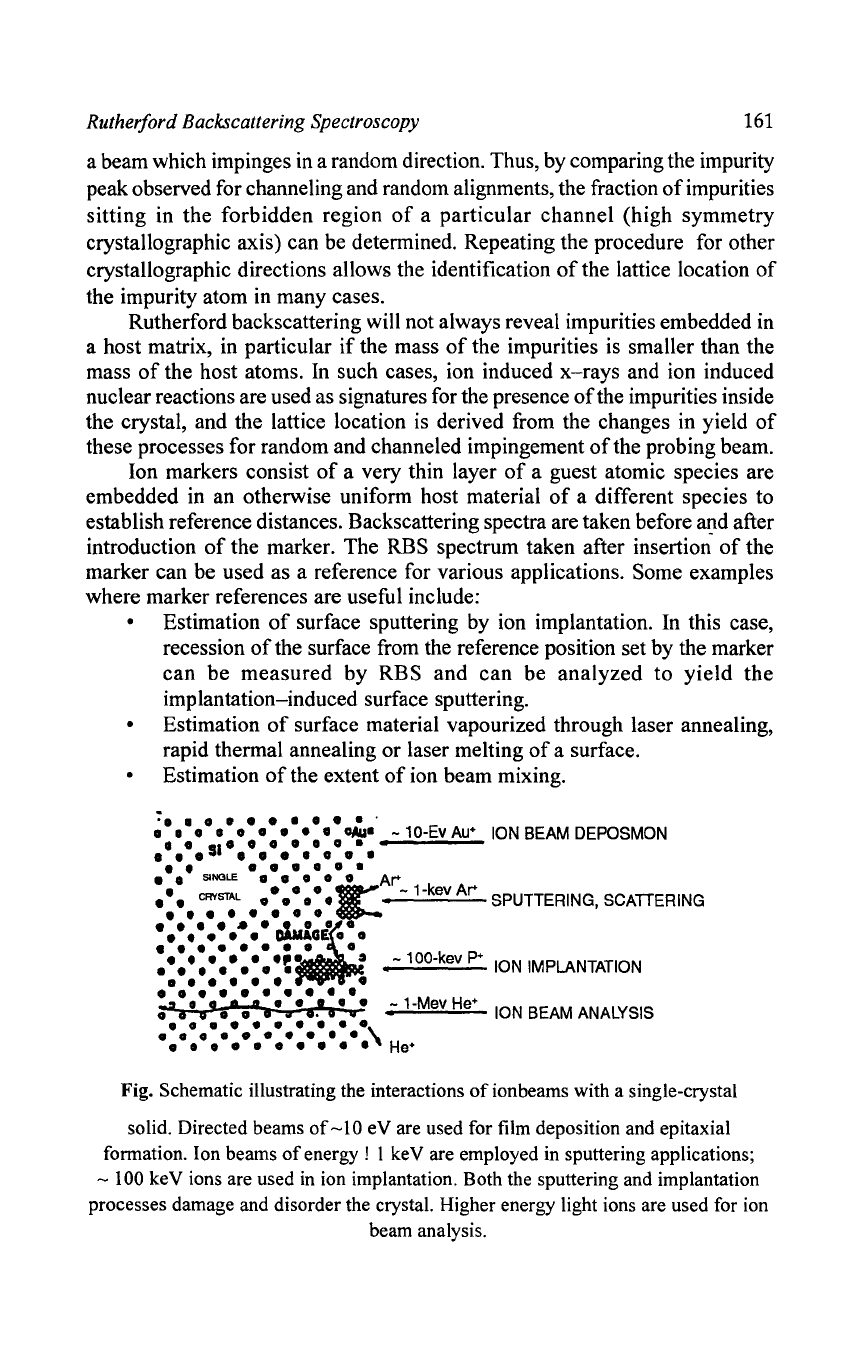
Fig. Schematic illustrating the interactions
of
ionbeams with a single-crystal
solid. Directed beams
of
~
I 0 eV are used for film deposition and epitaxial
formation. Ion beams
of
energy! 1 keY are employed in sputtering applications;
~
100 keY ions are used
in
ion implantation. Both the sputtering and implantation
processes damage and disorder the crystal. Higher energy light ions are used for ion
beam analysis.