
Brewster H.D. Solid State Physics
Подождите немного. Документ загружается.

162
%ll'p~dp
..
Rutherford Backscattering Spectroscopy
·---1E~a;--
,',-.\
\'t
I'
••
('
)-
___
...:l.:_-_--'~~-r:7;~:---_
"
...
-}e-
---
p
,'..J.!
,
./
E,
"
"
~
E,
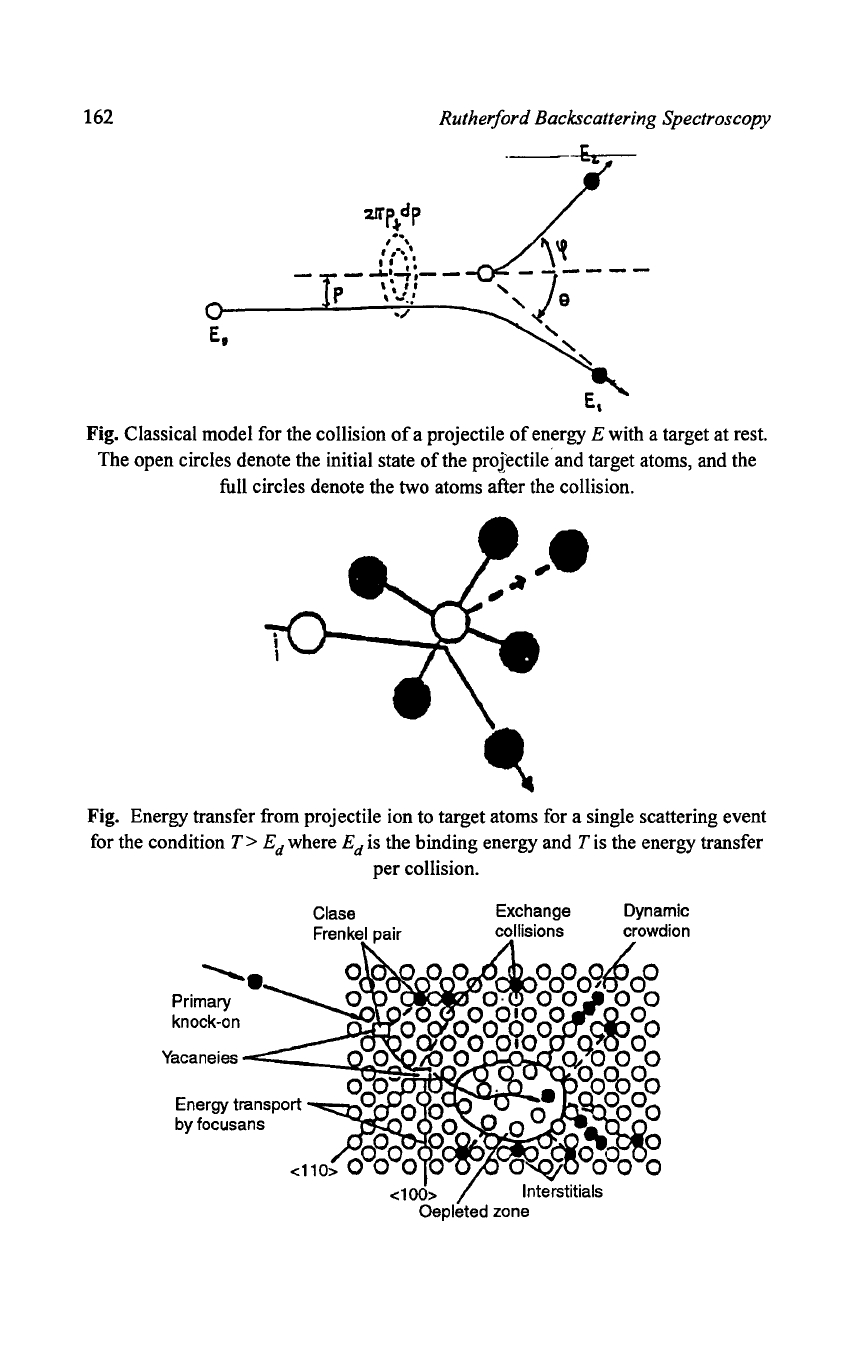
Fig. Classical model for the collision
of
a projectile
of
energy E with a target at rest.
The open circles denote the initial state
of
the projectile and target atoms, and the
full circles denote the two atoms after the collision.
Fig. Energy transfer from projectile ion to target atoms for a single scattering event
for the condition
T>
Ed
where
Ed
is the binding energy and T is the energy transfer
per
collision.
Clase
Frenkel
pair
Yacaneies
-
___
~~~~;Q~~~~~
Energy transport
byfocusans
Dynamic
Rutherford Backscattering Spectroscopy
163
,#1"''' ..
--
I
....
.,.
t
.....
,'"
....
, t
...
,.-
,'1
,
~.,.
I
" ,
, , I
"
~
1
,--
I
,
~"
I
t
......
,
r
......
t
......
I ..... "
..
I
I
t.
.,~""
,--....
f
I Inetdant .
01
#~#
"
------.
t
I beam
",(
j
,
.'
,:'" I Detector "
" I
~,
, .,.'
,.
...
-..."
~'
",,'
I '
~'
'C"...
f\
I 1 "
'... t
'...
L"I .,.'
--"-l
--r
'
,
,t,'
t
...
, "
~
'~'"
It
I,
" " ' I Vecuum pump
r
"'
'
..
_
..
__
~'
...
---~
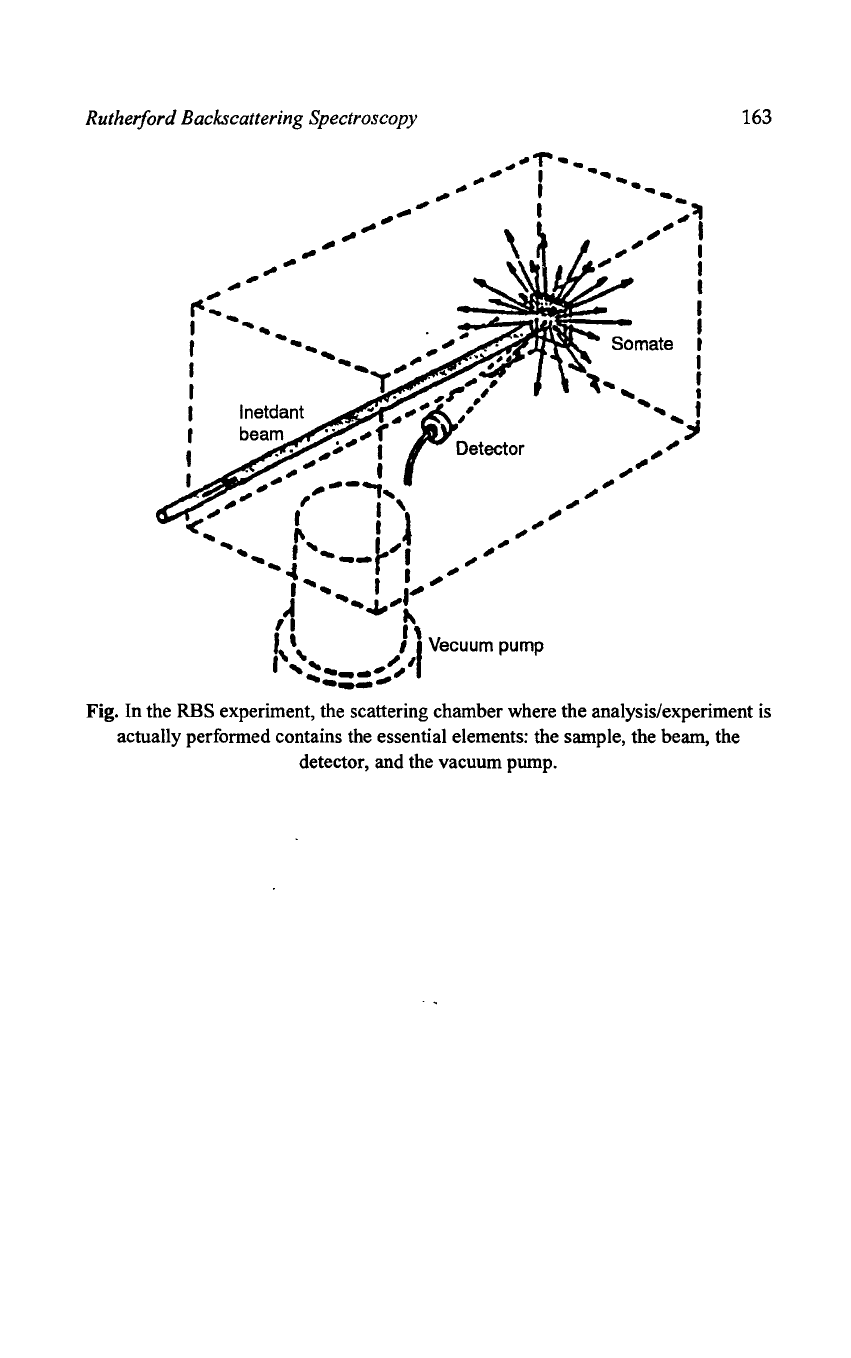
Fig. In the RBS experiment, the scattering chamber where the analysis/experiment is
actually performed contains the essential elements: the sample, the beam, the
detector, and the vacuum pump.
Chapter 7
Time-Independent Perturbation Theory
Another review topic that we discuss here is time-independent perturbation
theory because
of
its importance in experimental solid state physics in general
and transport properties in particular.
There are many mathematical problems that occur in nature that cannot
be solved exactly. It also happens frequently that a related problem can be
solved exactly. Perturbation theory gives us a method for relating the problem
that can be solved exactly to the one that cannot. This occurrence is more
general than quantum mechanics-many problems in electromagnetic theory
are handled by the techniques
of
perturbation theory.
In
this course however,
we will think mostly about quantum mechanical systems, as occur typically
in
solid state physics.
Suppose that the Hamiltonian for our system can be written as
H=H
+H'
o
where
Ho
is
the part that we can solve exactly and
HO
is the part that we cannot
solve. Provided that
HrO
«
Ho
we can use perturbation theory; that is, we
consider the solution
of
the unperturbed Hamiltonian
Ho
and then calculate
the effect
of
the perturbation Hamiltonian H'. For example, we can solve the
hydrogen atom energy levels exactly, but when we apply an electric
or
a
magnetic field we can
no
longer solve the problem exactly. For this reason,
we treat the effect
of
the external field s as a perturbation, provided that the
energy associated with these field s is small:
2 2
P e -
E-
H
H'
H = -
--
- er . = 0 +
2m r
where
and
H'=
-d.E.
As another illustration
of
an application
of
perturbation theory, consider
a weak periodic potential in a solid. We can calculate the free electron energy
Time-Independent Perturbation Theory
165
levels (empty lattice) exactly. We would like to relate the weak potential
situation to the empty lattice problem, and this can be done by considering the
weak periodic potential as a perturbation.
NON-DEGENERATE
PERTURBATION
THEORY
In non-degenerate perturbation theory we want to solve SchrAodinger's
equation
where
and
H=H.
+H'
o
H'«H
o
'
It
is then assumed that the solutions to the unperturbed problem
Ho~~=~~~
are known,
in
which
we
have labeled the unperturbed energy by
~
and the
unperturbed wave function
by
~~.
By non-degenerate we mean that there is
only one eigenfunction
~~
associated with each eigenvalue
~.
The wave
functions
~~
form a complete orthonormal set
f~~o~~d3r
=
(~~~~)
=
0nm.
Since
H'is
small, the wave functions for the total problem
~n
do not differ
greatly from the wave functions
~~
for the unperturbed problem. So we expand
~
in terms
of
the complete set
of
~~
functions
~n'=
LQn~~.
n
Such an expansion can always be made; that is no approximation. We
then substitute the expansion
of
equation A.10 into SchrAodinger's equation
to obtain
H~n'
= LQnCHo
+H')~~
=L
Q
nC
E
2
+H')~~
=En'LQn~~
n n n
and therefore we can write
n n
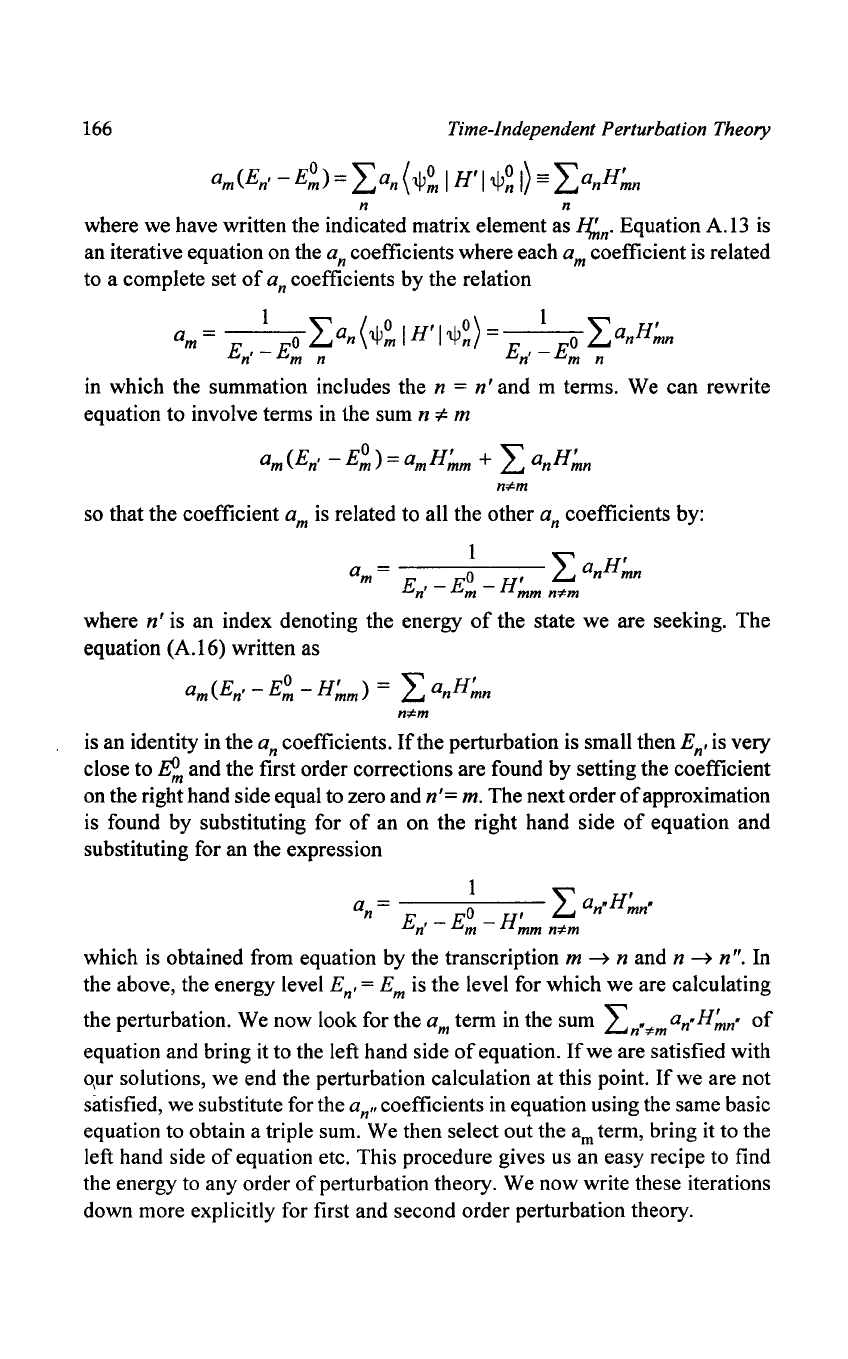
If
we are looking for the perturbation to the level m, then we multiply
equation from
~he
left by
~o;
and integrate over all space. On the left hand
side
of
equation we get
('ljJ~
1
'ljJ~
I)
=
0mn
while on the right hand side we
have the matrix element
of
the perturbation Hamiltonian taken between the
unperturbed states:
166
Time-Independent Perturbation Theory
ameEn'
-
E~)
=
Ian
(tjJ~
1
H'
1
tjJ~
I)
==
IanH~n
n n
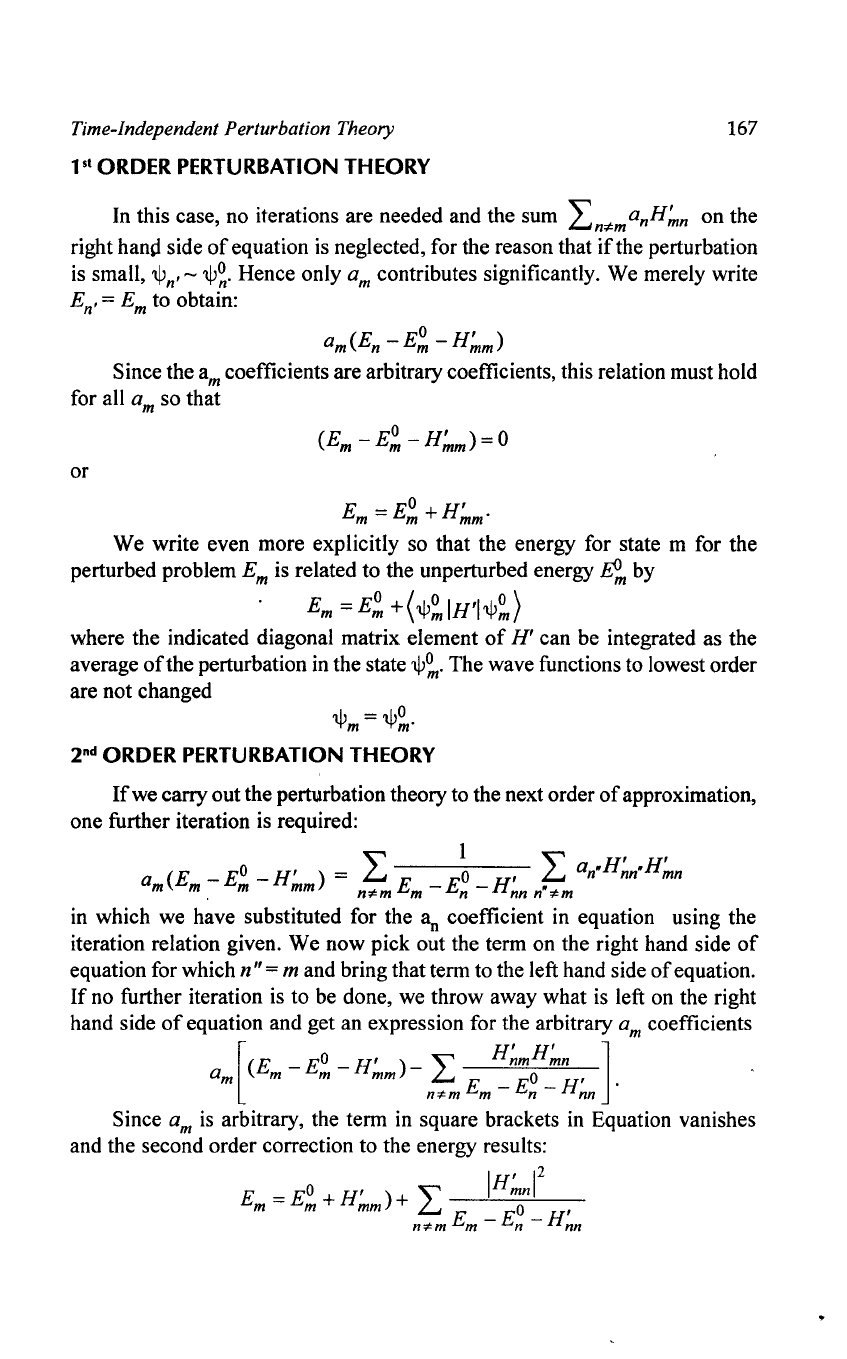
where we have written the indicated matrix element as
~n.
Equation A.
13
is
an iterative equation on the
an
coefficients where each
am
coefficient is related
to a complete set
of
an
coefficients by the relation
a
m
= E
'~EO
Ian(tjJ~IH'ltjJ~)=
E
'~EO
IanH~n
n m n n m n
in which the summation includes the n =
n'
and m terms. We can rewrite
equation to involve terms in the sum
n * m
am
(En'
-
E~)
=
amH~m
+ I
anH;"n
n*m
so that the coefficient
am
is
related to all the other
an
coefficients by:
a = 1
'"
a
H'
m E _
EO
_
H'
~
n
mn
n'
m
mm
n*m
where
n'
is an index denoting the energy
of
the state we are seeking. The
equation
(A. 16) written as
am
(En'
-
E~
-
H;"m)
= L
anH;"n
n*m
is
an identity in the
an
coefficients.
If
the perturbation is small then
En'
is very
close to
~
and the first order corrections are found by setting the coefficient
on the right hand side equal to zero and
n'
= m. The next order
of
approximation
is found by substituting for
of
an on the right hand side
of
equation and
substituting for an the expression
an
=
~,
I
an"H;"n"
En'
-Em
-Hmm
n*m
which is obtained from equation by the transcription m
~
nand
n
~
n". In
the above, the energy level
En'
=
Em
is the level for which we are calculating
the perturbation. We now look for the
am
term in the sum Ln"*m
an"H;"n"
of
equation and bring it to the left hand side
of
equation.
Ifwe
are satisfied with
o,ur
solutions, we end the perturbation calculation
at
this point.
If
we are not
satisfied, we substitute for the
an"
coefficients in equation using the same basic
equation to obtain a triple sum. We then select out the
am
term, bring
it
to the
left hand side
of
equation etc. This procedure gives us an easy recipe to find
the energy to any order
of
perturbation theory. We now write these iterations
down more explicitly for first and second order perturbation theory.
Time-Independent Perturbation Theory
167
15\
ORDER PERTURBATION THEORY
In
this case, no iterations are needed and the
sum"
anH'",n
on the
~n#m
right
han~
side
of
equation
is
neglected, for the reason that
if
the perturbation
is
small,
'ljJn'
-
'ljJ~.
Hence only
am
contributes significantly.
We
merely write
En'
=
Em
to obtain:
am(En
-E~
-H'",m)
Since the
am
coefficients are arbitrary coefficients, this relation must hold
for all
am
so that
or
Em
=E~
+H'",m·
We write even more explicitly so that the energy for state m for the
perturbed problem
Em
is related to the unperturbed energy
EJ",
by
Em
=E~
+('ljJ~IH'I'ljJ~)
where the indicated diagonal matrix element
of
H'
can be integrated as the
average
of
the perturbation in the state
'ljJ~.
The wave functions to lowest order
are not changed
'ljJm='ljJ~·
2
nd
ORDER PERTURBATION THEORY
Ifwe
carry out the perturbation theory to the next order
of
approximation,
one further iteration is required:
, " 1 " a
,H'
,H'
a
(E
-
EO
- H ) =
~
E
EO
H'
~
n
nn
mn
m
m.
m
mm
n#m
m - n -
nn
n'#m
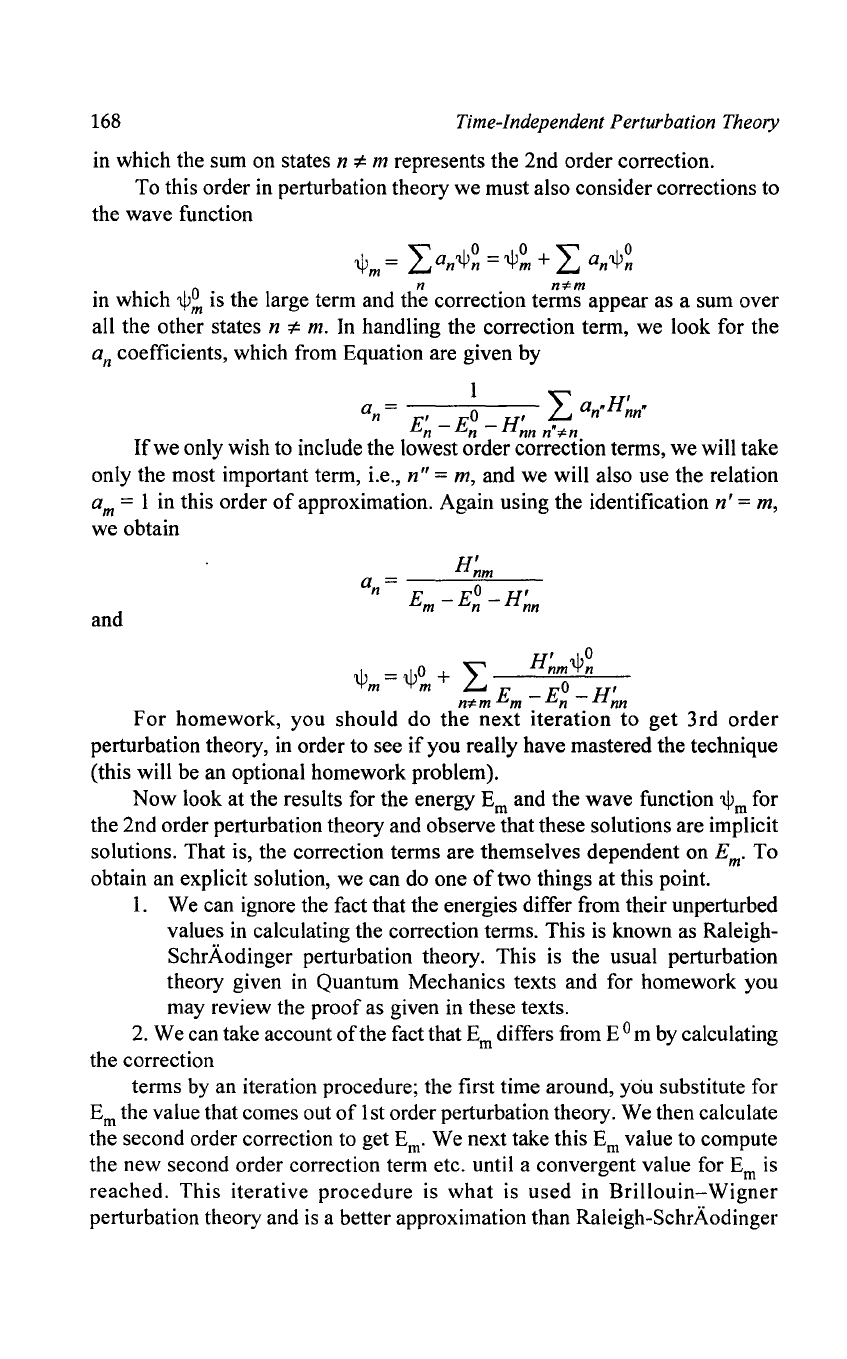
in which we have substituted for the
an
coefficient in equation using the
iteration relation given. We now pick out the term on the right hand side
of
equation for which
n"
= m and bring that term to the left hand side
of
equation.
If
no further iteration is to be done, we
throwaway
what
is
left on the right
hand side
of
equation and get an expression for the arbitrary
am
coefficients
[
C
E _EO
-H'
)-"
H~mH'",n
1
am
m m
mm
~
0,
n#mEm
-En
-Hnn
.
Since
am
is
arbitrary, the term
in
square brackets
in
Equation vanishes
and the second order correction to the energy results:
I
H'
12
E
=EO
+H'
)+"
mn
m m
mm
~
0,
n#mEm
-En
-Hnn
168
Time-Independent Perturbation Theory
in which the sum on states n
*"
m represents the 2nd order correction.
To this order in perturbation theory we must also consider corrections to
the wave function
,,0
0"
°
tP
m
=
.LJantP
n
=tP
m
+.LJ
antP
n
n
n*m
in which
tP~
is the large term and the correction terms appear as a sum over
all the other states
n
*"
nl.
In handling the correction term, we look for the
an
coefficients, which from Equation are given by
a = " a
.H
'
•
n E' _
EO
_
H'
~
n
nn
n n
nn
n
*n
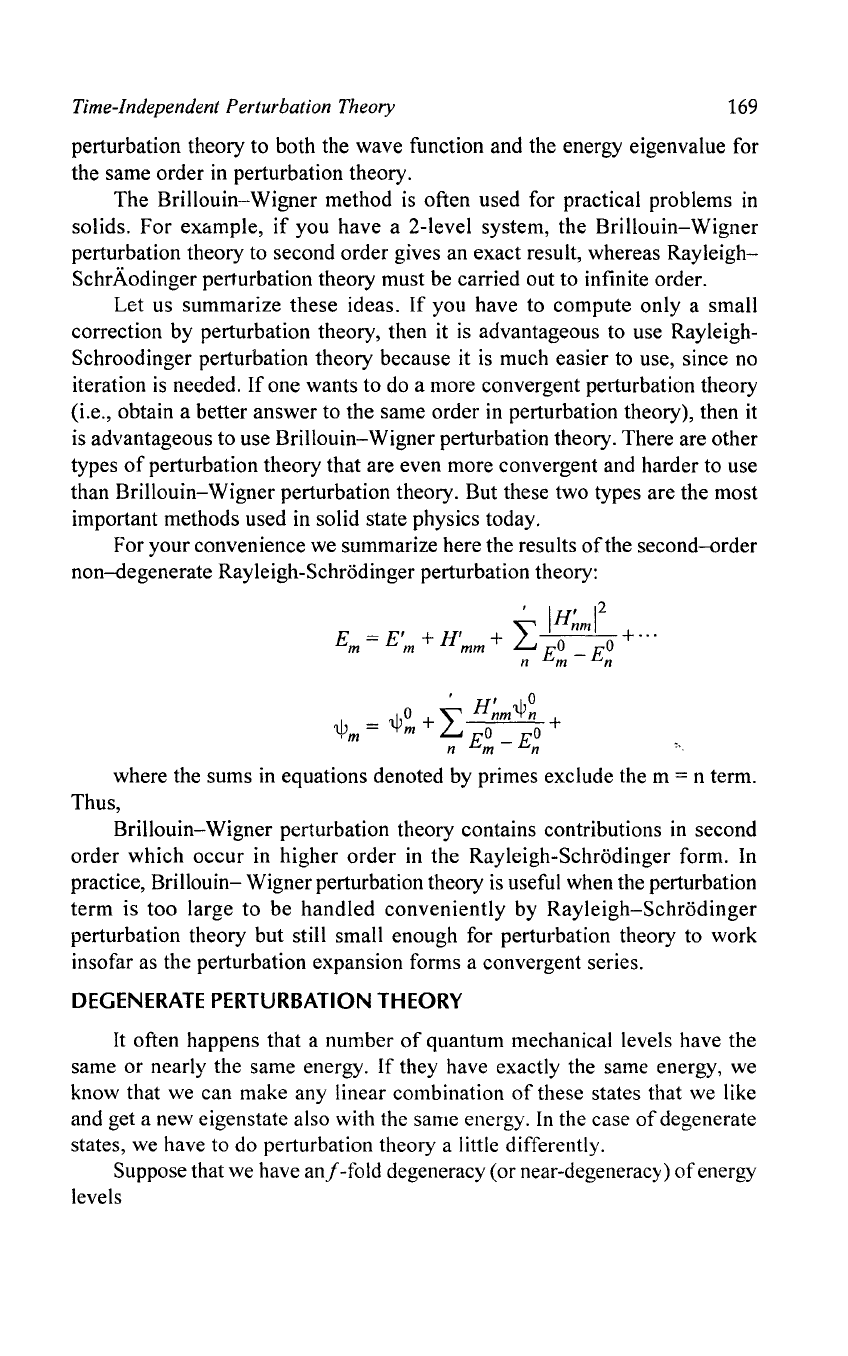
Ifwe
only wish to include the lowest order correction terms,
we
will take
only the most important term, i.e.,
n" =
m,
and we will also use the relation
am
= 1 in this order
of
approximation. Again using the identification n
'
=
m,
we obtain
and
tP
-
tP
0
+"
H~m
tP~
m - m
.LJ
E _
EO
_
H'
n*m
m n
nn
For
homework, you should do
the
next
iteration
to
get 3rd
order
perturbation theory,
in
order to see
if
you really have mastered the technique
(this will be an optional homework problem).
Now look at the results for the energy
Em
and the wave function
tP
m
for
the 2nd order perturbation theory and observe that these solutions are implicit
solutions. That is, the correction terms are themselves dependent on
Em.
To
obtain an explicit solution, we can do one
of
two things at this point.
1.
We can ignore the fact that the energies differ from their unperturbed
values in calculating the correction terms. This is known as Raleigh-
SchrAodinger perturbation theory. This is the usual perturbation
theory given
in
Quantum Mechanics texts and for homework you
may review the proof as given in these texts.
2.
We can take account
of
the fact that
Em
differs from
EO
m by calculating
the correction
terms by an iteration procedure; the first time around,
you substitute for
Em
the value that comes out
of
1st order perturbation theory. We then calculate
the second order correction to get
Em.
We next take this
Em
value to compute
the new second order correction term etc. until a convergent value for
Em
is
reached. This iterative procedure is what is used in
Brillouin-Wigner
perturbation theory and
is
a better approximation than Raleigh-SchrAodinger
Time-Independent Perturbation Theory
169
perturbation theory to both the wave function and the energy eigenvalue for
the same order in perturbation theory.
The Brillouin-Wigner method
is
often used for practical problems
in
solids. For example,
if
you have a 2-level system, the Brillouin-Wigner
perturbation theory to second order gives an exact result, whereas Rayleigh-
SchrAodinger perturbation theory must be carried out to infinite order.
Let us summarize these ideas.
If
you have to compute only a small
correction by perturbation theory, then it
is
advantageous to use Rayleigh-
Schroodinger perturbation theory because it
is
much easier to use, since no
iteration
is
needed.
If
one wants to do a more convergent perturbation theory
(i.e., obtain a better answer to the same order
in
perturbation theory), then it
is
advantageous to use Brillouin-Wigner perturbation theory. There are other
types
of
perturbation theory that are even more convergent and harder to use
than Brillouin-Wigner perturbation theory. But these two types are the most
important methods used in solid state physics today.
For your convenience we summarize here the results
of
the second--order
non-degenerate Rayleigh-Schrodinger perturbation theory:
, 1 '
12
L
Hnm
E =
E'
+
H'
+ + ...
m m mm
EO
_Eo
n m n
,
H'
'ljJ0
W =
'ljJ0
+
""
nm
n +
'm
m L..
EO
_Eo
n m n
where the sums
in
equations denoted by primes exclude the m = n term.
Thus,
Brillouin-Wigner perturbation theory contains contributions
in
second
order which occur in higher order in the Rayleigh-Schrodinger form. In
practice, Brillouin-Wigner perturbation theory
is
useful when the perturbation
term is too large to be handled conveniently by
Rayleigh-Schrodinger
perturbation theory but still small enough for perturbation theory to work
insofar as the perturbation expansion forms a convergent series.
DEGENERATE PERTURBATION THEORY
It
often happens that a number
of
quantum mechanical levels have the
same or nearly the same energy.
If
they have exactly the same energy, we
know that we can make any linear combination
of
these states that we like
and get a new eigenstate also with the same energy.
In
the case
of
degenerate
states, we have to do perturbation theory a little differently.
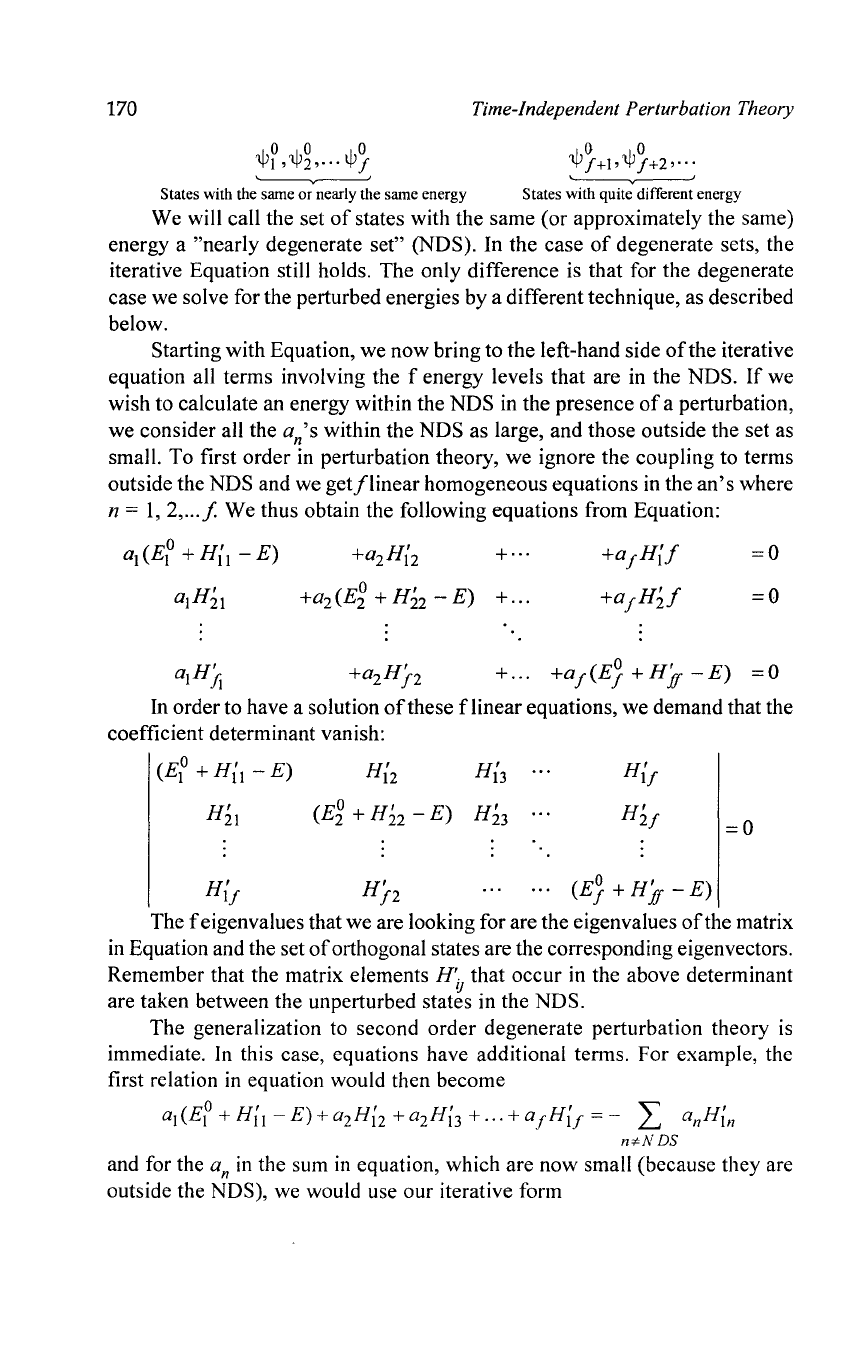
Suppose that we have an f -fold degeneracy (or near-degeneracy)
of
energy
levels
170
Time-Independent Perturbation Theory
o 0 0
01,0
0
1fJl
,1fJ2""
tjJ
f 'V
f+I,1fJ
f+2""
'------v-----'
'-----v----'
States with the same or nearly the same energy States with quite different energy
We will call the set
of
states with the same (or approximately the same)
energy a
"nearly degenerate set" (NOS). In the case
of
degenerate sets, the
iterative Equation still holds. The only difference
is
that for the degenerate
case we solve for the perturbed energies by a different technique, as described
below.
Starting with Equation, we now bring to the left-hand side
of
the iterative
equation all terms involving the f energy levels that are
in
the NOS.
If
we
wish to calculate an energy within the
NOS in the presence
of
a perturbation,
we consider all the
an's
within the NOS as large, and those outside the set as
small. To first order
in
perturbation theory, we ignore the coupling to terms
outside the
NOS and we
get/linear
homogeneous equations
in
the
an's
where
n =
1,2,
...
1 We thus obtain the following equations from Equation:
al(Ep
+H{l
-E)
+a2H{2 +...
+afH{f
=0
+a2
(E~
+ HZ2 -
E)
+ ...
=0
alH~
+a2Hj2
+ ...
+af(Ef+Hff-E)
=0
In
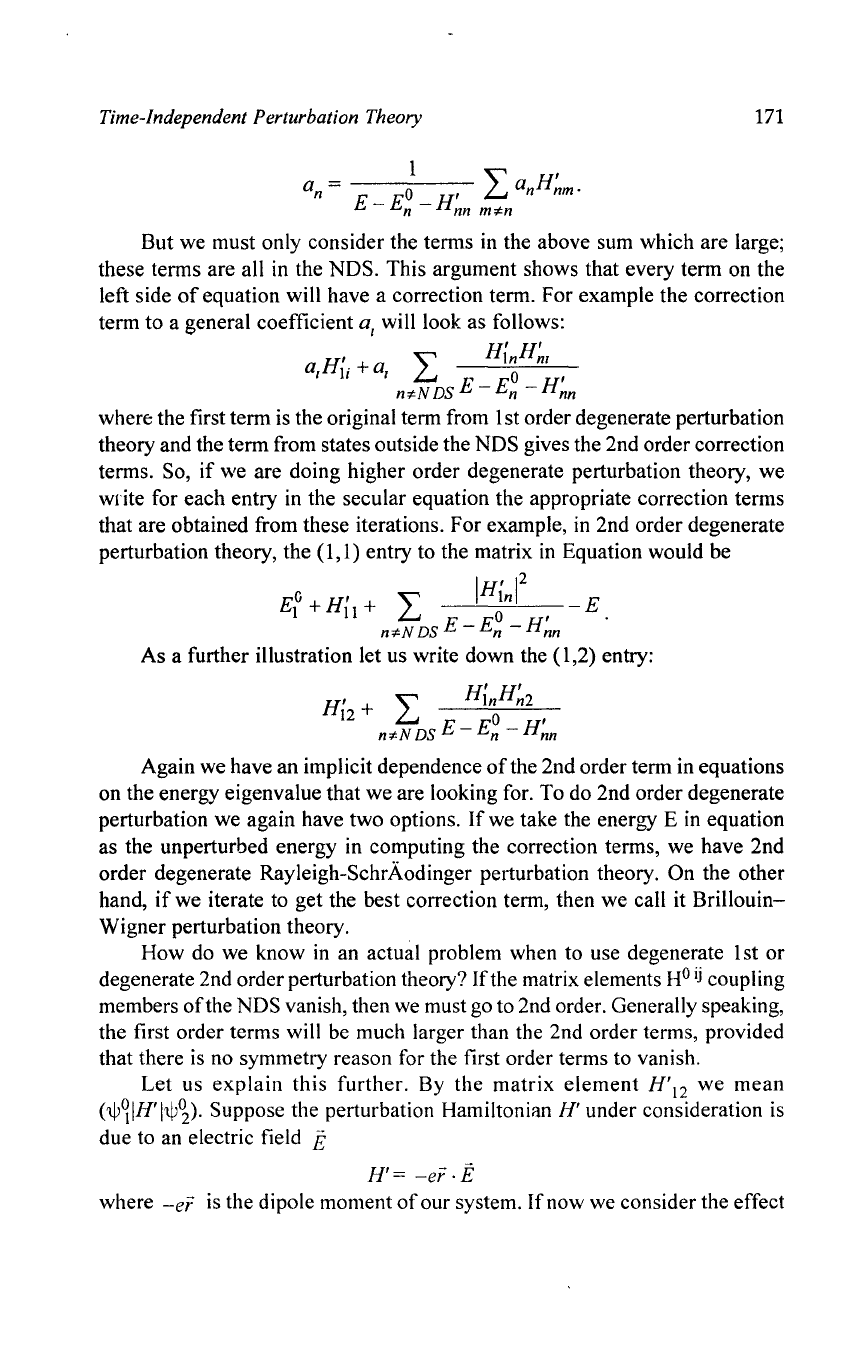
order to have a solution
ofthese
f linear equations, we demand that the
coefficient determinant vanish:
(E~
+ HZ2 -
E)
H
Z3
=0
~
~2
(~+~-~
The f eigenvalues that we are looking for are the eigenvalues
of
the matrix
in
Equation and the set
of
orthogonal states are the corresponding eigenvectors.
Remember that the matrix elements
H'ij that occur
in
the above determinant
are taken between the unperturbed states in the
NOS.
The generalization to second order degenerate perturbation theory
is
immediate.
In
this case, equations have additional terms. For example, the
first relation
in
equation would then become
al(E?
+Hil-
E
)+a2
H
i2
+a2
H
i3
+
...
+afHif
=-
L
anHin
n",NDS
and for the an
in
the sum
in
equation, which are now small (because they are
outside the NOS), we would use our iterative form
Time-Independent Perturbation Theory
171
1 L
H'
a = a
n E _ EO _
H'
n
nm·
n nn
m"#n
But we must only consider the terms
in
the above sum which are large;
these terms are all in the
NOS. This argument shows that every term on the
left side
of
equation will have a correction term. For example the correction
term to a general coefficient
a
l
will look as follows:
H'
H'
a
H'.
+a
"'" In m
I
II
I
L.J
0,
n"#NDSE-En
-Hnn
where the first term
is
the original term from 1 st order degenerate perturbation
theory and the term from states outside the
NOS gives the 2nd order correction
terms. So,
if
we are doing higher order degenerate perturbation theory, we
write for each entry in the secular equation the appropriate correction terms
that are obtained from these iterations. For example,
in
2nd order degenerate
perturbation theory, the (1,1) entry to the matrix
in
Equation would be
I
H'1
2
EO
+
H'
+
"'"
In - E
I
II
L.J
0,
n"#N
DS E -
En
- H nn
As a further illustration let us write down the (1,2) entry:
H
'
"'"
H;nH~2
12
+
L.J
0,
n"#NDSE-En
-Hnn
Again we have an implicit dependence
of
the 2nd order term in equations
on the energy eigenvalue that we are looking for. To do 2nd order degenerate
perturbation we again have two options.
If
we take the energy E
in
equation
as the unperturbed energy in computing the correction terms, we have 2nd
order degenerate Rayleigh-SchrAodinger perturbation theory.
On the other
hand,
if
we iterate to get the best correction term, then we call it Brillouin-
Wigner perturbation theory.
How do we know
in
an actual problem when to use degenerate 1 st or
degenerate 2nd order perturbation theory? If the matrix elements
HO
ij coupling
members
of
the NOS vanish, then
we
must go to 2nd order. Generally speaking,
the first order terms will
be
much larger than the 2nd order terms, provided
that there
is
no symmetry reason for the first order terms to vanish.
Let us
explain
this further.
By
the matrix
element
H'12
we
mean
('ljJ~IH'I'ljJ~).
Suppose the perturbation Hamiltonian
H'
under consideration
is
due to an electric field E
H'=
-er·F;
where
-er
is the dipole moment
of
our system. If now we consider the effect