
Brewster H.D. Solid State Physics
Подождите немного. Документ загружается.

172
Time-Independent Perturbation Theory
of
inversion on H', we see that r changes sign under inversion (x,
y,
z)
~
-
(x,
y,
z), i.e., r is an odd function.
Suppose that we are considering the energy levels
of
the hydrogen atom
in
the
presence
of
an electric field. We have s states (even), p states (odd), d states
(even), etc. The electric dipole moment will only couple an even state to an
odd state because
of
the oddness
of
the dipole moment under inversion.
Hence there is no effect in 1
st order non-degenerate perturbation theory.
For the
n = 1 level, there is an effect due to the electric field
in
second order
so that the correction to the energy level goes as the square
of
the electric
field, i.e.,
1£1
2
.
For the
nl2
levels, we treat them
in
degenerate perturbation theory because
the 2s and 2p states are degenerate in the simple treatment
of
the hydrogen
atom. Here, first order terms only appear in entries coupling
sand
p states. To
get corrections which split the
p levels among themselves, we must go to 2nd
order degenerate perturbation theory.
Chapter 8
s and Electron-Phonon Interaction
s
The solution
of
the problem in quantum mechanics using raising and
lowering operators. This is aimed at providing a quick review as background
for the lecture on phonon scattering processes and other topics in this course.
The Hamiltonian for the in one-dimension is written as:
2
p 1 2
H=
-+-1(X
2m
2
We
know
classically
that
the
frequency
of
oscillation
is
given
by
00
= -JKI m so that
p2
1 2 2
H=
-+-moo
x
2m
2
Define the lowering and raising operators a and
at
respectively by
p -
imrox
a=
-J2nmro
p +
imrox
at
=
-=-====-
-J2nmro
Since (p, x] = Mi, then
[a,
at]
= I so that
I
H=
-[(p
+ iromx)(p -iron/x) +
mnro)]
2m
=
noo[ata
+
112].
Let N =
at
a denote the number operator and its eigenstates
In)
so that
Nln)
= nln) where n is any real number. However
(nINln) = (nla
t
aln) =
(YlY)
= n
~
0
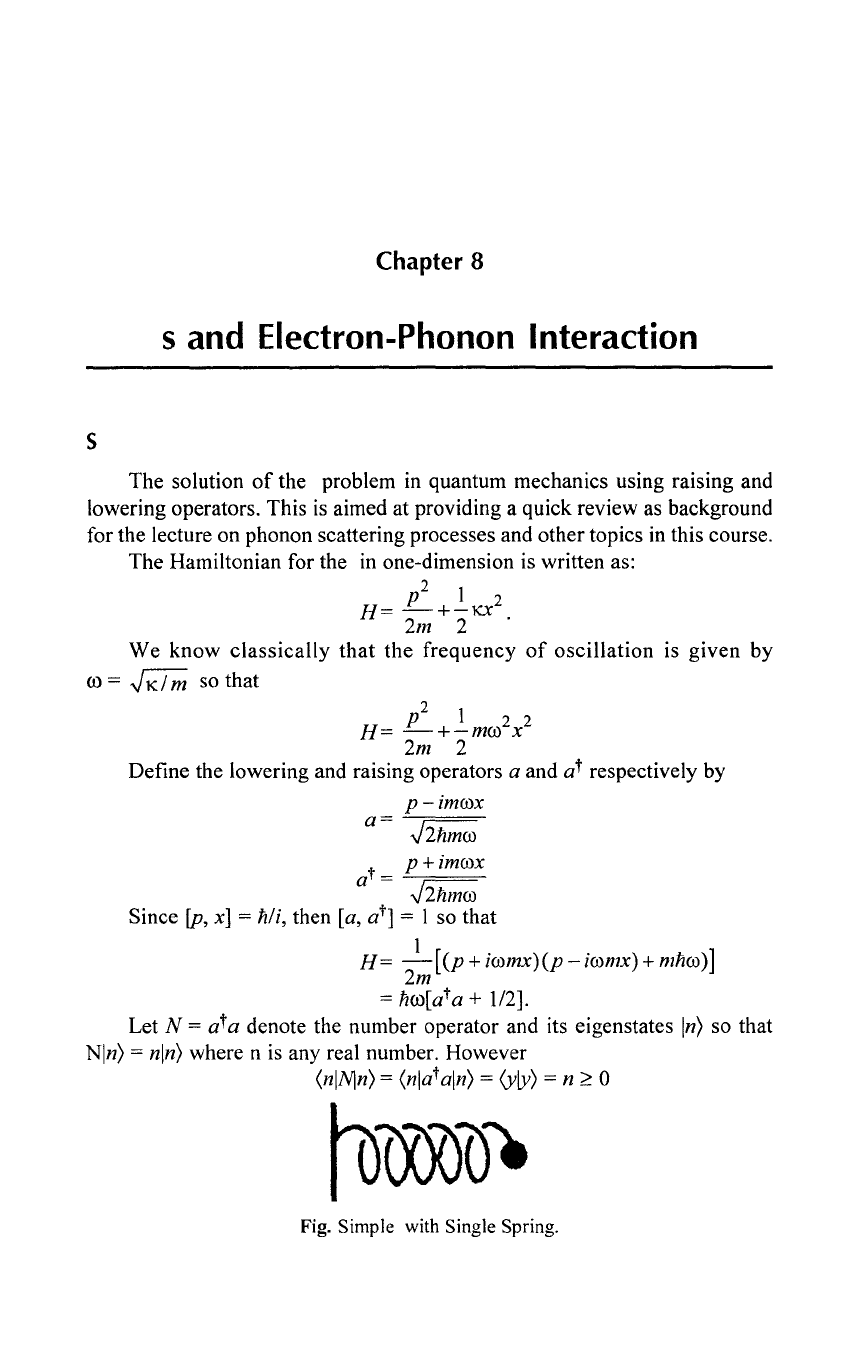
Fig. Simple with Single Spring.
174
s
and
Electron-Phonon Interaction
where
lYl
= aln) and the absolute value square
of
the eigenvector cannot be
negative. Hence
11
is a positive number or zero.
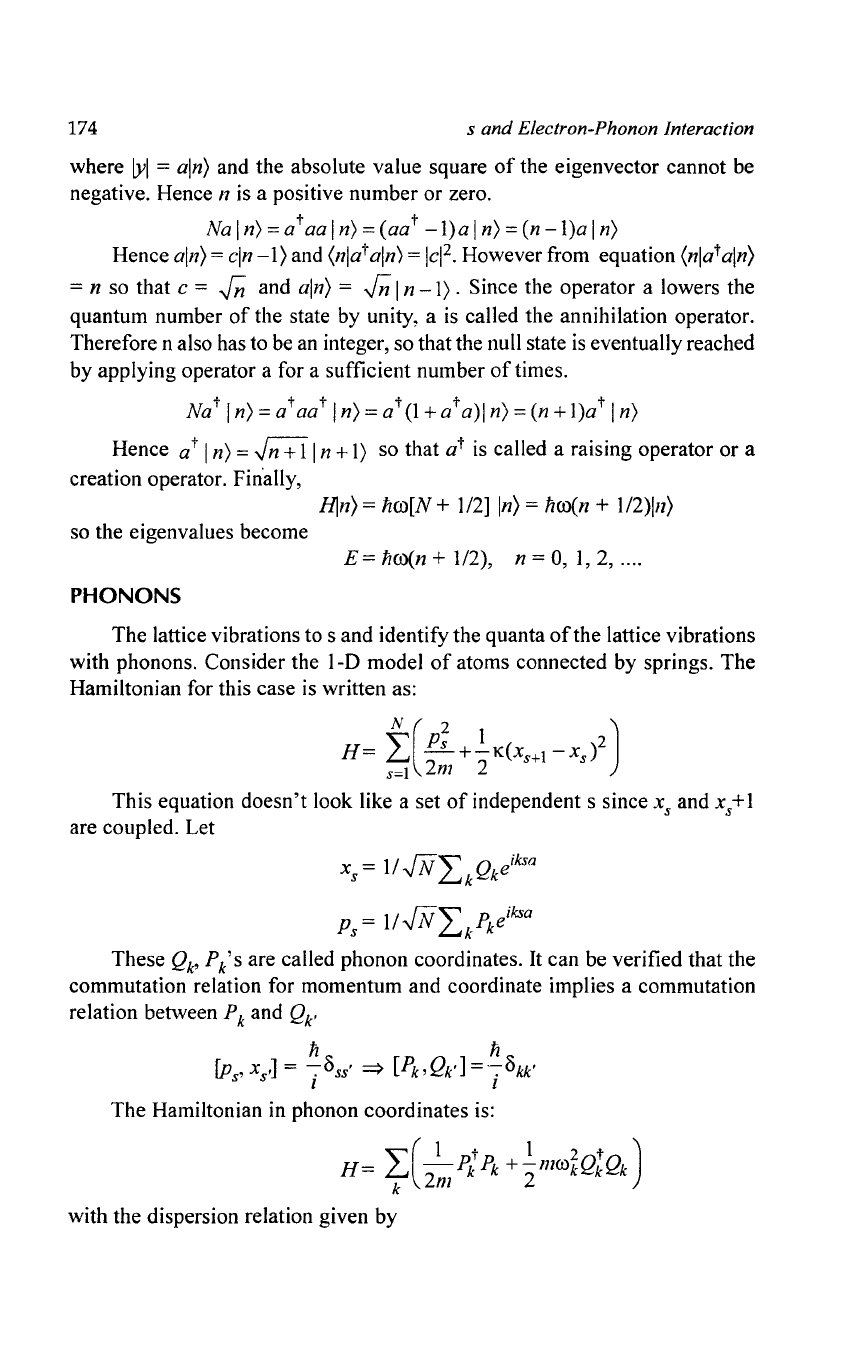
Naln>=ataaln)=(aa
t
-I)aln)=(n-I)aln)
Hence aln) =
cln
-1)
and (nlataln) =
Ic1
2
.
However from equation (nlataln)
= n so that c = .j;; and aln) = .j;;
In
-I)
. Since the operator a lowers the
quantum number
of
the state by unity, a
is
called the annihilation operator.
Therefore n also has to be an integer, so that the null state
is
eventually reached
by applying operator a for a sufficient number
of
times.
Na
tin)
=
at
aa
tin)
= a
tel
+
at
a)
In)
=
(n
+
I)a
tin)
Hence
at
In)
=
.J,;.tlln
+
1)
so that
at
is called a raising operator
or
a
creation operator. Fin'ally,
Hin) =
I1ro[N
+
112]
In)
=
l100(n
+
1/2)111)
so the eigenvalues become
E=
l100(n
+ 1/2), n =
0,
1,2,
....
PHONONS
The
lattice vibrations to s and identify the quanta
of
the lattice vibrations
with phonons. Consider the
I-D model
of
atoms connected by springs. The
Hamiltonian for this case is written as:
H=
f(p;
+!K(X
s
+!
_Xs)2)
s=l
2m 2
This equation
doesn't
look like a set
of
independent s since
Xs
and
xs+
1
are coupled. Let
x
=
1I.JN"
Q e
iksa
s
~k
k
P s =
lI.JN
L
k
Pke
iksa
These
Qk'
P/s
are called phonon coordinates. It can be verified that the
commutation relation for momentum and coordinate implies a commutation
relation between
P k and
Qk'
11 11
fps,x
s
']
=
--:-0ss'
=>
[Pk,Qk']=--:-0kk'
I I
The
Hamiltonian in phonon coordinates is:
H=
L(_l_Pktpk
+!11l(O~Q:Qk)
k
2m
2
with the dispersion relation given by
s
and
Electron-Phonon Interaction
O)k
=
J2i
(1-
coska)
This is all
in
Kittel ISSP, pp. 611-613. Again let
iP
k
t
+
mOOkQk
a =
k
.fij;moo
k
-iP
k
+ mOOkQi
at
= _-"==----'---.e:...
k .fij;
11100
k
so that the Hamiltonian is written as:
H =
2)
ro
k(ak
a
k +
112)
=>
E =
L(l1k
+
112)nrok
k k
175
The quantum
of
energy nO)k is called a phonon. The state vector
of
a
system
ofphonons
is written as
Inl'
11
2
,
...
,
11
k
,
...
),
upon which the raising and
lowering operator can act:
akin!,
n
2
, ... ,
11
k
, ... )
=
rn;;
I
nJ,n2,·
..
,nk
-1,
... )
alln!,
11
2
,
...
,
11
k
, ... )
=
~nk
+
11
nl,n2,
...
,nk
+
1,
... )
From equation it follows that the probability
of
annihilating a phonon
of
mode k is the absolute value squared
of
the diagonal matrix element
or
nk'
ELECTRON-PHONON INTERACTION
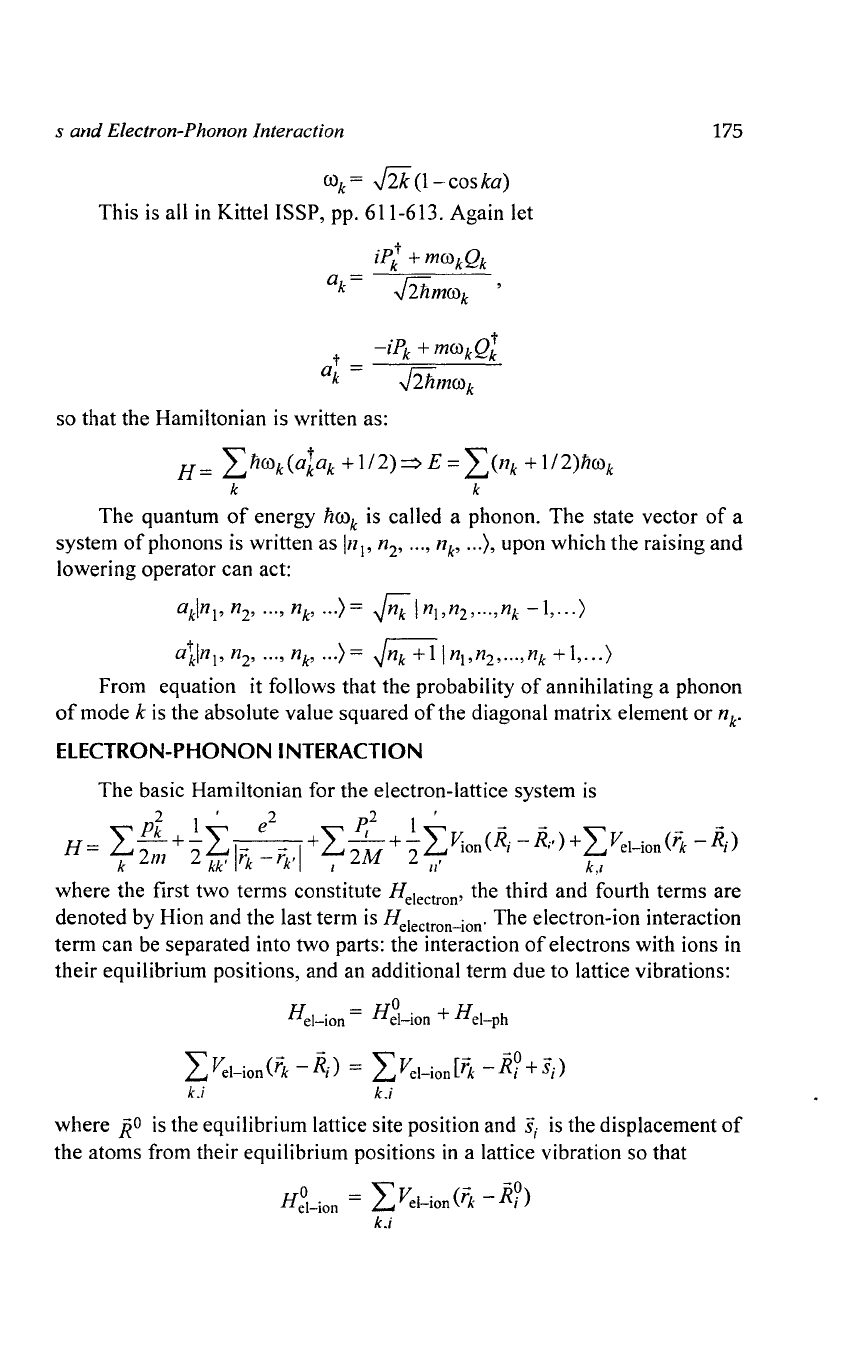
The basic Hamiltonian for the electron-lattice system
is
2
'2
2'
"Pk
1"
e
,,~
1"
-
-"
_-
H=
~-+-
~I-
- I +
~--+-
~Vion(Ri
-K,)+
~Ve!-ion(rk
-RJ
k
2m
2 kk' rk -
rk'
1
2M
2 11' k,l
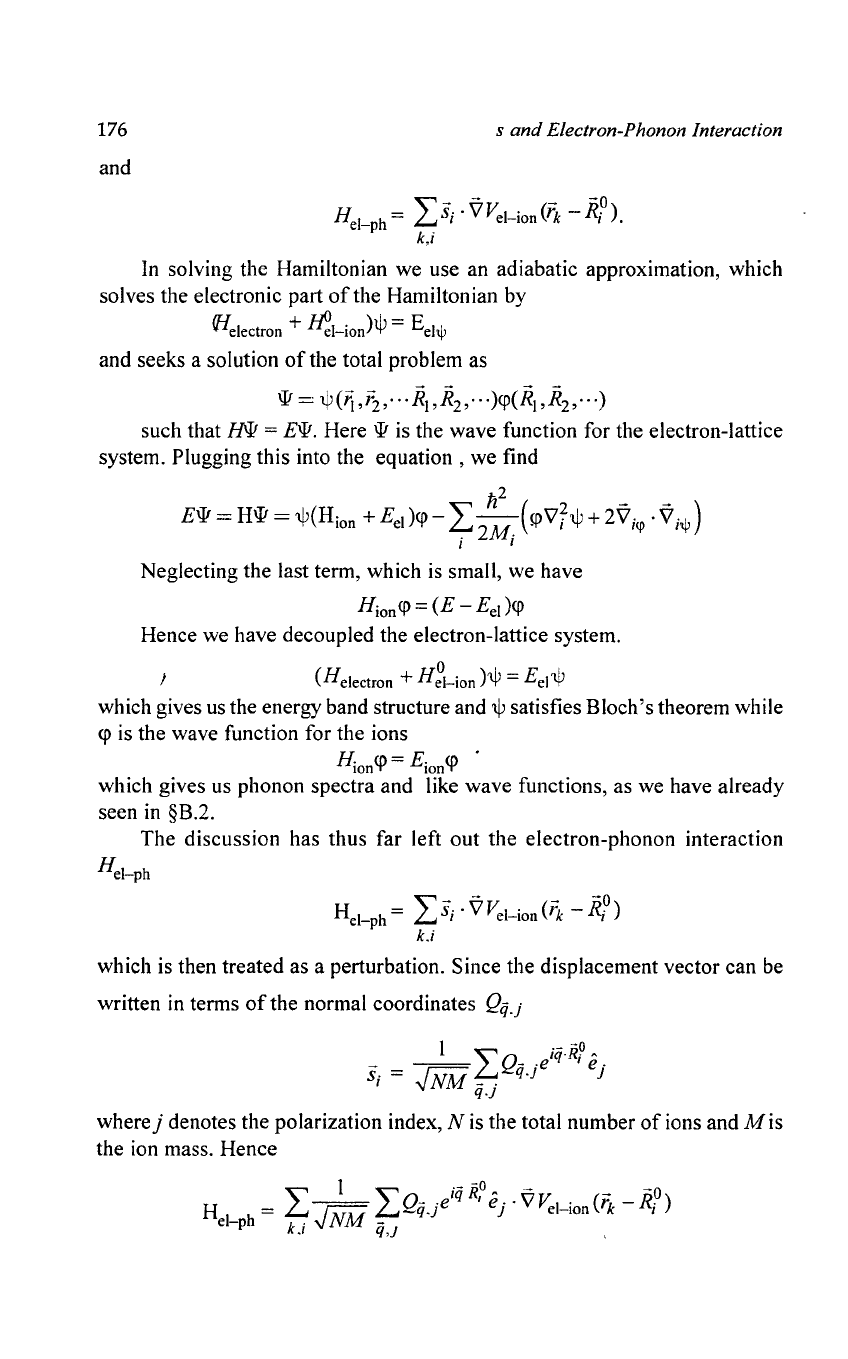
where the first two terms constitute Helectron' the third and fourth terms are
denoted by Hion and the last term
is
Helectron-ion' The electron-ion interaction
term can be separated into two parts: the interaction
of
electrons with ions in
their equilibrium positions, and an additional term due to lattice vibrations:
H
eJ
-
ion
=
H~-ion
+ H
el
-
ph
I Vel-ion
(Ii
- R
i
)
= I Vel-ion
[rk
-
R?
+ Si)
k.i
k.i
where R
O
is the equilibrium lattice site position and
Si
is
the displacement
of
the atoms from their equilibrium positions
in
a lattice vibration so that
176
s
and
Electron-Phonon Interaction
and
L
-
-0
H =
s;'
VVeJ-ion(rk
-R;
)
e1-ph
.
k,;
In solving the Hamiltonian we use an adiabatic approximation, which
solves the electronic part
of
the Hamiltonian by
f[-leJectron
+
~J-ion)ljJ
=
Eelt[l
and seeks a solution
of
the total problem as
W =
ljJ(~
,~,""
R
J
,R
2
,"·
.)cp(R
I
,R
2
,"··)
such that iN! = EiI!. Here W is the wave function for the electron-lattice
system.
Plugging this into the
equation,
we find
2
Ew
=
Hw
=
~(Hion
+
EeJ)CP-
L-n-(~V7~+2Vi(,D'
\\p)
; 2M;
Neglecting the last term, which is small, we have
H
ion
cp
=
(E
-
Eel
)cp
Hence we have decoupled the electron-lattice system.
(Helectron
+
H~J-ion)~
=
EeJ~
which gives us the energy band structure and
ljJ
satisfies Bloch's theorem while
<p
is the wave function for the ions
~on
<p
= E
ion
<p
•
which gives us phonon spectra and like wave functions, as we have already
seen in §B.2.
The
discussion has thus far left
out
the electron-phonon interaction
H
el
-
ph
,,-
-0
H
el
-
ph
=
L...J
s;
. V
Vel-ion
(Ii
-
R;
)
k.;
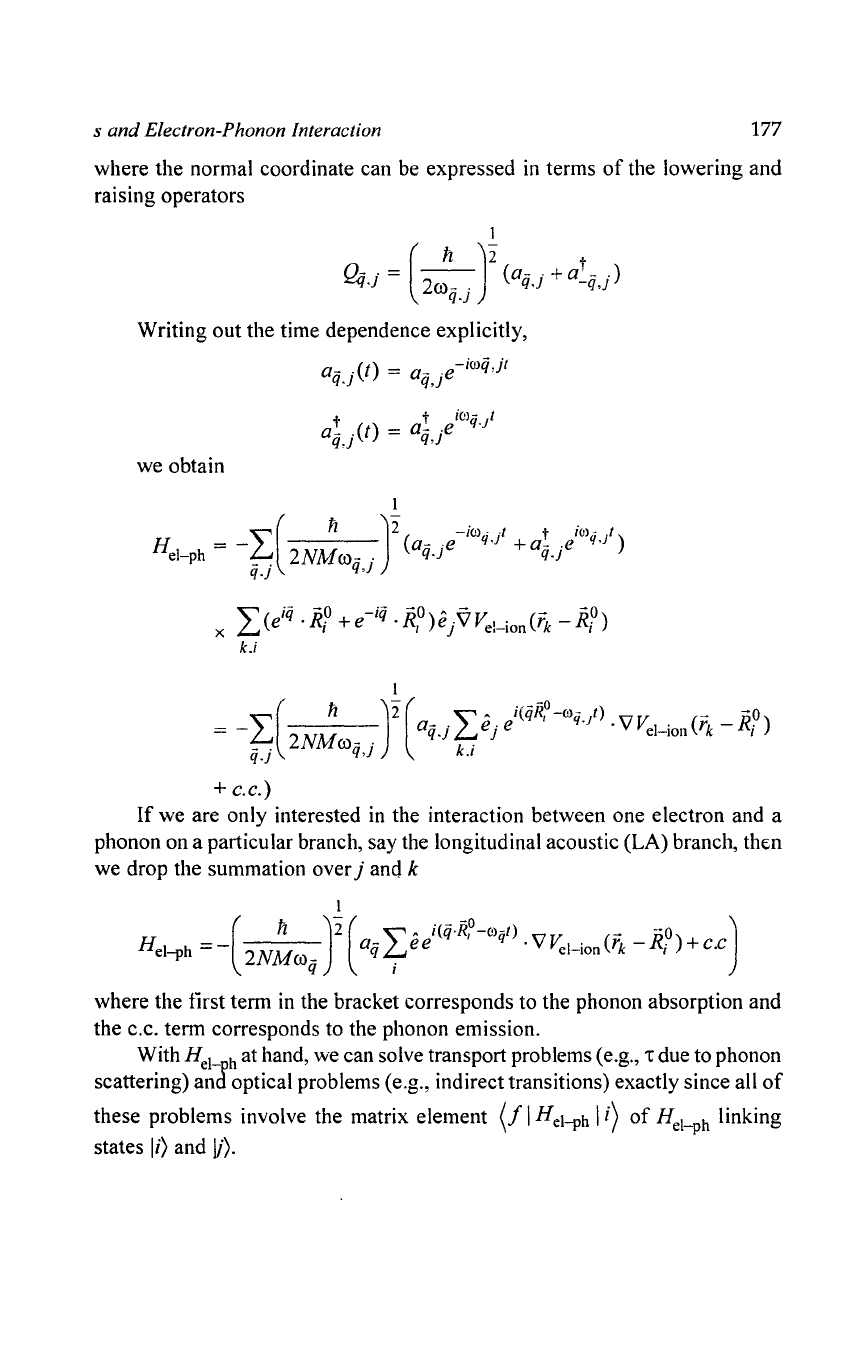
which is then treated as a perturbation. Since the displacement vector can be
written in terms
of
the normal coordinates Qij.j
1"
;q.R
O
A
S;
=
JNM
~Qij.je
I
ej
q.)
where j denotes the polarization index, N is the total number
of
ions and
Mis
the ion mass. Hence
"
1"
iij
R,D
A -
--0
H =
L.
r.;;-;
L.Qij.je
ej
.
VVeJ-ion
(rk
-
R;
)
e1-ph
k'
"NM
-
.1
q,)
,
s
and
Electron-Phonon Interaction
177
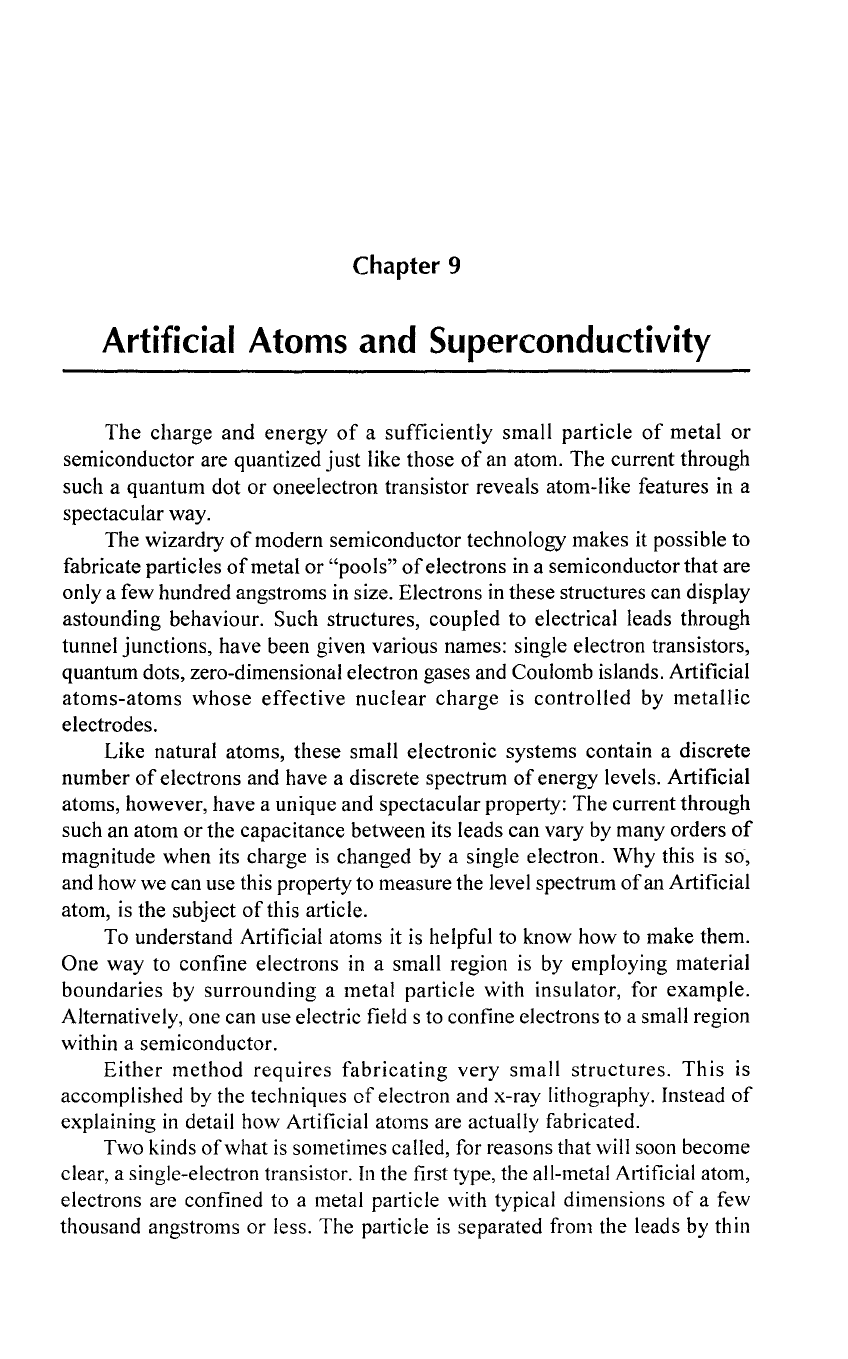
where the normal coordinate can be expressed
in
terms
of
the lowering and
raising operators
I
Qq.j
=
(2:-
.)2
(aij,j + a!ij,j)
q.}
Writing out the time dependence explicitly,
a-
.
(t)
=
a-
.e
-io)ij,jl
q.j
q,j
we obtain
I
,,(
11
)2
-iO)·.1
t
iO)-
1
H
e1
-
ph
= -
L....
2NMOJ-' (aij.je
q.J
+ a
q
./
q,J)
q.j
q,j
1
,,(
11
)2(
",
i(ijR,o-O)iij)
nv
(-
R-O)
= -
L....
_ . aq.j
L....ej
e . v e1-ion
rk
- i
q.j
2NMOJ
q
,j
k.i
+ c.c.)
If
we are only interested
in
the interaction between one electron and a
phonon on a particular branch, say the longitudinal acoustic (LA) branch,
then
we drop the summation over j and k
I
(
11
)2
(
",
i(ij.R,o
-0)-1)
-
-0
)
H
e1
-ph
= -
2NMOJij
aij
fee
q.
"v.:l-ion
(rk
-
Ri
) + c.c
where the first term
in
the bracket corresponds to the phonon absorption and
the c.c. term corresponds to the phonon emission.
With
H
e1
_ h at hand, we can solve transport problems (e.g.,
l'
due to phonon
scattering)
and
optical problems (e.g., indirect transitions) exactly since all
of
these problems involve the matrix element
(J
I
Hel-ph
I
i)
of
He1-ph linking
states
Ii)
and Ii).
Chapter 9
Artificial
Atoms
and
Superconductivity
The
charge and
energy
of
a sufficiently small particle
of
metal
or
semiconductor are quantized
just
like those
of
an atom. The current through
such a quantum dot
or
oneelectron transistor reveals atom-like features in a
spectacular way.
The wizardry
of
modern semiconductor technology makes it possible to
fabricate particles
of
metal
or
"pools"
of
electrons in a semiconductor that are
only a few hundred angstroms
in
size. Electrons
in
these structures can display
astounding behaviour. Such structures, coupled to electrical leads through
tunnel junctions, have been given various names: single electron transistors,
quantum dots, zero-dimensional electron gases and Coulomb islands. Artificial
atoms-atoms
whose
effective
nuclear
charge
is
controlled
by
metallic
electrodes.
Like natural atoms, these small electronic systems contain a discrete
number
of
electrons and have a discrete spectrum
of
energy levels. Artificial
atoms, however, have a unique and spectacular property: The current through
such an atom
or
the capacitance between its leads can vary by many orders
of
magnitude when its charge
is
changed by a single electron. Why this is so,
and how we can use this property to measure the level spectrum
of
an Artificial
atom, is the subject
of
this at1icIe.
To understand Artificial atoms it is helpful to know how to make them.
One way to confine electrons in a small region is by employing material
boundaries by surrounding a metal particle with insulator, for example.
Alternatively, one can use electric field s to confine electrons to a small region
within a semiconductor.
Either
method
requires
fabricating
very
small
structures.
This
is
accomplished by the techniques
of
electron and x-ray lithography. Instead
of
explaining
in
detail how Artificial atoms are actually fabricated.
Two kinds
of
what
is
sometimes called, for reasons that will soon become
clear, a single-electron transistor.
In
the first type, the all-metal A11ificial atom,
electrons are confined to a metal
pa11icIe
with typical dimensions
of
a few
thousand angstroms
or
less. The pat1icle is separated
fr0111
the leads by thin
Artificial Atoms
and
Superconductivity
179
insulators, through which electrons must tunnel to get from one side to the
other. The leads are labeled "source" and "drain" because the electrons enter
through the former and leave through the latter the same way the leads are
labeled for conventional field effect transistors, such as those
in
the memory
of
your personal computer. The entire structure sits near a large, well-insulated
metal electrode, called the gate.
A structures that is conceptually similar to the all-metal atom but
in
which
the confinement
is
accomplished with electric field s
in
gallium arsenide. Like
the all-metal atom, it has a metal gate on the bottom with an insulator above
it; in this type
of
atom the insulator
is
AIGaAs. When a positive voltage
Vg
is
applied to the gate, electrons accumulate
in
the layer
of
GaAs above the
AIGaAs. Because
of
the strong electric field at the
AlGaAs-GaAs interface, the electrons' energy for motion perpendicular
to the interface
is
quantized, and at low temperatures the electrons move only
in
the two dimensions parallel to the -interface.
The
special feature that makes
this an Artificial atom is the pair
of
electrodes on the top surface
of
the GaAs.
When a negative voltage
is
applied between these and the source or drain, the
electrons are repelled and cannot accumulate underneath them.
Consequently the electrons are confined
in
a narrow channel between the
two electrodes. Constrictions sticking but into the channel repel the electrons
and create potential barriers at either end
of
the channel. An electron to travel
from the source to the drain it must tunnel through the barriers. The
"pool"
of
electrons that accumulates between the two constrictions plays the same role
that the small particle plays
in
the all-metal atom, and the potential barriers
from the constrictions play the role
of
the thin insulators. Because one can
control the height
of
these barriers by varying the voltage on the electrodes,
This type
of
Artificial atom the controlled-barrier atom. Controlled- barrier
atoms
in
which the heights
of
the two potential barriers can be varied
independently have also been fabricated.
In
addition, there are structures that
behave like controlled-barrier atoms but in which the barriers are caused by
charged impurities or grain boundaries.
The electrons
in
a layer
of
GaAs are sandwiched between two layers
of
insulating AlGaAs. One or both
of
these insulators acts as a tunnel barrier.
If
both barriers are thin, electrons can tunnel through them, and the structure
is
analogous to the single-electron transistor without the gate. Such structures,
usually called quantum dots, have been studied extensively. The cylinder can
be made by etching away unwanted regions
of
the layer structure, or a metal
electrode on the surface, can be used to repel electrons everywhere except
in
a small circular section
of
GaAs. Although a gate electrode can be added to
this kind
of
structure, most
of
the experiments have bee done without one, so
we call this the two-probe atom.
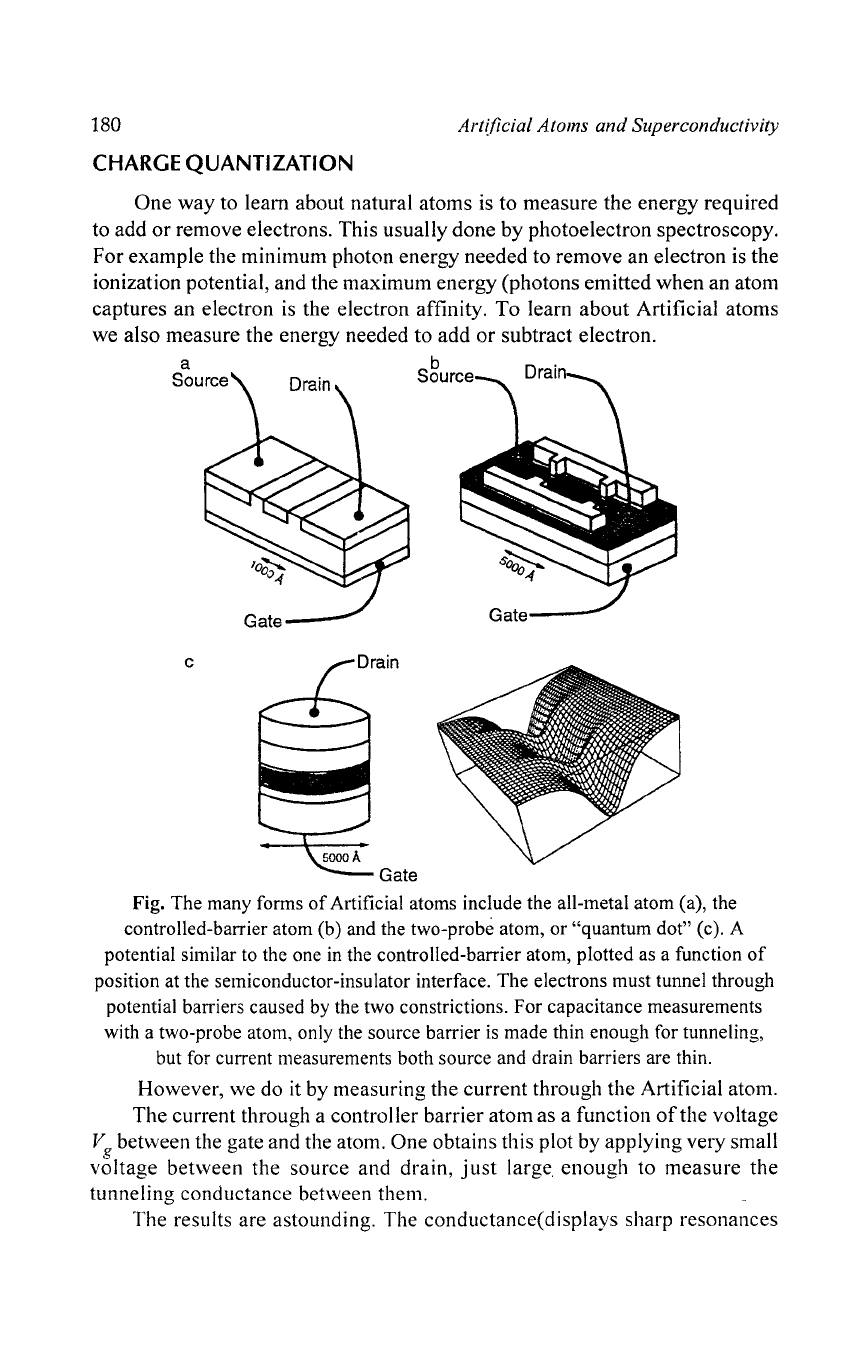
180
Art!!icial Atoms
and
Superconductivity
CHARGE
QUANTIZATION
One
way
to learn
about
natural
atoms
is
to
measure
the
energy
required
to
add
or
remove
electrons.
This
usually
done
by
photoelectron
spectroscopy.
For
example
the
minimum
photon
energy
needed
to
remove
an electron
is
the
ionization potential,
and
the
maximum
energy
(photons
emitted
when
an atom
captures
an
electron
is the
electron
affinity.
To
learn
about
Artificial
atoms
we
also
measure
the
energy
needed
to
add
or
subtract
electron.
c
Gate
b
Sou
Fig. The many forms
of
Artificial atoms include the all-metal atom (a), the
controlled-barrier atom (b) and the two-probe atom, or
"quantum dot" (c). A
potential similar
to
the one
in
the controlled-barrier atom, plotted
as
a function
of
position at the semiconductor-insulator interface. The electrons must tunnel through
potential barriers caused
by
the two constrictions. For capacitance measurements
with a two-probe atom, only the source barrier
is
made thin enough for tunneling,
but for current measurements both source and drain barriers are thin.
However,
we
do
it
by
measuring
the
current
through
the
Artificial atom.
The
current
through
a
controller
barrier
atom
as
a function
of
the
voltage
Vg
between
the gate
and
the atom.
One
obtains
this plot
by
applying
very
small
voltage
between
the
source
and
drain,
just
large,
enough
to
measure
the
tunneling
conductance
between them.
The
results
are
astounding.
The
conductance(displays
sharp
resonances
Artificial Atoms and Superconductivity
181
that are almost periodic
in
V g By calculating the capacitance between the
Artificial atom and the gate we can show
2
;8 that the period is the voltage
necessary to add one electron to the confinedpool
of
electrons. That is why
we
sometimes call the controller barrier atom a single-electron transistor:
Whereas the transistors in your personal computer turn on only on(when many
electrons are added to them, the Artificial atom turns on and
off
again every
time a single electron added to it.
A simple theory, the Coulomb blockade model, explains the periodic
conductance resonances. This model
is
quantitatively correct for the all-metal
atom and qualitatively correct for the controlled-barrier atom. To understand
the model, think about how an electron
in
the all-metal atom tunnels from one
lead onto the metal particle and then onto the other lead.
Suppose the particle is neutral to begin with. To add a charge Q to the
particle requires energy
Q2/2C, where C is the total capacitance between the
particle and the rest
of
the system; since you cannot add less than one electron
the flow
of
current requires a Coulomb energy e
2
/2C. This energy barrier
is
called the Coulomb
blockade. A fancier way to say this is
that
charge
quantization leads to an energy gap in the spectrum
of
states for tunneling:
For an electron to tunnel onto the particle, its energy must exceed the Fermi
energy
of
the contact by e
2
/2C, and for a hole to tunnel, its energy must be
below the Fermi energy by the same amount. Consequently the energy gap
has width
e
2
/C.
If
the temperature
is
low enough that
kT
< e
2
/2C, neither
electrons nor holes can flow from one lead to the other.
The gap in the tunneling spectrum
is
the difference between the "ionization
potential"
and the "electron affinity"
of
the Artificial atom. For a hydrogen
atom the ionization potential is 13.6 eV, but the electron affinity, the binding
energy
of
11,
is only 0.75 eV. This large difference arises from the strong
repulsive interaction between the two electrons bound to the same proton. Just
as for natural atoms like hydrogen, the difference between the ionization
potential
and
electron
affinity
for
artificial
atoms
arises
from
the
electronelectron interactions; the difference, however,
is
much smaller for
Artificial atoms because they are much bigger than natural ones.
By changing the gate voltage
Vg
one can alter the energy required to add
charge to the particle.
Vg
is applieq between the gate and the source, but
if
the
drain-source voltage
is
very small, the 'source, drain and particle will all be at
almost the same potential. With
Vg
applied, the electrostatic energy
of
a charge
Q on the particle is
E =
QVg
+ (/-12C
For negative charge
Q,
the first term
is
the attractive interaction between
Q and the positively charged gate electrode, and the second tenn
is
the repulsive