
Brewster H.D. Solid State Physics
Подождите немного. Документ загружается.

182
Artificial Atoms
and
Superconductivity
interaction among the bits
of
charge on the particle. Equation
C.I
shows that
the energy as a function
of
Q is a parabola with its minimum at Q =
-CV
g
.
10-'
GA TE VOLTAGE
V.
(mlfliYolW)
10-",---------
......
v,
(millivolts)
•
10-"
2~9~ln.o~-L---L-~2~92~.2
v,
(millivolts)
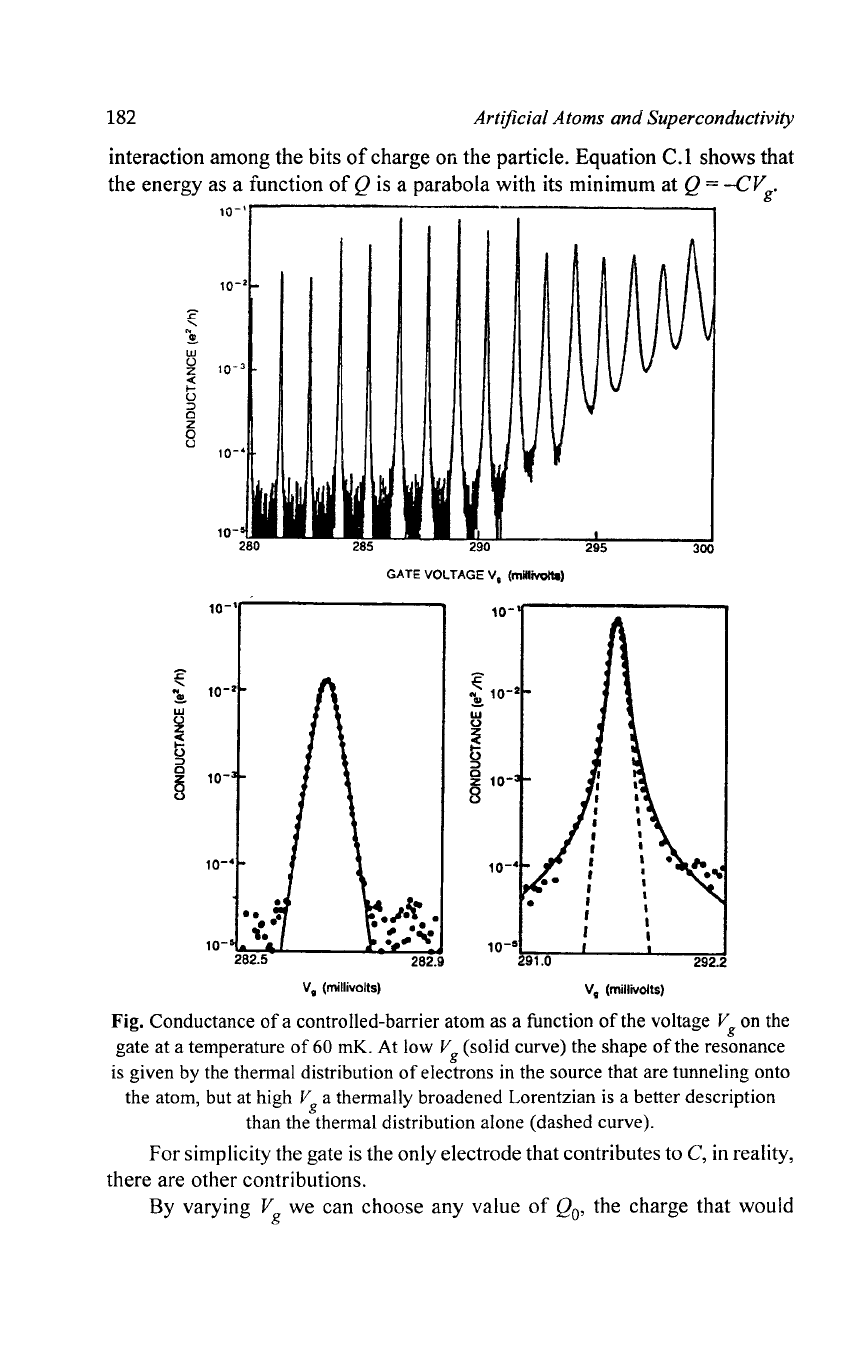
Fig. Conductance
of
a controlled-barrier atom
as
a function
of
the voltage
Vg
on the
gate at a temperature
of
60
mK. At low
Vg
(solid curve) the shape
of
the resonance
is
given by the thennal distribution
of
electrons
in
the source that are tunneling onto
the atom, but at high
Vg
a thennally broadened Lorentzian
is
a better description
than the thermal distribution alone (dashed curve).
For simplicity the gate
is
the only electrode that contributes to
C,
in
reality,
there are other contributions.
By varying
Vg
we can choose any value
of
Qo'
the charge that would
Artificial Atoms
and
Superconductivity
183
minimize the energy in equation
C.l
if
charge were not quantized. However,
because the real charge is quantized, only discrete values
of
the energy E are
possible.
When
Q
o
=
-Ne,
an integral number N
of
electrons minimizes E, and the
Coulomb interaction results in the same energy difference
e
2
/2C
for increasing
or
decreasing N
by
1.
For
all
other
values
of
Q
o
except Q
o
=
-(N
+ 1I2)e there
is
a smaller, but nonzero, energy for either adding
or
subtracting an
~lectron.
Under
such circumstances no current can flow at low temperature.
However,
if
Q
o
=
-{N
+ 1I2)e the state with Q =
-Ne
and
that
with
Q =
(N
+
l)e
are degenerate, and the charge fluctuates between the two values
even
at
zero
temperature.
Consequently
the
energy
gap
in
the
tunneling
spectrum disappears, and current can flow. The peaks in conductance are
therefore periodic, occurring
whenever
CV
g
= Q
o
=
-(N
+ 1/2)e, spaced in
gate voltage by
e/C.
0
0
-
-Ne
~
V
\"
-~"J
\/0
0
=
-(N+'1,)e
0.,=
-(N+'1.)e
~-(N+l)e_Ne
-(N+1V
V
-Ne
-(N+
l)e
-Ne
C'lARGE
-Ne
-(N+1)e
~Bn
D
-------lncreasm9
gale
voltage
".
------_
....
~
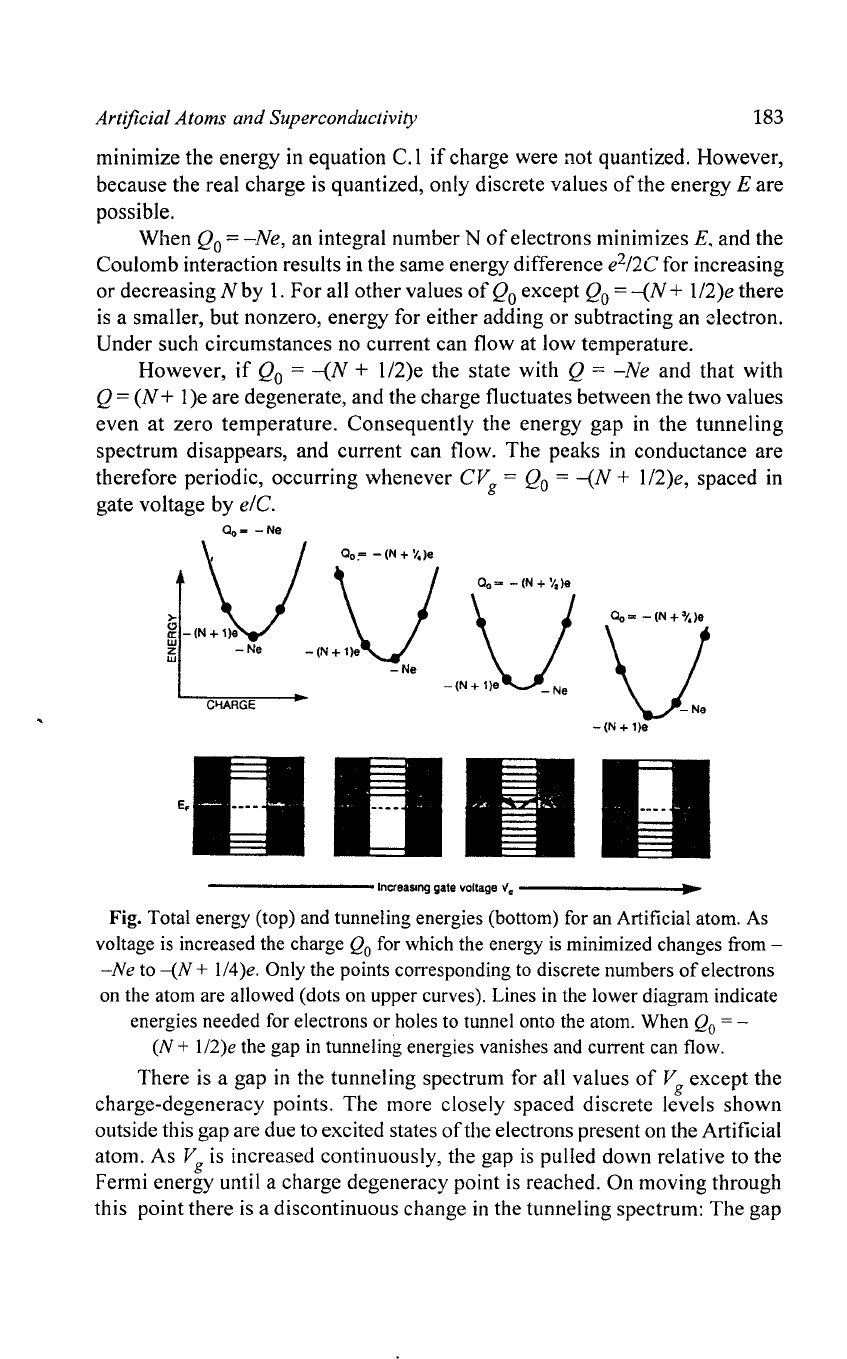
Fig. Total energy (top) and tunneling energies (bottom)
for
an
Artificial atom.
As
voltage
is
increased the charge Q
o
for
which the energy
is
minimized changes
from
-
-Ne
to
-(N
+
114
)e.
Only the points corresponding
to
discrete numbers
of
electrons
on
the atom are allowed (dots
on
upper curves). Lines
in
the lower diagram indicate
energies needed
for
electrons or holes
to
tunnel onto the atom. When Q
o
= -
(N
+ 1I2)e the gap
in
tunneling energies vanishes
and
current can
flow.
There
is a gap in the tunneling spectrum for all values
of
V except the
charge-degeneracy points.
The
more closely spaced discrete
llvels
shown
outside this gap are due to excited states
of
the electrons present on the Artificial
atom. As
Vg
is increased continuously, the gap
is
pulled down relative to the
Fermi energy until a charge degeneracy point is reached.
On moving through
this point there
is
a discontinuous change in the tunneling spectrum:
The
gap
184
Artificial Atoms
and
Superconductivity
collapses and then reappears shifted up by e
2
/C. Simultaneously the charge
on the Artificial atom increases by I and the process starts over again. A charge-
degeneracy point and a conductance peak are reached every time the voltage
is
increased by e/C, the amount necessary to add one electron to the Artificial
atom. Increasing the gate voltage
of
an Artificial atom is therefore analogous
to moving through the periodic table for natural atoms by increasing the nuclear
charge.
The quantization
of
charge on a natural atom
is
something we take for
granted. However,
if
atoms were larger, the energy needed to add or remove
electrons would be smaller, and the number
of
electrons on them would
fluctuate except at very low temperature. The quantization
of
charge is
just
one
of
the properties that Artificial atoms have
in
common with natural ones.
ENERGY
QUANTIZATION
the
Coulomb blockade model accounts for charge quantization but ignores
the quantization
of
energy resulting from the small size
of
the Artificial atom.
Tfi'Is
confinement
of
the electrons makes the energy spacing
of
levels
in
the
atom relatively large at low energies.
If
one thinks
of
the atom as a box, at the
lowest energies the level spacings are
of
the order
ti
2
/ma
2
,
where a is the size
of
the box. At higher energies the spacings decrease for a three-dimensional
atom because
of
the large number
of
standing electron waves possible for a
given energy.
If
there are many electrons
in
the atom, they fill up many levels,
and the level spacing at the Fermi energy becomes small. The all-metal atom
has so many electrons (about
10
7
)
that the level spectrum is effectively
continuous. Because
of
this, many experts do not regard such devices as
"atoms," it is helpful to think
of
them as being atoms in the limit
in
which the
number
of
electrons
is
large.
In
the controlled-barrier atom, however, there
are only about
30-60 electrons, similar to the number
in
natural atoms like
krypton through xenon.
Two-probe atoms sometimes have only one or two electrons. (There are
actually many more electrons that are tightly bound to the ion cores
of
the
semiconductor, but those are unimportant because they cannot move.) F or most
cases, therefore, the spectrum
of
energies for adding an extra electron to the
atom is discrete,
just
as
it is for natural atoms.
One can measure the energy level spectrum directly by observing the
tunneling current at fixed
Vg
as a function
of
the voltage V
ds
between drain
and source. Suppose we adjust
Vg
so that, for example, Q
o
=
-{N
+ 1I4)e and
then begin to increase
V
ds
.
The Fermi level
in
the source rises
in
proportion to
V
ds
relative to the drain, so it also rises relative to the energy levels
of
the
Artificial atom. Current begins to flow when the Fermi energy
of
the source
is
Artificial Atoms
and
Superconductivity
185
raised
just
above the first quantized energy level
of
the atom.
As
the Fermi
energy
is
raised further, higher energy levels
in
the atom fall below it, and
more current flows because there are additional channels for electrons to use
for tunneling onto the Artificial atom. We measure an energy level by
measuring the voltage at which the current increases or, equivalently, the
voltage at which there
is
a peak
in
the derivative
of
the current,
dlldV
ds
'
(We need to correct for the increase in the energy
of
the atom with V
ds
' but
this is a small effect.) Many beautiful tunneling spectra
ofthis
kind have been
measured
5
for two-terminal atoms.
Increasing the gate voltage lowers all the energy levels
in
the atom by
e
V.s'
so that the entire tunneling spectrum shifts with V
g
.
One can observe this
eftect by plotting the values
of
Vds
at which peaks appear in
dlldV
ds
' As
Vg
increases you can see the gap in the tunneling spectrum shift lower and then
disappear at the charge-degeneracy point,just as the Coulomb blockade model
predicts.
The discrete energy levels
of
the Artificial atom. For the range
of
Vs
the
voltage is only large enough to add or remove one electron from the atom; the
discrete levels above the gap are the excited states
of
the atom with one extra
electron, and those below the gap are the excited states
of
the atom with one
electron missing (one hole). At still higher voltages one observes levels for
two extra electrons or holes and so forth. The charge-degeneracy points are
the values
of
Vg
for which one
of
the energy levels
of
the Artificial atom is
degenerate with the Fermi energy in the leads when
Vds
=
0,
because only
then
can
the charge
of
the atom fluctuate.
In
a natural atom one has little control over the spectrum
of
energies for
adding
or
removing electrons. There the electrons interact with the fixed
potential
ofthe
nucleus and with each other, and these two kinds
of
interaction
determine the spectrum.
In
an Artificial atom, however, one can change this
spectrum completely by altering the atom's geometry and composition. For
the all-metal atom, which has a high density
of
electrons, the energy spacing
between the discrete levels
is
so small that
it
can be ignored. The high density
of
electrons also results in a short screening length for external electric field
t
s,
so electrons added to the atom reside on its surface. Because
of
this, the
electron-electron interaction is always
e
2
/C (where C is the classical
geometrical capacitance), independent
of
the number
of
electrons added. This
is
exactly the case for which the Coulomb blockade model was invented, and
it works well: The conductance peaks are perfectly periodic
in
the gate voltage.
The difference between the
"ionization potential" and the "electron affinity"
is
e
2
/C,
independent
of
the number
of
electrons on the atom.
In
the controlled-barrier atom, the level spacing
is
one or two tenths
of
186
Artificial Atoms
and
Superconductivity
the energy gap. The conductance peaks are not perfectly periodic
in
gate
voltage, and the difference between ionization potential and electron affinity
has a quantum mechanical contribution.
In the two-probe atom the electron-electron interaction can be made very
small, so that
a
4r-------------------------------------~
I
c:
II
I
o
:::.
-2
-1
o
DRAIN-50URCE VOLTAGE V
d
•
(millivolts)
GATE VOLTAGE
Vg
(millivolts)
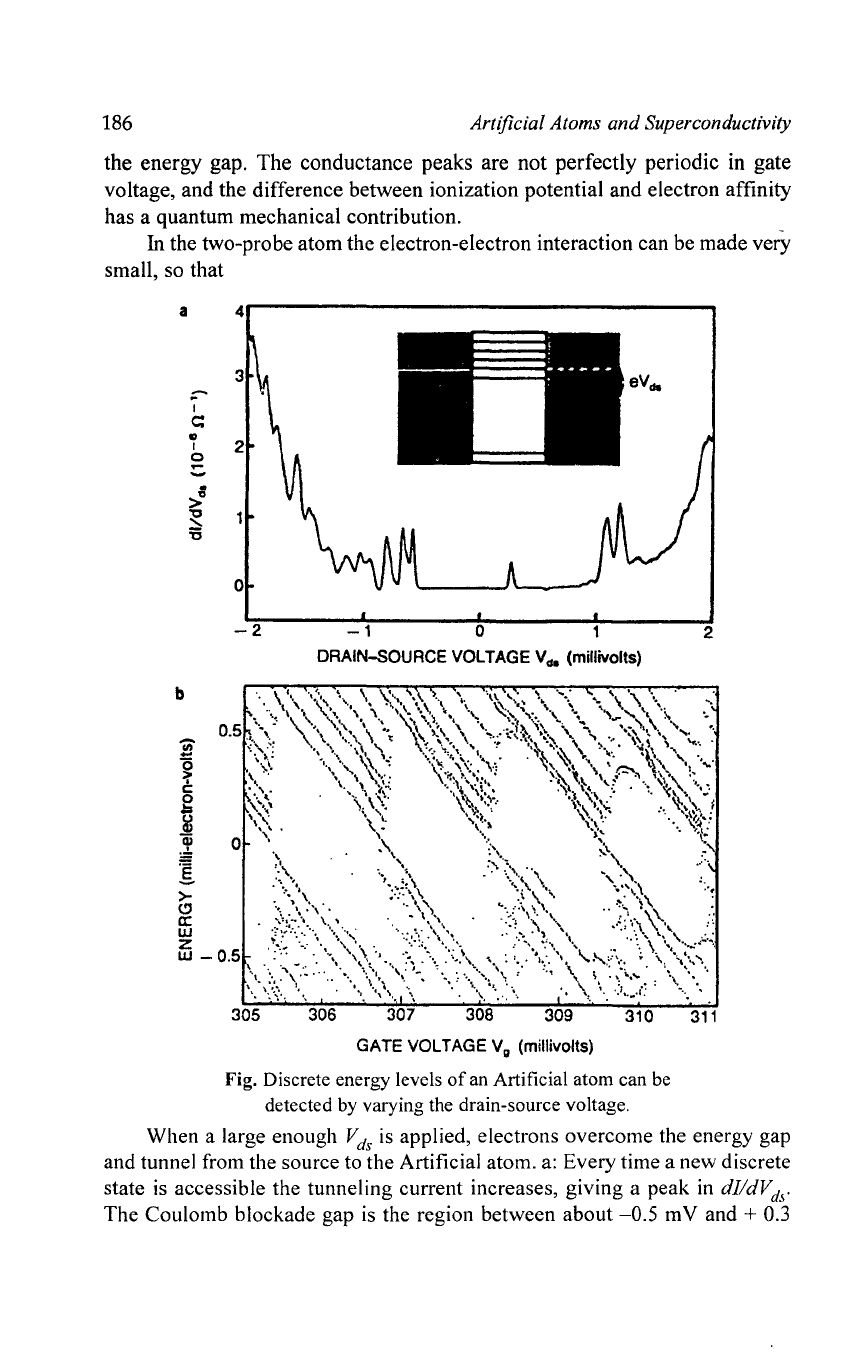
Fig. Discrete energy levels
of
an
Artificial atom can
be
detected
by
varying the drain-source voltage.
2
When a large enough
Vds
is
applied, electrons overcome the energy gap
and tunnel from the source to the Artificial atom.
a:
Every time a new discrete
state
is
accessible the tunneling current increases, giving a peak
in
dlldVd.l'
The Coulomb blockade gap
is
the region between about
-0.5
mV and +
0.3
Artificial Atoms and Superconductivity 187
m V where there are no peaks.
b:
Plotting the positions
of
these peaks at various
gate voltages gives the level spectrum.
Note how the levels and the gap move downward as
Vg
increases. One
can in principle reach the limit opposite to that
of
the all-metal atom. One can
find the energy levels
of
a two-probe atom by measuring the capacitance
between its two leads as a function
of
the voltage between them. When no
tunneling occurs, this capacitance is the series combination
of
the source-atom
and atom-drain capacitances. For capacitance measurements, two-probe atoms
are made with the insulating layer between the drain and atom so thick that
current cannot flow under any circumstances. Whenever the Fermi level in
the source lines up with one
of
the energy levels
of
the atom, however, electrons
can tunnel freely back and forth between the atom and the source. This causes
the
total
capacitance
to
increase,
because
the
source-atom
capacitor
is
effectively shorted by the tunneling current. The amazing thing about this
experiment is that a peak occurs in the capacitance every
time' a single electron
is added to the atom. The voltages at which the peaks occur give the energies
for adding electrons to the atom,
just
as the voltages for peaks in
dlldV
ds
do
for the controlled-barrier atom or for a two probe atom in which both the source-
atom barrier and the atom-drain barrier are thin enough for tunneling.
The energies for adding electrons to a two-probe atom vary with a
magnetic field perpendicular to the GaAs layer. In an all-metal atom the levels
would be equally spaced, by
e
2
/C , and would be independent
of
magnetic
field because the electron-electron interaction completely determines the
energy. By contrast, the levels
of
the two-probe atom are irregularly spaced
and depend on the magnetic field in a systematic way. For the two-probe atom
the fixed potential determines the energies at zero field. The level spacings
are irregular because the potential is not highly symmetric and varies at random
inside the atom because
of
charged impurities in the GaAs and AIGaAs. It is
clear that the electron-electron interactions that are the source
of
the Coulomb
blockade are not always so important
in
the two-probe atom as in the all-metal
and controlled-barrier atoms. Their relative importance depends in detail on
the geometry.
ARTIFICIAL ATOMS
IN
A MAGNETIC FIELD
Level spectra for natural atoms can be calculated theoretically with great
accuracy, and it would be nice to be able to do the same for Artificial atoms.
No one has yet calculated. an entire spectrum. However, for a simple geometry
we
can
now
predict
the
charge-degeneracy
points,
the
values
of
Vg
corresponding to conductance peaks. From the earlier discussion it should be
clear that in such a calculation one must take into account the
electron's
interactions with both the fixed potential and the other electrons.
188
Artificial Atoms
and
Superconductivity
The simplest way to do this is with an extension
of
the Coulomb blockade
model.
It
is
assumed, as before, that the contribution to the gap
in
the tunneling
spectrum from the Coulomb interaction is
e
2
IC
no matter how many electrons
are added to the atom.
To account for the discrete levels one pretends that once on the atom,
each electron interacts independently with the fixed potential. All one has to
do is solve for the energy levels
of
a single electron in the fixed potential that
creates the Artificial atom and then fill those levels in accordance with the
Pauli exclusion principle. Because the electron-electron interaction
is
assumed
always to be
e
2
/C,
this
is
called the constant-interaction model.
Now think about what happens when one adds electrons to a controlled-
barrier atom by increasing the gate voltage while keeping
Vdsjust
large enough
so one can measure the conductance. When there are
N - 1 electrons on the
atom the
N - 1 lowest energy levels are filled. The next conductance peak
occurs when the gate voltage pulls the energy
of
the atom down enough that
the Fermi level in the source and drain becomes degenerate with the Nth level.
Only when an energy level
is
degenerate with the Fermi energy can current
flow; this is the condition for a conductance peak.
When
Vg
is
increased further and the next conductance peak is reached,
there are
N electrons on the atom, and the Fermi level
is
degenerate with the
(N
+ I )-th level. Therefore to get from one peak to the next the Fermi energy
must be raised by
e
2
/C
+ (E
N
+
1
-
EN)'
where
EN'
is the energy
of
the Nth level
of
the atom.
If
the energy levels are closely spaced the Coulomb blockade
result
is
recovered, but in general the level spacing contributes to the energy
between successive conductance peaks.
It turns out that we can test the results
of
this kind
of
calculation best
if
a
magnetic field
is
applied perpendicular to the GaAs layer. For free electrons
in two dimensions, applying the magnetic field results in the spectrum
of
Landau levels with energies
(n
+ I
=/2)n(fJc
where the cyclotron frequency
is
(fJc
= eBlm*c, and m*
is
the effective mass
of
the electrons.
In
the controlled
barrier atom and the two-probe atom, we expect levels that behave like Landau
levels at high field
s,
with energies that increase linearly
in
B.
This behaviour
occurs because when the field is large enough the cyclotron radius is much
smaller than the size
of
the electrostatic potential well that confines the
electrons,
and the
electrons
act
as
if
they
were
free. Levels
shifting
proportionally to B , as expected, are seen e?'perimentally.
To calculate the level spectrum we need to model the fixed potential, the
analog
of
the potential from the nucleus
of
a natural atom. The simplest choice
is
a potential, and this turns out to be a good approximation for the controlled-
barrier atom.
Artificial Atoms and Superconductivity
189
The calculated level spectrum as a function
of
magnetic field for
non interacting electrons
in
a two dimensional potential.
At
low field s the
energy levels dance around wildly with magnetic field. This occurs because
some states have large angular momentum and the resulting magnetic moment
causes their energies to shift up or down strongly with magnetic field.
As the field is increased, however, things settle down. For most
of
the
field range shown there are four families
of
levels, two moving up, the other
two down. At the highest field s there are only two families, corresponding to
the two possible spin states
of
the electron.
Suppose we measure, in an experiment like the one whose results, the
gate voltage at which a specific peak occurs as a function
of
magnetic field.
This value
of
Vg
is the voltage at which the Nth energy level is degenerate
with the Fermi energy in the source and drain. A shift in the energy
of
the
level will cause a shift in the peak position.
The calculated energy
of
the 39th level, so it gives the prediction
of
the
constant-interaction model for the position
of
the 39th conductance peak. As
the magnetic field increases, levels moving up in energy cross those moving
down, but the number
of
electrons is fixed, so electrons jump from upward-
moving filled levels to downward-moving empty ones. The peak always follows
the 39th level, so it moves
up
and down
in
gate voltage.
A measurement
of
Vg
for one conductance maximum, as a function
of
B.
The behaviour is qualitatively similar to that predicted by the constant-
interaction model. The peak mover up and down with increasing B , and the
frequency
of
level crossings changes at the field where only the last two
families
of
levels remain. However, at high B the frequency is predicted to be
much lower than what
is
observed experimentally. While the constant-
interaction model is in qualitative agreement with experiment, it is not
quantitatively correct.
To anyone who has studied atomic physics, the constant-interaction model
seems quite crude. Even the simplest models used to calculate energies
of
many electron atoms determine the charge density and potential self-
consistently.
One begins by calculating the charge density that would result
from non interacting electrons
in
the fixed potential, and then one calculates
the effective potential an electron sees because
of
the fixed potential :illd the .
potential resulting from this charge density. Then one calculates the charge
density again.
One does this repeatedly until the charge density and potential
are self-consistent.
The constant-interaction model fails because it
is
not self- consistent. The
results
of
a self-consistent calculation for the controlled-barrier atom.
It
is
in
good agreement with experiment-much better agreement than the constant-
interaction model gives.
190
Artificial Atoms
and
Superconductivity
CONDUCTANCE
LINE
SHAPES
In atomic physics, the next step after predicting energy levels
is
to explore
how an atom interacts with the electromagnetic
field,
because the absorption
and emission
of
photons teaches us the most about atoms. For Artificial atoms,
absorption and emission
of
electrons plays this role, so we had better understand
how
this process works.
Think about what happens when the gate voltage in the controlled-barrier
atom is set
at
a conductance peak, and an electron is tunneling back and forth
between the atom and the leads.
Since the electron spends only a finite time
't
on
the atom, the uncertainty principle tells us that the energy level
of
the
electron has a width
tz/'t. Furthermore, since the probability
of
finding the
electron on the atom decays as
e
tlt
,
the level will have a Lorentzian line-shape-
This
line shape
can
be
measured
from
the
transmission
probability
spectrum T(E)
of
electrons with energy E incident on the Artificial atom from
the source. The spectrum is given
by
T(E)=
r
2
+(E-E
N
)2
where r is approximately
nt't
and
EN
is the energy
of
the Nth level.
The
probability that electrons are transmitted from the source to the drain is
approximately,proportional to the conductance G.
In fact, G;
(e
2
/h)T,
where e
2
/h is the quantum
of
conductance.
It
is easy to
show that one must have G
< e
2
= h for each
of
the barriers separately to
observe conductance resonances. This condition is equivalent to requiring that
the separation
of
the levels is greater than their width r.
Like any spectroscopy, our electron spectroscopy
of
Artificial atoms has
a finite resolution. The resolution is determined
by
the energy spread
of
the
electrons in the source, which are trying to tunnel into the Artificial atom.
These electrons are distributed according to the Fermi-Dirac function,
1
feE)
=
exp[(E
-
EF)/
kT] + 1
where
EF is the Fermi energy.
The
tunneling current is given by
/=
J~T(E)[f(E)
-
feE
-eVds)]dE.
Equation says that the net current is proportional to the probability
f(E)T
(E) that there is an electron in the source with energy E and that the electron
can tunnel between the source and drain minus the equivalent probability for
electrons going from drain to source.
Artificial Atoms
and
Superconductivity
191
The best resolution is achieved by making
Vds«
kT.
Then
[f(E)
-
f(E-
eV
d
)];
eVds
(dfldE), and
lis
proportional to V
ds
' so the conductance is
I/V
ds
.
The experiments well: At low
Vg
, where r
is
much less than
kT
, the
shape
of
the conductance resonance
is
given by the resolution function
dJldE.
But at higher
Vg
one sees the Lorentzian tails
of
the natural line shape quite
clearly.
The width
r depends exponentially on the height and width
of
the potential
ban ier, as is usual for tunneling. The height
of
the tunnel barrier decreases
with
Vg,
which
is
why the peaks become broader with increasing
Vg.
Just as
we have control over the level spacing in Artificial atoms, we also can control
the coupling to the leads and therefore the level widths.
It
is clear why the present generation
of
Artificial atoms show unusual
behaviour only at low temperatures: When kT becomes comparable to the
eIflergy
separation between resonances, the peaks overlap and the features
disappear.
APPLICATIONS
The behaviour
of
Artificial atoms is so unusual that it is natural to ask
whether they will be useful for applications to electronics. Some clever things
can be done., Because
of
the electron-electron interaction, only one electron
at a time can pass through the atom.
With devices like the
"turnstile" device shown on the cover
of
this issue
the two tunnel barriers can be raised and lowered independently. Suppose the
two barriers are raised and lowered sequentially at a radio or microwave
frequency v.
Then, with a small source-drain voltage applied, an electron will tunnel
onto the atom when the source-atom barrier is low and
off
it when the atom-
drain barrier
is
low. One electron will pass in each time interval
V-I,
producing
a current e V.
Other applications, such
as
sensitive electrometers, can be imagined.
However, the most interesting applications may involve devices in which
several Artificial atoms are coupled together to fonn Artificial molecules or
in
which many are coupled to form Artificial solids. Because the coupling
between the Artificial atoms can be controlled, new physics as well as new
applications may emerge. The age
of
Artificial atoms has only
just
begun.
SUPERCONDUCTIVITY
Before we start with the theoretical treatment
of
superconducitvity, we
review some
of
the charactistic experimental facts, in order to gain an overall
picture
of
this striking manifestation
of
quantum mechanics on a macrosocpic
scale.