
Brewster H.D. Solid State Physics
Подождите немного. Документ загружается.

22
Energy Dispersion Relations
in
Solids
which the potential V
(r)
=
0,
we can see the effect
of
the very weak periodic
potential
in
partially lifting the band degeneracy at the various high symmetry
points
in
the Brillouin zone.
The
threshold for optical transitions corresponds
to photons having sufficient energy to take an electron from an
occupie~
state
at
kF
to an unoccupied state at
kF
since the wave vector for photons
is
very
small compared with
kF
and wave vector conservation (i.e., crystal momentum
conservation)
is
required for optical transitions. The threshold for optical
transitions
is
indicated
by
nO).
Because
of
the low density
of
initial and final
states for a given energy separation, we would expect optical interband
transitions for alkali metals to be very weak and this
is
in
agreement with
experimental observations for all the alkali metals. The notation a.u. stands
for atomic units and expresses lattice constants
in
units
of
Bohr radii. The
electron energy
is
given
in
Rydbergs where 1 Rydberg = 13.6 e
V,
the ionization
energy
of
a hydrogen atom.
NOBLE
METALS
The noble metals are copper, silver and gold and they crystallize
in
a
face centered cubic (FCC) structure; the usual notation for the high symmetry
points
in
the FCC Brillouin zone. As
in
the case
of
the alkali metals, the noble
metals have one valence electron/atom and therefore one electron
pel"
primitive
unit cell. However, the free electron picture does not work so well for the
noble metals.
In the case
of
copper, the bands near the Fermi level are derived from the
4s and
3d
atomic levels. The so-called 4s and 3d bands accommodate a total
of
12
electrons, while the number
of
available electrons
is
11. Therefore the
Fermi level must cross these bands. Consequently copper is
metallic. We see
that the
3d
bands are relatively flat and show little dependence on wave vector
k. We can trace the 3d bands by starting at k = ° with the r
25
, and r
12
levels.
On the other hand, the
45
band has a strong k-dependence and large curvature.
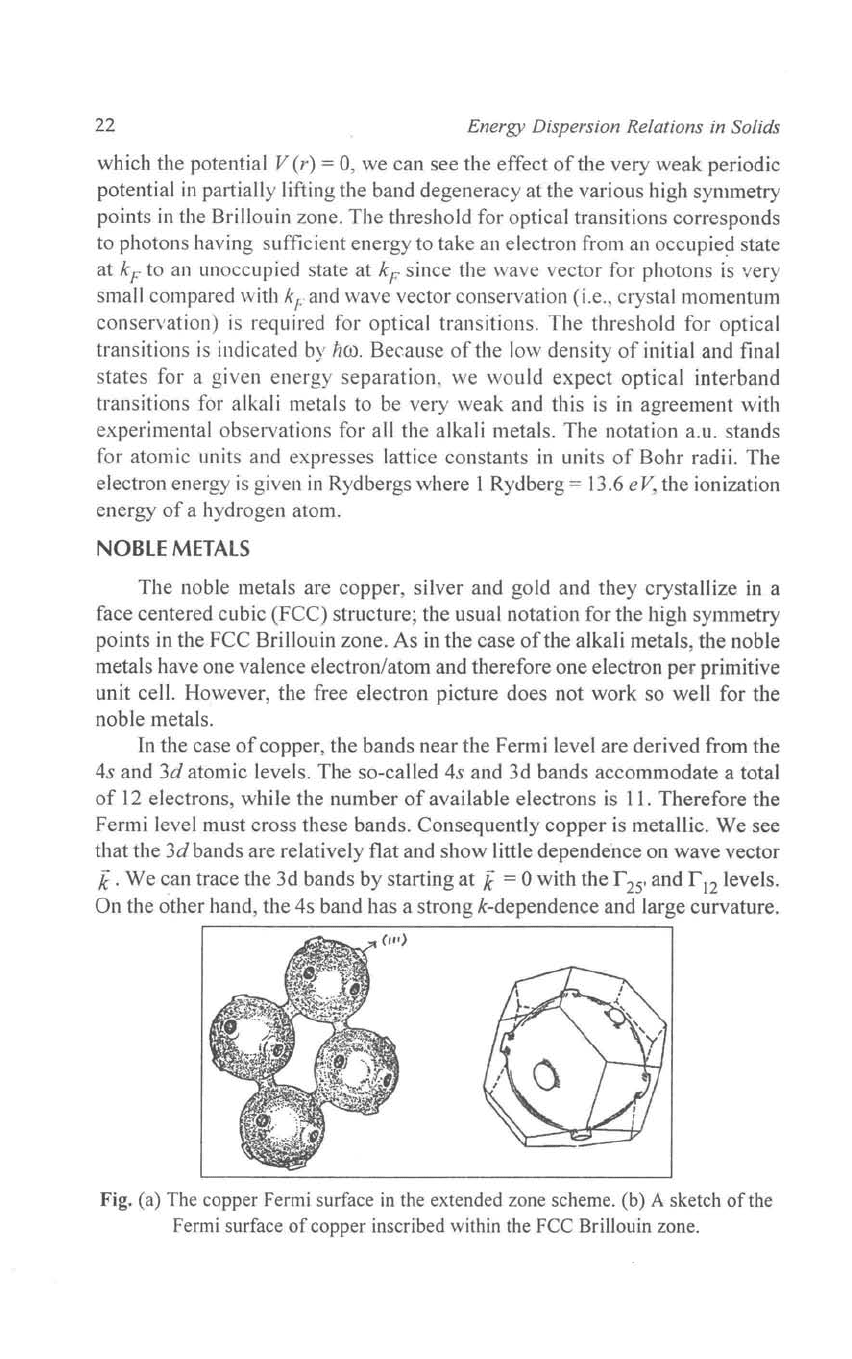
Fig. (a) The copper Fermi surface
in
the extended zone scheme. (b) A sketch
of
the
Fermi surface
of
copper inscribed within the FCC Brillouin zone.
Energy Dispersion Relations
in
Solids
23
This band can be traced by starting at k = 0 with the
I)
level. About
halfway between
r and X, the 4s level approa-ches the
3d
levels and mixing
or hybridization occurs. As we further approach the X-point, we can again
pick up the 4s band (beyond where the interaction with the
3d
bands occurs)
because
of
its high curvature. This 4s band eventually crosses the Fermi level
before reaching the Brillouin
Zone boundary at the X point. A similar mixing
or hybridizat-ion between
4s and
3d
bands occurs
in
going from r to L, except
that
in
this case the 4s band reaches the Brillouin Zone boundary before
crossing the Fermi level.
Of
particular significance for the transport properties
of
copper
is
the
band gap that opens up at the L-point.
In
this case, the band gap
is
between
the
L
2
,
level below the Fermi level
EF
and the L) level above E
F
. Since this
bandgap
is
comparable with the typical bandwidths
in
copper, we cannot expect
the Fermi surface to be free electron like. By looking at the energy bands
E(k)
along the major high symmetry directions such as the (100), (110) and
(111) directions, we can readily trace the origin
of
the copper Fermi surface.
Here we see basically a spherical Fermi surface with necks pulled out in
the (111) directions and making contact with the Brillouin zone boundary
through these necks, thereby linking the Fermi surface
in
one zone to that in
the next zone in the extended zone scheme. In the
(100) direction, the cross
section
of
the Fermi surface is nearly circular, indicative
of
the nearly parabolic
E
(-k)
relation
of
the 4s band at the Fermi level in going from r to X In
contrast,
in
going from r to L, the 4s band never crosses the Fermi level.
Instead the 4s level is depressed from the free electron parabolic curve as the
Brillouin zone boundary is reached, thereby producing a higher density
of
states. Thus, near the zone boundary, more electrons can be accommodated
per unit energy range, or to say this another way, there will be increasingly
more
k vectors with approximately the same energy.
This causes the constant energy surfaces to be pulled out in the direction
of
the Brillouin zone boundary. This "pulling out" effect follows both from
the weak binding and tight binding approximations and the effect
is
more
pronounced as the strength
of
the periodic potential (or Va) increases.
If
the
periodic potential
is
sufficiently strong so that the resulting bandgap at the
zone boundary straddles the Fermi level, as occurs at the L-point
in
copper,
the Fermi surface makes contact with the Brillouin zone boundary.
The
resulting Fermi surfaces are called open surfaces because the Fermi surfaces
between neighboring Brillouin zones are connected.
The electrons associated with the necks are contained
in
the electron
pocket shown in the
E(k)
diagram away from the L-point
in
the LW direction
which is
? to the
{Ill}
direction. The copper Fermi surface bounds electron
24
Energy Dispersion Relations in
Solids
states. Hole pockets are formed in copper
in
the extended zone and constitute
the unoccupied space between the electron surfaces. Direct evidence for hole
pockets
is
provided by Fermi surface measurements.
From the
E(k)
diagram for copper we see that the threshold for optical
interband transitions occurs for photon energies sufficient to take an electron
at constant
k {vector from a filled 3d level to an unoccupied state above the
Fermi level.
Such interband transitions can be made near the L-point
in
the Brillouin
zone. Because
of
the high density
of
initial states
in
the d-band, these transitions
will be quite intense. The occurrence
of
these interband transitions at -. 2
eV
gives rise to a large absorption
of
electromagnetic energy
in
this photon energy
region. The reddish colour
of
copper metal is thus due to a higher reflectivity
for photons (below the threshold for interband transitions) than for photons
(above this threshold).
POLYVALENT
METALS
The simplest example
of
a polyvalent metal is aluminum with 3 electrons/
atom and having a 3s
2
3p electronic configuration for the valence electrons.
(As far as the number
of
electrons/atom is concerned, two electrons/atom
completely fill a non-degenerate band_one for spin up, the other for spin down.)
Because
of
the partial filling
of
the 3
s2
3
p6
bands, aluminum is a metal.
Aluminum crystallizes in the FCC structure so
we can
use the same
notation as for the Brillouin zone. The energy bands for aluminum are very
free electron like. This follows from the small magnitudes
of
the band gaps
relative to the band widths on the energy band.
The lowest valence band is the 3s band which can be traced
by
starting at
zero energy at the
r point
(f
= 0) and going out to X
4
at the X-point, to
W3
at
the
W -point, to
L'2
at the L-point and back to r) at the r point
(f
= 0). Since
this band always lies below the Fermi level, it is completely filled, containing
2 electrons. The third valence electron partially occupies the second and third
p-bands (which are more accurately described as hybridized 3p-bands with
some admixture
of
the
3s
bands with which they interact).
The second band is partly filled; the occupied states extend from the
Brillouin zone boundary inward toward the centre
of
the zone; this can be
seen
in
going from the X point to r, on the curve labeled
~)'
Since the second band states near the centre
of
the Brillouin zone remain
unoccupied, the volume enclosed by the Fermi surface in the second band
is
a
hole pocket. Because
E(k)
for the second band
in
the vicinity
of
EF
is
free
electron like, the masses for the holes are approximately equal to the free
electron mass.
Energy Dispersion Relations
in
Solids 25
The
yd
zone electron pockets are small and are found around the K - and
W
-points.
These pockets are k space volumes that enclose electron states, and
because
of
the large curvature
of
E(k).
these electrons have relatively small
masses. This diagram gives no evidence for any
41h
zone pieces
of
Fermi
surface, and for this reason
we can conclude that all the electrons are either
in
the second band or
in
the third band.
The
total electron concentration IS
sufficient to exactly fill a half
of
a Brillouin zone:
V
V,)
+V
=
BZ
e,_ e.3
,.,
....
With regard to the second zone, it
is
pattially filled with electrons and
the rest
of
the zone
is
empty (since holes correspond to the
un
filled states):
V
h
.
2
+ V
e
.2
= V
BZ
,
with the volume that is empty slightly exceeding the volume that
is
occupied. Therefore we focus attention on the more dominant second zone
holes. Substitution
cf
equation into equation then yields for the second zone
holes and the third zone electrons
V
BZ
Vh2-V~=-
, e .
.)
2
where the subscripts
e,
h on the volumes in k space refer to electrons
and holes and the Brillouin zone
(B.Z.) index is given for each
of
the carrier
pockets. Because
of
the small masses and high mobility
of
the 3
rd
zone
electrons, they
playa
more important role in the transport properties
of
aluminum than would be expected from their small numbers.
From the
E(k)
we see that at the same k -points (near the K - and
W-
points
in
the Brillouin zone) there are occupied 3s levels and unoccupied 3p
levels separated by -
leV.
From this we conclude that optical interband
transitions should be observable in the
leV
photon energy range. Such
interband transitions are
in
fact observed experimentally and are responsible
for the departures from nearly perfect reflectivity
of
aluminum mirrors in the
vicinity
of
leV.
SEMICONDUCTORS
Assume that we have a semiconductor at
T=
0
Kwith
no impurities. The
Fermi level
will then lie within a band gap. Under these conditions, there are
no carriers, and no Fermi surface. We now illustrate the energy band structure
for several representative semiconductors
in
the limit
of
T =
OK
and no
impurities. Semiconductors having no impurities or defects are
called intrinsic
semiconductors.
26
PBTE
Energy Dispersion Relations
in
Solids
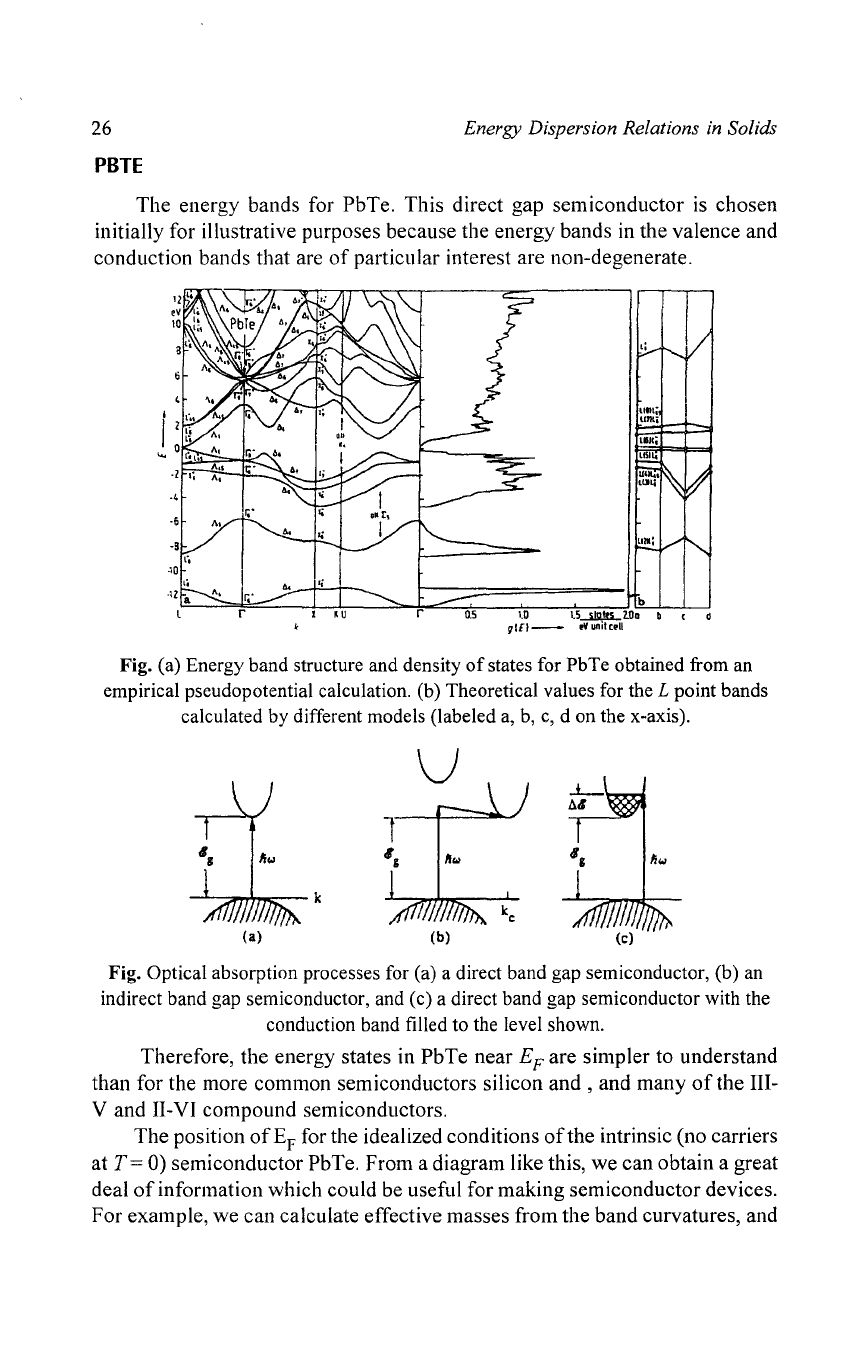
The energy bands for PbTe. This direct gap semiconductor
is
chosen
initially for illustrative purposes because the energy bands in the valence and
conduction bands that are
of
particular interest are non-degenerate.
';
b
I
'U
r
0.5
1.0
lS--lll!!!1..1.0Q b c d
gl£!-
o'Iunitcrll
Fig. (a) Energy band structure and density
of
states for PbTe obtained from an
empirical pseudopotential calculation. (b) Theoretical values for the
L point bands
calculated by different models (labeled
a,
b,
c,
d on the x-axis).
\J
(a)
(b)
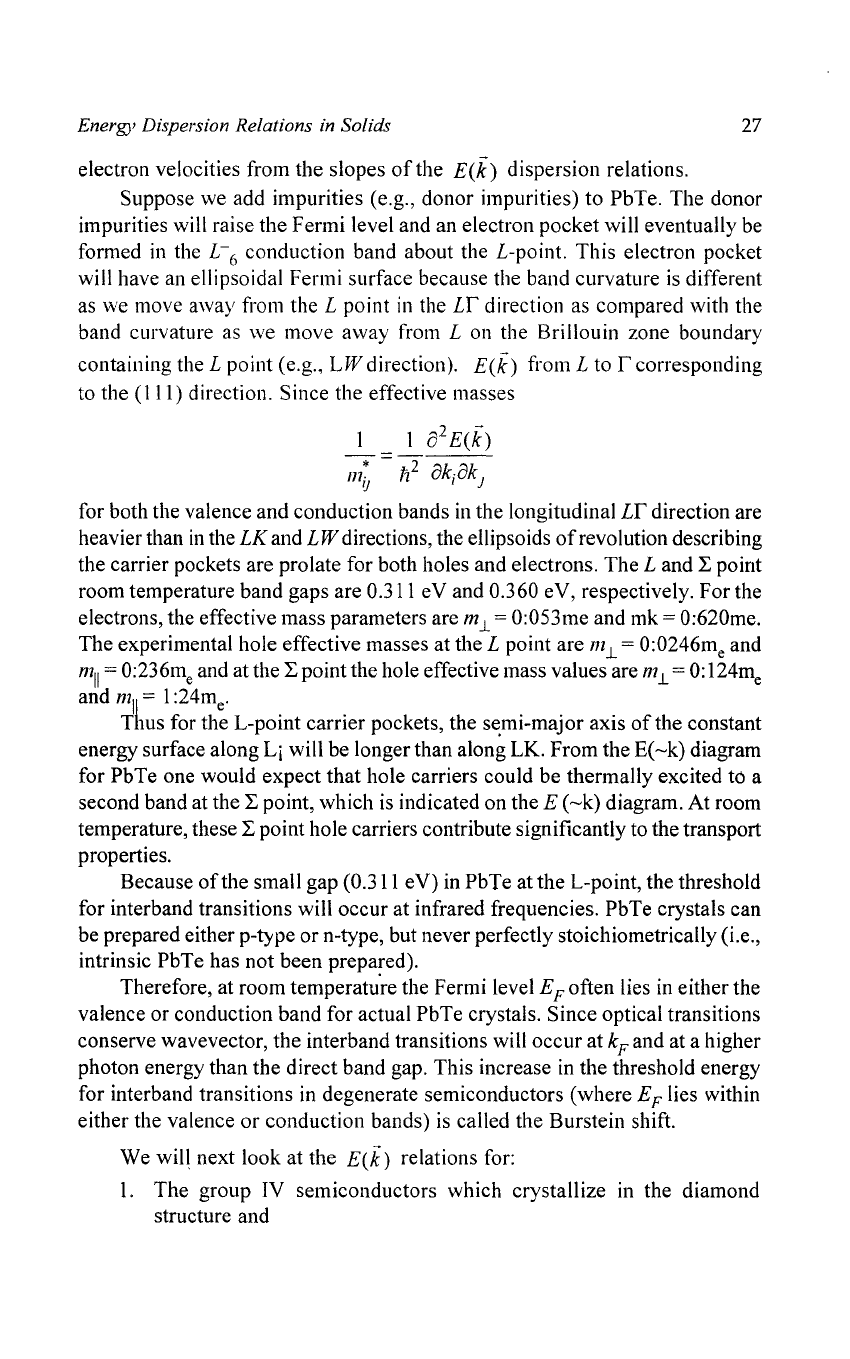
Fig. Optical absorption processes for (a) a direct band gap semiconductor, (b) an
indirect band gap semiconductor, and (c) a direct band gap semiconductor with the
conduction band filled to the level shown.
Therefore, the energy states in PbTe near
EF
are simpler to understand
than for the more common semiconductors silicon
and,
and many
of
the
111-
V and II-VI compound semiconductors.
The position
ofE
F
for the idealized conditions
of
the intrinsic (no carriers
at
T= 0) semiconductor PbTe. From a diagram like this, we can obtain a great
deal
of
information which could be useful for making semiconductor devices.
For example, we can calculate effective masses from the band curvatures, and
Energy Dispersion Relations in Solids
27
electron velocities from the slopes
of
the
E(k)
dispersion relations.
Suppose we add impurities (e.g., donor impurities) to PbTe. The donor
impurities will raise the Fermi level and an electron pocket will eventually be
formed
in
the
L-
6 conduction band about the L-point. This electron pocket
will have an ellipsoidal Fermi surface because the band curvature
is
different
as we move away from the
L point
in
the
Lf
direction as compared with the
band curvature as we move away from
L on the Brillouin zone boundary
containing the
L point (e.g., LW direction).
E(k)
from L to f corresponding
to the (111) direction. Since the effective masses
=
171~
n
2
akiak}
for both the valence and conduction bands
in
the longitudinal
Lf
direction are
heavier than
in
the LK and LW directions, the ellipsoids
of
revolution describing
the carrier pockets are prolate for both holes and electrons. The
Land
L point
room temperature band gaps are
0.311 eV and 0.360 eV, respectively. For the
electrons, the effective mass parameters are
1711.
= 0:053me and mk = 0:620me.
The experimental hole effective masses at the L point are
l1l1.
= 0:0246m
e
and
l1l11
= 0:236m
e
and at the L point the hole effective mass values are
1711.
=
0:
124me
and
17111
= 1 :24me'
Thus for the L-point carrier pockets, the
s~mi-major
axis
of
the constant
energy surface along
Lj will be longer than along LK. From the E(
~k)
diagram
for PbTe one would expect that hole carriers could be thermally excited
to a
second band at the
L point, which is indicated on the E
(~k)
diagram. At room
temperature, these
L point hole carriers contribute significantly to the transport
properties.
Because
of
the small gap (0.311 eV) in PbTe at the L-point, the threshold
for interband transitions will occur at infrared frequencies. PbTe crystals can
be prepared either
p-type
or
n-type, but never perfectly stoichiometrically (i.e.,
intrinsic PbTe has not been prepared).
Therefore, at room temperatu're the Fermi level
E F often lies in either the
valence or conduction band for actual PbTe crystals. Since optical transitions
conserve wavevector, the interband transitions will occur at
kF
and at a higher
photon energy than the direct band gap. This increase
in
the threshold energy
for interband transitions in degenerate semiconductors (where
EF
lies within
either the valence
or
conduction bands)
is
called the Burstein shift.
We will next look at the
E(k)
relations for:
I. The group IV semiconductors which crystallize in the diamond
structure and
28
Energy Dispersion Relations
in
Solids
2.
The closely related III-V compound semiconductors which crystallize
in
the zincblende structure. These semiconductors have degenerate
valence bands at
k = 0
(.1
lbl
£T\
~~
(~)
,~'
,~
/.."""m'·'
...
:':"\'\j?-::.-.-.-"~,,
/'
~
"'"
..
-,.:>"
~/
inSb
,/,
_',
GoAs
.,.,'.,
\ ".
~
(tl
0"/ l A r
':
~
,(
~K
X
"'r
"
{el
00
,
'~
o
;,
"
,'0
',(dl \
\
.•••.
':' • • .
,I"
\
00'
~/
Ge
r
IV,
Ill-V;
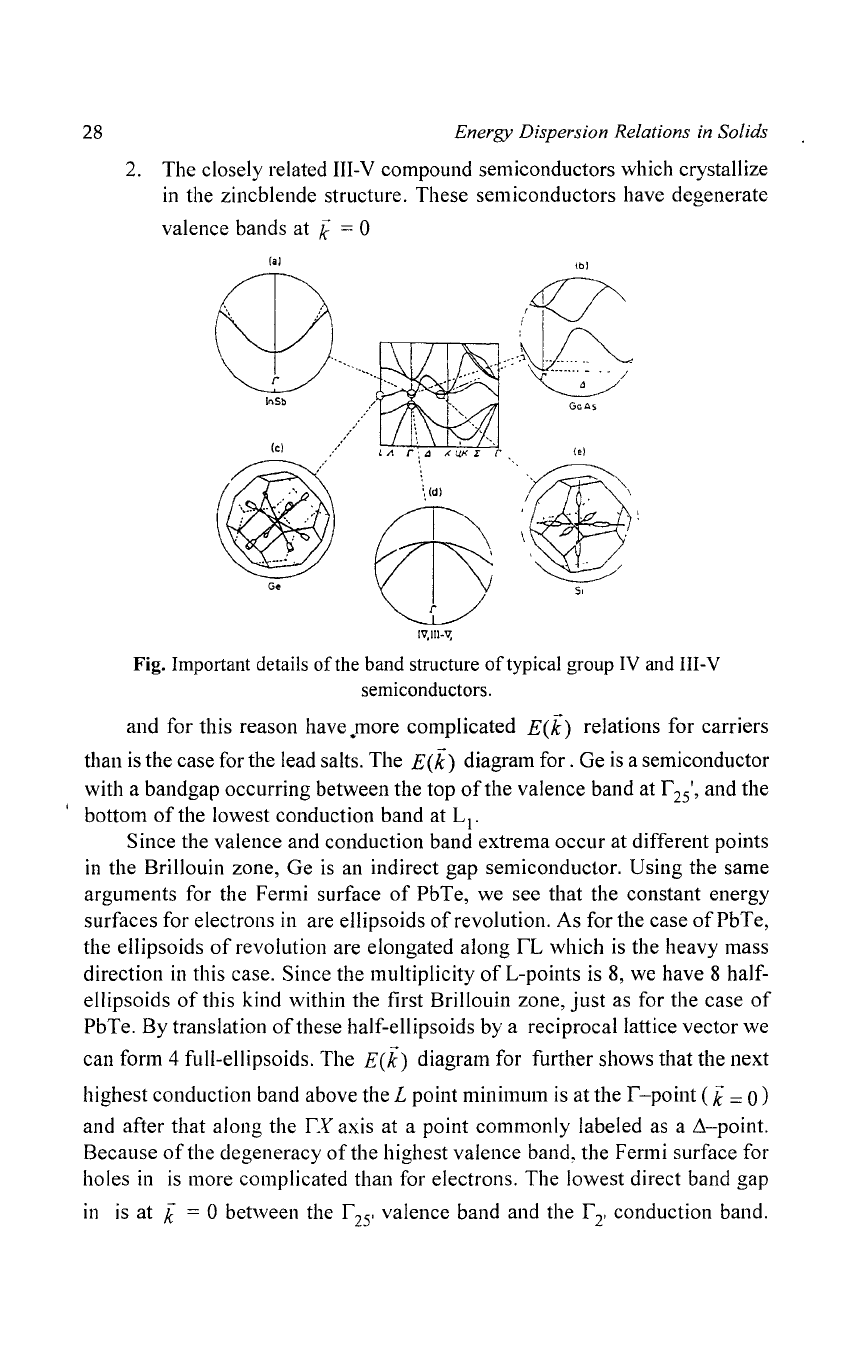
Fig. Important details
of
the band structure
of
typical group
IV
and III-V
semiconductors.
and for this reason have .more complicated
E(k)
relations for carriers
than is the case for the lead salts. The
E(k)
diagram for. Ge
is
a semiconductor
with a bandgap occurring between the top
of
the valence band at r
2S
',
and the
bottom
of
the lowest conduction band at L
j
.
Since the valence and conduction band extrema occur at different points
in
the Brillouin zone, Ge
is
an indirect gap semiconductor. Using the same
arguments for the Fermi surface
of
PbTe, we see that the constant energy
surfaces for electrons in are ellipsoids
of
revolution. As for the case
of
PbTe,
the ellipsoids
of
revolution are elongated along
rL
which is the heavy mass
direction
in
this case. Since the multiplicity
of
L-points is 8, we have 8 half-
ellipsoids
of
this kind within the first Brillouin zone,
just
as for the case
of
PbTe. By translation
of
these half-ellipsoids by a reciprocal lattice vector we
can form 4 full-ellipsoids. The
E(k)
diagram for further shows that the next
highest conduction band above the
L point minimum is at the r
-point
(k =
0)
and after that along the
rx
axis at a point commonly labeled as a L1-point.
Because
of
the degeneracy
of
the highest valence band, the Fermi surface for
holes
in
is
more complicated than for electrons. The lowest direct band gap
in
is
at k = 0 between the r
2S
' valence band and the r
2
,
conduction band.
Energy Dispersion Relations
in
Solids
29
From the
E(k)
diagram
we
note that the electron effective mass for the r
2
,
conduction band
is
very small because
of
the high curvature
of
the r
2
0 band
about
k = 0, and this effective mass
is
isotropic so that the constant energy
surfaces are spheres.
The optical properties for show a
very weak optical absorption for photon
energies corresponding to the indirect gap.
Since the valence and conduction
band extrema
occur
at a different k -point
in
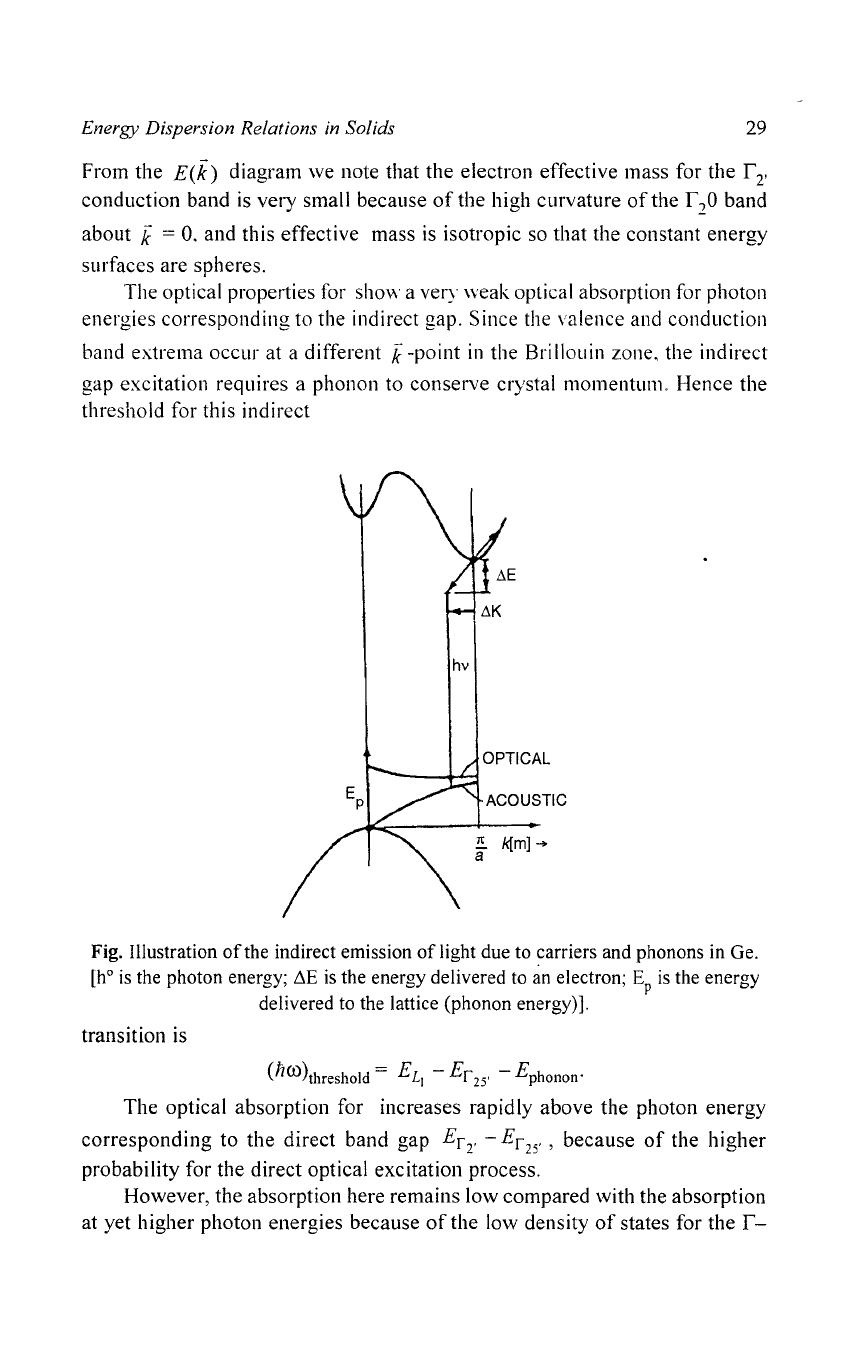
the Brillouin zone, the indirect
gap excitation requires a phonon to conserve crystal momentum. Hence the
threshold for this indirect
hv
ACOUSTIC
!:.
k[m]-+
a
Fig. Illustration
of
the indirect emission
of
light due to carriers and phonons in Ge.
[hO
is
the photon energy;
~E
is
the energy delivered to an electron;
Ep
is
the energy
delivered to the lattice (phonon energy)).
transition is
(!iCD)threshold =
ELI
- E
r25
, -
Ephonow
The
optical absorption for increases rapidly above the photon energy
corresponding
to the direct band gap
Er
2' -
Er
25' , because
of
the higher
probability for the direct optical excitation process.
However, the absorption here remains low compared with the absorption
at yet higher photon energies because
of
the low density
of
states for the
r-
30
Energy Dispersion Relations
in
Solids
point transition,
as
seen from the
E(k)
diagram. Very high optical absorption,
however, occurs for photon energies corresponding to the energy separation
between the L
3
, and
L1
bands which
is
approximately the same for a large
range
of
k values, thereby giving rise to a very large joint density
of
states
(the number
of
states with constant energy separation per unit energy range).
A large joint density
of
states arising from the tracking
of
conduction and
valence bands
is
found
for,
silicon and the III-V compound semiconductors,
and for this reason these materials tend to have high dielectric constants.
Silicon
From the energy band diagram for silicon,
we
see that the energy bands
of
Si
are quite similar to those
for.
They do, however, differ in detail. For
example, in the case
of
silicon, the electron pockets are formed around a
~
point located along the
IX
(100) direction. For silicon there are 6 electron
pockets within the first Brillouin zone instead
of
the 8 half-pockets which
occur
in.
The constant energy surfaces are again ellipsoids
of
revolution with
a heavy longitudinal mass and a light transverse effective mass. The second
type
of
electron pocket that
is
energetically favored
is
about the
LI
point, but
to fill electrons there, we would need to raise the Fermi energy by
~
1 eV.
Silicon is
of
course the most important semiconductor for device
applications and
is
at the heart
of
semiconductor technology for transistors,
integrated circuits, and many electronic devices. The optical properties
of
silicon also have many similarities to those
in
, but show differences in detail.
For Si, the indirect gap occurs at
~
1 eV and
is
between the 1
25
,
valence band
and the
~
conduction band extrema. Just
as
in the case
for,
strong optical
absorption occurs for large volumes
of
the Brillouin zone at energies
comparable to the
L
3
,
~
LI
energy separation, because
of
the "tracking"
of
the valence and conduction bands. The density
of
electron states for
Si
covering
a wide energy range where the corresponding energy band. Most
of
the features
in the density
of
states can be identified with the band model.
III-V
Compound Semiconductors
Another important class
of
semiconductors is the III-V compound
semiconductors which crystallize in the zincblende structure; this structure
is
like the diamond structure except that the two atoms/unit cell are
of
a different
chemical species. The III-V compounds also have many practical applications,
such
as
semiconductor lasers for fast electronics, GaAs
in
light emitting diodes,
and InSb for infrared detectors.
The
E
(k)
diagram for GaAs is shown and we see that the electronic
levels are very similar to those
of
Si
and Ge. One exception
is
that the lowest
Energy
Disper~ion
Relations
in
Solids
31
conduction band for GaAs
is
at k = 0 so that both valence and conduction
band extrema are at
k =
O.
Thus GaAs
is
a direct gap semiconductor, and for
this reason GaAs shows a stronger and more sharply defined optical absorption
threshold than Si or Ge.
Here we see that the lowest conduction band for GaAs has high curvature
and therefore a small effective mass. This mass
is
isotropic so that the constant
energy surface for electrons
in
GaAs
is
a sphere and there
is
just
one such
sphere
in
the Brillouin zone. The next lowest conduction band
is
at a
L\
point
and a significant carrier density can be excited into this
L\
point pocket at high
temperatures.
The constant energy surface for electrons
in
the direct gap semiconductor
InSb
is
likewise a sphere, because InSb
is
also a direct gap semiconductor.
InSb
differs
from
GaAs
in
having
a
very
small
band
gap
(-
0.2 eV), occurring
in
the infrared. Both direct and indirect band gap materials
are found
in
the III-V compound semiconductor family. Except for optical
phenomena close to the band gap, these compound semiconductors all exhibit
very similar optical properties which are associated with the band-tracking
phenomena.
"lero
Gap"
Semiconductors
It
is
also possible to have "zero gap" semiconductors. An example
of
such a material
is
which also crystallizes
in
the diamond structure. The energy
band model for without spin-orbit interaction.
On this diagram the zero gap
occurs between the
r
25
,
valence band and the r
2
'
conduction band, and the
Fermi level runs right through this degeneracy point between these bands.
Spin-orbit interaction (to be discussed later in this course) is very important
for
in
the region
of
the k = 0 band degeneracy and a detailed diagram
of
the
energy bands near
k = 0 and including the effect
of
spin-orbit interaction. In
the effective mass for the conduction band
is
much lighter than for the valence
band as can be seen by the band curvatures.
Optical transitions labeled
B occur in the far infrared from the upper
valence band to the conduction band. In the near infrared, inter band transitions
labeled
A are induced"from the
I7
valence band to the
I1
conduction band. We
note that is classified as a zero gap semiconductor rather than a semimetal
because there are no band overlaps
in
a zero-gap semiconductor anywhere
in
the Brillouin zone.
Because
of
the zero band gap
in
grey tin, impurities
playa
major role in
determining the position
of
the Fermi level.
is
normally prepared n-type which