
Brewster H.D. Solid State Physics
Подождите немного. Документ загружается.

52
Effective Mass Theory
and
Transport Phenomena
In
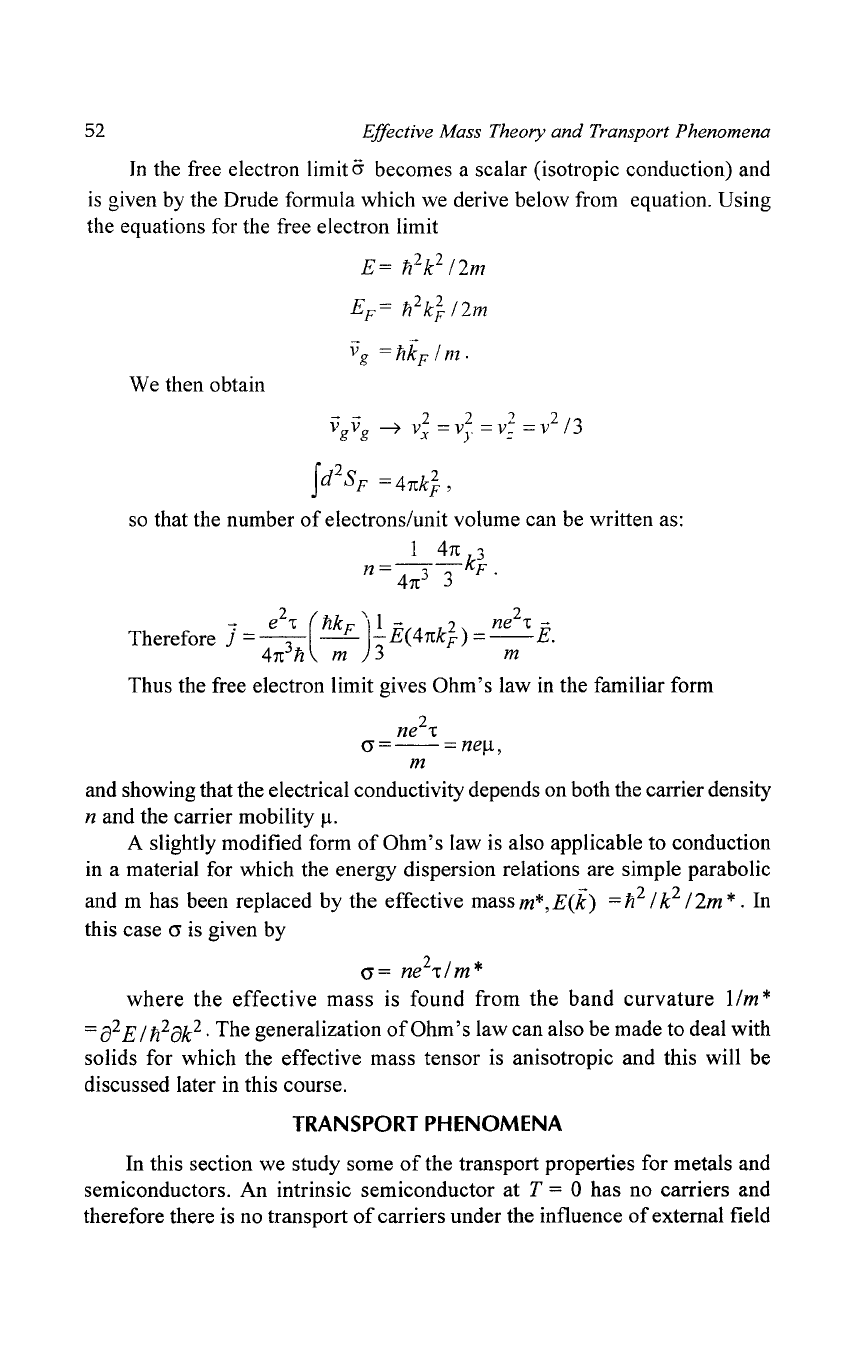
the free electron limitcr becomes a scalar (isotropic conduction) and
is
given by the Drude formula which we derive below from equation. Using
the equations for the free electron limit
We then obtain
E=
1i2k2/2m
E
F
=
1i
2
kJ
/2m
Vg
=1ik
F
/m.
f
d2S
F = 41tkJ '
so that the number
of
electrons/unit volume can be written as:
__
1_41t k
3
n -
41t
3
3
F.
2
(k
"1
2
-:
e"t
n F j - 2
ne
't
-
Therefore)
=-3-
--
-E(41tk
F
)=--E.
41t
n m 3 m
Thus the free electron limit gives
Ohm's
law in the familiar form
ne
2
't
cr
=
--
=
nell,
m
and showing that the electrical conductivity depends on both the carrier density
n and the carrier mobility
!-t.
A slightly modified form
of
Ohm's
law is also applicable to conduction
in a material for which the energy dispersion relations are simple parabolic
and m has been replaced by the effective mass
m*,
E(k)
=
1i
2
/ k
2
/2m
*.
In
this case
cr
is given by
cr=
ne
2
./m*
where
the
effective
mass
is found from
the
band
curvature
11m
*
= a
2
E
/1i
2
ae·
The generalization
of
Ohm's
law can also be made to deal with
solids for which the effective mass tensor is anisotropic and this will be
discussed later in this course.
TRANSPORT
PHENOMENA
In this section we study some
of
the transport properties for metals and
semiconductors. An intrinsic semiconductor at
T = 0 has no carriers and
therefore there is no transport
of
carriers under the influence
of
external field
Effective Mass Theory and Transport Phenomena
53
s.
However at finite temperatures there are thermally generated carriers.
Impurities also can serve to generate carriers and transport properties. For
insulators, there
is
very little charge transport and
in
this case the defects and
the ions themselves can participate
in
charge transport under the influence
of
external applied field
s.
Metals make use
of
the Fermi-Dirac distribution
function but are otherwise similar
to
semiconductors, for which the Maxwell-
Boltzmann distribution function
is
usually applicable.
At finite fields, the electrical conductivity will depend
on
the product
of
the carrier
densit~f
and the carrier mobility. For a one carrier system, the gives
the carrier density and the magnetoresistance gives the mobility, the key
parameters governing the transport properties
of
a semiconductor. From the
standpoint
of
device applications, the carrier density and the carrier mobility
are the parameters
of
greatest importance.
To the extent that electrons can
be
considered as particles, the electrical
conductivity, the electronic contribution to the thermal conductivity and the
magnetoresistance are all found by solving the Boltzmann equation. For the
case
of
ultra-small dimensions, where the wave aspects
of
the electron must
be considered (called mesoscopic physics), more sophisticated approaches to
the transport properties must be considered. To review the standard procedures
for classical electrons, we briefly review the Boltzmann equation and its
solution in the next section.
THE
BOLTZMANN
EQUATION
The Boltzmann transport equation
is
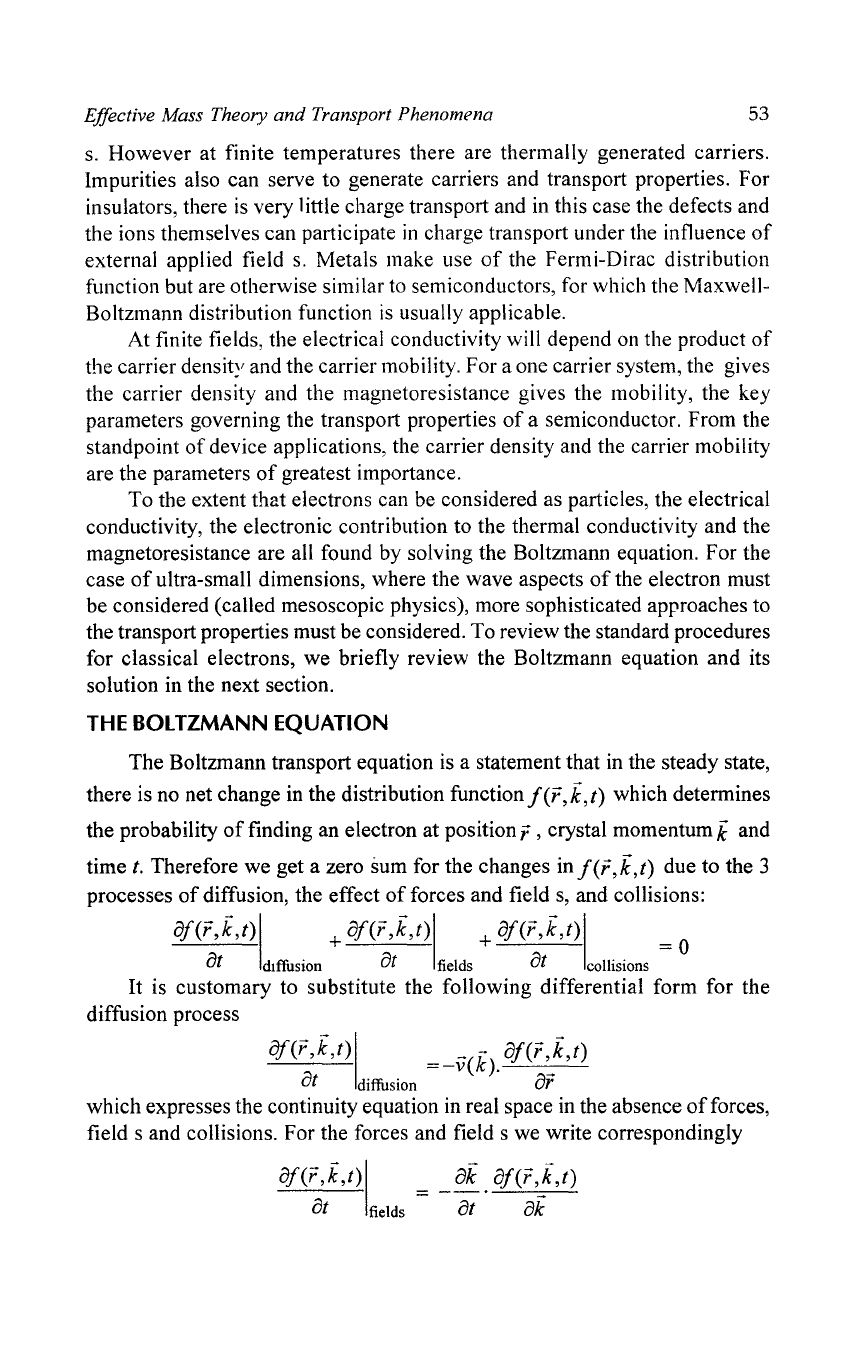
a statement that
in
the steady state,
there is no net change
in
the distribution function f(r,k,t) which determines
the probability
of
finding an electron at position r , crystal momentum k and
time
t.
Therefore we get a zero sum for the changes in f(r,k,t) due to the 3
processes
of
diffusion, the effect
of
forces and field
s,
and collisions:
8f(r,k,t)I +
af(r,k,t)1
+
8f(r,k,t)1
= 0
at
diffusion
at
fields
at
collisions
It
is customary to substitute the following differential form for the
diffusion process
af(r,k,t)I =-v(k). al(r
~k,t)
at
diffusion
ar
which expresses the continuity equation
in
real space in the absence
of
forces,
field s and collisions. For the forces and field s we write correspondingly
al(r,k,t)1
= _ af . al(r,k,t)
at
fields
at
ak
54
Effective Mass Theory
and
Transport Phenomena
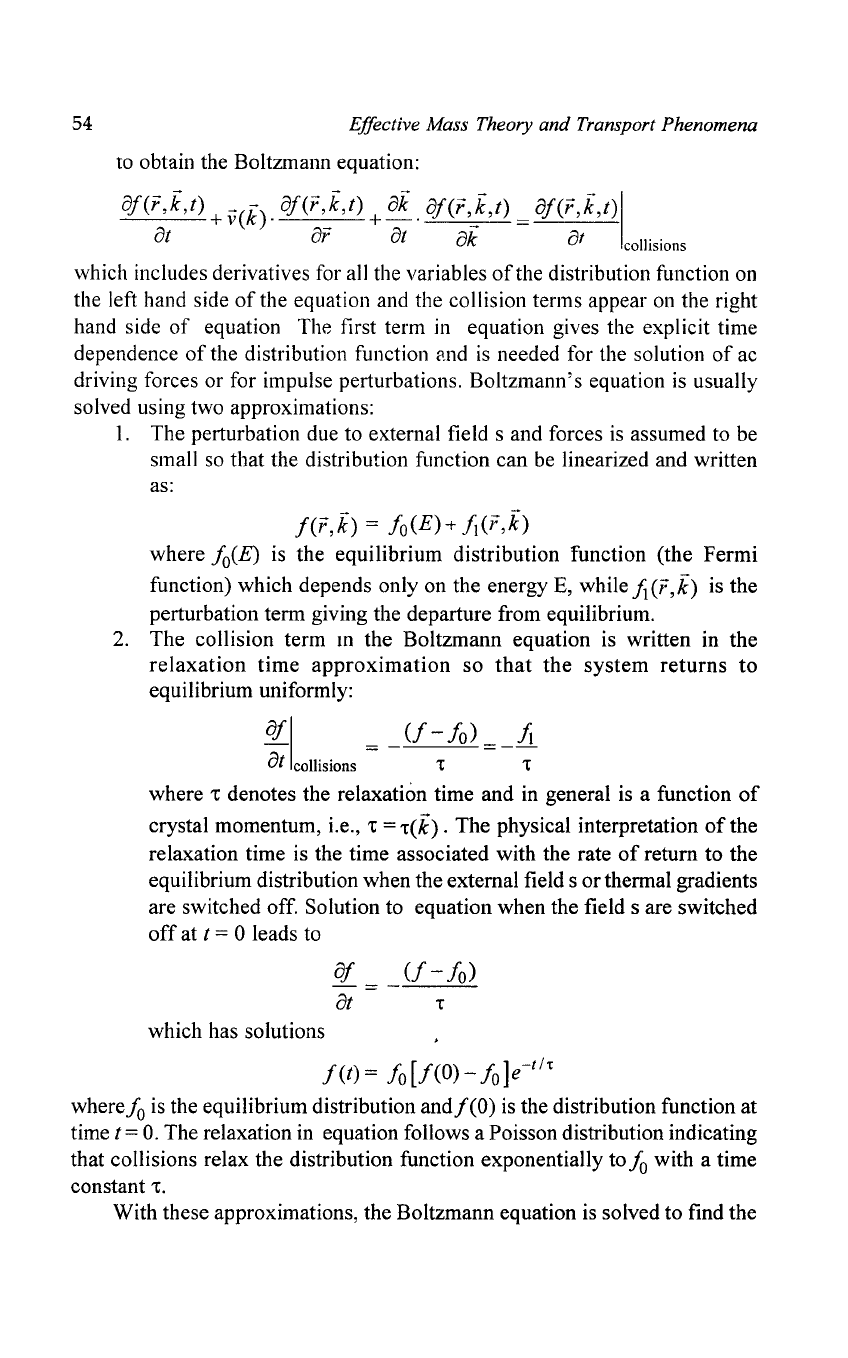
to obtain the Boltzmann equation:
afCF,k,t) + vCk). OfCF,k,t) +
ok
. OfCF,k,t) = afCF,k,t)I
at
of
at
ok
at
collisions
which includes derivatives for all the variables
of
the distribution function
on
the left hand side
of
the equation and the collision terms appear
on
the right
hand side
of
equation The first term
in
equation gives the explicit time
dependence
of
the distribution function
cmd
is
needed for the solution
of
ac
driving forces or for impulse perturbations. Boltzmann's equation
is
usually
solved using two approximations:
1.
The perturbation due to external field s and forces
is
assumed to be
small so that the distribution function can
be
linearized and written
as:
fCF,k) =
foCE)
+
fi
(F,k)
where fo(E)
is
the equilibrium distribution function (the Fermi
function) which depends only on the energy
E,
while
Ji
(F,k) is the
perturbation term giving the departure from equilibrium.
2.
The collision term
111
the Boltzmann equation is written in the
relaxation
time
approximation
so
that
the
system
returns to
equilibrium uniformly:
Of
I
(f
-
fo)
= _
Ji
at collisions
1:
1:
where
't
denotes the relaxation time and
in
general
is
a function
of
crystal momentum, i.e.,
1:
= 1:(k). The physical interpretation
of
the
relaxation time is the time associated with the rate
of
return to the
equilibrium distribution when the external field s or thermal gradients
are switched off. Solution to equation when the field s are switched
off
at t = 0 leads to
which has solutions
f(t)
=
fo[J(O)-fo]e-
tlt
wherefo
is
the equilibrium distribution andf(O)
is
the distribution function at
time
t =
O.
The relaxation
in
equation follows a Poisson distribution indicating
that collisions relax the distribution function exponentially to
fa
with a time
constant
'to
With these approximations, the Boltzmann equation
is
solved to find the
Effective Mass Theory
and
Transport Phenomena
55
distribution function which
in
turn determines the number density and current
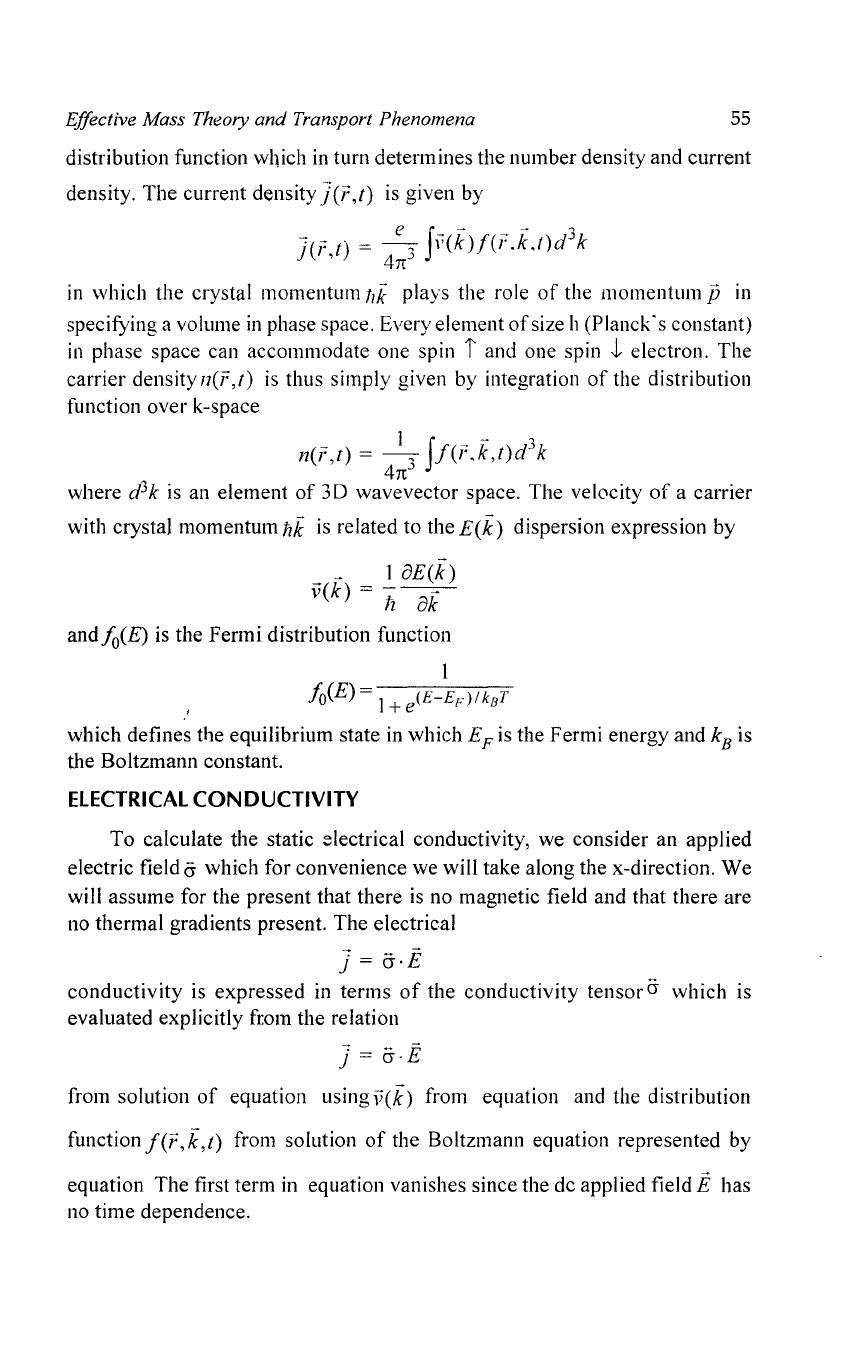
density. The current density
JCr,t)
is
given by
J(i:,t)
=
4:
3
f
v
(k)f(r.k.t)d
3
k
in
which the crystal momentum
11k
plays the role
of
the momentum p
111
specifying a volume
in
phase space. Every element
of
size h (Planck' s constant)
in
phase space can accommodate one spin i and one spin
J-
electron. The
carrier density
ll(r,!)
is
thus simply given by integration
of
the distribution
function over k-space
- 1 f
--
3
n(r,t)
=
-,
f(r.k,t)d
k
47r)
where d
3
k
is
an element
of
3D wave vector space. The velocity
of
a carrier
with crystal momentum
hk
is related to the
E(k)
dispersion expression by
_ 1
oE(k)
v(k)
=
tz
ok
andfo(E)
is
the Fermi distribution function
1
fo(E) = 1 +
e(E-E
F
)/
kBT
which defines the equilibrium state
in
which
EF
is the Fermi energy and
kB
is
the Boltzmann constant.
ElECTRICAL
CONDUCTIVITY
To calculate the static
~lectrical
conductivity, we consider an applied
electric
field
cr
which for convenience we will take along the x-direction. We
will assume for the present that there
is
no magnetic field and that there are
no thermal gradients present. The electrical
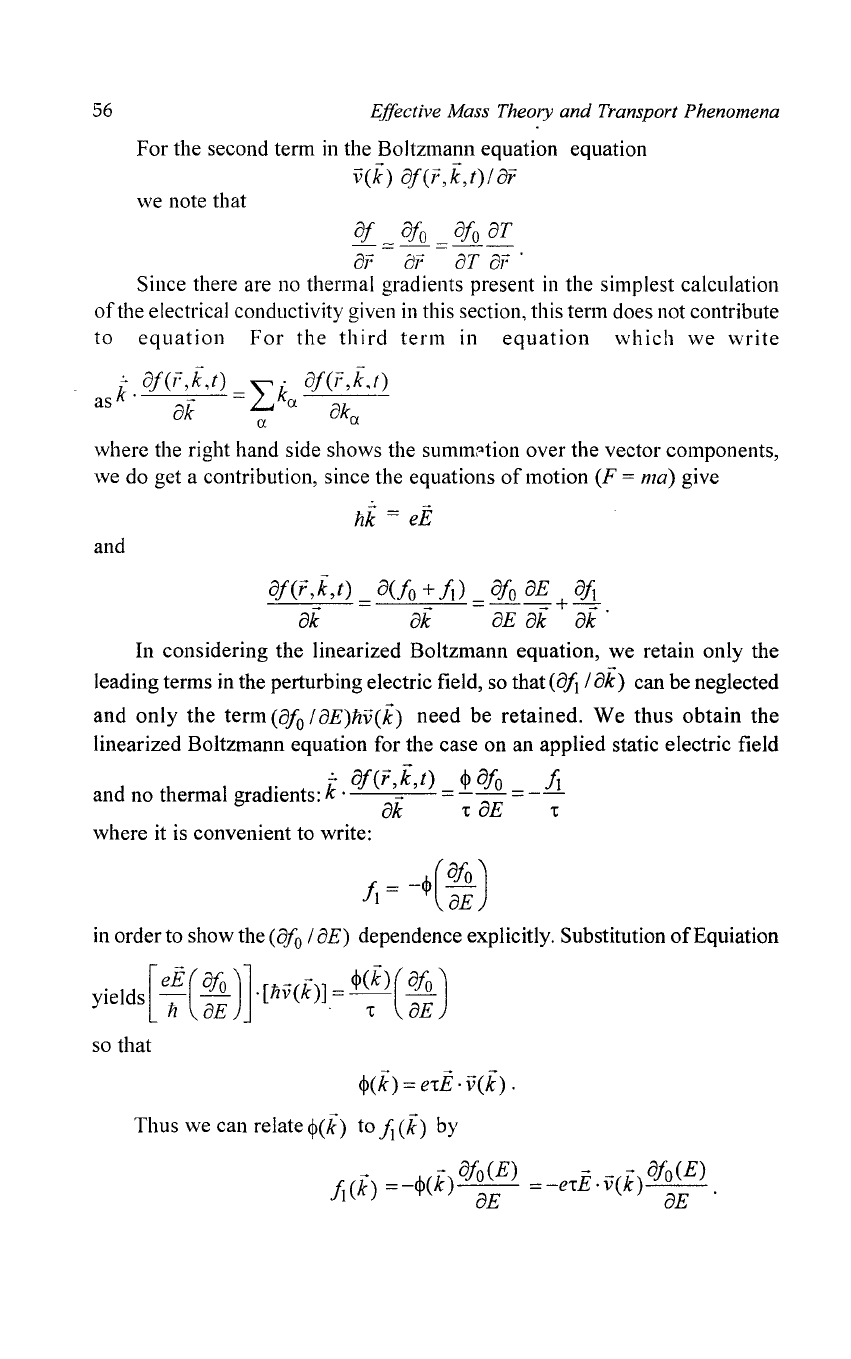
J =
cr·E
conductivity is expressed in
terms
of
the conductivity tensor
cr
which is
evaluated explicitly from the relation
J =
cr·E
from solution
of
equation using
v(k)
from equation and the distribution
function
f(r,k,t)
from solution
of
the Boltzmann equation represented by
equation The first term
in
equation vanishes since the dc applied field E has
no time dependence.
56
Effective Mass Theory
and
Transport Phenomena
For the second term
in
the Boltzmann equation equation
v(k)
81(r,k,t)/
or
we note that
0/ % %
or
-:;;:-=--
or or
or
or .
Since there are
no
thermal gradients present
in
the simplest calculation
of
the electrical conductivity given
in
this section, this term does not contribute
to
equation
For
the
third
term
in
equation
which
we
write
- -
k.
o/(l\k,t)
=
~
k
o/(r,k,t)
as
ok
L...
a
ok
a a
where the right hand side shows the summi'tion over the vector components,
we do get a contribution, since the equations
of
motion
(F
= ma) give
11k
=
eE
and
o/(r,k,t)
_ 0(/0 +
fi)
_
810
oE ofi
--"---~-:--'---'-
- - -
-----:::;-
+
----:::;-
ok ok oE ok ok
In considering the linearized Boltzmann equation, we retain only the
leading terms
in
the perturbing electric field, so that(ofi /
ok)
can be neglected
and
only
the term
(0/0
/oE)l1v(k)
need be retained.
We
thus obtain the
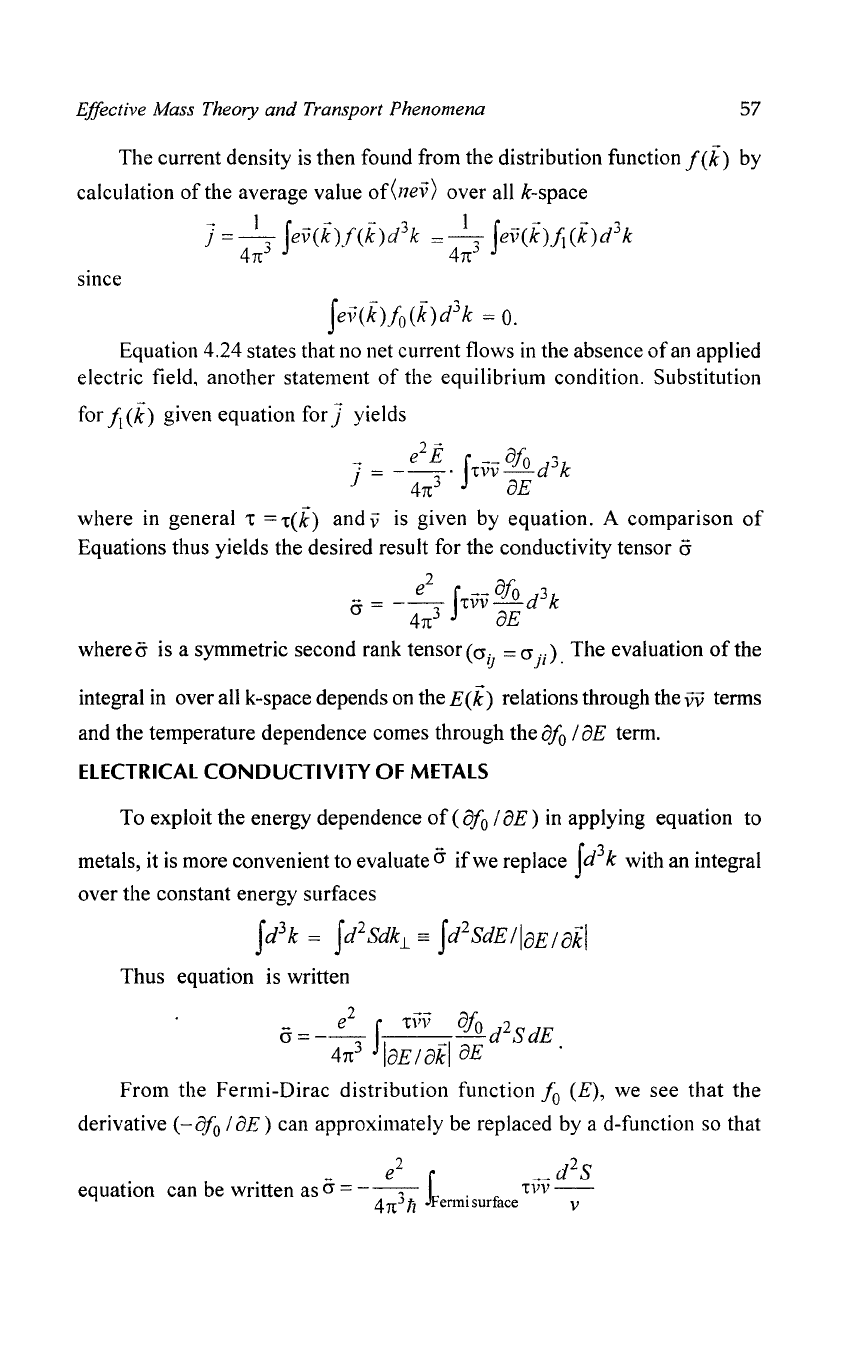
linearized Boltzmann equation for the case on an applied static electric field
.
.:.
o/(r,k,t)
<l>
%
fi
and no thermal gradIents: k . - =
--0
=--
ok
't
E
't
where it is convenient to write:
in
order to show the
(0/0
/oE)
dependence explicitly. Substitution ofEquiation
. [eE(ofo)]
["--(k-)]_<l>(k)(ofo)
YIelds
- - .
nV
-
--
--
n oE .
't
oE
so that
<l>(k)
=
e'tE'
v(k)
.
Thus we can relate
<l>(k)
to fi
(k)
by
-
,h(k-)
810
(E)
E-
-(k-)
0/0
(E)
fi(k)
=-'1' oE
=-el"v
oE'
Effective Mass Theory
and
Transport Phenomena 57
The current density
is
then found from the distri bution function 1
(k)
by
calculation
of
the average value of(nev) over all k-space
]
=~
Jev(k)f(k)d
3
k
=~
fel
i
(k)fi(k)d
3
k
4n-' . 4n-'
since
f
ev
(k)10(k)d
3
k =
O.
Equation 4.24 states that no net current flows
in
the absence
of
an
applied
electric
field, another statement
of
the equilibrium condition. Substitution
for
fi
(k)
given equation for J yields
2-
~
e E f
--
8f
o
d
3
k
} =
---~.
'tvv-
4n-'
aE
where in general
1:
=
't(k)
and v
is
given by equation. A comparison
of
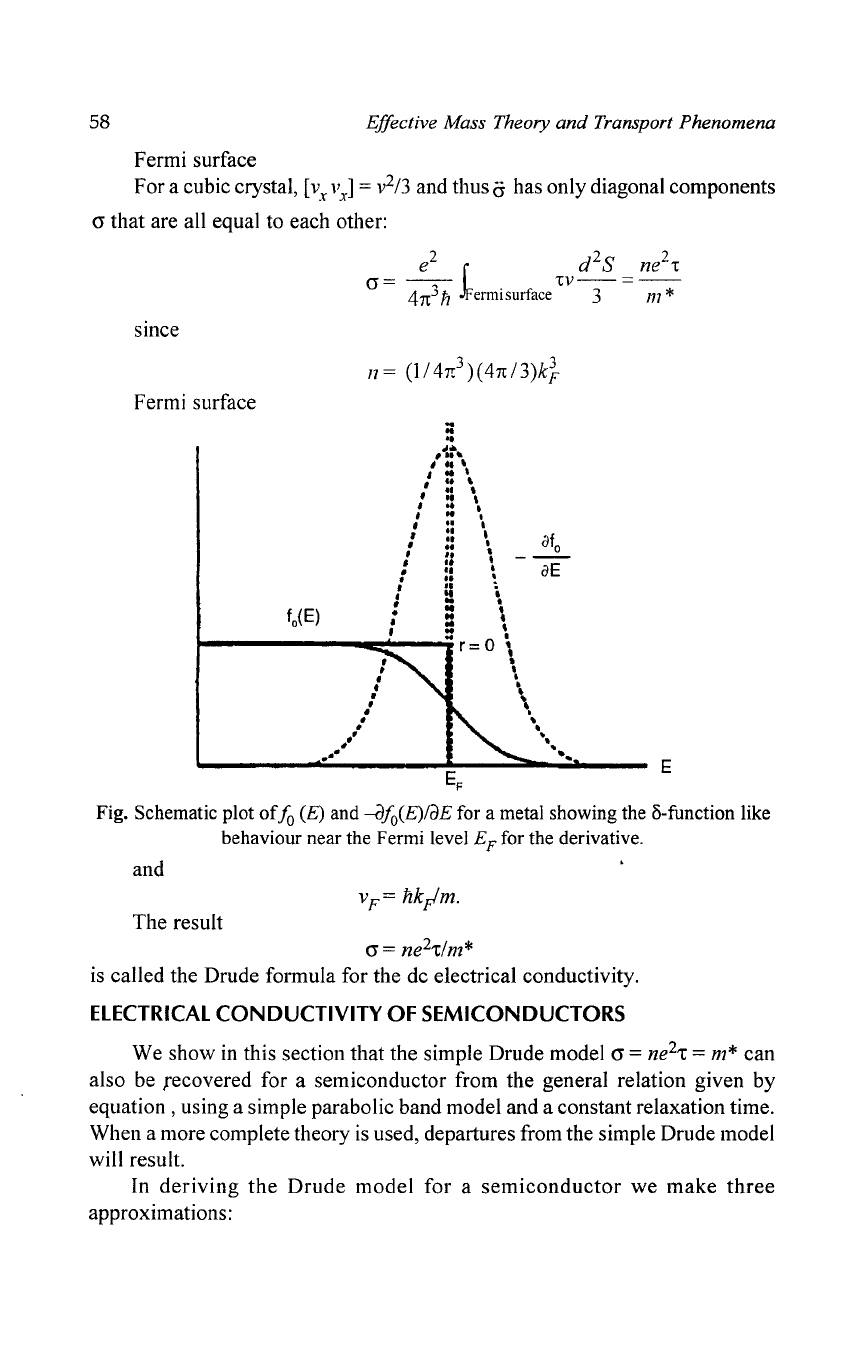
Equations thus yields the desired result for the conductivity tensor
cr
- =
-~
f'tvv
alo
d
3
k
cr
4n
3
aE
where
cr
is a symmetric second rank tensor
(cr·
=
cr
..
) The evaluation
of
the
1]
]1.
integral
in
over all k-space depends on the
E(k)
relations through the
vv
terms
and the temperature dependence comes through the
010
10E
term.
ELECTRICAL
CONDUCTIVITY
OF
METALS
To exploit the energy dependence
of
(010
10E)
in
applying equation to
metals, it
is
more convenient to evaluate
cr
if
we replace
fd
3
k with an integral
over the constant energy surfaces
fd
3
k = fd2Sdk.l
==
fd2SdEIloEloki
Thus equation is written
cr=-
e2~
f
.vv
_
010
d
2
SdE
4n-'
10E
loki
oE
.
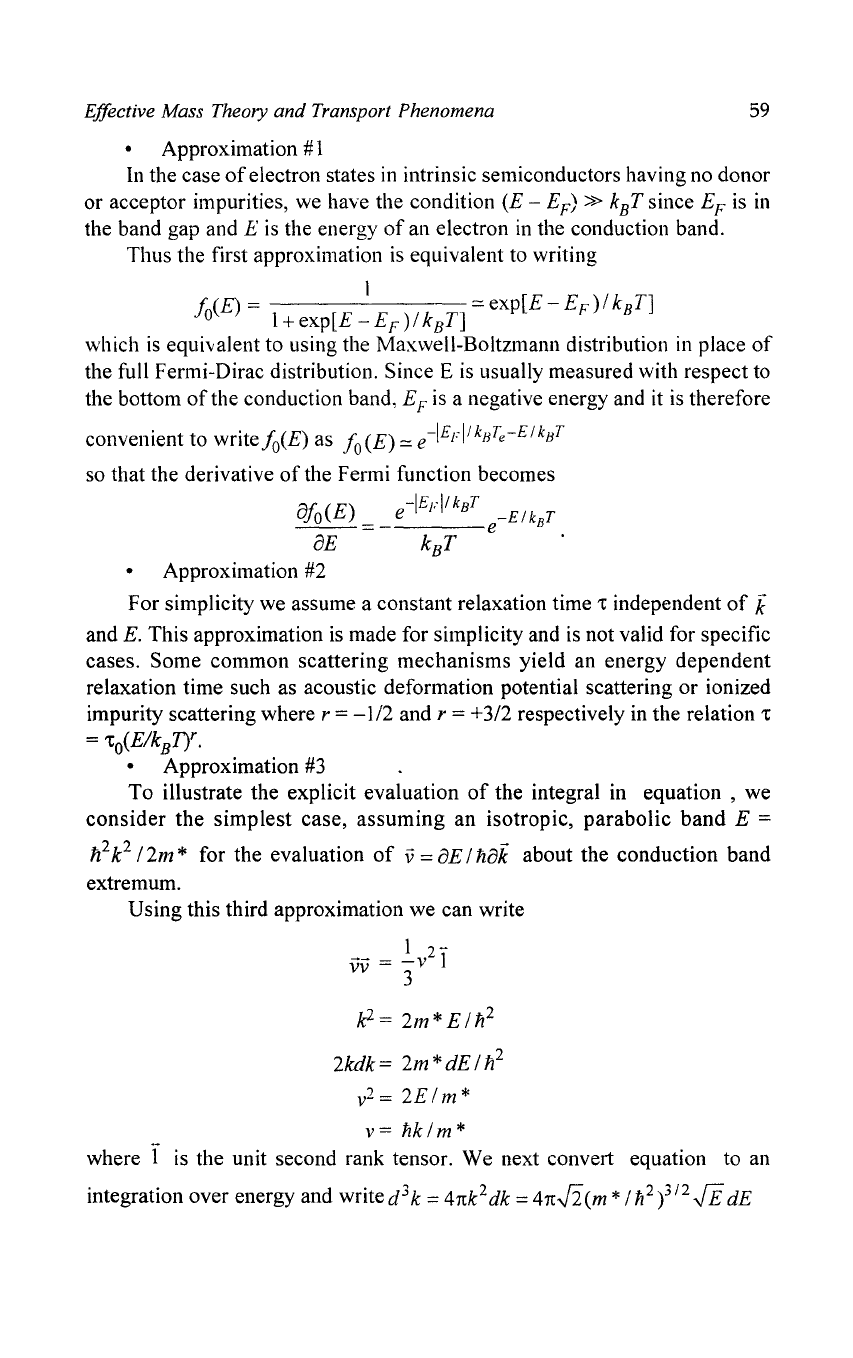
From the Fermi-Dirac distribution function
10
(E), we see
that
the
derivative
(-
alo
10E) can approximately be replaced by a d-function so that
2 2
_
e!
__
d S
equation can be written as
cr
=
--~-
.
'tvv--
4
n-'
11
F
enm
surface V
58 Effective Mass Theory
and
Transport Phenomena
Fermi surface
F or a cubic crystal,
[vx
"xl
= v
2
/3
and thus
(j
has only diagonal components
0'
that are all equal to each other:
sll1ce
Fermi surface
-
..
'.
~.
,
I,
..
~
..
,
,
::
\
,
4'
,
"
::
'.
,
..
I
,
..
,
, '1 ,
:
:i
\
:
::
\
•
It
,
fo(E)
i i \
~------------~~:----~=
\
r-
r=O,
,
\
EF
\.
,
•
' .
.
....
E
Fig. Schematic plot
oflo
(E)
and
---:OIoCE)I2JE
for a metal showing the
C)-function
like
behaviour near the Fermi level
EF
for the derivative.
and
The result
0'
= ne
2
'C/m*
is
called the Drude formula for the dc electrical conductivity.
ELECTRICAL
CONDUCTIVITY
OF
SEMICONDUCTORS
We show
in
this section that the simple Drude model
0'
= ne
2
't
= m* can
also be recovered for a semiconductor from the general relation given by
equation, using a simple parabolic band model and a constant relaxation time.
When a more complete theory
is
used, departures from the simple Drude model
will result.
In
deriving
the
Drude model for a
semiconductor
we make
three
approximations:
Effective Mass Theory
and
Transport Phenomena
59
• Approximation # 1
In
the case
of
electron states
in
intrinsic semiconductors having no donor
or acceptor impurities, we have the condition
(E - E
F
) »
kBT
since
EF
is
in
the band gap and E
is
the energy
of
an electron
in
the conduction band.
Thus the first approximation
is
equivalent to writing
1
fO(£)
=
::::
exp[E -
EF)I
kBT]
J(
1 + exp[E -
EF)I
kBT]
which
is
equivalent to using the Maxwell-Boltzmann distribution
in
place
of
the full Fermi-Dirac distribution. Since E
is
usually measured with respect to
the bottom
of
the conduction band, E F
is
a negative energy and
it
is therefore
convenient to write
fo(E) as fo(E):::: e
-[Er[1
kBTe-
E
I kBT
so that the derivative
of
the Fermi function becomes
a
~f
(E)
-[EF[I
ksT
~o
=_e
e-ElksT
aE
kBT
• Approximation #2
For simplicity we assume a constant relaxation time
't
independent
of
k
and
E.
This approximation
is
made for simplicity and is not valid for specific
cases.
Some common scattering mechanisms yield an energy dependent
relaxation time such as acoustic deformation potential scattering or ionized
impurity scattering where
r = -112 and r =
+312
respectively
in
the relation
't
= 'to(ElkBnr.
• Approximation
#3
To illustrate the explicit evaluation
of
the integral in
equation,
we
consider
the simplest case,
assuming
an isotropic, parabolic
band
E =
h
2
k
2
12m
* for the evaluation
of
v =
aE
1
hak
about the conduction band
extremum.
Using this third approximation we can write
lr
vv
=
-v
1
3
~=
2m*
Elh2
2kdk=
2m
*
dE
1 h
2
v
2
=
2E
1m *
v =
tzk
1m *
where 1
is
the unit second rank tensor. We next convert equation to an
integration over energy and write d
3
k =
4nk
2
dk =
4nJi(m
* 11'12)3/2
JE
dE
60
Effective Mass Theory
and
Transport Phenomena
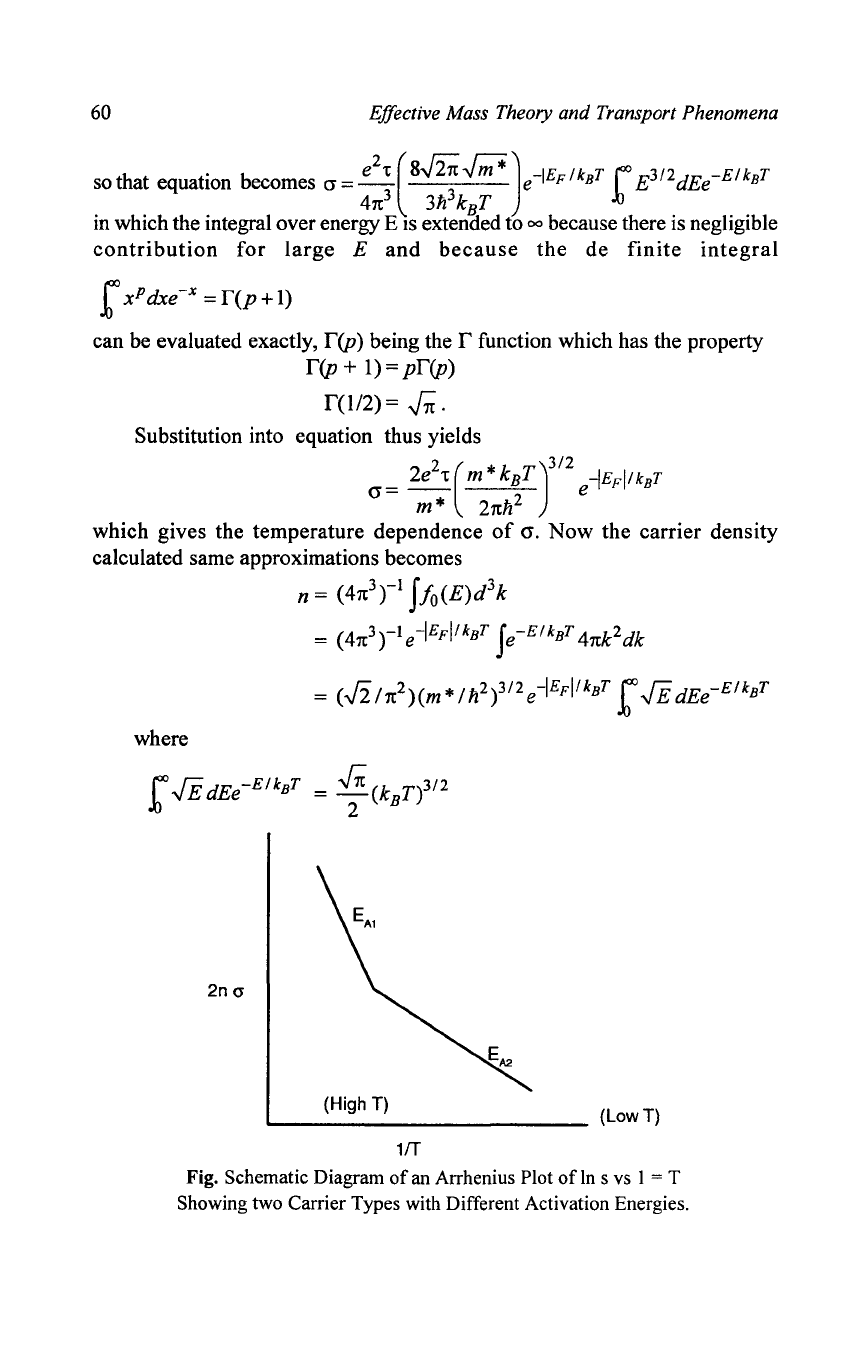
sothat equation becomes cr= e
2
•
[8J2;.j;;*Je-IEFlkBT
rE3/2dEe-ElkBT
4n
3
3h
3
k T
in which the integral over energy E IS
exten~ed
to
00
because there is negligible
contribution
for
large
E
and
because
the
de
finite
integral
r x
P
dxe-
x
=
r(p
+
1)
can be evaluated exactly,
r(p)
being the r function which has the property
r(p
+ 1) =
pr(p)
r(U2)
= J;c.
Substitution into equation thus yields
0'=
2e
2
.(m*k
B
TJ3/2
e-lEFl/kBT
m * 2nh2
which gives the temperature dependence
of
0'.
Now
the carrier density
calculated same approximations becomes
n = (4n
3
)-1
ffo(E)d
3
k
= (4n
3
)-le
-IEFl/kBT
fe-ElkBT
4nk
2
dk
= (.J2ln2)(m*lh2)3/2e-IEFl/kBT r JEdEe-ElkBT
where
r
JE
dEe-EI
kBT
=
~
(k
B
T)3/2
2n
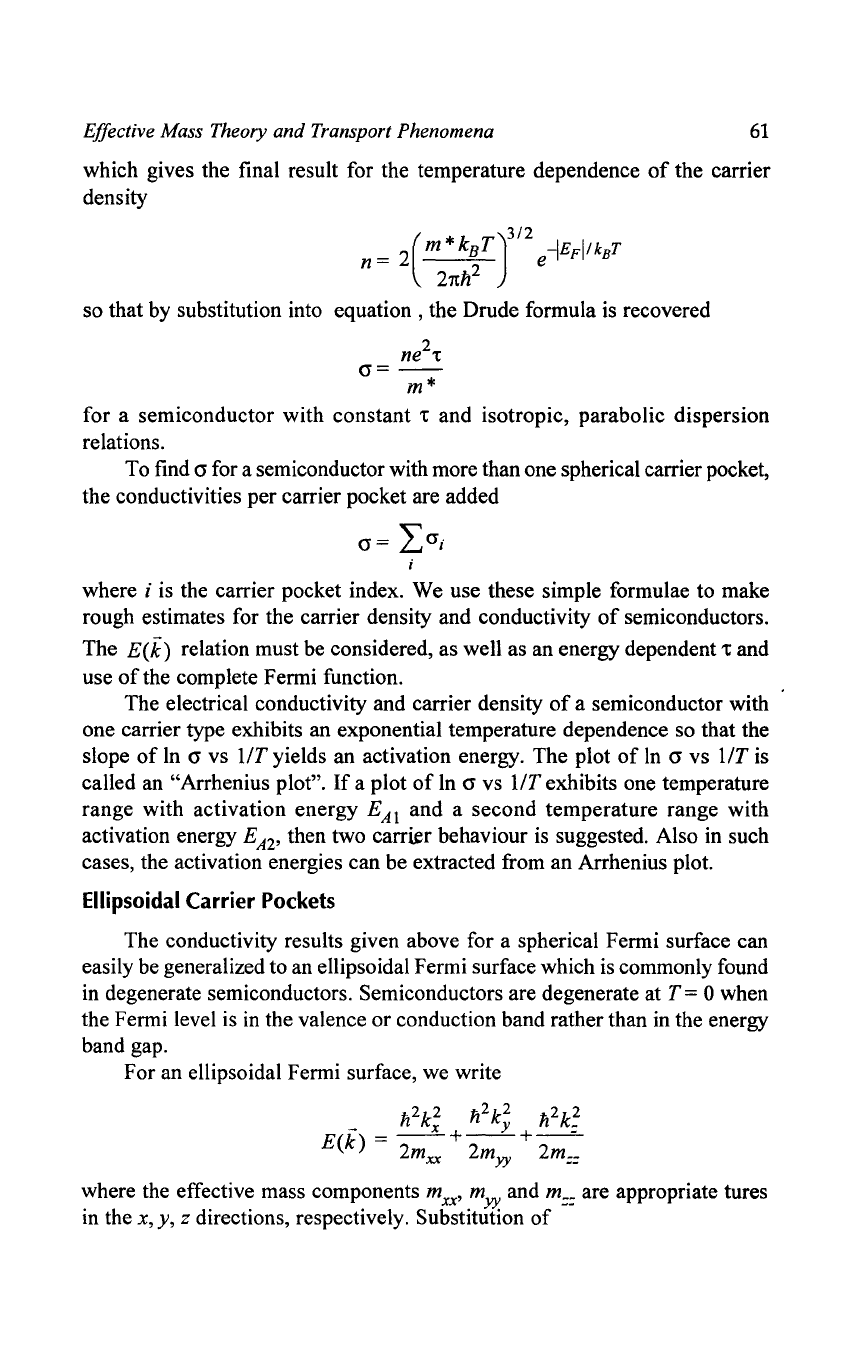
cr
'--
__
(H_i_9
h
_
T
_)
________
(Low T)
1fT
Fig. Schematic Diagram
of
an Arrhenius Plot
of
In
s vs I = T
Showing two Carrier Types with Different Activation Energies.
Effective Mass Theory
and
Transport Phenomena
61
which gives the final result for the temperature dependence
of
the carrier
density
n=
2(m*k
B
T)3/2
e-lEFII
kBT
27th
2
so that by substitution into equation, the Drude formula is recovered
ne
2
,
0'=
--
m*
for a semiconductor with constant
't
and isotropic, parabolic dispersion
relations.
To find
0' for a semiconductor with more than one spherical carrier pocket,
the conductivities per carrier pocket are added
0'=
La;
where i is the carrier pocket index. We use these simple formulae to make
rough estimates for the carrier density and conductivity
of
semiconductors.
The
E(k) relation must be considered, as well as an energy dependent
't
and
use
of
the complete Fermi function.
The electrical conductivity and carrier density
of
a semiconductor with
one carrier type exhibits an exponential temperature dependence so that the
slope
of
In
0'
vs
liT
yields an activation energy. The plot
of
In
0'
vs
liT
is
called an
"Arrhenius plot".
If
a plot
of
In
0'
vs
liT
exhibits one temperature
range with activation energy
E A 1 and a second temperature range with
activation energy
E
A2'
then two
carrU!r
behaviour
is
suggested. Also in such
cases, the activation energies can be extracted from an Arrhenius plot.
Ellipsoidal
Carrier
Pockets
The conductivity results given above for a spherical Fermi surface can
easily be generalized to an ellipsoidal Fermi surface which is commonly found
in degenerate semiconductors. Semiconductors are degenerate at
T = 0 when
the Fermi level is
in
the valence
or
conduction band rather than in the energy
band gap.
For an ellipsoidal Fermi surface, we write
h
2
k
2
h
2
k
2
h2k~
- _
__
x_
+
__
Y_
+
__
_
E(k)
-
2mxx
2myy
2m:;:;
where the effective mass components m
xx
'
myy
and
m:;:;
are appropriate tures
in the
x, y, z directions, respectively. Substitution
of