
Brewster H.D. Solid State Physics
Подождите немного. Документ загружается.

42 Effective Mass Theory
and
Transport Phenomena
For many practical situations we find a solid in the presence
of
some
perturbing field (e.g., an externally applied electric field, or the perturbation
created by an impurity atom or a crystal defect).
The perturbation may be either time-dependent or time-independent. We
will show here that under many common circumstances this perturbation can
be
treated
in
the effective mass approximation whereby the periodic potential
is
replaced by an effective Hamiltonian based on the E
(k
) relations for the
perfect crystal. To derive the effective mass theorem, we
stmi with the time-
dependent Schroodinger equation
,
-;
_ in a\Vn(r,t)
(Ho + H
)\Vn(T
,t)
- at
We then substitute the expansion for the wave packet
\Vn(r,t) = fdOkAnk(t)eif.i'Unk(r)
into Schroodinger's equation and make use
of
the Bloch solution
to obtain:
- -
Hoeik'Tunk(r) = En(k)eik'Tunk(r)
fd
3
k[En
(k)
+
H']A
nk
(t)eif.i'unk (F) = in(a\VnCr,t)/ at
= in fd3kitnk(f)eik.r unk(r).
It
follows from
Bloch's
theorem that
En(k)
is a periodic function in the
reciprocal lattice. We can therefore
exp,and
En(k)
in a Fourier series in the
direct lattice
where the
RI
are lattice vectors.
Now
consider the differential operator
En
(-iV)
formed by replacing k by
-iV
-
"E
R{'V
E
(-tv)
=
L.J
nl
e
n _
R{
Consider the effect
of
En
(-iV)
on an arbitrary function
fCr).
Since
eR{.v
can be expanded in a Taylor series, we obtain
i{,vf(r)
= [l+R
I
·v+k(R
I
·V)(R/.V)+''']f(r)
Effective Mass Theory
and
Transport Phenomena
-
-0
1 8
2
=
f(F)+R,·V
f(r)+-R,aR/f>.--f(r)+
...
2!
'
,f'
8ra8rp
=
fer
+R,).
Thus the effect
of
E/l(-/l)
on a Bloch state
is
E/l(-iV)"Vllk(l-:) =
~E/l'''Vnk(r
+R,)
R,
since from
Bloch's
theorem
Substitution
of
En(-iV)"Vnk(r) = En(k)"Vnk(r)
from equation into SchrAodinger's equation yields:
f d
3
k [
En
(
-iV)
+
H'
JAnk
(t)e
ik
r
unk
(r)
= [En
(-iV)
+
H']
fd3kAnk(t)eik.r unk(F)
so that
[En(
-iV)
+ H']"Vn(r,t) =
itt
8"Vn8~,t)
.
43
This result
is
called the effective mass theorem. We observe that the
original crystal Hamiltonian
p2/2m + V
(r
) does not appear in this equation.
It
has instead been replaced by an effective Hamiltonian which
is
an operator
formed from the solution
E (k) for the perfect crystal
in
which we replace k
by
-iV.
For example, for the free electron (V( r )
==
0)
_
tt
2
V
2
En(-iV)~---.
2m
In
applying the effective mass theorem, we assume that E ( k )
is
known
either from the results
of
a theoretical calculation or from the analysis
of
experimental results.
44
Effective Mass Theory
and
Transport Phenomena
What is important here is that once E ( k) is known, the effect
of
various
perturbations on the ideal crystal can be treated
in
tenns
ofthe
solution to the
energy levels
of
the perfect crystal without recourse to consideration
of
the
full Hamiltonian.
In practical cases, the solution to the effective mass equation
is
much
easier to carry out than the solution to the original Schroodinger equation.
According to the above discussion, we have assumed that
E
(k)
is
specified throughout the Brillouin zone. For many practical applications, the
regIOn
of
k -space which
is
of
impoliance
is
confined to a small portion
of
the Brillouin
zone.
In
such cases it is only necessary to specify E
(k)
in
a local region (or
regions) and to localize our wavepacket solutions to these local regions
of
k -space.
Suppose
that
we
localize
the
wavepacket
around
k =
ko'
and
correspondingly expand our Bloch functions around
kO'
\link
(r)
=
eif.F
Unk
(r)
=
i~"i'
Unko
(r)
= eiCk-koF
\lInko
(r)
where we have noted that
unk
(r)
=
unko(i')
has only a weak dependence on
k.
Then our wavepacket can be written as
\lfnk(r,t) = fd3kAnk(t)ei(k-koF\lInko(r) =
F(r,f)\lfnko(r)
where
F(r,f)
is called the amplitude
or
envelope function and
is
defined by
F(r,f)
=
fd
3
k Ank(t)ei(k-ko)"i' .
Since the time dependent Fourier coefficients Ank(t) are assumed here to
be
large only near k =
ko'
then
F(r,f)
will be a slowly varying function
of
r , because in this case
/(k-kO)i'
1
'(k-
k-)-
e =
+1
- 0
'r+'"
It
can be shown that the envelope function also satisfies the effective
mass equation
[
- ] -
"Ii
aF(r,t)
En(-iV)+H'
F(r,t)
= I at
where we now replace k -
ko
in
En(
k) by -iV . This form
of
the effective
mass equation is useful for treating the problem
of
donor and acceptor impurity
states
in
semiconductors, and
ko
is taken as the band extremum.
Effective Mass Theory
and
Transport Phenomena
45
a
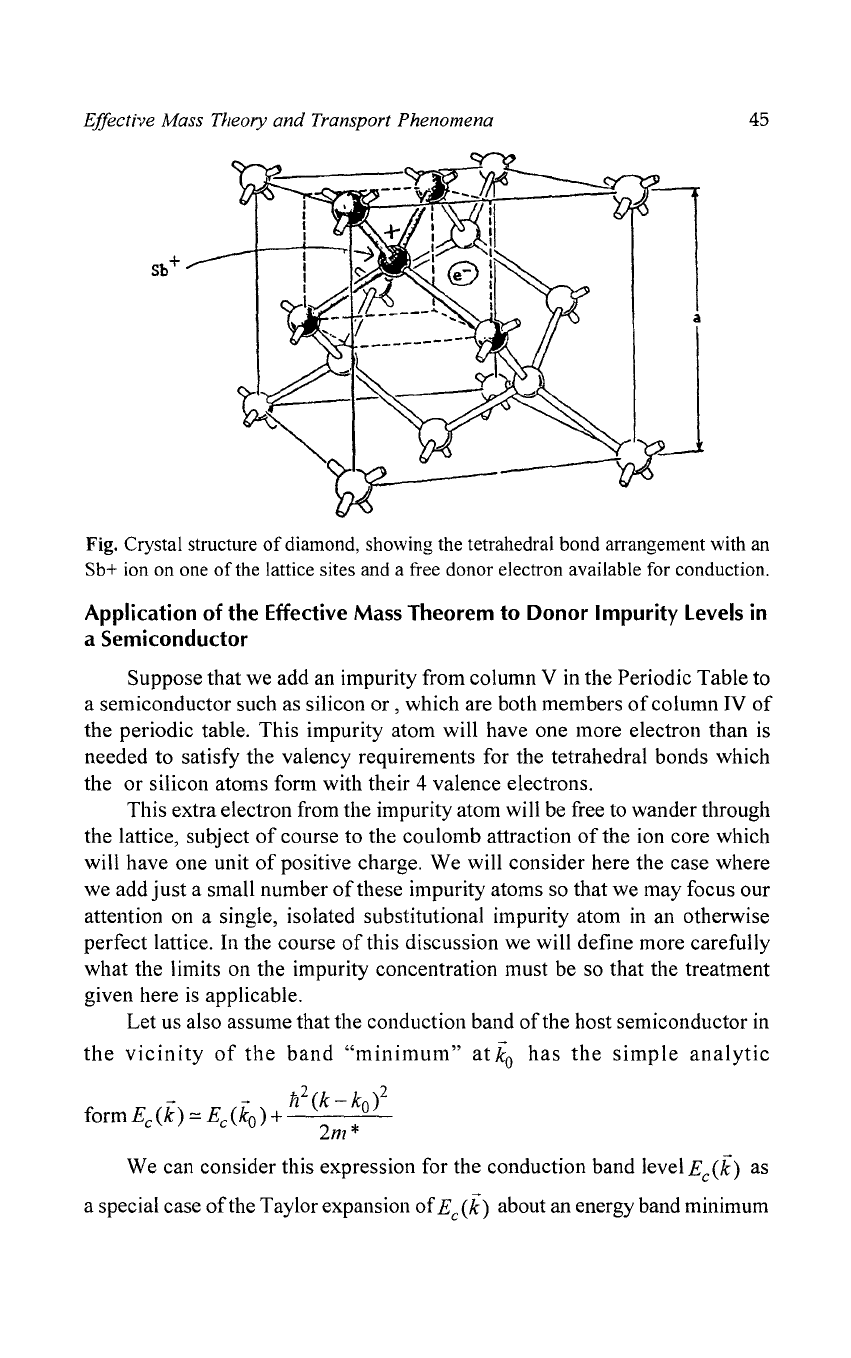
Fig. Crystal structure
of
diamond, showing the tetrahedral bond arrangement with
an
Sb+ ion on one
of
the lattice sites and a free donor electron available for conduction.
Application of the Effective Mass Theorem to Donor Impurity levels
in
a Semiconductor
Suppose that we add an impurity from column V
in
the Periodic Table to
a semiconductor such as silicon or , which are both members
of
column IV
of
the periodic table. This impurity atom will have one more electron than
is
needed to satisfy the valency requirements for the tetrahedral bonds which
the or silicon atoms form with their 4 valence electrons.
This extra electron from the impurity atom will be free to wander through
the lattice, subject
of
course to the coulomb attraction
of
the ion core which
will have one unit
of
positive charge. We will consider here the case where
we add
just
a small number
of
these impurity atoms so that we may focus our
attention on a single, isolated substitutional impurity atom
in
an otherwise
perfect lattice. In the course
of
this discussion we wi
11
define more carefully
what the limits on the impurity concentration must be so that the treatment
given here
is
applicable.
Let us also assume that the conduction band
of
the host semiconductor
in
the
vicinity
of
the
band
"minimum"
atko
has
the
simple
analytic
- - n
2
(k-k
o
)2
form
Ec
(k):::::
Ec
(k
o
)
+
----'--
2m*
We can consider this expression for the conduction band level
Ec(k)
as
a special case
of
the Taylor expansion
of
Ec(k)
about an energy band minimum
46 Effective Mass Theory
and
Transport Phenomena
at k = k
o
.
For the present discussion,
E(k)
is assumed to
be
isotropic
in
k;
this typically occurs
in
cubic semiconductors with band extrema at k =
O.
The
quantity
m*
in
this equation
is
the effective mass for the electrons. We will
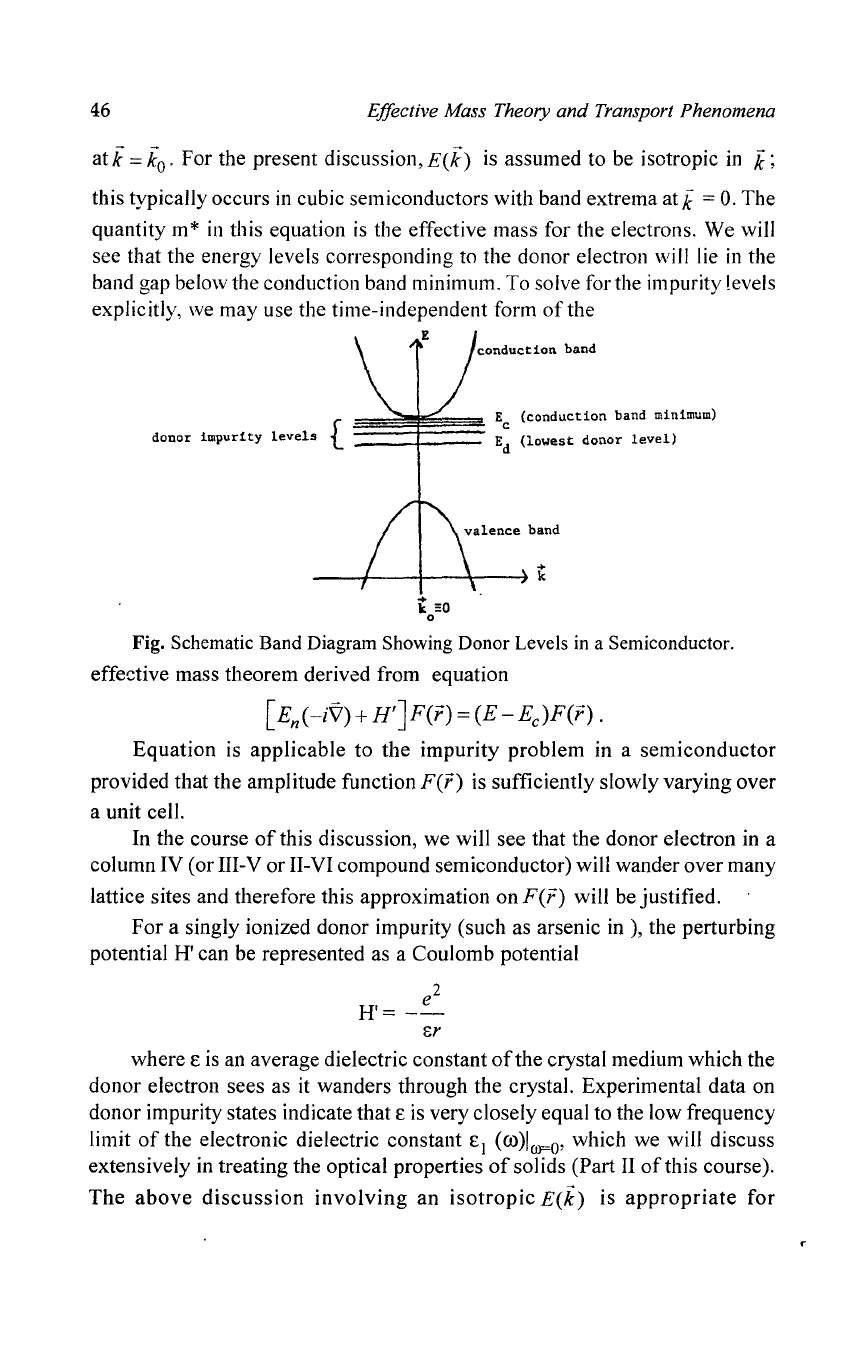
see that the energy levels corresponding to the donor electron will lie
in
the
band gap below the conduction band minimum. To solve for the impurity !evels
explicitly, we may use the time-independent form
of
the
conduction
band
~~~~~~
Ec
(conduction
band
minimum)
donor
impurity
levels
{
Ed
(lowest
donor
level)
...
____
+-
__
~--~
__
~
k
k =0
o
Fig. Schematic Band Diagram Showing Donor Levels in a Semiconductor.
effective mass theorem derived from equation
[En(
-iV)
+
H'JF(r)
=
(E
- EC>F(r) .
Equation is applicable to
the
impurity problem in a semiconductor
provided that the amplitude function
F(r)
is sufficiently slowly varying over
a unit cell.
In the course
of
this discussion, we will see that the donor electron in a
column IV ( or III-V or II-VI compound semiconductor) will wander over many
lattice sites and therefore this approximation on
F(r)
will
be
justified.
For a singly ionized donor impurity (such as arsenic in
),
the perturbing
potential H' can be represented as a Coulomb potential
2
H'=-~
Er
where £
is
an
average dielectric constant
of
the crystal medium which the
donor electron sees as it wanders through the crystal. Experimental data on
donor impurity states indicate that
£ is very closely equal to the low frequency
limit
of
the electronic dielectric constant
£1
(00)1(0=0'
which we will discuss
extensively in treating the optical properties
of
solids (Part
II
of
this course).
The
above
discussion
involving
an
isotropic
E(k)
is
appropriate
for
Effective Mass Theory
and
Transport Phenomena
47
semiconductors with conduction band minima at
ko
=
O.
The Effective Mass
equation for the unperturbed crystal is
2
-
tz
2
E
(-i\l)
=
--\7
n
2111*
in
which we have replaced k by -
iV
.
The donor impurity problem
in
the effective mass approximation thus
becomesr-~\72
_~lF(r)
L 2m *
2-r
= (E -
Ec
)F(r)
where all energies are measured with respect to the bottom
of
the conduction
band
Ec'
Ifwe
replace m* by m and e
2
/by e
2
,
we immediately recognize this
equation
as
Schroodinger's
equation
for a
hydrogen
atom
under
the
identification
of
the energy eigenvalues with
e
2
me
4
E
=--=--
n 2n2
Go
2n2
tz2
where
Go
is
the Bohr radius
Go
=
tz
2
/me
2
.
This identification immediately allows
us to write
E[
for the donor energy levels as
m*e
4
E[
=
E[=1
=
Ec
-
~
.
22-
11
where
1=
1,
2, 3, ... is an integer denoting the donor level quantum numbers
and we identify the bottom
of
the conduction band
Ec
as the ionization energy
for this effective hydrogenic problem.
Physically,
this
means
that
the
donor
levels
correspond
to
bound
(localized) states while the band states above
Ec
correspond to de localized
nearly-free electron-like states. The lowest or
"ground-state" donor energy
level is then written as
m*e
4
Ed
=
E[=1
=Ec -
22-2112
.
It
is convenient to identify the "effective" first Bohr radius for the donor
level as
*
a
=--
o m * e
2
and to recognize that the wave function for the ground state donor level will
be
of
the form
48 Effective Mass Theory
and
Transport Phenomena
•
F(r)
= Ce-
r1ao
where C
is
the normalization constant. Thus the solutions to equation for a
semiconductor are hydrogenic energy levels with the substitutions
m
~
111*,
e
2
~
(e
2
/£) and the ionization energy usually taken as the zero
of
energy for
the hydrogen atom now becomes
E
e
,
the conduction band extremum.
For a semiconductor like we have a very large dielectric constant,
£;
16.
The value for the effective mass
is
somewhat more difficult to specify
in
since
the constant energy surfaces for are located about the L-points
in
the Brillouin
zone and are ellipsoids
of
revolution. Since the constant energy surfaces for
such semiconductors are non-spherical, the effective mass tensor
is
anisotropic.
However we will write down
an
average effective mass value
m*lm;
0.12"
(Kittel
ISSP) so that we can estimate pertinent magnitudes for the donor levels
in
a
....
typical semiconductor. With these values for £ and
nz*
we obtain:
Ee
-
Ed::=:'
0.007eV
and the effective Bohr radius
ab::=:'
7oA.
These values are to
be
compared with the ionization energy
of
13.6 eV
for the hydrogen atom and with the hydrogenic Bohr orbit
of
a
o
=
/i
2
/me
2
=
o.sA.
Thus we see that
a6
is
indeed large enough to satisfy the requirement
that
F(r)
be
slowly varying over a unit cell. On the other hand,
if
a6
were to
be comparable to a lattice dimension, then
F(r)
could not be considered as a
slowly varying function
ofr
and generalizations
of
the above treatment would
have to be made. Such generalizations involve:
1.
Treating
E(k)
for a wider region
of
k -space, and
2.
Relaxing the condition that impurity levels are to be associated with
a single band. From the uncertainty principle, the localization
in
momentum space for the impurity state requires a delocalization in
real space; and likewise, the converse is true, that a localized
impurity in real space corresponds to a delocalized description
in
k -space. Thus "shallow" hydro genic donor levels can be attributed
to a specific band at a specific energy extremum at
ko
in the
Brillouin zone.
On the other hand, "deep" donor levels are not
hydrogenic and have a more complicated energy level structure. Deep
donor levels cannot be readily associated with a specific band or a
specific
k point
in
the Brillouin zone.
In
dealing with this impurity problem, it
is
very tempting to discuss the
donor levels
in
silicon
and.
For example
in
silicon where the conduction band
extrema are at the
~
point, the effective mass theorem requires us to
Effective Mass Theory
and
Transport Phenomena
49
. _ ti
2
a
2
ti
2
(a
2
a
2
)
replaceE(-iV)
byE(-IY')~--2
*-82
--2
•
-a
2
+8
2
mt
x
rtl,
y z
and the resulting Schroodinger equation can
no
longer be solved exactly.
Although this
is
a very interesting problem from a practical point
of
view, it
is
too difficult a problem for us to solve
in
detail for illustrative purposes
in
an
introductory course.
QUASI-CLASSICAL
ElECTRON
DYNAMICS
According to the "Correspondence Principle"
of
Quantum Mechanics,
wavepacket solutions
of
SchrAodinger's equation follow the
trajector~es
of
classical particles and satisfY Newton's laws. One can give a Correspondence
Principle argument for the form which is assumed by the velocity and
acceleration
of
a wavepacket. According to the Correspondence Principle, the
connection between the classical Hamiltonian and the quantum mechanical
Hamiltonian is made by the identification
of
p
~
(Ii / i)V . Thus
En(
-iV)
+
H'(r)
B En(P /
ti)
+
H'(r)
==
Hclassical
(p,r).
In
classical mechanics, Hamilton's equations give the velocity according
.1-
==
aH
==
V H
==
aE(k)
to.
ap
P liak
in agreement with the for a wavepacket given by equation. Hamilton's
equation for the acceleration
is
given by:
7
aH
aH'(r)
p==-
ar
==-
ar
.
For example, in the case
of
an applied electric field
jj;
the perturbation
Hamiltonian
is
so that
fexmi
surface
at
t-O
H'(r)
==
-er'
jj;
I
,
,
\
I
I
Ill-
Fermi
surface
"
at
t-lit
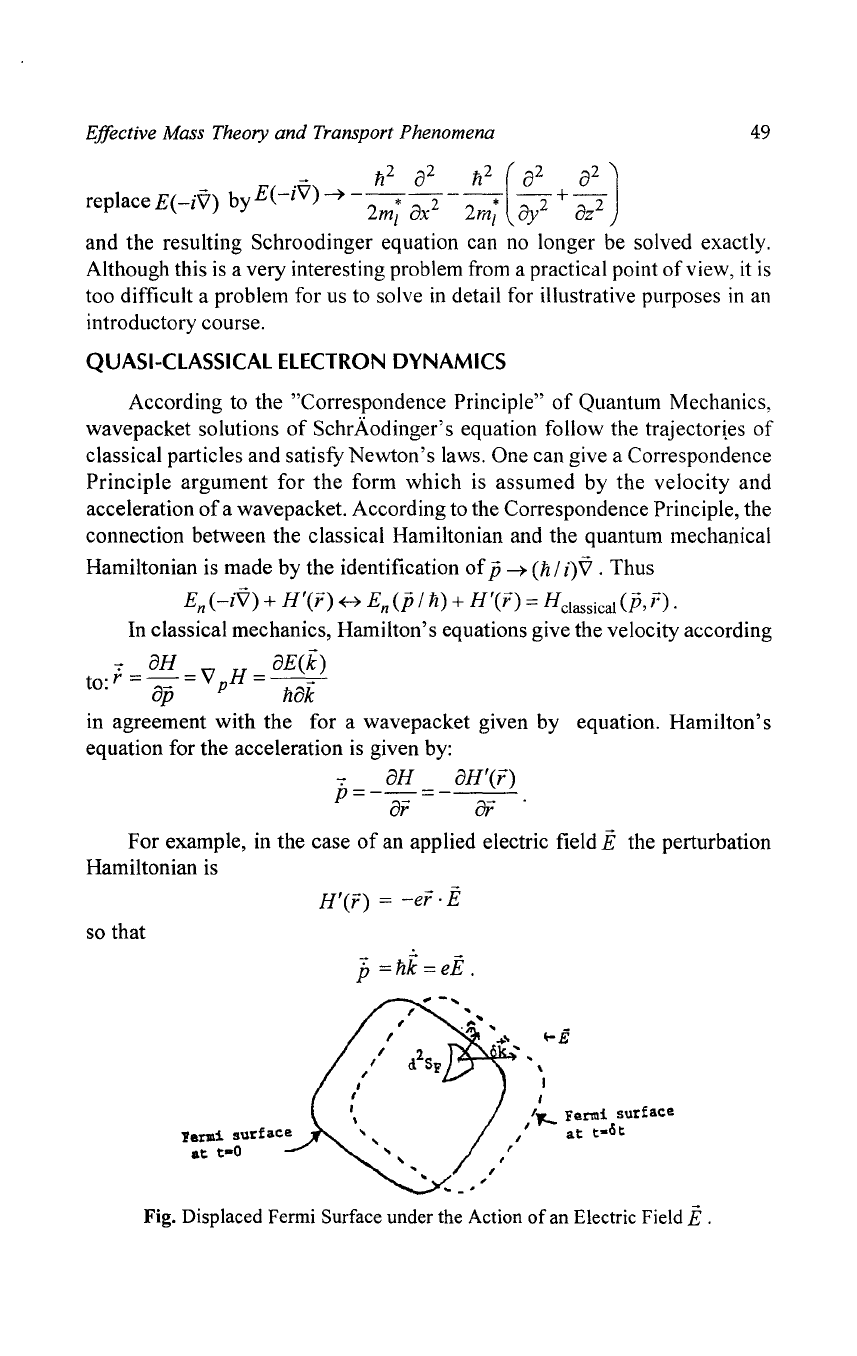
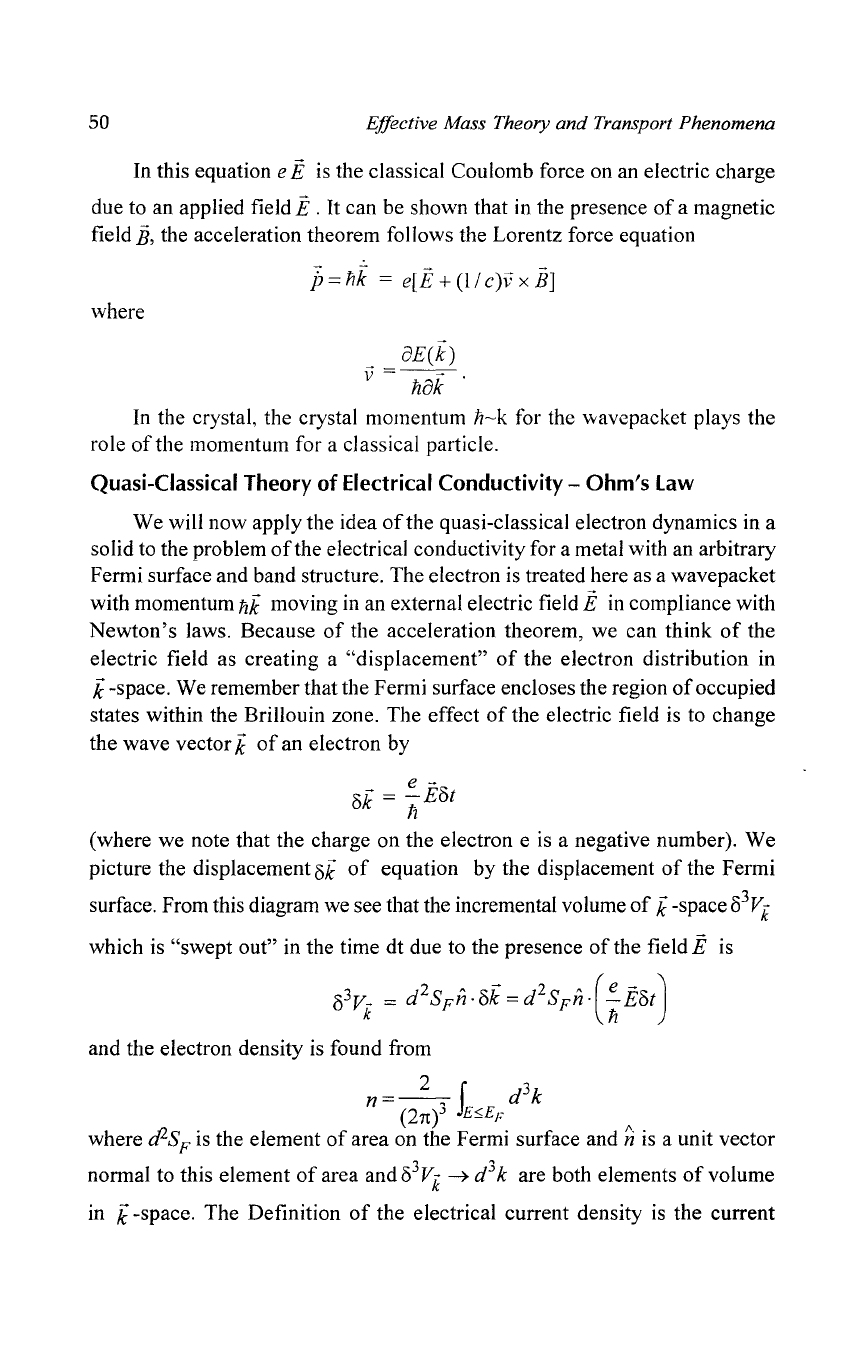
Fig. Displaced Fermi Surface under the Action
of
an Electric Field
jj;
.
50
Effective Mass Theory
and
Transport Phenomena
In this equation e if
is
the classical Coulomb force on
an
electric charge
due to an applied field
if .
It
can be shown that in the presence
of
a magnetic
field
13,
the acceleration theorem follows the Lorentz force equation
where
oE(k)
11
=
noI
.
In
the crystal, the crystal momentum
n-k
for the wavepacket plays the
role
of
the momentum for a classical particle.
Quasi-Classical Theory of Electrical Conductivity -
Ohm's
Law
We will now apply the idea
of
the quasi-classical electron dynamics in a
solid to the problem
of
the electrical conductivity for a metal with
an
arbitrary
Fermi surface and band structure. The electron
is
treated here as a wavepacket
with momentum
11.k
moving in an external electric field if
in
compliance with
Newton's laws. Because
of
the acceleration theorem, we can think
of
the
electric field as creating a
"displacement"
of
the electron distribution in
k -space. We remember that the Fermi surface encloses the region
of
occupied
states within the Brillouin zone. The effect
of
the electric field
is
to change
the wave vector
k
of
an electron by
e -
8k
=
-E8t
Ii
(where we note that the charge on the electron e
is
a negative number). We
picture the displacement
8k
of
equation by the displacement
of
the Fermi
surface. From this diagram we see that the incremental volume
of
k -space 8
3
V
k
which is "swept out" in the time dt due to the presence
of
the field if IS
8
3
V
k
= d
2
S
F
n.8k
=d2SFn{~if8t)
and the electron density
is
found from
n=_2_
r d
3
k
(21t)3
k,;E
F
where
J2s
F
is
the element
of
area on the Fermi surface and
~
is
a unit vector
normal to this element
of
area and 8
3
V
k
~
d
3
k are both elements
of
volume
in
k -space. The Definition
of
the electrical current density
is
the current
Effective Mass Theory
and
Transport Phenomena
51
flowing through a unit area
in
real space and is given by the product
of
the
(number
of
electrons per unit volume) with the (charge per electron) and with
the
0 so that the current density 8] created by applying the electric field E
for a time interval 8t
is
given by
8]
=
f[2/(2n)3].[
83V
d·[e].[v
g
]
where v g
is
the for electron wave packet and
2/(21t)3
is
the density
of
electronic
states
in
k -space (including the spin degeneracy
of
two) because we can put
2 electrons
in
each phase space state. Substitution for 8
3
V
k
in
equation yields
the instantaneous rate
of
change
of
the current density averaged over the Fermi
surface
a]
_ e
2
ri
_
~
- 2 e
2
ri
ri _
(V
g .
E)
2
---3
'-!vgn.Ed
SF =
-3
,-!'j'Vgl-
1
-I
(d
SF)
at
4n
11
4n
11
Vg
since the given by equation
is
directed normal to the Fermi surface. In a real
solid, the electrons will not be accelerated
in
de finitely, but will eventually
collide with an impurity, or a lattice defect or a lattice vibration (phonon).
These collisions will serve to maintain the displacement
of
the Fermi
surface at some steady state value, depending on
't,
the average time between
collisions. We can introduce this relaxation time through the expression
n(t)
= n(O)e
-I
I
1:
where net)
is
the number
of
electrons that have not made a collision at time
t,
assuming that the last collision had been made at time t =
o.
The relaxation
time is the average collision time
(t)
=~
r
te-
I
I
'tdt =
t.
If
in
equation,
we set (8t) =
't
and write the average current density
as
J =
(8J>
, then we
2 -
E-
-:
e t
f-
V
g
· 2
)
=-3
V
g
-
1
-
1
(d
SF)·
4n
11
Vg
We define the conductivity tensor as ] =
cr
. E , so that equation provides
an explicit expression for the tensor
a .
2
--
__
~
fVgV
g
(d
2
S )
(J
- 4n
3
11
Ivgl
F .