
Brewster H.D. Solid State Physics
Подождите немного. Документ загружается.

32
Energy Dispersion Relations in Solids
means that there are some electrons always present
in
the conduction band
(for example a typical electron concentration would be
10
15
fcm
3
which
amounts to less than I
carrierll 0
7
atoms).
Molecular
Semiconductors - Fullerenes
Other examples
of
semiconductors are molecular solids such
as
C
60
.
For
the case
of
solid C
60
•
a C
60
molecule, which crystallizes
in
a FCC structure
with four
C
60
molecules per conventional simple cubic unit cell. A small
distortion
of
the bonds. lengthening the C-C bond lengths on the single bonds
to
1.46° A and shortening the double bonds to 1.40°
A,
stabilizes a band gap
of
~
I .5e V.
In
this semiconductor the energy bandwidths are very small compared
with the band gaps, so that this material can be considered as an organic
molecular semiconductor. The transport properties
of
C
60
differ markedly from
those for conventional group IV
or
III-V semiconductors.
SEMIMETALS
Another type
of
material that commonly occurs in nature
is
the semimetal.
Semimetals have exactly the correct number
of
electrons to completely fill an
integral number
of
Brillouin zones. Nevertheless,
in
a semimetal the highest
occupied Brillouin zone
is
not filled up completely, since some
of
the electrons
find lower energy states in
"higher" zones.
For semimetals the number
of
electrons that spill over into a higher
Brillouin zone
is
exactly equal to the number
of
holes that are left behind.
This is illustrated schematically in where a two-dimensional Brillouin zone
and a circular Fermi surface
of
equal area
is
inscribed. Here we can easily see
the electrons in the second zone at the zone edges and the holes at the zone
corners that are left behind in the first zone. Translation by a reciprocal lattice
vector brings two pieces
of
the electron surface together to form a surface in
the shape
of
a lens, and the 4 pieces at the zone corners form a rosette shaped
hole pocket. Typical examples
of
semi metals are bismuth and graphite. For
these semimetals the carrier density
is
on the order
of
one carrierll 0
6
atoms.
The carrier density
of
a semimetal is thus not very different from that
which occurs
in
doped semiconductors, but the behavior
of
the conductivity
cr(I) as a function
of
temperature is very different.
For intrinsic semiconductors, the carriers which are excited thermally
contribute significantly to conduction. Consequently, the conductivity tends
to rise rapidly with increasing temperature. For a semimetal, the carrier
concentration does not change significantly with temperature because the
carrier density
is
determined by the band overlap. Since the electron scattering
by lattice vibrations increases with increasing temperature, the conductivity
of
semimetals tends to fall as the temperature increases.
Energy Dispersion Relations in Solids
33
A schematic diagram
of
the energy bands
of
the semimetal bismuth.
Electron and hole carriers exist in equal numbers but at different locations
in
the Brillouin zone. For Bi, electrons are at the L-point, and holes at the T -
point. The crystal structure for Bi can be understood from the NaCI structure
by considering a very small displacement
of
the
Na
FCC structure relative to
the Cl FCC structure along one
of
the body diagonals and an elongation
of
that body diagonal relative to the other 3 body diagonals. The special
fill
g
direction corresponds to
f - T
in
the Brillouin zone while the other three
{Ill}
directions are labeled as f -
L.
Instead
of
a band gap between valence and conduction bands (as occurs
for semiconductors), semimetals are characterized by a band overlap
in
the
millivolt range.
In
bismuth, a small band gap also occurs at the L-point between
the conduction band and a lower filled valence band. Because the coupling
between these L-point valence and conduction bands
is
strong. some
of
the
effective mass components for the electrons
in
bismuth are anomalously small.
As far as the optical properties
of
bismuth are concerned, bismuth behaves
much like a metal with a high reflectivity at low frequencies due to strong
free carrier absorption.
INSULATORS
The electronic structure
of
insulators is similar to that
of
semiconductors,
in that both insulators and semiconductors have a band gap separating the
valence and conduction bands. However, in the case
of
insulators, the band
gap
is
so large that thermal energies are not sufficient to excite a significant
number
of
carriers.
The simplest insulator is a solid formed
ofrare
gas atoms. An example
of
a rare gas insulator is solid argon which crystallizes in the FCC structure with
one Ar atom/primitive unit cell. With an atomic configuration
3s
2
3p6, argon
has filled 3s and 3p bands which are easily identified in the energy band
diagram. These occupied bands have very narrow band widths compared to
their
band
gaps
and
are
therefore
well
described
by
the
tight
binding
approximation. This higher energy states forming the conduction bands (the
hybridized 4s and 3d bands) show more dispersion than the more tightly bound
valence bands. The band diagram shows argon to have a direct band gap at
the
f point
of
about 1 Rydberg or 13.6 eV. Although the 4s and 3d bands
have similar energies, identification with the atomic levels can easily be made
near
k = 0 where the lower lying 4s-band has considerably more band curvature
than the 3d levels which are easily identified because
of
their degeneracies
[the so called three-fold
tg
(f
25
,) and the two-fold e
g
(f
12
) crystal field levels
for d-bands
in a cubic crystal].
Another example
of
an insulator formed from a closed shell configuration
34
Energy Dispersion Relations
in
Solids
is
found. Here the closed shell configuration results from charge transfer, as
occurs
in
all ionic crystals.
F or example
in
the ionic crystal LiF (or
in
other alkali halide compounds)
the valence band
is
identified with the filled anion orbitals (fluorine p-orbitals
in
this case) and at much higher energy the empty cation conduction band
levels will lie (lithium s-orbitals
in
this case). Because
of
the wide band gap
separation
in
the alkali halides between the valence and conduction bands,
such materials are transparent at optical frequencies.
Insulating behavior can also occur for wide bandgap semiconductors with
covalent bonding, such as diamond, ZnS and
GaP. The
E(
k) diagrams for
. these materials are very similar to the dispersion relations for typical III-V
semiconducting compounds and the group IV semiconductors silicon
and;
the main difference, however,
is
the large band gap separating valence and
conduction bands.
Even in insulators there is a finite electrical conductivity. For these
materials the band electronic transport processes become less important relative
to charge hopping from one atom to another by over-coming a potential barrier.
Ionic conduction can also occur
in
insulating ionic crystals. From a practical
point
of
view, one
of
the most important applications
of
insulators is the control
of
electrical breakdown phenomena.
The principal experimental methods
f~r
studying the electronic energy
bands depend on the nature
of
the solid. For insulators, the optical properties
are the most important, while for semiconductors both optical and transport
studies are important. For metals, optical properties are less important and
Fermi surface studies become more important.
In the case
of
insulators, electrical conductivity can arise through the
motion
of
lattice ions as they move from one lattice vacancy to another, or
from one interstitial site to another. Ionic conduction therefore occurs through
the presence
of
lattice defects, and
is
promoted
in
materials with open crystal
structures. In ionic crystals there are relatively few mobile electrons or holes
even at high temperature so that conduction
in
these materials
is
predominantly
due to the motions
of
ions.
Ionic conductivity
(crionic)
is
proportional both to the density
of
lattice
defects (vacancies and interstitials) and to the diffusion rate, so that we can
write
cr.
.
~
-(£+£0)/
kBT
IOnIC e
where
Eo
is the activation energy forv ionic motion and E
is
the energy for
formation
of
a defect (a vacancy, a vacancy pair, or an interstitial). Being an
activated process, ionic conduction
is
enhanced at elevated temperatures. Since
defects in ionic crystals can be observed visibly as the migration
of
colour
Energy Dispersion Relations in Solids
35
through the crystal, ionic conductivity can be distinguished from electronic
conductivity by comparing the transport
of
charge with the transport
of
mass,
as can, for example, be measured by the material plated out on electrodes in
contact with the ionic crystal.
In this course, we will spend a good deal
of
time studying optical and
transport properties
of
solids.
In
connection with topics on magnetism,
we
will also study Fermi surface measurements which are closely connected to
issues relevant to transport properties.
Since Fern1i surface studies, for the
most part, are resonance experiments and involve the use
of
a magnetic field,
it
is
pedagogically more convenient to discuss these topics in 'Part III
of
the
course, devoted to Magnetism.
We
have presented this review
of
the electronic
energy bands
of
solids because the E
(k
) relations are closely connected with
a large number
of
common measurements in the laboratory, and because a
knowledge
ofthe
E ( k ) relations forms the basis for many device applications.
WHAT
IS
CONDENSED
MATTER
PHYSICS?
LENGTH,
TIME,
ENERGY
SCALES
We will be concerned with:
•
ro,
T«
leV
1
•
\x.
- x
.\,
-»
1A
I } q
as compared
to
energies in the MeV for nuclear matter, and GeV or even T
eV, in particle physics.
The properties
of
matter at these scales is determined
by
the behaviour
of
collections
of
many
(-
10
23
) atoms.
In general,
we
will be concerned with scales much smaller than those at
which gravity becomes very important, which is the domain
of
astrophysics
and cosmology.
MICROSCOPIC
EQUATIONS
VS.
STATES
OF
MATTER,
PHASE
TRANSITIONS,
CRITICAL
POINTS
Systems containing many particles exhibit properties which are special
to such systems.
Many
of
these properties are fairly insensitive to the details
at
length scales shorter than
1A
and energy scales higher than
leV
- which
are quite adequately described by the equations
of
non-relativistic quantum
mechanics.
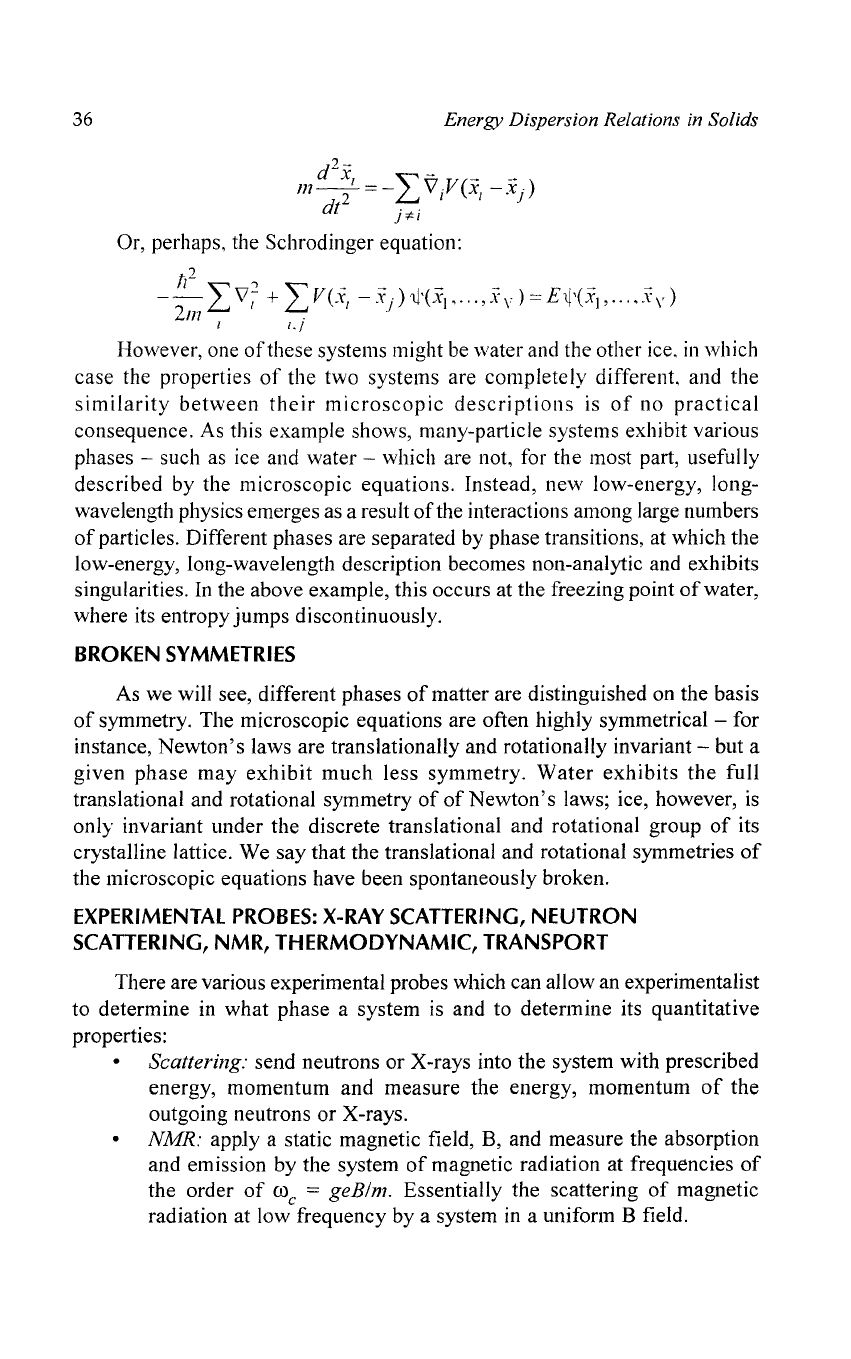
Such properties are emergent. For example, precisely the same
microscopic equations
of
motion -
Newton's
equations - can describe two
different systems
of
10
23
H
2
0 molecules.
36
Energy Dispersion Relations
in
Solids
d
2
xI
"V
V(-
_0)
111-
2
-=-
~
i
XI
-Xj
dt
joti
Or, perhaps, the Schrodinger equation:
tz2
')
_ _ _
_0
,_
_
-:;-
IV;
+
IV(X
I
-Xj)1l'(Xl.···,xv)=E~'(Xl'···'X\')
~1I1
.
I
1.1
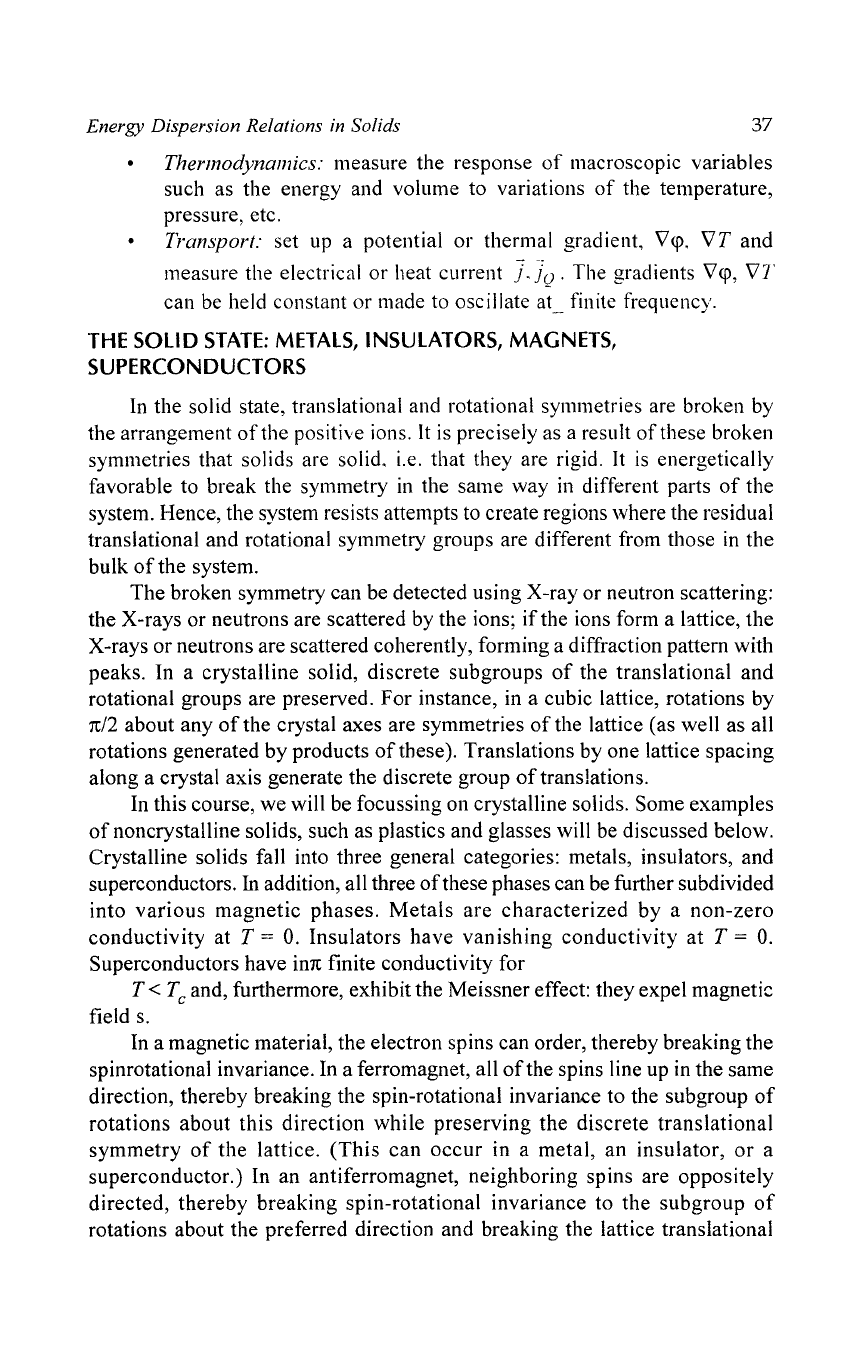
However, one
of
these systems might be water and the other ice.
in
which
case the properties
of
the two systems are completely different, and the
similarity
between
their
microscopic
descriptions
is
of
no
practical
consequence.
As
this example shows, many-particle systems exhibit various
phases - such as ice and water - which are not, for the most part, usefully
described by the microscopic equations. Instead, new low-energy, long-
wavelength physics emerges as a result
of
the interactions among large numbers
of
particles. Different phases are separated by phase transitions, at which the
low-energy, long-wavelength description becomes non-analytic and exhibits
singularities.
In
the above example, this occurs at the freezing point
of
water,
where its entropy jumps discontinuously.
BROKEN
SYMMETRIES
As we will see, different phases
of
matter are distinguished on the basis
of
symmetry. The microscopic equations are often highly symmetrical - for
instance, Newton's laws are translationally and rotationally invariant - but a
given phase may
exhibit
much
less symmetry.
Water
exhibits the full
translational and rotational symmetry
of
of
Newton's laws; ice, however,
is
only invariant under the discrete translational and rotational group
of
its
crystalline lattice. We say that the translational and rotational symmetries
of
the microscopic equations have been spontaneously broken.
EXPERIMENTAL
PROBES:
X-RAY
SCATTERING,
NEUTRON
SCATTERING,
NMR,
THERMODYNAMIC,
TRANSPORT
There are various experimental probes which can allow an experimentalist
to determine
in
what phase a system
is
and to determine its quantitative
properties:
• Scattering: send neutrons or X-rays into the system with prescribed
energy, momentum and measure the energy, momentum
of
the
outgoing neutrons or X-rays.
NMR: apply a static magnetic field, B, and measure the absorption
and emission by the system
of
magnetic radiation at frequencies
of
the order
of
COc
= geB/m. Essentially the scattering
of
magnetic
radiation at low frequency by a system
in
a uniform B field.
Energy Dispersion Relations
in
Solids
37
Thermodynamics: measure the
respon~e
of
macroscopic variables
such as the energy and volume to variations
of
the temperature,
pressure, etc.
Tramporf: set up a potential or thermal gradient,
V<p,
VT
and
measure the electrical or heat current
]']Q'
The gradients
V<p,
V1'
can be held constant or made to oscillate at_ finite frequency.
THE
SOLID
STATE:
METALS,
INSULATORS,
MAGNETS,
SUPERCONDUCTORS
In
the sol
id
state, translational and rotational symmetries are broken by
the arrangement
of
the positive ions.
It
is precisely as a result
of
these broken
symmetries that solids are solid, i.e. that they are rigid.
It
is
energetically
favorable to break the symmetry
in
the same way
in
different parts
of
the
system. Hence, the system resists attempts to create regions where the residual
translational and rotational symmetry groups are different from those
in
the
bulk
of
the system.
The broken symmetry can be detected using X-ray or neutron scattering:
the X-rays or neutrons are scattered by the ions;
if
the ions form a l'lttice, the
X-rays
or
neutrons are scattered coherently, forming a diffraction pattern with
peaks. In a crystalline solid, discrete subgroups
of
the translational and
rotational groups are preserved. For instance, in a cubic lattice, rotations by
rrJ2
about any
of
the crystal axes are symmetries
of
the lattice (as well as all
rotations generated by products
of
these). Translations by one lattice spacing
along a crystal axis generate the discrete group
of
translations.
In
this course, we will be focussing on crystalline solids. Some examples
of
noncrystalline solids, such as plastics and glasses will be discussed below.
Crystalline solids fall into three general categories: metals, insulators, and
superconductors.
In addition, all three
of
these phases can
be
further subdivided
into
various
magnetic phases.
Metals
are
characterized
by a non-zero
conductivity at
T =
O.
Insulators have vanishing conductivity
at
T =
O.
Superconductors have
in7t
finite conductivity for
T <
Tc
and, furthermore, exhibit the Meissner effect: they expel magnetic
field
s.
In a magnetic material, the electron spins can order, thereby breaking the
spinrotational invariance. In a ferromagnet,
all
of
the spins line up in the same
direction, thereby breaking the spin-rotational invariance to the subgroup
of
rotations about this direction while preserving the discrete translational
symmetry
of
the lattice.
(This
can
occur
in a metal, an insulator,
or
a
superconductor.) In an antiferromagnet, neighboring spins are oppositely
directed, thereby breaking spin-rotational invariance to the subgroup
of
rotations about the preferred direction and breaking the lattice translational
38
Energy Dispersion Relations
in
Solids
symmetry to the subgroup
of
translations by an even number
of
lattice sites.
Recently, new states
of
matter - the fractional quantum Hall states - have
been discovered in effectively two-dimensional systems in a strong magnetic
field at very low
T.
Tomorrow's experiments will undoubtedly uncover new
phases
of
matter.
OTHER
PHASES:
LIQUID
CRYSTALS,
QUASICRYSTALS,
POLYMERS,
GLASSES
The liquid - with full translational and rotational symmetry - and the
solid - which only preserves a discrete subgroup - are but two examples
of
possible realizations
of
translational symmetry.
In
a liquid crystalline phase,
translational and rotational symmetry
is
broken to a combination
of
discrete
and continuous subgroups.
For instance, a nematic liquid crystal is made
up
of
elementary units which
are line segments.
In
the nematic phase, these line segments point, on average,
in the same direction, but their positional distribution is as in a liquid. Hence,
a nematic phase breaks rotational invariance to the subgroup
of
rotations about
the preferred direction and preserves the full translational invariance. Nematics
are used in LCD displays.
In a smectic phase, on the other hand, the line segments arrange themselves
into layers, thereby partially breaking the translational symmetry so that discrete
translations perpendicular to the layers and continuous translations along the
layers remain unbroken. In the smectic-A phase, the preferred orientational
direction
is
the same as the direction perpendicular to the layers; in the smectic-
. C phase, these directions are different.
In a hexatic phase, a two-dimensional system has broken orientational
order, but unbroken translational order; locally, it looks like a triangular lattice.
A quasi crystal has rotational symmetry which is broken to a 5-fold discrete
subgroup. Translational order is completely broken (locally, it has discrete
translational order).
Polymers are extremely long molecules. They can exist
in solution
or
a chemical reaction
C(ln
take place which cross-links them,
thereby forming a gel. A glass
is
a rigid, 'random' arrangement
of
atoms.
Glasses are somewhat like
'snapshots'
of
liquids, and are probably non-
equilibrium phases, in a sense.
Chapter 2
Effective Mass Theory
and Transport Phenomena
WAVEPACKETS
IN
CRYSTALS
AND
OF
ELECTRONS
IN
SOLIDS
In
a crystal lattice, the electronic motion which is induced by an applied
field
is
conveniently described by a wavepacket composed
of
eigenstates
of
the unperturbed crystal. These eigenstates are Bloch functions
_
If-/'
-
\jJnk(r) = e unk(r)
and are associated with band
n. These wavepackets are solutions
of
the time-
dependent Schroodinger equation
.
a\jJn(r,t)
HO\jJn(r,t)
=
111
at
where the time independent part
of
the Hamiltonian can be written as
2
Ho=
L+V(r)
2m
where
VCr) =
VCr
+ Rn) is the periodic potential. The wave packets \jJn(r,t)
can be written
in
terms
of
the Bloch states
\jJ
nk
(r)
as
\jJn(r,t) = LAn.k(t)\jJnk(r) = f
d3kA
n.k(t)\jJnk(r)
k
where we have replaced the sum by an integration over the Brillouin zone,
since permissible
k values for a macroscopic solid are very closely spaced. If
the Hamiltonian
Ho
is
time-independent as
is
often the case, we can write
A (t) = A
e-lWn(k)!
n.k n.k
where
40
Effective Mass Theory
and
Transport Phenomena
and thereby obtain
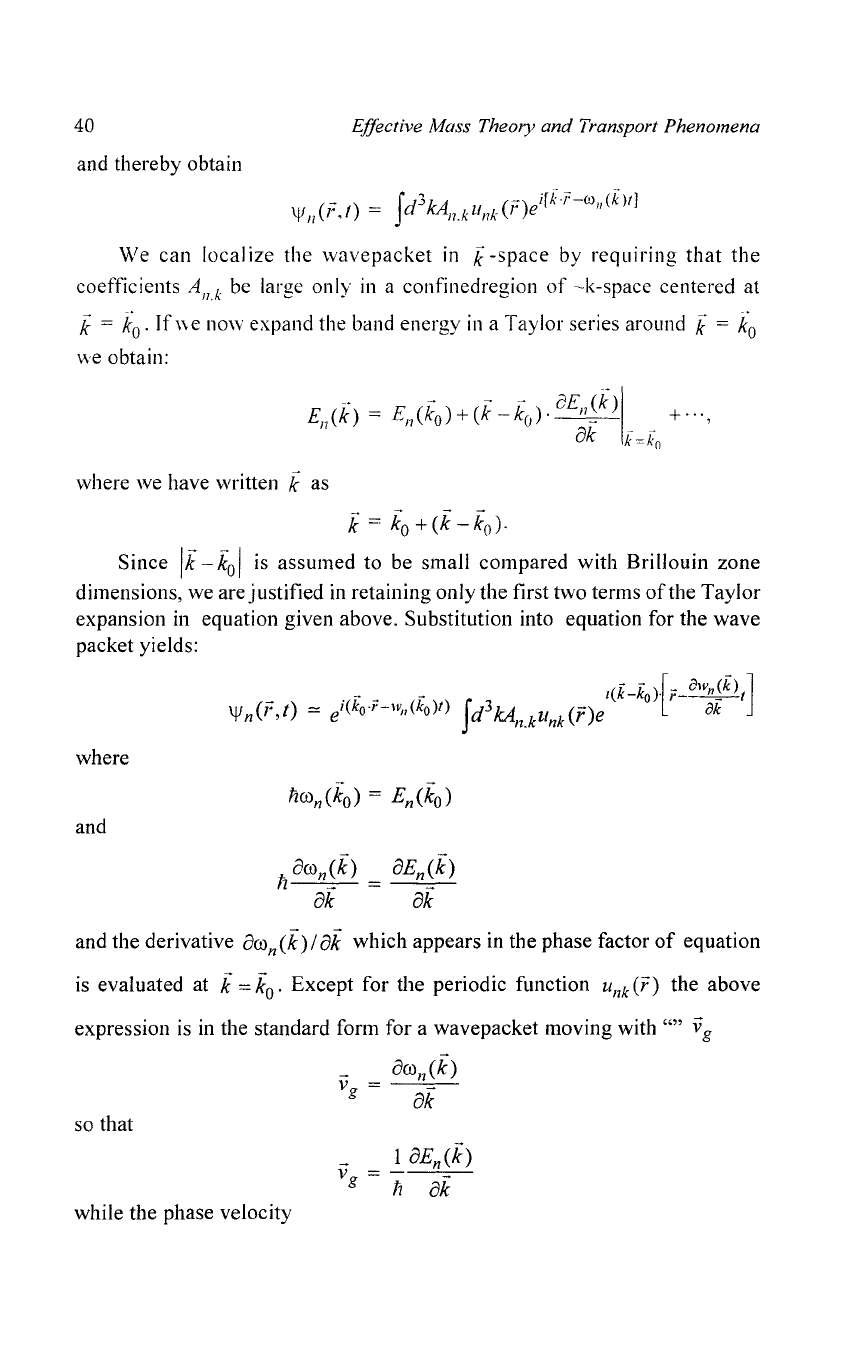
We can localize the
wavepacket
in
k
-space
by requiring
that
the
coefficients A
II
.
k
be large only
in
a confinedregion
of
-k-space centered at
k = k
a
·
)f\\e
now expand the band energy
in
a Taylor series around k =
ka
we obtain:
where we have written
k as
k =
ka
+(k
-ko)'
Since
Ik
-kal
is
assumed to be small compared with Brillouin zone
dimensions, we are justified
in
retaining only the first two terms
of
the Taylor
expansion in equation given above. Substitution into equation for the wave
packet yields:
where
and
and the derivative
offin(k)/
ok
which appears in the phase factor
of
equation
is evaluated at
k = k
a
.
Except for the periodic function unk
(r)
the above
expression is
in
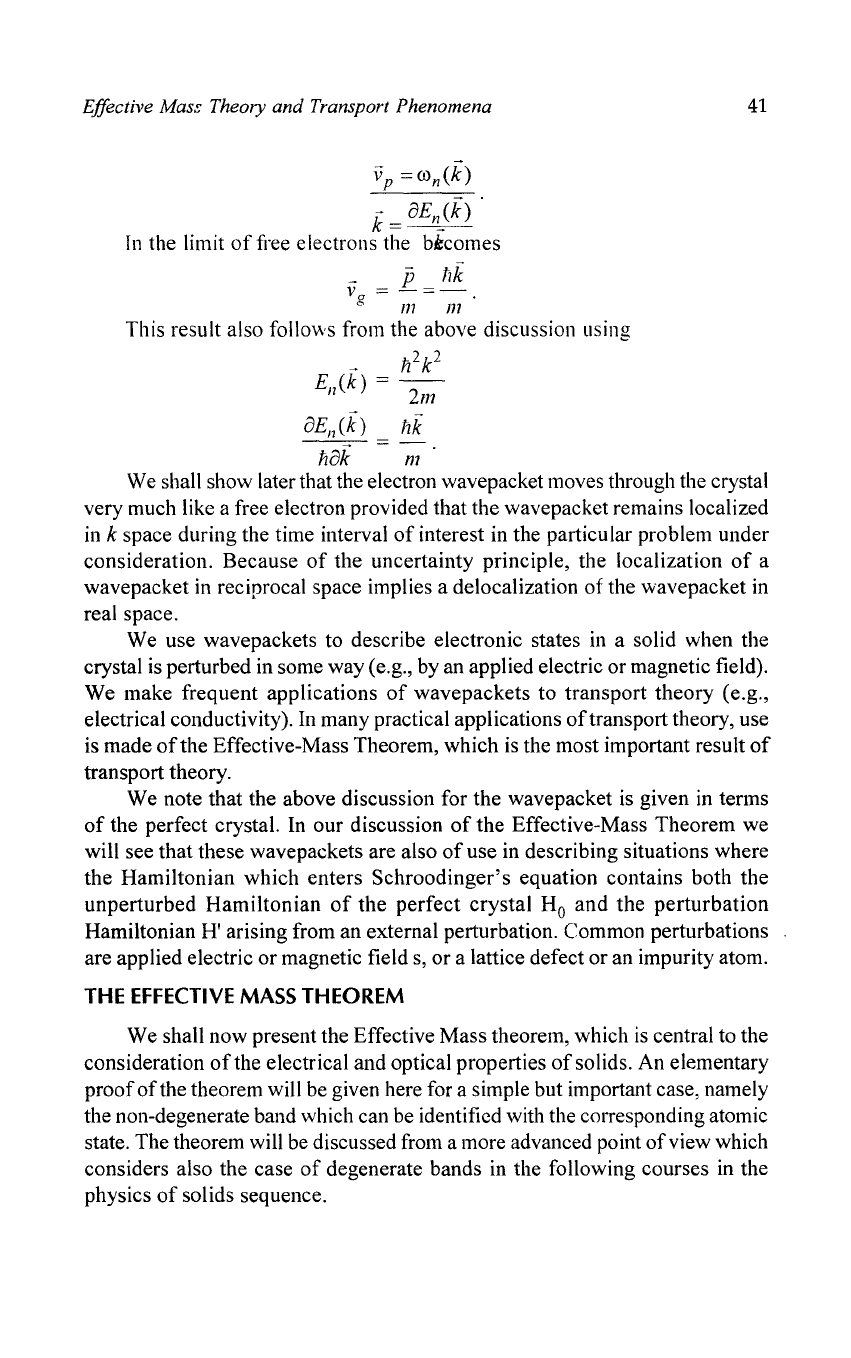
the standard form for a wavepacket moving with
""
v g
so that
while the phase velocity
Vg
=
v =
g
offin(k)
ok
Effective Mass Theory
and
Transport Phenomena
Vp
=OJn(k)
k =
BEn_(kl
In
the limit
of
free electrons the bkcomes
_ p tlk
v -
---
g-m-m·
This result also follo\\'s from the above discussion
Llsing
_
1i
2
k
2
E
(k)
=-
II
2m
BEn(k)
lik
IiBk
m
41
We shall show later that the electron wavepacket moves through the crystal
very much like a free electron provided that the wavepacket remains localized
in
k space during the time interval
of
interest in the particular problem under
consideration.
Because
of
the
uncertainty principle, the localization
of
a
wavepacket in reciprocal space implies a delocalization
of
the wavepacket in
real space.
We use wavepackets to describe electronic states in a solid when the
crystal is perturbed in some
way
(e.g., by an applied electric
or
magnetic field).
We
make frequent applications
of
wavepackets
to
transport
theory
(e.g.,
electrical conductivity). In many practical applications
of
transport theory, use
is made
of
the Effective-Mass Theorem, which is the most important result
of
transport theory.
We
note
that
the above discussion for
the
wavepacket is given in terms
of
the perfect crystal. In
our
discussion
of
the Effective-Mass Theorem
we
will see
that
these wavepackets are also
of
use
in describing situations where
the
Hamiltonian
which enters
Schroodinger's
equation contains both
the
unperturbed
Hamiltonian
of
the
perfect
crystal
Ho
and
the
perturbation
Hamiltonian H' arising from
an
external perturbation. Common perturbations
are applied electric
or
magnetic field s,
or
a lattice defect
or
an impurity atom.
THE
EFFECTIVE
MASS
THEOREM
We
shall now present the Effective
Mass
theorem, which
is
central to the
consideration
of
the electrical and optical properties
of
solids. An elementary
proof
of
the theorem will be given here for a simple but important case, namely
the non-degenerate band which can be identified with the corresponding atomic
state. The theorem will be discussed from a more advanced point
of
view which
considers also the case
of
degenerate bands in the following courses in the
physics
of
solids sequence.