
Brewster H.D. Solid State Physics
Подождите немного. Документ загружается.

222
Artificial Atoms
and
Superconductivity
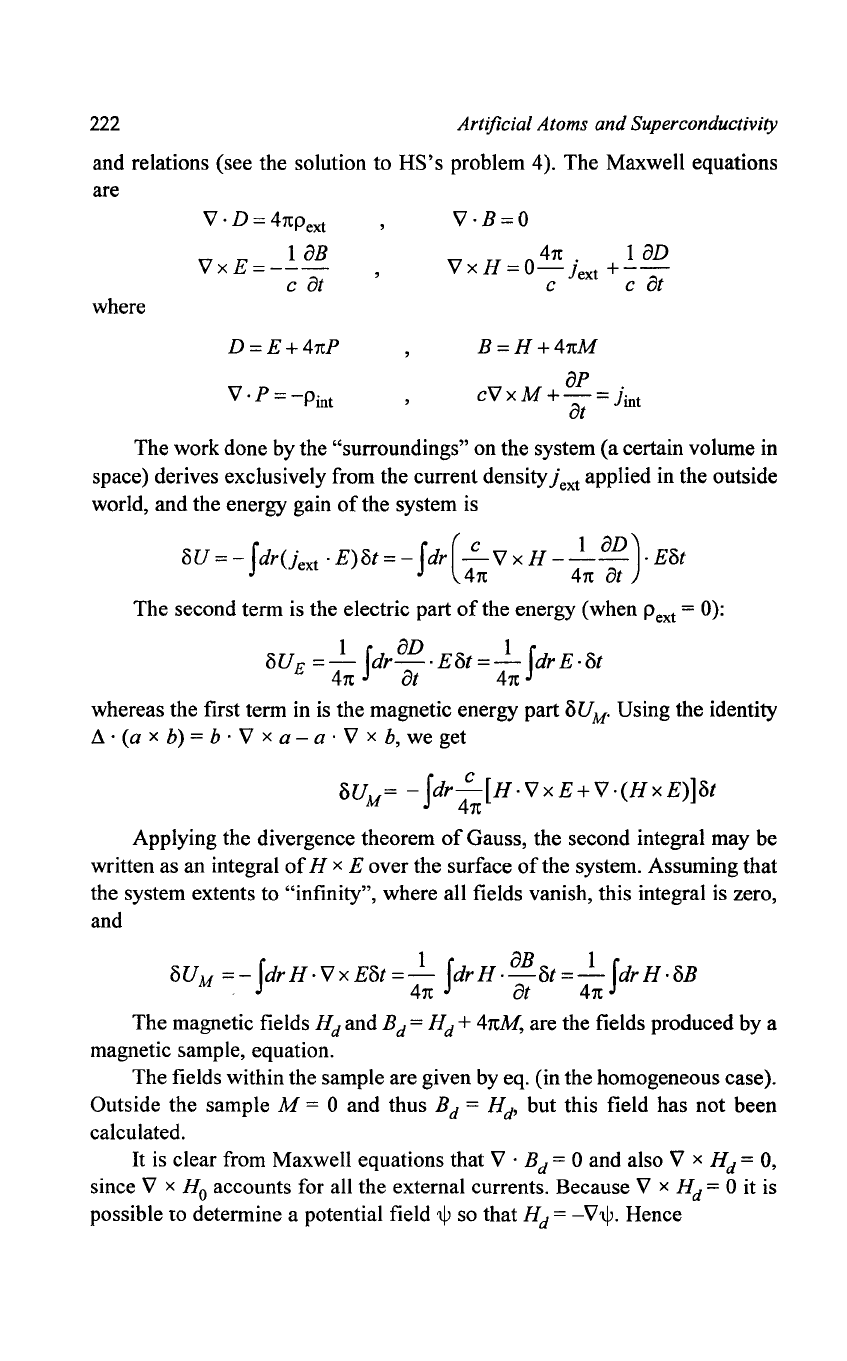
and relations (see the solution to
HS's
problem 4). The Maxwell equations
are
where
'V
. D =
41tP
ex
t
1
aB
'VxE=---
c at
D=E+41tP
'V
,P=-Pint
'V·B=O
'V
x H = 0
41t
J'
+!
aD
c ext C at
B=H
+41tM
n M
ap
.
CvX
+-=J't
at m
The work done by the "surroundings" on the system (a certain volume in
space) derives exclusively from the current density
jext
applied in the outside
world, and the energy gain
of
the system is
8U
=
-fdr(jext
.
E)8t
=-fdr(~'V
x H
__
1
aD).
E8t
41t
41t
at
The second tenn is the electric part
of
the energy (when P
ext
=
0):
8U
E
=_1
f
draD
.E8t=_1
fdrE.8t
41t
at
41t
whereas the first tenn in
is
the magnetic energy part
8U
M
.
Using the identity
~.
(a
x
b)
= b . V x a - a . V x
b,
we get
8U
M
= -
fdr
:1t[H,VXE+V.(HXE)]8t
Applying the divergence theorem
of
Gauss, the second integral may be
written as an integral
of
H x E over the surface
of
the system. Assuming that
the system extents to
"infinity", where all fields vanish, this integral is zero,
and
8U
M
=-fdr
H·
VxE8t=_1
fdrH.
aB
8t=_1
fdr
H
·8B
.
41t
at
4n
The magnetic fields Hd and B d = Hd +
4nM,
are the fields produced by a
magnetic
f>ample,
equation.
The fields within the sample are given by eq. (in the homogeneous case).
Outside the sample
M = 0 and thus Bd = H
d
, but this field has not been
calculated.
It is clear from Maxwell equations that
V . B d = 0 and also V x Hd =
0,
since V x
Ho
accounts for all the external currents. Because V x Hd = 0 it is
possible
to
determine a potential field
tjJ
so that Hd = -VtjJ. Hence
Artificial Atoms
and
Superconductivity
223
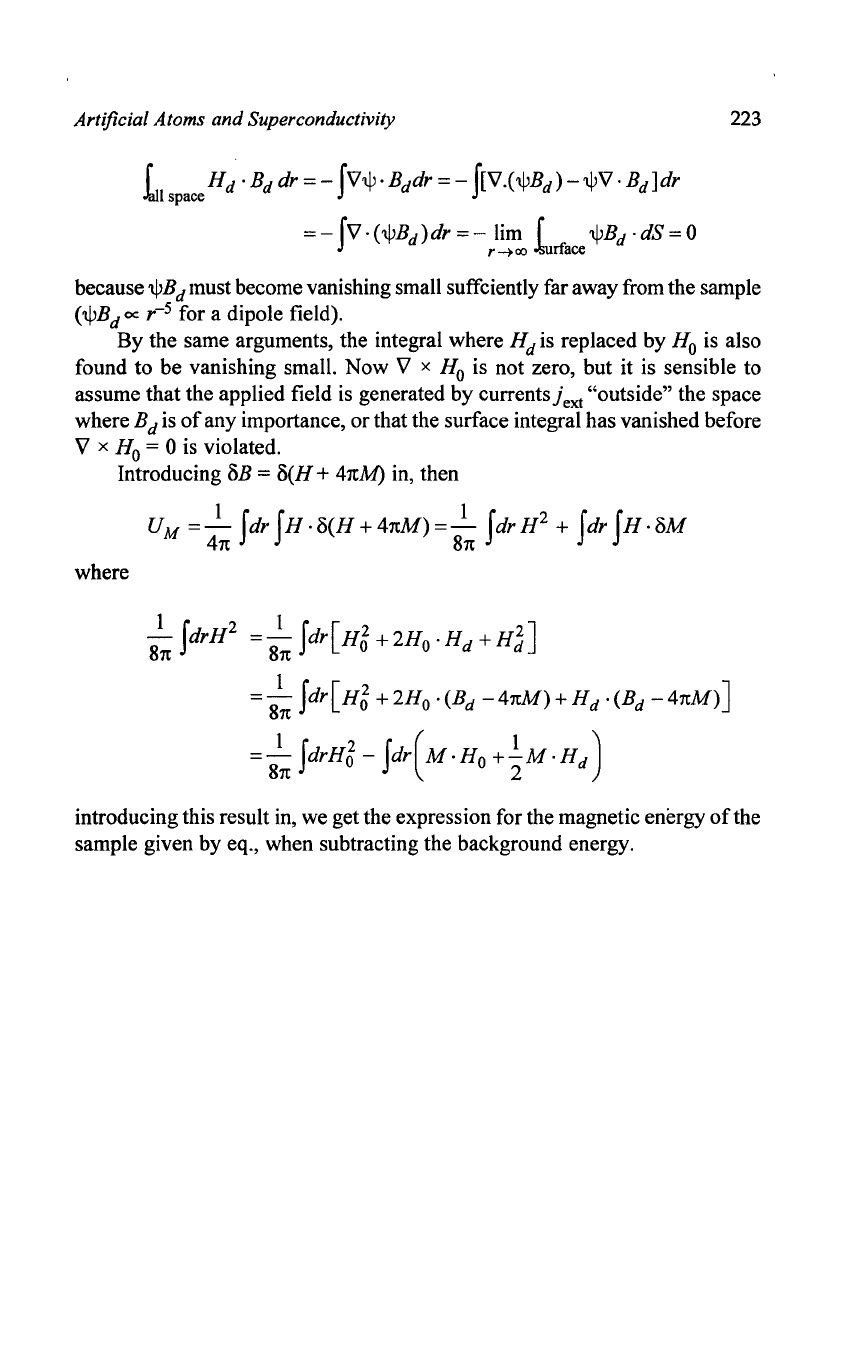
because
\)JB
d must become vanishing small suffciently far away from the sample
(\)JBd
oc
r-
5
for a dipole field).
By the same arguments, the integral where
Hd
is replaced by
Ho
is also
found to be vanishing small. Now
V x
Ho
is not zero, but it is sensible to
assume that the applied field is generated by currentsjext
"outside" the space
where
B d is
of
any importance, or that the surface integral has vanished before
V x
Ho
= 0
is
violated.
Introducing
BE
=
B(H
+
41tM)
in, then
where
U
M
= 4
1
1t
fdr
fH.8(H+41tM)=8~
f
drH2
+ fdr
fH.8M
_1
rdrH2
81t
J'
introducing this result in, we get the expression for the magnetic energy
of
the
sample given by eq., when subtracting the background energy.
Chapter
10
Quantum and Statistical Mechanics
STATES
AND
OPERATORS
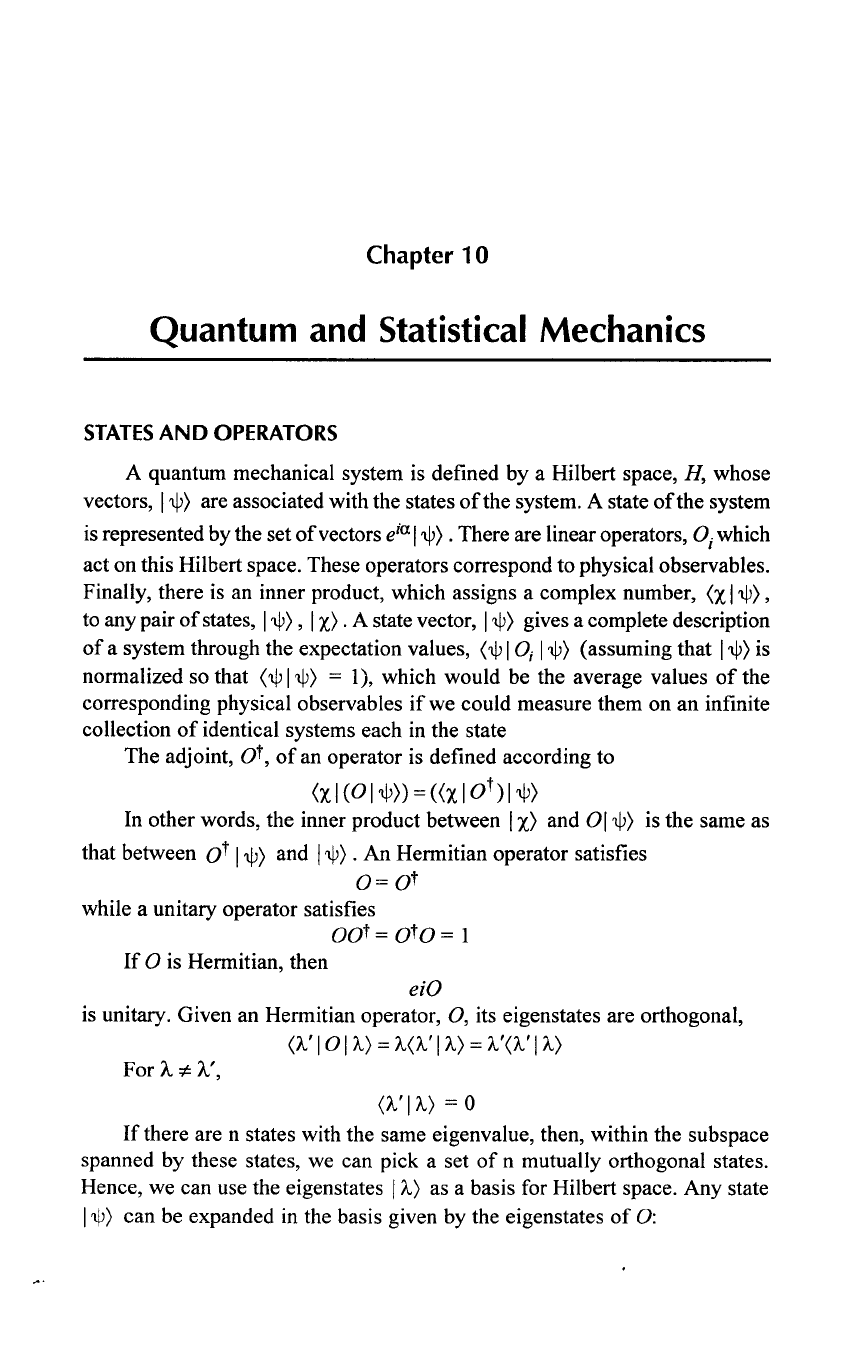
A quantum mechanical system is defined
by
a Hilbert space, H, whose
vectors,
1'ljJ)
are associated with the states
ofthe
system. A state
ofthe
system
is represented
by
the set
of
vectors e
ia
I
'ljJ)
. There are linear operators,
0i
which
act
on
this Hilbert space. These operators correspond to physical observables.
Finally, there is an inner product, which assigns a complex number,
<X
I
'ljJ)
,
to any pair
of
states, I
'ljJ)
, I
X)
. A state vector,
1'ljJ)
gives a complete description
of
a system through the expectation values,
('l\J
I
0;
1
'l\J)
(assuming that
1'ljJ)
is
normalized so that
<'l\J
1
'l\J)
= 1), which would be the average values
of
the
corresponding physical observables
if
we
could measure them
on
an
infinite
collection
of
identical systems each in the state
The
adjoint,
ot,
of
an operator is defined according to
(xl(OI'ljJ»)=«xlot)I'l\J)
In other words, the inner product between I
X)
and
01
'l\J)
is the same as
that between
ot
1
'l\J)
and
1'ljJ)
.
An
Hermitian operator satisfies
O=ot
while a unitary operator satisfies
oot=
otO=
1
If
0 is Hermitian, then
eiO
is unitary. Given an Hermitian operator,
0,
its eigenstates are orthogonal,
(A' 1
01
A)
=
A(A'
1
A)
= A'(A' 1
A)
For
A"*
A',
(A' 1
A)
= 0
If
there are n states with the same eigenvalue, then, within the subspace
spanned
by
these states, we can pick a set
of
n mutually orthogonal states.
Hence,
we
can use the eigenstates 1
A)
as a basis for Hilbert space.
Any
state
1
'ljJ)
can
be expanded in the basis given by the eigenstates
of
0:
Quantum and Statistical Mechanics
225
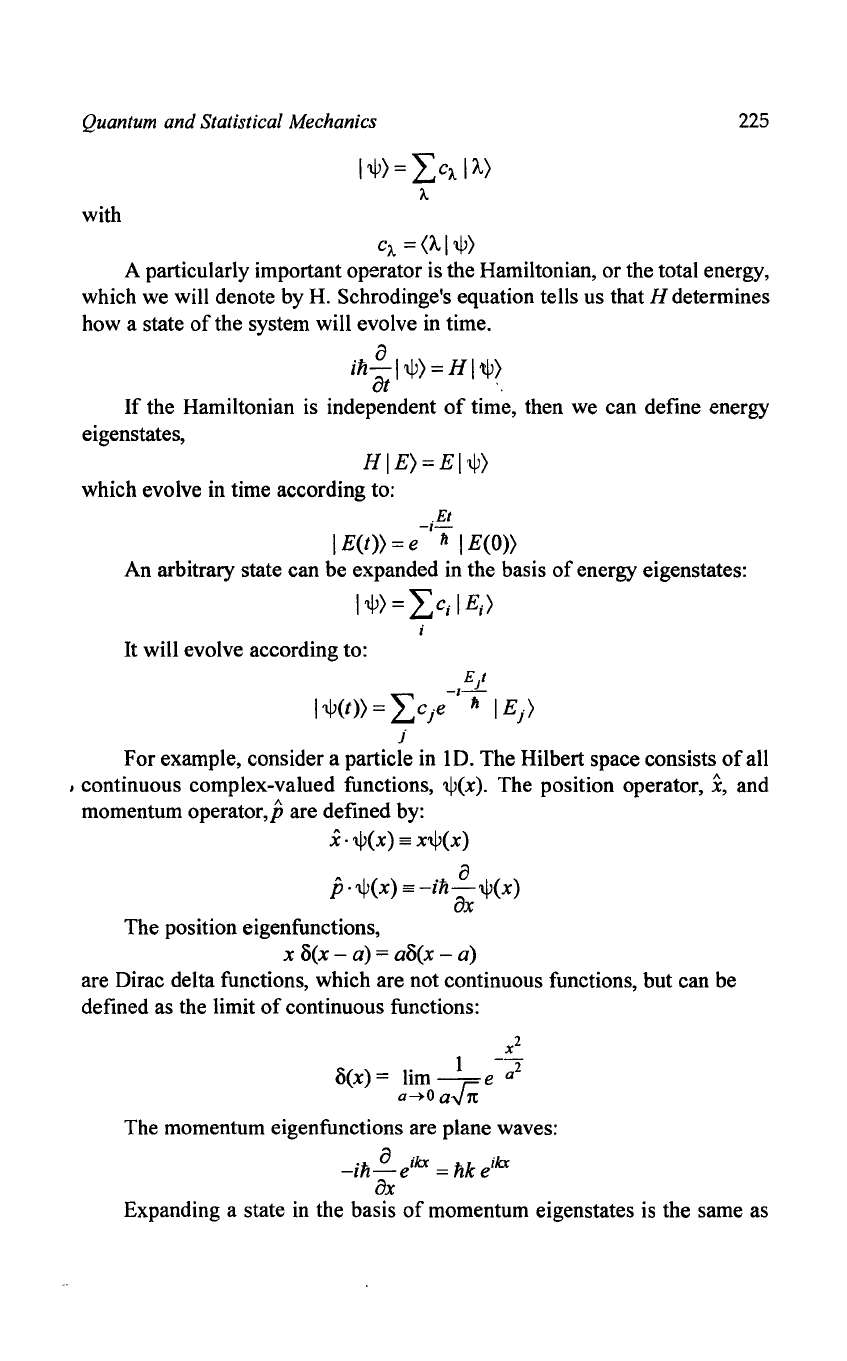
with
C"-
=
0.1
'¢)
A particularly important operator is the Hamiltonian, or the total energy,
which we will denote by
H.
Schrodinge's equation tells us that H determines
how a state
of
the system will evolve in time.
ih~1
'¢) =
HI
tV)
at
"
If
the Hamiltonian is independent
of
time, then we can define energy
eigenstates,
HI
E)
=EI'¢)
which evolve in time according to:
,Et
-/-
I
E{t»
= e
11
I
E{O»
An arbitrary state can be expanded in the basis
of
energy eigenstates:
1'¢)=Lc;IE;)
;
It will evolve according to:
El
I '¢(t» =
Lcje
-/111
E)
j
For example, consider a particle in
10.
The Hilbert space consists
of
all
, continuous complex-valued functions,
,¢(x). The position operator,
X,
and
momentum operator,p are defined by:
x·
'¢(x)
==
x,¢{x)
p.
,¢(x)
==
-ih~'¢{x)
ax
The position eigenfunctions,
x o{x - a) = ao{x - a)
are Dirac delta functions, which are not continuous functions, but can be
defined as the limit
of
continuous functions:
x
2
1
--
O{x)
= lim
--e
a
2
a~O
a,J;.
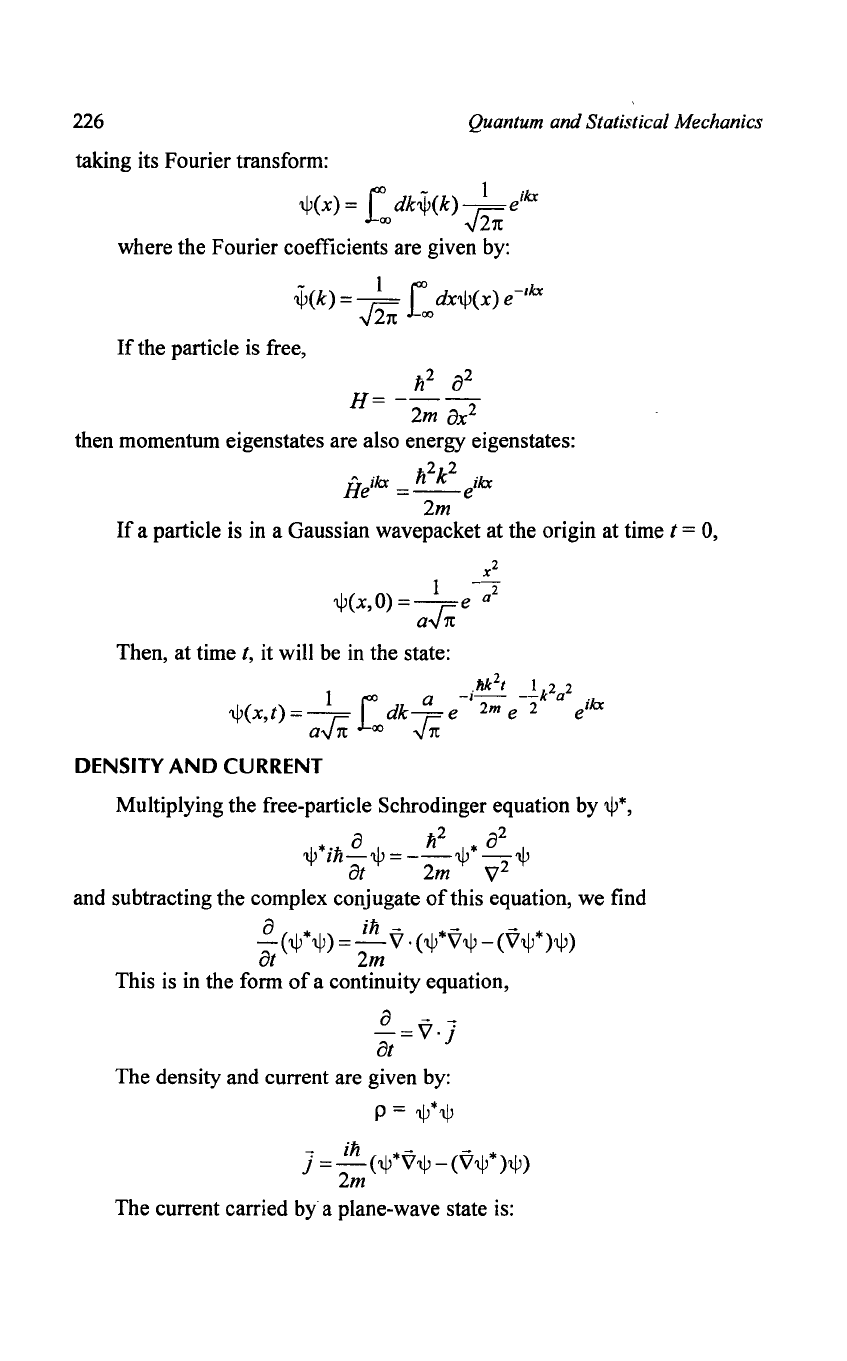
The momentum eigenfunctions are plane waves:
·h
a
;kx
hk;kx
-I
-e
= e
ax
Expanding a state
in
the basis
of
momentum eigenstates is the same as
226
Quantum and Statistical Mechanics
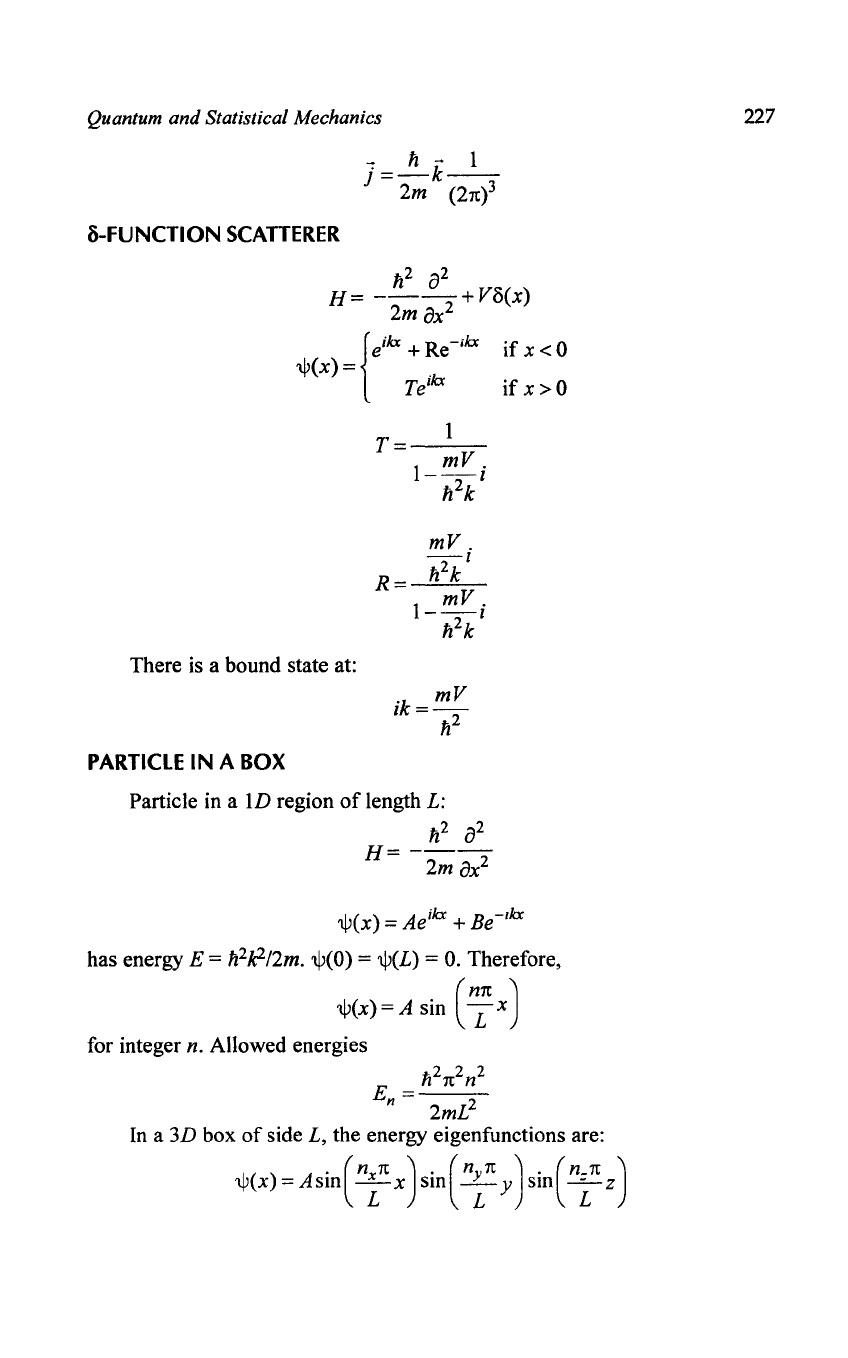
taking its Fourier transform:
'ljJ(x)
= F dk,;j)(k)
~
e
ih
100
,,2rc
where the Fourier coefficients are given by:
,;j)(k)
=
~
F dx'ljJ(x)
e-,h
,,2rc
100
If
the particle is free,
h
2
a
2
H=----
2m
ax
2
then momentum eigenstates are also energy eigenstates:
2 2
A
'h
h k ',-
He' =
__
e'1!.J<
2m
If
a particle is in a Gaussian wavepacket at the origin at time t = 0,
x
2
1
-2
'ljJ(x,O)
=--e
a
a~
Then, at time
t,
it will be
in
the state:
,hk
2
t 1 2 2
1 [ a
-1-
--k
a ,
'ljJ(X,t) =
--
dk-
e
2m
e 2 e
'h
a~
00
~
DENSITY
AND
CURRENT
Multiplying the free-particle Schrodinger equation by
'ljJ*,
2
a2
'ljJ*ih~'ljJ
=
-~'ljJ*-'ljJ
at
2m V
2
and subtracting the complex conjugate
of
this equation, we find
~('ljJ*'ljJ)
=~V
.(tjJ*V'ljJ-(VtjJ*)'ljJ)
at
2m
This is in the form
of
a continuity equation,
a
--
-=V·j
at
The density and current are given by:
p =
'ljJ*'ljJ
J
=~('ljJ*V'ljJ-(V'ljJ*)'ljJ)
2m
The current carried
by
a plane-wave state is:
Quantum and Statistical Mechanics
- h - 1
j=-k--
2m
(27t)3
~-FUNCTION
SCATTERER
h
2
a
2
H=
---+V8(x)
2m
ax
2
{
e
ikx
+ Re
-jkx
if
x < 0
'ljJ(x)
=
"kx
Te'
if
x>O
mV.
-I
R =
--=h....:..
2
k:-.--
1-
mV
i
h
2
k
There is a bound state at:
.k
mV
1=-
h
2
PARTICLE
IN A BOX
Particle in a
ID
region
of
length L:
h
2
a
2
H=
----
2m
ax
2
'ljJ(x)
=
Ae
ikx
+ Be-
Ikx
has energy E =
h2~/2m.
'ljJ(O)
=
'ljJ(L)
=
o.
Therefore,
'ljJ(x)=A sin
(n;
x)
for integer n. Allowed energies
tt
2
7t
2
n
2
E
=-----:-
n
2mL2
In
a 3D box
of
side L, the energy eigenfunctions are:
'ljJ(x)
= ASin( n
l
7t
x)
sin(
n~7t
Y
)sin
(
n~7t
z)
227
228
Quantum
and
Statistical Mechanics
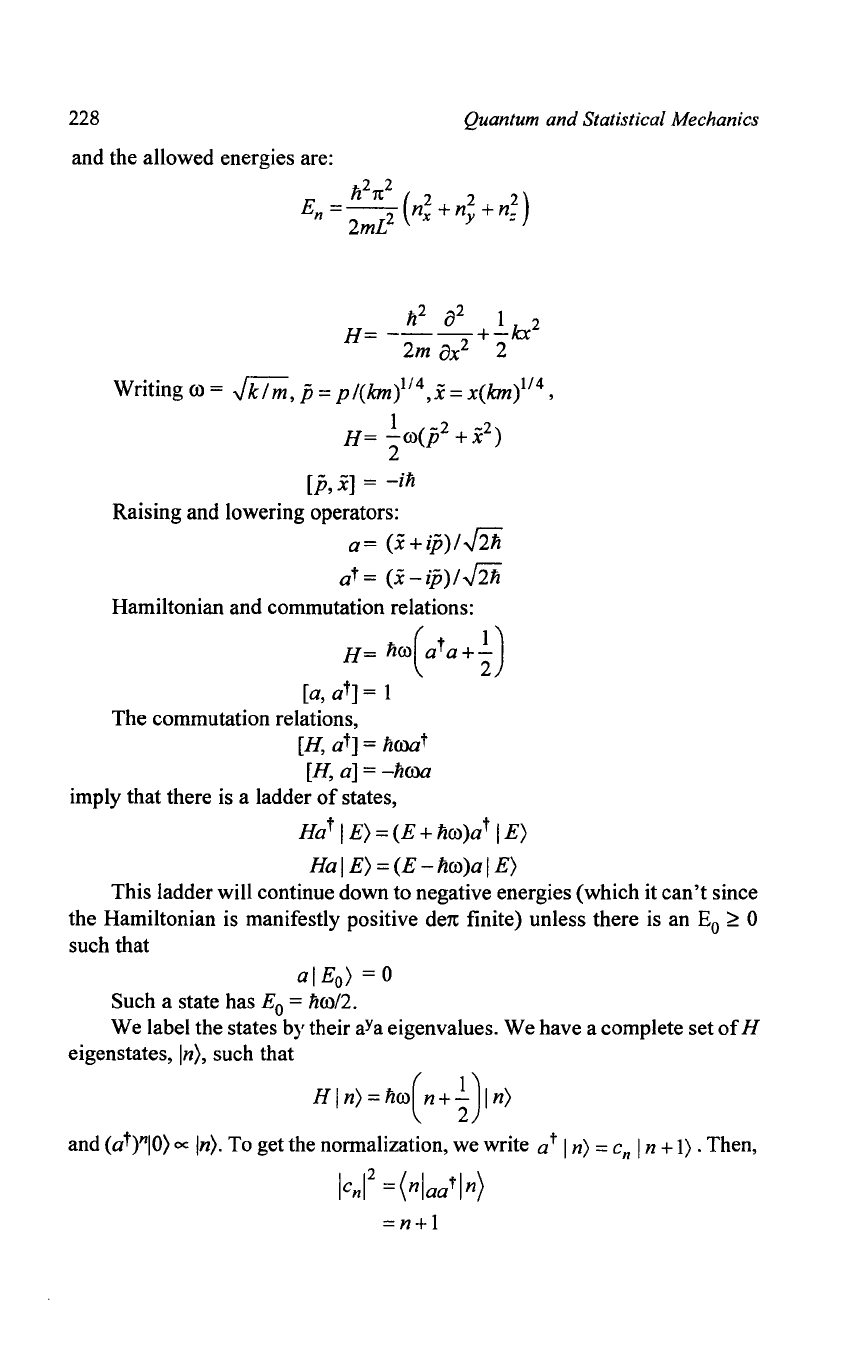
and the allowed energies are:
h
2
a
2
1 2
H=
---+-kx
2m
ax
2
2
Writing
co
=
.Jk/m,
p =
p/(km)l!4,x
=
x(kmF4,
H=
~ro(p2
+x2)
2
[p,
x] =
-ih
Raising
and
lowering operators:
a=
(x
+ip)/J"ih
a
t
=
(x-ip)/J"ih
Hamiltonian
and
commutation relations:
H=
hro(
ata
+~)
[a,
at]
= 1
The
commutation relations,
[H,
at]
= hroa
t
[H,
a]
= -hroa
imply
that
there is a ladder
of
states,
Hat
I E) =
(E
+ hro)a
t
I
E)
Hal
E)
=(E
-hro)al
E)
This
ladder will continue
down
to
negative energies
(which
it
can't
since
the
Hamiltonian is manifestly positive
den
finite) unless
there
is
an
Eo
~
0
such
that
al
Eo)
= 0
Such
a state has
Eo
= hco/2.
We
label the states
by
their
aYa
eigenvalues.
We
have a complete
set
of
H
eigenstates,
In),
such
that
HI
n) =
hro(
n+~}
n)
and (at)nIO)
oc
In).
To get the normalization,
we
write
at
In) = C
n
In
+
1)
. Then,
Ic
n
l
2
=(nlaatln)
=n+l
Quantum and Statistical Mechanics
Hence,
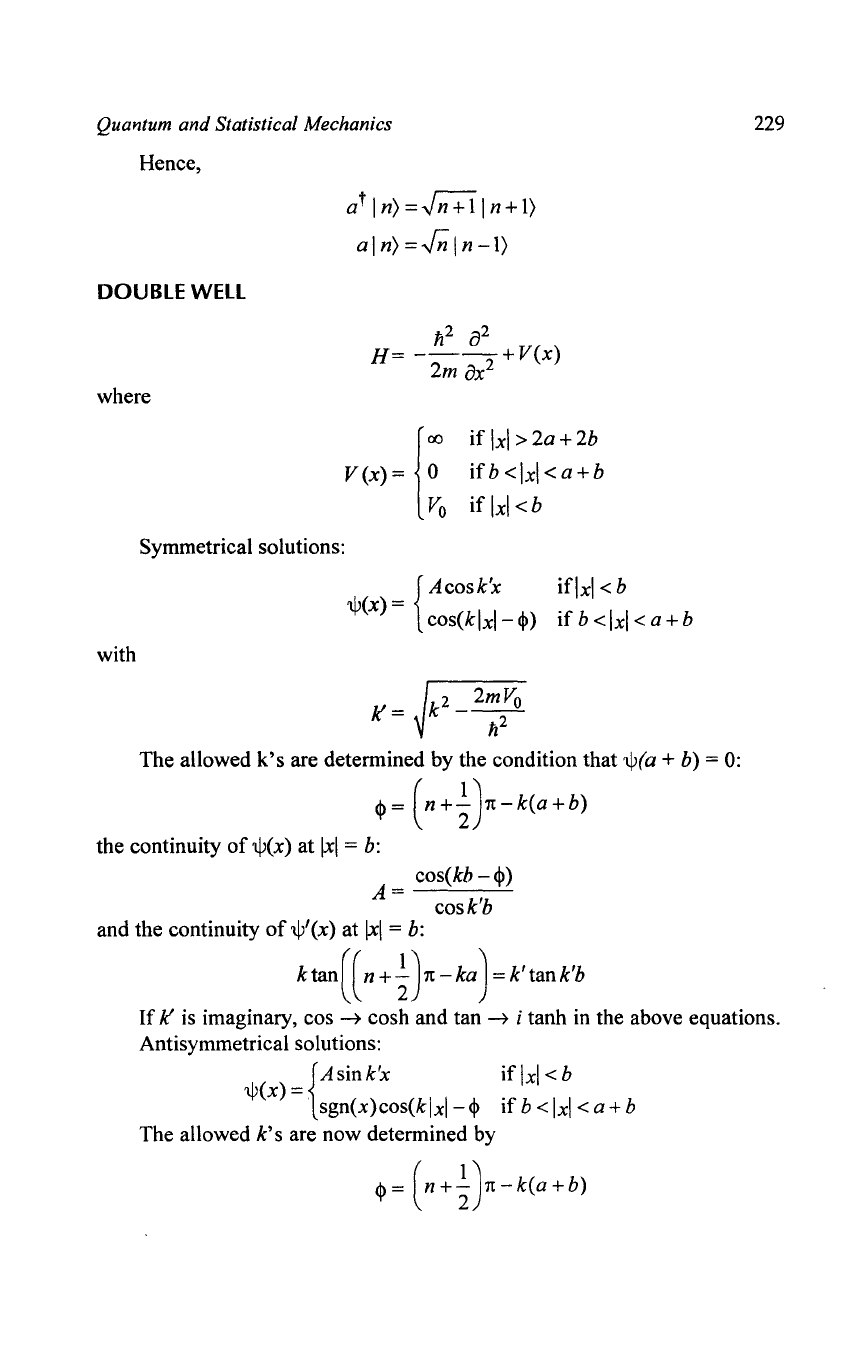
DOUBLE
WEll
where
Symmetrical solutions:
with
a
t
ln)=.Jn+lln+l)
a
In)
=
Fn
In-I)
V (x) =
{~
Vo
if
Ixl
> 2a +
2b
if
b <
Ixl
< a + b
if
Ixl
<b
{
Acosk'x
iflxl < b
t\J(x)
=
cos(klxl-
~)
if
b <
Ixl
< a + b
It=Jk2_2mvo
/i
2
The allowed
k's
are determined by the condition that
t\J(a
+ b) =
0:
<I>
=
(n
+
~)
1t
-
k(
a +
b)
the continuity
of
t\J(x)
at
Ixl
=
b:
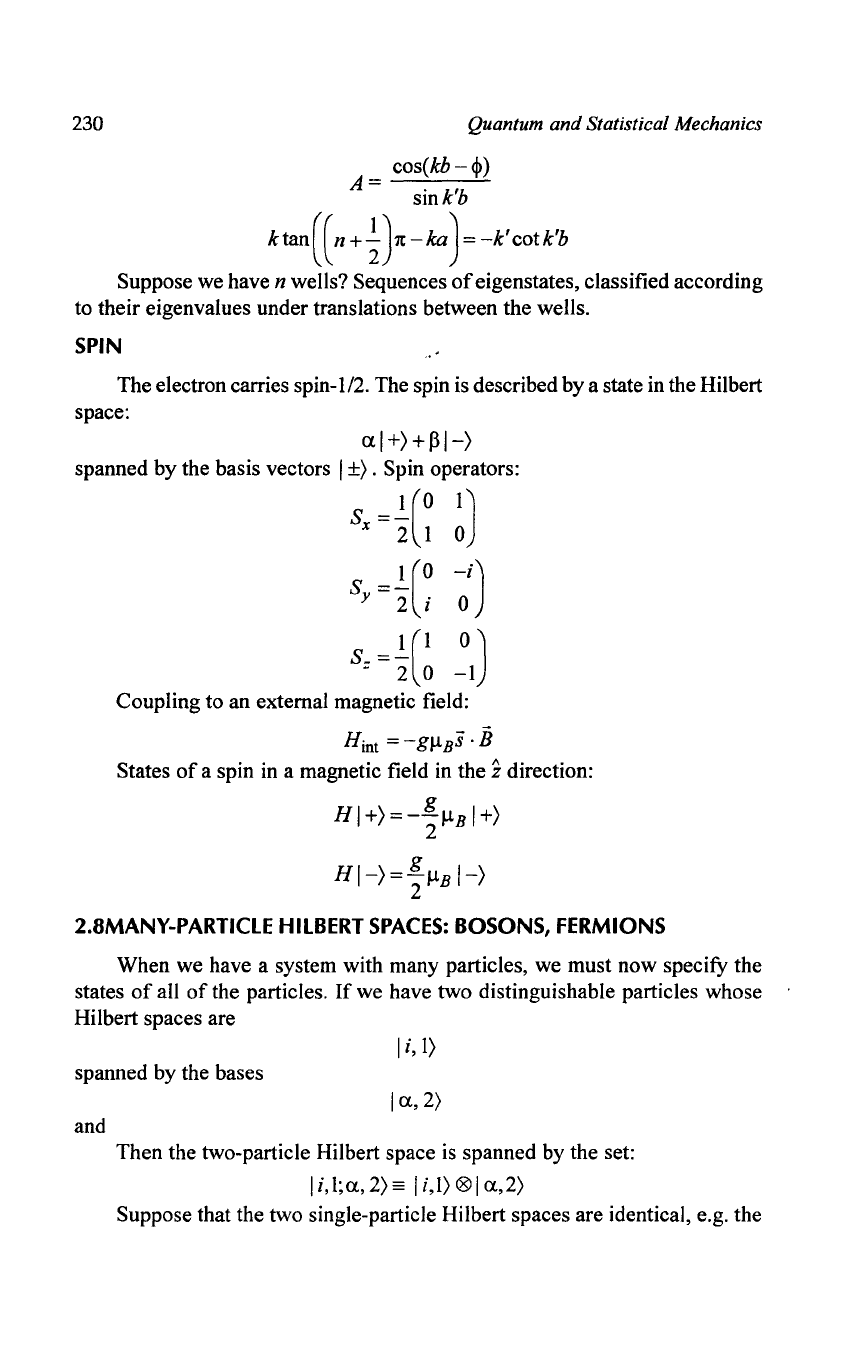
cos(kh
-<I»
A=
--'---'-'-
cosk'h
and the continuity
of
t\J'(x)
at
Ixl
=
b:
ktan(
(n
+~)1t
-ka)
= k'tank'b
229
If
It
is
imaginary, cos
~
cosh and tan
~
i tanh
in
the above equations.
Antisymmetrical solutions:
t\J(x)
=
{
A
sin
k'x
if
Ixl
< b
. sgn(x)cos(klxl-
~
if
b <
Ixl
< a + b
The allowed
k's
are now determined by
<I>
=
(n
+
~)
1t
-
k(
a + b)
230
Quantum
and
Statistical Mechanics
cos(kb-<j»
A=
. k'b
SIn
ktan(
(n+~)1t-ka
) =
-k'
cot
k'b
Suppose
we
have n wells? Sequences
of
eigenstates, classified according
to
their
eigenvalues
under
translations between
the
wells.
SPIN
The electron carries spin-I12. The spin is described
by
a state in the Hilbert
space:
o.l+)+~I-)
spanned
by
the basis vectors I
±)
. Spin operators:
Sx=~(~
~)
S
=-
1
(0
-Oi)
y 2 i
S
=!(1
0)
= 2 0
-1
Coupling
to
an
external magnetic field:
Hint =
-g~Bs
. B
States
of
a spin in a magnetic field in
the
z direction:
HI+)=-g~BI+)
2
HI-)=~~BI-)
2.8MANY-PARTICLE
HILBERT
SPACES:
BOSONS,
FERMIONS
When
we
have a system with
many
particles,
we
must
now
specify the
states
of
all
of
the particles.
If
we
have
two
distinguishable particles
whose
Hilbert spaces are
Ii,
1)
spanned
by
the bases
I a., 2)
and
Then
the two-particle Hilbert space is spanned by the set:
li,l;o.,2)=
li,I)®lo.,2)
Suppose that the
two
single-particle Hilbert spaces are identical, e.g. the
Quantum and Statistical Mechanics
two particles are in the same box. Then the two-particle Hilbert space is:
1
i,j)
=1
i,l)
®I
j,2)
231
If
the particles are identical, however, we must be more careful. 1
i,j)
and
1
j,i)
must be physically the same state, i.e.
I
i,j)
=
eiCJ.
I
j,i)
Applying this relation twice implies that
I
i,j)
= e
2i
CJ.
I
i,j)
so e
ilt
= ± I. The former corresponds to bosons, while the latter corresponds to
fermions. The two-particle Hilbert spaces
of
bosons and fermions are
respectively spanned by:
1
i,j)
+ Ii,
i)
and
1
i,j)
-I
j,i)
The n-particle Hilbert spaces
of
bosons and fermions are respectively
spanned by:
LI
i
1t
(I) ....
,i1t(n»
1t
and
L (_I)1t I i
1t
(I)
....
,ilt(n»
1t
In position space, this means that a bosonic wavefunction must be
completely symmetric:
t\J(Xl>""
xi'"
.,x
i'"
.,x
n
)
= t\J(xl>'"
'Xi'"
"Xi""
,xn)
while a fermionic wavefunction must be completely antisymmetric:
t\J(
Xl" .. ,
Xi
,
...
,
Xi"
.. , xn) = -t\J( Xl'
...
, X J '
•••
, Xi'
...
,
Xn
)
STATISTICAL
MECHANICS
MICROCANONICAL,
CANONICAL,
ENSEMBLES
In
statistical mechanics, we deal with a situation in which even the
quantum state
of
the system is unknown. The expectation value
of
an
observable must be averaged over:
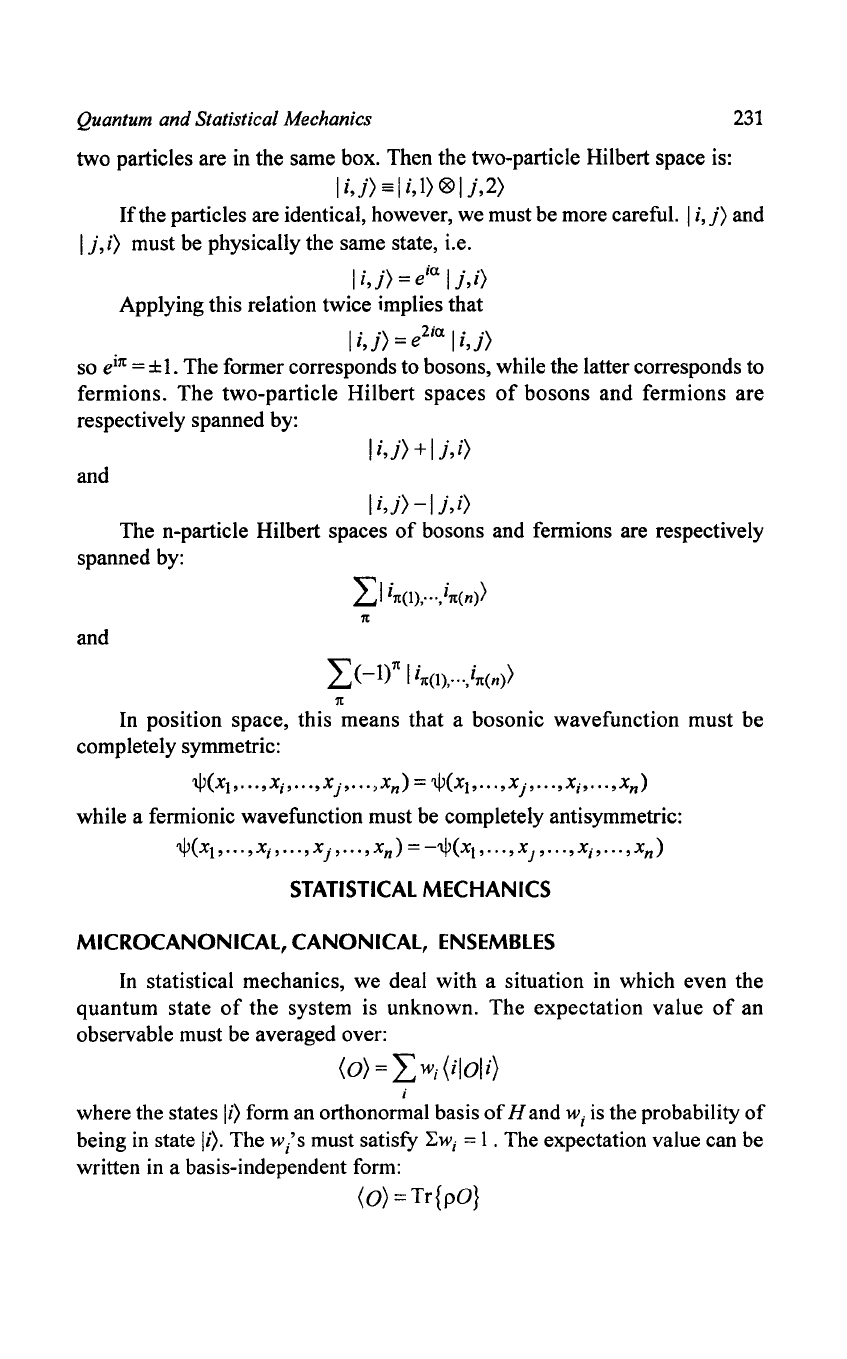
(0)=
Lwi(iloli)
i
where the states Ii) form an orthonormal basis
of
Hand
Wi
is
the probability
of
being
in
state Ii). The w;'s must satisfy
l:w;
= 1 . The expectation value can be
written
in
a basis-independent form:
(0)
=Tr{pO}