
Brewster H.D. Solid State Physics
Подождите немного. Документ загружается.

192
a
i
c:
~
7.0
~
S
>-
6.5
Cl
cr
w
z
w
Artificial Atoms
and
Superconductivity
b
2r-------------------------------~
c
1.5r-----------------------
.......
o~~
____
~~--~~----~~--~
1.0 1.5 2.0 2.5 3.0
MAGNETIC
FIELD
(tesla)
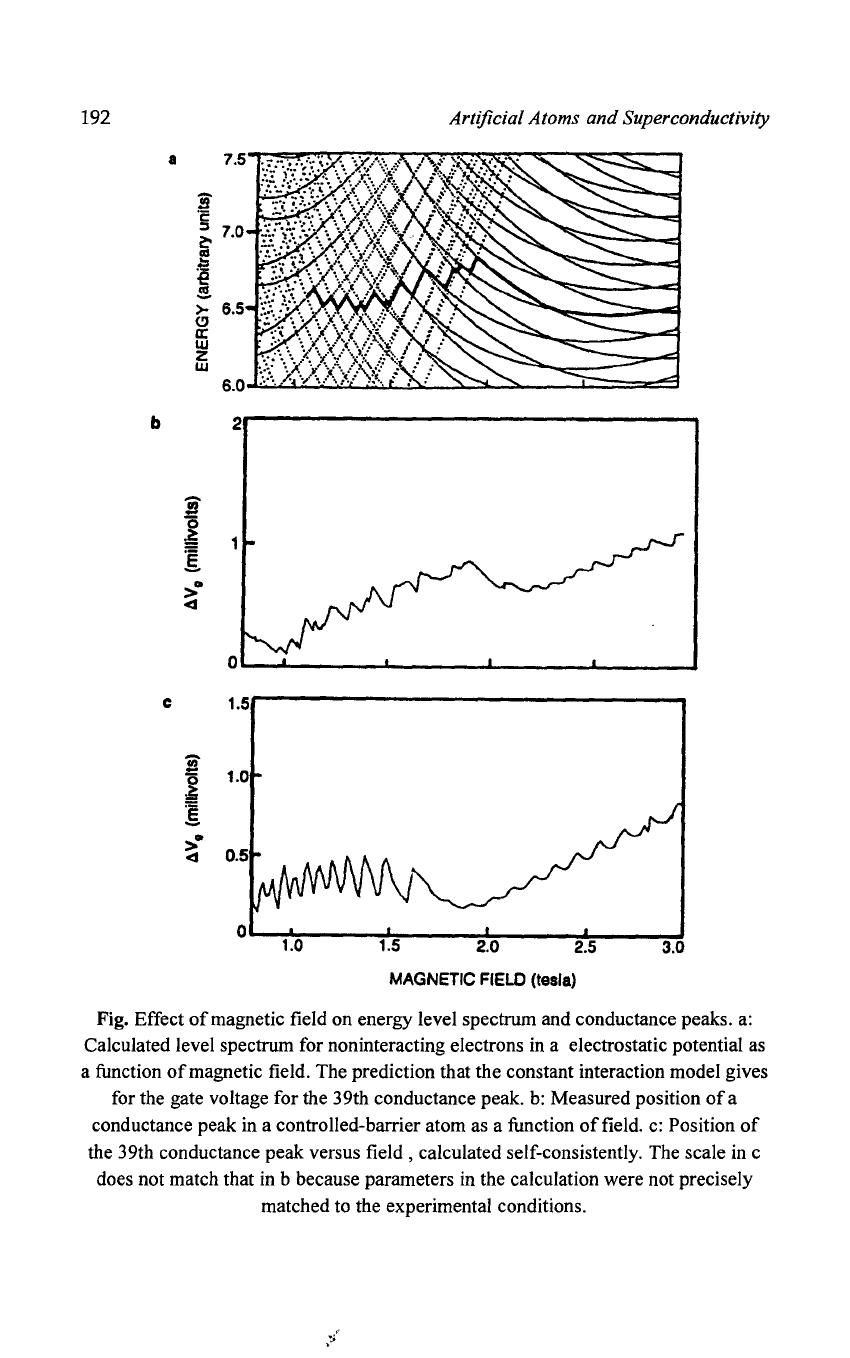
Fig. Effect
of
magnetic field on energy level spectrum and conductance peaks.
a:
Calculated level spectrum for noninteracting electrons
in
a electrostatic potential
as
a function
of
magnetic field. The prediction that the constant interaction model gives
for the gate voltage for the 39th conductance peak.
b:
Measured position
of
a
conductance peak in a controlled-barrier atom as a function offield.
c:
Position
of
the 39th conductance peak versus field, calculated self-consistently. The scale in c
does not match that in b because parameters in the calculation were not precisely
matched to the experimental conditions.
Artificial Atoms
and
Superconductivity
193
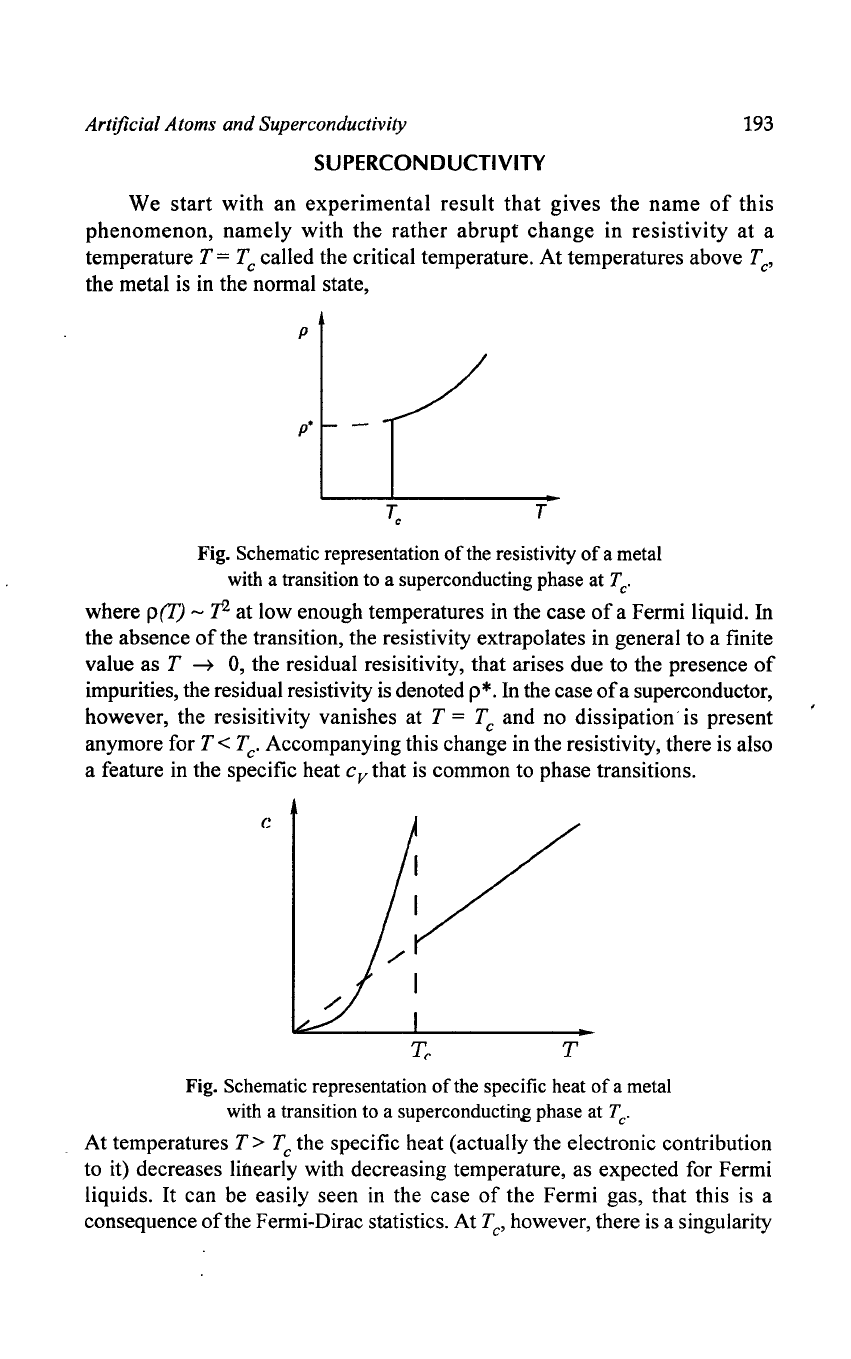
SUPERCONDUCTIVITY
We
start
with
an
experimental
result
that
gives
the
name
of
this
phenomenon,
namely
with
the
rather
abrupt
change
in
resistivity
at a
temperature
T =
Tc
called the critical temperature.
At
temperatures above T
c
'
the metal
is
in the normal state,
p
T
Fig. Schematic representation
of
the
resistivity
of
a metal
with
a transition
to
a superconducting phase
at
Tc'
where p(T)
~
'f2 at low enough temperatures in the case
of
a Fermi liquid.
In
the absence
of
the transition, the resistivity extrapolates in general to a finite
value as
T
~
0, the residual resisitivity, that arises due to the presence
of
impurities, the residual resistivity
is
denoted p*. In the case
ofa
superconductor,
however, the resisitivity vanishes at
T =
Tc
and no dissipation is present
anymore for
T <
Tc'
Accompanying this change in the resistivity, there is also
a feature in the specific heat
C
v
that
is
common to phase transitions.
Fig.
Schematic representation
of
the
specific heat
of
a
metal
with
a transition
to
a superconducting phase
at
T
c
'
At
temperatures T>
Tc
the specific heat (actually the electronic contribution
to it) decreases lifiearly with decreasing temperature, as expected for Fermi
liquids. It can be easily seen in the case
of
the Fermi gas, that this
is
a
consequence
of
the Fermi-Dirac statistics.
At
T
c
'
however, there
is
a singUlarity
194
Artificial Atoms and Superconductivity
in
C
v
that manifests experimentally as ajump. At low temperatures the specific
heat decreases exponentially,
Cv
~
exp ( - ; ) .
Since the specific heat
is
associated with the density
of
states at the Fermi
energy, an exponential decrease
is
then a signal
of
an energy gap in the
electronic spectrum.
Also in the presence
of
a magnetic field a number
of
remarkable
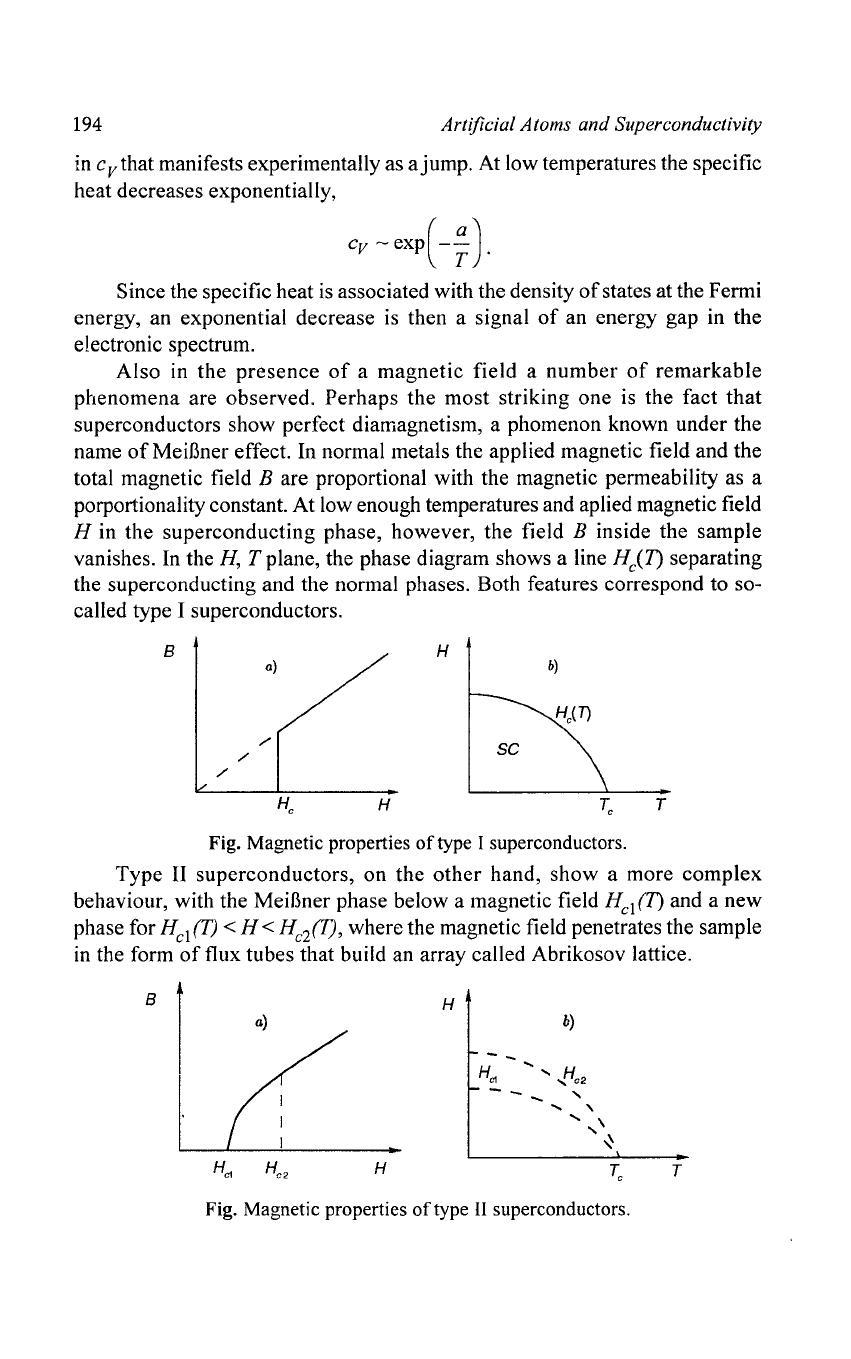
phenomena are observed. Perhaps the most striking one is the fact that
superconductors show perfect diamagnetism, a phomenon known under the
name
of
MeiI3ner effect.
In
normal metals the applied magnetic field and the
total magnetic field
B are proportional with the magnetic permeability as a
porportionality constant. At low enough temperatures and aplied magnetic field
H in the superconducting phase, however, the field B inside the sample
vanishes.
In
the
H,
T plane, the phase diagram shows a line He(1) separating
the superconducting and the normal phases. Both features correspond to so-
called type I superconductors.
B H
a)
b)
sc
,/
,/
,/
H T
Fig. Magnetic properties
of
type I superconductors.
Type
II
superconductors, on the other hand, show a more complex
behaviour, with the MeiBner phase below a magnetic field
He!
(1) and a new
phase for
Hcl
(T)
< H <
HelT),
where the magnetic field penetrates the sample
in
the form
of
flux tubes that build an array called Abrikosov lattice.
H
a)
b)
H
T
Fig. Magnetic properties
of
type
II
superconductors.
Artificial Atoms
and
Superconductivity
195
We will discuss first a phenomenological theory due to Ginzburg and
Landau, that starting with fro phase transitions will be able to describe
consistently many
of
the features discussed above. Later, we discuss electron-
phonon coupling and the BCS-theory due to Bardeen, Cooper and Schrieuer,
that will give us a microscopic insight into the mechanism
of
superconductivity.
THEORY
This phenomelogical theory is a special case
of
the general theory for
phase transitions developed by Landau.
In this frame,
we
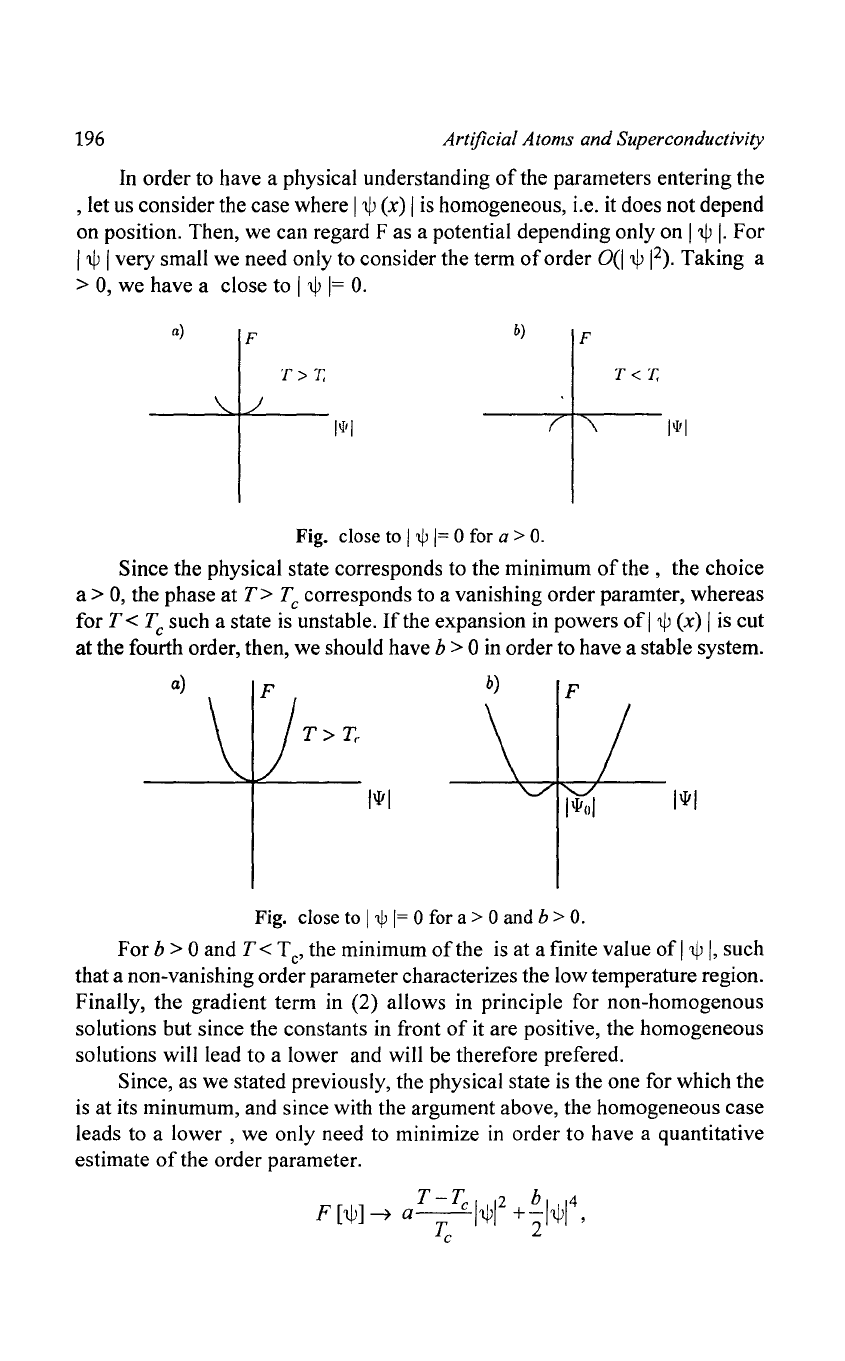
cor..sider the F as a functional
of
a field that should
describe the possible phases
of
the system. This order parameter
'l\J
has the
property
of
being zero in the high temeprature phase, where the new order is
still not established,
and'l\J
*-
0 below T
e
,
where the
new
phase appears. The
order parameter should be such that it contains information relevant to the
ordered phase.
In the case
of
superconductivity,
we
consider that the new phase can be
described by a wave function, and hence it will have in general a real and an
imaginary part.
We
say then, that the order parameter has two components. In
the general frame
of
the theory
of
phase transitions, the number
of
components
of
the order parameter will determine in general the major features
of
the
transition. For example, in the case
of
a ferromagnet,
if
the system is isotropic
in spin space, the order parameter will be a vector with three components.
WITHOUT
MAGNETIC FIELD
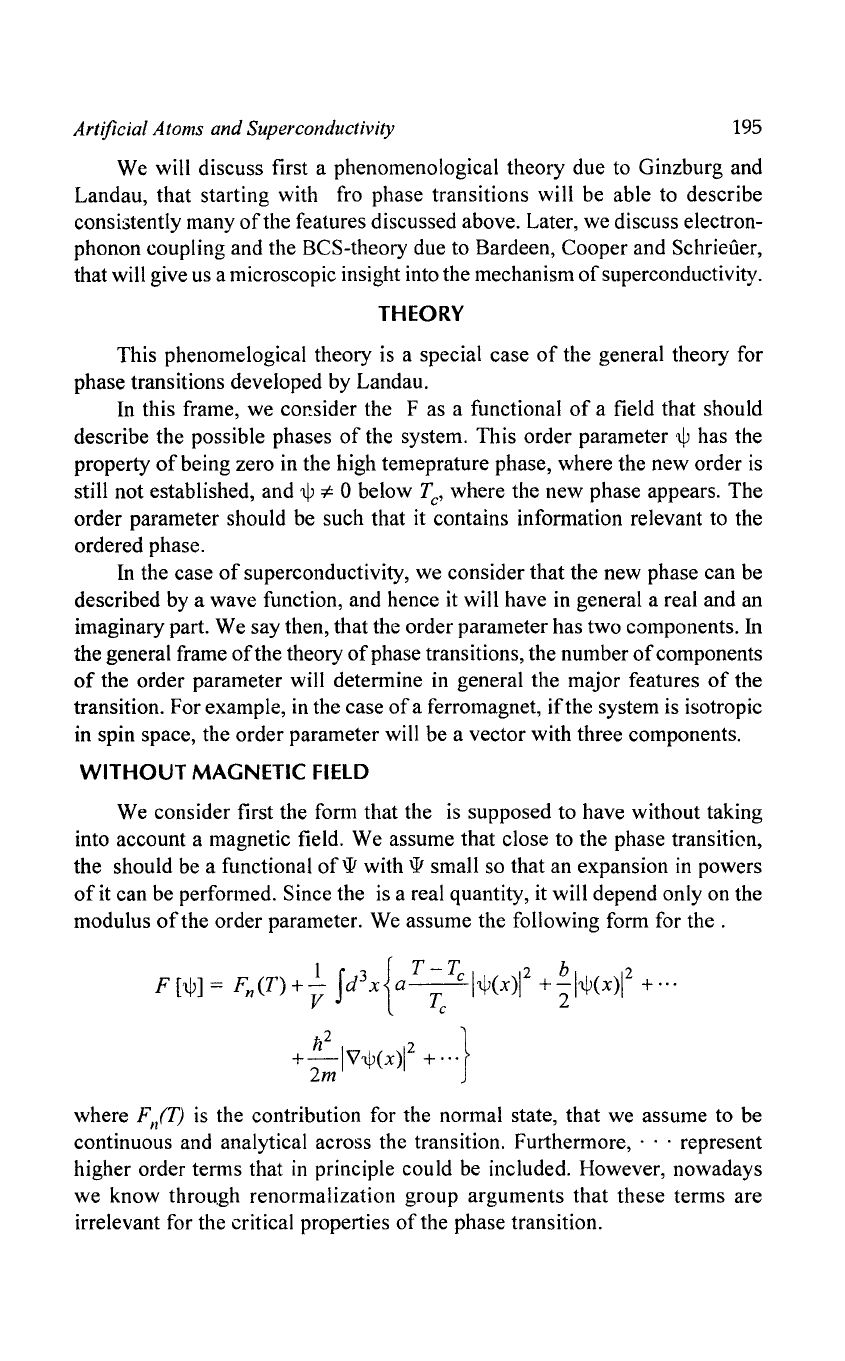
We consider first the form that the is supposed to have without taking
into account a magnetic field. We assume that close to the phase transiticn,
the should be a functional
of
W with W small so that an expansion in powers
of
it can be performed. Since the is a real quantity, it will depend only on the
modulus
of
the order parameter. We assume the following form for
the.
1 f 3 { T -
Te
1
12
b 1
12
F['l\J] =
Fn(T)+-
d x
a--'l\J(x)
+-'l\J(x)
+ ...
V
Tc
2
h
2
}
+-IV't[l(x)1
2
+
...
2m
where F,/T) is the contribution for the normal state, that we assume to be
continuous and analytical across the transition. Furthermore,
...
represent
higher order terms that
in
principle could be included. However, nowadays
we
know throu,gh renormalization group arguments
that
these terms are
irrelevant for the critical properties
of
the phase transition.
196
Artificial Atoms
and
Superconductivity
In
order to have a physical understanding
of
the parameters entering the
, let
us
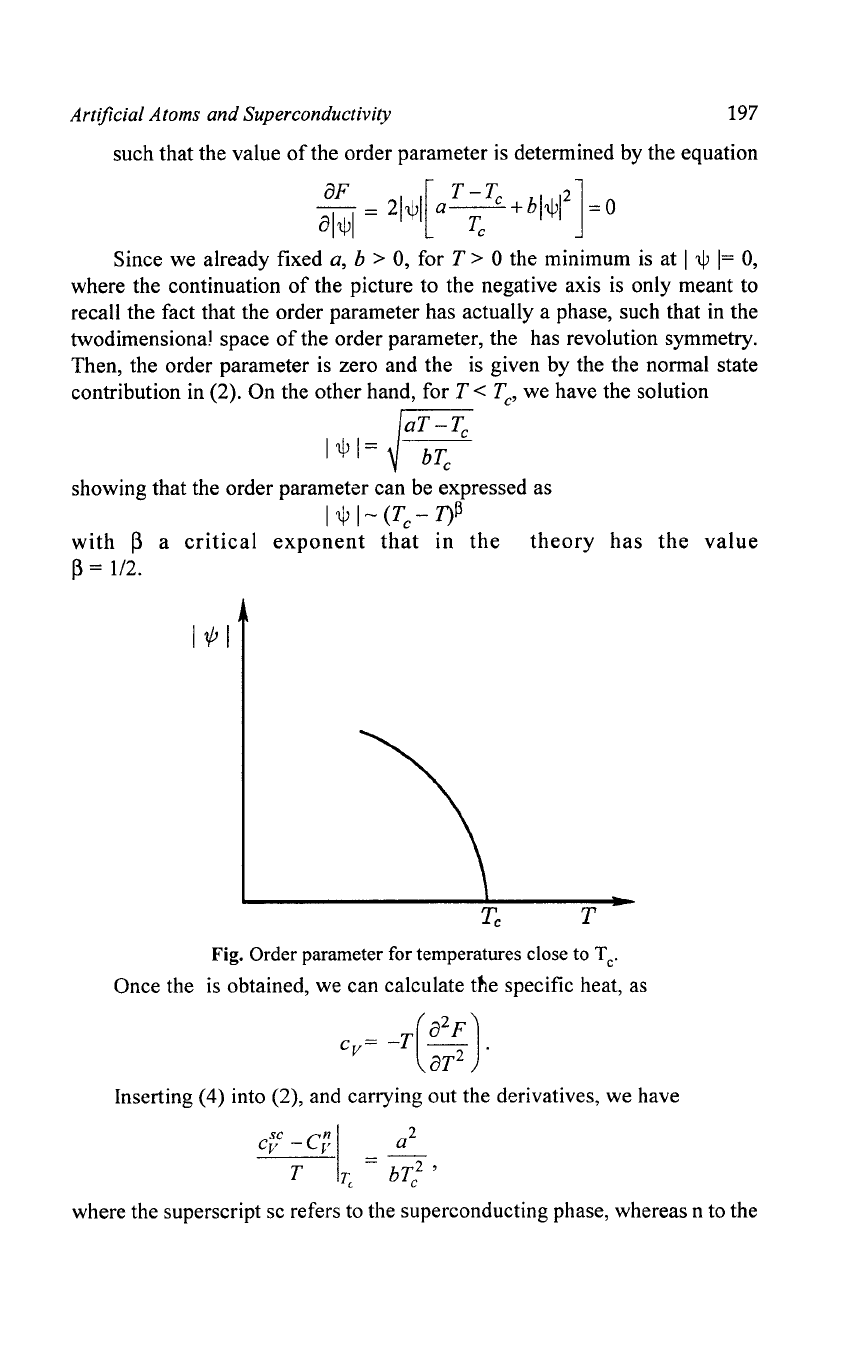
consider the case where
I'l/J
(x) I
is
homogeneous, i.e. it does not depend
on position. Then, we can regard F as a potential depending only on
I'l/J
I.
For
I'l/J
I very small we need only to consider the term
of
order
D(I'l/J
1
2
).
Taking a
>
0,
we have a close to
I'l/J
1=
0.
a)
F
b)
F
T>T.
T<T.
Fig. close
to
1
'ljJ
1=
0 for a >
o.
Since the physical state corresponds to the minimum
of
the,
the choice
a>
0,
the phase at
T>
Tc
corresponds to a vanishing order paramter, whereas
for
T <
Tc
such a state
is
unstable.
If
the expansion
in
powers
of
I'l/J
(x) I
is
cut
at the fourth order, then, we should have
b > °
in
order to have a stable system.
a)
b)
F
T>
T,.
Iwl
Fig. close
to
1
'ljJ
1=
0 for a > 0 and b >
o.
For b > ° and T < T
c'
the minimum
of
the is at a finite val ue
of
I'l/J
I,
such
that a non-vanishing order parameter characterizes the low temperature region.
Finally, the gradient term in (2) allows in principle for non-homogenous
solutions but since the constants in front
of
it are positive, the homogeneous
solutions will lead to a lower and will be therefore prefered.
Since, as we stated previously, the physical state
is
the one for which the
is
at its minumum, and since with the argument above, the homogeneous case
leads to a
lower,
we only need to minimize
in
order to have a quantitative
estimate
of
the order parameter.
T-T
2 b 4
F
['l/J]
~
a_
c
I'l/JI
+-I'l/JI
'
Tc
2
Artificial Atoms
and
Superconductivity
197
such that the value
of
the order parameter
is
determined by the equation
~:I
= 2
1
1(11[
a T
;e
Te
+ b
l
1(112]
= 0
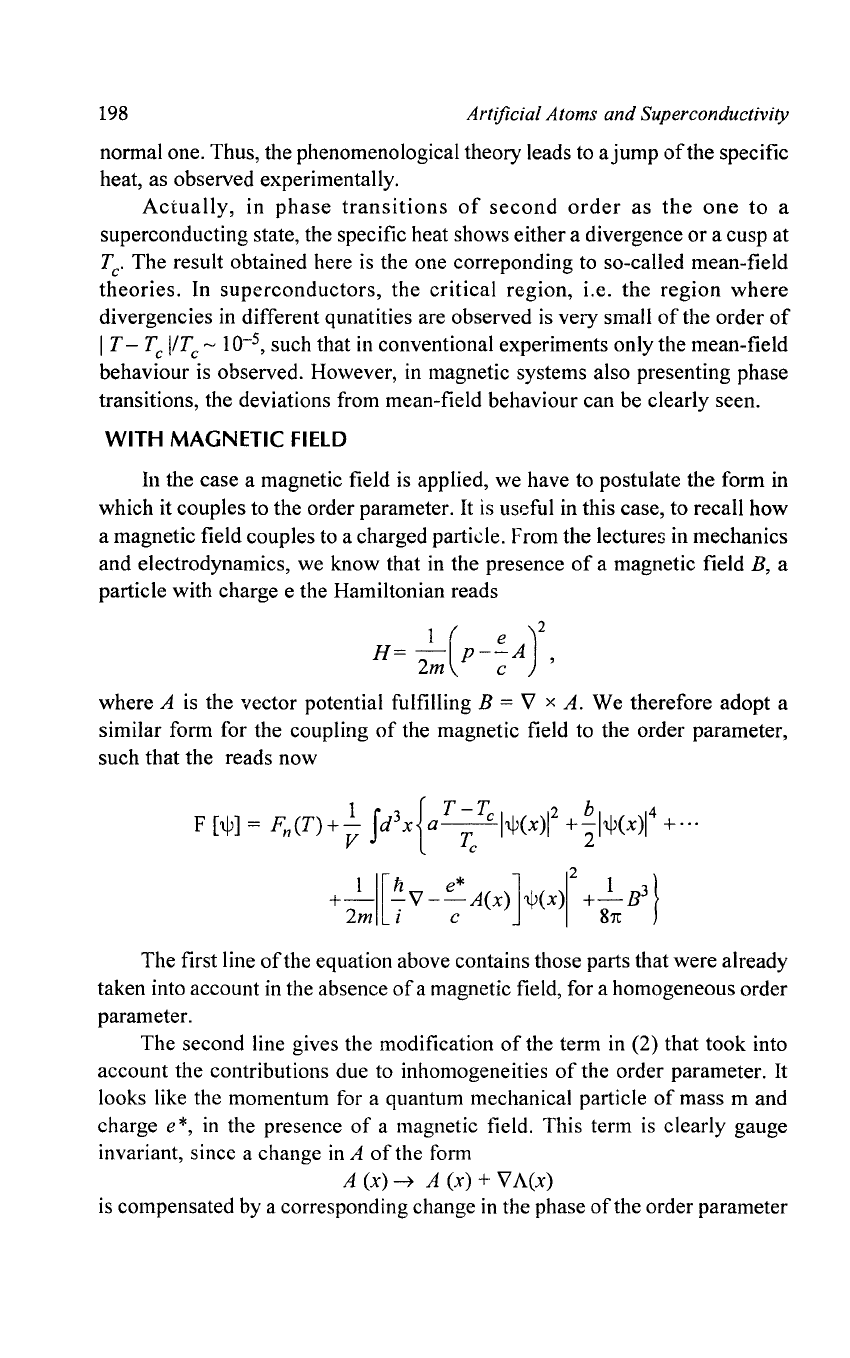
Since we already fixed
a,
b > 0, for T > ° the minimum
is
at
11(1
1=
0,
where the continuation
of
the picture to the negative axis
is
only meant to
recall the fact that the order parameter has actually a phase, such that
in
the
twodimensiona
1
space
of
the order parameter, the has revolution symmetry.
Then, the order parameter
is
zero and the is given by the the normal state
contribution in (2).
On the other hand, for T < T
e
,
we have the solution
~aT-T
11(1
1 =
bT
e
e
showing that the order parameter can be expressed as
11(1
1 -
(Te
-
1)~
with
~
a
critical
exponent
that
in
the
theory
has
the
value
~
=
112.
1
1/'1
Fig. Order parameter for temperatures close to T
c'
Once the
is
obtained, we can calculate the specific heat,
as
c
v
=
-T(:~).
Inserting (4) into (2), and carrying out the derivatives, we have
se
en
I 2
Cv
- v _
~
T -
bT
2
,
Tc
e
where the superscript sc refers to the superconducting phase, whereas n to the
198
Artificial Atoms
and
Superconductivity
normal one. Thus, the phenomenological theory leads to
ajump
of
the specific
heat, as observed experimentally.
Actually,
in
phase
transitions
of
second
order
as
the
one
to
a
superconducting state, the specific heat shows either a divergence or a cusp at
Tc.
The result obtained here
is
the one correponding to so-called mean-field
theories. In superconductors, the critical region, i.e. the region where
divergencies in different qunatities are observed is very small
of
the order
of
I T -
Tc
IITc
~
10-
5
,
such that
in
conventional experiments only the mean-field
behaviour is observed. However, in magnetic systems also presenting phase
transitions, the deviations from mean-field behaviour can be clearly seen.
WITH
MAGNETIC
FIELD
In
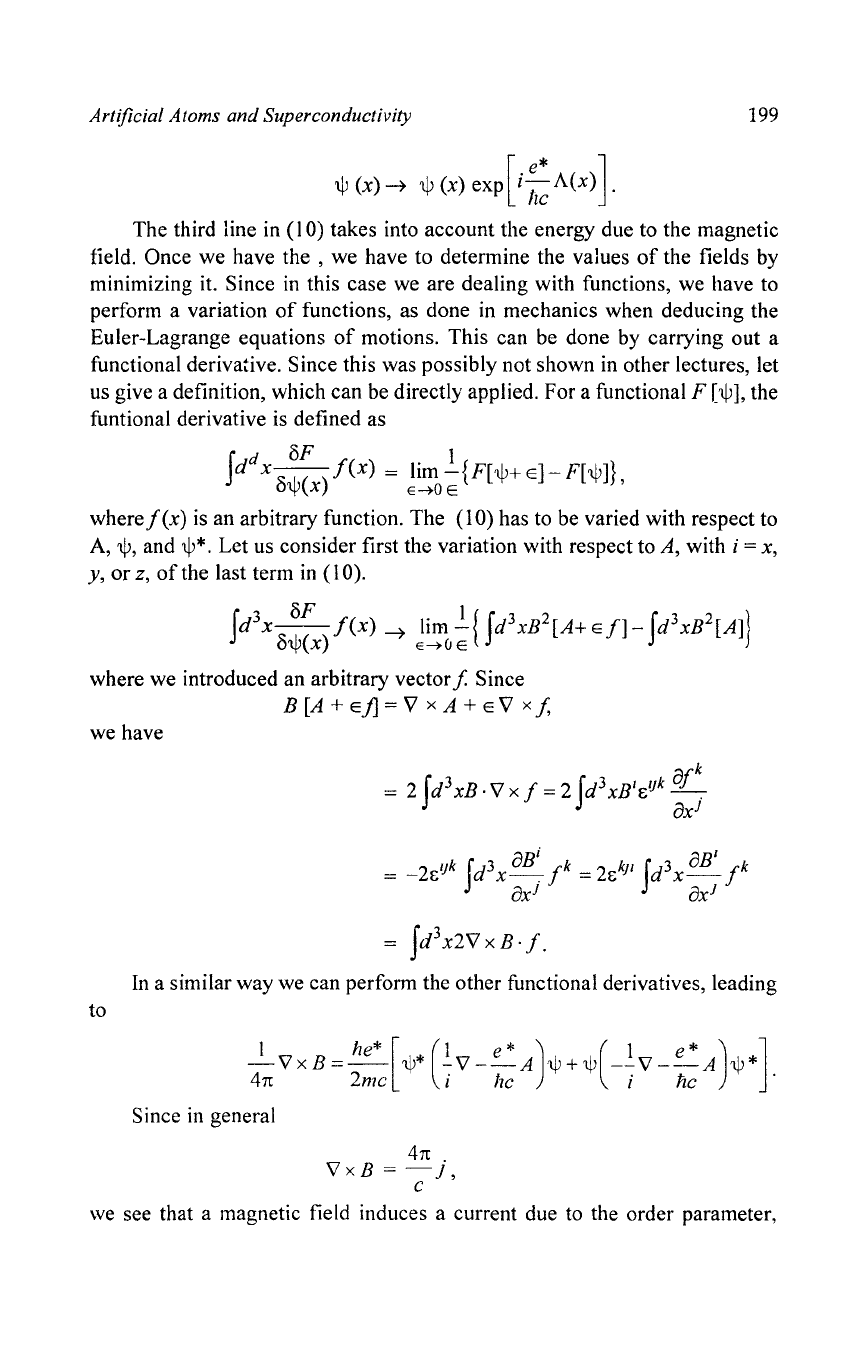
the case a magnetic field is applied, we have to postulate the form
in
which it couples to the order parameter.
It
is
useful in this case, to recall how
a magnetic field couples
to
a charged partide. From the lectures in mechanics
and electrodynamics, we know that
in
the presence
of
a magnetic field B, a
particle with charge e the Hamiltonian reads
H=
_1_(P_~A)2,
2m c
where A is the vector potential fulfilling B = V x A. We therefore adopt a
similar form for the coupling
of
the magnetic field to the order parameter,
such that the reads now
F
['ljJ]
=
Fn(T)+-
d x a
__
c
1't(J(x)
+-
't(J(x)
+ ...
1 f 3 { T - T
12
b 1
14
V
Tc
2
1 n
e*
1 3
1
2
+-I[-:-V--A(X)]'t(J(X)
+-B}
2m I C 8n
The first line
of
the equation above contains those parts that were already
taken into account
in
the absence
of
a magnetic field, for a homogeneous order
parameter.
The second line gives the modification
of
the term
in
(2) that took into
account the contributions due to inhomogeneities
of
the order parameter.
It
looks like the momentum for a quantum mechanical particle
of
mass m and
charge
e*,
in
the presence
of
a magnetic field. This term
is
clearly gauge
invariant, since a change
in
A
of
the form
A
(x)~
A (x) +
VA(x)
is
compensated by a corresponding change
in
the phase
of
the order parameter
Artificial Atoms and Superconductivity
'ljJ
(x)
~
'ljJ
(x)
exp[i~A(X)].
he
199
The third line in (10) takes into account the energy due to the magnetic
field.
Once
we
have
the,
we have to determine the values
of
the fields by
minimizing it. Since
in
this case we are dealing with functions, we have to
perform a variation
of
functions, as done in mechanics when deducing the
Euler-Lagrange equations
of
motions. This can be done by carrying out a
functional
derivative. Since this was possibly not shown in other lectures, let
us give a definition, which can be directly applied. For a functional
F
['ljJ],
the
funtional derivative is defined as
J
d
8F
1
d x
8
'ljJ(x)f(x) =
~~~{F['ljJ+E]-F['ljJn,
where f (x) is an arbitrary function. The (10) has to be varied with respect to
A,
'ljJ,
and
'ljJ*.
Let us consider first the variation with respect to A, with i = x,
y,
or
z,
of
the last term in
(l0).
f
d3x~
f(x)
~
lim
~{Jd3xB2[A+
Ef]
-fd
3
xB
2
[A]l
j
8'ljJ(x)
E---+UE
where we introduced an arbitrary vector f Since
B [A +
Ej]
= V x A + E V x
f,
we have
to
= Jd
3
x2V
x
B·
f.
In
a similar way we can perform the other functional derivatives, leading
_1
Y'xB=
he*
['ljJ*(~Y'-~A)'ljJ+tjJ(-~Y'-~A)tjJ*].
411:
2me I he I lie
Since
in
general
411:
.
Y'xB=-j,
e
we see that a magnetic field induces a current due to the order parameter,
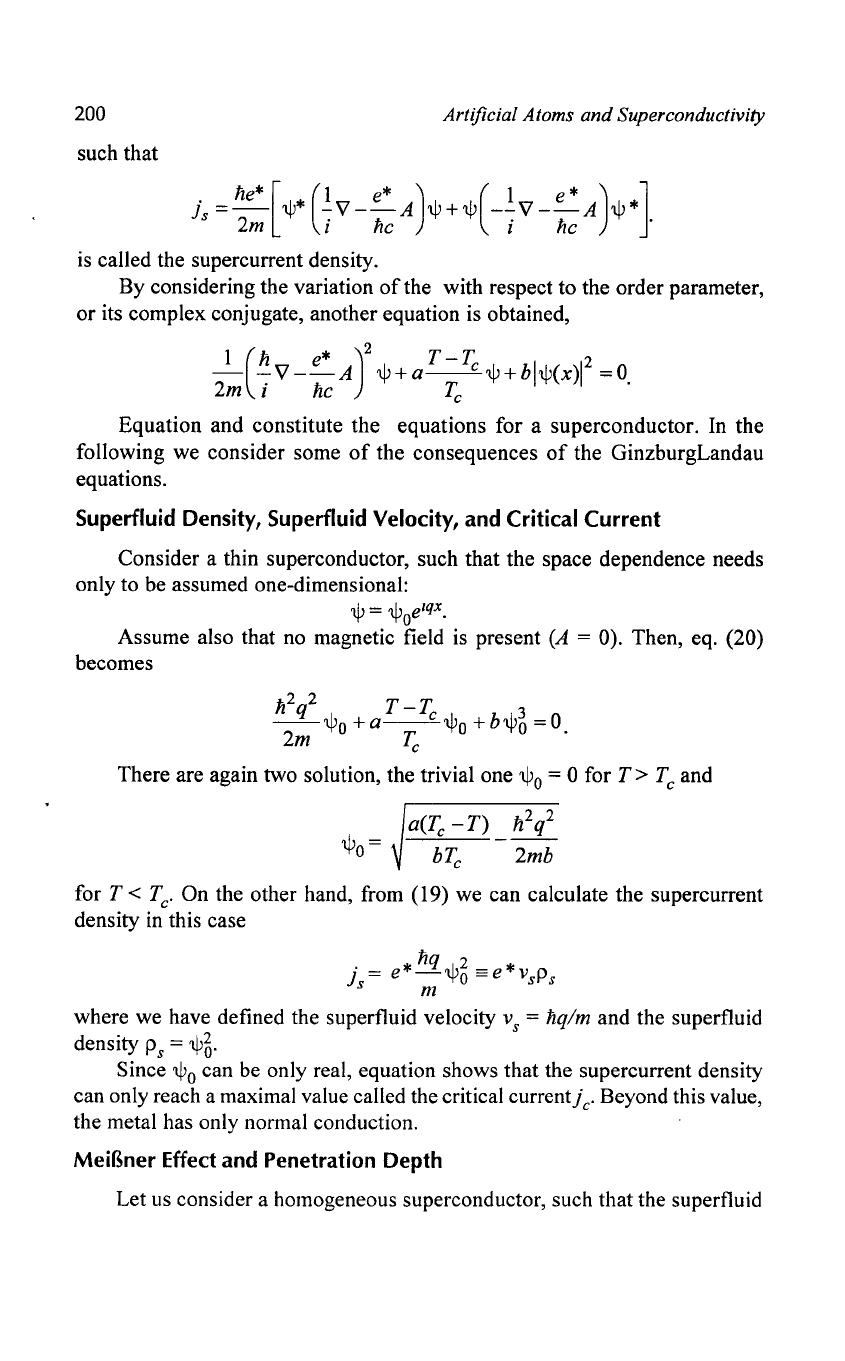
200
Artificial Atoms
and
Superconductivity
such that
is
=
lie*
['ljJ*
(~V-~A)'ljJ+'ljJ(-~V-~A)'\jJ*].
2m I lie I lie
is called the supercurrent density.
By
considering the variation
of
the with respect
to
the order parameter,
or
its
complex
conjugate, another equation is obtained,
1 ( Ii
e*)2
T - T 2
-
-:V--A
'ljJ+a--c'ljJ+bl'ljJ(x)1
=0.
2m I lie
Tc
Equation
and
constitute
the
equations
for a
superconductor.
In
the
following
we
consider some
of
the
consequences
of
the GinzburgLandau
equations.
Superfluid
Density,
Superfluid
Velocity,
and
Critical
Current
Consider a thin superconductor, such
that
the
space dependence needs
only
to
be assumed one-dimensional:
'ljJ
=
tPoe
1qx
•
Assume also that no magnetic field is present
(A
= 0). Then, eq. (20)
becomes
1i
2
l T
-Tc
3
--'ljJo
+a--tPo
+btPo
=0.
2m
T;;
There are again two solution, the trivial one
tPo
= 0 for
T>
Tc
and
a(Tc
-
T)
_
1i
2
q2
bT
c
2mb
for T <
Tc.
On
the other hand, from (19)
we can
calculate the supercurrent
density in this case
. _ e* liq
.1,2
=e*v
p
is
-
'VO
- s s
m
where
we
have defined the superfluid velocity
Vs
= nq/m
and
the superfluid
density p
s =
'ljJ6·
Since
'ljJo
can be only real, equation shows
that
the supercurrent density
can only reach a maximal value called the critical currentic. Beyond this value,
the metal has only normal conduction.
Mejgner
Effect
and
Penetration Depth
Let
us consider a homogeneous superconductor, such
that
the superfluid
Artificial Atoms
and
Superconductivity
201
density canbe considered constant
in
space. The whole space dependence is
the
in
the phase
of
the order parameter,
tV
==
tVo
exp[i<p(x)].
If
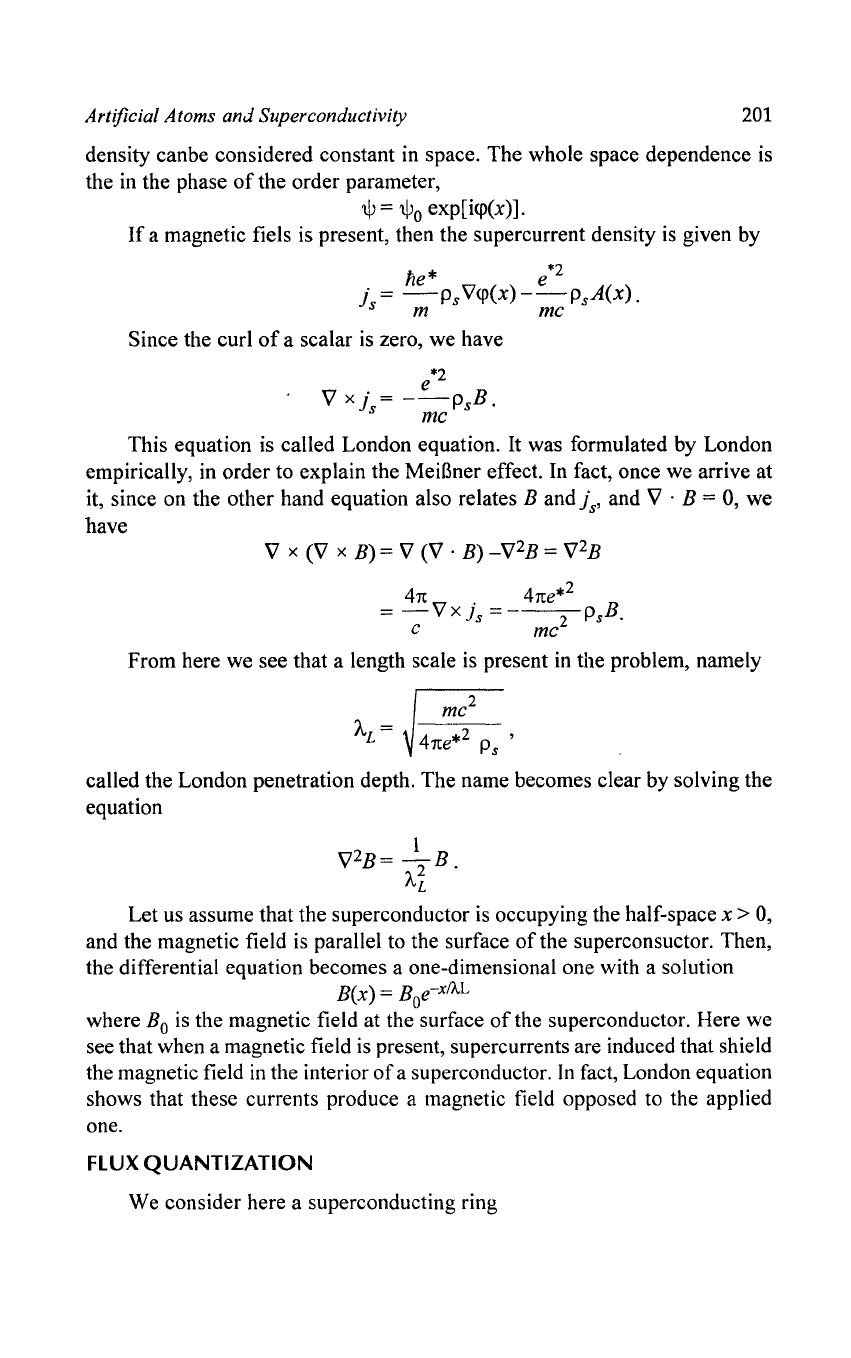
a magnetic fiels is present, then the supercurrent density
is
given by
ne*
/2
is
==
-Ps
V'q>(x)
--PsA(x).
m me
Since the curl
of
a scalar
is
zero, we have
/2
V'
xl·
==
--P
B
s s .
me
This equation is called London equation. It was formulated by London
empirically, in order to explain the
MeiBner effect. In fact, once we arrive at
it, since on the other hand equation also relates
B and
is'
and V . B
==
0, we
have
V x
(V
x B)
==
V
(V
. B) -
V2
B
==
V2
B
4n
. 4ne*2
==
-V'x}
=---P
B
e s
me2
s·
From here we see that a length scale
is
present
in
the problem, namely
A
==
L 4ne*2 P
s
'
called the London penetration depth. The name becomes clear by solving the
equation
1
V2B==
-B
Al
Let us assume that the superconductor
is
occupying the half-space x > 0,
and the magnetic field is parallel to the surface
of
the superconsuctor. Then,
the differential equation becomes a one-dimensional one with a solution
B(x)
==
Boe-
xlAL
where
Bo
is
the magnetic field at the surface
of
the superconductor. Here we
see that when a magnetic field
is
present, supercurrents are induced that shield
the magnetic field
in
the interior
of
a superconductor.
In
fact, London equation
shows that these currents produce a magnetic field opposed to the applied
one.
FLUX
QUANTIZATION
We consider here a superconducting ring