
Brewster H.D. Solid State Physics
Подождите немного. Документ загружается.

Chapter
11
Broken Translational Invariance
SIMPLE
ENERGETICS
OF
SOLIDS
Why do solids form? The Hamiltonian
of
the electrons and ions is:
2 2 2
22
2
H=I~+IPa+I
e
+I
Ze
-I
Ze
I
2me
a
2M
i>
j
17;
-
rjl
a>b
IRa
-
Rbi
i,a
Iii
-
Rt,1
It is invariant under the symmetry,
r;
~
r;
+
a,
Ra
~
Ra
+ a . However,
the energy can usually be minimized by forming a crystal. At low enough
temperature, this will win out over any possible entropy gain in a competing
state, so crystallization will occur. Why is the crystalline state energetically
favorable? This depends on the type
of
crystal. Different types
of
crystals
minimize different terms in the Hamiltonian. In molecular and ionic crystals,
the potential energy is minimized.
In
a molecular crystal, such as solid nitrogen,
there is a van der Waals attraction between molecules caused by polarization
of
one by the other. The van der Waals attraction is balanced by short-range
repulsion, thereby leading to a crystalline ground state.
In
an ionic crystal,
such as NaCl, the electrostatic energy
of
the ions is minimized (one must be
careful to take into account charge neutrality, without which the electrostatic
energy diverges).
In covalent and metallic crystals, crystallization is driven by the
minimization
of
the electronic kinetic energy.
In
a metal, such as sodium, the
kinetic energy
of
the electrons is lowered by their ability to move throughout
the metal.
In
a covalent solid, such as diamond, the same
is
true. The kinetic
energy gain is high enough that such a bond can even occur between
just
two
molecules (as
in
organic chemistry). The energetic gain
of
a solid is called the
cohesive energy.
QUANTUM
MECHANICS
OF
A
LINEAR
CHAIN
As a toy model
of
a solid, let us consider a linear chain
of
masses m
connected by springs with spring constant
B.
Suppose that the equilibrium
Broken Translational Invariance
243
spacing between the masses is
a.
The equilibrium positions define a
ID
lattice.
The lattice 'vectors',
R
J
,
are defined by:
R
J
=ja
They connect the origin to all points
ofthe
lattice.
If
Rand
R'
are lattice
vectors, then
R +
R'
are also lattice vectors. A set
of
basis vectors is a minimal
set
of
vectors which generate the full set
of
lattice vectors by taking linear
combinations
of
the basis vectors.
In
our ID lattice, a is the basis vector.
Let u
j
be the displacement
of
the
z1h
mass from its equilibrium position
and let pi be the corresponding momentum. Let us assume that there are N
masses, and
let's
impose a periodic boundary condition, u
i
= U
,
+
N
•
The
Hamiltonian for such a system is:
H
=_l-LP;
+!BL(u
j
-U
i
+l)2
2m i 2 i
Let us use the Fourier transform representation:
1"
ikja
u
j
=
.IN
f
Uke
1"
°kO
Pj
=
.IN
fPke,ga
As a result
of
the periodic boundary condition, the allowed
k's
are:
k =
27tn
Na
We can invert (4.4):
1 " e'k'ja _ 1 " "
ei(k-k')Ja
--L..Juk
---L..JL..Juk
.JN
J
.JN
kJ
244
Broken Translational Invariance
Hence,
Pk
and uk' commute unless k = k'.
The displacements described by uk are the same as those described by
U
27tm
•
k+-
for a any mteger n:
a
Hence,
U
1"
-I(k+
27tm)ja
k+
21tm
=
r;:;
~
U j e a
a
"\IN j
1 I
-Ikja
=
--
u·e
IN
. }
}
k
= k
21trn
-
+--
a
Hence, we call restrict attention to n =
0,
1,
... ; N - 1 in (4.5). The
Hamiltonian can be rewritten:
H =
I-
1
-PkP_k
+ 2B
(sin+
ka)2
uku_k
k 2m 2
Recalling the solution
of
the problem, we define:
at
=_1_
k
J2iz
1
[ 4mB ( sin
k;
r Y
uk
+
~
Pk
[4mB(Sin
~n
(Recall that
uk
=u-k,Pk
= P-k·) which satisfy:
[ako
a
k]=l
Then:
with
Broken Translational Invariance
245
1
(Ok
=2(!Ylsin
k
;1
Hence, the linear chain
is
equivalent to a system
of
N independent
s.
Its
thermodynamics can be described by the
Planck distribution.
The operators
at, a
k
are said to create and annihilate phonons.
We
say
that a state
I
'tjJ)
al
a
k I
'tjJ)
=
Nk
1'tjJ)
with has
Nk
phonons
of
momentum
k.
Phonons are the quanta
of
lattice
vibrations, analogous to photons, which are the quanta
of
oscillations
of
the
electromagnetic eld.
Observe that, as k
~
0,
ffi
k
~
0:
1
(
Ba
)"2
(Ok~O
=
--
k
mla
The physical reason for this
is
simple: an oscillation with k = 0
is
a uniform
translation
of
the linear chain, which costs no energy.
Note that the reason for this is that the Hamiltonian
is
invariant under
translations
u;
~
u;
+
A..
However, the ground state
is
not: the masses are
located at the points
x)
= j
a'
Translational invariance has been spontaneously
broken.
Of
course, it could
just
as well be broken with
x}
=
ja
+
A.
and, for this
reason,ffi
k
~
0 as k
~
O.
An oscillatory mode
of
this type
is
called a Goldstone
mode.
Consider now the case in which the masses are not equivalent. Let the
masses alternate between m and
M.
As we will see, the phonon spectra will
be more complicated. Let a be the distance between one m and the next
m.
The Hamiltonian is:
I(
1 2 1 2 1 2 1
2)
H =
-PI
I
+-P2
i
+-B(Ull
-U21)
+-B(U21
-uII+I)
2m ' 2m ' 2 ' , 2 ' ,
The equations
of
motion are:
d
2
m-
2
Ull
=-B[(ull
-U21)-(U'lI_1
-UI1)]
dt'
"
..
, ,
d
2
M-
2
U21
=-B[(u21-
u
Il)+(u21
-uII+I)]
df'
" , ,
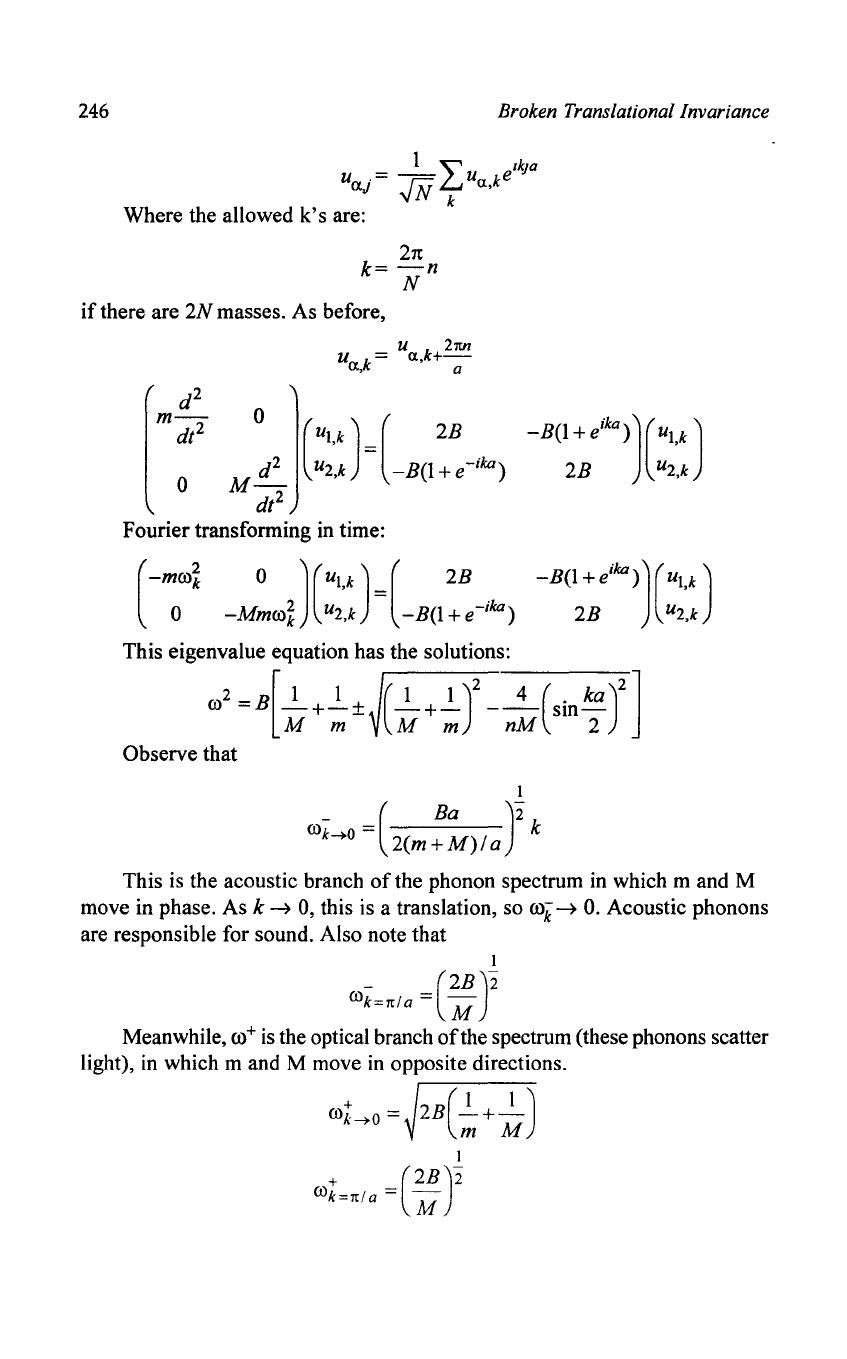
Going again to the Fourier representation, a =
1;
2
246 Broken Translationallnvariance
1 L /Iga
U
'=.IN
u
a
k
e
f1.J
N '
k
Where the allowed
k's
are:
21t
k=-n
N
if
there are
2N
masses. As before,
o
U
2m
U =
ak+-
f1.,k
'a
Fourier transforming
in
time:
(-:ro
i
-M:roZJ(
:~,:J=(
-B(l
::-;Aa)
-B(~:eMa»)(
::::)
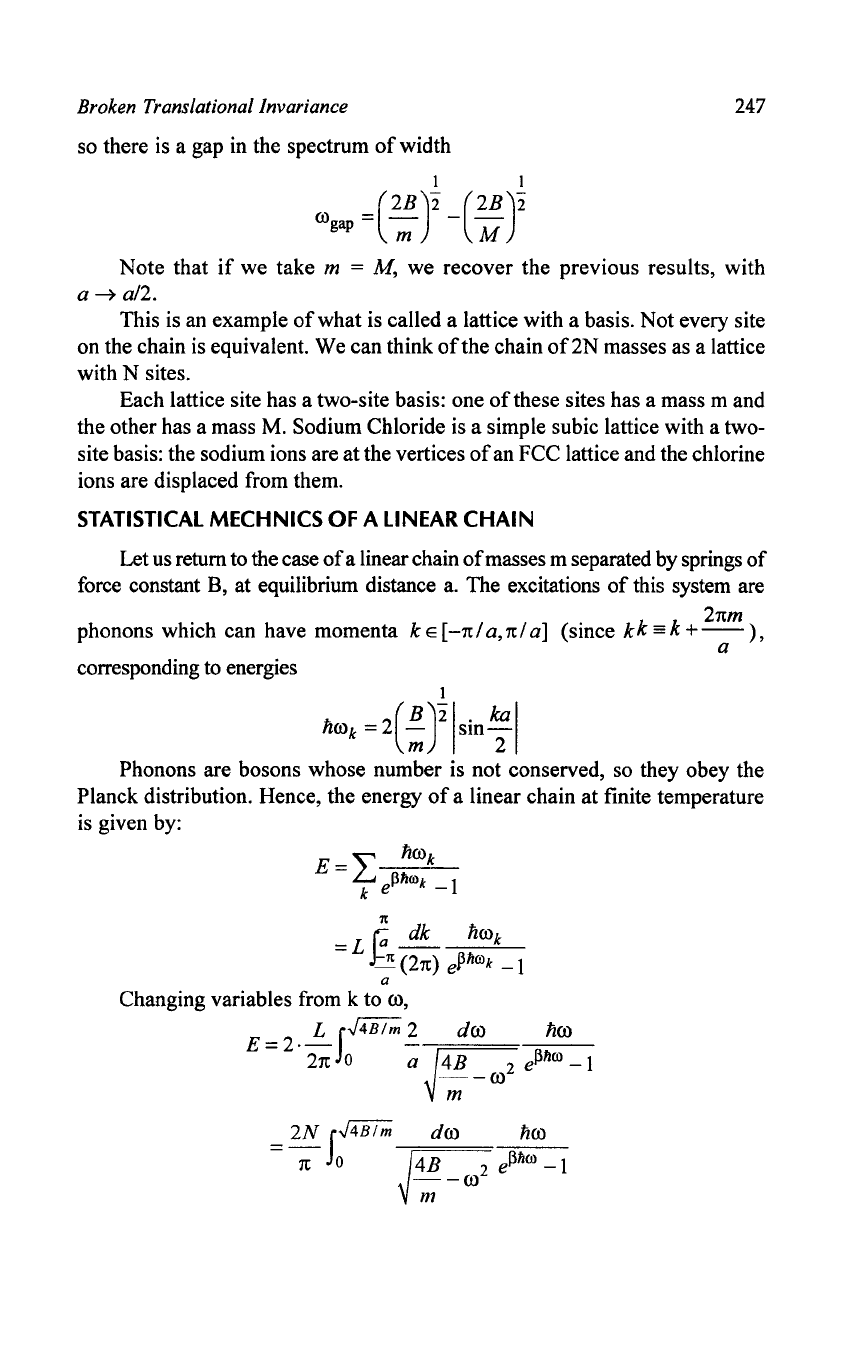
This eigenvalue equation has the solutions:
2_
[1
1
PI
1)2
-4
(.-ka)2]
(0
-B
M + m
±VlM+-;;;)
-
nM
sm
2
Observe that
1
(Ok~O
=
(2(m
:~)/
a Y k
This
is
the acoustic branch
of
the phonon spectrum in which m and M
move in phase. As
k
~
0, this is a translation, so
OY;;
~
O.
Acoustic phonons
are responsible for sound. Also note that
1
_
(2B)2
(Ok=1tla = M
Meanwhile,O)+
is
the optical branch
of
the spectrum (these phonons scatter
light),
in
which m and M move
in
opposite directions.
(Ot~o
=
J2B(~
+
~)
1
rot=1tla
=(~y
Broken Translational Invariance
247
so there is a gap in the spectrum
of
width
1 1
OO
gap
=(~y
-(~y
Note that
if
we take m = M, we recover the previous results, with
a
-7
a12.
This is an example
of
what is called a lattice with a basis. Not every site
on the chain is equivalent. We can think
ofthe
chain
of2N
masses as a lattice
with N sites.
Each lattice site has a two-site basis: one
of
these sites has a mass m and
the other has a mass
M.
Sodium Chloride is a simple subic lattice with a two-
site basis: the sodium ions are at the vertices
of
an FCC lattice and the chlorine
ions are displaced from them.
STATISTICAL
MECHNICS
OF
A LINEAR
CHAIN
Let us return to the case
of
a linear chain
of
masses m separated by springs
of
force constant B, at equilibrium distance
a.
The excitations
of
this system are
21tm
phonons which can have momenta k E [
-1t
I a, 1t I
a]
(since k k
==
k +
--
) ,
a
corresponding to energies
1
hOOk
=
2(~Ylsin
~I
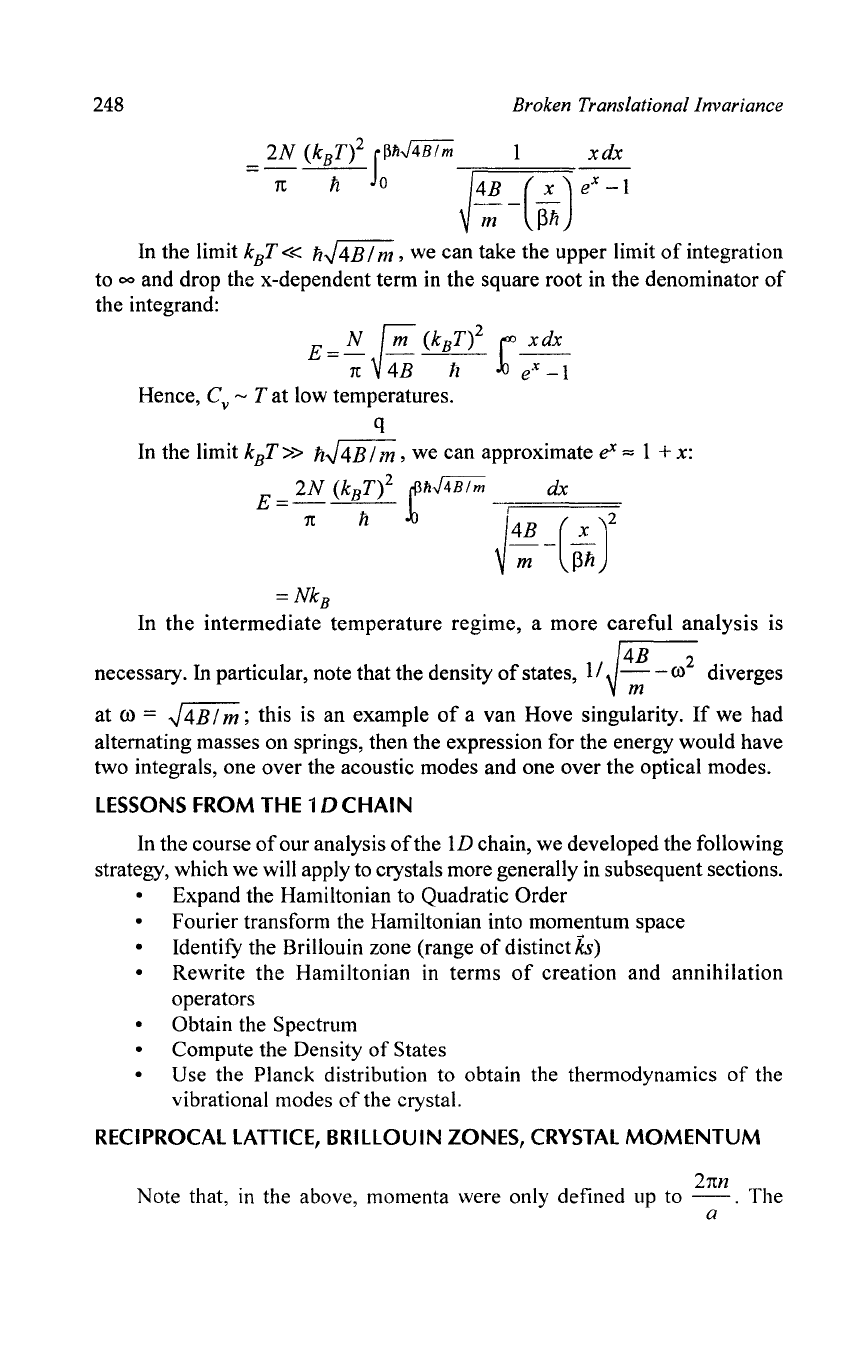
Phonons are bosons whose number is not conserved, so they obey the
Planck distribution. Hence, the energy
of
a linear chain at finite temperature
is given by:
1t
_ L
Ia
dk
hOOk
-
~
(21t)
e
Plirok
-1
a
Changing variables from k to
ro,
L
rJ4Blm
2 dro
hro
E
~
2·
21t
Jo
a
~~
_00'
.,Jl>ro-I
=
2N
rJ4Blm
dro
hro
1t
Jo
~4B
_
ro
2
e~IiOl_l
m
248 Broken Translationallnvariance
_
2N
(kBT)2 r
h
.J4Blm
1
xdx
- n h 0
J~
-(;hY-l
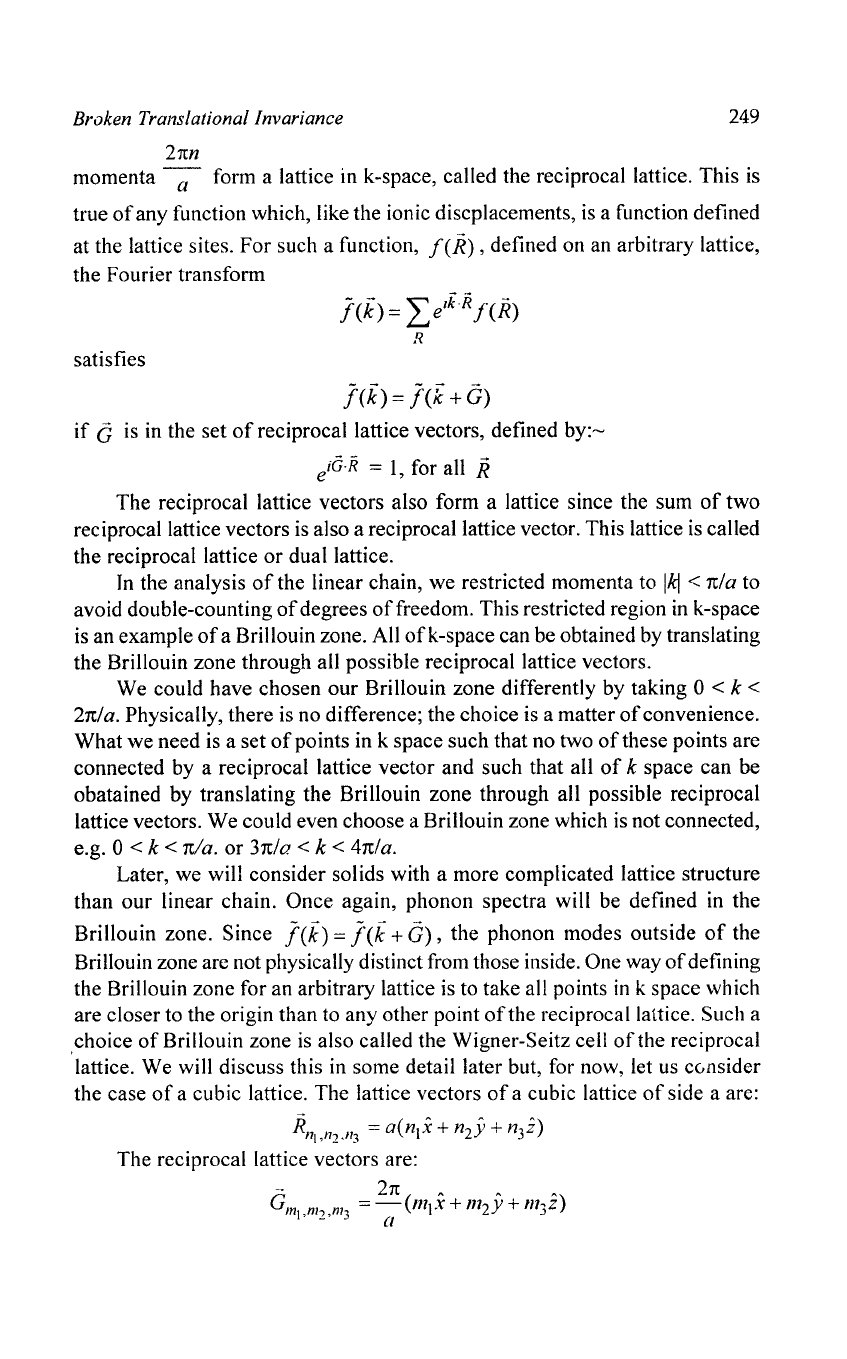
In the limit
kBT«
Ii.,}
4B / m , we can take the upper limit
of
integration
to
00
and drop the x-dependent term
in
the square root in the denominator
of
the integrand:
E=
N
~
m (kBT)2 r
xdx
n:
4B
tz
e
X
-l
Hence, C
v
- T at low temperatures.
q
In
the limit
kBT»
Ii.,}
4B / m , we can approximate
eX
""
1 + x:
E =
2N
(kBT)2 !h.J4Blm dx
n h
J~
-(;h)'
=Nk
B
In the intermediate temperature regime, a more careful analysis is
necessary.
In particular, note that the density
of
states,
1/)
~
-
00
2
diverges
at
(0
=
.,}
4 B /
m;
this is an example
of
a van Hove singularity.
If
we had
alternating masses on springs, then the expression for the energy would have
two integrals, one over the acoustic modes and one over the optical modes.
LESSONS
FROM
THE
1 D
CHAIN
In the course
of
our analysis
of
the
ID
chain, we developed the following
strategy, which we will apply to crystals more generally
in
subsequent sections.
Expand the Hamiltonian to Quadratic
Order
•
Fourier transform the Hamiltonian into momentum space
• IdentifY the Brillouin zone (range
of
distinctks)
•
Rewrite the Hamiltonian in terms
of
creation and annihilation
operators
• Obtain the Spectrum
Compute the Density
of
States
Use the
Planck distribution to obtain the thermodynamics
of
the
vibrational modes
of
the crystal.
RECIPROCAL LATTICE, BRillOUIN
ZONES,
CRYSTAL
MOMENTUM
2n:n
Note that,
in
the above, momenta were only defined
up
to
--.
The
a
Broken Tral1slationallnvariance
249
2rrn
momenta
-;;
form a lattice in k-space, called the reciprocal lattice. This
is
true
of
any function which, like the ionic discplacements,
is
a function defined
at the lattice sites. For such a function,
f(R)
, defined on an arbitrary lattice,
the Fourier transform
l(k) = Ie1k-R
feR)
R
satisfies
l(k) =
l(f
+
G)
if
G
is
in the set
of
reciprocal lattice vectors, defined
by:~
iG·R
= 1 for all
R-
e '
The reciprocal lattice vectors also form a lattice since the sum
of
two
reciprocal lattice vectors
is
also a reciprocal lattice vector. This lattice
is
called
the reciprocal lattice or dual lattice.
In
the analysis
of
the linear chain, we restricted momenta to
Ikl
< rrla to
avoid double-counting
of
degrees
of
freedom. This restricted region
in
k-space
is
an example
of
a Brillouin zone. All ofk-space can be obtained by translating
the Brillouin zone through all possible reciprocal lattice vectors.
We could have chosen our Brillouin zone differently by taking
0 < k <
2rrJa.
Physically, there is no difference; the choice
is
a matter
of
convenience.
What we need
is
a set
of
points in k space such that no two
of
these points are
connected by a reciprocal lattice vector and such that all
of
k space can be
obatained by translating the Brillouin zone through all possible reciprocal
lattice vectors. We could even choose
a Brillouin zone which
is
not connected,
e.g.
0 < k < n/a. or 3nlo < k < 4nla.
Later, we will consider solids with a more complicated lattice structure
than our linear chain.
Once again, phonon spectra will be defined
in
the
Brillouin zone. Since
l(k) =
l(k
+
G),
the phonon modes outside
of
the
Brillouin zone are not physically distinct from those inside.
One way
of
defining
the Brillouin zone for an arbitrary lattice
is
to take all points
in
k space which
are closer to the origin than to any other point
of
the reciprocal lattice. Such a
.choice
of
Brillouin zone
is
also called the Wigner-Seitz cell
of
the reciprocal
lattice. We will discuss this in some
detaillater
but, for now, let
us
cc..nsider
the case
of
a cubic lattice. The lattice vectors
of
a cubic lattice
of
side a are:
R
I11
,112.
11
3 =
a(nl;
+ n2Y +
113
z
)
The reciprocal lattice vectors are:
G
-
2rr
("
" "
In In In
= -
IIllx
+ 1Il2Y + II/-,.Z)
1,
2,
3
(l
J
250
Broken Translational Invariance
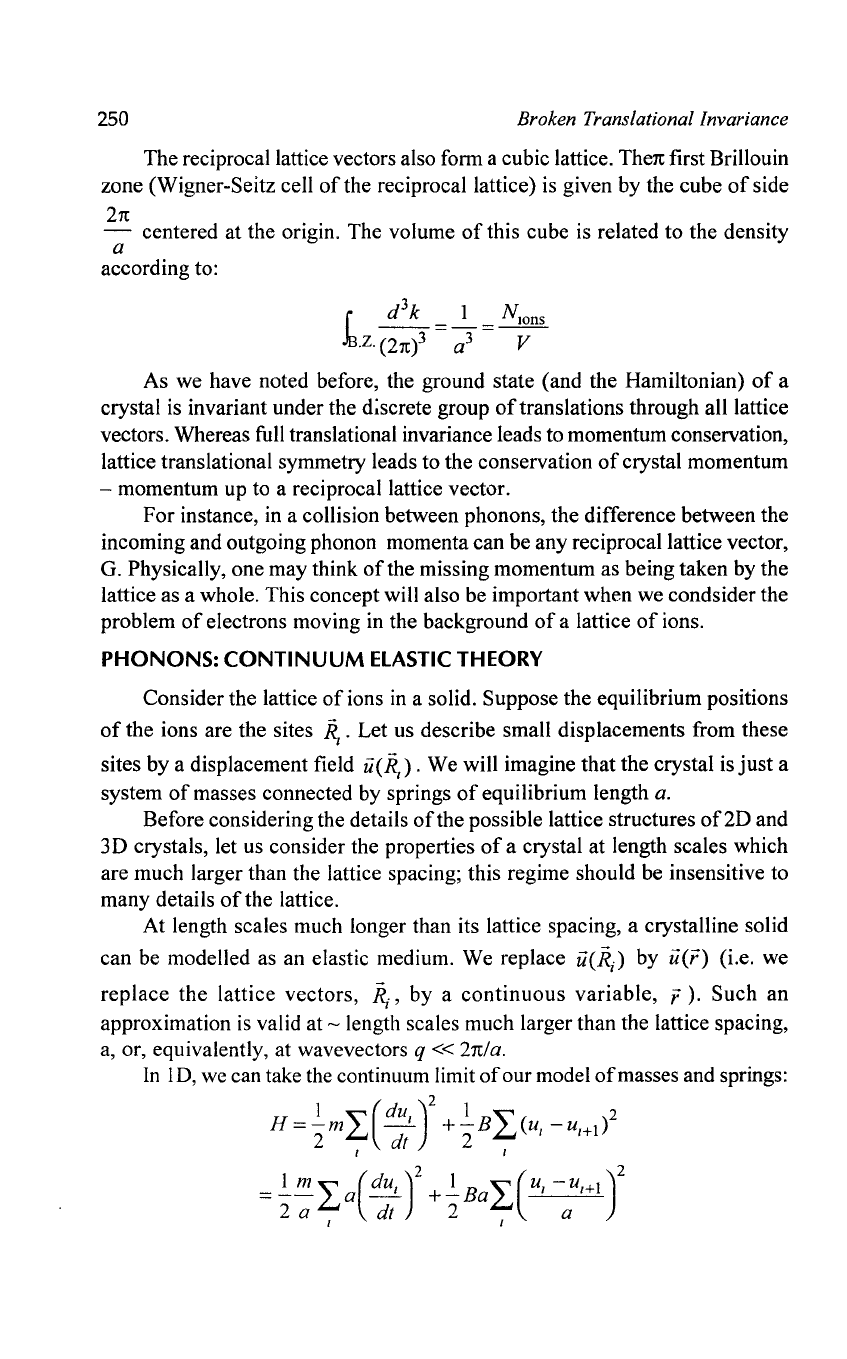
The reciprocal lattice vectors also fonn a cubic lattice. Then first Brillouin
zone (Wigner-Seitz cell
of
the reciprocal lattice) is given by the cube
of
side
2n
- centered at the origin. The volume
of
this cube is related to the density
a
according to:
r d
3
k
__
1
__
N)ons
Js.z.
(21t)3
- a
3
- V
As we have noted before, the ground state (and the Hamiltonian)
of
a
crystal
is
invariant under the
d~screte
group
of
translations through all lattice
vectors. Whereas full translational invariance leads to momentum conservation,
lattice translational symmetry leads to the conservation
of
crystal momentum
- momentum up to a reciprocal lattice vector.
For instance,
in
a collision between phonons, the difference between the
incoming and outgoing phonon momenta can be any reciprocal lattice vector,
G.
Physically, one may think
of
the missing momentum as being taken by the
lattice as a whole. This concept will also be important when we condsider the
problem
of
electrons moving in the background
of
a lattice
of
ions.
PHONONS: CONTINUUM
ELASTIC
THEORY
Consider the lattice
of
ions
in
a solid. Suppose the equilibrium positions
of
the ions are the sites
R,.
Let us describe small displacements from these
sites by a displacement field
u(R,).
We will imagine that the crystal is
just
a
system
of
masses connected by springs
of
equilibrium length
a.
Before considering the details
of
the possible lattice structures
of2D
and
3D crystals, let
us
consider the properties
of
a crystal at length scales which
are much larger than the lattice spacing; this regime should be insensitive to
many details
of
the lattice.
At length scales much longer than its lattice spacing, a crystalline solid
can be modelled
as
an elastic medium. We replace U(Ri) by
u(r)
(i.e. we
replace the lattice vectors,
~,
by a continuous variable,
r).
Such an
approximation
is
valid at
~
length scales much larger than the lattice spacing,
a, or, equivalently, at wave vectors
q « 2n/a.
In
1
D,
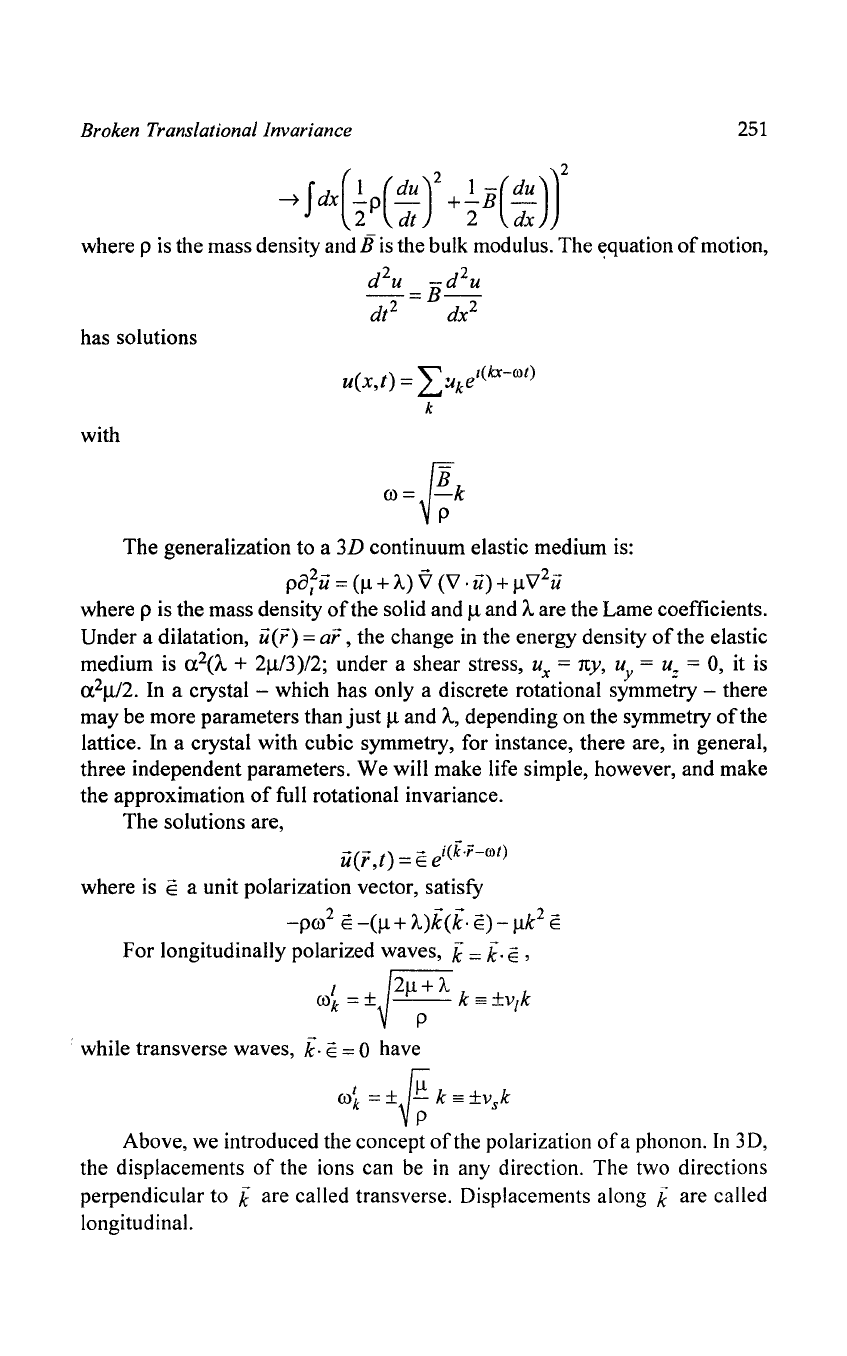
we can take the continuum limit
of
our model
of
masses and springs:
H=~mL(dUI)2
+~BL(UI
-Ul+l)2
2 dt 2
I I
=
~
m L
a
(du
,
)2
+~BaL(UI
-U
1
+l)2
2 a
dt
2 a
I I
Broken Translational Invariance
251
->
Jdx(H~;)'
+~ii(:))'
where p
is
the mass density and jJ
is
the bulk modulus. The equation
of
motion,
d
2
u =
jjd
2
u
dt
2
dx
2
has solutions
with
u(x,t)
=
:~:>ke'(kx-rot)
k
ro=~k
The generalization to a 3D continuum elastic medium is:
pa~u
= (Il +
A)
V
(V·
u)
+
IlV
2
u
where p is the mass density
of
the solid
and)l
and A are the Lame coefficients.
Under a dilatation,
u(r)
=
ar,
the change
in
the energy density
of
the elastic
medium
is
a.
2
(A.
+ 2)l/3)/2; under a shear stress, U
x
=
Tty,
u
y
= U
z
= 0, it
is
a.
2
)l/2. In a crystal - which has only a discrete rotational symmetry - there
may be more parameters than
just
)l and
A,
depending on the symmetry
of
the
lattice. In a crystal with cubic symmetry, for instance, there are,
in
general,
three independent parameters. We will make life simple, however, and make
the approximation
of
full rotational invariance.
The solutions are,
-(-
t)
-
i(f.F-rot)
U
r,
=Ee
where is E a unit polarization vector, satisfy
-pol
E
-(Il
+
A)k(k·
E)
-llk2
E
For longitudinally polarized waves, k = f. E ,
I
J21l+A
(f)k
= ±
-p-
k
==
±v,k
..
while transverse waves,
k·
E = 0 have
(f)~
=
±l
k
==
±vsk
Above, we introduced the concept
of
the polarization
ofa
phonon.
In
3D,
the displacements
of
the ions can
be
in
any direction. The two directions
perpendicular to
k are called transverse. Displacements along k are called
longitudinal.