
Brewster H.D. Solid State Physics
Подождите немного. Документ загружается.

202
Artificial Atoms
and
Superconductivity
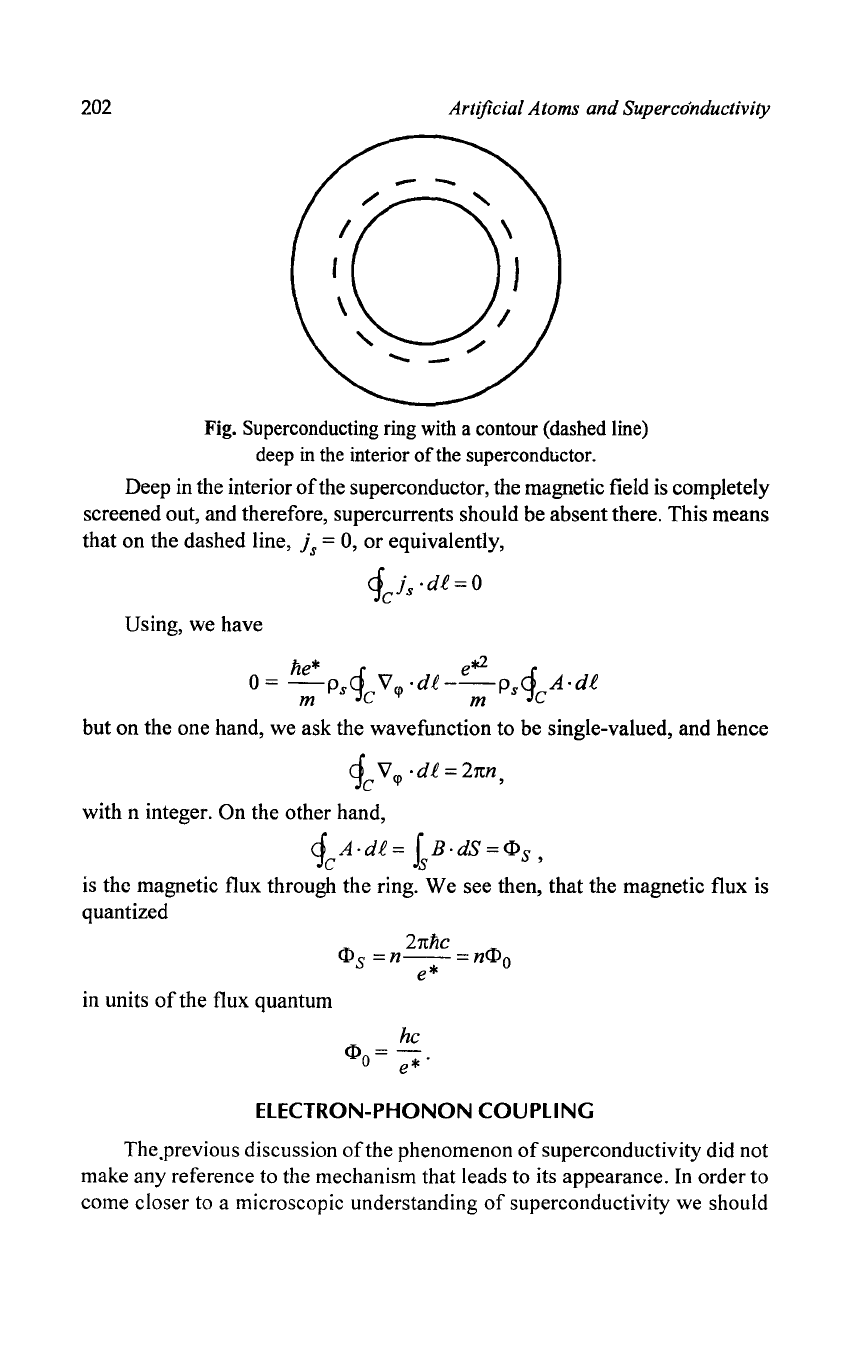
Fig. Superconducting ring
with
a contour (dashed line)
deep
in
the
interior
of
the
superconductor.
Deep in the interior
of
the superconductor, the magnetic field is completely
screened out, and therefore, supercurrents should be absent there. This means
that on the dashed line,
js
= 0,
or
equivalently,
cfc
js
.
df
= 0
Using, we have
o = ne* p
rf
V . d f -
e~
p
rf
A·
d f
m
s'1c
cp
m
s'1c
but on the one hand, we ask the wavefunction to be single-valued, and hence
rf
V
·df=2rcn
'1c
cp
,
with n integer. On the other hand,
cfc
A
·df
=
1B.dS
=
cI>s
,
is the magnetic flux through the ring.
We
see then, that the magnetic flux is
quantized
in units
of
the flux quantum
2rcnc
cI>s
=
n--
=
ncI>o
e*
ELECTRON-PHONON COUPLING
The.previous discussion
of
the phenomenon
of
superconductivity did not
make any reference to the mechanism that leads to its appearance.
In
order to
come closer to a microscopic understanding
of
superconductivity we should
Artificial Atoms
and
Superconductivity
203
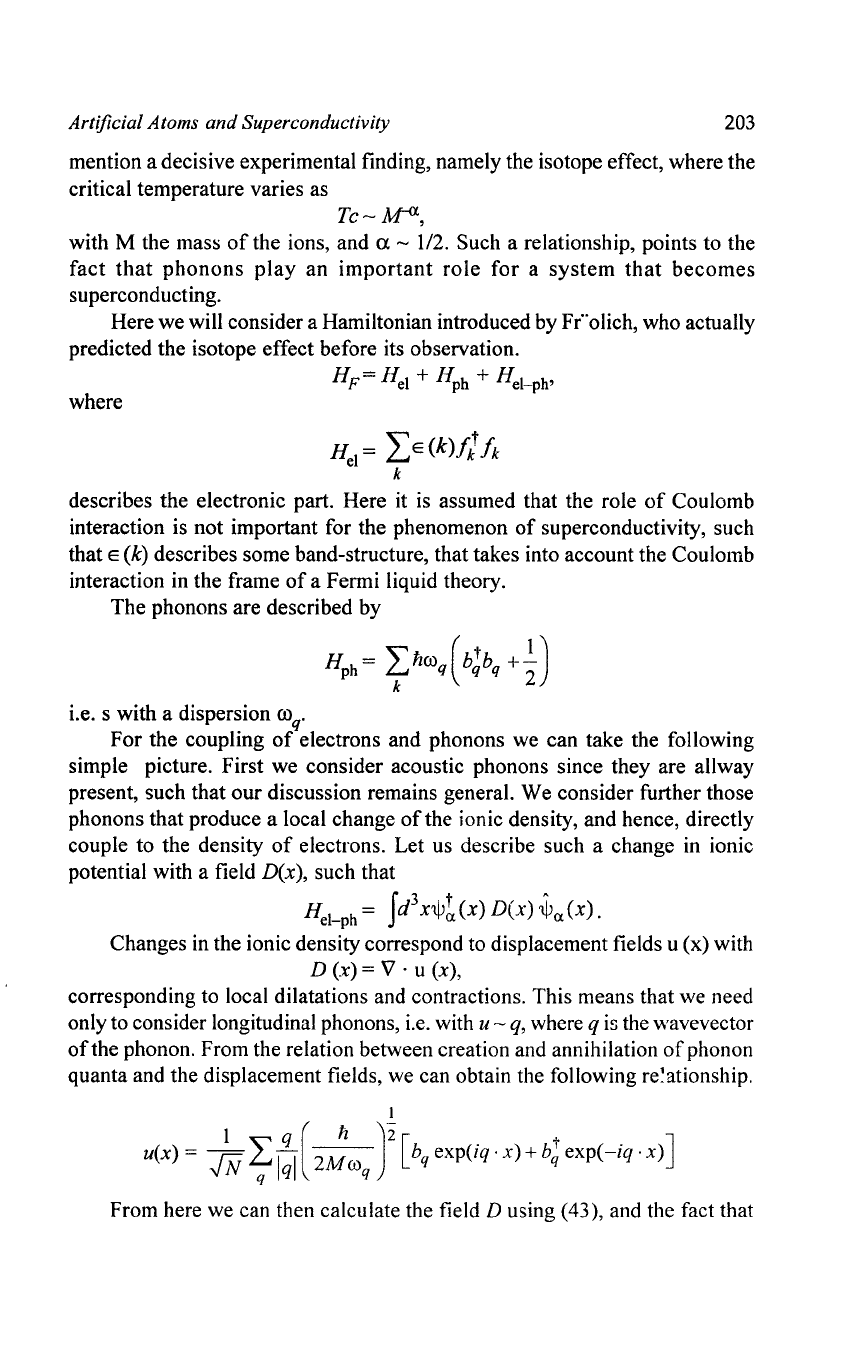
mention a decisive experimental finding, namely the isotope effect, where the
critical temperature varies as
Tc~
M-U,
with M the mass
of
the ions, and
ex
~
112.
Such a relationship, points to the
fact
that
phonons
play
an
important
role
for a
system
that
becomes
superconducting.
Here we will consider a Hamiltonian introduced by
Fr··olich, who actually
predicted the isotope effect before its observation.
where
H
F
=
He!
+
Hph
+ H
e1
_
ph
'
H =
"E(k)flfk
e!
~
k
describes the electronic part. Here it
is
assumed that the role
of
Coulomb
interaction is not important for the phenomenon
of
superconductivity, such
that
E (k) describes some band-structure, that takes into account the Coulomb
interaction in the frame
of
a Fermi liquid theory.
The phonons are described by
Hph
=
~fzO)q
(bJb
q
+~)
i.e. s with a dispersion
ffi
q
.
For the coupling
of
electrons and phonons we can take the following
simple picture. First we consider acoustic phonons since they are allway
present, such that
our discussion remains general. We consider further those
phonons that produce a local change
of
the ionic density, and hence, directly
couple to the density
of
electrons. Let us describe such a change in ionic
potential with a field
D(x), such that
H
e1
_
ph
=
fd3xtIJ~(x)D(x)~a(x).
Changes in the ionic density correspond to displacement fields u (x) with
D (x) = V . u (x),
corresponding to local dilatations and contractions. This means that we need
only to consider longitudinal phonons, i.e. with
u
~
q,
where q
is
the wavevector
of
the phonon. From the relation between creation and annihilation
of
phonon
quanta and the displacement fields, we can obtain the foHowing
re~ationship.
I
u(x) =
,iN
~
1:1
(
2:
"'q
y
[b
q
exp(iq
x)
+
b;
exp(
-iq
x)
J
From here we can then calculate the field
Dusing
(43), and the fact that
204
Artificial Atoms
and
Superconductivity
for an acoustic phonon,
roq
=
Vs
q,
with vs the sound velocity.
1
D (x) =
.iN
L(
2::Vs y [b
q
exp(iq
.x)-bJ
exp(-iq
·x)
]
q
For the electronic field operators, we use an expansion
in
Bloch states
~a(x)
=
Lfkauk(x)exp(ik.x),
k
~~(x)
=
Lfl
p
u
;(x)exp(-ik.x).
k
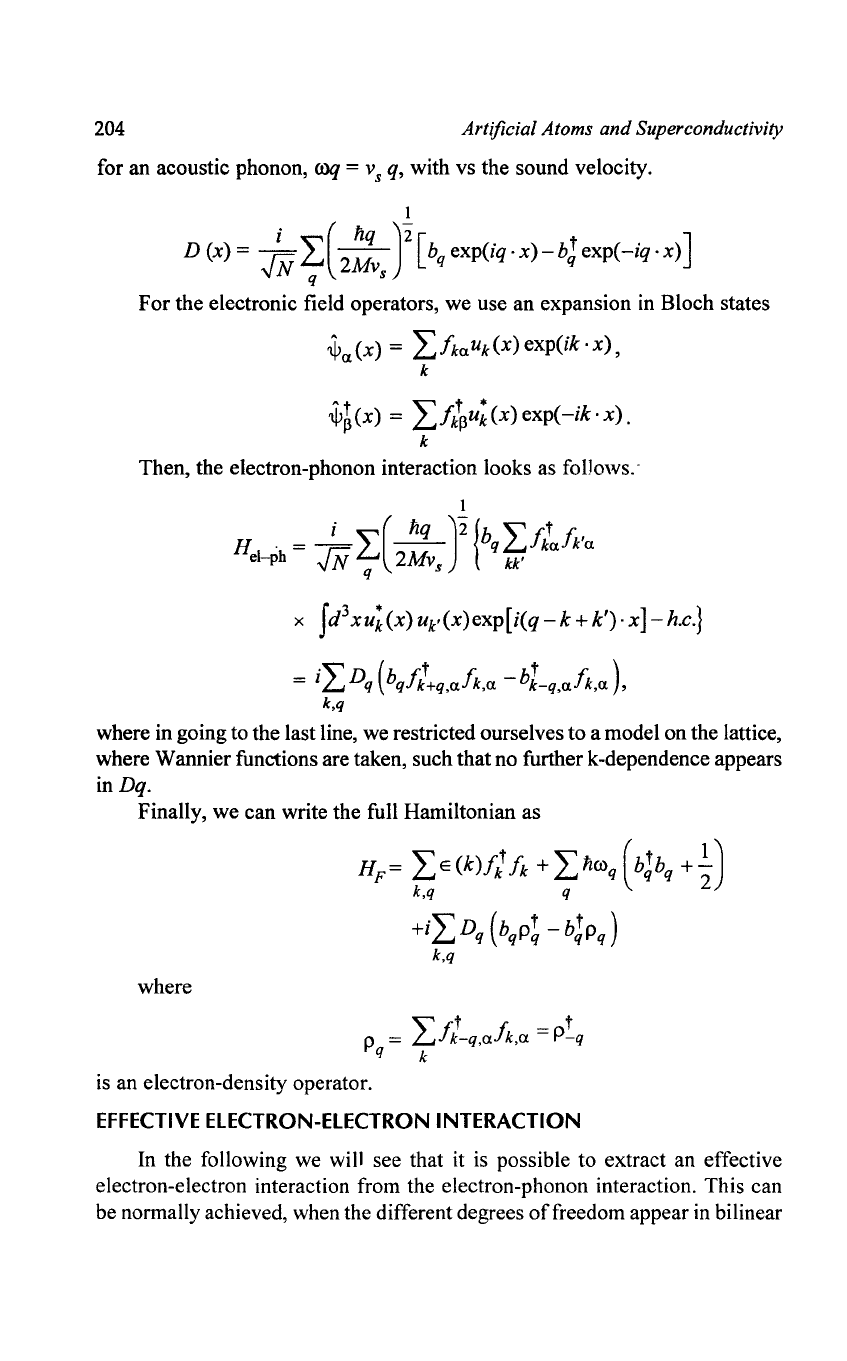
Then, the electron-phonon interaction looks as follows.-
1
H . =
_1_·
"'(~)2
{b
q
Lfl
a
fk'a
el-ph
.IN
'7
2Mv s
kk'
x
fd3xu;(x)
Uk'
(x) exp [i(q
-k
+
k')·
x]
-
h.e.}
= iLDq(bqfkt+q,afk,a
-bLq,afk,a),
k,q
where in going to the last line, we restricted ourselves to a model on the lattice,
where Wannier functions are taken, such that no further k-dependence appears
inDq.
Finally, we can write the full Hamiltonian as
H
F
=
LE(k)fktfk
+ LhCOq(bJb
q
+.!..)
k~
q 2
+iLD
q
(bqP~
-bJp
q
)
k,q
where
is
an electron-density operator.
EFFECTIVE ELECTRON-ELECTRON
INTERACTION
In the following we will see that it is possible to extract an effective
electron-electron interaction from the electron-phonon interaction. This can
be normally achieved, when the different degrees offreedom appear
in
bilinear
Artificial Atoms
and
Superconductivity
205
forms and the coupling between different kinds
of
excitations
is
linear. This
can be easily shown
in
a path integral formalism. Here, we will restrict ourselves
to
workl
in
the frame
of
second quantization and use a canonical transformation.
A canonical transformation one in which the canonical commutation relations
of
operators is preserved.
We start with an anti unitary operator
S,
i.e.
51
=
-8,
such that exp S is
unitary.
By
performing a,unitary transformation, all physical quantities remain
unchanged. Applied
on
the Hamiltonian, we transform it as follows
HF=
e-sH~
1 1
=
HF
+[HF,S]+-[[HF,S],S]+-[[[HF'S],S],S]+···
2!
3!
For the choice
of
S,
we
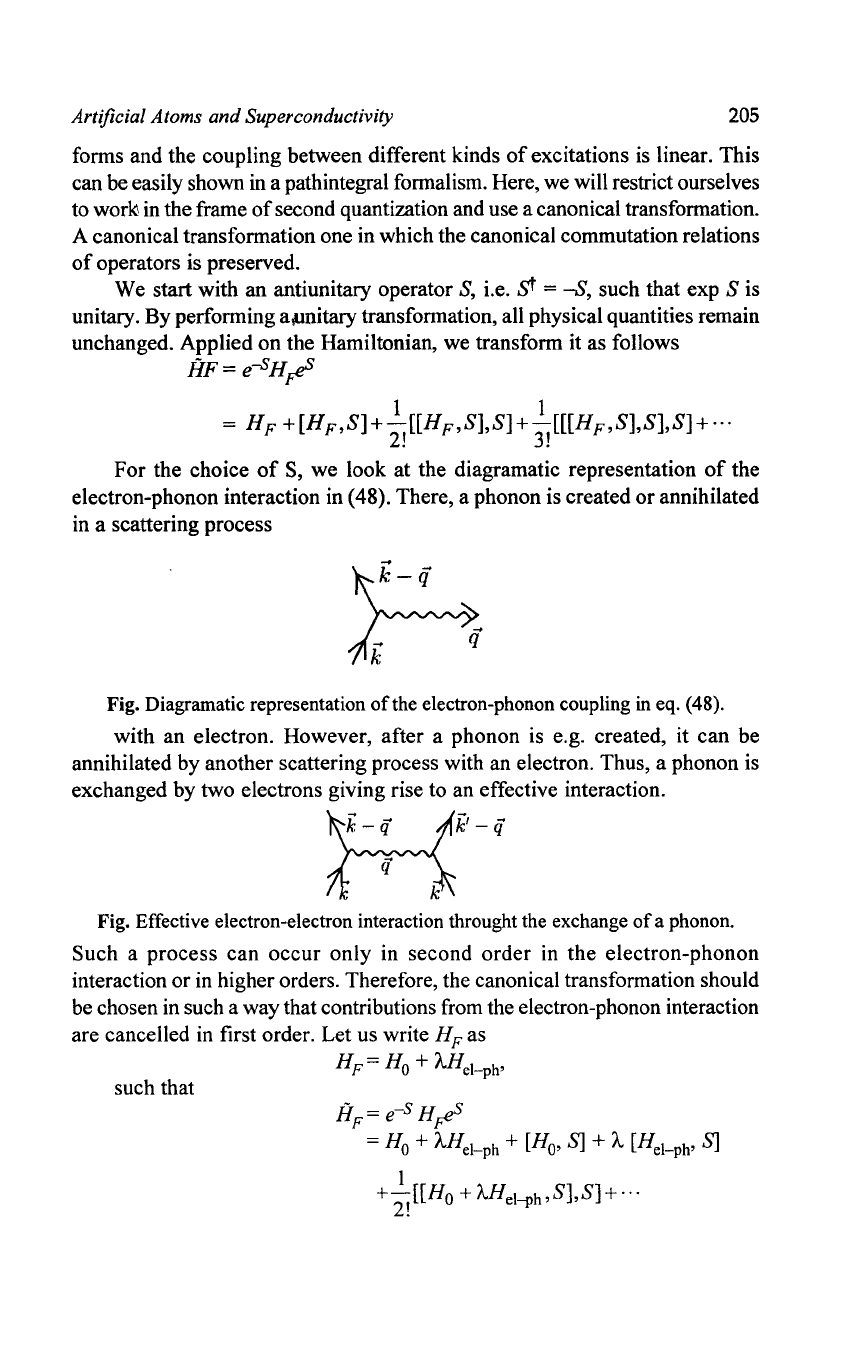
look at the diagramatic representation
of
the
electron-phonon interaction in (48). There, a phonon is created
or
annihilated
in a scattering process
}4
--if
_
- q
k
Fig. Diagramatic representation of
the
electron-phonon coupling in
eq.
(48).
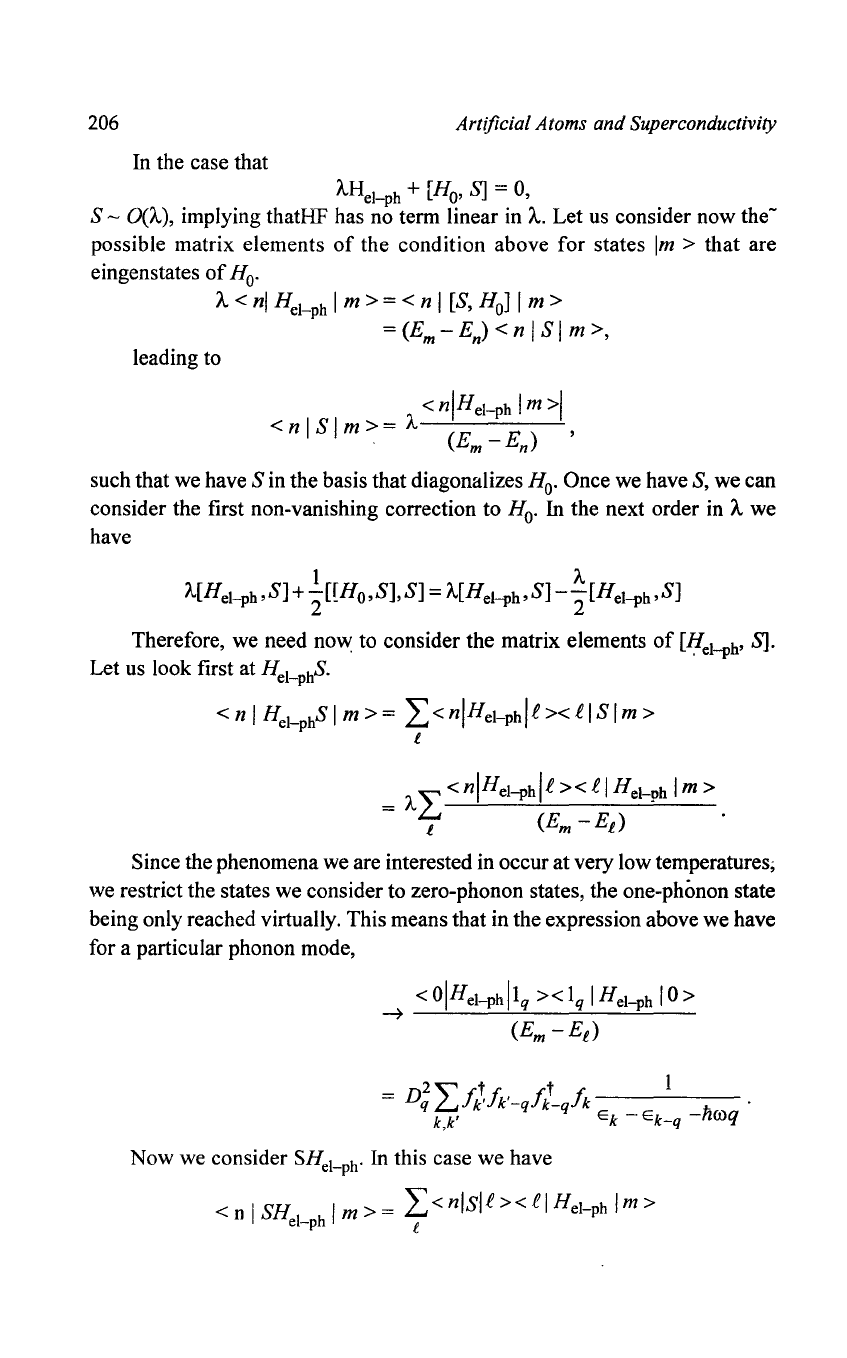
with an electron. However, after a phonon is e.g. created, it can be
annihilated by another scattering process with an electron. Thus, a phonon is
exchanged by two electrons giving rise to an effective interaction.
M
~-~
k'-ij
q
k
Fig. Effective electron-electron interaction throught
the
exchange of a
phonon.
Such a process
can
occur
only in second
order
in the electron-phonon
interaction or
in
higher orders. Therefore, the canonical transformation should
be chosen in such a way that contributions from the electron-phonon interaction
are cancelled
in
first order. Let us write HF as
such that
H
F
=
Ho
+
lJl
el
-
ph
'
H
F
= e-
s
H~S
=
Ho
+ AH
el
_
ph
+
[Ho,
S]
+ A
[H
el
-
ph
'
S]
I
+
2![[H
o
+
lliel-ph
,S],S] + ...
206
Artificial Atoms
and
Superconductivity
In
the case that
ABel_ph
+
[Ho'
51
= 0,
S -
0(1...),
implying thatHF has no term linear in
A.
Let us consider now the-
possible matrix elements
of
the condition above for states
1m
> that are
eingenstates
of
H
o
'
A <
nl
H
eI
_
ph
1 m > = < n 1
[S,
Ho]
1 m >
=
(Em
- En) < n 1 S 1 m >,
leading to
<
niH
el-ph
1 m
>1
<nISlm>=
A
(Em-En)
,
such that we have S in the basis that diagonalizes
Ho'
Once we have
S,
we can
consider the first non-vanishing correction to
Ho'
In the next order in A we
have
1 A
A[
He1-ph'
S]
+
2"[[
H
o
, S], S] =
A[
Hel-ph'
S]
-"2[
He1-ph'
S]
Therefore, we need
no~
to consider the matrix elements
of
[!fel-ph'
51.
Let us look first at
He1_phS.
< n 1
He1_phS
1m
>=
L <
nIHe1_phl.e
><.el
SI
m >
l
=
AL
<nIHe1-Phl.e
><.e
1 H
e1
-
ph
1 m >
l
(Em-El)
Since the phenomena we are interested in occur at very low temperatures;
we restrict the states we consider to zero-phonon states, the one-phonon state
being only reached virtually. This means that in the expression above we have
for a particular phonon mode,
_
2"
ttl
-
Dq
L..Jlk.fk'-qlk-qlk
Ii'
k,k'
Ek
-
Ek-q
-
roq
Now we consider
SH
e1
_
ph
'
In
this case we have
< IS'lI 1
>=
L<nlsl.e><fIHe1_phlm>
n
llel_ph
m l
Artificial Atoms
and
Superconductivity
207
-7
Di
Lfk~fk'-qfLqfk
1 .
k,k'
Ek
-
Ek-q
+
hroq
Putting all the contributions together, we obtain an effective electron-
electron interaction
of
the form
with
Dihroq
Wkq
= 2 2
(Ek
-
Ek+q)
- h
ro
q
This means that for a small region around the Fermi energy with
IE
k - E k+q I <
hroq,
an attractive interaction among electrons arises mediated
by phonons.
One could then roughly argue that a new bound state consisting
of
two fermions could appear, such that the bound pair would have bosonic
character, and hence, similarly to 4 He, a supertluid phase could appear. Since
in this case the pair would be charged, superconductivity would take place.
That such a bound state can occur even in the presence
of
many electrons, is
the subject
of
the theory by Bardeen, Cooper ans Schrieffer.
THE BeS THEORY
After we have seen that the electron-phonon coupling gives rise to an
effective attractive interaction between electrons, the idea that pairs will form
becomes natural. The theory developed by Bardeen, Cooper and Schrieffer
(BCS), allows for a calculation
of
several features related to the transition to
superconductivity like the isotope effect, and also features related to the ground-
state like the opening
of
a gap in the one-particle excitation spectrum. Although
the full
developemeflt
of
the consequences
of
the BCS-theory lie beyond the
scope
of
these lectures, we should mention that this theory is one
of
the most
predictive theories in solid state physics.
The following features should be taken into account, when discussing
pairing.
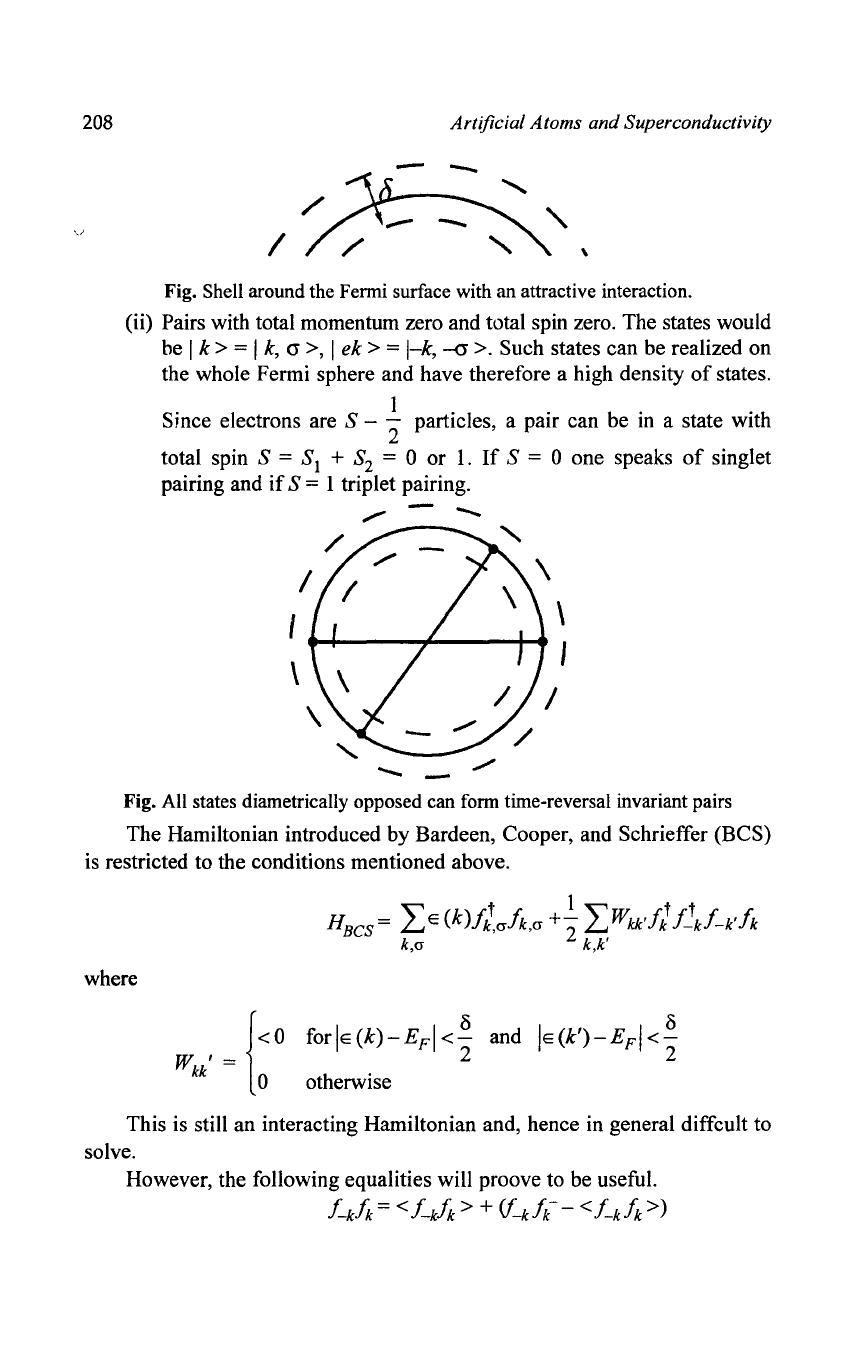
(i) A s
SlOW
n
by
(61),
there
is
an
attract:±re
m.1:Eract:ion
fur
statEs
W .ith
eneIgy
1=
k - E
k+q
I < 0 -
hOOD'
where
OOD
is
the Debye frequency,
that gives the characteristic phonon frequency
of
the system.
208
Artificial Atoms and Superconductivity
/
,
Fig. Shell around the Fenni surface with an attractive interaction.
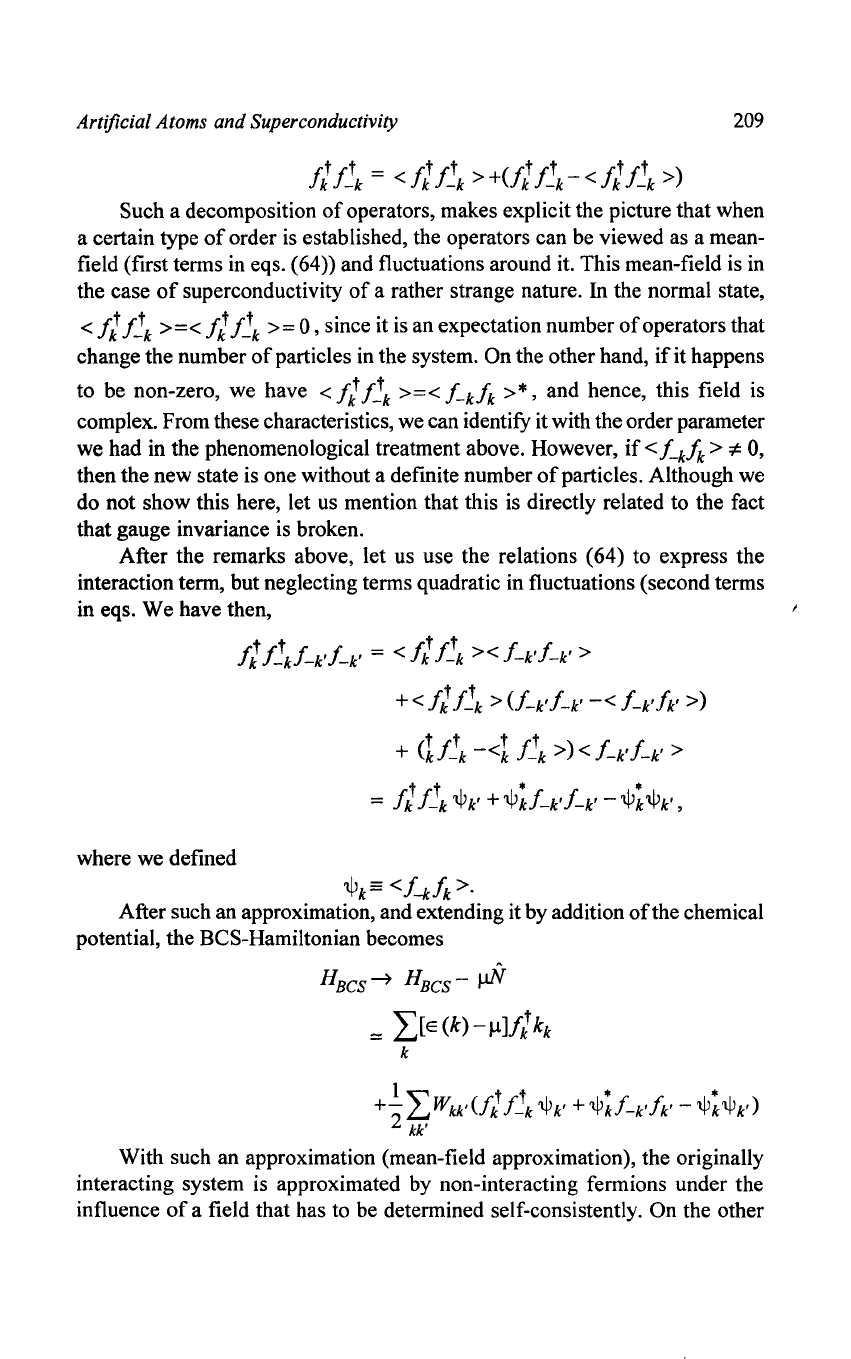
(ii) Pairs with total momentum zero and total spin zero. The states would
be
I
k>
= I
k,
cr
>, I
ek>
= I-k, -<r >. Such states can be realized on
the whole Fermi sphere and have therefore a high density
of
states.
1
Since electrons are S
-"2
particles, a pair can be
in
a state with
total spin
S = SI +
S2
= 0 or
1.
If
S = 0 one speaks
of
singlet
pairing and
if
S = 1 triplet pairing.
,.."
-...
\
/
-..._/
Fig. All states diametrically opposed can fonn time-reversal invariant pairs
The Hamiltonian introduced by Bardeen, Cooper, and Schrieffer (BCS)
is
restricted to the conditions mentioned above.
where
{
(5 (5
<0
for!E(k)-E
F
!<-
and
!E(k')-E
F
!<-
W ' = 2 2
kk
0
h·
ot erwlse
This is still an interacting Hamiltonian and, hence in general diffcult to
solve.
However, the following equalities will proove to be useful.
Lkik =
<Lkik
> +
if-kit
- <Lkh »
Artificial Atoms
and
Superconductivity
209
fIf!k
=
<fIf!k
>+(fIf!k-<fIf!k
»
Such a decomposition
of
operators, makes explicit the picture that when
a certain type
of
order is established, the operators can be viewed as a mean-
field (first terms in eqs. (64)) and fluctuations around it. This mean-field is in
the case
of
superconductivity
of
a rather strange nature.
In
the normal state,
<
fi
f!k
>=<
fi
f!k
>=
0,
since it is an expectation number
of
operators that
change the number
of
particles in the system. On the other hand,
if
it happens
to be non-zero,
we
have <
fi
f!k
>=<
f-kfk
>*,
and hence, this field is
complex. From these characteristics, we can identify it with the order parameter
we
had in the phenomenological treatment above. However,
if
<Lkh
>
*"
0,
then the new state is one without a definite number
of
particles. Although we
do
not show this here, let us mention that this is directly related to the fact
that
gauge invariance is broken.
After
the remarks above, let us use the relations (64) to express the
interaction term, but neglecting terms quadratic in fluctuations (second terms
in eqs.
We
have then,
where
we
defined
fl
f!kf-k,f-k'
= <
fkt
f!k
><
f-k,f-k' >
+ <
fl
f!k
> (f-k' f-k'
-<
f-k'
ik,
»
+ <If!k
-<1
f!k
»<f-k,f-k'
>
t t * *
= fk
Lk
,pk'
+ ,pkf-k' f-k'
-,pk
,pk',
'h=
<f-kf
k
>.
After such an approximation, and extending it by addition
of
the chemical
potential, the BCS-Hamiltonian becomes
HBCS-7
H
BCS
--
~
=
2)E(k)-~]flkk
k
+~
LW
kk
'(flf!k
,pk'
+,p;f-k,fk' -
,p;,pk')
2
kk'
With such an approximation (mean-field approximation), the originally
interacting system is approximated by non-interacting fermions under the
influence
of
a field that has to be determined self-consistently. On the other
210 Artificial Atoms
and
Superconductivity
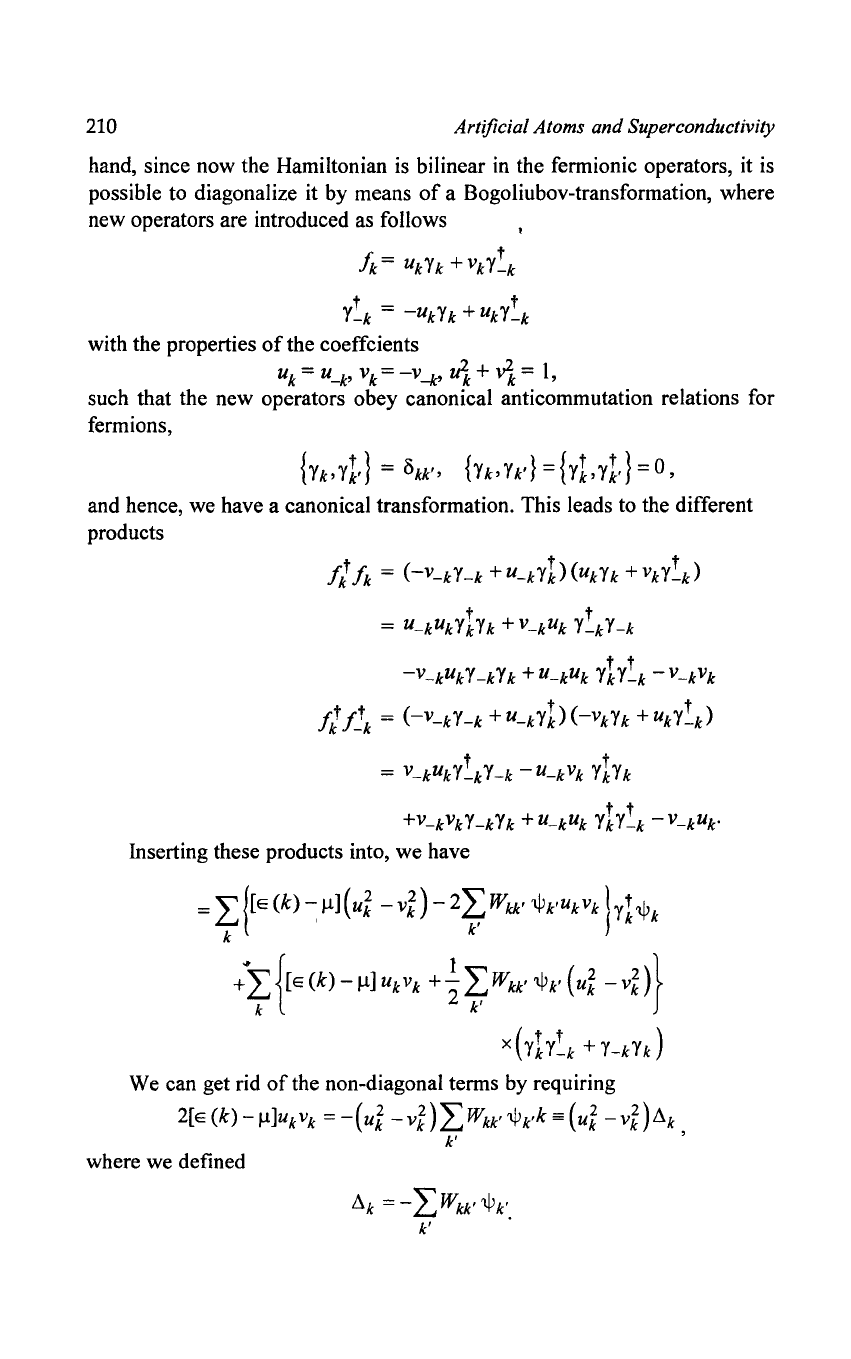
hand, since now the Hamiltonian is bilinear in the fermionic operators, it is
possible to diagonalize it by means
of
a Bogoliubov-transformation, where
new operators are introduced as follows
fk=
ukYk +VkY!k
Y!k
=
-uk
Y k +
uk
Y!k
with the properties
of
the coeffcients
uk
=
u_
k
, v
k
=
-v-k'
z1
+
vi
=
1,
such that the new operators obey canonical anticommutation relations for
fermions,
{rk'Y!'}
=
0kk"
{Ybyd={rLyO=O,
and hence, we have a canonical transformation. This leads to the different
products
f:fk
=
(-v-kY-k
+U-kY!)(UkYk +VkY!k)
=
u-kukyhk
+v_kuk Y!kY-k
t t
-v-kukY-kYk
+u_kuk YkY-k
-v_kvk
f:f!k
=
(-v-kY-k
+U-kY!)(-VkYk
+UkY!k)
= V-kUkY!kY-k
-u-kvk
Y!Yk
t t
+v-kvkY-kYk +u_kuk YkY-k
-v_kuk·
Inserting these products into,
we
have
=
~{[E(k)~~](u;
-vi}-2t,W
kk
, tPk,ukvk }Y!tPk
+I{[E(k)-~]UkVk
+!
IWkk,tPk'(U;
-vn}
k 2
k'
x ( Y r Y!k + Y
-k
Y k )
We can get rid
of
the non-diagonal terms by requiring
2[E
(k)
-
~]ukvk
=
-{ui
-v1)I
W
kk' tPk,k
==
{ui
-v1),1k
k'
,
where we defined
Artificial Atoms and Superconductivity
211
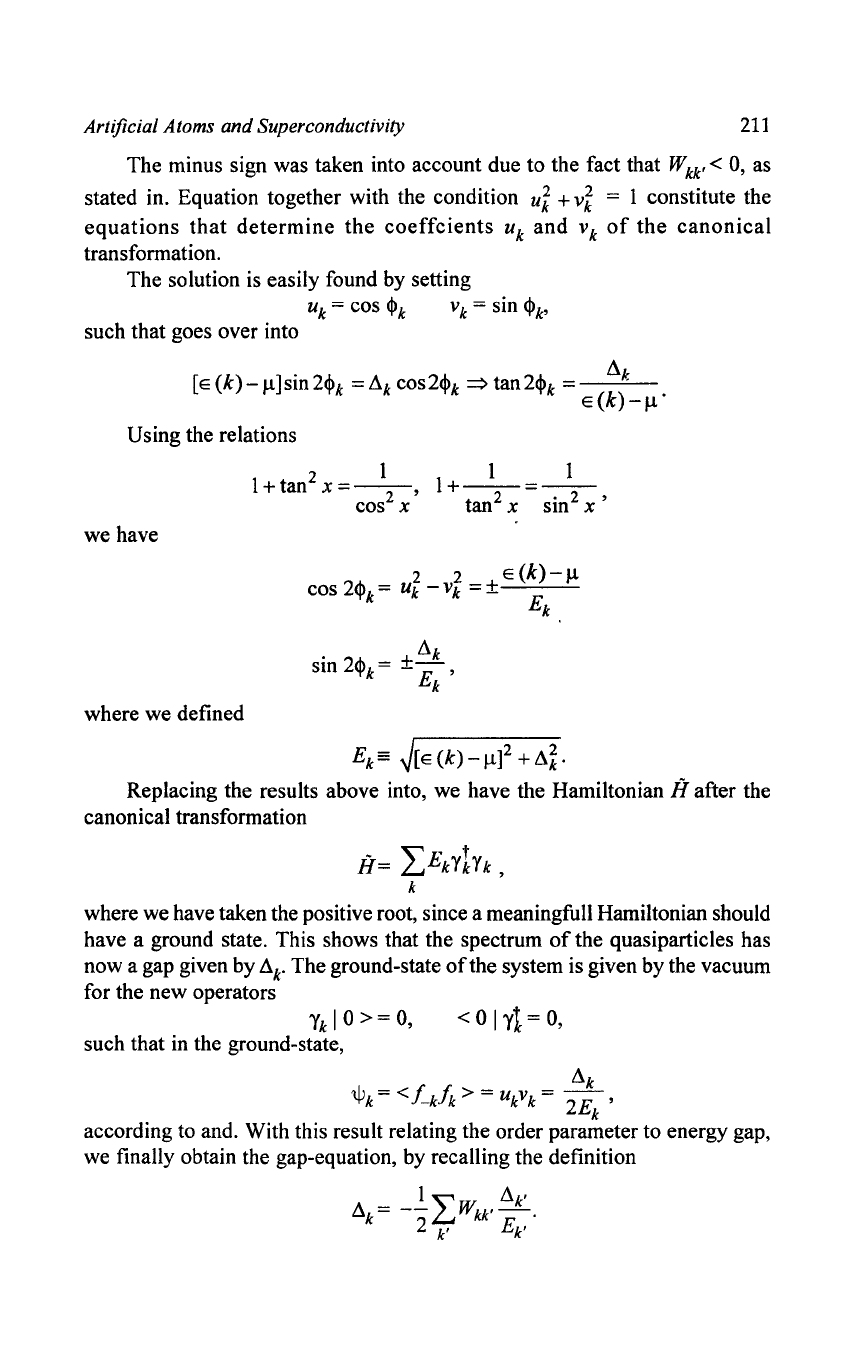
The minus sign was taken into account due to the fact that W kk' < 0, as
stated in. Equation together with the condition
ui
+
vi
= 1 constitute the
equations
that
determine
the
coeffcients
uk
and
v
k
of
the
canonical
transformation.
The solution is easily found by setting
uk
= cos
<Ilk
V
k
= sin
<Ilk'
such that goes over into
[E{k)-Jl]sin2<1lk
=~kcos2(h
~tan2<1>k
=
~k
.
E{k)-Jl
Using the relations
2 1 1 1
l+tan
x=--2-'
1+--=--
cos x tan
2
x sin
2
x '
we
have
where
we
defined
~k
sin
211\
=
±-
'i'k
Ek
'
E
k
=
~[E{k)-Jlf
+~1·
Replacing the results above into, we have the Hamiltonian
il
after the
canonical transformation
-
"E
t
H=
L.
kYkYk,
k
where we have taken the positive root, since a meaningfull Hamiltonian should
have a ground state. This shows that the spectrum
of
the quasiparticles has
now a gap given by
~k.
The ground-state
of
the system is given
by
the vacuum
for the new operators
Yk
I ° > = 0, < ° I
yt
= 0,
such that in the ground-state,
~k
't(Jk
= <Lkhc > =
ukv
k
= 2Ek '
according to and. With this result relating the order parameter to energy gap,
we finally obtain the gap-equation, by recalling the definition
1"
~k'
!l.k=
--
L.Wkk'-.
2
k'
E
k
,