
Brewster H.D. Solid State Physics
Подождите немного. Документ загружается.

232
Quantum
and
Statistical Mechanics
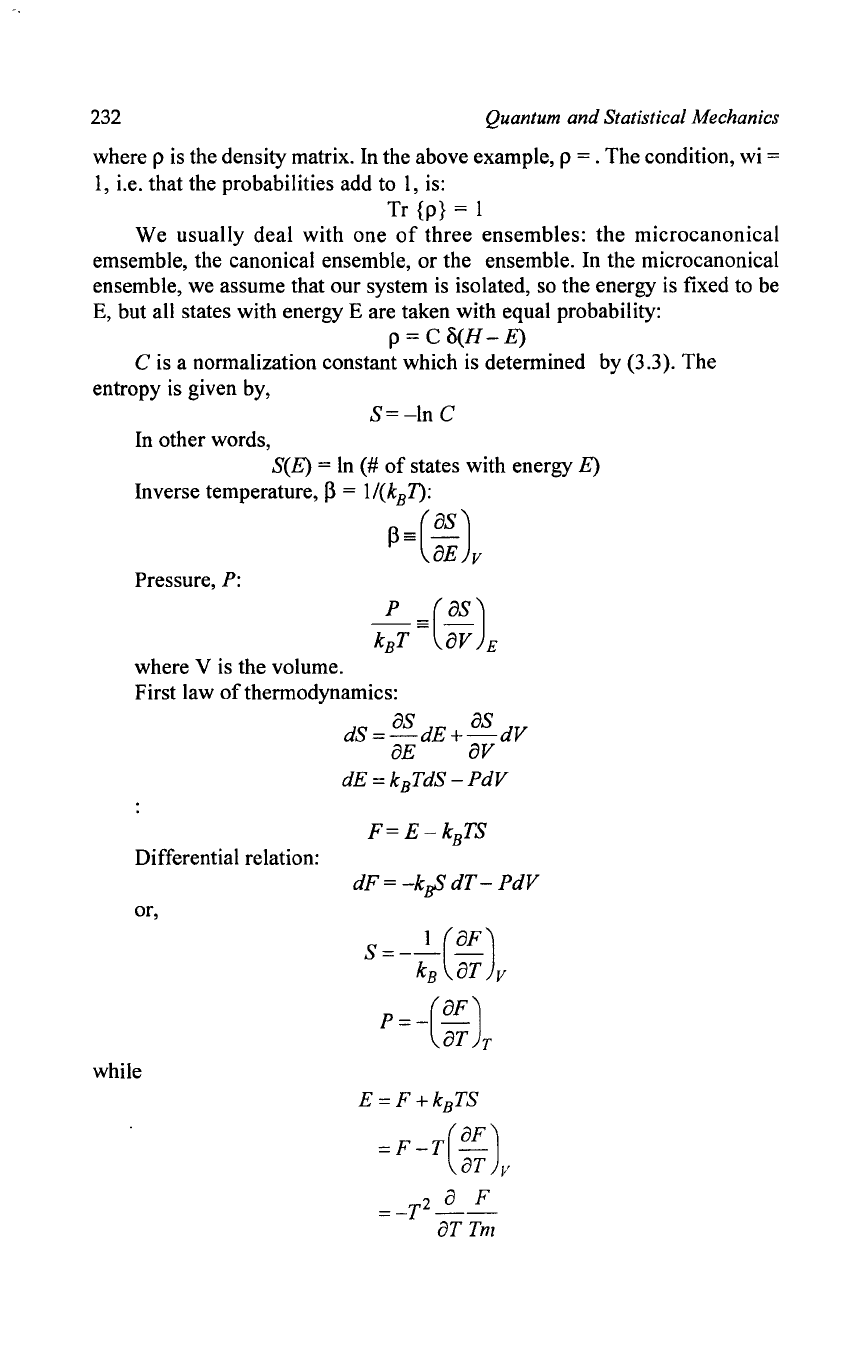
where p is the density matrix. In the above example, p = . The condition, wi =
1,
i.e. that the probabilities add to
1,
is:
Tr
{p}
= I
We
usually deal with one
of
three
ensembles:
the
microcanonical
emsemble, the canonical ensemble, or the ensemble. In the microcanonical
ensemble, we assume that our system
is
isolated, so the energy is fixed to be
E, but all states with energy E are taken with equal probability:
p = C
O(H-E)
C is a normalization constant which is determined by (3.3). The
entropy is given by,
S=-ln
C
In other words,
S(E) =
In
(#
of
states with energy E)
Inverse temperature,
~
=
1/(kBT):
~==(asJ
aE v
Pressure,
P:
P
(as)
kBT
==
av
E
where V is the volume.
First law
of
thermodynamics:
Differential relation:
or,
while
dS =
as
dE +
as
dV
aE
av
dE = kBTdS -
PdV
dF
=
-ksS
dT
-
PdV
S
___
1
(aF)
kB
aT
v
p=_(aF)
aT
T
E = F +kBTS
=F_T(aF)
aT
v
=_T2~£
aTTm
Quantum and Statistical Mechanics
233
In
the canonical ensemble, we assume that our system is
in
contact with
a heat reservoir so that the temperature
is
constant. Then,
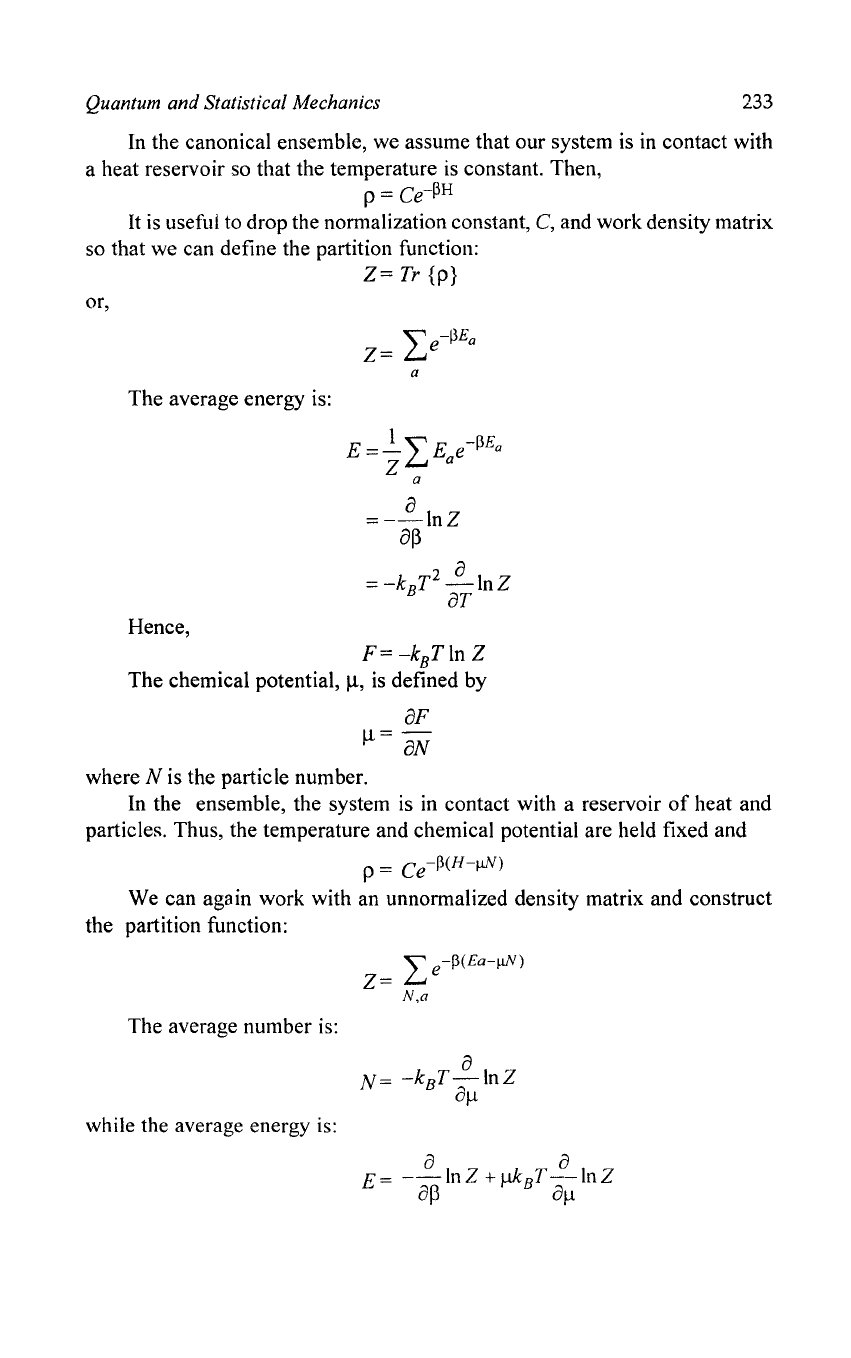
p =
Ce-~H
It
is
useful to drop the normalization constant,
C,
and work density matrix
so that we can define the partition function:
or,
The average energy
is:
Hence,
Z=
Tr
{p}
a
a
=--lnZ
a~
2 a
=-kBT
-lnZ
aT
F=
-kBTln
Z
The chemical potential,
Il,
is
defined by
aF
Il=
-
aN
where N is the particle number.
In
the ensemble, the system
is
in
contact with a reservoir
of
heat and
particles. Thus, the temperature and chemical potential are held fixed and
p =
Ce-~(H-~)
We
can again work with an unnormalized density matrix and construct
the partition function:
The average number
is:
while the average energy
is:
a
N=
-kBT-lnZ
Oil
o 0
E=
--lnZ
+/lkBT--lnZ
o~
Oil
234
Quantum
and
Statistical Mechanics
BOSE-EINSTEIN
AND
PLANCK DISTRIBUTIONS
Bose-Einstein Statistics
For
a system
of
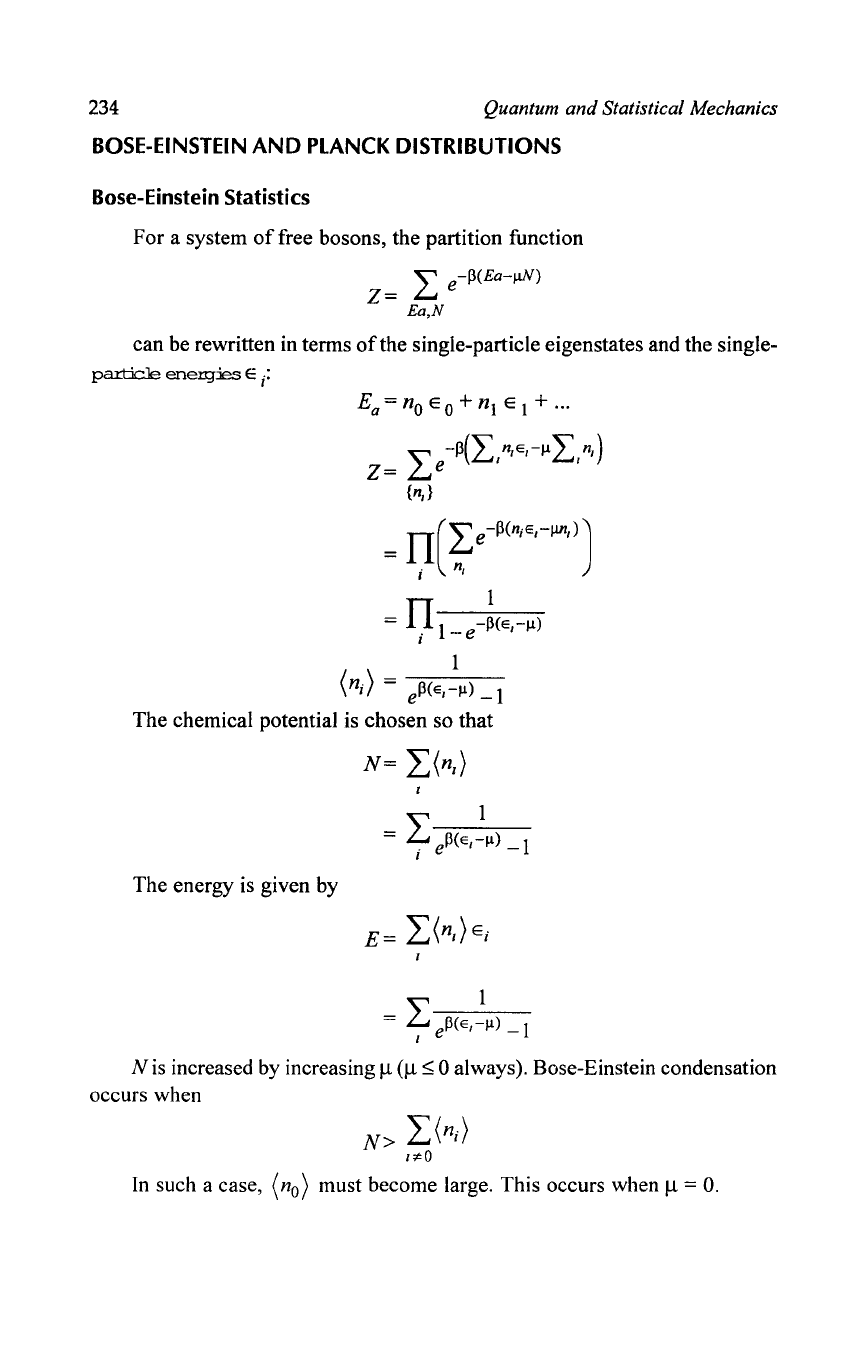
free bosons, the partition function
" -f3(Ea-J,tN)
Z=
L..J
e
Ea,N
can
be rewritten in terms
of
the single-particle eigenstates and the single-
part:icJe
enezgjes
E
j:
Z=
Ie-
f3
(L,n,E,-Il
L
,n,)
{n,}
1
=
IT
1
-f3(E
-11)
j
-e
'
1
(n
j
)
= e
f3
(E,-Il)_1
The
chemical potential is chosen so
that
The
energy is given by
N
is
increased by increasing
~ (~~
0 always). Bose-Einstein condensation
occurs when
N>
I(n
i
)
/';<0
In
such a case,
(no)
must become large. This occurs when
~
=
o.
Quantum
and
Statistical Mechanics
The
Planck
Distribution
235
Suppose N is not fixed, but is arbitrary, e.g. the numbers
of
photons and
neutrinos are not fixed. Then there is no Lagrange multiplier
)l
and
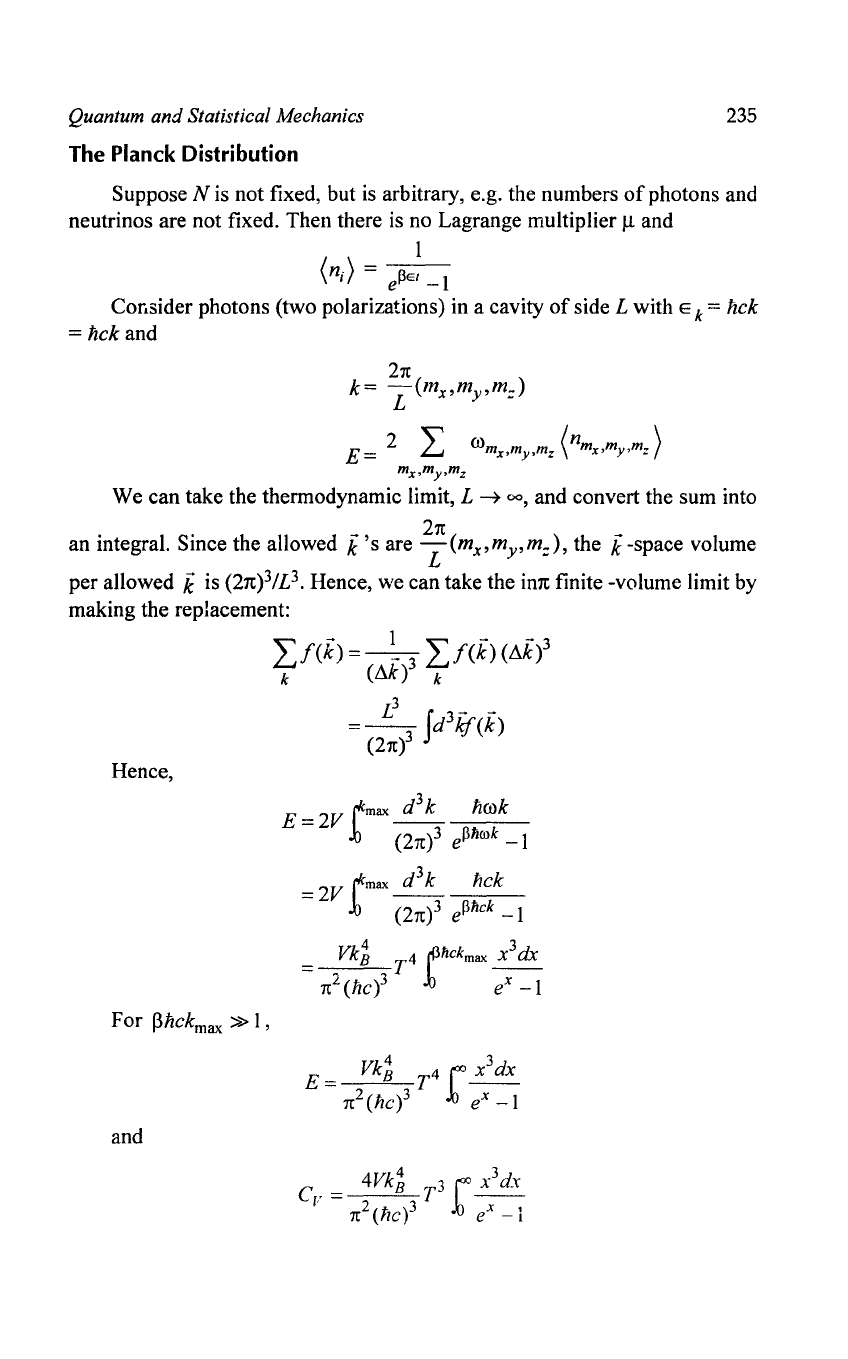
1
(n
j
)
=
e~EI
_ 1
Cor.sider photons (two polarizations) in a cavity
of
side L with E k = nck
=
nckand
21t
k=
/:(mx,my,m=)
E=
2 I O)mx,my,m
z
(nmX,my,m
z
)
mx
,my ,m
z
We can take the thermodynamic limit, L
~
00, and convert the sum into
an integral. Since the allowed
k
's
are
2;
(mx,my,m=), the k -space volume
per allowed
k is (2n)3IL3. Hence, we can take the inn finite -volume limit by
making the replacement:
Hence,
For
pnck
max
»1,
and
If(k)=~
If(k)
(l1k)3
k
(11k)
k
3
=_L_
fd
3
iif(k)
(21t)3
k
4 3
C . =
4V,
B T3 r x
dx
r-
2 3
1t
(ne)
eX
- 1
236
Quantum
and
Statistical Mechanics
For
~lickmax
«1,
and
FERMI-DI
RAC
DISTRI
EUTION
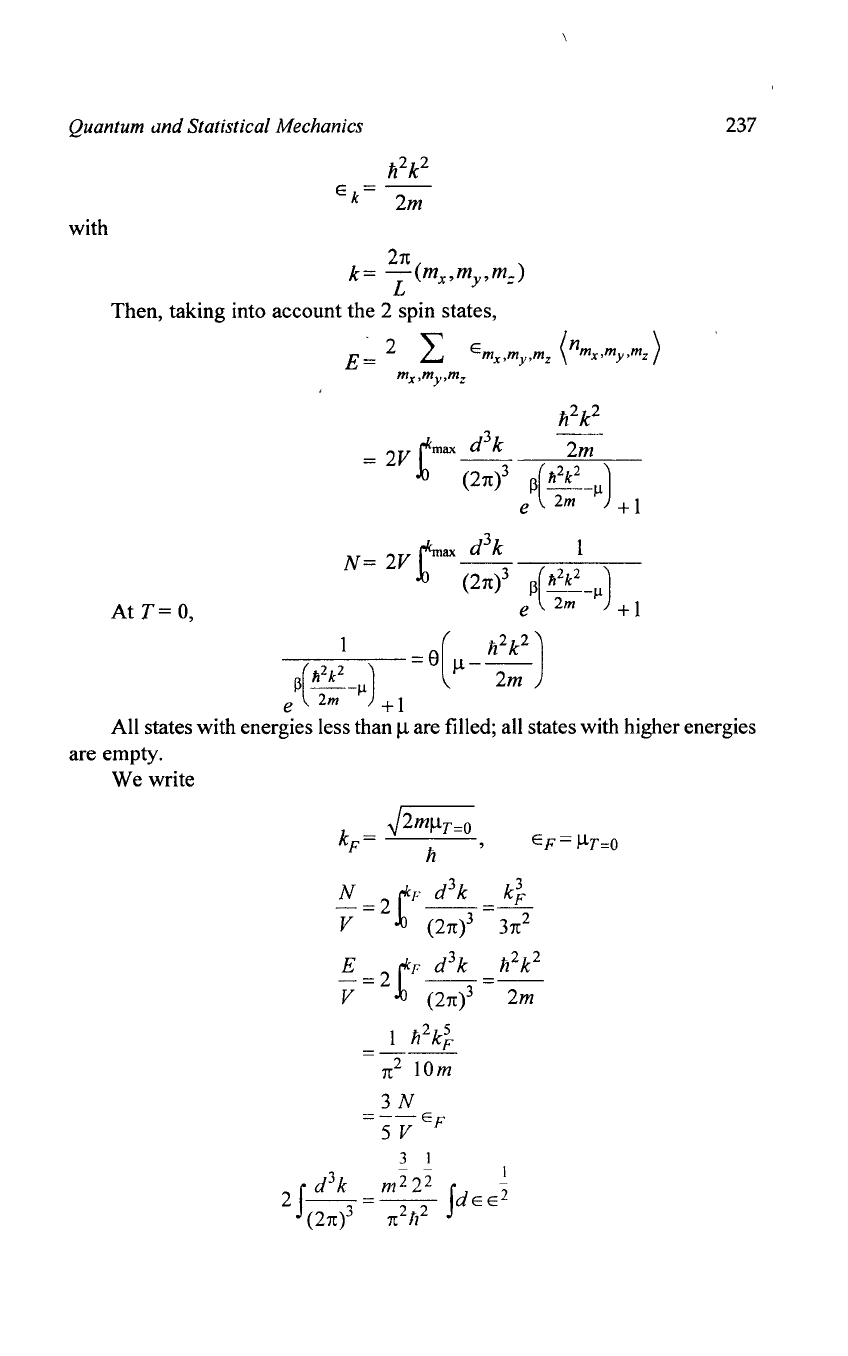
For a system
of
free fermions, the partition function
"
-~(Ea-J1N)
Z=
LA
e
EQ,N
can again be rewritten in terms
of
the single-particle eigenstatesand the single-
particle energies
E
j:
but now
so that
n = 0 1
I '
Z=
Ie
-~(L,n,E,-~
L,n,)
{n,
}
=
n(
±
e-~(n'E'-~')J
I
n,=O
= n
(1
+ e
-~(E,-~»)
1
(n
1
)
=
e~(E'+~)+l
The
chemical potential is chosen so that
1
N=
I
eP(E,+~)
+ 1
I
The energy is given by
THERMODYNAMICS
OF THE
Free electron gas
in
a box
of
side
L:
Quantum
and
Statistical Mechanics
237
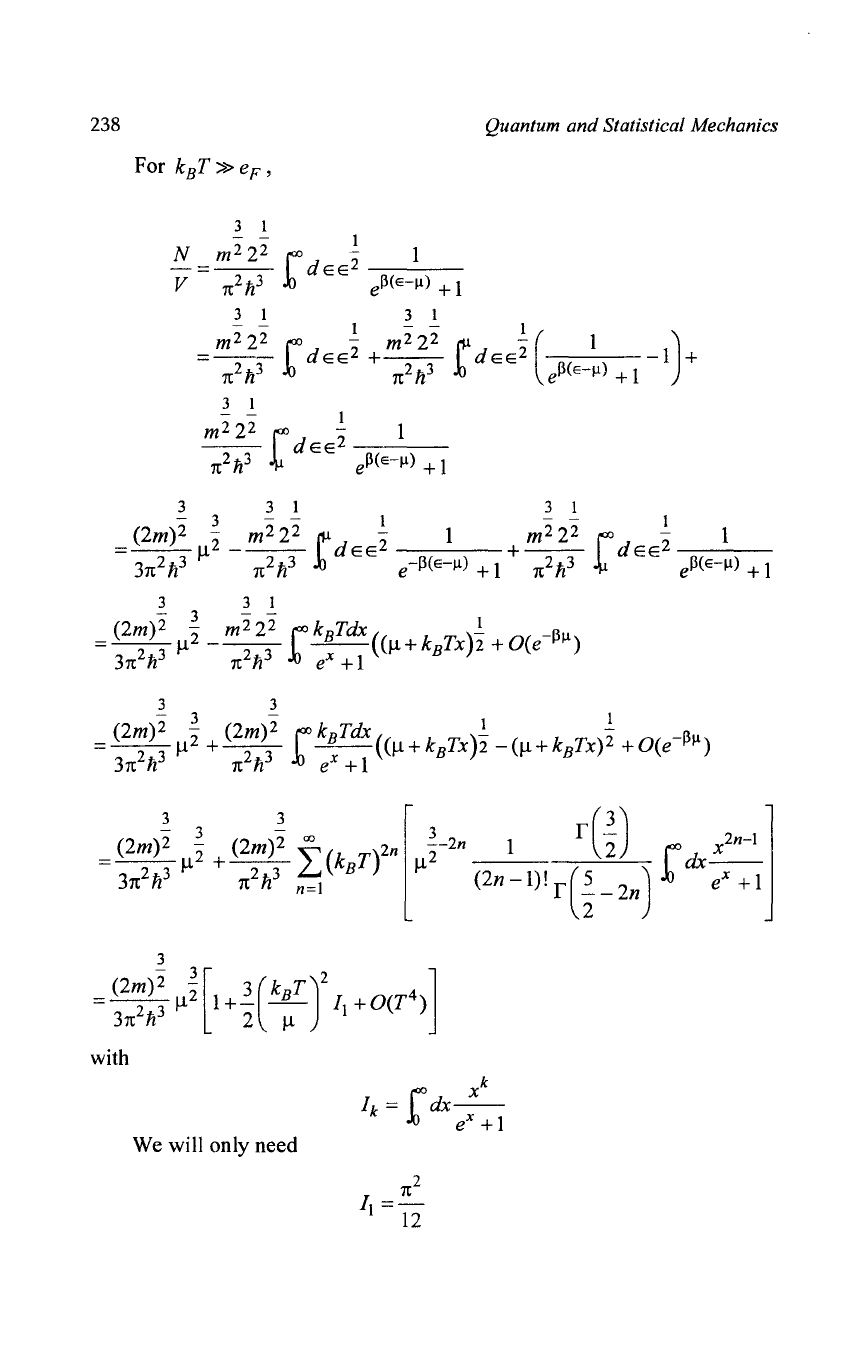
with
21t
k=
T(mx,my,m=)
Then, taking into account the 2 spin states,
. 2
"E
(nm
m m )
E=
~
mx,my,m
z
x'
y'
z
mx,my,m
z
3
N=
2vtax~
1
(21t)3
13(1I2tC_~)
At
T = 0, e 2m + 1
{.y~"
1 =
e(~
-
.::'
)
e 2m
+1
All states with energies less than Il are filled; all states with higher energies
are empty.
We
write
N _ 2
rF
d
3
k _
k}
V -
.b
(21t)3
-
31t
2
E = 2
rF
d
3
k =
112
k
2
V
.b
(2rr)3
2m
_1_1l2k~
rr2
10m
3N
=--EF
5 V
3 1
3
2.
2.
1
2f~=~fdEE2
(2rr)3
rr2fJ2
238
Quantum
and
Statistical Mechanics
3
=
C2m)2
,3
[1
+~(kBTJ2
I +
OCT
4
)]
31t
2
h
3
2
~
1
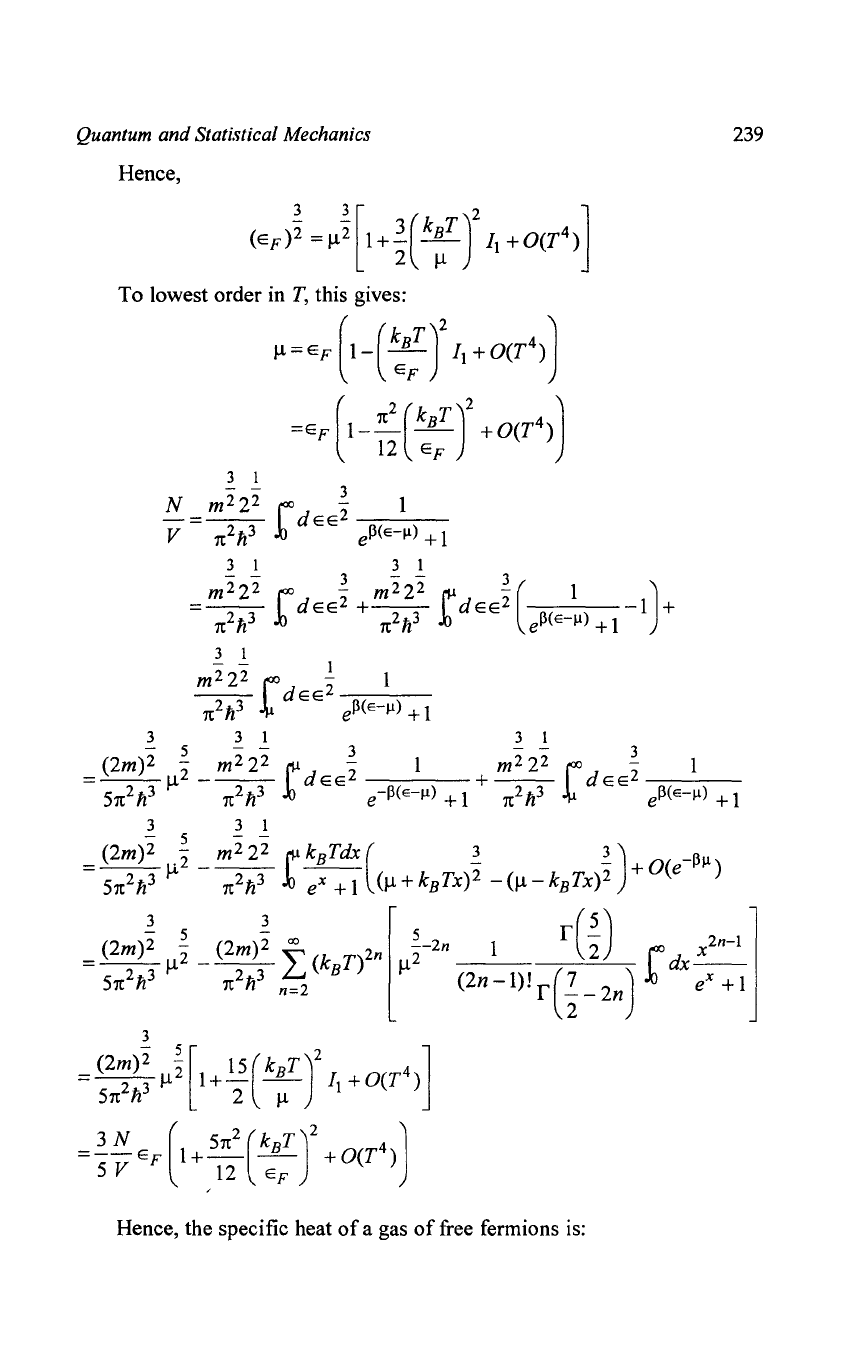
with
We will only need
Quantum
and
Statistical Mechanics
Hence,
(E)
~1'~[l+w~Tr
I, +O(T
4
)]
To lowest order in
T,
this gives:
I'~E+-(~:r
I, +O(T
4
)J
~E+-
~:
(~:r
+O(T
4
)J
Hence, the specific heat
of
a gas
of
free fermions
is:
239
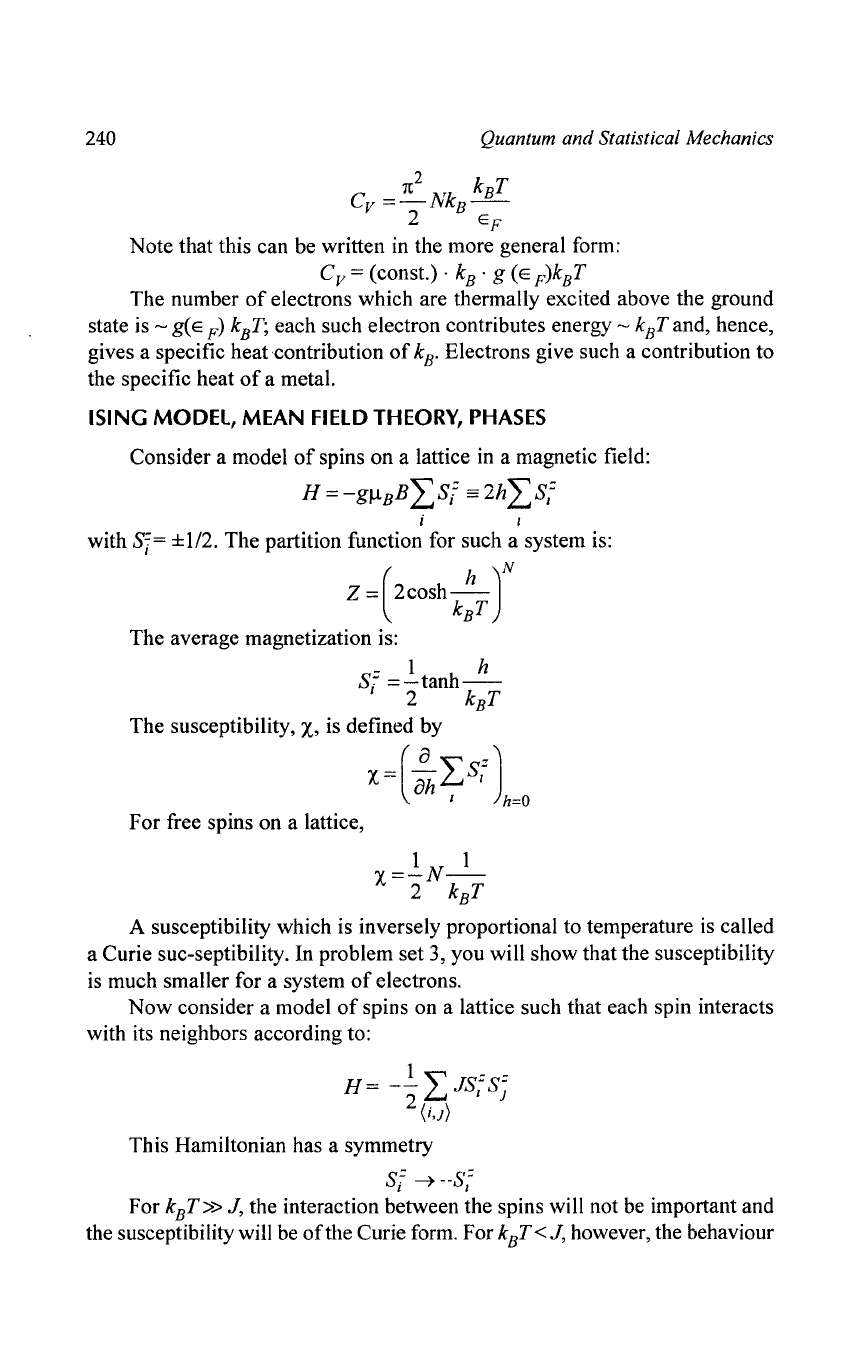
240
Quantum and Statistical Mechanics
C
_
1t
2
Mk
kBT
V
--lV
B--
2
EF
Note
that
this can be written in the more general form:
C
v
= (const.) °
kB
° g (E
F)kBT
The
number
of
electrons which are thermally excited above the ground
state is
~
g( E
F)
kBT;
each such electron contributes energy
~
kBT and, hence,
gives a specific
heat
contribution
of
kBo
Electrons give such a contribution to
the specific
heat
of
a metal.
ISING
MODEL,
MEAN
FIELD
THEORY,
PHASES
Consider a model
of
spins
on
a lattice in a magnetic field:
H =
-gil
BB I
Sj=
==
2h I
S,=
j ,
with
Sf=
±1I2.
The
partition function for such a system is:
Z=(2COSh~)N
kBT
The
average magnetization is:
- 1 h
S':'
=-tanh--
, 2 kBT
The
susceptibility,
X,
is defined by
F
or
free spins
on
a lattice,
X=(:h
LS
,=)
,
h=O
1 1
X=-N-
2 kBT
A susceptibility which is inversely proportional to temperature is called
a Curie suc-septibility. In problem
set
3,
you
will
show
that
the susceptibility
is
much
smaller for a system
of
electrons.
Now
consider a model
of
spins on a lattice such that each spin interacts
with its neighbors according to:
1 L
--
H=
--
JS~S-
2 ' j
(;,j)
This Hamiltonian has a symmetry
S;=
~--S,=
For
kBT»
J,
the interaction between the spins will not be important and
the susceptibility will be
of
the Curie form. For kBT<J, however, the behaviour
Quantum
and
Statistical Mechanics
241
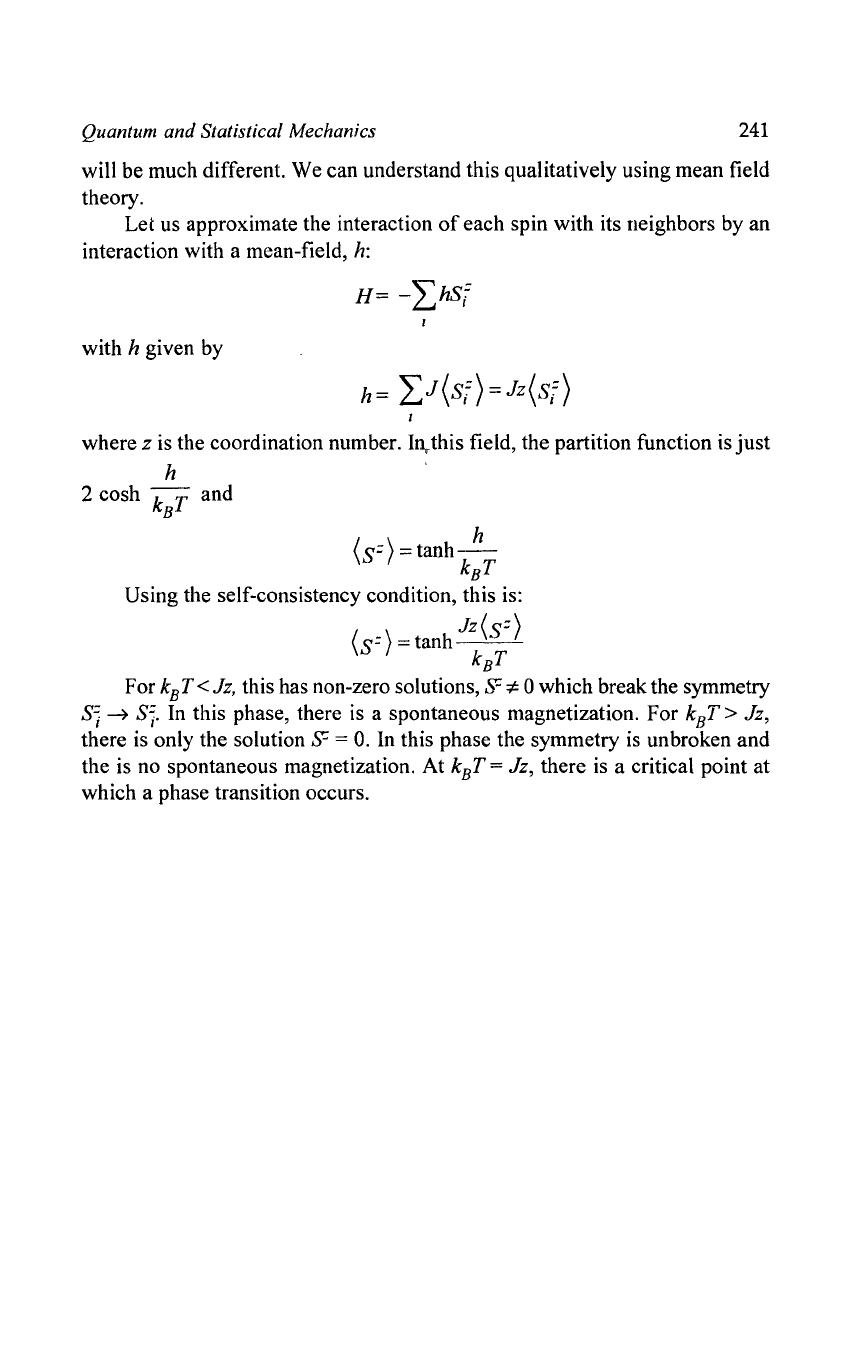
will be much different. We can understand this qualitatively using mean field
theory.
Let us approximate the interaction
of
each spin with its neighbors by an
interaction with a mean-field,
h:
with h given by
where
z is the coordination number. In,.this field, the partition function is
just
h
2 cosh k
BT
and
(S=)=tanh~
kBT
Using the self-consistency condition, this is:
JZ(
-)
(S= ) = tanh
s-
kBT
For
kBT
<
Jz,
this has non-zero solutions,
~"*
0 which break the symmetry
Sj
~
Sj.
In
this phase, there is a spontaneous magnetization. For kBT> Jz,
there is only the solution
~
=
O.
In
this phase the symmetry
is
unbroken and
the is no spontaneous magnetization. At
kBT
= Jz, there
is
a critical point at
which a phase transition occurs.