
Brewster H.D. Solid State Physics
Подождите немного. Документ загружается.

212
Artificial Atoms
and
Superconductivity
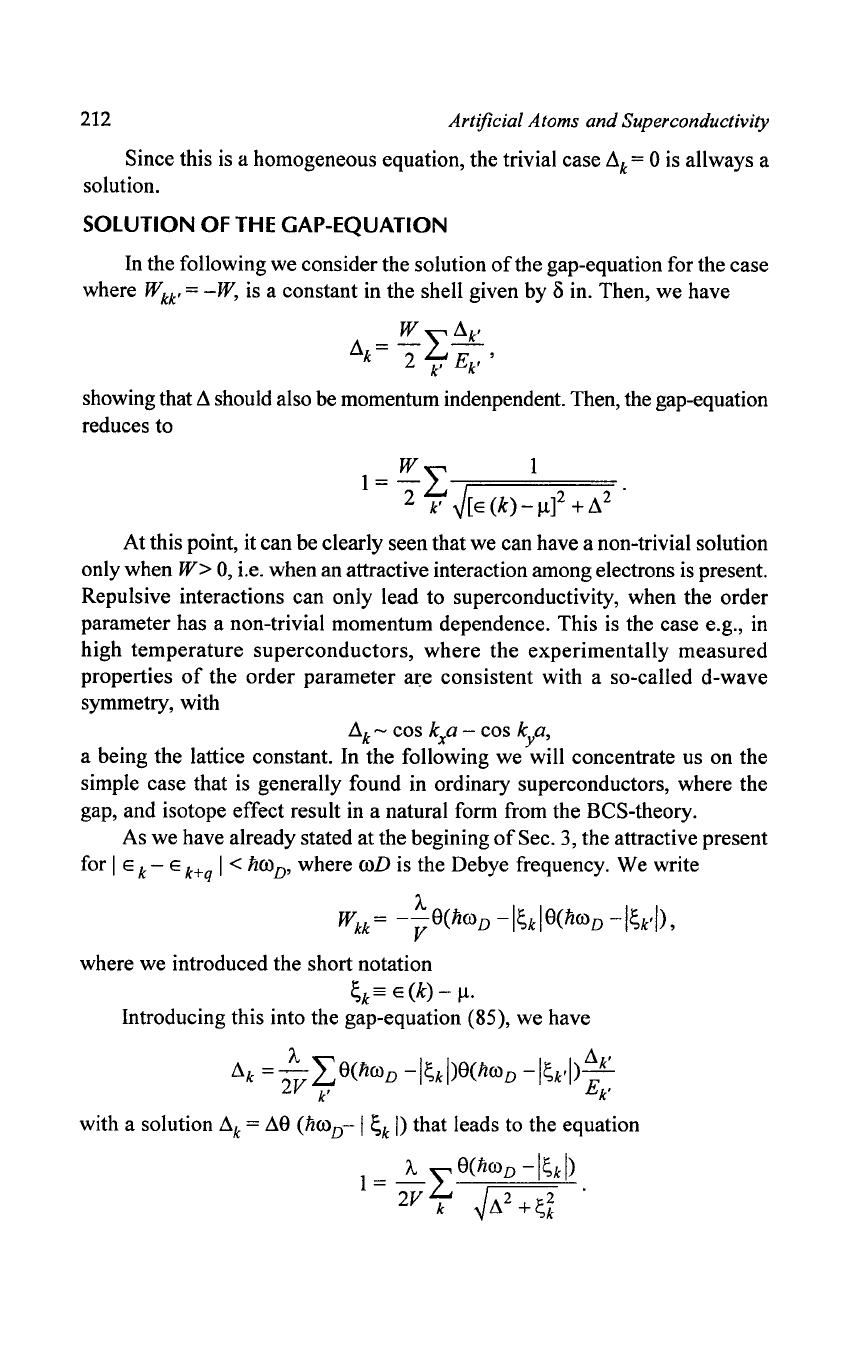
Since this
is
a homogeneous equation, the trivial case Ilk = 0
is
allways a
solution.
SOLUTION OF THE GAP-EQUATION
In the following we consider the solution
of
the gap-equation for the case
where
W
kk
' =
-W,
is
a constant in the shell given by 8 in. Then, we have
W"
Ilk'
Il
k
=
-2
L.J
-E
'
k' k'
showing that
11
should also be momentum indenpendent. Then, the gap-equation
reduces to
1=
WI
1
2
k'
~[E(k)-~'\i+1l2
.
At this point, it can be clearly seen that we can have a non-trivial solution
only when
W>
0,
i.e. when an attractive interaction among electrons
is
present.
Repulsive interactions can only lead to superconductivity, when the order
parameter has a non-trivial momentum dependence. This
is
the case e.g., in
high temperature superconductors, where the experimentally measured
properties
of
the order parameter
at:e
consistent with a so-called d-wave
symmetry, with
Ilk - cos kxa - cos kya,
a being the lattice constant. In the following we will concentrate us on the
simple case that is generally found in ordinary superconductors, where the
gap, and isotope effect result
in
a natural form from the BCS-theory.
As we have already stated at the begining
of
Sec. 3, the attractive present
for
IE
k - E k+q I <
hOOD'
where
ooD
is the Debye frequency. We write
A.
W
kk
= - V
O(hffiD
-ISkIO(hffiD
-Isk'/),
where we introduced the short notation
~k=
E(k)
-~.
Introducing this into the gap-equation (85), we have
Ilk
=~
IO(hffiD
-ISkl)O(hffiD
-Isk'/)Ll
k
,
2V
k'
E
k
,
with a solution Llk =
Ll8
(hOOD-I
~k
I)
that leads to the equation
1 =
~
I
O(hffiD
-ISkl)
2V
k
~
Ll
2
+
S~
.
Artificial Atoms
and
Superconductivity
213
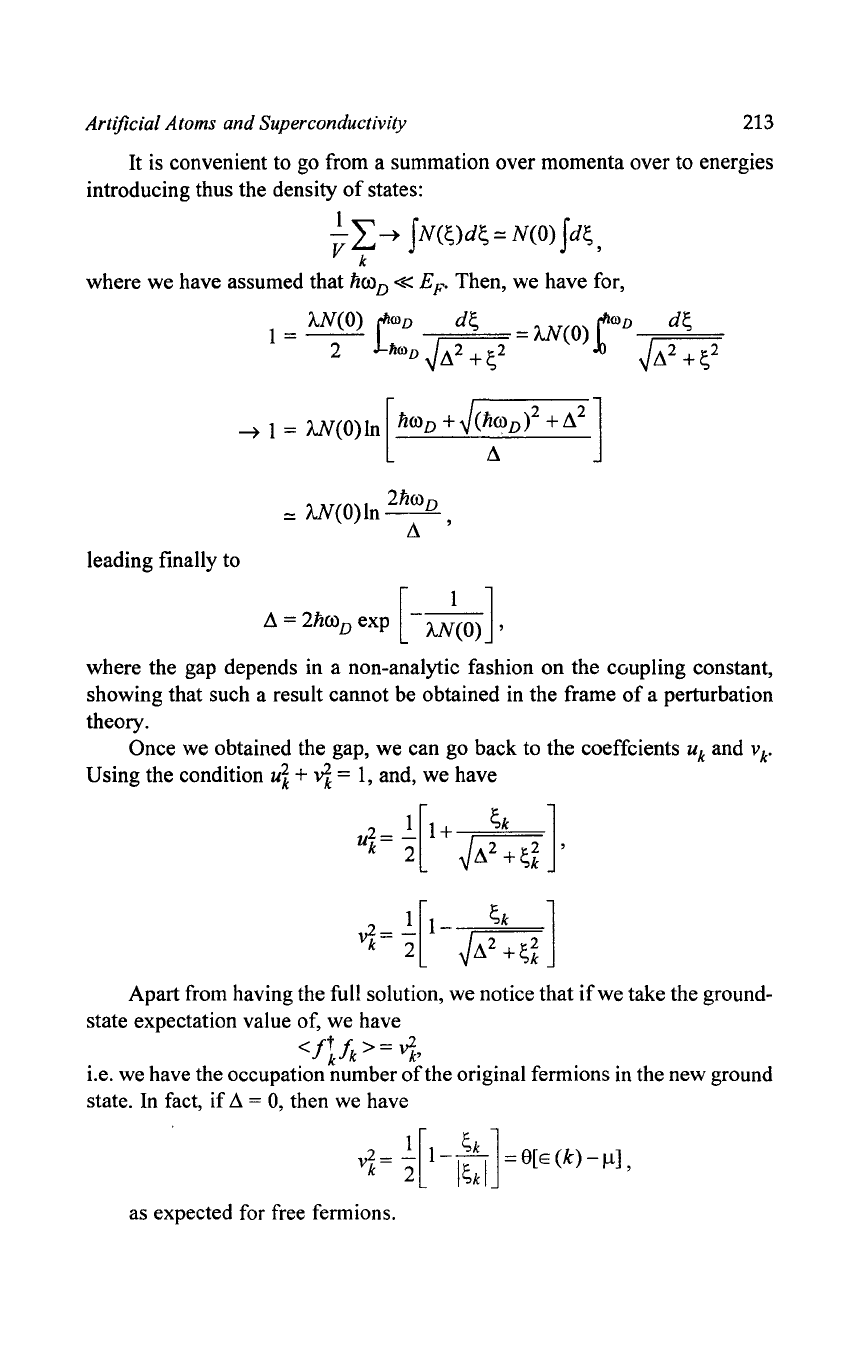
It is convenient to go from a summation over momenta over to energies
introducing thus the density
of
states:
~
I
~
fN(~)d~
=
N(O)
fd~,
k
where
we
have assumed that
hro
D
«
Ep
Then, we have for,
1
= 'AN(O)
rroD
d~
= AN(O)
rhroD
d~
2
lIroD~tl2+~2
.b
~tl2+~2
-->
1
~
AN(O)ln
[hOOD
+J(I:D)'
+,1.,]
=
AN(O)ln
2hroD
,
tl
leading finally to
tl
=
2hro
D
exp [ -
'A;(O)]
,
where the gap depends in a non-analytic fashion
on
the cClupling constant,
showing that such a result cannot be obtained in the frame
of
a perturbation
theory.
Once we obtained the gap,
we
can go back to the coeffcients uk and v
k
.
Using the condition
u~
+
~
=
1,
and,
we
have
ul~
~[l+
J):~ll
vj~
Hl-
J):~ll
Apart from having the full solution, we notice that
if
we
take the ground-
state expectation value of, we have
<flfk>=
~,
i.e. we have the occupation number
of
the original fermions in the new ground
state. In fact,
if
tl
=
0,
then we have
as expected for free fermions.
214
Artificial Atoms
and
Superconductivity
<
11",
>
nonnal
state
~
superconducting
state
/-
-I
1-
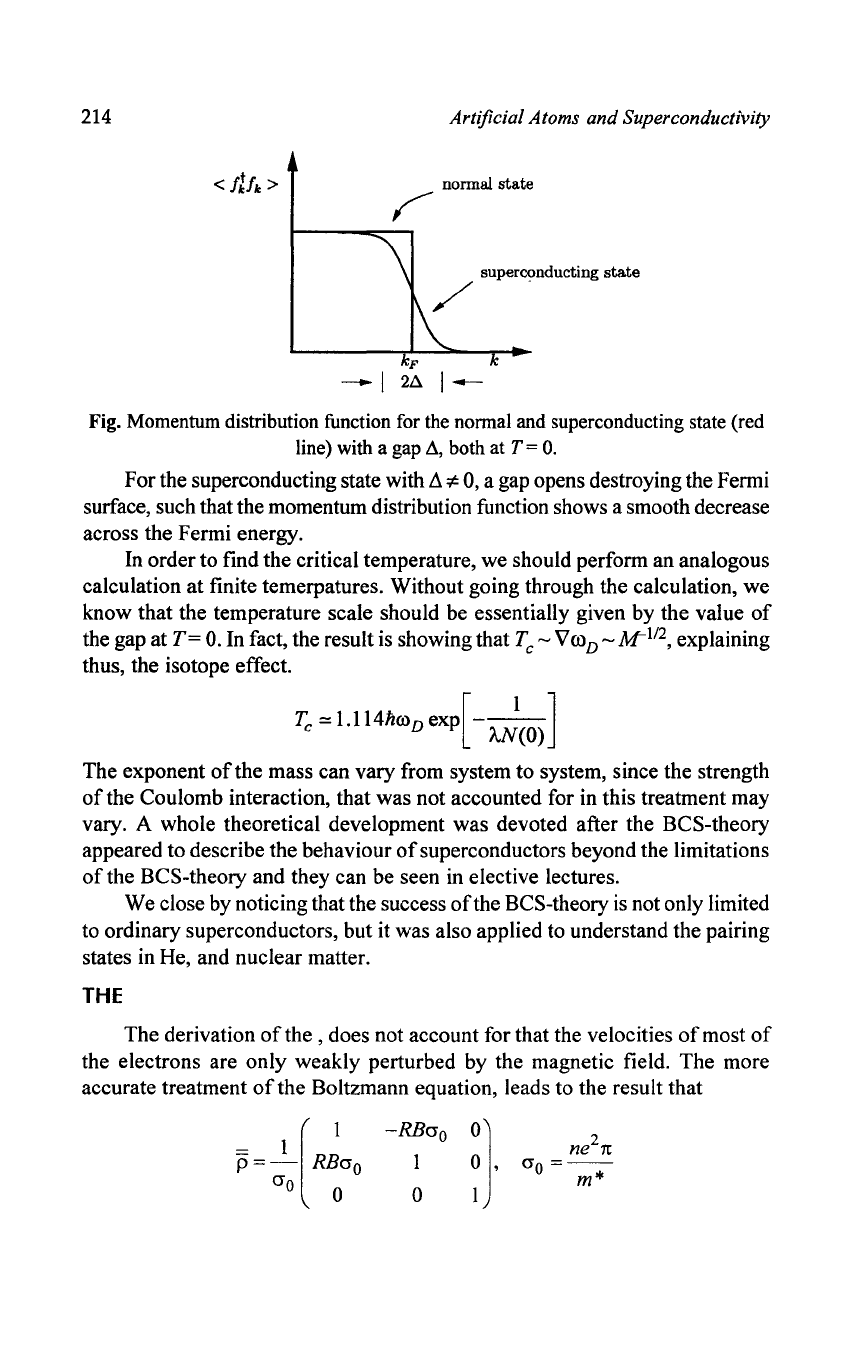
Fig.
Momentum
distribution
function
for
the
normal
and
superconducting state (red
line)
with
a
gap
A,
both at
T=
o.
For the superconducting state with
Il:t
0, a gap opens destroying the Fermi
surface, such that the momentum distribution function shows a smooth decrease
across the Fermi energy.
In order to find the critical temperature, we should perform an analogous
calculation
at
finite temerpatures. Without going through the calculation, we
know that the temperature scale should be essentially given by the value
of
the gap at T =
O.
In fact, the result is showing that
Tc
- V
(J)
D -
A-r
112,
explaining
thus, the isotope effect.
Tc
= 1.1l4liroD
exp[
__
l_]
'AN(O)
The exponent
of
the mass can vary from system to system, since the strength
of
the Coulomb interaction, that was not accounted for in this treatment may
vary.
A whole theoretical development was devoted after the BCS-theory
appeared to describe the behaviour
of
superconductors beyond the limitations
of
the BCS-theory and they can be seen in elective lectures.
We close by noticing that the success
of
the BCS-theory
is
not only limited
to ordinary superconductors, but it was also applied to understand the pairing
states in He, and nuclear matter.
THE
The derivation
of
the,
does not account for that the velocities
of
most
of
the electrons are only weakly perturbed by the magnetic field. The more
accurate treatment
of
the Boltzmann equation, leads to the result that
(
1
= 1
P
=-
RBao
ao
o
-REao
I
o
Artificial Atoms
and
Superconductivity
215
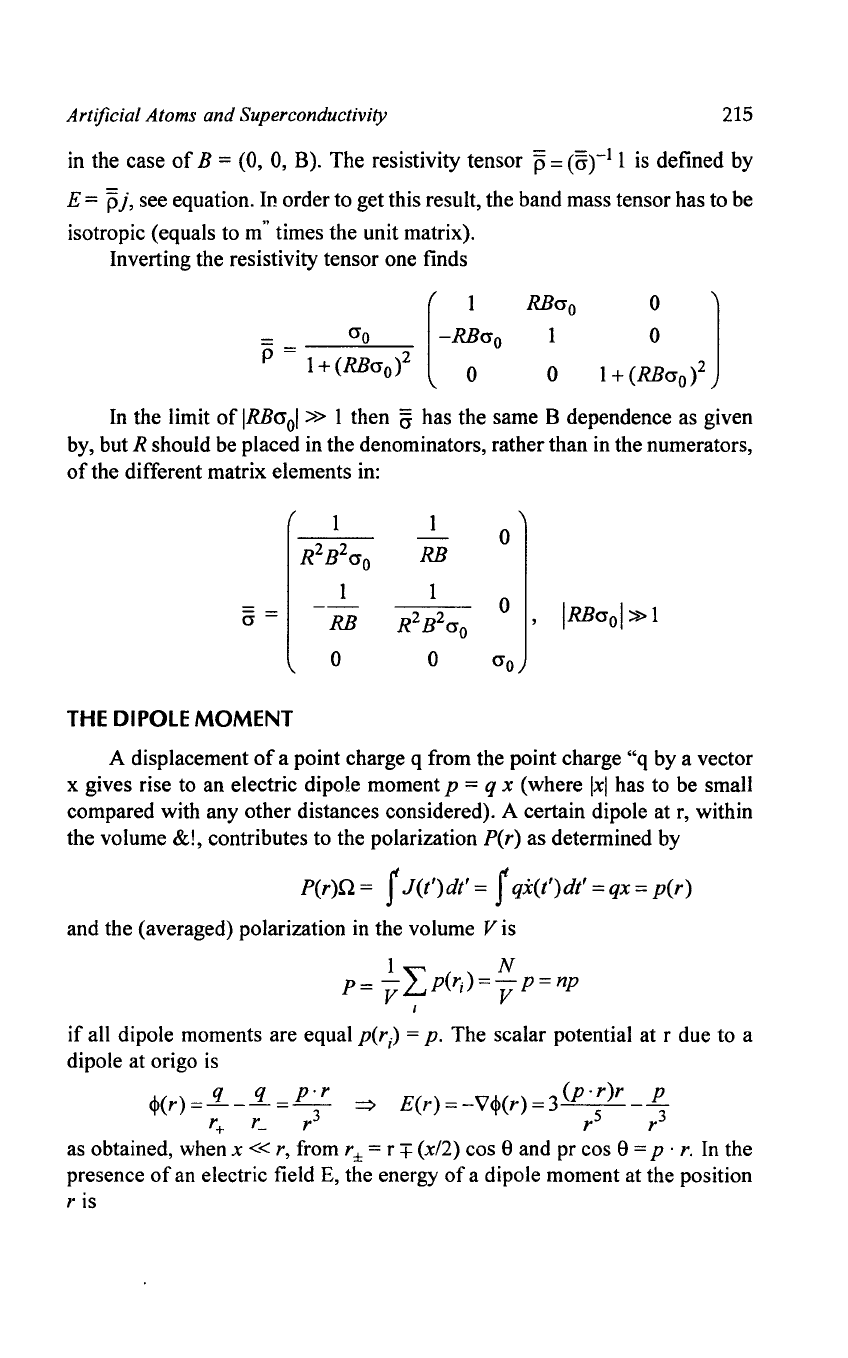
in the case
of
B = (0, 0, B). The resistivity tensor p =
(a)-II
is defined by
E =
pj,
see equation. In order to get this result, the band mass tensor has to be
isotropic (equals to
m"
times the unit matrix).
Inverting the resistivity tensor one finds
REao
1
o
In the limit
of
IREaol
» I then
cr
has the same B dependence as given
by, but
R should be placed in the denominators, rather than in the numerators,
of
the different matrix elements in:
R2B2ao
0
RE
1 1
0
cr=
RE
R2B
2
a
IREaol» 1
0
0 0
ao
THE
DIPOLE
MOMENT
A displacement
of
a point charge q from the point charge
"q
by a vector
x gives rise to an electric dipole moment
p = q x (where
Ixl
has to be small
compared with any other distances considered). A certain dipole at r, within
the volume &!, contributes to the polarization
P(r) as determined by
P(r)Q = J
J(t')dt'
= J qx(t')dt' = qx =
p(r)
and the (averaged) polarization in the volume V is
1 N
P=
VLP(r;)=Vp=np
1
if
all dipole moments are equal
p(r
i
)
= p. The scalar potential at r due to a
dipole at origo is
~(r)
=.!L _.!L =
p.
r
~
E(r)
=
-V'~(r)
= 3
(p.
r)r
L
r+
r_
r3
r
5
r3
as obtained, when
x«
r, from
r±
= r
=+=
(x/2) cos e and
pr
cos e =
p'r.
In the
presence
of
an electric field E, the energy
of
a dipole moment at the position
r is
216
Artificial Atoms
and
Superconductivity
U
=q~(r+~x
)-q~(r-~x)
=
q(
~(r)+~x.
Vf(r)-q(~(r)-~x.
v~(r»)
=
qx·
Vf(r)
=
-p(r)·
E(r)
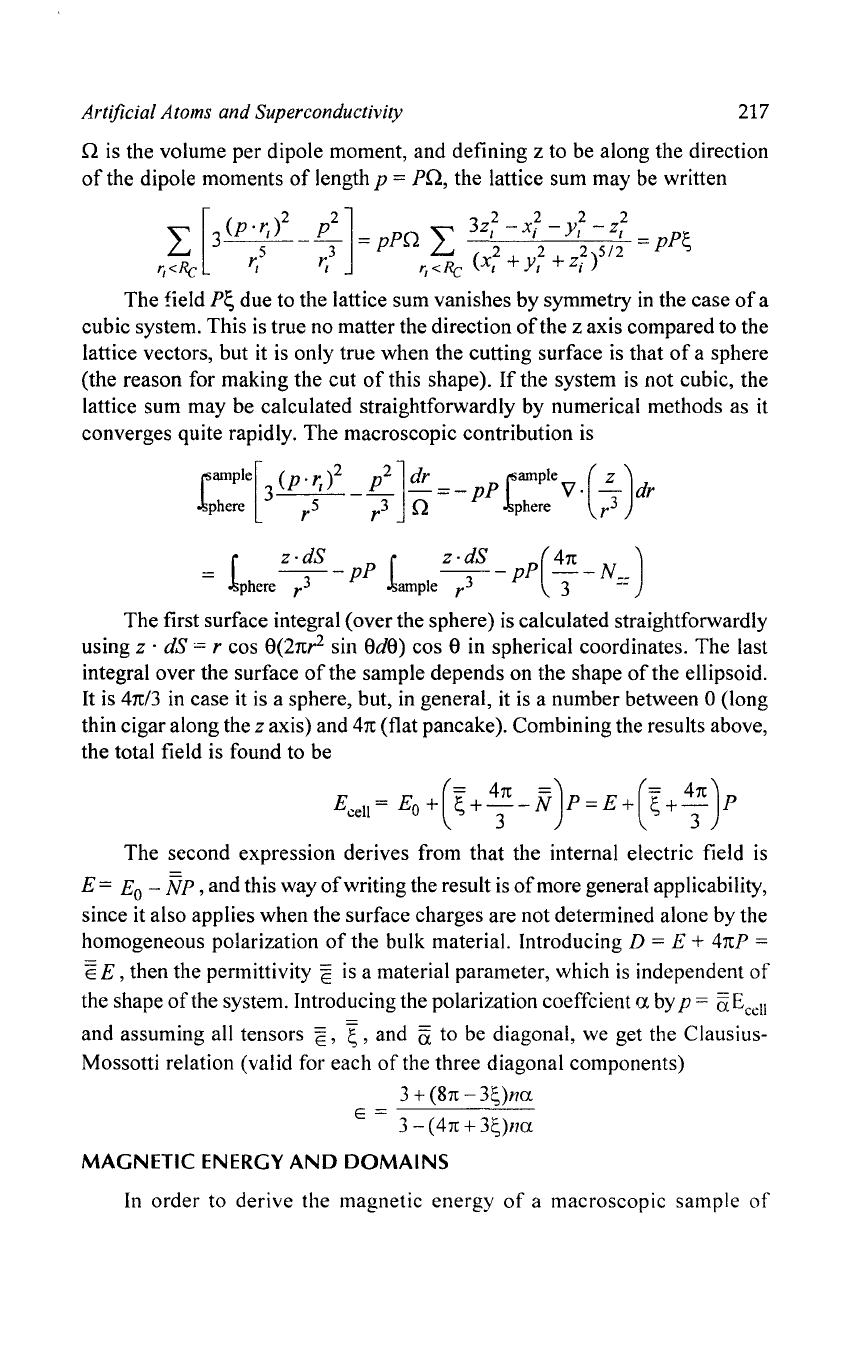
The combination
of
and determines the field energy
of
two dipoles
PI
(r
I
)
and
plr
2
)
to be
U
=
-3
(PI·
r12)(P2 .
r12)
+ PI .
P2
12
5 3 '
'i2
=
rl
- r2
r12
r12
We shall consider an ellipsoidal sample
of
a homogeneous dielectric
material. Classical electrostatics shows that the polarization
P,
and thus also
the electric field
E inside the ellipsoid,
is
uniform
in
the presence
of
an applied
uniform electric field
Eo.
We shall assume this to be the situation, in which
case the total field
Ecell acting on a certain dipole in the system is the same for .
all sites and equal to the field Ecell (0) acting on the dipole placed in the centre
of
the sample. The dipole-dipole interaction
is
of
long range.
It
declines proportionally with
r-
3
,
but the number
of
dipoles at the distance
r increases as
Y2
and, as a consequence, the distribution
of
dipoles on the surface
affects the dipole in the centre no matter how far the distance is to the surface.
In
order to handle this enormous span
of
length scales, we make a cut between
the microscopic world
of
a discrete lattice
of
dipoles and the macroscopic
continuous material with its uniform polarization. The cut to be used is the
surface
of
a sphere centered at the dipole considered. The radius
of
this sphere
Rc should be large compared with the lattice spacing, but smaller than the
shortest distance to the surface (or smaller than the size
of
crystallites
in
a
polycrystalline sample or the size
of
the domains in the case
of
an ordered
material). The total field
is
the sum
of
the applied field and the field due to all
other dipoles in the sample, i.e. the energy
of
the dipole at r = 0
is
(PI
·rJ
P
[
2
2]
U(O) =
-p·Ecell(O)=-p·E
o
-
L 5
--3
r(;tO rj
r,
Introducing the cut and applying a continuous approximation for the
macroscopic contribution
of
the dipoles outside the sphere, we get
Artificial Atoms and Superconductivity
217
0. is the volume per dipole moment, and defining z to be along the direction
of
the dipole moments
of
length p =
po.,
the lattice sum may be written
[
(
2
2]
2 2 2 2
" 3
p·r,)
_L
=
po."
3z,
-xi
-
Y,
-z,
=
P~
~
5 3 P
~
2 2 2
5/2
P
'i<Rc
r,
r,
r,
<Rc
(x, +
Y,
+
Zj
)
The field
P~
due to the lattice sum vanishes by symmetry
in
the case
of
a
cubic system. This is true no matter the direction
of
the z axis compared to the
lattice vectors, but it is only true when the cutting surface is that
of
a sphere
(the reason for making the cut
of
this shape).
If
the system is not cubic, the
lattice sum may be calculated straightforwardly by numerical methods as it
converges quite rapidly. The macroscopic contribution is
r
amP1e[
(p.
r.)2
p2]
dr _
ramPle
( Z )
3
'--
---pP
V'.
- dr
phere
r5
r3
n phere
r3
_ r
z·dS
_
pP
r
z·dS
_
pp(41t
-N
)
- .!,phere
r3
.!,ample
r3
3
==
The first surface integral (over the sphere) is calculated straightforwardly
using
z .
dS
= r cos a(21tr2 sin
ada)
cos a in spherical coordinates. The last
integral over the surface
of
the sample depends on the shape
of
the ellipsoid.
It is
41t/3
in case it is a sphere, but, in general, it is a number between 0 (long
thin cigar along the
z axis) and
41t
( flat pancake). Combining the results above,
the total field is found to be
EceU=
Eo+(~+
~1t
-N)P=E+(~+
~1t)p
The
second expression derives from that the internal electric field is
E=
Eo
-
NP,
and this way
of
writing the result is
of
more general applicability,
since it also applies when the surface charges are not determined alone by the
homogeneous polarization
of
the bulk material. Introducing D = E +
41tP
=
E E , then the permittivity E is a material parameter, which
is
independent
of
the shape
of
the system. Introducing the polarization coeffcient a by p =
exEcdl
and assuming all tensors E'
~,and
ex
to be diagonal, we get the Clausius-
Mossotti relation (valid for each
of
the three diagonal components)
3 +
(81t
-
3~)na
E=
3 -
(41t
+
3~)l1a
MAGNETIC
ENERGY
AND DOMAINS
In
order to derive the magnetic energy
of
a macroscopic sample
of
218
Artificial Atoms
and
Superconductivity
microscopic dipoles
or
of
supercurrent loops in a superconductor,
we
start
out
with the classical description
of
the fields. Introducing the magnetic H field,
the Maxwell equations to be considered are
VxH=
41t
j
+.!.
aD
V.B=O
c ext C
at
'
where
B=H
+4rrM,
'V·H=-41t'V·M
The
sample is assumed to be placed in a uniform applied field
Bo
= H
o
'
and the sources
of
the fields (the external currents) are assumed
to
lie outside
the reach
of
the fields B d and
Hd
produced by the sample. The total fields are
H=
Ho
+
Hd>
B =Bo + B
d
, Bd= Hd+ 41tM
The
magnetic energy
of
the sample is the total magnetic energy minus
the magnetic energy
of
the space without the sample:
U=
_1
L
[fH
.&B-'!'H'5Jdr
41t
1 space 2
As shown in the appendix,
fall
space
Ho
. B
ddr
=
fall
space
Ho
. B ddr = 0 and
the magnetic energy reduces to
U= r
[-M.H
o
-.!.M.H
d
+
fH.&MJdr=-
r [M.&Ho]dr
J.,ample
2
J.,ample
Two
things
are
worth
to notice. First,
the
energy
only
involves
an
integration over the space occupied by the sample (where M is non-zero).
Second, the applied field
Ho
is the independent variable in the final expression.
This is in accordance with the experimental situation and is in contrast with
the original expression, which involves B as the independent variable.
The
magnetic energy U is equal the magnetic contribution F M to the
of
the sample,
and
fJr)
= 1
H
o M(r,Hb)·dHb,
FM
= r
fM(r)dr
J.,ample
is
of
general applicability.
If
a homogeneous sample in the shape
of
an ellipsoid is placed in a uniform
field, then the magnetization
Mis constant throughout the sample. The Maxwell
equations imply that the magnetic field within the sample, i.e. the internal
field, is reduced from the applied field by the
"demagnetization field
NM
,
or
that
or
H = H = H -
N=M
B = B = H
==
-
N=M
+
41tM
• I 0 ' I 0
Artificial Atoms,
and
Superconductivity
219
inside the sample. The demagnetization tensor N
is
the same one as introduced
in
the case
of
an electric polarization, and it
is
diagonal with respect to the
main axes
of
an ellipsoid.
Assuming the field and thus also the magnetization along a main axis
z,
then
the demagnetization field is determined by
N==
' which is a number lying
between
0 (long thin needle along
z)
and
41t
(thin disk perpendicular to z).
In
the latter case the internal magnetic induction is the same as the applied one B
=
Bo
reflecting that all the magnetic field lines
of
each individual magnetic
moment are looping back through the sample.
Returning to the first expression in for the magnetic energy, then the
integration
of
H with respect to M requires a knowledge
of
the relation between
the magnetization
of
the sample and the internal magnetic field. Introducing
the characteristic material parameter, the magnetic susceptibility tensor (at
zero field)
8Ma.
X(X~=
8H
when assuming the field and magnetiz:td5n'1.long z (as long as M = X=jl).
The magnetization
of
a uniform sample
of
microscopic dipoles is
1
,,_
M=
V~/-li
I
If
these magnetic dipoles are only coupled mutually by the classical dipole
field, then we may calculate the energy directly in the same way as in the case
of
electric dipoles (the P and M fields are equivalent and E corresponds to H
not to B). The energy
of
a dipole in the middle
of
the sample is:
U(
-0)-
- H - -
[H
,,31j(ili.r,)-ili1j2J
r - - -/-l.
cell
- -f..l. 0 +
LJ
5
i
1j
and using the procedure explained on "the dipole moment", we get
In the paramagnetic phase there
is
only one domain, and defining a "non-
interacting"
susceptibility
Xo
(the susceptibility when the dipole field
is
ne-
glected) by
M =
Xo
H
cell
'
we get
M
Xo
X - - -
-~-"-------c-
- H - 1 - (
~1t
+
~
r
H=~
l+NX
220
Artificial Atoms
and
Superconductivity
Systems exist where this susceptibility diverges at a suffciently low
temperature TC , i.e. where [(
41t/3)
+
xlXo
~
1,
in which case the system is a
ferromagnet below
Tc
' an ordering produced exclusively by the classical
dipole-dipole in-teraction (one example
is
LiHoF 4 where T c =
1.5
K).
In the other extreme case
of
a ferromagnet,
I~I
and hence
1M!
= M is a
constant. Introducing this in nd summing over all sites, the average energy
density is found to be
u = -(Mz)H
o
+-iNzz(Mz)2
--i(
~1t
+~)M2
Here
(M)
is the magnetization, along the direction
of
the applied field,
averaged over the sample, which average
is
equal M
if
there
is
only one domain.
By introducing this average, the expression is
of
more general validity,
since it
is
the dipolar energy density
of
the sample also in the presence
of
many different domains (the cutting sphere is assumed to lie within one domain
with the magnetization
1M!
=
M).
The minimization
of
(13) with respect to
(M)
leads to
and
(Mz)=M and
H=O-Ho
-Nz=M,
when
Ho
>
NzzM
The magnetization rises linearly with
Ho
and attains the saturation value
M when
Ho
=
Hd
= N
z
#'
The internal field is the most natural choice for the
field variable when investigating the material parameters
of
the sample, see
the definition
of
X.
In
terms
of
H the magnetization is a step function,
(M)
=
M as soon as H is non-zero.
In
this account we have neglected the energy cost due to the domain walls
between the different domains. This energy cost should be included in a realistic
model together with a more direct evaluation
of
the demagnetization field,
which would change from one domain to the next. However,
if
the domain
walls are easily created as
is
the case
if
the magnetic anisotropy is weak, the
simple averaging
of
the domain effects is acceptable. In the case
of
hard
magnetic systems (large magnetic anisotropy) the situation is complicated and
irreversible hysteresis phenomena become important (permanent magnets).
In
most magnetic material the classical dipole-dipole interaction is weak
compared to other
"two-ion interactions" (exchange interactions), and the
difference between
Xo
and X
in
(12) may safely be neglected. However, the
long range nature
of
the coupling implies that it
is
important,
in
most cases, to
account for the demagnetization field, i.e. to realise that the internal field
is
Artificial Atoms
and
Superconductivity
221
H =
Ho
- N
zz
(M
z
),
and that the system may possibly divide itself into different
domains. The approximative inclusion
of
the dipole-dipole interaction, where
X;
Xo'
corresponds to the use
of
Hcell H in, and thus that the energy
of
the
dipole moment
p.
is
U(r
= 0) =
-p..
H.
Hence, when focussing on the material
parameters
or
the principal behaviour
of
a certain system, we normally assume
that
we
are left with only one magnetic domain and that the magnetic field
variable is the internal field
H.
The thermodynamic quantities are then derived
from the partition function Z according to
and
s=_aF
aT'
U=F+TS
c=
au
=T
as
aT
aT
where the expressions for M and X are the results derived from and, when
approximating
Ho
by H in (6). The thermodynamic magnetization derived from
the is actually the one, which determines what are the microscopic dipoles in.
In the mean-field approximation the interactions between the magnetic
moments are replaced by effective fields acting on the single moments and
H =
Lilt
as for non-interacting moments.
In
this case, the partition function
Z =
rrZI
(=
ZN
for a uniform system)and all thermodynamic quantities are
derived from the partition functions
of
the single moments. Determining the n
eigenstates and eigenvalues
of
the Hamiltonian for the lth site we may introduce
the population factor
Pi
of
the ith level
n
LP,
=1
(kBT=lIl3)
i=1
where the last identity follows from
Zt
=
Li-~E'.
The ith population factor is
the probability that the ith level is occupied. Immediate consequences
of
this
interpretation
of
Pi
are
n
U=
N(Ht)=NLE,p,
1=1
and
N N n
Ma =
-V(J.!u)
=-V
L(iIJlul
i
)
P,
1=1
which results agree with those obtained from the thermodynamic definitions