
Carson Ph., Mumford C. Hazardous Chemicals Handbook (Справочник по опасным химическим веществам)
Подождите немного. Документ загружается.


Silver, platinum and Galvanized pipe or brass or
tantalum, carbon, graphite bronze fittings
for wet gas. At higher
pressures use extra heavy
black iron pipe. High-
pressure steel, Monel or
aluminium-iron-bronze valves
Hydrogen selenide F T Aluminium and stainless
steel are preferred but iron,
steel or brass are acceptable
Hydrogen sulphide F T Aluminium preferred. Iron and steel Many metals in the presence of
are satisfactory. Brass, though moist gas
tarnished, is acceptable
Isobutane F Most common metals
Isobutylene F Most common metals
Krypton Most common metals
Methane F Most common metals
Methyl acetylene F Most common metals Copper, silver, mercury and
their alloys
Methylamine C F T Iron and steel Copper, tin, zinc and their
alloys. Avoid mercury
Methyl bromide C F T Most common metals when dry Aluminium and its alloys
3-Methyl-1-butane F Most common metals
Methyl chloride F T Most common metals when Zinc, magnesium rubber and
dry neoprene particularly when
moist. Aluminium is forbidden
Methyl fluoride F T Most common metals
Methyl mercaptan F T Stainless steel and copper-free
steel alloys and aluminium.
Iron and steel for dry gas
Methyl vinyl ether F Most common metals Copper and its alloys
Neon Most common metals
Nickel carbonyl F T Most common metals for pure gas.
Copper or glass-lined equipment
for carbonyl in the presence
of carbon monoxide
Nitric oxide T O Most common metals for dry
gas. For moist gas use
18:8 stainless steel, PTFE
Nitrogen Any common metal
Nitrogen dioxide C T O Most common metals for dry
gas. For moist gas use
18:8 stainless steel
Nitrogen trifluoride T O Nickel and Monel are Plastics
preferred. Steel, copper
and glass are acceptable at
ordinary temperatures
Nitrogen trioxide C T O Steel for
dry
gas otherwise
use 18:8 stainless steel
Nitrosyl chloride C T O Nickel, Monel and Inconel. For
moist gas tantalum is suitable
Nitrous oxide O Most common metals
Octofluorocyclobutane T Cast iron and stainless steel <120°C, Avoid the metals opposite
steel ≤175°C, Inconel, nickel >500°C
and platinum ≤400°C
Oxygen O Most common metals On grease or combustible
COMPRESSED GASES 269
Table 9.1 Cont’d
Gas Hazard
(1)
Materials of construction for ancillary services
(2)
Compatible Incompatible

270 COMPRESSED GASES
Oxygen difluoride T O Glass, stainless steel, copper, materials
Monel or nickel ≤200°C. At
higher temperatures only
nickel and Monel are
recommended
Ozone F T O Glass, stainless steel, Teflon, Copper and its alloys, rubber or
Hypalon, aluminium, any composition thereof, oil,
Tygon, PVC and polythene grease or readily combustible
material
Perchloryl fluoride T Most metals and glass for dry Many gasket materials are
gas at ordinary embrittled
temperatures At higher temperatures many
organic materials and some
metals can be ignited
Some metals such as titanium
show deflagration in contact
with the gas under severe shock
Perfluorobutane Most common materials
Perfluorobutene T Most common materials when dry
Perfluoropropane Most common metals
Phosgene C T Common metals for dry gas.
Monel, tantalum or glass
lined equipment for moist gas
Phosphine F T Iron or steel
Phosphorus pentafluoride F T Steel, nickel, Monel and Pyrex for
dry gas. For moist gas hard
rubber and paraffin wax
Phosphorus trifluoride Steel, nickel, Monel and the
more noble metals and
Pyrex for dry gas
Propane F Most common metals
Propylene F Most common metals
Propylene oxide F T Steel or stainless steel Rubber
preferred though copper
and brass are suitable for
acetylene-free gas. PTFE gaskets
Silane F T Iron, steel, copper, brass
Silicone tetrafluoride C T Most common metals for the
dry gas. Steel, Monel and
copper for moist gas
Sulphur dioxide C T O Most common metals for dry gas. Zinc
Lead, carbon, aluminium and
stainless steel for moist gas
Sulphur hexafluoride Most common metals.
Copper, stainless steel and
aluminium are resistant to
the decomposition
products at 150°C
Sulphur tetrafluoride C T Stainless steel or ‘Hastelloy Glass for moist gas
C’ lined containers. Glass
suitable for short exposures
if dry. ‘Tygon’ for low-pressure
connections
Sulphuryl fluoride T Any common metal at normal Some metals at elevated
temperatures and pressures temperatures
Tetrafluoroethylene F Most common metals
Table 9.1 Cont’d
Gas Hazard
(1)
Materials of construction for ancillary services
(2)
Compatible Incompatible

Tetrafluorohydrazine T O Glass, stainless steel, copper or
nickel to temperatures of 200°C.
For higher temperatures use
nickel and Monel
Trichlorofluoromethane T Steel, cast iron, brass, Some of the opposite at high
copper, tin, lead, temperatures magnesium
aluminium under normal, alloys and aluminium coating
dry conditions >2% magnesium. Natural rubber
1,1,2-Trichloro-1,2,2- As above As above
trifluoroethane
Trimethylamine C F T Iron, steel, stainless steel and Copper, tin, zinc and most of
Monel. Rigid steel piping their alloys
Vinyl bromide F T Steel Copper and its alloys
Vinyl chloride C F T Steel Copper and its alloys
Vinyl fluoride F Steel Copper and its alloys
Xenon Most common materials
C Corrosive
F Flammable
T Toxic
O Oxidizing
(1)
Even non-toxic gases are potentially hazardous owing to asphyxiation (oxygen deficiency). Irrespective of material, all
equipment must be adequately designed to withstand process pressures.
(2)
This is a guide and is no substitute for detailed literature.
To prevent interchange of fittings between cylinders of combustible and non-combustible
gases, the valve outlets are screwed left-hand and right-hand thread, respectively (Table 9.2).
Primary identification is by means of labelling with the name and chemical formula on the
shoulder of the cylinder. Secondary identification is by use of ground colours on the cylinder
body. Unless specified in Table 9.2, gas and gas mixtures shall be identified by a colour classification
indicating gas properties in accordance with the risk diamond on the cylinder label e.g.
Toxic and/or corrosive Yellow
Flammable Red
Oxidizing Light blue
Inert (non-toxic, non-corrosive, Bright green
non-flammable, non-oxidizing
The full scheme is given in BS EN 1089–3: 1997.
This should be consulted for the colour coding of gas mixtures used for inhalation e.g. medical
and breathing apparatus mixtures containing oxygen.
COMPRESSED GASES 271
Table 9.1 Cont’d
Gas Hazard
(1)
Materials of construction for ancillary services
(2)
Compatible Incompatible
Table 9.2 Specific colour codes for selected compressed gases
Gas Colour
Acetylene Maroon
Argon Dark green
Carbon dioxide Grey
Helium Brown
Oxygen White
Nitrogen Black
Nitrous oxide Blue

272 COMPRESSED GASES
Table 9.3 General precautions for handling compressed gases
Consult the supplier for data on the specification, properties, handling advice and on suitable service materials for individual
gases.
Storage
Segregate according to hazard.
Stores should be adequately ventilated and, ideally, located outside and protected from the weather.
Store away from sources of heat and ignition.
Cylinders within workplaces should be restricted to those gases in use. Specially designed compartments with partitions may
be required to protect people in the event of explosion. Take into account emergency exits, steam or hot water systems,
the proximity of other processes etc. Consider the possibility of dense gases accumulating in drains, basements, cable
ducts, lift shafts etc.
Where necessary, provide fireproof partitions/barriers to separate/protect cylinders.
Protect from mechanical damage.
All cylinders must be properly labelled and colour coded (BS 349).
Store full and empty cylinders separately.
Use in rotation: first in, first out.
Restrict access to the stores to authorized staff.
Display ‘No smoking’ and other relevant warning signs.
Ensure that all staff are fully conversant with the correct procedures when using pressure regulators. (For cylinders without
handwheel valves, the correct cylinder valve keys should be kept readily available, e.g. on the valve. Only use such keys.
Do not extend handles or keys to permit greater leverage; do not use excessive force, e.g. hammering, when opening/
closing valves or connecting/disconnecting fittings. The pressure regulator must be fully closed before opening the
cylinder valve. This valve can then be opened slowly until the regulator gauge indicates the cylinder pressure but should
not be opened wider than necessary. The pressure regulator can then be opened to give the required delivery pressure.
When a cylinder is not in use, or is being moved, the cylinder valve must be shut. When a cylinder has been connected,
the valve should be opened with the regulator closed; joints should then be tested with soap/detergent solution.)
Clearly and permanently mark pressure gauges for use on oxygen. Do not contaminate them with oil or grease or use them
for other duties.
Cylinders that cannot be properly identified should not be used; do not rely on colour code alone.
Never try to refill cylinders.
Never use compressed gas to blow away dust or dirt.
Provide permanent brazed or welded pipelines from the cylinders to near the points of gas use. Select pipe materials suitable
for the gas and its application. Any flexible piping used should be protected against physical damage. Never use rubber
or plastic connections from cylinders containing toxic gases.
On acetylene service, use only approved fittings and regulators. Avoid any possibility of it coming into contact with copper,
copper-rich alloys or silver-rich alloys. (In the UK use at a pressure greater than 600 mbar g must be notified to HM
Explosives Inspectorate for advice on appropriate standards.)
On carbon dioxide service, rapid withdrawal of gas may result in plugging by solid CO
2
. Close the valve, if possible, to allow
the metal to warm up; this will prevent a sudden gas discharge.
Replace the correct caps or guards on cylinder valves when not in use and for return to the supplier.
Test and inspect cylinders and pressure regulators regularly in accordance with current legislation.
Design and manage cylinder stores in accordance with suppliers’ recommendations.
Wear appropriate personal protection when entering any store.
Inspect condition of cylinders regularly, especially those containing hazardous gases (e.g. corrosive).
Use
Transport gases in specially designed trolleys and use eye protection, stout gloves (preferably textile or leather) and protective
footwear.
Do not roll or drop cylinders off the backs of wagons; never lift cylinders by the cap.
Ideally, depending on the length of pipe run, locate cylinders outside (for hazardous gases, valves installed within the
workplace can be used for remote control of the main supply from the cylinder in the event of an emergency). Site
cylinders so that they cannot become part of an electrical circuit.
Securely clamp, or otherwise firmly hold in position, cylinders on installation. (Unless otherwise specified, cylinders containing
liquefied or dissolved gases must be used upright.)
Avoid subjecting cylinders containing liquid to excessive heat.
Table 9.3 provides general guidance for handling compressed gases.

The hazards and safety precautions for selected common compressed gases are discussed
below to illustrate the general approach. More details should be sought from suppliers. Some
methods for their preparation in situ are noted; full experimental details must be obtained from
the literature.
Acetylene
Acetylene is manufactured by the controlled reaction between water and calcium carbide:
CaC
2
+ 2H
2
O → Ca (OH)
2
+ C
2
H
2
Alternatively it is obtained from cracking low molecular-weight aliphatic hydrocarbons, or by the
partial oxidation of natural gas.
Because of its high chemical reactivity, acetylene has found wide use in synthesis of vinyl
chloride, vinyl acetate, acrylonitrile, vinyl ethers, vinyl acetylene, trichloro- and tetrachloro-
ethylene etc., in oxyacetylene cutting and welding, and as a fuel for atomic absorption instruments.
Acetylene is a simple asphyxiant and anaesthetic. Pure acetylene is a colourless, highly flammable
gas with an ethereal odour. Material of commercial purity has an odour of garlic due to the
presence of impurities such as phosphine. Its physical properties are shown in Table 9.4. Acetylene,
which condenses to a white solid subliming at –83
o
C, is soluble in its own volume of water but
highly soluble in acetone.
Under certain conditions acetylene can explode when mixed with air, hydrogen or ethylene.
Accidental heating of a small area of cylinder wall to 185
o
C or above may promote an extremely
dangerous condition. Violent reactions have occurred between acetylene and oxidants such as
oxides of nitrogen (see later), nitric acid, calcium hypochlorite, ozone and halogens. In the free
state acetylene can decompose violently, e.g. above 9 psig (0.62 bar) undissolved (free) acetylene
will begin to dissociate and revert to its constituent elements. This is an exothermic process which
can result in explosions of great violence. For this reason acetylene is transported in acetone
contained in a porous material inside the cylinder. Voids in the porous substance can result from
settling, e.g. if the cylinder is stored horizontally or through damage to the cylinder in the form
of denting. Voids may enable acetylene to decompose, e.g. on initiation by mechanical shock if
the cylinder is dropped.
Fit approved cylinder pressure regulators, selected to give a maximum pressure on the reduced side commensurate with the
required delivery pressure. (The regulator and all fittings upstream of it must be able to withstand at least the maximum
cylinder pressure.)
Fit in-line flame arresters for flammable gases and eliminate ignition sources.
Use compatible pipe fittings. (Flammable gas cylinders have valves with left-hand threads; cylinders for oxygen and non-
flammable gases, except occasionally helium, have valves with right-hand threads. Certain liquefied gas cylinders have
two supply lines, one for gas and one for liquid, dependent on cylinder position.)
Do not use oil, grease or joining compounds on any fittings for compressed gas cylinders.
Fit an excess flow valve to the outlet of a regulator, selected to allow the maximum required gas flow.
Use respirators and face protection etc. when changing regulators on cylinders of toxic gases.
Turn off gas supply at the cylinder at the end of each day’s use.
Consider the need for gas detection/alarms, e.g. for hazardous gases left in use out of normal hours.
Periodic checks:
Ensure no gas discharge when gauge reading is zero
Ensure reading on gauge does not increase as the regulator valve is closed
Check for ‘crawl’ due to wear on the regulator valve and seat assembly
Ensure no leak between cylinder and regulator
Overhaul regulators on a 3–6 month basis for corrosive gases, annually for others
Train staff in hazards and correct handling procedures.
ACETYLENE 273
Table 9.3 Cont’d

274 COMPRESSED GASES
Table 9.4 Physical properties of acetylene
Molecular weight 26.038
Vapour pressure of pure liquid at 21°C (not cylinder pressure) 43.8 bar
Specific volume at 15.6°C, 1 atm 902.9 ml/g
Boiling point at 1.22 atm –75°C
Sublimation point at 1 atm –84.0°C
Triple point at saturation pressure –80.8°C
Specific gravity, gas at 15.6°C, 1 atm (air = 1) 0.9057
Density, gas at 0°C, 1 atm 1.1709 g/l
Critical temperature 36.3°C
Critical pressure 62.4 bar
Critical density 0.231 g/ml
Latent heat of sublimation at –84°C 193.46 cal/g
Latent heat of fusion at triple point 23.04 cal/g
Flammable limits in air 2.5–81.0% by volume
Auto-ignition temperature 335°C
Gross heat of combustion at 15.6°C, 1 atm 13.2 cal/cc
Specific heat, gas at 25°C, 1 atm
C
p
0.4047 cal/g°C
C
v
0.3212 cal/g °C
ratio
C
p
/
C
v
1.26
Thermal conductivity, gas at 0°C 4.8 × 10
–5
cal/s cm
2
°C/cm
Viscosity, gas at 25°C, 1 atm 0.00943 cP
Entropy, gas at 25°C, 1 atm 1.843 cal/g °C
Solubility in water at 0°C, 1 atm 1.7 vol/vol H
2
O
Figure 9.1 illustrates the rise in cylinder pressure with temperature. Normally, acetylene cylinders
are fitted with a fusible metal plug which melts at about 100°C.
Acetylene can form metal acetylides, such as copper or silver acetylide, which on drying
become highly explosive: service materials require careful selection.
In addition to the general precautions for compressed gases in Table 9.3, the following control
measures should be considered for acetylene:
• Never use free acetylene at pressures above 9 psig (0.62 bar) unless special safety features are
employed.
• Store and use cylinders only in an upright position.
• Store reserves separate from oxygen cylinders.
• Ensure that no means of accidental ignition are in the area and provide adequate ventilation.
• Consult local regulations for use of this gas.
• Ensure that ‘empty’ cylinders have the valve closed to prevent evaporation of acetone.
• Close cylinder valve before shutting off regulator, to permit gas to bleed from regulator.
• When used e.g. for welding, avoid the careless use of flame which could fuse the metal safety
plug in the cylinder.
• In the event of fire issuing from the cylinder, close the gas supply if it is safe to do so and
evacuate the area.
• Consider the need for detection/alarm systems and in any event check periodically for leaks
with e.g. soap solution, never with a naked flame.
Air
The physical properties of air are given in Table 9.5. Air is a mixture of nitrogen, oxygen, argon,

500
400
300
200
100
30 40 50 60 70 80 90 100 110 120
–1 41016212732 384349
°F
°C
Temperature
Pressure (psia)
carbon dioxide, water vapour, rare gases and trace quantities of ozone, oxides of nitrogen, acetylene,
methane and other hydrocarbons. Its composition varies with altitude. Dry air is inert in its effect
on metals and plastics. The hazards associated with compressed air, in addition to those associated
with any pressure system (i.e. the potential for rupture of equipment or pipework), are:
• From inhalation at pressures above atmospheric, used in tunnelling or diving, or from breathing
apparatus or resuscitation equipment, if the pressure is too high or exposure is prolonged. This
may cause symptoms from pain to dyspnoea, disorientation and unconsciousness; it may be
fatal.
• From particulate matter blown from orifices or surfaces, e.g. into the eyes.
• From entry into any of the body orifices, which can result in serious internal damage.
• From penetration of unbroken skin, or cuts. Foreign matter, e.g. grease, metal, concrete, may
also be injected into subcutaneous tissues.
• From whipping of an unsecured hose on rapid gas release.
Figure 9.1
Acetylene (in acetone): full cylinder pressure versus temperature
Table 9.5 Physical properties of air
Density @ 20°C, 1 atm 0.0012046 g/l
Critical temperature –140.6°C
Critical pressure 546.8 psia (37.2 atm) (38.4 kg/cm
2
absolute)
Critical density 0.313 g/ml
Viscosity @ 0°C, 1 atm 170.9 micropoises
AIR 275

276 COMPRESSED GASES
The precautions include:
• Prohibition on playing around with compressed air hoses, e.g. aiming directly at any individual.
• Avoidance of blowing away dust or dirt from equipment, the floors, or clothing etc. (which
may also produce a dust inhalation or explosion hazard).
• Direction of the exhaust air from tools away from the operator.
• Proper training and instruction for anyone required to use air-fed breathing apparatus. Restriction
of exposures to compressed air to safe levels.
Ammonia
Ammonia can be made on a small scale by heating an intimate mixture of ammonium chloride
and dry slaked lime in a ratio of 1:3, respectively:
Ca(OH)
2
+ 2NH
4
Cl → CaCl
2
+ 2NH
3
+ 2H
2
O
Industrially, production is either from the Haber process at high pressure:
N
2
+ 3H
2
→ 2NH
3
or the cyanamide process
CaC
2
+ N
2
→ CaCN
2
+ C
CaCN
2
+ 3H
2
O → 2NH
3
+ CaCO
3
At room temperature and atmospheric pressure ammonia is a colourless, alkaline gas with a
pungent smell. It dissolves readily in water. Physical properties are summarized in Table 9.6. The
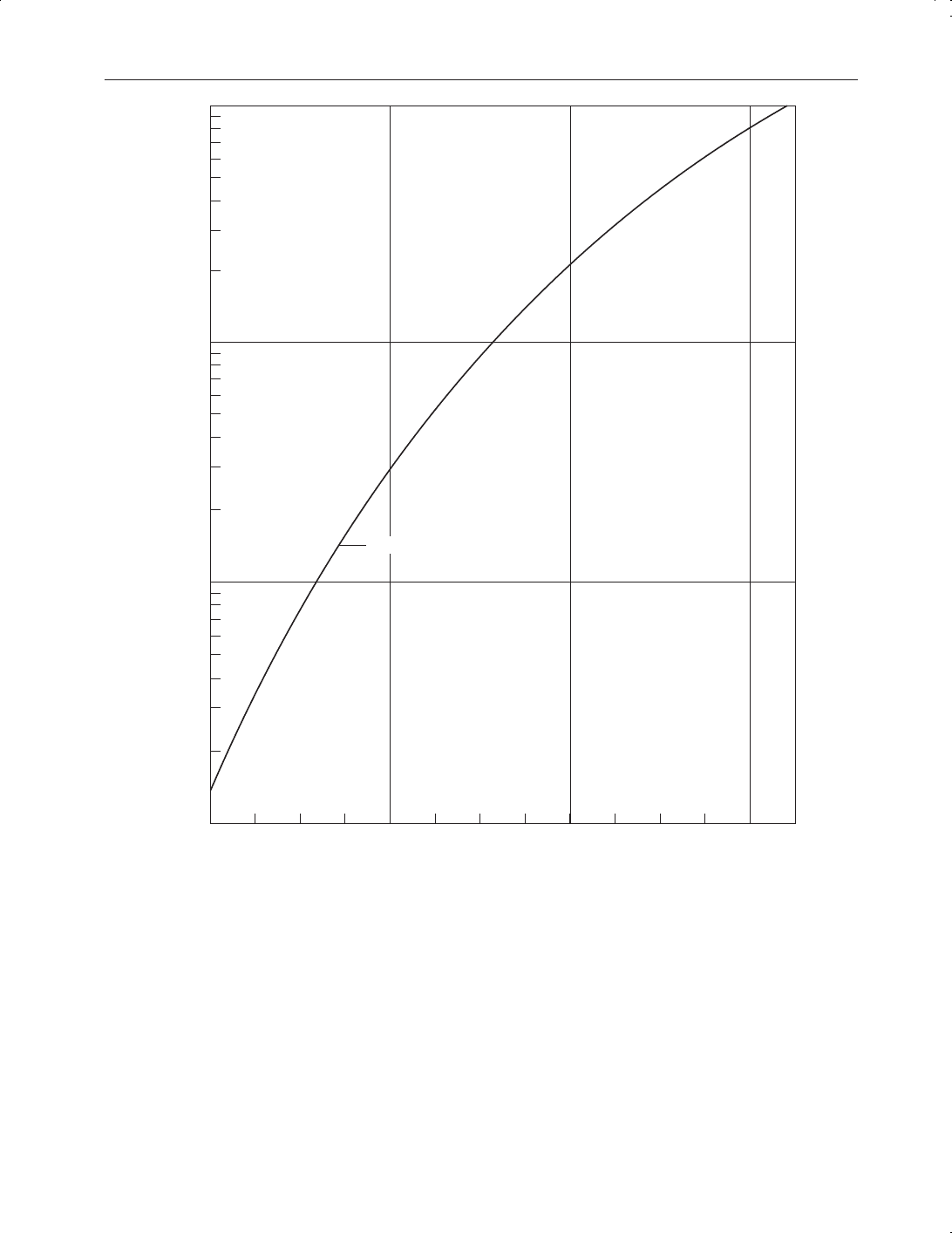
effect of temperature on vapour pressure of anhydrous ammonia is shown in Figure 9.2.
Ammonia is shipped as a liquefied gas under its own vapour pressure of 114 psig (7.9 bar) at
21°C. Uses are to be found in refrigeration, fertilizer production, metal industries, the petroleum,
chemical and rubber industries, domestic cleaning agents and water purification. Aqueous solutions
of ammonia are common alkaline laboratory reagents; ca 0.88 solution is the strongest available.
Ammonia gas is expelled on warming.
Ammonia gas is irritating to the eyes, mucous membranes and respiratory tract. Because of its
odour few individuals are likely to be unwittingly over-exposed for prolonged periods. Table 9.7
summarizes the physiological effects of human exposure. Clearly at high concentrations the gas
becomes corrosive and capable of causing extensive injuries. Thus 1% in air is mildly irritating,
2% has a more pronounced effect and 3% produces stinging sensations.
On contact with the skin, liquid ammonia produces severe burns compounded by frostbite due
to the freezing effect from rapid evaporation from the skin.
Moist ammonia attacks copper, tin, zinc and their alloys. Ammonia is also flammable with
flammability limits of 15–28%.
Ammonia can also react violently with a large selection of chemicals including ethylene oxide,
halogens, heavy metals, and oxidants such as chromium trioxide, dichlorine oxide, dinitrogen
tetroxide, hydrogen peroxide, nitric acid, liquid oxygen, and potassium chlorate.
Besides the control measures given in Table 9.3, the following precautions are appropriate:
• Wear rubber gloves, chemical goggles and, depending upon scale, a rubber apron or full
chemical suit.
• Never heat ammonia cylinders directly with steam or flames to speed up gas discharge.

• Use under well-ventilated conditions and provide convenient safety showers and eye-wash
facilities.
• Ensure that gas cannot be accidentally ignited.
• Check for leaks, e.g. with moist litmus paper or concentrated hydrochloric acid (which forms
dense white fumes of ammonium chloride).
• In the event of accident, administer first aid (see Table 9.9).
Carbon dioxide
Carbon dioxide is present in air and is a constituent of natural gas escaping from mineral springs
and fissures in the earth’s surface. It is also the ultimate product of combustion of carbon and its
compounds. Laboratory scale preparation usually entails reaction between dilute hydrochloric
acid and marble (calcium carbonate):
2HCl + CaCO
3
→ CaCl
2
+ H
2
O + CO
2
Industrially, it is obtained as a by-product of fermentation of sugar to alcohol:
C
6
H
12
O
2
→ 2C
2
H
5
OH + 2CO
2
or by burning coke/limestone mixture in a kiln:
CaCO
3
→ CO
2
+ CaO
Table 9.6 Physical properties of ammonia
Molecular weight 17.031
Vapour pressure at 21°C (cylinder pressure) 7.87 bar
Specific volume at 21°C, 1 atm 1.411 ml/g
Boiling point at 1 atm – 33.35°C
Triple point at 1 atm – 77.7°C
Triple point pressure 1.33 mbar
Specific gravity, gas at 0°C, 1 atm (air = 1) 0.5970
Density, gas at boiling point 0.000 89 g/ml
Density, liquid at boiling point 0.674 g/ml
Critical temperature 132.44°C
Critical pressure 113 bar
Critical density 0.235 g/ml
Flammable limits in air 15–28% by volume
Latent heat of vaporization at boiling point 327.4 cal/g
Specific heat, liquid at –20°C 1.126 cal/g K
Specific heat, gas at 25°C, 1 atm
C
p
0.5160 cal/g°C
C
v
0.4065 cal/g °C
ratio,
C
p
/
C
v
1.269
Thermal conductivity, gas at 25°C, 1 atm 5.22 × 10
–5
cal/s cm
2
°C/cm
Entropy, gas at 25°C, 1 atm 2.7 cal/g °C
Heat of formation, gas at 25°C –648.3 cal/g
Solubility at 0°C, 1 atm
in water 42.8% by weight
in methanol, absolute 29.3% by weight
in ethanol, absolute 20. 95% by weight
Viscosity, gas at 0°C, 1 atm 0.009 18 cP
Viscosity, liquid at –33.5°C 0.266 cP
CARBON DIOXIDE 277
278 COMPRESSED GASES
Boiling point
2252001751501251007550250–25–50–75–100°F
10793796652372510–4–18–32–46–60–73°C
Temperature
1000
900
800
700
600
500
400
300
200
100
90
70
60
50
40
30
20
10
9
8
7
6
5
4
3
2
80
1
Vapour pressure (psia)
Liquid carbon dioxide is discussed on page 261. Carbon dioxide gas is commonly used for
carbonating drinks, in fire extinguishers, for gas-shielding of welding and in shell moulding in
foundries. Its physical and toxicological properties are summarized in Tables 8.5, 8.6 and 5.29.
The gas is non-flammable, and is used for inert gas purging. Because it is 1.5 times
heavier than air it may accumulate at low level. The general handling precautions are those in
Table 9.3.
Figure 9.2
Ammonia vapour pressure versus temperature