
Chen C.J. Physics of Solar Energy
Подождите немного. Документ загружается.


i
i
“ChenSolarEnergy” — 2011/5/17 — 17:56 — page 52 — #79
i
i
i
i
i
i
52 Nature of Solar Radiation
The power densities of the incident, transmitted, and reflected light can be evaluated
using Eqs. 2.74 and 2.75 and the expression of the Poynting vector, Eq. 2.60. For
incident light, the magnitude is
S
I
=
1
μ
0
E
I
B
I
=
n
1
μ
0
c
I
2
. (2.76)
For transmitted light,
S
T
=
1
μ
0
E
T
B
T
=
n
2
μ
0
c
T
2
. (2.77)
Using Eq. 2.74,
S
T
=
4n
1
n
2
(n
1
+ n
2
)
2
n
1
μ
0
c
I
2
=
4n
1
n
2
(n
1
+ n
2
)
2
S
I
. (2.78)
A dimensionless coefficient of transmission is defined as
T≡
S
T
S
I
=
4n
1
n
2
(n
1
+ n
2
)
2
. (2.79)
Following Eqs. 2.77 and 2.78, the intensity of reflected light can be determined, and a
dimensionless coefficient of reflection is defined as
R≡
S
R
S
I
=
n
1
− n
2
n
1
+ n
2
2
. (2.80)
For semiconductors, the reflection loss can be significant. For example, for silicon, n =
3.49. The reflection coefficient is
R =
(1 − 3.49)
2
(1 + 3.49)
2
≈ 0.3076. (2.81)
More than 30% of light is lost by reflection. To build high-efficiency solar cells, an
antireflection coating is essential. We will discuss this in Section 9.4.
2.3 Blackbody Radiation
It was known for centuries that a hot body emits radiation. At around 700
◦
C, a body
becomes red hot. At even higher temperatures, a body emits much more radiation,
and the color changes to orange, yellow, white, and even blue. In the late nineteenth
century, in order to understand phenomena related to industry technology such as steel
making and incandescent light bulbs, heat radiation became a hot subject for physicists.
Although all hot bodies emit radiation, blackbodies emit the maximum amount of
radiation at a given temperature. At equilibrium, radiation emitted must equal radia-
tion absorbed. Therefore, the body that emits the maximum amount also absorbs the
maximum amount—which should look black. Practically, a blackbody is constructed
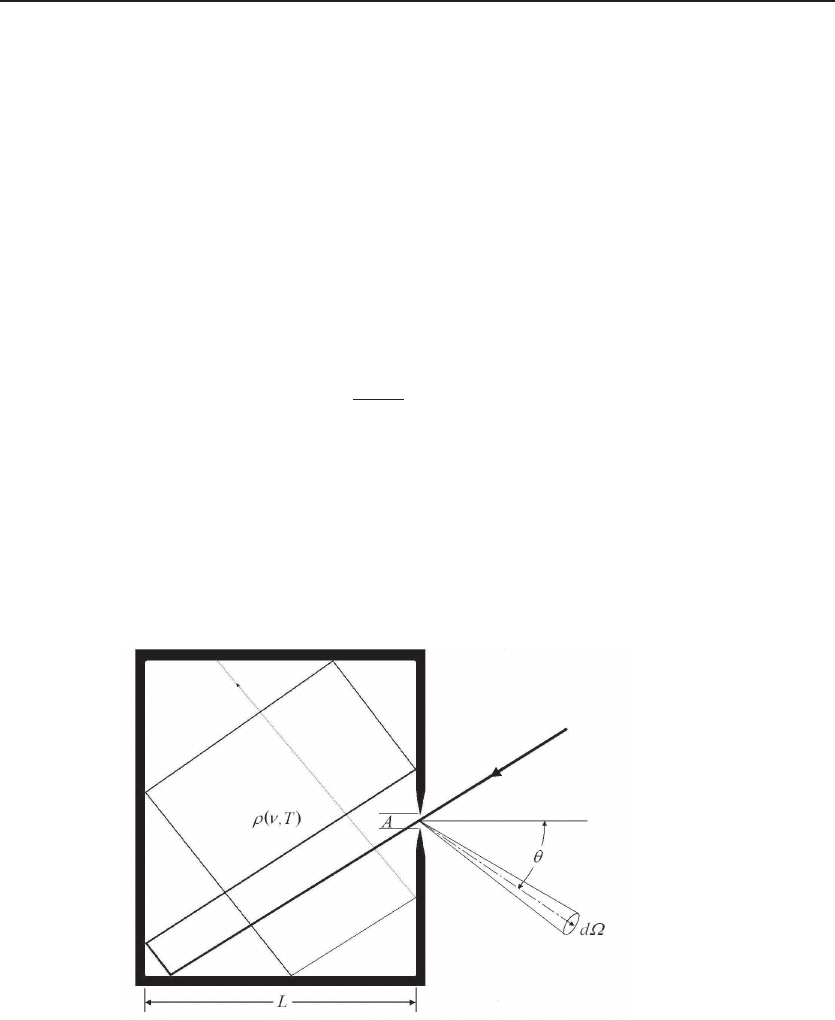
by opening a small hole on a large cavity, as shown in Fig. 2.4. Any light ray passing
i
i
“ChenSolarEnergy” — 2011/5/17 — 17:56 — page 53 — #80
i
i
i
i
i
i
2.3 Blackbody Radiation 53
through the hole with area A experiences multiple reflections on the internal surface of
the cavity. If the material is not absolutely shiny, after several impingements, the light
will eventually be completely absorbed by the cavity. Therefore, the small hole on the
large cavity always looks black, which is a good example of a blackbody.
2.3.1 Rayleigh–Jeans Law
The energy density of radiation as a function of its frequency was studied in the late
nineteenth century by Lord Rayleigh and then by Sir James Jeans using classical sta-
tistical physics. They treated standing electromagnetic waves in a cavity as individual
modes, and the modes follow the equal-partition law of Maxwell–Boltzmann statistics.
Consider a closed cubic cavity with reflective inner surfaces of side L. A sinusoidal
electromagnetic wave with frequency ν satisfies the following equation:
∇
2
A +
4π
2
ν
2
c
2
A =0. (2.82)
Assuming that the cavity is made of metal. On the walls of the cavity, electrical
field intensity vanishes. Therefore, the vector potential vanishes. The general solution
of Eq. 2.82 satisfying that condition is
A = A
0
sin(k
x
x)sin(k
y
y)sin(k
z
z). (2.83)
The wavevectors are defined by
Figure 2.4 Blackbody radiation. A large cavity with a small hole is a good blackbody. The
light enters the hole will experience multiple reflections, and all be absorbed and thus looks black. A
blackbody emits maximum amount of radiation when heated.

i
i
“ChenSolarEnergy” — 2011/5/17 — 17:56 — page 54 — #81
i
i
i
i
i
i
54 Nature of Solar Radiation
k
x
=
πn
x
L
,k
y
=
πn
y
L
,k
z
=
πn
z
L
, (2.84)
where n
x
,n
y
, and n
z
are positive integers. By direct substitution one finds that the
solution, Eq. 2.83, satisfies differential equation 2.82 and the boundary conditions at
the walls. Each set of the integers, n
x
,n
y
,n
z
, represents a pattern of electromagnetic
wave in the cavity. Inserting Eq. 2.84 into Eq. 2.82 yields
k
2
x
+ k
2
y
+ k
2
z
=
4π
2
ν
2
c
2
, (2.85)
andintermsofthenumbersn
x
,n
y
, and n
z
, Eq. 2.85 becomes
n
2
x
+ n
2
y
+ n
2
z
=
4ν
2
L
2
c
2
. (2.86)
Now, we count the number of standing waves with frequencies ν by considering
a sphere of radius
n
2
x
+ n
2
y
+ n
2
z
=2νL/c.ThenumberN of modes with positive
n
x
,n
y
,andn
z
up to ν is
N =
1
8
4
3
π
2νL
c
3
=
4πν
3
L
3
3c
3
, (2.87)
For each type of standing wave, there are two polarizations. Therefore, the number of
modes of standing electromagnetic waves is
N =
8πν
3
L
3
3c
3
, (2.88)
where L
3
is the volume, and the density of states at frequency ν is
d
dν
N
L
3
=
8πν
2
c
3
. (2.89)
According to Maxwell–Boltzmann statistics, at absolute temperature T , each degree
of freedom contributes energy k
B
T ,wherek
B
is the Boltzmann constant, and the energy
density is
ρ(ν, T )=
d
dν
N
L
3
k
B
T =
8πν
2
c
3
k
B
T. (2.90)
Equation 2.90 is the energy density of radiation per unit frequency interval in a
cavity of temperature T . It is not directly observable. The directly observable quantity
is the spectral radiance u(ν, T ), that is, the energy radiating from a unit area of the
hole per unit frequency range. To calculate u(ν, T )fromρ(ν, T ), first we consider a
simplified situation: If the field has a well-defined direction of radiation with velocity
c,wehave
u(ν, T )=cρ(ν, T ). (2.91)

i
i
“ChenSolarEnergy” — 2011/5/17 — 17:56 — page 55 — #82
i
i
i
i
i
i
2.3 Blackbody Radiation 55
Because the hole is small, the radiation field in a cavity is isotropic. As the radiation
only comes through a hole of well-defined direction, u(ν, T ) should be a fraction of
cρ(ν, T ). The value of the fraction can be determined using the following argument.
Consider a sphere of radius R. The surface area of the sphere is 4πR
2
. If the radiation
inside the sphere is allowed to emit over all directions, the area is 4πR
2
. If the radiation
is allowed to emit in only one direction, the area is a disc with radius R,thatis,πR
2
.
Consequently, the factor is 1/4. Equation 2.91 becomes
u(ν, T )=
1
4
cρ(ν, T ). (2.92)
Following is a more detailed proof of the factor 1/4. Consider the radiation from a
small hole of area A on the cavity; see Fig. 2.4. Because the electromagnetic wave is
isotropic and the speed of light is c, the energy radiated through a solid angle dΩat
an angle θ is
dE
dt dΩ
=
c
4π
ρ(ν, T ) A cos θ (2.93)
because the area of the hole observed from an angle θ is A cos θ. Integrating over the
hemisphere, the total irradiation per unit area is
u(ν, T )=
c
4π
π/2
0
2π cos θ sin θdθρ(ν, T )=
c
4
ρ(ν, T ), (2.94)
confirming Eq. 2.92. Using Eq. 2.90, we finally obtain the Rayleigh–Jeans distribution
of blackbody radiation,
u(ν, T )=
2πν
2
c
2
k
B
T. (2.95)
The Rayleigh–Jeans distribution fits the low-frequency behavior of the experimental
energy density very well. However, as the frequency increases, the spectral irradiance
increases, the total irradiation energy is infinite. This contradicts the experimental fact
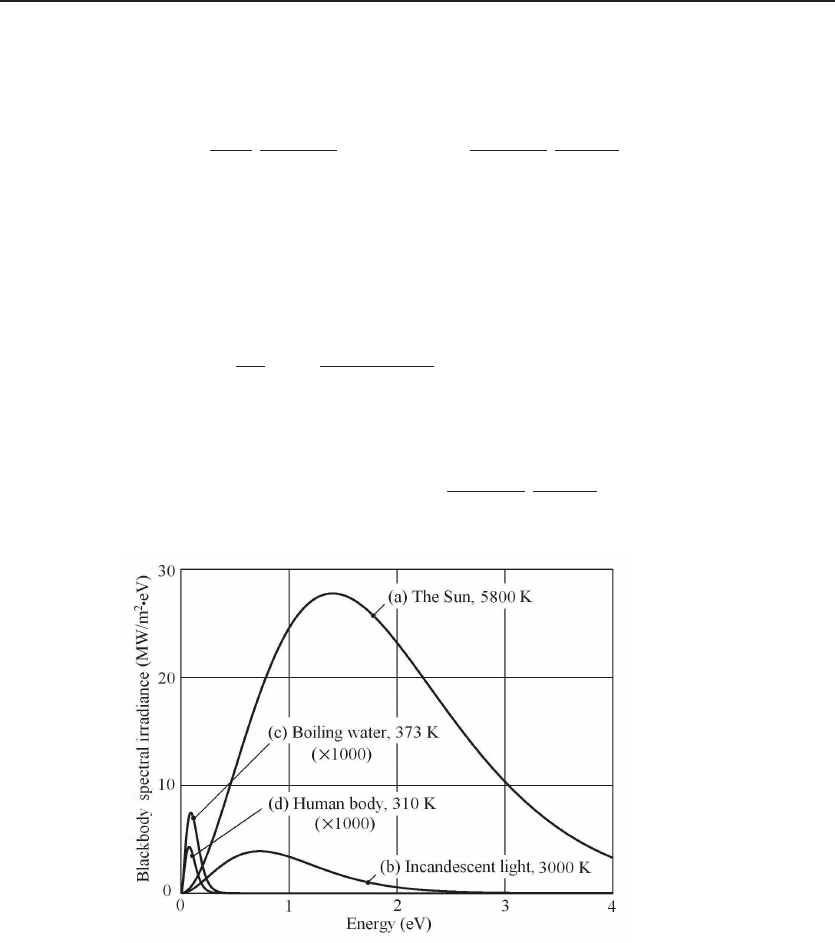
that the total blackbody radiation is finite, and the spectral density has a maximum;
see Fig. 2.5.
2.3.2 Planck Formula and Stefan–Boltzmann’s Law
In 1900, Max Planck found an empirical formula that fits accurately the experimental
data,
u(ν, T )=
2πν
2
c
2
hν
e
hν/k
B
T
− 1
. (2.96)
The constant h in the formula, Planck’s constant, was initially obtained by fitting
with experimental blackbody radiation data. Later, Planck found a mathematical
explanation of his formula by assuming that the energy of radiation can only take
discrete values. Specifically, he assumed that the energy of radiation with frequency ν
can only take integer multiples of a basic value hν,theenergy quantum,

i
i
“ChenSolarEnergy” — 2011/5/17 — 17:56 — page 56 — #83
i
i
i
i
i
i
56 Nature of Solar Radiation
=0,hν,2hν, 3hν, .... (2.97)
According to Maxwell–Boltzmann statistics, the probability of finding a state with
energy nhν is exp(−nhν/k
B
T ). The average value of energy of a given component of
radiation with frequency ν is
¯ =
∞
n=0
nhν e
−nhν/k
B
T
∞
n=0
e
−nhν/k
B
T
=
hν
e
hν/k
B
T
− 1
. (2.98)
instead of k
B
T . By replacing the expression k
B
T in Eq. 2.90 with Eq. 2.98, we
recovered Eq. 2.96.
Initially, Max Planck believed that the quantization of energy is only a mathemat-
ical trick to reconcile his empirically obtained formula with the knowledge of physics
known at that time. The profound significance of the concept of quantization of radi-
ation and the meaning of Planck’s constant were discovered by Albert Einstein in his
interpretation of the photoelectric effect, which is the conceptual foundation of solar
cells.
By integrating the spectral radiance over frequency, the total radiation is found to
be
U(T )=
∞
0
2πhν
3
c
2
dν
e
hν/k
B
T
− 1
=
2πh
c
2
k
B
T
h
4
∞
0
x
3
dx
e
x
− 1
=
2
15
π
5
k
4
B
c
2
h
3
T
4
.
(2.99)
Here a mathematical identity is applied,
∞
0
x
3
dx
e
x
− 1
=
π
4
15
. (2.100)
Equation 2.99 is Stefan–Boltzmann’s law, discovered experimentally before the Planck
formula and backed by an argument using thermodynamics. The constant in Eq. 2.99,
σ ≡
2
15
π
5
k
4
B
c
2
h
3
=
π
2
k
4
B
60 c
2
3
=5.67 × 10
−8
W
m
2
· K
4
, (2.101)
is called the Stefan–Boltzmann’s constant. It can be memorized using the mnemonic:
45678. The total radiance is proportional to the fourth power of absolute temperature,
and the coefficient is 5.67 times the inverse eighth power of 10.
i
i
“ChenSolarEnergy” — 2011/5/17 — 17:56 — page 57 — #84
i
i
i
i
i
i
2.3 Blackbody Radiation 57
For applications in solar cells, the electron volt is the most convenient unit of photon
energy; see Fig. 2.5. The Planck formula for blackbody spectral irradiance in terms of
photon energy in units of electron volts is
u(, T )=
2πq
4
c
2
h
3
3
e
/
T
− 1
=1.587 × 10
8
3
e
/
T
− 1
W
m
2
· eV
, (2.102)
where
T
= k
B
T/q is the value of k
B
T in electron volts. Numerically, it equals
T
=
T/11, 600. For the Sun, T
=5800 K; thus
=0.5 eV. At the location of Earth, the
radiation is diluted by the distance from the Sun to Earth, the astronomical constant
A
=1.5 ×10
11
m. Introducing a geometric factor f representing the solid angle of the
Sun with radius r
=6.96 × 10
8
m as observed from Earth
f =
r
A
2
=
6.96 × 10
8
2
[1.5 × 10
11
]
2
=2.15 × 10
−5
, (2.103)
the spectrum of the AM0 solar radiation (outside the atmosphere at the location of
Earth) is
u
⊕
(, T )=fu
(, T )=3.41 × 10
3
3
e
/
− 1
W
m
2
· eV
. (2.104)
Figure 2.5 Blackbody spectral irradiance. The blackbody spectral irradiance, or the radiation
power emitted per square meter per unit energy interval (here in electron volts) at an energy value
(also in electron volts) at four different temperatures ise shown. The maximum of solar irradiance is
at 1.4 eV, with a value of 27.77 MW/m
2
·eV. The temperature of the filament of an incandescent light
is about 3000 K. The radiation power density at the filament surface is only about 7% that on the
Sun. The spectral irradiance from a blackbody at the boiling points of water and the human body are
also shown, in units of kW/m
2
·eV.

i
i
“ChenSolarEnergy” — 2011/5/17 — 17:56 — page 58 — #85
i
i
i
i
i
i
58 Nature of Solar Radiation
Table 2.3: Blackbody Radiation at Different Temperatures
Radiator Temperature Power Peak Peak λ Peak u
(K) (W/m
2
)(eV)(μm) (W/m
2
·eV)
The Sun 5800 6.31 × 10
7
1.410 0.88 2.81 ×10
7
Light bulb 3000 4.59 × 10
6
0.728 1.70 3.88 × 10
6
Boiling water 373 1.10 × 10
3
0.091 13.6 7.46 × 10
3
Human body 310 5.24 × 10
2
0.075 16.5 4.28 × 10
3
The position of the peak in blackbody spectral irradiance can be of a transcendental
equation
d
dx
[3 log x −log (e
x
− 1)] = 0, (2.105)
and can be obtained by numerical computation,
x =2.82. (2.106)
In other words, the peak of blackbody spectral irradiance is at
MAX
=2.82
T
=2.43 × 10
−4
T (eV). (2.107)
The peak value for the function x
3
/(e
x
− 1) is 1.42. Therefore, the peak value of the
spectral irradiance is
u
MAX
=1.42
2πqk
3
B
c
2
h
3
T
3
∼
=
1.44 × 10
−4
T
3
W
m
2
· eV
. (2.108)
Table 2.3 lists the data for some frequently encountered cases.
2.4 Photoelectric Effect and Concept of Photons
The photoelectric effect was discovered accidentally by Heinrich Hertz in 1887 during
experiments to generate electromagnetic waves. Since then, a number of studies have
been conducted in an attempt to understand the phenomena. Around 1900, Phillip
Lenard did a series of critical studies on the relation of the kinetic energy of ejected
electrons with the intensity and wavelength of the impinging light [50]. His results were
in direct conflict with the wave theory of light and inspired Albert Einstein to develop
his theory of photons.
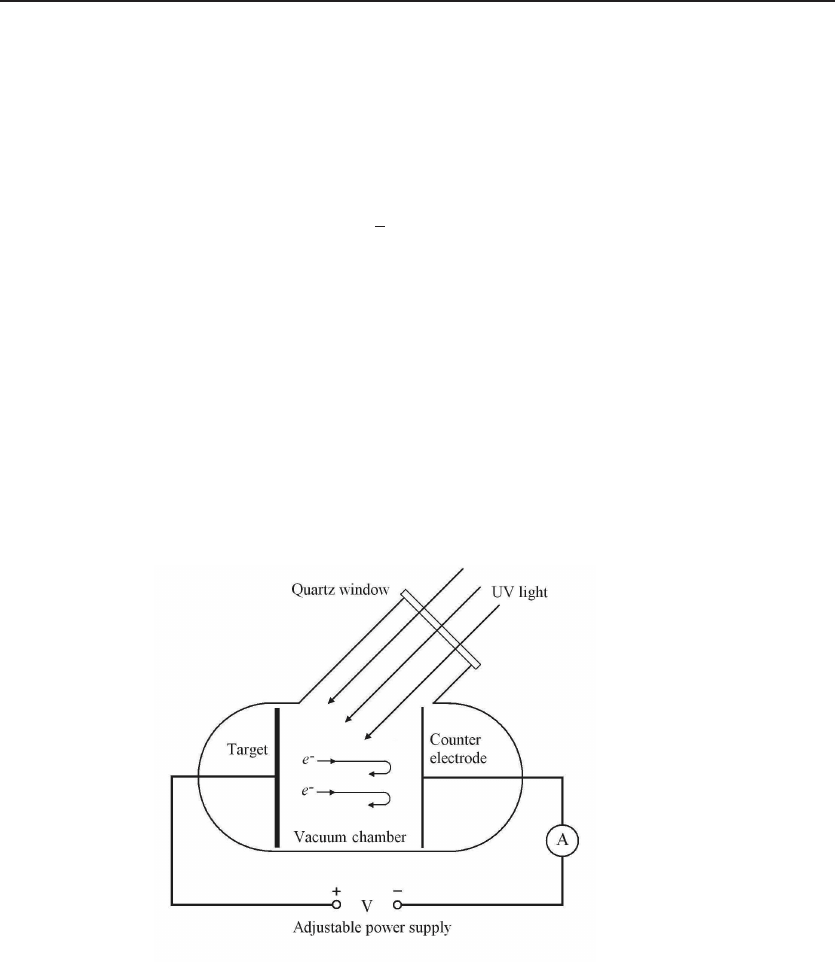
Figure 2.6 shows schematically the experimental apparatus of Phillip Lenard. The
entire setup was enclosed in a vacuum chamber. An electric arc lamp, using carbon
rods or zinc rods as the electrodes, generates strong UV light. A quartz window allows
such UV light to shine on a target made of different metals. The target and a counter
i
i
“ChenSolarEnergy” — 2011/5/17 — 17:56 — page 59 — #86
i
i
i
i
i
i
2.4 Photoelectric Effect and Concept of Photons 59
electrode are connected to an adjustable power supply. An ammeter is used to measure
the electric current generated by the UV light, the photocurrent, especially when the
voltages between the two electrodes are very small. By gradually increasing the voltage,
which tends to reflect the electrons back to the target, the photocurrent is reduced. The
voltage with which the photocurrent becomes zero is recorded as the stopping voltage.
The stopping voltage is apparently related to the kinetic energy of the electrons
ejected from the target:
qV =
1
2
mv
2
. (2.109)
Understandably, the photocurrent varies with the intensity of light. By changing
the magnitude of the current that drives the arc or the distance from the arc lamp to
the target, the photocurrent could change by two orders of magnitude: for example,
from 4.1 to 276 pA. An unexpected and dramatic effect Lenard observed was that no
matter how strong or how weak the light is, and no matter how large or how small
the photocurrent is, the stopping voltage does not change; see Table 2.4. The stopping
voltage changes only when the material for the electric arc lamp changes. However, for
a given type of arc, the stopping voltage stays unchanged.
The effect Lenard observed has no explanation in the framework of the wave theory
of light. According to the wave theory of light, the more intense the light is, the more
kinetic energy the electrons acquire.
Figure 2.6 Lenard’s apparatus for studying photoelectric effect. A quartz window allows
the UV light from an electric arc lamp to shine on a target. The voltage between the target and
the counter electrode is controlled by an adjustable power supply. An ammeter is used to measure
the electric current generated by the UV light, the photocurrent. By gradually increasing the voltage
(with the polarity as shown), the photocurrent is reduced. The voltage with which the photocurrent
becomes zero is recorded as the stopping voltage [50].

i
i
“ChenSolarEnergy” — 2011/5/17 — 17:56 — page 60 — #87
i
i
i
i
i
i
60 Nature of Solar Radiation
Table 2.4: Stopping Voltage for Photocurrent
Rod Driving Distance Photocurrent Stopping
material current (A) to target (cm) (pA) voltage (V)
Carbon 28 33.6 276 -1.07
Carbon 20 33.6 174 -1.12
Carbon 28 68 31.7 -1.10
Carbon 8 33.6 4.1 -1.06
Zinc 27 33.6 2180 -0.85
Zinc 27 87.9 319 -0.86
Source: P. Lenard, Annalen der Physik, 8, 167 (1902) [50].
2.4.1 Einstein’s Theory of Photons
In 1905, while employed as a patent examiner at the Swiss Patent Office, Albert Einstein
wrote five papers, published in Annalen der Physik, that initiated the twentieth century
revolution in science. For general public, Einstein is mostly known for his theory of
relativity. Therefore, when the Swedish Academy announced in 1922 that Einstein
had won the Nobel Prize “for services to theoretical physics and especially for the
discovery of the law of the photoelectric effect,” referring to his paper On a Heuristic
Viewpoint Concerning the Production and Transformation of Light [27], the public was
surprised. In hindsight, the Nobel Committee was correct: His paper on photoelectric
effect is considered the boldest, the most revolutionary, and the most original. Although
its predictions were fully verified by experiments, for many years, several prominent
physicists did not accept Einstein’s concept of photons. Here is a quote from Einstein
[27]:
According to the assumption considered here, when a light ray starting from
a point is propagated, the energy is not continuously distributed over an
ever increasing volume, but it consists of a finite number of energy quanta,
localized in space, which move without being divided and which can be
absorbed or emitted only as a whole.
According to Einstein, light, when it interacts with matter, appears as a flow of
individual and indivisible particles. When a photon interacts with an electron, either
it is absorbed or there is no interaction. The energy value of a photon, , depends on
its frequency,
= hν, (2.110)
where h =6.63 × 10
−34
J · s is Planck’s constant and ν is the frequency of light. For
example, for green light, λ =0.53 μm, and the frequency is 5.6 × 10
14
s
−1
. The energy
of the photon is 3.7 × 10
−19
J, or 2.3 eV.

i
i
“ChenSolarEnergy” — 2011/5/17 — 17:56 — page 61 — #88
i
i
i
i
i
i
2.4 Photoelectric Effect and Concept of Photons 61
When a photon interacts with an electron in the metal, it transfers the entire energy
to the electron. The electron could escape from the metal by overcoming the work
function φ of the metal, typically a few electron volts. If the energy of the photon
is smaller than the work function of the metal, the electron would stay in the metal.
If the energy of the photon is greater than the work function of the metal, then the
electron can escape from the metal surface with an excess kinetic energy,
1
2
mv
2
= hν − φ. (2.111)
The kinetic energy of an escaping electron can be measured by an external voltage,
or electric field, to turn it back onto the target. Voltage that just is enough to cancel
the kinetic energy is called the stopping voltage,
qV
stop
=
1
2
mv
2
= hν − φ, (2.112)
where q is the electron charge, 1.60 ×10
−19
C. According to Einstein’s quantum theory
of light, the stopping voltage is linearly dependent on the frequency of the photon and
independent of the intensity of light. The slope should be a universal constant, which
provides a direct method to determine the value of Planck’s constant,
ΔV
stop
Δν
=
h
q
. (2.113)
2.4.2 Millikan’s Experimental Verification
Einstein’s theory of photons was rejected by a number of prominent physicists for
many years, including Max Planck, Niels Bohr, and notably Robert Millikan. Starting
in 1905, for 10 years Millikan worked to disprove Einstein’s theory. Finally, in 1916,
Millikan published a long paper on Physical Review, entitled A Direct Photoelectric
Determination of Planck’s h [61]. The conclusion reads as follows:
1. Einstein’s photoelectric equation has been subject to very searching tests
and it appears in every case to predict exactly the observed results.
2. Planck’s h has been photoelectrically determined with a precision of
about .5 percent.
In 1923, Millikan received a Nobel Prize “for his work on the elementary charge of
electricity and on the photoelectric effect.”
An interesting fact in the history of science is that in the same paper Millikan
emphatically rejected Einstein’s theory of photons. He said that Einstein’s photon hy-
pothesis “may well be called reckless first because an electromagnetic disturbance which
remains localized in space seems a violation of the very conception of an electromagnetic
disturbance, and second because it flies in the face of the thoroughly established facts
of interference.” Millikan wrote that Einstein’s photoelectric equation, although accu-
rately representing the experimental data, “cannot in my judgment be looked upon at