
Chen C.J. Physics of Solar Energy
Подождите немного. Документ загружается.


i
i
“ChenSolarEnergy” — 2011/5/17 — 17:56 — page 82 — #109
i
i
i
i
i
i
82 Tracking Sunlight
and i
, j
, k
are
i
= i sin φ + k cos φ,
j
= j,
k
= −i cos φ + k sin φ,
(4.3)
and
i = i
sin φ −k
cos φ,
j = j
,
k = i
cos φ + k
sin φ,
(4.4)
where φ is the (geographical) latitude of the observer; see Figs 4.2 and 4.4. Using
Eqs. 4.1 and 4.2, we obtain
S = i (cos δ cos ω sin φ − sin δ cos φ)
+ j cos δ sin ω
+ k (cos δ cos ω cos φ +sinδ sin φ),
(4.5)
and
S = i
(cos h cos A sin φ +sinh cos φ )
+ j
cos h sin A
+ k
(−cos h cos A cos φ +sinh sin φ).
(4.6)
Comparing Eqs. 4.5 and 4.6 with Eqs. 4.1 and 4.2, we obtain the transformation for-
mulas for the two sets of angles:
cos h cos A =cosδ cos ω sin φ − sin δ cos φ, (4.7)
cos h sin A =sinω cos δ, (4.8)
sin h =cosδ cos ω cos φ +sinδ sin φ; (4.9)
and
cos δ cos ω =cosh cos A sin φ +sinh cos φ, (4.10)
cos δ sin ω =cosh sin A, (4.11)
sin δ = −cos h cos A cos φ +sinh sin φ. (4.12)

i
i
“ChenSolarEnergy” — 2011/5/17 — 17:56 — page 83 — #110
i
i
i
i
i
i
4.2 Celestial Sphere 83
4.2.2 Coordinate Transformation: Spherical Trigonometry
The coordinate transformation formulas can be easily obtained using formulas in spher-
ical trigonometry; see Fig. 4.3. We should focus our attention on the spherical triangle
PZX, with three arcs p =
ZX, z =
XP,andx =
PZ. As seen from Fig. 4.3, the
relations between the elements of the spherical triangle and the quantities of interest
are
P = ω,
Z = 180
◦
− A,
p =90
◦
− h,
z =90
◦
− δ,
x =90
◦
− φ.
(4.13)
First, consider the case of given declination δ and hour angle ω in the equatorial
system to find height h and azimuth A in the horizon coordinate system. The latitude of
theobserver’slocationφ is obviously a necessary parameter. Using the cosine formula
cos p =cosx cos z +sinx sin z cos P, (4.14)
with Eqs. 4.13, we obtain
sin h =sinδ sin φ +cosδ cos φ cos ω. (4.15)
Further, using the sine formula
sin Z
sin z
=
sin P
sin p
, (4.16)
we find
cos h sin A =sinω cos δ. (4.17)
Finally, applying Formula C in Appendix B,
sin x cos Z =cosz sin p − sin z cos p cos X, (4.18)
and using Eqs. 4.13, we find
cos h cos A =sinφ cos δ cos ω − cos φ sin δ. (4.19)
Equations 4.15, 4.18 and 4.19 are identical to Eqs. 4.7, 4.8, and 4.9.
Next, we consider the case of given height h and azimuth A in the horizon coordinate
system to find declination δ and hour angle ω in the equatorial system. Again, the
latitude of the observer’s location φ is a necessary parameter.
Using the cosine formula
cos z =cosp cos x +sinp sin x cos Z, (4.20)
we have
sin δ = −cos h cos A cos φ +sinh sin φ. (4.21)

i
i
“ChenSolarEnergy” — 2011/5/17 — 17:56 — page 84 — #111
i
i
i
i
i
i
84 Tracking Sunlight
By rearranging Eq. 4.18, we find
cos δ sin ω =cosh sin A. (4.22)
Similar to the derivation of Eq. 4.19, using formula C,
sin z cos P =cosp sin x −sin p cos x cos Z, (4.23)
we obtain
cos δ cos ω =cosh cos A sin φ +sinh cos φ. (4.24)
Those equations are identical to Eqs. 4.10–4.12.
4.3 Treatment in Solar Time
Since the prehistory era, human activities have been revolving around the apparent
motion of the Sun across the sky. The solar time t
, which is based on the hour angle
of the Sun, is an intuitive measure of time and was used for thousands of years in all
cultures of the world. As we will discuss in Section 4.4, because the apparent motion
of the Sun is nonuniform and depends on location, it is not an accurate measure of
time. The difference between solar time and standard time as used in everyday life,
even with proper alignment, can be more than ±15 min.
To make an estimate of solar radiation, sometimes high accuracy is not required.
Thus, the simple and intuitive solar time is widely used in the solar energy literature.
For example, to compute the integrated values of total insolation over a day or a year,
the time shift is irrelevant. The concepts become simple. For example, at solar noon,
when the Sun is passing the meridian, solar time is zero. Sunrise time, which is always
negative, equals sunset time in magnitude. In this case, the hour angle of the Sun is
a measure of time. In other words, if t
is the solar time on an 24-h scale, the hour
angle of the Sun ω
s
in radians is
ω
s
= π
t
− 12
12
, (4.25)
and
t
=12+12
ω
s
π
. (4.26)
4.3.1 Obliquity and Declination of the Sun
The orbital plane of Earth around the Sun, the ecliptic, is at an angle called the obliquity
from the equator. From the point of view of an observer on Earth, the Sun is moving
in the ecliptic plane; see Fig. 4.5. On a time scale of centuries, the obliquity angle
varies over time. Currently, =23.44
◦
. This is what causes the seasons.
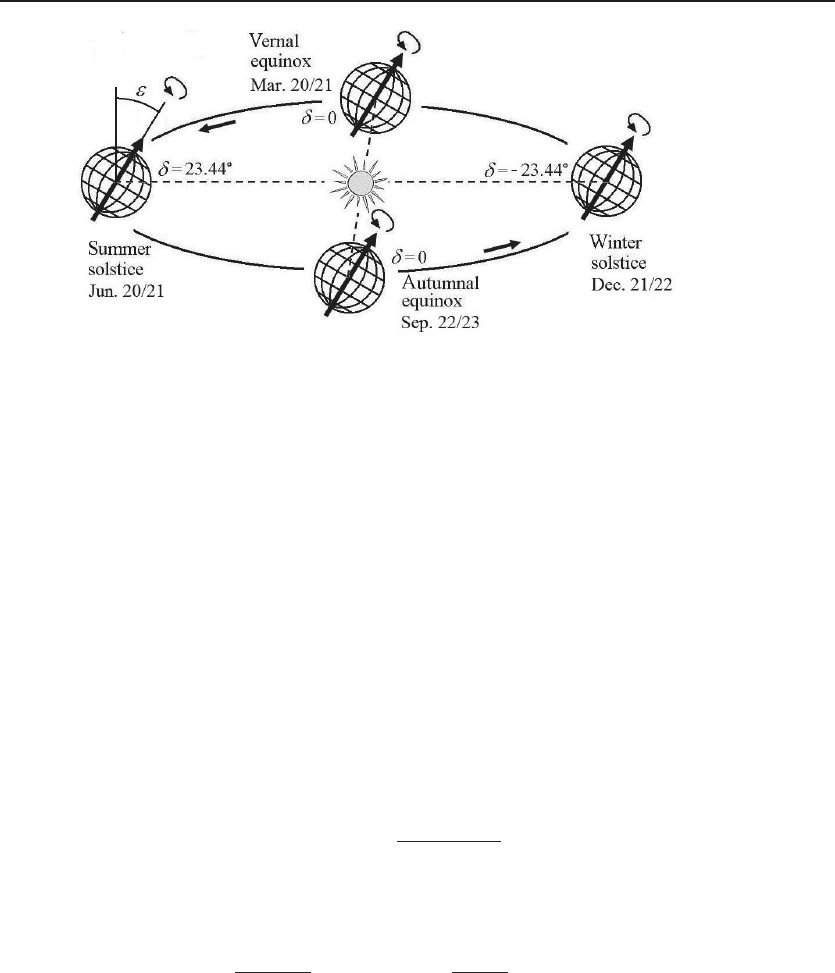
Related to the motion of the Sun over a calendar year, there are four cardinal
points. At the vernal equinox, the trajectory of the Sun intersects the celestial equator,
i
i
“ChenSolarEnergy” — 2011/5/17 — 17:56 — page 85 — #112
i
i
i
i
i
i
4.3 Treatment in Solar Time 85
Figure 4.5 Obliquity and the seasons. The rotational axis and the orbital plane of Earth has
a tilt angle ,theobliquity, which is the origin of the seasons. It causes a periodic difference between
solar time and civil time.
heading north. At the summer solstice, the trajectory of the Sun reaches its northern
most point, which is about 23.44
◦
above the celestial equator. At the autumnal equinox,
the trajectory of the Sun intersects the celestial equator, heading south. At the winter
solstice, the trajectory of the Sun reaches its lowest point, which is about 23.44
◦
below
the celestial equator. The dates and times of these four cardinal points vary year by
year.
In line with the concept of solar time, the motion of the Sun along its orbital can
be described by the mean longitude l. At the vernal equinox, l = 0. At the summer
solstice, l = π/2, or 90
◦
. At the autumnal equinox, l = π, or 180
◦
.Atthewinter
solstice, l =3π/2, or 270
◦
.
An accurate formula for the declination of the Sun is presented in Section 4.4.7. Here
we present a simple approximation by assuming that the declination varies sinusoidally
with the mean longitude l and consequently is linear according to the number of the day
in a year. The error could be as large as 1.60
◦
, but is acceptable in many applications:
δ ≈ ε sin l = ε sin
2π (N − 80)
365.2422
, (4.27)
where ε is the obliquity of the ecliptic, currently ε =23.44
◦
;andN is the number of
the day counting from January 1, which can be computed using the formula
N =INT
275 × M
9
− K × INT
M +9
12
+ D − 30, (4.28)
where M is the month number, D is the day of the month, and K = 1 for a leap year,
K = 2 for a common year. A leap year is defined as divisible by 4, but not by 100,
except if divisible by 400. INT means taking the integer part of the number. This
i
i
“ChenSolarEnergy” — 2011/5/17 — 17:56 — page 86 — #113
i
i
i
i
i
i
86 Tracking Sunlight
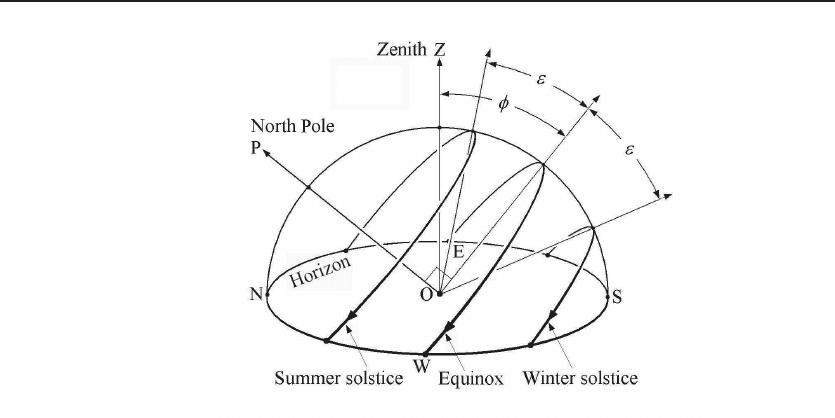
Figure 4.6 Apparent motion of the Sun. Earth is rotating on its axis OP eastward. The
apparent motion of the Sun is moving westward. Because of obliquity, on different days of a year, the
declination of the Sun varies. At the winter solstice, the declination of the Sun reaches its minimum,
−ε. At the summer solstice, the declination of the Sun reaches its maximum, +ε. At the vernal
equinox or autumnal equinox, the declination of the Sun is zero, and the Sun is moving on the celestial
equator.
formula can be verified directly. The number 80 in Eq. 4.27 is the number of the day
of the vernal equinox, March 20 or 21. The actual date varies from year to year. It also
differs between leap year and common year. Using Eq. 4.28, it can be shown that this
date varies from 79 to 81. The most common number of days of vernal equinox is 80.
The apparent motion of the Sun from an observer on Earth is shown in Fig. 4.6.
Earth is rotating on its axis OP eastward because of its spin. Therefore, apparently, the
Sun is moving westward. Due to obliquity, on different days of a year, the declination of
the Sun varies. At the winter solstice, the declination of the Sun reaches its minimum,
−ε. At the summer solstice, the declination of the Sun reaches its maximum, +ε.At
the vernal equinox or autumnal equinox, the declination of the Sun is zero, and the
Sun is moving on the celestial equator.
4.3.2 Sunrise and Sunset Time
Using the treatments in the previous section, we will give an example using the time of
sunrise (or sunset) in solar time. The condition of sunrise is the time when the height
of the Sun h is zero. According to Eq. 4.15, the condition is
sin δ sin φ +cosδ cos φ cos ω =0, (4.29)
or
cos ω
s
= −tan δ tan φ. (4.30)

i
i
“ChenSolarEnergy” — 2011/5/17 — 17:56 — page 87 — #114
i
i
i
i
i
i
4.3 Treatment in Solar Time 87
For each value of the cosine, there are multiple values of the angle ω. For example,
at the equator, φ = 0, the times of sunrise and sunset are always at 6:00 am and 6:00
pm solar time. The duration of the day is always 12 hours. At the North Pole or South
Pole, tan φ = ∞, there is never a sunrise or a sunset. In the temperate zones and the
Torrid Zone, the sunrise and sunset times in terms of the 24-h solar time of the N th
day of the year is determined by
t
s
=12∓
12
π
arccos [−tan δ tan φ] . (4.31)
In the frigid zones, where
φ>90
◦
− ε, (4.32)
there is a period of time in a year when the Sun never rises or never sets.
Another time of the day which is useful for the computation of solar radiation is
the solar time when the Sun crosses the East–West great circle. The condition is where
the azimuth A = ±π/2, or cos A = 0. From Eq. 4.7, one finds
cos ω
ew
=tanδ cot φ, (4.33)
or, in terms of solar time in hours,
t
ew
=12±
12
π
arccos [tan δ cot φ] . (4.34)
4.3.3 Direct Solar Radiation on an Arbitrary Surface
For a surface of arbitrary orientation, with polar angle β and azimuth angle γ, the unit
vector of its norm N is given se
N = i sin β cos γ + j sin β sin γ + k cos β. (4.35)
The convention of the sign of the angle is the same as the hour angle: The origin of
the azimuth is south and westward it is positive. Combining Eq. 4.35 with Eqs. 4.7,
4.8, and 4.9, the cosine between the norm of the surface and the solar radiation is
cos θ = N · S =sinβ cos γ (cos δ cos ω sin φ −sin δ cos φ)
+sinβ sin γ cos δ sin ω
+cosβ (cos δ cos ω cos φ +sinδ sin φ),
(4.36)
or, rearranging
cos θ =sinδ (sin φ cos β − cos φ sin β cos γ)
+cosδ
(cos φ cos β cos ω +sinφ sin β cos γ cos ω
+sinβ sin γ sin ω) .
(4.37)

i
i
“ChenSolarEnergy” — 2011/5/17 — 17:56 — page 88 — #115
i
i
i
i
i
i
88 Tracking Sunlight
For a surface facing south with γ = 0, Eq. 4.37 simplifies to
cos θ =sin(φ −β)sinδ + cos(φ − β)cosδ cos ω. (4.38)
Consider special cases as follows: For a horizontal surface, β =0,
cos θ =sinφ sin δ +cosφ cos δ cos ω. (4.39)
At the North Pole, where φ = π/2,
cos θ =sinδ. (4.40)
And at the equator, where φ =0,
cos θ =cosδ cos ω. (4.41)
For a vertical surface facing south, β = π/2andγ =0,
cos θ = −cos φ sin δ +sinφ cos δ cos ω. (4.42)
At the North Pole, where φ = π/2,
cos θ =cosδ cos ω. (4.43)
And at the equator, where φ =0,
cos θ =sinδ. (4.44)
Of particular importance is a surface with latitude tilt,or
β = φ. Equation 4.38 is
greatly simplified:
cos θ =cosδ cos ω. (4.45)
The surface can get high radiation energy over the entire year, because cos δ is always
greater than 0.93.
4.3.4 Direct Daily Solar Radiation Energy
An important application in terms of solar time is the computation of direct solar
radiation energy H
D
on a surface on a clear day. The effect of clouds and scattered
sunlight will be treated in Chapter 5. In a clear day, on a surface perpendicular
to the sunlight, the power is 1 kW/m
2
, and the total radiation energy in an hour
is 1 kWh/m
2
. When the sunlight is tilted with an angle θ, the radiation energy is
reduced to cos θ × 1 kWh/m
2
. Therefore, the daily direct solar radiation energy in
units of kilowatt-hours per square meter is the integration of cos θ over 24 h.
i
i
“ChenSolarEnergy” — 2011/5/17 — 17:56 — page 89 — #116
i
i
i
i
i
i
4.3 Treatment in Solar Time 89
Consider first a vertical surface facing south in the northern temperate zone, namely,
β = π/2andγ = 0. From Eq. 4.36, one obtains
cos θ =cosδ cos ω sin φ − sin δ cos φ. (4.46)
During days between the vernal equinox and the autumnal equinox, sunlight can shine
on the south surface only when the Sun locates in the southern half of the sky. The
direct daily solar radiation energy H
D
in kilowatt-hours per square meter is
H
D
=
12
π
cos δ sin φ
ω
ew
−ω
ew
cos ωdω−
24
π
ω
ew
sin δ cos φ
=
24
π
(cos δ sin φ sin ω
ew
− ω
ew
sin δ cos φ).
(4.47)
During the days between the autumnal equinox and the vernal equinox of the next
year, the available sunlight is limited from sunrise to sunset. The daily solar radiation
energy in kilowatt-hours per square meter is
H
D
=
12
π
cos δ sin φ
ω
s
−ω
s
cos ωdω−
24
π
ω
s
sin δ cos φ
=
24
π
(cos δ sin φ sin ω
s
− ω
s
sin δ cos φ).
(4.48)
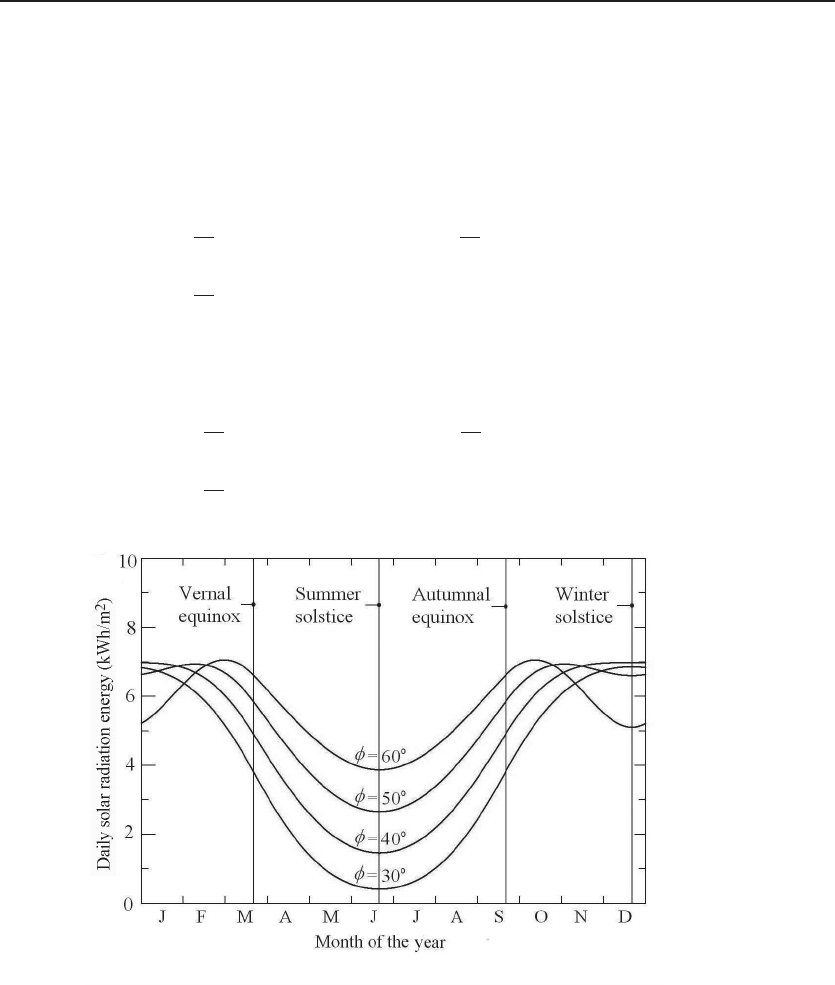
Figure 4.7 Daily solar radiation energy on a vertical surface facing south. In the winter,
the surface enjoys almost full sunlight, except for places with very high latitude. In the summer, the
solar radiation is much weaker. From the point of view of passive solar buildings, south-facing windows
are highly preferred. For solar photovoltaic applications, south-facing panels are much more efficient
in the winter.
i
i
“ChenSolarEnergy” — 2011/5/17 — 17:56 — page 90 — #117
i
i
i
i
i
i
90 Tracking Sunlight
The direct daily solar radiation energy on a surface facing south for four latitudes in
the northern temperate zone of the entire year is shown in Fig. 4.7. As shown, in the
winter time, the surface enjoys almost full sunlight, except for places with very high
latitude, where the radiation energy is reduced because of the late sunrise and early
sunset. In the summer, the solar radiation is much weaker because of tilting. From
the point of view of passive solar buildings, South-facing windows are highly preferred.
For solar photovoltaics applications, south-facing panels are much more efficient in the
winter. However, the overall efficiency is not high.
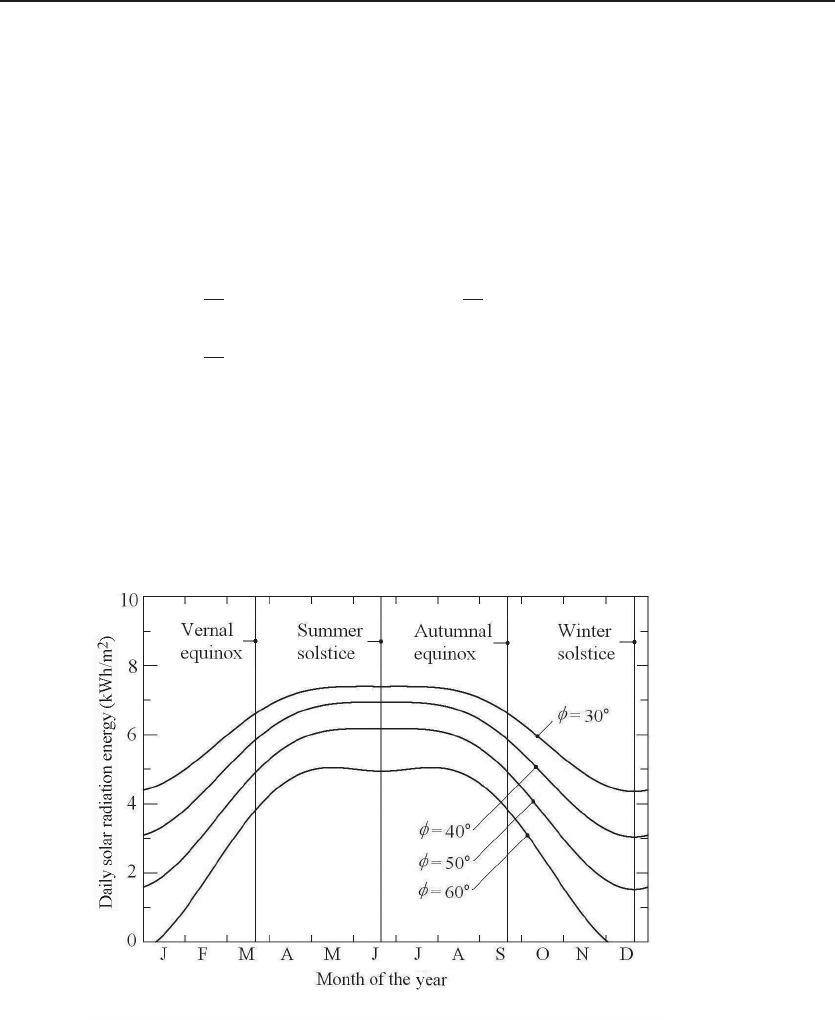
Next, consider a west-facing surface, with β = π/2andγ = π/2. From Eq. 4.36,
one obtains
cos θ =cosδ sin ω. (4.49)
Sunlight starts at noon with ω = 0 and disappears at sunset. Therefore, the daily solar
radiation energy in kilowatt-hours per square meter is
H
D
=
12
π
cos δ
ω
s
0
sin ωdω
=
12
π
(cos δ +sinδ tan φ).
(4.50)
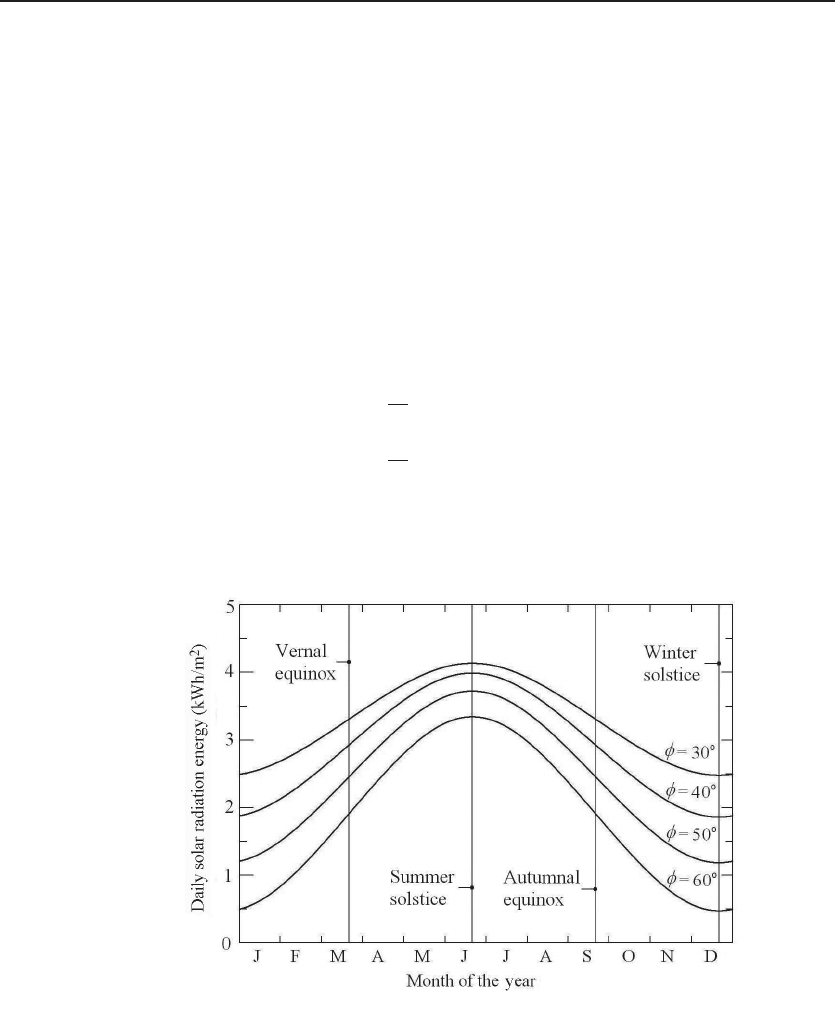
where Eq. 4.30 is used. As shown in Fig. 4.8, in the summer, the solar radiation is
much stronger than in the winter. From the point of view of passive solar buildings,
Figure 4.8 Daily solar radiation energy on a vertical surface facing west. In the summer,
the solar radiation is much stronger than in the winter. From the point of view of passive solar
buildings, west-facing windows must be avoided whenever possible.
i
i
“ChenSolarEnergy” — 2011/5/17 — 17:56 — page 91 — #118
i
i
i
i
i
i
4.3 Treatment in Solar Time 91
west-facing windows must be avoided whenever possible. For solar photovoltaics appli-
cations, west-facing panels only work in the summer, but the overall efficiency is only
one-half of the optimum orientation; see below.
For rooftop applications in large cities, to avoid structural damages from wind,
horizontal placement of solar panels surface is often used. Since β = 0, using Eq. 4.36,
cos θ =cosδ cos ω cos φ +sinδ sin φ. (4.51)
By integrating the cosine over time from sunrise to sunset, the daily radiation energy
is
H
D
=
12
π
cos δ cos φ
ω
s
−ω
s
cos ωdω+
24
π
ω
s
sin δ sin φ
=
24
π
(cos δ cos φ sin ω
s
+ ω
s
sin δ sin φ).
(4.52)
The variation of the radiation energy over a year is shown in Fig. 4.9. As shown, in
the summer, especially in locations with low latitude, the radiation energy is strong.
However, in winter, especially in locations of higher latitude, the daily radiation energy
is weak.
A much better choice for solar panel placement is latitude tilt. From Eq. 4.45,
between the vernal equinox and the autumnal equinox, the daily radiation energy is
Figure 4.9 Daily solar radiation energy on a horizontal surface. In the summer, especially
in locations with low latitude, the radiation energy is strong. However, in the winter, especially in
locations of higher latitude, the daily radiation energy is weak.