
Chen C.J. Physics of Solar Energy
Подождите немного. Документ загружается.


i
i
“ChenSolarEnergy” — 2011/5/17 — 17:56 — page 42 — #69
i
i
i
i
i
i
42 Nature of Solar Radiation
equations explaining electromagnetic phenomena, now known as Maxwell’s equations.
Based on those equations, he predicted the existence of electromagnetic waves, propa-
gating in free space with a speed that equals exactly the speed of light, which was then
verified experimentally by Heinrich Hertz. Maxwell’s bold postulation that light is an
electromagnetic wave has since become one of the cornerstones of physics.
2.1.1 Maxwell’s Equations
In vacuum, or free space, Maxwell’s equations are
∇·E =
ρ
ε
0
, (2.1)
∇·B = 0, (2.2)
∇×E = −
∂B
∂t
, (2.3)
∇×B = ε
0
μ
0
∂E
∂t
+ μ
0
J. (2.4)
Electric current cannot exist in free space. For linear, uniform, isotropic materials, the
current density J is determined by the electric field intensity E through Ohm’s law,
J = σE. (2.5)
The names, meanings, and units of the physical quantities in these equations are
listed in Table 2.1. For example, the electric constant has an intuitive meaning as
follows. A capacitor made of two parallel conducting plates with area A and distance d
has a capacitance C = ε
0
A/d in farads. Similarly, the electric constant has an intuitive
meaning as follows. An inductor made of a long solenoid of N loops with cross-sectional
area A and length l has an inductance L = μ
0
N
2
A/l in henrys.
Table 2.1: Quantities in Maxwell’s Equations
Symbol Name Unit Meaning or Value
E Electric field intensity V/m
B Magnetic field intensity T (tesla) N/A·m
ρ Electric charge density C/m
3
J Electric current density A/m
2
ε
0
Electric constant F/m 8.85 × 10
−12
F/m
(permittivity of free space)
μ
0
Magnetic constant H/m 4π × 10
−7
H/m
(permeability of free space)
σ Conductivity (Ω · m)
−1

i
i
“ChenSolarEnergy” — 2011/5/17 — 17:56 — page 43 — #70
i
i
i
i
i
i
2.1 Light as Electromagnetic Waves 43
2.1.2 Vector Potential
To treat the electromagnetic field in space, a convenient method is to use the vector
potential. From Eq. 2.2, it is possible to construct a vector field A which satisfies
B = ∇×A. (2.6)
Then, Eq. 2.2 is automatically satisfied. Substituting Eq. 2.6 into Eq. 2.3, one obtains
∇×E = −
∂
∂t
∇×B. (2.7)
For any function φ(r), ∇×[∇φ(r)] = 0, it is possible to set up the vector potential A
such that
E = −
∂A
∂t
−∇φ, (2.8)
where φ is the electrostatic potential arising from the charges. The choice of the vector
potential is not unique. By adding a gradient of an arbitrary function to it, values of
the electric field and magnetic field do not change. This is called the gauge invariance
of the vector potential. It is possible to define a vector potential which satisfies the
condition
∇·A =0. (2.9)
Equation 2.9 is called the Coulomb gauge, which is the most convenient gauge to treat
nonrelativistic problems of an atomic system and an independent electromagnetic wave.
In fact, using Eq. 2.9 and the first Maxwell equation Eq. 2.1, one obtains
∇
2
φ = −
ρ
ε
0
, (2.10)
which means that the scalar potential is generated by the static charges only. It is
thus convenient for treating the problems of interactions between the radiation field
and atomic systems. For details of the gauge problem, see, for example, The Quantum
Theory of Radiation by Walter Heitler [37].
2.1.3 Electromagnetic Waves
In this section, we study the electromagnetic waves in free space, that is, where the
electric charge ρ and current J are zero. Substituting Eqs 2.6 and 2.8 into Eq. 2.4, we
have
∇×∇×A + ε
0
μ
0
∂
2
A
∂t
2
=0. (2.11)
Using the identity
∇×∇×A ≡∇(∇·A) −∇
2
A (2.12)
and Eq. 2.9, Eq. 2.11 becomes
∇
2
A − ε
0
μ
0
∂
2
A
∂t
2
=0. (2.13)

i
i
“ChenSolarEnergy” — 2011/5/17 — 17:56 — page 44 — #71
i
i
i
i
i
i
44 Nature of Solar Radiation
Introducing
c =
1
√
ε
0
μ
0
, (2.14)
Eq. 2.13 becomes
∇
2
A −
1
c
2
∂
2
A
∂t
2
= 0, (2.15)
which is a wave equation with velocity c. Because of Eqs. 2.6 and 2.8, the electric field
intensity and the magnetic field intensity also satisfy the same wave equation,
∇
2
E −
1
c
2
∂
2
E
∂t
2
= 0 (2.16)
and
∇
2
B −
1
c
2
∂
2
B
∂t
2
=0, (2.17)
Accordingtovaluesofε
0
and μ
0
coming from electromagnetic measurements in 1860s,
the velocity of electromagnetic waves should be 3.1 × 10
8
m/s. On the other hand,
experimental values of the speed of light at that time were 2.98 ×10
8
–3.15 × 10
8
m/s.
The difference was within experimental error. Maxwell proposed thusly [58]:
The agreement of the results seems to show that light and magnetism are
affections of the same substance, and that light is an electromagnetic dis-
turbance propagated through the field according to electromagnetic laws.
Maxwell’s theory of electromagnetic waves was experimentally verified by Heinrich
Hertz in 1865. From recent electrical measurements, one finds 1/
√
ε
0
μ
0
=2.998 ×
10
8
m/s, which is exactly the speed of light in a vacuum, c.
2.1.4 Plane Waves
An electromagnetic wave with circular frequency ω in space is defined as
A(x, y, z , t)=A(x , y, z ) e
−iωt
. (2.18)
To study the properties of electromagnetic waves, we consider the case that the
wave propagates in one direction, say z. In this case, the field intensities only depend
on z. Equation 2.15 becomes
d
2
A
dz
2
+
ω
2
c
2
A = 0. (2.19)
The general solution is
A = A
0
e
i(k
z
z −ωt)
. (2.20)
where A
0
is a constant, and the z-component of the wavevector k
z
is defined as
k
z
=
ω
c
. (2.21)
i
i
“ChenSolarEnergy” — 2011/5/17 — 17:56 — page 45 — #72
i
i
i
i
i
i
2.1 Light as Electromagnetic Waves 45
2.1.5 Polarization of Light
Although in general the vector potential could have x, y, z-components, because of Eq.
2.9, the z-component of the vector potential must be zero,
∇·A =
∂A
x
∂x
+
∂A
y
∂y
+
∂A
z
∂z
= ik
z
A
z
=0. (2.22)
This means that A
z
must be a constant over the entire space. Because we are interested
in electromagnetic waves, or the variation of electromagnetic fields, we can simply
set A
z
=0. Thewavesaretransverse. In other words, the intensity vectors are
perpendicular to the direction of propagation.
The direction of the vector potential could be either x or y or a linear combination
of x-andy-components. For the x-component of A,wehave
A
x
= A
x0
e
i(k
z
z−ωt)
,A
y
=0,A
z
=0. (2.23)
The electric field intensity, according to Eq. 2.8, is
E
x
= iωA
x0
e
i(k
z
z−ωt)
,E
y
=0,E
z
=0. (2.24)
And the magnetic field intensity, according to Eq. 2.6, is
B
x
=0,B
y
= ik
z
A
x0
e
i(k
z
z−ωt)
,B
z
=0. (2.25)
Therefore, the only nonvanishing components of the electric field intensity and the
magnetic field intensity are E
x
and B
y
. According to Eq. 2.21, they are in phase and
proportional,
E
x
= cB
y
. (2.26)
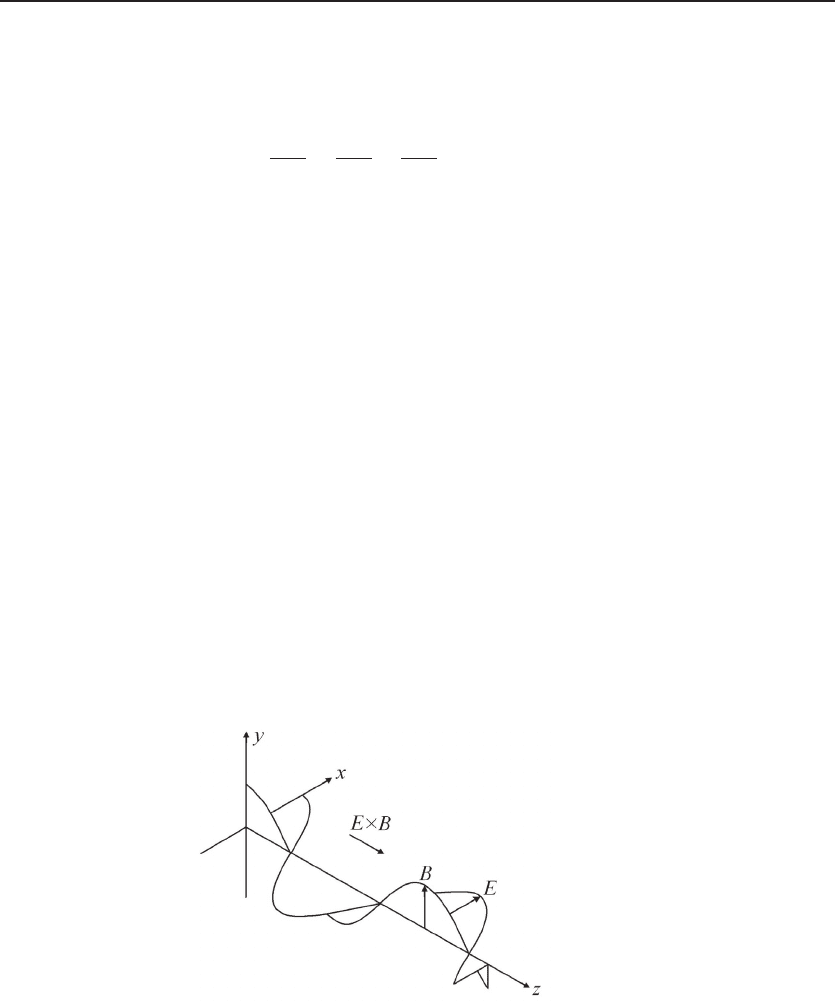
Figure 2.2 Electromagnetic wave. The electromagnetic wave is transverse, where the intensity
vectors E and B are perpendicular to the direction of propagation. The electric field intensity E is
perpendicular to the magnetic field intensity B. The energy flux vector S = μ
−1
0
E × B is formed from
E and B by a right-hand rule.

i
i
“ChenSolarEnergy” — 2011/5/17 — 17:56 — page 46 — #73
i
i
i
i
i
i
46 Nature of Solar Radiation
In summary, according to the electromagnetic theory of light, the electric field inten-
sity vector is perpendicular to the direction of the propagation of light. The magnetic
field intensity is perpendicular to both the direction of the electric field intensity vector
and the direction of the propagation of light, and its magnitude is proportional to the
electric field intensity. See Fig. 2.2.
2.1.6 Motion of an Electron in Electric and Magnetic Fields
In this section, the interaction of the radiation field—electric and magnetic fields vary-
ing with time—with the electrons is studied using classical mechanics as a preparation
for a quantum-mechanical treatment.
The standard method of developing the quantum mechanics of a dynamic system
is first to cast the classical equation of motion into Hamiltonian format. The Hamilto-
nian H(p, r) of a dynamic system is a function of its coordinate r and corresponding
momentum p, representing the total energy. For example, for an electron with charge
q movinginanelectricfieldwithpotentialφ(r), the Hamiltonian is
H =
1
2m
e
p
2
+ qφ(r). (2.27)
The equations of motion in the Hamiltonian format are a pair of first-order ordinary
differential equations:
˙p
x
= −
∂H
∂x
, (2.28)
˙x =
∂H
∂p
x
. (2.29)
There are similar equations for y and z. Using Eqs 2.29 and 2.27, the expression of
momentum is found to be identical to the usual definition,
p = m
e
v = m
e
˙
r, (2.30)
where a dot means taking a derivative with respect to time t. Applying Eqs. 2.28 and
2.29 to Eq. 2.27, one finds
m
e
¨
r = −q∇φ(r)=qE, (2.31)
which is Newton’s equation of motion, where E is electric field intensity.
For the motion of an electron in both electric and magnetic fields, the standard
method is to insert the vector potential A into the expression of momentum by simply
substituting p with p − qA in the Hamiltonian,
H =
1
2m
e
(p − qA)
2
+ qφ(r), (2.32)
or
H =
1
2m
e
(p
x
− qA
x
)
2
+(p
y
− qA
y
)
2
+(p
z
− qA
z
)
2
+ qφ(x, y, z). (2.33)

i
i
“ChenSolarEnergy” — 2011/5/17 — 17:56 — page 47 — #74
i
i
i
i
i
i
2.2 Optics of Thin Films 47
Applying Eq. 2.29 to Eq. 2.32, one obtains
p
x
= m
e
˙x + qA
x
(2.34)
and so on. In vector form, it is
p = m
e
˙
r + qA, (2.35)
which is the definition of momentum in a magnetic field. Applying Eq. 2.28 to Eq. 2.32
and using Eq. 2.35, for the x-component, yield
dp
x
dt
= q
∂A
x
∂x
˙x +
∂A
y
∂x
˙y +
∂A
z
∂x
˙z
− q
∂φ
∂x
. (2.36)
The familiar Newton equation of motion, similar to Eq. 2.31, can be obtained from
Eqs. 2.33 and 2.36. The x-component is given as
m
e
¨x =
dp
x
dt
− q
dA
x
dt
. (2.37)
Note that
dA
x
dt
=
∂A
x
∂t
+
∂A
x
∂x
˙x +
∂A
x
∂y
˙y +
∂A
x
∂z
˙z, (2.38)
for example, for the x-component, one obtains,
m
e
¨x = q
˙y
∂A
y
∂x
−
∂A
x
∂y
+˙z
∂A
z
∂x
−
∂A
x
∂z
−
∂A
x
∂t
−
∂φ
∂x
. (2.39)
Using Eqs. 2.6 and 2.8, in vector form, the equation of motion is
m
e
¨
r = qE + q
˙
r × (∇×A)=qE + q
˙
r × B. (2.40)
which is Newton’s equation of motion including the magnetic force. Therefore, the
correctness of the Hamiltonian, Eq. 2.32, is verified. We will use the Hamiltonian in
the quantum-mechanical treatment of the interaction of radiation with atomic systems.
2.2 Optics of Thin Films
Maxwell’s theory of light plays a critical role in the understanding of selective absorp-
tion films for solar thermal applications and antireflection films in photovoltaics. The
general theory with an arbitrary incident angle is rather complicated. However, for ap-
plications related to solar energy, it suffices to study the case of normal incidence, which
demonstrates most of the related physics. First, let us extend Maxwell’s equations to
dielectrics.

i
i
“ChenSolarEnergy” — 2011/5/17 — 17:56 — page 48 — #75
i
i
i
i
i
i
48 Nature of Solar Radiation
2.2.1 Relative Dielectric Constant and Refractive Index
Maxwell’s equations, Eqs. 2.1–2.4 are used for the case of a vacuum. To describe elec-
tromagnetic phenomena in a nonmagnetic medium, the electric constant ε
0
is replaced
by the electric constant of the medium, ε. Maxwell’s equations are
∇·E =
ρ
ε
, (2.41)
∇·B = 0, (2.42)
∇×E = −
∂B
∂t
, (2.43)
∇×B = εμ
0
∂E
∂t
+ μ
0
J. (2.44)
Following the procedures in Section 2.1.1, we found the wave equations for the electric
field intensity and the magnetic field intensity:
∇
2
E −
1
v
2
∂
2
E
∂t
2
=0, (2.45)
∇
2
B −
1
v
2
∂
2
B
∂t
2
=0, (2.46)
where the velocity v is given as
v =
1
√
εμ
0
. (2.47)
Table 2.2: Dielectric Constant and Refractive Index of Selected Materials
Material Wavelength ε
r
n
Silicon 1.39 μm 12.2 3.49
Germanium 2.1 μm 16.8 4.10
TiO
2
2.0 μm 5.76 2.4
SiO
2
Visible 2.40 1.55
Window glass Visible 2.40 1.55
ZnS Visible 5.43 2.33
CeO
2
Visible 3.81 1.953
CaF
2
Visible 2.06 1.435
MgF
2
Visible 1.91 1.383
Source: American Institute of Physics Handbook,
3rd Ed, McGraw-Hill, New York, 1982.

i
i
“ChenSolarEnergy” — 2011/5/17 — 17:56 — page 49 — #76
i
i
i
i
i
i
2.2 Optics of Thin Films 49
Comparing with Eq. 2.14, the relation of v with c is
c
v
=
ε
ε
0
. (2.48)
Defining the relative dielectric constant of the medium as
ε
r
≡
ε
ε
0
, (2.49)
the ratio of the speed of light in a vacuum and the speed of light in the medium, defined
as the refractive index n,is
n ≡
c
v
=
√
ε
r
. (2.50)
In general, the relative dielectric constant and the refractive index depend on the
frequency or wavelength of the electromagnetic wave. For application in solar energy
devices, the most relevant case is solar radiation in the visible or infrared. Table 2.2
shows the relative dielectric constant and refractive index of several materials often
used in solar energy devices.
For electromagnetic waves propagating in the z direction with wavevector k and
electric field intensity in x, similar to Eqs. 2.24–2.26, the nonzero components are
E
x
= E
0
e
i(kz−ωt)
(2.51)
B
y
=
k
ω
E
0
e
i(kz−ωt)
. (2.52)
The wavevector k is given as
k =
ω
v
=
ωn
c
. (2.53)
And, according to Eq. 2.50, the electric and magnetic fields are in phase and propor-
tional,
B
y
=
1
v
E
x
=
n
c
E
x
. (2.54)
2.2.2 Energy Balance and Poynting Vector
Let us study the energy balance in an electromagnetic field by considering a unit volume
with relatively uniform fields. If the current density is J and the electric field intensity
is E, the ohmic energy loss per unit time per unit volume is J ·E. Using Eq. 2.44, the
expression of energy loss becomes
J · E = −
1
μ
0
E · (∇×B)+εE ·
∂E
∂t
. (2.55)
Using the mathematical identity
E · (∇×B)=−∇· (E × B)+B ·(∇×E), (2.56)

i
i
“ChenSolarEnergy” — 2011/5/17 — 17:56 — page 50 — #77
i
i
i
i
i
i
50 Nature of Solar Radiation
Eq. 2.55 becomes
J · E = ∇·
1
μ
0
E × B
+
1
μ
0
B · (∇×E) − εE ·
∂E
∂t
. (2.57)
Using Eq. 2.43, Eq. 2.57 becomes
J · E = −∇ ·
1
μ
0
E × B
−
∂
∂t
ε
2
E
2
+
1
2μ
0
B
2
. (2.58)
The right-hand side of Eq. 2.58 has a straightforward explanation. The energy density
of the electromagnetic fields is
W =
ε
2
E
2
+
1
2μ
0
B
2
, (2.59)
and the power density of the electromagnetic field per unit area is
S =
1
μ
0
E × B. (2.60)
The vector S is called the Poynting vector after its discoverer.
For an electromagnetic wave, according to Eq. 2.54, cB
y
= nE
x
. The magnitude of
the Poynting vector along the direction of propagation is
S
z
=
n
μ
0
c
E
2
x
. (2.61)
2.2.3 Fresnel Formulas
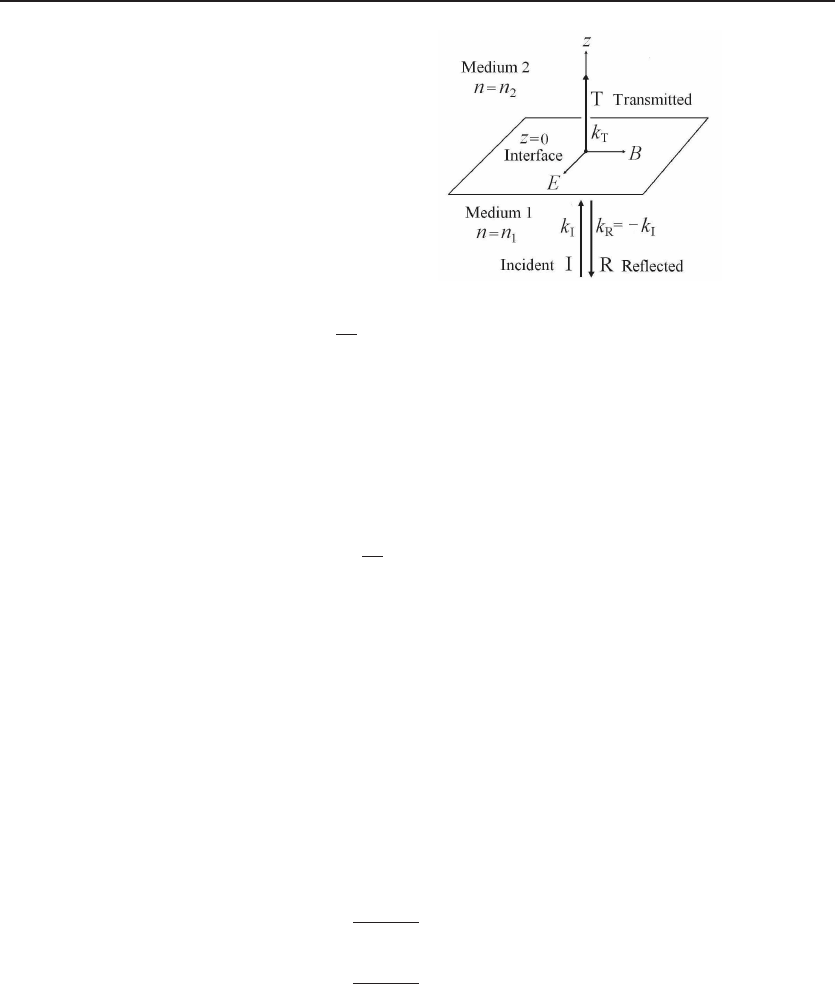
Consider two media of refractive indices n
1
and n
2
with an interface at z =0,asshown
in Fig. 2.3. The incident light is moving in the z direction with wavevector k
I
,
k
I
=
ωn
1
c
. (2.62)
The field intensities of the incident light are
E
I
= Ie
i(k
I
z−ωt)
, (2.63)
B
I
=
n
1
c
Ie
i(k
I
z−ωt)
, (2.64)
where I is a constant characterizing the intensity of incident light.
For transmitted light, the wavevector is determined by the refractive index of
medium 2,
k
T
=
ωn
2
c
. (2.65)
The field intensities of the transmitted light are
E
T
= Te
i(k
T
z−ωt)
, (2.66)
i
i
“ChenSolarEnergy” — 2011/5/17 — 17:56 — page 51 — #78
i
i
i
i
i
i
2.2 Optics of Thin Films 51
Figure 2.3 Derivation of Fresnel for-
mulas. Two media with indices of refrac-
tion n
1
and n
2
share an interface at z =0.
The incident light has a wavevector k
I
.
The wavevector of transmitted light is k
T
.
The wavevector of reflected light is identi-
cal to that of incident light but with oppo-
site sign. By applying Maxwell’s equations
at the interface, the relations between the
three components of light can be derived.
B
T
=
n
2
c
Te
i(k
T
z−ωt)
, (2.67)
The constant T characterizing the intensity of the transmitted light is to be determined
by the boundary conditions required by Maxwell’s equations.
For reflected light, because it is in the same medium as the incident light, the
absolute value of the wavevector is identical to that of the incident light. However, the
direction of z is reversed. By using the same notation k
I
, the field intensities of the
reflected light are
E
R
= Re
i(−k
I
z−ωt)
, (2.68)
B
R
= −
n
1
c
Re
i(−k
I
z−ωt)
. (2.69)
Notice the negative sign of the magnetic field intensity B
R
. Again, the constant R
characterizes the intensity of the reflected light.
On the interface, z = 0, following Eqs. 2.1 and 2.2, both electric field intensity and
magnetic field intensity should be continuous. In other words,
E
I
+ E
R
= E
T
, (2.70)
B
I
+ B
R
= B
T
. (2.71)
Using Eqs. 2.63–2.71, we find
I − R = T, (2.72)
n
1
(I + R)=n
2
T. (2.73)
The solutions of Eqs.2.72 and 2.73 are
R =
n
2
− n
1
n
2
+ n
1
I, (2.74)
T =
2n
1
n
2
+ n
1
I. (2.75)
Equations 2.74 and 2.75 are the Fresnel formulas for the case of normal incidence. Ob-
viously, if n
1
= n
2
, there is no reflected light, and 100% of incident light is transmitted
through the interface.