
Chen C.J. Physics of Solar Energy
Подождите немного. Документ загружается.


i
i
“ChenSolarEnergy” — 2011/5/17 — 17:56 — page 72 — #99
i
i
i
i
i
i
72 Origin of Solar Energy
At that time, geology was already well established based on two century’s accu-
mulation of discoveries and studies of fossils as well as geological strata, summarized
by Sir Charles Lyell in the 1830s in a three-volume monograph Elements of Geology
[55]. Geological evidence showed that Earth existed for more than one billion years
under basically uniform sunlight conditions. Charles Darwin explained the sequence
of discoveries in paleontology by evolution through natural selection in his 1859 monu-
mental monograph The Origin of Species [20]. According to Lyell and Darwin [55, 20],
countless evidence in paleontology has shown that the Sun has shined consistently for
at least 1 billion years. The assertion of Lord Kelvin that the Sun’s life expectancy is
about 20 million years is in direct conflict with the findings in geology and biology.
The discrepancy is due to the limitation in the theory of physics in the Victorian
period. On April 27, 1900, Lord Kelvin gave a lecture at the Royal Institution of
Great Britain entitled Nineteenth-Century Clouds over the Dynamical Theory of Heat
and Light [82]. Kelvin mentioned that the “beauty and clearness of theory” was over-
shadowed by “two clouds”: the null result of the Michelson–Morley experiment and
the difficulties in explaining the Stefan–Boltzmann law of blackbody radiation based
on classical statistical mechanics. Kelvin believed that these two problems were minor
and could be resolved within the framework of classical physics. Nevertheless, two
years before his death, in 1905, these “two clouds” evolved into a perfect storm in theo-
retical physics with the emergence of relativity and quantum theory, which completely
overturned the Kelvin–Helmholtz theory on the origin of solar energy.
The mystery of the origin of solar energy was resolved after Albert Einstein es-
tablished the relation between energy and mass [26], and Hans Bethe’s 1938 detailed
account of nuclear fusion as the origin of stellar energy [9, 8]. The time scale of Bethe
matches perfectly with the estimate of the Sun’s age based on the discoveries of Lyell
and Darwin.
3.3 Energy Source of the Sun
The answer to the source of stellar energy resides in the last of five 1905 papers by
Einstein, entitled Does the Inertia of a Body Depends Upon its Energy Content?In
contemporary notations, Einstein’s statement is as follows [26]:
If a body gives off energy ΔE in the form of radiation, its mass diminishes
by ΔE/c
2
. Because whether the energy withdrawn from the body becomes
radiation or else makes no difference, we might make a more general con-
clusion that the mass of a body is a measure of its energy content; if the
energy changes by ΔE, the mass changes accordingly by ΔE/c
2
.
Accordingly, if the initial mass of the body is m
0
and its final mass is m
1
,withΔm =
m
0
− m
1
, radiation can be emitted with energy
ΔE =Δmc
2
. (3.13)
i
i
“ChenSolarEnergy” — 2011/5/17 — 17:56 — page 73 — #100
i
i
i
i
i
i
3.3 Energy Source of the Sun 73
Using the vast experimental data on nuclear reaction already available at that time,
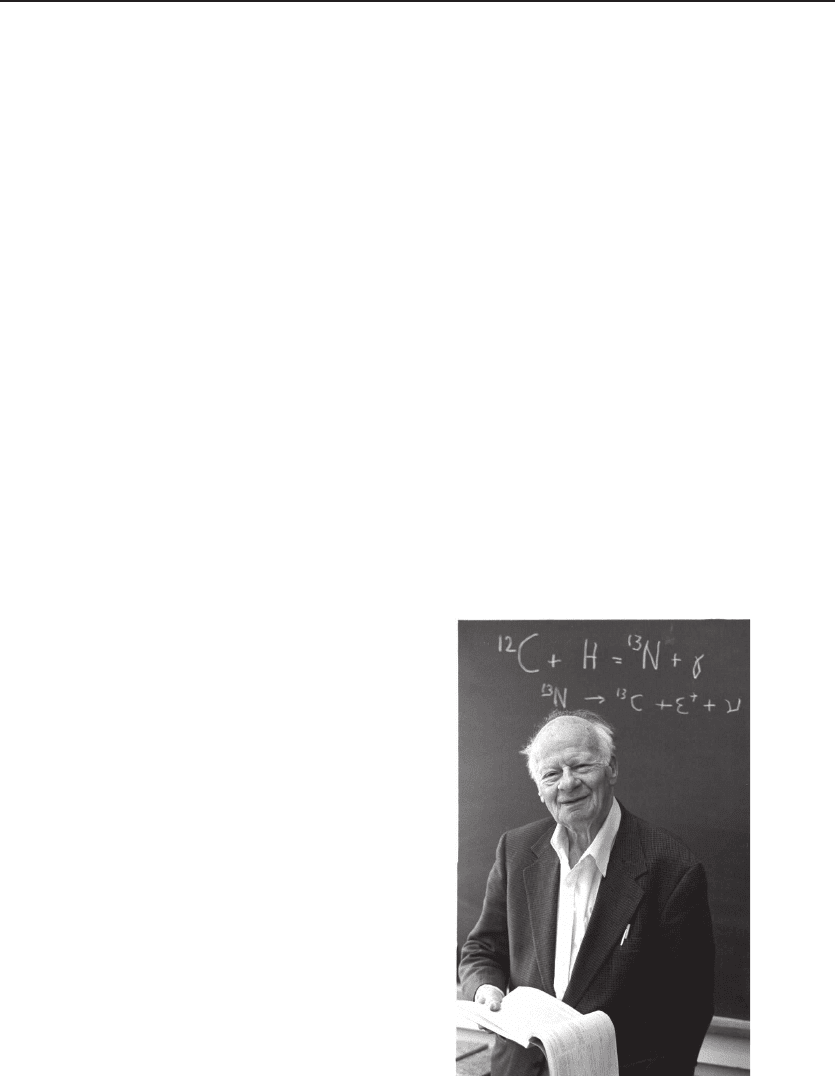
in 1938, Hans Bethe (Fig. 3.4) made a thorough study of all possible nuclear reactions
which could generate stellar energy [8, 9]. He concluded that, for stars with mass
similar to or less than the Sun, the proton–proton chain dominates. For stars with
mass much larger than the Sun, the process catalyzed by carbon, nitrogen, and oxygen
(the carbon chain) dominates.
3.3.1 The p − p Chain
Themassofprotonis1.672623×10
−27
kg, and the mass of a helium nucleus (the alpha
particle) is 6.644656 × 10
−27
kg. Every time four proton fuse into one alpha particle,
there is an excess of mass,
Δm =(4× 1.672623 − 6.644656) × 10
−27
kg = 4.5836 ×10
−29
kg. (3.14)
Using Einstein’s equation, the excess energy is
ΔE =4.5836 × 10
−29
×
2.99792 × 10
8
2
=4.11952 × 10
−12
J, (3.15)
or 25.7148 MeV. In other words, every hydrogen atom participating in the reaction
generates 6.4287 MeV of energy.
However, as shown below, part of the energy is radiated in the form of neutrinos, for
which the Sun and Earth are transparent. Therefore, the radiation energy generated
Figure 3.4 Hans Albrecht Bethe. German-
born American physicist (1906–2005) and No-
bel laureate for his 1938 theory on nuclear fu-
sion as the origin of stellar energy. A versa-
tile theoretical physicist, Bethe also made im-
portant contributions to quantum electrodynam-
ics, nuclear physics, solid-state physics, and as-
trophysics. Bethe left Germany in 1933 when
the Nazis came to power and he lost his job at
the University of T¨ubingen. He moved first to
England, then to the United States in 1935, and
joined the faculty at Cornell University, a position
which he occupied for the rest of his career. Dur-
ing World War II, he was appointed by John Op-
penheimer as the Director of Theoretical Division
of the Manhattan Project at Los Alamos labora-
tory. During 1948–1949 he was a visiting professor
at Columbia University. Photograph courtesy of
Mickael Okoniewski. Taken at Cornell University
on December 19, 1996.

i
i
“ChenSolarEnergy” — 2011/5/17 — 17:56 — page 74 — #101
i
i
i
i
i
i
74 Origin of Solar Energy
in the nuclear reaction is reduced:
1
H+
1
H −→
2
D+e
+
+ ν +0.164 MeV, (3.16)
2
D+
1
H −→
3
He + γ +5.49 MeV, (3.17)
3
He +
3
He −→
4
He + 2
1
H+12.85 MeV. (3.18)
The overall reaction is
4
1
H −→
4
He + 2e
+
+2ν +2γ +24.16 MeV. (3.19)
3.3.2 Carbon Chain
For stars with mass greater than the Sun, the carbon chain, or the CNO chain, dom-
inates the energy generation. Note that the carbon and nitrogen nuclei only act as
catalysts. The net result is again combining four protons to form a helium nucleus, or
an alpha particle.
12
C+
1
H −→
13
N+γ +1.95 MeV, (3.20)
13
N −→
13
C+e
+
+ ν +1.50 MeV, (3.21)
13
C+
1
H −→
14
N+γ +7.54 MeV, (3.22)
14
N+
1
H −→
15
O+γ +7.35 MeV, (3.23)
15
O −→
15
N+e
+
+ ν +1.73 MeV, (3.24)
15
N+
1
H −→
12
C+
4
He + 4.96 MeV. (3.25)
The overall reaction is
4
1
H −→
4
He + 2e
+
+2ν +3γ +25.03 MeV. (3.26)
3.3.3 Internal Structure of the Sun
Observing from Earth, the Sun is a sphere of roughly equal temperature, 5800 K. The
internal structure of the Sun is not observable. However, it can be inferred using the
laws of physics. A simple model of the structure of the Sun is based on an approxi-
mation that the Sun is made of spherical layers of uniform materials. The only spatial
parameter is the radial distance from the center. A balance between the gravitational
force and radiation pressure determines its density and temperature distribution. The
source of the energy is a nuclear reaction as presented in Section 3.3. The parameters
of the model are determined by comparing the output of the model with observations.
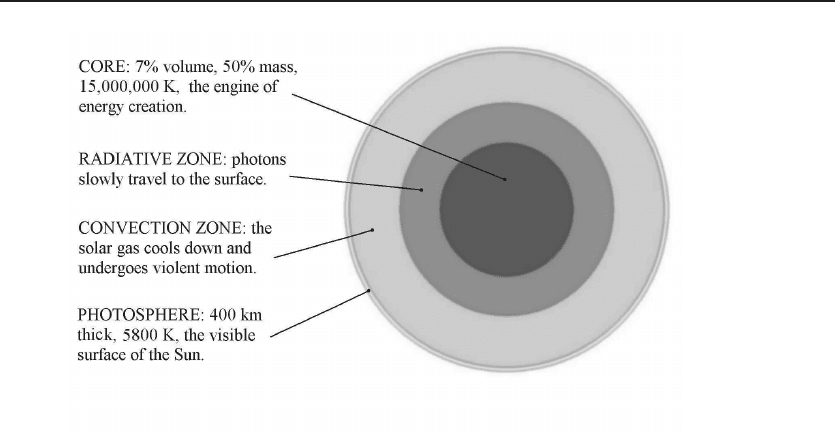
The current standard model is shown in Fig 3.5 [7, 68]. The core of the Sun, with
a density on the order of 100 g/cm
3
and a temperature of 10 × 10
6
− 15 × 10
6
K, is
the engine of energy creation. Here the nuclei and electrons combine to form a dense
and superhot plasma. The radiation energy generated in the core, mostly gamma rays,
travels to the surface through the radiation zone. The density of the radiation zone
i
i
“ChenSolarEnergy” — 2011/5/17 — 17:56 — page 75 — #102
i
i
i
i
i
i
3.3 Energy Source of the Sun 75
Figure 3.5 Internal structure of the Sun. The core of the Sun, with a density on the order of
100 g/cm
3
and temperature of 10 × 10
6
− 15 × 10
6
K, is the engine of energy creation. The radiation
energy generated in the core travels to the surface through the radiative zone. Through the convection
zone, the radiation energy is emitted by the photosphere. The boundaries between adjacent spheres
are gradual rather than well defined.
decreases from about 5 to about 1 g/cm
3
. It takes a photon about 170 thousand years
to travel through that region. The convection zone, with a density less than that of
water, is a zone of violent motion. The photosphere, a plasma of hydrogen and helium
with a density much lower than that of Earth’s atmosphere but totally opaque, is the
blackbody radiator that emits sunlight.

i
i
“ChenSolarEnergy” — 2011/5/17 — 17:56 — page 76 — #103
i
i
i
i
i
i
76 Origin of Solar Energy
Problems
3.1. Based on the current hydrogen reserve in the Sun and the energy output, if the
efficiency of generating radiation from the p −p chain is 90%, how many years can the
Sun keep burning?
3.2. Assuming that the nuclear radius R follows the simple formula R = r
0
A
1/3
,where
A is the atomic mass number (number of protons Z plus number of neutrons N)and
r
0
=1.25×10
15
m, how much kinetic energy is required for a proton (hydrogen nucleus)
to touch a carbon nucleus?
3.3. If the kinetic energy of the hydrogen nucleus is E
k
=1/2k
B
T ,tohave0.1%of
hydrogen nuclei reach the energy threshold for a CNO reaction, what is the minimum
temperature to initiate the nuclear fusion?
i
i
“ChenSolarEnergy” — 2011/5/17 — 17:56 — page 77 — #104
i
i
i
i
i
i
Chapter 4
Tracking Sunlight
Because of the rotation and the orbital motion of Earth around the Sun, the apparent
position of the Sun in the sky changes over time. To utilize the solar energy efficiently,
we must understand the apparent motion of the Sun. The accurate theory of the solar
system in astronomy and the data in The Astronomical Almanac can be overwhelmingly
complicated. In this chapter, we present a simple model which results in formulas easily
programmable on a microcomputer and accurate enough for solar energy utilization.
Analytic formulas are derived and presented.
4.1 Rotation of Earth: Latitude and Longitude
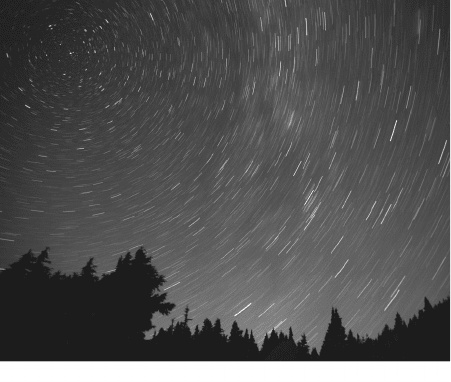
Figure 4.1 shows the apparent motion of the stars in the night sky. This motion is
due to the rotation of Earth on its axis. For solar energy applications, we can consider
Figure 4.1 The night sky. By orienting a camera toward the sky in the night and exposing for
some time, the stars seem to rotate around the celestial North Pole. Photo taken by Robert Knapp,
Portland, Oregon. See www.modernartphotograph.com. Courtesy of Robert Knapp.
77
Physics of Solar Energy C. Julian Chen
Copyright © 2011 John Wiley & Sons, Inc.
i
i
“ChenSolarEnergy” — 2011/5/17 — 17:56 — page 78 — #105
i
i
i
i
i
i
78 Tracking Sunlight
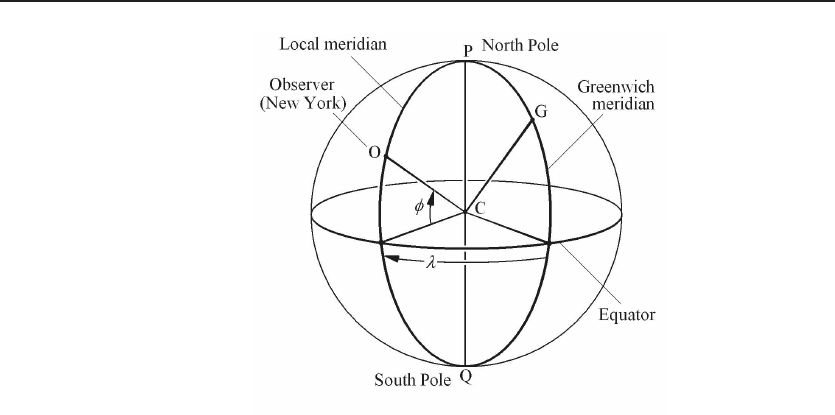
Figure 4.2 Latitude and longitude. The zero point of latitude, the prime meridian, is defined
as the meridian passing through the Royal Greenwich Observatory. East of the prime meridian is the
Eastern Hemisphere, and in the west is the Western Hemisphere. Similarly, north of the equator is
the Northern Hemisphere, and south of the equator is the Southern Hemisphere. The position of the
observer is identified by its latitude φ and longitude λ, as marked on the map, and can be determined
using GPS. The conversion of sign is eastward is positive and westward is negative. For example, the
latitude of New York City is φ =40
◦
47
N, or +0.712 rad, and its longitude is λ =73
◦
58
W, or -1.29
rad.
Earth as a perfect sphere rotating with a constant angular velocity on a fixed axis.
The axis of rotation of Earth crosses the surface of Earth at two points: the North
Pole and the South Pole. The great circle perpendicular to the axis is the equator.A
location on Earth can be specified by two coordinates, the latitude φ and the longitude
λ, as marked on the map and can be determined using GPS (the Global Positioning
System). The longitude specifies a meridian (a half great circle passing through the
two poles and the location). While the latitude is uniquely defined by the poles and the
equator, the longitude requires an origin as the zero point, the prime meridian.The
prime meridian was chosen by the International Meridian Conference held in October
1884 in Washington, D.C., as the meridian passing through a marked point in the Royal
Greenwich Observatory near London. Therefore, the prime meridian is often called the
Greenwich meridian. Figure 4.2 shows the definition of longitude and latitude.
4.2 Celestial Sphere
From the point of view of an observer on Earth, the Sun, as well as any star, is located
on a sphere of a large but undefined radius. The imaginary sphere is the celestial
sphere. There are two commonly used coordinate systems to describe the position of
an astronomical object on the celestial sphere, the horizon system and the equatorial
i
i
“ChenSolarEnergy” — 2011/5/17 — 17:56 — page 79 — #106
i
i
i
i
i
i
4.2 Celestial Sphere 79
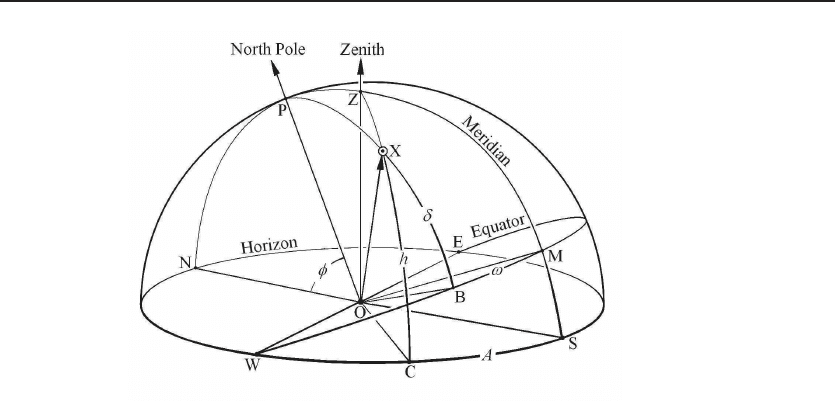
Figure 4.3 Celestial sphere and coordinate transformation. The horizon system defines
the position of a celestial body X as directly perceived by the observer. The angular distance of a
celestial body X to the horizon is its height h, also called altitude or elevation. The other coordinate
is azimuth A. The zero point of the azimuth is defined as the south point of the horizon. In the
equatorial coordinate system, the North Pole is the reference point. The celestial equator is the basic
plane. The distance of a celestial body to the equator is its declination δ. The other coordinate is
hour angle ω. The zero point of the hour angle is defined as the meridian; the half great circle passes
through the north celestial pole and the zenith. To convert the coordinates from the horizon system
to the equatorial system and vice versa, identities in spherical trigonometry are applied on a spherical
triangle formed by vertices Z (zenith), P (north celestial pole), and celestial body X.
system.
The extension of the center of Earth and an observer O into the sky is pointing to
the zenith Z (see Fig.4.2), and the plane perpendicular to that line or the corresponding
great circle is the horizon. The horizon divides the sphere into two hemispheres. The
upper hemisphere is visible to the observer, and the lower hemisphere is hidden under
the horizon. The angular distance of a celestial body above the horizon is its height h.
In the astronomy literature, the term altitude or elevation is also used. Obviously, the
height of the North Pole P equals the geographical latitude of the observer, φ.
To completely identify the position of a celestial body, X, we need another refer-
ence point. The great circle connecting the zenith with the North Pole is called the
meridian. It intersects the horizon at point S,thesouth point of the horizon.To
identify the position of a celestial body with respect to the south point, we draw a
great circle through the zenith and the star, which intersects the horizon at point C.
The angle
SC is defined as the azimuth A, or the horizontal direction of the celestial
body. Regarding the utilization of solar energy, we take the definition of azimuth to be
westward. Therefore, the azimuth of the Sun always increases over time.
The horizon system defines the position of a celestial body as directly perceived
by the observer. However, because Earth is round and rotating on its axis, those

i
i
“ChenSolarEnergy” — 2011/5/17 — 17:56 — page 80 — #107
i
i
i
i
i
i
80 Tracking Sunlight
Table 4.1: Notation in Positional Astronomy
Quantity Notation Definition
Latitude φ Geographical coordinate
Longitude λ Geographical coordinate
Height h Also called altitude or elevation
Azimuth A Horizontal direction or bearing
Declination δ Angular distance to the equator
Hour angle ω In radians, westward
Sunset hour angle ω
s
In radians, always positive
East-west hour angle ω
ew
In radians, always positive
Right ascension α Absolute celestial coordinate
Mean ecliptic longitude l On ecliptic plane
True ecliptic longitude θ On ecliptic plane
Eccentricity of orbit e Currently ≈ 0.0167
Obliquity of ecliptic ε Currently ≈ 23.44
◦
coordinates depend on the location of the observer and vary over time. In the equatorial
coordinate system, on the other hand, the position of the Sun is relatively independent
of the location of the observer. The coordinates of the Sun in the horizon system can
be obtained using a coordinate transformation from its coordinates in the horizontal
system.
In the equatorial system, the coordinate equivalent to the latitude of Earth is the
declination, δ, and the coordinate equivalent to the longitude of Earth for a fixed
observer is the hour angle, ω; see Fig. 4.3.
As shown, the declination is the angular distance of the celestial body to the celestial
equator. It is positive for the stars to the north of the celestial equator and negative
for the stars to the south of the celestial equator.
As we mentioned previously, the great circle connecting the zenith and the celestial
pole is the meridian, which is the reference point equivalent to the Greenwich meridian
in geography, which intersects the equator at point M . The great circle connecting
the celestial pole and the star is called the hour circle, which intersects the equator at
point B. The angle
MB is the hour angle ω, equivalent to longitude on Earth. The
convention is, if the celestial body is to the west of the meridian, the hour angle is
positive. This is natural and convenient for the position of the Sun, as its hour angle
defines the solar time.
Another coordinate frequently used in astronomy in place of the hour angle is the
right ascension α, which takes the vernal equinox as the reference point. We will
introduce it in a later section.
i
i
“ChenSolarEnergy” — 2011/5/17 — 17:56 — page 81 — #108
i
i
i
i
i
i
4.2 Celestial Sphere 81
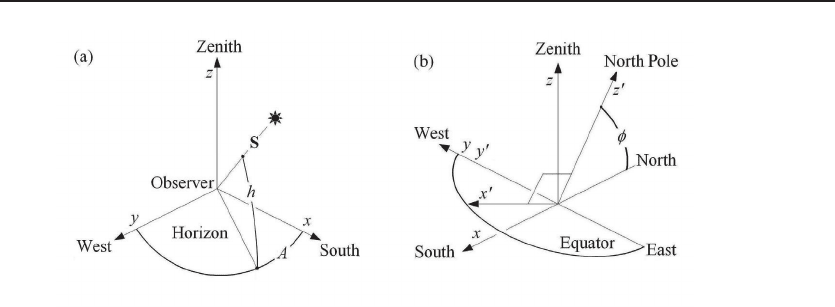
Figure 4.4 Coordinate transformation in Cartesian coordinates. (a) Cartesian coordinates
for the horizon system use the conventions that south is x,westisy, and the zenith is z. The position of
a celestial body is determined by two angles, height h and azimuth angle A. (b) Cartesian coordinates
for the equatorial system use the convention that z
-axis points to the North Pole, while the east-west
axis y
-axis is identical to that in the horizon system. The x
-axis is perpendicular to both. The
position of a celestial body is determined by declination δ and hour angle ω, see Fig. 4.3.
4.2.1 Coordinate Transformation: Cartesian Coordinates
The standard method of coordinate transformation in positional astronomy is using
spherical trigonometry, a brief summary of which is presented in-pdimensional Carte-
sian coordinates and spherical polar coordinates. Treating a two-dimensional problem
with three-dimensional methods is overkill. However, because most physicists and en-
gineers are familiar with such an approach, it may be easier to understand.
The Cartesian coordinates for the horizon system is shown in Fig. 4.4(a). Because
all celestial bodies move from east to west, the convention is, south is x, west is y,and
the zenith is z. A unit vector pointing to a celestial body is determined by two angles.
The polar angle is the height h. The azimuth angle A takes south as the zero point.
As shown in Fig. 4.4(a), using the three unit vectors i, j,andk pointing to x, y,and
z, respectively, a unit vector S pointing to the Sun is given as
S = i cos h cos A + j cos h sin A + k sin h. (4.1)
The Cartesian coordinates for the equatorial system and its relation to the horizon
system are shown in Fig. 4.4(b). The y
-axis is identical to that in the horizon system.
The z
-axis points to the North Pole, and the x
-axis is perpendicular to both. The
unit vectors in the equatorial system pointing to the x
, y
,andz
-axes are i
, j
,and
k
, respectively. Using declination δ and hour angle ω defined in Fig. 4.3, a unit vector
S pointing to the Sun in terms of i
, j
,andk
is given as
S = i
cos δ cos ω + j
cos δ sin ω + k
sin δ. (4.2)
From Fig. 4.4(b), the transformations between the two sets of unit vectors, i, j, k