
Chen C.J. Physics of Solar Energy
Подождите немного. Документ загружается.

i
i
“ChenSolarEnergy” — 2011/5/17 — 17:56 — page 62 — #89
i
i
i
i
i
i
62 Nature of Solar Radiation
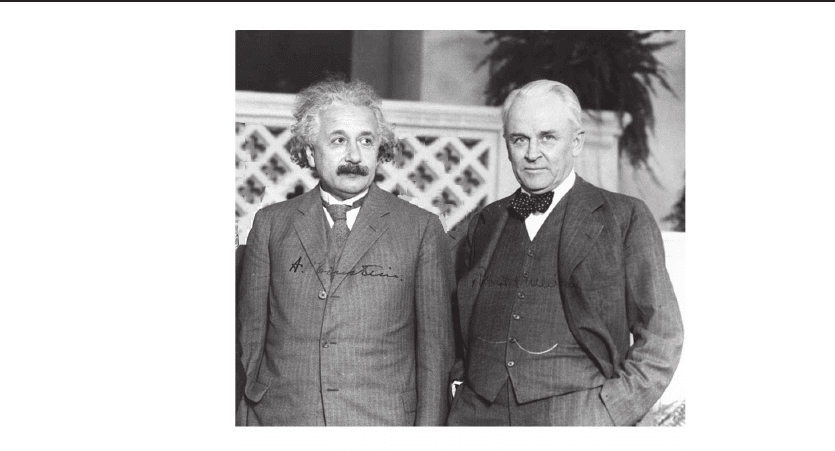
Figure 2.7 Albert Einstein and Robert Millikan. Both Einstein and Millikan won a Nobel Prize
for their contributions to the photoelectric effect. Photograph taken in 1930 when Robert Millikan
invited Albert Einstein to a conference in California. Original photograph courtesy of Smithsonian
Museum, slightly cleaned up by the author.
present as resting upon any sort of a satisfactory theoretical foundation [61].” In 1950,
at age 82, in his autobiography [62], Millikan reversed his position and admitted that
his experiments
proved simply and irrefutably, I thought, that the emitted electron that
escapes with the energy hν gets that energy by the direct transfer of hν
units of energy from the light to the electron, and hence scarcely permits of
any other interpretation than that which Einstein had originally suggested,
namely that of the semi-corpuscular or photon theory of light itself.
2.4.3 Wave–Particle Duality
The earlier objections to Einstein’s theory of photons was related to an even more
profound problem: the wave–particle duality of all particles. At the beginning of the
twentieth century, electrons were described by classical mechanics as being similar to
billiard balls. Einstein’s theory seemed to imply that photons are also like billiard balls
and that the photoelectric effect is a collision of the billiard balls with electrons. Such a
picture is not only hard to conceive but also in direct conflict with the well-established
interference phenomenon of light.
The paradox was resolved after Louis de Broglie extended Einstein’s postulate that
light can be both wave and particle to all particles, including the electron. According

i
i
“ChenSolarEnergy” — 2011/5/17 — 17:56 — page 63 — #90
i
i
i
i
i
i
2.5 Einstein’s Derivation of Blackbody Formula 63
to de Broglie, a particle with a momentum p should also be a plane wave with a
wavevector k such that
p = k, (2.114)
where = h/2π, Planck’s constant divided by 2π, is often called Dirac’s constant.
According to the theory of de Broglie, a better picture of the photoelectric effect is
that light radiation as a plane wave interacts with the electron in the electrode, which
is also a plane wave, but the energy transferred to the electron must be quantized to
satisfy the Einstein equation
= hν ≡ ω, (2.115)
where ω =2πν is the circular frequency of the light wave. This is an essential concept
regarding the understanding of solar cells and solar photochemistry, which we will
discuss in the corresponding chapters.
2.5 Einstein’s Derivation of Blackbody Formula
Based on the concept of photons and the interaction of photons with matter, Einstein
made a very simple derivation of the blackbody radiation formula. The key of his
derivation is the introduction of stimulated emission, which gave birth to the laser,
an acronym for light amplification by stimulated emission of radiation, and provides a
better understanding of the interaction between solar radiation and atomic systems.
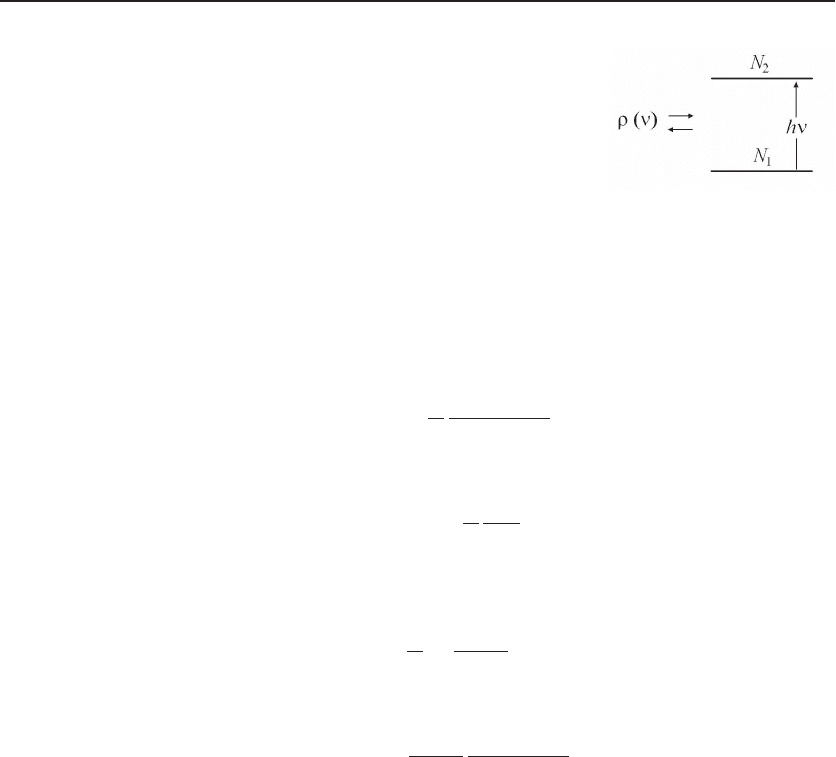
Einstein studied a simple two-state atomic system; see Fig. 2.8. The radiation
field is represented by an energy density ρ(ν), where ν is the frequency. The atomic
system has two states with an energy difference hν. According to Maxwell–Boltzmann
statistics, the ratio of the populations of the two states is
N
2
N
1
= e
−hν/k
B
T
. (2.116)
Einstein assumed three transition coefficients: the absorption coefficient B
12
,the
spontaneous emission coefficient A, and the stimulated emission coefficient B
21
.The
rate equations are
dN
2
dt
= B
12
N
1
ρ(ν) − B
21
N
2
ρ(ν) − AN
2
, (2.117)
dN
1
dt
= −B
12
N
1
ρ(ν)+B
21
N
2
ρ(ν)+AN
2
. (2.118)
At equilibrium, both dN
1
/dt and dN
2
/dt should vanish. Therefore,
N
2
N
1
=
B
12
ρ(ν)
A + B
21
ρ(ν)
= e
−hν/k
B
T
. (2.119)
The coefficients should not depend on temperature. At high temperature, the power
density should be high, and the right-hand side of Eq. 2.119 should approach unity.
i
i
“ChenSolarEnergy” — 2011/5/17 — 17:56 — page 64 — #91
i
i
i
i
i
i
64 Nature of Solar Radiation
Figure 2.8 Einstein’s derivation of blackbody
radiation formula. The radiation field ρ(ν) inter-
acts with a two-level atomic system. Three inter-
action modes are assumed: absorption, to lift the
atomic system from state 1 to state 2; spontaneous
emission and stimulated emission, the atomic system
decays from state 2 to state 1, giving out energy to
the radiation field.
Therefore, one must have
B
12
= B
21
= B. (2.120)
The absorption coefficient B
12
equals the stimulated emission coefficient B
21
,whichcan
be represented by a single coefficient B. Under any temperature, the power density
distribution of radiation is then
ρ(ν)=
A
B
1
e
hν/k
B
T
− 1
. (2.121)
For radiations of low photon energy, Eq. 2.121 reduces to
ρ(ν) →
A
B
k
B
T
hν
. (2.122)
It should be identical to the Rayleigh–Jeans formula. Comparing with Eq. 2.90, we
find the ratio of coefficients A and B,
A
B
=
8πhν
3
c
3
. (2.123)
Finally, Planck’s formula is recovered,
ρ(ν)=
8πhν
3
c
3
1
e
hν/k
B
T
− 1
. (2.124)

i
i
“ChenSolarEnergy” — 2011/5/17 — 17:56 — page 65 — #92
i
i
i
i
i
i
Problems
2.1. Show that the capacitance C of a parallel-plate capacitor with vacuum as the
dielectric is
C =
ε
0
A
d
[F], (2.125)
where A is the area and d is the distance between the electrodes.
2.2. Show that the capacitance C of a parallel-plate capacitor with a medium of relative
dielectric constant ε
r
is
C =
ε
0
ε
r
A
d
[F]. (2.126)
Calculate the capacitance of a capacitor with A =1m
2
and s = 1 mm for glass and
silicon.
2.3. Show that the inductance L of an inductor made of a long solenoid of N loops
with cross-sectional area A and length l is
L =
μ
0
N
2
A
l
[H]. (2.127)
2.4. Show that the speed of light v in a medium of relative dielectric constant ε
r
is
v =
c
√
ε
r
. (2.128)
Calculate the speed of light v in glass and silicon (the relative dielectric constants ε
r
for glass and silicon are 2.25 and 11.7, respectively).
2.5. The refractive index of window glass is n =1.50. How much light power is lost
when going through a sheet of glass at normal incidence? (Hint: there are two glass–air
interfaces.)
2.6. The radius of the Sun is R =6.96 ×10
8
m, and the distance between the Sun and
Earth is D =1.5 × 10
11
m. The solar constant is 1366 W/m
2
. Estimate the surface
temperature of the Sun. (Hint: use the Stefan–Boltzmann law.)
2.7. What is the magnitude of the electric field intensity of the sunlight just outside
the atmosphere of Earth?
2.8. What is the electric field intensity of the electron in a hydrogen atom at the
distance of one Bohr radius from the proton?
2.9. Derive the blackbody radiation spectral density per unit wavelength in unit of
micrometers.
2.10. Using the blackbody radiation formula per unit wavelength, derive the Wien
displacement law in micrometers.
Problems 65
i
i
“ChenSolarEnergy” — 2011/5/17 — 17:56 — page 66 — #93
i
i
i
i
i
i
66 Nature of Solar Radiation
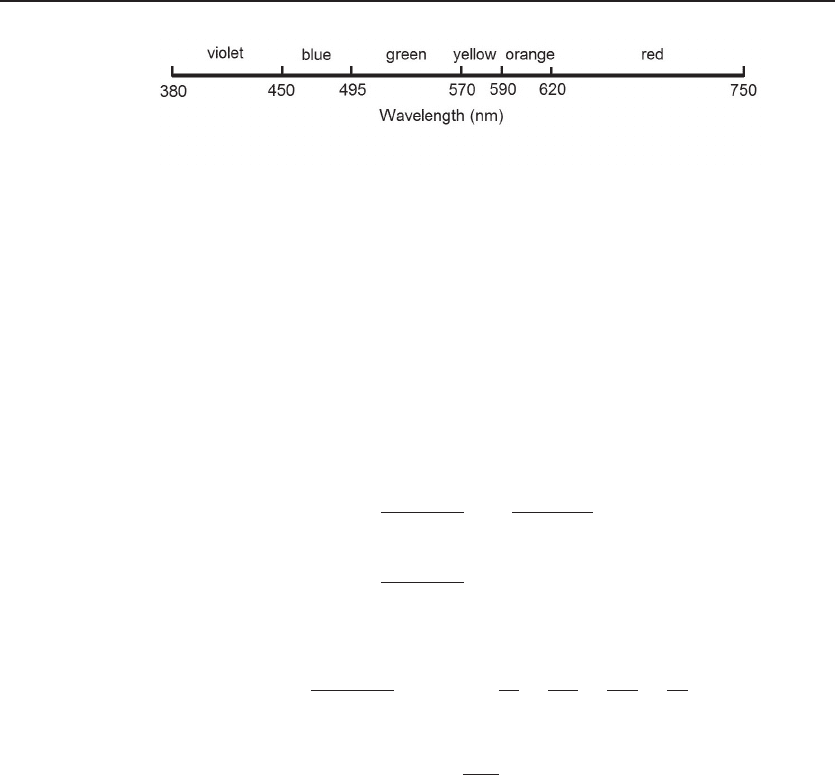
Figure 2.9 Wavelengths of visible lights.
2.11. The wavelengths of visible light with different colors in nanometers are shown
in Fig. 2.9. Compute the frequencies and energy values of the photons, in both joules
and electron volts.
2.12. What is the solar constant of Venus? Assume that the Sun is a blackbody emitter
at 5800 K and the mean Venus-Sun distance is 1.08 × 10
11
m.
2.13. To compute the blackbody irradiation for photon energy from
0
to infinity, an
easy-to-use formula can be obtained by introducing x
0
=
0
/k
B
T and expanding the
denominator of Eq. 2.99 into
U(T,
0
)=
2π(k
B
T )
4
c
2
h
3
∞
x
0
e
−x
x
3
dx
1 − e
−x
=
2π(k
B
T )
4
c
2
h
3
∞
n=1
∞
x
0
e
−nx
x
3
dx.
(2.129)
Prove that
U(T,
0
)=
2π(k
B
T )
4
c
2
h
3
∞
n=1
e
−nx
0
x
3
0
n
+
3x
2
0
n
2
+
6x
0
n
3
+
6
n
4
, (2.130)
with
x
0
=
0
k
B
T
. (2.131)
2.14. Assuming that the Sun is a blackbody emitter at 5800 K, what fraction of solar
radiation is green (wavelength between 495 and 570 nm)?
2.15. Assuming that the Sun is a blackbody emitter at 5800 K, what fraction of solar
radiation has photon energy greater than 1.1 eV?
i
i
“ChenSolarEnergy” — 2011/5/17 — 17:56 — page 67 — #94
i
i
i
i
i
i
Chapter 3
Origin of Solar Energy
Since the late-nineteenth century, measurement of solar radiation power density has
been diligently pursued. After the advancement of artificial satellites, solar radiation
data outside the atmosphere became available. From the data accumulated to date,
variation in the solar radiation power density at the average position of Earth outside
the atmosphere has not exceeded 0.1% over a century. Although not a physical constant,
this quantity, S, is often called the solar constant,
S = 1366 ± 3W/m
2
. (3.1)
The total radiation power of the Sun, L
,orthesolar luminosity, can be evaluated
using the solar constant and the average distance between the Sun and Earth, A
,the
astronomical unit of length,
A
=1.5 × 10
11
m, (3.2)
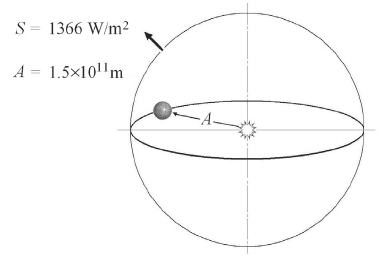
which gives (see Fig. 3.1)
L
=4πA
2
S =3.84 × 10
26
W. (3.3)
Figure 3.1 Luminosity of the Sun. The average radiation power density of sunlight outside the
atmosphere of Earth, the solar constant,isS = 1366 W/m
2
. The average distance between the Sun
and Earth, the astronomical constant,isA
=1.5 × 10
11
m. The luminosity of the Sun, or the total
power of solar radiation, is then L
=3.84 × 10
26
W.
67
Physics of Solar Energy C. Julian Chen
Copyright © 2011 John Wiley & Sons, Inc.

i
i
“ChenSolarEnergy” — 2011/5/17 — 17:56 — page 68 — #95
i
i
i
i
i
i
68 Origin of Solar Energy
The total power of solar radiation is about twenty trillion times the energy consumption
of the entire world, 1.6 ×10
13
W. For the purpose of utilizing solar poinof solar radiation
can one expect?
3.1 Basic Parameters of the Sun
For centuries, the Sun has been the subject of intense study by astronomers. The basic
parameters and the basic structure of the Sun are well understood [7, 63, 68, 79]. Here
is a brief summary.
3.1.1 Distance
The distance between the Sun and Earth has been measured using triangulation and
radar echoes. Because the orbit of Earth around the Sun is an ellipse, the distance is not
constant. Around January 3, at perihelion, the distance is at a minimum, 1.471 ×10
11
m. Around July 3, at aphelion, the distance is at a maximum, 1.521 × 10
11
m. The
average distance, A
=1.5 × 10
11
m (see Eq. 3.2) is treated as a basic parameter in
astronomy.
Besides the distance in meters, the average time for light to travel between the Sun
and Earth, the light time for the astronomical unit of distance τ
, has been determined
with high accuracy. For all practical applications in solar energy, the approximate
value, accurate to 0.2%, is worth memorizing:
τ
= 500 s. (3.4)
3.1.2 Mass
The mass of the Sun is measured using Kepler’s law and the orbital parameters of the
planets. Again, for all practical applications, an approximate value, accurate to 1%, is
worth memorizing:
m
=2× 10
30
kg. (3.5)
It is 333,000 times the mass of Earth. Due to radiation and solar wind, the Sun loses
10
17
kg of its mass per year, which is negligible. Practically, the mass of the Sun is a
constant over its lifetime.
3.1.3 Radius
The radius of the Sun is measured by the angular diameter of the visible disc. Because
the distance between the Sun and Earth is not constant, the angular diameter of the
Sun is not constant. It ranges from 31.6
to 32.7
.Theaveragevalueis32
, or 0.533
◦
.
Using the average distance A
, the radius of the Sun is then

i
i
“ChenSolarEnergy” — 2011/5/17 — 17:56 — page 69 — #96
i
i
i
i
i
i
3.1 Basic Parameters of the Sun 69
r
=
1.5 × 10
11
× 0.533
2 × 57.3
m
∼
=
6.96 × 10
8
m. (3.6)
Calculated from the radius, the volume of the Sun is 1.412×10
27
m
3
, and its average
density is 1.408 g/cm
3
.
3.1.4 Emission Power
The emission power of the surface of the Sun, in watts per square meter, can be
calculated from Eqs. 3.3 and 3.6:
U
=
L
4πr
2
=
3.84 × 10
26
4π (6.96 × 10
8
)
2
∼
=
63.1MW/m
2
. (3.7)
3.1.5 Surface Temperature
Considering the Sun as a blackbody, the temperature can be calculated from the Stefan–
Boltzmann law. Using Eqs. 3.7, 2.99, and 2.101,
T
=
U
σ
1/4
=
63.1 × 10
6
5.67 × 10
−8
1/4
∼
=
5800 K. (3.8)
In the literature, the surface temperature of the Sun varies from one source to another,
from 5600 to 6000 K. The difference is insignificant. Throughout this book, we will
use 5800 K as the nominal surface temperature of the Sun. Not only is this easy to
remember, but it is exactly equal to 0.5 eV, which is convenient for the treatment of
solar cells.
Table 3.1: Chemical Composition of the Sun
Element Z Molecular Abundance (% of Abundance
Weight Number of Atoms) (% of Mass)
Hydrogen 1 1.008 91.2 71.0
Helium 2 4.003 8.7 27.1
Oxygen 8 16.000 0.078 0.97
Carbon 6 12.011 0.043 0.40
Nitrogen 7 14.007 0.0088 0.096
Silicon 14 28.086 0.0045 0.099
Magnesium 12 24.312 0.0038 0.076
Neon 10 20.183 0.0035 0.058
Iron 26 55.847 0.0030 0.14
—emphSource: Ref. [79].
i
i
“ChenSolarEnergy” — 2011/5/17 — 17:56 — page 70 — #97
i
i
i
i
i
i
70 Origin of Solar Energy
3.1.6 Composition
The spectrum of solar radiation does not precisely match the spectrum of blackbody
radiation. The fine structure of the solar spectrum provides evidence of its chemical
composition (Table 3.1). Actually, the second most abundant element in the Sun,
helium, which was discovered from the spectrum of the solar radiation, comes from the
Greek word helios.
3.2 Kelvin–Helmholtz Time Scale
For centuries, the origin of sunlight has been a fundamental inquiry of all cultures. In
the middle of the nineteenth century, the field of thermodynamics matured. The first
law of thermodynamics states that energy can only change its form and can neither be
created nor be destroyed. The immense solar radiation is apparently draining enormous
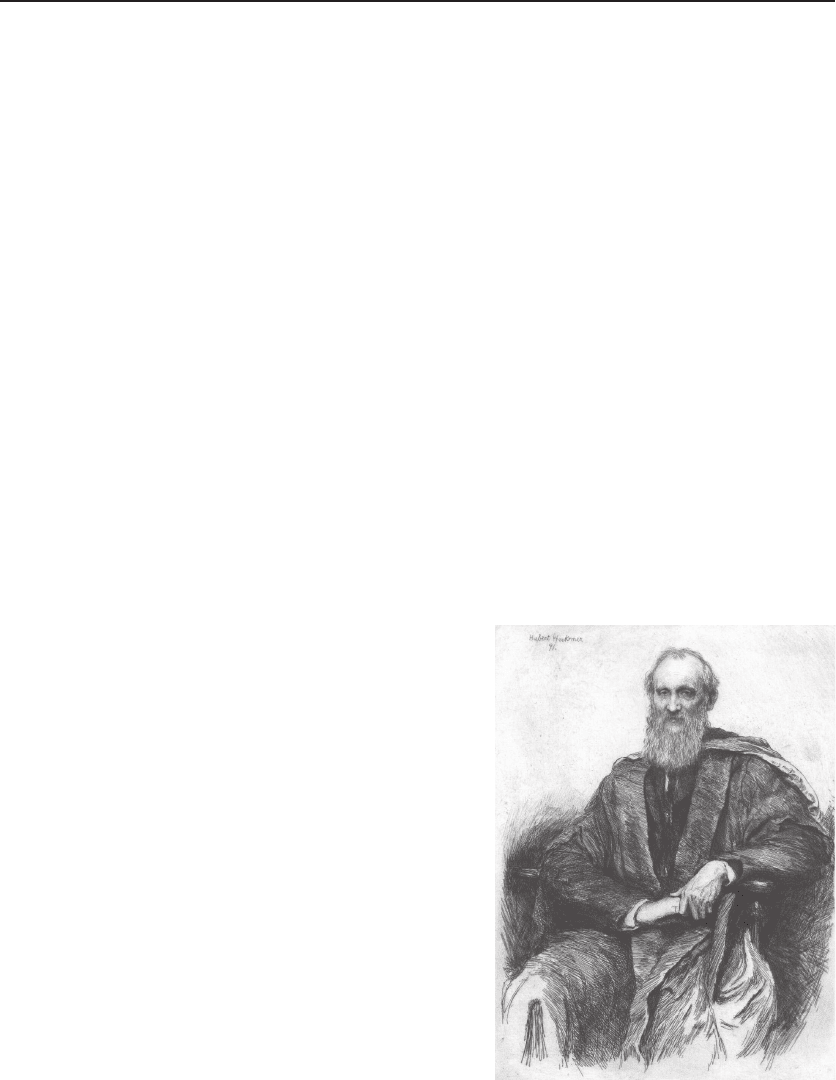
amounts of energy from the Sun. In the 1850s, Sir William Thomson (Fig. 3.2), one
of the founders of thermodynamics, made a thorough study on the origin of the Sun’s
energy based on the knowledge of physics at that time [81]. He argued that chemical
energy could not be the answer, because even if the Sun is made of coal and burns
completely, it can only supply a few thousand years of sunlight. The only explanation
based on the knowledge of that time was the gravitational contraction of the Sun, also
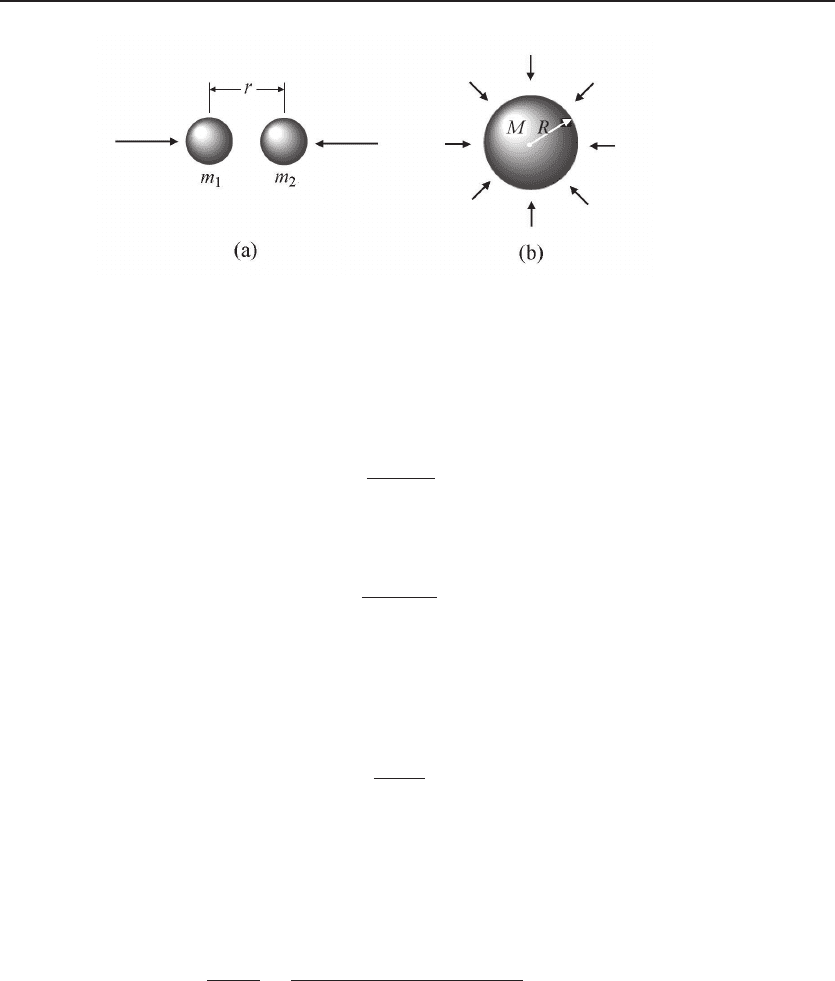
independently proposed by German physicist Hermann von Helmholtz; see Fig. 3.3(a).
When two meteorites with masses m
1
and m
2
approach from infinity to a distance r,
Figure 3.2 Sir William Thomson.
Irish-born Scottish physicist (1824-
1907), aka Lord Kelvin, one of the
founders of thermodynamics. He at-
tributed the origin of the Sun’s energy
to gravitational interaction, and as-
serted that the Sun could not shine for
more than 30 million years. He used
his theory to refuse Sir Charles Lyell’s
geology, and especially Charles Dar-
win’s evolutionary biology; both re-
quire that the lifetime of the Sun must
be at least one billion years. The dis-
crepancy was resolved by Albert Ein-
stein and Hans Bethe in the 20th cen-
tury. Artwork by Hubert Herkomer,
courtesy of Smithsonian Museum.
i
i
“ChenSolarEnergy” — 2011/5/17 — 17:56 — page 71 — #98
i
i
i
i
i
i
3.2 Kelvin–Helmholtz Time Scale 71
Figure 3.3 The Kelvin-Helmholtz model. A model of the origin of solar energy based on
gravitational contraction. (a) When two meteorites approach each other from faraway, the gravitational
potential energy is reduced and the kinetic energy is increased. (b) If the Sun is formed by coalition of
a large number of meteorites, the gravitational energy can be converted into kinetic energy, and then
radiated as heat.
the potential energy is decreased by
U = −
Gm
1
m
2
r
, (3.9)
where G =6.67 × 10
−11
N · m
2
/kg
2
is the gravitational constant. Because of gravita-
tional attraction, the system gains a kinetic energy
E
K
=
Gm
1
m
2
r
. (3.10)
Assuming that the Sun is formed by the coalescence of large number of meteorites
into a sphere of radius r
, as shown in Fig. 3.3(b), kinetic energy can be gained by
gravitational attraction. The value of the energy gain depends on the distribution of
the mass. By analogy to Eq. 3.10, we can make a good order-of-magnitude estimate
of the energy gain,
E
K
∼
=
GM
2
r
. (3.11)
Obviously it is an overestimate. For example, by calculating the energy gain with a
uniform mass distribution, a numerical factor of 0.6 appears. However, Eq. 3.11 gives
an upper limit. Based on the Kelvin–Helmholtz assumption, the lifetime of the Sun
can be estimated by dividing that energy gain by the rate of energy loss, or the solar
luminosity L
:
τ
KH
∼
=
GM
2
r
L
=
6.67 × 10
−11
×
2 × 10
30
2
6.96 × 10
8
× 3.84 ×10
26
≈ 10
15
s. (3.12)
The quantity τ
KH
, about 30 million years, is called the Kelvin–Helmholtz time scale.
Based on this calculation, Lord Kelvin asserted that the Sun’s life span must not exceed
30 million years [81].