
Chen C.J. Physics of Solar Energy
Подождите немного. Документ загружается.

i
i
“ChenSolarEnergy” — 2011/5/17 — 17:56 — page 203 — #230
i
i
i
i
i
i
9.5 Crystalline Silicon Solar Cells 203
recombination rate is reduced by suppressing minority-carrier concentration in these
regions. The doping process uses BBr
3
as the source dopant. The contact resistance
is also markedly reduced. On the front side, heavy phosphorous doping is made using
liquid PBr
3
as the dopant carrier. The width of the front metal contact is reduced to
expand the
Textured Front Surface
The front surface is textured to become a two-dimensional array of inverted pyramids.
The photons entering the substrate can be trapped by the textured top surface.
Double-Layer Antireflection Coating
As presented in Section 9.4, DLAR coatings can significantly improve overall efficiency.
A ZnS and MgF
2
DLAR coating is evaporated onto the cells.
9.5.3 Module Fabrication
Single silicon solar cells are fragile and vulnerable to the elements. In all applications,
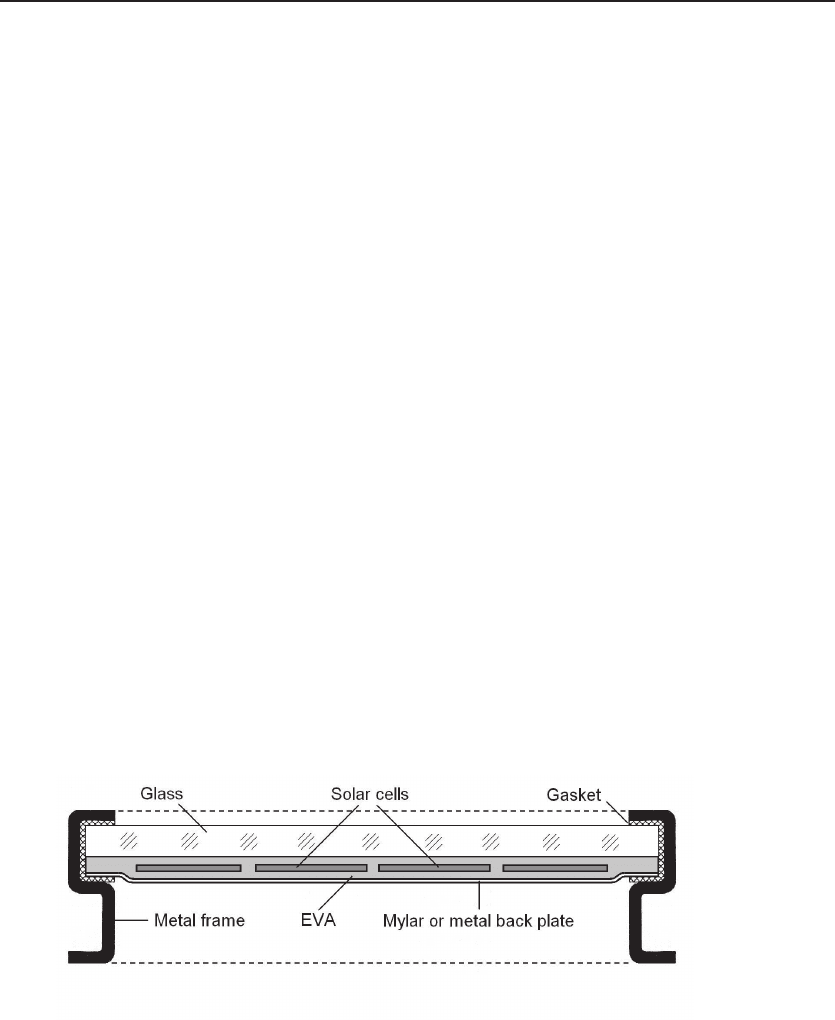
silicon solar cells are framed and protected to become solar modules. Figure 9.18 shows
a cross section of a typical solar module. To manufacture such a module, a piece of
low-iron window glass, two sheets of ethylene vinyl acetate (EVA) film (with typical
thickness of 0.5 mm), a rectangular array of solar cells, and a back plate, either a
Mylar film or a sheet of metal, are stacked together in a heated press machine. The
EVA is softened at about 150
◦
C, then tightly bonded with the solar cells and other
components. Finally, the glass module is framed by a metal structure with a protection
gasket.
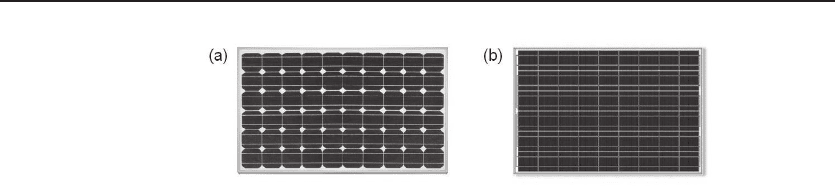
The monocrystalline solar module and polycrystalline solar module can be identified
by the look. Figure 9.19 shows the two types of solar nodules. Figure 9.19(a) is a
monocrystalline solar module. The solar cells are cut from a cylindrical single crystal
Figure 9.18 Cross section of typical solar module. A complete solar module is made of a piece
of low-iron window glass, two sheets of EVA film, an array of solar cells, and a back plate. Those
components are bonded together in a heated press.
i
i
“ChenSolarEnergy” — 2011/5/17 — 17:56 — page 204 — #231
i
i
i
i
i
i
204 Semiconductor Solar Cells
Figure 9.19 Monocrystalline solar module and polycrystalline solar module. (a) The
monocrystalline solar cells are cut from a cylindrical single crystal. To save material and space, the
solar cells are cut to an octagonal piece. There is always some wasted space because of the cut corners.
(b) The polycrystalline solar cells are cut from a rectangular ingot. The solar cells are usually perfect
squares. There is no wasted space.
to become an octagonal piece. Figure 9.19(b) is a module made of polycrystalline solar
cells which are cut from a rectangular ingot.
9.6 Thin-Film Solar Cells
Silicon as a solar cell material has many advantages. However, it also has a disadvan-
tage. As shown in Section 9.1, silicon is an indirect semiconductor. The absorption
coefficient near its band edge is low. Therefore, a fairly thick substrate is required. The
wafer is cut from a single crystal or an polycrystal ingot. The minimum thickness to
maintain reasonable absorption and mechanical strength is 0.1 – 0.2 mm. The cost of
the material and mechanical processing is substantial. The direct semiconductors often
have an absorption coefficient one or two orders of magnitude higher than silicon; see
Fig. 9.3. For those materials, a thickness of a few micrometers is sufficient. In addition
to a high absorption coefficient near the band gap which is close to 1 eV, there are many
other factors which determine the practicality of making a solar cell. To date, besides
silicon, only two such materials have reached the status of mass production, namely,
cadmium telluride (CdTe) and copper indium–gallium diselenade, Cu(InGe)Se
2
,of-
ten called CIGS. However, the material cost for these is still high. Amorphous-silicon
thin-film solar cells, in spite of their relatively low efficiency, are mass produced for
applications where a low efficiency is tolerable; see Table 1.6.
9.6.1 CdTe Solar Cells
Due to its high absorption coefficient and ease in making a p–type material, cadmium
telluride (CdTe) is currently the most popular material for thin-film solar cells [16, 19,
69]. Another advantage is its compatibility with CdS, a wide-band-gap semiconductor
for which it is easy to generate an n–type film. Because the absorption edge of CdS is
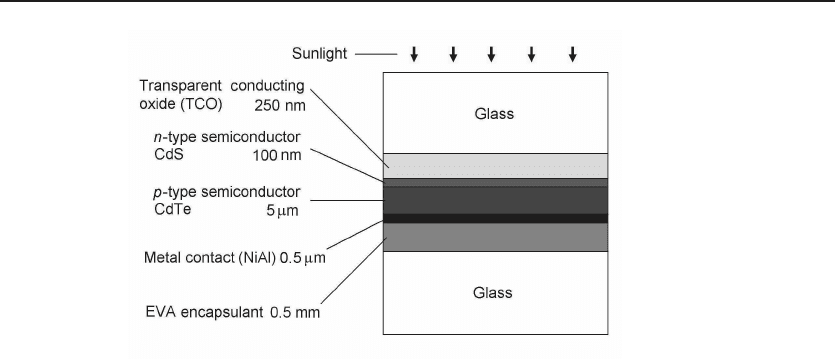
2.4 eV, it is transparent to the bulk of solar radiation. The typical structure of a CdTe
solar cell is shown in Fig. 9.20. As shown, the solar cell is sandwiched between two
sheets of window glass. The solar cell is made of a 5-μm film of CdTe, covered with a
100-nm CdS thin film, to form a pn-junction. To the sunny side is a film of TCO, to
i
i
“ChenSolarEnergy” — 2011/5/17 — 17:56 — page 205 — #232
i
i
i
i
i
i
9.6 Thin-Film Solar Cells 205
Figure 9.20 Typical structure of CdTe thin film solar cell. The pn-junction made of CdTe
and CdS is sandwiched between two glass plates. See Refs. [16], [19], and [69].
allow radiation to come in and serves as a conductor. To the back side is a metal film
for electric contact. A 0.5-mm EVA film is added for mechanical protection. The best
efficiency of CdTe solar cells is 16.5%, and expected to reach 20%.
One question often asked is about the toxicity of cadmium. According to a recent
study, because the quantity of cadmium is very small and is completely sealed by glass,
the environment impact is negligible.
The largest manufacturer of CdTe solar cells is First Solar, with headquarters in
Tempa, Arizona. For several years since 2002, First Solar was the largest manufacturer
of solar cells in the world. Only in late 2011 it was dethorned by Suntech. In September
2009, First Solar signed a contract with China to built a 2 GW solar field in Ordos,
Inner Mongolia. It is by far the largest solar field under development to date.
9.6.2 CIGS Solar Cells
The CuInSe
2
/CdS system was discovered in 1974 as a photovoltaic light detector [87].
In 1975, a solar cell was built with this materials which showed an efficiency comparable
to the silicon solar cells at that time [76]. In 2000s, the efficiency of CIGS thin-film solar
cells has reached 19.9%, comparable to polycrystalline silicon solar cells [19, 69, 78], see
Plate 5. As shown in Fig. 9.3, the band gap of CuInSe
2
is very close to the optimum
value, but its absorption coefficient is about 100 times greater than silicon. Therefore,
even if the semiconductor film were as thin as 2 μm, more than 90% of the near-infrared
and visible light would be absorbed.
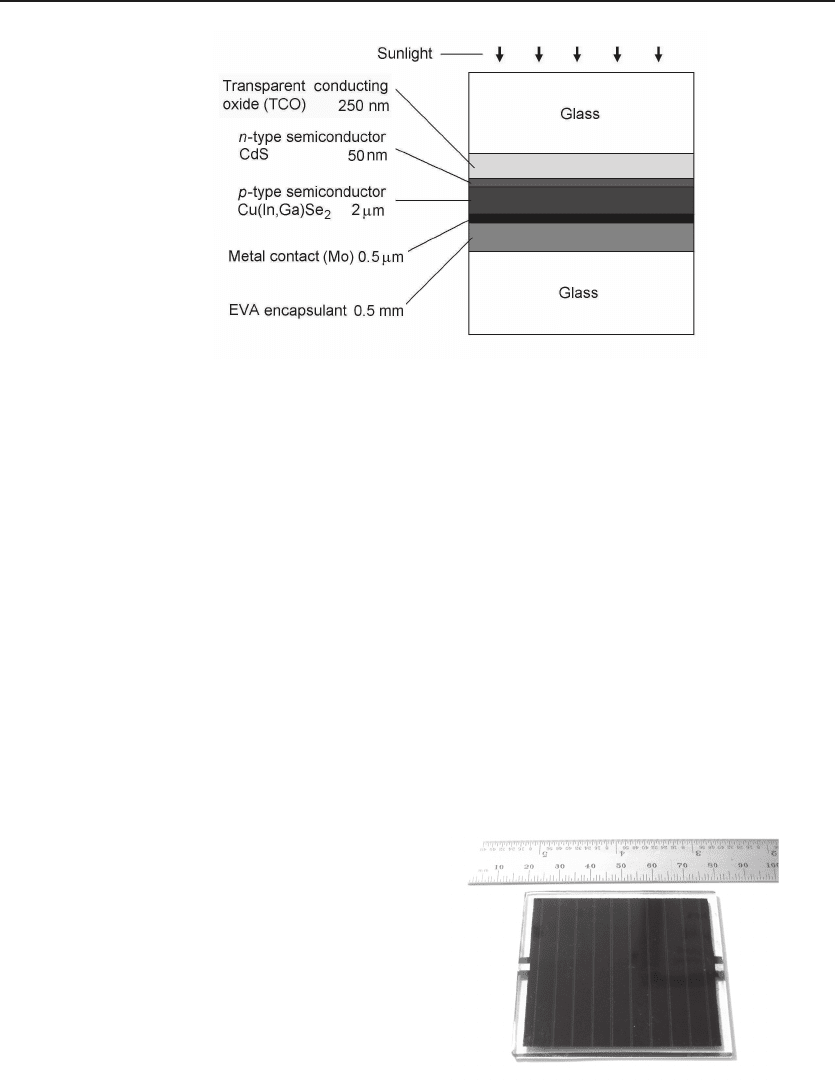
The typical structure of a CIGS solar cell is shown in Fig. 9.21. Similar to the CdTe
solar cells, a 50-nm n-type CdS film is used to form a pn-junction. Again, because the
quantity of cadmium used here is very small, and sandwiched between two glass plates,
the environment impact is negligible.
The CIGS solar cell can be produced with a wet process, without requiring a vac-
i
i
“ChenSolarEnergy” — 2011/5/17 — 17:56 — page 206 — #233
i
i
i
i
i
i
206 Semiconductor Solar Cells
Figure 9.21 Typical structure of CIGS thin-film solar cell. A pn-junction of Cu(InGa)Se
2
and CdS is sandwiched between two glass plates. See Refs. [19], [69], [76], [78], and [87].
uum. Therefore, the manufacturing cost can be low. Another advantage of CIGS solar
cells is that interconnections can be made on the same structure, similar to an inte-
grated circuit, thus a higher voltage single cell, for example 12 V, can be made without
requiring external connections. Figure 9.22 is an experimental 5-V CIGS solar cell,
made from 10 individual CIGS solar cells in a single glass envelop. The boundaries
between adjacent solar calls are apparent.
9.6.3 Amorphous Silicon Thin-Film Solar Cells
Because the cost of some key materials in CdTe and CIGS thin-film solar cells, notably
tellurium and indium, is high, silicon thin-film solar cells, in spite of their low efficiency,
have been mass produced for many years. For applications where efficiency is not
crucial, such as hand-held calculators and utility-scale solar fields in deserts, silicon
thin-film solar cells provide an advantage. Especially, silicon thin-film solar cells can
Figure 9.22 CIGS solar cell in-
tegrated circuit. An experimental
solar cell made of 10 individual CIGS
cells. The nominal voltage of each
CIGS solar cell is 0.5 V. By connect-
ing 10 individual CIGS solar cells in
series internally, a 5-V solar cell is
built. Because the connections are in-
tegrated, the device is compact and
rugged. Photo taken by the author.
i
i
“ChenSolarEnergy” — 2011/5/17 — 17:56 — page 207 — #234
i
i
i
i
i
i
be manufactured on flexible substrates.
A major disadvantage of silicon is its low absorption coefficient. However, by sub-
stantially doping amorphous silicon with hydrogen, up to 10%, its absorption coefficient
canbemadeashighas10
5
cm
−1
, with the band gap shifted from 1.1 eV to 1.75 eV,
similar to that of CdTe. In the literature, this material is often abbreviated as a-Si:H
[19]. Because of high defect density, the recombination rate in high. The efficiency of
the best experimental a-Si:H solar cells is around 10%, and for the mass-produced solar
cells, it is around 5%.
9.7 Tandem Solar Cells
As discussed in Section 9.2.1, over the entire solar spectrum, the highest efficiency comes
from photons with energy just above the band gap of the semiconductor material. For
photons with energy lower than the band gap, the semiconductor is transparent. There
is no energy conversion. For photons with energy much higher than the band gap, the
energy of the electron–hole pair quickly relaxes to that of the energy gap. The excess
photon energy over the band gap is lost. Therefore, by stacking two or more solar cells
in tandem, the efficiency can be much higher than the Shockley–Queisser limit.
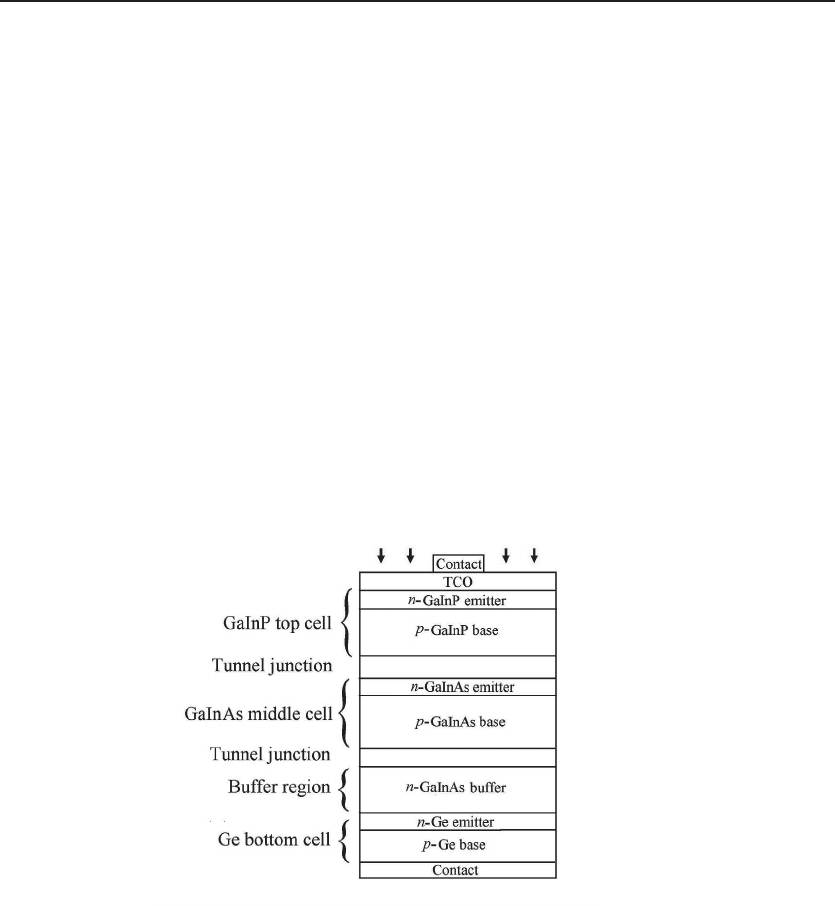
Figure 9.23 Multijunction tandem solar cell. Through the TCO layer, the sunlight falls on the
top cell first. The semiconductor material of the top cell has a large band gap, in this case GaInP, 1.9
eV. It is transparent to photons of energy smaller than 1.9 eV. Photons with energy greater than 1.9
eV will generate an electron–hole pair with energy about 1.9 eV. The middle cell, made of GaInAs,
has band gap 1.35 eV. Photos with energy between 1.35 and 1.9 eV will generate an electron–hole
pair of about 1.35 eV. The bottom cell is made of Ge, with a band gap of 0.67 eV. For photons
with energy greater than 0.67 eV and smaller than 1.35 eV, an electron–hole pair of about 0.67 eV is
generated. The voltage is additive, and thus it can generate much more power than the single cells,
often exceeding the Shockley–Queisser limit.
9.7 Tandem Solar Cells 207
i
i
“ChenSolarEnergy” — 2011/5/17 — 17:56 — page 208 — #235
i
i
i
i
i
i
208 Semiconductor Solar Cells
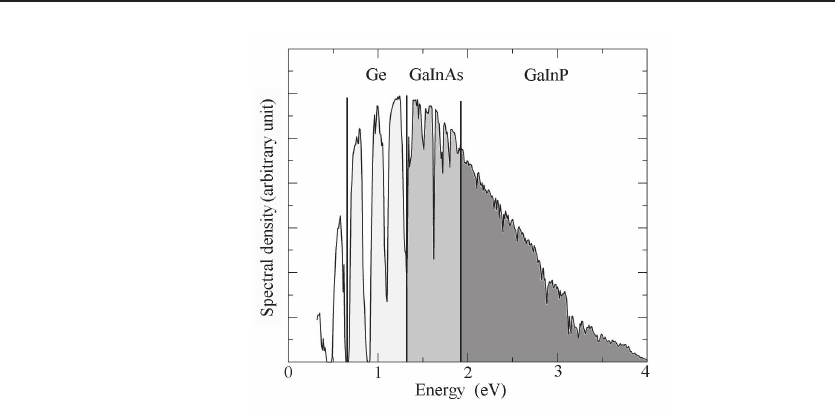
Figure 9.24 Working principle of multijunction tandem solar cells. The solar spectrum is
divided into three sections. Each section generates a voltage. The tandem cell can be considered as a
solar battery made of three cells. The voltage is additive, and thus it could generate much more power
than the single cells, often exceeding the Shockley–Queisser limit.
Figure 9.23 shows the schematic of a three-junction tandem cell. The top cell is
made of GaInP, with a band gap of 1.9 eV. The photons with energy greater than
1.9 eV will generate an electron–hole pair with energy about 1.9 eV. For photons with
energy smaller than 1.9 eV, that GaInP layer is transparent. The middle cell, made
of GaInAs, with a band gap of 1.35 eV, would absorb photons with energy between
1.35 and 1.9 eV, and generate an electron–hole pair of about 1.35 eV. The GaInAs film
is transparent to photons with energy smaller than 1.35 eV. Those photons then go
to a layer of Ge, with a band gap of 0.67 eV. For photons with energy greater than
0.67 eV and smaller than 1.35 eV, an electron–hole pair is generated in the bottom
cell. The current should be continuous, but the voltage is additive. Therefore, for solar
radiation with a rich spectrum, the tandem cell can generate much more power than
the single cells, thus often exceeding the Shockley–Queisser limit. Recently, a group at
Spectrolab has demonstrated a tandem solar cell of efficiency exceeding 40%. See [43].
Much of the material used in tandem cells is expensive. The major application of
tandem solar cells is with concentrated solar radiation. By concentrating solar radiation
100 folds or more, the area of the solar cell is less than 1% without concentration.
Economically it can be even better than crystaline silicon solar cells.

i
i
“ChenSolarEnergy” — 2011/5/17 — 17:56 — page 209 — #236
i
i
i
i
i
i
Problems
9.1. The ultimate efficiency of Shockley and Queisser can be easily computed by ex-
panding the denominator of Eq. 9.25,
η
u
(x
s
)=
15
π
4
x
s
∞
x
s
x
2
dx
e
x
− 1
=
15
π
4
x
s
∞
n=1
∞
x
s
e
−nx
x
2
dx.
(9.91)
Prove that
η
u
(x
s
)=
15
π
4
x
s
∞
n=1
e
−nx
s
x
2
s
n
+
2x
s
n
2
+
2
n
3
. (9.92)
9.2. If the temperature of the solar cell can be maintained at room temperature, what
is the effect of concentration of the sunlight by 100 times on the efficiency of solar cells?
For blackbody radiation, work out the enhancement for a silicon solar cell.
Hint: Instead of using the usual geometric factor f =2.15 × 10
−5
, using a larger
number, for example, 100f in Eq. 9.45.
9.3. The absorption coefficients of some frequently used solar cell materials at the
center of the visible-light spectrum are listed in Table 9.1. To achieve a total absorption
of 95%, what is the required thickness?
9.4. A typical solar cell is made from a 10-cm × 10-cm piece of single-crystal silicon.
Reverse saturation current I
0
is 3.7×10
−11
A/cm
2
.ForV =0, 0.05, 0.1, ... , 0.55, 0.6V,
calculate the forward current for the solar cell at room temperature.
9.5. For a typical silicon solar cell, the acceptor concentration in the p-region is N
A
=
1 × 10
16
/cm
3
, and the donor concentration in the n-region is N
D
=1× 10
19
/cm
3
.
Assuming that the built-in potential is 0.5 V, calculate the pn-junction capacitance of
the 10-cm × 10-cm solar cell. (The permittivity of free space is ε
0
=8.85×10
−14
F/cm,
and the relative permittivity of silicon is ε
r
= 11.8.)
Hint: the donor concentration is too high, thus the thickness of the n-type region
is negligible. Only the acceptor concentration is needed for calculation. The dielectric
constant (permittivity) of silicon is the product of the permittivity of free space and
the relative permittivity of silicon.
9.6. For an interface of air and glass with refractive index n, show that the transmit-
tance of each interface is
τ =
4n
(1 + n)
2
. (9.93)
Verify the validity of the relation by showing that if n=1, τ =1.
Problems 209

i
i
“ChenSolarEnergy” — 2011/5/17 — 17:56 — page 210 — #237
i
i
i
i
i
i
210 Semiconductor Solar Cells
9.7. If a solar device is covered with N sheets of glass with refractive index n,show
that the transmittance of the entire cover is
τ =
(4n)
2N
(1 + n)
4N
. (9.94)
9.8. A solar cell of 100 square centimeter area has a reversed-bias dark current of
2 × 10
−9
A, and a short-circuit current at one sun (1 kW/m
2
) of 3.5 A. At room
temperature, what is the open-circuit voltage? What is the optimum load resistance
(V
mp
/I
mp
)? What is the maximum power output?
9.9. A typical silicon solar cell has the following parameters:
Band gap of silicon is 1.1 eV.
The p-type material has an acceptor concentration N
A
=1× 10
16
cm
3
, with hole
diffusion coefficient D
p
=40cm
2
/s and lifetime τ
p
=5μs.
The n-type material has a donor concentration N
D
=10
19
cm
3
, with electron diffusion
coefficient D
n
=40cm
2
/s and lifetime τ
n
=1μs.
The intrinsic carrier concentration in silicon is n
i
=1.5 × 10
10
cm
3
.
For a 1-cm × 1-cm solar cell, calculate the following:
1. Reverse saturation current I
0
2. Short-circuit current under one sun solar radiation
3. Open-circuit voltage at room temperature
i
i
“ChenSolarEnergy” — 2011/5/17 — 17:56 — page 211 — #238
i
i
i
i
i
i
Chapter 10
Solar Electrochemistry
In the previous chapter, we discussed semiconductor solar cells, where photons from
the Sun generate electron–hole pairs, and then the energy in the electron–hole pair is
converted into electric energy. Solar photochemistry follows a different route: photons
from the Sun causes a molecule to go from its ground state to an excited state. The
energy stored in the excited molecule can be converted into either electrical energy, or
permanent chemical energy. The most important example of solar photochemistry is
photosynthesis, the conversion of solar energy into chemical energy stored in organic
material, such as glucose.
10.1 Physics of Photosynthesis
To date, most of the energy human society uses originates from photosynthesis. The
energy stored in food and traditional fuels, such as firewood, hey, and vegetable and
animal oil, comes directly or indirectly from photosynthesis. Fossil fuel is the remains of
ancient organisms, that is, stored product of photosynthesis. As the energy source of all
life on Earth, photosynthesis is a natural process that has evolved in the last one billion
years through natural selection. The study of photosynthesis will inspire us to create
high-efficiency systems to harvest solar energy. For more details on photosynthesis, see
Blankenship [11] and Voet [86].
Photosynthesis is arguably the most important chemical reaction on Earth. As
evidence, nine Nobel Prizes in Chemistry have awarded for research of photosynthesis:
1915: Richard Martin Wilstaetter, for chlorophyll purification and struc-
ture, carotenoids, anthocyanins.
1930: Hans Fischer, for haemin synthesis, chlorophyll chemistry.
1937: Paul Karrer, for carotenoid structure, flavins, vitamin B
2
.
1938: Richard Kuhn, for carotenoids, vitamins.
1961: Melvin Calvin, for carbon dioxide assimilation.
1965: Robert Burns Woodward, for total synthesis of vitamin B
12
, chloro-
phyll, and other natural products.
211
Physics of Solar Energy C. Julian Chen
Copyright © 2011 John Wiley & Sons, Inc.
i
i
“ChenSolarEnergy” — 2011/5/17 — 17:56 — page 212 — #239
i
i
i
i
i
i
212 Solar Electrochemistry
1978: Peter Mitchell, for oxidative and photosynthetic phosphorylation,
chemiosmotic theory.
1988: Hartmut Michel, Robert Huber, and Johannes Deisenhofer, for X-ray
structure of the bacterial photosynthetic reaction center.
1992: Rudolph Marcus, for electron transfer theory and application to the
primary photosynthetic charge separation.
1997: Paul D. Boyer and John E. Walker, for elucidation of enzymatic
mechanism underlying the synthesis of adenosine triphosphate (ATP).
A typical chemical equation for photosynthesis is the generation of glucose or fruc-
tose, C
6
H
12
O
6
, from carbon dioxide, water, and energy from solar radiation:
6CO
2
+6H
2
O+29.79 eV −→ C
6
H
12
O
6
+6O
2
. (10.1)
To understand the elementary process, reaction 10.1 is often written as
CO
2
+H
2
O+4.965 eV −→
1
6
(glucose) + O
2
. (10.2)
Because the typical energy of a photon from sunlight is 1–3 eV, the above process is
inevitably a multiphoton process.
10.1.1 Chlorophyll
Although there have been many different types of photosynthetic processes, only very
few survived the natural selection process to support life on Earth. Photosynthesis
relies on chlorophyll, the green pigment on plants. The word chlorophyll is derived
from two Greek words, cholos (“green”) and phyllon (“leaf”).
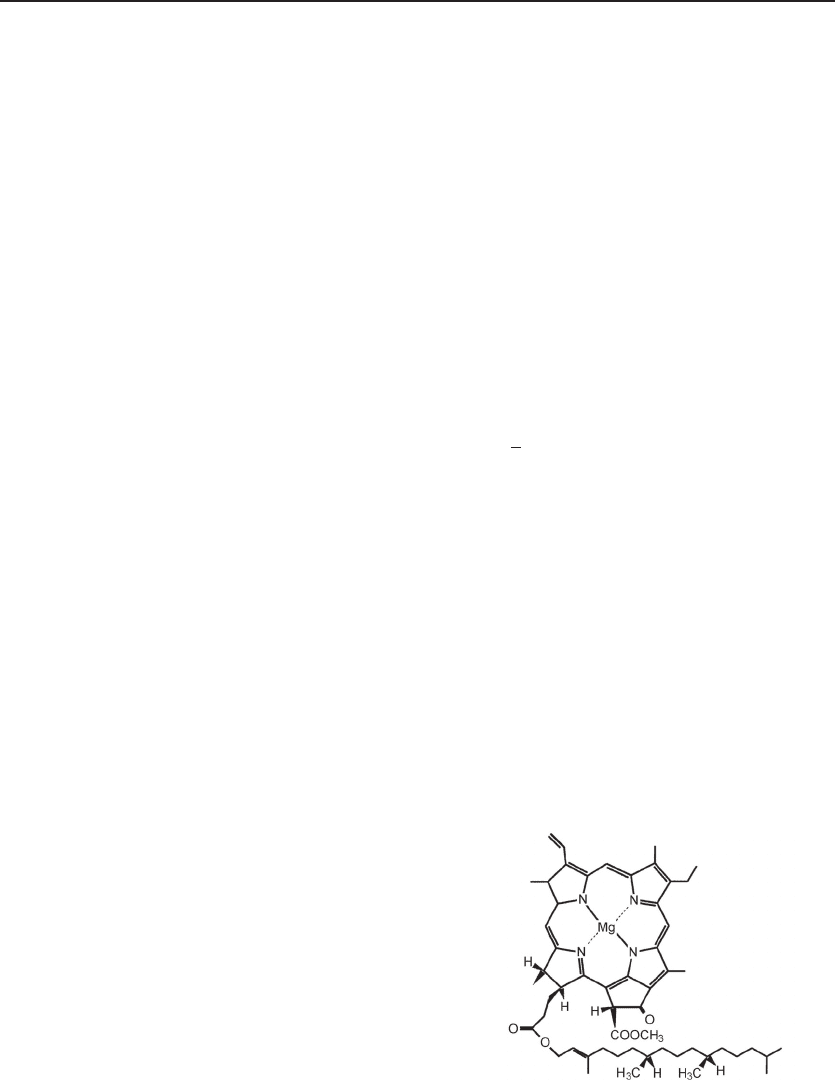
The most common chlorophyll in plants and algae is chlorophyll a.Thechemical
structure is shown in Fig. 10.1. It is a squarish planar molecule about 1 nm on each
side. A Mg atom at the center of the molecule is coordinated with four nitrogen atoms.
Each nitrogen atom is part of a pyrrole ring. At the external sites groups such as CH
3
Figure 10.1 Chlorophyll. Chem-
ical structure of the most common
chlorophyll, chlorophyll a.Atthe
center of the squarish molecule is a
Mg atom. Each nitrogen atom is part
of a pyrrole ring. A long hydrocar-
bon tail is attached through an oxy-
gen site. At the external sites, differ-
ent groups are bonded.