
Devore J.L., Berk K.N. Modern Mathematical Statistics with Applications
Подождите немного. Документ загружается.

Example 6.7 Th e time that it takes a randomly selected rat of a certain subspecies to find its way
through a maze is a normally distributed rv with m ¼ 1.5 min and s ¼ .35 min.
Suppose five rats are selected. Let X
1
, ..., X
5
denote their times in the maze.
Assuming the X
i
’s to be a random sample from this normal distribution, what is the
probability that the total time T
o
¼ X
1
þ ···þ X
5
for the five is between 6 and
8 min? By the proposition, T
o
has a normal distribution with m
T
0
¼ nm ¼
5ð1:5Þ¼7:5 and variance s
2
T
0
¼ ns
2
¼ 5ð:1225Þ¼:6125, so s
T
0
¼ :783. To stan-
dardize T
o
, subtract m
T
0
and divide by s
T
0
:
Pð6 T
0
8Þ¼P
6 7:5
:783
Z
8 7:5
:783
¼ P 1:92 Z :64ðÞ
¼ Fð:64ÞFð1:92Þ¼:7115
Determination of the probability that the sample average time
X (a normally
distributed variable) is at most 2.0 min requires m
X
¼ m ¼ 1:5 and s
X
¼ s=
ffiffiffi
n
p
¼
:35=
ffiffiffi
5
p
¼ :1565. Then
Pð
X 2:0Þ¼PZ
2:0 1:5
:1565
¼ PZ 3:19ðÞ¼Fð3:19Þ¼:9993
■
The Central Limit Theorem
When the X
i
’s are normally distributed, so is X for every sample size n. The
simulation experiment of Example 6.5 suggests that even when the population
distribution is highly nonnormal, averaging produces a distribution more bell-
shaped than the one being sampled. A reasonable conjecture is that if n is large, a
suitable normal curve will approximate the actual distribution of
X. The formal
statement of this result is the most important theorem of probability.
THEOREM
The Central Limit Theorem (CLT)
Let X
1
, X
2
, ..., X
n
be a random sample from a distribution with mean m and
variance s
2
. Then, in the limit as n !1, the standardized versions of X and
T
0
have the standard normal distribution. That is,
lim
n!1
P
X m
s=
ffiffiffi
n
p
z
¼ PðZ zÞ¼FðzÞ
and
lim
n!1
P
T
0
nm
ffiffiffi
n
p
s
z
¼ PðZ zÞ¼FðzÞ
where Z is a standard normal rv. As an alternative to saying that the standardized
versions of
X and T
0
have limiting standard normal distributions, it is customary
to say that
X and T
0
are asymptotically normal. Thus when n is sufficiently
large,
X has approximately a normal distribution with mean m
X
¼ m and
variance s
2
X
¼ s
2
=n. Equivalently, for large n the sum T
0
has approximately a
normal distribution with mean m
T
0
¼ nm and variance s
2
T
0
¼ ns
2
.
298 CHAPTER 6 Statistics and Sampling Distributions
A partial proof of the CLT appears in the appendix to this chapter. It is shown
that, if the moment generating function exists, then the mgf of the standardized
X
(and T
0
) approaches the standard normal mgf. With the aid of an advanced
probability theorem, this implies the CLT statement about convergence of prob-
abilities.
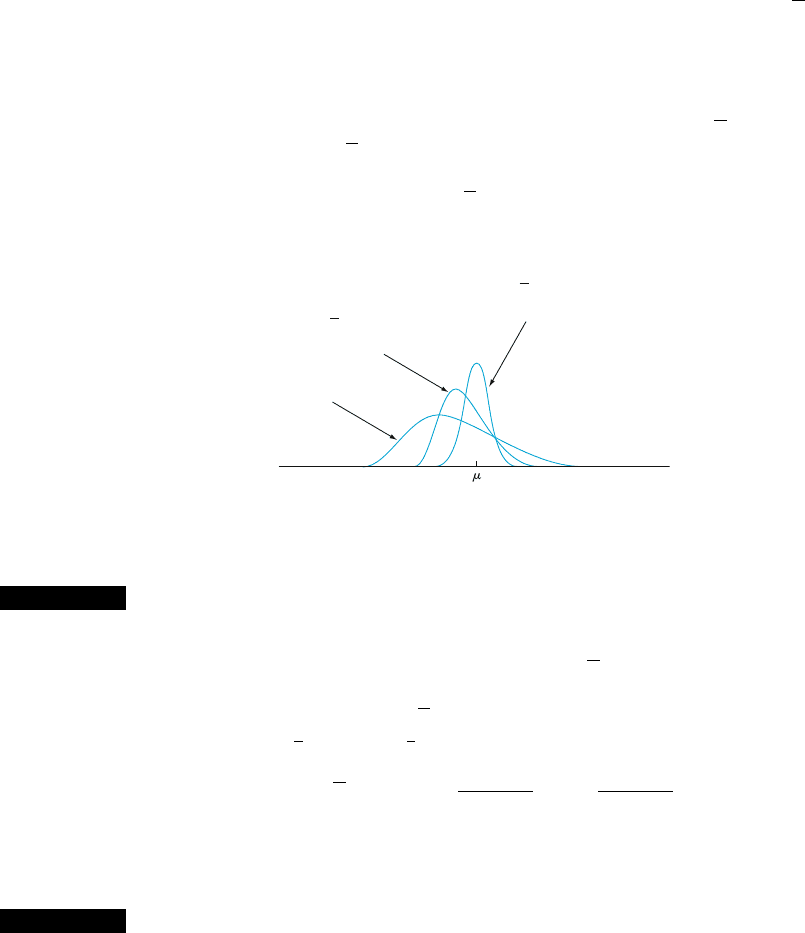
Figure 6.10 illustrates the Central Limit Theorem. According to the CLT,
when n is large and we wish to calculate a probability such as Pða
X bÞ, we
need only “pretend” that
X is normal, standardize it, and use the normal table. The
resulting answer will be approximately correct. The exact answer could be obtained
only by first finding the distribution of
X, so the CLT provides a truly impressive
shortcut.
Example 6.8 When a batch of a certain chemical product is prepared, the amount of a particular
impurity in the batch is a random variable with mean value 4.0 g and standard
deviation 1.5 g. If 50 batches are independently prepared, what is the (approximate)
probability that the sample average amount of impurity
X is between 3.5 and 3.8 g?
According to the rule of thumb to be stated shortly, n ¼ 50 is large enough for the
CLT to be applicable. The mean
X then has approximately a normal distribution
with mean value m
X
¼ 4:0 and s
X
¼ 1:5=
ffiffiffiffiffi
50
p
¼ :2121, so
Pð3:5
X 3:8Þ¼P
3:5 4:0
:2121
Z
3:8 4:0
:2121
¼ Fð:94ÞFð2:36Þ¼:1645
■
Example 6.9 Sup pose the number of times a randomly selected customer of a large bank uses the
bank’s ATM during a particular period is a random variable with a mean value of
3.2 and a standard deviation of 2.4. Among 100 randomly selected customers, how
likely is it that the sample mean number of times the bank’s ATM is used exceeds 4?
Let X
i
denote the number of times the ith customer in the sample uses the
bank’s ATM. Notice that X
i
is a discrete rv, but the CLT is not limited to
continuous random variables. Also, although the fact that the standard deviation
of this nonnegative variable is quite large relative to the mean value suggests
X distribution for
small to moderate n
Population
distribution
X distribution for
large n (approximately normal)
Figure 6.10 The Central Limit Theorem illustrated
6.2 The Distribution of the Sample Mean 299
that its distribution is positively skewed, the large sample size implies that X does
have approximately a normal distribution. Using m
X
¼ 3:2 and s
X
¼ :24,
Pð
X > 4ÞPZ>
4 3:2
:24
¼ 1 Fð3:33Þ¼:0004
■
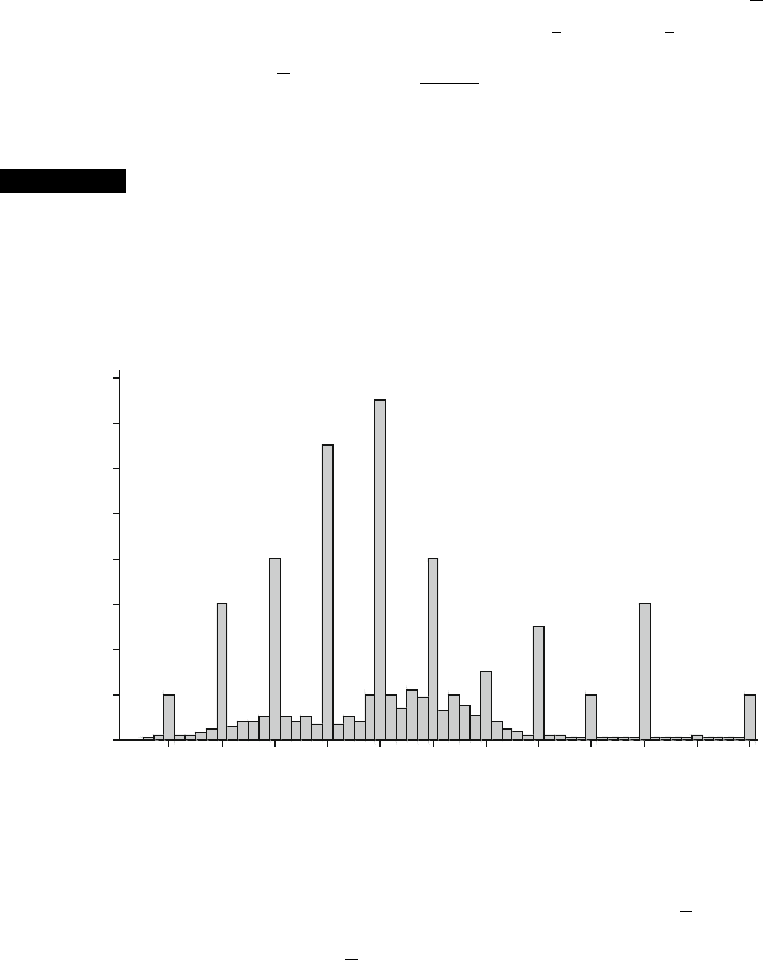
Example 6.10 Consider the distribution shown in Figure 6.11 for the amount purchased (rounded
to the nearest dollar) by a randomly select ed customer at a particular gas station
(a similar distribution for purchases in Britain (in £) appeared in the article “Da ta
Mining for Fun and Profit”, Statistical Science, 2000: 111–131; there were big
spikes at the values 10, 15, 20, 25, and 30). The distribution is obvio usly quite non-
normal.
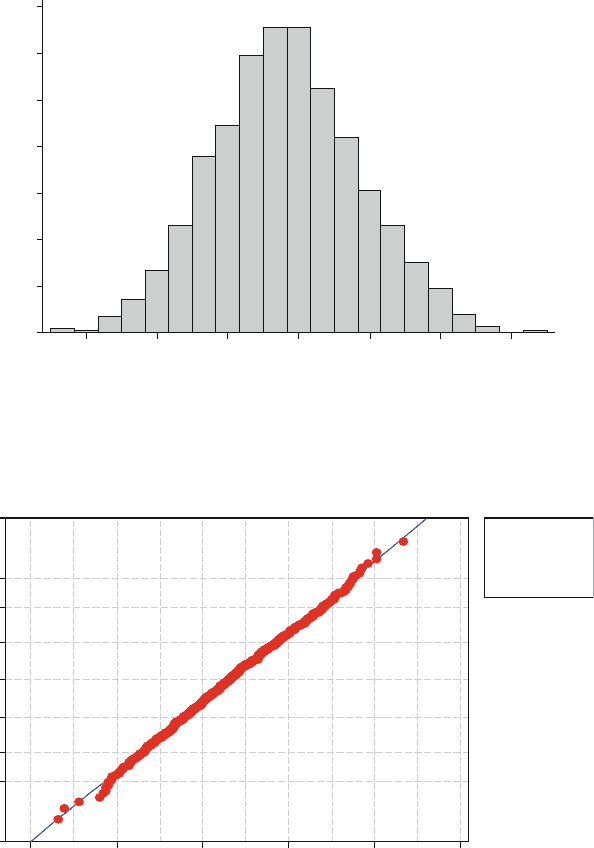
We asked MINITAB to select 1000 different samples, each consisting of
n ¼ 15 observations, and calculate the value of the sample mean
X for each one.
Figure 6.12 is a histogram of the resulting 1000 values; this is the approximate
sampling distribution of
X under the specified circumstances. This distribution is
clearly approximately normal even though the sample size is not all that large. As
further evidence for normal ity, Figure 6.13 shows a normal probability plot of the
1000
x values; the linear pattern is very prominent. It is typically not non-normality
in the central part of the population distribution that causes the CLT to fail, but
instead very substantial skewness.
5 1015202530354045505560
0.16
0.14
0.12
0.10
0.08
0.06
0.04
0.02
0.00
probability
purchase amount
Figure 6.11 Probability distribution of
X
¼ amount of gasoline purchased ($)
300
CHAPTER 6 Statistics and Sampling Distributions
A practical difficulty in applying the CLT is in knowing when n is suffi-
ciently large. The problem is that the accuracy of the approximation for a particular
n depends on the shape of the original underlying distribution being sampled. If the
underlying distribution is symmetric and there is not much probability in the tails,
then the approximation will be good even for a small n, whereas if it is highly
skewed or there is a lot of probability in the tails, then a large n will be required.
For example, if the distribution is uniform on an interval, then it is symmetric with
no probability in the tails, and the normal approximation is very good for n as
0.14
0.12
0.10
0.08
0.06
0.04
0.02
0.00
18 21 24 27 30 33 36
density
mean
Figure 6.12 Approximate sampling distribution of the sample mean amount
purchased when
n
¼ 15 and the population distribution is as shown in Figure 6.11
N
RJ
99.99
99
95
80
50
20
5
1
0.01
15 20 25 30 35 40
percent
mean
Mean
StDev
P-Value
26.49
3.112
1000
>0.100
0.999
Figure 6.13 Normal probability plot from MINITAB of the 1000
x
values based on
samples of size
n
¼ 15 ■
6.2 The Distribution of the Sample Mean 301
small as 10. However, at the other extreme, a distribution can have such fat tails
that the mean fails to exist and the Central Limit Theorem does not apply, so no n is
big enough. We will use the following rule of thumb, which is frequently somewhat
conservative.
RULE OF
THUMB
If n > 30, the Central Limit Theorem can be used.
Of course, there are exceptions, but this rule applies to most distributions of
real data.
Other Applications of the Central Limit Theorem
The CLT can be used to justify the normal approximation to the binomial distribu-
tion discusse d in Chapter 4. Recall that a binomial variable X is the number of
successes in a binomial experiment consisting of n independent success/failure
trials with p ¼ P(S) for any particular trial. Define new rv’s X
1
, X
2
, ..., X
n
by
X
i
¼
1 if the ith trial results in a success
0 if the ith trial results in a failure
(
ði ¼ 1; ...; nÞ
Because the trials are independent and P(S) is constant from trial to trial, the X
i
’s
are iid (a random sample from a Bernoulli distribution). The CLT then implies that
if n is sufficiently large, both the sum and the average of the X
i
’s have approxi-
mately normal distributions. When the X
i
’s are summed, a 1 is added for every S
that occurs and a 0 for every F, so X
1
þ ···þ X
n
¼ X ¼ T
0
. The sample mean of
the X
i
’s is X ¼ Xn
=
, the sample proportion of successes. That is, both X and X/n
are approximately normal when n is large. The necessary sample size for this
approximation depends on the value of p: When p is close to .5, the distribution
of each X
i
is reasonably symmetric (see Figure 6.14), whereas the distribution is
quite skewed when p is near 0 or 1. Using the approximation only if both np 10
and n(1 – p) 10 ensures that n is large enough to overcome any skewness in the
underlying Bernoulli distribution.
Recall from Section 4.5 that X has a lognormal distribution if ln(X) has a
normal distribut ion.
01 01
ab
Figure 6.14 Two Bernoulli distributions: (a)
p
¼ .4 (reasonably symmetric);
(b)
p
¼ .1 (
very
skewed)
302
CHAPTER 6 Statistics and Sampling Distributions
PROPOSITION
Let X
1
, X
2
, ..., X
n
be a random sample from a distribution for which only
positive values are possible [P(X
i
> 0) ¼ 1]. Then if n is sufficiently large,
the product Y ¼ X
1
X
2
·····X
n
has approximately a lognormal distribution;
that is, ln(Y) has a normal distribution.
To verify this, note that
lnðYÞ¼ln X
1
ðÞþln X
2
ðÞþþlnðX
n
Þ
Since ln (Y) is a sum of independent and identically distributed rv’s [the ln(X
i
)’s], it
is appro ximately normal when n is large, so Y itself has approximately a lognormal
distribution. As an example of the applicability of this result, it has been argued that
the damage process in plastic flow and crack propagation is a multiplicative
process, so that variables such as percentage elongation and rupture strength have
approximately lognormal distributions.
The Law of Large Numbers
Recall the first proposition in this section: If X
1
, X
2
, ..., X
n
is a random sample
from a distribution with mean m and variance s
2
, then E ðXÞ¼m and VðXÞ¼s
2
n
=
.
What happens to
X as the number of observations becomes large? The expected
value of
X remains at m but the variance approaches zero. That is,
Vð
XÞ¼E½ð X mÞ
2
! 0. We say that X converges in mean square to m because
the mean of the squared difference between
X and m goes to zero. This is one form
of the Law of Large Numbers, which says that
X ! m as n !1.
The law of large numbers should be intuitively reasonable. For example,
consider a fair die with equal probabilities for the values 1, 2, ...,6som ¼ 3.5.
After many repeated thr ows of the die x
1
, x
2
, ..., x
n
, we should be surprised if
x is
not close to 3.5.
Another form of convergence can be shown with the help of Chebyshev’s
inequality (Exercises 43 and 135 in Chapter 3), which states that for any random
variable Y, P(jY mjks) 1/k
2
whenever k 1. In words, the p robability that
Y is at least k standard deviations away from its mean valu e is at most 1/k
2
;ask
increases, the probability gets closer to 0. Apply this to the mean Y ¼
X of a
random sample X
1
, X
2
, ..., X
n
from a distribution with mean m and variance s
2
.
Then EðYÞ¼Eð
XÞ¼m and VðYÞ¼VðXÞ¼s
2
n
=
, so the s in Chebyshev’s
inequality needs to be replaced by s
ffiffiffi
n
p
=
. Now let e be a positive number close
to 0, such as .01 or .001, and consider Pð
X m
jj
eÞ, the probability that X differs
from m by at least e (at least .01, at least .001, etc.). What happens to this probability
as n !1? Setting e ¼ ks
ffiffiffi
n
p
=
and solving for k gives k ¼ e
ffiffiffi
n
p
s
=
. Thus
Pð
X m
jj
eÞ¼P X m
jj
e
ffiffiffi
n
p
s
s
ffiffiffi
n
p
1
e
ffiffiffi
n
p
s
2
¼
s
2
ne
2
so as n gets arbitrarily large, the probability will approach 0 regardless of how
small e is. That is, for any e, the chance that
X will differ from m by at least e
6.2 The Distribution of the Sample Mean 303
decreases to 0 as the sample size increases. Because of this, statisticians say that X
converges to m in probability.
We can summarize the two forms of the Law of Large Numbers in the
following theorem.
THEOREM
If X
1
, X
2
, ..., X
n
is a random sample from a distribution with mean m and
variance s
2
, then X converges to m
a. In mean square: E
X mðÞ½
2
! 0asn !1
b. In probability: P
X m
jj
eðÞ!0asn !1for any e > 0
Often we do not know m so we use
X to estimate it. According to the theorem,
X will be an accurate estimator if n is large. Estimators that are close for large n are
called consistent.
Example 6.11 Let’s apply the Law of Large Numbers to the repeated flipping of a fair coin.
Intuitively, the fraction of heads should approach
1
2
as we get more and more coin
flips. For i ¼ 1, ...n, let X
i
¼ 1 if the ith toss is a head and ¼ 0 if it is a tail. Then
the X
i
’s are independent and each X
i
is a Bernoulli rv with m ¼ .5 and standard
deviation s ¼ .5. Furthermore, the sum X
1
þ X
2
þ ... þ X
n
is the total number of
heads, so
X is the fraction of heads. Thus, the fraction of heads approaches the
mean, m ¼ .5, by the Law of Large Numbers.
■
Exercises Section 6.2 (11–26)
11. The inside diameter of a randomly selected pis-
ton ring is a random variable with mean value
12 cm and standard deviation .04 cm.
a. If
X is the sample mean diameter for a random
sample of n ¼ 16 rings, where is the sampling
distribution of
X centered, and what is the
standard deviation of the
X distribution?
b. Answer the questions posed in part (a) for a
sample size of n ¼ 64 rings.
c. For which of the two random samples, the one
of part (a) or the one of part (b), is
X more
likely to be within .01 cm of 12 cm? Explain
your reasoning.
12. Refer to Exercise 11. Suppose the distribution of
diameter is normal.
a. Calculate Pð11:99
X 12:01Þwhen n ¼ 16.
b. How likely is it that the sample mean diame-
ter exceeds 12.01 when n ¼ 25?
13. The National Health Statistics Reports dated Oct.
22, 2008 stated that for a sample size of 277 18-
year-old American males, the sample mean waist
circumference was 86.3 cm. A somewhat compli-
cated method was used to estimate various popula-
tion percentiles, resulting in the following values:
5th 10th 25th 50th 75th 90th 95th
69.6 70.9 75.2 81.3 95.4 107.1 116.4
a. Is it plausible that the waist size distribution is
at least approximately normal? Explain your
reasoning. If your answer is no, conjecture the
shape of the population distribution.
b. Suppose that the population mean waist size
is 85 cm and that the population standard
deviation is 15 cm. How likely is it that a
random sample of 277 individuals will result
in a sample mean waist size of at least 86.3 cm?
c. Referring back to (b), suppose now that the
population mean waist size is 82 cm (closer to
the median than the mean). Now what is the
(approximate) probability that the sample
mean will be at least 86.3? In light of this
calculation, do you think that 82 is a reason-
able value for m?
304
CHAPTER 6 Statistics and Sampling Distributions
14. There are 40 students in an elementary statistics
class. On the basis of years of experience, the
instructor knows that the time needed to grade a
randomly chosen first examination paper is a
random variable with an expected value of
6 min and a standard deviation of 6 min.
a. If grading times are independent and the
instructor begins grading at 6:50 p.m. and
grades continuously, what is the (approxi-
mate) probability that he is through grading
before the 11:00 p.m. TV news begins?
b. If the sports report begins at 11:10, what is the
probability that he misses part of the report if
he waits until grading is done before turning
on the TV?
15. The tip percentage at a restaurant has a mean
value of 18% and a standard deviation of 6%.
a. What is the approximate probability that the
sample mean tip percentage for a random
sample of 40 bills is between 16% and 19%?
b. If the sample size had been 15 rather than 40,
could the probability requested in part (a) be
calculated from the given information?
16. The time taken by a randomly selected applicant
for a mortgage to fill out a certain form has a
normal distribution with mean value 10 min and
standard deviation 2 min. If five individuals fill
out a form on 1 day and six on another, what is
the probability that the sample average amount
of time taken on each day is at most 11 min?
17. The lifetime of a type of battery is normally
distributed with mean value 10 h and standard
deviation 1 h. There are four batteries in a pack-
age. What lifetime value is such that the total
lifetime of all batteries in a package exceeds that
value for only 5% of all packages?
18. Let X represent the amount of gasoline (gallons)
purchased by a randomly selected customer
at a gas station. Suppose that the mean value
and standard deviation of X are 11.5 and 4.0,
respectively.
a. In a sample of 50 randomly selected custo-
mers, what is the approximate probability that
the sample mean amount purchased is at least
12 gallons?
b. In a sample of 50 randomly selected custo-
mers, what is the approximate probability that
the total amount of gasoline purchased is at
most 600 gallons.
c. What is the approximate value of the 95th
percentile for the total amount purchased by
50 randomly selected customers.
19. Suppose the sediment density (g/cm) of a ran-
domly selected specimen from a region is nor-
mally distributed with mean 2.65 and standard
deviation .85 (suggested in “Modeling Sediment
and Water Column Interactions for Hydrophobic
Pollutants,” Water Res., 1984: 1169–1174).
a. If a random sample of 25 specimens is selected,
what is the probability that the sample average
sediment density is at most 3.00? Between 2.65
and 3.00?
b. How large a sample size would be required to
ensure that the first probability in part (a) is at
least .99?
20. The first assignment in a statistical computing class
involves running a short program. If past experience
indicates that 40% of all students will make no
programming errors, compute the (approximate)
probability that in a class of 50 students
a. At least 25 will make no errors [Hint: Normal
approximation to the binomial]
b. Between 15 and 25 (inclusive) will make no
errors
21. The number of parking tickets issued in a certain
city on any given weekday has a Poisson distribu-
tion with parameter l ¼ 50. What is the approxi-
mate probability that
a. Between 35 and 70 tickets are given out on a
particular day? [Hint:Whenl is large, a Poisson
rv has approximately a normal distribution.]
b.
The total number of tickets given out during a
5-day week is between 225 and 275?
22. Suppose the distribution of the time X (in hours)
spent by students at a certain university on a partic-
ular project is gamma with parameters a ¼ 50 and
b ¼ 2. Because a is large, it can be shown that X has
approximately a normal distribution. Use this fact to
compute the probability that a randomly selected
student spends at most 125 h on the project.
23. The Central Limit Theorem says that
X is approx-
imately normal if the sample size is large. More
specifically, the theorem states that the standar-
dized
X has a limiting standard normal distribu-
tion. That is, ð
X mÞ=ðs=
ffiffiffi
n
p
Þ has a distribution
approaching the standard normal. Can you recon-
cile this with the Law of Large Numbers? If the
standardized
X is approximately standard normal,
then what about
X itself?
24. Assume a sequence of independent trials, each
with probability p of success. Use the Law of
Large Numbers to show that the proportion of suc-
cesses approaches p as the number of trials becomes
large.
6.2 The Distribution of the Sample Mean 305
25. Let Y
n
be the largest order statistic in a sample of
size n from the uniform distribution on [0, y].
Show that Y
n
converges in probability to y, that
is, that PðjY
n
yjeÞ!0asn approaches 1.
[Hint: The pdf of the largest order statistic appears
in Section 5.5, so the relevant probability can be
obtained by integration (Chebyshev’s inequality is
not needed).]
26. A friend commutes by bus to and from work
6 days/week. Suppose that waiting time is uni-
formly distributed between 0 and 10 min, and
that waiting times going and returning on various
days are independent of each other. What is the
approximate probability that total waiting time
for an entire week is at most 75 min? [Hint:
Carry out a simulation experiment using statistical
software to investigate the sampling distribu-
tion of T
o
under these circumstances. The idea of
this problem is that even for an n as small as 12,
T
o
and X should be approximately normal when
the parent distribution is uniform. What do
you think?]
6.3
The Mean, Variance, and MGF
for Several Variables
The sample mean X and sample total T
o
are special cases of a type of random
variable that arises very frequently in statistical applications.
DEFINITION
Given a collection of n random variables X
1
, X
2
, ..., X
n
and n numerical
constants a
1
, ..., a
n
, the rv
Y ¼ a
1
X
1
þþa
n
X
n
¼
X
n
i¼1
a
i
X
i
ð6:6Þ
is called a linear combination of the X
i
’s.
Taking a
1
¼ a
2
¼ ···¼ a
n
¼ 1 gives Y ¼ X
1
þ ···þ X
n
¼ T
o
, and
a
1
¼ a
2
¼¼a
n
¼
1
n
yields Y ¼
1
n
X
1
þþ
1
n
X
n
¼
1
n
X
1
þþX
n
ðÞ¼
1
n
T
o
¼ X. Notice that we are not requiring the X
i
’s to be independent or identically
distributed. All the X
i
’s could have different distributions and therefore differ ent
mean values and variances. We first consider the expected value and variance of a
linear combination.
PROPOSITION
Let X
1
, X
2
, ..., X
n
have mean values m
1
, ..., m
n
, respectively, and variances
s
2
1
; ...; s
2
n
, respective ly.
1. Whether or not the X
i
’s are independent,
Eða
1
X
1
þþa
n
X
n
Þ¼a
1
EðX
1
Þþþa
n
EðX
n
Þ
¼ a
1
m
1
þþa
n
m
n
ð6:7Þ
306 CHAPTER 6 Statistics and Sampling Distributions

2. If X
1
, ..., X
n
are independent,
Vða
1
X
1
þþa
n
X
n
Þ¼a
2
1
VðX
1
Þþþa
2
n
VðX
n
Þ
¼ a
2
1
s
2
1
þþa
2
n
s
2
n
ð6:8Þ
and
s
a
1
X
1
þþa
n
X
n
¼
ffiffiffiffiffiffiffiffiffiffiffiffiffiffiffiffiffiffiffiffiffiffiffiffiffiffiffiffiffiffiffiffiffiffiffi
a
2
1
s
2
1
þþa
2
n
s
2
n
q
ð6:9Þ
3. For any X
1
, X
2
, ..., X
n
,
Vða
1
X
1
þþa
n
X
n
Þ¼
X
n
i¼1
X
n
j¼1
a
i
a
j
covðX
i
; X
j
Þð6:10Þ
Proofs are sketched out later in the section. A paraphrase of (6.7) is that the
expected value of a linear combination is the same linear combination of the
expected values—for example, E(2X
1
þ 5X
2
) ¼ 2m
1
þ 5m
2
. The result (6.8)in
Statement 2 is a special case of ( 6.10) in Statement 3; when the X
i
’s are indepen-
dent, Cov(X
i
, X
j
) ¼ 0 for i 6¼ j and ¼ V(X
i
) for i ¼ j (this simplification actually
occurs when the X
i
’s are uncorrelated, a weaker condition than independence).
Specializing to the case of a random sample (X
i
’s iid) with a
i
¼ 1/n for every i
gives E ð
XÞ¼m and VðXÞ¼s
2
n
=
, as discussed in Section 6.2. A similar comment
applies to the rules for T
o
Example 6.12 A gas station sells three grades of gasolin e: regular, plus, and premium. These are
priced at $3.50, $3.65, and $3.80 per gallon, respectively. Let X
1
,X
2
, and X
3
denote
the amounts of these grades purchased (gallons) on a particular day. Suppose the
X
i
’s are independent with m
1
¼ 1000, m
2
¼ 500, m
3
¼ 300, s
1
¼ 100, s
2
¼ 80,
and s
3
¼ 50. The revenue from sales is Y ¼ 3.5X
1
þ 3.65X
2
þ 3.8X
3
, and
EðYÞ¼3:5m
1
þ 3:65m
2
þ 3:8m
3
¼ $6465
VðYÞ¼3:5
2
s
2
1
þ 3:65
2
s
2
2
þ 3:8
2
s
2
3
¼ 243; 864
s
Y
¼
ffiffiffiffiffiffiffiffiffiffiffiffiffiffiffiffiffi
243; 864
p
¼ $493:83
■
Example 6.13 The results of the previous proposition allow for a straightforward derivation of
the mean and variance of a hypergeometric rv, which were given without proof in
Section 3.6. Recall that the distribution is defined in terms of a population with N
items, of which M are successes and N–Mare failures. A sample of size n is drawn,
of which X are successes. It is equivalent to view this as random arrangement of all
N items, followed by selection of the first n. Let X
i
be 1 if the ith item is a success
and 0 if it is a failure, i ¼ 1, 2, ..., N. Then
X ¼ X
1
þ X
2
þ þX
n
According to the proposition, we can find the mean and variance of X if
we can find the means, variances, and covariances of the terms in the sum.
6.3 The Mean, Variance, and MGF for Several Variables 307