
Devore J.L., Berk K.N. Modern Mathematical Statistics with Applications
Подождите немного. Документ загружается.


The model is additive if and only if all g
ij
’s ¼ 0. The g
ij
’s are referred to as the
interaction parameters. The a
i
’s are called the main effects for factor A, and the
b
j
’s are the main effects for factor B. Although there are I a
i
’s, J b
j
’s, and IJ g
ij
’s in
addition to m, the conditions Sa
i
¼ 0, Sb
j
¼ 0, S
j
g
ij
¼ 0 for any i, and S
i
g
ij
¼ 0
for any j [all by virtue of (11.15) and ( 11.16)], imply that only IJ of these new
parameters are independently determined: m, I–1 of the a
i
’s, J–1 of the b
j
’s, and
(I–1)(J–1) of the g
ij
’s.
There are now three sets of hypotheses that will be considered:
H
0AB
: g
ij
¼ 0 for all i; j versus H
aAB
: at least one g
ij
6¼ 0
H
0A
: a
1
¼ a
2
¼¼a
I
¼ 0 versus H
aA
: at least one a
i
6¼ 0
H
0B
: b
1
¼ b
2
¼¼b
J
¼ 0 versus H
aB
: at least one b
j
6¼ 0
The no-interaction hypothesis H
0AB
is usually tested first. If H
0AB
is not rejected,
then the other two hypotheses can be tested to see whether the main effects are
significant. But once H
0AB
is rejected, we believe that the effect of factor A at any
particular level depends on the level of B (and vice versa). It then does not make
sense to test H
0A
or H
0B
. In this context a picture similar to that of Figure 11.7(b) is
helpful in visualizing the way the factors interact. Here the cell means are used
instead of x
ij
; this type of graph is sometimes called an interaction plot.
In case of interaction, it may be appropriate to do a one-way ANOVA to
compare levels of A separately for each level of B. For example, suppose factor A
involves four kinds of glue, factor B involves three types of material, the response is
strength of the glue joint, and the strength rankings of the glues clearly depend on
which material is being glued. In this situation with interaction, it makes sense to do
three separate one-way ANOVA analyses, one for each material.
Notation, Model, and Analysis
We now use triple subscripts for both random variables and observed values, with
X
ijk
and x
ijk
referring to the kth observation (replication) when factor A is at level i
and factor B is at level j. The model is then
X
ijk
¼ m þ a
i
þ b
j
þ g
ij
þ e
ijk
i ¼ 1; :::; I; j ¼ 1; :::; J; k ¼ 1; :::; K
ð11:18Þ
where the e
ijk
’s are independent and normally distributed, each with mean
0 and variance s
2
.
Again a dot in place of a subscript means that we have summed over all
values of that subscript, whereas a horizontal bar denotes averaging. Thus X
ij·
is the
total of all K observations made for factor A at level i and factor B at level j [all
observations in the (i, j)th cell], and
X
ij
is the average of these K observations.
598 CHAPTER 11 The Analysis of Variance
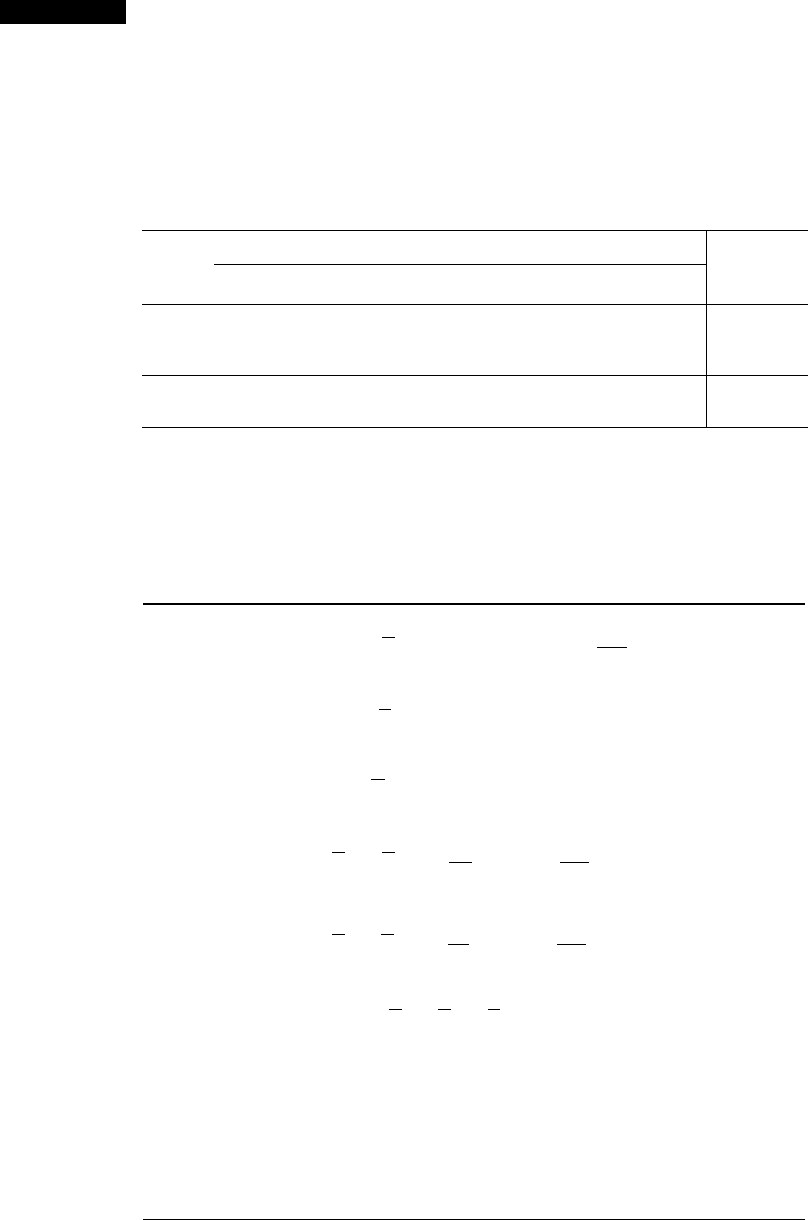
Example 11.16 Three different varieties of tomato (Harvester, Ife No. 1, and Pusa Early Dwarf) and
four different plant densities (10, 20, 30, and 40 thousand plants per hectare) are
being considered for planting in a particular region. To see whether either variety or
plant density affects yield, each combination of variety and plant density is used in
three different plots, resulting in the data on yields in Table 11.8 (based on the
article “Effects of Plant Density on Tomato Yields in Western Nigeria,” Exper.
Agric., 1976: 43–47).
Here, I ¼ 3, J ¼ 4, and K ¼ 3, for a total of IJK ¼ 36 observations
■
To test the hypotheses of interest, we again define sums of squares and
present computing formulas:
SST ¼
X
i
X
j
X
k
ðX
ijk
X
Þ
2
¼
X
i
X
j
X
k
X
2
ijk
1
IJK
X
2
df ¼ IJK 1
SSE ¼
X
i
X
j
X
k
ðX
ijk
X
ij
Þ
2
¼
X
i
X
j
X
k
X
2
ijk
1
K
X
i
X
j
X
2
ij
df ¼ IJðK 1Þ
SSA ¼
X
i
X
j
X
k
ðX
i
X
Þ
2
¼
1
JK
X
i
X
2
i
1
IJK
X
2
df ¼ I 1
SSB ¼
X
i
X
j
X
k
ðX
j
X
Þ
2
¼
1
IK
X
j
X
2
j
1
IJK
X
2
df ¼ J 1
SSAB ¼
X
i
X
j
X
k
ðX
ij
X
i
X
j
þ X
Þ
2
df ¼ðI 1ÞðJ 1Þ
The fundamental identity
SST ¼ SSA þ SSB þ SSAB þ SSE
implies that the interaction sum of squares SSAB can be obtained by
subtraction.
Table 11.8 Yield data for Example 11.16
Planting Density
Variety 10,000 20,000 30,000 40,000 x
i
x
i
H 10.5 9.2 7.9 12.8 11.2 13.3 12.1 12.6 14.0 10.8 9.1 12.5 136.0 11.33
Ife 8.1 8.6 10.1 12.7 13.7 11.5 14.4 15.4 13.7 11.3 12.5 14.5 146.5 12.21
P 16.1 15.3 17.5 16.6 19.2 18.5 20.8 18.0 21.0 18.4 18.9 17.2 217.5 18.13
x
.j.
103.3 129.5 142.0 125.2 500.00
x
j
11.48 14.39 15.78 13.91 13.89
11.5 Two-Factor ANOVA with K
ij
> 1 599
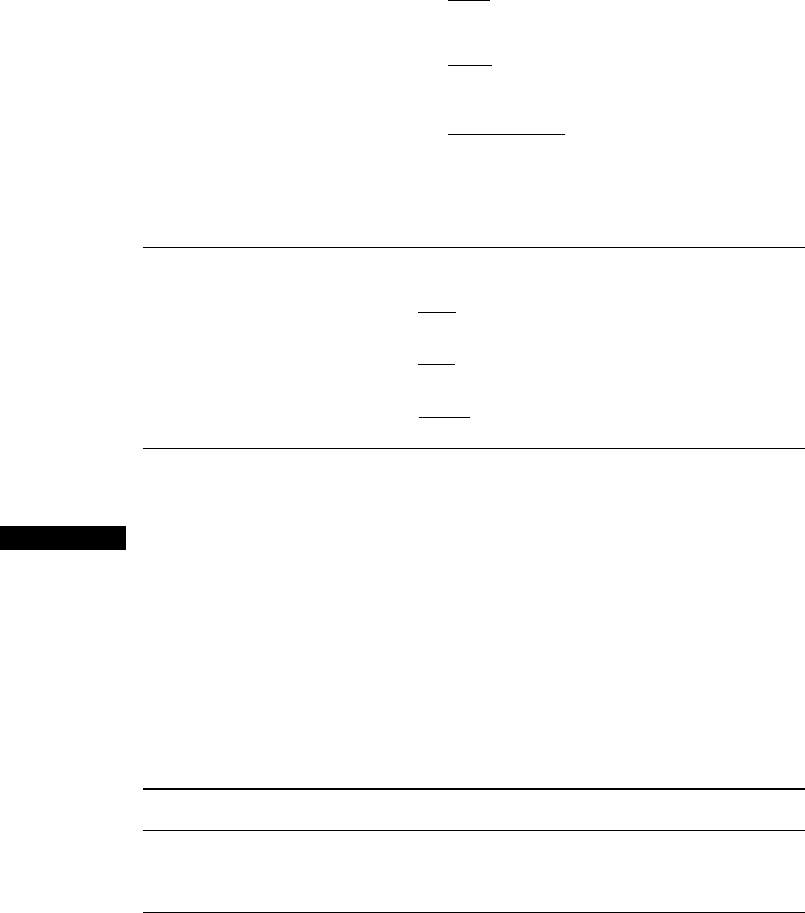
The computing formulas are all obtained by expanding the squared expres-
sions and summing. The fundamental identity is obtained by squaring and summing
an expression similar to Equation (11.2).
Total variation is thus partitioned into four pieces: unexplained (SSE—which
would be present whether or not any of the three null hypotheses was true) and three
pieces that may be explained by the truth or falsity of the three H
0
’s. Each of four
mean squares is defined by MS ¼ SS/df. The expected mean squares suggest that
each set of hypotheses should be tested using the appropriate ratio of mean squares
with MSE in the denominator:
E(MSE) ¼ s
2
E(MSA) ¼ s
2
þ
JK
I 1
X
I
i¼1
a
2
i
E(MSB) ¼ s
2
þ
IK
J 1
X
J
j¼1
b
2
j
E(MSAB) ¼ s
2
þ
K
ðI 1ÞðJ 1Þ
X
I
i¼1
X
J
j¼1
g
2
ij
Each of the three mean square ratios can be shown to have an F distribution
when the associated H
0
is true, which yields the followi ng level a test procedures.
Hypotheses Test Statistic Value Rejection Region
H
0A
versus H
aA
f
A
¼
MSA
MSE
f
A
F
a
;I1;IJðK1Þ
H
0B
versus H
aB
f
A
¼
MSB
MSE
f
B
F
a
;J1;IJð K1Þ
H
0AB
versus H
aAB
f
AB
¼
MSAB
MSE
f
AB
F
a
;ðI1ÞðJ1Þ;IJðK1Þ
As before, the results of the analysis are summarized in an ANOVA table.
Example 11.17
(Example 11.16
continued)
From the given data, x
2
¼ 500
2
¼ 250;000.
X
i
X
j
X
k
x
2
ijk
¼10:5
2
þ 9:2
2
þþ18:9
2
þ 17:2
2
¼ 7404:80
X
i
x
2
i
¼136:0
2
þ 146:5
2
þ 217:5
2
¼ 87;264:50
and
X
j
x
2
j
¼ 63;280:18
The cell totals (x
ij.
’s) are
10,000 20,000 30,000 40,000
H 27.6 37.3 38.7 32.4
Ife 26.8 37.9 43.5 38.3
P 48.9 54.3 59.8 54.5
600
CHAPTER 11 The Analysis of Variance

from which
P
i
P
j
x
2
ij
¼ 27:6
2
þþ54:5
2
¼ 22;100:28. Then
SST ¼ 7404:80
1
36
ð250;000Þ¼7404:80 6944:44 ¼ 460:36
SSA ¼
1
12
ð87;264:50Þ6944:44 ¼ 327:60
SSB ¼
1
9
ð63;280:18Þ6944:44 ¼ 86:69
SSE ¼ 7404:80
1
3
ð22;100:28Þ¼38:04
and
SSAB ¼ 460:36 327:60 86:69 38:04 ¼ 8:03
Table 11.9 summarizes the computation.
Since F
.01,6,24
¼ 3.67 and f
AB
¼ .84 is not 3.67, H
0AB
cannot be rejected at level
.01, so we conclude that the interaction effects are not significant. Now the presence
or absence of main effects can be investigated. Since F
.01,2,24
¼ 5.61 and f
A
¼ 103.02
5.61, H
0A
is rejected at level .01 in favor of the conclusion that different varieties
do affect the true average yields. Similarly, f
B
¼ 18.18 4.72 ¼ F
.01,3,24
,sowe
conclude that true average yield also depends on plant density.
Figure 11.11 shows the interaction plot. Notice the nearly parallel lines for
the three tomato varieties, in agreement with the F test showing no significant
interaction. The yield for Pusa Early Dwarf appears to be significantly above the
yields for the other two varieties, and this is in accord with the highly significant F
for varieties. Furthermore, all three varieties show the same pattern in which yield
increases as the density goes up, but decreases beyond 30,000 per hect are. This
suggests that planting more seed will increase the yield, but eventually overcrowd-
ing causes the yield to drop.
In this example one of the two factors is quantitative, and this is naturally the
factor used for the horizontal axis in the interaction plot. In case both of the factors
are quantitative, the choice for the horizontal axis would be arbitrary, but a case can
be made for two plots to try it both ways. Indeed, MINITAB has an option to allow
both plots to be included in the same graph.
Table 11.9 ANOVA table for Example 11.17
Source of Variation df Sum of Squares Mean Square f
Varieties 2 327.60 163.8 f
A
¼ 103.02
Density 3 86.69 28.9 f
B
¼ 18.18
Interaction 6 8.03 1.34 f
AB
¼ .84
Error 24 38.04 1.59
Total 35 460.36
11.5 Two-Factor ANOVA with K
ij
> 1 601
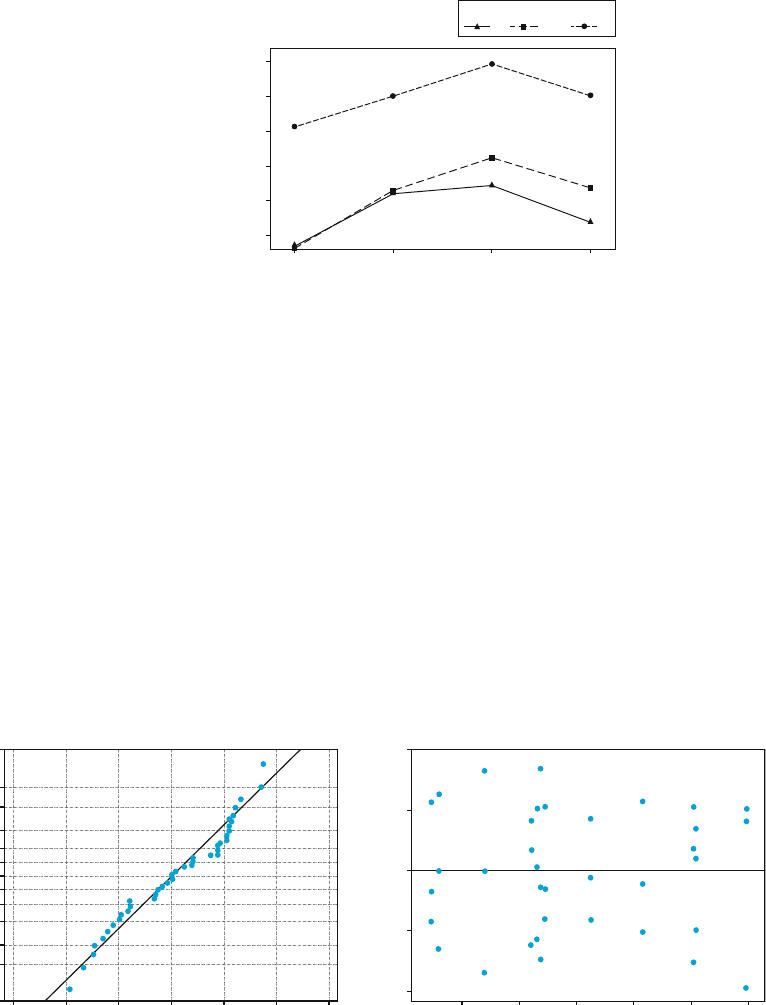
To check the normality and constant variance assumptions we can make plots
similar to those of Section 11.4. Define the predicted values (fitted values) to be the
cell means,
^
x
ijk
¼
x
ij
, so the residuals, the differences between the observations and
predicted values, are x
ijk
x
ij
. The normal plot of the residuals is Figure 11.12(a),
and the plot of the residuals against the fitted values is Figure 11.12(b). The normal
plot is sufficiently straight that there should be no concern about the normality
assumption. The plot of residuals against predicted values has a fairly uniform
vertical spread, so there is no cause for concern about the constant variance
assumption.
10000 20000 30000 40000
Density
20
18
16
12
14
10
Mean
Variety
H Ife P
Figure 11.11 Interaction plot for the tomato yield data
0−3 −2 −1
1
23
Residual
99
95
90
80
70
60
30
1
40
5
50
20
10
Normal Probability Plot of the Residuals
(response is Yield)
a
10 12 14 16 18 20
Fitted Value
2
1
0
−1
−2
Residuals Versus the Fitted Values
(response is Yield)
b
Percent
Residual
Figure 11.12 Plots from MINITAB to verify assumptions for Example 11.17 ■
602
CHAPTER 11 The Analysis of Variance

Multiple Comparisons
When the no-interaction hypothesis H
0AB
is not rejected and at least one of the two
main-effect null hypotheses is rejected, Tukey’s method can be used to identify
significant differences in levels. To identify differences among the a
i
’s when H
0A
is rejected:
1. Obtain Q
a,I,IJ(K1)
, where the second subscript I identifies the number of levels
being compared and the third subscript refers to the number of degrees of
freedom for error.
2. Compute w ¼ Q
ffiffiffiffiffiffiffiffiffiffiffiffiffiffiffiffiffiffi
MSE=JK
p
, where JK is the number o f observations averaged
to obtain each of the
x
i
’s compared in step 3.
3. Or der the
x
i
’s from smallest to largest and, as before, underscore all pairs that
differ by less than w. Pairs not underscor ed correspond to significantly different
levels of factor A.
To identify different levels of factor B when H
0B
is rejected, replace the second
subscript in Q by J, replace JK by IK in w, and replace
x
i
by
x
j
.
Example 11.18
(Example 11.17
continued)
For factor A (varieties), I ¼ 3, so with a ¼ .01 and IJ( K –1)¼ 24, Q
.01,3,24
¼
4.55. Then w ¼ 4:55
ffiffiffiffiffiffiffiffiffiffiffiffiffiffiffiffi
1:59=12
p
¼ 1.66, so ordering and underscoring gives
x
1
x
2
x
3
11.33 12.21 18.13
The Harvester and Ife varieties do not differ significantly from each other in effect
on true average yield, but both differ from the Pusa variety.
For factor B (density), J ¼ 4soQ
.01,4,24
¼ 4.91 and w ¼4:91
ffiffiffiffiffiffiffiffiffiffiffiffiffiffi
1:59=9
p
¼ 2:06
x
1
x
4
x
2
x
3
11.48 13.91 14.39 15.78
Thus with experimentwise error rate .01, which is quite conservative, only the
lowest density differs significantly from all others. Even with a ¼ .05 (so that
w ¼ 1.64), densities 2 and 3 cannot b e judged significantly different from each
other in their effect on yield.
■
Models with Mixed and Random Effects
In some situations, the levels of either factor may have been chosen from a large
population of possible levels, so that the effect s contributed by the factor are
random rather than fixed. As in Section 11.4, if both factors contribute random
effects, the mode l is referred to as a random effects model, whereas if one factor is
fixed and the other is random, a mixed effects model results. We will now consider
the analysis for a mixed effects model in which factor A (rows) is the fixed factor
and factor B (columns) is the random factor. When either factor is random,
interaction effects will also be random. The case in which both factors are random
is dealt with in Exercise 57. The mixed effects model is
11.5 Two-Factor ANOVA with K
ij
> 1 603

X
ij
¼m þ a
i
þ B
j
þ G
ij
þ e
ijk
i ¼1; ...; I; j ¼ 1; ...; J; k ¼ 1; ...; K
Here m and a
i
’s are constants with Sa
i
¼ 0 and the B
j
’s, G
ij
’s, and e
ijk
’s are
independent, normally distributed random variables with expected value 0 and
variances s
2
B
, s
2
G
, and s
2
, respectively.
1
H
0A
: a
1
¼¼a
I
¼ 0 versus H
aA
: at least one a
i
6¼ 0
H
0B
: s
2
B
¼ 0 versus H
aB
: s
2
B
> 0
H
0G
: s
2
G
¼ 0 versus H
aG
: s
2
G
> 0
It is customary to test H
0A
and H
0B
only if the no-interaction hypothesis H
0G
cannot
be rejected.
The relevant sums o f squares and mean squares needed for the test procedures
are defined and computed exactly as in the fixed effects case. The expected mean
squares for the mixed model are
E MSEðÞ¼s
2
E MSAðÞ¼s
2
þ Ks
2
G
þ
JK
I 1
X
a
2
i
E MSBðÞ¼s
2
þ Ks
2
G
þ IKs
2
B
and
E MSA BðÞ¼s
2
þ Ks
2
G
Thus, to test the no-i nteraction hypothesis, the ratio f
AB
¼ MSAB/MSE is again
appropriate, with H
0G
rejected if f
AB
F
a
;ðI 1ÞðJ1Þ;IJðK1Þ
. However, for testing
H
0A
versus H
aA
, the expected mean squares suggest that although the numerator of
the F ratio should still be MSA, the denominator should be MS AB rather than MSE.
MSAB is also the denominator of the F ratio for testing H
0B
.
1
This is referred to as an “unrestricted” model. An alternative “restricted” model requires that S
i
G
ij
¼ 0
(so the G
ij
’s are no longer independent). Expected mean squares and F ratios appropriate for testing
certain hypotheses depend on the choice of model. Minitab’s default option gives output for the
unrestricted model.
604 CHAPTER 11 The Analysis of Variance

For testing H
0A
versus H
aA
(factors A fixed, B random) , the test statistic value
is f
A
¼ MSA/MSAB, and the rejection region is f
A
F
a
;I1;ðI1ÞðJ1Þ
. The
test of H
0B
versus H
aB
utilizes f
B
¼ MSB/MSAB, and the rejection region is
f
B
F
a
;J1;ðI1ÞðJ1Þ
.
Example 11.19 A process engi neer has identified two potential causes of electric motor vibration,
the material used for the motor casing (fa ctor A) and the supply source of bearings
used in the motor (factor B). The accompanying data on the amount of vibration
(microns) resulted from an experiment in which motors with casings made of steel,
aluminum, and plastic were constructed using bearings supplied by five randomly
selected sources.
Supply source
Material 12345
Steel 13.1 13.2 16.3 15.8 13.7 14.3 15.7 15.8 13.5 12.5
Aluminum 15.0 14.8 15.7 16.4 13.9 14.3 13.7 14.2 13.4 13.8
Plastic 14.0 14.3 17.2 16.7 12.4 12.3 14.4 13.9 13.2 13.1
Only the three casing materials used in the experiment are under consideration for
use in production, so factor A is fixed. However, the five supply sources were
randomly selected from a much larger population, so factor B is random. The
relevant null hypotheses are
H
0A
: a
1
¼ a
2
¼ a
3
¼ 0 H
0B
: s
2
B
¼ 0 H
0G
: s
2
G
¼ 0
MINITAB outpu t appears in Figure 11.13 .
Factor Type Levels Values
casmater fixed 3 1 2 3
random 5 1 2 3 4 5
DF SS MS F P
casmater 2 0.7047 0.3523 0.24 0.790
source 4 36.6747 9.1687 6.32 0.013
8 11.6053 1.4507 13.03 0.000
Error 15 1.6700 0.1113
Total 29 50.6547
Source Variance Error Expected Mean Square for Each Term
component term (using unrestricted model)
1 casmater 3 (4) + 2(3)
2(3)
2(3)
+
3(4) + +
4 (4) +
(4)
source
Source
casmater*source
Q[1]
2 source
1.2863
6(2)
3 casmater*source 0.6697
4 Error
0.1113
Figure 11.13 Output from MINITAB’s balanced ANOVA option for the data of
Example 11.19
11.5 Two-Factor ANOVA with K
ij
> 1 605
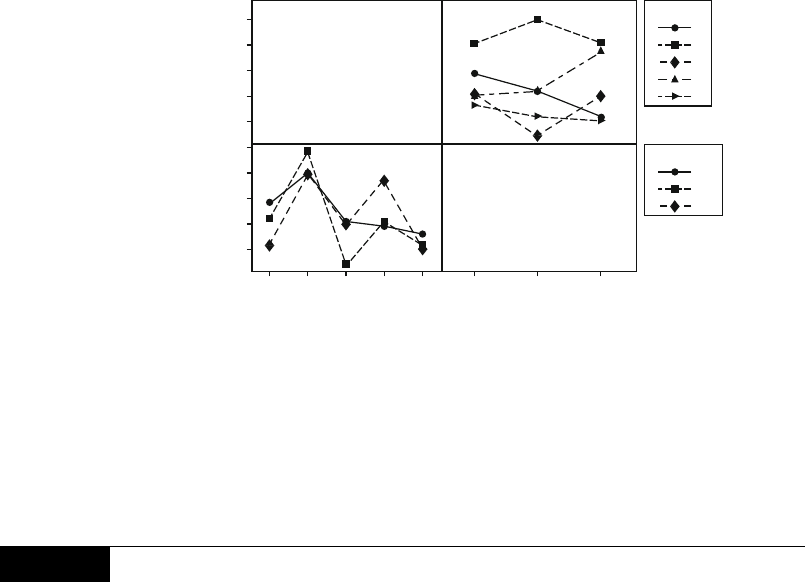
The printed 0.000 P-value for interaction means that it is less than .0005 (the
actual value is .000018). To interpret the significant interaction we use the interac-
tion plot, Figure 11.14, which has both versions, one with source on the x-axis and
one with material on the x-axis. Interaction is evident, because the best material (the
one with the least vibration) depends strongly on source. For source 1 the best
material is steel, for source 3 the best material is plastic, and for source 4 the best
material is aluminum. Because of this interaction, we ordinarily would not interpret
the main effects, but one cannot help noticing that there is strong dependence of
vibration on source. Source 2 is bad for all three materials and source 3 is pretty
good for all three materials. When one-way ANOVA analyses are done to compare
the five sources for each of the three materials, all three show highly significant
differences. This is consistent with the P-value of 0.013 for source in Figure 11.13.
We can conclude that, although the interaction causes the best material to depend
on the source, the source also makes a difference of its own.
When at least two of the K
ij
’s are unequal, the ANOVA computations are
much more complex than for the case K
ij
¼ K, and there are no nice formulas for
the appropriate test statistics. One of the chapter references can be consulted for
more information.
Exercises Section 11.5 (49–57)
49. In an experiment to assess the effects of curing
time (factor A) and type of mix (factor B) on the
compressive strength of hardened cement cubes,
three different curing times were used in combi-
nation with four different mixes, with three obser-
vations obtained for each of the 12 curing
time–mix combinations. The resulting sums of
squares were computed to be SSA ¼ 30,763.0,
SSB ¼ 34,185.6, SSE ¼ 97,436.8, and SST
¼ 205,966.6.
a. Construct an ANOVA table.
b. Test at level .05 the null hypothesis H
0AB
: all
g
ij
’s ¼ 0 (no interaction of factors) against
H
0AB
: at least one g
ij
6¼ 0.
1234
5
APS
Interaction Plot(data means)for vibration
17
17
16
15
14
14
13
15
16
13
Source
Material
Source
1
2
3
4
5
Material
A
P
S
Fig.11.14 MINITAB interaction plot for the data of Example 11.19 ■
606
CHAPTER 11 The Analysis of Variance

c. Test at level .05 the null hypothesis H
0A
: a
1
¼
a
2
¼ a
3
¼ 0 (factor A main effects are absent)
against H
aA
: at least one a
i
6¼ 0.
d. Test H
0B
: b
1
¼ b
2
¼ b
3
¼ b
4
¼ 0 versus H
aB
:
at least one b
j
6¼ 0 using a level .05 test.
e. The values of the
x
i
’s were
x
1
¼
4010:88;
x
2
¼ 4029:10; and
x
3
¼ 3960:02.
Use Tukey’s procedure to investigate signifi-
cant differences among the three curing times.
50. The article “Towards Improving the Properties of
Plaster Moulds and Castings” (J. Engrg. Manuf.,
1991: 265–269) describes several ANOVAs car-
ried out to study how the amount of carbon fiber
and sand additions affect various characteristics of
the molding process. Here we give data on casting
hardness and on wet-mold strength.
Sand
Addition
(%)
Carbon
Fiber
Addition
(%)
Casting
Hardness
Wet-
Mold
Strength
0 0 61.0 34.0
0 0 63.0 16.0
15 0 67.0 36.0
15 0 69.0 19.0
30 0 65.0 28.0
30 0 74.0 17.0
0 .25 69.0 49.0
0 .25 69.0 48.0
15 .25 69.0 43.0
15 .25 74.0 29.0
30 .25 74.0 31.0
30 .25 72.0 24.0
0 .50 67.0 55.0
0 .50 69.0 60.0
15 .50 69.0 45.0
15 .50 74.0 43.0
30 .50 74.0 22.0
30 .50 74.0 48.0
a. An ANOVA for wet-mold strength gives
SSSand ¼ 705, SSFiber ¼ 1278, SSE ¼ 843,
and SST ¼ 3105. Test for the presence of any
effects using a ¼ .05.
b. Carry out an ANOVA on the casting hardness
observations using a ¼ .05.
c. Make an interaction plot with sand percentage
on the horizontal axis, and discuss the results of
part (b) in terms of what the plot shows.
51. The accompanying data resulted from an
experiment to investigate whether yield from a
chemical process depended either on the formula-
tion of a particular input or on mixer speed.
Speed
60 70 80
189.7 185.1 189.0
1 188.6 179.4 193.0
Formulation 190.1 177.3 191.1
165.1 161.7 163.3
2 165.9 159.8 166.6
167.6 161.6 170.3
A statistical computer package gave SS(Form) ¼
2253.44, SS(Speed) ¼ 230.81, SS(Form*Speed)
¼ 18.58, and SSE ¼ 71.87.
a. Does there appear to be interaction between the
factors?
b. Does yield appear to depend on either formu-
lation or speed?
c. Calculate estimates of the main effects.
d. Verify that the residuals are 0.23,0.87, 0.63,
4.50,1.20,3.30,2.03,1.97,0.07,1.10,
0.30,1.40,0 .67,1.23,0.57,3.43,0.13,
3.57.
e. Construct a normal plot from the residuals
given in part (d). Do the e
ijk
’s appear to be
normally distributed?
f. Plot the residuals against the predicted values
(cell means) to see if the population variance
appears reasonably constant.
52. In an experiment to investigate the effect of “cement
factor” (number of sacks of cement per cubic yard)
on flexural strength of the resulting concrete (“Stud-
ies of Flexural Strength of Concrete. Part 3: Effects
of Variation in Testing Procedure,” Proceedings
ASTM, 1957: 1127–1139), I ¼ 3 different factor
values were used, J ¼ 5differentbatchesofcement
were selected, and K ¼ 2 beams were cast from
each cement factor/batch combination. Summary
values include
PPP
x
2
ijk
¼ 12;280;103,
PP
x
2
ij
¼ 24;529;699,
P
x
2
i
¼ 122;380;901,
P
x
2
j
¼ 73;427;483, and x
¼ 19;143.
a. Construct the ANOVA table.
b. Assuming a mixed model with cement factor
(A) fixed and batches (B) random, test the three
pairs of hypotheses of interest at level .05.
53. A study was carried out to compare the writing
lifetimes of four premium brands of pens. It was
thought that the writing surface might affect life-
time, so three different surfaces were randomly
selected. A writing machine was used to ensure
that conditions were otherwise homogeneous
11.5 Two-Factor ANOVA with K
ij
> 1 607