
Devore J.L., Berk K.N. Modern Mathematical Statistics with Applications
Подождите немного. Документ загружается.

Thus x ¼ 4908=8 ¼ 613 :5, y ¼ 22:7=8 ¼ 2:838, and
^
b
1
¼
S
xy
S
xx
¼
15;441:4 ð4908 Þð22:7Þ=8
3;190;248 ð4908Þ
2
=8
¼
1514:95
179;190
¼ :00845443 :00845
^
b
0
¼2:838 ð:00845443Þð613:5Þ¼2:349
We estimate that the expected change in tree mass associated with a 1-part-per-
million increase in CO
2
concentration is .00845. The equation of the estimated
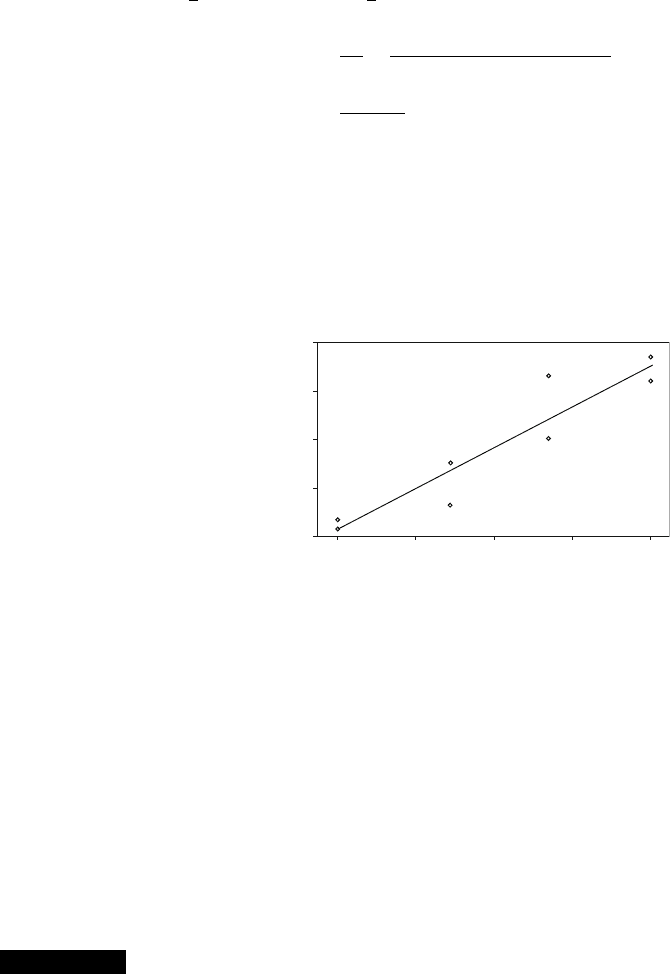
regression line (least squares line) is then y ¼2.35 + .00845x. Figure 12.10,
generated by the statistical computer package R, shows that the least squares line
provides an excellent summary of the relationship between the two variables.
The estimated regression line can immediately be used for two different pur-
poses. For a fixed x value x
;
^
b
0
þ
^
b
1
x
(the height of the line above x*) gives either (1)
a point estimate of the expected value of Y when x ¼ x* or (2) a point prediction of the
Y value that will result from a single new observation made at x ¼ x*.
The least squares line should not be used to make a prediction for an x value
much beyond the range of the data, such as x ¼ 250 or x ¼ 1000 in Example 12.5.
The danger of extrapolation is that the fitted relationship (a line here) may not be
valid for such x values. (In the foregoing example, x ¼ 250 gives
^
y ¼:235, a
patently ridiculous value of mass, but extrapolation will not always result in such
inconsistencies.)
Example 12.6 Refer to the tree-mass-CO
2
data in the previous example. With a little extrapola-
tion, a point estimate for true average mass for all specimens with CO
2
concentra-
tion 365 is
^
m
Y365
¼
^
b
0
þ
^
b
1
ð365Þ¼2:35 þ :00845ð365Þ¼:73
With a little more extrapolation, a point estimate for true average mass for all
specimens with CO
2
concentration 315 is
^
m
Y315
¼
^
b
0
þ
^
b
1
ð315Þ¼2:35 þ :00845ð315Þ¼:31
510410 610 710 810
CO2
5
4
3
2
1
mass
Figure 12.10 A scatter plot of the data in Example 12.5 with the least squares
line superimposed, from R
■
628 CHAPTER 12 Regression and Correlation
The values 315 and 365 are chosen based on actual values: the average world
atmospheric CO
2
concentration rose from 315 to 365 parts per million between
1960 and 2000. Even if the prediction equation is somewhat inaccurate when
extrapolated to the left, it is clear that changes in carbon dioxide are making a
big difference in the growth of trees. Notice that in Figure 12.10 the tree mass
increases by a factor of more than 4 while the CO
2
concentration increases by just a
factor of 2.
■
Estimating s
2
and s
The parameter s
2
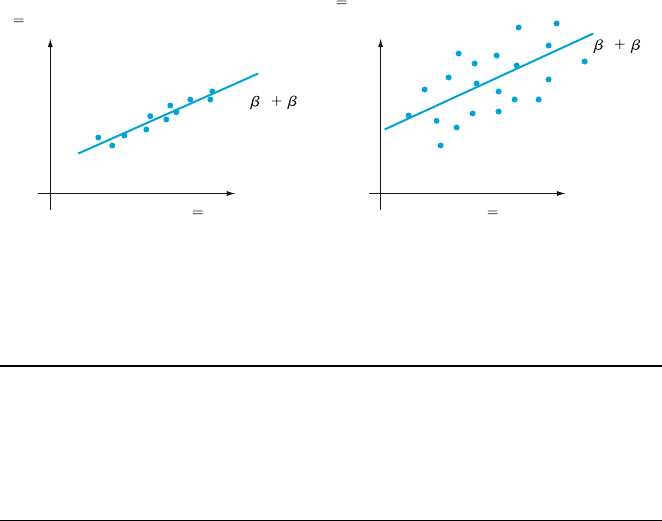
determines the amount of variability inherent in the regression
model. A large value of s
2
will lead to observed (x
i
, y
i
)’s that are quite spread out
about the true regression line, whereas whe n s
2
is small the observed points will
tend to fall very close to the true line (see Figure 12.11). An estimate of s
2
will be
used in confidence interval (CI) formulas and hypothesis-testing procedures pre-
sented in the next two sections. Because the equation of the true line is unknow n,
the estimate is based on the extent to which the sample observations deviate from
the estimated line. Many large deviations (residuals) suggest a large value of s
2
,
whereas if all deviations are small in magnitude it indicates that s
2
is small.
DEFINITION
The fitted (or predicted) values
^
y
1
;
^
y
2
; ...;
^
y
n
are obtained by successively
substituting the x values x
1
, ..., x
n
into the equation of the estimated regres-
sion line:
^
y
1
¼
^
b
0
þ
^
b
1
x
1
;
^
y
2
¼
^
b
0
þ
^
b
1
x
2
; ...;
^
y
n
¼
^
b
0
þ
^
b
1
x
n
. The residuals
are the vertical deviations y
1
^
y
1
; y
2
^
y
2
; ...; y
n
^
y
n
from the estimated
line.
In words, the predicted value
^
y
i
is the value of y that we would predict or expect
when using the estimated regression line with x ¼ x
i
;
^
y
i
is the height of the
estimated regression line above the value x
i
for which the ith observation was
made. The residual y
i
^
y
i
is the difference between the observed y
i
and the
predicted
^
y
i
. If the residuals are all small in mag nitude, then much of the variability
y Elongation
x Tensile force
y Product sales
x
Advertisin
g
expenditure
0 1
x
0 1
x
ab
Figure 12.11 Typical sample for s
2
: (a) small; (b) large
12.2 Estimating Model Parameters 629
in observed y values appears to be due to the linear relationship between x and y,
whereas many large residuals suggest quite a bit of inherent variability in y relative
to the amount d ue to the linear relation. Assuming that the line in Figure 12.9 is the
least squares line, the residuals are identified by the vertical line segments from
the observed points to the line. When the estimated regress ion line is obtained
via the principle of least squares, the sum of the residuals should in theory be zero
(an immediate consequence of the first normal equation; see Exercise 24). In
practice, the sum may deviate a bit from zero due to rounding.
Example 12.7 Japan’s high population density has resulted in a multitude of resource usage
problems. One especially serious difficulty concerns waste removal. The article
“Innovative Sludge Handling Through Pelletization Thickening” (Water Res.,
1999: 3245–3252) reported the development of a new compression machine for
processing sewage sludge. An important part of the investigation involved relating
the moisture content of compressed pellets ( y, in %) to the machine’s filtration rate
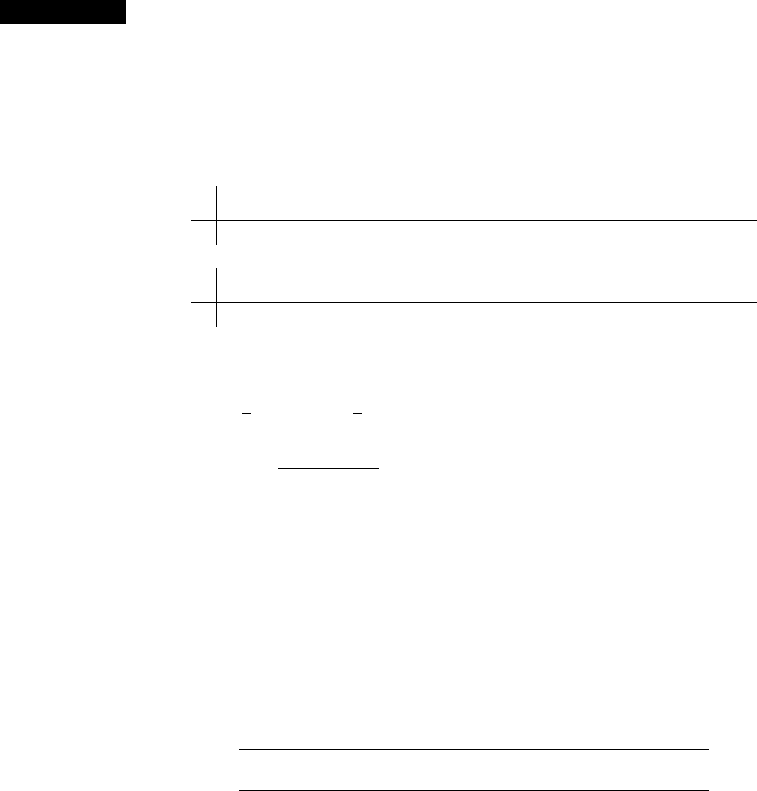
(x, in kg-DS/m/h). The following data was read from a graph in the paper:
x 125.3 98.2 201.4 147.3 145.9 124.7 112.2 120.2 161.2 178.9
y 77.9 76.8 81.5 79.8 78.2 78.3 77.5 77.0 80.1 80.2
x 159.5 145.8 75.1 151.4 144.2 125.0 198.8 132.5 159.6 110.7
y 79.9 79.0 76.7 78.2 79.5 78.1 81.5 77.0 79.0 78.6
Relevant summary quantities (summary statistics) are
P
x
i
¼ 2817:9,
P
y
i
¼
1574:8,
P
x
2
i
¼ 415;949:85,
P
x
i
y
i
¼ 222;657:88, and
P
y
2
i
¼ 124;039:58,
from which
x ¼ 140:895, y ¼ 78:74, S
xx
¼ 18;921:8295, and S
xy
¼ 776:434. Thus
^
b
1
¼
776:434
18;921:8295
¼ :04103377 :041
^
b
0
¼78:74 ð:04103377Þð140:895Þ¼72:958547 72:96
from which the equation of the least squares line is
^
y ¼ 72:96 þ :041x. For numerical
accuracy, the fitted values are calculated from
^
y
i
¼ 72:958547 þ :04103377x
i
:
^
y
1
¼ 72:958547 þ :04103377 125:3ðÞ78:100 y
1
^
y
1
200; etc:
A positive residual corresponds to a point in the scatter plot that lies above the graph
of the least squares line, whereas a negative residual resu lts from a point lying
below the line. All predicted values (fits) and residuals appear in the accompanying
table.
Obs Filtrate Moistcon Fit Residual
1 125.3 77.9 78.100 0.200
2 98.2 76.8 76.988 0.188
3 201.4 81.5 81.223 0.277
4 147.3 79.8 79.003 0.797
5 145.9 78.2 78.945 0.745
6 124.7 78.3 78.075 0.225
7 112.2 77.5 77.563 0.063
8 120.2 77.0 77.891 0.891
630
CHAPTER 12 Regression and Correlation

9 161.2 80.1 79.573 0.527
10 178.9 80.2 80.299 0.099
11 159.5 79.9 79.503 0.397
12 145.8 79.0 78.941 0.059
13 75.1 76.7 76.040 0.660
14 151.4 78.2 79.171 0.971
15 144.2 79.5 78.876 0.624
16 125.0 78.1 78.088 0.012
17 198.8 81.5 81.116 0.384
18 132.5 77.0 78.396 1.396
19 159.6 79.0 79.508 0.508
20 110.7 78.6 77.501 1.099
■
In much the same way that the deviations from the mean in a one-sample
situation were combined to obtain the estimate s
2
¼
P
ðx
i
xÞ
2
=ðn 1Þ, the
estimate of s
2
in regression analysis is based on squaring and summing the
residuals. We will continue to use the symbol s
2
for this estimated variance, so
don’t confuse it with our previous s
2
.
DEFINITION
The error sum of squares (equivalently, residual sum of squares), denoted
by SSE, is
SSE ¼
X
ðy
i
^
y
i
Þ
2
¼
X
½y
i
ð
^
b
0
þ
^
b
1
x
i
Þ
2
and the least squares estimate of s
2
is
^
s
2
¼ s
2
¼
SSE
n 2
¼
P
ðy
i
^
y
i
Þ
2
n 2
The divisor n 2ins
2
is the number of degrees of freedom (df) associated with the
estimate (or, equivalently, with the error sum of squares). This is because to obtain
s
2
, the two parameters b
0
and b
1
must first be estimated, which results in a loss of
2 df (just as m had to be estimated in one-sample problems, resulting in an estimated
variance based on n 1 df). Replacing each y
i
in the formula for s
2
by the rv Y
i
gives the estimator S
2
. It can be shown that S
2
is an unbiased estimator for
s
2
(although the estimator S is biased for s). The mle of s
2
has divisor n rather
than n 2, so it is biased.
Example 12.8
(Example 12.7
continued)
The residuals for the filtration rate–moi sture content data were calculated previ-
ously. The corresponding error sum of squares is
SSE ¼ð:200Þ
2
þð:188Þ
2
þþð1:099Þ
2
¼ 7:968
The estimate of s
2
is then
^
s
2
¼ s
2
¼ 7:968=ð20 2Þ¼:4427, and the estimated
standard deviation is
^
s ¼ s ¼
ffiffiffiffiffiffiffiffiffiffiffi
:4427
p
¼ :665. Roughly speaking, .665 is the mag-
nitude of a typical deviation from the estimated regression line.
■
12.2 Estimating Model Parameters 631

Computation of SSE from the defini ng formula involves much tedious
arithmetic because both the predicted values and residuals must first be calculated.
Use of the following computational formula does not require these quantities.
SSE ¼
X
y
i
2
^
b
0
X
y
i
^
b
1
X
x
i
y
i
This expre ssion results from substituting y
i
¼
^
b
0
þ
^
b
1
x
i
into
P
ðy
i
^
y
i
Þ
2
, squaring
the summand, carrying the sum through to the resulting three terms, and simplify-
ing (see Exercise 24). This computational formula is especially sensitive to the
effects of rounding in
^
b
0
and
^
b
1
, so use as many digits as your calculator will
provide.
Example 12.9 The article “Promising Quantitative Nondestructive Evaluation Techniques for
Composite Materials” (Mater. Eval., 1985: 561–565) reports on a study to investi-
gate how the propagation of an ultrasonic stress wave through a substance depends
on the properties of the substance. The accompanying data on fracture strength
(x, as a percentage of ultimate tensile strength) and attenuation ( y, in neper/cm, the
decrease in amplitude of the stress wave) in fiberglass-reinforced polyest er com-
posites was read from a graph that appeared in the article. The simple linear
regression model is suggested by the substantial linear pattern in the scatter plot.
x 12 30 36 40 45 57 62 67 71 78 93 94 100 105
y 3.3 3.2 3.4 3.0 2.8 2.9 2.7 2.6 2.5 2.6 2.2 2.0 2.3 2.1
The necessary summary quantities are n ¼ 14,
P
x
i
¼ 890,
P
x
2
i
¼ 67;182,
P
y
i
¼ 37:6,
P
y
2
i
¼ 103:54,
P
x
i
y
i
¼ 2234:30, from which S
xx
¼
10;603:4285714, S
xy
¼155:98571429,
^
b
1
¼:0147109, and
^
b
0
¼ 3:6209072.
The computational formula for SSE gives
SSE ¼ 103:54 ð3:6209072Þð37:6Þð:0147109Þð2234:30Þ¼:2624532
so s
2
¼ .2624532/12 ¼ .0218711 and s ¼ .1479. With rounding to three decimal
digits in the computational formula for SSE, the result is
SSE ¼ 104 ð3:62Þð37:6Þð:0147Þð2234:30Þ¼104 103:331 ¼ :669
which is wrong in all digits. The problem is that, even though each of the three
terms may be correct in its first three nonzero digits, the three correct digits can be
subtracted away, leaving you with no correct digits.
■
The Coefficient of Determination
Figure 12.12 shows three different scatter plots of bivariate data. In all three plots,
the heights of the different points vary substantially, indicating that there is much
variability in observed y values. The points in the first plot all fall exactly on a
straight line. In this case, all (100% ) of the sample variation in y can be attributed to
632 CHAPTER 12 Regression and Correlation
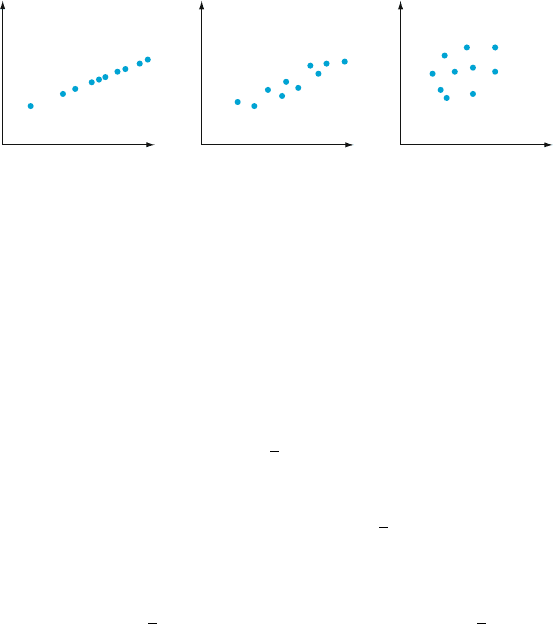
the fact that x and y are linearly related in combination with variation in x. The
points in Figure 12.12 b do not fall exactly on a line, but compared to overall y
variability, the deviations from the least squares line are small. It is reasonable to
conclude in this case that much of the observed y variation can be attributed to the
approximate linear relationship between the variables postulated by the simple
linear regression model. When the scatter plot looks lik e that of Figure 12.12c,
there is substantial variation about the least squares line relative to overall y
variation, so the simple linear regression model fails to explain variation in y by
relating y to x.
The error sum of squares SSE can be interpreted as a measure of how much
variation in y is left unexplained by the model—that is, how much cannot be
attributed to a linear relationship. In Figure 12.12a, SSE ¼ 0, and there is no
unexplained variation, whereas unexplai ned variation is small for the data of
Figure 12.12b and much larger in Figure 12.12c. A quantitative measur e of the
total amount of variation in observed y values is given by the total sum of squares
SST ¼ S
yy
¼
X
ðy
i
yÞ
2
¼
X
y
2
i
ð
X
y
i
Þ
2
=n
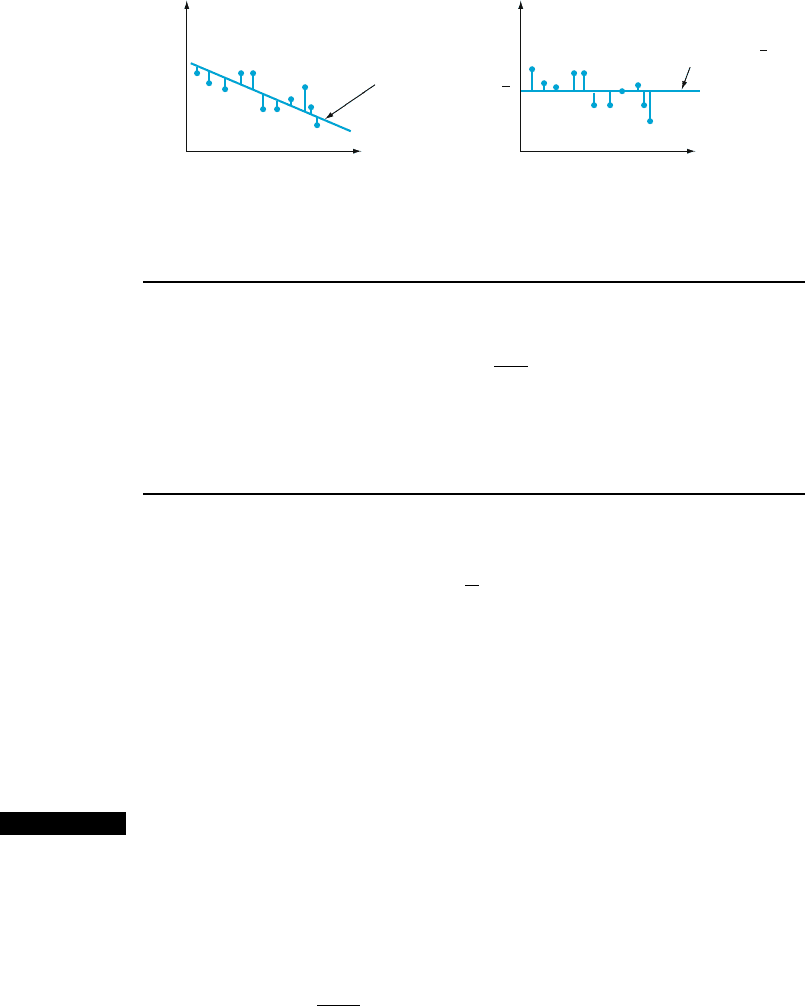
The total sum of squares is the sum of squared deviations about the sample
mean of the observed y values. Thus the same number
y is subtracted from each y
i
in
SST, whereas SSE involves subtracting each different predicted value
^
y
i
from the
corresponding observed y
i
. Just as SSE is the sum of squared deviations about
the least squares line y ¼
^
b
0
þ
^
b
1
x, SST is the sum of squared deviations about the
horizontal line at height
y (since then vertical deviations are y
i
y), as pictured in
Figure 12.13. Furthermore, because the sum of squared deviations about the least
squares line is smaller than the sum of squared deviations about any other line,
SSE < SST unless the horizontal line is the least squares line. The ratio SSE/SST
is the proportion of total variation that cannot be explained by the simple linear
regression model, and 1 SSE/SST (a number between 0 and 1) is the proportion
of observed y variation explained by the model.
x
y
x
y
x
y
abc
Figure 12.12 Explaining y variation: (a) all variation explained; (b) most
variation explained; (c) little variation explained
12.2 Estimating Model Parameters 633
DEFINITION
The coefficient of determination, denot ed by r
2
, is given by
r
2
¼ 1
SSE
SST
It is interpreted as the proportion of observed y variation that can be
explained by the simple linear regression model (attributed to an approximate
linear relationship between y and x).
In equivalent words, r
2
is the proportion by which the error sum of squares is
reduced by the regression line compared to the horizontal line. For example, if
SST ¼ 20 and SSE ¼ 2, then r
2
¼ 1
2
20
, so the regression reduces the error sum
of squares by .90 ¼ 90%.
The higher the value of r
2
, the more successful is the simple linear regression
model in explaining y variation. When regression analysis is done by a statistical
computer package, either r
2
or 100r
2
(the percentage of variation explained by the
model) is a prominent part of the output. If r
2
is small, an analyst may want to
search for an alternative model (either a nonlinear model or a mul tiple regression
model that involves more than a single independent variable) that can more
effectively explain y variation.
Example 12.10
(Example 12.5
continued)
The scatter plot of the CO
2
concentration data in Figure 12.10 indicates a fairly high
r
2
value. With
^
b
0
¼2:349293
^
b
1
¼ :00845443 Sy
i
¼ 22:7
Sx
i
y
i
¼ 15; 441:4 Sy
2
i
¼ 78:93
we have
SST ¼78:93
22:7
2
8
¼ 14:519
SSE ¼78:93 ð2:349293Þð22:7Þð:00845443Þð15;441 :4Þ¼1 :711
Least squares line
y
x
y
x
y
Horizontal line at height y
ab
Figure 12.13 Sums of squares illustrated: (a) SSE ¼ sum of squared deviations about
the least squares line; (b) SST ¼ sum of squared deviations about the horizontal line
634
CHAPTER 12 Regression and Correlation
The coefficient of determination is then
r
2
¼ 1
1:711
14:519
¼ 1 :118 ¼ :882
That is, 88.2% of the observed variation in mass is attributable to (can be explained
by) the approximate li near relationship between mass and CO
2
concentration, a
fairly impressive result. The r
2
can also be interpreted by saying that the error sum
of squares using the regression line is 88.2% less than the error sum of squares
using a horizontal line. By the way, although it is common to have r
2
values of .88
or more in engineering, the physical sciences, and the biological sciences, r
2
is
likely to be much smaller in social sciences such as psychology and sociology. An
r
2
as big as .5 would be unusual in predicting one test score from another. In
particular, when third grade verbal IQ score is used to predict third-grade written IQ
score for the 33 students of Example 1.2, r
2
is only .28.
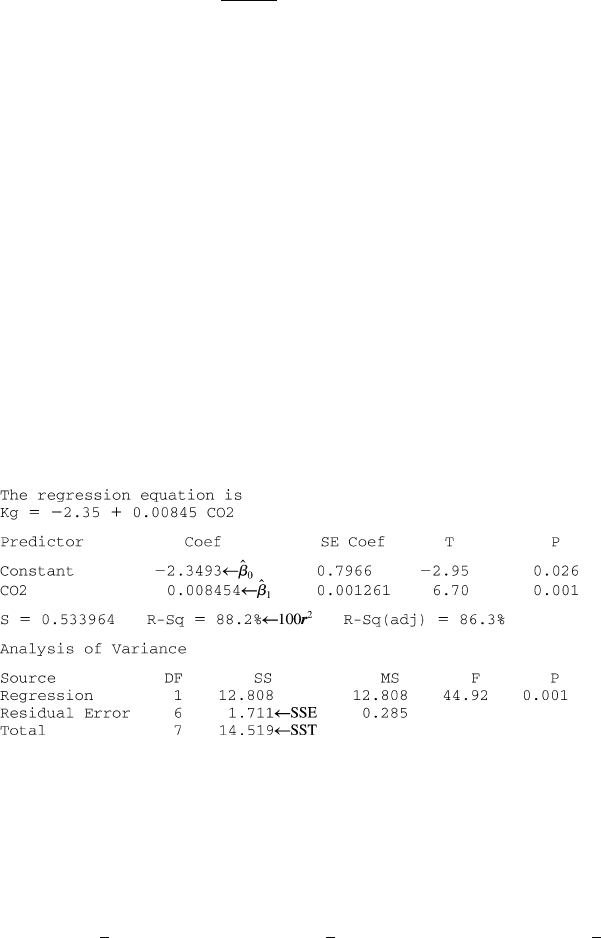
Figure 12.14 shows partial MINITAB output for the CO
2
concentration data
of Examples 12.5 and 12.10; the package will also provide the predicted values and
residuals upon request, as well as other information. The formats used by other
packages differ slightly from that of MINITAB, but the information content is very
similar. Quantities such as the standard deviations, t-ratios, and the details of the
ANOVA table are discussed in Section 12.3.
For regression there is an analysis of variance identity like the fundamental
identity (11.1), in Section 11.1. Add and subtract
^
y
i
in the total sum of squares:
SST ¼
X
ðy
i
yÞ
2
¼
X
½ðy
i
^
y
i
Þþð
^
y
i
yÞ
2
¼
X
ðy
i
^
y
i
Þ
2
þ
X
ð
^
y
i
yÞ
2
Notice that the middle (cross-product) term is missing on the right, but see Exercise
24 for the justification. Of the two sums on the right, the first is SSE ¼
P
ðy
i
^
y
i
Þ
2
Figure 12.14 MINITAB output for the regression of Examples 12.5 and 12.10 ■
12.2 Estimating Model Parameters 635

and the second is something new, the regression sum of squares, SSR ¼
P
ð
^
y
i
yÞ
2
. Interpret the regression sum of squares as the amount of total variation
that is explained by the model. The analysis of varianc e identity for regression is
SST ¼ SSE þ SSR ð12:4Þ
The coefficient of determination in Example 12.10 can now be written in a
slightly different way:
r
2
¼ 1
SSE
SST
¼
SST SSE
SST
¼
SSR
SST
the ratio of explained variation to total variation. The ANOVA table in Figure 12.14
shows that SSR ¼ 12: 808, from which r
2
¼ 12:808=14:519 ¼ :882.
Terminology and Scope of Regression Analysis
The term regression analysis was first used by Francis Galton in the late nineteenth
century in connection with his work on the relationship between father’s height
x and son’s height y. After collecting a number of pairs (x
i
, y
i
), Galton used the
principle of least squares to obtain the equation of the estimated regression line
with the objective of using it to predict son’s height from father’s height. In using
the derived line, Galton found that if a father was above average in height, the son
would also be expected to be above average in height, but not by as much as the
father was. Similarly, the son of a shorter-than-aver age father would also be
expected to be shorter than average, but not by as much as the father. Thus the
predicted height of a son was “pulled back in” toward the mean; because regression
can be defined as moving backward, Galton adopted the terminology regression
line. This phenomenon of being pulled back in toward the mean has been observed
in many other situations (e.g., batting averages from year to year in b aseball) and is
called the regression effect or regression to the mean. See also Section 5.3 for a
discussion of this topic in the context of the bivariate normal distribution.
Because of the regression effect, care must be exer cised in experiments that
involve selecting individuals based on below average scores. For example, if
students are selected because of below average performance on a test, and they
are then given special instruction, then the regression effect predicts improvement
even if the instruction is useless. A similar warning applies in studies of under-
performing businesses or hospital patients.
Our discussion thus far has presumed that the independent variable is under
the control of the investigator, so that only the dependent variable Y is random. This
was not, however, the case with Galton’s experiment; fathers’ heights were not
preselected, but instead both X and Y were random. Methods and conclusions of
regression analysis can be applied both when the valu es of the independent variable
are fixed in advance and when they are random, but because the derivations and
interpretations are more straightforward in the former case, we will continue to
work explicitly with it. For more comme ntary, see the excellent book by Michael
Kutner et al. listed in the chapter bibliography.
636 CHAPTER 12 Regression and Correlation

Exercises Section 12.2 (13–30)
13. Exercise 4 gave data on x ¼ BOD mass loading
and y ¼ BOD mass removal. Values of relevant
summary quantities are
n ¼ 14
X
x
i
¼ 517
X
y
i
¼ 346
X
x
2
i
¼ 39;095
X
y
i
¼ 17;454
X
x
i
y
i
¼ 25;825
a. Obtain the equation of the least squares line.
b. Predict the value of BOD mass removal for a
single observation made when BOD mass
loading is 35, and calculate the value of the
corresponding residual.
c. Calculate SSE and then a point estimate of s.
d. What proportion of observed variation in
removal can be explained by the approximate
linear relationship between the two variables?
e. The last two x values, 103 and 142, are much
larger than the others. How are the equation of
the least squares line and the value of r
2
affected by deletion of the two corresponding
observations from the sample? Adjust the
given values of the summary quantities, and
use the fact that the new value of SSE is
311.79.
14. The accompanying data on x ¼ current density
(mA/cm
2
) and y ¼ rate of deposition (mm/min)
appeared in the article “Plating of 60/40 Tin/
Lead Solder for Head Termination Metallurgy”
(Plating and Surface Finishing, Jan. 1997:
38–40). Do you agree with the claim by the
article’s author that “a linear relationship was
obtained from the tin–lead rate of deposition as
a function of current density”? Explain your
reasoning.
x 20 40 60 80
y .24 1.20 1.71 2.22
15. Refer to the data given in Exercise 1 on tank
temperature and efficiency ratio.
a. Determine the equation of the estimated
regression line.
b. Calculate a point estimate for true average
efficiency ratio when tank temperature is 182.
c. Calculate the values of the residuals from the
least squares line for the four observations for
which temperature is 182. Why do they not all
have the same sign?
d. What proportion of the observed variation in
efficiency ratio can be attributed to the simple
linear regression relationship between the two
variables?
16. As an alternative to the use of father’s height to
predict son’s height, Galton also used the mid-
parent height, the average of the father’s and
mother’s heights. Here are the heights of 11
female students along with their midparent
heights in inches:
Midparent 66.0 65.5 71.5 68.0 70.0 65.5 67.0
Daughter 64.0 63.0 69.0 69.0 69.0 65.0 63.0
Midparent 70.5 69.5 64.5 67.5
Daughter 68.5 69.0 64.0 67.0
a. Make a scatter plot of daughter’s height
against the midparent height and comment
on the strength of the relationship.
b. Is the daughter’s height completely and
uniquely determined by the midparent
height? Explain.
c. Use the accompanying MINITAB output to
obtain the equation of the least squares line
for predicting daughter height from midparent
height, and then predict the height of a daugh-
ter whose midparent height is 70 in. Would
you feel comfortable using the least squares
line to predict daughter height when midpar-
ent height is 74 in.? Explain.
Predictor Coef SE Coef T P
Constant 1.65 13.36 0.12 0.904
midparent 0.9555 0.1971 4.85 0.001
S ¼ 1.45061 R-Sq ¼ 72.3% R-Sq(adj) ¼69.2%
Analysis of Variance
Source DF SS MS F P
Regression 1 49.471 49.471 23.51 0.001
Residual 9 18.938 2.104
Error
Total 10 68.409
d. What are the values of SSE, SST, and the
coefficient of determination? How well does
the midparent height account for the variation
in daughter height?
e. Notice that for most of the families, the mid-
parent height exceeds the daughter height. Is
this what is meant by regression to the mean?
Explain.
17. The article “Characterization of Highway Runoff
in Austin, Texas, Area” (J. Environ. Engrg.,
1998: 131–137) gave a scatter plot, along with
12.2 Estimating Model Parameters 637