
Devore J.L., Berk K.N. Modern Mathematical Statistics with Applications
Подождите немного. Документ загружается.


the least squares line, of x ¼ rainfall volume
(m
3
) and y ¼ runoff volume (m
3
) for a particular
location. The accompanying values were read
from the plot.
x 5 12141723304047
y 4 10131515252746
x 55 67 72 81 96 112 127
y 38 46 53 70 82 99 100
a. Does a scatter plot of the data support the use
of the simple linear regression model?
b. Calculate point estimates of the slope and
intercept of the population regression line.
c. Calculate a point estimate of the true average
runoff volume when rainfall volume is 50.
d. Calculate a point estimate of the standard
deviation s.
e. What proportion of the observed variation in
runoff volume can be attributed to the simple
linear regression relationship between runoff
and rainfall?
18. A regression of y ¼ calcium content (g/L) on
x ¼ dissolved material (mg/cm
2
) was reported
in the article “Use of Fly Ash or Silica Fume to
Increase the Resistance of Concrete to Feed
Acids” (Mag. Concrete Res., 1997: 337–344).
The equation of the estimated regression line
was y ¼ 3.678 + .144x, with r
2
¼ .860, based
on n ¼ 23.
a. Interpret the estimated slope .144 and the
coefficient of determination .860.
b. Calculate a point estimate of the true average
calcium content when the amount of dis-
solved material is 50 mg/cm
2
.
c. The value of total sum of squares was SST
¼ 320.398. Calculate an estimate of the error
standard deviation s in the simple linear
regression model.
19. The cetane number is a critical property in spe-
cifying the ignition quality of a fuel used in a
diesel engine. Determination of this number for a
biodiesel fuel is expensive and time-consuming.
The article “Relating the Cetane Number of Bio-
diesel Fuels to Their Fatty Acid Composition:
A Critical Study” (J. Automobile Engr., 2009:
565–583) included the following data on x ¼
iodine value (g) and y ¼ cetane number for a
sample of 14 biofuels. The iodine value is the
amount of iodine necessary to saturate a sample
of 100 g of oil. The article’s authors fit the simple
linear regression model to this data, so let’s fol-
low their lead.
x 132.0 129.0 120.0 113.2 105.0 92.0 84.0
y 46.0 48.0 51.0 52.1 54.0 52.0 59.0
x 83.2 88.4 59.0 80.0 81.5 71.0 69.2
y 58.7 61.6 64.0 61.4 54.6 58.8 58.0
X
x
i
¼1307:5;
X
y
i
¼779:2;
X
x
2
i
¼128;913:93;
X
x
i
y
i
¼71;347:30;
X
y
2
i
¼43;745:22
a. Obtain the equation of the least squares line,
and then calculate a point prediction of the
cetane number that would result from a single
observation with an iodine value of 100.
b. Calculate and interpret the coefficient of
determination.
c. Calculate and interpret a point estimate of the
model standard deviation s.
20. A number of studies have shown lichens (certain
plants composed of an alga and a fungus) to be
excellent bioindicators of air pollution. The arti-
cle “The Epiphytic Lichen Hypogymnia phy-
sodes as a Biomonitor of Atmospheric Nitrogen
and Sulphur Deposition in Norway” (Environ.
Monitoring Assessment, 1993: 27–47) gives the
following data (read from a graph) on x ¼ NO
3
wet deposition (g N/m
2
) and y ¼ lichen N (% dry
weight):
x .05 .10 .11 .12 .31 .37 .42
y .48 .55 .48 .50 .58 .52 1.02
x .58 .68 .68 .73 .85 .92
y .86 .86 1.00 .88 1.04 1.70
The author used simple linear regression to ana-
lyze the data. Use the accompanying MINITAB
output to answer the following questions:
a. What are the least squares estimates of b
0
and
b
1
?
b. Predict lichen N for an NO
3
deposition
value of .5.
c. What is the estimate of s?
d. What is the value of total variation, and how
much of it can be explained by the model
relationship?
638
CHAPTER 12 Regression and Correlation

The regression equation is lichen
N ¼ 0.365
+ 0.967 no3 depo
Predictor Coef Stdev t-ratio P
Constant 0.36510 0.09904 3.69 0.004
no3 depo 0.9668 0.1829 5.29 0.000
S ¼ 0.1932 R-sq ¼ 71.7% R-sq (adj) ¼ 69.2%
Analysis of Variance
Source DF SS MS F P
Regression 1 1.0427 1.0427 27.94 0.000
Error 11 0.4106 0.0373
Total 12 1.4533
21. The article “Effects of Bike Lanes on Driver and
Bicyclist Behavior” (ASCE Transportation
Engrg. J., 1977: 243–256) reports the results of
a regression analysis with x ¼ available travel
space in feet (a convenient measure of roadway
width, defined as the distance between a cyclist
and the roadway center line) and separation dis-
tance y between a bike and a passing car (deter-
mined by photography). The data, for ten streets
with bike lanes, follows:
x 12.8 12.9 12.9 13.6 14.5
y 5.5 6.2 6.3 7.0 7.8
x 14.6 15.1 17.5 19.5 20.8
y 8.3 7.1 10.0 10.8 11.0
a. Verify that
P
x
i
¼ 154:20,
P
y
i
¼ 80,
P
x
2
i
¼ 2452:18,
P
x
i
y
i
¼ 1282:74, and
P
y
2
i
¼ 675:16.
b. Derive the equation of the estimated regres-
sion line.
c. What separation distance would you predict
for another street that has 15.0 as its available
travel space value?
d. What would be the estimate of expected sep-
aration distance for all streets having avail-
able travel space value 15.0?
22. For the past decade rubber powder has been used
in asphalt cement to improve performance. The
article “Experimental Study of Recycled Rubber-
Filled High-Strength Concrete” (Mag. Concrete
Res., 2009: 549–556) included on a regression of
y ¼ axial strength (MPa) on x ¼ cube strength
(MPa) based on the following sample data:
x 112.3 97.0 92.7 86.0 102.0
y 75.0 71.0 57.7 48.7 74.3
x 99.2 95.8 103.5 89.0 86.7
y 73.3 68.0 59.3 57.8 48.5
a. Verify that a scatter plot supports the assump-
tion that the two variables are related via the
simple linear regression model.
b. Obtain the equation of the least squares line,
and interpret its slope.
c. Calculate and interpret the coefficient of deter-
mination
d. Calculate and interpret an estimate of the error
standard deviation s in the simple linear
regression model.
e. The largest x value in the sample considerably
exceeds the other x values. What is the effect
on the equation of the least squares line of
deleting the corresponding observation?
23. Show that the mle’s of b
0
and b
1
are indeed the
least squares estimates. [Hint: The pdf of Y
i
is
normal with mean m
i
¼ b
0
+ b
1
x
i
and variance
s
2
; the likelihood is the product of the n pdf’s.]
24. Denote the residuals by e
1
; ...; e
n
ðe
i
¼ y
i
^
y
i
Þ
a. Show that
P
e
i
¼ 0 and
P
x
i
e
i
¼ 0. [Hint:
Examine the two normal equations.]
b. Show that
^
y
i
y ¼
^
b
1
ðx
i
xÞ.
c. Use (a) and (b) to derive the analysis of vari-
ance identity for regression, Equation (12.4),
by showing that the cross-product term is 0.
d. Use (b) and Equation (12.4) to verify the
computational formula for SSE.
25. A regression analysis is carried out with y ¼ tem-
perature, expressed in
C. How do the resulting
values of
^
b
0
and
^
b
1
relate to those obtained if y is
reexpressed in
F? Justify your assertion. [Hint:
new y
i
¼ y
0
i
¼ 1:8y
i
þ 32:]
26. Show that b
1
and b
0
of Expressions ( 12.2 ) and
(12.3) satisfy the normal equations.
27. Show that the “point of averages” ð
x; yÞ lies on the
estimated regression line.
28. Suppose an investigator has data on the amount
of shelf space x devoted to display of a particular
product and sales revenue y for that product. The
investigator may wish to fit a model for which
the true regression line passes through (0, 0).
The appropriate model is Y ¼ b
1
x+e. Assume
that (x
1
, y
1
), ...,(x
n
, y
n
) are observed pairs gener-
ated from this model, and derive the least squares
estimator of b
1
.[Hint: Write the sum of squared
deviations as a function of b
1
, a trial value, and use
calculus to find the minimizing value of b
1
.]
12.2 Estimating Model Parameters 639

29. a. Consider the data in Exercise 20. Suppose that
instead of the least squares line passing through
the points (x
1
, y
1
), ...,(x
n
, y
n
), we wish the
least squares line passing through
ðx
1
x; y
1
Þ; ...; ðx
n
x; y
n
Þ. Construct a
scatter plot of the (x
i
, y
i
) points and then of
the ðx
i
x; y
i
Þ points. Use the plots to explain
intuitively how the two least squares lines are
related to each other.
b. Suppose that instead of the model
Y
i
¼ b
0
þ b
1
x
i
þ e
i
i ¼ 1; ...; nðÞ, we wish
to fit a model of the form
Y
i
¼ b
0
þ b
1
ðx
i
xÞþe
i
i ¼ 1; ...; nðÞ.
What are the least squares estimators of b
0
and
b
1
, and how do they relate to
^
b
0
and
^
b
1
?
30. Consider the following three data sets, in which
the variables of interest are x ¼ commuting dis-
tance and y ¼ commuting time. Based on a scatter
plot and the values of s and r
2
, in which situation
would simple linear regression be most (least)
effective, and why?
12 3
xyx y x y
15 42 5 16 5 8
16 35 10 32 10 16
17 45 15 44 15 22
18 42 20 45 20 23
19 49 25 63 25 31
20 46 50 115 50 60
S
xx
17.50 1270.8333 1270.8333
S
xy
29.50 2722.5 1431.6667
^
b
1
1.685714 2.142295 1.126557
^
b
0
13.666672 7.868852 3.196729
SST 114.83 5897.5 1627.33
SSE 65.10 65.10 14.48
12.3
Inferences About the Regression
Coefficient
1
In virtually all of our inferential work thus far, the notion of sampling variability
has been pervasive. In particular, properties of sampling distributions of various
statistics have been the basis for developing confidence interval formulas and
hypothesis-testing methods. The key idea here is that the value of virtually any
quantity calculated from sample data—the value of virtually any statistic—is going
to vary from one sample to another.
Example 12.11 Re consider the global warming data on x ¼ CO
2
and y ¼ tree growth mass from
Example 12.5 in the previous section. There are 8 observations, 2 at each of the x
values 408, 554, 680, and 812. Suppose that the slope and intercept of the true
regression line are b
1
¼ .0085 and b
0
¼2.35, with s ¼ .5 (consistent with the
values
^
b
1
¼ :00845,
^
b
0
¼2:349, s ¼ 0:534, computed in Example 12.10). Using
R, we proceeded to generate a sample of random deviations
~
e
1
; ...;
~
e
8
from a
normal distribution with mean 0 and standard deviation .5, and then added
~
e
i
to
b
0
+ b
1
x
i
to obtain 8 corresponding y values. Regression calculations were then
carried out to obtain the estimated slope, intercept, and standard deviation. This
process was repeated a total of 20 times, resulting in the values given in Table 12.1 .
There is clearly variat ion in values of the estimated slope and estimated
intercept, as well as the estimated standar d deviation. The equation of the least
squares line thus varies from one sample to the n ext. Figure 12.15 shows graphs of
the true regression line and the 20 sample regression lines.
640 CHAPTER 12 Regression and Correlation
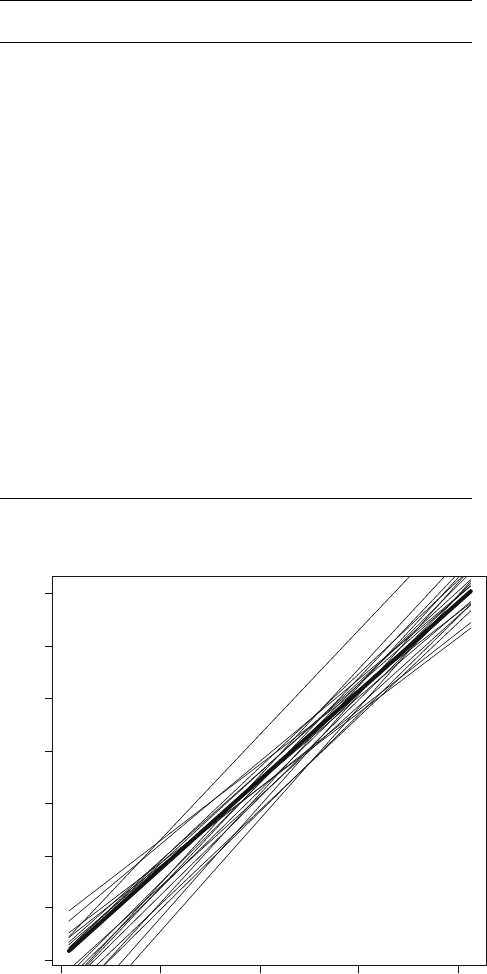
Table 12.1 Sim ulation results for Example 12.11
^
b
0
^
b
1
s
1 2.606 0.0086 0.312
2 3.639 0.0104 0.345
3 3.316 0.0100 0.530
4 3.042 0.0093 0.475
5 3.400 0.0103 0.441
6 3.932 0.0107 0.328
7 2.533 0.0090 0.423
8 2.862 0.0100 0.676
9 2.152 0.0081 0.401
10 2.975 0.0093 0.409
11 2.255 0.0084 0.639
12 3.003 0.0095 0.437
13 3.187 0.0093 0.587
14 2.424 0.0087 0.598
15 1.490 0.0073 0.735
16 1.812 0.0074 0.332
17 1.845 0.0079 0.552
18 4.080 0.0107 0.520
19 2.958 0.0090 0.718
20 1.670 0.0072 0.574
400 500 600 700 800
CO2
4.5
4.0
3.5
3.0
2.5
2.0
1.5
1.0
mass
Figure 12.15 Simulation results from Example 12.11: graphs of the true
regression line and 20 least squares lines (from R) ■
12.3 Inferences About the Regression Coefficient b
1
641

The slope b
1
of the population regression line is the true average change in the
dependent variable y associated with a 1-unit increase in the independent variable x.
The slope of the least squares line,
^
b
1
, gives a point estimate of b
1
. In the same way
that a confidence interval for m and procedures for testing hypotheses about m were
based on properties of the sampling distribution of
X, further inferences about b
1
are
based on thinking of
^
b
1
as a statistic and investigating its sampling distribution.
The values of the x
i
’s are assumed to be chosen before the experiment is
performed, so only the Y
i
’s are random. The estimators (statistics, and thus random
variables) for b
0
and b
1
are obtained by replacing y
i
by Y
i
in (12.2) and (12.3):
^
b
1
¼
P
ðx
i
xÞðY
i
YÞ
P
ðx
i
xÞ
2
;
^
b
0
¼
P
Y
i
^
b
1
P
x
i
n
Similarly, the estimator for s
2
results from replacing each y
i
in the formula for s
2
by
the rv Y
i
:
^
s
2
¼ S
2
¼
P
Y
2
i
^
b
0
P
Y
i
^
b
1
P
x
i
Y
i
n 2
The denominator of
^
b
1
, S
xx
¼
P
ðx
i
xÞ
2
, depends only on the x
i
’s and not
on the Y
i
’s, so it is a constant. Then because
P
ðx
i
xÞY ¼ Y
P
ðx
i
xÞ¼
Y 0 ¼ 0, the slope estimator can be written as
^
b
1
¼
P
ðx
i
xÞY
i
S
xx
¼
X
c
i
Y
i
where c
i
¼ðx
i
xÞ=S
xx
That is,
^
b
1
is a linear function of the independent rv’s Y
1
, Y
2
, ..., Y
n
, each of which
is normally distributed. Invoking properties of a linear funct ion of random variables
discussed in Section 6.3 leads to the following results (Exercise 40).
1. Th e mean value of
^
b
1
is Eð
^
b
1
Þ¼m
^
b
1
¼ b
1
,so
^
b
1
is an unbiased estimator
of b
1
(the distribution of
^
b
1
is always centered at the value of b
1
).
2. Th e variance and standard deviation of
^
b
1
are
Vð
^
b
1
Þ¼s
2
^
b
1
¼
s
2
S
xx
s
^
b
1
¼
s
ffiffiffiffiffiffi
S
xx
p
ð12:5Þ
where S
xx
¼
P
ðx
i
xÞ
2
¼
P
x
2
i
P
x
i
ðÞ
2
=n. Replacing s by its estimate
s gives an estimate for s
^
b
1
(the estimated standard deviation, i.e., estimated
standard error, of
^
b
1
):
s
^
b
1
¼
s
ffiffiffiffiffiffi
S
xx
p
(This estimate can also be denoted by
^
s
^
b
1
.)
3. Th e estimator
^
b
1
has a normal distribution (because it is a linear function
of independent normal rv’s).
642 CHAPTER 12 Regression and Correlation

According to (12.5), the variance of
^
b
1
equals the variance s
2
of the random error
term—or, equivalently, of any Y
i
—divided by
P
ðx
i
xÞ
2
. Because
P
ðx
i
xÞ
2
is
a measure of how spread out the x
i
’s are about x, we conclude that making
observations at x
i
values that are quite spread out results in a more precise estimator
of the slope parameter (smaller variance of
^
b
1
), whereas values of x
i
all close to each
other imply a highly variable estimator. Of course, if the x
i
’s are spread out too far,
a linear model may not be appropriate throughout the range of observation.
Many inferential procedures discussed previously were based on standardiz-
ing an estimator by first subtracting its mean value and then dividing by its
estimated standard deviation. In particular, test procedures and a CI for the mean
m of a normal population utilized the fact that the standar dized variable
ð
X mÞ=ðS=
ffiffiffiffiffi
nÞ
p
—that is, ðX mÞ=S
^
m
—had a t distribution with n 1 df. A similar
result here provides the key to further inferences concerni ng b
1
.
THEOREM
The assumptions of the simple linear regression model imply that the
standardized variable
T ¼
^
b
1
b
1
S=
ffiffiffiffiffiffi
S
xx
p
¼
^
b
1
b
1
S
^
b
1
has a t distribution with n 2 df.
The T ratio can be written as
T ¼
^
b
1
b
1
S=
ffiffiffiffiffiffi
S
xx
p
¼
^
b
1
b
1
s=
ffiffiffiffiffiffi
S
xx
p
ffiffiffiffiffiffiffiffiffiffiffiffiffiffiffiffiffiffiffiffiffiffiffiffiffiffi
ðn 2ÞS
2
s
2
ðn 2Þ
s
The theorem is a consequence of the following facts: ð
^
b
1
b
1
Þ=ðs=
ffiffiffiffiffiffi
S
xx
p
Þ
N 0; 1ðÞ, ðn 2ÞS
2
s
2
w
2
n2
, and
^
b
1
is independent of S
2
. That is, T is a standard
normal rv divided by the square root of an independent chi-squared rv over its df, so
T has the specified t distribution.
A Confidence Interval for b
1
As in the derivation of previous CIs, we begin with a probability statement:
P t
a=2;n2
<
^
b
1
b
1
S
^
b
1
< t
a=2;n2
!
¼ 1 a
Manipulation of the inequalitie s inside the parentheses to isolate b
1
and substitution
of estimates in place of the estimators gives the CI formula.
12.3 Inferences About the Regression Coefficient b
1
643

A 100(1 a)% CI for the slope b
1
of the true regression line is
^
b
1
t
a=2;n2
s
^
b
1
This interval has the same general form as did many of our previous intervals. It is
centered at the point estimate of the parameter, and the amount it extends out to
each side of the estimate depends on the desired confidence level (through the
t critical value) and on the amount of variability in the estimator
^
b
1
(through s
^
b
1
,
which will tend to be small when there is little variability in the distribution of
^
b
1
and large otherwise).
Example 12.12 Is it possible to predict graduation rates from freshman test scores? Based on
the average SAT score of entering freshmen at a university, can we predict the
percentage of those freshmen who will get a degree there within 6 years? We use a
random sample of 20 universities from the 248 national universities listed in the
2005 edition of America’s Best Colleges, published by U. S .News & World Report.
Rank University Grad rate SAT Private or State
1 2 Princeton 98 1465.00 P
2 13 Brown 96 1395.00 P
3 15 Johns Hopkins 88 1380.00 P
4 69 Pittsburgh 65 1215.00 S
5 77 SUNY-Binghamton 80 1235.00 S
6 94 Kansas 58 1011.10 S
7 102 Dayton 76 1055.54 P
8 107 Illinois Inst Tech 67 1166.65 P
9 125 Arkansas 48 1055.54 S
10 139 Florida Inst Tech 54 1155.00 P
11 147 New Mexico Inst Mining 42 1099.99 S
12 158 Temple 54 1080.00 S
13 172 Montana 45 944.43 S
14 174 New Mexico 42 899.99 S
15 178 South Dakota 51 944.43 S
16 183 Virginia Commonwealth 42 1060.00 S
17 186 Widener 70 1005.00 P
18 187 Alabama A&M 38 722.21 S
19 243 Toledo 44 877.77 S
20 245 Wayne State 31 833.32 S
The SAT scores were actually given in the form of first and third quarti les, so the
average of those two numbers is used here. Notice that some of the SAT scores are
not integers. Those values were computed from ACT scores using the NCAA
formula SAT ¼55.556 + 44.444ACT, which is equivalent to saying that there
is a linear relationship with 17 on the ACT corresponding to 700 on the SAT, and
26 on the ACT corresponding to 1100 on the SAT.
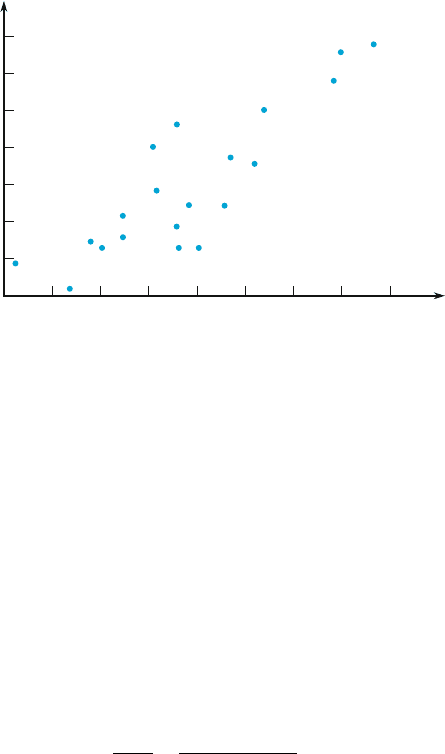
The scatter plot of the data in Figure 12.16 suggests the appropriateness of the
linear regression model; graduation rate increases approximately linearly with SAT.
644 CHAPTER 12 Regression and Correlation
The values of the summary statistics required for calculation of the least squares
estimates are
X
x
i
¼21;600:97
X
y
i
¼1189
X
x
2
i
¼24;034;220:545
X
x
i
y
i
¼1;346;524:53
X
y
2
i
¼78;113
from which S
xy
¼ 62,346.86, S
xx
¼ 704,125.298,
^
b
1
¼ :08854513,
^
b
0
¼
36:1830309, SST ¼ 7426:95, SSE ¼ 1906:439, r
2
¼ 1 1906:439=7426: 95 ¼
:7433. Roughly 74% of the observed variation in graduation rate can be attributed to
the simple linear regression model relationship between graduation rate and SAT.
Error df is 20 2 ¼ 18, giving s
2
¼ 1906.439/18 ¼ 105.9 and s ¼ 10.29.
The estimated standard deviation of
^
b
1
is
s
^
b
1
¼
s
ffiffiffiffiffiffi
S
xx
p
¼
10:29
ffiffiffiffiffiffiffiffiffiffiffiffiffiffiffiffiffiffiffiffiffiffiffiffiffi
704;125:298
p
¼ :01226
The t critical value for a confidence level of 95% is t
.025,18
¼ 2.101. The confidence
interval is
:0885 2:101ðÞ:01226ðÞ¼:0885 :0258 ¼ :063 ;:114ðÞ
With a high degree of confidence, we estimate that an average increase in
percentage graduation rate of between .063 and .114 is associated with a 1 point
increase in SAT. Multiplying by 100 gives the change in graduation percentage
corresponding to a 100 point increase in SAT, 8.85 2.58, between 6.3 and 11.4.
This shows that a substantial increase in graduation rate accompanies an increase of
100 SAT points. Is this a causal relationship, so a university president can count on
an increased graduation rate if the admissions process becomes more selective in
terms of entrance exam scores? One can imagine contrary scenarios, such as that
more serious students attend more prestigious colleges, with higher entrance
requirements and higher graduation rates, and that prestige would not be affected
by an increase in entrance requirements. However, it seems more likely that
60
50
40
30
90
80
70
100
700 800 900 1000 1100 1200 1300 1400 1500
Grad. rate
SAT
Figure 12.16 Scatter plot of the data from Example 12.12
12.3 Inferences About the Regression Coefficient b
1
645
prestige would benefit from higher test scores, so this scenario is not a very good
argument against causality. In any case, there is at least one university president
who claimed that increasing test scores resulted in a higher graduation rate.
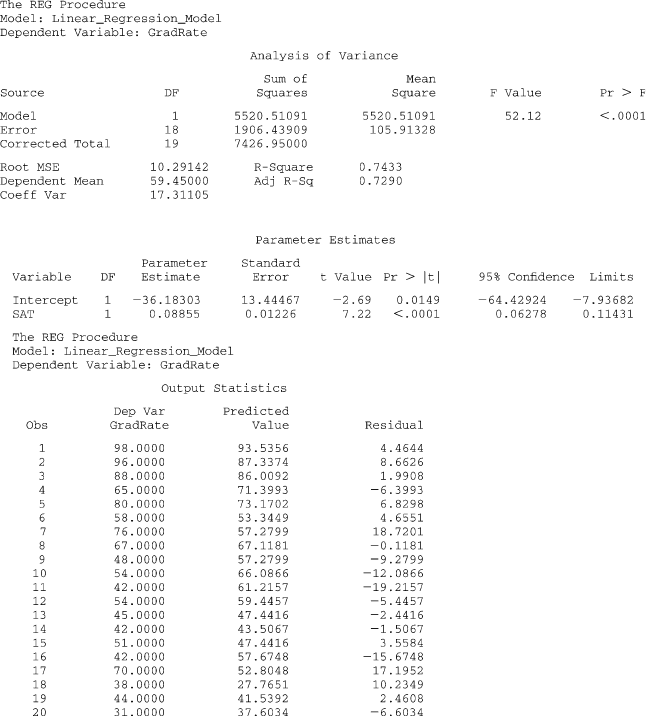
Looking at the SAS output of Figure 12.17, we find the value of s
^
b
1
under
Parameter Estimates as the second number in the Standard Error column. All of the
widely used statistical packages include this estimated standard error in output.
There is also an estimated standard error for the statistic
^
b
0
. Confidence intervals for
b
1
and b
0
appear on the output. For all of the statistics, compare the values on the
SAS output with the values that we calculated.
The output shows the values of graduation rate, predicted values, and residuals.
Matching the rows in Figure 12.17 with the corresponding rows in the original listing
of the data, it is possible to see that the residuals for the private universities are mostly
positive. However, it is much easier to see this in Figure 12.18,wheretheprivate
Figure 12.17 SAS output for the data of Example 12.12
646
CHAPTER 12 Regression and Correlation
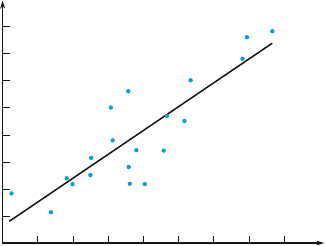
universities are labeled “P” and the public universities are labeled “S.” Of the seven
private universities, five are above their predictions (positive residual) and one is
barely below. Private universities mostly seem to achieve a higher graduation rate for
a given entrance exam score (for more on this issue, see the rest of the story in
Sections 12.6 and 12.7). It is interesting to speculate about why this might occur.
Is there a more nurturing atmosphere with more individual attention at private
schools? On the other hand, private universities might attract students who are
more likely to graduate regardless of the campus atmosphere.
■
Hypothesis-Testing Procedures
As before, the null hypothesis in a test about b
1
will be an equality statement. The
null value (value of b
1
claimed true by the null hypothesis) will be denoted by b
10
(read “beta one nought,” not “beta ten”). The test statistic results from replacing b
1
in the standardized variable T by the null value b
10
—that is, from standardizing the
estimator of b
1
under the assumption that H
0
is true. The test statistic thus has a
t distribution with n 2 df when H
0
is true, so the type I error probability is
controlled at the desired level a by using an appropriate t critica l value.
The most commonly encountered pair of hypotheses about b
1
is H
0
: b
1
¼ 0
versus H
a
: b
1
6¼ 0. When this null hypothesis is true, m
Yx
¼ b
0
independent of x,
so know ledge o f x gives no information about the value of the dependent variable.
A tes t of these two hypotheses is often referred to as the model utility test in simple
linear regression. Unless n is quite small, H
0
will be rejected and the utility of
the model confirmed precisely when r
2
is reasonably large. The simple linear
regression model should not be used for further inferences (estimates of mean
value or predictions of future values) unless the model utility test results in
rejection of H
0
for a suitably small a.
60
50
40
20
30
90
80
70
100
Grad. rate
P
P
P
P
P
S
S
S
S
S
S
S
S
S
S
S
S
P
P
P
700 800 900 1000 1100 1200 1300 1400 1500
SAT
Figure 12.18 Comparing private and state universities
12.3 Inferences About the Regression Coefficient b
1
647