
Devore J.L., Berk K.N. Modern Mathematical Statistics with Applications
Подождите немного. Документ загружается.


Assuming that the pairs are drawn from a bivariate normal distribution allows
us to test hypotheses about r and to construct a CI. There is no completely
satisfactory way to check the plausibility of the bivariate normality assumption.
A partial check involves constructing two separate normal probability plots, one for
the sample x
i
’s and another for the sample y
i
’s, since bivariate normality implies
that the marginal distributions of both X and Y are normal. If either plot deviates
substantially from a straight-line pattern, the following inferential procedures
should not be used when the sample size n is small. Also, as discussed in Example
12.19, the scatter plot should show a roughly elliptical shape.
TESTING
FOR THE
ABSENCE
OF CORRE-
LATION
When H
0
: r ¼ 0 is true, the test statistic
T ¼
R
ffiffiffiffiffiffiffiffiffiffiffi
n 2
p
ffiffiffiffiffiffiffiffiffiffiffiffiffiffi
1 R
2
p
has a t distribution with n 2 df (see Exercise 65).
Alternative Hypothesis Rejection Region for Level a Test
H
a
: r > 0 t t
a,n2
H
a
: r < 0 t t
a,n2
H
a
: r 6¼ 0 either t t
a/2,n2
or t t
a/2,n2
A P-value based on n 2 df can be calculated as described previously.
Example 12.20 Neu rotoxic effects of manganese are well known and are usually caused by high
occupational exposure over long periods of time . In the fields of occupational
hygiene and environmental hygiene, the relationship between lipid peroxida tion,
which is responsible for deterioration of foods and damage to live tissue, and
occupational exposure had not been previously reported. The article “Lipid Perox-
idation in Workers Exposed to Manganese” (Scand. J. Work Environ. Health, 1996:
381–386) gave data on x ¼ manganese concentration in blood (ppb) and y ¼ con-
centration (mmol/L) of malondialdehyde, which is a stable product of lipid peroxi-
dation, both for a sample of 22 workers exposed to manganese and for a control
sample of 45 individuals. The value of r for the control sample was .29, from which
t ¼
ð:29Þ
ffiffiffiffiffiffiffiffiffiffiffiffiffiffi
45 2
p
ffiffiffiffiffiffiffiffiffiffiffiffiffiffiffiffiffi
1 :29
2
p
2:0
The corresponding P-value for a two-tailed t test based on 43 df is roughly .052 (the
cited article reported only that the P-value > .05). We would not want to reject the
assertion that r ¼ 0 at either significance level .01 or .05. For the sample of
exposed workers, r ¼ .83 and t ¼ 6.7, clear evidence that there is a positive
relationship in the entire population of exposed workers from which the sam ple
was selected. Although in general correlation does not necessarily imply causation,
it is plausible here that higher levels of manganese cause higher levels of per-
oxidation.
■
668 CHAPTER 12 Regression and Correlation

Because r measures the extent to which there is a linear relationship between
the two variables in the population, the null hypothesis H
0
: r ¼ 0 states that there is
no such population relationship. In Section 12.3, we used the t ratio
^
b
1
=s
^
b
1
to test for
a linear relationship between the two variables in the context of regression analysis.
It turns out that the two test procedures are completely equivalent because
r
ffiffiffiffiffiffiffiffiffiffiffi
n 2
p
=
ffiffiffiffiffiffiffiffiffiffiffiffiffi
1 r
2
p
¼
^
b
1
=s
^
b
1
(Exercise 65). When interest lies only in assessi ng the
strength of any linear relationship rather than in fitting a model and using it to
estimate or predict, the test statistic formula just presented requires fewer computa-
tions than does the t ratio.
Other Inferences Concerning r
The procedure for testing H
0
: r ¼ r
0
when r
0
6¼ 0 is not equivalent to any
procedure from regression analysis. The test statistic is based on a transformation
of R called the Fisher transformation.
PROPOSITION
When (X
1
, Y
1
), ...,(X
n
, Y
n
) is a sample from a bivariate normal distribution,
the rv
V ¼
1
2
ln
1 þ R
1 R
ð12:10Þ
has approximately a normal distribution with mean and variance
m
V
¼
1
2
ln
1 þ r
1 r
s
2
V
¼
1
n 3
The rationale for the transformation is to obtain a function of R that has a variance
independent of r; this would not be the case with R itself. Also, the approximation
will not be valid if n is quite small.
The test statistic for testing H
0
: r ¼ r
0
is
Z ¼
V
1
2
ln½ð1 þ r
0
Þ=ð1 r
0
Þ
1=
ffiffiffiffiffiffiffiffiffiffiffi
n 3
p
Alternative Hypothesis Rejection Region for Level a Test
H
a
: r > r
0
z z
a
H
a
: r < r
0
z z
a
H
a
: r 6¼ r
0
either z z
a/2
or z z
a/2
A P-value can be calculated in the same manner as for previous z tests.
12.5 Correlation 669
Example 12.21 As far back as Leonardo da Vinci, it was known that height and wingspan
(measured fingertip to fingertip between outstretched hands) are closely related.
For these measurements (in inches) from 16 students in a statistics class notice how
close the two values are.
Student: 12345678
Height: 63.0 63.0 65.0 64.0 68.0 69.0 71.0 68.0
Wingspan: 62.0 62.0 64.0 64.5 67.0 69.0 70.0 72.0
Student: 910111213141516
Height: 68.0 72.0 73.0 73.5 70.0 70.0 72.0 74.0
Wingspan: 70.0 72.0 73.0 75.0 71.0 70.0 76.0 76.5
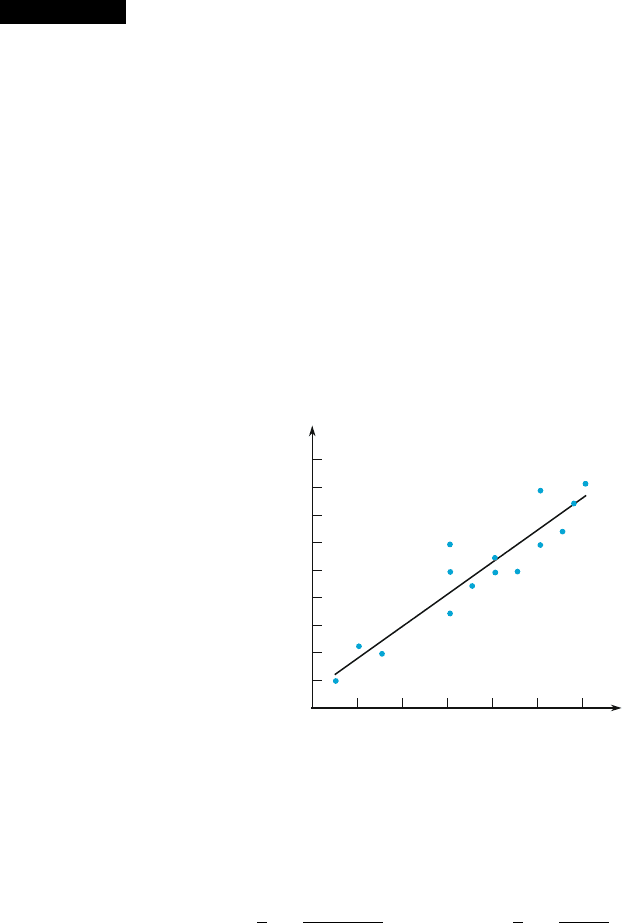
The scatter plot in Figure 12.26 shows an approximat ely linear shape, and the point
cloud is roughly elliptical. Also, the normal plots for the individual variables are
roughly linear, so the bivariate normal distribution can reasonably be assumed.
The correlation is compute d to be .9422. Can it be conclude that wingspan
and height are highly correlated, in the sense that r > .8? To carry out a test of
H
0
: r ¼ .8 versus H
a
: r > .8, we Fisher transform .9422 and .8:
1
2
ln
1 þ :9422
1 :9422
¼ 1:757
1
2
ln
1 þ :8
1 :8
¼ 1:099
The calculation is easily done on a calculator with hyperbolic functions,
because the inverse hyperbolic tangent is equivalent to the Fisher transformation.
That is, tanh
1
(.9422) ¼ 1.757 and tanh
1
(.8) ¼ 1.099. Compute z ¼
1:757 1:099ðÞ=ð1=
ffiffiffiffiffiffiffiffiffiffiffiffiffiffi
16 3
p
Þ¼2:37. Since 2.37 1.645, at level .05 we can
reject H
0
: r ¼ .8 in favor of H
a
: r .8. Indeed, because 2.37 2.33, it is also
true that we can reject H
0
in this one-tailed test at the .01 level, and conclude that
wingspan is highly correlated with height.
■
64
62
60
74
76
68
66
72
70
78
62 64 66 68 70 72 74
Wingspan
Height
Figure 12.26 Wingspan plotted against height
670
CHAPTER 12 Regression and Correlation

To obtain a CI for r, we first derive an interval for
m
V
¼
1
2
ln½ð1 þ rÞ=ð1 rÞ. Standardizing V, writing a probability statement, and
manipulating the resulting inequalities yields
v
z
a=2
ffiffiffiffiffiffiffiffiffiffiffi
n 3
p
; v þ
z
a=2
ffiffiffiffiffiffiffiffiffiffiffi
n 3
p
ð12:11Þ
as a 100(1 a)% interval for m
V
, where v ¼
1
2
ln½ð1 þ rÞ=ð1 rÞ. This interval can
then be manipulated to yield a CI for r.
A 100(1 a)% confidence interval for r is
e
2c
1
1
e
2c
1
þ 1
;
e
2c
2
1
e
2c
2
þ 1
where c
1
and c
2
are the left and right endpoints, respectively, of the interval
(12.11).
Example 12.22
(Example 12.21
continued)
The sample correlation coefficient between wingspan and height was r ¼ .9422,
giving n ¼ 1.757. With n ¼ 16, a 95% confidence interval for m
n
is
1:757 1:96=
ffiffiffiffiffiffiffiffiffiffiffiffiffiffi
16 3
p
¼ 1:213; 2:301ðÞ¼c
1
; c
2
ðÞ.
The 95% interval for r is
e
21:213ðÞ
1
e
21:213ðÞ
þ 1
;
e
22:301ðÞ
1
e
22:301ðÞ
þ 1
¼ð:838;:980Þ
As before, this calculation can be done more easily using the hyperbolic
tangent, which is the inverse of the Fisher transformation. This gives (tanh(1.213),
tanh(2.301)) ¼ (.838, .980). Notice that this interval excludes .8, and that our
hypothesis test in Example 12.21 would have rejected H
0
: r ¼ .8 in favor of the
alternative H
a
: r > .8 at the .025 level. ■
Absent the assumption of bivariate normality, a bootstrap procedure can be
used to obtain a CI for r or test hypotheses.
In Chapter 5, we cautioned that a large value of the correlation coefficient
(near 1 or 1) implies only association and not causation. This applies to both
r and r. It is easy to find strong but weird correlations in which neither variable is
casually related to the other. For example, since prohibition ended in the 1930s,
beer consumption and church attendance have correlated very highly. Of course,
the reason is that both variables have incr eased in accord with population growth.
12.5 Correlation 671
Exercises Section 12.5 (56–67)
56. The article “Behavioural Effects of Mobile Tele-
phone Use During Simulated Driving” (Ergo-
nomics, 1995: 2536–2562) reported that for a
sample of 20 experimental subjects, the sample
correlation coefficient for x ¼ age and y ¼ time
since the subject had acquired a driving license
(yr) was .97. Why do you think the value of r is
so close to 1? (The article’s authors gave an
explanation.)
57. The Turbine Oil Oxidation Test (TOST) and the
Rotating Bomb Oxidation Test (RBOT) are two
different procedures for evaluating the oxidation
stability of steam turbine oils. The article
“Dependence of Oxidation Stability of Steam
Turbine Oil on Base Oil Composition” (J. Soc.
Tribologists Lubricat. Engrs., Oct. 1997: 19–24)
reported the accompanying observations on x ¼
TOST time (hr) and y ¼ RBOT time (min) for 12
oil specimens.
TOST 4200 3600 3750 3675 4050 2770
RBOT 370 340 375 310 350 200
TOST 4870 4500 3450 2700 3750 3300
RBOT 400 375 285 225 345 285
a. Calculate and interpret the value of the sample
correlation coefficient (as did the article’s
authors).
b. How would the value of r be affected if we had
let x ¼ RBOT time and y ¼ TOST time?
c. How would the value of r be affected if RBOT
time were expressed in hours?
d. Construct a scatter plot and normal probability
plots and comment.
e. Carry out a test of hypotheses to decide
whether RBOT time and TOST time are line-
arly related.
58. Torsion during hip external rotation and extension
may explain why acetabular labral tears occur in
professional athletes. The article “Hip Rotational
Velocities During the Full Golf Swing” (J. Sport
Sci. Med., 2009: 296 – 299) reported on an inves-
tigation in which lead hip internal peak rotational
velocity (x) and trailing hip peak external rota-
tional velocity (y) were determined for a sample of
15 golfers. Data provided by the article’s authors
was used to calculate the following summary
quantities:
S
xx
¼ 64;732:83; S
yy
¼ 130;566:96;
S
xy
¼ 44;185:87
Separate normal probability plots showed very
substantial linear patterns.
a. Calculate a point estimate for the population
correlation coefficient.
b. If the simple linear regression model were fit
to the data, what proportion of variation in
external velocity could be attributed to the
model relationship? What would happen to
this proportion if the roles of x and y were
reversed? Explain.
c. Carry out a test at significance level .01 to
decide whether there is a linear relationship
between the two velocities in the sampled pop-
ulation; your conclusion should be based on a
P-value.
d. Would the conclusion of (c) have changed if
you had tested appropriate hypotheses to
decide whether there is a positive linear asso-
ciation in the population? What if a signifi-
cance level of .05 rather than .01 had been
used?
59. The authors of the paper “Objective Effects of a
Six Months’ Endurance and Strength Training
Program in Outpatients with Congestive Heart
Failure” (Med. Sci. Sports Exercise, 1999:
1102–1107) presented a correlation analysis to
investigate the relationship between maximal lac-
tate level x and muscular endurance y. The accom-
panying data was read from a plot in the paper.
x 400 750 770 800 850 1025 1200
y 3.80 4.00 4.90 5.20 4.00 3.50 6.30
x 1250 1300 1400 1475 1480 1505 2200
y 6.88 7.55 4.95 7.80 4.45 6.60 8.90
S
xx
¼ 36.9839, S
yy
¼ 2,628,930.357,
S
xy
¼ 7377.704
A scatter plot shows a linear pattern.
a. Test to see whether there is a positive correla-
tion between maximal lactate level and muscu-
lar endurance in the population from which this
data was selected.
b. If a regression analysis were to be carried out
to predict endurance from lactate level, what
proportion of observed variation in endurance
could be attributed to the approximate linear
relationship? Answer the analogous question if
regression is used to predict lactate level from
672
CHAPTER 12 Regression and Correlation
endurance—and answer both questions with-
out doing any regression calculations.
60. Hydrogen content is conjectured to be an impor-
tant factor in porosity of aluminum alloy castings.
The article “The Reduced Pressure Test as a Mea-
suring Tool in the Evaluation of Porosity/Hydro-
gen Content in A1–7 Wt Pct Si-10 Vol Pct SiC(p)
Metal Matrix Composite” (Metallurg. Trans.,
1993: 1857–1868) gives the accompanying data
on x ¼ content and y ¼ gas porosity for one par-
ticular measurement technique.
x .18 .20 .21 .21 .21 .22 .23
y .46 .70 .41 .45 .55 .44 .24
x .23 .24 .24 .25 .28 .30 .37
y .47 .22 .80 .88 .70 .72 .75
MINITAB gives the following output in response
to a CORRELATION command:
Correlation of Hydrcon and
Porosity ¼ 0.449
a. Test at level .05 to see whether the population
correlation coefficient differs from 0.
b. If a simple linear regression analysis had been
carried out, what percentage of observed vari-
ation in porosity could be attributed to the
model relationship?
61. Physical properties of six flame-retardant fabric
samples were investigated in the article “Sensory
and Physical Properties of Inherently Flame-
Retardant Fabrics” (Textile Res., 1984: 61–68).
Use the accompanying data and a .05 significance
level to determine whether there is a significant
correlation between stiffness x (mg-cm) and thick-
ness y (mm). Is the result of the test surprising in
light of the value of r?
x 7.98 24.52 12.47 6.92 24.11 35.71
y .28 .65 .32 .27 .81 .57
62. The article “Increases in Steroid Binding
Globulins Induced by Tamoxifen in Patients with
Carcinoma of the Breast” (J. Endocrinol., 1978:
219–226) reports data on the effects of the drug
tamoxifen on change in the level of cortisol-bind-
ing globulin (CBG) of patients during treatment.
With age ¼ x and DCBG ¼ y, summary values
are n ¼ 26,
P
x
i
¼ 1613,
P
ðx
i
xÞ
2
¼3756:96,
P
y
i
¼281:9,
P
ðy
i
yÞ
2
¼ 465:34, and
P
x
i
y
i
¼16;731
a. Compute a 90% CI for the true correlation
coefficient r.
b. Test H
0
: r ¼.5 versus H
a
: r < .5 at level
.05.
c. In a regression analysis of y on x, what propor-
tion of variation in change of cortisol-binding
globulin level could be explained by variation
in patient age within the sample?
d. If you decide to perform a regression analysis
with age as the dependent variable, what pro-
portion of variation in age is explainable by
variation in DCBG?
63. A sample of n ¼ 500 (x, y) pairs was collected
and a test of H
0
: r ¼ 0 versus H
a
: r 6¼ 0 was
carried out. The resulting P-value was computed
to be .00032.
a. What conclusion would be appropriate at level
of significance .001?
b. Does this small P-value indicate that there is a
very strong relationship between x and y (a
value of r that differs considerably from 0)?
Explain.
c. Now suppose a sample of n ¼ 10,000 (x, y)
pairs resulted in r ¼ .022. Test H
0
: r ¼0 versus
H
a
: r 6¼ 0 at level .05. Is the result statistically
significant? Comment on the practical signifi-
cance of your analysis.
64. Let x be number of hours per week of studying and
y be grade point average. Suppose we have one
sample of (x, y) pairs for females and another for
males. Then we might like to test the hypothesis
H
0
: r
1
r
2
¼ 0 against the alternative that the two
population correlation coefficients are different.
a. Use properties of the transformed variable V ¼
.5ln[(1 + R)/(1 R)] to propose an appropriate
test statistic and rejection region (let R
1
and
R
2
denote the two sample correlation coeffi-
cients).
b. The paper “Relational Bonds and Customer’s
Trust and Commitment: A Study on the Mod-
erating Effects of Web Site Usage” (Serv. Ind.
J., 2003: 103–124) reported that n
1
¼ 261,
r
1
¼ .59, n
2
¼ 557, r
2
¼ .50, where the first
sample consisted of corporate website users
and the second of non-users; here r is the
correlation between an assessment of the
strength of economic bonds and performance.
Carry out the test for this data (as did the
authors of the cited paper).
65. Verify that the t ratio for testing H
0
: b
1
¼ 0in
Section 12.3 is identical to t for testing H
0
: r ¼ 0.
66. Verify Property 2 of the correlation coefficient:
the value of r is independent of the units in which
x and y are measured; that is, if x
i
0
¼ ax
i
+ c and
y
i
0
¼ by
i
+ d, a > 0, b > 0, then r for the (x
i
0
, y
i
0
)
pairs is the same as r for the (x
i
, y
i
) pairs.
12.5 Correlation 673

67. Consider a time series—that is, a sequence of
observations X
1
, X
2
, ...on some response variable
(e.g., concentration of a pollutant) over time—
with observed values x
1
, x
2
, ..., x
n
over n time
periods. Then the lag 1 autocorrelation coefficient
is defined as
r
1
¼
P
n1
i¼1
ðx
i
xÞðx
iþ1
xÞ
P
n
i¼1
ðx
i
xÞ
2
Autocorrelation coefficients r
2
, r
3
, ... for lags 2,
3, ... are defined analogously.
a. Calculate the values of r
1
, r
2
, and r
3
for the
temperature data from Exercise 79 of Chapter 1.
b. Consider the n 1 pairs (x
1
, x
2
), (x
2
, x
3
), ...,
(x
n 1
, x
n
). What is the difference between the
formula for the sample correlation coefficient r
applied to these pairs and the formula for r
1
?
What if n, the length of the series, is large?
What about r
2
compared to r for the n 2 pairs
(x
1
, x
3
), (x
2
, x
4
), ...,(x
n 2
, x
n
)?
c. Analogous to the population correlation coeffi-
cient r,letr
i
(i ¼ 1, 2, 3, ... ) denote the theo-
retical or long-run autocorrelation coefficients at
the various lags. If all these r’s are zero, there is
no (linear) relationship between observations in
the series at any lag. In this case, if n is large, each
R
i
has approximately a normal distribution with
mean 0 and standard deviation 1=
ffiffiffi
n
p
and differ-
ent R
i
’s are almost independent. Thus H
0
: r
i
¼ 0
can be rejected at a significance level of approxi-
mately .05 if either r
i
r2=
ffiffiffi
n
p
or r
i
2=
ffiffiffi
n
p
.If
n ¼ 100 and r
1
¼ .16, r
2
¼.09, r
3
¼.15, is
there evidence of theoretical autocorrelation at
any of the first three lags?
d. If you are testing the null hypothesis in (c) for
more than one lag, why might you want to
increase the cutoff constant 2 in the rejection
region? [Hint: What about the probability of
committing at least one type I error?]
12.6
Assessing Model Adequacy
A plot of the observed pairs (x
i
, y
i
) is a necessary first step in deciding on the form
of a mathematical relationship between x and y. It is possible to fit many functions
other than a linear one (y ¼ b
0
+ b
1
x) to the data, using either the principle of least
squares or another fitting method. Once a function of the chosen form has been
fitted, it is important to check the fit of the model to see whether it is in fact
appropriate. One way to study the fit is to superimpose a graph of the best-fit
function on the scatter plot of the data. However, any tilt or curvature of the best-fit
function may obscure some aspects of the fit that should be investigated. Further-
more, the scale on the vertical axis may make it difficult to assess the extent to
which observed values deviate from the best-fit functions.
Residuals and Standardized Residuals
A more effective approach to assessment of model adequacy is to compute the
fitted or predicted values
^
y
i
and the residuals e
i
¼ y
i
^
y
i
and then plot various
functions of these computed quantities. We then examine the plots either to confirm
our choice of model or for indications that the model is not appropriate. Suppose the
simple linear regression model is correct, and let y ¼
^
b
0
þ
^
b
1
x be the equation of the
estimated regression line. Then the ith residual is e
i
¼ y
i
ð
^
b
0
þ
^
b
1
x
i
Þ. To derive
properties of the residuals, let e
i
¼ Y
i
^
Y
i
represent the ith residual as a random
variable (rv) (before observations are actually made). Then
EðY
i
^
Y
i
Þ¼EY
i
ðÞEð
^
b
0
þ
^
b
1
x
i
Þ¼b
0
þ b
1
x
i
ðb
0
þ b
1
x
i
Þ¼0 ð12:12Þ
Because
^
Y
i
ð¼
^
b
0
þ
^
b
1
x
i
Þis a linear function of the Y
j
’s, so is Y
i
^
Y
i
(the coefficients
depend on the x
j
’s). Thus the normality of the Y
j
’s implies that each residual is
normally distributed. It can also be shown (Exercise 76) that
674 CHAPTER 12 Regression and Correlation

VðY
i
^
Y
i
Þ¼s
2
1
1
n
ðx
i
xÞ
2
S
xx
"#
ð12:13Þ
Replacing s
2
by s
2
and taking the square root of Equation (12.13) gives the
estimated standard deviation of a residual.
Let’s now standardize each residual by subtracting the mean value (zero) and
then dividing by the estimated standard deviation.
The standardized residuals are given by
e
i
¼
y
i
^
y
i
s
ffiffiffiffiffiffiffiffiffiffiffiffiffiffiffiffiffiffiffiffiffiffiffiffiffiffiffiffiffiffiffiffiffiffi
1
1
n
ðx
i
xÞ
2
S
xx
s
i ¼ 1; ...; n ð12:14Þ
Notice that the variances of the residuals d iffer from one another. If n is reasonably
large, though, the bracketed term in (12.13) will be approximately 1, so some
sources use e
i
/s as the standardized residual. Computation of the e
i
*’s can be
tedious, but the most widely used statistical computer packages automatically
provide these values and (upon request) can construct various plots involving them.
Example 12.23 Example 12.12 presented data on x ¼ average SAT for entering freshmen and
y ¼ six-year percentage graduation rate. Here we reproduce the data along with the
fitted valu es and their estim ated standard deviations, residuals and their estimated
standard deviations, and standardized residuals. The estimated regression line is
y ¼36.18 + .08855x, and r
2
¼ .729. Notice that estimated standar d deviations
of the residuals (in the s
e
column) differ somewhat, so e* 6¼ e/s. The standard
deviations of the residuals are higher near
x, in contrast to the standard deviations of
the predicted values, which are lower near
x.
xy
^
ys
^
y
es
e
e*
722.21 38 27.7651 4.9554 10.2349 9.020 1.135
833.32 31 37.6034 3.8016 6.6034 9.564 0.690
877.77 44 41.5392 3.3838 2.4608 9.719 0.253
899.99 42 43.5067 3.1894 1.5067 9.785 0.154
944.43 45 47.4416 2.8394 2.4416 9.892 0.247
944.43 51 47.4416 2.8394 3.5584 9.892 0.360
1005.00 70 52.8048 2.4785 17.1952 9.989 1.721
1011.10 58 53.3449 2.4517 4.6551 9.995 0.466
1055.54 48 57.2799 2.3208 9.2799 10.026 0.926
1055.54 76 57.2799 2.3208 18.7201 10.026 1.867
1060.00 42 57.6748 2.3143 15.6748 10.028 1.563
1080.00 54 59.4457 2.3012 5.4457 10.031 0.543
1099.99 42 61.2157 2.3142 19.2157 10.028 1.916
1155.00 54 66.0866 2.4780 12.0866 9.989 1.210
1166.65 67 67.1181 2.5345 0.1181 9.974 0.012
1215.00 65 71.3993 2.8346 6.3993 9.893 0.647
1235.00 80 73.1702 2.9845 6.8298 9.849 0.693
1380.00 88 86.0092 4.3392 1.9908 9.332 0.213
1395.00 96 87.3374 4.4963 8.6626 9.257 0.936
1465.00 98 93.5356 5.2522 4.4644 8.850 0.504
■
12.6 Assessing Model Adequacy 675

Diagnostic Plots
The basic plots that many statisticians recommend for an assessment of model
validity and usefulness are the following:
1. y
i
on the vertical axis versus x
i
on the horizontal axis
2. y
i
on the vertical axis versus
^
y
i
on the horizontal axis
3. e
i
* (or e
i
) on the vertical axis versus x
i
on the horizontal axis
4. e
i
* (or e
i
) on the vertical axis versus
^
y
i
on the horizontal axis
5. A normal probability plot of the standardized residuals (or residuals)
Plots 3 and 4 are called residual plots against the independent variable and fitted
(predicted) values, respective ly.
If Plot 2 yields points close to the 45
line [slope +1 through (0, 0)], then the
estimated regression function gives accurate predictions of the values actually
observed. Thus Plot 2 provides a visual assessment of model effectiveness in
making predictions. Provided that the model is correct, neither residua l plot should
exhibit distinct patterns. The residuals should be randomly distributed about
0 according to a normal distribution, so all but a very few standardized residuals
should lie between 2 and +2 (i.e., all but a few residuals within 2 standard
deviations of their expected value 0). The plot of standardized residuals versus
^
y
is really a combination of the two other plots, showing implicitly both how
residuals vary with x and how fitted values compare with observed values. This
latter plot is the single one most often recommended for multiple regression
analysis. Plot 5 allows the analyst to assess the plausibility of the assumpt ion that
e has a normal distribution.
Example 12.24
(Example 12.23
continued)
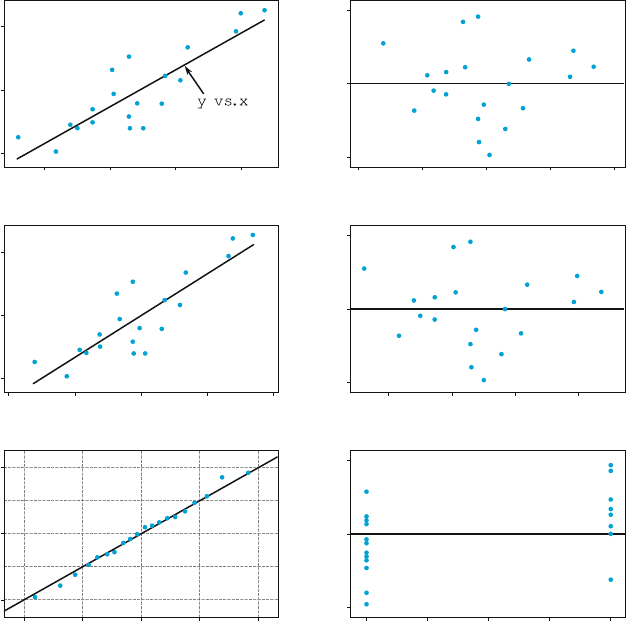
Figure 12.27 presents the five plots just recommended along with a sixth plot. The
plot of y versus
^
y confirms the impression given by r
2
that x is fairly effective in
predicting y. The residual plots show no unusual pattern or discrepant values. The
normal probability plot of the standardized residuals is quite straight. In summary,
the first five plots leave us with no qualms about either the appropriateness of a
simple linear relationship or the fit to the given data.
Notice that plotting against x yields the same shape as a plot against the
predicted values. Is this surprising? The predicted value is a linear function of x,so
the plots will have the same appearance. Given that the plots look the same, why
include both? This is preparation for the next section, where more than one
predictor is allowed, and plotting against x is not the same as plotting against the
predicted values.
The sixth plot in Figure 12.27 is in accord with what was found graphically in
Example 12.12. In that example, Figure 12.18 showed that private universities
might tend to have better graduation rates than state universities. For another
graphical view of this, we show in the last plot of Figure 12.27 the standardized
residuals plotted against a variable that is 0 for sta te universit ies and 1 for private
universities. In this graph the private universities do seem to have an advantage, but
we will need to wait until the next section for a hypothesis test, which requires
including this new variable as a second predictor in the model.
676 CHAPTER 12 Regression and Correlation
Difficulties and Remedies
Although we hope that our analysis will yield plots like the first five of
Figure 12.27, quite frequently the plots will suggest one or more of the following
difficulties:
1. A nonlinear probabilistic relationship between x and y is appropriate.
2. Th e variance of e (and of Y) is not a constant s
2
but depends on x.
3. Th e selected model fits the data well except for a very few discrepant or outlying
data values, which may have greatly influenced the choice of the best-fit
function.
4. Th e error term e does not have a normal distribution (this is related to item 3).
5. When the subscript i indicates the time order of the observations, the e
i
’s exhibit
dependence over time.
6. One or mor e relevant independent variables have been omitted from the model.
1200800 1000 1400
SAT
30
90
60
20 40 60 80 100
Predicted Value
2
0
-2
y
=
-36.18
+.08855
x
Standardized
residuals vs.
predicted
60 8020 40 100
Predicted Value
30
90
60
800 1000 1200 1400
SAT
2
0
-2
y
vs.
predicted
Standardized
residuals vs.
x
01
-2 2-1
z Score
-2
2
0
0.00 0.25 0.50 0.75 1.00
State = 0 Private = 1
2
0
-2
Normal
probability
plot
Standardized
residuals vs.
another variable
Graduation Rate
Standardized Residual
Graduation Rate
Standardized Residual
Standardized Residual
Standardized Residual
Figure 12.27 Plots for the data from Example 12.24 ■
12.6 Assessing Model Adequacy 677