
Devore J.L., Berk K.N. Modern Mathematical Statistics with Applications
Подождите немного. Документ загружается.

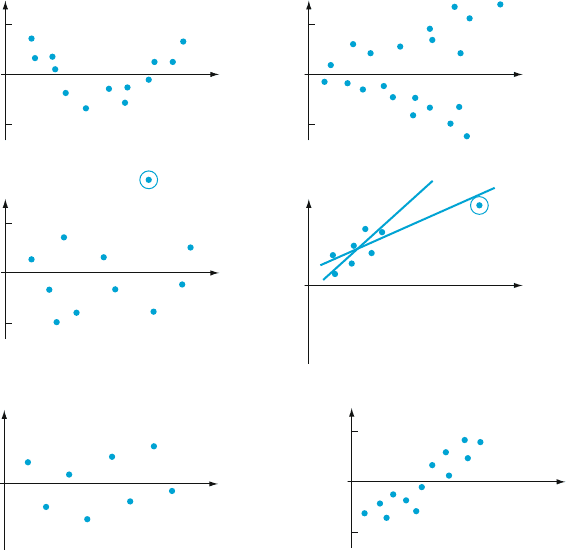
Figure 12.28 presents residual plots corresponding to items 1–3, 5, and 6. In
Chapter 4, we discussed patterns in normal probability plots that cast doubt on the
assumption of an underlying normal distribution. Notice that the residuals from the
data in Figure 12.28d with the circled point included would not by themselves
necessarily suggest further analysis, yet when a new line is fit with that point
deleted, the new line differs considerably from the original line. This type of
behavior is more difficult to identify in multiple regression. It is most likely to
arise when there is a single (or very few) data point(s) with independent variable
value(s) far removed from the remainder of the data.
We now indicate briefly what remedies are available for the types of diffi-
culties. For a more comprehensive discussion, one or more of the references on
regression analysis should be consulted. If the residual plot looks something like
that of Figure 12.28a, exhibiting a curved pattern, then a nonlinear function of x
may be fit.
The residual plot of Figure 12.28b suggests that, although a straight-line
relationship may be reasonable, the assumption that V(Y
i
) ¼ s
2
for each i is of
doubtful validity. When the error term e satisfies the independence and constant
variance assumptions (normality is not needed) for the simple linear regression
+2
-2
+2
-2
+2
-2
+2
-2
e*
e*
e* e*
e*
x
x
x
x
y
Time order
of observation
Omitted
independent
variable
ab
cd
e
f
Figure 12.28 Plots that indicate abnormality in data: (a) nonlinear relationship;
(b) non-constant variance; (c) discrepant observation; (d) observation with large
influence; (e) dependence in errors; (f) variable omitted
678
CHAPTER 12 Regression and Correlation

model of Section 12.1, it can be shown that among all unbiased estimators of b
0
and
b
1
, the ordinary least squares estimators have minimum variance. These estimators
give equal weight to each (x
i
, Y
i
). If the variance of Y increases with x, then Y
i
’s for
large x
i
should be given less weight than those with small x
i
. This suggests that
b
0
and b
1
should be estimated by minimizing
f
w
ðb
0
; b
1
Þ¼
X
w
i
½y
i
ðb
0
þ b
1
x
i
Þ
2
ð12:15Þ
where the w
i
’s are weights that decrease with increasing x
i
. Minimization of
Expression (12.15 ) yields weighted least squares estimates. For example, if the
standard deviation of Y is proportional to x (for x > 0)—that is, V(Y) ¼ kx
2
—then
it can be shown that the weights w
i
¼ 1=x
2
i
yield minimum variance estimators of
b
0
and b
1
. The books by Michael Kutner et al. and by S. Chatterjee et al. contain
more detail (see the chapter bibliography). Weighted least squares is used quite
frequently by econometricians (economists who use statistical methods) to estimate
parameters.
When plots or other evidence suggest that the data set contains outliers or
points having large influence on the resulting fit, one possible approach is to omit
these outlying points and recompute the estimated regression equation. This would
certainly be correct if it were found that the outliers resulted from errors in
recording data values or experimental errors. If no assignable cause can be found
for the outliers, it is still desirable to report the estimated equation both with and
without outliers. Yet another approach is to retain possible outliers but to use an
estimation principle that puts relatively less weight on outlying values than does the
principle of least squares. One such principle is MAD (minimize absolute devia-
tions), which selects
^
b
0
and
^
b
1
to minimize
P
y
i
b
0
þ b
1
x
i
ðÞ
jj
. Unlike the
estimates of least squares, there are no nice formulas for the MAD estimates;
their values must be found by using an iterative computational procedure . Such
procedures are also used when it is suspected that the e
i
’s have a distribution that is
not normal but instead has “heavy tails” (making it much more likely than for the
normal distribution that discrepant values will enter the sample); robust regression
procedures are those that produce reliable estimates for a wide variety of underly-
ing error distributions. Least squares estimators are not robust in the same way that
the sample mean
X is not a robust estimator for m.
When a plot suggests time dependence in the error terms, an appropriate
analysis may involve a transformation of the y’s or else a model explicitly including
a time variable. Lastly, a plot such as that of Figure 12.28f, which shows a pattern in
the residuals when plotted against an omitted variable, suggests considering a
model that includes the omitted variable. We have already seen an illustration of
this in Example 12.24. ■
Exercises Section 12.6 (68–77)
68. Suppose the variables x ¼ commuting distance
and y ¼ commuting time are related according
to the simple linear regression model with
s ¼ 10.
a. If n ¼ 5 observations are made at the x values
x
1
¼ 5, x
2
¼ 10, x
3
¼ 15, x
4
¼ 20, and
x
5
¼ 25, calculate the standard deviations of
the five corresponding residuals.
b. Repeat part (a) for x
1
¼ 5, x
2
¼ 10, x
3
¼ 15,
x
4
¼ 20, and x
5
¼ 50.
c. What do the results of parts (a) and (b) imply
about the deviation of the estimated line from
12.6 Assessing Model Adequacy 679

the observation made at the largest sampled x
value?
69. The x values and standardized residuals for the
chlorine flow/etch rate data of Exercise 51 (Sec-
tion 12.4) are displayed in the accompanying
table. Construct a standardized residual plot and
comment on its appearance.
x 1.50 1.50 2.00 2.50 2.50
e* .31 1.02 1.15 1.23 .23
x 3.00 3.50 3.50 4.00
e* .73 1.36 1.53 .07
70. Example 12.7 presented the residuals from a
simple linear regression of moisture content y
on filtration rate x.
a. Plot the residuals against x. Does the resulting
plot suggest that a straight-line regression
function is a reasonable choice of model?
Explain your reasoning.
b. Using s ¼ .665, compute the values of the
standardized residuals. Is e
i
* e
i
/s for
i ¼ 1, ..., n, or are the e
i
*’s not close to
being proportional to the e
i
’s?
c. Plot the standardized residuals against x.
Does the plot differ significantly in general
appearance from the plot of part (a)?
71. Wear resistance of certain nuclear reactor compo-
nents made of Zircaloy-2 is partly determined by
properties of the oxide layer. The following data
appears in an article that proposed a new nonde-
structive testing method to monitor thickness of
the layer (“Monitoring of Oxide Layer Thickness
on Zircaloy-2 by the Eddy Current Test Method,”
J. Test. Eval., 1987: 333–336). The variables are
x ¼ oxide-layer thickness (mm) and y ¼ eddy-
current response (arbitrary units).
x 0 7 17 114 133
y 20.3 19.8 19.5 15.9 15.1
x 142 190 218 237 285
y 14.7 11.9 11.5 8.3 6.6
a. The authors summarized the relationship by
giving the equation of the least squares line as
y ¼ 20.6 .047x. Calculate and plot the resi-
duals against x and then comment on the
appropriateness of the simple linear regres-
sion model.
b. Use s ¼ .7921 to calculate the standardized
residuals from a simple linear regression.
Construct a standardized residual plot and
comment. Also construct a normal probability
plot and comment.
72. As the air temperature drops, river water
becomes supercooled and ice crystals form.
Such ice can significantly affect the hydraulics
of a river. The article “Laboratory Study of
Anchor Ice Growth” (J. Cold Regions Engrg.,
2001: 60–66) described an experiment in which
ice thickness (mm) was studied as a function of
elapsed time (hr) under specified conditions. The
following data was read from a graph in the
article: n ¼ 33; x ¼ .17, .33, .50, .67, ..., 5.50;
y ¼ .50, 1.25, 1.50, 2.75, 3.50, 4.75, 5.75, 5.60,
7.00, 8.00, 8.25, 9.50, 10.50, 11.00, 10.75, 12.50,
12.25, 13.25, 15.50, 15.00, 15.25, 16.25, 17.25,
18.00, 18.25, 18.15, 20.25, 19.50, 20.00, 20.50,
20.60, 20.50, 19.80.
a. The r
2
value resulting from a least squares fit
is .977. Given the high r
2
, does it seem appro-
priate to assume an approximate linear rela-
tionship?
b. The residuals, listed in the same order as the x
values, are
1.03 0.92 1.35 0.78 0.68 0.11 0.21
0.59 0.13 0.45 0.06 0.62 0.94 0.80
0.14 0.93 0.04 0.36 1.92 0.78 0.35
0.67 1.02 1.09 0.66 0.09 1.33 0.10
0.24 0.43 1.01 1.75 3.14
Plot the residuals against x, and reconsider the
question in (a). What does the plot suggest?
73. The accompanying data on x ¼ true density
(kg/mm
3
) and y ¼ moisture content (% d.b.)
was read from a plot in the article “Physical
Properties of Cumin Seed” (J. Agric. Engrg.
Res., 1996: 93–98).
x 7.0 9.3 13.2 16.3 19.1 22.0
y 1046 1065 1094 1117 1130 1135
The equation of the least squares line is y
¼ 1008.14 + 6.19268x (this differs very slightly
from the equation given in the article); s ¼ 7.265
and r
2
¼ .968.
a. Carry out a test of model utility and comment.
b. Compute the values of the residuals and
plot the residuals against x. Does the plot
suggest that a linear regression function is
inappropriate?
680
CHAPTER 12 Regression and Correlation

c. Compute the values of the standardized
residuals and plot them against x. Are there
any unusually large (positive or negative)
standardized residuals? Does this plot give
the same message as the plot of part (b)
regarding the appropriateness of a linear
regression function?
74. Continuous recording of heart rate can be used to
obtain information about the level of exercise
intensity or physical strain during sports partici-
pation, work, or other daily activities. The article
“The Relationship Between Heart Rate and Oxy-
gen Uptake During Non-Steady State Exercise”
(Ergonomics, 2000: 1578–1592) reported on a
study to investigate using heart rate response (x,
as a percentage of the maximum rate) to predict
oxygen uptake (y, as a percentage of maximum
uptake) during exercise. The accompanying data
was read from a graph in the paper.
HR 43.5 44.0 44.0 44.5 44.0 45.0 48.0 49.0
VO
2
22.0 21.0 22.0 21.5 25.5 24.5 30.0 28.0
HR 49.5 51.0 54.5 57.5 57.7 61.0 63.0 72.0
VO
2
32.0 29.0 38.5 30.5 57.0 40.0 58.0 72.0
Use a statistical software package to perform a
simple linear regression analysis. Considering
the list of potential difficulties in this section,
see which of them apply to this data set.
75. Consider the following four (x, y) data sets; the
first three have the same x values, so these values
are listed only once (Frank Anscombe, “Graphs in
Statistical Analysis,” Amer. Statist., 1973: 17–21):
1–312344
xyyyxy
10.0 8.04 9.14 7.46 8.0 6.58
8.0 6.95 8.14 6.77 8.0 5.76
13.0 7.58 8.74 12.74 8.0 7.71
9.0 8.81 8.77 7.11 8.0 8.84
11.0 8.33 9.26 7.81 8.0 8.47
14.0 9.96 8.10 8.84 8.0 7.04
6.0 7.24 6.13 6.08 8.0 5.25
4.0 4.26 3.10 5.39 19.0 12.50
12.0 10.84 9.13 8.15 8.0 5.56
7.0 4.82 7.26 6.42 8.0 7.91
5.0 5.68 4.74 5.73 8.0 6.89
For each of these four data sets, the values of the
summary statistics
P
x
i
,
P
x
2
i
,
P
y
i
,
P
y
2
i
, and
P
x
i
y
i
are virtually identical, so all quantities
computed from these five will be essentially
identical for the four sets—the least squares
line (y ¼ 3 + .5x), SSE, s
2
, r
2
, t intervals, t sta-
tistics, and so on. The summary statistics provide
no way of distinguishing among the four data
sets. Based on a scatter plot and a residual plot
for each set, comment on the appropriateness or
inappropriateness of fitting a straight-line model;
include in your comments any specific sugges-
tions for how a “straight-line analysis” might be
modified or qualified.
76. a. Express the ith residual Y
i
^
Y
i
(where
^
Y
i
¼
^
b
0
þ
^
b
1
x
i
) in the form
P
c
j
Y
j
, a linear
function of the Y
j
’s. Then use rules of vari-
ance to verify that VðY
i
^
Y
i
Þ is given by
Expression (12.13).
b. As x
i
moves farther away from x, what hap-
pens to Vð
^
Y
i
Þ and to VðY
i
^
Y
i
Þ?
77. If there is at least one x value at which more than
one observation has been made, there is a formal
test procedure for testing
H
0
: m
Y·x
¼ b
0
+ b
1
x for some values b
0
, b
1
(the
true regression function is linear)
versus
H
a
: H
0
is not true (the true regression function is
not linear)
Suppose observations are made at x
1
, x
2
, ..., x
c
.
Let Y
11
; Y
12
; ...; Y
1n
1
denote the n
1
observations
when x ¼ x
1
; ...; Y
c
1
; Y
c
2
; ...; Y
cn
c
denote the n
c
observations when x ¼ x
c
.Withn ¼ Sn
i
(the
total number of observations), SSE has n 2df.
We break SSE into two pieces, SSPE (pure error)
and SSLF (lack of fit), as follows:
SSPE ¼
X
i
X
j
ðY
ij
Y
i
Þ
2
¼
X
i
X
j
Y
2
ij
X
i
n
i
ðY
i
Þ
2
SSLF ¼ SSE SSPE
The n
i
observations at x
i
contribute n
i
1dfto
SSPE, so the number of degrees of freedom for
SSPE is S
i
(n
i
1) ¼ n c and the degrees of
freedom for SSLF is n 2 (n c) ¼ c 2. Let
MSPE ¼ SSPE/(n c), MSLF ¼ SSLF/(c 2).
Then it can be shown that whereas E(MSPE) ¼ s
2
whether or not H
0
is true, E(MSLF) ¼ s
2
if H
0
is
true and E(MSLF) > s
2
if H
0
is false.
Test statistic: F ¼ MSLF=MSPE
Rejection region: f F
a
;c2;nc
12.6 Assessing Model Adequacy 681

The following data comes from the article
“Changes in Growth Hormone Status Related to
Body Weight of Growing Cattle” (Growth, 1977:
241–247), with x ¼ body weight and y ¼ meta-
bolic clearance rate/ body weight.
x 110 110 110 230 230 230 360
y 235 198 173 174 149 124 115
x 360 360 360 505 505 505 505
y 130 102 95 122 112 98 96
(So c ¼ 4, n
1
¼ n
2
¼ 3, n
3
¼ n
4
¼ 4.)
a. Test H
0
versus H
a
at level .05 using the lack-
of-fit test just described.
b. Does a scatter plot of the data suggest that the
relationship between x and y is linear? How
does this compare with the result of part (a)?
(A nonlinear regression function was used in
the article.)
12.7
Multiple Regression Analysis
In multiple regression, the objective is to build a probabilistic model that relates a
dependent variable y to more than one independent or predictor variable. Let k
represent the number of predictor variables (k 2) and denote these predictors by
x
1
, x
2
, ..., x
k
. For example, in attempting to predict the selling price of a house, we
might have k ¼ 3withx
1
¼ size (ft
2
), x
2
¼ age (years), and x
3
¼ number of rooms.
DEFINITION
The general additive multiple regression model equation is
Y ¼ b
0
þ b
1
x
1
þ b
2
x
2
þþb
k
x
k
þ e ð12:16Þ
where E(e) ¼ 0 and V(e) ¼ s
2
. In addition, for purposes of testing hypoth-
eses and calculating CIs or PIs, it is assumed that e is normally d istributed and
also that the e’s associated with various observations, and thus the Y
i
’s
themselves, are independent of one another.
Let x
1
; x
2
; ...; x
k
be particular values of x
1
, ..., x
k
. Then (12.16 ) implies that
m
Yx
1
;x
2
;...;x
k
¼ b
0
þ b
1
x
1
þþb
k
x
k
ð12:17Þ
Thus, just as b
0
+ b
1
x describes the mean Y value as a function of x in simple linear
regression, the true (or population) regression function b
0
+ b
1
x
1
+ + b
k
x
k
gives the expected value of Y as a function of x
1
, ..., x
k
.Theb
i
’s are the true (or
population) regression coefficients. The regression coefficient b
1
is interpreted as
the expected change in Y associated with a 1-unit increase in x
1
while x
2
, ..., x
k
are
held fixed. Analogous interpretations hold for b
2
, ..., b
k
.
Estimating Parameters
The data in simple linear regression consists of n pairs (x
1
, y
1
), ...,(x
n
, y
n
). Suppose
that a multiple regression model contains two predictor variables, x
1
and x
2
. Then
each observation will consist of three numbers (a triple): a value of x
1
, a value of x
2
,
and a value of y. More generally, with k independent or predictor variables, each
682 CHAPTER 12 Regression and Correlation
observation will consist of k + 1 numbers (a “k + 1 tuple”). The values of the
predictors in the individual observations are denoted using double-subscripting:
x
ij
¼ the value of the jth predictor x
j
in the ith observation
i ¼ 1; ... ; n; j ¼ 1; ... ; kðÞ:
Thus the first subscript is the observation number and the second subscript is the
predictor number. For example, x
83
is the value of the 3rd predictor in the 8th
observation (to avoid confusion, a comma can be inserted between the two sub-
scripts, e.g. x
12,3
). The first observation in our data set is then (x
11
, x
12
, ..., x
1k
, y
1
),
the second is (x
21
, x
22
, ..., x
2k
, y
2
), and so on.
Consider candidates b
0
, b
1
, ..., b
k
for estimates of the b
i
’s and the
corresponding candidate regression function b
0
+ b
1
x
1
+ + b
k
x
k
. Substituting
the predictor values for any individual observation into this candidate function
gives a predict ion for the y value that would be observed, and subtracting this
prediction from the actual observed y value gives the prediction error. The princi-
ple of least squares says we should square these prediction errors, sum, and then
take as the least squares estimates
^
b
0
;
^
b
1
; ...;
^
b
k
, the values of the b
j
’s that minimize
the sum of squared prediction errors. To carry out this program, form the criterion
function (sum of squared prediction errors)
gðb
0
; b
1
; ...; b
k
Þ¼
X
n
i¼1
y
i
b
0
þ b
1
x
i1
þþb
k
x
ik
ðÞ½
2
and then take the partial derivative of g(·) with respect to each b
j
(j ¼ 0, 1, ..., k),
and equate these k + 1 partial derivatives to 0. The result is a system of k +1
equations, the normal equations, in the k + 1 unknowns (the b
j
’s). It is very
important here that the normal equations are linear in the unknowns becau se the
criterion function is quadratic.
nb
0
þ
X
x
i1
b
1
þ
X
x
i2
b
2
þþ
X
x
ik
b
k
¼
X
y
i
X
x
i1
b
0
þ
X
x
2
i1
b
1
þ
X
x
i1
x
i2
b
2
þþ
X
x
i1
x
ik
b
k
¼
X
x
i1
y
i
.
.
.
X
x
ik
b
0
þ
X
x
i1
x
ik
b
1
þþ
X
x
i;k1
x
ik
b
k1
þ
X
x
2
ik
b
k
¼
X
x
ik
y
i
We will assume that the system has a unique solution, the least squares estimates
^
b
0
;
^
b
1
;
^
b
2
; ...;
^
b
k
. The next section uses matrix algebra to deal with the system of
equations and develop inferential procedures for multiple regression. For the
moment, though, we shall take advantage of the fact that all of the commonly
used statistical software packages are programmed to solve the equations and
provide the results needed for inference.
Sometimes interest in the individual regression coefficients is the main
reason for doing the regression. The article “Autoregressive Modeling of Baseball
Performance and Salary Data,” Proceedings of the Statistical Graphics Section,
American Statistical Association, 1988, 132–137, describes a multiple regression of
runs scored as a function of singles, doubles, triples, home runs, and walks
(combined with hit-by-pitcher). The estimated regression equation is
12.7 Multiple Regression Analysis 683

runs ¼2:49 þ :47 singles þ :76 doubles þ 1: 14 triples þ 1:54 home runs
þ :39 walks
This is very similar to the popular slugging percentage statistic, which gives
weight 1 to singles, 2 to doubles, 3 to triples, and 4 to home runs. However, the
slugging percentage gives no weight to walks, whereas the regression puts weight
.39 on walks, more than 80% of the weight it assigns to singles. The importance of
walks is well-known among statisticians who follow baseball, and it is interesting
that there are now some statistically savvy people in major league baseball man-
agement who are emphasizing walks in choosing players.
Example 12.25 The article “Factors Affecting Achievement in the First Course in Calculus”
(J. Exper. Educ., 1984: 136–140) discussed the ability of several variables to
predict y ¼ freshman calculus grade (on a scale of 0–100). The variables included
x
1
¼ an algebra placement test given in the first week of class, x
2
¼ ACT math
score, x
3
¼ ACT natural science score, and x
4
¼ high school percentile rank. Here
are the scores for the first five and the last five of the 80 students (the data set is
available from the web site for this book):
Observation Algebra ACTM ACTNS HS Rank Grade
12127236862
21629329975
32230329895
42534289078
52229239995
.
.
.
.
.
.
.
.
.
.
.
.
.
.
.
.
.
.
76 22 29 26 88 85
77 17 29 33 92 75
78 26 27 29 95 88
79 26 28 30 99 95
80 21 28 30 99 85
The JMP statistical computer package gave the following least squares estimates:
^
b
0
¼ 36:12
^
b
1
¼ :9610
^
b
2
¼ :2718
^
b
3
¼ :2161
^
b
4
¼ :1353
Thus we estimate that .9610 is the average increase in final grade associated with a
1–point increase in the algebra placement score when the other three predictors are
held fixed. Another way to interpret this is to say that a 10-point increase in the algebra
pretest score, with the other scores held fixed, corresponds to a 9.6 point increase in the
final grade, an increase of approximately one letter grade if A ¼ 90s, B ¼ 80s, etc.
The other estimated coefficients are interpreted in a similar manner.
The estimated regression equation is
y ¼ 36:12 þ :9610x
1
þ :2718x
2
þ :2161x
3
þ :1353x
4
:
A point prediction of final grade for a single student with an algebra test score of 25,
ACTM score of 28, ACTNS score of 26, and a high school percentile rank of 90 is
^
y ¼ 36:12 þ :9610 25ðÞþ:2718 28ðÞþ:2161 26ðÞþ:1353 90ðÞ¼85:55
684 CHAPTER 12 Regression and Correlation

a middle B. This is also a point estimate of the mean for the population of all
students with an algebra test score of 25, ACTM score of 28, ACTNS score of 26,
and a high school percentile rank of 90
■
^
s
2
and the Coefficient of Multiple Determination
Substituting the values of the predictors from the successive observations into the
equation for an estimated regression function gives the predicte d or fitted values
^
y
1
;
^
y
2
; ...;
^
y
n
. For example, since the values of the four predictors for the last
observation in Example 12.25 are 21, 28, 30, and 99, respectively, the
corresponding predicted value is
^
y
80
¼ 83:79. The residuals are the differences
y
1
^
y
1
; ...; y
n
^
y
n
. In simple linear regression, they were the vertical deviations
from the least squares line, but in general there is no geometric interpretation in
multiple regression (the exception is the case k ¼ 2, where the estimated regression
function specifies a plane in three dimensions and the residuals are the vertical
deviations from the plane). The last residual in Example 12.25 is 85
83.79 ¼ 1.21. The closer the residuals are to 0, the better the job our estimated
equation is doing in predicting the y values actually observed.
The residuals are sometimes important not just for judging the quality of a
regression. Several enterprising students developed a multiple regression model
using age, size in square feet, etc. to predict the price of four-unit apartment
buildings. They found that one building had a strongly negative residua l, meaning
that the price was much lower than predicted. As it turned out, the reason was that
the owner had “cash-flow” problems, and needed to sell quickly, so the students got
an unusually good deal.
As in simple linear regression, the estimate of the variance parameter s
2
is
based on the sum of squared residuals (or sum of squared errors) SSE = Sðy
i
^
y
i
Þ
2
.
Previously, we divided SSE by n 2 to obtain the estimate. The explanation was that
the two parameters
^
b
0
and
^
b
1
had to be estimated, entailing a loss of two degrees of
freedom. For each parameter there is a normal equation that can be expressed as a
constraint on the residuals, with a loss of 1 df. In multiple regression with k
predictors, k + 1 df are lost in estimating the b
i
’s (don’t forget the constant term
b
0
). Here are the normal equations rewritten as constraints on the residuals:
X
½y
i
ðb
0
þ x
i1
b
1
þ x
i2
b
2
þþx
ik
b
k
Þ ¼ 0
X
x
i1
½y
i
ðb
0
þ x
i1
b
1
þ x
i2
b
2
þþx
ik
b
k
Þ ¼ 0
.
.
.
X
x
ik
½y
i
ðb
0
þ x
i1
b
1
þ x
i2
b
2
þþx
ik
b
k
Þ ¼ 0
The first equation says that the sum of the residuals is 0, the second equation
says that the first predictor times the residual sums to 0, etc. These k + 1 constraints
allow any k + 1 residuals to be determined from the others. This implies that SSE is
based on n (k + 1) df and this is the divisor in the estimate of s
2
:
^
s
2
¼ s
2
¼
SSE
n ðk þ 1Þ
¼ MSE;
^
s ¼ s ¼
ffiffiffiffi
s
2
p
12.7 Multiple Regression Analysis 685

SSE can once again be regarded as a measure of unexplained variation in the
data—the extent to which observed variation in y cannot be attributed to the model
relationship. Total sum of squares SST, defined as
P
ðy
i
yÞ
2
as in simple linear
regression, is a measure of total variation in the observed y values. Taking the ratio
of these sums of squares and subtracting from one gives the coefficient of multiple
determination
R
2
¼ 1
SSE
SST
Sometimes called just the coefficient of determination or the squared multiple
correlation, R
2
is interpreted as the proportion of observed variation that can be
attributed to, or equivalently, explained by, the model relationship. Thinking of
SST as the error sum of squares using just the constant model (with b
0
as the only
term in the model) havi ng
y as the predictor, R
2
is the proportion by which the
model reduces the error sum of squares. For example, if SST ¼ 20 and SSE ¼ 5,
then the model reduces the error sum of squares by 75%, so R
2
¼ .75. The closer R
2
is to 1, the greater the proportion of observed variation that can be explained by the
fitted model.
Unfortunately, there is a potential problem with R
2
: its value can be inflated
by including predictors in the model that are relatively unimportant or even
frivolous. For example, suppose we plan to obtain a sample of 20 recently sold
houses in order to relate sale price to various characteristics of a house. Natural
predictors include interior size, lot size, age, number of bedrooms, and distance to
the nearest school. Suppose we also include in the model the diameter of the
doorknob on the door of the master bedroom, the height of the toilet bowl in the
master bath, and so on until we have 19 predict ors. Then unless we are extrem ely
unlucky in our choice of predictors, the value of R
2
will be 1 (because 20
coefficients are estimated from 20 observations)! Rather than seeking a model
that has the highest possibl e R
2
value, which can be achieved just by “pack ing” our
model with predictors, what is desired is a relatively simple model based on just a
few important predictors whose R
2
value is high.
It is therefore desirable to adjust R
2
to take account of the fact that its value
may be quite high just because many predictors were used relative to the amount of
data. The adjusted coefficient of multiple determination is defined by
R
2
a
¼ 1
MSE
MST
¼ 1
SSE=½n ðk þ 1Þ
SST=ðn 1Þ
¼ 1
n 1
n ðk þ 1Þ
SSE
SST
The ratio multiplying SSE/SST in adjusted R
2
exceeds 1 (the denominator is
smaller than the numerator), so adju sted R
2
is smaller than R
2
itself, and in fact
will be much smaller when k is large relative to n. A value of R
2
a
much smaller than
R
2
is a warning flag that the chosen model has too many predictors relative to the
amount of data.
Example 12.26 Continuing with the previous example in which a model with four predictors was fit
to the calculus data consisting of 80 observations, the JMP software package gave
SSE ¼ 7346.05 and SST ¼ 10,332.20, from which s ¼ 9.90, R
2
¼ .289, and
R
2
a
¼ :251. The estimated standard deviation s is very close to 10, which corre-
sponds to one letter grade on the usual A ¼ 90s, B ¼ 80s, ..., scale. About 29% of
686 CHAPTER 12 Regression and Correlation

observed variation in grade can be attributed to the chosen model. The difference
between R
2
and R
a
2
is not very dramatic, a reflection of the fact that k ¼ 4 is much
smaller than n ¼ 80.
■
A Model Utility Test
In multiple regression, is there a single indicator that can be used to judge whether a
particular model will be useful? The value of R
2
certainly communicates a prelimi-
nary message, but this value is sometimes deceptive because it can be greatly
inflated by using a large number of predictors (large k) relative to the sample size n
(this is the rationale behind adjusting R
2
).
The model utility test in simple linear regression involved the null hypothesis
H
0
: b
1
¼ 0, according to which there is no useful relation between y and the single
predictor x. Here we consi der the assertion that b
1
¼ 0, b
2
¼ 0, ..., b
k
¼ 0, which
says that there is no useful relationship between y and any of the k predictors. If at
least one of these b’s is not 0, the corresponding predictor(s) is (are) useful. The test
is based on a statistic that has a particular F distribution when H
0
is true (see
Sections 10.5 and 11.1 for more about F tests).
Null hypothesis: H
0
: b
1
¼ b
2
¼¼b
k
¼ 0
Alternative hypothesis: H
a
: at least one b
i
6¼ 0 i ¼ 1; ...; kðÞ
Test statistic value:
f ¼
R
2
=k
ð1 R
2
Þ=½n ðk þ 1Þ
¼
SSR=k
SSE/½n ðk þ 1Þ
¼
MSR
MSE
ð12:18Þ
where SSR ¼ regression sum of squares ¼ SST SSE
Rejection regio n for a level a test: f F
a,k,n(k+1)
See the next section for an explanation of why the ratio MSR/MSE has an F
distribution under the null hypothesis.
Except for a constant multiple, the test statistic here is R
2
/(1 R
2
), the ratio
of explained to unexplained variation. If the proportion of explained variation is
high relative to unexplained, we would naturally want to reject H
0
and confirm the
utility of the model. However, the factor [n (k + 1)]/k decreases as k increases,
and if k is large relative to n, it will reduce f considerably.
Example 12.27 Re turning to the calculus data of Example 12.25, a model with k ¼ 4 predictors
was fitted, so the relevant hypotheses are
H
0
: b
1
¼ b
2
¼ b
3
¼ b
4
¼ 0
H
a
: at least one of these four b’s is not 0
Figure 12.29 shows output from the JMP statist ical package. The values of s (Root
Mean Square Error), R
2
, and adjusted R
2
certainly suggest a useful model. The
value of the model utility F ratio is
f ¼
R
2
=k
ð1 R
2
Þ=½n ðk þ 1Þ
¼
:289=4
:711=ð80 5Þ
¼ 7:62
12.7 Multiple Regression Analysis 687