
Devore J.L., Berk K.N. Modern Mathematical Statistics with Applications
Подождите немного. Документ загружается.


^
y
1
.
.
.
^
y
n
2
6
4
3
7
5
¼
^
y ¼ X
^
b ¼ X½X
0
X
1
X
0
y
Because y-hat is the product of H ¼ X½X
0
X
1
X
0
and y, the matrix H is called the
hat matrix. A residual is y
i
^
y
i
, so the vector of n residuals is
y
^
y ¼ y Hy ¼ðI HÞy:
The error sum of squares SSE is the sum of the n squared residuals,
SSE = (y
^
yÞ
0
ðy
^
yÞ¼ y
^
y
kk
2
An unbiased estimator of s
2
is MSE ¼ S
2
¼ SSE/[n (k + 1)]. Notice that the
estimated variance is the average [with n (k + 1) in place of n] squared residual.
The divisor n (k + 1) is used because SSE is proportional to a chi-square rv with
n (k + 1) degrees of freedom under the assumptions given at the beginnin g of this
section, including the assumption that X
0
X be invertible.
We can rewrite the normal equations in the form
0 ¼ X
0
y X
0
X
^
b ¼ X
0
ðy X
^
bÞ¼X
0
ðy
^
yÞ: ð12:19Þ
Because the transpose of X times the residual vector is zero, each of the columns of
X, including the column of 1’s, is perpendicular to the residual vector y
^
y.In
particular, because the dot product of the column of 1’s with the residual vector is
zero, the sum of the residuals is zero. There are k + 1 columns of X, and the dot
product of each column with the residual vector is zero, so there are k + 1 condi-
tions satisfied by the residual vector. This helps to explain intuitively why there are
only n (k + 1) degrees of freedom for SSE.
Letting
y be the vector with n identical components y, the total sum of
squares SST is the sum of the squared deviations from
y, SST ¼ y y
kk
2
. Simi-
larly, the regression sum of squares SSR is defined to be the sum of the squared
deviations of the predicted values from
y, SSR ¼
^
y y
kk
2
. As before the ANOVA
relationship is
SST ¼ SSE þ SSR ð12:20Þ
This can be obtained by subtracting and adding
^
y:
SST ¼jjy
yjj
2
¼½ðy
^
yÞþð
^
y yÞ
0
½ðy
^
yÞþð
^
y yÞ
¼jjy
^
yjj
2
þjj
^
y yjj
2
¼ SSE þ SSR:
The cross-terms in the matrix product are zero because of Equation (12.19) (see
Exercise 102).
Recall that the null hypothesis in the model utility test is H
0
: b
1
¼¼b
k
¼0,
in which case the model consists of just b
0
. That is, under H
0
the observations all have
the same mean m ¼ b
0
. For a normal random sample with mean m and standard
708 CHAPTER 12 Regression and Correlation

deviation s, a proposition in Section 6.4 shows that SST/s
2
has the chi-squared
distribution with n 1 df. Dividing Equation (12.20) by s
2
gives
SST
s
2
¼
SSE
s
2
þ
SSR
s
2
It can be shown that SSE and SSR are independent of each other. We know that
SST=s
2
w
2
n1
under the null hypothesis and SSE=s
2
w
2
nk1
. Then, by a prop-
osition in Section 6.4, SSR/s
2
is distributed as chi-squared with degrees of freedom
[n 1] [n (k + 1)] ¼ k. Recall from Section 6.4 that the F distribution is the
ratio of two independent chi-squares that have been divided by their degrees of
freedom. Applying this to SSR/s
2
and SSE/s
2
leads to the F ratio
SSR
s
2
k
SSE
s
2
½n ðk þ 1Þ
¼
SSR
k
SSE
n ðk þ 1Þ
¼
MSR
MSE
F
k;nðkþ1Þ
ð12:21Þ
Here MSR ¼ SSR/k and MSE was previously defined as SSE/[n (k + 1)]. The
F ratio MSR/MSE is a standard part of regression output for statistical computer
packages. It tests the null hypothesis H
0
: b
1
¼ ¼ b
k
¼ 0, the hypothesis of a
constant mean model. This is the model utility test, and it tests the hypothesis that
the explanatory variables are useless for predicting y. Rejection of H
0
occurs for
large values of the F ratio. This should be intuitively reasonable, because if the
prediction quality is good, then SSE should be small and SSR should be large, and
therefore the F ratio should be large. The dividing line between large and small is
set using the upper tail of the F distribution. In particular, H
0
is typically rejected if
the F ratio exceeds F
.05,k,n(k+1)
.
Another measure of the relationship between y and the predictors is the R
2
statistic, the coefficient of multiple determination, which is the fraction SSR/SST:
R
2
¼
SSR
SST
¼
SST SSE
SST
¼ 1
SSE
SST
ð12:22Þ
By the analysis of variance, Equation (12.20), this is always between 0 and 1. The
R
2
statistic is also called the squared multiple correlation. For example, suppose
SST ¼ 200, SSR ¼ 120, and therefore SSE ¼ 80. Then R
2
¼ 1 (SSE/SST) ¼
1 80/200 ¼ .60, so the error sum of squares is 60% less than the total sum of
squares. This is sometimes interpreted by saying that the regression explains 60%
of the variability of y, which means that the regression has reduced the error sum of
squares by 60% from what it would be (SST) with just a constant model and no
predictors.
The F ratio and R
2
are equivalent statistics in the sense that one can be
obtained from the other. For example, dividing numerator and denominator through
by SST in Equation (12.21) and usin g Equation (12.22), we find that the F ratio is
[see Equation (12.18)]
F ¼
R
2
=k
ð1 R
2
Þ=½n ðk þ 1Þ
12.8 Regression with Matrices 709
In the special case of just one predictor, k ¼ 1, F ¼ (n 2)R
2
/(1 R
2
), and the
multiple correlation is just the absolute valu e of the ordinary correlation coefficient.
This F is the square of the statistic T ¼
ffiffiffiffiffiffiffiffiffiffiffi
n 2
p
R=
ffiffiffiffiffiffiffiffiffiffiffiffiffiffi
1 R
2
p
given in Section 12.5.
Example 12.33
(Example 12.32
continued)
The predicted values and residuals are easily obtained:
^
y ¼ X
^
b ¼
120
121
12:50
12:51
130
131
2
6
6
6
6
6
6
4
3
7
7
7
7
7
7
5
61:417
95:50
33
2
4
3
5
¼
129:583
162:583
177:333
210:333
225:083
258:083
2
6
6
6
6
6
6
6
6
6
4
3
7
7
7
7
7
7
7
7
7
5
y
^
y ¼
132
167
170
204
230
260
2
6
6
6
6
6
6
6
6
6
4
3
7
7
7
7
7
7
7
7
7
5
129:583
162:583
177:333
210:333
225:083
258:083
2
6
6
6
6
6
6
6
6
6
4
3
7
7
7
7
7
7
7
7
7
5
¼
2:417
4:417
7:333
6:333
4:917
1:917
2
6
6
6
6
6
6
6
6
6
4
3
7
7
7
7
7
7
7
7
7
5
Therefore, the error sum of squares is SSE ¼ y
^
y
kk
2
¼ 2:417
2
þþ1:917
2
¼
147:083 and MSE ¼ s
2
¼ SSE/[n (k + 1)] ¼ 147.083/[6 (2 + 1)] ¼ 49.028.
The square root of this yields the estimated standard deviation s ¼ 7.002, which is
a form of average for the magnitude of the residuals. However, notice that only one
of the six residuals exceeds s in magnitude. The total sum of squares is
SST ¼jjy
yjj
2
¼
P
ðy
i
193:83Þ
2
¼ 10;900:83. The regression sum of squares
can be obtained by subtraction using the analysis of variance, SSR ¼ SST
SSE ¼ 10,900.83 147.083 ¼ 10,753.75. The sums of squares and the computa-
tion of the F test and R
2
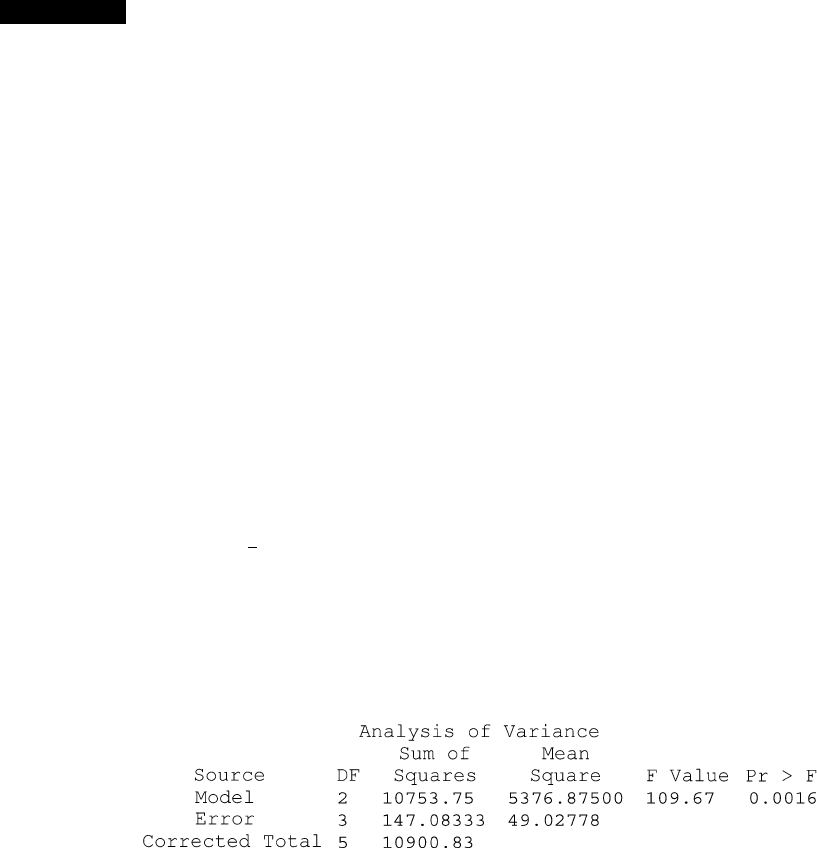
are often done through an analysis of variance table, as
copied in Figure 12.36 from SAS output.
The regression sum of squares is called the model sum of squares here. The mean
square is the sum of squares divided by the degrees of freedom, and the F value
is the ratio of mean squares. Because the P-value is less than .05, we reject the
null hypothesis (that both the engine size and fuel population coefficients are 0) at
the .05 leve l. The coefficient of multiple determination is R
2
¼ SSR/SST ¼
10,753.75/ 10,900.83 ¼ .9865. We say that the two predictors account for
98.65% of the variance of horsepower because the error sum of squares is reduced
by 98.65% compared to the total sum of squares.
■
Figure 12.36 Analysis of variance table from SAS
710
CHAPTER 12 Regression and Correlation

Covariance Matrices
In order to develop hypothesis tests and confidence intervals for the regression
coefficients, the standard deviations of the estimated coefficients are needed. These
can be obtained from a certain covariance matrix, a matrix with the variances on
the diagonal and the covariances in the off-diagonal eleme nts. If U is a column
vector of random variables U
1
, ..., U
n
with means m
1
¼ E(U
1
), ..., m
n
¼ E(U
n
), let
m be the vector of these n means and define
CovðUÞ¼
CovðU
1
;U
1
Þ CovðU
1
;U
n
Þ
.
.
.
.
.
.
.
.
.
CovðU
n
;U
1
Þ CovðU
n
;U
n
Þ
2
6
6
6
4
3
7
7
7
5
¼
E½ðU
1
m
1
ÞðU
1
m
1
Þ E½ðU
1
m
1
ÞðU
n
m
n
Þ
.
.
.
.
.
.
.
.
.
E½ðU
n
m
n
ÞðU
1
m
1
Þ E½ðU
n
m
n
ÞðU
n
m
n
Þ
2
6
6
6
4
3
7
7
7
5
¼ E
U
1
m
1
.
.
.
U
n
m
n
2
6
6
6
4
3
7
7
7
5
U
1
m
1
; ; U
n
m
n
½
8
>
>
>
<
>
>
>
:
9
>
>
>
=
>
>
>
;
¼Ef½U m½U m
0
g
ð12:23Þ
When n ¼ 1 this reduces to just the ordinary variance. The key to finding the
needed covariance matrix is this proposition:
PROPOSITION
If A is a matrix with constant entries and V ¼ AU, then Cov(V) ¼ ACov(U)A
0
.
Proof By the linearity of the expectation operator, E(V) ¼ E(AU) ¼ AE(U).
Then
CovðVÞ¼ E AU E AUðÞ½AU E AUðÞ
0
g¼EfA½U EðUÞðA½U EðUÞ½Þ
0
¼ E AU EðUÞ½U EðUÞ½
0
A
0
¼ AE U EðUÞ½U EðUÞ½
0
A
0
¼ ACovðUÞA
0
■
Let’s apply the proposition to find the covariance matrix of
^
b. Because
^
b ¼½X
0
X
1
X
0
Y, we use A ¼½X
0
X
1
X
0
and U ¼ Y. The transpose of A is
A
0
¼f½X
0
X
1
X
0
g
0
¼ X½X
0
X
1
. The covariance matrix of Y is just the variance
s
2
times the n-dimensional identity matrix, that is, s
2
I, because the observations are
independent and all have the same variance s
2
. Then the proposition says
Covð
^
bÞ¼ACovðYÞA
0
¼½X
0
X
1
X
0
½s
2
IX½X
0
X
1
¼ s
2
½X
0
X
1
ð12:24Þ
12.8 Regression with Matrices 711

We also need to find the expected value of
^
b,
Eð
^
bÞ¼Eð½X
0
X
1
X
0
YÞ¼½X
0
X
1
X
0
EðY Þ
¼½X
0
X
1
X
0
EðXb þ eÞ¼½X
0
X
1
X
0
Xb ¼ b
That is,
^
b is an unbiased estimator of b (for each i,
^
b
i
is unbiased for estimating b
i
).
Write the inverse matrix as ½X
0
X
1
¼ C ¼½c
ij
. In particular, let
c
00
; c
11
; ...; c
kk
be the diagonal elements of this inverse matrix. Then
Vð
^
b
j
Þ¼s
2
c
jj
. Also,
^
b
j
is a linear combination of Y
1
, ..., Y
n
, which are independent
normal, so ð
^
b
j
b
j
Þ=ðs
ffiffiffiffiffi
c
jj
p
ÞNð0; 1Þ It follows that (this requires the indepen-
dence of S and the estimated regression coefficients, which we will not prove)
ð
^
b
j
b
j
Þ=ðS
ffiffiffiffiffi
c
jj
p
Þt
nðkþ1Þ
. This leads to the confidence interval and hypothesis
test for coefficients of Section 12.7.
The 95% confidence interv al for b
j
is
^
b
j
t
:025;nðkþ1Þ
s
ffiffiffiffiffi
c
jj
p
: ð12:25Þ
We can test the hypothesis H
0
: b
j
¼ b
j0
using the t ratio
T ¼
^
b
j
b
j0
S
ffiffiffiffiffi
c
jj
p
t
nðkþ1Þ
Statistical software packages usually provide output for testing H
0
b
j
¼ 0 against
the two-sided alternative H
a
: b
j
6¼ 0. In particular, we would reject H
0
in favor of
H
a
at the 5% level if |t| exceeds t
.025,n(k+1)
. Usually, with computer output there is
no need to use statistical tables for hypothesis tests because P-values for these tests
are included.
Example 12.34
(Example 12.33
continued)
For the engine horsepower scenario we found that s ¼ 7.002,
^
b
0
¼61:417,
^
b
1
¼ 95:5,
^
b
2
¼ 33 and [X
0
X]
1
has elements c
00
¼ 79/12, c
11
¼ 1, c
22
¼ 2/3.
Therefore, we get these 95% confidence intervals:
^
b
1
t
:025;6ð2þ1Þ
s
ffiffiffiffiffiffi
c
11
p
¼95:5 3:182ð7:002Þ
ffiffiffi
1
p
¼95:50 22:28 ¼½73:22 ; 117:78
^
b
2
t
:025;6ð2þ1Þ
s
ffiffiffiffiffiffi
c
22
p
¼33 3:182ð7 :002Þ
ffiffiffiffiffiffiffiffi
2=3
p
¼33 18:19 ¼½14:81; 51:19
We can also do the individual t tests for the coefficients:
^
b
1
0
s
ffiffiffiffiffiffi
c
11
p
¼
95:5 0
7:002
ffiffiffi
1
p
¼ 13:64; two-tailed P-value ¼ : 0009
^
b
2
0
s
ffiffiffiffiffiffi
c
22
p
¼
33 0
7:002
ffiffiffiffiffiffiffiffi
2=3
p
¼ 5:77; two-tailed P-value ¼ :0103
Both of these exceed t
.025,621
¼ 3.182 in absolute value (and their P-values are
less than .05), so for both of them we reject at the 5% level the null hypothesis that
the coefficient is 0, in favor of the two-sided alternative. These conclusions are
consistent with the fact that the corresponding confidence intervals do not include
zero. Also, recall that the F test rejected at the 5% level the null hypothesis that both
coefficients are zero . As our intuition suggests, horsepower increases with engine
size and horsepower is higher when the engine requires premium fuel.
■
712 CHAPTER 12 Regression and Correlation

The Hat Matrix
The foregoing proposition can be used to find estimated standard deviations for
predicted values and residua ls. Recall that the vector of predicted values can be
obtained by multiplying the hat matrix H times the Y vector, HY ¼
^
Y. First, in
order to apply the proposition, let’s obtain the transpose of H. With the help of the
rules (AB)
0
¼ B
0
A
0
and (A
1
)
0
¼ (A
0
)
1
, we find that H is symmetric, H
0
¼ H:
H
0
¼ XX
0
X½
1
X
0
no
0
¼ X
0
ðÞ
0
f X
0
X½
1
g
0
X
0
¼ XX
0
X½
0
1
X
0
¼ XX
0
X½
1
X
0
¼ H:
Therefore,
Covð
^
YÞ¼HCovðYÞH
0
¼ X½X
0
X
1
X
0
½s
2
IX½X
0
X
1
X
0
¼ s
2
X½X
0
X
1
X
0
¼ s
2
H:
ð12:26Þ
A similar calculation shows that the covariance matrix of the residuals is
CovðY
^
YÞ¼s
2
ðI HÞð12:27Þ
Of cours e, the true variance s
2
is generally unknown, so the estimate s
2
¼ MSE is
used instead.
Example 12.35
(Example 12.34
continued)
Continue again with the horsepower example. If residuals and predicted values are
requested from SAS, then the output includes the information in Figure 12.37.
The column labeled “Std Error Mean Predict” has the estimated standard
deviations for the predicted values and it contains the square roots of the s
2
H matrix
diagonal elements. The column labeled “Std Error Residual” has the estimated
standard deviations for the residuals, and it contains the square roots of the diagonal
elements of s
2
(I H). The column labeled “Student Residual” is what we defined as
the standardized residual in Section 12.6. It is the ratio of the previous two col-
umns.
■
The hat matrix is also important as a measure of the influence of individual
observations. Because
^
y ¼ Hy,
^
y
i
¼ h
i1
y
1
þ h
i2
y
2
þþh
in
y
n
, and therefore
@
^
y
i
=@y
i
¼ h
ii
. That is, the partial derivative of
^
y
i
with respect to y
i
is the ith
diagonal element of the hat matrix. In other words, the ith diagonal element of H
measures the influence of the ith observation on its predicted value. The diagonal
Obs Residual
Student
Residual
1
132.0000 129.5833 5.3479 2.4167 4.520 0.535
2
167.0000 162.5833 5.3479 4.4167 4.520 0.977
3
170.0000 177.3333 4.0426 –7.3333 5.717 –1.283
4
204.0000 210.3333 4.0426 –6.3333 5.717 –1.108
5
230.0000 225.0833 5.3479 4.9167 4.520 1.088
6
260.0000 258.0833 5.3479 1.9167 4.520 0.424
Dep Var
Predicted
Value
StdError
Mean Predict
StdError
Residual
Figure 12.37 Predicted values and residuals from SAS
12.8 Regression with Matrices 713

elements of H are sometimes called the leverages to indicate their influence over
the regression. An observation with very high leverage will tend to pull the
regression toward it, and its residual will tend to be small. Of course, H depends
only on the values of the predictors, so the leverage measures only one aspect of
influence. If the influence of an observation is defined in terms of the effect on the
predicted values when the observation is omitted, then an influential observation is
one that has both large leverage and a large (in absolute valu e) residual.
Example 12.36 Stude nts in a statistics class measured their height, foot length, and wingspan
(measured fingertip to fingertip with hands outstretched) in inches. Leonardo da
Vinci was aware that the wingspan tends to be very nearly the same as height. Here
in Table 12.3 are the measurements for 16 students. The last column has the
leverages for the regr ession of wingspan on height and foot length.
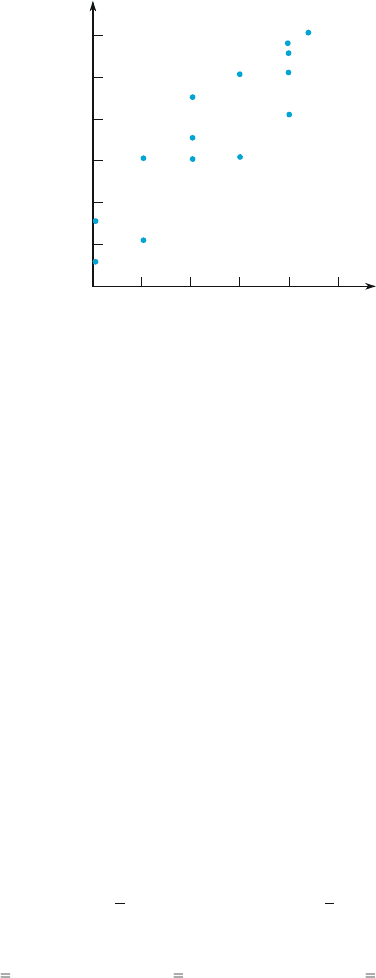
In Figure 12.38 we show the plot of height against foot length, along with the
leverage for each point. Notic e that the points at the extreme right and left of
the plot have high leverage, and the points near the center have low leverage.
However, it is interesting that the point with highest leverage is not at the extremes
of height or foot length. This is student number 7, with a 10-in. foot and height of
71 in., and the high leverage comes from the height being extreme relative to foot
length. Indeed, when there are several predictors, high leverage often occurs when
values of one predictor are extreme relative to the values of other predictors. For
example, if height and weight are predictors, then an overweight or underweight
subject would likely have high leverage.
Table 12.3 Height, foot length, and wingspan
Obs Height Foot Wingspan Leverage
1 63.0 9.0 62.0 0.239860
2 63.0 9.0 62.0 0.239860
3 65.0 9.0 64.0 0.228236
4 64.0 9.5 64.5 0.223625
5 68.0 9.5 67.0 0.196418
6 69.0 10.0 69.0 0.083676
7 71.0 10.0 70.0 0.262182
8 68.0 10.0 72.0 0.067207
9 68.0 10.5 70.0 0.187088
10 72.0 10.5 72.0 0.151959
11 73.0 11.0 73.0 0.143279
12 73.5 11.0 75.0 0.168719
13 70.0 11.0 71.0 0.245380
14 70.0 11.0 70.0 0.245380
15 72.0 11.0 76.0 0.128790
16 74.0 11.2 76.5 0.188340
714
CHAPTER 12 Regression and Correlation
In Figure 12.39 there is some useful output from MINITAB, including the
model utility test, the regression coefficients, and the correlations among the
variables. The correlation table shows all three correlations among the three vari-
ables along with their P-values. Clearly, the three variables are very strongl y
related. However, when wingspan is regressed on height and foot length, the
P-value for foot length is greater than .05, so we can consider eliminating foot
length from the regression equation. Does it make sense for foot length to be very
strongly related to wingspan, as measured by correlation, but for the foot length
term to be not statistically significant in the regression equation? The difference is
that the regression test is asking whether foot length is needed in addition to height.
Because the two predictors are themselves highly correlated, foot length is redun-
dant in the sense that it offers little prediction ability beyond what is contributed
by height.
Analysis of Variance
Source DF SS MS F P
Regression 2 294.79 147.40 67.33 0.000
Residual Error 13 28.46 2.19
Total 15 323.25
Predictor Coef SE Coef T P
Constant
6.085 8.018 0.76 0.461
height 0.8060 0.2305 3.50 0.004
foot 1.973 1.044 1.89 0.081
S
1.47956 R-Sq 91.2% R-Sq(adj) 89.8%
Correlations: height, foot, wingspan
height foot
foot 0.892
0.000
wingspan 0.942 0.911
0.000 0.000
Figure 12.39 Regression output for height, foot length, and wingspan ■
64
62
74
68
66
72
70
9.0 9.5 10.0 10.5 11.0 11.5
Height
Foot length
0.08
0.07
0.22
0.26
0.15
0.25
0.13
0.23
0.24
0.14
0.19
0.17
0.20
0.19
Figure 12.38 Plot of height and foot length showing leverage
12.8 Regression with Matrices 715

Exercises Section 12.8 (91–104)
91. Fit the model Y ¼ b
0
þ b
1
x
1
þ b
2
x
2
þ e to the
data
x
1
x
2
y
1 11
111
1 10
114
a. Determine X and y and express the normal
equations in terms of matrices.
b. Determine the
^
b vector, which contains the
estimates for the three coefficients in the
model.
c. Determine
^
y, the predictions for the four
observations, and also the four residuals.
Find SSE by summing the four squared resi-
duals. Use this to get the estimated variance
MSE.
d. Use the MSE and c
11
to get a 95% confidence
interval for b
1
.
e. Carry out a t test for the hypothesis H
0
:
b
1
¼ 0 against a two-tailed alternative, and
interpret the result.
f. Form the analysis of variance table and carry
out the F test for the hypothesis H
0
: b
1
¼ b
2
¼ 0. Find R
2
and interpret.
92. Consider the model Y ¼ b
0
þ b
1
x
1
þ e for the
data
x
1
y
.5 1
.5 2
.5 2
.5 3
.5 8
.5 9
.5 7
.5 8
a. Determine the X and y matrices and express
the normal equations in terms of matrices.
b. Determine the
^
b vector, which contains the
estimates for the two coefficients in the
model.
c. Determine
^
y, the predictions for the eight
observations, and also obtain the eight resi-
duals.
d. Find SSE by summing the eight squared resi-
duals. Use this to get the estimated variance
MSE.
e. Use the MSE and c
11
to get a 95% confidence
interval for b
1
.
f. Carry out a t test for the hypothesis H
0
: b
1
¼ 0
against a two-tailed alternative.
g. Carry out the F test for the hypothesis H
0
:
b
1
¼ 0. How is this related to part (f)?
93. Suppose that the model consists of just
Y ¼ b
0
þ e so k ¼ 0. Estimate b
0
from
[X
0
X]
1
X
0
y. Find simple expressions for s and
c
00
, and use them along with Equation (12.25)
to express simply the 95% confidence interval
for b
0
. Your result should be equivalent to the
one-sample t confidence interval in Section 8.3.
94. Suppose we have (x
1
, y
1
), ...,(x
n
, y
n
). Let k ¼ 1
and let x
i1
¼ x
i
x; i ¼ 1; ...; n, so our model
is y
i
¼ b
0
þ b
1
ðx
i
xÞþe
i
i ¼ 1; ...; n:
a. Obtain
^
b
0
and
^
b
1
from [X
0
X]
1
X
0
y.
b. Find c
00
and c
11
and use them to simplify the
confidence intervals [Equation (12.25)] for
b
0
and b
1
.
c. In terms of computing [X
0
X]
1
, why is it better
to have x
i1
¼ x
i
x rather than x
i1
¼ x
i
?
95. Suppose that we have Y
1
, ..., Y
m
~ N( m
1,
s
2
),
Y
m+1
, ..., Y
m+n
~ N( m
2
, s
2
), and all m + n obser-
vations are independent. These are the assump-
tions of the pooled t procedure in Section 10.2.
Let k ¼ 1, x
11
¼ .5, ..., x
m1
¼ .5, x
m+1,1
¼.5,
..., x
m+n,1
¼.5. For convenience in inverting
X
0
X assume m ¼ n.
a. Obtain
^
b
0
and
^
b
1
from [X
0
X]
1
X
0
y.
b. Find simple expressions for
^
y, SSE, s, c
11
.
c. Use parts (a) and (b) to find a simple expres-
sion for the 95% CI [Equation (12.25)] for b
1
.
Letting
y
1
be the mean of the first m observa-
tions and
y
2
be the mean of the next n obser-
vations, your result should be
^
b
1
t
:025;mþn2
s
ffiffiffiffiffiffiffiffiffiffiffi
1
m
þ
1
n
r
¼
y
1
y
2
t
:025;mþn2
ffiffiffiffiffiffiffiffiffiffiffiffiffiffiffiffiffiffiffiffiffiffiffiffiffiffiffiffiffiffiffiffiffiffiffiffiffiffiffiffiffiffiffiffiffiffiffiffiffiffiffiffiffiffiffiffiffiffiffi
P
m
i¼1
ðy
i
y
1
Þ
2
þ
P
mþn
i¼mþ1
ðy
i
y
2
Þ
2
m þn 2
v
u
u
u
t
ffiffiffiffiffiffiffiffiffiffiffi
1
m
þ
1
n
r
which is the pooled variance confidence inter-
val discussed in Section 9.2.
716 CHAPTER 12 Regression and Correlation

d. Let m ¼ 3 and n ¼ 3, with y
1
¼ 117,
y
2
¼ 119, y
3
¼ 127, y
4
¼ 129, y
5
¼ 138,
y
6
¼ 139. These are the prices in thousands
for three houses in Brookwood and then three
houses in Pleasant Hills. Apply parts (a), (b),
and (c) to this data set.
96. The constant term is not always needed in the
regression equation. For example, many physical
principles involve proportions, where no con-
stant term is needed. In general, if the dependent
variable should be 0 when the independent vari-
ables are 0, then the constant term is not needed.
Then it is preferable to omit b
0
and use the model
Y ¼ b
1
x
1
þ b
2
x
2
þþb
k
x
k
þ e. Here we
focus on the special case k ¼ 1.
a. Differentiate the appropriate sum of squares
to derive the one normal equation for estimat-
ing b
1
.
b. Express your normal equation in matrix
terms, X
0
Xb ¼ X
0
y, where X consists of one
column with the values of the predictor vari-
able.
c. Apply part (b) to the data of Example 12.32,
using hp for y and just engine size in X.
d. Explain why deletion of the constant term
might be appropriate for the data set in part (c).
e. By fitting a regression model with a constant
term added to the model of part (c), test the
hypothesis that the constant is not needed.
97. Assuming that the analysis of variance table is
available, show how the last three columns of
Figure 12.37 (the columns related to residuals)
can be obtained from the previous columns.
98. Given that the residuals are y
^
y ¼ðI HÞy,
show that CovðY
^
YÞ¼ I HðÞs
2
.
99. Use Equations (12.26) and (12.27) to show that
each of the leverages is between 0 and 1, and
therefore the variances of the predicted values
and residuals are between 0 and s
2
.
100. Consider the special case y ¼ b
0
þ b
1
x þ e,so
k ¼ 1 and X consists of a column of 1’s and a
column of the values x
1
, ..., x
n
of x.
a. Write the normal equations in matrix form,
and solve by inverting X
0
X.[Hint:ifad 6¼ bc,
then
ab
cd
1
¼
1
ad bc
d b
ca
Check your answers against those in Sec-
tion 12.2.]
b. Use the inverse of X
0
X to obtain expressions
for the variances of the coefficients, and
check your answers against the results given
in Sections 12.3 and 12.4 (
^
b
0
is the predicted
value corresponding to x* ¼ 0).
c. Compare the predictions from this model with
the predictions from the model of Exercise 94.
Comparing other aspects of the two models,
discuss similarities and differences. Mention,
in particular, the hat matrix, the predicted
values, and the residuals.
101. Continue Exercise 94.
a. Find the elements of the hat matrix and use
them to obtain the variance of the predicted
values. Noting the result of Exercise 100(c),
compare your result with the expression for
Vð
^
YÞ given in Section 12.4.
b. Using the diagonal elements of H, obtain the
variances of the residuals and compare with
the expression given in Section 12.6
c. Compare the variances of predicted values
for an x that is close to
x and an x that is far
from
x.
d. Compare the variances of residuals for an x
that is close to
x and an x that is far from x .
e. Give intuitive explanations for the results of
parts (c) and (d).
102. Carry out the details of the derivation for the
analysis of variance, Equation (12.20).
103. The measurements here are similar to those in
Example 12.36, except that here the students did
the measurements at home, and the results suf-
fered in accuracy. These are measurements from
a sample of ten students:
Wingspan Foot Height
74 13.0 75
56 8.5 66
65 10.0 69
66 9.5 66
62 9.0 54
69 11.0 72
75 12.0 75
66 9.0 63
66 9.0 66
63 8.5 63
a. Regress wingspan on the other two variables.
Carry out the test of model utility and the tests
for the two individual regression coefficients
of the predictors.
12.8 Regression with Matrices 717